




Abstract
Although there is broad consensus that more inclusive approaches are needed in climate adaptation planning, it is unclear how cities should redesign rules, institutions, and decision-making processes to produce more equitable forms of participation and engagement. This paper evaluates different planning procedures and institutional arrangements across twenty-five U.S. cities. Although arrangements are context-specific, institutional designs fall into three categories: consultative partnerships, strategic collaborations, and expansive co-governance arrangements. Each institutional design leads to different kinds of inclusion outcomes. Our results empiricize how cities can pursue more inclusive climate adaptation planning and highlight opportunities to advance and implement broader procedural equity goals.
Introduction
Many cities and local governments globally are beginning to pursue more social equity and justice-focused climate adaptation actions (Anguelovski and Carmin 2011; Cannon et al. 2023; Fitzgerald 2022; Woodruff et al. 2021). Researchers in this domain are responding to emerging critiques on the structural drivers of socioeconomic inequalities in cities. These inequalities are being magnified by climate change through the unequal experience of climate hazards and risks by historically marginalized and vulnerable communities (Brand and Miller 2020; Keith et al. 2023; Meerow and Newell 2019; Shi et al. 2016; Smith et al. 2022) and the focus of adaptation efforts on the well-being of wealthier communities, often omitting the needs of neighborhoods that are unable to afford climate resilience services and infrastructure (Anguelovski et al. 2016). Such critiques frame emerging theories on “climate urbanism,” which posit that cities and local governments are implementing climate actions that are fronts for the continued retainment of capital-extractive, speculative, and exclusionary forms of development (Castán Broto, Robin, and While 2020; Long and Rice 2019). Examples of “climate urbanism” include green housing developments that displace lower income communities (Hochstenbach and Musterd 2018) and protective infrastructure against climate impacts that rely on private investments (Rice 2014).
In response to these critiques, much attention focuses on distributive equity concerns in the context of climate change—including addressing unequal exposure to climate impacts, structural socioeconomic vulnerabilities, as well as the maldistribution of risk burdens. However, corresponding theorizations on the governance processes that underpin such forms of maldistribution—including the various institutional arrangements, decision-making procedures, and the actors, ideas, and power structures—remain comparatively abstract. To fill this gap, in this paper, we explore the institutional arrangements that may underpin efforts toward more socially inclusive and equitable planning action in cities. Drawing on the research on institutionalization (see Anguelovski and Carmin 2011) and “institutional work” (Beunen and Patterson 2019) in urban climate change governance, this paper focuses on underlying institutional processes and procedures—specifically the pathways of ideation, contestation, and institutionalization of climate adaptation plans—as core components and drivers of equitable climate planning action in cities.
Our research is based on an analysis of climate adaptation–related planning documents published between 2012 and 2020 from the twenty-five largest cities in the United States. We explore the shape and form of participatory approaches to climate adaptation planning, the ways in which local governments are operationalizing equitable planning principles on the ground. In addition to asking whether particular institutional arrangements lead to different procedural and participatory outcomes, we further examine how these various institutional arrangements can support efforts to tackle structural inequities. The United States is a unique case since—until February 2021 with the release of President Biden’s Executive Order 14008 on Tackling the Climate Crisis at Home and Abroad and the subsequent request for all Federal agencies to publish climate adaptation plans—the country lacked significant federal policy drivers for adaptation, so progressive action often originated from some states and localities (Shi and Moser 2021). Furthermore, research into local-level climate adaptation plans have yielded important insights on climate mitigation strategies (Bierbaum et al. 2013; Carlson and McCormick 2015; Hughes 2015; Shi, Chu, and Debats 2015; Stults and Woodruff 2017). Even more recent assessments have emerged assessing how local-level approaches are considering historic and structural forms of socioeconomic or political inequality in addition to scientific evidence on climate models, projections, and scenarios (Dodman et al. 2022).
Literature Review
Research on the institutionalization of urban climate governance, especially within varying objectives under climate mitigation, has continued to grow (Bierbaum et al. 2013; Fitzgerald 2022; Roy et al. 2024; Stults and Woodruff 2017); however, questions of how climate adaptation, risk reduction, and resilience building are institutionalized in local contexts have slowed in comparison. Scholars who study the impacts of extreme heat, sea level rise, wildfires, and drought, among other events, in urban contexts have consistently noted the importance of sympathetic policy, entrepreneurs, legal and regulatory opportunities, or public awareness of highly uncertain future risk scenarios (Ziervogel et al. 2017). Still, given the varied local experiences of climate impacts and different political, social, and ecological contexts on the ground, synthetic assessments of how climate adaptation ideas and priorities are integrated within city-level decision-making have proven to be challenging. Research into how institutions are redesigned, respond, or adapt to climate change either highlight the context dependency of particular processes (i.e., processes are unique and difficult to compare) or simply suggest that the politics of local institutional change is complicated. Barring several notable exceptions (e.g., Angelo et al. 2022; Beunen and Patterson 2019; Ford, Berrang-Ford, and Paterson 2011; Meerow and Newell 2019), the result is an abundance of site-specific, single case studies that explore how climate adaptation priorities are mainstreamed into particular cities. These case studies lack corresponding theoretically robust analyses of how institutionalization processes can be compared, learned, or scaled-up across contexts.
As assessments of how climate adaptation actions are institutionalized in cities—especially in relation to their institutional structures and arrangements—are difficult to achieve, scholars have focused on more normative critiques of these institutional arrangements through the lenses of power differences, structural inequality, and social exclusion and marginality (e.g., Fitzgerald 2022). Drawing on recent literature in urban political ecology, researchers increasingly point to the underlying political economic structures that explain individual cases of inequality within cities and broader patterns of exclusion and inequity in how climate adaptation efforts are planned and implemented in cities to support global flows of speculative and extractive capital (Anguelovski et al. 2016, Anguelovski, Irazábal-Zurita, and Connolly 2019; Egge and Ajibade 2023; Goh, 2020, 2021). The literature on “climate urbanism” perfectly encapsulates this conceptual pivot and refocusing of attention on how climate change entrenches the maldistribution of resources and capacities that is a function of modern extractive capitalism; how climate change reignites structural socioeconomic inequalities that fall along racial, class, and gender lines; and how historically disadvantaged communities continue to be unrecognized and ignored in decision-making processes (Castán Broto, Robin, and While 2020; Long and Rice 2019). Such lack of meaningful inclusion is especially detrimental to indigenous groups, racial minorities, gender and sexual minorities, youth, people with disabilities, and communities experiencing intergenerational poverty (see Amorim-Maia et al. 2022).
Climate urbanism provides a robust platform upon which to critique the continued maldistribution of resources and nonrecognition of historically marginalized voices in climate adaptation planning efforts (Ajibade et al. 2022; Amorim-Maia et al. 2023; Bellinson and Chu 2019; Castán Broto, Westman, and Huang 2023; Shi and Moser 2021; Ziervogel and Morgan 2023). All of these authors forcefully critique the managerial and technocratic approaches taken by many urban climate adaptation plans, which often overemphasize regulatory, financial, and engineered interventions while marginalizing historic social, cultural, and economic inequalities that reproduce unequal adaptive capacity in the first place (Meerow and Newell 2019; Shi et al. 2016).
Such normative critiques, although relatively straightforward as a way to identify ongoing urban planning efforts around climate adaptation and resilience, lack a corresponding constructive dimension. At best, recent analyses on “negotiated resilience” have highlighted the complex political relationships and arrangements involved when climate ideas and policies are contested by and between powerful social groups that have different interests, values, and biases (Harris, Chu, and Ziervogel 2018; Ziervogel and Morgan 2023). Examples of this can be found in case studies of Berkeley, California (Bellinson and Chu 2019), Toronto, Canada (Fitzgibbons and Mitchell 2021), among others. Despite these insights, policymakers and practitioners are often offered an ability to diagnose inequalities and injustices that their planning processes seem to be replicating or entrenching but are left without an awareness of the potential opportunities to facilitate change.
A primary conceptual objective of this paper is to connect emerging critical theories of climate urbanism as they relate to climate adaptation to the literature on equity planning, especially in terms of how policymaking and planning institutions can be redesigned to further procedural equity and justice. Having equitable and inclusive planning processes, especially ones that recognize and actively include historically marginalized voices, is a fundamental ingredient for addressing equity implications of ongoing climate adaptation efforts (Chu 2016; Lieberknecht et al. 2024). We, therefore, build on established insights of equity planning (see Krumholtz 1986; Zapata and Bates 2015), how these approaches can be assessed in view of more contemporary climate adaptation efforts (Chu and Cannon 2021), as well as the longstanding constructive critiques of participatory efforts (Arnstein 1969; Forester 1982; Innes and Booher 2004). We do this to understand the types of institutional arrangements that cities in the United States use to frame, communicate, and deliver procedural equity in climate adaptation planning. Specifically, we create different categories to outline what these inclusive practices look like on the ground. We combine these established and more applied theories of equity planning with earlier concepts of institutionalization and urban climate governance, like those we have described at the beginning of this section (Anguelovski et al. 2016; Cannon et al. 2023; Chu 2016; Fitzgibbons and Mitchell 2021).
Our call to renew institutional thinking in urban climate adaptation planning addresses several notable gaps in scholarship. For one, we seek to build on emerging critical scholarship on the maldistribution of adaptation services and infrastructure by assessing the ideas, participatory processes, and planning arrangements that are meant to further procedural equity and inclusion in the first place. Second, we bring forward established queries on institutionalization in urban climate governance by applying more contemporary investigations on “institutional work,” which speaks to the cumulative effects of action and rules undertaken by multiple actors and its communicative and discursive dimensions (Beunen and Patterson 2019) and orienting that in climate adaptation theory and practice. Third, we further ideas on how urban institutions can be redesigned—especially according to normative criteria on inclusion (see Chu and Cannon 2021, for instance)—to further equitable adaptation planning. We build on ongoing work on “negotiated resilience” (Harris, Chu, and Ziervogel 2018) and apply a more structural institutional lens to understand how new rules, norms, and procedures can be designed to better account for sources of power asymmetry, further inclusion of diverse voices, and enable broad engagement with historically marginalized communities.
Data and Methods
This study examines climate adaptation plans published between 2012 and 2020 for the twenty-five largest cities in the United States by population size, as detailed in the 2020 U.S. Census, for which plans were publicly available (see Table 1). To locate city-level adaptation planning documents, we conducted an online search, finding relevant planning documents for each city on three types of websites: (1) the Adaptation Clearinghouse (https://www.adaptationclearinghouse.org/), an online portal that provides resources for various stakeholders to help communities adapt to climate change; (2) individual city or municipal government websites; and (3) the specific offices of sustainability or environmental protection (if available) website for a given city. Following similar approaches as others (Angelo et al. 2022; Chu and Cannon 2021; Reckien et al. 2018), we focused only on stand-alone documents produced by a given city to narrow the research scope for in-depth analysis. If there were multiple climate adaptation–related planning documents for a city, we selected the most recent document available or the plan that most readily and apparently addressed climate adaptation priorities and strategies.
List of Cities and Their Planning Documents Included in This Study.
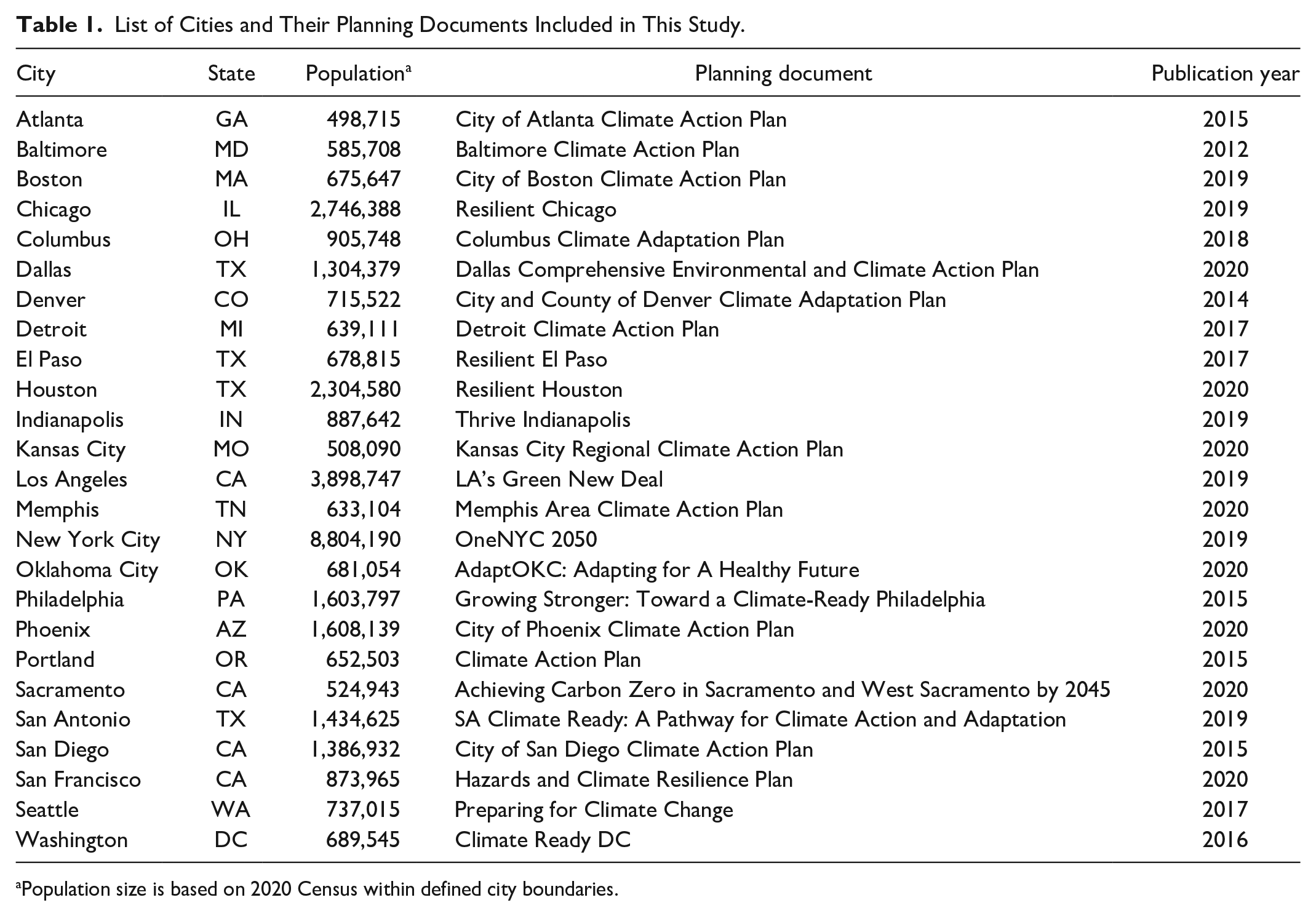
Population size is based on 2020 Census within defined city boundaries.
Individual planning documents were analyzed using Atlas.ti to identify the trends of climate action undertaken by cities and how these actions link to procedural equity outcomes. To do this, we analyzed plans using diverse keyword searches to inductively assess planning documents using a coding protocol developed from concurrent research investigating equity, inclusion, and justice criteria for decision-making on climate adaptation in the ten largest U.S. cities (Chu and Cannon 2021). Search terms included the following keywords: “equit,” “vulnerab,” “equa,” “frontline,” “marginal,” “elderly,” “underserved,” “disadvantaged,” “minority,” “low-income,” “histor,” “engage,” “participat,” “outreach,” “workshop,” “process,” “participation,” “accountability,” “inclusi,” “just,” and “reconciliation.” Sentences and their context were analyzed for their meaning and were subsequently coded as relevant for an understanding of overall inclusive decision-making processes and procedural equity outcomes.
Interrater reliability of coding was achieved by two authors analyzing each plan and discussion of analysis and findings in team research meetings (Creswell and Creswell 2017). After inductive coding, plans were analyzed deductively by one author and checked by another author to identify climate action trends across cities and their linkages with procedural equity outcomes. The goal was to evaluate different planning procedures and institutional arrangements across the twenty-five cities identified in Table 1. More specifically, our analysis explored the shape and form of participatory approaches to climate adaptation planning, the ways in which local governments are operationalizing equitable planning principles on the ground, and how decision-makers learn, develop, and deploy procedurally equitable planning processes. In addition to asking whether particular institutional arrangements lead to different procedural and participatory outcomes, we further examine how these various institutional arrangements support (or not) differing extents and depths of focus on tackling structural inequities. It is necessary to note that plans are aspirational and our analysis does not yield insights into planning implementation, which remains an important gap in research. Analyzing plans can help us to better understand the strategies employed in the planning and decision-making processes. In the following sections, we present the results of the coding analysis with a focus on unpacking the various approaches that enable procedural equity and institutionalize different participatory institutional designs in climate adaptation planning across U.S. cities.
Multiple Institutional Designs in Cities
Our analysis found that cities are increasingly deploying different institutional strategies to address socioeconomic injustices that are being entrenched or exacerbated by climate change. There is common understanding on the need for more inclusive and representative decision-making processes. Across all twenty-five cities, we see the emergence of different arrangements that seek broader inclusion of key stakeholder voices such as from socially vulnerable residents and historically overburdened communities, and are spearheaded by strong leadership, typically from the Mayor’s office or offices of sustainability or resilience. Although there are some common approaches to conducting public outreach, engagement, and participation as part of their climate adaptation planning efforts, there appears to be no consensus on how cities can (or should) redesign rules, institutions, and decision-making processes to lay the groundwork for operationalizing (re)distributive outcomes. Although procedural equity does not always lead to distributive equity, increased procedural equity may have downstream positive effects for reducing different forms of inequity (e.g., distributive, recognitional). Leveraging equity planning research, with a focus on participatory approaches to inform our approach (Arnstein 1969; Chu and Cannon 2021; Forester 1982; Innes and Booher 2004), our analysis showed that institutional designs broadly fall into three archetypes—consultative partnerships, strategic collaborations, and expansive co-governance arrangements. Figure 1 illustrates these three archetypes.
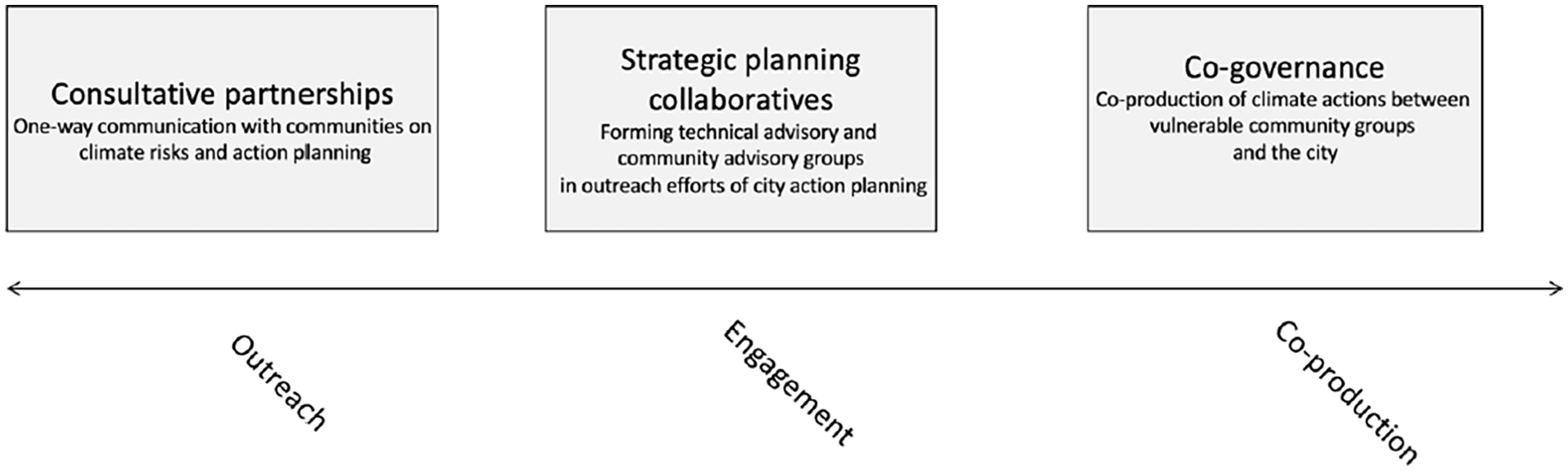
Illustration of the three archetypes of institutional arrangements cities use to foster participation and inclusion in climate adaptation planning.
In the sections below, we elaborate on the three institutional archetypes that cities have designed to enable more inclusive climate adaptation planning. We also provide illustrative examples from the surveyed plans of each archetype. Building on insights garnered from the literature reviewed above, we find that each institutional design leads to different inclusive outcomes, with differing extent and depth of focus on tackling structural inequities, and in doing so highlight the opportunity space for cities to advance broader procedural equity in climate adaptation planning.
Consultative Partnerships
Cities in the United States are increasingly working across municipal departments—especially public health, emergency management, environmental protection, housing, human health services, and so on—to inform and develop their climate adaptation plans. These partnerships include those within, as well as with actors beyond, the local government itself. One main category of efforts that cities tend to pursue to further procedural equity and inclusion is through straightforward, often episodic, consultative communication channels between municipal departments, relevant agencies, and community-level stakeholders. Such consultation arrangements are characterized by their focus on soliciting input and bringing together members from different city departments to confront the multidimensional challenges posed by climate change. These partnerships often also include notable community organizations, citizens groups, or scientific experts to facilitate communication and awareness across bureaucratic and professional silos (examples highlighted below).
We see numerous examples of expert-led one-way communication and knowledge dissemination efforts within municipal departments and with the public on the risks posed by climate change (i.e., Oklahoma City, Denver, Boston, Columbus, Memphis, Kansas City, San Francisco, and New York City). Many of these efforts attempt to bring together diverse interests and voices into decision-making, with a focus on including those working outside of domains traditionally thought of as climate-related, such as housing, education, transportation, and public health. For instance, Oklahoma City held focus groups with members from different city departments, while Denver surveyed city departments and business owners to develop their adaptation plan. Boston emphasized strengthening partnerships between municipal agencies, such as the Boston Public Health Department and the Department of Neighborhood Development, to try to ensure equitable outcomes from transportation investments.
Many cities also place emphasis on broad communication and education efforts with the public, especially in terms of raising awareness of climate impacts and potential risks to communities, health, and livelihoods. For example, Columbus pursued educational campaigns on best practices for being outside in extreme heat, while Memphis launched a campaign in which well-known Memphians communicated the importance of climate adaptation, encouraging both behavioral changes and public support for implementing planning actions. San Francisco has plans to develop a public outreach campaign to raise awareness and educate citizens regarding different climate risks (such as fire and tsunami). The city is setting up processes to ensure critical information regarding climate hazards are accessible to vulnerable communities, particularly those in low-income, homeless, or immigrant communities. Similarly, Columbus is developing educational campaigns across a range of media (print, TV, radio) regarding best practices for coping with extreme heat, making residents aware of renewable energy resources, and how to reduce water use.
Communication and education efforts can also target specific historically disadvantaged, vulnerable, or overburdened communities to connect them to city adaptation actions. For example, New York City supports creative approaches to educate and engage New Yorkers about climate change and the importance of climate action. The plan addresses the importance of public art campaigns and activism—particularly youth-led climate activism—in giving people a voice and bringing New Yorkers into the climate conversation. Kansas City outreached with low-income communities to increase food access programs, while Memphis pursued a waste reduction education campaign. These examples highlight how cities are employing different risk-based communication strategies to make residents aware of climate impact and of the services cities are providing to address such impacts.
Consultative partnerships are characterized by general communication pathways that facilitate knowledge transfer and awareness building, although these pathways tend to be episodic, consultative, and involve agencies and community partners who are frequently already aware of climate risks and the need to adapt to climate impacts. Most consultative partnerships were informal, although we increasingly see more structured bidirectional partnerships between municipal actors, with many planning documents listing specific agencies, organizations, or community groups as partners (see “Strategic Planning Collaboratives” section below). The institutional designs described here represent an important step in ensuring city departments are aware of and contributing to city efforts to connect residents, particularly from vulnerable populations, to ongoing city services and planning efforts. However, these partnerships often lack specificity or substantive interaction, and so they tend not to foster deep connections, learning, or co-production of knowledge.
Strategic Planning Collaboratives
A second form of institutional arrangement that we found was one in which cities worked across city departments, county agencies, and community partners—such as residents who represented neighborhoods, schools, and community groups—in more interactive but also specialized, intensive, and strategic ways (i.e., Atlanta, Baltimore, San Antonio, Sacramento, Boston, Chicago, Dallas, Houston). Strategic planning collaboratives are characterized by bringing together different stakeholders into institutional arrangements to foster community engagement. This institutional arena allows for multidirectional communication between the city and local, neighborhood-level actors.
These kinds of strategic planning collaboratives take several different forms, and they typically involve a combination of citizen advisory groups and technical steering committees. For example, Atlanta initiated a public engagement effort with local schools, neighborhoods, government agencies, businesses, and community organizations, as well as led workshops with academics and businesses to identify and address climate adaptation problems and actions including reducing greenhouse gas emissions through transportation and energy efficiency initiatives, such as through regional planning and infrastructure improvements and building retrofits. Baltimore developed a sustainability advisory committee, composed of resident, local, and state agency representatives. This committee held topical town halls to affirm the pressing adaptation issues, including the need for tree planting, energy efficiency, and pedestrian and bicycle infrastructure improvements. Rather than being general communication arenas (i.e., those described as consultative partnerships above), these committees’ primary functions include steering the conversation and direction of climate action with the municipal jurisdiction, assisting with resourcing and identifying capacities required for planning and decision-making, as well as further garnering support for the climate action agenda across groups that historically participated less in planning efforts.
We see numerous examples of technical advisory or steering committees across the United States. For instance, San Antonio created a Technical and Community Advisory Committee to advise city staff and provide input on implementing adaptation goals as well as identify adaptation-mitigation co-benefits (such as reduce carbon intensity of energy supply, zero net energy building code, reduce vehicle travel miles by diversifying transportation options). The city also established a Climate Equity Advisory Committee, made up of representatives from community-based organizations and other key stakeholders representing the interests of low-income populations, communities of color, and other vulnerable populations. This committee’s objective is to provide input on the implementation of the Climate Action and Adaptation Plan to ensure an equity-centered approach. Elsewhere, Sacramento established an Equity Technical Advisory Committee and published a set of equity principles and strategies to evaluate every program and policy through an equity lens. For example, this group recommended that Sacramento prioritize resource allocation to marginalized communities, invest in equity education for city personnel, assess racial and socioeconomic impacts of climate action policies, as well as authentically and inclusively involve marginalized communities, and expand the capacity of community organizations in these communities.
Some cities highlight the diversity of stakeholders involved and the number and type of outreach and engagement efforts made to promote equitable decision-making processes. One notable example is Boston, which created a working group of such stakeholders and used an inclusive engagement approach to ensure positive outcomes for city residents. Over seventy organizations participated in the working group. Stakeholders of the working group included community groups, environmental justice and environmental advocacy groups, labor unions, student associations, developers, real estate and architecture associations, green construction companies, transportation service providers, regional agencies, neighboring municipalities, faith-based organizations, academic and cultural institutions, and more.
Such interactive processes entail working with stakeholders to communicate, learn, and mobilize for different kinds of action, often focusing on vulnerable populations as important targets for adaptation planning. For instance, to understand the city’s strengths, climate threats, and challenges, Chicago embarked on a series of agenda-setting workshops with one hundred civic and community leaders, an online survey that garnered over 450 responses, in-person meetings, workshops, and panels with over 675 participants and 130 organizations represented. Similarly, San Antonio hosted more than three hundred events, reached over eleven thousand residents, and collected over three thousand feedback responses on the draft plan. Elsewhere, Dallas ensured that outreach campaigns and materials were available in multiple languages and were culturally appropriate. Dallas held over 180 individual meetings with community groups, two surveys, campaigns on multiple social media platforms, and launched a website with the intent to share public information and be transparent. Staff in Dallas met one-on-one with over six thousand people, attained over nine thousand individual comments and suggestions from every zip code in Dallas, and convened two stakeholder groups to advise the city on outreach, vision, goals and objectives, and actions for the plan. Also in Texas, Houston invested in a culturally competent approach, prioritizing grassroots organizations deeply rooted in immigrant communities and including them in funding and planning efforts. Around one hundred Working Group members representing community organizations, academic institutions, philanthropy, business organizations, professional associations, and government developed more than one hundred recommendations for the city’s plan.
An outcome of these strategic planning committees and groups is the ability to deliberate on particular forms of climate risk and their implications for specific sectors or sections of society. We see numerous such efforts focus on the nexus of climate change and health care services in lower income communities. For instance, to confront the dangerous health impacts from increased temperatures for residents with lower access to air conditioners, cities including Columbus, Phoenix, Philadelphia, and Washington DC are expanding cooling centers especially in low-income communities. Similarly, Indianapolis identified the importance of communicating health risks from climate impacts, including climate-related illnesses. Such strategic efforts target the awareness gap of residents and aim to mobilize citizen engagement and participation. By enabling broader awareness and uptake of the programs, services, and infrastructure that already exist, cities are attempting through these strategic collaboratives to leverage their resources to assist vulnerable residents in adapting to climate impacts.
Co-Governance
The third common institutional type that we see in cities is different approaches to co-governance, in which residents from frontline communities and vulnerable groups co-produce climate action planning (i.e., Detroit, Kansas City, Sacramento, Seattle, Houston, Dallas, Boston, Columbus). Co-governance generates civic mobilization by connecting climate change science to differential vulnerabilities, focusing on residents from certain sociodemographic backgrounds who are both more exposed to harmful impacts and often lack resources and capacity to address these impacts. For instance, Detroit developed a resident-led effort called the Climate Ambassadors Program. The Ambassadors lead community days in their neighborhoods to discuss and inform residents of climate-related risks, services, and programs the city offers to help residents cope with such impacts, such as raising awareness on climate-related health effects and responses and assess health impacts from land-use decisions (e.g., urban heat islands, stormwater management). Similarly, Kansas City hosts Climate Conversations that include videos created by city residents on different topics and priorities such as food, air quality, and infrastructure to serve as a reference for various local groups discussing climate actions. Another promising example was found in Sacramento, which established an Environmental Justice Collaborative Governance Committee to provide bidirectional communication pathways for marginalized communities, communities of color, and local youth in developing and shaping solutions to climate-related problems.
In Seattle, the city emphasized empowering frontline communities as leaders in the planning process, requiring that municipal authorities work to rebuild trust in government that has steadily eroded due to systemic racism and classism. The Planning for Climate Change plan highlights engaging the community as partners in determining which strategies to pursue. Moreover, Seattle’s Environmental Action Agenda aims to advance equity and environmental justice and increase capacity for those most affected by environmental issues to lead in the development and implementation of climate solutions. Similarly, Houston acknowledges that historically the city has not engaged environmental justice communities in land-use planning processes and decisions, resulting in overall environmental degradation in and around communities of color and low-income neighborhoods. As one of the environmental justice strategies, the city plans to establish a multidirectional engagement structure to incorporate community voices into future neighborhood planning and land-use decisions, especially related to hazard-producing use. Similarly, Dallas through their extensive outreach and engagement is working with vulnerable populations to address barriers due to income, language access, education, and age in accessing financial and technical assistance programs.
Finally, some cities focus on integrating creative approaches such as art or youth-led activism to engage citizens in climate conversations. For instance, Boston assembled a street team of Boston youth and residents, engaged residents and commuters throughout Boston, and learned about their climate action priorities, challenges, and needs. More than ten community-based organizations supported the Street Team by recruiting participants and distributing information and surveys to their membership. Residents—including youth and those fluent in Spanish, Haitian Creole, Mandarin Chinese, and other languages—were trained and participated in this effort. This team attended nineteen community events and engaged over 1,400 residents and commuters, collecting more than seven hundred survey responses and conducting sixteen interviews with small businesses, fourteen of which were minority- and/or women-owned. The Street Team engaged communities whose voices are often underrepresented in climate action planning by taking climate action engagement into Boston’s neighborhoods.
A notable aspect of co-governance approaches is through interactive, multidirectional, intensive, community-led, and broadly inclusive processes to assess and evaluate local climate impacts and adaptation needs. For instance, to support historically vulnerable groups as co-creating partners in adaptation planning, numerous cities, including Columbus, Indianapolis, and Oklahoma City, are using community-generated tools and civic scientific data (i.e., locally ground-truthed social vulnerability indices) to help assess local or regional exposure to climate impacts, particularly extreme heat, flooding, and air quality, and social vulnerability. In addition, Columbus is making a directory of civic leaders, particularly from marginalized and underserved communities, to continue engaging with local officials and businesses. Another notable example is found in San Antonio, where key stakeholders will use the Climate Equity Screening Tool—a checklist assessing themes of access and accessibility, affordability, cultural preservation, and health safety and security across different programs—to evaluate an adaptation strategy before implementation. This approach is intended to leverage the different experiences and perspectives of city residents whose lives will be most impacted by climate change to guide decision-making around climate action and adaptation.
Implications for Participatory Approaches to Equity Planning
Building on prior research (e.g., Angelo et al. 2022; Beunen and Patterson 2019; Meerow and Newell 2019; Patterson 2021), our research yields novel insights into how climate adaptation priorities are integrated or “mainstreamed” (Bae and Feiock 2012, 2013) in U.S. cities, especially within their respective decision-making and governance arrangements. Examining multiple U.S. cities offers a theoretically robust analysis of how institutionalization processes can be compared, learned, or scaled-up across contexts. From the analysis presented above, we see that cities have attempted to design—in varying degrees—different types of institutional arenas to include and connect with frontline, overburdened, and historically disadvantaged communities. Orienting more contemporary investigations on institutional work—defined as the cumulative effects of action and rules undertaken by multiple actors and its communicative and discursive dimensions (Beunen and Patterson 2019)—to climate adaptation theory and practice, we identify the typologies of institutional design at play in U.S. cities’ efforts. For the most part, these arenas require building arrangements to enable collaboration as well as forming strategic relationships across different agencies, community groups, and scientific and technical experts.
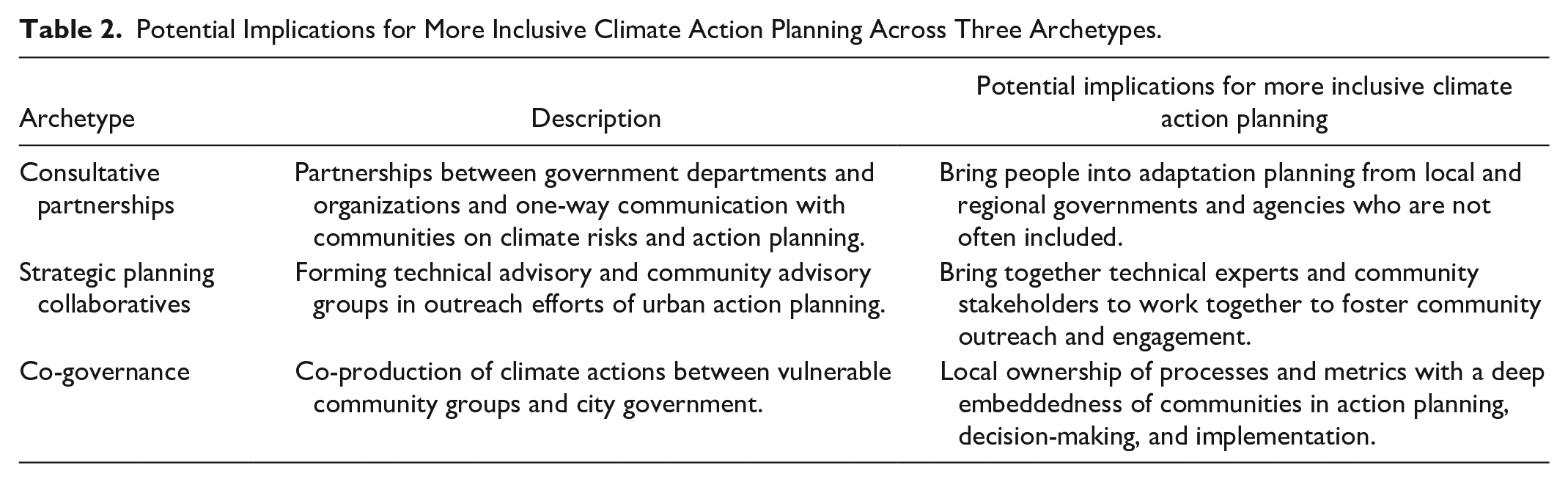
Our analysis highlights a continuum of efforts that span from consultative partnerships and strategic planning collaboratives to co-production and co-governance of climate adaptation plans and actions. Figure 1 illustrates this continuum and Table 2 presents the kinds of institutional arrangements with example social equity outcomes. We also find that a majority of these institutional arrangements broadly focus on consultative partnerships rather than on co-created decision-making approaches. In particular, plans typify participatory approaches in equity planning (e.g., Arnstein 1969; Forester 1982; Innes and Booher 2004) through mostly outreach and engagement, such as through public educational campaigns (see Columbus; Denver); however, exceptions include climate advisory and/or stakeholder committees (i.e., Baltimore), community roundtables (i.e., El Paso), and community workshops and planning meetings (i.e., Boston, Atlanta, Washington DC). Our results subsequently showcase potential institutional arenas of inclusion to facilitate procedural equity of residents and frontline communities to varying degrees and extents.
Potential Implications for More Inclusive Climate Action Planning Across Three Archetypes.
As we have demonstrated, co-governance is an institutional arrangement that is best suited to address climate equity concerns. The unequal experience of inequalities by historically marginalized and vulnerable communities that are being magnified by climate change (Brand and Miller 2020; Meerow and Newell 2019; Shi et al. 2016; Smith et al. 2022) makes approaches that advance climate equity in adaptation imperative for cities to undertake.
Co-governance approaches provide us the tools to innovatively address these persistent inequities in climate adaptation planning and a roadmap for redesigning institutional arrangements to further procedural equity and justice. Co-governance frameworks are able to do this because it allows for the meaningful partnership of residents with city decision-makers to co-create adaptation actions based on their experiences and what they are most in need of (Kooiman et al. 2008; Lieberknecht et al. 2024). For instance, co-governance arrangements could help cities move beyond resilience roundtables to focus on racial reconciliation opportunities and what disadvantaged communities identify as the most important for advancing their adaptive capacity. Such institutional arenas are essential given the typically managerial and technocratic approaches that characterize many urban climate adaptation plans, which tend to overemphasize regulatory, financial, and engineered interventions while marginalizing historic social, cultural, and economic inequalities that reproduce unequal adaptive capacity in the first place (Meerow and Newell 2019; Shi et al. 2016).
Most cities analyzed here are focusing on outreach and engagement, which are important first steps to increase inclusion and work to rectify social inequalities. Yet, in taking climate urbanism critiques seriously, for cities to move beyond actions that are a front for the continued retainment of capital-extractive, speculative, and exclusionary forms of development (Castán Broto, Robin, and While 2020; Long and Rice 2019), cities must move toward co-governance to better address climate equity and meaningfully include voices from frontline and marginalized communities, which is fundamental to address equity implications of ongoing climate adaptation efforts (Chu 2016). The importance of co-governance in partnering with residents from underserved communities to create climate actions cannot be overshadowed by its institutional constraints. Co-governance is difficult to achieve because it is time-intensive, and requires resources and extensive relationship and trust building. To achieve co-governance, planners and community members need to work across jurisdictional boundaries, develop resource capacity for both governments and community members, have strong, coordinated and effective leadership, and a citizenry aware of city adaptation planning efforts. Cities reviewed here do this in a variety of ways offering diverse and innovative approaches to institutionalizing arrangements to include equity in adaptation planning.
Conclusion
This research furthers understanding on how climate adaptation, risk reduction, and resilience are institutionalized in local contexts. Bridging a normative critique of the historical and contemporary inequities experienced by marginalized and overburdened communities, we offer a constructive framework for analyzing urban climate governance through an equity planning lens. By connecting climate urbanism with equity planning, we offer insights into how urban planning institutions can begin to be redesigned to further procedural equity and justice. Climate urbanism theories offer a platform to assist with advancing procedural equity through its critique of the continued maldistribution of resources and nonrecognition of historically marginalized voices in climate adaptation planning efforts (Bellinson and Chu 2019; Castán Broto, Westman, and Huang 2023; Shi and Moser 2021). To center vulnerable residents’ experiences, knowledge, and concerns aiding cities in identifying barriers to access, routes through such barriers, and meaningful pathways of communication around adaptation planning necessitates new institutional arenas for decision-making.
In looking across the adaptation plans of the twenty-five U.S. cities, we have shown how institutionalization processes have been used to begin to try to rectify the maldistribution of resources and capacities entrenched by climate change. Across recent studies of urban climate adaptation, there has not been a particular empirical focus on procedural justice beyond assertions that processes need to be more inclusive and representative (e.g., Cannon et al. 2023). Our research supports this point and additionally illustrates what they look like on the ground—namely, consultative partnerships, strategic planning collaboratives, and co-governance institutional arenas. Although generally lacking in the academic literature, cities are doing more to include and engage residents in climate adaptation planning with procedural justice having been pursued primarily through community engagement and outreach strategies. At the same time, more research is needed to identify procedural equity in the implementation of plans to assess the degree of equity created. In our analysis, we were unable to assess the degree procedural equity strategies were implemented or how impactful they were or not. Future research should consider assessing procedural equity strategies, their implementation, and impact in climate adaptation planning.
Identifying on-the-ground processes cities are using to advance procedural equity in climate adaptation is a necessary step to understand how new environmental policy priorities get institutionalized in decision-making—such as through the existing rules and norms—to improve institutional design to better address equity and justice. Such insights point us to how cities are operationalizing procedural justice. Given institutional adaptation likely co-occurs as demonstrated in this research and elsewhere (see Patterson 2021), future research must evaluate the different institutional arrangements used to implement climate adaptation in a more equitable and redistributive way. To assist in such evaluations, potential metrics that could be explored further include number of community members reached, number and extent to which participants in vulnerable communities are involved in planning, quality and extent of outreach events, or the success of climate adaptation programs in frontline communities.
Footnotes
Declaration of Conflicting Interests
The author(s) declared no potential conflicts of interest with respect to the research, authorship, and/or publication of this article.
Funding
The author(s) received no financial support for the research, authorship, and/or publication of this article.
