



Abstract
This study contributes to planning debates around industrial rezoning and the changing nature of urban manufacturing. Drawing on interviews with food and beverage manufacturers in Melbourne, Australia, we examine the relationship between zoning and firm operations, comparing experiences in planned industrial zones with those in mixed-use districts. We found that industrial zones more effectively shield manufacturers from competing and conflicting uses. However, they may not accommodate the growing set of enterprises that combine production and service functions. We also found variation in industrial zones with some performing as de facto mixed-use environments that provide proximity benefits alongside regulatory protection.
Introduction
Industrial lands play a role in supporting sustainable and resilient economies (Chapple 2014; Dierwechter and Pendras 2020; Ferm and Jones 2017; Grodach and Guerra-Tao 2022; Green Leigh and Hoelzel 2012). Yet many strong market cities continue to reduce their share of industrial land in the name of sustainability. Facing pressure to maximize land use intensity and increase housing supply, governments target urban industrial land for “upzoning” to residential and mixed-use development without adequately considering the trade-offs (De Boeck and Ryckewaert 2020; Ferm and Jones 2016; Gabbe 2018; Wolf-Powers 2005). While mixed-use redevelopment may create denser, transit-oriented places, it can also worsen housing affordability (Moos et al. 2018). In the process, this may reduce land use mix and employment diversity as higher value uses displace a varied set of enterprises that cannot afford higher rents (Becker and Friedman 2020; Curran 2007; De Boeck, Bassens, and Ryckewaert 2019; Gallagher, Sigler, and Liu 2023). This ultimately thwarts planners’ sustainability goals.
In this context, alternative solutions to planning for urban industrial land are required. While industrial preservation zones in high-cost markets remain crucial, this alone has not sufficiently protected and supported urban industry (Davis and Renski 2020). Recent work argues that the changing nature of urban manufacturing toward smaller scale and niche production calls for reintegrating production into mixed-use zones (Hatuka and Ben-Joseph 2022; Lane and Rappaport 2020; Roost and Jeckel 2021). However, there is limited research on mixed-use industry zones, and this work does not explain how firms survive and thrive where price pressures are strong and protective zoning is weak.
This study contributes to a more nuanced understanding of the relationship between zoning and the changing needs of urban industry by comparing the experiences of firms in industrial zones to those in mixed-use areas. Focusing on food and beverage manufacturers in Melbourne, Australia, we examine how zone designation affects firm operations and location decisions in relation to four key themes in the industrial zoning literature—affordability, complementary uses, conflicting uses, and building characteristics.
The following section presents the debates around industrial zoning in strong market cities. We then provide an overview of the research approach. Next, the study findings provide insights into how the zoning context affects food and beverage manufacturers. We found that planned industrial zones shield manufacturers from higher rents and competing uses more effectively than mixed-use zones. However, some firms reported operational challenges with industrial zones, particularly hybrid manufacturing enterprises that combine production and service functions. We also found contextual variation in planned industrial areas, with some zones exhibiting characteristics of mixed-use environments while affording regulatory protection. In the conclusion, we discuss the implications of adapting land use planning policy to support contemporary urban manufacturing.
Urban Industry: Protective Zoning or Mixing Uses?
Planning scholars argue that the ongoing protection of industrial zones in high-cost real estate markets is essential (Chapple 2014; Ferm and Jones 2017; Green Leigh and Hoelzel 2012; Lester, Kaza, and Kirk 2013; Schrock et al. 2019). Industrial zones protect a diverse group of industries that provide an important source of job and income diversity compared to other employment areas (Grodach and Guerra-Tao 2022). They enable agglomeration economies by providing affordable space and flexible buildings for a variety of small and specialized businesses that rely on proximity to suppliers, labor, retail markets, and room to grow (Gibson et al. 2017). Industrial land also provides space for essential and local-serving industries including repair and recycling (Tsui et al. 2020), construction (De Boeck Bassens and Ryckewaert 2019), and food production and processing (Schrock et al. 2019).
Abundant research demonstrates that a lack of protective zoning or the rezoning of planned industrial areas leads to the incursion of higher-value commercial and residential development (Bonello et al. 2022; Curran 2007; Ferm and Jones 2016; Gallagher, Sigler, and Liu 2023; Grodach 2022; Sprague and Rantisi 2019; Wolf-Powers 2005). This bids up rents, reduces available production space, introduces conflicting uses, and creates uncertainty for existing occupants. Manufacturing and related activities that rely on industrial zones in central locations close to their markets and local suppliers are forced to relocate or close permanently. This breaks up industry agglomerations and the economic and employment benefits they provide.
Nonetheless, due to ongoing development pressures, protective industrial zones may not support new industry. Vague zoning code language and special use permits may enable industrial conversions. Industrial landowners can also maintain passive uses like warehousing and storage in anticipation of rezoning to allow higher-return office and residential development. This may explain why industrial preservation policies appear to slow the loss of industrial land but not grow new industrial activity (Davis and Renski 2020).
Some argue that protected industrial zones are outmoded and call instead for mixing industry with other uses. They argue that industrial zoning is “still chained to a legacy of quarantining production activities [that] does not enable the dynamic mixed-use patterns that support contemporary modes of urban industry” (Lane and Rappaport 2020, 3). From this perspective, planned industrial zones are “protective but inflexible” (Bingham and Shapiro 2020, 203). They contain overly strict regulatory environments that may harm urban industry because they separate firms from other related uses.
Mixed-use places may better support urban industry due to the changing nature of urban manufacturing. The manufacturing firms that can remain in central areas tend to be small-scale and highly networked, adopt more advanced production technologies, and blend production, design, and retail functions (Hatuka and Ben-Joseph 2022; Lane and Rappaport 2020; Roost and Jeckel 2021). This applies to both advanced manufacturing that employs digital production technologies (Busch et al. 2021) and “low-tech, high-touch” operations that engage in craft-based or artisan production often for high-end and local consumer markets (Grodach and Martin 2021; Wolf-Powers et al. 2017). Much of the latter is tied to specialty food production and cultural product industries (Grodach et al. 2017; Schrock et al. 2019). These firms define an emerging form of manufacturing “servitization,” in which manufacturers pursue hybrid business models that blend production with design and/or consumer service functions (Bryson 2010; De Propris and Storai 2019). Because these firms do not fit a traditional industry mold and typically serve local markets on-site, mixed-use spaces may attract rather than price out.
Rather than shielding industry from out-of-control real estate markets directly, mixed-use advocates prioritize planning guidelines that increase land use intensity, generate a more diverse industry mix, and flexibly respond to the changing needs of urban industry. They propose zoning for shared workspaces in larger industrial buildings and enabling service functions through higher retail ratios in industrial zones. They call for vertical mixed-use industrial buildings that rely on higher-rent upper-floor commercial spaces to subsidize lower-rent, ground-floor production space (Hatuka and Ben-Joseph 2022; Love 2017). They also seek to create pedestrian environments that do not interfere with production through human-scale façades, limited building set-backs, connected street networks, rear-access loading docks and parking, and improved access to amenities (Hill 2020; Lane and Rappaport 2020).
However, transitioning protected industrial zones to mixed-use come with significant trade-offs (Grodach 2022). Mixed-use zones that permit industry open the door to rising rents and potentially real estate speculation. 1 They can also introduce conflicting uses. This is particularly the case when mixing residential and industrial uses (Ryckewaert, Jan Zaman, and De Boeck 2021). Although many cities allow light manufacturing in commercial mixed-use zones, regulations often do not adequately consider industrial needs against other uses (Hatuka and Ben-Joseph 2022; Hill 2020). As a result, industrial operations that generate use conflict, for example, noise, or have stringent health code requirements, like food and beverage manufacturing, may find mixed-use zones cost prohibitive despite other location and space benefits. For these reasons, mixed-use zones will likely support smaller, low-impact, and higher-end makers/manufacturers and effectively exclude some essential and local-serving industries even if zones are designed for mixed industry (Bonello et al. 2022). Further, this will ultimately dilute the industry and employment mix in the zone over time as commercial and residential uses come to dominate (Gallagher, Sigler, and Liu 2023).
In summary, the literature points toward four key themes where zoning affects firm location and operations:
- Affordability: lower rent/sf, particularly important for small and start-up firms
- Complementary uses: supporting physical proximity between manufacturers and suppliers, and access to markets and labor
- Conflicting uses: industrial protection by regulating out incompatible residential and commercial uses
- Building characteristics: preserving amenable built forms (e.g. high ceilings, loading docks, utilities, etc.) and/or incentivizing new or upgraded industrial buildings.
Focusing on food and beverage manufacturers in central Melbourne, Australia, this paper contributes to the urban industrial space debate by providing a deeper understanding of the relationship between planning regulations and firm operations and decision-making across these four themes. The analysis is guided by three questions: Why do manufacturing firms locate and maintain their business in industrial zones or mixed-use areas? How do zoning regulations affect business operations? How does this vary between firms located in planned industrial zones and mixed-use areas?
Research Approach
This study compared the experiences of food and beverage manufacturers operating under different types of land use zoning contexts in Melbourne, Australia. The aim was to comparatively analyze firm characteristics and the reported location advantages and disadvantages of firms in planned industrial zones and zones that permit a mix of industrial, commercial, and/or residential uses. Planned industrial zones include all land zoned industrial (Industrial 1, 2, and 3 zones in the Melbourne Planning Scheme). Mixed-use zones encompass land zoned commercial or mixed-use that permit industrial uses.
We conducted the study in Melbourne because the city is the historical manufacturing center of Australia and subsequently experienced major rezoning of industrial land to facilitate restructuring toward a service-based economy (Dingle and O’Hanlon 2009). Between 2000 and 2018, State Government rezoned 2,423 ha (~9.3 square miles) of industrial land largely for residential and mixed-use development (State of Victoria 2019). Yet, some industrial land remains within the highly gentrified central city, as we discuss below.
We limited our analysis to zones within 8 km (~5 miles) of Melbourne’s central business district because this captures most of the city’s longstanding industrial zones with concentrations of manufacturing activity, including food and beverage producers (Grodach and Martin 2021). These zones have been protected for industrial use since the establishment of zoning in Melbourne during the mid-20th century (Hurley et al. 2023). The sites contain many of the locational (e.g., access to markets, labor, and transport) and built environment features (e.g., smaller blocks, connected street network, rear-access loading docks, and access to amenities) outlined in the literature (Hill 2020; Lane and Rappaport 2020; Wolf-Powers et al. 2017). While we do not claim Melbourne is representative of other cities, its planning and industrial context reflects the issues and challenges behind the urban industrial space debate.
We focus on food and beverage manufacturing because it is a comparatively large, diverse, and growing sector that remains clustered in central cities (Grodach and Martin 2021; Schrock et al. 2019). It encompasses a range of enterprises that produce for local consumption and wider export. Food and beverage producers also have special space needs related to storage, ventilation, loading access, and other factors that typically require regulatory oversight. Additionally, food and beverage manufacturers represent an opportunity to closely study the changing manufacturing operations that exist in cities today. Firms often adopt hybrid business models that incorporate on-site production and consumption and, as a result, do not easily fit in traditional single use zoning categories.
We used the Australian Business Register and Google Maps to identify potential interview participants. We recorded all firms within an 8 km radius from the city center that correspond to the Australia New Zealand Standard Industrial Classification (ANZSIC) definition for “11 Food Product Manufacturing” and “121 Beverage Manufacturing.” We only included firms that physically produced food or beverage products on-site, which we ascertained by scanning websites and street views of business premises. This includes traditional factory spaces and production of food products in shop front spaces. We excluded company headquarters or retail spaces associated with a manufacturing enterprise.
This resulted in an inventory of 160 firms organized by business name, main product, zoning type, and address. It is likely that our approach undercounts the number food and beverage manufacturers in Inner Melbourne (e.g., start-ups without a Google listing or Australian Business Number); however, there are no other sources of firm-level data at the metropolitan scale available. Like other studies that use site-based samples (e.g., Wolf-Powers et al. 2017), the lack of population parameters limited our ability to assess the representativeness of our sample.
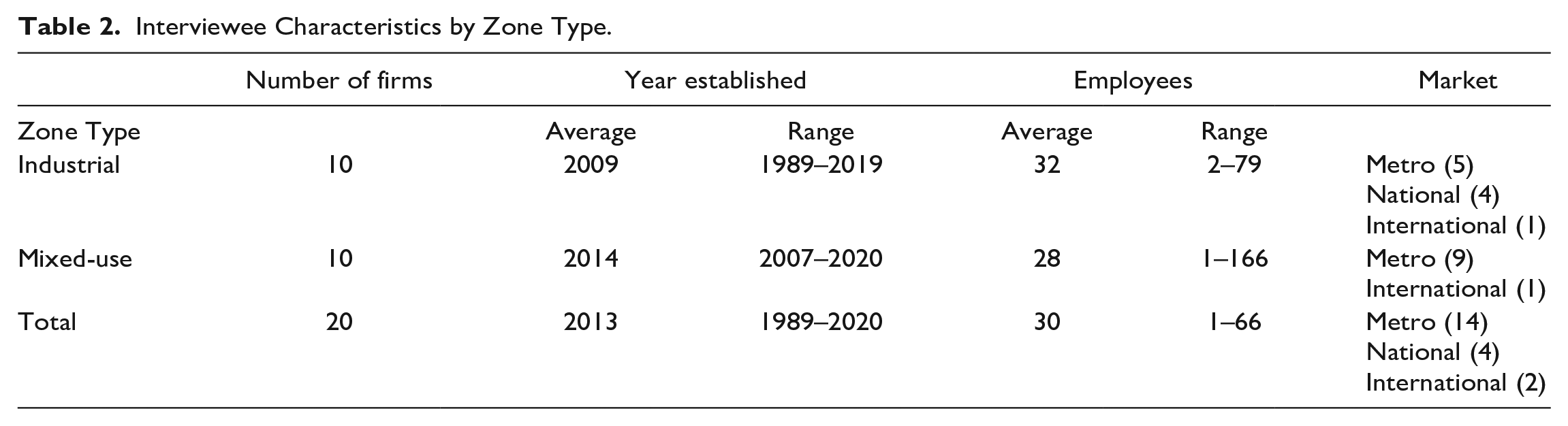
The researchers contacted all firms in the inventory via email and phone for interview. We conducted interviews with a sample of twenty firms (12.5 percent) that was broadly representative of our inventory between July and August 2022 (Table 1). Interviewees are distributed evenly across industrial and mixed-use zones, closely reflecting our inventory (51 percent in industrial zones, 49 percent in mixed-use zones). They encompass a range of small and medium-sized operations based on the number of employees and involve varying market reach (Tables 2 and 3). Three-fifths of the sample is involved in coffee, beer, and spirits manufacturing. While this partly reflects the rise of craft-based beverage manufacturers servicing high-end, urban consumer markets, there is still significant variation between producers. For example, coffee and spirits manufacturers range from micro-enterprises founded within the last five years to established, mid-sized firms with international market reach (Table 3).
Primary Products, Interview Sample versus All Firms.
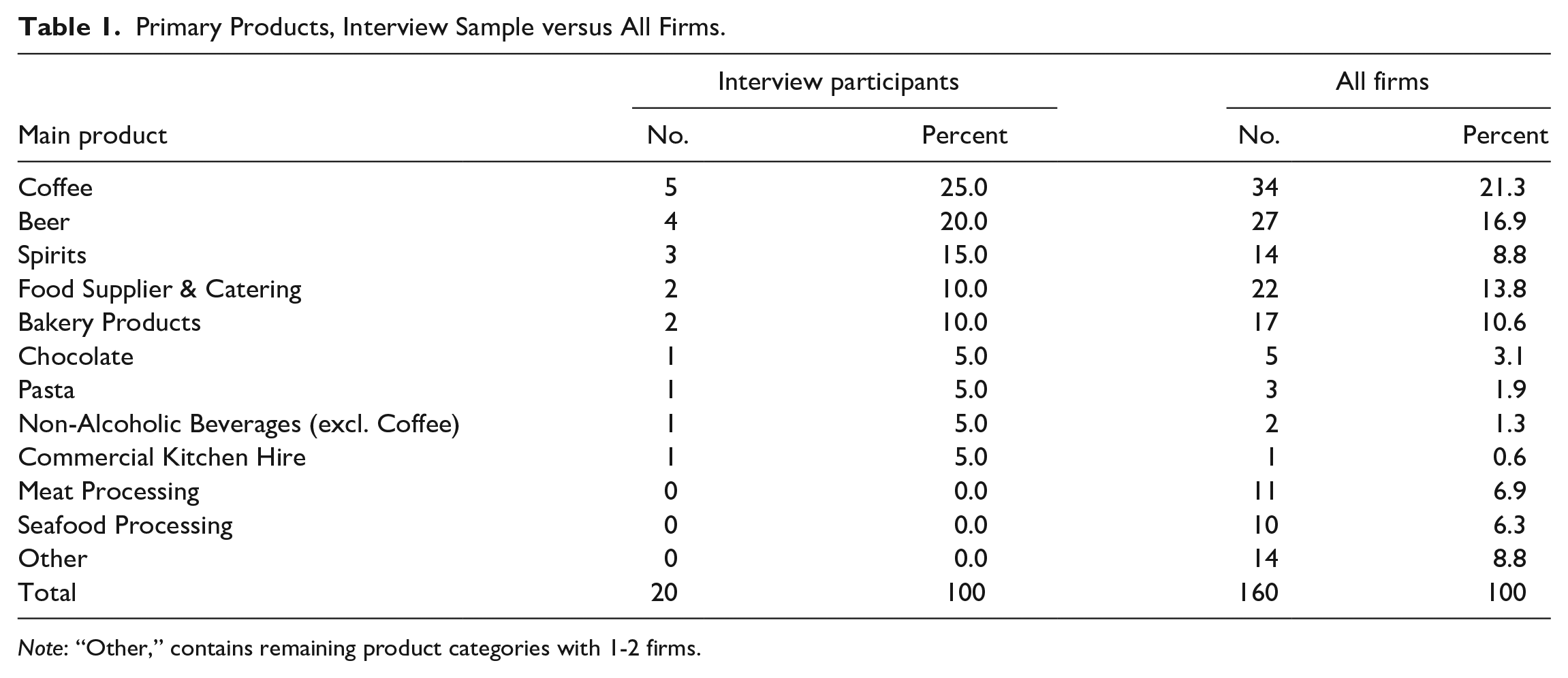
Note: “Other,” contains remaining product categories with 1-2 firms.
Interviewee Characteristics by Zone Type.
Interview Characteristics by Main Product.
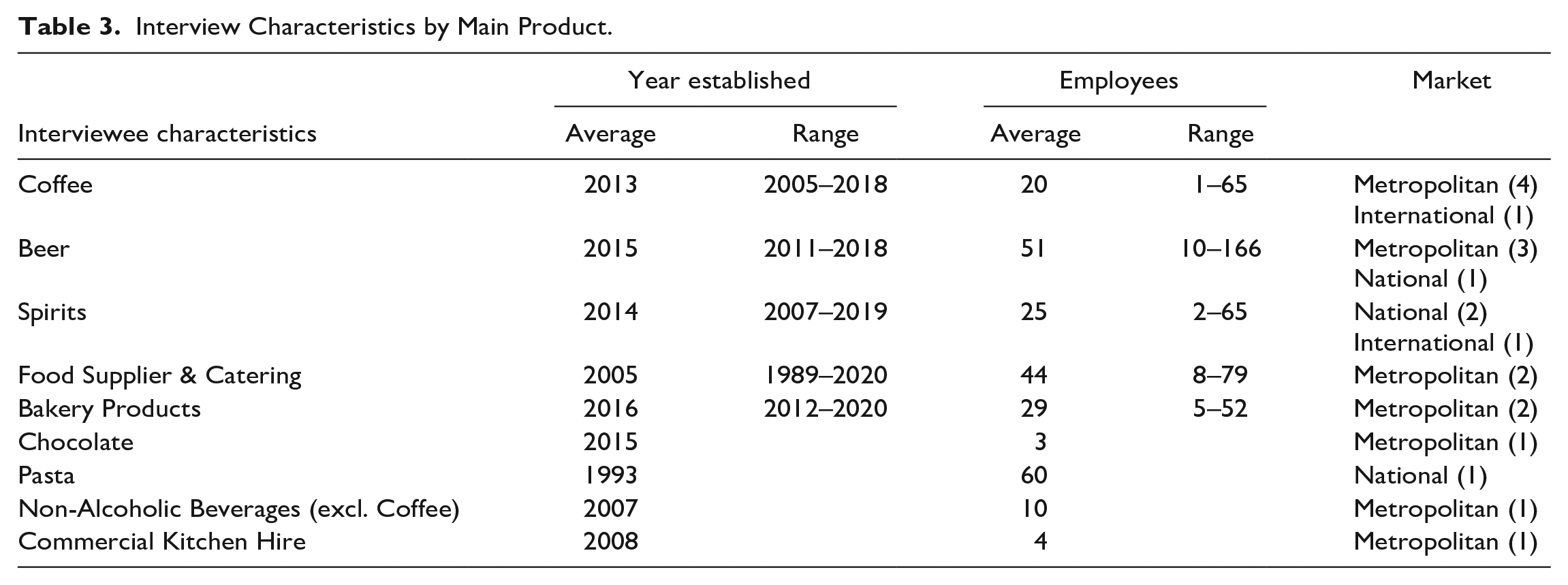
Differentiating by land use context, firms located in planned industrial zones are older, employ slightly more people, and have larger markets than those in mixed-use zones. Eleven firms (five in industrial zones and six in mixed-use zones) contain on-site consumer service functions alongside production. Service functions range from limited retail (e.g., commercial bakery or coffee roaster with restricted retail pick-up and/or training facilities) to comprising a central component of the business model (e.g., breweries with pub).
A potential limitation of the interview pool is a dearth of older manufacturers (only two firms opened before 2000). Because data is not available on firm age for the entire group of firms in the study area, we do not know if the firm age in our sample is representative of all manufacturers. It is possible that many firms established prior to 2000 are no longer in existence due to industrial rezonings or other factors related to their business. Data on employee size and market for all firms in the study area is also unavailable. Additionally, we were unable to secure interviews with meat and seafood processors, which together account for 13 percent of central city food and beverage manufacturers in our inventory. These producers may have specific needs and issues that are not represented in our findings.
We conducted interviews with the owner or a senior manager of each firm using a semi-structured interview protocol (Appendix). Interviews lasted between 40 and 90 minutes. We first asked interviewees for background information on the business, including the start date, product lines, workforce size and roles, market geography, supply geography, and primary costs. Second, we enquired about the advantages and disadvantages of the business’s location and workspace in relation to agglomeration dynamics and business needs. Finally, we asked specifically about the business’s experience with issues related to zone regulations and how they may influence location decisions and business models. This included discussion of the trade-offs that businesses made between proximity (e.g., to workforce, customers, and suppliers), operational decisions (e.g., operating hours, noise, emissions, traffic, and parking), and building considerations (e.g., floor area, building height, and retail space limits).
Finally, we transcribed and coded all interviews using Nvivo. Our coding protocol included four key themes: affordability, complementary uses, conflicting uses, and building characteristics. We then used matrix queries to divide interview responses according to whether businesses were located in a planned industrial zone or a mixed-use district. This enabled us to examine how responses compared to literature, as well as how this varied by land use context.
Zoning Regulations and Business Operations in Planned Industrial and Mixed-Use Zones
As a starting point, we explore the character of and variation between planned industrial zones and mixed-use zones. While distinct regulations define each type of zone, revisions to code language and changes in land uses over time have resulted in a patchwork of conditions on the ground. Taking this into consideration, we then comparatively analyze how official zoning designation and context relates to business decisions across four key themes in the literature: affordability, complementary uses, conflicting uses, and building characteristics. As outlined above, the chief arguments for protected urban industrial zones are that they moderate rents and zone out conflicting uses that interfere with industrial operations. Central industrial zones that permit industry are also essential for supporting complementary uses and underpinning localization economies. They often accomplish this through the provision of flexible buildings and space use. However, mixed-use zones may provide similar flexibility while enabling closer supplier and customer relations, especially where businesses seek to blend production and service functions. In turn, this may support business clusters particularly for small and emerging industries.
In line with the literature, although the character of planned industrial zones varies, we found that they generally shielded food and beverage manufacturers from higher rents and competing uses more effectively than mixed-use zones. Industrial zones tended to better support production functions than denser, built-out mixed-use areas, but also created challenges, particularly for those firms that combine production and consumer services on site. As a result, some firms were willing to eschew the benefits of an industrial zone location in exchange for the more immediate access to customer foot traffic that comes with denser mixed-use residential areas. In other instances, firms benefited from the legacy of industrial rezonings and variances, which created de facto mixed-use environments in protected industrial zones. In sum, the findings point toward reassessing the dichotomy between industrial and mixed-use zoning and the suitability of industrial and mixed zones to meet the needs of contemporary urban manufacturing.
Distinct Zoning Codes, Varied Land Use Contexts
Industrial zones and mixed-use zones contain code language that prioritizes different sets of uses. All zones mix uses in practice, and actual land uses and built environment features vary both between and within zone types. Some planned industrial zones contain a mix of industrial and commercial uses. In some instances, residential uses are also present due to variations in code language over time, special use permits, and permissive code language.
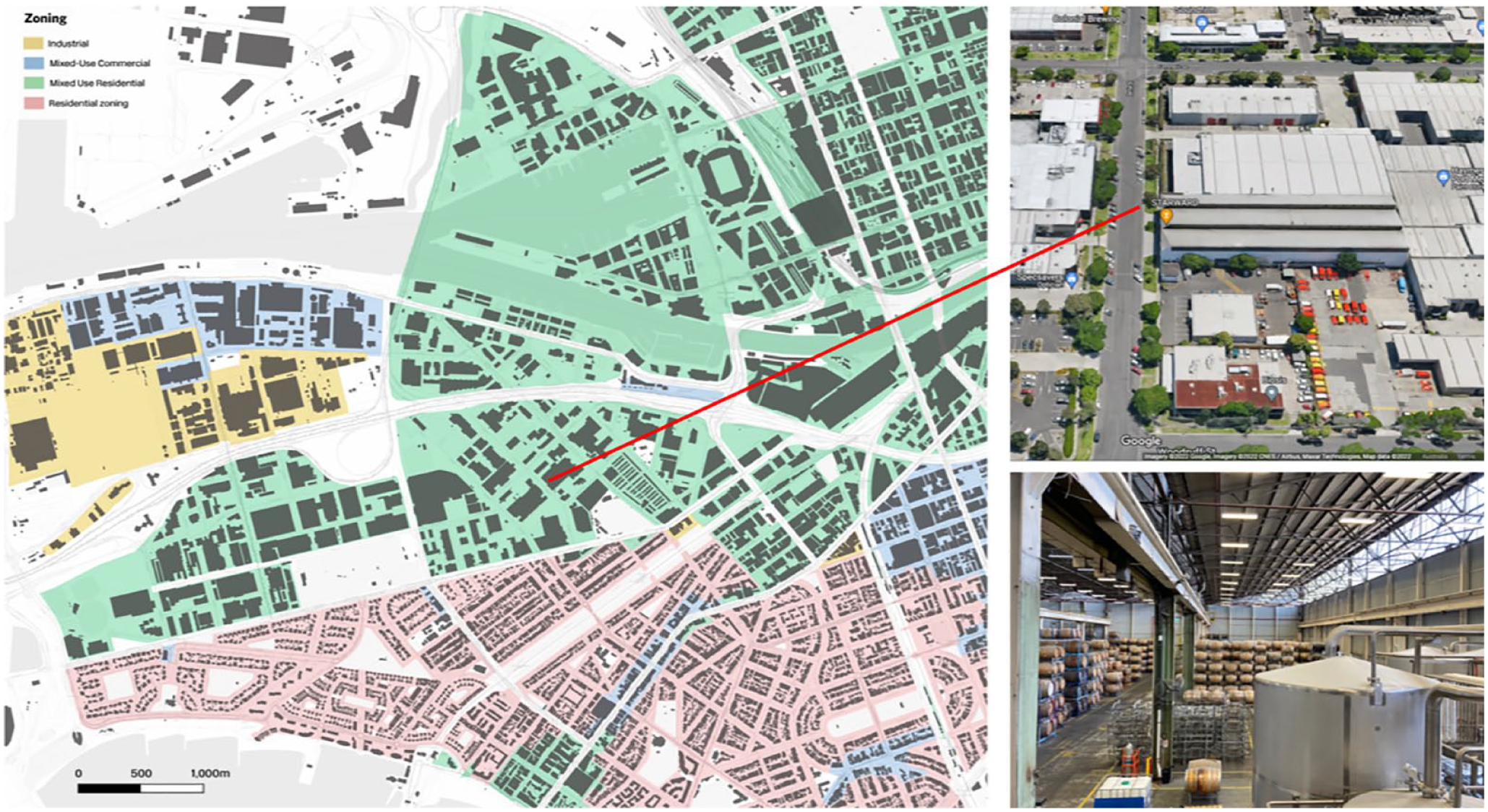
In fact, none of the industrial zone firms interviewed are located on single-use industrial blocks. Six firms are in industrial areas that contain a mix of industrial and commercial uses separated from residential uses. It is also common for mixed-use commercial and residential zones to surround established industrial zones that contain a mix of older one to three-story warehouse and manufacturing spaces, as shown in Figure 1. In fact, much of the industrial land in central Melbourne consists of small pockets situated between other zones as successive rezonings carved away larger industrial areas. Additionally, the remaining four industrial zone firms are on blocks that form de facto mixed-use zones because they include residential uses or abut residential or mixed-use zones that include residential properties (Figure 2).
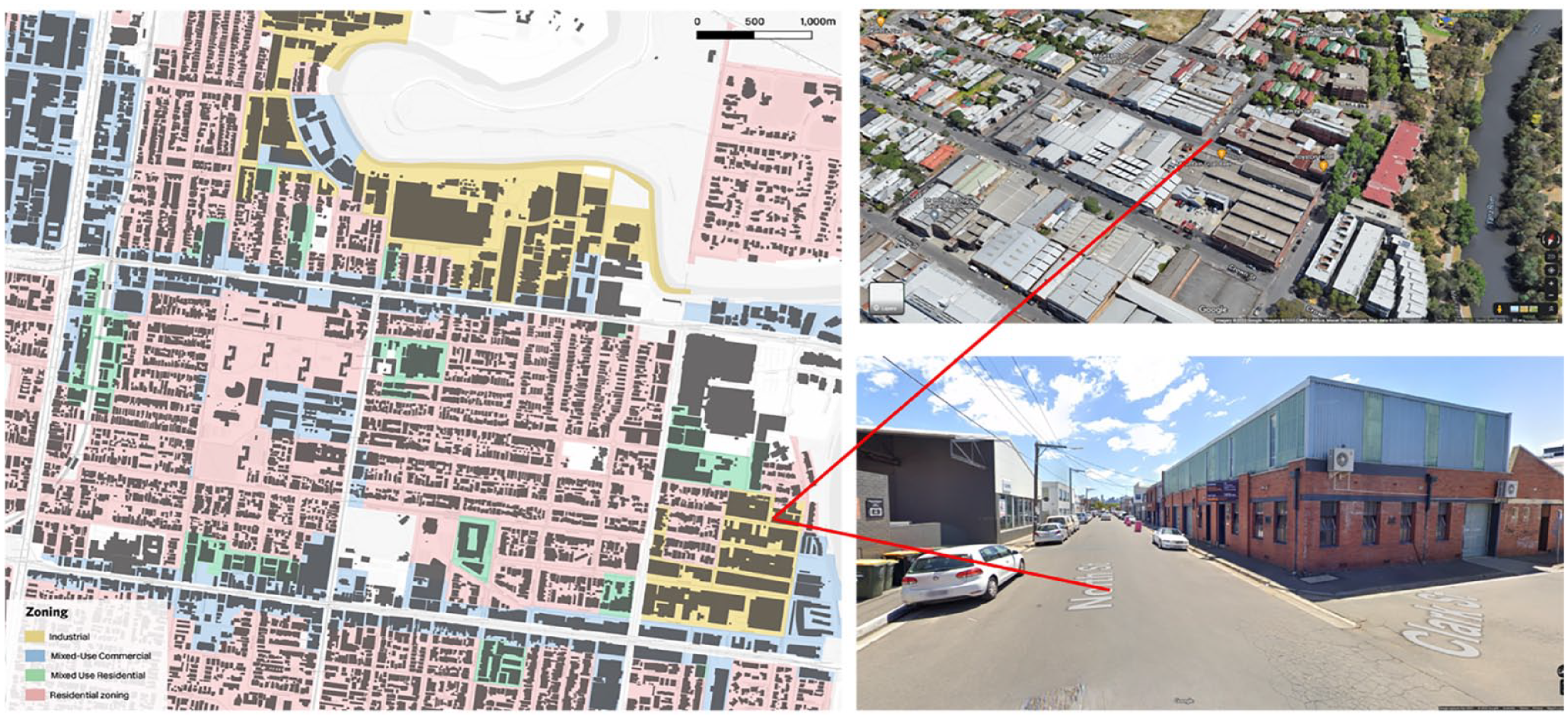
Pocket industrial zones surrounded by other zones.
Urban industrial zones abut mixed-use residential zones.
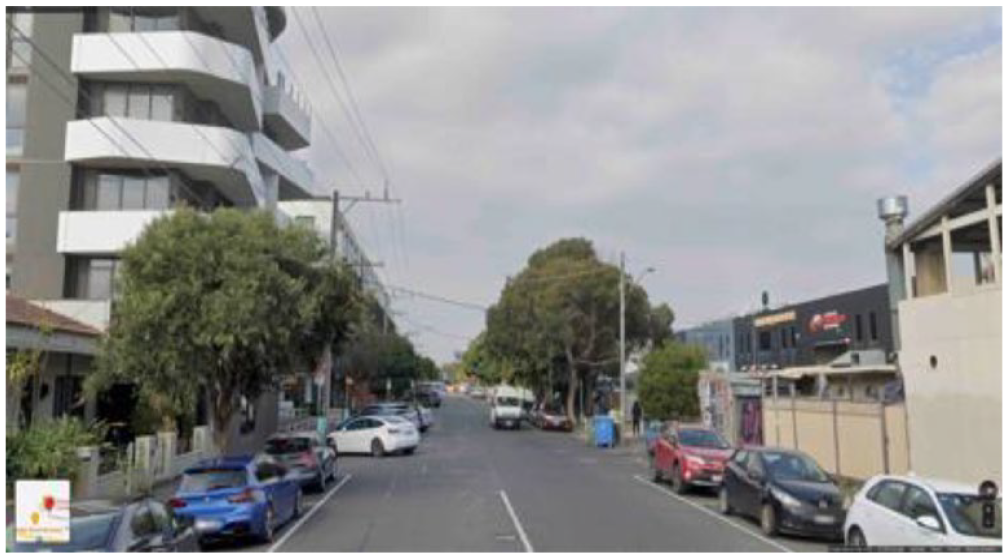
Mixed-use zones can vary widely in terms of their commercial, residential, and industrial mix as well. Six of ten mixed-use firms are in zones that include residential properties. Three others are in commercial mixed-use zones that exhibit a strong industrial character defined by large floor plate buildings. These areas continue to essentially function as industrial zones despite their rezoning from industrial within the last decade (Figure 3). As we elaborate below, despite the varied context within zones, zone regulations matter and create different conditions, benefits, and challenges for food and beverage manufactures in Melbourne.
Large floor plate commercial mixed-use zone near central business district.
Affordability
Affordability was a key concern to interviewees because rent is one of the primary expenses for most central city firms, regardless of zone type. Approximately two-thirds of food and beverage manufacturers in planned industrial zones indicated that their current location offers greater affordability than other inner-city locations. By comparison, just four firms in mixed-use areas cited affordability as an advantage of their location. Two of these firms (a distillery and food supplier/caterer) are in inner-urban renewal areas that were recently zoned industrial and continue to support predominately industrial uses (Figure 3).
While planned industrial zones moderate rents, firms in these zones face trade-offs with the types of activities that they are permitted to accommodate under one roof. City councils prohibited three interviewees in industrial zones from setting up ancillary retail or hospitality activities. As a result, one of the distilleries interviewed is investigating nearby sites for a standalone bar, creating the prospect of additional rent or moving costs.
Beyond this, industrial zones in high-foot traffic areas can still command high rents despite regulatory protections. Another distillery that produces and sells on-site in an industrial zone that abuts a residential neighborhood reported rent increases as a key concern: “Our rent has gone up massively because the cost of land in inner-city areas just goes up” (Simon, distillery, industrial zone).
Although affordable sites exist in mixed-use areas that permit industry, the range of other uses allowed raises potential rents, particularly in those areas rezoned from industrial over the last decade. These areas still contain many older factory spaces. Some are occupied by small manufacturers, but they are increasingly redeveloped for office or residential uses, which bid up area rents and slowly price out the former. As one interviewee noted while discussing possible location alternatives in mixed-use areas near Melbourne’s central business district: I think there’s a good mix there. . .You’re really close to residential and obviously the CBD, but there’s a good balance in those areas, and. . .you get a bit worried when you see them just demolishing and focusing on one land use, and that for the last 20 years has primarily been high-density residential. So, when you see the old factories going down, it’s just like, ‘No, no, wait up, let’s not just put an apartment there.’ Yeah, it seems like the councils are really quick to rezone and clean up and rezone industrial to a commercial high-density residential (Ashley, distillery, industrial zone).
Additionally, the introduction of a more productive industrial use can bid up rents. For example, a small brewery in a mixed-use area was able to negotiate an affordable rate in their first year but faced rent increases in subsequent years after the business had secured a change-of-use permit to transform a storage facility into a brewery. Similarly, a coffee roaster located in a mixed-use area noted that “similar square meterage is now for lease at four times the price [they] managed to negotiate” when the business opened five years ago (Angus, coffee roastery, mixed-use zone).
Complementary Uses
All twenty firms in industrial and mixed-use zones cited proximity benefits typically associated with agglomeration economies. Fourteen firms indicated access to local suppliers as foundational to their business operations. For instance, three of the five coffee manufacturers interviewed source some or all of their green beans (raw, unroasted coffee) from an established coffee wholesaler and importer in central Melbourne. These types of relationships are important for small manufacturers because they enable oversight over product sourcing, quality control, and more favorable pricing.
Eighteen firms noted market access as a primary location benefit. This was particularly the case for firms like breweries that report on-site consumption as a primary component of the business model. In mixed-use areas, firms cited foot traffic as a key determinant in their location decision to allow for front-of-house hospitality operations.
Customer access factored into industrial zone location decisions as well. Here, five firms cited foot traffic and public transport access as crucial to their business model. As a brewery owner explained, “I had no intention of setting up a restaurant or having a kitchen so having food options nearby was good for me” (Zach, brewery, industrial zone). These firms are in remaining pockets of industrial land near activity centers with intensifying residential development (Figures 1 and 2).
Moreover, despite encountering noise complaints, these firms gain the protection of an industrial zone along with the advantages of a high-density location: Medium to high density living usually has people who work most of the time. . .and they probably don’t cook as much, which means they go out and eat. With one more [apartment] construction going on right there on the corner, two more further up, I guess that brings more residents out and it’s good for the businesses (Ken, brewery, industrial zone).
Firms without on-site consumption are still located in central mixed-use zones as a base to deliver to their target market in the inner city. For example, a catering and meal delivery service recently moved closer to the city to maximize the number of customers living in their delivery radius.
Finally, some firms considered workforce accessibility and deeper customer engagement: Being in [a central area] is really accessible for things like staff training, staff meetings or events, hosting customers. I think if we were to move to somewhere else, we’d probably think of having a separate facility for training in the inner city or a secondary roasting place . . . But it will definitely lose something if we weren’t able to show our customers through the whole roasting process on site and say, ‘everything’s done here. It’s all done by us. (Jason, coffee roaster, industrial zone)
Conflicting Uses
While dense urban areas provide advantages to businesses, they also create tensions between competing or incompatible uses. Overall, industrial zones provided greater protection and separation from residents than mixed-use zones. Six of the manufacturers in industrial zones purposely avoided mixed-use areas where residents may complain about noise, odor, truck traffic, parking, or late operating hours. In some cases, this was based on prior experience: We’re really lucky that we don’t actually deal with residentials because if it was zoned like half residential, half commercial, there’d be an uproar. . .The fact that we’re open 24/7, and the sound and the noise. That was one of the key reasons why we left Fitzroy. . .they were rezoning everything [and]. . .across the road from us, they were. . .converting warehouses to warehouse apartments (John, food supplier, industrial zone).
Even in areas where industrial zones abut residential neighborhoods, zone regulations protected firms from potential conflicts arising from their manufacturing operations. For example, when a commercial bakery opened in a former pie factory across the road from a residential area, they faced minimal planning obstacles due to the site’s prior use and industrial zoning designation: We did do a couple of checks. . .that we weren’t going to face any issues with delivery drivers at 2:00 or 3:00am and how that might impact the residents that live there. But Council said that it was absolutely fine for us to continue because the previous tenants had done that. There didn’t seem to be an issue with zoning or noise complaints (Amy, commercial bakery, industrial zone).
Ironically, the only formal objections against respondents in industrial zones pertained to their hospitality operations. For example, a brewery received noise complaints from nearby residents directed at its brewpub, which the Council dismissed because noise levels did not breach permitted decibel limits in the industrial zone. Similarly, a distillery received a formal objection related to alcohol consumption in its tasting room during the planning process, though this was also resolved, and planning permission was eventually granted.
At the same time, however, three industrial zone firms faced permit delays and other issues with establishing customer-facing uses despite their manufacturing operations being allowed “as-of-right” in the zone. In short, industrial zoning codes are intended to “provide for the manufacturing industry, the storage, and distribution of goods” by regulating incompatible uses such as retail and hospitality (Victoria State Government 2022), but the planning code does not yet recognize how to accommodate industrial producers that also maintain some consumer function at the point of manufacture.
In contrast, five of six firms in mixed-use areas with residential uses on the same block cited complaints from neighbors or planning issues around parking, operating hours, and ancillary customer-facing uses. This included a brewery that applied to expand its retail operation. The business received a “large number of complaints from residents” concerned with late-night noise and alcohol consumption, which automatically triggered a formal council hearing. A kombucha producer received formal complaints from neighbors about late operating hours and fears the premises operated as a “boarding house” (Dean, non-alcoholic beverage manufacturer, mixed-use zone).
In short, firms near intensifying residential development face a trade-off between the benefits of a growing customer base and the costs of mitigating their impact on neighborhood amenity. Although industrial zones generally provided greater protection for manufacturers, respondents still faced a delicate balancing act. As one coffee roaster explained, alleviating conflict with neighbors and planning authorities ultimately requires “pick[ing] your spot for your purpose”: If you want to run an espresso bar, it makes sense to pick somewhere where it’s going to be easy to [reach a] customer base, foot traffic . . .Versus what do I need for a coffee roaster?. . .I need access, I need trucks, I need parking, I need container height doors, etc. (Craig, coffee roastery, mixed-use zone).
Building Characteristics
In line with the mixed-use industry literature, three firms in these areas selected “character buildings” (Nic, brewery, mixed-use zone) with high ceilings and natural light to support their hospitality offerings. Yet, firms balanced these aesthetic characteristics against the functional attributes of a space for manufacturing purposes. While one respondent wanted an accessible location near customers, they also needed a site where: We could produce dangerous goods. We need to have a certain level of fire suppression. We need to have a certain level of building standard to make sure it’s safe. . .[and] it’s the right building for maturing our whisky. We like a big shed that’s not insulated because it captures more heat (Anon., distillery, mixed-use zone).
Similarly, although some industrial zone firms fitted out buildings for customer-facing uses, they primarily selected spaces based on functional attributes. Respondents valued high ceilings for truck access, clearance for large equipment, storage, ventilation, and utility access.
In addition, firms sought larger floorplates and flexible building configurations to accommodate different functions. For example, one respondent that specialized in natural flavors and “ready-to-drink” coffee based their R&D and marketing operations in a Melbourne industrial zone and production operations in another state. After successfully applying for a government relocation grant, the business was able to move their manufacturing operations to their Melbourne factory and consolidate the different streams of their business under one roof: “There’s nothing like having everybody on the same site, really focused around the objectives, focused around the product” (Paul, coffee products manufacturer, industrial zone).
At the same time, not only are larger format buildings scarce in central locations, but also firms face logistical challenges working out of an older, dense central location. In some instances, firms navigated these issues through building modifications, which planning authorities generally allowed in industrial areas when they pertained to manufacturing operations: This site was an old furniture site. . .and we then converted it into a warehouse. We raised the roof. . .We built cool rooms and freezers, the offices. We put the roller doors in. . .we had to keep the four walls, that was a part of the planning process (John, food supplier, industrial zone).
However, many logistical challenges extended beyond the boundaries of the factory. Firms across industrial and mixed-use areas had to deal with difficult truck access, parking restrictions and traffic in older, built-up areas with narrow streets. Access to utilities and infrastructure was also a key concern. Six firms in industrial zones and four in mixed-use zones struggled with inadequate power, gas, water, and/or waste management services. However, this was not just a problem in older, inner-city areas. Two respondents that are currently considering expanding their operations noted the lack of adequate power in outer-suburban industrial zones, which are designed for logistics rather than manufacturing. This also means that outer industrial buildings tend to be very large warehouses in monofunctional industrial estates, limiting the location alternatives for small-to-medium manufacturers: Even if you try to get out of the city, it’s hard to find a better deal because the warehouses get bigger. So you end up paying the same annual rent, you’re just getting a lot of space that you don’t want (Zach, brewery, industrial zone).
While property ranges from 200 square meters to over 4,000 square meters, most interviewees reported difficulties finding suitable production space, particularly in industrial zones where 60 percent of firms noted that they had outgrown their current space.
Rethinking Urban Industrial Zones and Mixed-Use Areas
This research asked why urban manufacturing firms locate and maintain a business in different zoning contexts, and how zoning regulations affect their operations. In the process, we engage in debates around industrial rezoning and contemporary needs for urban production. We compared the experiences of food and beverage manufacturers in planned industrial zones and mixed-use areas in Melbourne, Australia, concentrating on four themes – affordability, complementary uses, conflicting uses, and building characteristics. We found that planned industrial zones shielded manufacturers from higher rents and competing uses more effectively than mixed-use zones. Urban industrial zones also offer flexible built environments and enable access to local suppliers and markets. However, they do not always support emerging forms of manufacturing that blend production and consumption functions. While mixed-use zones offer more flexibility for hybrid functions, they do not protect rent-sensitive firms from affordability and land use conflicts. Finally, we identify contextual variation in planned industrial zones. Significantly, many urban industrial zones exhibit characteristics of mixed-use environments while affording regulatory protection.
Understanding the relationship between zoning and firm operations is particularly important for planning, not only due to ongoing pressures to rezone urban industrial land to other uses but also given the diversity and changing character of urban manufacturing. As our research shows, a mix of food and beverage manufacturers persist in high-cost central cities, ranging from small, artisan manufacturing enterprises to established, mid-sized firms with national and international market reach. Urban manufacturing firms are increasingly hybrid with blended production and service functions. This presents new considerations for land use planning and adds a new layer to the debates around the need for industrial zoning in strong market cities.
Planned industrial zones that protect manufacturing in high-cost markets remain crucial but have not sufficiently adapted to new industry contexts. Food and beverage manufacturers in Melbourne locate and maintain businesses in urban industrial zones for anticipated reasons. These zones generally provide comparatively affordable rent, shield manufacturers from conflicting and competing uses and, in the process, offer important proximity benefits, particularly in relation to customer and supplier access. Yet, firms also faced issues with inflexible and lengthy planning processes that failed to accommodate new uses, particularly producers with consumer-facing operations.
Firms opting to set up in mixed-use zones tend to incorporate consumer services in their business model. These firms are willing to trade comparably lower rents and protection from conflicting uses for higher foot traffic. While our findings indicate that urban manufacturers can survive in commercial and residential neighborhoods, calls for reintegrating production into mixed-use areas fall short without addressing real estate pressures on rent-sensitive but essential industries.
Related to this, another important finding in the context of rezoning for mixed-use development, is that planned industrial zones in central areas already contain a diversity of uses and land use types. While industrial code regulations apply to inner city and outer-suburban locations alike, industrially zoned land is by no means single-use and context varies widely. For various reasons, central city industrial zones have evolved into pockets of industrial activity surrounded by commercial and residential areas. As we uncover, they now resemble a de facto form of mixed-use with greater protection of industrial activity than commercial zones. While industrial zones do not necessarily separate conflicting uses, their regulations nonetheless afford protection from residential complaints and other potential sources of conflict. Future research can further explore this phenomenon by taking account of other variables alongside formal code designation such as built environment characteristics and land use diversity.
Within the context of dwindling urban industrial land, our research responds to the gap in knowledge on the role of zoning in relation to urban production operations and location decisions. This knowledge can help planners to better understand and plan for urban industrial futures in strong market cities and for emerging forms of urban industry that blend production and service functions. Our findings illustrate the importance of planned urban industrial zones, but also the need to rethink current zoning in response to varying contexts and industry needs.
Planning practitioners need to consider the land use diversity already present in planned industrial zones when pursuing mixed-use development strategies. Current planning policy does not fully recognize the variation within manufacturing enterprises and continues to separate most industrial uses under the perception that it harms residential amenities. Current industrial zoning is geared more toward outer-suburban activity and throws up regulatory hurdles for contemporary food and beverage manufacturers.
Planners can look toward the de facto mixed-use industrial zones that we studied to develop zoning overlays or new zoning categories that are more appropriate to urban manufacturing than current zones based on large-lot, monofunctional activity. This requires formulations that enable hybrid business models geared toward local production markets and new mixed-use industrial zones that remain functional for small-scale manufacturing operations in terms of building, utility, parking, and other functional requirements. This includes permitting limited on-site consumption and retail uses when they are part of manufacturing operations or calling out specific types of artisan manufacturing in targeted areas when they support larger planning goals.
Reintegrating production within the urban fabric requires more finely tuned and imaginative land use systems. This requires industrial zoning better suited to the multifaceted needs of contemporary urban manufacturing but also a fundamental rethink of mixed-use areas toward more productive ends.
Footnotes
Appendix
Acknowledgements
Thank you to Maria Daels for your invaluable research assistance and members of the larger research project team, Elizabeth Taylor and Joe Hurley, for ongoing discussion on urban industrial lands.
Declaration of Conflicting Interests
The author(s) declared no potential conflicts of interest with respect to the research, authorship, and/or publication of this article.
Funding
The author(s) disclosed receipt of the following financial support for the research, authorship, and/or publication of this article: This work was supported by the Australian Research Council Discovery Project Remaking Post-industrial Plans: Urban Industrial Zoning Past and Future (DP210103690).
