




Abstract
More than 500,000 people experience homelessness in the United States, and many turn to transit vehicles, stops, and stations for shelter. We present findings from a survey of 115 U.S. and Canadian transit operators that inquired about homelessness on transit systems. We find that homelessness is broadly present, though more concentrated on central hotspots, and worsened during the pandemic. In response, transit agencies often initiate a combination of punitive and outreach strategies. Based on our findings, we argue for better data collection, establishment of policies and protocols, engagement in outreach strategies, and partnering with service providers.
Introduction
More than half a million individuals experience homelessness every single night in the United States (U.S. Department of Housing and Urban Development [U.S. HUD] 2021). Visible homelessness grew on the streets of U.S. cities in the 1980s, after the loss of well-paying industrial jobs, the closure of many mental health institutions, the general lack of affordable housing, the gutting of welfare programs, and the crack-cocaine epidemic that together pushed people to the streets (National Academies of Sciences, Engineering, and Medicine 2018; Wolch and Dear 1993). Despite efforts by local governments and nonprofits, homelessness has not subsided but in fact worsened in U.S. metropolitan areas over the last decade, as housing costs rose and affordable housing became scarcer (U.S. HUD 2021).
In many major cities where homelessness is concentrated, the capacity of shelters and social service agencies is far outpaced by the needs of the rapidly growing unhoused population. As a result, many are forced to look for shelter in various public spaces. Among the more common (and also understudied) of these settings are public transit environments: buses, trains, stops, stations, and other transit facilities (Ding, Loukaitou-Sideris, and Wasserman 2022). Many people experiencing homelessness turn to transit for shelter; others ride transit to work and errands, as well as to temporary housing and supportive services.
The Coronavirus Disease 2019 (COVID-19) pandemic intensified the scale of the homelessness crisis and its implications for transit (Loukaitou-Sideris et al. 2023). As the extent of homelessness has grown too severe for existing safety nets to manage, transit operators are increasingly confronting issues of homelessness and drawing on strategies from areas beyond transportation in response (Loukaitou-Sideris et al. 2021, 2022). But even though news reports have focused attention to unhoused individuals on various U.S. transit systems, and some municipal governments (e.g., in New York) are pushing aggressive measures to remove them from transit (Price 2022), scholarly research has not yet systematically documented the scale and scope of the problem. And yet, with COVID-19 posing new dangers to both unhoused individuals and transit systems, understanding and responding to the needs of this vulnerable population is vital. This study presents findings from a survey of U.S. public transit operators on issues of homelessness on their systems, both before and during the coronavirus pandemic, to understand the extent of the homelessness challenge in transit environments and what can be done to address it.
Literature Overview
Transit environments, such as transit vehicles, stations, and transit centers, represent common settings for individuals experiencing homelessness because of their anonymity, relative publicness, and often, microclimate control. Nevertheless, the literature on the intersection of transit and homelessness is sparse. The few studies that exist indicate that public transit plays an important role in enhancing the mobility of this disadvantaged group. Transit often serves as the most commonly used mode of transportation for unhoused travelers, along with walking—in contradistinction to the automobile-heavy travel patterns of housed U.S. residents (Ding, Loukaitou-Sideris, and Wasserman 2022; Murphy 2019). At the same time, a number of unhoused individuals use transit environments for shelter, though count data are scarce (Loukaitou-Sideris et al. 2022). In a few northern U.S. cities, where recent homelessness counts have disaggregated people sleeping in transit environments, the share of unhoused individuals sheltering there was frequently more than half of the total unhoused population, but numbers varied widely by year and city (New York City Department of Homeless Services 2012, 2020; New York State Comptroller 2020; Legler 2019; Mark Legler, pers. comm.). Those sheltering on transit are more likely to be more disadvantaged and chronically unhoused than other people experiencing homelessness (Nichols and Cázares 2011; Wiggins 2017; Wilder Research 2019).
In a series of focus groups with unhoused individuals in Long Beach, California, Jocoy and Del Casino (2010) found that more than half of them took transit daily, but some also reported unpleasant experiences, such as not being picked up by drivers (38%) or being harassed by other riders (12%). Conducting in-person interviews with 159 people experiencing homelessness in Toronto, Hui and Habib (2016, 2017) found that significant numbers of those who had no bike or car relied on transit to access or search for jobs, health care, or social services, making an average of five trips daily. The authors found that the cost of transit prevented some unhoused individuals (primarily those of ages 40–60) from finding appropriate job prospects (Hui and Habib 2017). Attesting to the common use of transit vehicles for shelter by the unhoused, Nichols and Cázares (2011) interviewed 49 unhoused individuals who used a particular bus line in Santa Clara County, California, finding that two-thirds of them used the bus as their shelter.
Some studies have surveyed transportation operators to understand the magnitude of homelessness on their systems. An early national survey by the Port Authority of New York and New Jersey found that all responding transit operators and airports viewed homelessness as an issue in their facilities (Ryan 1991). Bassett, Tremoulet, and Moe (2013) surveyed 69 state or provincial departments of transportation (DOTs) about homelessness and found that 70 percent regularly encountered unhoused individuals in their rights-of-way, near freeways, interchanges, rest areas, and so on. More recently, Boyle (2016) surveyed 55 U.S. transit operators on issues of homelessness and responses thereto, finding that homelessness represented a challenge for 91 percent of the agencies surveyed. Another survey of staff at 49 U.S. transit operators in 2018 found that over two-thirds of them believed their agency should have a role in addressing homelessness (Bell et al. 2018).
A few case studies have evaluated the effectiveness of particular interventions undertaken by a transit agency in response to homelessness. For example, Rudy and Delgado (2006) studied an Orange County, California program, in which bus operators, law enforcement officers, and mental health workers teamed up on high-priority lines, increased the number of people in homelessness accessing services, and decreased rider complaints. Bay Area Rapid Transit (BART) has implemented comprehensive outreach efforts, including unarmed transit ambassadors, “pit stop” restrooms, and crisis de-escalation training for law enforcement (Boyle 2016; Powers 2019). Such outreach efforts are in accordance with empirical evidence that indicates that law enforcement cannot address the root problem of homelessness, while outreach tends to yield more positive housing and health outcomes for people experiencing homelessness (Berk and MacDonald 2010; Goldfischer 2020; Hartmann McNamara, Crawford, and Burns 2013; Herring 2019; Munthe-Kaas, Berg, and Blaasvær 2018; Olivet et al. 2010).
Nevertheless, transit agencies have often ignored or minimized their social service role. As Taylor and Morris (2015, 347) argue, under the umbrella of providing public transportation, transit agencies often have conflicting or misdirected goals that “suggest a lack of focus on the needs of transit riders themselves, particularly the poor and transit dependent.” We consider unhoused riders as belonging to this group. Indeed, in the press and agency reports, questions about homelessness often center on the experience of housed riders. A key question, whether the presence of unhoused riders affects transit ridership, is fraught and understudied. Though still debated, the main determinants of transit ridership are either external to transit operators—such as population density, area median income, and auto ownership (Taylor et al. 2009)—or related to service supply (Alam, Nixon, and Zhang 2015; Boisjoly et al. 2018). Harder-to-measure factors like homelessness and perceptions of safety are rarely included in studies about the deterrents of transit use. 1 Nonetheless, perceptions of visible homelessness on transit systems represent a significant factor in depressing rider satisfaction in some passenger surveys (BART and Corey, Canapary & Galanis Research 2019).
The COVID-19 pandemic hit the transit industry hard, with ridership plummeting and slow to return, service cuts, and some agencies even discouraging nonessential transit use in the pandemic’s initial months. Nevertheless, thanks to emergency federal funding, transit operators responded to federal and local mandates on mandatory masking, cleaning and sanitizing vehicles and settings, and onboard occupancy limitations (Mader 2021; Wasserman et al. 2022). Although agency staff reported increased homelessness on their systems during the pandemic as well (Wasserman et al. 2022), surveys and professional reports written before the pandemic do not capture the potentially unique challenges of rising homelessness during a health crisis. Most of the reasons for transit becoming a site for shelter during the pandemic lay beyond the control of transit operators. Fear of disease led homeless shelters to lower capacity to allow for distancing (Ockerman 2020), pushing more unhoused Americans onto the streets and transit. Public libraries (often frequented by unhoused people) closed during the pandemic (Kendall 2020). Moreover, as some people in low-wage jobs were furloughed or laid off due to the economic and social effects of the pandemic in its first year, an inability to pay rent forced some into homelessness, especially where state and municipal eviction moratoria expired (Blasi 2020). These moratoria may indeed have blunted or delayed a rise in homelessness, though many illegal evictions or “self-evictions” under pressure from landlords did occur even with moratoria in place (Anti-Eviction Mapping Project 2021; Capps 2022; United Way 2021). Because the pandemic caused homelessness counts in most U.S. regions to be canceled for almost two years, 2 its actual effect on the total number of unhoused individuals—let alone its effect on homeless counts on transit—remains uncertain, as of this writing (Capps 2022).
In sum, a limited literature has started documenting the challenge of homelessness for transit agencies but lacks the evidence of large survey data. Few studies discuss both the scope of homelessness in transit settings and agencies’ response to homelessness. In addition, earlier surveys and professional reports do not capture the challenges of rising homelessness during a health crisis. To address these issues, we developed a survey targeting a wide cross-section of transit operators.
Research Questions and Methods
The purpose of the survey was to help us respond to the following research questions:
To answer these questions, we deployed a thirty-seven-question online survey (see online Appendix), made up primarily of closed-ended questions (Loukaitou-Sideris et al. 2020). Some questions drew on those asked by Boyle (2016) in a prior, smaller nationwide survey, in order to examine change over time. 3 Other questions asked about concerns since the onset of the COVID-19 pandemic and about other aspects of homelessness in transit environments not covered by previous surveys. We piloted and refined the survey with the staff at the California Transit Association, the California Department of Transportation, and two large transit operators.
Using the latest available annual data from the National Transit Database (Report Year 2018) (Federal Transit Administration 2020), we created a list of all transit operators in the United States who operate 100 or more vehicles in maximum service. Following Boyle (2016), we used vehicles in peak service as our metric, especially because vehicles are used by unhoused people to both shelter and ride. We selected agencies with over 100 vehicles for our national sample because many smaller operators primarily operate paratransit or specialized services only. Our national sample included a range of small and large operators from urban, suburban, and even rural and exurban regions. For smaller agencies, we searched the American Public Transportation Association’s contact database and identified and sent the survey to their Chief Operating Officers, requesting them to respond to it or to ask the most appropriate person in their agency to respond. For larger agencies, we sent the survey to their heads of safety/security and operations divisions. We e-mailed these contacts a link to the survey and sent follow-up messages throughout the period that the survey remained open. We asked all e-mail recipients to forward the survey to the staff person(s) with the best knowledge of homelessness on their system, if someone other than themselves. If multiple respondents at a single agency disagreed in their answers, we averaged their responses for questions on an ordinal scale and used responses that indicated the presence of a particular program or effort over responses that indicated its absence.
Because California is the state with the highest number of unsheltered individuals (U.S. HUD 2021), we also conducted an oversample in California, sending the survey to all operators who are members of the California Transit Association. This oversample included more small transit agencies, so we exercise caution in comparing the two sets of responses and do so sparingly. Except where otherwise noted, survey results discussed below refer only to the national survey.
The survey was launched on July 30, 2020 and remained open for two months. Out of the 164 agencies in our national sample, we received back responses from 81 agencies (see Figure 1 for their location), a response rate of 49 percent. Other than a slightly higher response rate among larger agencies and slightly lower rate among agencies in and around the New York City area, the responses relatively evenly reflected the national sample by size and geography. In the California oversample, 52 of the 85 agencies responded. Forty-two responding agencies in the national sample were large (with over 300 vehicles), and 39 were small; the California oversample contained 52 agencies, with nine of them having over 300 vehicles. Where appropriate, we calculated the statistical significance of select survey findings using Pearson’s chi-square tests.
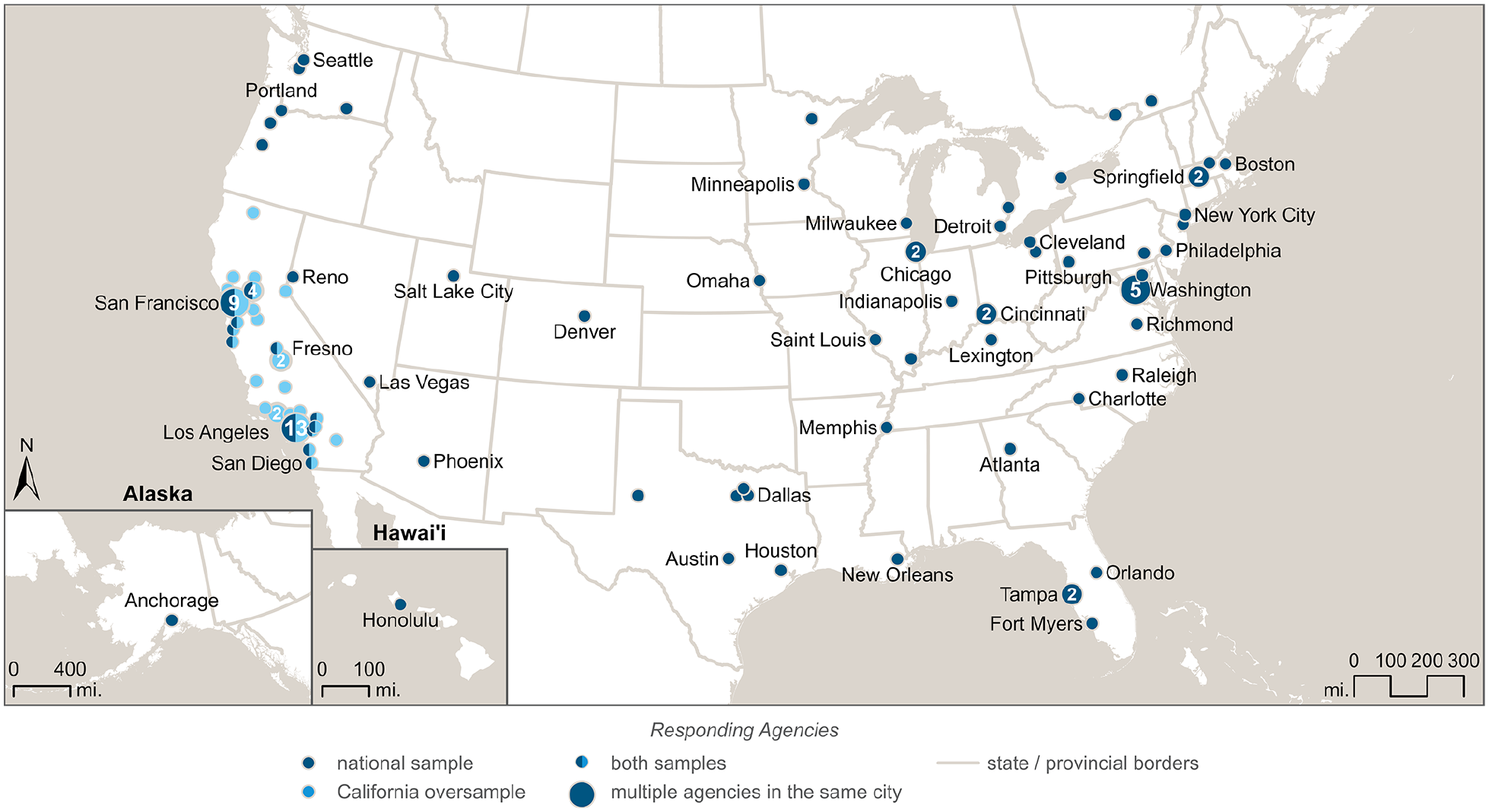
Responding Agencies
Findings
Extent of Homelessness in Transit Settings
Homelessness is unfortunately a common occurrence across U.S. transit systems, though our survey reveals that its extent varies from one city and one system to another. Table 1 shows each agency’s estimate or count of their daily unhoused population before the COVID-19 pandemic. In the national survey, almost two out of three agencies reported 100 or more unhoused people on their system daily (excluding those that responded “I don’t know”). However, only 13 operators in the U.S. sample estimated having 500 or more people experiencing homelessness on their system, nine of which are large agencies, including five on the Pacific Coast (arguably the epicenter of the U.S. homelessness crisis) and another two in the Mountain West.
Estimated Daily Number of People Experiencing Homelessness on Transit Systems
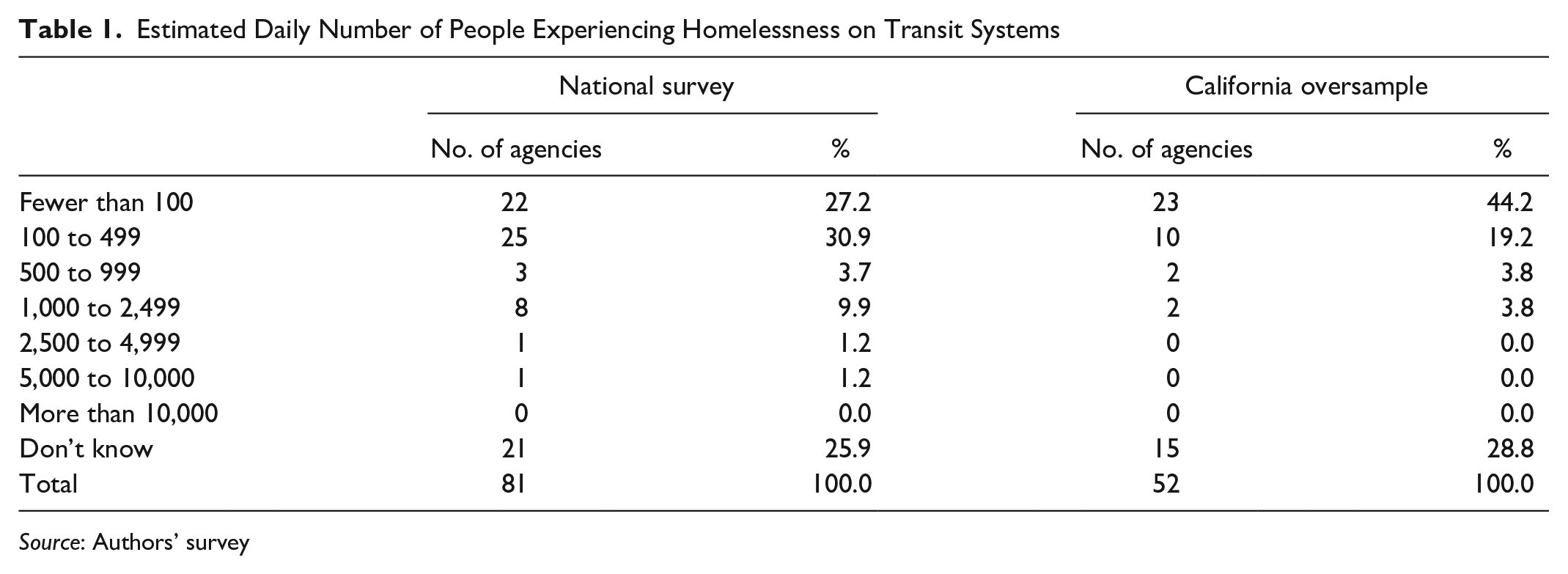
Source: Authors’ survey
The numbers given by survey respondents in most cases represent their best estimates. Indeed, very few agencies (9% of the national survey) regularly take counts of unhoused people on their system; only 19 percent have access to counts or formal estimates, partial or full, from any source. Overall, concrete data on the extent of homelessness on transit is sorely lacking.
The clear majority of agencies (57%) that offered an estimate reported rising numbers of unhoused individuals on their systems during the pandemic. Some agency staff may have perceived homelessness to be increasing on their systems because unhoused riders made up a larger share of riders, as overall transit ridership and service fell since the onset of the pandemic (Bureau of Transportation Statistics [BTS] 2021; Dai et al. 2020; Transit App 2021). However, this survey finding aligns with reports discussed above of rising homelessness on transit. This is likely primarily due to the reasons outlined earlier, which were beyond the control of transit operators. One additional reason (discussed below) that was within transit agencies’ control was the suspension of fares and fare enforcement during the pandemic.
Transit Settings for Homelessness
Unhoused riders concentrate on some transit modes more than others. Among bus operators, 91 percent classified their buses as hotspots for homelessness, while light rail (83%), heavy rail (73%), and commuter rail (62%) were each less likely than buses to be cited as settings for homelessness. However, operators reported commonly seeing homelessness on all modes but ferries and paratransit. Homelessness is concentrated more in certain settings: while 83 percent of agencies identified transit vehicles as hotspots, they listed stops and stations as the most common places for visible homelessness (89%). Unlike state DOTs, which frequently see encampments on their rights-of-way and near their facilities (Bassett, Tremoulet, and Moe 2013), these other settings were less cited. Respondents most commonly indicated major bus hubs or large intermodal stations, often centrally located, as the geographic location where most people experiencing homelessness are found.
Challenges and Concerns
Homelessness in transit settings poses a variety of challenges to transit operators, including a lack of resources, support, and training to address it and complaints from housed riders about visible homelessness. As shown in the top bars of Figure 2, 86 percent of agencies regard the extent of homelessness on their system as a challenge to some degree. Almost half (46%) of them see it as a minor challenge, while 40 percent as a major challenge. Staff at large operators in the national sample were more likely than staff at small operators to characterize the extent of homelessness on their systems as a challenge, but this difference was not statistically significant.
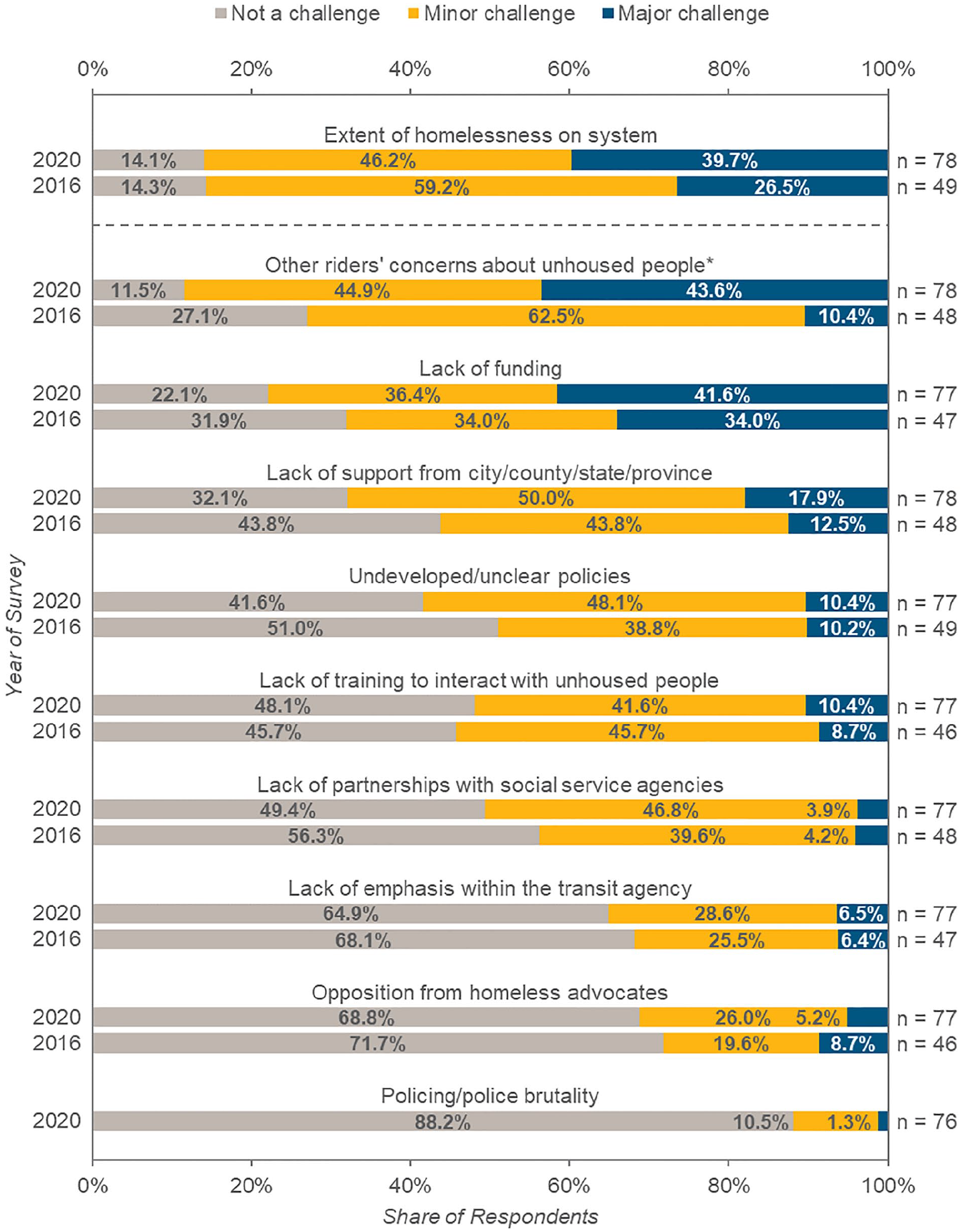
Ratings of Challenges (2020 National Survey), in Comparison with Boyle (2016)
Respondents described several homelessness-related issues as challenging. The most highly reported issues included, in descending order: other riders’ concerns about unhoused individuals; lack of funding; lack of support from city, county, state, or provincial governments; and unclear or undeveloped policies on how to address homelessness in transit settings. Large agencies (with more than 300 vehicles) were more likely than small agencies to consider the lack of adequate funding a challenge (p < .05). A large majority (88%) of survey respondents did not consider police brutality in addressing homelessness as a challenging issue.
As seen in Figure 2, which compares responses from our survey to questions of the same wording asked in Boyle’s (2016) smaller survey of transit agencies, the severity of the challenges caused by homelessness in transit settings seems to have worsened. As with many other urban issues, the pandemic likely exacerbated these challenges: 48 percent of respondents perceived the challenge of homelessness as worsening during the pandemic, and only eight percent thought it had eased. While the pandemic’s effects explain some of the difference as compared to 2016, U.S. homeless counts had already risen by almost six percent between 2016 and the pre-pandemic January 2020 count (U.S. HUD 2021) (a factor noted by transit agency staff interviewed in Loukaitou-Sideris et al. (2022)); different samples between the two surveys may also be a factor.
Homelessness generates concerns among housed riders, which may influence transit policy, insofar as they are passed along to agency staff and decision makers, who must weigh them against or alongside the needs of unhoused riders. The top bar of Figure 3 shows that 88 percent of agencies indicated that they receive complaints related to homelessness. While the prevalence of these concerns, as perceived by agency staff, remained steady from 2016 to 2020, their severity appears to have worsened. This is particularly true for concerns over aggressive behavior by unhoused people and discomfort among housed riders. And the pandemic added a new concern: 90 percent of agencies noted that housed riders are concerned that unhoused riders may be spreading disease. Respondents at large operators were statistically significantly more likely to receive complaints about discomfort from visible homelessness (p < .05) than their peers at small operators.
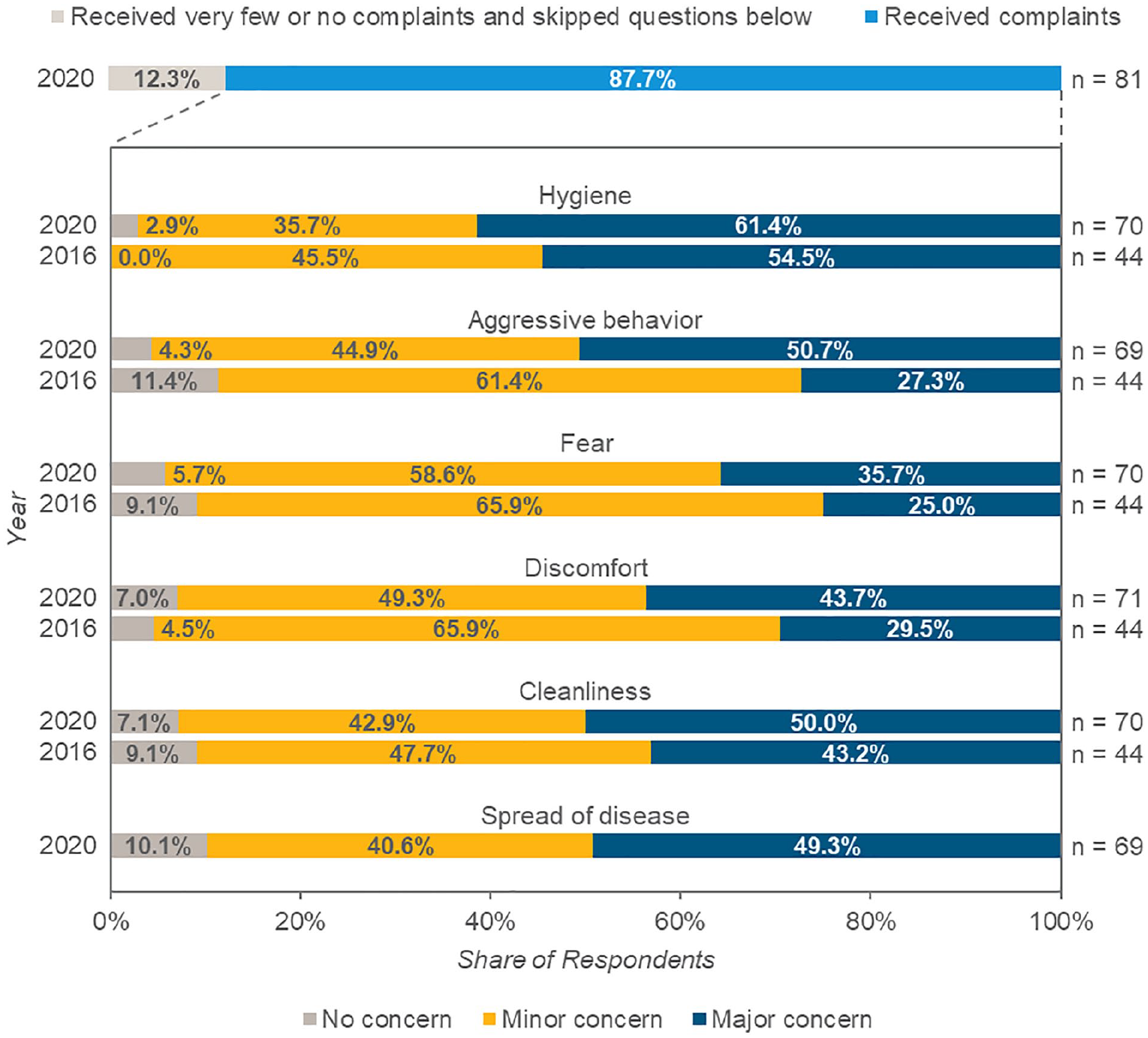
Characterization by Agency Staff of Housed Riders’ Concerns about Unhoused Riders (2020 National Survey) in Comparison to Boyle (2016)
Meanwhile, staff at six out of 10 agencies perceived that the presence of unhoused riders in transit settings had a negative effect on general ridership, and staff at almost seven out of ten agencies in the California oversample believed the same. This perception increased during the pandemic (by 6 percentage points in the national survey). However, we caution that our survey results speak only to perceptions of this effect among staff respondents, not necessarily homelessness’ actual effect on ridership numbers. Public transit use decreased significantly during the pandemic (BTS 2021; Dai et al. 2020; Transit App 2021), amid public concerns about the higher spread of the disease in enclosed environments. Given these massive upheavals in travel patterns caused by other factors, it is interesting that many transit staff also attributed depressed ridership to the larger visibility of homelessness in transit settings.
Responses to Homelessness
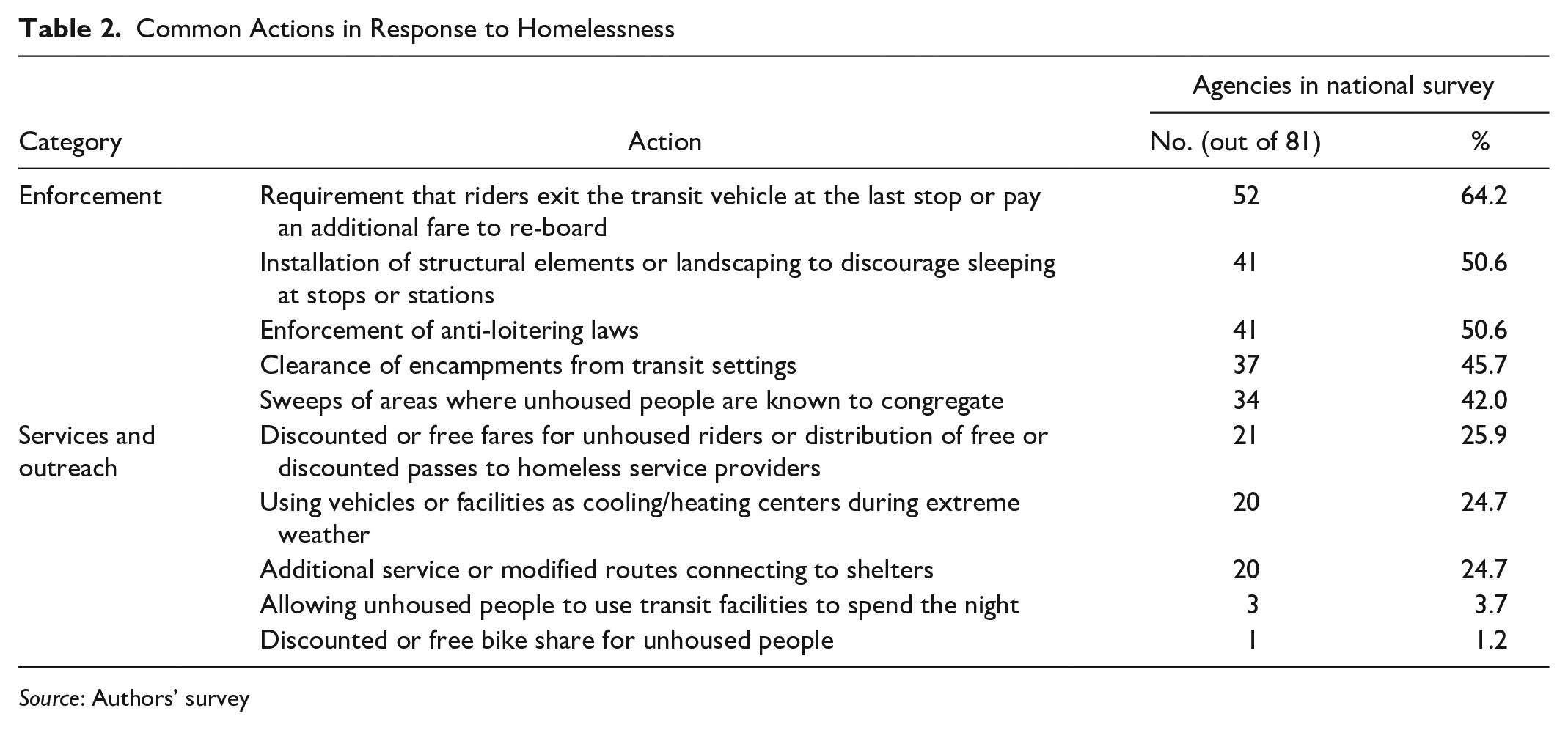
Despite all the challenges and concerns at play, only a minority of agencies (23%), mostly large operators, have developed formal policies on how to address homelessness on their systems. In the absence of formal plans, most agencies nonetheless take a number of actions in response to homelessness, as can be seen in Table 2. We classify these into two broad categories: enforcement and outreach/service actions. The plurality of surveyed agencies (56%) believed that they maintain a balance between enforcement and outreach/service actions. However, this belies the results presented in Table 2, as the frequency of reported enforcement actions was higher than the frequency of reported outreach actions. We should also note that who handles transit security varies by agency: some employ their own transit police, fare enforcement officers, or non-sworn ambassadors; others contract with local police departments or even with private security companies; and others lack formal policing arrangements on their system. We did not examine, however, whether these different types of security provision influence the outcomes of enforcement policies.
Common Actions in Response to Homelessness
Source: Authors’ survey
Many enforcement actions relate to the enforcement of municipal anti-loitering laws and other efforts to discourage or push unhoused people away from transit spaces. About half of the responding agencies clear homeless encampments from transit settings, and 42 percent undertake sweeps of areas on their systems where unhoused individuals are known to congregate. About another half also employ “hostile architecture,” such as installing arm dividers at bus stop benches to prevent their use as beds. The most common practice, however, undertaken by almost two-thirds of responding agencies, is requiring that all riders exit the transit vehicle at the end of the route and pay a fare to re-board, a protocol that disrupts unhoused riders from continually resting on transit vehicles throughout the day.
Less common are responses that provide services to riders experiencing homelessness. For example, a little over a quarter of the responding agencies indicated that they provide free or discounted fares to unhoused riders and social service providers who work with them, one-fifth allow unhoused riders to use vehicles or transit centers as shelters during extreme weather, and one-fifth have modified their service to add additional routes or service connecting to homeless shelters.
The pandemic caused a number of agencies to change the way they respond to homelessness. First, many operators increased their overall efforts (both enforcement and outreach). Despite the difficulties of in-person work during the pandemic, more agencies (30%) reported increasing their homelessness responses than those that reported decreasing them (7%), underscoring the severity of the homelessness crisis on many transit systems since the onset of the pandemic. Second, the pandemic led many agencies to develop or rethink their policies on homelessness: 42 percent of operators created or altered policies and procedures on interacting with unhoused people because of the pandemic. Policies responding to the pandemic, which particularly—positively or negatively—affected unhoused people, included suspension of fare collection (discussed below), strict enforcement of disembarking at the end of the line for cleaning and sanitizing vehicles, barring carrying bulky items on vehicles, limitation of onboard occupancy (to satisfy physical distancing requirements), mask distribution, and installation of hand-sanitizing dispensers (Mader 2021). Finally, some agencies reported initiating new partnerships because of the pandemic.
During the pandemic, many agencies stopped collecting fares, in large part to reduce the risk of virus transmission at fareboxes, often located close to drivers. In our national survey, we drew a distinction between three types of agencies: 44 “fare-free” operators (those that formally suspended transit fares on at least one mode for at least part of the pandemic), 16 “honor systems” (those that paused fare inspection and enforcement checks on at least one mode for at least part of the pandemic but were not fare-free), and nine “fare-collecting” operators (those that retained fares as normal). Agencies in the first two groups were more likely to report increased homelessness on their systems than those agencies that did not suspend fare collection or inspection. However, neither the difference between fare-collecting operators and the other two groups together nor the difference between fare-free operators and the other two groups together was statistically significant—though the three subsamples were quite small and therefore difficult to compare definitively.
In 2020, U.S. transit agencies were also buffeted by protests nationwide following the killings of George Floyd, Breonna Taylor, and Ahmaud Arbery. Protests affected operations at the street level, such as rerouting buses around demonstrations, and at the system level, such as agency-wide shutdowns during curfew hours (Nguyen 2020) and lending buses to carry police officers to, and arrestees from, areas of confrontation (Do and Walker 2020; Nelson 2020). Despite the dramatic effects of these protests on transit and discussion by activists of the interplay of transportation and policing, few of the operators surveyed (23%) reported changing their policies around homelessness in response, and only three agencies reported reducing policing.
Implementation and Resources
Implementation of responses to homelessness requires resources. However, crucially, the large majority of agencies (74%) do not have a dedicated line item in their budgets for such actions. Only four agencies in our survey reported receiving funding from outside sources (federal, state, regional, or local government) to address issues of homelessness, two of which were in California, one in New York, and one in Texas. Instead, 47 percent of the responding agencies drew funding from their general operating funds, while another 34 percent indicated that they do not spend funds specifically on addressing homelessness. Only nine out of the 81 agencies that responded to the survey question about funding allocate $100,000 or more annually to respond to homelessness, and only three of these allocate $1 million or more.
Potentially as a result of lack of funding, the vast majority of agencies (85%) reported not having specifically designated staff addressing issues of homelessness in their systems. Only two of the 81 agencies indicated having six or more staff members dedicated to such issues, while 61 agencies reported having no dedicated staff. Such lack of dedicated staff is widespread, with no statistically significant difference between large and small operators. Agencies were divided in their responses about employee training: 60% train their frontline employees or all employees on how to interact with unhoused riders, while the remaining do not.
Partnerships
Given that transit agencies have limited resources, it is not surprising that most (89%) enter into partnerships and collaborations with other entities to address homelessness. Almost three out of four agencies have partnered with local law enforcement, about six out of ten have partnered with public social service and public health agencies, and 55 percent have a partnership with a nonprofit or private foundation or organization. Large agencies were as likely as small agencies to report partnerships with homeless shelters, public social service agencies, and other local governments. The growth in partnerships compared to the findings of Boyle (2016) could indicate a shift toward a more holistic approach to addressing homelessness. However, the high number of partnerships could also be the outcome of a persistent lack of resources among transit agencies in the face of increasing homelessness across U.S. cities. Indeed, despite the rising number of partnerships, about half (51%) of survey respondents considered a lack of partnerships with social service agencies to be a challenge for their agency, and over two-thirds (68%) saw a lack of support from city, county, and state governments as a challenge.
Not all partnerships are considered equally effective and successful. More than half (57%) of the agencies that rated the success of their partnerships said that those with nonprofits or social service agencies were the most successful. Meanwhile, 40 percent of responding agencies listed partnerships with law enforcement as the most successful.
Self-Evaluation of Responses to Homelessness
Most survey participants considered their agency’s responses to homelessness as “somewhat successful” (34%) or “neutral” (44%); only a few considered them as either “unsuccessful” (16%) or “very successful” (6%). Although respondents working at large operators were slightly more likely to deem their efforts successful, the difference between them and their peers at small operators was not statistically significant. The specific strategies most likely to be rated moderately successful or very successful were all enforcement-related, while strategies to assist people experiencing homelessness were rated as slightly less (though still largely) successful. As we discuss below, different definitions of “success” might make enforcement strategies seem successful to survey respondents by one measure—reducing the number of unhoused people on the system—but outreach policies seem less successful by another, more difficult metric—improving the lives of the unhoused.
We also asked survey respondents to list the primary positive outcomes and major challenges or drawbacks of their agency’s efforts to address homelessness. Respondents at slightly over half (53%) of responding operators listed positive outcomes for the operator itself, including fewer unhoused people on the system, higher customer satisfaction or fewer customer complaints, better trained or more confident staff, and better coordination with partners. However, respondents at more than a third (39%) of agencies found that the primary positive outcomes from their efforts were improvements for people experiencing homelessness, including connecting them to housing resources, providing more social services, and offering free or reduced fares. Although both of these sets of responses are desirable, it is interesting that some agencies implicitly defined success on the issue of homelessness as improved operation of their system (because of fewer unhoused riders), while others defined it as improved quality of life for unhoused people. Among the challenges and drawbacks of agencies’ homelessness efforts, respondents most often cited inadequate funding, a sense that their efforts were of low priority to law enforcement agencies, and negative effects of their efforts on other riders.
Discussion
Needs and Strategies in Addressing Homelessness on Public Transit
During the pandemic, when transit ridership dropped significantly nationwide, public libraries closed, and many shelters reduced capacity, transit vehicles remained among the only available shelters for many unhoused individuals. This is possibly why the majority of transit agency respondents perceived homelessness as a greater challenge since the onset of the pandemic than before. The pandemic also changed the way that many transit agencies responded to visible homelessness on their systems, adopting a variety of strategies, some more potentially helpful to their unhoused riders and others more punitive. The suspension of transit fares and the distribution of masks, sanitizer, and protective gear targeted all transit riders but may have especially aided unhoused riders. On the contrary, the closure of transit center buildings, the enforcement of disembarking transit vehicles at the end of their routes, and policies against the carrying of bulky items on transit vehicles must have been particularly hard for unhoused riders.
The pandemic may have accentuated the crisis; but even when it subsides, homelessness is likely to remain in the absence of a larger social welfare policy and affordable housing for the poor. How can transit agencies respond in ways that help their unhoused riders while providing service and mobility for all riders, housed and unhoused? In what follows, we discuss suggestions, informed by our survey.
The need for better data
We found that the vast majority of agencies do not count the number of unhoused individuals on their system. However, U.S. HUD requires that regional housing agencies conduct at least biennial “point-in-time” counts of people experiencing homelessness (U.S. HUD 2021). At a minimum, the portion of unhoused individuals in transit settings in such counts should be disaggregated. Ideally, transit operators could also sponsor their own counts, especially before and after adopting new policies. Operators who partner with law enforcement or service providers should also ensure through contract language that statistics on the number of contacts, referrals to shelter and housing, and other relevant metrics are regularly collected and shared publicly. Assessing the scale of the crisis and evaluating possible policy responses requires such data collection. By not counting the people experiencing homelessness, transit policymakers implicitly send a message that these people do not count.
The need for plans, policies, and evaluation metrics
The survey showed that the vast majority of agencies do not have formal policies or protocols on how to address homelessness on their systems. Many transit operators are often subject to municipal ordinances and local law enforcement policies, which may influence their agendas and actions. Thus, they typically use combinations of law enforcement and outreach strategies and ad hoc case- or context-specific interventions to address the issue. As homelessness is a widely present and persistent challenge in transit settings, it makes sense, however, for agencies to develop formal plans, policies, and protocols on how to address the needs of unhoused riders. Regard for their well-being and mobility needs must be built into agencies’ strategic plans and other long-range planning documents. Key performance indicators should include metrics like the number of unhoused riders referred to and placed into short-term shelter beds and long-term housing by partner organizations of transit agencies, or given other needed resources such as access to mental and physical health care.
The tension between punitive and outreach strategies and the need for more outreach
Scholars such as DeVerteuil (2014) and DeVerteuil and Wilton (2009) have described “spaces of abeyance” as places to contain or obscure populations deemed “surplus.” The displacement of unhoused individuals from other public spaces (especially those frequented by higher income populations), combined with a larger failure of U.S. housing policy to accommodate them, has led transit to become a space of abeyance (and survival) for unhoused people. Yet many transit managers, especially during the pandemic, have pushed against this, through enforcement actions that push unhoused riders into other spaces of abeyance and/or partnerships with shelters and services that provide not just abeyance but care or sustenance. As DeVerteuil (2014) argues, punitive or controlling strategies are often inherently linked to more supportive approaches—perhaps as alternative or reaction, but especially as coexisting or dependent impulses of how to handle marginalized populations in cities. We see this tension between punitive and outreach strategies play out on U.S. transit systems today.
While agencies seem more prone to using enforcement than outreach strategies, we also notice a shift to outreach strategies compared to survey findings from Boyle (2016). Empirical studies about homelessness, discussed above, find that law enforcement alone cannot address the root problem, while outreach and support may be a more effective approach. In other words, removing people experiencing homelessness from transit settings would frequently result in their reappearance at the same or another setting later, as they have no other places to go. Seeking to connect these individuals to shelter opportunities, social services, and medical or mental health resources presents a more effective way to respond to the issue and even possibly help some individuals get out of homelessness. One challenge, however, is that many transit agencies may not be familiar with tasks relating to community engagement and outreach to unhoused individuals. Therefore, joining forces with other municipal agencies, social service providers, and nonprofits is worth pursuing.
The need of coordination and partnerships
Given the scale of the crisis, collaboration and partnerships with other agencies and organizations are indeed vital, and most agencies are already engaged in such partnerships. In addition to the added expertise on matters relating to the welfare of unhoused individuals, partnerships may also lead to cost-sharing and added resources for transit agencies. These collaborations can focus on connecting those experiencing homelessness to the broader social service system, beyond what operators directly administer. In addition, transit agencies should play a role in new or existing regional or citywide efforts addressing homelessness. Finally, partnerships should be tailored to the role best suited for each partner. For instance, it may make more sense to engage a social service provider to conduct outreach on the system with specially trained caseworkers, rather than trying to shoehorn this role into a pre-existing contract with a law enforcement agency.
The need for external funding
The survey showed that the vast majority of agencies do not receive outside funding to address homelessness, and only a handful have dedicated staff or a budgetary line item for this challenge. As homelessness is on the rise, transit operators and industry groups therefore should look to lobby for grants and funds to respond to the homelessness crisis and hire and train the necessary personnel to do so. While it may seem unfair to transit agencies that they need to address homelessness, a problem whose root causes they cannot solve, agencies can use that potential sense of unfairness as a powerful argument for greater funding and resources, instead of a reason to ignore the problem.
Limitations
The survey revealed the actions and experiences of transit agencies and perceptions of their employees. We did not directly collect actual counts or views of those experiencing homelessness, and this represents a limitation of this study.
Our empirical work took place during the pandemic, which made face-to-face interviews with unhoused individuals impossible. We hope that future research projects will be able to include their voices. Nonetheless, the subject of our survey, the ways that transit agencies view and respond to homelessness, has a definite bearing on the mobility of unhoused individuals, given that these agencies decide on and implement policies that affect unhoused individuals’ travel and shelter.
Conclusion
Half a century after its reemergence as an urban problem, homelessness has risen in many North American cities (National Academies of Sciences, Engineering, and Medicine 2018) and has become particularly visible in transit environments. Yet the issue of homelessness in transit settings is understudied by scholars and tackled by many operators without structured plans. Our survey casts light on the extent of the crisis and responses to it. We find that transit homelessness is prevalent in some cities, especially those on the West Coast, and in certain central transit settings. The COVID-19 pandemic exacerbated the homelessness crisis, as it not only brought contagion and disease but also economic hardship to many, forcing the most vulnerable onto streets and transit. The perception of the majority of the transit staff surveyed was that the number of unhoused riders increased during the pandemic.
Most transit agencies face challenges in responding to the needs of people experiencing homelessness on their systems, including a lack of funding, staff, and formalized policies; a weak safety net beyond transit; and negative reactions and concerns from housed riders. Nevertheless, many operators increasingly enter into partnerships with other public agencies and nonprofits to offer some combination of enforcement and outreach strategies.
At a fundamental level, the path an agency chooses in addressing homelessness depends on how it defines success. In an open-ended question about the most positive outcomes of their agency’s efforts, many respondents framed their answers in terms of success for their agency itself and its operations, but not necessarily based on the welfare of people experiencing homelessness. While “better-trained staff” and “better coordination with partners” may indirectly help unhoused people, defining better training and better partnerships as successes in and of themselves confuses means with ends. This difference in framing becomes even more problematic when agencies define “fewer unhoused people on their system” as a goal. Characterizing an agency’s goal in this way incentivizes pushing as many unhoused people as possible off the transit system and discourages beneficial programs like offering them free or discounted fares.
Based on our survey and prior studies, we believe that the truly effective efforts at addressing homelessness stem from defining success in terms of improvements in the lives and mobility of unhoused riders. To be sure, improving the welfare of unhoused individuals should be a collective effort, and a transit agency cannot be expected to house the unhoused, when its primary mission is transportation. However, centering the mobility and well-being of unhoused riders when defining success fits within public transit’s long-established social service role and is an important first step to improving outcomes for them and for all riders. Indeed, transit agencies have a responsibility to ensure that their services are easily accessible to their unhoused riders and also help these riders access assistance and support. But addressing the challenge of homelessness in transit environments is a larger social issue that requires state and municipal support and resources, collaboration, and coordination of different entities.
Supplemental Material
sj-pdf-1-jpe-10.1177_0739456X221121612 – Supplemental material for A Bus Home: Homelessness in U.S. Transit Environments
Supplemental material, sj-pdf-1-jpe-10.1177_0739456X221121612 for A Bus Home: Homelessness in U.S. Transit Environments by Jacob L. Wasserman, Anastasia Loukaitou-Sideris, Hao Ding and Ryan Caro in Journal of Planning Education and Research
Footnotes
Declaration of Conflicting Interests
The author(s) declared no potential conflicts of interest with respect to the research, authorship, and/or publication of this article.
Funding
The author(s) disclosed receipt of the following financial support for the research, authorship, and/or publication of this article: We would like to acknowledge the University of California Institute of Transportation Studies (UC-ITS-2021-13 and UC-ITS-2021-54) for supporting this research, from funding the State of California through the Public Transportation Account and the Road Repair and Accountability Act of 2017 (Senate Bill 1).

Supplemental Material
Supplemental material for this article is available online.
Notes
Author Biographies
References
Supplementary Material
Please find the following supplemental material available below.
For Open Access articles published under a Creative Commons License, all supplemental material carries the same license as the article it is associated with.
For non-Open Access articles published, all supplemental material carries a non-exclusive license, and permission requests for re-use of supplemental material or any part of supplemental material shall be sent directly to the copyright owner as specified in the copyright notice associated with the article.
