



Abstract
Contrasting cases in Toronto, New York, and Vancouver, we identify benefits and drawbacks associated with the publicly owned variety of community land trust, which we call a public land trust (PLT). Public ownership can obviate the need to finance a land sale, and enable sustained access to ongoing technical assistance and professional expertise, thereby reducing burdens on community capacity. While a degree of community control can also be maintained with public ownership, it may nonetheless be at greater risk when political winds change. In as much as PLTs secure affordable tenure and community control, they may warrant greater policy/planning consideration.
Introduction
Community land trusts (CLTs) are typically defined as non-profit, non-governmental organizations which own land, most often on behalf of a group of housing unit owners. By enabling community and resident control of land, CLTs offer the promise of escaping the pressures of the market to permanently secure tenure and reduce gentrification-related displacement, while avoiding the need for heavy and sustained government intervention to do so (Davis 1994; Davis, Algoed, and Hernández-Torrales 2020; Ehlenz and Taylor 2019); Choi, Van Zandt, and Matarrita-Cascante 2018). While the traditional CLT definition thus typically precludes public-sector land ownership, some land trusts do feature government ownership. Such trusts exist in multiple cities, including Canada’s two highest housing-cost cities, Vancouver and Toronto, as well as in U.S. cities such as Flagstaff and Irvine (DeFilippis, Stromberg, and Williams 2018). In academic research, non-governmental CLTs nonetheless continue to be cast as an orange that is the only fruit, to borrow from the title of Jeanette Winterson’s prize-winning 1985 novel, Oranges Are Not the Only Fruit. But traditional non-governmental CLTs are not the only type of land trust; they are not the only fruit. 1 As contrasted with traditional CLTs, what are the benefits, drawbacks, and broader theoretical and practical implications of direct government ownership and involvement in what we call public land trusts (PLTs, that is, trusts with a government landowner), largely ignored to date in peer-reviewed literature?
Contrasting public with community ownership of land trusts via analytic case studies across three high-cost North American cities (New York, Toronto, and Vancouver), we find two primary benefits of maintaining a formal and direct public-sector ownership role. First, by obviating the need to finance a land sale by holding it as a public asset, PLTs may more readily leverage the power of the state and publicly controlled land in high-cost cities, potentially at greater scale, as the Toronto and Vancouver cases suggest. Second, by maintaining a formal ownership role, government can step in and provide technical assistance, administrative support, and operating guidance, where and when appropriate, resulting in improved outcomes that help assure its long-term viability, and reducing the degree to which community capacity is taxed to maintain the trust, as comparisons between the Toronto and New York cases attest. Such benefits do not come, however, without costs or drawbacks. PLTs may require particular political circumstances to enact, and may be perceived to be exposed to privatization risk, partial loss of community control, or shifting government support as political winds change, as the Toronto case suggests. We also find, however, that it may be possible to structure a public–community partnership to mitigate such concerns, as in Vancouver. Policymakers and planners may thus wish to consider public ownership models for land trusts, particularly in high-cost cities where political climates may enable the effective structuring of public–community partnerships to empower residents and other civil society stakeholders to play an active governance role on publicly owned land.
Parsing Government and Community Roles in Land Trusts
In both peer-reviewed and gray literature, the question of the respective roles played by government versus community actors has frequently appeared as a background issue in the implementation and development of urban land trusts. Although today’s CLTs are frequently associated with high-cost cities, where governments are actively experimenting with how to assist them (Moore and McKee 2012), the first CLT was a rural farm experiment, established in 1969–1970 by Black civil rights organizers in the American South (Davis 2010; Ehlenz and Taylor 2019). CLTs quickly spread to urban settings, where the challenges of implementing the model while relying primarily on community action without explicit government support soon became apparent. For example, one of the first urban CLTs was D.C.’s Columbia Heights Ownership Project, which began to acquire properties in 1976 (Institute for Community Economics [ICE] 1982). Due to “the burden of rehabilitating and managing dilapidated buildings with
CLTs achieved more durable success beginning in the early 1980s, when “state and local governments began to contribute to the support infrastructure for CLTs” (Meehan 2014, 123). Efforts in Boston, MA, and Burlington, VT, where local governments stopped short of owning the land but played a more active role in the process, are indicative of the myriad roles played by the public sector in CLTs’ development. In Boston, the Dudley Street Neighborhood Initiative (DSNI) CLT (Engelsman, Rowe, and Southern 2018), still in existence today, acquired condemned land and condemnation powers from city government. This was the first known instance of a government voluntarily deeding land and condemnation power/eminent domain to a community organization, and was the direct result of sustained community activism (Davis 2010; Meehan 2014). In Burlington, then-Mayor Bernie Sanders’ administration used myriad public policy tools to enable a CLT, including
a $200,000 seed grant and . . . staff support from the municipal bureaucracy to shepherd the organization into existence. The city later made a significant loan from its pension fund, which was matched by the Burlington Savings Bank and bolstered with funds from U.S. Department of Housing and Urban Development programs to make initial home purchases affordable. To provide a more sustainable source of revenue, the Burlington Housing Trust Fund was created in 1988, bankrolled by a small increase in property taxes. (Blumgart 2016)
Accordingly, scholars have repeatedly affirmed that community mobilization and activism efforts, which provided the impetus for founding many CLTs, can also be directed to secure state support (Bunce 2016; Engelsman, Rowe, and Southern 2018; Meehan 2014; Wolf-Powers 2014). Consistent with a history of community-welcomed government support of CLTs, Angotti (with Jagu 2007) noted that although CLTs often require public subsidy and support, such subsidy is justifiable given that CLTs can better secure long-term affordability than many other affordable housing models, which often lack sufficient, permanent protections (e.g., expiries/sunset clauses) from long-term market speculation forces.
Nonetheless, Meehan (1996) argued CLTs with direct public-sector involvement in their governance or ownership could become co-opted, experience mission drift, or feel constrained in disagreeing with government. Towey (2009) noted that Chicago’s CLT is effectively managed by the city’s housing agency through mayoral board appointees, but the drawbacks, benefits, and implications of this arrangement are unclear. In observing that governments sometimes retain land ownership in CLTs, as in Flagstaff and Irvine, such trusts are often simply presumed an imperfect form of CLT, with government ownership conflated with a lack of meaningful community and resident control, participation, or engagement (Davis with Dubb 2011; Davis and Jacobus 2008; DeFilippis, Stromberg, and Williams 2018; Thompson 2020). Indeed, when there is a lack of community involvement, CLTs may become less focused on building community or generating liberatory politics, and more focused on operating as “just” another technocratic permanently affordable housing tool (DeFilippis, Stromberg, and Williams 2018; DeFilippis et al. 2019; Kruger et al. 2020). But, as these same scholars note, such loss of community and resident participation and control can also occur with a non-governmental landowner, when non-profit staff take control of a CLT. It is possible that such risks may be compounded when CLTs are enabled by governments merely as tokenistic, technocratic responses of political-economic elites to housing unaffordability; such governments may also be amenable to CLTs as to offload affordable housing responsibility onto the community, in a form of “soft neoliberalization” (DeFilippis, Stromberg, and Williams 2018). Community ownership is often thus conceived of as necessary but not sufficient to achieve community control (Lowe and Thaden 2016; Spicer 2020; Spicer and Casper-Futterman 2020).
Beyond the studies cited above, which indirectly address concerns surrounding various government versus community roles with respect to ownership and control, there has been limited systematic investigation of the specific, concrete effects of direct government involvement on participation or control in land trusts. What is known, empirically, is that the “idealized” CLT model—one using the classic tri-partite 2 community governance and ownership model—is not the only organizational structure that exists among entities using the CLT label (Lowe and Thaden 2016). It is not even the dominant model: Sungu-Eryilmaz and Greenstein (2007), in the first comprehensive survey of American CLTs, estimated that such trusts accounted for only 30 percent of CLTs. Beyond variability with respect to their use of tri-partite community governance, CLTs use a wide variety of ownership and partnership structures for the buildings/structures on their land, often in ways which can enhance CLTs’ ability to achieve their goals of securing permanently affordable tenure and community control. Moore (2018) found that U.K. CLTs increasingly partner with local non-profit housing associations, enabling them to combine community leadership with access to professional, technical expertise. Ehlenz (2018) analyzed CLTs deployed with limited-equity housing cooperatives (LECs). She found each model offers distinct benefits and drawbacks, with possible gains associated with joint use.
Notwithstanding the concerns regarding direct government involvement as reviewed above, another of the diverse ways in which land trusts can be structured is with the government as the landowner. As Angotti (2011, 122) noted, “communities do not necessarily have to own the land to have effective control over how it is used.” Botzem and Besedovsky (2021) observed that in municipal housing corporations in Berlin, communities and residents can exert control without ownership, through grassroots movements which seek to keep these entities accountable. Might a degree of community control in CLTs thus be possible with public ownership? In fact, the possibility of government playing a formal ownership role had been explicitly considered by early CLT advocates. In The Community Land Trust: A Guide to a New Model for Land Tenure in America, one of the first comprehensive concept and visioning guides for CLTs, Swann et al. (1972) stated that city government itself can effectively act as a land trust’s owner, in a section detailing provisions for different models of an “urban land trust”:
Numerous opportunities may exist . . . for community groups
Given the expressed concerns about a potential loss of community control associated with government ownership, however, what compelling rationale might there be for a government to retain ownership and play a direct, ongoing role on land which might otherwise be community-owned?
Two justifications are suggested by existing literature. The first is linked to the role the public sector can play in maximizing one of the central benefits of land trusts: it can eliminate rising, market-based land costs as a long-term barrier to acquiring and maintaining land to secure urban tenure. As per Huron,
the value of the housing is separated from the value of the land on which that housing sits. As noted earlier, in urban areas,
In as much as the public sector can use its resources and capabilities to reduce land acquisition costs for CLTs in expensive markets by holding ownership of the land (as suggested by Swann et al. 1972), might this present a compelling reason to consider public ownership? The second justification is linked to the potential role of government in reducing the burden on community and resident capacity that CLTs impose. Many community residents who are at risk of displacement or are experiencing housing precarity, and who might benefit from some of the CLT model’s benefits, may nonetheless lack the interest or time to assume the burdens associated with community ownership. As noted earlier, the first CLT in D.C. failed in part due to the labor burden associated with an entirely community resource-dependent implementation (Davis, Rosenberg, and Acker 2019; ICE 1982). At other D.C. LECs which formed around the same time, Huron (2018, chapters 3, 5) found that many potential and actual residents were primarily seeking affordable housing, and had neither the desire nor time to participate in the intensive roles and responsibilities involved in collective tenure. This is consistent with other research on such “third way” (Wegmann et al. 2017) collective tenure models: members of marginalized groups who reside in equity-restricted housing cooperatives, for example, may find the responsibilities of collective ownership and governance stressful, yielding negative effects in their lives (Wasylishyn and Johnson 1998). Might public ownership reduce this burden, by enabling the government to provide an ongoing degree of technical assistance and professional expertise, reducing the degree to which CLTs’ collective governance taxes community and resident capacity?
If such benefits can be realized, how might the potential control-related drawbacks of a direct public-sector role be mitigated? Long-standing, widely cited research in institutional economics, which with the notable exception of Fainstein (2018) has not been well applied to either urban planning in general, or housing and CLTs specifically, has shown that ownership and control in organizations and enterprises, typically investor-owned corporations, can be functionally separated (Berle and Means 1932; Chandler and Alfred 1962; Lazonick 1988; Lazonick and O’Sullivan 2000). To achieve such separation, the property rights conveyed with ownership can be structured and held in such a manner that they do not automatically convey full management and governance control to the equity owner. There is no reason that such separation of ownership and control could not be achieved in a land trust model which is structured as a public–community partnership, rather than a public–private partnership (PPP), in which a government landowner relinquishes a degree of control to partner community organizations. It is true that when she argued that “the left needs to devise its own version of the public-private partnership,” Fainstein (1990, 42) was referring to partnerships between government and investor-owned corporations, but there is nothing to prevent versions between government and community, as well, provided that the community can maintain “a sense of ownership” through voice and influence in process, outcome, and distribution (Lachapelle 2008). Despite this possibility, and despite the potential rationales for public ownership reviewed above, its benefits and drawbacks have not been systematically examined in empirical CLT literature.
Research Method and Case Selection Justification
To examine this question, using document analysis and interviews with key informants, we developed comparative analytic case studies of land trusts to identify relevant control and ownership features of two different public ownership models, to contrast with another case operating using a “classic” community ownership approach. Consistent with existing comparative case study approaches in planning as developed from long-established sociological and political science–based approaches (Krehl and Weck 2020), in selecting cases, we sought to reduce other sources of variation by identifying areas where persistent housing unaffordability is a key driver of local interest in land trusts. As to enable analysis of challenges and benefits that occur over time, we also focused on well-established, mature trusts. We identified such cases across three high-priced North American cities: Toronto, Vancouver, and New York. Two differently structured, publicly owned cases (which we refer to as public land trusts, or PLTs) in the first two cities are contrasted with traditional, non-governmental CLTs in the third. Documents analyzed (n = 82) included policy reports, legislation, web sites, and collateral informational material produced by the land trusts, as well as ephemera such as board meeting minutes and field notes from a scholar-activist previously involved with New York CLTs (the late Peter Marcuse).
Document contents were thematically coded and analyzed, using a standard, fixed coding approach (Allen 2017) with respect to the varying roles of government and community as pertains to the trusts’ formation and ongoing maintenance. By inductively and iteratively applying Lachapelle’s (2008) three dimensions that contribute to a sense of ownership in community development (voice/influence in process, outcome, and distribution) to the case data, we identified five dimensions through which to operationalize and evaluate salient roles of community versus public-sector land trust actors: ownership/finance, formal governance, affordability, civic engagement, and political context.
Interviews (n = 17) were conducted in all three cities. Key informants in all three cities included city government housing planners, land trust board members and staff (at the subject trusts, as well as at other, new/emerging trusts), non-profit housing developers, advocacy groups, and land trust residents in two of the cities. One author also resides in a housing unit located on the Toronto land trust, while another author was a resident-owner in housing which had been part of the same city program as a New York CLT. The questions asked of informants addressed distinctions and similarities between different land trust approaches, particularly with respect to the roles of the state versus community.
One might question whether cases from Canada, historically perceived to possess a slightly stronger welfare state 3 and more progressive politics, are comparable with the United States. Do Canadian jurisdictions benefit from greater legislative authority or stronger political appetite for public ownership, making it difficult to compare with U.S. cities? It is true Canada’s high-cost cities have experience with public ownership of physical assets and structures: Toronto’s CN Tower and Downsview Park Airport redevelopment are owned by crown corporations, effectively arms’-length public entities. But comparably high-cost U.S. jurisdictions also retain state-owned land leased for development, as well, using similar structural arrangements: Roosevelt Island and Battery Park City are two high-profile New York examples. The United States also has publicly owned housing land trusts: beyond Flagstaff and Irvine, mentioned earlier (DeFilippis et al. 2019), the Presidio Trust in San Francisco contains housing units, where residential tenure preference is given to the site’s commercial tenants. Meanwhile, other American CLTs have introduced formal government roles, as noted earlier (e.g., Chicago). A review of broader U.S.–Canadian housing policy differences and similarities is offered as a Methodological Appendix.
Case Overviews and Summary Facts
We first briefly review the facts and background features of the primary cases in the three cities (Table 1), before offering a cross-case comparative analysis.
Case Overviews and Summary Facts.
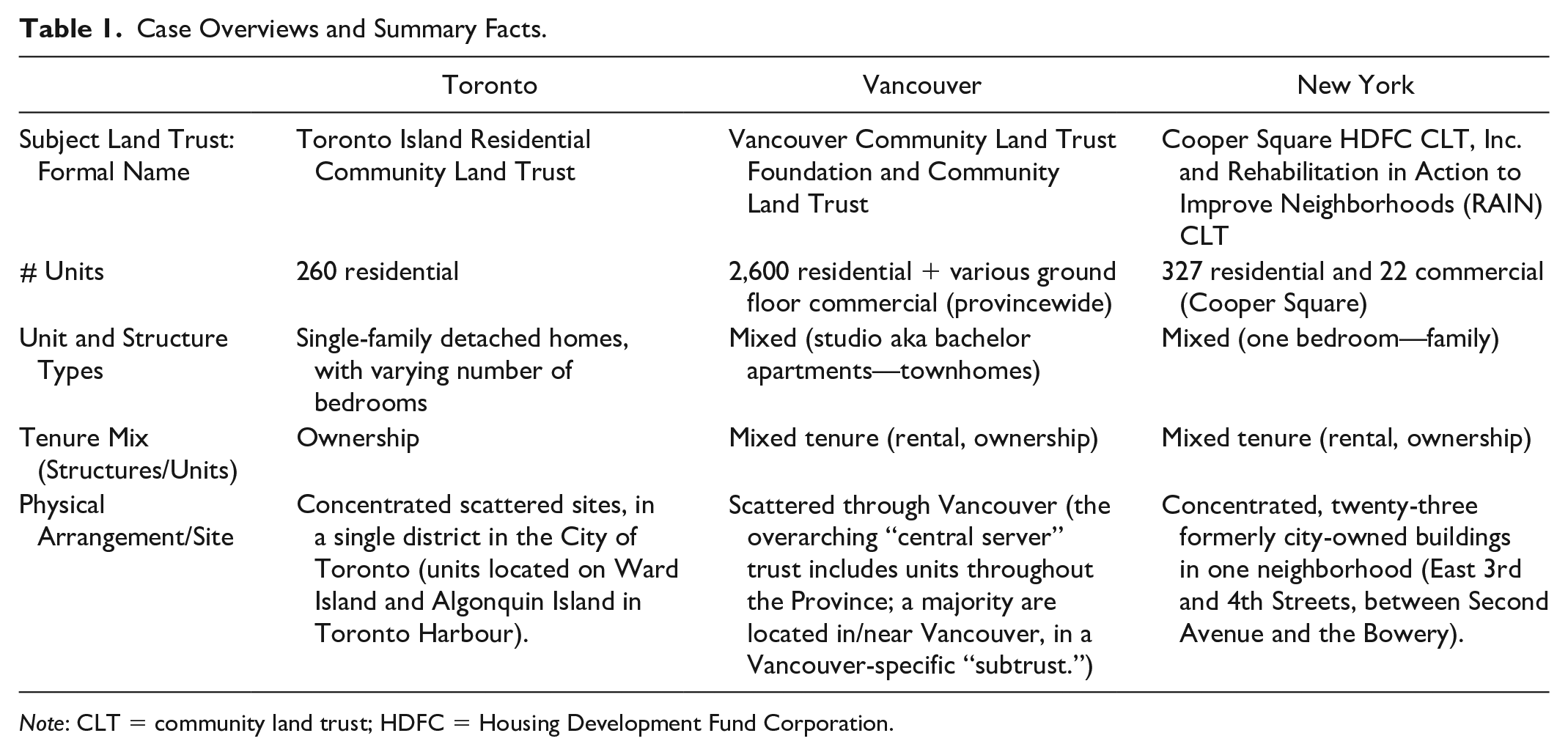
Note: CLT = community land trust; HDFC = Housing Development Fund Corporation.
Toronto Island Residential Community Land Trust
The Toronto Island Residential Community Land Trust was formed in 1993 through provincial legislation, The Toronto Island Residential Community Stewardship Act. Despite its name, the trust is not owned by the community, but rather for the community, by the provincial government. The PLT solution aimed to prevent both economic eviction and windfall profit on public land and preserve a permanent residential community. The current community consists of 260 homes housing 620 people. Current average home prices are just over half the Toronto City average (unadjusted for location or home type).
The Toronto Islands are accessible by a short public ferry from the Downtown Waterfront and as such has always been a desirable destination, located adjacent to the city’s heart. Between 1860 and 1930, the islands grew into a popular residential and recreation destination. Homes were built on leased land, renewed year over year (Gibson 1984). In the late 1940s, the city reviewed its lease policy and began to consider other options for the islands. Community resistance took many forms, and visions for the islands were varied. By the 1960s, the government stopped renewing leases and began demolishing homes for a public park. A small community remained on the east end of the islands which mobilized and advocated for permanence (Gibson 1984). Community mobilization spanned thirty years, spurring many lawsuits, publicity campaigns, and some civil disobedience. The final negotiation involved three levels of government; the remaining residential area was transferred to provincial land ownership and secured with a law that formalized the trust and granted it a ninety-nine-year lease. As a result of this highly charged and lengthy political process, the trust involves an unusual patchwork of regulations, reconfiguring typical divisions of private and public benefits and responsibilities. Today, resales are restricted to a purchasers’ list managed by the trust, and price appreciation is limited by a formula which precludes windfall profits. 4
Vancouver Community Land Trust Foundation and Community Land Trust
The Vancouver Community Land Trust Foundation is an arm’s length affiliate of Community Land Trust, an entity which operates and manages housing units on behalf of multiple land trusts in British Columbia (BC). Initially, the Community Housing Land Trust Foundation (CHLTF), a non-profit, non-governmental trust created and run by the non-profit Cooperative Housing Federation of BC (CHFBC), was established in 1993 and seeded with 354 units of existing cooperative housing. In response to a 2012 Municipal Request for Expression of Interest (RFEOI) arising from a Mayoral Task Force on affordable housing, a separate land trust in Vancouver was created in 2013–2014: the Vancouver Community Land Trust Foundation, with the city leasing four public land sites to the trust to develop 358 new units. This expansion was driven by citywide public and not-for-profit actors, rather than by a specific neighborhood’s community, and local actors use the term “social-public partnership” to refer to this arrangement (cf. Menser 2018; Patten 2015). Since then, a third trust, Community Land Trust Foundation of BC, was created to further develop and acquire units in the province, including in Greater Vancouver. Furthermore, Vancouver has subsequently increased its contributed land, adding seven sites for construction of 1,000+ new units, in partnership with Vancouver Affordable Housing Agency (VAHA) and non-profit and coop partners. Title to these contributed lands across all the trusts remain with the province and city governments, with the trust typically granted ninety-nine-year leases. The trusts partner with cooperatives, non-profit housing societies, and municipal/provincial housing agencies, who manage and operate individual sites, with some central oversight through three appointed board members from Community Land Trust and the CHF BC. Of note, cooperatives are primarily rental, with no resident equity. Each site is operated by a separate organization, and would-be residents apply directly to each for occupancy. Affordability in perpetuity is embedded into the trusts’ constitution; individual properties use a range of income, rent, and price resale restrictions.
Overall, the portfolio across these various trusts, all managed by the provincial Community Land Trust, has expanded to encompass more than 2,600 units, with Community Land Trust acting as what some CLT professionals call a “central server” model, a centralized entity handling some aspects of management and administration, on behalf of individual trusts and sites. Its portfolio includes a variety of multi-unit housing types, from low-density townhomes and single-unit houses to mid/high-rise towers. In some cases, commercial ground floor space is dedicated to non-market uses, such as food banks or community centers that need only cover operating costs. While many sites are in Vancouver, there are also suburban trust properties, including in other parts of the province, with new sites being added and existing sites intensified. Community Land Trust manages the portfolio and is therefore able to leverage economies of scale for both financing expansion and capital repairs. This has also created other advantages that come with scale: in the case of new development, as noted in a recent report, the Vancouver sites “were not viable for development of affordable housing on their own. However, in one portfolio development, they became viable . . . ” (Real Estate Foundation of BC 2016, 11).
New York: Cooper Square and Rehabilitation in Action to Improve Neighborhoods (RAIN) CLTs
New York’s first two CLTs, the Cooper Square CLT and RAIN CLT (Lower East Side), formed in Manhattan in the 1980s/1990s, and are fairly well researched (Angotti 2011; Angotti with Jagu 2007; Wolf-Powers 2014). As with the Toronto case, these New York CLTs formed after long community organizing efforts, which were initially focused on community control rather than the CLT model, per se. In Cooper Square’s case, such control via a CLT was ultimately achieved through disposition of foreclosed, surplus city government property, and financed in part through subsidized and below market-rate city government lending programs. Both are traditional CLTs, in that they are entirely community-owned and governed, with no state ownership, and little formal/direct state oversight or involvement. Most units on both trusts are legally owned as either LEC units, or below-market-rate rental units operated by a Mutual Housing Association (MHA). Cooper Square, with 22 commercial units and 327 mixed-tenure housing units, formed in 1994, in an effort which began with an early 1960s community-created plan in response to Robert Moses’ top-down plan to destroy the area and replace it with union-sponsored housing cooperatives (Angotti with Jagu 2007). The CLT was formed after the foreclosed units became part of the city’s Tenant Interim Lease (TIL) program, in which the city acted as a temporary, medium-term caretaker and asset manager for many foreclosed housing units located throughout the city, acting as interim owner until they could be sold (Braconi, 1999). Many city-foreclosed properties were converted to cooperative ownership (including some as market-rate cooperatives, eventually yielding windfall profits) with those converted to restricted ownership forms receiving assistance from the city and non-profit advocacy organization Urban Homesteader Assistance Board (UHAB), formed in the 1970s. The Cooper Square Committee, which developed the 1960s alternative community plan, helped create a MHA to transfer governance of the units from the city, which sold the land to the trust in 1994, and later in the 2000s formed a formal LEC for the cooperative resident-owned units. While LEC units on RAIN CLT continue to operate, the CLT itself is effectively defunct and no longer operational. At some point during the early 2000s, governance of the CLT collapsed due to both community capacity issues and organizational design/model challenges, according to interviewees. Because this leaves the CLT out of compliance with mortgage document requirements, the lending city agency has unsuccessfully attempted to encourage a restart of active governance of the CLT.
Building on Cooper Square’s success and growing CLT interest, a non-profit advocacy organization, New York City Community Land Initiative (NYCCLI) formed in 2013. New CLTs, such as the Interboro CLT, are now acquiring new parcels, as is the East Harlem CLT. The city government also announced funding and technical assistance in 2017, with $1.65 million in public grants for such land trusts, using funds from state bank settlements, which more broadly funded $3.5 million in statewide CLT development (Savitch-Lew 2017). In 2019, New York’s state government announced $1 million in additional loan funds to CLTs statewide, including New York City. In 2021, NYCCLI led calls for a $1.5 City government-funded CLT initiative, to enable further expansion of the model.
Cross-case analysis
To begin to identify the benefits, drawbacks, and broader theoretical and practical implications of varying government versus community ownership roles in land trusts, we systematically review the effects of government ownership and its relationship to community across the five salient dimensions introduced in the methods section—ownership/finance, formal governance, affordability, civic engagement, and political context (Table 2). We also position the three cases along a conceptual continuum, as shown in Figure 1, with respect to the overall degree to which the state or the community variably plays a dominant role directly in the land trust. As Figure 1 suggests, despite respectively operating with clear public and community ownership of the land, neither the Toronto nor the New York cases are fully dominated by public or community actors to the exclusion of the other, with both types of actors exerting relatively comparable involvement in Vancouver. Community plays an active role in the Toronto PLT, as does the public sector in New York CLTs. Beyond the three cases, it also possible to conceive of land trusts which could be even comparatively more dominated by the public sector, or contain little indirect public/state involvement at all.
Public versus Community Roles across Key Dimensions.
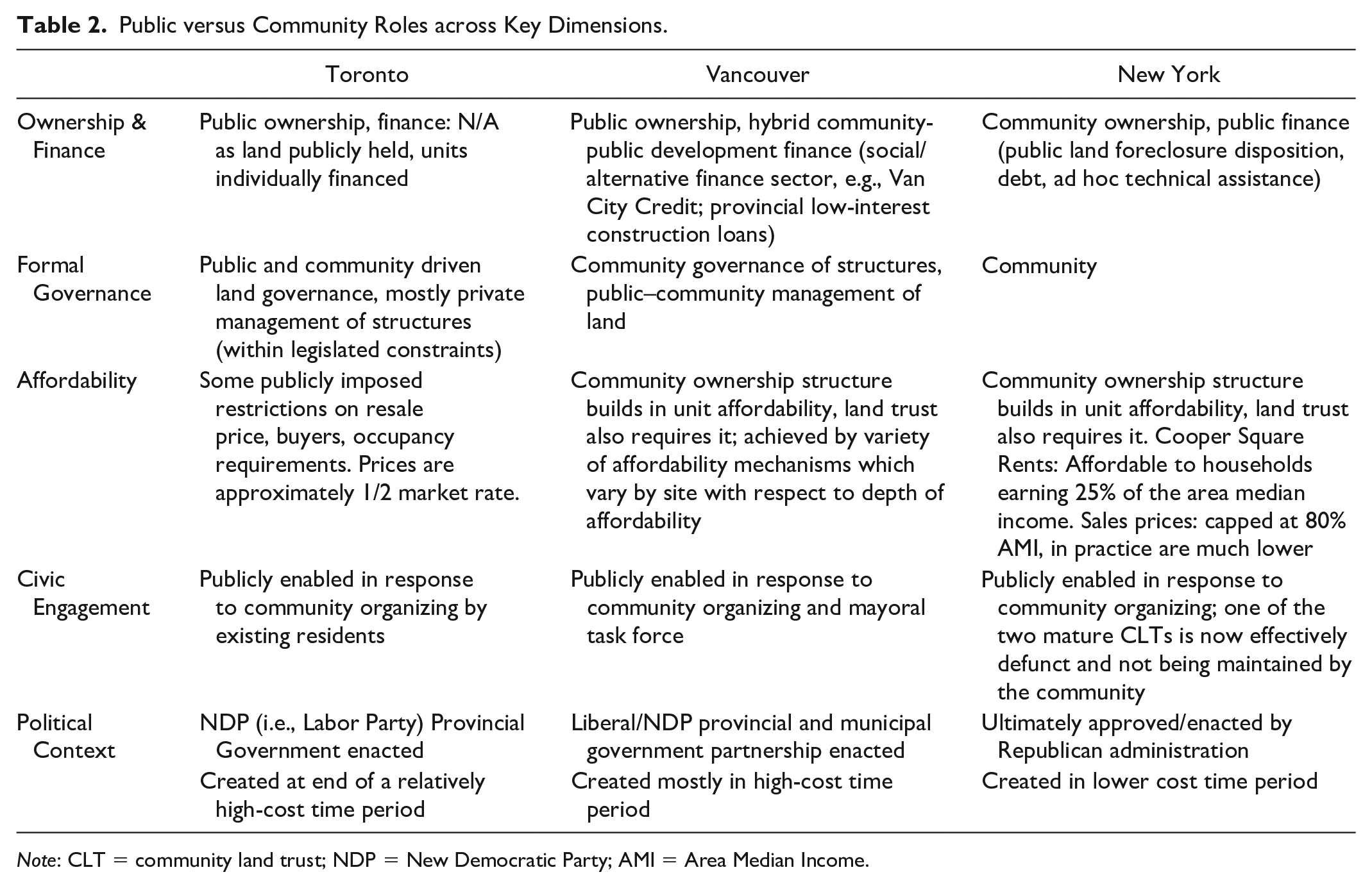
Note: CLT = community land trust; NDP = New Democratic Party; AMI = Area Median Income.

Role of public versus community spheres in the case study trusts.
Ownership/Finance
The case data show that, when compared with public ownership, community ownership does not necessarily translate into greater financial independence from the state. In the New York case, although ownership remains entirely with the community sector via existing, mature, non-profit CLT organizations, the government played key direct and indirect financial roles in the initial establishment and ongoing operations of the two mature CLTs, having foreclosed on the properties, sold them to the community rather than on the open market, and having repeatedly provided below-market-rate mortgage debt, tax abatements, and ongoing no-cost technical assistance and grants. At Cooper Square, finances are additionally supplemented by market forces: commercial units at the property, although voluntarily held below-market to rent to “mom and pops,” cross-subsidize housing units. Given this degree of dependence on both the state and, to a lesser extent, the market, it is difficult to argue that the ownership and finance of the CLTs reflect complete community control.
In contrast, in both Canadian cases, ownership title to the land remains with either the provincial (Ontario, BC) or municipal (Vancouver) government, yielding clear financial benefits by reducing the need to procure acquisition financing for the land, which can be prohibitively expensive in strong markets where available sites are scarce, and which can generate excess costs on both an up-front and ongoing basis. In both cases, however, public ownership has also not entirely crowded out or precluded community financial involvement in securing ownership, either.
In the Toronto case, title to the home resides with the homeowner, who receives some of the financial benefits of traditional home ownership, including limited accrued equity and benefits on sale from any improvements to the structure. But because the public retains ownership of the land, there is no ongoing finance or mortgage required for the land each home sits on. Furthermore, there are no public finance programs to finance unit sales: residents obtain a traditional mortgage (which may include their lease price) from a bank or a credit union, although this has required ongoing education and outreach to banks and credit unions over the years as financial institutions have been reluctant to mortgage on leased land. Some community fundraising was also undertaken at the start to assist those who did not qualify for a traditional mortgage and needed capital to pay for their home lease or to ensure homes met building codes. In Vancouver, unit ownership can take different forms depending on the community or non-profit organization at each site, but the trusts’ constitutions insist on maintaining affordability; units generally have built-in income-related price/charge restrictions. BC Housing, a government-sponsored agency, offers low-interest financing to a number of the sites’ sponsoring organizations. Community finance institutions also play a role: Vancity, a credit union actively involved with the land trust, is a key lender with community or non-profit societies which own or develop units on trust-managed public land. Furthermore, the trusts include some market-rate rental units for cross-subsidy purposes. Given this operating complexity, there is a fairly sophisticated, ongoing relationship between government and community organizations that provides the basis for this ownership model.
Formal Trust Governance
While ownership clearly conditions the governance structures deployed across the cases, the governance arrangements show that public ownership can be structured to include meaningful community involvement, while also showing that, under certain circumstances, a wholesale lack of state involvement in governance may come with drawbacks.
In New York, reflecting the non-governmental ownership structure, governance is at the discretion of the trusts and their community-based operating partners. The government has no role in determining board composition. At RAIN, noted earlier, this became a problem, however, when CLT governance ceased, although some of the cooperative structures in the CLT still maintain their own building-level governance, separate from the land trust. The city government’s efforts to encourage a governance restart have not been successful thus far. At Cooper Square, governance is through the Cooper Square MHA, which was set up before the CLT’s creation. MHA members include three LEC resident-owners and six community members with no financial interest in the entity. By-laws specify that these members “include representatives of local community-based housing or social service organizations and/or representatives of city-wide housing or technical assistant organizations or professionals in the housing field or educational institutions, such as urban planners and housing policy experts.” Nonetheless, conflict and stability concerns at Cooper Square were noted by multiple interviewees, with public-sector actors expressing concern that the CLT had not been able to adhere to its by-laws in finding community sector actors with sufficient expertise. They noted that while such expertise could be made available through the city’s various public housing financing and development divisions, requiring its use at either CLT would be “difficult to . . . impose because the city has no direct ownership or governance role” and speculated that the city “did not have the foresight or wherewithal, at the time, to negotiate . . . ideal clawback or reversion rights in the case of covenant breach.” An actor at emerging New York CLT, meanwhile, similarly expressed concerns regarding the Cooper Square and RAIN CLT models, which they referred to as “community organizer”-led models, as opposed to the emerging “real estate development” models at some new CLTs in the City, which are typically led by planning/housing professionals with expertise in property development/ management.
Both the Canadian cases, in contrast, have more visible public-sector involvement in governance, in ways clearly tied to their public ownership structure. The Toronto governance model in some aspects mimics the composition of a classic tri-partite land trust board comprised of leaseholders’ representatives, community non-leaseholders, and representatives of the public interest (Davis 2010). In Toronto, however, the public interest takes the form of a direct government board role. Although they invite community recommendations, the government retains sole right to appoint members, and the board structure and reporting requirements are established through provincial regulations and a MOU (memorandum of understanding) between the trust and the Ministry of Municipal Affairs and Housing. The trust is required to have annual audited budgets, an annual business plan, and risk assessment reports, which are shared with the provincial Ministry and the community each year. The configuration of the board has changed over time, although always including some elected community members. Currently the volunteer board is comprised of such community representatives and members appointed from the general public. Historically, the government also appointed representatives from the public sector.
The Vancouver model lacks the “classic” CLT tri-partite governance model, but nonetheless has three different levels of governance which offer opportunities for a degree of community self-determination and participation. At the highest level, Community Land Trust, which acts as general developer and operator for sites held across the various legal sub-trusts, is governed by the twelve-member board of the CHFBC, in turn elected by its members; there is a portfolio administration agreement that outlines responsibilities, roles, and how decisions are made (Patten 2015). Second, the various legal trusts lease the lands from the province and city, offering an important opportunity for public and community actors to negotiate specific concerns and issues, as this is the specific point at which control of the land is relinquished by the government under partnership agreement. Third, each individual site manages membership acceptance and responsibilities, although the higher-level centralized trusts impose some oversight on these site-specific boards, as noted earlier. These are run by different community organizations, whether cooperative or non-profit. Different sites may focus on different community sub-populations (e.g., women fleeing domestic violence, formerly homeless populations, supportive housing for people struggling with mental illness and addiction) with housing allocated by income and need. As a result, the model allows the possibility of distinct, site-specific community identity and self-management, which can vary in degree depending on the structure of the individual cooperative or society.
Affordability
In all three cities, the trusts embed income or price restrictions to preserve affordability. The weakest protections appear to be in Toronto, but this does not appear to be a function of its public ownership or greater government involvement. Rather, it appears to reflect the fact that the original goal of the PLT was to “prevent displacement of an existing community,” according to an informant there. Specifically, units on the Toronto PLT are cheaper than market-rate housing—recent units have sold for half the typical citywide prices—through provisions which establish resale prices based on the appraised value of the house plus a lease price, and restrict house sales to waitlist members, who are not prioritized based on means-tested need, as is the case with the city’s social/public housing stock. Affordability can thus be partially eroded through the equity amount and home improvements. The lack of rental housing at the PLT also limits affordability, as the originally envisioned cooperative component of the trust, which would have included a rental development, was canceled upon the election of a new provincial government. In contrast, affordability, as noted earlier, is the explicit goal of the Vancouver model and numerous mechanisms are in place to preserve this. In New York, both rental and for-sale units are almost all entirely income or resale price restricted at the building level, with affordability also embedded through the MHA being the primary leaseholder on both the LEC and rental units; the land-lease terms and the trust itself also require permanent affordability of units.
Civic Engagement
The case data affirm that substantial civic engagement can be consonant with public ownership and that community ownership is no guarantee of sustained civic participation.
Consistent with the reviewed literature, the original New York CLTs were the result of broader, sustained community organizing and action. The community remains highly engaged, particularly in Cooper Square, but as noted earlier, RAIN is now all but defunct. Cooper Square’s history, however, spurred interest elsewhere in the city in a less community-oriented (while still technically community-owned and governed) CLT model, labeled by informants as a “real estate development” CLT model, noted above, which “streamlines” and “professionalizes” (in the words of informants) governance to enable multi-site operation at scale. Those who favor Cooper Square’s community organizer CLT model refer to this as the “McDonaldization” of CLTs, with the chief proponent of this approach, Interboro CLT, referred to by detractors as the McDonalds of CLTs. These concerns—both regarding RAIN being effectively defunct and with respect to Interboro being driven by the organization’s staff rather than by community members—are both consistent with anecdotal suggestions in the literature reviewed earlier: community ownership is no guarantee of community participation or involvement.
Meanwhile, contradicting existing literature, civic engagement is significant in both Canadian cases, despite public ownership. In the Toronto example, the community holds the majority of board places and undertakes extensive community work supporting its mandate of stewardship and benefiting the community and the broader public. Furthermore, the enabling legislation was signed after several decades of community mobilization in the face of potential eviction to produce a lasting politically tenable solution to an entrenched conflict, and reflects a community-led, community-driven process. In Vancouver, while community actors played an active role in organizing to create the Vancouver-specific land trust, the catalyst leading to its development was a 2012 Mayoral Task Force on Affordable Housing (Patten 2015), which led to an RFEOI which created the opportunity for non-profit housing actors, social financiers, and others to conceive of and propose of the idea for the land trust. Thus, the trust reflects both a political opportunity created and advanced by the city, as well as community and civic engagement in response. The decentralized site management and governance, reviewed above, also enables a limited degree of community and resident control.
Political Context
The political context of the three cases suggests that, beyond the retention of land by the public sector, effective ongoing government involvement in land trusts may require politically progressive governments which are attuned to urban displacement as a critical issue.
In both Canadian cases, the trusts were created when left-wing governments were in power, and in periods where housing prices were relatively high. The Toronto trust was created by a New Democratic Party (NDP) government (effectively Canada’s Labor party) when they controlled the provincial government. 5 The NDP has not held provincial power since. It was also legally enabled after the end of Toronto’s late 1980s housing boom, in which house prices reached levels not seen again until the 2010s. In Vancouver, the aforementioned Mayoral Task Force of 2012, and subsequent decision to contribute city-retained and owned land to an affordable housing land trust, were in no doubt influenced by the long-running rise in house prices. Indeed, housing unaffordability contributed to the municipal election of a center-left social democratic and green party (Vision Vancouver, a municipal political party), which wrested mayoral and city council control from a center-right party in 2008, and which subsequently maintained control of both government branches for a decade. The mayor, the longest-serving in city history, was succeeded in 2018 by a new, politically independent mayor who was previously an NDP Member of Parliament. Over this time period, as the city’s affordable housing crisis grew progressively worse, stronger community involvement and engagement have resulted in solutions like the land trust, again reflecting the conjoint role of community and the public sector. These efforts have also involved working with provincial government, as detailed earlier, to expand land trust development capacity.
In New York, community ownership was achieved under conditions which were consistent with the CLT literature’s concerns regarding CLTs forming as a response to neoliberal offloading of state responsibility. The Cooper Square CLT was enabled under a Republican administration (Mayor Giuliani) and maintained through subsequent Republican mayoral administrations. Furthermore, both it and RAIN were developed when the City’s population was declining, leading to widespread foreclosures and low property prices. Public funding and capacity were also strained, and at Cooper Square in particular, the community had advocated for its broader plan for self-determination for decades. While today the Lower East Side and Cooper Square are highly desirable, at the time this was not the case (Mele 2000), with housing stock there experiencing disinvestment and often in a state of disrepair.
Discussion: The Benefits and Drawbacks of Public Ownership and Involvement
In considering benefits and drawbacks with respect to greater government involvement in land trusts, we review three key findings from the cross-case data analysis. First, land trusts in high-cost cities may often be heavily dependent on the state across multiple and ongoing fronts, and in ways which suggest that land trusts may have more to gain than to lose by formally and directly partnering with progressive governments, regardless of whether the state retains ownership of the land. Specifically, an active state role, particularly in procuring and providing sites for acquisition and/or development, may be necessary for land trusts to achieve scale in high-cost cities today at all, a reality discussed by informants in all three cities. As reviewed earlier, in New York, there would likely not be any CLT units in existence were it not for an active public sector offering below-market-rate financing, agreeing to sell foreclosed units to the community, and providing ad hoc technical assistance to CLT development efforts. Today, New York CLTs seeking to acquire units and/or sites struggle in the open acquisitions market. Given competition from market-rate and other affordable housing developers, some have suggested CLTs be given right of first offer on all city-foreclosed properties or public land slated for development or sale. In the Parkdale neighborhood of Toronto, the city’s first non-governmental CLT acquired a fifteen-room boarding house in 2019, the first acquisition of existing units from the open market. But this acquisition was made possible in part by below-market-rate, public financing. A subsequent 2021 acquisition consisted of government-owned properties, which were not sold at market value. The development sites in Vancouver’s trusts were all also contributed by the government (which remains the landowner), toward the goal of achieving scale and operating efficiencies with the land trust.
This is not to say that such direct state involvement is a panacea: governments can be slow to act, as evidenced by an emerging CLT’s lengthy two-year wait on city financing for a new site in New York, relayed by interviewees, and by the slow appointment of board members in the Toronto case. Government agencies can obviously also be highly political, as well: arrangements need to take the strengths and limitations of the entities involved, as well as their long-term stability, into account. Furthermore, substantial contributions of public land for a trust to operate and develop, as in BC, can also be risky: an informant expressed concern that the rapid scaling, made possible in part through public land, could fail, as the development pipeline may exceed Community Land Trust’s organizational capacity to deliver, jeopardizing the model’s standing and appeal over the long run. Nonetheless, it is difficult to envision CLTs successfully competing with investors for properties in these high-cost cities without supportive state treatment. While this may merely reflect the unique situations in these three cities, we suspect this is a widespread challenge in expensive cities experiencing housing affordability crises. In as much as market-wide, supply constraint-driven unaffordability motivates local interest in land trusts, the state as a source of lower cost land may be critical to the model’s uptake and viability.
Second, the Toronto case suggests some community control may be achieved even when there is a public landowner, but that this control may be politically tenuous. For example, residents on the Toronto Islands PLT have experienced very different provincially mandated compositions for the land trust board under different governments, with varying degrees of community and public representation and involvement. The Conservative government elected in 2018 was slow to appoint new representatives to the trust, which then spent significant time without a full complement of members in its day-to-day operations and governance deliberations. According to informants, there has been some concern, should the government decide they disagree ideologically with the trust model, that they might expropriate the trust, privatize the land, or act in ways to undermine the community’s role in governance of the trust. Thus, while Island residents do have some say in governance, and control the land directly through the trust, their control is shaped by ongoing provincial governance requirements, which the province, as landowner, has been able to impose. It is unclear whether this is a “lesser” degree of control, however, than that offered by some traditional CLTs. As consistent with existing academic critiques of CLTs as potentially being implemented as “just” a technocratic housing tool, emerging New York CLTs would also seem to be unlikely to fully deliver on the community control promise of CLTs, particularly next-generation “McDonalds”-style professional and technocratic CLTs, which focus on the model’s housing benefits alone, arguably at the cost of realizing such community control. Ownership is, as noted earlier, not synonymous with control.
Third, the “social-public” or “community-public” partnership involved in creating a PLT may offer an opportunity in politically favorable environments to renegotiate state/community responsibilities and strengths, in a way which mitigates concerns of “soft neoliberalization” offloading of state responsibility to the community (DeFilippis, Stromberg, and Williams 2018). Such offloading onto groups with the fewest resources or capacity to perform the functions in question is deeply problematic. By including the government in a more formal way, either through ownership or formal governance roles, however, such concerns might be mitigated, and reduce capacity constraints on both the community and the state. By maintaining a formal role, the government can step in and provide direct capacity where and when appropriate. In Toronto, as noted by informants, government representatives on the land trust board have historically provided technical assistance, administrative assistance, and operating guidance, thereby reducing the degree to which community capacity is taxed in governing the trust, and resulting in improved decision-making outcomes that assure the long-term viability of the Islands as a residential and commercial location. For example, government expertise has assisted the board in directly managing trust buildings and land assets and has advised community organizations about long-term management of community buildings which the community controls (and leases from the trust). The precise nature of government involvement matters, however, and must be carefully structured. This is not to say there is no offloading in Toronto: the community performs governance work for free. But it is possible to envision models where the public sector pays for this. Nonetheless, sustained government involvement has produced observable public and community benefit.
Conversely, in New York, the defunct RAIN CLT provides direct evidence of what can go wrong when community capacity is insufficient to maintain CLT governance, a situation which might be prevented by maintaining a formal government role, as to assure the possibility that the state can step in as a cure agent. Perversely, because the government is the land trust’s lender, and because RAIN is out of loan compliance, individual developments like this can weigh on already-constrained public-sector capacity. As noted by a city employee,
we deal with tens of thousands of units each year . . . programs and processes are streamlined . . . .so that we can operate at scale . . . when you have one project . . . have issues, where we also can’t even step in to fix things, it eats up our time and resources . . . we don’t have the resources to spend that much time on just one project . . .
Echoing this sentiment, a local CLT actor stated it was unfortunate there had not been a more formal way for the city government to remain involved in RAIN, and went on to articulate a related point. Professionalization, be it in either the public or community sectors, is often normatively viewed as a negative trait in the “community organizer” approach to CLTs. In speaking to this phenomenon, an informant noted that
the typical person doesn’t know how (multi-family) real estate works, and in an (community) organizer model . . . (they) can be resistant to learning how, as if it is “bad” to know property accounting, about deferred maintenance . . .
By retaining a formal role for the public sector, these challenges might be mitigated. But this would require operating and partnership agreements that clearly delimit the state’s power, as to overcome understandable suspicions of state motives that those operating with a community organizer model of the CLT might hold.
As community activists continue to work toward housing justice, particularly within the Movement for Black Lives, new constellations of public–community contracts are possible and may be required. Elsewhere, communities are attempting to articulate the ways the state needs to contribute to land trusts. The Africatown CLT in Seattle recently sought control of a public land parcel, and under community pressure, the City of Seattle agreed to transfer it (Moorer 2020). Such contracts are where the roles and positionality of the state vis-à-vis community will be decided; one wonders what other state supports might be forthcoming. In post-Katrina New Orleans, a CLT was formed without state support. One of the organizers, Shayna Griffin, stated, as quoted by Ruth Wilson Gilmore in an interview,
We did do this. We helped ourselves. And what this tells me is that the state we need is the one that will do this. We actually need that state that belongs to us, rather than think that we can do this ourselves for each other. We need the pro-state state, not the anti-state state. (Murakawa and Gilmore 2020)
This highlights the challenge of assembling land trusts in the face of a hostile market and neoliberal government [the “anti-state state”] that falls on community groups, but also the possibility for a changed role for the state, one that works for the people excluded. To that end, by more directly supporting CLTs, politically progressive governments can more effectively accomplish affordable housing goals for their constituents. State support for land trusts is also not a one-way street: by rendering public subsidies and supports more durable, governments also benefit from the arrangement.
Conclusions and Limitations
In this study, we sought to systematically consider the respective roles of government versus community in land trusts, as to clarify the benefits and drawbacks that may be presented by more active government ownership and involvement. We conclude that PLTs warrant consideration alongside traditional CLTs as a useful planning tool, particularly in high-cost cities where land prices may be a barrier to independent CLT land acquisition/development, and where political contexts are favorable. PLTs can secure tenure and a degree of community control like CLTs, but likely require election of highly supportive administrations to enact, and may be at greater risk when the political climate changes. Public ownership may comparatively reduce strains on community capacity. Community-oriented models may be reliant on government to a greater degree than expected, and in high-cost cities, may require active government supports to be viable. In return, by supporting land trusts, governments may better secure their long-term housing affordability goals. To these ends, during our research, informants in New York uniformly expressed interest in the Canadian models, and independently suggested such approaches might be useful in their local context. Indeed, based on our presentation of this study’s findings to a U.S. municipal housing agency, the PLT was explicitly named as an item of interest in a public RFEOI by the agency. This is not to suggest that all land trusts should have a significant direct and sustained public role, or that public ownership is preferable to community models. Empirical research has not adequately identified the conditions under which one is preferable to the other. There are many CLT cases where community-centric approaches, with little government involvement, have been successful. For practitioners, however, such limitations are perhaps less important than the point that greater public roles in land trusts are possible and can in some instances be desirable, if structured to yield gains for both government and community.
In drawing on cases from just three cities, our research may suffer from selection/sample bias in ways which undermine generalizability of our findings across all contexts. Using more robust samples, future research might enable further development of the public–community continuum (Figure 1) to more fully assesses the degree and nature of community versus public involvement with respect to questions of ownership, governance, and control, leading to a more precise evaluation of the causes and consequences of different structures. Such research might also attempt to assess which roles are “best” performed by community versus the public in different land trust contexts, as well as in alternative tenure models in general. It might also examine the role of different political/policy environments and cost structures on the viability of a direct public role in land trusts: as the politics of the Canadian cases suggest—in both, progressive governments in expensive regions played a role in initial implementation—PLTs may also be less viable in more politically conservative or lower-cost areas.
Nonetheless, states structure all market activity, including that of alternatives which emerged in response to state abandonment or paternalism. While CLTs developed in resistance to the state and as an alternative to the traditional market, they inescapably function in relation to that same state and market. It follows, then, that a more active and deliberate consideration of the roles of public vis-à-vis community in land trusts could open up possibilities for more just relations via the broader development of public–community or public–social partnerships, embodying Fainstein’s (1990) long-ago call for a PPP for the left, and enable a re-positioning of the state to commit to decommodified land for housing. PLTs have significant potential to scale up and expand the stock of housing protected from the market, while relieving pressure on community groups to expand and maintain property financing, development, and operations expertise. However, the community activism and political engagement that has produced many land trusts today will likely remain necessary, not only to push the state to reposition itself to realize the potential of PLTs, but to remain vigilant to keep them public.
Methodological Appendix
Canada, like the United States, remains a homeownership society, with 2018 national homeownership at nearly 69 percent according to Statistics Canada, higher than in the United States; its principal cities also boast higher homeownership rates than comparable U.S. jurisdictions, with Toronto and Vancouver substantially higher than New York, San Francisco, and Los Angeles (Hogue 2019). Like the United States, Canadian society also highly stigmatizes public housing (August 2014; Reutter et al. 2009; Silver 2011). It has also similarly seen systematic public housing disinvestment alongside efforts to demolish concentrated public housing and replace it with deconcentrated, mixed-income communities (e.g., Toronto’s Regent Park and Don Mount Court). Canada also offers rent supplement programs (recently expanded in Ontario, via the Canada Ontario Housing Benefit, or COHB) which bear some similarity in design to U.S. housing voucher programs. Such similarities are not surprising, given both nations are classified as liberal market economies with residual welfare states (Esping-Andersen 1990; Hall and Soskice 2001), and are more similar than different with respect to state economic intervention to enhance public welfare. Such national classificatory typologies have also been developed specifically for housing (Kemeny 2006), which affirm these broader welfare regime classifications. Kemeny’s housing regimes typology assigns both Canada and United States to the same “dualist” category, with only a residual publicly owned housing sector (e.g., 1%–2% in both Canada and the United States, cf. Suttor 2016), which is supplemented by a mix of fairly similar demand-side (e.g., household housing allowances, vouchers, and supplements) and supply-side (publicly issued or insured construction loans and subsidies for non-government-owned units, partnership and operating agreements with third-sector housing providers) strategies. In general, these strategies both privilege the private housing market, with a focus on indirect government intervention into said market. Both federal nations’ overall policy environments have become even more similar in recent decades with respect to housing policy (Walks and Clifford 2015), with increasing general pressure to dispose of publicly owned land in Canada, as well (Whiteside 2019). Canada has, however, relied somewhat more on “third sector” housing providers than the United States, as both nations pulled back from public housing ownership/development after the 1970s (Dreier and Hulchanski 1993; Sousa and Quarter 2003). This third sector in Canada, similar to the United States, includes non-profit housing societies (akin to American Community Development Corporations (CDCs)), cooperatives, and, according to recent research, approximately a dozen traditional CLTs with active holdings (Bunce and Aslam 2016). Nonetheless, studies have found when comparing among such residual/dualist housing regime countries, although Canada and the United States are not identical, they are more similar to each other than even to other residual/dualist countries with respect to such policies and legislative authority (Hulse 2003).
This is not to say there are no meaningful national differences between Canadian and U.S. housing policies and politics that might pertain to land trusts. While Canada’s national government has a similar majoritarian (winner-take-all) electoral system as the United States, and has been led by one of two parties (Liberals or Conservatives) at all times over the last century (Gaines 1999), it persists in having three major parties, one of which—the NDP—is left-wing. This party’s local affiliates occasionally attain power in municipal or provincial government elections, which, as the case histories will show, may be germane to enabling local conditions for PLTs. But such variation between Canadian local and national conditions also applies to U.S. jurisdictions, meaning that some Canadian and U.S. cities may have much in common (cf. Boudreau et al. 2007; Filion, Kramer, and Sands 2016; Savitch and Kantor 2002; Slater 2004; Zolnik 2004). Political and policy contexts in Toronto, for example, may be more similar to those in New York than to those in Montréal, and conversely, New York may be more comparable with Toronto than Tampa. To that end, differences and similarities in local conditions may be as important, if not more so, than national conditions in making comparisons, as per the above-cited scholarship on the structural similarities which enable comparisons in urban development patterns between high-cost, progressive Canadian cities like Toronto and Vancouver, and U.S. ones like New York.
Footnotes
Acknowledgements
The authors kindly thank James DeFilippis for his comments and feedback on this paper, and Natasha Cheong and Keisha St. Louis-McBurnie for their research assistance. They also thank Evan Casper-Futterman for pointing them to Susan Fainstein’s long-ago call for PPPs for the left. They also wish to thank the land trust participants, community organizers, and policymakers for their time, expertise, and input, as well.
Declaration of Conflicting Interests
The author(s) declared no potential conflicts of interest with respect to the research, authorship, and/or publication of this article.
Funding
The author(s) received no financial support for the research, authorship, and/or publication of this article.
