




Abstract
A key theme in urban governance research is how neoliberalism reshapes the state–society relationship. Our study on Guangzhou, where urban regeneration through massive redevelopment of “villages-in-the-city” uncovered interactions between the state, market, and community in local governance, contributes to this debate. Based on intensive field research to analyze three projects, we find that what really controls neoliberal growth in China is not simply the authoritarian tradition of the socialist state but also the power of the indigenous village communities. Our findings suggest that state intervention for community building is vital for rebalancing power relations between the state, market, and community.
Introduction
The triumph of neoliberalism has transformed urban governance globally, whereby local governments depend more on the market for urban revitalization (Cahill and Konings 2017; Hood 1991; Rhodes 1996; Savoie 1994; Stoker 2005). Since the 1980s, de-industrialization, economic restructuring, exodus of the middle class, and inflow of rural or overseas migrants caused severe urban decline in many Western cities, all of which have eroded the local tax base. To tackle these problems, many city governments adopted a “property-led” urban regeneration strategy, expecting that the redevelopment of old properties and refurbishment of obsolete buildings in inner cities would have positive effects on the local economy and society (I. Kuyucu 1992; T. Kuyucu and Unsal 2010). Two major paradigm shifts are discernible under this strategy: one is a strong faith in private sector efficiency and in a market-led approach to urban regeneration (Lowndes and Sullivan 2004; Ruming 2009); another is a shift in the public sector from regulatory to facilitatory and developmental functions (Erie, Kogan, and MacKenzie 2010; Kirkpatrick 2007; Pierre 2000). However, the increasing coalition between political and business elites in urban renewal has often led to gentrification, the disintegration of existing neighborhoods, and the dislocation of underprivileged households (Freeman and Braconi 2004; Halpern 1995; Molotch 1976; Roy 2005; van Horen 2000).
Urban regeneration in China has witnessed similar phenomena. During the 1990s, the progressive fiscal decentralization promoted by the central Chinese government enticed local governments to pursue wealth accumulation from real estate booms (Leaf 1995; O’Neil 2000; Zhou and Logan 1996). Many local state agents, such as state-owned enterprises, have started working closely with developers to turn their land into real estate projects, making use of their special relationships with the government to rapidly acquire land and planning permissions (Fang and Zhang 2003; He and Wu 2009; Y. Zhang and Fang 2015; Zhu 1999). Consequently, urban regeneration has led to collusion between local governments and developers, excluding residents from participation, thus limiting their rights to adequate compensation and replacement housing (Abramson 2001; He 2007; Siu 2009; Yang and Chang 2007; Zhai and Ng 2012).
Existing scholarship on China’s state–society relationship suggests that this growing coalition between the government and the market does not denote the rise of neoliberalism in urban China. For instance, Harvey (2005, 34) viewed the case of China as a “particular kind of neoliberalism interdigitated with authoritarian centralized control.” Jun Zhang (2013) suggested that China’s market reforms represent a form of “variegated capitalism,” under which marketization was promoted without political liberalization. Kan (2016) and Wu (2018) argued that, despite extensive commodification and marketization over the last four decades of reforms, the state gave the market force limited space to grow because of its continued dominance in development processes. In this study, we provide an alternative perspective by highlighting the inadequacies of the authoritarian tradition of the socialist state to explain China’s urban transformation, as the local state has shifted its responsibilities for planning and implementing redevelopment projects to developers and local communities.
Our study draws from the analysis of Guangzhou, where the city government has progressively pursued property-led urban regeneration through massive redevelopment of “villages-in-the-city (VIC).” From the 1980s to the early 2000s, rapid urbanization led to the emergence of VICs in many Chinese cities. This was particularly true of Guangzhou, where swift urban expansion swallowed a lot of arable land but left behind the village housing sites. VICs present a “chaotic” and “messy” landscape set against a backdrop of new high-rise buildings in the city centers (Figure 1). Occupying highly accessible land in good locations, they become targets for urban renewal. Since the early 2000s, the city government has sought to cut the costs of urban renewal in part by outsourcing the responsibility of planning and implementing VIC redevelopment to the private sector and villagers. When the local agents of a traditionally authoritarian state have progressively engaged with neoliberal transformation to embrace a market-driven approach in urban renewal, we seek in this study to propose a refocused inquiry into what really holds the reins of the shift of urban China to neoliberal growth. Our findings shed light on the nature of China’s neoliberal urban growth and suggest that state intervention for community building is vital for rebalancing power relations between the state, market, and community.
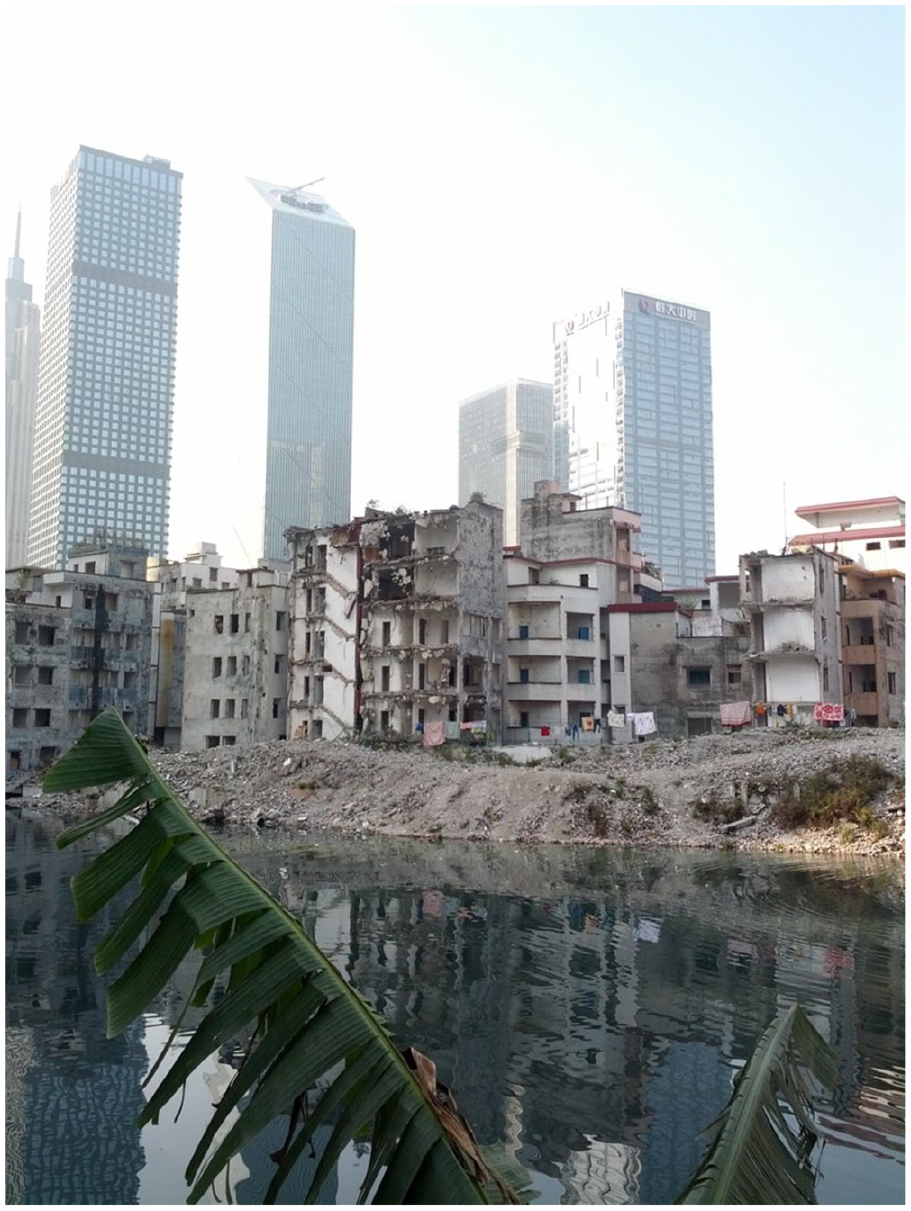
A village-in-the-city in Guangzhou.
Bringing the Role of Villagers into the Power Analysis
Urban regeneration in Guangzhou is conventionally state-dominated. In the 1990s, property developers were not permitted to participate in VIC redevelopment. Through a state-dominated approach, the city government took the lead not only in project planning and design but also in compensation and villager resettlement (Tang et al. 2008). In the early 2000s, VIC redevelopment began involving private developers in dividing their redevelopment sites into three zones: a housing apartment area for rehousing the affected villagers; a consolidated zone for investment properties, such as hotels and offices, to be owned and managed by village organizations (i.e., shareholding cooperatives [SCs]) for generating collective income for the villagers; and a private development area for the construction of commercial properties by property developers. The Liede, Linhe, and Xian projects are good examples.
The Liede project began in 2007 and was completed in 2017. The total site area for redevelopment was 290,000 m2, which was divided into three zones (Figure 2). Zone 1 had a total area of approximately 140,000 m2. It was developed into more than ten blocks of residential buildings to provide rehousing units for affected villagers, which were completed by 2010. Zone 2, with an area of about 40,000 m2, was used for the development of the villagers’ collectively owned commercial properties. These collectively owned properties generated recurrent rental income for dividend distribution to villagers. Zone 3, which was completed in 2017, had an area of approximately 110,000 m2 for office, hotel, and shopping mall development by property developers.
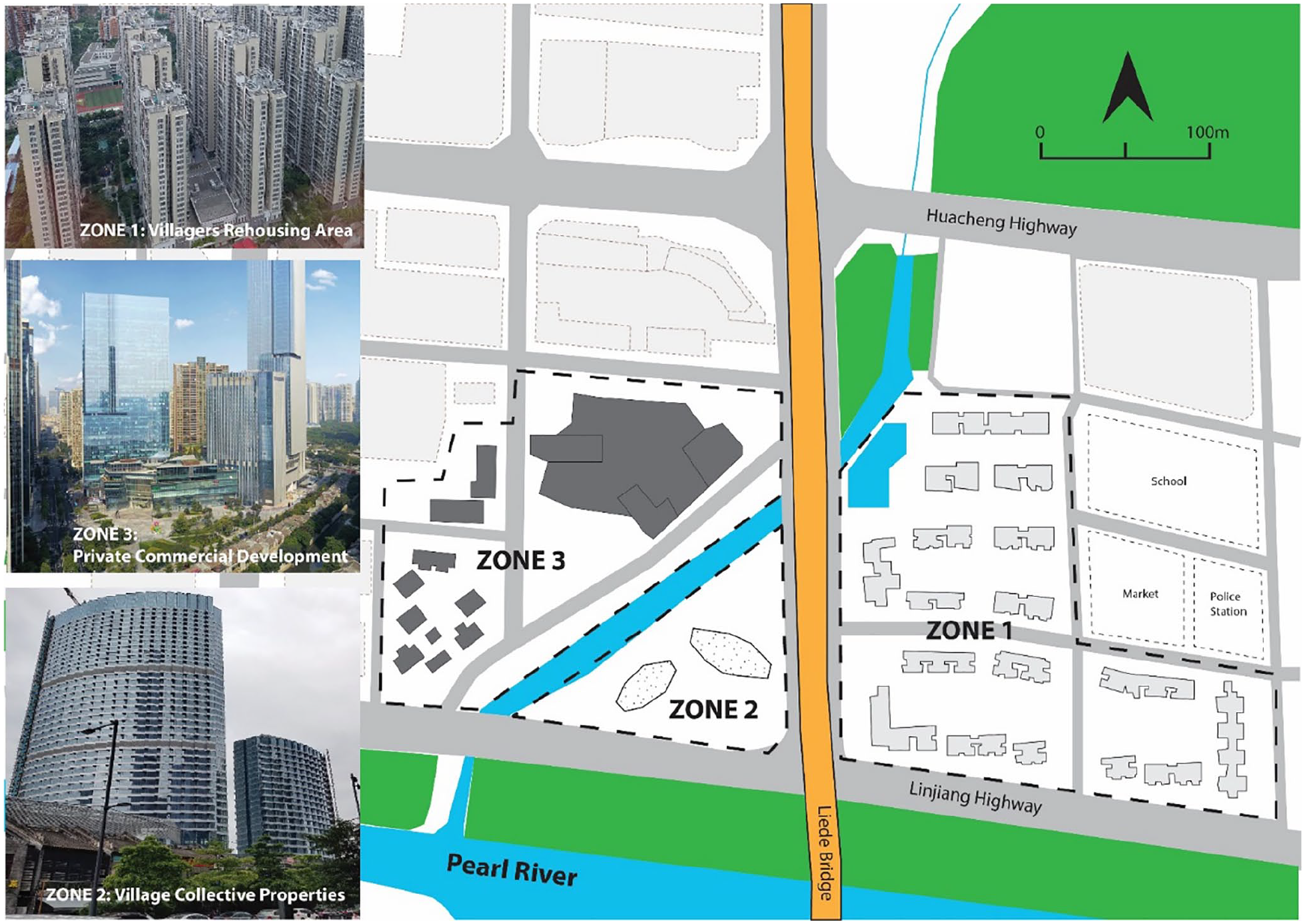
Liede Village redevelopment project.
The Linhe project took 4.5 years to complete, from 2010 to 2014. The total site area for redevelopment was 65,000 m2, which was also divided into three zones (Figure 3). Zone 1 contained approximately 6,000 m2 of rehousing units for affected villagers; Zone 2, approximately 5,000 m2 in size, was allocated to the villagers’ collectively owned commercial properties for rental generation; and Zone 3 comprised approximately 60,000 m2 for office and residential development by property developers. When the redevelopment was complete, the new neighborhood comprised six blocks of forty-nine-story residential buildings for rehousing the affected villagers, four blocks of thirty-six-story residential buildings, one twenty-five-story office building owned by the developer, and one commercial building collectively owned by the villagers for rental income generation. In 2010, the old village was demolished and handed over to the developer. In 2014, all affected villagers were moved back to the site.
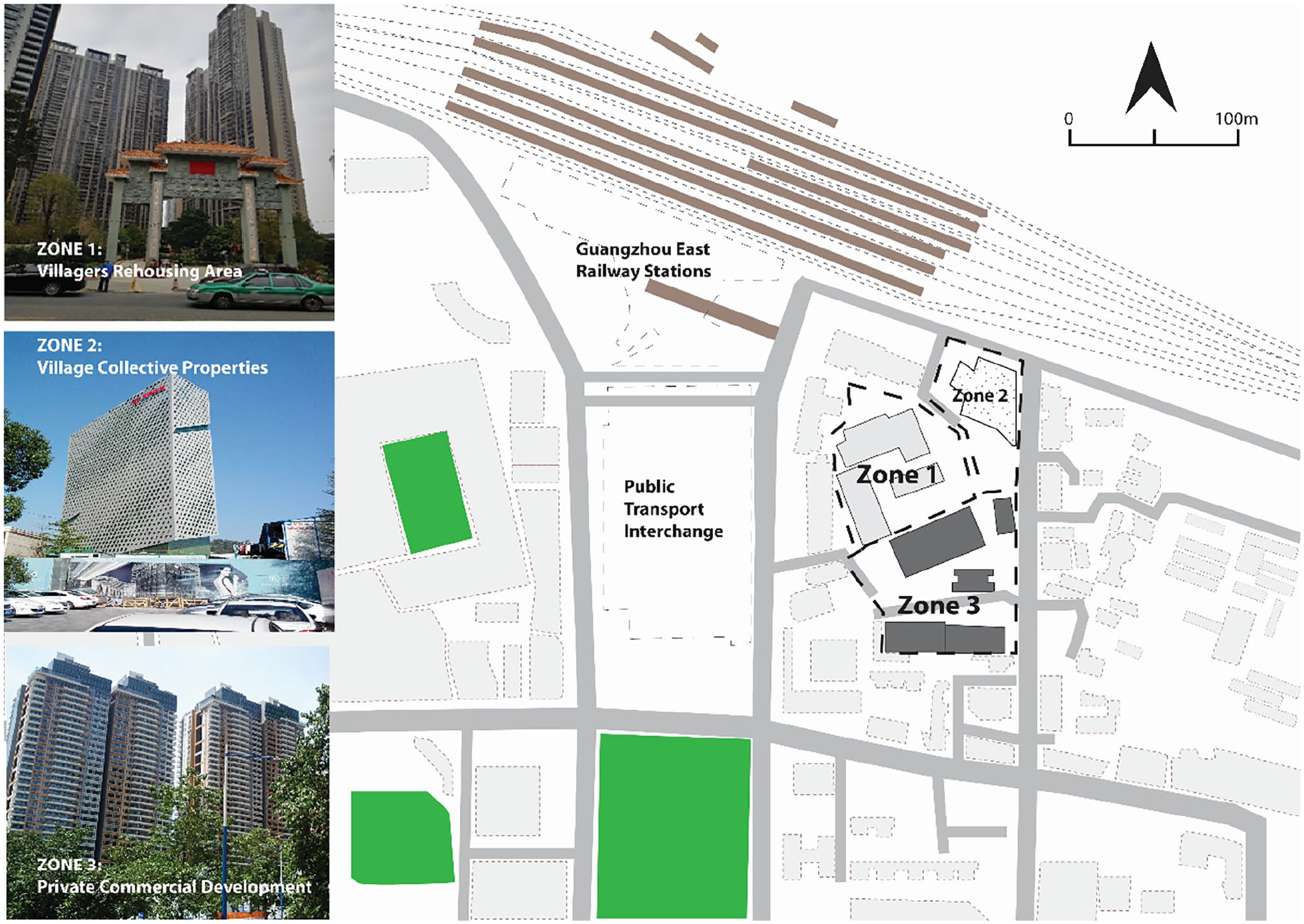
Linhe Village redevelopment project.
The Xian project began in July 2009 but remains incomplete. The total site area for redevelopment was 185,000 m2 (including 22,100 m2 of road), which was divided into three zones (Figure 4). Zone 1 included about 75,000 m2 of rehousing units for affected villagers; Zone 2, about 26,000 m2 in size, was allocated to the villagers’ collectively owned commercial properties for rental generation; and Zone 3 comprised approximately 61,400 m2 for development by the private sector. The redevelopment was planned to be completed in 2013 but was suspended in 2011 because of resistance on the part of some villagers who were dissatisfied with the relocation and compensation arrangements. The site was therefore left as a ruin for more than four years before the project restarted in 2014. The first two phases of resettlement housing have been completed, but the third phase of 576 units is still under construction.
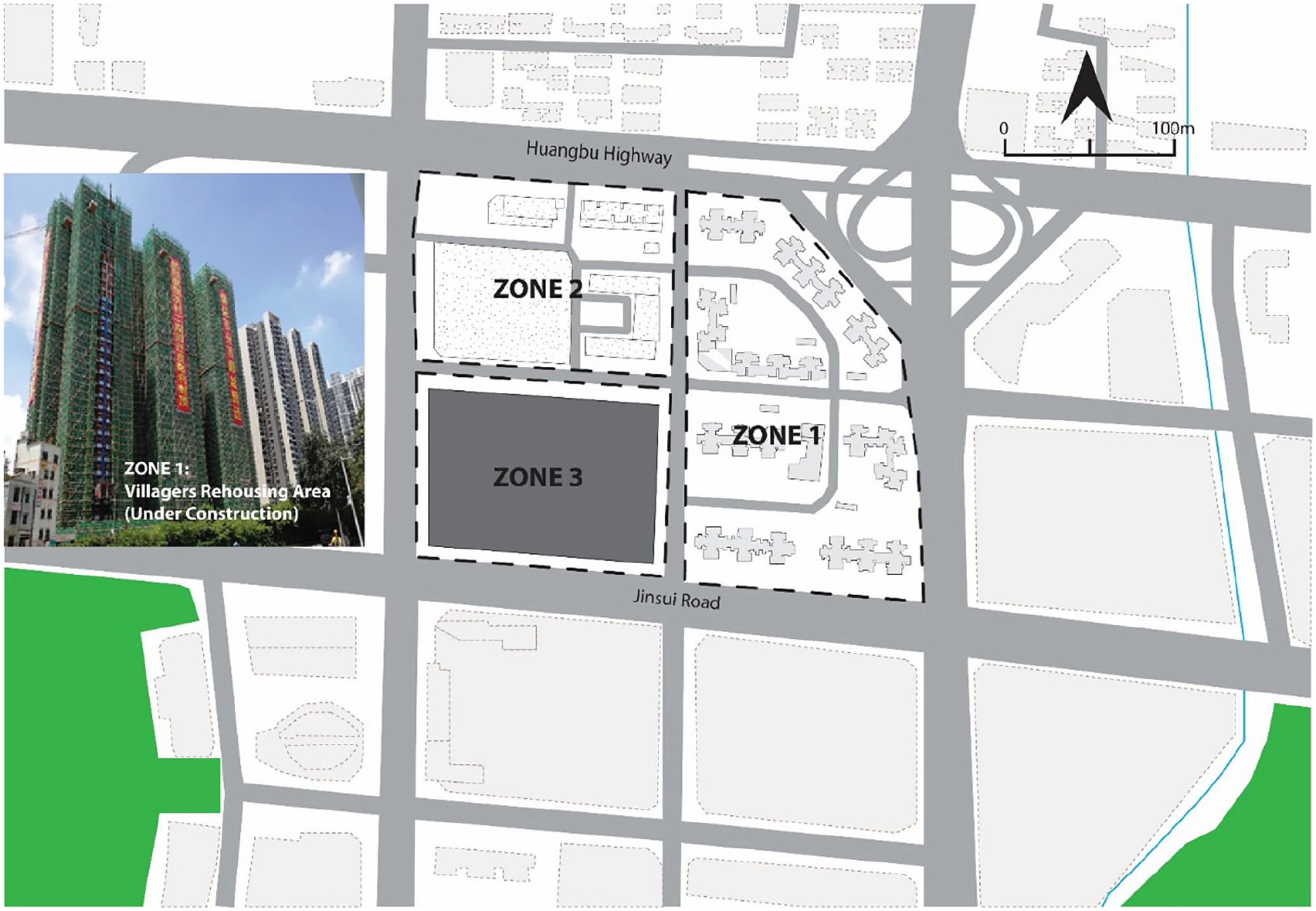
Xian Village redevelopment project.
The heavy involvement of private developers in financing these three redevelopment projects is often perceived as a monumental break with the past, representing urban China’s embrace of neoliberal growth models. For instance, Yuan et al. (2019) highlighted the “bottom-up” approach initiated by the private developers in the Liede and Linhe projects, while L. H. Li et al. (2014) and Y. L. Lin, Hao, and Stan (2015) suggested that these projects reflect a neoliberal paradigm shift from a “state-led” to a “market-led” approach in urban regeneration. Drawing from intensive field research to examine the process and outcome of these projects, our study suggests that it is simplistic to describe them as a neoliberal paradigm shift, even though they all adopted a three-zone redevelopment model to gain the direct involvement of private developers.
Existing scholarship has mostly addressed the power relationships between the city government and property developers, paying relatively less attention to the role of villagers in VIC development. Our empirical research examines the interaction of multiple actors, including not only the city government and developers but also village leaders and villagers as collective actors in the redevelopment processes. Since 2015, we have conducted intensive field research to investigate their interactions in project planning and implementation. We divided our field research into two major stages.
Between 2015 and 2016, we visited the Policy Research of Guangzhou Municipality and the Three Old Office (now Urban Renewal Authority), interviewing six local officials who were familiar with VIC redevelopment policies. Meanwhile, through personal and professional connections with the private developers involved in VIC redevelopment, we interviewed project managers with experience of project implementation on the ground. Between 2017 and 2019, we conducted more than fifty interviews with villagers to explore how they engaged with their village organizations to respond to redevelopment. 1 Seeking an endogenous perspective to explore their interactions in project planning and implementation, our research finds that the power relations among the city government, developers, and villagers took very different forms.
Re-reading a Tale of Three Village Redevelopment Projects
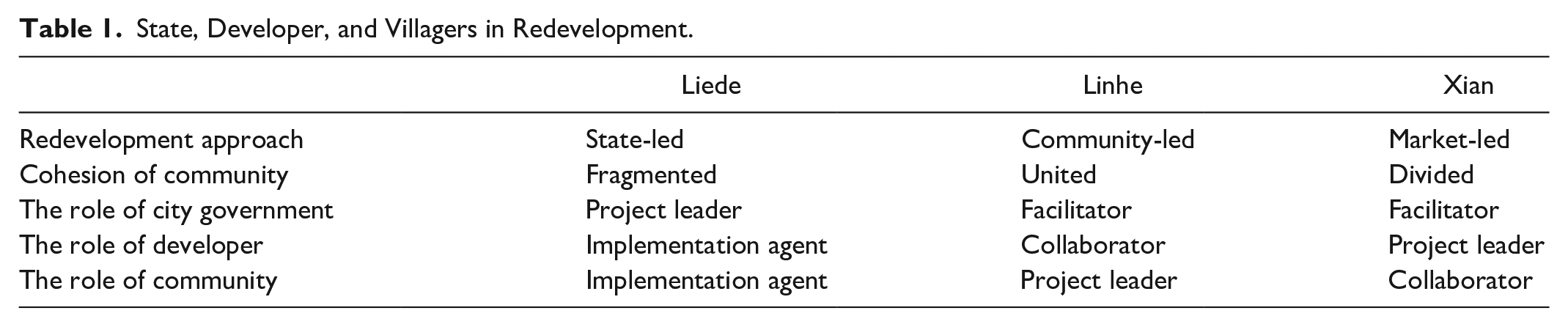
As shown in Table 1, the three villages adopted different approaches to their redevelopment, with different outcomes. In Liede, the city government was heavily involved in the entire redevelopment process. Linhe was a community-led project, in which villagers collectively worked in collaboration with private developers to complete the redevelopment as scheduled. Finally, the Xian redevelopment project, which was market-driven and led by private developers, was characterized by tension. The interventions of developers through urban planners and village cadres to deal with resistance from villagers escalated internal conflicts and violent clashes among the villagers. Eventually, the city government intervened in the provision of resettlement housing for the villagers. The sections below will elaborate on the different interaction and power dynamics between multiple actors in each project.
State, Developer, and Villagers in Redevelopment.
State-Led Redevelopment
While the city government made the first attempt to collaborate with property developers in the Liede project, previous studies have identified it as a market-led model because the developers significantly funded the project (Y. L. Lin, De Meulder, and Wang 2012). Nonetheless, we should not overlook the dominant role played by the city government in project planning and implementation. Our investigation suggests that the project was ultimately state-led for the following two reasons.
First, the city government was responsible for land requisition and rehousing. It began acquiring housing land from villagers in the early 2000s. The city government addressed villagers’ resistance to redevelopment by guaranteeing that local rehousing would be provided for all affected villagers. In addition, all households received a rental subsidy (linqianfei) so that they could find temporary accommodation elsewhere during the reconstruction period. The city government raised funds for temporary relocation and construction of resettlement homes by converting a portion of the collective land in Liede into state-owned land and selling it to a developer through public auction. The land sale contract required the developer to pay land premiums to the government from the date of auction in 2007, but the site would not be handed over to the bidder for actual development until 2010. Through this special land sale agreement, the government received a total of 4.6 billion yuan to fund its villager relocation and rehousing programs. In April 2007, the old village was demolished, and all villagers were required to move out. Each household received a rental subsidy averaging about 3,000 yuan per month, which was enough to rent a two-bedroom unit in the nearby districts. In April 2010, the rehousing zone was completed, and the villagers returned to the site and moved into their newly built resettlement housing.
Second, to ensure successful implementation, the city government directly supported the development of Zone 2, which was given to the village organization to develop its collectively owned properties. According to the planning permission, Zone 2 was to be redeveloped into a hotel, from which rental income would be distributed among the villagers as dividends. The village organization first collaborated with a developer from Hong Kong. However, the development ran into financial difficulties and was suspended because of the withdrawal of the developer. The city government then intervened and offered interest-free loans to help the village organization overcome its financial difficulties. These findings point that the Liede redevelopment project was indeed state-led and heavily engineered by the local government. Despite the participation of the developers, the government still played a driving role in project planning and implementation to achieve the project’s successful outcomes.
In sum, the city government took full responsibility for the entire process of project planning and implementation in the Liede project through direct involvement in land acquisition and rehousing. Some villagers and project officers suggested it was impossible for the redevelopment project to succeed within the set time frame without direct government intervention. The project managers appointed by the developers also emphasized the decisive role of the state and suggested that there were at least two main reasons why the developer accepted such a seemingly unfavorable arrangement. First, the developer relied on the government to remove some “nail” households (dingzihu) who were refusing to move out, and to handle the permanent relocation of an old school within the village for the visually impaired. Second, the developer wanted to build up the population density in the neighborhood to support its future shopping mall development. Third, the developer received an award granted by the city government to recognize their support for city development. Furthermore, to support the involvement of the developer in the project, the city government approved their development applications. The office towers, hotel, and shopping mall in Zone 3 were completed on schedule by the developer between 2013 and 2016.
Community-Led Development
Linhe was a community-led redevelopment project initiated by the village organization and supported by villagers. Despite the increasing participation of developers in the Liede project, the city government played a dominant role in ensuring successful outcomes through its heavy involvement in project planning and design as well as in compensation and villager resettlement. In contrast, the city government’s role in the Linhe project was limited to offering policy support and granting planning permission to the developers’ applications for plot ratio relaxation. The strong leadership of the village leader and the unity of the villagers promoted collaboration between the villagers and private developers, and this was essential to the success of the village-led model. Under the strong leadership of their village leader Liang Yue Quan, the villagers organized themselves to plan the redevelopment project and manage temporary relocation and rehousing.
The support and respect Liang received from the local population motivated him to fulfill the demands of his fellow villagers through village redevelopment: to improve the living environment of the villagers and to enlarge the village’s future collective income. By the end of the 1990s, nearly all arable land in Linhe had already been acquired by the government for urban development. During the 1980s and 1990s, the city government offered extremely low compensation for all land acquisitions. The rate of land compensation in Linhe was approximately 80,000 yuan per mu on average, which was substantially lower than the rates of between 150,000 and 500,000 yuan per mu the city government subsequently offered in the early 2000s. Therefore, the villagers of Linhe felt aggrieved because their collective wealth was comparatively lower than that of other villagers in the same district.
As early as 2003, Liang initiated the idea of village redevelopment to improve the economic welfare of his fellow villagers. However, it was difficult for him to identify a collaborative partner, as many private developers shunned VIC redevelopment projects at the time owing to the long development process and increased market uncertainties. In the early 2000s, VIC redevelopment projects were highly risky. This was not only due to real estate market recession during that period but also the fragmented ownership of village land and inefficiencies in land-use planning regulations for the conversion of collective land into state-owned land. From the developers’ perspective, it was more cost-effective to obtain land for property development through public auctions and tenders than by acquiring village land, which involved complicated bureaucratic procedures.
Linhe was allowed to implement its village-led redevelopment plan in 2009 when the sanjiugaizao policy was introduced. As mentioned in the earlier section, the sanjiugaizao policy provided incentives and clear guidelines that facilitated cooperation between villagers and property developers. After the introduction of the sanjiugaizao policy, Liang signed a redevelopment agreement with a property developer from Hong Kong on behalf of the villagers. Under the agreement, the developer would pay rental subsidies to the villagers during the temporary relocation period while constructing the resettlement housing. Moreover, the developer invested in the development of villagers’ collective commercial properties, contributing about 70 percent of the total investment. The agreement, on the contrary, did not require the villagers to fund the redevelopment project; instead, they were required to vacate the site and hand it over to the developer by a mutually agreed date. In other words, the villagers contributed part of their village land (Zone 3) in exchange for the developer’s direct investment in the construction of resettlement housing (Zone 1) and in the development of their collectively owned property (Zone 2).
To facilitate the implementation of the agreements with the developer, the village collectively organized villagers to find community-based solutions to deal with the conflicts arising from redevelopment. Through a community-driven approach, more than 80 percent of the villagers who cast their votes in a meeting of SC supported the proposed redevelopment project. At this stage, most villagers supported the proposed redevelopment project because they expected an improved living environment and higher household incomes. However, when villagers were required to sign a formal agreement to vacate their houses for redevelopment, some changed their minds; the reasons were varied.
Some villagers fought over the ownership of their “unauthorized structures.” The city government had introduced a set of standards to govern compensation assessments for unauthorized structures. However, the question of who owned these structures was highly controversial as some villagers had built their houses on courtyards that were conventionally shared with relatives. For others, the limited relocation fees were inadequate to pay for suitable accommodation for their families during the redevelopment period. Such individuals were also unwilling to move to other districts because their kids were attending school in Tianhe. Other villagers were worried about how they would finance their future rentals. Some villagers generated stable rental income from leasing their houses to migrant workers. For example, a villager with a five-story village house used one story for self-occupation, and leased the other four stories to generate a monthly rental income of approximately 3,500 yuan. He expected that it would be very difficult to secure higher rental income when the supply of rental housing in the neighborhood would increase rapidly after redevelopment.
To address the concern about managing the leasing of their properties after redevelopment, several measures were adopted at community level to pacify disgruntled villagers and secure their cooperation to vacate their village houses for the commencement of the project. The village cadres mediated in resolving disputes over the ownership of unauthorized structures and the village collective formed a special task force to help villagers. The task force formed a mutual-help program to meet the housing needs of villagers locally. To resolve villagers’ concerns over the leasing of their properties after redevelopment, the SC promised to set a center that would centrally manage rent affairs so that villagers would lease their properties through the SC rather than private housing agents on the open market.
Market-Led Redevelopment
The bottom-up approach failed in Xian Village because the local village community was extremely divided which made it impossible for villagers to reach a consensus for collective action. This eventually required the local state to intervene and “save” the project. The Xian Village redevelopment began with a market-oriented model led by developers, even though its implementation involved collaboration with corrupt local officials. In 2010, a local developer reached an agreement with the village organization to carry out redevelopment. While some villagers accepted the compensation offered and moved to seek temporary accommodation outside, others refused due to a dispute with the village organization over the amount of compensation. To avoid delays in land acquisition, the developer depended on professional planners and village cadres to deal with such villagers’ resistance.
As a way of enticing villagers, thereby precluding them from impeding the village redevelopment project, planners made impressive presentations that included conceptual drawings of certain aspects of the new plans, artistic renditions of new landscape features, and an enormous scale model showing the extent of the proposed redevelopment to give the villagers a concrete sense of the bright future.
In doing so, the planners assumed that the “best” practices that were successful in metropolitan centers could be transplanted to the rural context. However, this triggered stronger resistance from the villagers who became increasingly aware of the hidden costs of the project such as the risk of cultural dissolution and destruction and the fact that the redevelopment project would alter the village landscape forever. Furthermore, the developer bribed the village leaders who in return promised to remove the villagers who were holding out. This only worsened the cleavages and conflicts between villagers and their village leaders, and weakened the solidarity of the village community. As a result, villagers began suspecting that the village redevelopment project was merely adopted by the village leaders for their own benefit.
Some villagers reported the case to the local authority, but their grievances were not addressed. With no formal channels to appeal to, the villagers resorted to open protests and daily resistance as a strategy to defend their collective interests. The key person that villagers wished to reprimand was the Secretary of the Villagers’ Committee, who came from the largest clan with the family name “Lu.” Villagers were angry with Lu because for more than thirty years as Secretary of the Villagers’ Committee, he had consistently favored his relatives and supporters in distributing land income. In this case, redevelopment triggered direct confrontation between village cadres and villagers. Villagers discovered that Lu and his working group conspired with local officials from the municipality to suppress those households that objected to redevelopment. The strong opposition from and disagreements among villagers resulted in the village redevelopment project in Xian being suspended in 2013.
Faced with these challenges, the government sought to overcome the stalemate through adopting a market-based approach. It introduced a new developer with more capital and vast experience in redevelopment projects to collaborate with the village organization. However, the villagers found that the village leaders were still receiving kickbacks from the developer to support the coercive eviction of villagers and forceful demolition of their houses. This created more tension between the developer and the villagers. The deep distrust between the villagers and the village leaders weakened the functioning of the village organization as a mediator in the process of redevelopment. Concerned that the tensions might eventually degenerate into a political crisis, the city government abandoned its market-oriented approach and switched to direct intervention to pacify the villagers.
The city government dismissed and replaced all corrupt village cadres and imposed penalties on them. It further took charge of the construction of the resettlement areas and guaranteed the provision of adequate local rehousing to all affected villagers after redevelopment. The city government also took over all the road improvement work around the village with the aim of enhancing the accessibility of the village after redevelopment. Finally, after realizing that the success of redevelopment would be impossible if the concerns of the villagers were not properly resolved, the city government looked toward the support of villagers’ self-organized groups. Redevelopment caused deep division among the villagers. To mend the broken relationships among villagers, the city government first identified some villagers to form a “harmonious relocation” working group and offered financial support for them to organize publicity activities through various meetings and home visits to explain to the villagers the rehousing arrangement and the long-term benefits of redevelopment.
A villager indicated that he joined the working group because he wanted to help his grandparents accomplish their wishes. He moved out of the village with his parents and grandparents in the early 2000s when he was still in secondary school. Like many of his relatives and neighbors, the man and his family were living in rented housing elsewhere for more than ten years and were waiting to move back after redevelopment. However, the project was suspended because of disputes among the private developers and the village collective. Seeing that the village site was still laid in ruins, his grandparents were depressed as it seemed hopeless to move back and spend the rest of their lives in their homeland. The man shared such views with his peers and invited more and more young villagers to join the working group. Their dedication and caring attitudes served to win the hearts of opponents and helped to reduce their hostility toward redevelopment. With the collective effects of the working group, the project was resumed in 2016, and it is now expected that all affected villagers will be able to move back to the new development by the completion of the third phase of resettlement housing.
Neoliberal State Transformation, but Not Neoliberal Urban Regeneration
These three projects represent a neoliberal transformation of the local state, but by no means indicate a neoliberal paradigm shift from a “state-led” to a “market-led” approach in urban regeneration. Rather, they are reflective examples of why decentralization of authority and responsibility to promote bottom-up redevelopment does not necessarily lead to the rapid growth of market forces in urban regeneration.
The city government adopted a state-led approach to the Liede redevelopment, as this project could not afford to fail for two main reasons. First, any delay or failure would affect the completion of Liede Bridge, which was a core piece of infrastructure supporting the city government of Guangzhou to host the 2010 Asian Games. As a new crossing of 4.3 km over the Pearl River, the Liede Bridge was not only a flagship project but also a major artery connecting Pazhou Island and Tianhe District for local and international visitors. Liede Village was in the way of the construction of the viaduct of the bridge, and the political importance of this piece of infrastructure meant that the city government had to remove Liede Village by 2010. Second, the city government hoped to use the success of Liede project as a showcase of the “bright” future for VIC redevelopment.
However, this state-led approach was not financially viable in the long term, especially when the city government decided to expand the redevelopment program to cover more than fifty villages. Given that it is increasingly difficult to finance urban regeneration through borrowing or increasing local taxes, the city government progressively utilized private capital to promote urban-property regeneration. Furthermore, the forcible implementation of land acquisitions resulted in government shouldering the huge political cost of confronting disgruntled villagers directly and, where necessary, using force to break their resistance. Therefore, from 2010, it adopted a bottom-up approach by which it withdrew from direct involvement and encouraged villagers to conduct redevelopment on their own initiatives. In retreating, the city government offered two policy incentives to encourage market participation or self-initiated redevelopment by villagers.
The first initiative involved compensation for “unauthorized” buildings and structures. Village redevelopment often triggered strong resistance from villagers because these “unauthorized” structures gave the villagers a handsome rental income. To pacify the affected villagers, the city government issued a new guideline stipulating that compensation would also be offered for “unauthorized” buildings and structures provided that they had been built before the announcement of the redevelopment program. The second incentive encouraged the involvement of private capital in village redevelopment. Under the sanjiu gaizhao (“Three Olds”) policy promoting partnerships between villagers and developers, the city government reduced the land premium for land conversion, allowing developers and villagers to share a greater proportion of the income arising from redevelopment (G. C. S. Lin 2015). Moreover, a special office (sanjiuban) under the direct leadership of the mayor was set up to help developers and villagers in the submission of development applications (Y. Li et al. 2018).
After instituting these policy changes, the city government withdrew from directly intervening in land acquisition, financing, and rehousing; instead, it maintained a facilitatory role promoting bottom-up redevelopment. Nonetheless, decentralization did not stimulate market forces in urban regeneration. Following a bottom-up approach to promote collaboration between villagers and private developers, Linhe and Xian achieved different outcomes, despite strong policy support and a booming property market creating favorable conditions for their implementation. What really holds the reins of the shift of urban China to neoliberal growth, we shall argue, is not simply the authoritarian tradition of the socialist state but also the power of the indigenous village communities.
The Power of the Village Community
Unlike the residents of conventional urban neighborhoods, villagers are not individualized actors (Dai 2015; Zhu and Guo 2015). In the late 1980s, these three villages underwent rapid in situ urban transition because of land requisitions by the city government for the construction of the Tianhe Central Business District. Although they lost their arable land to urbanization, villagers were not completely landless; they continued to collectively own a certain amount of commercial land through their SC for collective income generation. SCs were equipped with a company-like structure, under which a Board of Directors was formed to implement the decisions of the shareholders’ meeting according to a set of rules and procedures derived from the so-called Articles of Association. However, it would be wrong to assume that SCs are corporations, as they envisaged their purpose of not only producing dividends but also generating stable income to support village facilities and social welfare services.
The collective commercial land was returned by the city government as part of land compensation. With the rental income generated from leasing these commercial lands to outside investors, SCs developed welfare systems for their fellow villagers. Many village facilities (such as roads, water supply systems, kindergarten, primary schools, and community centers) and social services (such as old-aged pension and medical insurance) were funded by SCs rather than by the government (Wong 2015). After deducting the costs for the provision of these facilities and services, the remaining collective incomes were equally distributed to individual villagers as dividends. Holding their collective welfare through SCs, villagers also firmly developed a deep sense of belonging to their village community from their traditional lineage networks.
Like many VICs in southern China, Liede, Linhe, and Xian owe their origin to the colonial era. Liede has a history of more than 800 years. During the Song dynasty, several big clans, including Li, Liang, Liu, and Mai, arrived to build their “natural villages.” Located near Liede, Xian also has a long history of nearly 800 years. In terms of village size and demographic features, Xian closely resembles Liede. It has three major clans: Xian, Lu, and Liang. With a shorter history of nearly 450 years, Linhe Village had several clans, including Liang, Guo, Chi, He, and Lin. Community ties in each village were based on kinship and neighborhood, conditioning the behaviors and social interactions of villagers. As kinship networks were organized along ancestral lines and family surnames, being born within an indigenous residence itself constituted eligibility for participating in and entitlement to the collective assets of the village.
SCs clearly defined the individual shares of villagers to their collective income but were not able to completely sweep away their sense of community grounded in their deep-rooted lineage network. As Wong, Tang, and Liu. (2018, 1067) suggest, the nature of community in VICs is still “spatially bounded and ethnicity based.” Much of the existing literature on VIC suggested that the operation of most SCs was not entirely independent of the influence of informal village norms and rules, such as their shared assumptions about kinship relations and gender roles (e.g., Wong, Tang, and Liu 2020; Zhao and Webster 2011). Our study also found that villagers perceived themselves not only as shareholders but also as members of their village community. In this sense, when they gathered to make decisions on village redevelopment, they fought for both individual and collective interests. The compensation packages for their private housing were their primary concerns. Meanwhile, ensuring the generation of higher collective income after redevelopment to improve their welfare conditions was equally important to villagers. To achieve their individual and collective interests, villagers not only actively participated in the formal elections in the shareholders’ meeting to voice their needs but also engaged with their lineage cadres in the actual project implementation to affect the outcome of the redevelopment.
The inclusion of lineage leaders had ambivalent effects. In the case of Linhe, the solidarity and cohesion of the villagers under a strong lineage leader enhanced the collective strength of the village organization, sped up reaching consensus, and augmented the bargaining power of the villagers. On the contrary, divisions among villagers in Xian generated severe conflicts and tensions that developers could not manage despite their strong financial power and vast experience in other property development projects. The diminution of the community eventually forced the developers to retreat and required direct state intervention to respond to the demands of the villagers for fair compensation and rehousing. It is worth noting that interventions of the city government in Xian did not simply reproduce the “state-led” approach that it used in Liede. Apart from strengthening direct interventions to ensure compensation and rehousing, it also actively engaged directly with villagers in their self-organizing activities to form community-based solutions. Furthermore, it has shown signs of slowing down VIC redevelopment and a shift toward village upgrading (instead of demolition) as an alternative for improving the living environment of VICs.
Overall, the contrasting experiences of the three villages highlight the important role of the village community in resisting the imposition of top-down state policies as well as enabling and constraining the participation of market players in project implementation. This also explains why China’s urban growth has not made a neoliberal shift, even though the local state has actively pursued property-led urban regeneration.
Conclusion
We conclude our study by drawing some key findings that are relevant to other Chinese cities and beyond. The state, communities, and markets are “complements, not substitutes” (Bowles and Gintis 2002, F149). Markets are vital in ensuring efficiency in resource allocation, but their power must be restrained by appropriate planning interventions (Friedmann 1992). As a result of neoliberal growth, the state and markets in many cities have expanded their power and reach in tandem (Kjaer 2004). Local communities are therefore increasingly expected to get involved in policy making and implementation as a social counterweight to state authority and corporate power (Rajan 2019). However, we should not assume that expanding democratic processes such as grassroots elections to encourage community participation would automatically yield consensus.
Over the past decades, state restructuring under neoliberalism has reshaped not only the power of private capital but also the role of communities in many parts of the world. The ideological triumph of neoliberalism championed the market allocation of spatial, political, and financial resources in ways that would favor economic growth. Meanwhile, neoliberalism led many Western nations to move away from a welfare state approach by offloading the responsibility for social service support (which was originally offered by the government as part of the social safety net) to communities (Birk 2018; Trnka and Trundle 2014). Kelly and Caputo (2011, 2) described this movement, which has made communities identifiable entities for the implementation of social welfare programs, as the “responsibilization” of the community. However, communities vary considerably in terms of their capacities in project planning and implementation. Our research finds that “responsibilization” of the community only succeeded in those with the capacity to effectively form community-based solutions and actions to cope with the conflicts arising from decentralization. In these communities, devolution of power coming along with offloading responsibility often worsens internal cleavages in a community by shifting unresolved conflicts to the grassroots.
We suggest that any attempt to offload responsibility needs to be supported by community capacity building. It is vital to empower villagers to take up responsibilities that they are required to perform. This does not eliminate the role of the state, but it does imply a need for changes in the form of state intervention. Instead of getting heavily involved in the operation of development or redevelopment projects, the state should take sides with communities and stand by for the social needs of their members. The effective participation of market players in urban redevelopment requires both policy support and community cooperation. These state interventions for community building should not be understood as a resistance to market and private capital. Rather, they represent an alternative way to produce a right power balance that can benefit communities and preserve the effective contribution of market mechanisms under decentralization.
Finally, this pragmatic approach of state intervention for community building highlights the roles of planners as not only coordinators but also communicators and learners. In recent years, more and more professional planners have been assigned to coordinate village renewal and redevelopment projects. For professional planners, a key challenge is how to effectively narrate and communicate the needs of villagers to inform decision-making and planning interventions. As Flyvbjerg (2002) suggests, planners should go beyond the conventional ideal for communicative rationality to embrace a more pragmatic approach by injecting themselves into the in-depth analysis of concrete cases to understand the fascinating complexity of power dynamics on the ground. An understanding of the different values and interests of specific groups in situational practice is essential for all planners to be skilled at community capacity building and identifying the inevitable trade-offs and long-term consequences inherent in all significant urban regeneration programs.
Footnotes
Acknowledgements
We are indebted to all the interviewees who generously shared their stories and information with us in this study. We also thank the anonymous reviewers for their useful comments on this article.
Authors’ Note
All remaining errors are the responsibilities of the authors.
Declaration of Conflicting Interests
The author(s) declared no potential conflicts of interest with respect to the research, authorship, and/or publication of this article.
Funding
The author(s) disclosed receipt of the following financial support for the research, authorship, and/or publication of this article: The work described in this article was supported by a grant from the Research Grants Council of the Hong Kong Special Administrative Region, China (Project No.: PolyU 152193/18E), and an international grant (Grant No. 131778) from the Ford Foundation.
