




Abstract
Technical safety standards have a strong yet controversial impact on the design of current playgrounds. This article studies the process of making a unique art-playground under the strict safety requirements. Building on the case study of a participatory design project between artists and children in Turku, Finland, this paper discusses the many legal and technical ambiguities regarding the playground standardization and investigates artists’ experiences of implementing standards in their work. The article shows that despite the controversies, it is possible to make playgrounds that comply with the standards, respect children’s desires, and are original and creative in their appearance.
Introduction
On the last day of 2015, a new children’s playground was opened in the city of Turku, Finland. The playground, which was given the name PAPU, consisted of a large and multidimensional sculpture that was designed collectively by five professional visual artists and local children. In the opening speech, PAPU was referred to as “a work of art that allows and requires people to play with it.” Moreover, it was mentioned in the speech that safety had been considered in “each square centimetre” of the work. The City of Turku had, for instance, hired a safety consultant who supervised the work and instructed the artists about safety requirements concerning playgrounds. Despite its unorthodox appearance and artistic content, PAPU was designed and built in a way that complied with the existing safety standards imposed on playground equipment.
This article can be read in two ways. Firstly, it is a study of a participatory design and art project, where a group of artists, city officers, a safety expert, and children were able to co-design a unique playground that satisfactorily merged together artistic visions and strict safety demands. Second, and more critically, the article is an account of the standardization of children’s play environments, which, in this case, is linked to the wider themes of excessive safety awareness and risk avoidance in contemporary Western societies (Furedi 2002a; Koskela 2009; Thom, Sales, and Pearce 2007). The relationship between children’s well-being, safety, and play is a complex issue (see Brussoni et al. [2015] for a systematic review). Many critical writers see that the strong emphasis on risk aversion can have unwanted effects on children and their quality of life (see, for example, Brussoni et al. 2012) and that current safety concerns limit children’s spontaneous play and other behavior (e.g., Ball et al. 2019; Furedi 2002b; Koskela 2009; Setälä 2012; Wyver et al. 2010). Koskela (2009, 132–48), for instance, describes how the discussion around children’s safety has become a taboo that no one can question, and how it can lead to such negative consequences as restrictions on children’s mobility, uncritical reliance on expertise, and commodification of play. Koskela (2009, 137–40) uses contemporary playgrounds and their rigid safety regulations as examples of how the current safety culture confines children’s spatial independence and everyday lives.
As the opportunities for children’s independent outdoor play have been decreasing especially in cities (see, for example, Frost 2012; Valentine and McKendrick 1997), public authorities and planners around the world have started looking for solutions as to how to create intriguing and safe urban play environments (Drianda and Kinoshita 2015). Hence, playgrounds are linked to wider discussions about child-friendly cities (Bishop and Corkery 2017; Gleeson and Sipe 2006; McAllister 2008) and urban planning and design that, nevertheless, are dominated by adults and their priorities and regulative rules. Public playgrounds have become important leisure environments for small children and their families in many urbanized areas where they offer structured, free-of-charge, and seemingly safe play spaces for children. What are of special relevancy in relation to the safety of the playgrounds are the notions of risk and risk-management. While children in earlier decades were seen to learn about risks through experience, since the latter half of the 20th century, risks and accidents have been considered manageable and preventable (Ball 2007). Thus, risk-management has become a common practice in playground planning and different kinds of precautionary safety procedures have been developed to minimize the risk of injuries and fatalities during children’s play (see, for example, Junttila 2014; more critically, Ball 2007; Ball et al. 2019; Gill 2007). Technical safety standards, especially, have obtained a significant yet ambiguous role in the current playground development, as will be discussed in this paper.
In Finland, the safety and risk management of public playgrounds are steered through the adoption of European Standards EN 1176 and 1177, which give detailed instructions and recommendations for the physical features of playgrounds and playground equipment. While the safety standards have been important in what Little and Eager (2010, 501) call “engineering out the hazards” from the playgrounds, they have also been criticized, for instance, for not taking account of children’s needs adequately enough (Herrington and Nicholls 2007) or of impoverishing the play environments and making them “too safe” (Furedi 2002b, 47–48). However, as the case of PAPU demonstrates, the question about playground safety standards is not that straightforward. As Timmermans and Epstein (2010, 70) point out, standards as such are not inherently good or bad, and therefore such simplifications are also avoided here. The article shows that even if standards have a strong and sometimes controversial impact on the design, production, and management of current playgrounds, it is possible to make creative playgrounds that comply with the standards, give respect to children’s hopes and desires, and are original and creative in their function and appearance. The challenges with the standards are more related to the questions of how the standards are used and where to draw the limits of standardization.
The article starts with an analysis of the legal and techno-scientific aspects behind playground standards and standardization particularly in Finland. Current Finnish legislation about consumer safety, together with the contents of the European Standards EN 1176 and 1177, are examined, with a focus on the ways standards have obtained a special status in shaping and regulating contemporary play environments. Then, the actual case of the PAPU playground is introduced. The design process of PAPU is studied in detail to demonstrate the ways safety requirements and artistic working methods were combined together during the project. The special emphasis is laid on the thoughts and experiences of the artists who were responsible for most of the design work behind PAPU. A more critical approach is applied when discussing the role of safety standards as established policy and practice in playground development in Turku. Some further controversies related to the standards are expressed by associating them with the fields of art and play. The aim of this paper is not to undermine the importance of safety on children’s playgrounds, but rather to demonstrate the complexities, ramifications, as well as the benefits related to the usage of safety standards in creative playground development.
Playground Safety Standards
Standards, in general, hold a special position among the rules and regulations that frame our social and material worlds. They are used in many contexts and for various purposes, but on a general level they can be called the “agreed-upon rules” that aim to regulate, organize, and calibrate social life by rendering the world equivalent across time and space (Timmermans and Epstein 2010, 71). They can be regarded as “tools of governance” because they aim to shape the conduct of people and organizations (Ponte, Gibbon, and Vestergaard 2011), and they also have a strong but often invisible influence on the physical elements of the environment, including urban and natural landscapes (Ben-Joseph 2005; Ben-Joseph and Szold 2004). Busch (2011, 13) writes that standards are means by which we construct realities. They are means of partially ordering people and things so as to produce outcomes desired by someone. As such, they are part of the technical, political, social, economic, and ethical infrastructures that constitutes human societies.
Nevertheless, standards are “so taken for granted, so mundane, so ubiquitous, that they are extremely difficult to write about. They are usually noticed only when they fail to work” (Busch 2011, 2).
Despite this pervasiveness of standards, their official status remains ambiguous. The process of standardization is based on international co-operation among industries and authorities. As regards the European playground standards, for example, anyone with adequate experience from the field can participate in their development by contacting the national standardization bodies (in Finland, for example, Finnish Standards Association [SFS] and General Industry Federation [YTL]). The international versions of playground standards are confirmed and published by the European Committee for Standardization (CEN) and its technical subcommittee CEN TC 136 SC1 (Junttila 2014, 15–16). In principle, the standards are not legally binding rules but more like technical instructions about playground materials and structures. Yet, as Herrington and Nicholls (2007) critically discuss, safety standards are often treated as official policies and guidelines that strongly affect what kind of public playgrounds are built for children (see also Spiegal et al. 2014). This is also the case in Finland, where the adoption of standards is promoted through legislative regulation.
Legal Aspects
In Finland, the detailed safety requirements for public playgrounds are determined by the European Standards for Playground Equipment and Surfacing EN 1176 and EN 1177 that were published for the first time in 1998. As stated by the SFS (2017), the technical specifications of the standards “are not mandatory but hold the status of a voluntary standard.” However, the current legislation in Finland encourages the adoption of the standards indirectly. The legal basis for the safety of consumer goods and services, also including playground facilities and equipment, is specified in the Consumer Safety Act (2011), where it is declared that “an operator has a duty to take care of . . . that a consumer good or service does not cause danger to anyone’s health or property” 1 (5 §). According to the same paragraph, the operator must have sufficient and correct knowledge about the consumer goods or services they provide. All this obligates the providers of public playgrounds, which in Finland concerns mainly the cities and municipalities, 2 to evaluate the possible dangers and risks related to playgrounds.
The Consumer Safety Act further defines that “a consumer good or a service is considered not to be dangerous to anyone’s health or property when it is produced according to the harmonized standards” (§ 11). The harmonized standards refer to the standards published in the Official Journal of the European Union (OJ), but as the journal does not cover standards about playground equipment, other international and national standards are also taken into account (§ 11-1). Hence, in legal terms, a playground is regarded as safe (i.e., not-dangerous) if it is designed, constructed, and maintained according to the European Standards EN 1176 and EN 1177. For that reason, it is advisable for the providers to follow the standards to avoid possible liability questions. Nevertheless, in Finnish case-law, there are no juridical precedents that would directly take a stand on the usage or neglect of the standards EN 1176 and EN 1177 (Finlex 2017) and therefore their legal status remains indeterminate.
Technical Details
The techno-scientific nature of standards is manifested in the precision of their content. In Finland, the technical details of the standards EN 1176 and EN 1177 are compiled in a handbook (SFS 2009), which consists of 237 pages of highly detailed information about the materials and structures of playground equipment and surfacing. The standards include several mathematical formulas and diagrams, and the accuracies of different measures are indicated in units of millimeters, hectograms, and angle degrees. The standard EN 1176, for instance, specifies that in a rest position, a swing has to have a minimum of 350 mm clearance to the ground (EN 1176-2: 4.2), and to prevent fingers from getting trapped, special kinds of measuring probes (EN 1176-1: D.10) are needed to test that the gaps or holes in play equipment are either less than eight millimeters or more than twenty-five millimeters wide (EN 1176-1: 4.2.7.6). Many of the measurements behind the playground standards are based on “anthropometry,” in which the body sizes and body proportions of a large number of children are measured, compared, and tabularized (Junttila 2014, 140–53; see Norris and Wilson 1995). For instance, different kinds of probes (EN 1176-1: D.1–D.2) simulating children’s head sizes are used to test the full, partial, or v-shaped openings of the play equipment (EN 1176-1: 4.2.7.2). However, with regard to head and neck sizes, the standard 1176 does not apply to children with head measurements bigger than “normal,” including, for example, children with Down’s syndrome (EN 1176-1, 5).
Considering all this, the amount and preciseness of technical specifications seem so extensive that it requires some level of expertise to understand, implement, and evaluate playground standards. Moreover, the details based on mathematical calculations, engineering, and laboratory tests make the standards seem abstract and formal. When combined with the legislative provisions regarding the operator’s duties, it follows that it is difficult to build any atypical, free-form, or self-made playgrounds. For example, in the RT Building Information File, which is an important source for Finnish building and construction industries, it is stated that due to liability reasons, mainly manufactured play equipment is recommended for outdoor playgrounds (RT 89-10966, 24).
Practical Impacts on Playground Design
As a result of the legal and technical safety aspects discussed above, it is often easier for a playground provider to buy ready-made and standardized play equipment from a manufacturer. Consequently, playgrounds easily start to resemble each other and become homogenous in their style. Woolley and Lowe (2013) call the current popular designs as the “Kit, Fence, Carpet” (KFC) style of playgrounds, consisting of “a kit of fixed play equipment, with a fence surrounding it and a carpet of rubber surface” (Woolley and Lowe 2013, 56). These kinds of manufactured playgrounds exclude other forms of play environments, including the so-called “adventure playgrounds,” where children are allowed to act more freely and build their own play structures (Frost 2006; Staempfli 2009). Moreover, natural elements such as trees, stones, and water can be seen problematic in terms of safety and may therefore be avoided in playground designs. The preference of manufactured play equipment over natural or adventure ones is not merely an aesthetic question but it also has social and developmental consequences. The studies show that more naturally designed playgrounds have greater play value for children than the manufactured play spaces (Luchs and Fikus 2013; Woolley and Lowe 2013), and the same has been argued about adventure playgrounds (Staempfli 2009).
The question now is whether it is possible to make any alternative and creative playgrounds under the current legal provisions and technical safety requirements that regulate playground design, construction, and management. More critical writers see that the safety standards and their focus on technical details ignore children’s needs and “limit the very purpose of a playground as a place of play” (Herrington and Nicholls 2007, 131–32). In recent years, however, there has been some loosening in the attitudes concerning playground safety (Gill 2007) and risk is no longer seen only as a threat that needs to be avoided but also as a natural and educational part of children’s play. For example, a risk management tool known as the “risk benefit assessment” (RBA) has been introduced, considering both risks and benefits of a playground safety process (Ball et al. 2019, 6). Even in the foreword of the latest playground standard EN 1176, revised and published in 2008, it is stated that it is beneficial for children to learn from the risks in the playground, and that bruises and even broken bones may follow from risk-taking (EN 1176-1, 5; see also Little and Eager 2010, 502). Nonetheless, at least in Finland, where the consumer and product safety is supervised and promoted by the Finnish Safety and Chemicals Agency (Tukes), the standards are closely followed in public playgrounds. However, as the study of the PAPU playground demonstrates, and as it is argued, for instance, by Little and Eager (2010, 501), safety standards as such do not need to prevent creative and interesting playground designs.
Case: PAPU Playground
On New Year’s Eve 2015, more than a hundred children with their families gathered in Kupittaa Park in Turku to celebrate the opening of a new playground. The playground was not an ordinary one but it consisted of a vast metal and wooden sculpture resembling an insect or a vehicle, with an old ship’s cabin as the creature’s head and concrete pipes as wheels (Figure 1). An undulating slide and a climbing frame in the shape of a wing were part of the sculpture. The work included several stairs on different levels and a barrier preventing children falling from the deck of the construction. The ensemble was named PAPU (a bean) based on the result of a public naming contest, with reference to the work being both a sculpture and a park at the same time (Finnish:
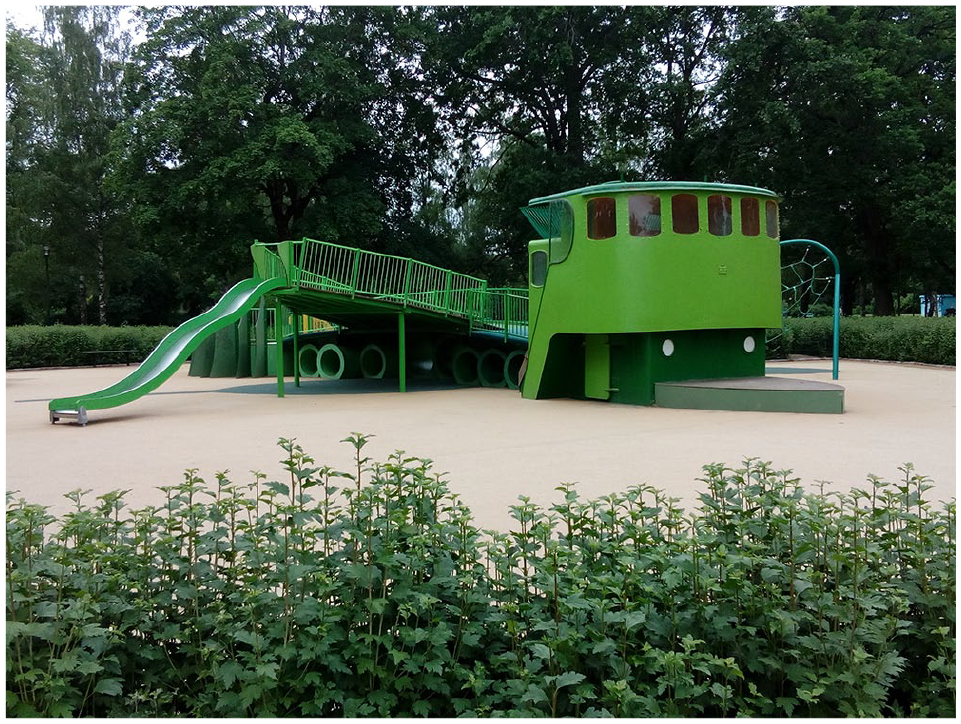
A photograph of PAPU showing the “head” and the “body” of the sculpture.
The PAPU playground is used here as an example to illustrate how safety, creativity, and art have been combined together when designing playgrounds for and with children. The main data of this part of the study consists of interviews conducted with the group of artists who were involved in the PAPU project and the Turku City authorities responsible for playground design and management in the city. Children were left outside the study due to privacy issues. Additional information about PAPU was received from the media, policy documents, and the Internet. All five artists in the PAPU design group were contacted but one of them did not answer to the study request. Consequently, altogether four artists (A1–A4), two city officers (C1–C2), and a safety consultant (C3) were interviewed during the summer 2016. The interviews were semi-structured and the results were interpreted by using qualitative content analysis (Tuomi and Sarajärvi 2009), where different themes appearing in the interviews were recognized and further scrutinized through analytic coding (Cope 2010). The general objective was to discover what the different stakeholders—and the artists, in particular—thought about the design and implementation process of PAPU and how they expressed their attitudes and opinions about the safety issues related to the project.
A Participatory Art Project
The PAPU playground was built to Kupittaa Park to replace an old statue park that had been a popular play space for local children for nearly thirty years. The original park, made in 1986–1988 as a collective project between artists and children, consisted of large sculptures representing imaginary creatures such as giants and a dragon that could be climbed on and run around. In 2013, the old park was demolished, which caused discontent among local people and even a small demonstration was organized to resist the bulldozing of the sculptures (Turun Sanomat, October 12, 2013). In the media, the reasons for demolition were explained to be the bad condition of the old statues and the fact that they did not meet the current European playground standards (Yle, October 11, 2013).
In January 2015, the City of Turku announced an art competition where they invited five local artists (A1–A5), all of whom had previous experience in making public art, to each draft a proposal for a new art-playground that would be located in the same place as the old statue park. The criteria that were emphasized in the competition were the safety, feasibility, and artistic innovativeness of the proposal and that it would involve children’s participation and fit the surroundings. Officially, a proposal called Ötökkä (a bug) won the art competition, but it was soon announced that the artists had decided to re-plan the playground from the beginning and work together as a group ( www.turku.fi , March 20, 2015). By chance, the artists happened to know each other in advance and with their collaboration, they wanted to make the statement against the situation where artists always need to compete against each other.
The design and implementation schedule for PAPU was strict. During the spring of 2015, the artists organized several workshops for local children where, for example, they built together different kinds of structures from cardboard boxes and brushwood, which then worked as inspirations for the actual sculpture. The workshops were free of charge and they were held in different cultural venues around the city. The artists took some ideas from children’s sketches and works, modified their content, and incorporated the ideas into the final playground design. For example, the concepts of an animal (insect) and a vehicle were among the ideas derived from children’s workshops, as well as smaller details such as an abstract drawing that was later carved on the “tail” of the sculpture.
Involving children in the design process like this indicates a more participatory approach to playground planning where children are given more power to influence their own living environment (see, for example, Birch et al. 2016; Kuusisto-Arponen and Laine 2015). In the case of PAPU, however, children were not able to take part in the making of the final sculpture because the construction work required specific professional skills and equipment. Artists were, nevertheless, satisfied with the workshops, and as one of them disclosed, they found it important that the collaboration and the participation of children “was not quasi-democratic but was done genuinely instead” (A1). In fact, one of the artists mentioned how the presence of children eased the collaboration between the artists, because then “the visions of different artists were not fighting against each other” as the ideas came originally from the children (A2).
After the workshops, the design process of PAPU proceeded rapidly and the scale model of the new playground was introduced to the public in June 2015. The work had been divided so that one artist was responsible for designing the “head” of the sculpture, one took care of the “tail” and stairs, and the rest designed the “body” and “wings,” respectively. The detailed construction drawings were ordered from a planning firm, and the foundations and welding were made by professionals to make the sculpture durable and safe. Some critical parts, such as the slide and the climbing net, were bought ready-made from manufacturers, but otherwise the structures of the sculpture were mostly self-constructed. The construction work was implemented during the summer and autumn 2015 with some delays in the process, but eventually the playground was opened at the end of 2015. According to the city officers (C1, C2), the final budget of PAPU was comparable with the costs of a normal, medium-sized playground, so making a creative playground proved not to be more expensive than making a traditional one.
All the interviewed participants seemed to be rather content with how the PAPU project had been executed. The artists related in the interviews that they were pleased with how the city had carried out its part in the project, and when they were asked how the process could have been improved, they did not have anything to add apart from some minor comments about time management (A1, A3) and funding issues (A2). What the artists saw to be the special merits of the project were the mutual ambition that all the stakeholders shared to achieve a good result, and, in particular, how the city had organized and taken care of the safety issues as part of the project.
Artists Facing the Safety Standards
Safety was, as already mentioned, one of the main criteria imposed for the playground, which in this case meant the adoption of the European Standards EN 1176 and EN 1177 in the design of PAPU. The artists, with the exception of one of them (A2), did not have any former experience in making play equipment for children under the current European playground standards. The one who had taken part in a similar kind of project before described in the interview how frustrating it had been to deal with the numerous safety rules in his earlier work, and how he had “warned the other artists about all the painstaking details” that designing a children’s playground would involve (A2). In the case of PAPU, nevertheless, the incorporation of safety aspects into the design process went more smoothly. Both the artists and the city officers found it important that the safety expectations, requirements, and limitations were already made clear at the beginning of the project, and not in the way that “you first make some wild ideas and then afterwards someone comes and bans them all,” as one of the interviewees expressed it (C1). The artists were guided through the playground safety requirements by a professional safety consultant who had been hired for the project by the City of Turku. All the interviewed artists found the presence of the safety consultant useful, and one of them said, it was fantastic that you did not need to go outside your own field of know-how and you did not need to remember all the details, because there was [the name of the consultant] who checked what you can do and what you cannot do. (A1)
The safety consultant could be contacted at any point during the project and he also organized safety lectures for the artists. The artists found the safety requirements and standards rather “amusing” (A1–A3) and “sometimes annoying” (A3) due to their pedantry but also “challenging and interesting” (A4). At first, the details of the standards sounded difficult and strange to the artists, but “after the first shock was over,” as one of them described, “they became a natural part of the project, and in the end we were able to make an amazing work of art” (A2). Once the artists were asked whether they felt that the safety aspects influenced their artistic vision, there were some differences and hesitation in their answers. Most artists (A1–A3) said that there were not that many compromises made, yet once they were talking about the details of the design, it appeared that some original ideas concerning, for instance, the form of the stairways, barriers, and the uses of recycled material had needed to be simplified because they had not met the existing playground standards. This slowed down the design process, as “there was no spot that you could make badly as every detail needed to be thought about carefully” (A3). One of the artists (A4) was a little more critical and said that the safety aspects affected the appearance of the artwork quite much, but he added that there were also other factors influencing the end result such as the money available and the characteristics of the building materials. Eventually, however, none of the interviewed artists found the safety requirements overwhelmingly problematic, and most of them felt that the technical standards did not prevent creativity but rather gave some limits and thresholds within which they could operate. At some level, the strict and precise standards even facilitated the work of the artists because “once you get these rules, then you don’t need to think about them anymore” (A3). Therefore, with regard to the creative design process, the safety requirements and standards could be seen “as much as an opportunity as a challenge,” as it was defined by one of the artists (A3) at the opening ceremony of PAPU.
Safety Standards as Policy and Practice
What was interesting in the interviews was that, apart from some minor jokes and comments which the artists made about the playground safety standards, no one was really trying to question them. “It is a whole other discussion, whether these standards are reasonable,” remarked one of the artists (A2) but then continued, “but because the City of Turku had made the decision to follow the rules millimetre by millimetre—then the work was to be done according to them.” Some artists (A1–A3), however, took up the situation in other European countries where the playgrounds are more freely designed, even if the same European Standards EN 1176 and EN 1177 also existed there (see also Gill 2007, 32–36). This shows that in the case of PAPU, the adoption of safety standards was also a question of political conventions and not only of safety as such. One reason behind the compliance with the standards had undoubtedly to do with their controversial status as “voluntary but compulsory rules,” as the safety consultant hired in the PAPU project defined the essence of the standards (C3). At least in the City of Turku, the playground safety standards have become an established policy and practice in playground development, and according to a city officer (C2), the standards EN 1176 and EN 1177 are currently used as building guidelines for all the new playgrounds and when repairing the old ones (see also Turun kaupunki 2016).
While there are self-evident assets related to the usage of safety standards, treating them as principle guidelines for playground design can also be held debatable (cf. Ball et al. 2019; Herrington and Nicholls 2007; Spiegal et al. 2014). Even if a playground is built and maintained according to the standards, it does not mean that the playground is necessarily safe or risk-free in use. Nevertheless, even in those cases where the safety standards fail to ensure the safe use of playgrounds, their official status is strong, as an example from PAPU demonstrates. Soon after the new playground was opened, there was an angry message left in the feedback service of the City of Turku, where PAPU was accused of being “a badly-designed, unsafe park” (https://opaskartta.turku.fi/eFeedback, January 5, 2016). The anonymous writer wrote, for example, that the deck of the sculpture was too slippery, the steps were too high or difficult to climb, and the tunnels too shallow so the children hurt themselves “and came away bruised and crying” (Figures 2A and 2B). In the reply from the City of Turku, the criticism was responded to by stating that “the artwork fulfils the safety standards SFS-EN 1176 set on playground equipment” (January 8, 2016). Referring to the existing European standards gave the answer an authority that was difficult to deny or challenge, and in this way, the standards consolidated their significance as established policy and practice despite their weaknesses.
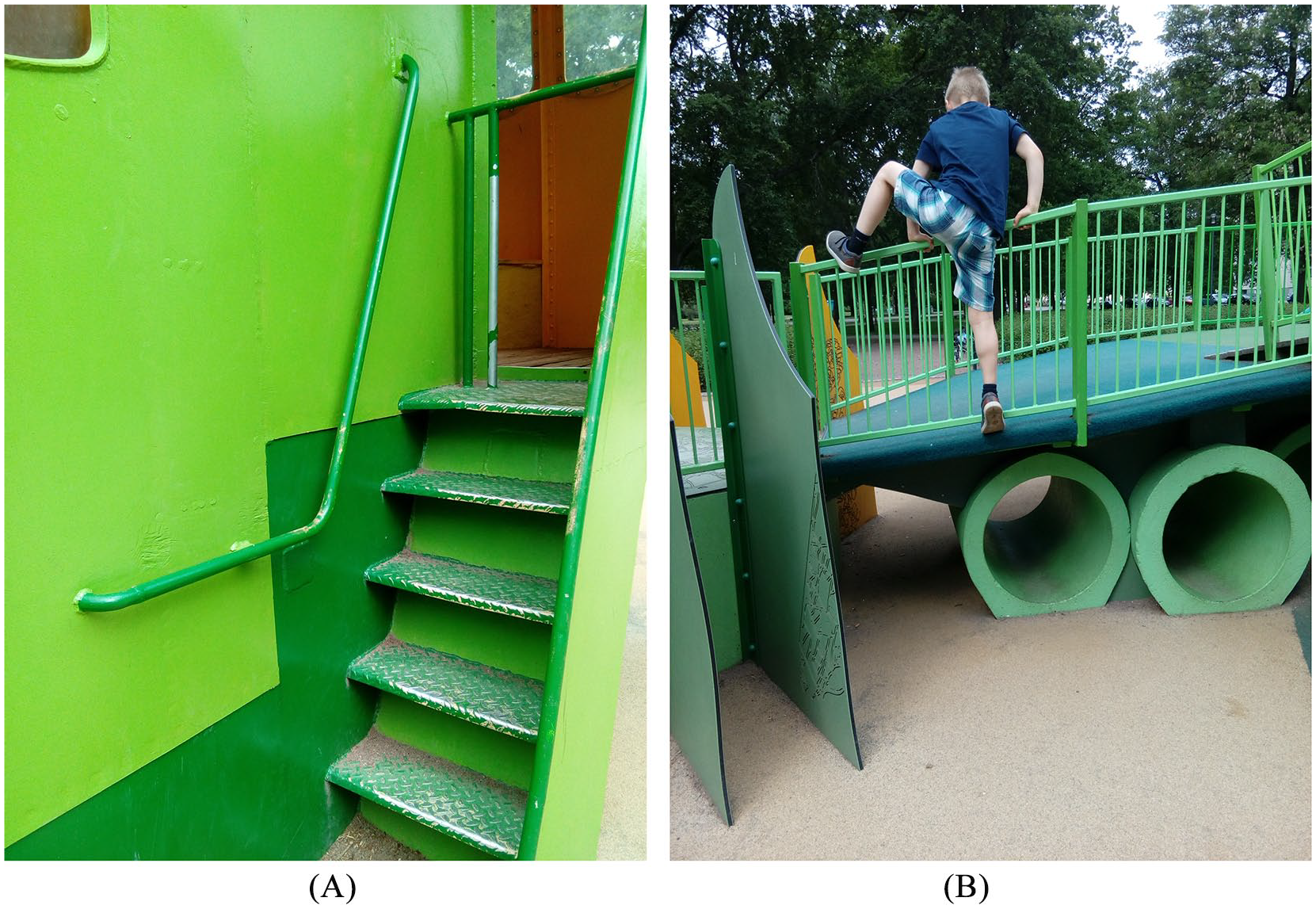
(A) The steps considered being too dangerous and (B) narrow tunnels. A child climbing over the safety railings.
Art and Play: Testing the Limits of Standards
Although the safety standards were faithfully followed in the making of PAPU, as described above, there were two specific aspects that challenged their dominance. These were related to PAPU’s position as public art and to the spontaneous and transgressive nature of play. The artists accepted the safety standards without any major complaints when they were linked to the making of a children’s playground, but when the conversation turned to art in general, differing opinions were revealed. The artists (A1, A3, A4) recounted that when they had created public art earlier, the questions of safety and liability had received a much more minor role. The artists described that some structural configurations, such as calculating the wind loads or preparing the constructional drawings, also need to be done when making more traditional sculptures for public spaces, but the kind of detailed safety procedures that the PAPU project required are not normally demanded. One of the artists (A3) presumed that the absence of safety thinking from traditional public art has to do with the old-fashioned view in which “artworks were meant to be watched but not to be used.” PAPU, however, represented a more participatory form of “new genre public art” (Lacy 1995), where the audience is expected to explore, take part, and engage with the art actively (see also Knight 2008). A scenario in which similar kinds of safety standards that concern public playgrounds would also be applied to public art in general caused opposition and doubt among the artists. The safety consultant (C3), however, did not see the “safety standardization” of public art impossible because he saw that when an artwork is located in a public space, it is open to unpredictable and unsafe uses. The success of the PAPU project was therefore a twofold case: while the project showed that it was possible to combine together art and safety, it also brought technical safety standards to the domain of art to which they have traditionally not belonged.
Even more complicated was the relationship between playground safety standards and the actual act of playing. Play is, already by definition, a “free and voluntary activity, a source of joy and amusement” (Caillois [1958] 2001, 6; see also Huizinga [1938] 2014). Especially, the uncontrolled form of play known as paidia, which is based on spontaneity and on “diversion, turbulence, free improvisation, and carefree gaiety” (Caillois [1958] 2001, 13), can be difficult to regulate through standardization. As Kuusisto-Arponen and Laine (2015) have observed, children do not always act in playgrounds as designers or adults expect them to do. Instead, children sometimes aim to “re-territorialize” the playgrounds and thereby transgress the spatial control of adults (Thomson 2005). In PAPU, for example, some older children kept climbing on the top of the ship’s cabin, and when the city added a new fence on the roof, they started to use the fence as a foothold to reach the roof even better. The same situation occurred with the safety barrier on the deck of the sculpture, which was supposed to prevent accidents and risky behavior, but which instead urged some children to climb on, hang from, and jump over the railings (Figure 2B). The artists did not find this “misbehaviour” of children simply as a bad thing. On the contrary, one of the artists said that “it is nice that bigger kids are using that barrier to climb on it, which is a new function that we had not thought about in advance” (A1). Hence, these risky and unexpected uses of PAPU manifested the freedom, spontaneity, and transgression related to the act of playing, which the strict technical standards were not able to fully repress.
Conclusion
According to Furedi (2002a, 1), safety is “the fundamental value of our times” and “[o]nce a preoccupation with safety has been made routine and banal, no area of human endeavour can be immune from its influence” (Furedi 2002a, 4). In this paper, this prominence of safety thinking has been studied in the field of contemporary playground design. In Finland, the deep-rooted relationship between safety and playground development is evident, for example, in the ways safety and risk evaluation are defined and required by law (Consumer Safety Act 2011) and in the strong (yet obscure) role that technical standards (EN 1176 and EN 1177) have gained in risk prevention. However, while the safety standards have a powerful effect on the design and management of playgrounds, this article also shows that compliance with them does not need to be an obstacle for creative playground planning.
The case of the PAPU playground presents some concrete ways of how to integrate safety thinking and creativity in playground design. Involving artists in the design process, good co-operation among the different stakeholders, and proactive approaches to problem solving were some of the key factors behind the favorable outcome of the PAPU project. An opportunity to consult with a safety expert, in particular, was seen beneficial for the whole process. Children’s ideas were taken into account in planning, indicating that creativity was not only seen as the artists’ or designers’ privilege. The artists were trained about safety procedures at an early phase of the project, making safety awareness a normalized part of the design process behind PAPU. Critically, this kind of normalization can be seen as a symptom of the routinization of safety that has been problematized by Furedi (2002a) and others (e.g., Koskela 2009). However, the artists involved in the PAPU project did not feel that the safety requirements hindered their creativity but rather that the standards only set boundaries for the design details. Thus, somewhat paradoxically, the predetermined standards also facilitated the creative design process by relieving the artists from extra safety concerns.
Due to the many positive aspects of playground safety standards, any possible critique should not be so much addressed to their role as practical design tools. What is a more crucial question is how the standards are used and for what purposes, and further, where to draw the limits for standardization or how to organize risk management (cf. Ball et al. 2019). Problems may arise, for instance, if the playground standards are treated as undeniable policy instruments to govern the planning processes (Spiegal et al. 2014), or if they are used for litigation purposes in liability questions (cf. Herrington and Nicholls 2007). In both cases, the power and purpose of standards go beyond their original function as technical instructions. Furthermore, implicit trust in safety standards may be problematic, because even if standards aim to diminish the risk of injuries, they cannot guarantee full safety in playgrounds, and accidents happen despite precautionary safety procedures. Children continue to act in unpredictable ways and therefore using standardized criteria for playground products is an artificial way to define safety. Moreover, children are different in their body figures and sizes, so common standards can be difficult to establish. Reliance on anthropometric measurements can lead to discrimination of children whose bodies are deviant from “the normal.” The clearest example of this kind of situation is how children with deviating head sizes have been partially excluded from the coverage of the playground standard EN 1176.
In addition to the legal and technical challenges related to safety standards, it is also debatable as to what can be standardized. As Timmermans and Epstein (2010, 85) point out, “the choice of standards of any sort implies one way of regulating and coordinating social life at the expense of alternative modes.” Therefore, critical discussion is needed about the limits of standardization and whether standards are appropriate means to govern children’s play environments if and when creating child-friendly cities. However, the question about playground safety standards is not a simple one, as has been discussed in this paper. The complexity related to standards is manifested, for example, in the ways they are simultaneously powerful and mundane (as characterized by Busch 2011), voluntary but compulsory (as defined by the safety consultant of PAPU), and challenging but helpful (as described by PAPU artists). These ambiguities demonstrate that the world of safety standards is not a fixed one and there is still space for alternative interpretations and creative expression even under the regulatory predominance of standards in playground planning.
Footnotes
Acknowledgements
I would like to thank the anonymous reviewers for their insightful comments and the artists and other informants for their involvement in this study.
Declaration of Conflicting Interests
The author(s) declared no potential conflicts of interest with respect to the research, authorship, and/or publication of this article.
Funding
The author(s) disclosed receipt of the following financial support for the research, authorship, and/or publication of this article: This work was supported by the Finnish Cultural Foundation’s Varsinais-Suomi Regional Fund (personal grant).
