



Abstract
“Deathscapes” constitute a growing field of research, yet the topic remains widely neglected within urban planning. In this paper, we examine the adequacy of existing provision for death, remembrance, and the disposal of body remains for ethnic minority groups living in four British towns: Huddersfield, Newport, Northampton, and Swindon. We show how the needs of ethnic minority groups are routinely peripheralized through a lack of acknowledgment of diverse cultural and religious needs. The paper argues that the failure of contemporary planning policy and practice to address the intersections between death and ethnicity has contributed to ongoing forms of exclusion from the British society.
What on its face looks like a general policy which applies to everyone equally may in fact have an unequal impact on a minority. In other words, to treat everyone in the same way is not necessarily to treat them equally. Uniformity is not the same thing as equality. —Lord Justice Singh and Mrs Justice Whipple
1
Introduction
The epigraph quoted above forms part of a legal ruling in a case against the Inner North London Senior Coroner. The Coroner’s Office did not prioritize the release of deceased Muslim or Jewish people and argued that their policy to release bodies in order of death was a fair and non-discriminatory approach. The Jewish and Muslim community and representative organizations had made representations to the Coroner about their religious requirements for a speedy burial. However, the Coroner’s office described their system as a “taxi rank”; by taking cases in order of death, they claimed their approach ensured equality. The legal case revealed that some deaths were, in fact, prioritized but rarely on the basis of religion. The Judges found in favor of the Jewish community who brought the claim and determined that the policy also discriminated against the Muslim community as well, as both groups had religious requirements to bury a body quickly. Furthermore, the approach of taking cases in date order conflicted with the statutory requirement for the local government to protect equality. This case highlights the problematic normative discourses and provision within British public services and policy-making, when it does not take religious or ethnic difference into account. The assertion that the Coroner’s policies were neutral was based on norms acceptable to the white majority and which did not specifically conflict with Christian requirements.
The policies and practices associated with death and body disposition have significant implications for particular faith groups at an already vulnerable time of grief and bereavement. Public funerary and related services and policies draw together a range of national and local state sectors, including planning. While this case focused on the coroner’s service, such claims of equal policy provision and treatment are familiar to British planning scholars who have critiqued that racial and ethnic inequalities sustained by claims of the profession’s neutrality for the past three decades (see Gale and Thomas 2021; Krishnarayan and Thomas 1993; Royal Town Planning Institute/Commission for Racial Equality 1983; Thomas 2000). More recently, there is a growing body of work critiquing the ways in which planning has failed to engage with racial and ethnic difference and embeds forms of white privilege (see, for example, Brand, 2018; Goetz, Williams, and Damiano 2020). Rather than being “neutral,” the ways in which spatial planning engages with matter relating to death, body disposal, and remembrance are part of this series of structural inequalities in society.
Our paper brings questions of race, planning, and cemeteries, crematoria, and related provision into closer dialogue (see, for example, Gale 2005; Hunter 2016; Jassal 2015; McClymont 2016). Our focus is on the spatial arrangements that mediate the capacity for ethnic and racial minorities to fulfill death rituals in the United Kingdom with particular emphasis on England and Wales (a separate framework operates in Scotland and Northern Ireland). We consider how the shaping of provisions illuminates the continuing exclusions of ethnic and religious minorities from British identity and material space. Planning is an important dimension of provision for deathscapes such as cemeteries and crematoria but must be situated as part of a wider statutory framework. The necessary arrangements for death and body disposal involve that state and private services working with families and communities at a time of grief and loss.
Our paper draws on an eighteen-month project examining how four towns in England and Wales with diverse populations planned for differing community needs and the experiences of these communities around death and remembrance. 2 Black and Minority Ethnic (BME) is often used as an overarching term to define “non-white” ethnic, racial, and religious minorities, although these identities may intersect (see Meer 2008). Significant populations from New Commonwealth immigration principally from the Caribbean, Africa, South, and East Asia took up their rights as British citizens to settle in the United Kingdom in the decades following World War II. More recent migrants have arrived primarily from the Eastern European countries that joined the European Union in 2004. These towns all had established minority populations of between 7 and 17 percent against a national average of 20 percent (2011 Census). Our research program enabled us to survey the existing and planned provision for each of the locales.
The universality of death may lead us to believe that there are few barriers to being able to fulfill religious or cultural preferences in death and the burial or cremation of body remains. These assumptions are compounded by the limited attention to matters of death within planning scholarship and the persistence of assumptions around “normalized death rites” in relation to diverse communities (for an exception, see Basmajian and Coutts 2010). This journal has addressed important questions of planning for a diversity of ages and life stages and in relation to ethnicity, race, and anti-racism (see, for example, Greenlee et al. 2018; Sweet and Etienne 2011; Umemoto 2001; Warner and Zhang 2019; Williams 2020). However, a growing number of studies have highlighted the inherent racial and ethnic politics of death, including the erasure of cemeteries in the United States and Europe, and the inability for religious communities to follow rituals in Britain and Europe (see Ansari 2007; Lemke 2020; Miller and Rivera 2006; Maddrell et al. 2021).
In the first section, we identify the necessary discursive shift required to challenge simplistic constructions of immigrant and minority identity as non-British. We suggest that there is an assumption that state provision is general enough to cater for a multiethnic society, and any consideration of BME group needs is dependent on local demand. Burials have a more obvious planning dimension, but the rituals for both burial and cremation require culturally appropriate facilities. Decisions about ash scattering also relate to considerations about the location of home and peoples’ final resting place in multiethnic Britain. We consider how death, as the end point of the lifecycle, intersects with a contested politics of ethnic, cultural, and religious need and belonging. We then turn to our empirical findings to explore how participants viewed provision in relation to their needs. We argue that cemeteries and crematoria, along with associated funerary practices, crystallize a series of majority-defined assumptions about established spatial arrangements for death. BME groups faced challenges in arranging funerals and dealing with body disposal in their hometowns in ways that align with their religious faith despite increasing provision for religious difference. We then turn to how participants framed decisions about the location of their body remains in relation to families and home. We argue that ongoing challenges to having needs met impact understandings of feelings of British and transnational identity, alongside their connection to their hometowns and families.
Planning for the End
Planning forms part of a wider set of spatial governance practices that include allocation of cemeteries or crematoria within local authority areas. However, these considerations take place in a British discipline that has insufficiently considered ethnic and cultural differences in the past decades. U.K. planning has recognized that there is an increasing multiethnic composition of England and Wales. However, planning assumptions continue to revolve around spatial understanding that normalizes the white majority population and their needs and preferences (see Beebeejaun 2004; Gale and Thomas 2021). An idea that planning serves all communities equally has long pervaded British planning and when faced with providing for their needs considers them as a special form of provision. Numerous studies have shown how ethno-religious needs, such as places of worship or eruvs, are presented as incursions upon an asserted British landscape (Gale 2008; Gale and Naylor 2002; Watson 2005). Opposition has often organized around ideas of a traditional homogeneous and Christian culture as well as expressions of Far-Right nationalism (Gale and Thomas 2021). Planning scholars Richard Gale and Huw Thomas (2021, 136) conclude “it is difficult to say categorically that the planning system is more sensitive to race quality now than it was 40 years ago.” Planning has been slow to act to challenge racial hatred which can be channeled against minority communities within planning (Thomas 2000; Watson 2005).
The marginalization of BME groups is compounded by the lack of legal obligation in England and Wales to provide space for burial. 3 It is no wonder that U.K. state and private provision for death is uncoordinated and has been described as “chaotic” (Rugg 2007). No comprehensive mapping data for current or former burial grounds in England and Wales exist (see Ministry of Justice 2007). Assessments and survey reveal the United Kingdom is running out of space for burial, with estimates suggesting more than half of municipal burial grounds will be full within ten years. It is estimated that 70 percent are in the control of the Church of England and 21 percent in the control of Local Authorities, and the remainder are controlled by a range of interests including other religions, charities, natural burial sites, or private burial grounds (Ministry of Justice 2007). 4
The allocation of cemeteries and crematoria on a technical land-use basis contributes to death and body disposal becoming a further location where minorities are neglected and their needs marginalized. Although places of worship are a distinct area of research, they form part of deathscapes given their role in religious services and the performance of rituals such as washing the body. Their location is therefore an important consideration in thinking about the provision for death and body disposal.
All groups are impacted by the uneven provision of burial sites or cremation arrangements, but there are specific challenges for BME groups outside of cities. The presence of ethnic and racial different groups is considered as increasing ordinary and accepted dimensions of urban life in cities (see Amin 2012; Neal et al. 2017; Vincent, Neal, and Iqbal 2017). In contrast, a growing set of commentaries have demonstrated a disdain for a multiethnic Britain with white majorities depicted as under threat (see Rojek, 2007 for a discussion). Britain, outside of cities, is imagined by some as an ethnically homogeneous white polity under threat from ethnic diversity (Goodhart 2017). Towns are part of the perceived non-metropolitan spaces of an implicitly white majority Britain. The confinement of diversity to cities helps sustain a set of planning practices primarily oriented toward white Christian secular practices grounded in that heritage (see Baker 2019 for a critique). Such thinking allows for the normalization and invisibility of power relations, which reify the majority culture (in this case, a blend of Christian, Christian heritage, and secular norms) as “neutral.” These claims have implications for the welfare and sense of belonging of ethnic minority groups, in terms of practicalities of service provision and more intangible senses of diasporic identity. Minority practices become peripheralized against the normative dimensions of imagined broadly monocultural shared practices of death and memorialization.
These tensions may be exacerbated due to a lack of new space for burials in England and Wales. Non-Christian religious communities also face opposition in trying to develop new sites for synagogues, mosques, and temples where funeral services and rites are held.
Cemeteries and crematoria are not just places of remembrance but may provide one of the limited sites of open space within peoples’ neighborhoods. Their main purpose is as a memorial space, but their common planning designation as a green or open space frames these as primarily secular spaces for general community use (Rugg, 2006). Many British cemeteries were developed during the Victorian era and have become sites of nature with few new burials. They are now often in highly urban areas as cities expanded, meaning that these spaces perform multiple functions and bring challenges for planning and urban management (Gandy 2012; Woodthorpe 2011). Planning considerations have tended to focus on the more mundane or everyday dimensions of these spaces such as site access and car parking, public transportation, and appropriate usages such as dog walking, sports usage, and general recreation.
Practices of body disposal and remembrance are central to human cultures (Kellehear 2007), and they therefore represent, or are critical to, understandings of sacredness both for members of organized religions and for society more generally (Francis, Kellaher, and Neophytou 2005). Rather than assuming consensus over these spaces, it is important to remember the Victorian history of many cemeteries as places for a particular aesthetic and practice of contemplation and relaxation. These cemeteries arose in response to the public health crises precipitated by increasing urbanization and overcrowding of bodies (Rugg 1997). Some also addressed the long-standing exclusions from burials for nonconformists. 5 Victorian burial grounds contained numerous elaborate stone memorials to those interred there. However, in contrast to the Victorian aesthetic, lawn cemeteries were developed in the twentieth century, with more uniform gravestones and grass lawns enabling easier maintenance. The Anglican church moved to a position of allowing cremation during the twentieth century, and cremations increased significantly from the 1940s as a funeral choice. However, the Roman Catholic church did not give permission to be cremated until 1963 (Knight 2018). Cremation also matched and then overtook burial as the preferred means for the disposition of the dead, and currently around 77 percent of people have their body remains cremated (see Rugg 2016; The Cremation Society, N.d.). Crematoria in Britain usually have a chapel for the service and an attached garden of remembrance for the scattering or interment of ashes. These are often municipal or privately run facilities but form part of the sacred space of death (Davies 1996).
Through considering the historic planning of spaces of death, we also find evidence of a long-standing ethnic minority presence alongside histories of segregation and exclusion for Jewish and Muslim communities (Kadish 2011). The history of Muslim burial can be traced back to the mid-nineteenth century where significant populations existed around major urban centers and ports. The historian Humanyun Ansari notes that many Muslims would have been buried in nonconformist graves, although efforts were made to follow religious rites and rituals. It was only in 1936 that negotiations began for a Muslim section of a graveyard in Harton, South Shields. Ansari (2007, 564) notes the shift from repatriation to wanting religiously appropriate burial space in the United Kingdom as a British Muslim identity has emerged: They [young Muslims] have developed more complex emotional and cultural bonds with the country of their birth, and this is reflected in an increase in the number of families, compared with the past, who are now choosing to bury their kin in Britain. As they do so, they seek suitable provision for performing the last rites according to Islamic requirements.
The development of a stronger voice within the Muslim community has been an important dimension to the increased provision for Islamic burials. The development of spaces for BME communities to articulate their needs and desires is not a one-off moment but a process that develops over time. The variable capacity of ethnic and religious groups to find places for “everlasting rest” challenges a sense of belonging and the capacity to have final wishes met and connect to ideas of belonging through life and death.
Diasporic Belonging
How might spaces of death and body disposal link to lived experiences of belonging and identity? The feminist geographer Avtar Brah (1996) argues that migration to Britain created a diaspora space focused on the places of origin of migrants. In reconfiguring our understanding of British BME groups, we should be attentive to “the entanglements of genealogies of dispersion with those of ‘staying put’” (p. 178). As Brah (1996, 190) further notes, “It is quite possible to feel at home in a place and yet, the experience of social exclusions might prohibit public proclamations of the place as home.” The critical race theorist Katherine McKittrick (2006, xii) reminds us that “black matters are spatial matters.” While McKittrick’s writings are based within North American scholarship and focus on black communities, her work is highly important in connecting racial discourses to the spatial configuration of patterns of recognition or erasure. Decisions about death and the final resting place for burial or the scattering or internment of ashes of the “migrant body” are situated within lives where the right to belong and right to stay are political rights that encompass the full life cycle of a citizen.
The location of body remains or the ability to complete the cycle of life in a chosen location exists at the intersections of belonging, citizenship, and place attachment. bell hooks’ (2009, 6) reflections on belonging remind us that “If one has chosen to live mindfully, then choosing a place to die is as vital as choosing where and how to live.” For migrant populations and their children, grandchildren, and subsequent generations, these are important and complex questions spanning ideas around migration, mobility, citizenship, and intergenerational belonging.
There is an extensive literature on death, burial, and cremation that considers the experiences of migrants and the importance of repatriation of body remains (Félix 2011), as well as transnational migrants’ complex connections to ancestral lands (Zirh 2012). These literatures are important and repatriation remains an important option for some. However, a growing number of scholars have turned to changing death practices as immigrants become long-standing citizens in their former places of arrival. The religious studies scholar Alistair Hunter (2016, 250) highlights how Death in diaspora may be the occasion to lay what are perhaps the deepest and most permanent foundations for settlement and belonging of migrants and subsequent generations, through burial and other funerary practices in the adopted homeland.
These changing attitudes reflect the complex entanglements of diaspora and family and national attachments. However, the capacity for BME communities to have their needs met lies in tension with the implicit norms about what constitutes a funeral and appropriate burial or cremation practices. These decisions are dependent on the capacity and willingness of the national and local state to accommodate their needs. This includes the funeral rites for an individual but also spans the certification of death and moves through decisions about the final place of bodily remains (see Maddrell et al, 2021). The political scientist Osman Balkan’s (2016, 149) study of Alevi Muslim undertakers in Berlin situates their important role in mediating between families and the German state at the point of death: In confronting death in the diaspora, immigrants are compelled to navigate different bureaucratic structures, burial practices, and rituals of memorialization that are incongruous and potentially antithetical to the rites and traditions in their country of origin. In such situations, undertakers play an important pedagogical role. They must instruct their customers not only about the laws of the dead but by extension, the legal-rational order of the host society.
Funeral directors play an important role acting as significant mediators and interlocuters, and these findings are supported within our own research (see Maddrell et al. 2021). However, our focus is on an exploration of the context of established norms in which decisions are made and the barriers to bodily disposal for minorities.
In the next section, we turn to our research design. In the following two sections, we then turn to our findings. We explore how individuals’ and communities’ desire for religiously appropriate funerals and decisions about burial or cremation are mediated through the local state and the limitations to current provision. We then turn to the question of a final resting place after death and the importance of family connections as well as local and national identity. We set out how current provisions make assumptions about norms that reinforce feelings of invisibility or neglect of needs within towns. We consider how spatial planning and wider urban governance hold presumptions about burial sites and crematoria that assume that these spaces serve all needs equally. A continuing lack of recognition of ethnic/racial diversity and religious diversity in Britain undermines these communities’ rights as citizens worthy of respect and consideration at a time of vulnerability.
Research Design
Our four cases were selected as they had populations of 160,000 and 220,000, meaning they had sufficiently clear spatial boundaries so that cemetery and crematoria provision covered the whole local population. A city is not a clear empirical definition as city status is granted by the Crown and is honorific. Newport was previously the largest town in Wales but gained formal city status in 2002. From a practical perspective, we considered population size and demographics to select our cases (see Table 1). Each of the local authority’s boundaries geographically encompasses the town, and thus provision for inhabitants is considered across the town.
Ethnic Breakdown of Case Study Towns.
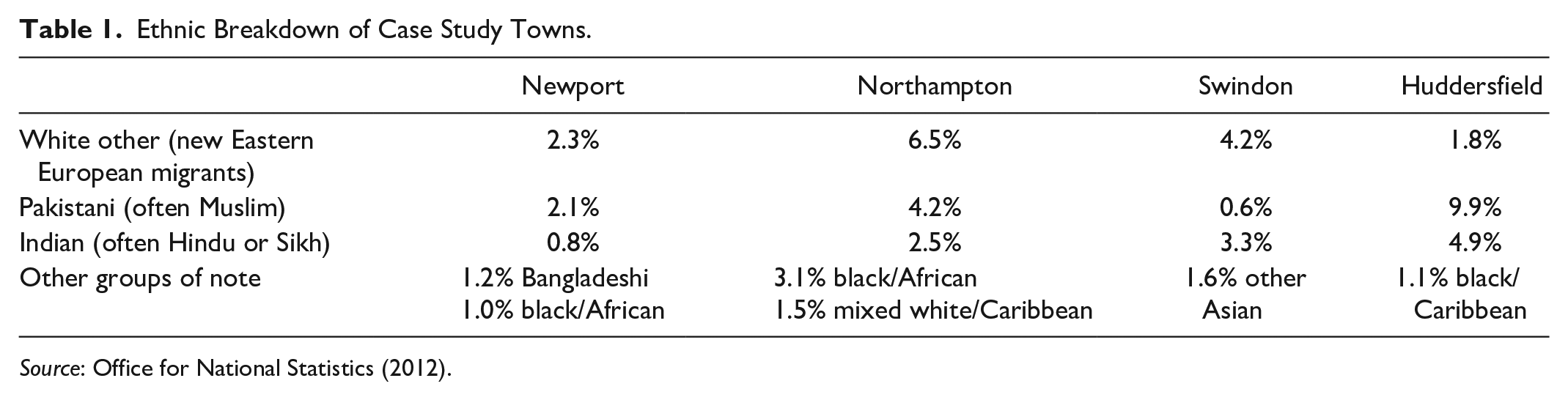
In this paper, we present findings related to provision in the four towns and how these mediated feelings of belonging. Our research used a mixed-methods approach. The findings presented in this paper are based on qualitative interviews and focus groups where we explore both the needs and desires of a range of minority ethnic and migrant groups and the way these issues were perceived and addressed by service providers, policymakers, and more formal stakeholders, including religious leaders and activists. We purposively excluded recently bereaved people from our research due to the sensitivities of the topic.
We conducted twenty-one semi-structured interviews with stakeholders, such as community leaders and cemetery and crematorium managers, and sixteen biographical interviews with individual users from diverse backgrounds recruited through snowball sampling. Semi-structured interviews enabled us to discuss issues in a way that was as comfortable as possible given the sensitivities of the topic (Dunn 2005). The interviews focused on experiences with funerals, visits to cemeteries or crematoria, particular needs, customs or provisions, and specific issues or concerns, all set within the context of wider personal and family histories. These biographical interviews asked people to discuss their lives and personal and family migratory trajectories rather than primarily focusing on experiences of death and bereavement. “In contrast to more quantitative methods of investigation, they have proven to reveal ‘blind spots’ and unorthodox stories instead of central tendencies” (Schubring, Mayer, and Thiel 2019). The project conducted fifteen focus groups, with a total of 112 participants representing varied community groups, including policymakers, providers, and users. We draw on the focus groups with users where participants discussing interpretations of faith, experiences, and their wishes stimulated significant reflection on how death is mediated within the diasporic space.
The research interviews and focus groups were recorded if consent was given and transcribed by the researchers. We analyzed our research findings, first, by coding the interview transcripts inductively, thus looking for main topics, and, second, by drafting a deductive coding list based on team discussions and our previous work on deathscapes, diversity, and planning (Boeije and Bleijenbergh 2019). This reiteration and interplay between inductive and deductive analysis allowed us to start from the perspectives of research participants (Edwards and Brannelly 2017), while it simultaneously enabled us to critically engage with the data, as well as our own embodied performance and intersectional identities as researchers (Ellingson 2006; Ezzy 2010). Our team was interdisciplinary and of mixed gender and ethnicity. The research team read transcripts and discussed research findings and were involved in empirical research in one or more of the towns (Mathijssen et al. 2021).
Being Together after Death
Each of the four town’s original cemeteries dated back to the Victorian era, and several cemeteries in each location had been closed to new burials due to pressure for space. Furthermore, none of them had policies for the allocation of new sites. Specific issues emerge for Muslim and Jewish communities who must bury their dead, although communities are affected by the increased pressure on these sites. 6 All cemeteries are owned by the local state, although Amey, a private contractor, runs Northampton’s provision. Crematoria were a mix of local state and private providers. Taking each town in turn, Huddersfield has seven cemeteries in total, and of these one has a Muslim section. There is no Jewish section in the town, and the nearest section is in Bradford, around a thirty-minute car journey away. Newport had one cemetery that is closed to new burials, and the remaining two were constructed during the Victorian period and now have sections for the Muslim, Jewish, and Baha’i faith. There are also sections for children, green burials, and cremated remains. Newport also has a historic Jewish cemetery, and the community dates to around 1850; however, it declined significantly in the twentieth century. Northampton has seven cemeteries with five still open to new burials. One of the cemeteries has a Muslim, Jewish, and Chinese section. Swindon has two cemeteries open to new burial. One of the cemeteries has a Jewish and Muslim section, and the other has a Muslim section and sections for Ba’hai and Plymouth Brethren. The third cemetery is closed to new burials. There is one crematoria in Swindon operated by the local state and five others within one hour’s drive of the town.
Decisions about the appropriate death rites for a person are influenced by faith as well as individual and family preferences. Religious and cultural beliefs are important for many when someone dies, even if the deceased or their family do not regularly practice their faith. Previously many British Muslim and Hindu communities wanted the repatriation of bodies or remains to ancestral homelands (Gardner 1998; Rugg and Parsons 2018). Our work finds that many respondents saw demand for repatriation to be reduced if local communities were able to perform appropriate rituals (see Ahaddour and Broeckaert 2017 for a European comparative view). The increasing multiethnic nature of Britain emphasizes the “staying power” of minorities and the importance of recognizing shifting and complex ethnocultural identities. As Jassal (2015, 488) argues.
[. . . .] it cannot be assumed that just because migrants have transnational histories, they are destined to places classified as home for ethnic bodies. This kind of essentialist understanding of migrants needs to be continuously challenged.
For BME communities with diasporic identities, home and attachment lie in more than one place (Brah 1996). However, the ability to construct home and belonging through an appropriate burial or cremation is heavily reliant on what provision is available. Muslims and Jewish faith groups should be buried alongside members of one’s own faith. We were able to speak to religious and community leaders as well as members of the Muslim community. Each of our towns had a Muslim burial section, but there was pressure for further grave space to be made available. A focus group with Muslim men in one town addressed these challenges. One participant discussed the importance of faith-based burials to the Muslim and Jewish population. He argued that spatial arrangements within the cemetery were important, including grave direction, but also pointed out that it was important for the local state to have knowledge of other faiths and encourage wider respect for difference. He continued that the knowledge of the neighboring local authority was limited: “they just built a brand-new cemetery on the side over there. They never consulted any faith group.” They had not allocated a Muslim section, so they will not be able to be buried there. However, the desire for religious separation is not understood by all, and a cemetery manager in the same town as the focus group asserted, “I think Muslims should be buried with the Roman Catholics and Church of England people. I think they shouldn’t have their own blocks. It’s not that I’m a racist. It’s just, what difference does it make?” The designation of Muslim sections should not necessarily be interpreted as a practice that is accepted by all those working in the state sector. The comments from the cemetery manager echo a long-standing coercive politics of minority cohesion and integration into British societal norms (Worley 2005).
In addition to separate burial space, Muslim and Jewish burials should take place within twenty-four hours, and there are various rituals and customs regarding burial practices, including the washing of the body with each faith having a series of rites to be followed. A mixed faith focus group turned to the difficulties of following Muslim religious practice, with the local state citing safety issues as a reason they must have a coffin and could not have a plank over the body. One Muslim respondent described it as follows: [An] inconsistency I mentioned, if you go over towards more dense areas, more ethnically dense areas, you find the councils have overcome this, they are accommodating this already. So, most of the cemeteries in London would allow you to bury without a box, or the Midlands, or Huddersfield.
Here, the respondent raised the important point that variation was dependent on more ethnic minority people in an area because of the strength of community voice. The group spoke about the quality of provision in a cemetery in London which had spaces for Muslims to perform ablutions and was considered an exemplary site.
Body disposal and remembrance represent, or are critical to, understandings of sacredness both for members of organized religions and for society more generally (Francis, Kellaher, and Neophytou 2005). Such sacred spaces encompass differing religious dimensions in diverse societies, and acceptable practices for some may be perceived as disrespectful to others. These tensions emerge through prioritizing these sites as leisure spaces over their role as spaces of remembrance. Graves are sacred for Muslims, so dogs walking over graves or dogs urinating on graves was deeply offensive. During a focus group with Muslim participants in Huddersfield, we prompted them to discuss the cemeteries they use in the town, including positive aspects as well as any concerns. Part of this discussion focused specifically on the accessibility of one cemetery that was a popular green space. One participant spoke about the problems raised by people walking over Muslim graves: I think it’s not labelled where you should and shouldn’t be walking—there’s people walking over the graves. And you see a lot of people getting offended. There’s a lot of people walking over. If there’s anything there, especially the older ones [graves], you sometimes don’t realize and you just walk over . . . . people are walking along thinking it’s grass and its actually graves they’re walking on. That’s a big issue. (British Muslim Man [focus group])
The man’s concerns were reflected in a recent legal case which determined that a Muslim man’s wish to stop people walking on his father’s grave was not a human rights issue. Instead, cemetery convention and maintenance concerns of a lawn cemetery took precedence over his religious concerns (The Queen on the application of Atta Ul Haq and Walsall Metropolitan Borough Council, EWHC 70 2019). These concerns raise issues about municipal cemeteries that are sensitive to differing religious need rather than assuming universal provision is suitable. Established and new cemeteries are often also considered as green space in local plans. However, the green space designation is not a neutral act but one that renders some religious concerns as subservient to the majority. The issue exemplifies how spatial arrangements, including planning, have been neglectful of how spaces serve and are claimed by majority groups. Deeply held religious beliefs were considered subservient to the preferences of the white cultural majority and the embedded belief that the cemetery co-exists as a leisure and green space.
Difficulties in finding appropriate provision or sufficient sensitivity toward family needs meant that communities had to take steps to replace or augment state provision or decide to move from private to community provision. A Muslim Burial Council that operated in Huddersfield served the community and arranged most funerals in the area, from the collection of the body to liaising with the funeral director. It was nonprofit and volunteers staffed the service. However, it became involved in a specific campaign that started during our work in Huddersfield. Kirklees, the local authority, proposed a significant increase in the cost of weekend burials and had not considered the uneven impacts of a proposal on certain faith communities. The Muslim Burial Council organized to oppose the proposal highlighting how Muslim and Jewish communities would have been disproportionately affected due to their religious requirements for a body to be buried within twenty-four hours of death or as soon as possible after death. The local council decided to not introduce the charge after consulting with local faith groups. The policy did not impact the majority community because it is not a requirement for Christians and funerals are most often held on a weekday rather than on a weekend. The burial service and the campaign give a positive example of community organizing, but it raises questions about the lack of recognition for ethnic and religious groups in decision-making.
Burials are a highly important issue within the research. However, spaces of death and remembrance encompass places of worship. Some communities held funerals or services in their places of worship; others washed bodies or wanted space to be able to do so. These rituals could be performed in places of worship with appropriate facilities, but there is a continuing struggle to gain permission for mosques, temples, and synagogues. However, the consideration of these issues remains problematic (see Gale and Thomas 2021). We asked a Planning Officer at one Council how, during the ten years in his role, has the approach to planning policy changed given the increasing multiethnic nature of society? They replied suggesting that the issue had little to do with ethnic identity or different religions and was merely a case of “suitable premises”: I have to say, very little has changed. The only direct involvement we’ve had in terms of that area of work is on a reactive basis, where different faiths are looking for a place of worship, essentially. Sometimes that has been a challenge, not due to their particular faith just in terms of finding a suitable premises, any faith would have the same challenge . . . .essentially, it’s not been our role to find those premises for them. (British white Planning Officer [Interview])
This assertion was interesting given that one minority faith group in the town had been searching for a site for a much-needed place of worship for two decades, despite the community having lived in the town for more than sixty years or three generations and thus having strong ties to British and local community.
The challenge in finding suitable accommodation also contributes to specific limitations in providing for funerals, and up until eighteen months ago, people had to go to a temple in a major city nearly hundred miles away. The local authority had finally offered a site in a light industrial estate in what looked like an old warehouse unit. The group had to operate it as a community hub with facilities onsite, including a library and meditation space. Our interviewees were happy to run the space, but the unattractive location can be contrasted with the spaces held by the Church of England and Roman Catholic churches in Britain. Rising land costs and lack of suitable premises have made finding places of worship a long-standing challenge for minority faith groups and some Christian denominations (Becci, Burchardt, and Giorda 2017). BME communities have greater success in gaining planning permission for places of worship (N. Ahmed, Dwyer, and Gilbert 2020), but many mosques and temples have been opposed within the planning system because they are seen to “threaten” British society (see Gale 2005, 2008; Gale and Thomas, 2018).
There are further implications if non-Christian places of worship lack facilities and parking spaces. Large funerals created tensions due to a lack of facilities near many places of worship. Participants across our towns raised issues about parking and transportation to funerals, as well as the tensions larger funerals had caused with residential neighbors: Another issue is parking problem[s] when there is a funeral prayer in the mosque. People and relatives come from far and wide. Depending on the family networks and popularity of person, usually 500-600 people participate in funeral prayer, and then parking in nearby streets becomes an issue. We need permission from parking council to allow people to park in their designated spaces when there is a funeral. (Interview with British Muslim Man who was an active member of the local religious community)
Decisions about death and the disposal of body remains are sensitive conversations. However, it is evident that changes to traditional practices have required the concerted interventions of community groups and faith leaders. These have achieved partial success, and having organizations such as Muslim Burial Councils can ensure sensitive treatment of dead bodies and respect for religious practice.
The government has tried to address the urgent need for burial and crematoria spaces through amending planning policy so that these facilities can be constructed on green belt land on certain conditions. The local plan for the Huddersfield area states the following: As the principal objective of green belt policy is to maintain an open character it follows that any new building, as well as the treatment of associated outside space, including for access and car parking should be no more than is genuinely required to enable that use to be carried on. (Kirklees draft Local Plan, 2016)
While these measures are welcome, viewing cemeteries and crematoria as a single provision suitable for all members of the community fails to engage with how community needs may differ. One response has been for communities to purchase and operate private burial sites, although these have sometimes been met with local opposition. But there are questions regarding the conceptualization of provision and how religious sensitivities should be addressed. Current planning provision and policy focus on green and open space in ways that neglect differing faith needs and the sacredness of these sites.
Death in the Peripheries
Some respondents articulated that they felt invisible within the town. For example, a Hindu participant said that there was little understanding of basic facts about their religious death practices, such as whether their faith buried or cremated bodies when a member of the community had died suddenly. The participant spoke about his shock at the lack of knowledge of the community given that they had been in the town for many decades. The urban planner Anna Livia Brand (2018, 269) argues that planning is infused with a white spatial imaginary whereby “. . . the margin of non-white experience and vision are outside the normal in ways that erase the everyday struggles and spatial production . . . and racializes space . . . .” An imaginative whiteness, namely an implicit normalization of white norms and customs, is framed, which holds a right to be in particular places and whose values can be reflected (see also Williams 2020). Such assumptions are problematized by BME groups’ wishes to remain present in death.
Questions of repatriation are complex as BME groups are British citizens, and many have been born in the United Kingdom or lived here for several decades. The assertion that they would necessarily be repatriated rather than remain in the United Kingdom speaks to the idea that they are out of place and their presence was considered temporary. Although migrants might imagine a return to an ancestral homeland, it was evident from our research that many wanted their physical remains to be in their adopted homeland. Reasons for deciding to have body remains repatriated were found to be related to English and Welsh burial regulations. One focus group with Muslim men discussed repatriation given that graves are leased for hundred years in England and Wales. The researcher queried the concept of permanence and its meaning in Islam. One respondent suggested, “[O]ne of the other reasons . . . they go back to the country of origin, because they know it is their piece of land, or a Muslim graveyard that would never be dug up or someone buried on top.” The discussion turned to the need for a Muslim-owned burial ground: But talking about the graveyard for Muslims, it could solve the problem of burying Muslims in the short term, because we have our own staff, our own control and we can do it. But there are smaller things we prefer to have our own way. So, if we have our own graveyard it makes it perfect for us.
Here, two possible solutions emerge to overcome the rules and norms of England and Wales. The first is repatriation and the second is to develop private burial grounds, something that the Jewish community and the Muslim community, to a limited extent, have established (Department for Communities and Local Government 2016). These choices highlight how Muslim burial needs were only considered partially met in one of our towns.
However, more engagement with BME groups is needed to consider the uneven impacts of current provision and future proposals. The reuse of graves after seventy-five years has been under review by successive governments since the early 2000s (Fairbairn 2017). The proposal is acknowledged to be sensitive societally but gives no indication that there are religious requirements for Muslim and Jewish burial to be in graves held in perpetuity (see Outmany 2016 for discussion in the Dutch context). Instead, we continue to observe regulatory processes and policy-making, including planning, modeled on the funerary practices of the established church or secular funerals.
Many of our interviewees negotiated a sense of home through thinking about what their own and children’s British or hybrid identity meant for them after death. A significant finding from our interviews and focus groups was that many wanted to stay near to their children and the place they had spent much of their own lives to enable practices of remembrance to continue.
A focus group with a mixed Hindu and Muslim group of British South Asian women, who had immigrated to the United Kingdom, discussed their desires to rest in home space: I would like to go where I have been all my life. I have been in this country for the last 47 years, and my children are here, so I want to be here. I don’t want my body to be flown to India. (British Muslim woman of South Asian Heritage [focus group])
The group spoke about their children being able to visit them easily and spend time with them after death. They did not like the idea that their children would need to buy a plane ticket to visit and would only be able to visit infrequently. Family ties were clearly important. Another interview reflected on the location of home in relation to family: So, my kids are born here. If I was to be buried in Zimbabwe, what are the chances of them deciding to visit Zimbabwe? But I call Zimbabwe my home, if I say I want to take my kids to Zimbabwe, I would say I’m going home. There is a difference there, because to them, it is only a destination. [. . . ] (Christian man of British Zimbabwean heritage [focus group])
While burial may seem to raise the clearest planning issues, cremation also has its own spatiality and raises questions about a sense of belonging. British crematoria provide gardens of memorial where ashes are interred, but many people scatter ashes at sites that hold some meaning for the deceased. The practice is not expressly forbidden in the United Kingdom although a landowner’s permission should be sought. An assumption that there is no need to clarify arrangements or have ash scattering sites outside of crematoria has significant impacts on Hindus. Some focus groups talked about the extra expenses incurred, for example, hiring a boat to scatter ashes and the need for sites. The River Soar in Leicester is one of the few places that has been consecrated for Hindu rites in England.
Repatriation was discussed in several interviews but primarily related to more recent immigrants. A member of the Hindu community suggested that “people settled and brought up here obviously they [their ashes] will not be repatriated.” There are no explicit restrictions on scattering ashes in the United Kingdom except if the land is privately owned, but the Church of England strongly advises against ash scattering with a strong directive to bury ashes. In reality, many people in Britain scatter ashes without trying to get relevant permission. One respondent said, Because my uncle wanted his ashes scattered at [named] Castle and my family had to end up doing it on the hush, on the quiet. Because you can’t get permission to do that, you just have to do and hope no one [notices]. (British Ba’hai man [focus group])
The dominance of the Church of England and Church in Wales contributes to the lack of a more coherent policy or provision of sacred sites. The scattering of ashes is not considered appropriate and the Church guides that cremated remains are either buried or “reverently disposed of by a minister in a churchyard or other burial ground (General Synod of the Church of England 2019) The municipal and non-spiritual dimensions of planning provision can be inferred from the fact that the only relevant legislation relates to water courses and the need to consult with the Environment Agency. The recent wishes for a Hindu scattering site to be located at Windermere in the Lake District further show how BME identities reflect diverse place attachment and are not confined to cities (Farley 2018). Lake Windermere has become perceived by some as a religious and sacred site that weaves together Hindu rites with an appreciation of a quintessentially English landscape, showing multicultural identities are woven within diasporic space.
The desire to be laid to rest near the family was a clear theme of our work and supports findings that repatriation is a declining need among BME groups who had been British citizens for decades. A closer examination of the politics of belonging found that our respondents often wanted their body remains situated in their home town near to close family. These decisions were framed around their established lives in their hometowns, their sense of Britishness, and wanting to feel that they could be easily visited and connected to family after death. Having families settled in the United Kingdom and being British alongside having children and grandchildren who are British were important to emphasize in terms of local identity and belonging in the town where they lived. Despite variable provision, hometowns remained the chosen location for burial, cremation, and other forms of remembrance.
These decisions show how complex negotiations of “home” and “belonging” were. They have specific implications for cemetery and crematoria space and how provision for death should be considered. A strong theme within the findings was that many participants thought that cities had much better provision and that the larger proportions of BME people meant that services were provided for them. Many respondents referred to funerals they had been to where they considered religious and cultural needs had been met more comprehensively. In an interview with a couple belonging to the local African and Afro-Caribbean Methodist church, Birmingham was contrasted as a multiethnic city where diversity was understood as opposed to their own town: [B]ecause I attended a funeral in Birmingham, which is quite diverse. It was different. They were much more tolerant and much more understanding, whereas in [town 4] where there is no high number of ethnic minorities, it is something that is new to them as well. Sometimes we go here and explain it, and sometimes they don’t understand it or they don’t understand you. (British [Christian] man of Zimbabwean and British [Christian] women of Zimbabwean-Malawian origin [interview])
While the couple were Christian, their church was part of the black Methodist church which is separate from the majority Methodist church. Whenever a member of their church was buried, the local authority would ensure there were no other burials at the cemetery because their funerals were considered more “joyful.” These prescription over religious practices and appropriate behavior made distinctions between appropriate and inappropriate funeral practices that reinforced ideas of what was considered appropriately British practices of mourning. The framing of the city as an imagined multiethnic space, for good or ill, was considered to be a more appropriate space, where diversity could be recognized and their needs met.
The idea of invisibility or unknowability has long been a focus of inquiry and writing within black feminist and postcolonial thought (Ahmed 2014; Collins 2002; McKittrick 2006). Inattentiveness to racial and ethnic minorities is not merely about practical issues such as providing information but an epistemic question of acknowledged belonging (Bhambra 2017). The status of ethnic and racial minorities as “others” places such groups outside the mainstream focus of planning and contributes to the peripheralization of their needs. In thinking about the spaces of death, our interviewees drew attention to how the implicit organization of space excluded or marginalized some.
Conclusions
For Katherine McKittrick (2013, 2), the New York African Burial Ground raises questions about the profound racialization of urban space that necessitates “an assertion of city life that opens up a spatial continuity between the living and the dead.” Planners must work at the intersections of more technical land-use questions, the death services industry, and the differing needs of groups, particularly faith and cultural communities. In the absence of a more considered and thoughtful approach to planning, death becomes a further site where minorities’ needs marginalized. In neglecting provision for the dead within urban planning discourse, the sacred nature of the dead to their loved ones and wider communities is overlooked. The right to live and die with dignity and in accordance with faith and cultural wishes, and moreover in a location which is meaningful to the person’s life course and sense of place attachment is vital. But these decisions are challenged by a politics of Britishness that neglects the long histories of minority British communities.
We argue that a crucial dimension to recognizing a multiethnic England and Wales is the capacity to fulfill death rituals in a place of one’s choice. As burial sites become “full,” the lack of attention to the socioethnic diversity of the nation risks replicating long-standing practices of death and remembrance that fails to consider their implicit assumptions. Planning’s relatively limited attention to these issues significantly hinders the articulation of minority group needs and wishes. Through researching towns as multiethnic spaces, we contribute to the small and growing field that challenges ideas that they are spaces outside of British multiethnic society. While planning is not the sole policy arena for resolving these issues, it plays a significant role in mediating provision for a range of groups. We argue that recognizing the United Kingdom as a multiethnic country with a long history of ethnic and racial minorities is supported by a greater understanding of those communities who have asserted a politics of belonging through creating space for death (Ansari 2007).
Planning’s lack of vocabulary to engage with the qualities of sacred space prohibits fuller discussion about diverse community needs. There are positive signs that the local state and funeral directors in each area worked with local communities to help meet their needs. The ability to have different funeral rites accommodated and to receive advice on these from funeral directors and communities is important at a time of grief when we want loved ones to be remembered in line with faith and individual wishes. However, ethnic and racial minorities have historically been under-represented within broader planning policy and participation. While cemeteries are valued green spaces in urban area, more discussion is needed about how conflicting uses are mediated in ways that do not uncritically sustain a white spatial imaginary. Further consideration is needed to explore how the sacred dimensions of different faiths can coexist with community uses. Planners will need to consider how to negotiate thoughtfully when planning cemeteries and crematoria and determining whether this fulfills green space provision. New facilities and land-use allocations should consider their multi-faith usages. Planners can play a critical role in considering death and the disposal of body remains as part of a wider landscape of faith and religious and community facilities. There is, thus, potential for more sensitive consultation with and recognition of faith communities.
Currently, there is inadequate theorization within planning practices that continues to underplay how spatial arrangements are encoded with racial assumptions, leading to marginalization of ethnic and racial norms. Thinking about how cultural norms infuse existing spaces and future planned provision requires the planning profession to consider its own white spatial imaginary. We contend that the forms of negotiation and translation of needs our respondents faced undermine a sense of belonging within British society. More research is needed to examine how the uneven allocation of space for different groups and lack of understanding of requirements erode the rights of local belonging. Moreover, any review of the reuse of graves should be mindful of different religious requirements and engage with these communities.
The right to a sense of home and belonging is a process that is challenged and renegotiated within national political discourse, the quotidian practices of everyday life, and in planning for the end of life for minority groups. Our research demonstrates that BME communities are able to have a range of needs and religious requirements met but that the planning and statutory framework continues to hold a limited knowledge of ethnic and religious difference. The assertion of universal policies obscures a widespread ambivalence toward the complex religious and personal wishes of diverse communities in relation to death. Moreover, existing practices have revealed the extent of challenges to creating a sense of belonging for BME communities even if basic provision exists. There is a need for cemeteries, crematoria, and remembrance sites to reflect the ongoing needs of ethnic and racial groups, alongside the continuing challenge for spatial arrangements to recognize diverse cultural practices and wishes in death.
Footnotes
Acknowledgements
We thank the interviewees, the Royal Town Planning Institute, and the Institute of Cemetery and Crematorium Management for their support of our work. We thank Sufyan Abid Dogra who provided some additional research assistance on the project. Thanks to the editors and four referees for their encouragement and helpful comments on this paper.
Declaration of Conflicting Interests
The author(s) declared no potential conflicts of interest with respect to the research, authorship, and/or publication of this article.
Funding
The author(s) disclosed receipt of the following financial support for the research, authorship, and/or publication of this article: Our research was funded by AHRC Grant AH/N01025/1.
