




Abstract
The paper contributes to a critique of Israeli Critical Planning Studies (CPS). Critical scholars conceptualize Israeli planning as colonial, aspiring to dispossess Bedouin indigenous people without implementing participation or considering cultural needs. By studying current plans and interviewing planners and senior officials, the paper shows that planning has progressed dramatically during recent decades. The article continues with positioning the critique within the political context it originated from. It concludes with a Lefebvrian–Gramscian analysis of the place of critical scholars within the political production of space and the way this affects CPS.
Introduction
This paper offers a critique of Israeli Critical Planning Studies (CPS) in two parts: first, it studies the progress made in planning Bedouin settlements and confronts the findings with CPS’s common assumptions and assertions. Second, it lays forth a Lefebvrian–Gramscian theory to explain the context in which such assumptions were made. Critical scholarship is a crucial pillar of planning theory and practice as it informs us of what is wrong with existing planning and proposes ways to amend it. Critical writers, especially radical ones, can deconstruct and politicize planning and uncover its underlying interests and ideologies (Albrechts 2015; Miraftab 2009; Sandercock 2004). In fact, CPS have widely detached themselves from modernist-positivist approaches and entered a post- (positivist, modern, colonial, etc.) era (Almendinger 2017; Fainstein 2000). This tectonic shift brought to the forth pragmatic approaches and also radical approaches that denounced much of state-led planning for being abusive, coercive, and unjust, even when it was experiencing progress in various fields, such as in communicative or culturally sensitive practices (Huxley and Yiftachel 2000; Newman 2011; Rankin 2009; Yiftachel 1998).
In contrast, I adopt here the pragmatic perspective for planning, which always seeks opportunity for change amidst necessary compromises (Hoch 2007; Stein and Harper 2012). This view was indeed found to be widely salient among planning practitioners who take on hybrid roles and maneuver between the pressures of state or market actors and their professional values which commonly relate to participation, democracy, and so on (Sager 2009; Steele 2009). From a pragmatic perspective, there are some significant contradictions enveloped within the rise of radical CPS. First, while potentially being a crucial catalysis of positive change, scholars who specialize in critique may find it difficult to recognize or appreciate positive progress when it is being made. When taking a radical standpoint, they are often drawn to endlessly scrutinize mechanisms of injustice, such that only an overall revolution in power structures can, allegedly, dismantle. By this, they detach themselves from real-world planning and cease to inform practitioners how to do better practice. Second, as they deconstruct and politicize planning and planners, radical scholars often fail to apply the same standards themselves. In this way, they reject the misleading myth of objectivity claimed by modern planning, while positioning themselves as objective observers (Eagleton 2014). This is particularly the case in the landscape of Israeli CPS, where scholars often criticize Israeli planning apparatus not only to improve it, but also to leverage the critique as (yet another) instrument to delegitimize the national Zionist project. Despite the above contradictions, there has been nearly no attempt within planning studies to scrutinize Israeli CPS or understand its origins.
After a framing of the theoretical outline for the paper, an updated picture of current progress in planning of Bedouin settlements in Israel is provided. This case study has become a recurring theme in Israeli CPS, through which a dire situation of planning injustice is reflected. The study relies on semi-structured interviews, held during 2016–2019, with eighteen professional planners and officials who work in the field (a minority of them chose to remain anonymous). This is considered a highly representative sample, having that the planners and officials who were deeply engaged with the informal Bedouin settlement issue are few (a few dozens) and that the selected interviewees have worked (or work) in/with nearly all Bedouin informal communities. I complement the research with an analysis of aerial photos, statutory plans (approved or in the making), and official planning committees’ protocols. It is portrayed how a growing number of settlements are formalized, and how their planning is culturally sensitive and collaborative to a significant degree (though, not without room for further improvement).
In the second part, Israeli CPS is contextualized in relation to the ongoing struggles that were waged by civil-society networks for over three decades and the demands it has raised to the planning apparatus. This part is based on several interviews with activists and analysis of various related reports and academic literature. The paper concludes with a discussion of the place of Israeli CPS scholars and scholarship in the political production of formalized space.
Scholars and the Production of Perceived Space
The intellectuals/scholars who produce knowledge and diffuse it are central ideological agents in struggles over hegemony. Each class or alignment of classes (historical block) must produce its own “organic intellectuals” to win hegemony (Gramsci 1971). The end of modernism has pulled the rug from under Marxist-Gramscian notions about intellectuals leading the universal class, the proletariat. Postmodernists have debated over what should be the intellectuals’ position and role from now on: are they independent observers or are they structured by their specific place in society. Some believed they can remain objective through reflective practice, so they can “speak the truth to power” (Chomsky 2003). Others, more skeptical regarding objectivism, have sought a new role within the “new social movements” as “quasi-organic” intellectuals who act as spokespersons and propagandists whilst simultaneously immersing themselves in collective action (Bassett 1996). Confident in their (scientific?) understanding of social justice and emancipation, these scholars called from the pages of scientific journals and books for “academic activism” (Fuller and Kitchin 2004; Maxey 1999). This activism has several manifestations, but one of them is particularly important, as Blomley (1994, 385) suggests: Critical insight is an undeniably powerful political resource [. . .] there is still space for progressive academics to offer useful contributions; perhaps by offering theoretical narratives or conceptual framings for local events.
In regard to production of knowledge of/in planning, Lefebvre’s “production of space” theory has much to offer. This theory has received wide attention in the recent decade regarding the Jewish-Bedouin conflict, beginning in Karplus and Meir (2014; also, Meir and Karplus 2018) and proceeding in Jabareen (2014; also, Jabareen and Switat 2019) and Dekel, Meir, and Alfasi (2019a, 2019b). The core of this theory is to see spatial processes as a continuous endeavor in three dimensions: the perceived, material (practical, physical) production of objects such as structures or bodies; the lived, the production of meaning, composing sets of emotions, ideologies, and symbols that are attributed to space; and the conceived, the production of knowledge, arrangement of space through paradigmatic configurations such as plans, tenure rights, laws, and theoretical knowledge (Schmid 2008).
The focus of this paper is the perceived dimension. Early Lefebvrian scholars conceptualized it as being produced exclusively by state planners and architects who draw schemes that represent space according to their interests. Indeed, planning was widely seen as a crucial vector of producing state spaces and hegemony (Harvey 1978; Huxley and Yiftachel 2000). Nevertheless, Meir and Karplus (2018) assert that there is no single spatial comprehensive and hegemonic product. Subaltern groups may struggle for alternative codes of spatial conduct. This relates to Gramsci’s (1971) discussion of counter-hegemony which was leveraged in Israeli CPS to explain Bedouin resistance to state-imposed plans (Kedar, Amara, and Yiftachel 2018). Dekel (2020a) implements Lefebvre’s theory to the production of informal space, where inhabitants act strategically to prevent their eviction: producing alternative knowledge, documents, arrangements, enumerations, and schemes to compete with official plans, promoting formalization as a professionally crafted solution.
Thus, the production of alternative knowledge is a crucial aspect in the struggle of informal inhabitants and their supporting social movements to re-produce space and prevent eviction. For this, scholars may have an important role in this endeavor. As in multiple other cases throughout the globe, scholars can integrate into wide and complex trans-local networks, made of informal inhabitants, social movements, nongovernmental organizations (NGOs), political parties, and others, that collaborate for various reasons to resist eviction (Dekel 2020a; Doshi 2013; Holston 2009; Miraftab 2009).
But, when scholars cross the lines from being elitist observers to political activists, is their research not compromised? Are we to take these activists’ findings at face value? These are tough questions to handle within the platform of academic journals. It may raise concern for undermining the basis of knowledge production—by the way, a role once eagerly pursued by postmodern scholars in their campaign against modernist academy. It may also cause suspicion about regressive aims. Nevertheless, we should not surrender to a so-called “all-or-nothing” politics of knowledge (Pile and Rose 1992). CPS—and scholars—must confront criticism of their own position within the society they study and use it to refine, or even rearrange, their analysis. The following critique, while centering on Israeli CPS, can in fact inform and inspire a rethinking for CPS of other locations/contexts. It is a demand to end the monopoly of radical studies over the critical standpoint and to allow critical theoretical tools for other perspectives in/of planning (and elsewhere).
Background: Critiques of Israeli Planning
Israeli planning has undergone and is still undergoing significant transformations from its modernist-centralist origins (Alterman 2001; Hershkowitz 2010). The changes reflect the influence of new neoliberal discourses and modes of governance and, of what may be considered as counter-hegemonic influences, such as postmodern and postcolonial ideas. Scholars, as well as social movements, continuingly criticize Israeli planning mechanisms—politically or instrumentally (e.g., through appeals)—demanding reforms in environmental protection, public participation, cultural acceptance, just allocation, and so forth. Notwithstanding some small changes as a result, most writers mourn the fact that the hopes for radical transformations fall in face of institutional resistance (Fenster 2009; Schipper 2015; Yacobi 2007). The Israeli critical discourse largely perceives the state’s planning apparatus as animated by sectoral interests (Fenster 2009; Yiftachel 2009) and centralist tendencies (Alfasi 2003) without change appearing in the horizon.
I wish to challenge this view by pointing to recent profound changes in Israeli planning practice. These changes, which may be termed “progressive,” are not some minor adjustments aimed at privileged sectors but significant reforms, aimed at one of the most vulnerable and deprived sectors in Israel—the Bedouin in Be’er-Sheva metropolis (Eastern Negev). Today, there are approximately 250,000 Bedouin in the region, a third of them living in informal and impoverished settlements, facing potential threat of eviction (Jabareen and Switat 2019; Tzfadia et al. 2020). Nonetheless, the robust literature on the subject hardly mentions progress. Critical postcolonial scholars, who dominate research in this field (Dekel 2020b), argue that the imposition of informal status on these villages is the “settler-state’s” method of marginalizing the Bedouin, denying them indigenous rights on their lands and historical villages, and eventually evicting them into top-down planned urban locales in favor of settling the region with Jews (Abu-Saad 2008; Dinero 1996; Fenster 2009; Jabareen 2014; Kedar, Amara, and Yiftachel 2018; McKee 2016; Nasasra 2017; Shmueli and Khamaisi 2015; Yiftachel 2009; Yiftachel, Roded, and Kedar 2016). To give a recent and clear example, this was echoed by Jabareen and Switat who, based on a brief survey of statutory plans (most are explicitly outdated) and a non-exhaustive reading of the relevant literature, reached these far-reaching conclusions: State institutions seek to discipline, punish, and manipulate the communities inhabiting Palestinian Bedouin informal spaces [. . .] Numerous experts, architects, and urban planners also take part in disciplining these informal communities[. . .] the [state’s] plan perpetuates the current policy of concentrating the Palestinian Bedouin within existing recognized villages while disregarding their right to choose their own way of life and place of residence and failing to provide them with a range of housing options. (Jabareen and Switat 2019, 104)
The critiques, to a changing degree, all portray Israeli planning as a colonial apparatus, promoting various kinds of injustice. The following chapters will provide background and then analyze whether these critiques adequately portray the current reality of planning for the Bedouin today, and if not—why?
Planning for the Bedouin
The Bedouin in Be’er-Sheva metropolis were originally a pastoralist-tiller society. 1 Following the 1948 War, most of them fled to neighboring Arab countries and only few tribes were officially allowed to stay (largely, those who remained neutral during the battles) and were put under military rule. Subsequently, the region was developed with Jewish settlements, while the Bedouin remained in impoverished and informal rural locales. In 1966, the military rule was terminated, and the state embarked on a continuous attempt to urbanize the Bedouin in planned towns, seven of them were established between 1966 and 1996. These towns were to absorb the evicted Bedouin from across the region and provide them with a suitable platform for modernization (Meir 2019; Yahel and Kark 2018). The towns initiative was criticized for being an instrument to displace the Bedouin from their lands, so to allocate it for Jewish purposes (Abu-Saad 2008; Jabareen and Switat 2019; Kedar, Amara, and Yiftachel 2018). Moreover, these towns soon became infamous for unsuitable planning, failing in nearly every parameter due to a modernist and paternalistic top-down planning approach, which did not involve the Bedouin communities in the process and paid little attention to their unique cultural codes. Until today, the towns remain deeply impoverished and infested with crime, unemployment, physical neglect, and alienation. The entrenched tribal separations in the Bedouin society have transformed each neighborhood into a segregated island, in which women in particular suffer of various social constraints (Ben-Israel 2013; Dinero 1996, 2010; Meir 2019; Tamari et al. 2016).
Last, much of the towns’ municipal areas were not developed because of the dispute over lands: the Bedouin, on the one side, claiming traditional ownership of land, and on the other side, the state that rejected the claims as invalid and arguing all the region’s lands are legally the property of the state. Nonetheless, all Bedouin, land claimers and non-claimers, strictly respected the customary law and refused to settle or use a plot claimed by others, even when the state allocated it to them. One planner of the town of Laquia in the 1980s reflected on this (Levin 22/5/2019, interview): “The neighborhood plan looked perfect in our eyes. The only problem was that no one bothered to consult the Bedouin land claimers [. . . Y]ears later I’ve traveled there—no one moved in.”
In the aftermath, the towns absorbed only half of the Bedouin population. The rest, mostly traditional landowners, remained in their informal locales (Meir 2019). The state described them as “Scattered” (Pzura), depicting a chaotic, unregulated, illegal, and thus undesired settlement type. Civil-society and critical scholars have chosen to see them otherwise, as “unrecognized villages,” implying that they represent a coherent settlement form, structured along non-Western, yet no-less legitimate spatial-cultural codes. Living outside the formal frameworks enabled the Bedouin to practice a traditional lifestyle and livelihood (Kohn, Meir, and Kissinger 2020; Meir 2019; Meir and Karplus 2018). They still maintain a rural—yet gradually urbanizing—spatiality and lifestyle, producing a peri-urban tribally segregated landscape up to thirty miles away from Be’er-Sheva. The informal construction of facts-on-the-ground, such as building homes or cultivating land plots, was above all, a method to physically assert their claim on the lands they claim to have traditionally cultivated and owned according to their customary law (Dekel, Meir, and Alfasi 2019a; McKee 2016; Meir 2019). They did so despite the state’s repeated denial of the validity of the claims and its attempts to relocate them into the formal towns. In practice, despite the formal rejection of their claims, the Bedouin continued to treat them as valid, trade land among themselves, and react violently to other Bedouin who trespassed into a claimed plot (even when he did so with state permission; Kedar, Amara, and Yiftachel 2018; Meir 2019; Shmueli and Khamaisi 2015; Yahel 2019). 2
During the 1990s, new plans were drawn that, again, did not recognize the informal settlements, designating them for future eviction. This has triggered the mobilization of multiple civil-society actors, who organized to struggle for formalization, recognition of traditional tenures, and planning that would be collaborative and culturally sensitive. The lead organization was “The Regional Council for Arab-Bedouin Unrecognized Villages” (RCUV) which worked in mutual collaboration with various NGOs, local committees, and international institutions. This trans-local civic network has filed appeals in courts and planning committees, lobbied in the parliament, published professional reports, and campaigned for their causes (Abu-Saad 2008; Greenspan 2014; Kedar, Amara, and Yiftachel 2018; Koensler 2013; McKee 2016; Nasasra 2017; Yiftachel 2009). As elaborated by Dekel, Meir, and Alfasi (2019a, 2019b; Dekel 2020b), these joint struggles have substantially pressured the state and gradually brought it to forfeit its old Zionist and modernist planning paradigms and mentality, and to pragmatically embrace new policies. Such shifts were most evident in the decisions of Goldberg (2008) governmental committee or the Begin (2013) plan for regularization. These policies are today led by the Bedouin Settlement Authority (BSA). The following two chapters survey three significant policy shifts: formalization in situ, culturally sensitive planning, and participation.
Part 1: Progress in Planning for the Bedouin
Formalization of Settlements
Eleven settlements were formalized (what is commonly referred to as “recognized”) so far, meaning, declared as legal settlements in a governmental decision and represented in statutory plans with a “settlement symbol.” One more new village, Tarabin, was established to absorb a relocated informal community, and at least one other is currently planned to absorb more designated relocations (from Wadi Na’am). The villages which were chosen for formalization were the largest and most populated (Atkes 26/11/2018, Deshe 20/5/2019, Moshe 12/2/2017, BSA officials, interviews). These numbers stand in contrast to the RCUV’s and civil society’s declarations, that there are forty-six “unrecognized village” which deserve recognition. A map of the different settlements in the region is portrayed in Figure 1, with the imposition of the RCUV’s markings of “unrecognized villages.”
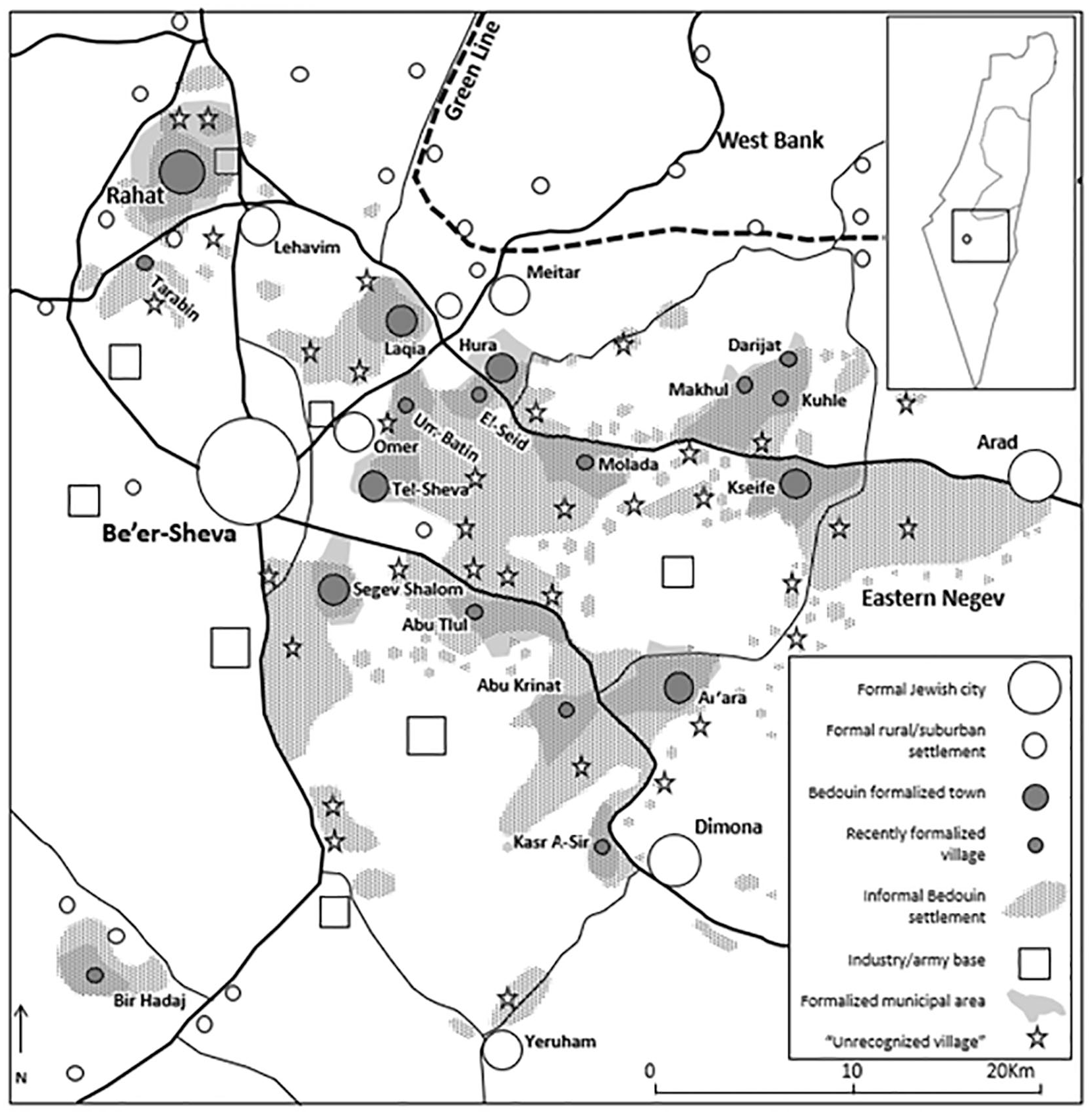
Map of Beer-Sheva metropolitan area and the Bedouin settlements.
The fact that not all the RCUV’s self-declared “villages” were formalized has raised condemnations from scholars and civil society of the “colonial policy” (e.g., Abu-Saad 2008; Kedar, Amara, and Yiftachel 2018). The state’s professional rationale for this differential formalization was not properly addressed by scholars though, having that it was seen merely as a distraction to promote the nationally motivated displacement. The state’s professional reasoning is that the sparse, dispersed, and extremely poor informal housing clusters, which are designated for relocation, cannot economically provide for themselves if they were to be formalized in situ (Atkes 26/11/2018, Atsmon 28/1/2019, Deshe 20/5/2019, interviews). They would necessarily rely heavily on state subsidies for infrastructures and services and will not have the organizational and financial capacity to promote local growth or support the inhabitants’ needs. Moreover, the scattered dispersal of the settlements carries high costs for service delivery and is also environmentally harmful. These principles are framed under concepts such as “municipal carrying capacity,” “minimal settlement size,” “provision efficiency,” and so forth (Atkes 26/11/2018, Deshe 20/5/2019, Moshe 2/2/2017, interviews; Dekel, Meir, and Alfasi 2019a; Stern and Gradus 1979; Yahel 2019; also, Duchan 2010). In one example, the head of the BSA has confronted the Regional Planning Committee with this rationale, regarding the formalized settlement of Sa’awa (formerly: Molada): When we will create a settlement of 15,000 inhabitants, dispersed over 11,000 dunams, who will take care of the roads? Provide public services? Pick up the garbage? In a municipality ranked 1 out of 10 in socio-economic criteria. (Ma’ayan, in: Regional Committee 2018).
These explanations carry heavy weight regarding the future socioeconomic development of the Bedouin. They can be contested but cannot be simply dismissed as some form of colonial manipulation.
Figure 2 illustrates a meaningful difference between formalized and informal locales, relating to the above rationale. It portrays six aerial photos of Bedouin settlements: formalized—(1) Kasr A-Sir, (2) Abu-Tlul, and (3) El-Seid, and informal—(4) Katmat, (5) Sawawin, and (6) Um-Ratem. It is apparent that the (still) informal ones are, in contrast with declarations of scholars and NGOs, “non-villages.” They are comprised small dispersed tribal housing compounds and are substantially different from the more clustered, populated, and physically developed villages that were formalized.
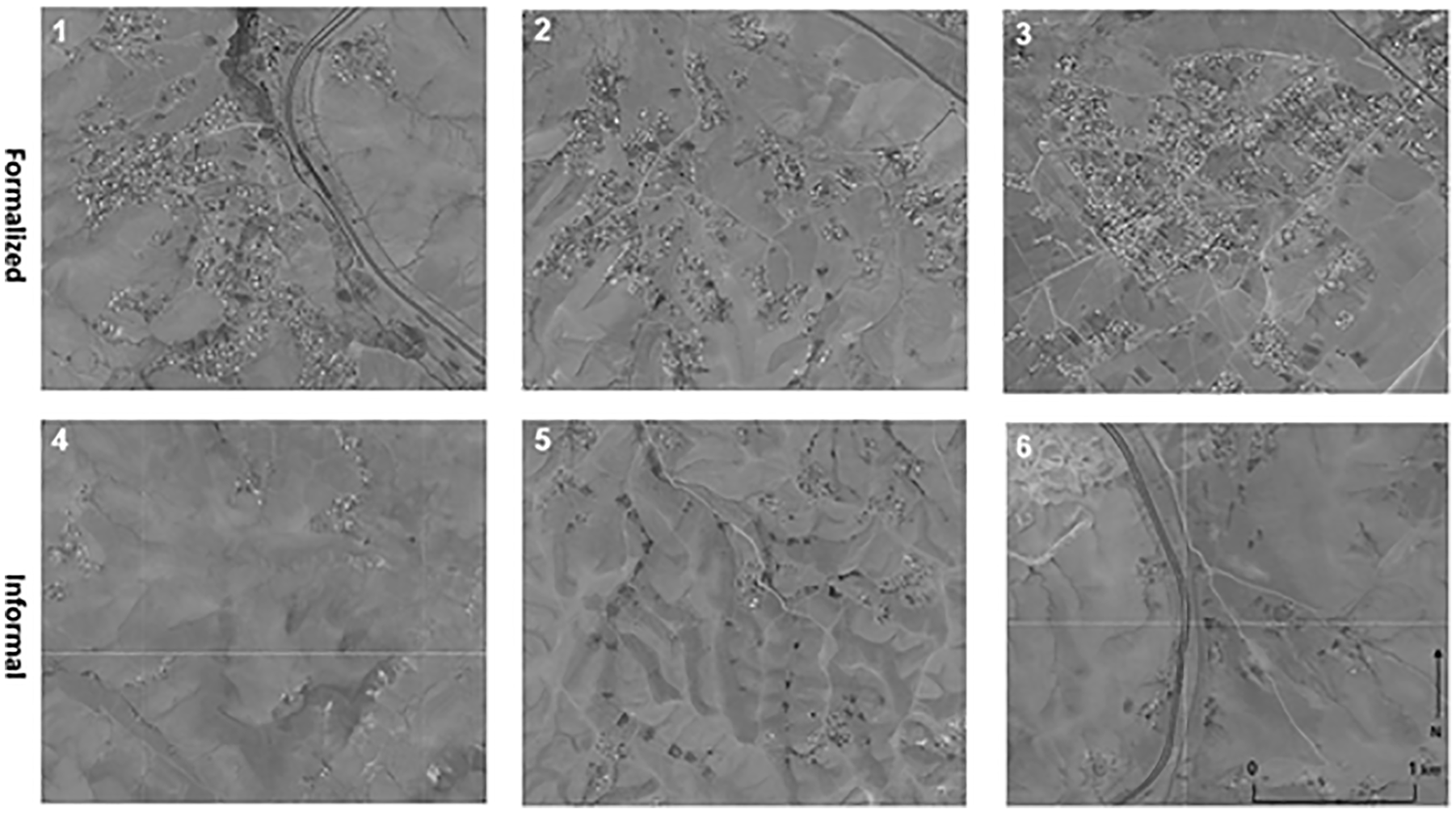
Aerial photos of informal and formalized Bedouin settlements.
State agents have investigated the numerous appeals for formalization, presented by Bedouin inhabitants who were aided by professional NGOs and sympathetic scholars (e.g., Begin 2013; Duchan 2010; Goldberg 2008). Indeed, they have adopted some of them, gradually broadening the extent of formalization. In one example, an appeal presented by the NGO Bimkom has brought to the formalization of Darijat as a village, independent of its neighboring (also formalized) villages (D. 9/7/2020, Darijat planner, interview; Weinshall 2018). In other examples, settlements were formalized in situ by broadening the municipal area of the nearby formal town to include them. In this manner, parts of the informal locales of Awagan and A-Ziadne were incorporated into the existing towns of Laquia and Rahat. More small compounds were absorbed this way into Rahat, Hura, and Kseife (Amit 16/9/2016, Brandeis 9/2/2019, Rosner 12/2/2019, Shaked 26/11/2018, planners in Rahat, Hura, and Kseife, interviews). There are, though, settlements that are left out. The reasons for unrecognition are worthy of debate, yet, it is obvious (see Table 1) that formalization is a crucial process in the region, in terms of scale and affected population: tens-of-thousands of Bedouin inhabitants are living or will soon live in newly formalized settlements, many of them where they are (as a new village or incorporated into existing towns) or after small local movements. In this sense, the Bedouin and civil society have achieved a major victory in dismantling the prolonged insistent unrecognition policy and promoting mass scale formalization in situ.
Population of Bedouin Settlements by Type, 2017.
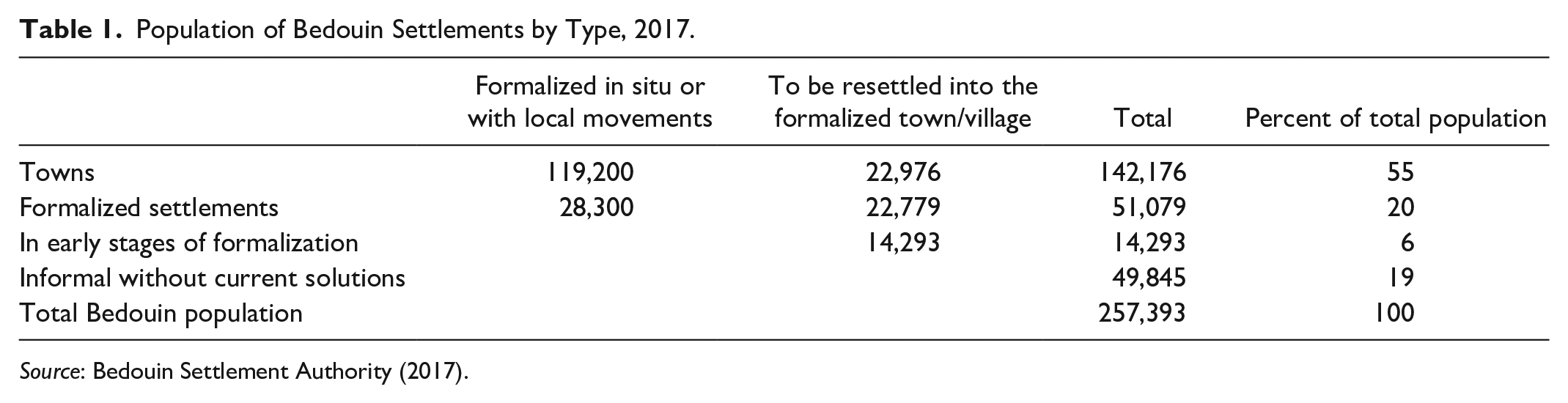
Source: Bedouin Settlement Authority (2017).
Planning Trends in the Formalized Settlements
This part of the paper does not deal with how the Bedouin perceive the planning. Such a research endeavor, if made in the future, can indeed provide another crucial angle to the issue (noticeably, Bedouin perspectives are commonly portrayed in the literature). It is worth noting a recent survey, conducted by the BSA, that revealed, first, that the issue of housing (and therefore of planning) is perceived to be the most crucial to deal with by the government. Second, it revealed that the population is highly divided on its opinion of the changes in policy taking place in recent years: one third did not feel any change, another third think it got worse, and the last third believes it improved (Webdone 2019).
Interestingly, the interviewed planners and advisors (who work privately as service providers to state agencies)—and even certain officials—are not free of criticism toward the state’s policies. Some express disappointment of the lack of consistency in policies or allocation of promised budgets (planners and officials, interviews, 2019). General frustration was expressed regarding the treating of the land tenure issue (which often hampers their work in the land use field): “The state does anything it can to minimize the Bedouin’s rights—this is not how compromise is made” (Atsmon 28/1/2019, advisor, interview). One high-ranking official even resigned when an eviction order was given against his will (Shoshani 12/9/2016, interview). Nonetheless, they all noted that significant progress was made during the last two decades in the overall policy and in specific practices of planning.
Planners of formal Bedouin settlements have consistently moved along a “study-curve” since the first, notoriously failed, Tel-Sheva episode (the first Bedouin town). Considerations of special sociocultural aspects have been integrated into new towns’ planning, among them, the permission for self-building on subsidized plots or the delineation of neighborhoods that are associated only with specific tribes (Stern and Gradus 1979; Tamari et al. 2016). The planning of the formalized settlements entails another significant few steps of change. The transformation is evident when observing Figure 3, where four statutory plans of land-uses for south Kasr A-Sir are portrayed. The first two are of the so-called (by the planners) “first generation”: (1) comprehensive outline plan, approved 2005 (no. 101/02/28); (2) local outline plan for neighborhoods 7 and 9, approved 2007 (no. 113/03/28). The last two are of the “second generation”: (3) outline plan for the southern neighborhoods (no. 624-0315317, in an approval process); (4) outline plan for neighborhoods 4 to 6, approved 2014.
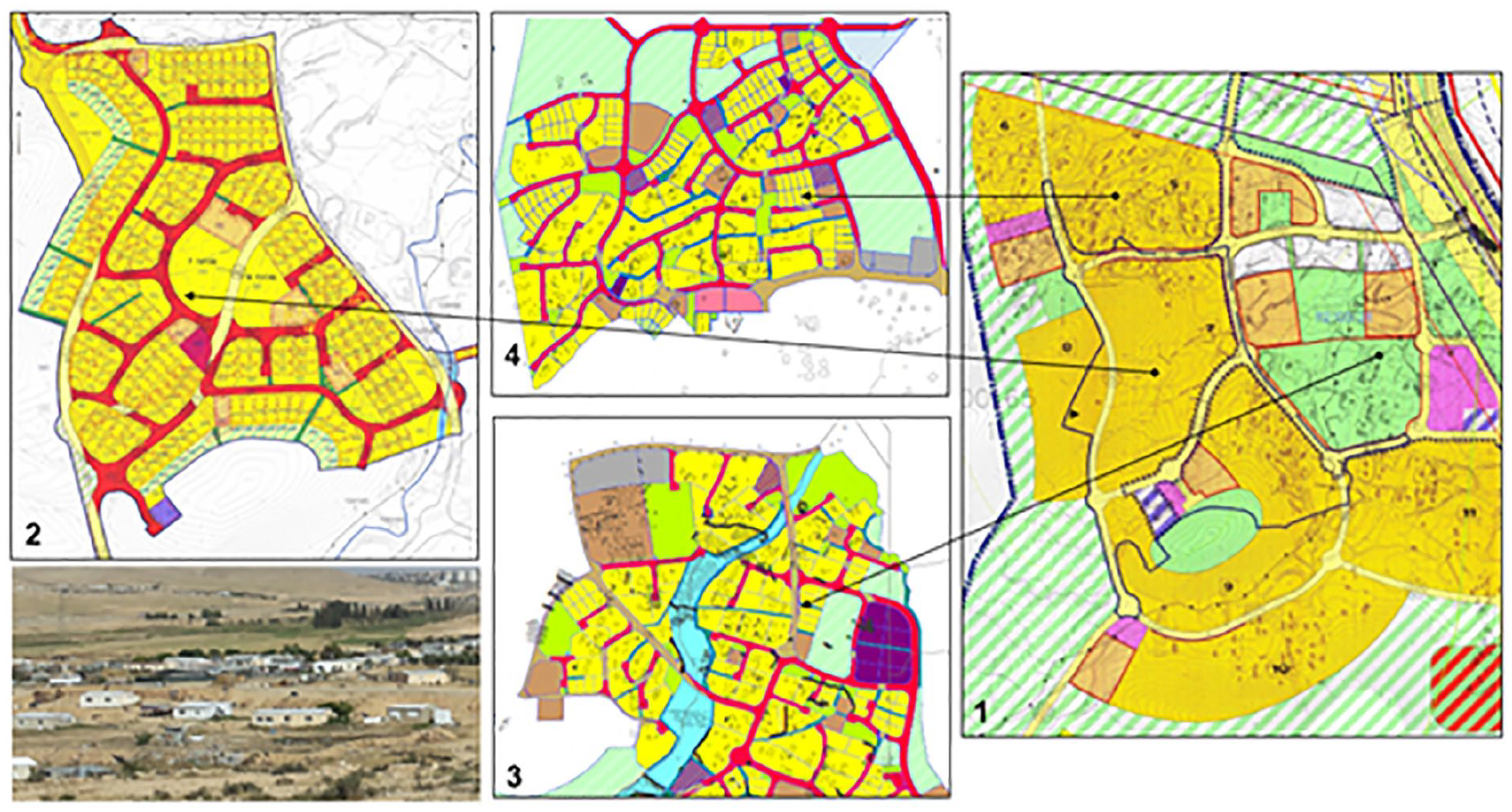
Statutory plans of Kasr A-Sir and a photo of the village.
As visible, the first generation portrays a clear modernist top-down land-use designations, where existing structures (Figure 3.1, in black) are not considered as a base for planning. They are sometimes delineated for residence (orange/yellow) and other times for open space or agriculture (green). Figure 3.2 shows the delineation of plots, in a regular, geometric, standardized manner, as if the planned area was a “blank page.”
During the planning process, the inhabitants continuously demanded that their needs be handled with more caution. With aid from the NGO Bikmom, which specializes in advocating for planning rights, they have published an agenda, stating their visions and needs (Lerner, Tobi, and Eli 2003). While it did not affect the planning directly, it clearly had significance regarding the long term. A crucial step was with the assignment of one of Bimkom’s activists as the official lead planner for the village. He explained the new rationale he uses in his planning: There is need, as much as possible, to regularize in-situ; to create plots, roads, and infrastructures that are laced into the existing fabric, with as little friction as possible. Not demolishing houses, enabling inhabitants to continue daily living while development takes place around them. (Ilan 13/5/2019, Kasr A-Sir’s Planner, interview)
His view is manifested in the “second-generation” plans, which are, as visible, much more irregular and attentive to existing structures (not running over them with roads, for instance). Instead of standardized plots, the plan offers “familial residence compounds,” large plots of up to ten dunams, containing several housing units of the same extended family (Ilan 13/5/2019, interview; also plan no. 624-0315317).
3
The structuring of independent compounds of several houses around one-exit alleys is also notable, in comparison with the first generation’s suburban style structure of multiple individual plots along main streets. This comes to serve a fundamental cultural need of the Bedouin, as described by Hura’s planner (Shpinat 6/5/2019, interview): They fear of interacting with people outside their extended family. We, as planners, are used to form spatial connectivity points, but the Bedouin do not feel safe in the outside society. Their central desire, as expressed to us, is to avoid “friction,” so we have planned the entire settlement as small familial clusters, using roads and creeks as protective buffers around them—while defining flexible designations in case they will want to change this in the future.
In Abu-Tlul, the inhabitants’ major concerns were elaborated in a paper published following the settlement’s formalization, with aid from Bimkom. Their key demands were taking the existing spatial situation as is; not inserting relocated tribes without the locals’ consent; a rural village, dissected according to traditional tenures and tribal affiliations (using inner-roads as agreed upon borders); incorporating agricultural land-uses, along with commerce near the main road; participation of the inhabitants in the process (Bimkom 2007). These principles stand in sharp contrast to former top-down policies, which attempted to realign space according to geometric lines, interrupting existing social separations and vigorously rejecting the Bedouin traditional tenure system, on the grounds that its validity was denied by courts.
The recent making of Abu-Tlul’s land-use statutory plan represents a rejection of old paradigms and, to a large extent, an adoption of the inhabitants’ wills and needs. The planning process contained public participation processes at a scale and depth that was repetitively portrayed by the planners as one “unseen in any other project throughout Israel.” During planning, multiple meetings were held by the planning crew (which contained professional planners and anthropologists) with the communities, families, and individuals, in order to create an exact mapping of familial affiliations, locational preferences, and other specific needs. The settlement’s neighborhoods were designed according to the existing tribal layout, with significant effort not to relocate any family without consent and to outline familial compounds in congruence with the traditional land claims—despite the fact that the claims still remain formally unrecognized (Brandeis 9/2/2019, Ben-David 30/5/2019, Abu-Tlul’s planners and social advisors, interviews; also, Kahana 26/11/2018, Shpinat 6/5/2019, Ilan 13/5/2019, planners in other settlements, interviews).
The lead planner describes a case where the participation process was proved to be highly influential: I’ve planned the village with two entrances [from the adjacent highway . . .] but when we came to the participation process, we heard how important it is for the inhabitants of the third compound not to drive through the others’ territory, and to have their own entrance. If we won’t give them one, it would mean discriminating them, so if we really wanted to have participation, and not solely for the sake of appearance, a genuine process confronting a reasonable argument, we must accept it. (Brandeis, in: Committee for Principal Planning Issues 2012)
The current plan, as seen in Figure 4, contains the three entrances, wide agricultural plots, enlarged municipal area, centers with building rights for commercial uses, and clear separations between three tribal neighborhoods by creeks—all are aspects seen as highly important by inhabitants (Brandeis 9/2/2019, Abu-Tlul planners, interview).
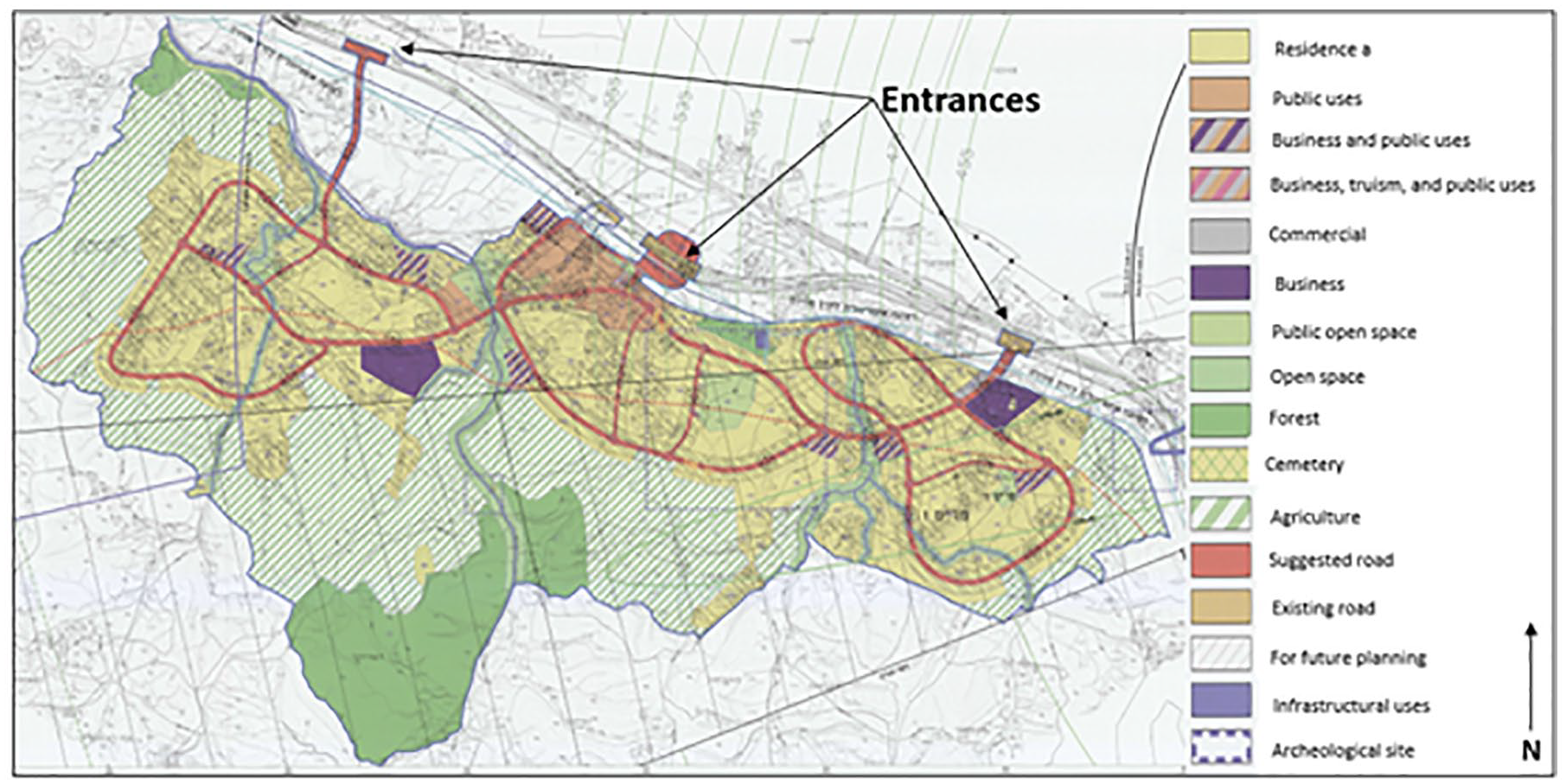
Statutory plan of Abu-Tlul.
Inhabitants are highly involved in the development process, which was structured according to nearly every need they have raised, within practical limits: “We sit for hours in the guests’ tent, with the blueprints. They say what they like and what not. Our final plans encounter no objections—the inhabitants really want them” (Rosner 12/2/2019, planner of Wadi Na’am, interview). Another planner described the depth of the participation process in the formalization of housing compounds around Kseife: After studying the area and drawing sketches with the inhabitants, we reach the climax of the planning work in a one-day workshop. It begins with a survey of the village by the municipality’s officials, the planners, architects, and others of the professional staff. Then, a tour in the village, guided by a local representative. Next, the participants gather in the traditional guests’ tent, where a discussion is held (over maps of topography, environmental limitations, neighboring plans, aerial photos, etc.), in which the inhabitants and staff develop the preferred alternative. By the evening, an agreement is achieved and more of the tribe’s people gather to join and get updated. In the following months, minor changes may occur, while informing and consulting with the inhabitants, and the plan is promoted for approval within the planning institutions. (Cohen 1/2/2019, Kseife planner, interview)
In the development process, there are inhabitants which are designated for relocation within the settlements’ area or from the outside in, to free up land for agriculture or infrastructures, and to create a somewhat concentrated residence area for efficient service and infrastructure allocation. The evacuated households receive substantial compensation and subsidized plots within their tribal neighborhood (married couples receive the plot for free) (Deshe 20/5/2019, BSA official, interview; see also Israel Land Authority 2019; Yahel 2019). In Kasr A-Sir, the land claims were mapped in a thorough work and the housing compounds were outlined according to them. This fact reveals how the state, though not acknowledging the claims, internalized that no planning will be successfully implemented if it ignores them. In one example, it came to a point where the planner became the mediator between brothers who had a dispute over their inherited land claim. With his aid, they settled the dispute, agreed on equal allocation among themselves, and consented with the relocation of some of them into their new (claimed) plots, so infrastructure development can be made (Ilan 13/5/2019, interview).
This comes as part of an overall change in housing plots allocation policy. The state publicly recognized that it severely neglected the Bedouin housing needs in the past and is now planning a housing inventory of tens-of-thousands in the towns and formalized villages (Atkes 16/4/2020, Lecture to the Planners’ Union; Deshe 20/5/2019, BSA officials, interview; Weinshall 2018; Yahel 2019). In 2019 alone, planning committees officially approved plans for nearly 25,000 housing units in Bedouin settlements which were initiated by the BSA—compared with numbers ranging between a few hundreds to 4,000 in the years before 2017 (BSA 2020). This is accompanied with parallel steps to trigger socioeconomic development, as part of a series of governmental decisions: the five-year plans in 2011, no. 3708, and in 2017, no. 2397. These allocate heavy budgets (NIS three billion for five years) to develop formal(-ized) Bedouin towns and villages, in fields of education, employment, health, welfare, and environmental development (State of Israel 2017; also, Atkes 16/4/2020, Lecture to the Planners’ Union; Deshe 20/5/2019, BSA officials, interview; Sofer-Furman et al. 2016). Of special interest is the planning of industrial compounds, which are currently developed in villages such as Um-Batin, Abu-Krinat, and Bir-Hadaj. These, for the first time, are expected to generate employment and local municipal revenues (e.g., Local Plan 802/03/25). It appears that while Zionist politics still contain fragments that use anti-Bedouin rhetoric (for various political reasons, e.g., Ben-Zikri 2018), the multiple planning and spatial policy agencies portray a clear long-lasting trend of progress.
Part 2: Production of Critical Knowledge and the Politicized Production of Space
How is it that the bulk of Israeli critical scholarship has ignored such obvious and significant trends of progress in planning for the Bedouin? Was it a scientific blind-spot, a recent development that was not yet detected? I intend to claim otherwise by analyzing the political context in which CPS scholars act. To provide a full picture, I begin with analyzing their counterparts, the so-called pro-Zionist scholars.
As observed by Israeli critical scholars, until the 1980s, Israeli scholars were recruited to the Zionist project and supported it with their endeavor of knowledge production (Shenhav and Hever 2004). In the first stage, when the Bedouin were under military rule, modernist Zionist scholars had close connections with the governing apparatus. They commonly conceptualized the Bedouin as part of nature, an exotic relic of pre-modern societies. Mor (1969), for example, wrote that the Bedouin “live in a mysterious strange world, detached from the modern vibrant life we are familiar with.” After the military rule was terminated, research changed accordingly to reflect and support the mission of modernizing the Bedouin. The region’s history was seen as “static” until Zionism came and brought progress with it (Kark 1979). The fact that Mor published his findings inside a handbook by the Advisor for Arab issues to the Prime Minister Office, and Kark within a publication of the Ministry of Defense, tells much about the relations which existed between scientific knowledge and state power. Anthropologists and social geographers played key roles in aiding planners to accommodate the urbanization process of the Bedouin society, but it is important to notice they have viewed their part, in modernist eyes, as essential for the benefit of Bedouin society (e.g., Marx 1990; Marx 11/9/20, interview; Stern and Gradus 1979). The informal locales which stubbornly remained were conceptualized as “spontaneous” and were destined to disappear with progress and urbanization.
This changed dramatically since the 1990s, when Israeli social sciences were overtaken with the postmodern and postcolonial turns. The shift in the study of the Bedouin can be traced back to scholars such as Shamir (1996), who deconstructed the dichotomy of “culture” (state) versus “nature” (Bedouin). He was followed by many who criticized the “colonial state” and described the counter-hegemonic Bedouin struggle to protect their indigenous rights. “Spontaneous,” in the new scholarship, was replaced with “unrecognized village,” suggesting a legitimate settlement that deserves recognition (e.g., Kedar, Amara, and Yiftachel 2018; Nasasra 2017; Yiftachel 2009). This body of scholarship, in which CPS became prominent, harshly criticized pro-Zionist intellectuals who served the state’s interests when, for example, they provided expert opinion in lawsuits over land ownership: It is not a personal but a structural phenomenon . . . recruitment of intellectuals to normalize disputed narratives, disguised as scientific truth. (Yiftachel et al. 2012)
CPS scholars make extensive use of Gramsci’s concept of hegemony to explain this recruitment of intellectuals by the state. According to this, Zionist scientists act as state functionaries who use their prestige, in their mutual relationship with the dominant Zionist group, to dismantle the Bedouin indigenous claim for land ownership and uproot them (also, Richard 2016; Yiftachel et al. 2012; Yiftachel, Roded, and Kedar 2016).
Nonetheless, CPS scholars provide no satisfying analysis of their own political origins and motivations for criticizing state planning. Importantly, they identify ideologically with the goal of manifesting indigenous justice by recognizing the Bedouin villages. This is apparent in the collection “Indigenous (in)justice,” in which multiple scholars and activists collaborated to deconstruct state discourse and promote formalization and recognition of indigenous tenure claims. As the editors clarified, “the reason for the development of an indigenous discourse and research has been the constant quest for indigenous justice—to which we hope this volume makes a worthy contribution” (Amara, Abu-Saad, and Yiftachel 2012). 4
On a deeper level, CPS scholars in general take part in the tendency toward post-modernist (and sometimes even post-anarchic) worldviews that are so emblematic of current academy. From this, they derive an inherent criticism and even antagonism toward structures of power, especially state institutions (Allmendinger 2017; Blomley 1994; Newman 2011). This is reflected in one example, where a scholar describes her activism within Bedouin communities. She explains, according to Mouffe’s (postmodern) theory, that antagonism between the community and the state was made visible and explicit in the process as means to enhance democratic planning (Fenster 2009). One result of this tendency is that the academy has utterly ceased to cooperate and inform government agencies in how to plan better (except, indirectly, through civil-society pressure; Dekel, Meir, and Alfasi 2019b). Scholars live and act within certain milieus, communities of discourse, and groups of interest. The background of the scholars at hand is closely tied with the emergence of a thick and complex network of civil-society organizations that struggled in multiple arenas to stop evictions and promote formalization and culturally sensitive planning, recognition of indigenous tenure claims, and allocation of services and infrastructures (see Fenster 2009; Greenspan 2014; Koensler 2013; McKee 2016; Nasasra 2017; Richard 2016; Yiftachel 2009). This Network had tremendous influence over formalization and planning for the Bedouin (Dekel 2020b; Dekel, Meir, and Alfasi 2019a, 2019b). Scholars of CPS are not only integrated into it but lead it in many aspects. Many (perhaps most) of the prominent scholars of the CPS serve (or served) as board members of the most influential NGOs and/or as their advocates or professional advisors. Their prestige and professional knowledge are often the key drivers behind the attempts of civil-society organizations to convince policymakers to amend the state’s plans and adopt alternative plans, as described by Yiftachel and Kedar (2000: 95 [Hebrew]): “The entrance of academics and professionals into the field [political struggle], helped ‘hacking’ and criticizing decision making processes and resource allocation within the system.” Their political involvement is apparent in the three following examples:
The Goldberg committee
This special governmental committee assembled in 2008, after a fierce civic struggle against evictions (Dekel, Meir, and Alfasi 2019b). Its members heard dozens of witnesses but among the most influential were prominent scholars (alone or as part of NGO coalitions) who explained why the indigenous Bedouin claims are valid (Bimkom 2008; Yiftachel 2008). As a result, the committee announced a shift toward more formalization and a more collaborative planning policy (Goldberg 2008; Ilan 13/5/2019, planner, interview).
The alternative plan for unrecognized Arab-Bedouin villages in the Negev
This plan was initiated by a Bedouin grassroot organization, but the bulk of its content was written or guided by prominent scholars of CPS who acted as activists in offering a comprehensive professional alternative to state plans. The plan still functions as the leading agenda of the civic network. At its core is the delineation of forty-six unrecognized Bedouin villages (Dekel, Meir, and Alfasi 2019b; Regional Council of Bedouin Villages, Bimkom, and Sidre 2012). However, as analyzed above, not all the delineated villages can be objectively treated as such for planning purposes. The marking of multiple locations as “unrecognized villages” is a method to claim ownership of the land by certain Bedouin groups and prevent eviction of the informal housing in the area. This political construct later informed CPS findings and was considered there as an empirical fact.
The UN report
In 2011, the special rapporteur on the rights of indigenous peoples, James Anaya, toured the Negev and published a special report in which he wrote, “Israel should immediately cease to carry out any further demolitions of Bedouin villages in the Negev or any forced relocations of Bedouin from unrecognized villages” (Anaya 2011). CPS scholars have quoted him as a crucial reference to support the claim of colonialism and indigenous rights (Yiftachel, Roded, and Kedar 2016). The tour, though, was originally initiated as a result of the prolonged lobbying effort, made by the civic organizations that CPS scholars lead or work with. His conclusions were highly influenced by what they presented to him.
The production of critical scientific knowledge is deeply tangled in the production of alternative political knowledge, meant to push for the recognition of the settlements. This knowledge is part and parcel of a wide networked endeavor, in which multiple political actors engage with each other, beginning in informal Bedouin communities, stretching through NGOs and supportive scholars, political opposition parties and social movements, and ending in European states, global funds, and the European Union that provide budgets to support the networks’ activity. Importantly, this alignment was not primarily constructed to fight for specific Bedouin indigenous rights but, to a large extent, as part of the wider Jewish-Arab conflict (Dekel, Meir, and Alfasi 2019a, 2019b; Koensler 2013). This is the political context in which CPS scholars mold their worldviews and write from. For a significant degree, it explains why the conflict between Jews and Bedouin (-Palestinians) is not framed in CPS as a struggle between two national groups over national territory and sovereignty, but as “good vs. evil” struggle of illegitimate colonizers against the subaltern and the dispossessed.
When scholars are so deeply tangled with political movements and organizations, it is not surprising to find that the knowledge production is also tangled. To give one clear example, Shalhoub-Kevorkian et al. (2014, 170) write, While housing demolition are legally supported under the pretext of Bedouin violation of land and planning laws . . ., it is apparent that the policy is one of dispossession: designed to get rid of the unrecognized villages as a means to force villagers into overcrowded and impoverished government-planned townships grouped in just 0.8 percent of the entire Naqab area.
Amazingly, to support this definitive accusation (a non-accurate one, as shown in the above findings), they make references (only) to reports by the prominent political NGOs Human Rights Watch and Adala. Moreover, the study itself was coordinated by another political NGO, Ma’an.
Discussion
The above “NGOization of space” (borrowing from Yacobi 2007)—including conceived space—may look to some as part of a benevolent quest, but it also represents to others a slippery road to the politicization of scientific knowledge. When Europe-backed grassroots and NGOs or leftist thinktanks provide the literature review, collect the data, or coordinate the studies, and when scholars act as liminal figures, moving between the realms of activism and academy, we must rethink CPS. In discussing Israeli CPS, Bourdieu’s(1993, 37) insight is of relevance: Intellectuals always agree among themselves to leave out of play their own game and their own stakes. The fact that scholars of Israeli CPS are so deeply engaged in political activism, which is tied directly to their endeavor to produce alternative knowledge for an alternative space, raises significant questions regarding how to evaluate their research findings about Israeli planning for the Bedouin. Can these findings be used to develop planning theory, when at the same time they are used as political arguments?
The best way to approach this is by deploying the Gramscian perspective (Gramsci 1971), which, above all others, guides Israeli CPS. Just as Zionist scholars were “recruited” to defend and normalize the Zionist national project, post/anti-Zionist scholars of the CPS are also “recruited” to defend an alternative political project. In Gramscian terms, they function as organic or quasi-organic intellectuals. They are not (and, perhaps, cannot) be independent but integrated into a certain class alignment, “a historical block,” the network of informal dwellers, Palestinian nationalist movements, Israeli liberal-leftist movements, and European institutions. All these different fragments have little in common, but they highly overlap in their critique toward the Israeli state: most of the dwellers for their conflict over land and settlement; others, for it being an undesired national project in general; and others, for it being the specific political project of the Zionist national movement.
Are these scholars avantgarde? Do they put themselves “on the line,” as Blomley (1994) suggests? Not necessarily. Seeing that their perspective is overwhelmingly the dominant one within global scientific literature (while other perspectives are often marginalized, see Dekel 2020b), it can hardly be defined as counter-hegemonic (in contrast with what CPS scholars tend to argue). The fact that their project of alternative knowledge production deeply influenced Israeli planning and planners reinforces this conclusion. In fact, many planners or officials (whom scholars criticize so vigorously) sympathize with them, draw inspiration from them, and mold policy accordingly. The scholars’ milieu is by-and-large Western postmodern (and by implication, generally, post-Zionist) scholars and other members of liberal-leftist institutions and movements. Their constant attack on the Israeli nation state does not seem to jeopardize their positions and careers as Blomley (1994) implied. The economic and political support from institutions of Western superpowers sheds another light on the subject: as intellectuals in a globalized world, CPS scholars interact and draw social, economic, and symbolic capital from global networks. They are structurally positioned to reflect these networks’ agenda, just as “pro-Zionist” scholars draw capital from supporting the state’s narrative.
But, as Bassett explains, not all “new social movements” are necessarily progressive. Intellectuals who empathize with oppressed groups and aid them must simultaneously engage in “a reflexive critique of their own biases and frames of reference” (Bassett 1996, 518). Such reflection must ask whether the agendas of groups such as the European Parliament, Palestinian national movement, Israeli Leftist/Arab parties, or the stratum of land claimers within the Bedouin society can be considered as “just” in scientific terms.
This explicitly does not mean Israeli CPS scholars intend to make false claims in the name of science. What it does mean is that their point of departure is affected by the structural context in which they reside. They tend to adhere to certain “truths,” “common sense,” that guide the networks they interact with and act within, among them, is the assumption that Israeli planning seeks to “discipline, punish, and manipulate the Bedouin.” This assumption enables and legitimates a whole array of claims that eventually justifies the meta-claim about Israeli colonialism and the following conclusion that the Zionist national project must be dismantled. This is the foundation for an alternative project of production of perceived space, an insurgent act performed by academia and introduced as objective knowledge. If their assumption should fail, meaning, if Israeli planning will be found to experience significant progress and to hold a solid, justifiable (or at least, reasonable) rationale guiding its workings, this failure can jeopardize the rest of the claims and lead to a partial or full deconstruction of the paradigm of Israeli colonialism.
Conclusion
The findings in the first part of the paper portray a sharply different picture than the one painted in Israeli CPS. It was shown that Israel has formalized the largest and most populated informal settlements since the 2000s. Today, it continues in formalization schemes or in planning new villages for communities which will be relocated from hazardous sites or sites designated for, mainly, infrastructural development. The new villages are planned according to remarkably participative and culturally sensitive principles, at least as the interviewed planners perceive them or when compared with past practice. State planners portray a pragmatic attitude and practice, in which they gradually push toward formal planning while molding the regulations and codes, as much as they can, to adjust to the unique needs of the Bedouin. They dedicate considerable attention and resources for meetings with individuals, groups, and whole communities, to map their needs and desires and implement them in the statutory plan. Among the aspects that were highlighted are the planning of tribal/familial neighborhoods, allocation of agricultural lands, preservation of rural characteristics, consideration of the land claims in planning, enlargement of the municipal area to include the most inhabitants and avoid relocation as much as possible, and more. The major future challenge for the planners will be to continue to implement the products of participation in the actual plans, building further trust with the inhabitants despite the expanding demolition of unlicensed houses, find creative ways to parcel the land and to enable the issuing of building permits, foster local economic development, and to find fitting solutions for families which will be relocated for various reasons.
A case can be made that the state may have the capability to adjust and promote better planning practice and that cooperation with civil society and the academy will foster such a positive change. As Lane, for example, has argued, “progressive political projects, such as land justice for indigenous peoples, can occur because of, and not only in spite of, state action” (Lane 2006, 392). Nonetheless, the current trajectory of the most dominant scholars in the field distances them from collaborating with state planners. The bulk of scholars in the field are engaged in severe delegitimization of the state apparatus and accordingly portray its planners as repressive agents—a portrait, which is not aligned with actual events, as shown in the findings. In Lefebvrian–Gramscian terms, Israeli CPS scholars are deeply embedded as quasi-organic intellectuals in a political network of communities, NGOs, social movements, political parties, and global institutions. Within this network they perform as knowledge producers (of the perceived dimension) in the production of formalized space by the Bedouin and their supporters. Their research agenda and findings are, arguably, affected by this role.
Israeli CPS should carefully reflect on its position within Israeli-Bedouin politics and the way this affects the production of scientific knowledge. Political debate should always be welcome—indeed, the political endeavor of CPS scholars has gained significant fruits for the Bedouin—but it must be clearly framed as such. Planning studies may not benefit if they become a political battleground for contrasting narratives and interests, especially if it produces political knowledge that is “disguised as scientific truth.”
Footnotes
Declaration of Conflicting Interests
The author(s) declared no potential conflicts of interest with respect to the research, authorship, and/or publication of this article.
Funding
The author(s) received no financial support for the research, authorship, and/or publication of this article.
