




Abstract
The arrival of autonomous systems powered by artificial intelligence (AI) offers new possibilities for life, yet the focus tends to be more on the technology than the people it serves. Planners should consider the likely reception awaiting emerging intelligent systems. Using an online survey of 3,249 faculty, staff, and students at a major research university, we tested perceptions of autonomy, including domotics and autonomous vehicles. Embracing the new technology with variations in attitude associated with age, gender, and familiarity with new technology, people’s openness to AI-enabled devices applies if they remain a tool to support work and not replace human-centered interactions.
Introduction
Cities comprise a wide range of disparate technologies that work in isolation or networks to serve individual and collective needs. As cities evolve, some technologies disappear while others morph into more advanced forms. The result is an ever changing and increasingly complex sociotechnical environment that is likely to become even more sophisticated with the arrival of artificial intelligence (AI; Yigitcanlar et al. 2020). AI-enabled innovations are capable of making choices autonomously and generally fall into one of four categories: those that are slated to revolutionize mobility (autonomous), those that help us at home (domotics), those that help us at work (smart office), and those that will be present in public and semi-private spaces (smart spaces). The rhetoric of smart systems and AI, however, tends to empower the technology absent its host society, yet the success of technological advance lies in its social context (Bijker 1997; Green 2019). To understand the sociotechnical context of autonomy and AI, we survey the faculty, staff, and students at a major university to gain insights into public perceptions of these emerging technologies.
Over the past two centuries, disruptive technologies have been the hallmark of the industrial and digital revolutions, with the coming autonomy and AI revolution poised to introduce further social and economic change and stress (Makridakis 2017). AI seeks to replicate human decision making by combining data inputs that are manipulated according to algorithms to fulfill a control strategy (Nilsson 2014), which is applied to a wide range of uses including robotics (Raj and Seamans 2019), transportation (Sadek 2007), autonomous vehicles (AVs; Kreutzer and Sirrenberg 2020; Stone et al. 2016), medicine (Hamet and Tremblay 2017), and household applications (Friedland 2019; Hanson, Barth, and Silverman 2011; Kazantsev et al. 2012) as well as assistance for the disabled and elderly (Sale 2018). While the AI literature tends to focus on advancing the technology, there are also negative outcomes such as the malicious use associated with digital, physical, and political security (Brundage et al. 2018). A further concern is labor displacement and unemployment resulting from intelligent production systems (Kreutzer and Sirrenberg 2020).
The autonomous systems that represent smart systems are often powered by AI software that manages vast amounts of data to facilitate urban management. While the AI revolution approaches, and is present in many current applications, its ethical, social, and economic dimensions lag in recognition and attention. Alan Turing (2009) saw the ultimate test of AI being its actions and responses are indistinguishable from a human, but in achieving this, Kile (2013) laments the loss of “humanness” because of an AI-mediated future. The social dimension of autonomous systems and AI motivates our research as it applies to the human and planning dimensions. As Cath et al. (2018) note, there is no political vision or long-term strategy for guidance in the European Union, United Kingdom, or United States at a time when these systems are increasingly common.
The willingness of the public to accept autonomous systems will determine how and where they will be used. Our study contributes to the existing literature connecting adoption, use, and attitudes toward new technologies by uncovering the demographics of AI and autonomous system perception. In particular, we seek to understand place-based public perceptions by asking
In which AI-mediated environments do people accept future technologies?
Is there an affinity correlation among them?
Literature Review: Place Perceptions and People’s Sentiments of AI-Enabled Technologies
AI-enabled technologies are already shaping how we build and plan our cities and communities. AVs are currently being piloted in several cities worldwide (Salonen and Haavisto 2019; Wicki and Bernauer 2018) and the urban form may change in response to them (Millard-Ball 2018; Yigitcanlar, Wilson, and Kamruzzaman 2019). Similarly, Internet innovations and IoT (Internet of things) technology are affecting cities and communities, allowing for new forms of both work and commerce (Stiles and Andrews 2020; Yigitcanlar 2016). For example, work pods (self-contained micro-offices) and increased telecommuting make traditional offices less important while increasing the importance of public places with Internet accessibility (McLaughlin 2016; Ng 2016; Stiles and Andrews 2020). Combined, emerging technologies may lead to social changes, by facilitating new ways of communicating and interacting with others, as they often have in the past (Castells 2015). The potential for disruption caused by technology is high, although this is not a new phenomenon, as emerging technologies have historically led to disruption, especially in urban planning (Schumpeter 1911, 1942).
Ultimately, people’s perception of AI-enabled devices will influence how widespread their adoption is (Stone et al. 2016) and the scale of impact on the way we live—how we travel, work, and play. Predictions of how AI-enabled technologies will affect the cities of the future vary wildly between visions of efficient dreams to ghost cities (Kassens-Noor and Hintze 2020). Other future technologies, such as flying cars, have long been relegated to the domain of science fiction, but prototypes do exist (Kasliwal et al. 2019), and safety concerns are likely to dissipate if and when the technology becomes available (Eker et al. 2019, 2020; Kassens-Noor et al. 2021). The literature review that follows introduces readers to emerging AI technologies and AI-enabled devices of today (Pan 2016): AVs, domotics, smart offices, and public places. Finally, it compares people’s sentiment toward them, pointing out the gap in analyzing the relationship between the four.
AVs
AVs, making choices based on an AI-algorithm, may be responsible for analyzing road conditions, plotting courses, or recognizing a user; but an AI may also be responsible for more critical functions: when to break or swerve to avoid hitting another vehicle or pedestrian (Etzioni and Etzioni 2017; Hengstler, Enkel, and Duelli 2016). These thoughts are often at the forefront of people’s minds, with safety generally being their paramount concern (Bansal, Kockelman, and Singh 2016). Moreover, AV safety concerns are ubiquitous regardless of demographics, and are the most important factor in a person’s decision to ride in an AV (Bansal, Kockelman, and Singh 2016), Furthermore, recent experiments show that AVs may not be as resilient as marketing leads consumers to believe and are vulnerable to attacks by bad actors (Yan, Xu, and Liu 2016). In addition, the impact of AVs on the economy, especially on transportation and shipping, has people concerned for their jobs (Rajasekhar and Jaswal 2015). Finally, concerns exist that AVs will actually increase miles driven, and in turn, increase carbon emissions, and contribute to urban sprawl (Faisal et al. 2019; Ohnemus and Perl 2016; Thomopoulos and Givoni 2015; Yigitcanlar, Wilson, and Kamruzzaman 2019).
There are, of course, plenty of examples of how AVs could potentially save people money, and those too can influence perception. People value their time and money, and if an AV allows them to travel more efficiently, and at a reasonable price, then they are more likely to adopt the technology (Krueger, Rashidi, and Rose 2016). AVs may also increase mobility for the disabled and disadvantaged (Harper et al. 2016), and they may also help enhance existing transit networks by closing the first- and last-mile gaps (Hall, Palsson, and Price 2018). Although, just with all emerging technologies, they must be implemented correctly if society is to reap the full potential of their benefits (Kreutzer and Sirrenberg 2020; Yigitcanlar et al. 2020).
Domotics
Home automation, or domotics, is an emerging industry comprising numerous different devices and technologies. Smart fridges, toasters, and coffee pots in the kitchen, as well as autonomous vacuum cleaners, wireless HVAC (heating, ventilation, and air conditioning) controls, doorbell cameras, and a host of different sensors make up the “autonomous home” (Gomez and Paradells 2010, 93). These devices are often built in such a way as to be completely unobtrusive, they offer the ability to constantly monitor homes for problems, including emergencies, as well as offer convenience (Cook 2012). One of the primary benefits a smart home offers is its ability to increase safety. If linked with cameras and other sensors, an AI-algorithm is able to constantly monitor occupants’ health. For example, pregnant women, whose home could monitor their child’s development and detect problems before they become serious (Kazantsev et al. 2012). Similarly, athletes living in a smart home may be able to constantly monitor their training and fitness level (Kogias et al. 2016). Finally, seniors may be able to stay in their home longer, when domotic devices monitor heart rates (Hanson, Barth, and Silverman 2011).
Although, unobtrusive does not mean the technology will not affect privacy, which is a common concern (Chen and Lee 2019). This lack of privacy may be the largest barrier in getting people to adopt smart home technology, even though many individuals are unaware of how exactly their data are being or can be used (Tabassum, Kosinski, and Lipford 2019).
Smart Offices
Currently, smart office technology allows office workers to more easily access information, schedule meetings automatically, record their work progress, adjust environmental aspects (HVAC, lighting, screen preferences), and it also allows managers to monitor their employees’ performance (Ryu, Kim, and Yun 2015). Although, many of those tasks still require some form of human input, while the majority of the automatic aspects of smart offices are relegated to simpler tasks such as heating and lighting (Bhuyar and Ansari 2016); the benefits of these simple tasks include cost savings and lower carbon emissions (Giacobbe et al. 2018).
Smart office technology is now evolving beyond simple tasks and toward actual decision making in the workspace by allowing an AI to recognize workers through facial recognition and automatically adjusting their work environment to their individual preferences, and allowing them to seamlessly interface with their workstations (Friedland 2019). Smart offices of the future may also include sensors that constantly monitor workers’ stress levels, and alert them when they may be crossing into unhealthy territory (Gomez-Carmona and Casado-Mansilla 2017; Vildjiounaite et al. 2018). Similar to smart homes, privacy concerns may be the greatest barrier to the implementation and acceptance of smart offices. In an office setting, data thefts continue to occur, and people have had their identity, trade secrets, and legal/medical records stolen (Ezekiel 2012).
Smart Devices in Public Spaces
The future of work and life may be increasingly connected, as people are choosing to work from cafes, parks, and other public spaces, so long as they have Internet access (McLaughlin 2016; Ng 2016; Stiles and Andrews 2020). This “smart public” may become an integral part of the urban form, and AI-enabled technologies may increase its usefulness and efficacy even more so. Furthermore, public AIs are currently being developed, with the aim to improve public spaces, namely, by increasing communication and allowing regular citizens to interact with AI (Long, Jacob, and Magerko 2019). Beyond simple public spaces, smart cities themselves are increasingly realistic as a result of AI technology and the big data revolution (Yigitcanlar 2016; Yigitcanlar et al. 2020). However, just as with other emerging technologies, smart public spaces must be implemented appropriately and thoughtfully, lest their benefits go to waste. For instance, private entities may seek to control public–private spaces, which workers may rely on for Internet access, and severely limit accessibility for the disadvantaged (Huang and Franck 2018). Moreover, there are severe ethical, legal, and moral implications associated with how public entities use AI, with privacy being a major concern (Brundage et al. 2018).
Comparing Sentiments on Domotics, AVs, and Private and Public Spaces
AI-enabled technologies will revolutionize the way we live, yet are frequently studied in isolation of each other. AI-enabled technologies operate in four main spaces: AVs (roads), domotics, smart offices, and smart public spaces, in all of which they appear to garner similar perception from the general public in some ways but deviate in others. In general, people stand to benefit when these devices improve their lives, increasing efficiency and convenience, such as improving mobility as a result of AVs, or alleviating some of the tedium of everyday life (Beresford, Kübler, and Preibusch 2012; Harper et al. 2016). Conversely, perceptions of these technologies do differ. The main concern with AVs is generally safety (Bansal, Kockelman, and Singh 2016), whereas the main concern within smart homes and offices is generally privacy (Ezekiel 2012; Tekeoglu and Tosun 2015). Job loss is a moderately common concern regarding AVs (Rajasekhar and Jaswal 2015), but despite the potential for job loss, people do not appear to be as concerned about it relative to smart places, although some does exist (Chen and Lee 2019).
Demographics also appears to affect a person’s perception; a similar study to this one, conducted in Taiwan, found that both gender and experience with technology are major contributors to how people perceive AI in smart places (Chen and Lee 2019). The largest difference, however, are the physical spaces that have to change to accommodate these technologies (Stiles and Andrews 2020; Yigitcanlar 2016), and importantly, who controls said spaces (Huang and Franck 2018): domotics function in the home, and thus an individual will have the choice as to whether or not to allow an AI into their personal lives there. However, work, and especially public AIs, will not (assumedly) require consent from an individual to interact with them or gather data, this invasion of privacy can put people at risk (Tekeoglu and Tosun 2015).
Research attempting to understand people’s sentiments toward AIs is rare within the academic literature, and frequently focuses on singular aspects instead of their combined impact like Chen and Lee (2019) and Yigitcanlar, Kankanamge, and Vella (2020). This is troubling, as there has been a long-standing knowledge that land-use and transportation are deeply intertwined. Universities are well suited for AIs to take control of numerous aspects of day-to-day operations. Combined with their unique spatial attributes, they also can and have served as test beds for AVs and other autonomous technology (Carlevaris-Bianco, Ushani, and Eustice 2016; Kim et al. 2017). Improvements in AI and the technologies proliferation are likely inevitable (Stone et al. 2016). Our study analyzes how people living and working on an American university campus, which aspires to be a living laboratory for AI, perceive domotics (smart home and workplaces) and AVs.
Method
During the spring of 2019, the human resources department of a Tier 1 research university emailed a link to an online survey to all faculty, staff, and students working at or attending said university. The survey aimed to elicit people’s sentiment and perception regarding emerging technologies. Respondents were asked to rate their agreement with statements about AVs, smart places, and AI on a five-point Likert-type scale, starting at strongly disagree and ending with strongly agree, including a neutral option. Respondents were asked about which types of autonomous transportation they would feel most comfortable with and which work, home, or medical spaces they would feel comfortable with an AI-algorithm inhabiting. Moreover, they were asked which daily tasks they would feel comfortable allowing an AI-enabled device to take over for. In addition, respondents were asked to provide demographic data, including age, gender, race, ethnicity, and their role at the university (Online Appendix 1).
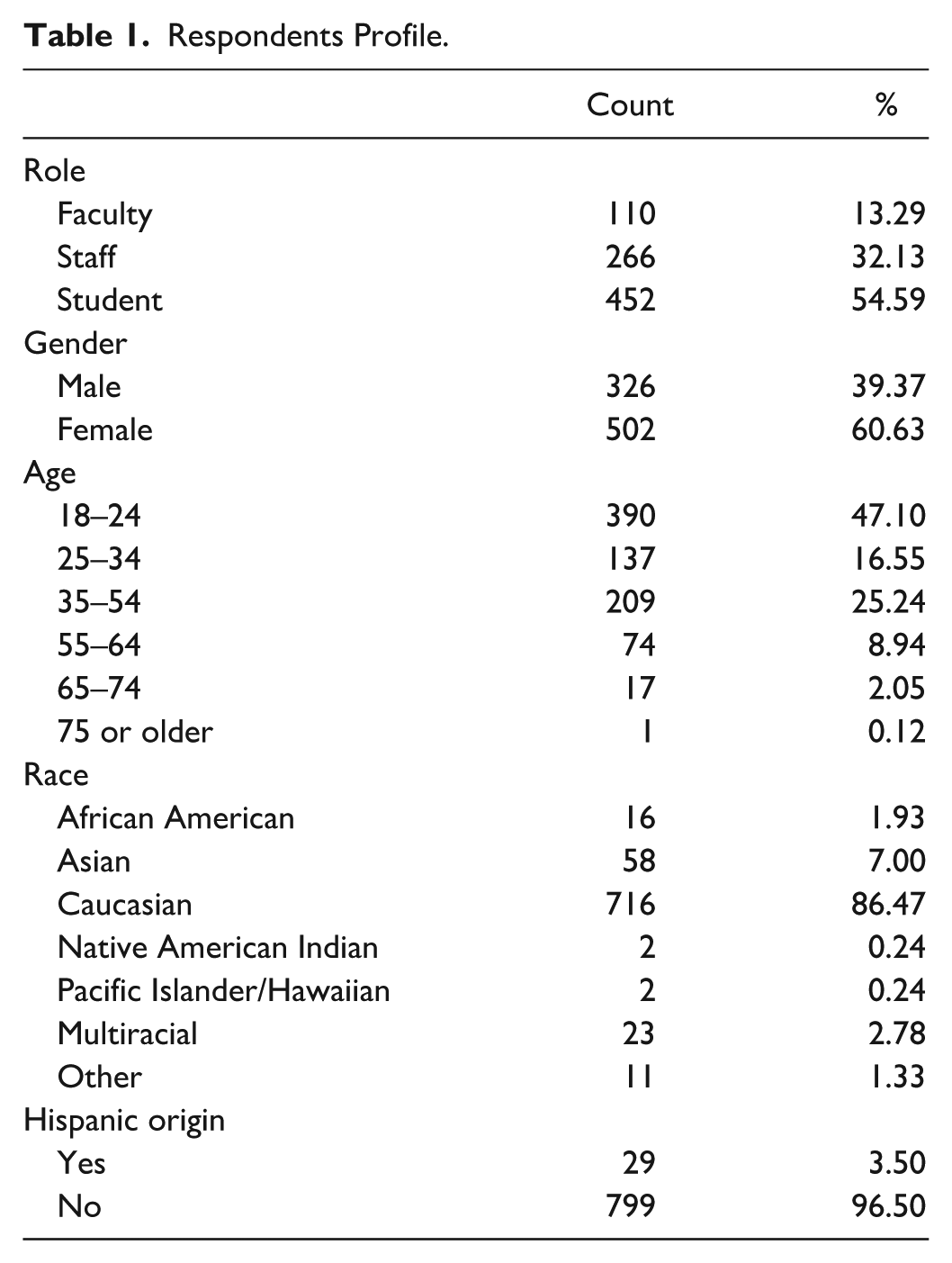
In total, 3,249 people answered the survey. Answers from respondents who did not agree to participate in the survey were removed. Our selected sample focuses on 828 faculty, staff, and students who provided completed responses to our questions of interest. Most respondents were students (54.59%), followed by staff (32.13%), and faculty (13.29%). Females outnumbered male respondents with 60.63%, and 39.37%, respectively. Because the survey was conducted at a university, age distribution was skewed toward those under the age of twenty-four (47.10%), although other age ranges were present, respondents twenty-five to thirty-four (16.55%), thirty-five to fifty-four (25.24%), fifty-five to sixty-four (8.94%), and sixty-five or older (2.05%). The majority of respondents (86.47%) were Caucasian, 7.00% Asian, 1.93% African American, 0.24% Native American, 0.24% Pacific Islander/Hawaiian, 2.78% Multiracial, and 1.33% “Other.” Native Americans, Pacific Islanders/Hawaiians, and multiracial respondents were grouped into “Other” category for statistical analysis; 3.50% of respondents were of Hispanic origin (Table 1).
Respondents Profile.
Ordinary least squares regressions were used to evaluate the demographic differences of respondents’ answers; respondents’ levels of comfort in different smart place setting; their willingness to use different modes of autonomous transportation (car, train, scooter, etc.); their feeling about sharing the road with AVs, be they pedestrians, cyclists, or other drivers; and the association between their perceptions of AVs, smart places, and AI. Spearman’s rank correlation tests were conducted to determine the relationship between respondents’ familiarity and perception of AVs, as well as the relationship between respondents’ supportiveness of AI investments and their level of comfort in an AI environment.
This survey does have limitations, being conducted on a university campus means most respondents were highly educated, young, students outnumbered all other campus roles, and not all races were represented equally. For instance, African Americans, Hispanic peoples, and Native Americans were underrepresented. The survey did not ask for respondents’ educational background, although it can be surmised that because it was conducted on a university campus, most all respondents likely have some college in their background. Finally, the survey design was relatively simple as it aimed to gather people’s perceptions; it was not able to capture the synergic impacts of various automated systems like Hainmueller, Hopkins, and Yamamoto (2014) did, which is worth exploring in future research.
Perceptions of AI-Enabled Devices at Home, Work, and in Public
Respondents’ sentiment toward AI and autonomous technology varied depending on each individual technology (Figure 1). Respondents have a sliding scale with which they welcome AI-enabled devices into their lives. For example, respondents are most welcoming of guided or fixed-route autonomous mobility, such as trains, less so of four-wheeled and enclosed AVs, that is, cars, and even less of autonomous two-wheeled vehicles, motorcycles, scooters, or bikes. A similar sliding scale exists for smart places: respondents welcome AI into their places of work and social life, more so than into their own homes, and even less into their doctors’ office. Likewise, respondents also outsourced simple work tasks, for example, scheduling meetings, rather than consequential ones, for example, childcare. When testing for associations between affinity toward different types and places of AI, we found that whether a respondent would be comfortable with an AI-enabled environment is statistically significantly associated with one’s perception of AVs and smart places. Demographics played an almost consistently significant role, as females, the elderly, and Caucasians were less familiar, felt less safe and comfortable, and were less welcoming of AVs than males, the younger, and Asians.
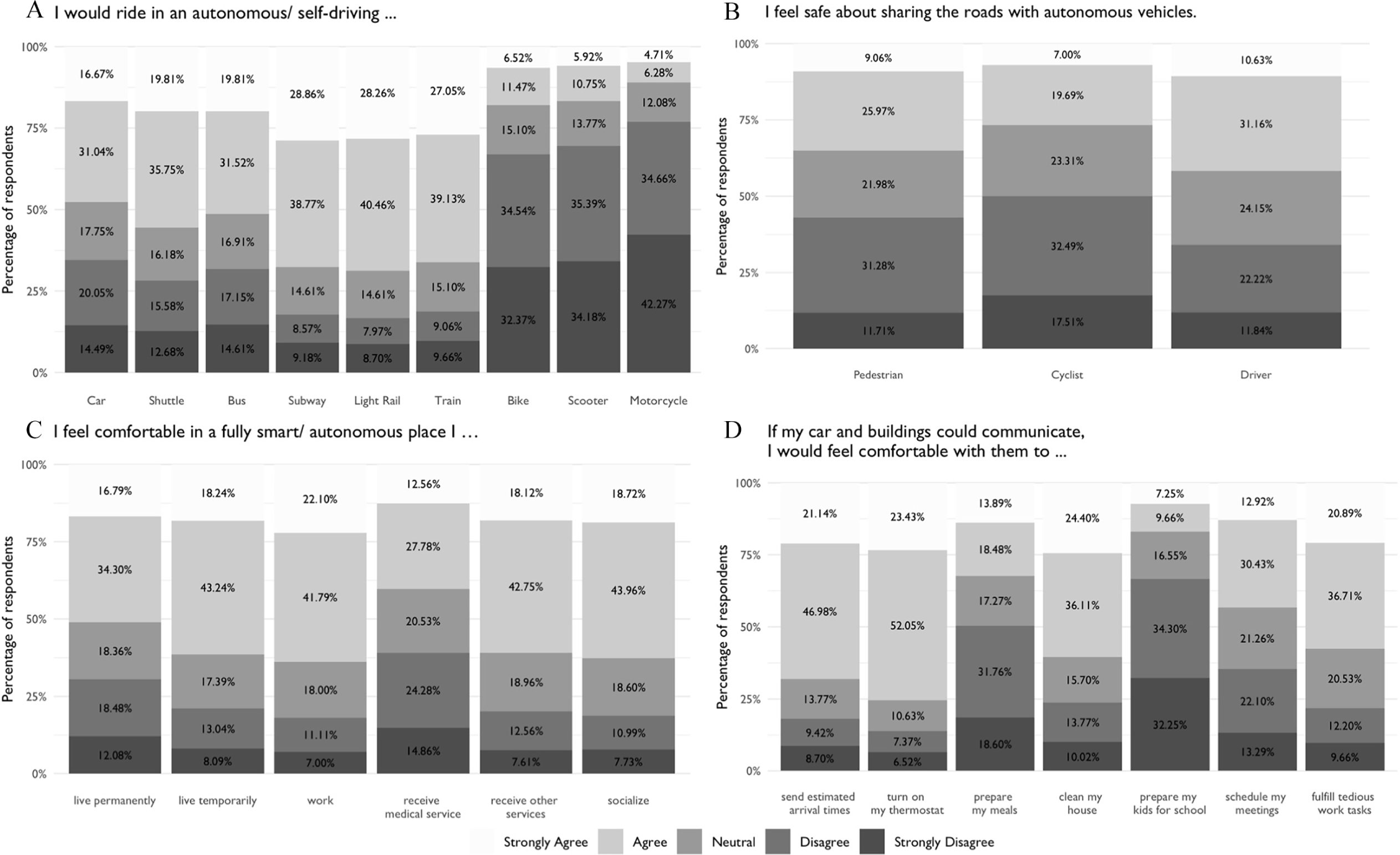
Respondents’ perceptions of autonomous vehicles and smart places (N = 828): (A) respondents’ willingness to ride in different modes of autonomous transport; (B) pedestrians, cyclists, and drivers’ safety feeling about sharing the road with autonomous vehicles; (C) level of comfort respondents feel when asked about autonomous technology in various everyday places; and (D) respondents’ level of comfort with different activities that autonomous technology could perform.
AVs
The plurality of respondents (45.89%) report having positive perceptions of AVs, even though most respondents voiced some form of concern regarding autonomous technology. Only 10.14% of respondents report having limited or no concerns at all. Respondents are nearly evenly concerned about vehicle safety (27.42%) as they are about conflicts with other drivers on the road (26.09%), and the lack of a human driver (30.31%). Males view the technology significantly more positively than females (p < .001); and younger respondents view AVs significantly more positively than do older respondents (p < .05), when controlling for other demographic factors.
The majority of respondents (54.47%) report being familiar with AVs. Holding other factors constant, males are more likely to be familiar with AVs than are females (p < .001). Age, race, and ethnicity have no significant bearing on whether or not a person is familiar with AVs. Familiarity with AVs is moderately positively correlated with a person’s perception of them (Spearman’s rho = .41, p < .001), meaning the more familiar someone is with the technology, the more likely they are to view it in a positive manner. This holds true for all modes of autonomous transportation, while familiarity is positively correlated with a person’s level of comfort with sharing roads with AVs. The majority of respondents view vehicles that are on a track (subway/train/light rail) as more favorable than they do cars or busses (Figure 1A), two-wheeled vehicles being the least well-perceived modes of transportation. In addition, male, younger, and Asian respondents are significantly more likely to be willing to ride in an AV than are females (p < .001), older (p < .001), and Caucasian respondents (p < .01). Ethnicity does not appear to be associated with a person’s willingness to ride.
Pedestrians, cyclists, and other drivers harbor a fair amount of concern about sharing the road with AVs (Figure 1B). A large number of pedestrians indicate that they do not feel comfortable at a crosswalk knowing AVs are nearby, with 42.99% of respondents either disagreeing or strongly disagreeing when asked if they would feel safe. Male pedestrians are significantly more comfortable with sharing the road with AVs than are females (p < .001) when controlling for other demographic factors. A greater percentage of cyclists (50.00%) feel unsafe with AVs on the roads than do pedestrians (42.99%). Male and younger cyclists are significantly more likely to feel safe sharing the road with AVs than are female (p < .001) and older cyclists (p < .05). The percentage of drivers in non-autonomous cars who report being comfortable with AVs was higher than those of their counterparts on foot or on bicycles, with 65.94% of respondents stating that they feel safe or neutral about sharing the roads. Male drivers are more comfortable with sharing the roads with AVs than are females (p < .001). Race and ethnicity did not have a relationship with pedestrians, cyclists, or drivers in non-autonomous cars’ feelings of safety while sharing the road with AVs.
Smart Places
Autonomous technology is especially welcome in places where people work, socialize, or receive general services. However, the majority of respondents are less welcoming of the technology being present in their home, and even more leery of its existence in places where they receive medical services (Figure 1C). Compared with smart homes, respondents are more likely to feel comfortable in a fully smart place where they live temporarily (p < .001), work (p < .001), receive services other than medical (p < .001), and socialize (p < .001); they are less likely to feel comfortable in a smart medical facility (p < .001). Male, younger, and Asian respondents are significantly more comfortable with smart places than are female (p < .001), older (p < .05), and Caucasian respondents (p < .05).
The majority of respondents feel comfortable allowing AI to communicate arrival times, operate thermostats, and perform other tedious tasks. In contrast, they were less comfortable with the technology preparing their meals, and dramatically less comfortable with it preparing their children for school (Figure 1D). Compared with sending estimated arrival time, respondents are significantly more comfortable with an AI communicating with other devices to turn on thermostats (p < .01), but less comfortable with them taking care of their children (p < .001), scheduling their meetings (p < .001), or preparing their meals (p < .001). Controlling for other demographic factors, males and Asians are significantly more comfortable with the notion of allowing autonomous technology to perform various actions or services than are females (p < .001) and Caucasians (p < .001). Age and ethnicity are not associated with whether or not a person is comfortable with this aspect of the technology.
AI, AVs, and Smart Places
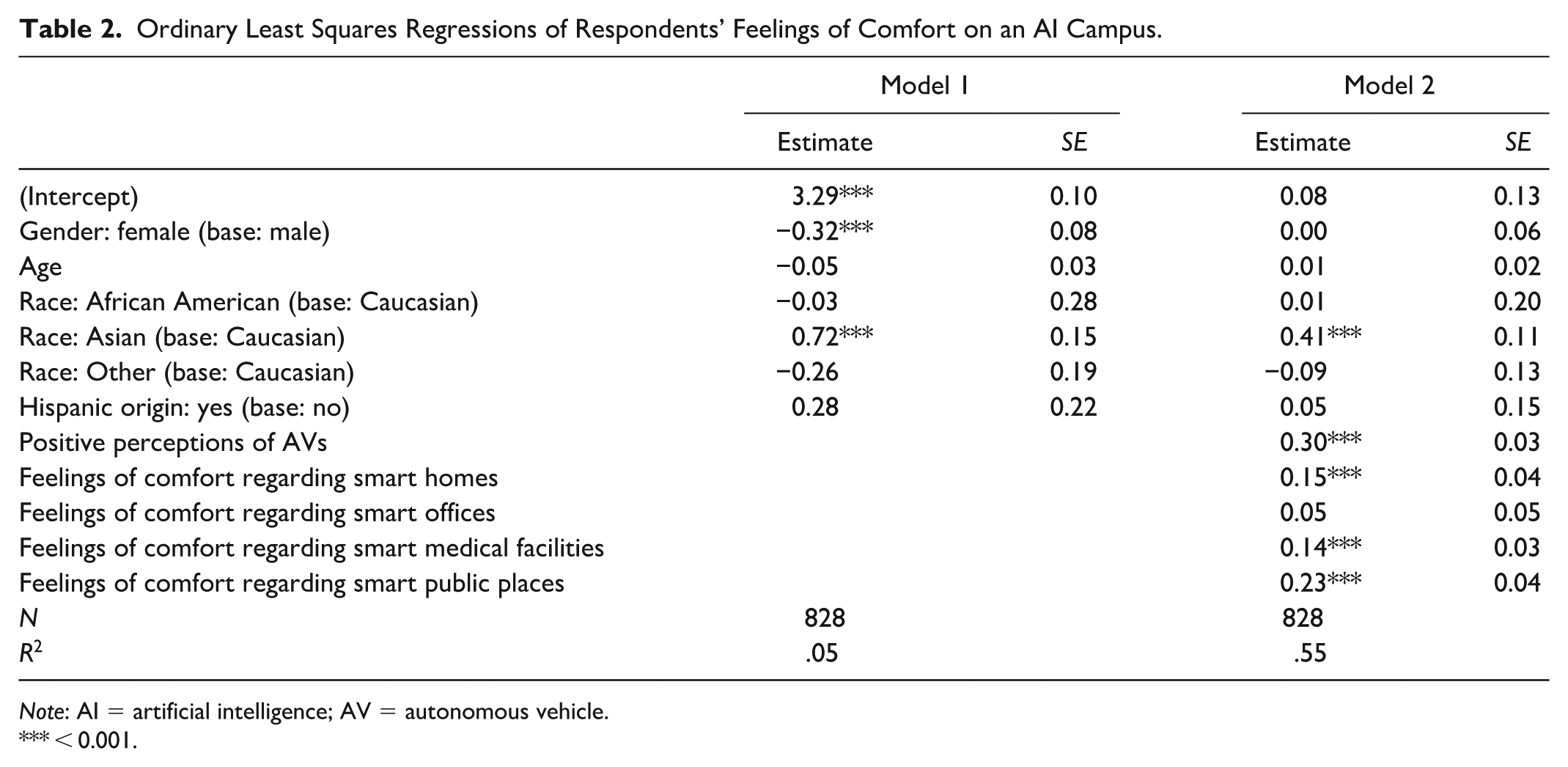
When asked if university students, faculty, and staff would feel comfortable on a campus where AI is in control of the day-to-day activities, 28.02% of respondents reported being neutral, 38.53% of respondents either agree or strongly agree that they would feel comfortable, whereas 33.46% either disagree or strongly disagree. As shown in Table 2, Model 1, males are significantly more comfortable being on such a campus than are females (p < .001), and Asian respondents report being significantly more comfortable with the concept of a smart campus than Caucasians (p < .001).
Ordinary Least Squares Regressions of Respondents’ Feelings of Comfort on an AI Campus.
Note: AI = artificial intelligence; AV = autonomous vehicle.
< 0.001.
We find that whether respondents would be comfortable in a campus environment where AI regulates daily operations is associated with their perceptions of AVs, and their feelings of comfort regarding smart places, when controlling for other factors (Table 2, Model 2). Respondents who perceive AVs positively are more likely to be comfortable on an AI-controlled campus (p < .001). Similarly, respondents who are comfortable with smart homes (p < .001), offices (p < .001), medical facilities (p < .001), and public places (p < .001) are more likely to be comfortable with an AI campus environment.
Respondents were then asked if they feel that their university should invest in autonomous technologies; 67.51% of respondents indicated that they support such investments, whereas 32.49% said they are not supportive. Males and Asians are significantly more likely to support such investments than are females (p < .001) and Caucasians (p < .01). In addition, respondents’ supportiveness of such investments is strongly positively correlated with their level of comfort regarding AI (Spearman’s rho = .66, p < .001). The more comfortable one is with AI, the more supportive of he or she is of one’s university investing in autonomous technologies.
Discussion
Transport AIs, home AIs, and work AIs will all play a critical role in the making of a smart city. We asked people living and working on an American university campus about their comfort with and perception of AI-mediated environments and test whether there is an affinity correlation between them. AI-enabled technologies have the capacity to dramatically change and affect our daily lives, for the better or worse. Where these technologies are implemented, and how planners and policy-makers take peoples’ sentiment into account, may mean the difference between successful, beneficial implementation and one in which people’s privacy and security are lost in the name of technological progress. Studies like this one may allow planners more success at fostering the former.
People who view AVs positively are also more likely to view domotics more favorably, including being comfortable in smart/autonomous places and AVs and smart homes communicating with each other. Younger generations, particularly males, are significantly more welcoming of the technologies than are other demographics, confirming previous studies (Bansal, Kockelman, and Singh 2016; Chen and Lee 2019). Results also indicate that Asians and Asian Americans are much more likely to adopt AVs and smart devices in their homes. We hypothesize that previous exposure to the technology, rather than culture, drives their perceptions, as familiarity with AVs has proven to increase a person’s willingness to ride (Chen and Lee 2019).
While a large subset of respondents viewed AVs in a positive way, the majority had some concerns over its use. Respondents were more likely to view fixed-route modes of transportation, for example, autonomous shuttles, trains, subways, and light rail as more positive than flexible modes of transportation, like autonomous cars and busses. Furthermore, a significant majority of respondents were not comfortable with the notion of autonomous two-wheeled transportation like autonomous bikes, scooters, or motorcycles. As is typical in most literature discussing the topic, safety was a major concern (Bansal, Kockelman, and Singh 2016). However, we advance that literature by arguing that people’s feeling of safety is higher in vehicles that appear to have fewer choices, for example, those on fixed routes compared with demand-response routes.
We found that the majority of respondents’ sentiment toward domotics (home and work AIs) is positive. Respondents welcome autonomous features in their workplaces, vacation destinations, stores, or restaurants, although they are less receptive to them existing in their home or doctor’s offices. People living and working on campus would accept many forms of autonomous technology, especially when AIs operate in a somewhat confined environment. For example, the impact of a meeting being rescheduled is far less grave than if an AI mishandles childcare. Privacy constraints often hinder people’s acceptance of AIs in personal settings, such as a home or in a doctor’s office (Beresford, Kübler, and Preibusch 2012). Similar to transport AIs, work and home AIs are more accepted if and when they operate with limited options. As trust in the technology continues to rise, and perceived usefulness increases, negative perceptions and attitudes might change (Krueger, Rashidi, and Rose 2016; Liljamo, Liimatainen, and Pöllänen 2018; Mcknight et al. 2011).
Conclusion
The future looks like it may be an automated one. AI and other technologies have the potential to benefit people, especially those who are disadvantaged (Harper et al. 2016; Yigitcanlar et al. 2020). But, without guiding the AI introduction purposefully with a focus on the difference in demographics, they may create more harm than good for the disadvantaged (Kassens-Noor, Dake, et al. 2020; Kassens-Noor, Kotval-Karamchandani, and Cai, 2020). Thus, it is important to get their implementation “right,” and to do so, people’s preferences, emotions, and sentiments must be taken into consideration. People appear to be much more comfortable with technology that is already available than they are with concepts of future technology. The fact that younger people, and especially those with more experience interfacing with technology, are more receptive of AIs indicates that it may be commonplace in the future (Bansal, Kockelman, and Singh 2016; Dos Santos et al. 2019; Liang and Lee 2017)
The implications for planning and policy are inherent yet understated. Planning is often political will, guided by citizen participation and buy-in. Hence, there are two facets to the implications: the first being political will. By this, we mean that AI-mediated environments need to be backed by political vision and be placed within long-term strategies. Letting technology be introduced into our societies to take over human tasks needs to be carefully implemented so that it fulfills a stated goal. There is need to include the phased introduction of various AI environments and their oversight and responsibilities into formal plans. Such a purposeful inclusion would mean and portray that the uses and effects have been vetted and there will be continuous monitoring of such implementation. The second facet is citizen participation and buy-in. The study shows that certain demographics are more receptive to adopting an AI environment than others. However, the more important outcomes are that people are particular about which technological environment they are willing to adopt based on their perceptions of personal and familial safety, and that familiarity and experience breed positive perceptions and willingness to adopt. As such, offering the ability to experience an AI-inhabited environment in phased tests would enable the citizenry to have the opportunity to interact with those environments and offer their feedback/suggestions for adoption. Such suggestions, when taken into consideration and included in formal plans, give people the satisfaction that their opinions and preferences have been included in the dissemination of AI-inhabited environments that are likely to affect them the most.
The critical questions center upon how communities, as collectives, manage and control the uses of AI for the well-being of all its citizens. AIs can increase our plan-making and decision-making capacities considerably when we get real-time information. On the contrary, there may well come a time when the ability of AI to garner data will become psychologically and socially interfering unless its purpose is clearly understood. Planners also need to constantly recognize that as long as the elements of AI are in the domain of the affluent and educated classes alone, as long as they remain expensive, and as long as they are not understood by a large segment of our society, there will be increased divisions in the American community. The more we understand about how people perceive AI (Shank, DeSanti, and Maninger 2019), the better we can plan for its implementation. There will always be resistance to change and new technologies; if planners wish to maximize the benefits of AI, they must consider people’s perception and get the implementation right.
Supplemental Material
sj-docx-1-jpe-10.1177_0739456X20984529 – Supplemental material for Living with Autonomy: Public Perceptions of an AI-Mediated Future
Supplemental material, sj-docx-1-jpe-10.1177_0739456X20984529 for Living with Autonomy: Public Perceptions of an AI-Mediated Future by Eva Kassens-Noor, Mark Wilson, Zeenat Kotval-Karamchandani, Meng Cai and Travis Decaminada in Journal of Planning Education and Research
Research Data
sj-xlsx-1-jpe-10.1177_0739456X20984529 – Supplemental material for Living with Autonomy: Public Perceptions of an AI-Mediated Future
sj-xlsx-1-jpe-10.1177_0739456X20984529 for Living with Autonomy: Public Perceptions of an AI-Mediated Future by Eva Kassens-Noor, Mark Wilson, Zeenat Kotval-Karamchandani, Meng Cai and Travis Decaminada in Journal of Planning Education and Research
Footnotes
Declaration of Conflicting Interests
The author(s) declared no potential conflicts of interest with respect to the research, authorship, and/or publication of this article.
Funding
The author(s) disclosed receipt of the following financial support for the research, authorship, and/or publication of this article: This work was supported by the Center of Business and Social Analytics at Michigan State University.

Supplemental Material
Supplemental material for this article is available online.
Author Biographies
References
Supplementary Material
Please find the following supplemental material available below.
For Open Access articles published under a Creative Commons License, all supplemental material carries the same license as the article it is associated with.
For non-Open Access articles published, all supplemental material carries a non-exclusive license, and permission requests for re-use of supplemental material or any part of supplemental material shall be sent directly to the copyright owner as specified in the copyright notice associated with the article.
