




Abstract
This article problematizes the relationship between the ethos of urban practitioners and the ideology of neoliberalism to show how neoliberalism has transformed urban design to make it an efficient mechanism for capital accumulation. The method used in the article is based on archival research and statistical analysis in addition to a comparative housing sample in Chile from the Servicio de Evaluación Ambiental (Environmental Assessment System). What emerges from such unpacking is a severe contradiction stemming from the clash between urban practitioners’ ethical responsibility in developing good cities and the neoliberalist goal of merely increasing the profitability of spaces. The article discusses the political and ideological dimensions of neoliberal urbanisms and the effects of neoliberalism in everyday urban practice of making in neoliberal urbanisms and discusses how to separate urban design practices from the profit-oriented ethos.
Introduction
This article presents an interpretation of the articulation of neoliberalism within the urban design disciplinary field, reflecting on its ideological dimension and presenting the contradiction in the ethos of urban practitioners. Specifically, this paper examines the relationship between housing production and the collective space in the city of Santiago, Chile, and how urban practitioners make decisions that go against urban design objectives in favor of neoliberal ideas. Urban planning is a market-driven field in Chile (and elsewhere; Gunder 2011); economic goals drive urban planning decisions, and real estate developers are the primary shapers of urban spaces (Murray and Clapham 2015). Thus, the housing market defines the typologies of Chilean urban spaces, and public spaces depend on the profitability of the neighborhoods; some common spaces are underdeveloped while others are better designed because those areas are desirable to real estate developers and investors (Boano and Vergara-Perucich 2017; Cattaneo Pineda 2011; Edward 2015; Vergara-Perucich 2019; Vergara-Perucich and Boano 2019). As architects, urbanists, and planners are the main agents of such decisions, this article explores how the neoliberal approach to urban practices is distant from ideal urban design objectives from theoretical perspectives. We present relevant discussions from the literature about how neoliberalism—as an ideology and a political project (Azevedo et al. 2019)—has influenced urban design field to fully orienting its ethos toward two neoliberal objectives: the promotion of free-market regimes and subsuming society to the rule of profit.
The neoliberalization of urban disciplines occurred based on a contradictory restructuring strategy that destabilized urban governance and socioeconomic regulations (Peck, Theodore, and Brenner 2017). In this article, we define neoliberalism as a theory, an ideology, and a political project (Harvey 2005) that offers an extreme interpretation of capitalist principles (Zimbalist and Sherman 1984). The contrast between the utopian vision of a free-market society and its actual realization in spaces is striking given the potentially coercive relationship between states and the hegemonic class and the focus on privatizing as many aspects of society as possible, including social services, culture, arts, politics, and the sciences (Theodore, Peck, and Brenner 2012).
Although critical reflections on the neoliberalization of urban practices are abundant (Brenner, Madden, and Wachsmuth 2011; Fezer 2013; Harvey 2012; Spencer 2016), the role of spatial practitioners as facilitators of these practices is an open field for exploration (Araabi 2018) because researchers have presented few feasible proposals or theories about post-neoliberal cities. Therefore, the practice of urban design under neoliberalism may inform theoretical discussions and offer insights into how the ethos of urban practitioners must change to pursue post-neoliberal urbanisms.
Despite decades of hegemonic control over urban production, the critique of the neoliberal city has only been made by researchers relatively recently. After years of neglecting the political role of urban design (Banerjee and Louaitou-Sideris 2011; Cuthbert 2010; Madanipour 2006), urban practitioners started to critically assess their role in society as political actors and as facilitators of the privatization of public spaces about 2005 more broadly. Just as liberal projects require industrialization, neoliberalism requires urban development (Harvey 2012, 2018), and urban practitioners play a central role as cities are the material expression of the production processes oriented toward financial and capitalist aims and have the backing of governments and ad hoc urban policy (Harvey 2018; Hidalgo Dattwyler et al. 2008; López-Morales 2010). The neoliberalization of urban design processes helped transform the city into a simple commodity (Stanek 2008), subjugating the use value of spaces in favor of its exchange value and provoking a contradiction in the ethos of urban practitioners (Mehrotra 2017). Using diverse approaches, researchers have articulated the relationships between neoliberal urbanisms and urban policy (Pinson and Morel Journel 2016), governance (Storper 2016), public spaces (Langhorst 2015), housing markets (López-Morales 2016), and informality (Boano and Talocci 2014). In these explorations, they examined the role of urban design under neoliberalism but not as the central topic, which is the focus of this paper.
The article is organized into three sections. The first outlines briefly the conceptual reflections on the ethos of urban practitioners to understand their motivations in practicing urban design. The second section describes the connection between neoliberalism and urban production in Chile by studying the housing market and its aesthetics to unveil the main features of urban design under neoliberal regimes. The method used here is based on data gathered after four months of archival work on the National Library of Chile between December 2015 and March 2016, revising the economic published advertisements in newspapers from 1980 to 2016. We used descriptive statistical analysis to identify how different housing production components varied over time, focusing on how the price was detached from its fundamentals while aesthetics became monotonous through the distribution of a homogeneous collection of typologies throughout the Chilean territory. The final section reflects therefore on the conceptual register of urban design under neoliberalism as a construct made by the emergence in the contradictions between the ethos and the praxis. We also note other areas of researcher to further explore the contradiction and offer suggestions for a post-neoliberal approach to urban design and architecture.
A Reflection on Urban Practitioners’ Ethos
Ethos is a series of attitudes and values which constitute the habits of a social group (Guzmán 2011). Ethos is also a tool useful for conducting discourse analysis which may serve to unpack disciplinary questions (Bermúdez 2007). The ethos analysis integrates objective information of ethical dimensions with its practical implications (Bourdieu 1990). The ethos of urban design practice refers to a set of beliefs and attitudes that practitioners use when deciding on urban forms and shaping spaces and is connected to the applied ethics of the built environment. The critical hermeneutics of the urban design practice offers a chance to theorize based on specific contexts—such as our focus on the urban practices under neoliberalism in the Chilean urban development from 1980 to 2016—and the questions emerging from those contexts (Correa, Arenas, and Alvarado 2018). Moreover, research on this ethos has significant implications for understanding the neoliberal values of professionals, as well as which aspects of such urbanisms influence the behavior and decision making of urban practitioners.
The unclear theoretical perimeter of urban design practice in the literature is actually one of its values (Boano and Talocci 2014); it is a mongrel disciplinary field that borrows methods and frameworks for studying and theorizing the urban space from other disciplines (Carmona 2014) that allow a wider spectrum of interventions and values to be applied. One of the problems of the urban design practice is that it operates by prescribing visions, processes, and ideas for cities based on fixed spatial elements that sometimes, as Sorkin (2013) reminds us, neglect the social consequences of such changes. It does focus on forms rather than consequences. In Latin America, the role of the state in shaping the city changed after neoliberalization (beginnings of the 1980s) and financial instruments were validated by governments who attributed social importance to widening people’s access to urban life even though that led low- and middle-income groups to indebtedness and precarious banking schemes to access mortgages (Hidalgo Dattwyler, Santana, and Quijada 2020). Urban practitioners in Latin America witnessed these processes and had to adopt the rationale of financial urban development. This contradiction between the need of producing urban spaces for sociality and citizenship to emerge and thrive and the market for making profit deployed conflictual social consequences at many urban dimensions, and housing is the most visible one in Chile.
The goal of urban design disciplinary field 1 is to address key considerations of the relationship between citizens and the civic space. Kuhne argues that a good civic space should have the qualities of utility, identity, and inclusivity. It should be space that all citizens make use of, identify with, and enjoy freely (cited in Gaffikin, Mceldowney, and Sterrett 2010, 499).
From a theoretical perspective, there have been changes in the definition of an urban space over the last twenty years (Castells 2008; Delgado and Malet 2007; Sennet 2014), moving from a strict focus on the spatial results of a design in the 1980s to an unclear and euphemistic definition at the beginning of the 1990s (Mitchell 2018). In the last ten years, urban spaces have been advanced as a multidimensional definition (Carmona 2014). According to Amin and Thrift’s (2002) notion of urban space, the relationship between public culture and public space is crucial as a setting of things, for human and non-human, in which the recognition of the urban space relies on a human pre-cognitive response rather than a rational construction. This setting may or may not generate an increase in collective impulses on public spaces. In this completely dynamic arrangement, the product and the process may be seen of the urban life across space and time, enabling an investigation into the nature of urban design (Amin and Thrift 2002). Given these complex dynamics, forces from diverse social groups that are involved in the urban production and have different interests manufacture the space. These forces may be social, political, cultural, or economic, but the result is an urban product. Bodnar (2015) suggests that public space is not a fixed category, noting that, through its objectivity and subjectivity, the space should be differentiated based on its ownership, for example. Bodnar (2015, 2099) states that the idea of the privatization of public space opens the possibility to differentiate between “privateness” and “publicness.” We have borrowed Bodnar’s publicness concept as a measure of intensity, along with Amin’s dynamic notion to create a continuous process with different intensities.
The confusion between publicness under private spaces open to public use (such as shopping malls or airports) is a complex issue, especially when neoliberalism rules because of the high importance given to profitability. Under neoliberalism, urban practitioners have to articulate a profit-driven way of developing the city to decision makers and investors without losing sights of good spaces, aesthetically and socially. The commitment to producing attractive designs to foster vibrant areas affordable and open to people, activities and interactions, exchanges, and consumption is accommodated by the market as a good space or even as a social value of consumerism in cities. In reality, this forceful way of understanding good spaces is a mirage becoming often a simple spectacle with the same typologies, as well as one of the distinguishing features of neoliberal urbanisms.
Margaret Kohn (2011) observes that, while emulating well-designed public spaces can give an illusion of community, private open spaces can never really achieve the effect of a co-creation process for designing spaces. An illusion of a good city composed of wide sidewalks, safe playgrounds, innovative benches, new shops; meanwhile, strident appearances lack social processes as investors who do not even live in the area under development largely drive such appearances. These good-looking spaces hide the complexities of gentrification (Inzulza-Contardo 2012), underpaid labor (Lambert and Herod 2016; Smith 2011), overcrowding (Richards 1995), informality (Naik 2015; Vergara-Perucich and Boano 2018), and real estate collusion (Vargas 2016). A good-looking urban space that did not involve a social interaction process in its generation is like an artificial sweetener because it provides a taste but is not grounded on real social relations; the inhabitants of the city receive a space whose main aim is creating financial value instead of urban life (Aalbers 2019), and any memorable urban experiences in the space are side effects rather than pursued outcomes. Furthermore, under neoliberalism, spaces are rarely conceived collectively or democratically. Local governments in neoliberal countries have been so focused on globalization, economic activation, rapid expansion, and mega-projects that they just want to produce and deliver the urban space disregarding the way they are designed (Al-Kodmany 2011).
Urban practitioners address city planning by creating and shaping public spaces and facilities, organizing private initiatives, reflecting on social needs, and defining how cities are developed (Barnett 1982). For Barnett (1982), the importance of urban practitioners stems from their knowledge of how to consciously elaborate a physical design to create an urban transformation. Shaping an urban form is complex because “there may well be a conflict of interest between good urban design and the needs of an architect’s client, so that cities [are] full of good modern buildings” (Barnett 1982, 238). A set of legal regulations may address these conflicts and help harmoniously organize the city while favoring common over private interest (Lynch 1982, as cited in George 1997). Embedded in the institutional frameworks of governments, local authorities, companies, and organized communities, these regulations define certain goals in relation to fulfilling social needs, and public urban practitioners working for state divisions at local, regional, and national levels. As most of their tasks concern the public realm (Miles 2000; Montgomery 1998), urban practitioners can actively contribute to resolving capital- and community-related conflicts of interest over a space with the aim of finding a better solution for both parties. Meanwhile, private urban practitioners attempt to fulfill the demands of their employers by maximizing the profitability of investments while attempting to create good urban spaces. However, as, under neoliberalism, the state transformed its goals to facilitate the role of real estate development and oriented urban policy to ensure the profitability of urban development businesses, both types of urban practitioners are chasing the same goals: economic efficiency and profit. This is the case in Chile, where, since 1979, the state has embraced the idea of leaving the role of shaping urban spaces to the market, dismantling urban planning, and working through a subsidiary scheme in which the provider of urban products is always a private agent for urban development (Cociña 2016; Daher 1990; Donoso and Sabatini 1980; Hidalgo Dattwyler, Bilbao, and Rivas 2016; López-Morales 2009; Smart and Burgos 2018; Vergara-Perucich and Aguirre-Nuñez 2019).
Urban design research has framed most of its knowledge production in framing, developing, and shaping a certain version of a good city. Urban design is an applied disciplinary field that combines the use of social science methods with the arts, discussing the imperious necessity of transforming research findings on urban forms by either norms, regulations, designs, or actions. One of the main responsibilities of urban practitioners in this field is articulating scientific knowledge with artistic techniques and creativity. Researchers, such as Cuthbert (2010), Oc (2014), Carmona (2016), and Araabi (2016), have characterized urban design as a field that articulates different modes of producing and studying the built environment, including geography, urban planning, urban studies, and architecture, to situate the public space at the center of discussions on how to improve urban life through spatial changes (Bentley 1976; Carmona 1998; Madanipour 2006).
Just as Henri Lefebvre (2003) suggests, urban practitioners may play a critical role as political catalyzers in separating urban processes from capitalism. Urban practitioners work with a basic need of society—the common space—and its organizational rationale. Therefore, these professionals are political agents capable of changing social relationships, materializing urban areas that reflect those relationships while also working within the urban system regardless of the dominant ideology. In other words, despite working in neoliberal scenarios, urban practitioners may make significant efforts to facilitate the creation of good spaces, overcoming the restrictions of a profit-oriented view of urban life. In a way, it seems impossible to escape being captured by the neoliberal system and resisting to the production according to its doxa and canons. Combining a more radical way of understanding this key role of neoliberalism with Lefebvre’s suggestion, urban practitioners may infiltrate a political apparatus and ignite strategic societal transformations by changing how cities are organized for the sake of the society. As such, urban practitioners can effectively affect the decision-making processes related to spaces and help imagine a post-neoliberal and more humanitarian urban life.
The importance of the market in shaping urban spaces increased after the emergence of neoliberalism (Harvey 2005), but the way how decision making is made specifically on urban forms remains under theorized. As part of neoliberal transformations, specifically present in the case of Chile, governments redirect state expenditures from social goods—such as housing, education, health care, and pensions—to address security measures controlled by market agents, subsidizing the private sectors for providing these services (Johnson 2011). Meanwhile, by weakening the public sector, neoliberalism directly changed the role of urban practitioners in society, and globalization accelerated this process.
Aspa Gospodini (2002) argues that the economic development of cities in the globalized era requires significant investments in urban spaces to ensure capital growth; thus, for Gospodini, urban practitioners are economic development agents. Matthew Carmona (2001) supports this view; he believes that good urban design helps expanding businesses break into new markets and contributes to enhancing a company’s image in communities. Under neoliberalism, entire areas of a city benefit from the production of high-quality urban design, but less attractive spaces for capital are neglected. Despite being privately owned, most open spaces designed for catching value are publicly accessible (Araabi 2018). Therefore, from the perspective of the provision of good spaces, one of the problems of urban practitioners applying neoliberal policies is the uneven distribution of good spaces throughout a city. In underdeveloped urban areas, the combination of the profit-oriented logic of urban design with a neoliberal set of ruling policies undermines the possibility of allocating capital investments to more deprived areas, where the value of the investments might be affected (Harvey 2012). Neoliberalism uses competition between products as a measure for optimizing investments. If we consider spaces as products (Lefebvre 1991), then we can see that less competitive spaces receive less attention from the market, reducing their chances of receiving investments for improvements because they are riskier investments. This is a supply and demand problem that is installed by a political-economic elite as a mantra for decision making, undermining the very possibility of providing spatial justice, which in the long term does not offer secure profit for capital.
Gunder (2011) goes further by observing that the urban design field lacks critical postures against the neoliberal agenda because contemporary urban design is a creation of neoliberalism. Urban design adopts the important role of providing a snapshot of success to neoliberalism, crystallizing the idea of the built environment as a commodity (Gunder 2011). As such, “when topics such as social justice, emancipatory design and gender are discussed under the titles of urban design, they cannot act otherwise than [is] required by neoliberal forces” (Araabi 2018, 4). Kanishka Goonewardena (2011) questions the co-dependence between capitalism and urban space production processes, demanding the disarticulation of these two concepts to develop what he called critical urbanism, a way of critical thinking that informs practice. We agree that one of the principal theoretical problems of urban design today is its subjugation to neoliberal objectives. This subjugation has forced urban practitioners to valorize methods from economics and finance as their own. Therefore, the ethos of urban practitioners in a neoliberal context will be exposed to significant contradictions between the pursuit of good urban design and the interests of capitalism.
In terms of capitalism, a good city is a profitable one. To illuminate the contradiction between the good city and a profitable urban processes, we must also address the definition of a good city after stripping that concept from economic and financial ideas. In our approach, we embraced Ash Amin’s (2006, 1020–1021) definition: I have chosen to redefine the good city as an expanding habit of solidarity and as a practical but unsettled achievement, constantly building on experiments through which difference and multiplicity can be mobilised for common gain and against harm and want.
To advance from an analysis of the world’s tendency to transform urban practitioners into instrumental actors to enhance profit and capital accumulation (Mitchell 2003), we must outline some basic principles to understand what decisions may lead to a good city based on Amin’s definition. First, to combat neoliberal urbanisms and attempt to humanize the urban space, urban practitioners should set a framework for developing a new urban practice that aims to foster solidarity within communities and provide an environment for enhancing urban life so that individuals may thrive socially. Andy Merrifield (2011, 479) suggests that the politics of encounter could be a solution as it is not abstract, and citizens do not have to demand it, mainly because it is something that “just does, just acts, affirms, takes, takes back.” The politics of encounter may be interpreted as a collectively invented language that is continuously enriched merely through the act of being in contact; urban practitioners could embrace this motto to establish a new ethos for the sake of the good city.
The Origin of the Contradiction: Chile in 1979
Augusto Pinochet’s dictatorship transformed Chile into a free-market champion following a non-gradualist path of monetary reforms, reducing the scope of the state in public affairs, privatizing social services and opening the country’s borders to international capital. The National Policy of Urban Development (NPUD) of 1979 reshaped city making, adapting methods and processes to the interests of the emerging neoliberal state and the entrepreneurial class. Before 1979, the law defined access to land as a right (Lawner 2013).
After the implementation of NPUD 1979, the Chilean state assumed a sort of advocacy role for property owners, embracing the trickle down mantra of the neoliberal system (Solimano 2012) and abandoning the pursuit of the common good (Gross 1990). Social housing programs even gradually transformed low-income communities into property owners (Rodríguez and Sugranyes 2005; Salcedo 2010). Consequently, urban practitioners learnt and adopted a free-market reasoning, prioritizing proposals that increased the exchange value of properties as part of the incorporation of the supply and demand rule into design processes.
NPUD 1979 declared that urban land was a non-scarce resource, allowing urban sprawl and doubling the metropolitan area of cities, such as Santiago (Trivelli 1981). As a non-scarce resource, land was subject to free trade, and profit was the main goal of urban development rather than organizing the space to ensure that most of the population had access to urban life (Daher 1990). Neoliberalizing all of the political and economic structures of Chile also transformed the culture. The transformation of citizens into consumers created a profit-oriented society and the neoliberal city (Janoschka and Hidalgo 2014).
Urban practices under neoliberalism in Chile were conceived by the dictatorship as a mode of spatial production targeted to extract as much profit as possible from urban production in which developers and investors are fully in charge of urban transformations, and the state acts as a facilitator, elaborating tailored regulations for the sake of free-market economics. The profit emerges when urban product sale prices are much higher than production costs, requiring households to pay high costs to secure a basic need, such as housing (Rolnik 2013). As housing and land are essential goods for living, consumers have little room for bargaining to get shelter in a neoliberal city (Vargas 2016). Instead, the rule of market forces them to participate in the process of reproducing the mode of neoliberal urban development.
Property owners have used neoliberal urbanism as a key strategy to establish themselves as a dominant class, employing spatial production to extract value from social relationships—particularly those related to housing and infrastructural developments (Harvey 2012)—and then shift to other economic activities, diversifying their capital stock. Under this scheme, urban practitioners serve neoliberal purposes by defining forms that might maximize the utility of a space. These principles fall under the following three main criteria:
Localization defines the quality of developments: In housing production, real estate marketers use precise definitions of building typologies based on the location of the plot, which defines the level of income of the potential customers (Assadi, Pulido, and Zapata 2008). Thus, based on typological sets and localization, the design must fulfill specific criteria related to prices, materials, colors, shapes, the number of parking spaces per flat, and the dimensions of the dwellings. In social housing, the criteria are more straightforward; everything must be as cheap as possible while still conforming to the not-so-demanding regulations (Cociña 2012). Localization is monopolistic, and it offers high precision rates of return on investments (Encinas et al. 2019).
Internal Rate of Return (IRR): IRR defines how much a (public or private) investor can spend on urban design innovations without ensuring high rates of return for the investment (MIDSEO 2013; Yaluff 2016). Thus, if an investor agrees to allow an urban practitioner to develop an innovative design, the project will rarely be accepted if it ends by reducing the profitability of a previously proven typology.
From the private to the public space: Urban transformations under a neoliberal regime depend on private sector interests (Theodore, Peck, and Brenner 2012). There are some exceptions, such as infrastructure projects (metros, some parks, and roads). However, it is more common to see architects developing public spaces as extensions of private projects rather than as consequences of comprehensive spatial improvement plans for urban areas (Greene, Rosas, and Valenzuela 2011). Neoliberal regimes fragment the transformation of spaces based on the interests of each stakeholder, activating urban projects rather than having them arise as a consequence of a common view about the future of the city. Therefore, urban design under neoliberalism seems like a collection of architectural objects populating the urban tissue in which the public space is a leftover from the spatial production process.
The effect of neoliberal transformations on the ethos of urban practitioners in Chile is easier to identify when analyzing how the economic features of housing projects progressed while the design of those projects became more monotonous. Using an aggregate analysis, it is possible to see how these principles operate. Figure 1 shows how neoliberalism affected housing prices through the deregulation of the market and the orientation of decision making toward profit. The figure shows the differences between construction costs, labor costs, and housing prices, depicting an impressive increase in housing prices in relation to other fundamentals in its pricing process. While construction costs increased by 18 percent and workforce salaries increased by 104 percent, housing prices increased by 226 percent. As construction costs incorporate the value of materials, we can infer that the materiality of projects from 1980 to 2016 did not drastically change. Likewise, while observing that workforce salaries represent 46 percent of housing price increases, we can conclude that investors whose earnings may be seen as a surplus value captured a high revenue (Das 2017). In other words, urban practitioners and construction workers in general produce more exchange value than the value of their wages, which investors and real estate developers capture. Investors and developers also extract value from the workforce by selling housing units at prices that are way higher than the actual aggregate value of the national economy (GDP [gross domestic product] per capita) in relation to the wages (Figure 2).
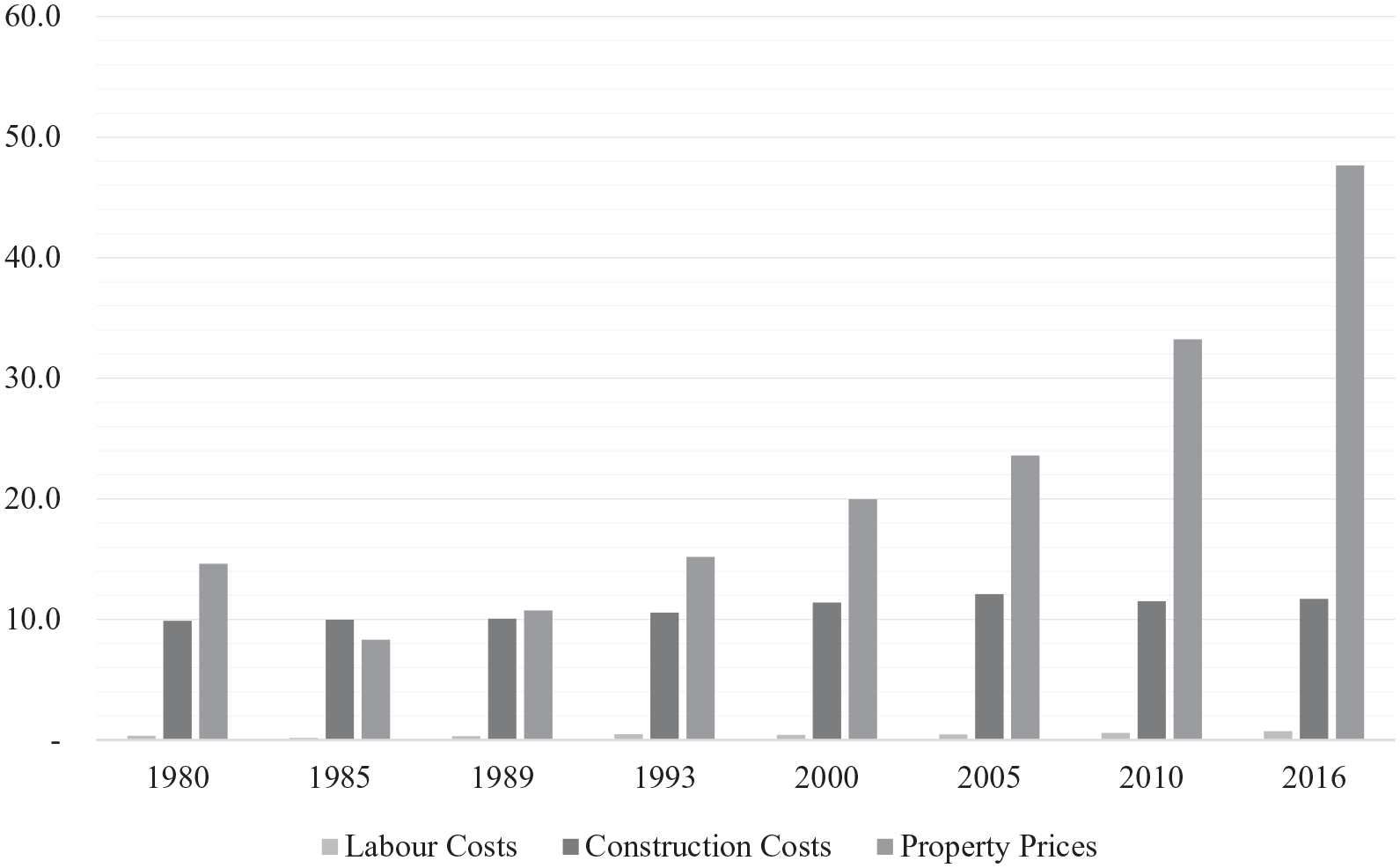
Evolution of the relationship between housing prices, construction costs, and labor wages in Chile from 1980 to 2016.
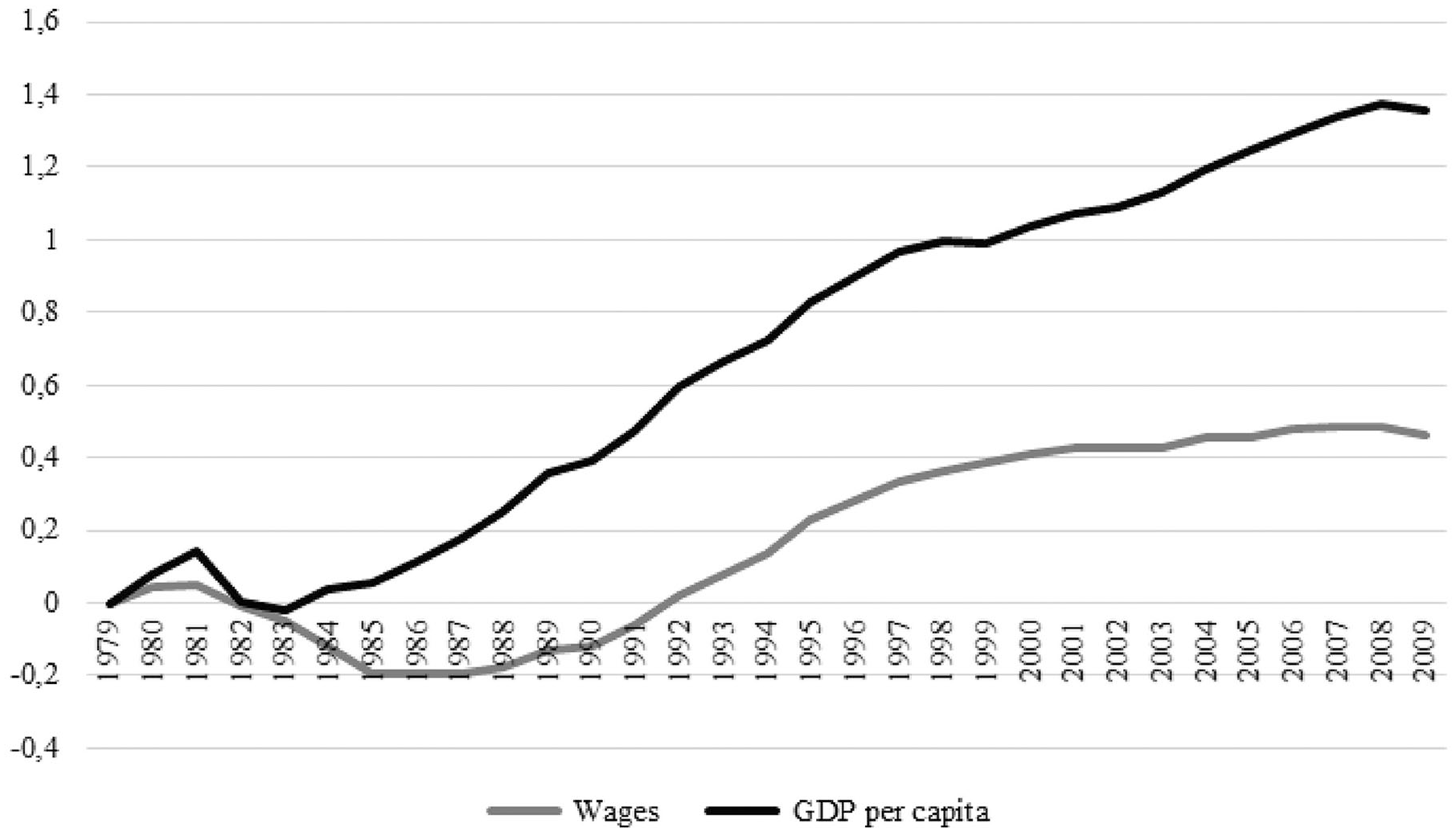
Aggregate GDP per capita and wages.
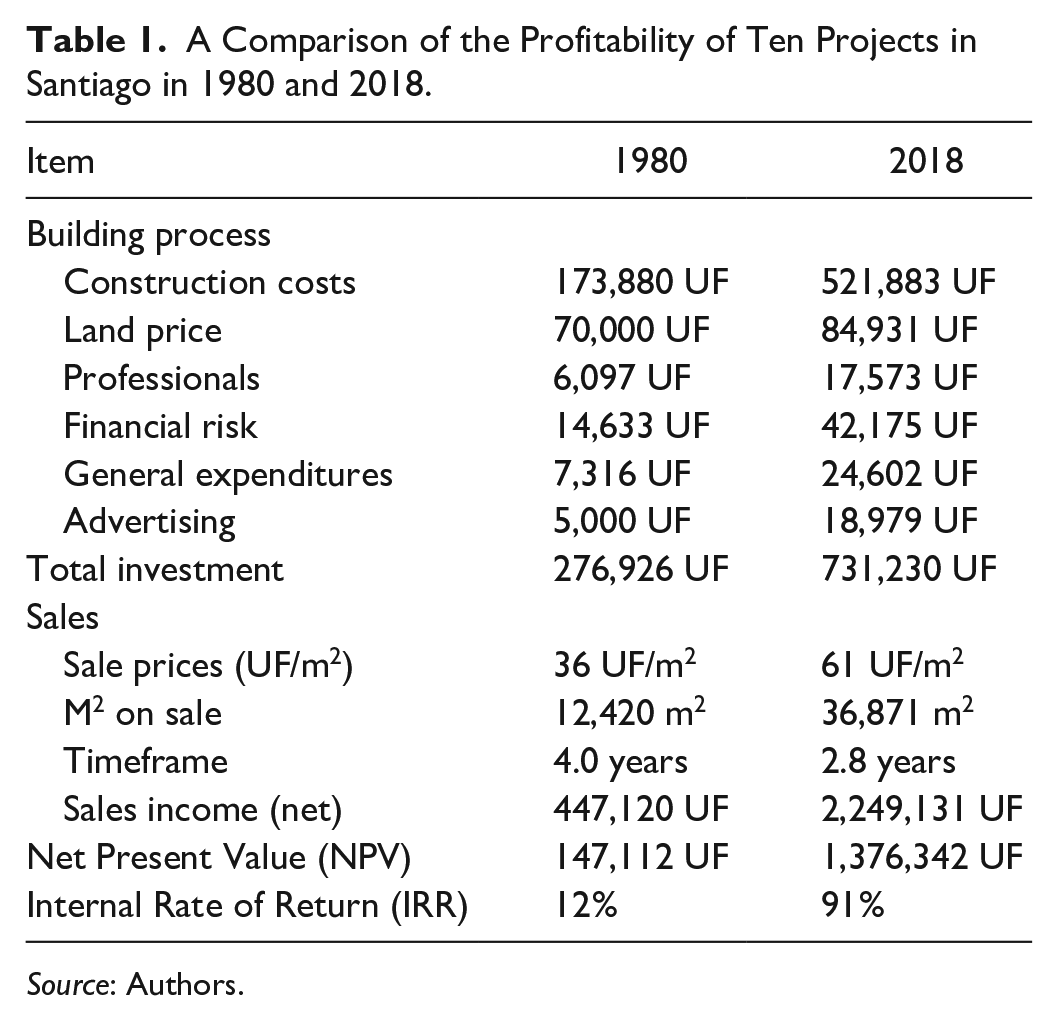
Upon closer review of the data, the change in the profitability of projects illustrates the influence of neoliberal urbanisms on housing prices. The following study compared the IRR of ten housing projects in 1980 with ten housing projects assessed and sold in 2018. The projects were in the same location and of similar size. Table 1 summarizes the results, presenting the significant profitability differences in the housing projects between 1980 and 2018 (values estimated in UF 2 ). When considering housing as a financial asset with an exchange value that surpasses its use value, the profitability of the production of a space becomes the main factor in deciding how to design and build cities.
A Comparison of the Profitability of Ten Projects in Santiago in 1980 and 2018.
Source: Authors.
Based on these economic requirements and changes in housing projects, imagination and creativity were both constrained by the rule of the IRR to ensure that the production of urban spaces was highly profitable over time. The urban space was treated by developers and investors as a financial asset where the investment risk should be reduced to the minimum to ensure the long-term income ratio of urban developments. In this case, designing innovative projects or thinking beyond the rules governing secure investments would not be desirable for the success of neoliberal urbanisms. This economistic understanding of the neglected value of urban design undermines the skills of urban practitioners, resulting in housing projects that adopt the serial production rationale instead of becoming unique explorations of urban development.
For example, Milton Friedman ([1962] 2002) criticized the monotonous spaces in East Berlin, calling them a consequence of central state planning and socialism. Friedman argued that, in a free-market economy, design and creativity should thrive because of the freedom of professionals and buyers (Vergara-Perucich 2017). The profit-oriented rationale of urban practices under neoliberalism oversimplifies the complexities of the city to control its development and address the expectations of investors, and results are as monotonous as those produced by centralized urban design as present in the Soviet Union housing developments.
There is an unequal relationship between urban investors and their clients (the city as a whole). Instead, the ethos of urban practitioners changed significantly to fit the neoliberal urbanism scenario. This change implied an urban design approach that aimed to define efficient methods for extracting value from urban life at a time when generic and low-risk designs emerged to secure the profitability of investments (Figure 3). The serial production drew on an industrialized interpretation of the international style, using simple lines with square compositions, no ornaments, wide rectangular windows, squared balconies, and the liberation of the first level for common uses. This oversimplification voided and de-theorized the design while also culturally infusing it with an economistic understanding of social relations.
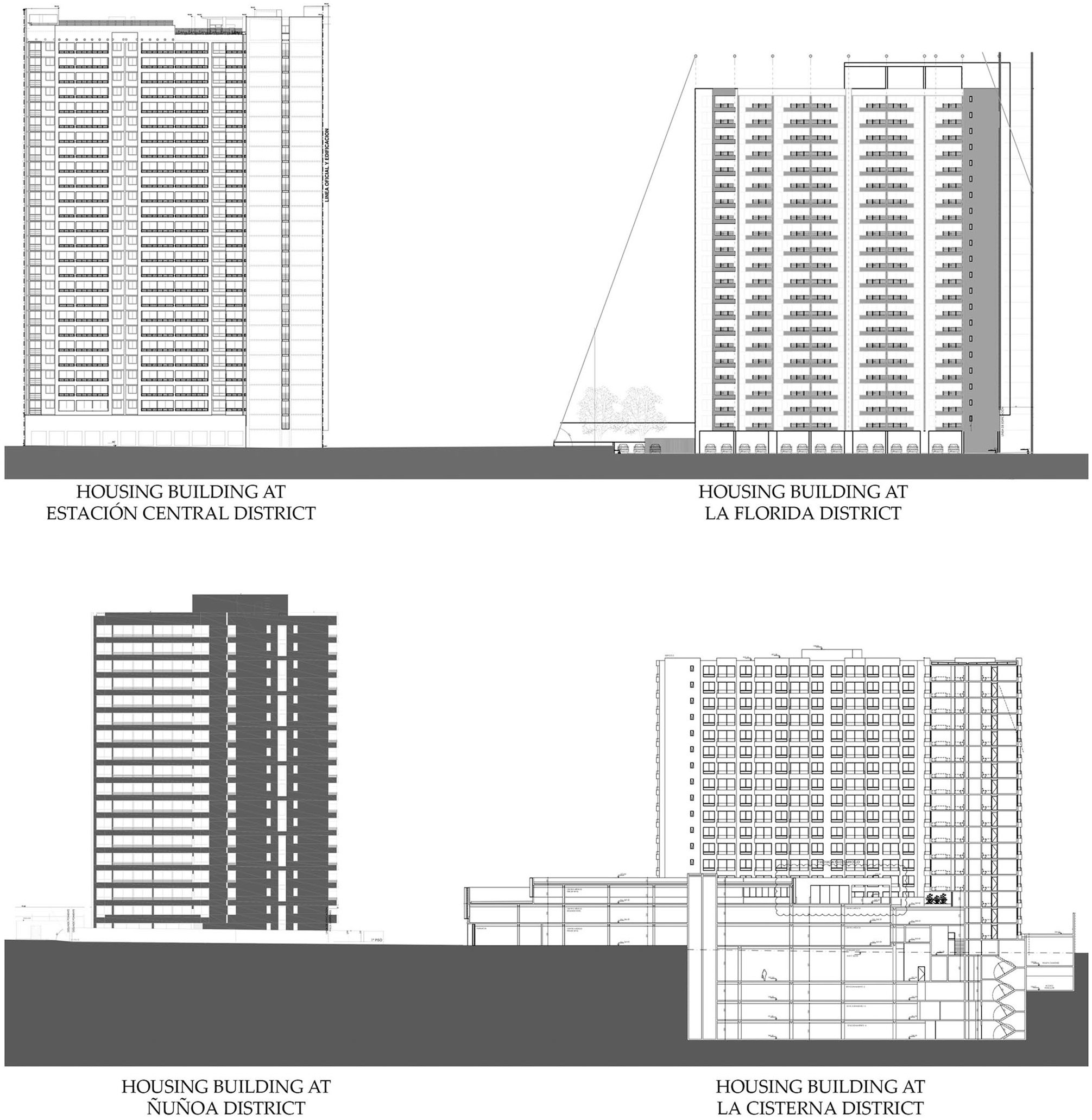
Selection of façades of buildings in Santiago.
Urban design practice involves reproducing standardized aesthetic proposals that ensure the efficiency of capital investments because the design proposals are based on successful urban product models that have already been sold by developers in the market. The creativity of the urban practices during neoliberalism in Chile has created a new aesthetic based on the repetition of successful housing typologies (Cattaneo Pineda 2011; Vergara 2017), representing the absorption of design skills by the rule exchange value to profit from the most elemental aspect of urban life: people’s relationships and their homes.
Urban practitioners working on neoliberal societies developed a particular aesthetic for housing projects using a twisted interpretation of Mies Van der Rohe’s famous saying: “less is more.” Under neoliberal urbanisms, this phrase indicates that lower costs mean greater earnings. This model of housing design influences the use of economies of scale for urban projects (Cociña 2016) through the replication of an existing design of a successful urban product throughout a city with only slight differences. This strategy reduces the design time required and thus increases revenue. Urban practitioners used this strategy to populate cities around Chile with a series of generic architectural typologies (Figure 4), which are efficient as commodities that ensure revenue through their commercialization but weak with regard to their creativity and not at all innovative.
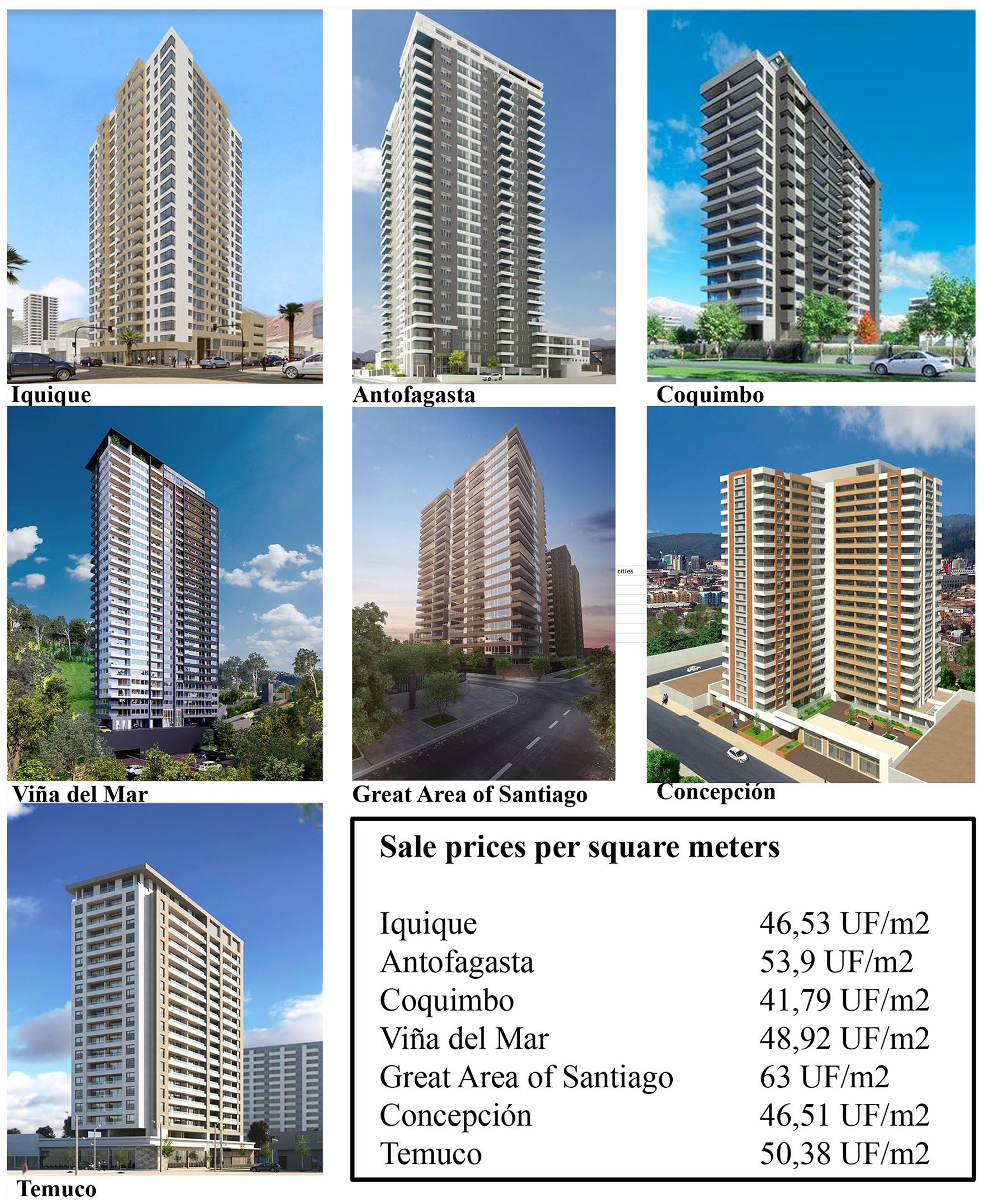
Selection of images of real estate development projects for construction in cities in Chile.
Figure 4 shows how housing production may vary in terms of pricing (recalling the monopolistic condition of location) but not much in terms of aesthetics. The urban practitioners followed a similar rationale for these projects using certain market guidelines. As a result, buildings in Iquique and Antofagasta (in the middle of Atacama Desert) will have similar typologies to those in Temuco and Concepción (near rain forest areas).
At the core of the contradiction for urban practitioners is the commercial condition of the urban product, that is, housing. Urban practitioners must fulfill the market demand by adapting their designs to the rule of profit. Thus, urban practitioners produce a commodity by extracting value from urban life. This product incorporates (1) the practices of the urban practitioners in developing the product and (2) the objective of the investors, which is to ensure the profitability of the urban product to sustain a long-term income scheme from the property tenure and urban capital accumulation. Therefore, the urban product fulfills two trajectories (Figure 5).
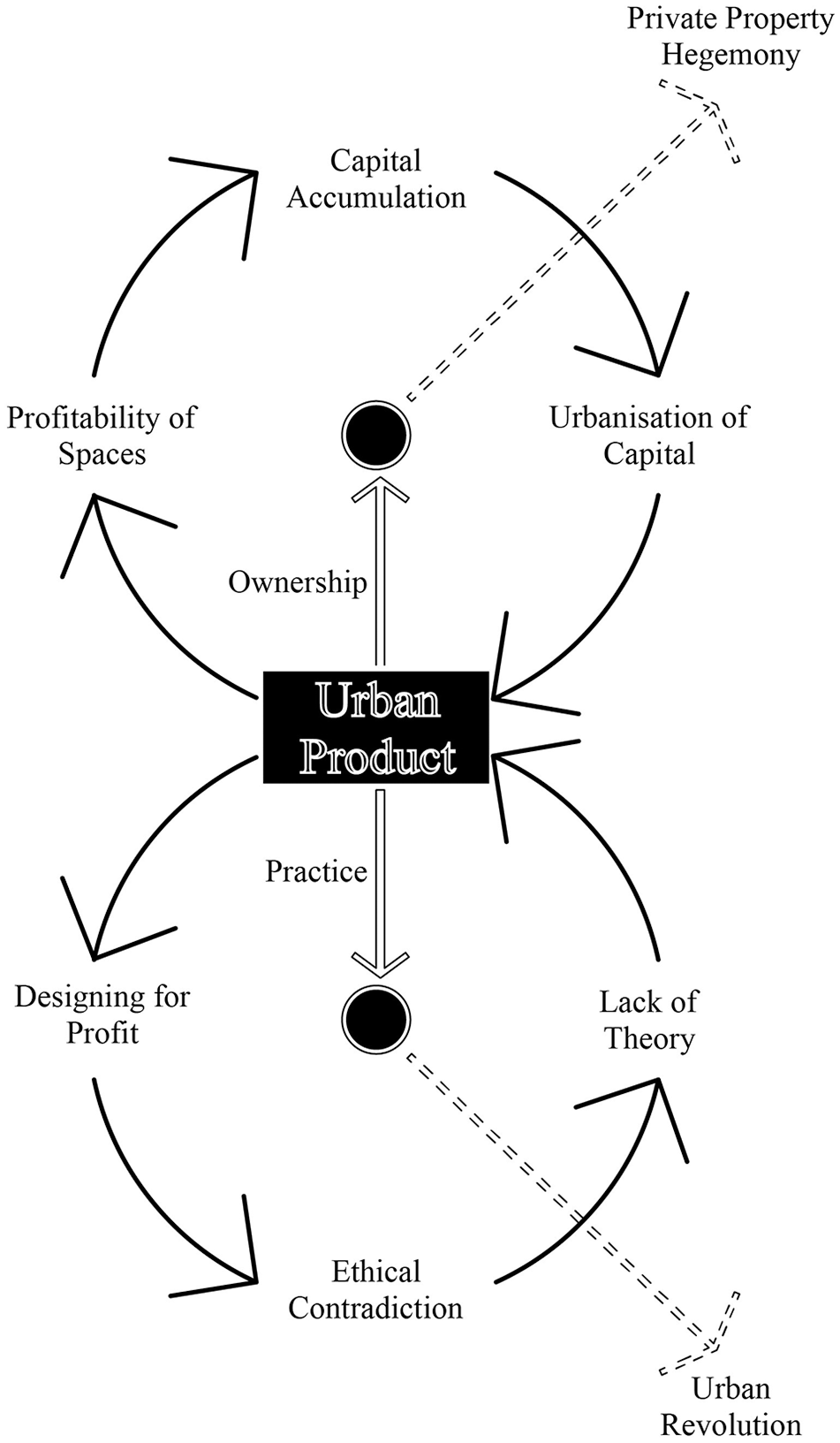
A summary of the cycle of the contradiction in the ethos of urban practitioners under neoliberalism.
At the core of the contradiction for urban practitioners is the commercial condition of the urban product, that is, housing. Urban practitioners must fulfill the market demand by adapting their designs to the rule of profit. Thus, urban practitioners produce a commodity by extracting value from urban life. This product incorporates (1) the practices of the urban practitioners in developing the product and (2) the objective of the investors, which is to ensure the profitability of the urban product to sustain a long-term income scheme from the property tenure and urban capital accumulation. Therefore, the urban product fulfills two trajectories (Figure 5). We understand the urban product as city parts ready to sell and elaborated to get profit from urban relations. The urban product is the outcome of urban design practice.
For investors, the urban product offers the possibility to transform a space into wealth by profiting from its production and enabling the process of capital accumulation through urban development. For urban practitioners, the urban product requires a design strategy that ensures the maximum profitability of the spatial transformations. This leads to a fundamental contradiction for urban practitioners because their ethical commitment to developing good cities clash with the neoliberal urbanism goal of increasing the profitability of spaces. It is an inevitable trap. Investors may not view all decisions that urban practitioners make for the sake of good cities as profitable, and these investors will most likely prefer to avoid risks and use previously profitable typologies. This leads to a sort of tacit aesthetical collusion whereby a new project adopts the spatial typologies and commercial rationale of nearby projects, thus generating a monotonous design, neglecting creativity and ignoring the relevance of the space in building a common idea of a city as a cultural representation of the society that inhabits it.
The pursuit of profit involves different methods and goals than the development of good urban design projects. Figure 5 presents two segmented arrows pointing in different directions. These arrows are indicative of two new potential futures: one is the total consolidation of the hegemonic class in controlling urban design by owning the space and the final success of the urban design field under neoliberalism. The other is a revolution from inside against this rationale by urban practitioners who realize their subjugation to the rules of profit and redefine their ethos toward an emancipatory practice, combating the contradiction and embracing the Ash Amin’s idea of a good city. The latter scenario would require imagining a post-neoliberal disciplinary approach to urban practices that would also require recommitting the value of utopian thinking in offering the societies of different cities a de-neoliberalized and humanized approach that represents the pursuit of a renewed ethos of urban design.
Conclusion: Urban Design under Neoliberalism
This article reflects on the relationships between urban practitioners and neoliberal urbanisms by studying the case of Chile, where housing is the most visible product of the interaction between urban design practices and neoliberal urban policy, to fuel a necessary debate on how to replace neoliberal urbanisms with another approach to developing cities. The novel coronavirus 2019 pandemic has made visible how inequality under neoliberal urbanisms became a key sanitary factor (Rose-Redwood et al. 2020; Standring and Davies 2020). This situation is quite critical in cities, such as Santiago, where low-income districts are more prone to coronavirus-related deaths than high-income districts (Vergara-Perucich et al. 2020).
To rethink the future of urban design practices, we believe that it is vital to outline how the neoliberal ideology created stressors in the ethos of urban practitioners to clarify the specific factors that triggered that stress. Our analysis shows that profit-driven decision-making processes and the state’s role as a business facilitator are the key factors that led to the contradiction that urban practitioners face. Urban practitioners have had to develop practices that fulfill the requirements of profit-driven decision makers, requiring them to assume that urban design and architecture (at least in cities) are no longer focused on what is better for all but on what is better for capitalism.
To broadening the discussion, we attempt to suggest a conceptual register: urban design under neoliberalism. This register incorporates the different reflections presented in this paper somehow showing the contradictions between the original objectives of urban practices and the actual possibilities of producing a better urban space even if under neoliberalism. The current discussions in the literature about the effects of neoliberalism on the urban are unclear on how this ideology transformed the way practitioners’ modes of practices and values designing of spaces and the civic aspect of it. Nevertheless, the mind-set of urban practitioners under neoliberalism remains open to critique, and our characterization of this practice may lead to further research in a more transdisciplinary manner.
We zoomed in the specific Chilean housing production to illustrate our understanding of the problem, and other researchers may use a similar approach to analyze transport planning, environmental policy, zoning, urban governance, and public policy design or explore interesting possibilities that deepen the contradictions in urban practices under neoliberalism. We showed how neoliberalism forces the development of certain decision-making modes and a series of spatial outcomes using designs repeated from previously successful models because of its focus on capital accumulation and profitability demonstrating that formalism compromised to profit.
A collective reflection about the ethical dimensions of urban design is necessary to find ways to help redirect the ethos of urban practitioners from delivering projects that serve private interests to decision making that focuses on the common good, as well as to help rediscover creativity in the process of designing spaces.
One of the seminal contradictions in the Chilean case is that Pinochet’s economic project—not the urban practitioners—led the neoliberalization of urban practices. Thus, authoritarianism and the repression of social forces enabled the development of this situation, but Chile’s democratic governments (1990–2018) did not change this approach to urban design implementation. However, the social movements that started after the events of October 18, 2019 (Mayol 2019), sparked a social demand that is changing the political and economic situation through the pursuit of changes to the constitution and political changes that may also demand a more active role of urban practitioners in producing good cities.
Therefore, a deep reflection on the contradictory nature of Chile’s urban decision environment may begin soon, requiring inputs from other fields, such as politics, economics, sociology, and psychology, to disentangle how the rule of the private property regime and the prioritization of profit commodified the production of urban spaces. To enable their eventual emancipation from neoliberal urbanisms, urban practitioners must confront the private property regime and prioritize the importance of the use value of cities over its monetary valorization. Emancipatory tactics to disentangle what we have called urban design under neoliberalism are urgently needed; otherwise, its subsumption to neoliberalism may be irrevocable.
One of our most concerning conclusions is the realization that, under neoliberalism, financial instruments inform all aspects of the work of urban practitioners better than spatial skills and creativity. Therefore, if nothing changes in the near future, it would not be surprising if urban designers became specialized in financial innovation and design policies to transform spaces into long-term fixed assets with similar financial efficiencies for stock and bond markets. This possible future would represent the final negation of the artistic features of urban design and its total dehumanization.
The possibility of subverting urban design under neoliberalism starts by comprehending its critical reproduction elements and its main contradictions. In this article, we focused on housing, but future students should cover other areas to develop a more concrete theory of the subversion. Our analysis shows that the path toward a future urban design practice that is separated from neoliberalism requires a revolutionary strategy to reveal the potential agency of its praxis as a subversive action for transforming society by changing the process of the production of urban space.
Footnotes
Declaration of Conflicting Interests
The author(s) declared no potential conflicts of interest with respect to the research, authorship, and/or publication of this article.
Funding
The author(s) disclosed receipt of the following financial support for the research, authorship, and/or publication of this article: This research was funded by ANID, grant number FONDECYT 11180569.
