




Abstract
While diversity is considered a condition for just and thriving neighborhoods and cities, planners often face challenges in creating and maintaining such neighborhoods, ensuring they remain inclusive. This article examines the social relationships of an aging ethnic enclave undergoing diversification through influxes of immigrants and young professionals. Field research conducted in Greektown in Baltimore revealed “symbolic relationships” across diverse resident groups that were derived from previous group experiences, cultural heritage, and self-identification. These inter-group symbolic relationships can serve as a foundation for the coexistence of diverse groups of residents and have the potential to foster collaboration among such groups.
Introduction
Diverse Neighborhoods
Planners value racial, ethnic, socioeconomic, and architectural diversity as signs of an inclusive neighborhood and seek to encourage such diversity as a strategy for creating just and thriving neighborhoods and cities (Fainstein 2005; Jacobs 1961). However, diverse neighborhoods create challenges for planners; as Sandercock (2000, 13) stated, “. . . we do share the space on the planet with others who in many ways are not like us, and we need to find ways of coexisting in these spaces . . . ” Planners, policymakers, and community organizations attempt to find these “ways,” but some of the attempts—such as mixed-income housing and dispersal projects—have had mixed results (Briggs 2006; Joseph 2006; Popkin et al. 2000). Just providing spaces for diverse groups of people in a limited geographic area (e.g., a neighborhood) does not guarantee instant and meaningful social interactions. These studies suggest that inclusive and collaborative social relationships are a necessary condition for a diverse environment, which leads to equality and inclusion in the planning process. Therefore, creating and maintaining diverse, just, safe, and thriving neighborhoods remains a challenge for planners, policymakers, and community organizers.
One cause of difficulty in creating diverse neighborhoods with collaborative social relationships is the ambiguous use of terms such as “diversity” and “diverse neighborhood” (Fainstein 2005) and insufficient attention to the existence of multiple, overlapping social groups in neighborhoods. For example, Studies on diversity often focus on racial diversity, particularly relationships between blacks and whites. Although discussions of ethnic diversity may include race, the focus is more often on differences in culture and social norms such as religion, language, social behavior, and housing preferences. In other words, ethnic diversity concerns who belongs to which social and cultural associations and/or networks and whether these networks are inclusive or exclusive. On one hand, generational diversity is a challenge in certain countries and regions where elderly members of the population tend to live in isolated areas due to the exodus of younger generations from rural areas to large cities (Chanpen and John 2006; Congzhi and Jingzhong 2014).
How these multiple forms of diversity influence social relationships must be discussed in the context of neighborhoods that have become increasingly complex demographically and culturally. In particular, this article examines the racial, ethnic, cultural, socioeconomic, and generational aspects that define residents’ identities and group relationships in a neighborhood, how these aspects encourage or discourage interaction with others, and if these relationships can lead to a collaborative and inclusive living environment.
Immigration and Diverse Neighborhoods
Numerous studies have suggested that the number of diverse neighborhoods in the United States is increasing as a result of policy as well as social and economic change (Crul 2016; Maly 2005; Meissner and Vertovec 2015). One explanation for this increase in diverse neighborhoods is a new settlement pattern among immigrants in the United States (Singer 2004). Historically, earlier waves of European immigrants from the late nineteenth century to early twentieth century shaped many major cities in the United States by establishing ethnic enclaves such as Little Italy and Greektown. Notably, such neighborhoods were often homogeneous in terms of race, ethnicity, and socioeconomic status. The ages of residents and the family structures were also similar as the majority of immigrants were working adults when they entered the United States. However, after the promulgation of the Immigration and Nationality Act in 1965, a new pattern of immigrant settlement was documented. While major gateways cities such as Los Angeles and Chicago continue to attract immigrants, some have started to settle in previously non-traditional locales such as smaller cities, suburbs, and rural communities. This occurs due to their diverse socioeconomic status: white-collar immigrants with high educational attainment directly move to suburban neighborhoods and low-waged immigrants to rural areas following the relocation of certain sectors such as food processing industry (Bean and Stevens 2003; Marrow 2005; Singer 2004; Waters and Jiménez 2005).
Many post-industrial cities that suffered population loss for decades, such as Baltimore, Maryland, are seeing a resurgence of immigrants (Singer 2004). 1 With fewer immigrants arriving from Europe after World War II, as well as the “white flight” of second-generation European immigrants, houses in the old ethnic enclaves of inner cities were vacated. New immigrants from Latin American and Asian countries often filled these houses. Accordingly, such post-industrial cities have become diverse with old and new immigrants that vary in their ethnicity, generation, and—in many cases—socioeconomic status.
Young Professionals and Diverse Neighborhoods
While immigrants are moving to a variety of places including former ethnic enclaves, young white-collar Americans are also moving to inner cities. Richard Florida (2002) promoted the concept of the “creative city” and encouraged cities to adopt policies to attract young, highly educated professionals. For example, in Baltimore, then-Mayor Martin O’Malley met with Florida and introduced the Creative Baltimore Initiative in 2004 to attract young professionals (Ponzini and Rossi 2010). Cities’ policy-led efforts to revitalize inner cities and young professionals’ preference for a certain lifestyle, such as a walkable place to live, are bringing young professionals back to city centers (Hyra 2015; Lees 2003; Sturtevant and Jung 2011). These young professionals—sometimes referred to as “gentrifiers”—are attracted by the affordability of the inner city. Moreover, first-time homebuyers consider inner-city homes a good investment. Recent studies have also discussed their preference for unique and authentic neighborhoods; notably, young professionals find that the exotic ethnic “flavor” in established immigrant neighborhoods can provide authentic cultural experiences (Brown-Saracino 2004; Lees, Slater, and Wyly 2008; Zukin 1996). Furthermore, the increasing number of young professionals is resulting in another dimension of inner-city neighborhoods, particularly the old immigrant enclaves.
Contemporary Diverse Neighborhoods
The two phenomena of contemporary immigrants’ new settlement pattern and gentrification have created racially, ethnically, and socioeconomically diverse neighborhoods in inner cities throughout the United States (Maly 2005). While both phenomena are well-discussed in fields that include sociology, ethnic studies, and urban planning, these discussions have not been well-integrated into existing research. Although a few studies have discussed the effects of gentrification on ethnic neighborhoods (Murdie and Teixeira 2011; Zukin 2016), they often treat demographic changes as sequences (e.g., from immigration to gentrification) and do not consider new immigrant influxes that occur simultaneously with gentrification. In reality, the phenomena may not always occur separately and/or sequentially; instead, they may occur simultaneously. Only a few studies have investigated these complex social dynamics, such as Hwang’s (2015) work, which discussed the role of immigrants in the gentrification process. However, for planners who are increasingly required to deal with diversifying neighborhoods, understanding the complex social relationships of diverse groups of people at the neighborhood level is important to successfully shape the future of these neighborhoods as well as cities as a whole.
Social Relationships in Diverse Neighborhoods
This article focuses on the social relationships between diverse groups of people—those who differ racially, ethnically, culturally, socioeconomically, generationally, and in other ways. Through analyzing the case of a rapidly diversifying former ethnic neighborhood in a post-industrial city with groups of new and old immigrants as well as young professionals, this study aims to enhance and add a new perspective to the discussion on social relationships in diverse neighborhoods.
The topic has been considered through multiple theoretical lenses. One avenue of exploration is contact theory, which suggests that the more individuals encounter people who are unlike them, the more they understand and accept them (Allport 1954; Gans 1961). Contact may also diminish intra-group solidarity as members gradually accept other cultures and expand networks beyond their group. Conversely, conflict theory suggests that the more individuals encounter people unlike themselves, the more protective they become, resulting in strengthening intra-group solidarity and increasing distrust of other groups (Alesina and Ferrara 2000; Blumer 1958; Bobo and Hutchings 1996). Putnam challenged both of these theories by arguing that increasing diversity harms inter-group trust as well as intra-group solidarity. He found that many people in diverse neighborhoods had withdrawn from their social lives—or, in his words, “hunkered down”—and described how “[t]rust (even of one’s own race) is lower, altruism and community cooperation rarer, friends fewer” (Putnam 2007, 137). In general, social fragmentation and isolation in diverse neighborhoods have been increasingly discussed in recent work (Bakker and Dekker 2012; Glas, Engbersen, and Snel 2019; Laurence and Bentley 2016; Stolle, Soroka, and Johnston 2008). These contradictory theories have one thing in common: inter- and intra-group relationships closely influence each other, which means intra-group relationships can determine the quantity and quality of inter-group relationships.
In another area of the spectrum of discussion on intra- and inter-group social relationships, social capital has been actively discussed in terms of the strength of such relationships—whether they are tight or loose—and its effect on certain outcomes such as generating more inclusive relationships (Coleman 1988; Lin 1999; Putnam 1995; Warren 1999). The concept of bonding and bridging social capital posits that different types of social networks have different effects on neighborhood communities. “Bonding social capital” means having “ties to people who are like you in some important way” (Putnam 2007, 143), or having strong and intimate relationships by sharing identity and culture with potentially limited groups of people. Conversely, “bridging social capital” is initially weak but spreads to the other groups and comprises “ties to people who are unlike you in some important way” (Putnam 2007, 143). Granovetter (1973) observed that weak ties—relationships with casual acquaintances—can generate more valuable ties than strong and more intimate relationships (such as those between family members) in contexts such as job searches. This suggests that loosely constructed, weak, or casual ties connecting different groups may be more efficient and valuable than tight and often family-based ties in relation to accomplishing certain tasks.
Through the case study, this article explores what kind of social relationships exist in a rapidly diversifying neighborhood and illustrates the nature of those relationships—whether they are confrontational, collaborative, or fragmented. It also analyzes how the strength of social relationships both inter- and intra-group influences the well-being of a neighborhood, with attention to the relationships based on direct interaction as well as those based on emotions, ideologies, identities, and place attachment. Notably, Low (1992) offered the concept of symbolic relationships to explain how social ties influence a sense of attachment to a place. She called attention to “. . . the symbolic relationship formed by people giving culturally shared emotional/affective meanings to a particular space or piece of land that provides the basis for the individual’s and group’s understanding of and relation to the environment” (Low 1992, 165). This article examines how the rapid diversification of a neighborhood by multiple groups that differ in significant ways (e.g., race, class, ethnicity, language, and generation) influences the social relationships across these groups, with particular attention to the role of culturally shared emotional/affective meanings and the possibility of symbolic relationships. These relationships are particularly important in the evolution of former ethnic enclaves to which the original residents have strong attachments to the neighborhoods.
Case
Greektown in Baltimore, Maryland, as an Immigrant Neighborhood
Greektown is a small neighborhood in Baltimore, Maryland. While it has long been known as a Greek immigrant neighborhood, it is now rapidly diversifying with the arrival of multiple groups. Throughout the late nineteenth and early twentieth centuries, Baltimore was an important port for immigrant arrivals, receiving more than 1.2 million immigrants between 1868 and 1914 (Baltimore Immigration Museum n.d.). The city enjoyed a thriving economy and reached a peak population of 949,708 in 1950. However, as with many other industrial cities, Baltimore’s population had declined by more than 30 percent by the 2000s (US Census Bureau 2010), with concentrated poverty, increasing crime, and disinvestment diminishing the tax base (Olson 1997). The city also has a long history of racial and ethnic tensions that often resulted in violence (Pietila 2010). Because of the city’s history, neighborhoods have been defined by race, ethnicity, class, and religion with strong neighborhoods’ identities. Consequently, Baltimore is often called “The City of the Neighborhoods” (Meghan 2017).
Greektown, a Greek immigrant enclave from the early twentieth century, is one of these neighborhoods (St. Nicholas Greek Orthodox Church n.d.). The neighborhood is close to the harbor, where many factories were historically located, and many residents commuted to work by foot in earlier days. Until 1980, Greektown was homogeneous in race and ethnicity, with Greek being the major ethnic group. Recently, the neighborhood has become more diverse due to an influx of immigrants from Latin America. While Greektown had no Hispanic residents in 1960, the 2010 Census indicates that 36 percent of neighborhood residents were Hispanic (Figure 1). Eastern Avenue, the main commercial street once occupied by various Greek business establishments, now has many Latino restaurants side by side (Figure 2).
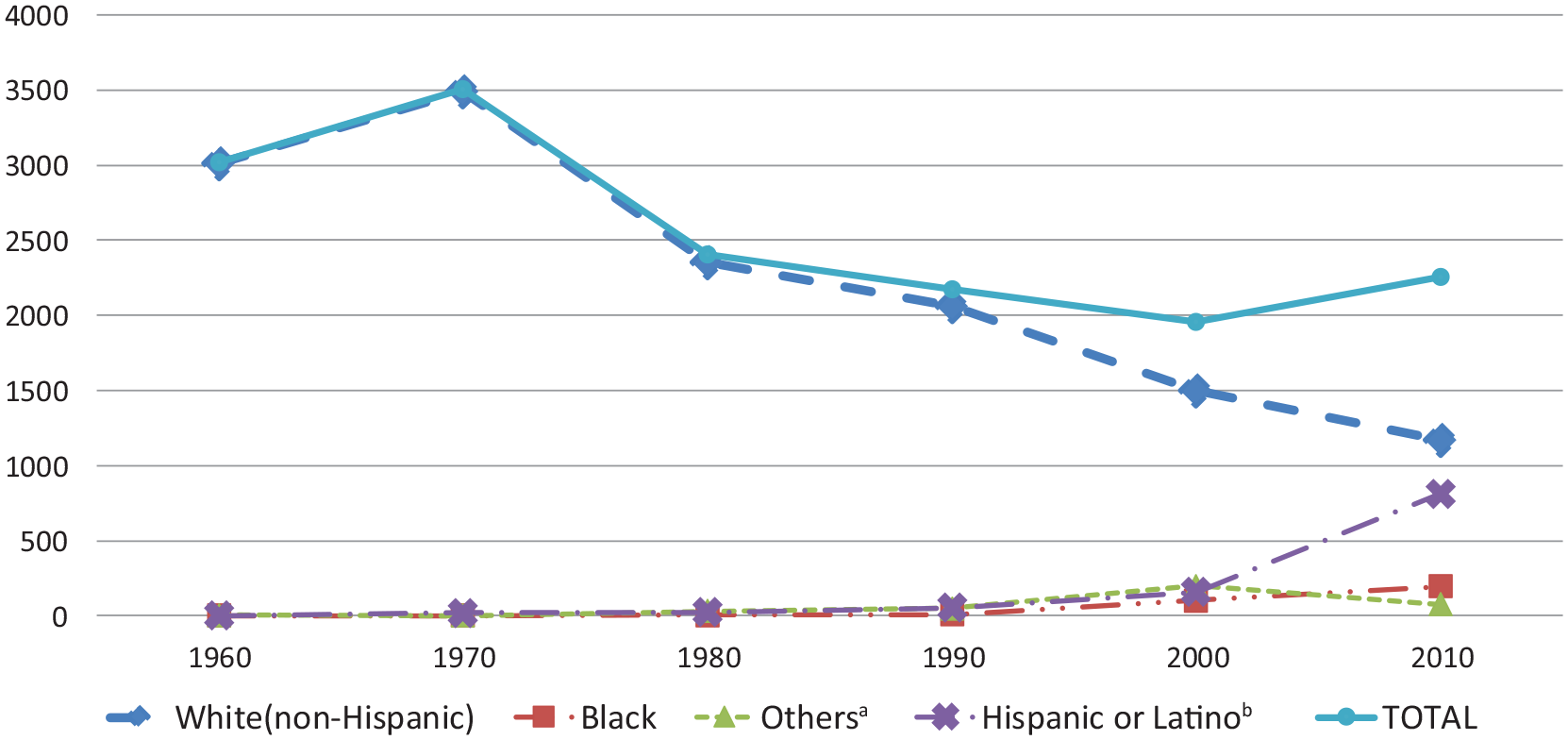
Population change in census tract 2607 (Greektown).
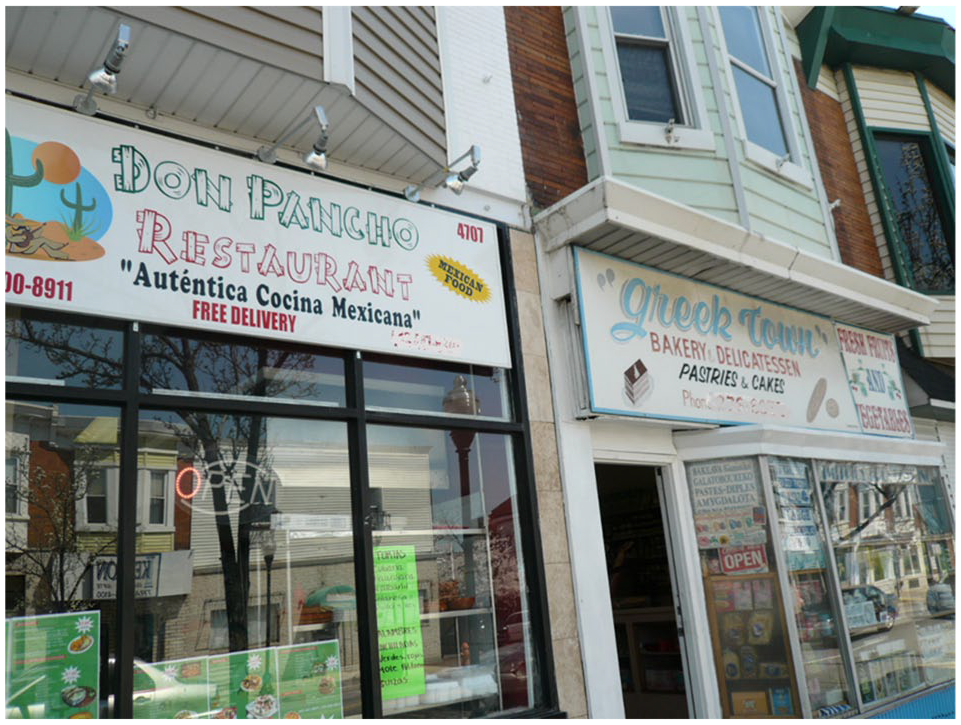
Main commercial street in Greektown, Baltimore, Maryland.
While immigrants continue to settle, the neighborhood has also seen the arrival of young, higher income residents in an old section of Greektown as well as in newly built, market-priced residential units on former industrial sites along the neighborhood’s southern edge. Notably, this provides the neighborhood with socioeconomic and generational diversity. As such, the influx of both immigrants and young professionals has made Greektown diverse in many ways.
Method
To comprehend the complex social dynamics of the Greektown neighborhood, ethnographic research was conducted from 2013 to 2015. Ethnography has a rich tradition of investigating social dynamics in cities and neighborhoods. It involves techniques such as participant observation and interviews, which are suited to investigating complex social dynamics (Agar 1996; Creswell 2007). In the case of Greektown, three groups—Greeks, Latinos, and young professionals—live in a small neighborhood, which inevitably makes them aware of the other groups, resulting in social relationships that take many forms. Ethnography is particularly well-suited for capturing residents’ daily lives in such a diverse neighborhood and for understanding their perceptions of other residents.
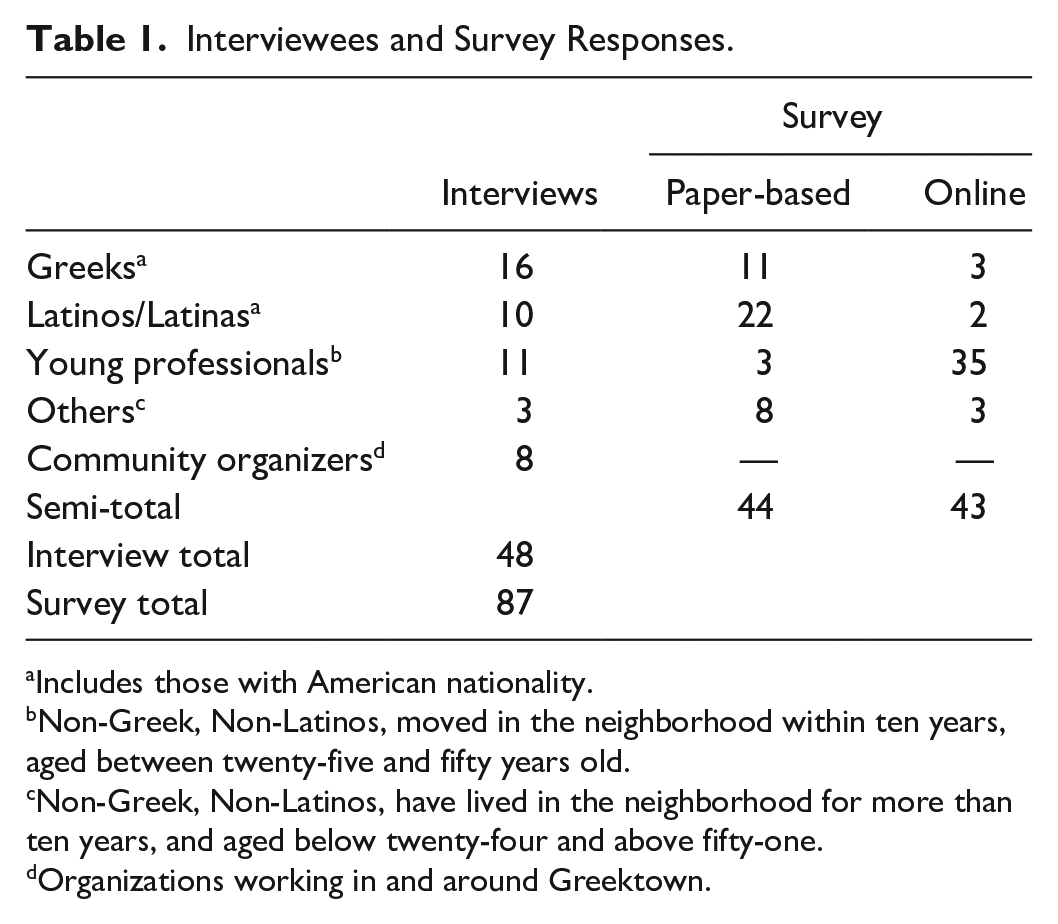
A total of forty-eight semi-structured and in-depth interviews (ranging from one to two hours in length) were conducted in-person, except the one over the phone, with members of the three groups: Greeks, Latinos, and young professionals. Interviews were also conducted with supporting organizations such as religious institutions and grassroots community organizations (see Table 1). Most interviews were conducted in English, while three interviews with Latino immigrants were performed with Spanish–English interpreters. The interviewees were first introduced by their support organizations, and then snowball sampling was employed thereafter. The interview questions investigated participants’ motivations for living in Greektown; their networks within and outside various groups in the neighborhood; the cultural and social values of their family, friends, and neighbors; and their attitudes toward housing and neighborhoods. The questions highlighted a sense of place attachment and intra-group cultural values that manifest in their daily behavior with neighbors. This also sheds light on the social capital that residents possess, including on whom they rely, with whom they communicate within and outside of the neighborhood, and how frequently they do so. Moreover, the interview questions sought to identify and examine the types of social relationships that exist in the diverse neighborhood—whether they were bonding, bridging, or another type.
Interviewees and Survey Responses.
Includes those with American nationality.
Non-Greek, Non-Latinos, moved in the neighborhood within ten years, aged between twenty-five and fifty years old.
Non-Greek, Non-Latinos, have lived in the neighborhood for more than ten years, and aged below twenty-four and above fifty-one.
Organizations working in and around Greektown.
During the fieldwork, a total of forty-five formal and informal community meetings, as well as various community events (e.g., monthly street clean-ups) were observed. In addition, informal conversations with owners and customers at Greek and Hispanic restaurants and retail establishments in the neighborhood were documented. Those data were transcribed and inductively coded and categorized to determine the following: (1) how neighborhood residents interact with people both within and outside of their groups, (2) the types of relationships that exist, (3) common themes among the residents that suggest the potential for mutual understanding and collaboration among groups, and (4) contradictory themes that could represent obstacles to residents building social relationships with members of other groups.
To supplement the fieldwork, a three-page survey in English and Spanish was distributed both on paper and online for residents to fill out (total responses: eighty-seven). The survey included questions that were asked in previous interviews and provided ample space for respondents to leave comments. The link to the online survey was circulated through the local community organization’s email list and via social networking services such as Facebook and Nextdoor. The paper-based surveys were handed out at local community events such as an outdoor movie showing and monthly community meetings.
These multiple tools—interview, in-person and online survey, and observation—were applied to ask questions that holistically captured social dynamics in this diverse neighborhood. As shown in Table 1, the number of responses to the interview request and both survey types varied by group. Young professionals overwhelmingly preferred the online survey while Latinos preferred the paper-based survey, particularly during local events where trusted community organizers were present and encouraged their participation. On the contrary, Greeks preferred in-person interviews over surveys. In summary, the way members of the groups responded to outsider’s requests are varied, and the research had to accommodate these differences.
During the fieldwork, the author identified herself to residents and organizations as a researcher studying the neighborhood as an outsider. The author did not live in the neighborhood and did not identify as Greek, Hispanic, or white. An outside stance may enable a researcher to see a neighborhood objectively and note things that are not necessarily apparent to its residents. In this study, members of the Greek, Hispanic, and white groups regarded the author as neutral and spoke openly about their own groups and their perceptions of other groups.
Group Solidarity and Internal Diversity
Using data from the interviews, observations, and surveys as a foundation to investigate social relationships, this section illustrates each group’s history of settlement and their motivations for living in Greektown in Baltimore, Maryland. Factors considered include the identity of members, what their social lives within their groups are like, and how they see the rapidly changing neighborhood.
Greeks
Over the past hundred years, the Greek community in Baltimore has experienced both growth and decline. The history of Greektown, similar to that of other European immigrant enclaves, is partially tied to the economic conditions of Greece. As the manufacturing industry in the United States grew from the late nineteenth century to the early twentieth century, many Greeks—mostly peasants—left the country and immigrated to Baltimore to work in shipyards and steel mills (Saloutos 1995). Even after Immigration Act of 1924 was passed, the Greek community in Baltimore slowly but steadily grew through the 1960s due to an economic depression in Greece.
After the 1970s, however, the Greek population in Baltimore began to decline (see Figure 1), possibly due to an exodus of the younger generation. Many Greektown residents confirmed this in interviews, with one resident stating that moving out was “perceived as ‘making it’ socially by buying a bigger single-family house in the suburbs.” Simultaneously, a minuscule number of immigrants has recently arrived from Greece to escape the 2009 debt crisis; however, their numbers have not compensated for the recent population loss in the community (Chrysopoulos 2016; St. Nicholas Greek Orthodox Church n.d.). According to Greektown residents, those recent Greek immigrants could refresh the memory of Greece among members of the community and bring new information about the current conditions in the country.
However, the majority of the remaining Greek-origin residents are seniors who own homes and want to remain in a familiar place that allows them to walk to Saint Nicholas Greek Orthodox Church (hereafter St. Nicholas), which is their place of worship as well as the center of their social lives. Suburban Greeks (members of younger generations) regularly visit Greektown when dropping their children off at the Greek school attached to St. Nicholas (which offers after-school programs), when attending events such as Greek festivals, or when dining at familiar Greek restaurants. Greektown is a physical home for the Greeks remaining in the neighborhood and remains a symbolic home to those living in the suburbs. As a result, they maintain a strong attachment to the place as well as group solidarity.
Latinos
As Figure 1 suggests, the increasing Latino population in Greektown has helped maintain the total number of residents in Greektown since 2000, which has also been the case in many ethnic enclave neighborhoods in other cities (Alba et al. 1995; Maly 2005; Suro 1998). In Baltimore, several Latino interviewees mentioned that they were attracted to Baltimore for its low living costs, the availability of entry-level jobs, and local pro-immigrant policies. 2 In addition, there are organizations located in nearby neighborhoods that provide health care and legal and language support for Latino immigrants in Baltimore, as well as Catholic churches that offer services in Spanish. Once a small number of Latinos had moved to Baltimore, their relatives and friends were drawn to the city. For example, Maria from Mexico first came to Baltimore to visit her sister. Although she had initially intended to stay there temporarily, she remained in Greektown, found a housekeeping job, and now lives with three other Mexican immigrants in an apartment rented from a Greek owner. Greektown is close to her workplace and the people with whom she socializes.
The growing Latino population in Baltimore is heterogeneous in terms of country of origin and immigration stage, ranging from individuals who have just arrived to second-generation immigrants from other cities in the United States. Therefore, differences exist in terms of English proficiency, socioeconomic status, the dialect of Spanish spoken, and cultural heritage (including culinary). However, in Greektown and the adjacent neighborhoods, there is no dominant Latino sub-group by numbers. Mexicans are the largest Latino group (e.g., 38% of all Latinos in Census tract 2607), followed by considerable numbers of Salvadorians and Ecuadorians (US Census Bureau. 2010). As social organizations and their products and services—including newspapers, legal services, language classes, and religious services—are not meant for nationals of specific countries but rather for all Spanish speakers, Latino interviewees often mentioned feeling as though they were a part of the larger Spanish-speaking community in Baltimore. A Peruvian local news reporter stated, “We are still small and relatively new, so we cannot afford to make differences among us.”
The Latino residents also include domestic migrants with Latino heritage, such as second-generation Dominican Americans from New York. These “veteran” Latinos often operate businesses that support new immigrant settlements, such as real estate and insurance businesses. Despite their different experiences and roles in the neighborhood, both newly arrived and second-generation Latino immigrants maintain strong connections to the Spanish-speaking community through business, social, and religious organizations. At the same time, their attachment to the neighborhood is fluid for many reasons, in addition to their short history with the neighborhood. Many participants expressed the hope of one day moving to a large single-family house with a backyard, where they can live with their family members in a location that does not have to be Greektown. In addition, support organizations such as business associations and Spanish-speaking churches are often located outside Greektown. For many new arrivals, settling into Greektown is considered the first step, while for “veteran” second-generation Latinos, the neighborhood provides good business/employment opportunities to support new arrivals; although there are individual’s differences based on nationalities, length of stay, and socioeconomic status, they are dependent upon and well-connected to each other.
Young Professional Newcomers
Over the past ten years or so, Greektown has attracted another group of new residents—relatively young and higher income residents. Some bought or rented row houses in the old part of the neighborhood and can be considered “pioneer” gentrifiers (Lees, Slater, and Wyly 2008). These residents are attracted by Greektown’s proximity to downtown, relatively low crime rate, and (most importantly) affordable prices. Some are artists, same-sex couples, and entrepreneurs, and they often prefer to renovate an old house than buy a new house. Recently, in response to the continued influx of these pioneers, private developers began converting former industrial sites into residential units on the southern edge of Greektown to accommodate this group of young professionals. Unlike the existing older row houses, these new houses have designated garages and are larger and more expensive 3 than those in other parts of the neighborhood. 4 Many people living in this section were highly educated young professionals, and a large proportion of those the author encountered were medical professionals as Greektown is located within walking distance of the Johns Hopkins Bayview Campus Hospital. As part of their efforts to revitalize the city center, Johns Hopkins and the City of Baltimore created incentives for employees purchasing homes in the city, which has motivated young people to buy houses in Greektown and nearby neighborhoods. 5 For many buyers in the new developments, their house is their first large investment.
Two types of gentrifiers are often discussed in terms of the sequence in which they move to a neighborhood; pioneers settle first in the neighborhood and are then followed by a more affluent group that eventually takes over and becomes the dominant group in the neighborhood (Glass 1964). In Greektown, however, the development of adjacent former industrial sites occurred while the old part of the neighborhood housed the pioneers, so the two groups of young professionals existed simultaneously instead of sequentially. Notably, these two groups of young professionals have many similarities; the majority are highly educated with white-collar jobs, relatively young, and well-connected through technology such as social network services. Moreover, some racial, ethnic, and sexual minorities are included in both groups—albeit in small numbers. Social relationships exist across the two sub-groups, and they often act together (e.g., hosting neighborhood events and fundraising for tree planting). Therefore, this article discusses young professionals as a single group while noting the diversity among young professionals in terms of housing tenure, length of residence in the neighborhood, race, ethnicity, and sexual orientation, among other factors.
As previously described, each of the three groups (based on ethnic and socioeconomic identification) demonstrated differences in the following factors: motivations for living in Greektown; housing tenure; length of stay in Greektown and the United States; income; educational attainment; and life stages, including age, family composition, and inherited culture (including religion, language, food preference, and other cultural aspects). At the same time, the fieldwork identified diversity within these groups, such as generational variety among Greeks, a variety of immigration stages (e.g., first- and second-generation) among Latinos, and different types of gentrifiers (e.g., pioneer and new building) among young professionals. Thus, while the members of each group are relatively well-connected, there is far more complexity in race, ethnicity, socioeconomic status, and generation within each group in this neighborhood.
Intra-group Relationships and the Necessity for Good Neighbors
While internal diversity exists within each group, the survey results confirm relatively frequent intra-group interactions compared with inter-group interactions (Table 2). Greeks have long-time Greek neighbors and a strong religious community at St. Nicholas with whom they interact. Moreover, they have frequent interactions with family members who are younger and often more educated and may live in the suburbs. Latinos are similarly well-connected to other Latinos through local Catholic churches, Latino organizations, and family and friends in other Baltimore neighborhoods as well in their home countries. According to the interviewees, young professionals often go out with their colleagues, college friends, and others with similar interests. For all three groups, members’ social networks are not tied to their neighborhood’s geographic boundaries; rather, they extend beyond the neighborhood and sometimes beyond the city, region, and country. Members of one group do not have to rely on the members of other groups in the neighborhood as their social needs are satisfied without inter-group interaction. As a result, the desire to have “good neighbors” in different groups seems to be diminishing in Greektown.
Interaction with Each Group.
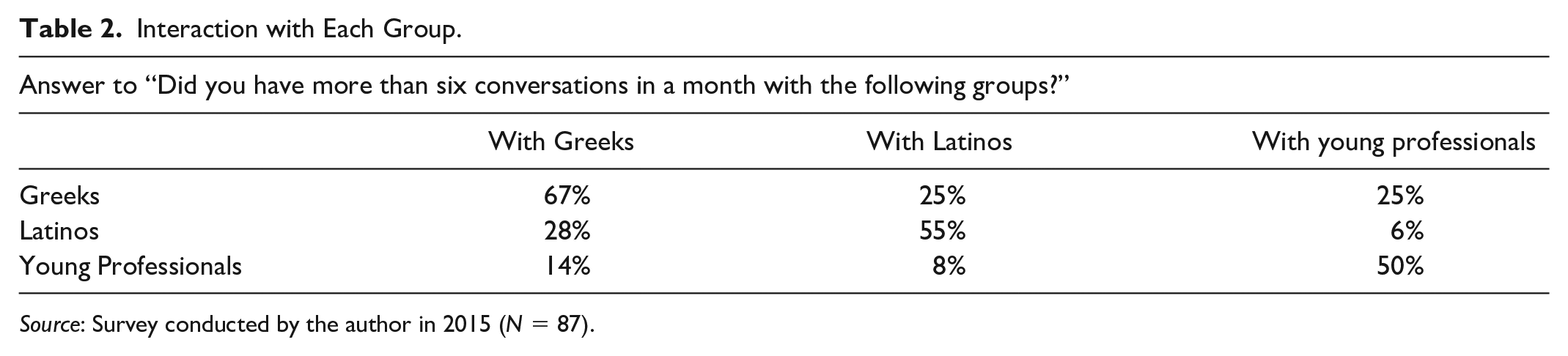
Source: Survey conducted by the author in 2015 (N = 87).
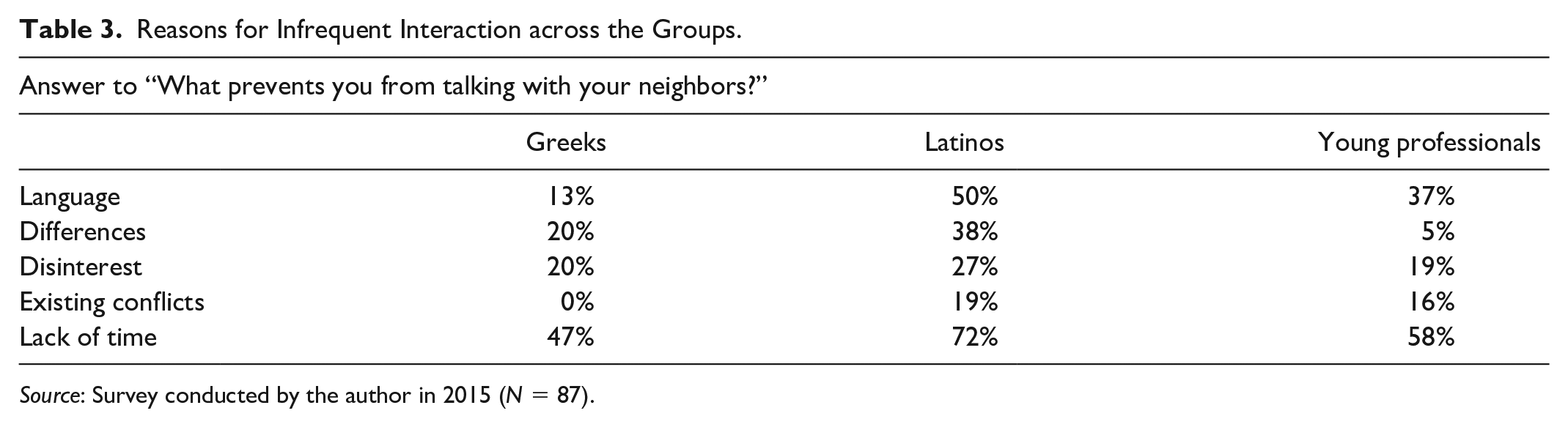
The survey further asked about the reasons for this diminishing need for interaction with neighbors in different groups. The results reveal that the residents’ primary explanation for infrequent interaction was their “lack of time” (Table 3). All groups largely denied differences between, disinterest in, or existing conflicts with other groups as causes for this situation. Moreover, among Latinos, many of whom are immigrants from Spanish-speaking countries, only half identify language as an obstacle. This finding can be interpreted as implying that the conventionally categorized differences among the groups (e.g., ethnicity or socioeconomic status) may be blurred by the groups’ internal diversity. Highly educated second-generation Latino immigrants perceived little difference between themselves and young professionals in terms of socioeconomic status while newly arrived Greek immigrants observed similarities with Latino immigrants in that they are both non-native English speakers who recently landed in a new environment. One young professional noted that there are translation apps for phones to enable communication with people speaking different languages. Therefore, they do not believe that differences in ethnicity, socioeconomic status, and language are clear barriers to communicating with—or significant sources of conflict with—other groups. On the contrary, “lack of time” may explain why interaction with members of other groups is a low priority in residents’ daily lives. They are already satisfied with their social lives centered within their own group due to strong intra-group social connections.
Reasons for Infrequent Interaction across the Groups.
Source: Survey conducted by the author in 2015 (N = 87).
Inter-group Relationships
Economic Relationships and Interdependency
Although the necessity for good neighbors is diminishing, there are beneficial economic relationships that exist, mostly between the two immigrant groups. For Greeks, renting their houses is one way of retaining ownership of their property and generating income without new major investments. One second-generation Greek American explained that, culturally, Greeks see real estate as an important family asset to pass on to the next generation—not as a commodity to trade for financial gain. According to another Greek resident, “Well, Greeks have a unique culture. They don’t want to sell. It is not something we are proud of doing. They want to give it to their kids and then grandkids.” 6 It is understood among this group that homeownership is a mechanism for accumulating intergenerational wealth. However, the emphasis on keeping property in the family and not treating it as a simple financial investment is based on Greeks’ and Greek Americans’ cultural and social practices and has greatly affected the neighborhood by potentially preventing drastic redevelopment. Rather than selling their property, Greeks often rent unoccupied houses to others—an option that is second only to their children living there. Greeks often rent older houses with minimal renovations at low rates to Latino immigrants, who repair and maintain the houses in exchange for lower rent, according to one Latino resident. 7
This practical relationship regarding housing is certainly a sign of positive social relationships, yet some older Greeks further appreciate how young Latino families have injected energy into the neighborhood. One example of this is the Latino-run businesses that have filled vacant retail shops along Eastern Avenue, a main commercial street. Many small Greek-owned businesses have closed and retail space has been left vacant due to the owners’ aging and decreasing clientele. However, as Latino immigrants have moved in, many of these shops have been converted to Latino restaurants and stores. Although members of one group typically do not patronize the other group’s businesses, Latino businesses have filled in vacant spaces on the avenue, thereby revitalizing the streetscape. A first-generation Greek immigrant and owner of a small corner shop since the 1980s said that it was good to see the vacant shops occupied. 8 These visual impacts and economic benefits have generated the subtle acceptance of Latinos by Greeks, despite their social distance.
Identification as Immigrants
At the same time, some Greeks—especially from the older generation—have grieved over the changes occurring in Greektown, recalling the “good old days” when most of their neighbors were Greek families and everybody knew each other. However, this feeling has not led to hostility toward other groups; rather, many Greeks described more nuanced relationships with the new immigrants. While one long-time resident in her seventies—a second-generation Greek—lamented the trash and noise generated by the newly settled residents (she carefully avoided using terms such as Hispanic or Latinos), she softened her tone and acknowledged the possibility that new residents who may be immigrants are not cognizant of the rules and regulations in a new place. She expressed understanding as her parents had gone through the same process. 9
The reason behind the nuanced relationships among neighborhood residents may be residents’ tight affiliation with their own ethnic groups and intra-group diversity. The Greeks in Greektown and the surrounding suburbs have maintained a strong ethnic culture through generations. As many Greek children attend the after-school program at St. Nicholas, the younger generations not only learn Greek language, history, and culture but also make lifelong friends who are of Greek descent. These horizontal networks (within the same generation) and vertical networks (within families across generations) strengthen the Greek community. Consequently, Greeks are aware that they are members of an immigrant family even if they are not immigrants themselves. This inheritance of ethnic identity as a Greek immigrant causes group members to feel that they can relate to newly arrived Latino immigrants. Nicholas, a second-generation Greek resident, stated about Latinos in Greektown: . . . they almost mirror the Greeks in the sense that the men come here to work long hours in manual labor to provide better educational opportunities for their children. It makes sense for this new, emerging immigrant community to feel comfortable in Greektown, being that it provided a similar environment for so many years to Greek immigrants. (Nicholas, a second-generation Greek American, July 2015)
Most of the sympathy and understanding expressed by Greeks was developed not from direct interaction with Latino residents of Greektown but through their knowledge of immigration, which has been passed down within Greek families and communities. The imagined stories of Latinos overlap with narratives heard from family members. Thus, the existence of multiple generations of Greeks and strong intra-group ties have helped foster an understanding of the other groups.
This type of acceptance is an important factor for Latinos living in this neighborhood. Jose, a second-generation Dominican American who moved to Baltimore to open a financial services business said, “Baltimore was a relatively easy city . . . as this city used to be an immigrant city. Baltimore doesn’t forget it.”
10
Carlos, a native of Honduras, moved to Baltimore from South Carolina a couple of years ago with his American wife and newborn baby. While in South Carolina, he experienced hostility against Latino immigrants regarding housing and jobs. The couple decided to move to a Latino-friendly city that would be a better place to raise their multiracial child, and both found jobs in Baltimore. The wife, Jennifer, who was born in Ohio, said, So we lived in South Carolina, and it was not friendly for Latinos at all. We went to New York to visit some people in upstate New York, and cops followed him in the mall. And he’s an educated Latino. Just like us. So I don’t think we would move anyplace where they weren’t open-minded enough to deal with a [our] multiracial kid and somebody who speaks a language other than English because I don’t—like Ohio, muh-uh—I wouldn’t do. [And Greektown] is a really friendly place. Surprisingly so. (Jennifer, the wife of a Latino immigrant, September 2014)
The respondents stated that they did not talk to their neighbors but felt they were friendly based on how people looked at them and by observing how people treated other Latino families. Despite differences regarding ethnicity, arrival time, and socioeconomic status, the two immigrant groups in Greektown have a nuanced understanding of each other.
Socially Minded Young Professionals
In contrast to the two immigrant groups, the majority of the young professionals in Greektown did not perceive themselves as immigrants or members of such a group. Many are more affluent than Latino immigrants and younger than the majority of the Greeks. However, their interest in and support for diversity, although it may be superficial, has generated a subtle acceptance of other groups. They repeatedly stated that they were not just “gentrifiers” or a typical “majority” who displace minorities and low-income residents, as mass media often report. Many expressed concerns over being considered gentrifiers and have tried not to behave insensitively. Leslie, an African American female in her early thirties residing in the new development project, expressed concern about gentrification: I’m a little concerned that the Latino population might be pushed out that’s in the neighborhood, and I don’t think that’s OK. So, [I know] some cities work to try to be more inclusive and try to, like, create mixed neighborhoods.
11
As a former public housing resident and the first college attendee in her family, she censured the process of gentrification and indicated that she supports a diverse neighborhood. She felt that living in a diverse neighborhood was “right,” although she also mentioned that she was too busy to partake in any of the social events in the neighborhood. Another resident, who is a researcher at a local university, expressed interest in community activities but stated, “I’m not in a community [organization] myself because I have been just so busy; not that that’s an excuse, but I’ve been really busy.” 12
These examples reflect the reality that young professionals in Greektown are willing to support the diverse neighborhood in principle; however, this does not always align with their actual interaction with the other groups. This suggests that infrequent interaction among groups does not indicate an unwillingness to interact or lack of interest in communicating. The majority of the young professionals are socially minded young people and some are minorities, with most stating they believe living in a diverse neighborhood is desirable. Despite their lack of interaction with other groups in the neighborhood, the young professionals mainly view other groups in a positive light.
Meaning of Diversity and Symbolic Relationships
The previously described conditions suggest very limited social relationships across the groups in the neighborhood, except for some practical relationships. Members of different groups seem to “hunker down” or not to associate with each other as the need for interaction and collaboration with other groups is not a priority due to strong intra-group relationships. At the same time, there are certain positive perceptions of the other groups.
One reason for this complex social dynamic is the differences that exist among the three groups regarding their views about diversity in their living environment. Members of the two immigrant groups did not seek to live in a diverse neighborhood. Many long-time Greek residents are attached to the neighborhood in which they lived their whole life because it is where they built primary friendships with other Greeks and where they own properties. Instead, diversity occurred through demographic shifts in the neighborhood through the aging of Greek residents and the exodus of second-generation Greeks to the suburbs, both of which have been accepted as inevitable events. Latinos chose the Greektown neighborhood not because of its diversity but because of the availability of affordable housing and the support available from nearby social organizations. For both immigrant groups, diversity is not something that they have proactively sought—it merely exists, and they accept the condition. Thus, while members of both immigrant groups do not seem enthusiastic about inter-group interaction, they are not hostile toward other groups.
On the contrary, many young professionals were attracted to the neighborhood by the chance to “enjoy” diversity, which is not possible in many American suburbs (Sturtevant and Jung 2011). In the interviews, they often expressed interest, understanding, and tolerance toward racially, ethnically, and generationally diverse groups of people. Many expressed familiarity with diverse communities by citing their college and high school experiences with friends from diverse ethnic backgrounds and their participation in international educational programs. These past experiences seem to forge their perception that diversity is a good idea. However, for many young professionals, diversity seems to be merely an attractive amenity of the neighborhood, as the developer’s choice of name for the new housing project—Athene Square—shows that the image of Greece is used as a marketing tool to appeal to young professionals seeking “authenticity.” While diversity connotes images that the young professionals find attractive, it is not something in which they are deeply involved.
Accordingly, the responses from the three groups of Greektown residents indicate that although the majority do not participate in formal social activities with members of other groups (e.g., actively taking part in community meetings), they exhibit some form of mutual acceptance. This acceptance is due to not only tangible economic benefits (e.g., Greeks’ and Latinos’ lessor and lessee relationships) but also intangible benefits such as feeling that new immigrants have injected energy into the neighborhood or feeling “right” about living in a diverse neighborhood. This atmosphere of acceptance is not characteristic of typical social relationships that are based on direct interaction; instead, these relationships are symbolic.
The symbolic relationships emerging from Greektown advances Low’s (1992) version of a symbolic relationship with a particular environment. In this study, symbolic relationships comprise the mental associations that people have with a group, place, institution, or elements of one of these. These associations derive from their previous experiences (e.g., having friends from diverse ethnic backgrounds in college), cultural heritage (e.g., growing up with certain cultural values such as the importance of being religious), self-identification (e.g., identifying as immigrants), and ideological beliefs (e.g., diversity is good and equality is important). Notably, these associations can be either positive or negative. In the positive symbolic relationships identified in this study, members of a group think affirmatively about, feel favorable toward, and/or identify with an entity or element in such a way that they consider themselves connected to people, places, or things that are in some way similar to themselves and are strengthened by the connection. Symbolic relationships can coexist with social relationships and may be derived from or contribute to them. When groups with reciprocal positive symbolic relationships have opportunities for interaction, the symbolic relationships may lead to social relationships. As presented in this case study, residents with positive symbolic relationships can coexist in a neighborhood and collaborate during events or incidents that require cooperation.
The positive symbolic relationships in Greektown can be explained by each group’s strong intra-group relationships. Despite Putnam’s claim that residents of diverse neighborhoods are removed from both intra- and inter-group communities (Putnam 2007), this study reveals that strong intra-group relationships do not always generate inter-group hostility. Rather, strong intra-group relationships based on sharing and inheriting collective memories and experiences can generate positive symbolic relationships with members of other groups. For example, first-generation Greek immigrants told stories of hardship in a new country to successive generations, enabling the Greek community to sympathize with Latino immigrants’ situation without direct interaction with the group. The young professionals share the idea that diversity is a good thing with other new residents and hope to sustain it. These examples demonstrate that while solid intra-group relationships may not always accelerate close social relationships with members of other groups, they can positively cultivate symbolic relationships.
As a basis for deeper social relationships, inter-group symbolic relationships provide a potential impetus for active collaboration when required. These relationships do not necessarily lead to the strong social relationships that planners often favor, such as active and cooperative participation in community meetings and building plans, but they can serve as a foundation for a community culture in which racially, ethnically, and socioeconomically different groups live together peacefully without discrimination, distrust, or exploitation.
Moreover, symbolic relationships foster various types of cooperation, such as individual acts of charity and participation in community activities. The following example demonstrates how symbolic relationships invoke individual acts of charity. At a very small gathering where the attendees were a second-generation Greek, a second-generation Latino social worker, and a few young professionals, we heard from the social worker that children of immigrants from warmer countries who attended the local school needed winter clothes. He noticed children wearing multiple layers of cotton T-shirts during cold weather. Word quickly spread, and members of the Greek community who felt sympathetic toward the newly arrived immigrants and young professionals who felt ethically obligated collected clothes while the Latino community helped to distribute the donated items at a local school and nearby churches.
Another example of how symbolic relationships generate community action involves a young professional who heard about an outdoor movie event in an adjacent gentrified neighborhood and wondered about its viability in Greektown. A second-generation Greek American immediately supported the idea and persuaded the St. Nicholas church to open their courtyard—a place that is typically used by the Greek community exclusively. Young professionals applied for funding and negotiated to rent the necessary equipment while the Latino community welcomed the idea and spread the word among members. On the night of the screening, nearby Greek retailers and restaurants catered Greek food, young professionals brought picnic chairs and wine, and many Latino families came out to enjoy the free event. Although they did not mingle in the courtyard, they all seemed to appreciate the event. This event was possible because positive symbolic relationships existed in Greektown.
Implications for Planning
As migration increases globally, planners in the United States and abroad are increasingly tasked with dealing with diverse neighborhoods. Challenges they face include the rapid transformation of neighborhoods and the accompanying drastic alteration of neighborhood characteristics. Furthermore, tensions between new and long-term residents with different backgrounds often result in the social exclusion of other groups and competition for resources, which can give rise to conflict and violence in the worst-case scenario. However, the case of Greektown demonstrates that the diverse groups in a neighborhood can coexist peacefully and, based on their positive symbolic relationships, engage in cooperation should the need arise. The suggestions that follow are based on the findings of this article and represent key factors that planners should consider to maintain diversity in neighborhoods and encourage residents’ collaborative and active participation in the planning process.
First, to cultivate symbolic relationships, planners can support ethnic and other community organizations as a means of strengthening intra-group relations that can serve as a basis of positive symbolic relationships. These solid intra-group relationships give immigrant populations—particularly vulnerable populations such as recent immigrants, the elderly, and the undocumented—an anchor in society, which is important for stabilizing their lives and creating a foundation that allows them to view other groups positively.
Second, planners should place a greater focus on residents’ motivations for moving into or continuing to live in a neighborhood when formulating plans. As residents’ expectations of a neighborhood differ in terms of how they appreciate diversity, planners must carefully examine the type of diversity, for example, ethnic, socioeconomic, or generational diversity, each group wishes to maintain.
Furthermore, planners should have a clear understanding of what diversity means in a neighborhood. While the conventional categorization of people such as whites, immigrants, low-income, or young/old has a certain rationale, planners must understand that these are not monolithic groups. Internal diversity within groups is often overlooked by planners and members of the groups themselves, as their identity, in the case of Greektown, as Greeks, Latinos, or young professionals is far more recognizable. By recognizing such intra-group diversity, planners can identify and support individuals who can represent their group in relationships with other groups. The internal diversity identified in this study has the potential to connect the groups highlighted here. For example, in Greektown, a small number of young second- and later-generation Greek Americans demonstrated sympathy toward Latino immigrants based on their knowledge of immigration through their family’s experiences. These younger Greeks are also native-born Americans and often have socioeconomically similar backgrounds as the young professionals, with high education levels and professional jobs. Second-generation Latinos, who are often bilingual and understand both American and Latin culture, have the potential to work with other groups while also being able to influence members of their group. Notably, some of these individuals are leaders of Latino organizations, and their words and actions have far-reaching effects. Planners can use the potential of these prospective group representatives and work with them to influence those with no direct interaction with other groups.
As society becomes increasingly fragmented and polarized, engaging in collaborative processes and building consensus among diverse groups are becoming increasingly difficult. This article outlines how planners can identify weak, often invisible, but valuable inter-group symbolic relationships among diverse groups and stimulate them as part of a strategy to create inclusive and potentially collaborative neighborhoods.
Footnotes
Acknowledgements
I would like to thank the anonymous reviewers for providing helpful comments and suggestions. Dr. Howell S. Baum has also given valuable feedback throughout this project. I owe my most sincere thanks to the residents and organizations in Greektown, Baltimore City, who donated their time to this research.
Declaration of Conflicting Interests
The author(s) declared no potential conflicts of interest with respect to the research, authorship, and/or publication of this article.
Funding
The author(s) received no financial support for the research, authorship, and/or publication of this article.
