




Abstract
As the field of planning stretches toward redressing the injustices of past land use patterns through reparative practices, student learning needs to include socio-emotional, as well as technical and intellectual, skill-building. Pedagogy should increase the planner’s ability to recognize systems of oppression and center lived expertise in decision-making processes. Transformational learning theory considers the mechanisms through which place-based learning expands student worldviews through exposure to other ways of knowing. Reflecting on a participatory action course through the analytical lens of transformational learning theory, this paper considers the pedagogical and ethical challenges and opportunities for planning education through collaborative action.
Introduction
Structural racism is built into the fabric of the U.S. land use system (Klosterwill et al. 2020; H. L. Taylor and Hill 2011), and because of the pervasiveness of white supremacist practices, the racial wealth gap continues to widen (Urban Institute 2017) despite civil rights policies (K.-Y. Taylor 2019). To participate in reparative systems change, future planners must employ skills of cultural humility, self-reflection, and power-sharing that center the wisdom of traditionally under-resourced communities to drive regenerative planning themselves (Dodman and Mitlin 2013; Shi et al. 2016; B. B. Wilson 2018). Decentering one’s own expertise is a precondition to co-produced planning (Beier et al. 2017), and a skill best learned by doing, but under the guidance of a teacher who ensures a “first, do no harm” ethic for the partnership and with infrastructure that allows for the sharing of power and resources throughout the collaboration.
Community-engaged teaching can be messy, complex, and unpredictable (Baum 2000; Winkler 2013). Porter (2015) refers to this state of practice as “beautiful messiness” because it “shakes up all our expectations about who is learning what from whom.” This “shake up” of traditional power dynamics between technical and local expertise can be an important part of planning education, because it allows students to test their assumptions about how their technical knowledge can and should be translated and applied, and how their approach to practice might vary depending on the social, environmental, economic, and political contexts in which they find themselves.
Transformational learning theory is an approach to teaching through place-based, experiential coursework that understands disorientation as a precondition to making positive shifts in consciousness. This article reflects on the opportunities and challenges in using applied planning courses to model best practices in collaborative action that center local knowledge and produce mutually beneficial outcomes for students and their community partners. It employs the experience of an applied course titled Ecological Democracy, held in partnership with youth leaders contributing to the community-driven redevelopment of their neighborhood, to consider the utility of transformational learning theory to applied planning pedagogy. Methods used to assess this effort include content analysis of weekly pre/reflections by students and mid- and end-of-semester self-assessments of their progress in each course learning objective, as well as the author’s participatory action research over the multi-year process of supporting this community-driven design processes in an extremely low-income community.
Implications for the field are rooted in an expansion of essential skills in planning pedagogy via two cognitive shifts required to actualize community-driven planning with traditionally underserved partners. First, planning pedagogy would benefit from a shift away from the charity-based lexicon of “service-learning” and toward language that asserts the importance of learning through relationships of mutual respect and power-sharing. Second, planning academia should grapple more directly with its historically explicit and currently tacit alliances with white supremacy before it can participate in reparative practices (Abrams 2017; Bates et al. 2018; Goetz, Williams, and Damiano 2020).
Transformation in Planning Pedagogy
Teaching equity and advocacy planning in a multicultural world is increasingly acknowledged in planning education as a valuable aspect of the formal education process (Botchwey and Umemoto 2020; Lung-Amam et al. 2015). Structural racism manifests in many aspects of planning practice (Bullard and Wright 2018; Lees, Shin, and López-Morales 2015; Lipsitz 2007; Ross and Leigh 2000). We must prepare students to make decisions that enact more just environments (Thomas 2012), which requires that they have a robust understanding of structural racism and their positionality within its manifestations in the built world (Trawalter, Bart-Plange, and Hoffman 2020). Coming to view “themselves (especially the white students) and their experiences as ‘racialized’ in ways they had not otherwise considered” can prep students for transformative learning experiences (Harwood and Zapata 2014; Lung-Amam et al. 2015, 338). Many planning professors are ill-equipped to facilitate constructive conversations that create brave spaces (Arao and Clemens 2013) where our students can talk through their blind spots and develop the emotional capacity and cultural humility (Sweet 2018) required to fully grapple with the implications of systemic inequities in their own work. Students and faculty need to develop skills of co-production, so that they may function as effective partners in collaborative pedagogy where they work with community partners (Campbell and Lassiter 2010). To date, in the planning literature, much of the pedagogical innovation in this arena is described with the verbiage of (critical) service-learning.
“Critical service-learning” is a strain of service-learning concerned with social justice, multiculturalism, and the redistributions of power (Dahms 1994; Densmore 2000; Mitchell 2008; O’Grady 2000; Sletto 2010). But the “service-learning” language itself, albeit pervasive, is inherently problematic because of its historical linkages with the white savior industrial complex (Cole 2012). Although critical service-learning literature draws from ethics of reciprocity and social justice motivations (Jacoby 1996; Kendall 1990; Sigmon 1979; Sletto 2013; Wade 1997; Yorio and Ye 2012), many of these nuances are lost on institutional administrators, on community partners, and on the students themselves. A charity intonation is often employed or at least perceived, reproducing an imbalanced power dynamic and a set of misunderstandings about who is giving and who is receiving knowledge that is harmful to all and prevents the formation of a partnership of mutual respect.
In the literature on planning pedagogy, much more nuanced approaches to power and partnership still use the language of critical service-learning. Planning academic Bjorn Sletto (2013) critiques the service-learning paradigm by introducing the concept of “interlocutors” to break down the binaries that limit new ways of working in these applied courses. Sletto (2010, 411) asserts that to educate reflective planners with effective participatory planning skills, planning pedagogy should prepare students to “adjust their strategies based on a critical understanding of the social contingencies of their knowledge production, which in turn is premised on a critical appreciation of the narratives that shape their identities and positionality.” Sletto sees the “education of self” as the first step in the process of becoming a reflective planner. Sletto (2010, 411) encourages “both teachers and students (to) conceptualize learning as reciprocal and knowledge production as socially contingent,” arguing that such an integrated approach to teaching, learning, and doing . . . helps prepare planners to engage in complex, multicultural planning situations where expert rationalities, theories, and methods are challenged, are rendered irrelevant, or even fuel conflicts and where contested epistemologies, rationalities, and narratives of place and people are routinely injected into the most “rational” of decision-making processes.
Helping students become attuned to the “social contingencies of their knowledge production” is eased by transdisciplinary approaches to student, faculty, partner, and reading make up. Nevertheless, I posit that the language of service-learning holds these pedagogical innovations back from a full paradigm shift. It is time to transform our pedagogical lexicon to match our values and our learning objectives.
Transformational learning is a body of pedagogical theory advocating for processes in education that result in significant change in the ways students understand their identity, culture, and behavior (Mezirow 1978, 1991, 2000). Empirically vetted by sociologist and adult education expert Jack Mezirow in his own work and then by others (Eyler and Giles 1999; Feinstein 2004), this theory asserts that the transformational learning process typically begins with students being exposed to a disorienting “dilemma” that challenges a person’s beliefs about how the world works, and pushes them to expand their worldview to consider new perspectives. In a transformational learning experience, this is then buttressed by a series of non-sequential events including self-examination, a recognition that one’s discontent and the process of transformation are shared, exploration of options for new roles, relationships, and actions, . . . acquiring knowledge and skills for implementing one’s plans, provisionally trying new roles, building competence and self-confidence in new roles and relationships, and a reintegration into one’s life on the basis of conditions dictated by one’s new perspective. (Mezirow 2000, 22, as quoted in Kiely 2005)
Transformational learning often centers on the privileging of local knowledge, so students expand their worldview through other ways of understanding their topic (Feinstein 2004).
Planning academic Richard Kiely (2005) sees transformational learning theory as especially applicable to applied planning classes because it “focuses on how . . . significant learning and behavioral changes often result from the way people make sense of ill-structured problems, critical incidents, and/or ambiguous life events.” Kiely identifies several important emotional aspects of transformational learning, including personalizing, processing, and connecting. He notes that after the disorienting exposure to the particulars of social injustice, students need to recalibrate their emotive base to make meaning out of these experiences.
Personalizing expresses the manner in which an individual student responds to the dissonance they experience. Processing includes problematizing, analyzing, and making attempts to solve social justice issues that emerge through reflective “processes such as journaling, reflection groups, community dialogues, walking, research, and observation.” And finally, connecting is gaining understanding through nonreflective modes of learning, largely done through relationship building activities with community members, peers, and faculty, such as “attending church, completing chores, playing games, sharing food, treating wounds, and sharing stories” (Kiely 2005, 8). Changing one’s mind-set requires both emotional and intellectual learning. Although this learning is not linear, transformational learning theory attempts to make visible the patterns within this learning process, which often oscillate between emotive and intellectual foci within the course of the class experience (Figure 1). Using the example of one such collaborative action course, this article considers the preconditions needed to facilitate mutually beneficial connection between partner and students.
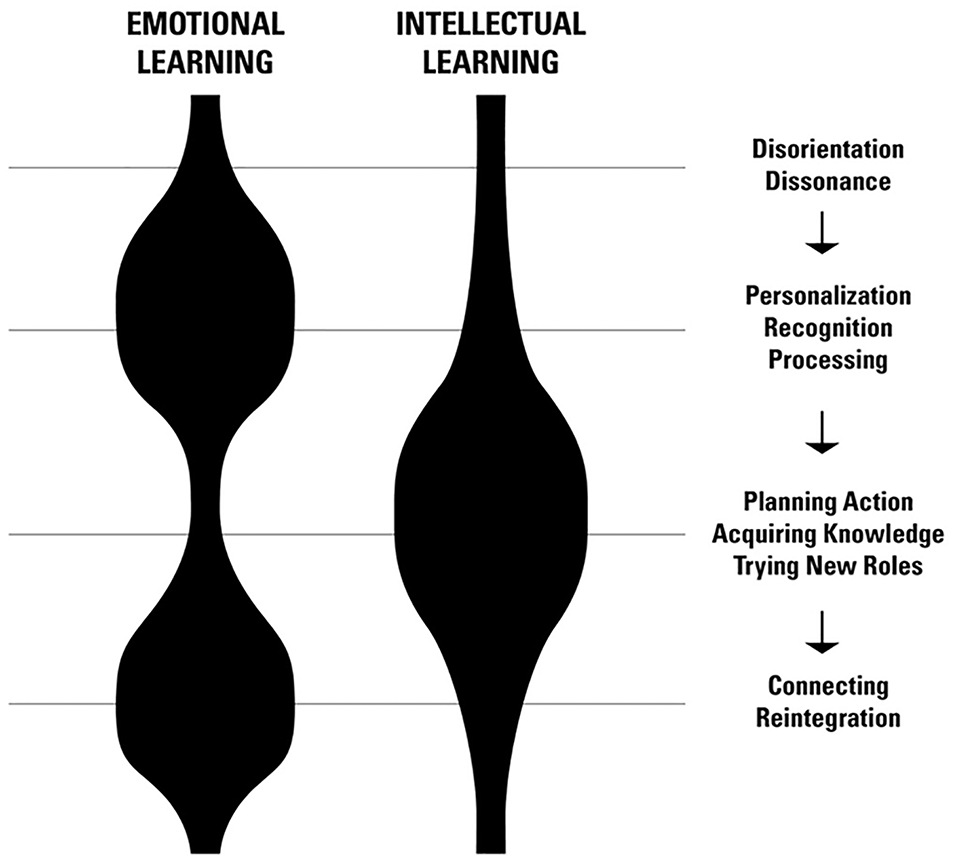
Transformational learning processes (illustrated by Kevan Klosterwill).
Resident-Led Redevelopment at Friendship Court
Friendship Court is home to 150 extremely low-income families in Charlottesville, VA. The housing complex was built on 11.25 acres in the center of town in 1968 as a part of the violent wave of displacements during urban renewal. As the tax credits financing this development came up for renewal, resident leaders worked with the local nonprofit housing partner to identify a resident-led redevelopment strategy to allow for much needed updates to the units without displacing any residents for any period of time. With the knowledge of the painful legacies of harm done to this community by urban renewal and with the additional knowledge that the industry standard for housing redevelopment is the retention of between 30 and 40 percent of original residents (Popkin, Levy, and Buron 2009), the team knew that power-sharing must be a core aspect of any decision-making process attempting to redress the failings of past urban planning projects. Charlottesville also suffers from one of the lowest social mobility rates in the country (Chetty et al. 2018), as well as great racial disparities in rates of infant mortality, of educational outcomes, of juvenile incarceration, and other indicators of structural racism. To radically disrupt these systems, power and resources must be redistributed to ensure that all residents have self-determination and new pathways to build wealth.
Community-driven design is a practical approach to implementing theories of design justice that critique traditional participatory design as falling short of its promise of redressing inequity, and supplants a focus on process with a focus on the redistribution of decision-making power and resources (Hou and Rios 2003; Lee 2019). Community-driven design projects are structured so as to ensure that affected parties have meaningful roles in the decision-making processes, but they often require leadership development programming to arm residents with the jargon necessary to engage in land use processes (B. B. Wilson 2018). In the Friendship Court redevelopment process, an election was held to form a majority-resident Advisory Committee to oversee all decision-making processes. These resident leaders thoughtfully deliberate about every major land use decision, which allows them to decode the jargon that often creates barriers to access in development decision-making process, and they are then able to direct organizational staff to research technical questions whenever they arise. All resident leaders are paid an honorarium for the expertise they contribute, and are provided child care, food, and transportation as needed to fully participate. But with more than 250 children living at Friendship Court as the planning process began, it became clear that having a robust platform for youth voice in the process was also critical. The ensuing community–university partnership began with the goal of supporting the emergent community-driven design endeavor, and quickly focused on supporting the development of a platform to expand the youth voice in the process.
The community–university partnership began in 2015, when Piedmont Housing Alliance (PHA), the local community development corporation managing the redevelopment, asked that I join their Board of Directors to help them frame a community-engaged design strategy for the redevelopment process. The university was useful as a resource mobilizer for the leadership programs—supporting both curricular development and funding acquisition, as there were several grants to which the university had access that the local community did not. But PHA staff also warned us that after years of being treated like research subjects by university students and faculty, that presence was not welcome in the neighborhood. Furthermore, because of the history of displacement due to urban renewal, many residents fundamentally distrusted urban planners. I had to always remember that despite my role as a committed organizational board member, my mere presence as a white, urban planning university professor could easily cause harm, and my curious (majority white) students often exponentially so. So early in the partnership, we worked predominantly as off-site support for PHA staff to help them construct the program. Once the team of seven young leaders were appropriately resourced for their time and wisdom, they expressed desire for direct partnership with a cohort of university students and that pedagogical experience is the focus of what follows.
Teaching through Collaborative Action
By the spring of 2017, and based on positive smaller engagements with university students, the Youth Leaders expressed an interest in working directly with their counterparts. In the fall of 2016, with the support of various members of the university–community partnership, but not through a single formal class, youth leaders completed the CITI human subjects research training; participated in workshops on interviewing, transportation, food justice, stormwater management; and other related topics (Figure 2). Based on that background experience, the youth leaders wanted support identifying open spaces within the area of Friendship Court that warranted immediate change, with a goal of prototyping open space innovations that would also inform future development plans. This course partnership was well suited for this task, as it aspired to have students grapple with socio-ecological issues through their support of community-driven design. Although a previous semester of this class (see Table 1) helped craft the curriculum conveying the basics of land use needed to ensure resident leaders had the capacity to navigate the jargon and decision-making labyrinth of redevelopment, this article focuses on the work done in partnership with youth leaders once they felt ready to participate in co-design activities.
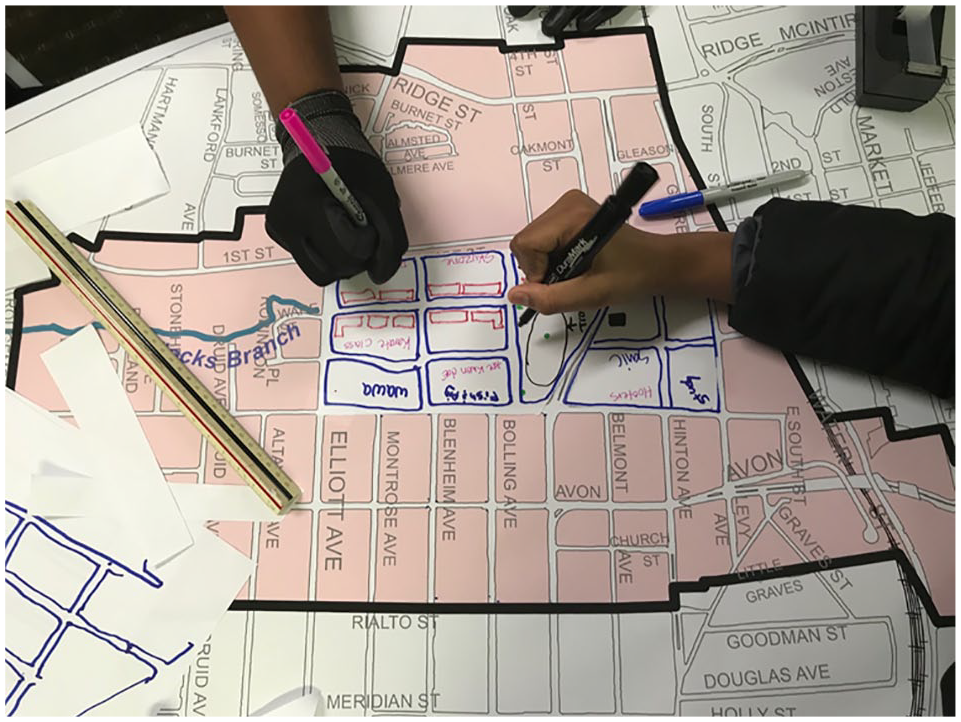
Youth leaders workshopping land use concepts.
Class Evolution over Three-Year Partnership.
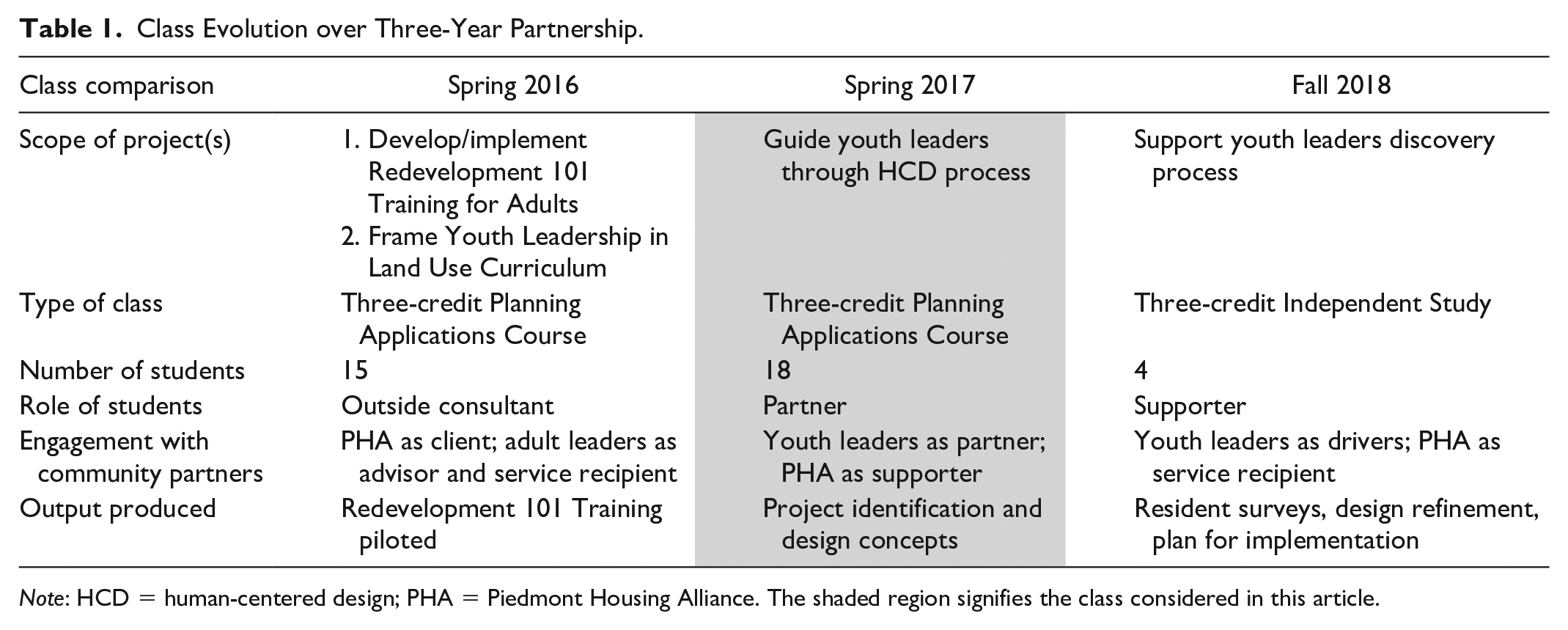
Note: HCD = human-centered design; PHA = Piedmont Housing Alliance. The shaded region signifies the class considered in this article.
Ecological Democracy is a three-credit applied course where students contribute to ongoing community–university partnerships focused on actualizing the knowledge of historically underserved communities in local socio-environmental planning practice. The course title is a reference to the literature describing the value of designing through local knowledge through this theoretical lens (Hester 2010; Peters 2017; Spirn 2016). Student learning objectives include
Understanding the linkages between environmental and social challenges in the built world,
Conducting self-directed research that informs local planning issues,
Collaborating in community partnerships based on mutual respect,
Co-creating platforms for communities to increase their social and ecological resilience,
Reflecting critically on your role as a practitioner and community member.
The project and scope are driven by the community partner—working through each section of the class syllabus together to ensure the activities undertaken and products produced are mutually beneficial. This ensures that the partnership remains responsive to the normal fluctuations of practice, but it also means the syllabus changes pretty significantly each semester. There are times where the student scope of work is focused on exploratory background research, and at other times, the work allows for more direct contact with community members.
Even with a direct invitation to partner, we had to be very thoughtful in how the class began their relationship. This predominantly white university is commonly referred to as “The Plantation” by neighborhood residents for both historic reasons (e.g., the campus was built by enslaved laborers) and contemporary ones (e.g., the university had not yet raised the base wage to $15/hour), so even willing partners brought well-founded mistrust and existing trauma to the community–university partnership. Furthermore, at Friendship Court, unfounded rumors swirled actively among residents about purported University plans to take the property by eminent domain and redevelop it as student housing. Given the potential that our presence had to do harm, care needed to be taken to ensure that university students would always come as humble partners, that students would only visit the site when explicitly invited by our young partners, that we would also invite them to our space as often as they would like, and that the youth voice and power would always be centered in the partnership.
Youth after-school opportunities that support place-based skill-building can be incredibly beneficial for youth social and emotional development, especially when the youth see themselves as effective contributors to activities that positively address real-world problems facing them and their communities (Hurd and Deutsch 2017). PHA staff and I worked with the youth leaders to identify various projects to which they could contribute, and the youth chose to focus their partnership efforts on short-term, smaller projects that would immediately benefit their community, while also prototyping possibilities for longer term change. All of the youth leaders expressed an interest in pursuing higher education, and they enjoyed visiting the university to ask questions of their new partners about the college experience and to use the School’s facilities. But before that relationship could really flourish, the university students needed to gain some background skills that would help them be the best possible partners.
Disorientation and Dissonance
Early in the semester, the university students worked to understand how inequities are institutionalized in land use and in their own lives. Awareness of structural racism is a precondition to deconstructing personal biases. As Public Health Law Scholar Dayna Matthew (2015, 63) describes, implicit bias work by social psychologists to date has been defined and limited by a symbolic interactionism framework. This framework has permitted only de-contextualized, ahistorical, and individualized consideration of the broadly systemic and institutional problems that produce health care disparities and health inequality.
In contrast, studying racial bias from a socio-ecological view illuminates the ways in which institutions and professions contributed to the perpetuation of structural inequities (Trawalter, Bart-Plange, and Hoffman 2020).
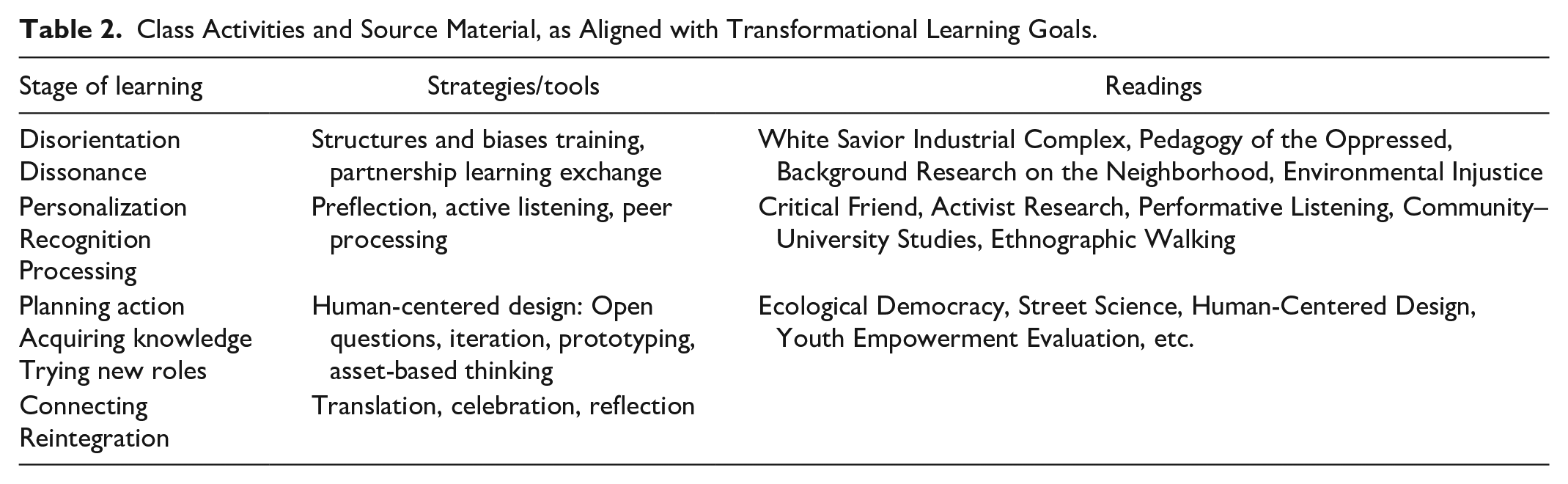
Alongside readings on the ways in which systemic inequities are perpetuated by land use (e.g., readings by Fullilove, Bullard, Agyeman, Abrams, and others), students also grapple with the concepts of privilege and of implicit bias (Bertrand and Mullainathan 2004; Dunham and Lawford-Smith 2017; Eberhardt et al. 2004; McIntosh 1989). While reading Pedagogy of the Oppressed (Freire 2007), we discussed the dehumanizing effects of poverty and the importance of learning from those with lived expertise. Reading about the “White Savior Industrial Complex” (Cole 2012), some students find themselves fighting an urge to defend past “service” activities, and we unpacked the challenges with that mind-set together. After taking online implicit bias tests (see Project Implicit, n.d.) in the comfort of their own homes, students process their experiences of taking the test and reflect on how implicit bias functions in their lives, through both individual journaling and in-class discussion. For many students, this was a disorienting part of their learning journey (Table 2), although many found contending with their own implicit biases and the ways in which structural racism effects those biases to be instructive nonetheless. As one student described it, I found this week’s (reading) concerning good intentioned racial bias, as well as the (implicit bias) test, to be both enlightening and somewhat unsettling. As an individual, I consider myself to be very liberal, with no conscious biases. However, the NYT
1
article that we read this week suggested that it is easy to blame others for bigotry . . . Good intentions do not guarantee immunity . . . and it is clear that even the best of intentions are not always translated as such. I took a few of the tests, and I found myself overthinking each answer that I marked . . . I became easily flustered, feeling there would be some sort of repercussions to my mistakes, actions, or response speed. I am not saying that any of this discomfort is bad; rather, I think that perhaps this discomfort is actually quite productive. If we continue to meander through life believing that we are morally superior or upright, we have done ourselves and our community an injustice. Shedding light on our “fast thinking” discrimination will allow us to approach this course and our community work, as well as our professional careers, in the most equitable way possible. Self check-ins like this, be they uncomfortable or not, may be just what we need to be the best planners, advocates, and citizens we can be.
Transformational learning theory understands all of these experiences—processing the weight of inherited privilege students carry as representatives of the university in our local community, the implicit biases that inform their initial reactions to other humans, and the structural racism that pervades all land use patterns—to be disorienting dilemmas. Identifying the ways in which inequity is built into the systems in which planners work will make future practitioners more thoughtful when crafting or implementing policies or programming. Developing the skills of personal and professional reflection are critical to doing this work well.
Class Activities and Source Material, as Aligned with Transformational Learning Goals.
Personalization, Recognition, and Processing
Transformational learning theory posits that in order for disorienting learning exercises to truly alter your worldview, students require personal and professional processing, active application of this new knowledge that allows you to operationalize this new frame of understanding, and shared experiences that allow for emotional connecting and grounding in community. Once we all had a shared language to begin our partnership, students sought skills that would help them be the best partners possible. While getting to know our young partners, and before we drafted a shared memorandum of understanding and scope of work for our partnership, students paired up with a “critical friend” charged with reading each other’s weekly pre/reflections (posted online), asking them questions for clarity, challenging them kindly when they might have been missing something, supporting them when they were struggling with something, and celebrating their moments of deep learning or personal growth (Costa and Kallick 1993; Falk 1995). I strove to model good practice by grappling openly with my own positionality as a white, middle-class professor of planning at the university, as well as the complexities of my role on the PHA Board of Directors. I explained the ways in which I attempt to redress power imbalances in the classroom and in these partnerships, and we brainstormed all the ways we might cultivate and maintain a relationship of mutual respect with our young colleagues at Friendship Court.
Students reflected in their weekly journals about the lesson from Freire that allowed them to better understand the importance of full self-determination in relationship to the dehumanizing aspects of poverty and to other forms of oppression. The class critically reflected on how they avoid reproducing colonial educational models with their work, and instead de-center themselves and the university so that their work can function as a resource with which residents could engage and employ at whatever depth they saw fit. We discussed the concepts of duality and code-switching, or “use of two or more linguistic varieties in the same conversation or interaction” (Myers-Scotton and Ury 1977, 5), and considered its necessity in the context of the skillsets that students required to translate planning jargon into accessible language, but also appreciated that this skillset is inherently developed by many underrepresented groups to assert their opinions in settings that perpetuate existing power dynamics. Students also practiced active listening (Srader 2015) by pairing up to do two exchanges that allowed them to explore different facets of interpersonal communication, including listening without reliance on verbal or physical cues and listening with the intent to redraw someone’s illustration from their verbal description of the sketch. These in-class exercises not only helped students refine their skills of personal reflection but also allowed for the class to develop a shared set of experiences on which they could build a positive partnership as a collective.
Action as a Vehicle to Try New Roles
Personal processing flowed directly into professional processing as the class took the generative turn of applying their new skills toward the project itself. Liz Ogbu (2018), a thought leader in human-centered design (HCD), was a visiting professor this semester, and led the partnership of young leaders and university students through a series of HCD activities to build their relationships and choose their sites of intervention. A common refrain Ogbu employs in her work, from which we drew extensively, is “What did they say? What did I hear? What does that mean?”—which gave the students a mantra of sorts to help them center good listening practices, check their own biases, and start to apply each collected data point to a larger ecosystem of design research that could move the project toward more refined design ideas. One student’s weekly reflection tried to capture the insights gleaned through the HCD workshops: Successful community-engaged design work can sometimes seem to be somewhat magical or alchemical, with good feelings and unique solutions seemingly coming from an unknown spark. This presentation dispelled that myth quickly, and focused on a number of strategies by which to generate particular kinds of data that aid in decision-making. In the case of Ogbu’s engaged interviewing process, the emphasis seems to be on a deep understanding of key, representative figures from a networked, holistic perspective, as opposed to a broader and more superficial information about things like preferences or demographics that tend to result from meetings and surveys. The brainstorming and prototyping activities produced a greater range of possibilities for evaluation, as compared to the development of one or a few possibilities that are then refined and defended. Seeing these ideas . . . presented in such a clear framework, supported by flowcharts and diagrams, allows me to appreciate its strengths and consider how it might be applied in my own practice.
Through this HCD process, the youth identified ideas for interventions next to the basketball courts, on the complex’s eight-foot tall perimeter fence—which the youth rightly viewed as oppressive, and in the outdated courtyard playgrounds (Figure 3).
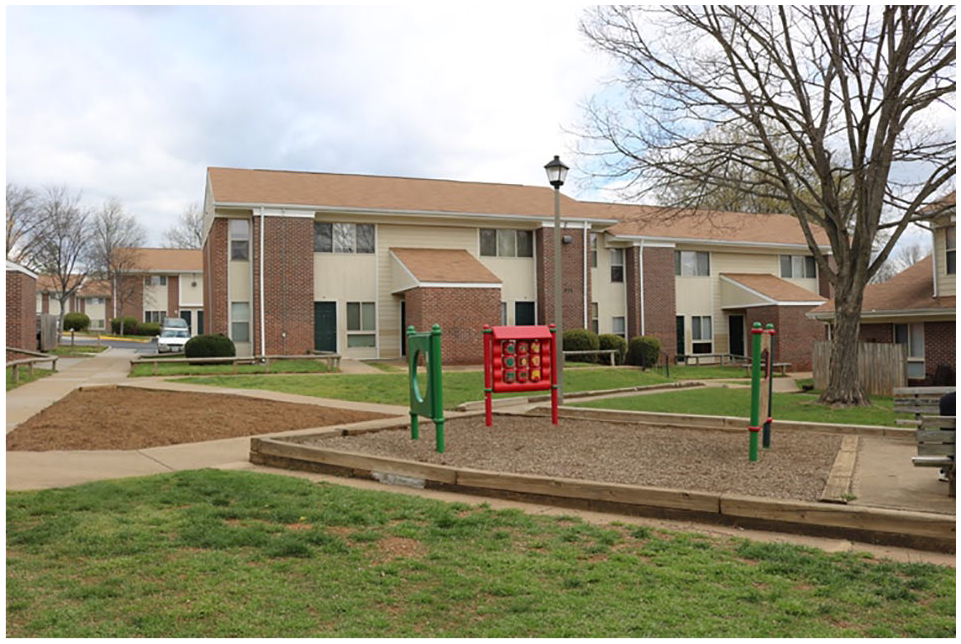
Existing courtyard youth chose for their design intervention.
Connecting and Reintegration
As the youth developed a trusting relationship with the university students, the richness of the partnership increased exponentially. The youth leaders honed in on the courtyards as the primary point of intervention (Figure 4), and began thinking about new material options for flooring after observing that children contracted ringworm from playing in the mulch. When one young leader suggested a nail salon as a desired courtyard addition, the full team of partners discussed the kernel of this idea until it became clear that places for quiet restoration were in short supply on site. Although the generated project ideas were not finalized and approved before the semester ended, the end of semester celebrations included time for shared reflection, communal eating (food was present at every interaction, actually), and presentations of their ideas to relevant neighborhood leadership and property management authorities.
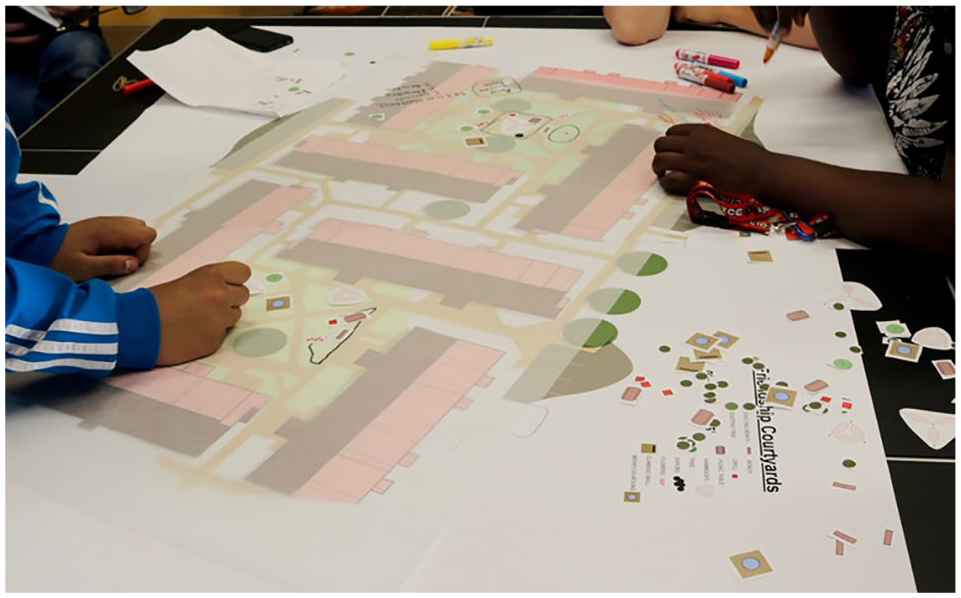
Student-developed co-design exercise of courtyard.
At the mid-point and at the end of the semester, students took self-assessments that asked them to rate their learning on a Likert-type scale for each of the learning objectives. In both assessments, almost all students reported tremendous growth in the learning objectives of becoming more empathetic professionals and of developing an awareness of structural inequalities and how they manifest in the built world. One student described her learning journey this way: This course was transformational. It was a perfect segue into doing the kind of work that the class focuses on because it was a very real project and situation, but we definitely enjoyed the benefits of pre-existing relationships with the community partners . . . The readings were fantastic . . . I suppose it was really important to front load the readings because of the “on-call” nature of the second half of the course, but I would have loved to continue building our theoretical repertoire. It was kind of emotionally exhausting at times, but the reflections were helpful in alleviating some of that. I think more in-person small-group discussion for reflection could also be really valuable, although I would hesitate to give up the opportunity to hear everyone in the class speak up about their experiences.
The “on-call” nature referenced above speaks to the deferential approach to community-driven design that marked the partnership. Several students identified the structural racism/implicit bias educational modules as critical to developing their skills of reflective practice, stating that the reading and training “continues to inform my daily activities and thinking.” Other students reported that the class reoriented their future professional aspirations. In terms of increasing their awareness of structural inequalities, the vast majority of students attributed their tremendous growth to direct engagement with community residents and partners.
Students facilitated a youth-led evaluation process, where our young partners set the metrics for program success. The youth identified three important measures: (1) the amount of shared learning, (2) the extent to which the project would be realized, and (3) the ability to be flexible and dynamic in responding to the youths’ perspectives. Success, above all, would be measured by the extent to which, as one youth leader put it, we co-create an environment “where everyone does their best, and can contribute their best to make the project the best and make themselves the best they can be.” Although the class only represented the co-design stage of the program, and thus did not get measured along these standards (we were careful to never survey the youth without their leadership driving such inquiries), PHA staff reported an increasingly positive relationship with the university because of our efforts, and appreciated that “university students were respectful of and focused on the youth themselves, their experiences and learning in particular,” which they thought led to increased feelings of support and confidence in the youth. And youth leaders expressed a deep desire to continue working with students on the implementation phase of their work.
What Happens after the Collaborative Action Course?
Instead of subjecting the young leaders to the emotional strain of developing new relationships with another group of University of Virginia (UVA) students in the next class, a small group of students from the 2017 class asked if we might hold a group independent study the following semester to continue the partnership directly. This group of four students and I continued to support the young leaders’ work that fall. The youth realized the level of responsibility neighborhood change included, and decided they needed to better understand the interests of other children before making design decisions. University student partners helped the youth develop a neighborhood survey about courtyard preferences, market and host an event to implement the survey (Figure 5), analyze its findings, refine their design ideas accordingly, and then present these findings and their ideas for courtyard redesign to the property management leadership. The youth consulted on the resulting courtyard playscape project, drawn up and built under the leadership of Alex Gilliam of Public Workshop, and with help from a university facilities training program and many children living at Friendship Court (Figure 6).
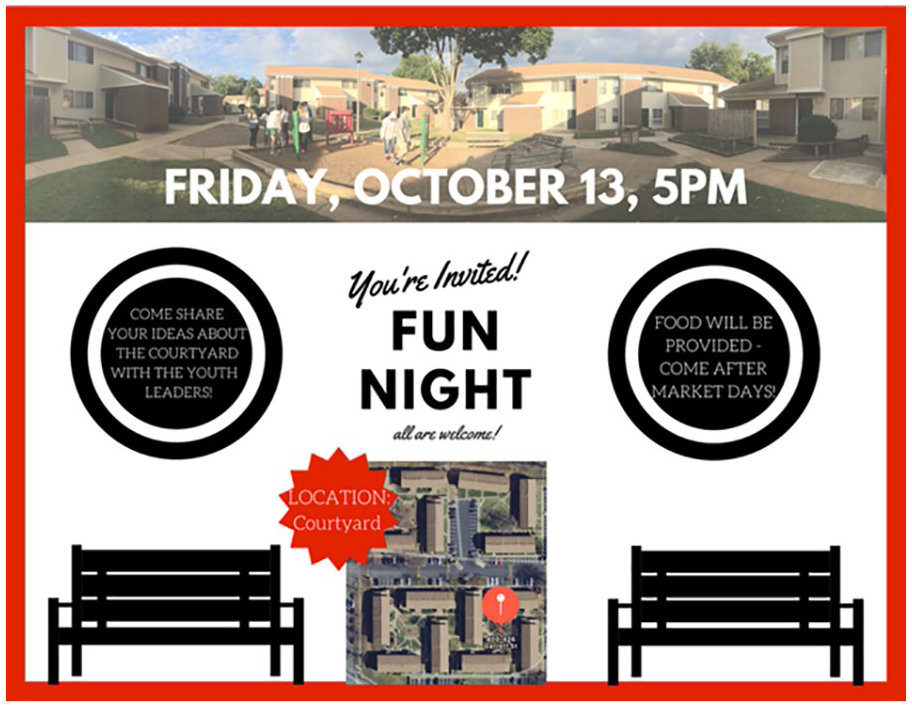
Youth-led event planning, complete with poster design.
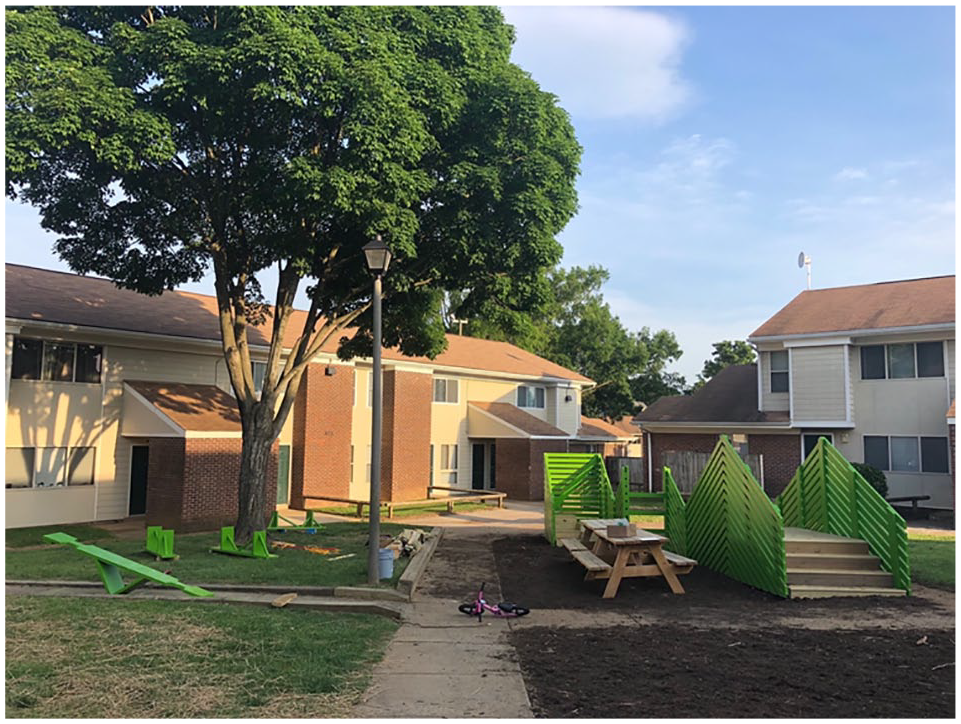
Final courtyard intervention installation underway.
This amended plan was a result of the challenges inherent in collaborative action classes. Property management staff proved to be unexpectedly reluctant partners in the design approval process, and the delays extended the project implementation well beyond the timescale of the semester course. Furthermore, although the youth leaders were very interested in the design process and in seeing the project completed, they were much less interested in leading construction—so bringing in an outside consultant that could push the conceptual design through implementation was essential.
Nevertheless, several long-term successes correlate with this work. First, in response to the youth taking a stewardship approach to their design process, the redevelopment community advisory board invited two of the young leaders to join the board in an official voting capacity. In 2018, the state honored PHA and the resident leadership team with the Virginia Housing Inclusive Communities Award. And in the spring of 2019, the first phase of redevelopment received the tax credit funding required to begin construction. This is not mentioned to infer a causal relationship with the class partnership, but only to note that the project’s success was not encumbered by such time and resource-intensive engagement commitments.
Opportunities and Challenges for Planning Pedagogy
High-quality collaborative action curricula require long-term partnerships built upon years of emotional and financial investment in order for them to become mutually beneficial endeavors, and they present a myriad of logistical challenges. Challenges include (1) the necessary messiness of these classes—which sometimes require a profound amount of care to ensure a legible learning experience; (2) a mismatch in time expended and professional validation of this work for faculty; (3) the understandable frustration students feel knowing that their jobs just out of school will likely not facilitate such community-centered power-sharing; and (4) the very real potential that community partners can be harmed by a partnership that is not properly structured or by students who are not properly trained prior to engagement. In this case, a patchwork of internal and external grants funded the effort of youth leaders, PHA staff, and the program curricular development by faculty and students that ensured all parties had the capacity to contribute fully. Without that outside financial support, it would have been much more challenging to position the students for such an impactful learning partnership. Furthermore, despite careful scoping, the course warranted more time than was allowed by the three-credit curricular model.
Community-engaged learning can destabilize long-held, but inaccurate, assumptions; can illustrate the importance of planning policies and programs focused on equitable impacts, not just equal access; and can buttress student learning about multiculturalism and structural inequalities through collaborative action. Implicit bias training can effectively aid in the destabilization process, and in the process of understanding oneself, but is only effective in remediating bias when paired with education on structural racism. Exposing planning and design students to “models of what race critical dialogue looks like” (Lung-Amam et al. 2015, 338) is essential to encouraging more effective and mutually beneficial partnerships with marginalized communities.
Teachers should take pains to balance the strain of disorienting dilemmas to which students are exposed in proportion with the emotional connection the partnership can provide. Also, the introduction of tools for culturally humble practice (e.g., active listening, ethnographic walks, critical reflection, and HCD) make the disorienting content much more palatable, as students feel better prepared to counter oppressive systemic issues in future practice. This experience supports Kiely’s (2005, 9) assertation that there is “an important interconnected and dialectical relationship between the cognitive and affective dimensions of the transformational learning process.” Processing is rational and reflective, while connecting serves an emotional learning need—and together they allow a student to experience transformation in terms of not only intellectual but also social learning.
This work, however, should only be done by teachers and community partners with the proper infrastructure to ensure a “first, do no harm” ethic as the baseline for every action. Long-term relationships that facilitate the co-creation of class syllabi and other forms of power-sharing can increase the mutual benefits of collaborative action classes. Calibrating the experience to ensure that community partners get more out of the exchange than they put in through time, energy, and expertise is essential. It is time to abandon the imbalanced lexicon of “service-learning” all together. If we are to change the paradigms of practice to redress the inequities our field helped create, finding ways to value local knowledge in both the teaching and application of planning is essential to that task.
Footnotes
Acknowledgements
Although not featured prominently in this piece out of respect for them, my deepest gratitude goes to the young designers we worked with at Friendship Court—thanks for learning with me. This work also benefited greatly from the partnership of staff at Piedmont Housing Alliance, Liz Ogbu of Studio O, Alex Gilliam of Public Workshop, Kevan Klosterwill, and the UVA student cohort with which I learned—especially Margaret Haltom, Sophie Schectman, and Joanie Fasulo, who still remain committed to the partnership years later.
Declaration of Conflicting Interests
The author(s) declared no potential conflicts of interest with respect to the research, authorship, and/or publication of this article.
Funding
The author(s) disclosed receipt of the following financial support for the research, authorship, and/or publication of this article: This learning partnership benefitted from the financial support of the Jessie Ball duPont Fund and the UVA Environmental Resilience Institute.
