




Abstract
This article discusses the ontological underpinnings and normative assumptions of the New Urbanism paradigm by exploring how long-term residents explain differences in two historic neighborhoods in Memphis, Tennessee. By using an engaged research approach, it examines the production and transformation of space, questioning the meaning of traditions from the perspective of Black residents. Findings suggest that a paradigm of urbanism ought to be built on a systematic investigation of the people–space–time nexus, arguing that the intersection of urbanisms is a way to understand and act on phenomena of urbanization often overlooked by mainstream urban design approaches.
Introduction
In the early 1990s, the search for a practical urban strategy to address the significant consequences of American suburbanization brought practitioners and academics together to craft a new paradigm that still informs the dominant approach to urban design in the United States today. New Urbanism (NU) seeks to promote principles of social order (Talen 1999) through mixed-use development (Duany 2000) and a strong emphasis on community building (Duany and Talen 2002). This paradigm features a new urban type conceived as the revival of the traditional American neighborhood and seen as the brick-and-mortar urban fabric reflecting environmental, social, and moral goals (Talen 1999). Although the traditional American neighborhood has been variously defined (Calthorpe 1993; Duany et al. 1991; Langdon 1995), common elements across definitions typically include “mixed use, mix of housing types, compact form, walkable environment, transportation alternatives, attractive public realm, quality urban design, centre with commercial and civic uses, clear edges, [and] narrow streets” (Grant 2005, 57).
In light of NU’s increasing influence, academics in the social sciences and design disciplines, planning practitioners, and urban designers have developed research agendas focused on its theoretical foundations, practices, implementation, and achievements. During the last twenty years, these inquiries have generated multiple rival positions from stalwart support of the NU movement to hard attacks based upon fundamental criticisms (Ellis 2002). The main concern, at the core of this debate, focuses on whether the NU paradigm is hiding a neoliberal agenda or instead embracing planning values to attain social equity, a democratic civil society, and ecologically sustainable futures (Gunder 2011). Over time, critiques fueling this debate have maintained a strong focus based upon the evaluation of NU-inspired developments. However, few scholars have questioned whether traditional American neighborhoods should be considered models for a contemporary urban design paradigm in the first place. More specifically, while the NU paradigm was founded on the assumption that the “new old” is good per se, limited research has been produced to explain the rationale supporting this hypothesis or interrogated the values, logic, and assumptions built into NU.
In this paper, I explain how the establishment of a dominant paradigm of urbanism focused on the building of new traditional neighborhoods privileges certain forms of urbanism while excluding others. I critically reflect on the ontological underpinnings of the NU paradigm by discussing the meaning of what is and is not considered traditional and whose types of urbanisms are included or excluded in the name of tradition. My goal is to generate useful insights for a new and more inclusive paradigm of urbanism. Theoretical frameworks developed inside and outside NU discourses guide the analysis of a case study examining two historic American neighborhoods in Memphis, Tennessee: Smokey City and Klondike. The first was settled as predominantly white and featured typical characteristics reflective of the NU canonization of the traditional neighborhood; the second was settled as one of the first examples of neighborhoods in Memphis with Black homeowners. This paper explores how long-term African American residents of Smokey City and Klondike experienced and explained differences between these two urban forms. Insights from this exploration illuminate how these neighborhoods came to be, whose interests they served, how they evolved, and, more generally, what lessons can be learned to generate an alternative and more inclusive paradigm of urbanism. 1
The paper starts with a brief review of NU foundational principles. By looking at the body of scholarship developed internally to the NU debate, I focus on research that has highlighted problematic issues of difference, diversity, and inclusion, which are related to NU ontological underpinnings and assessments of its planning outcomes. I then expand this review of the literature, outlining two bodies of scholarship, external to the NU debate. The first explores the link between issues of difference, diversity, and inclusion, and planning and decision-making. The second is concerned with the study of urban neighborhoods produced and used by Blacks in the United States, one of the many forms of urbanism that have been historically overlooked within mainstream planning and design practice. After presenting the case study of the Klondike and Smokey City communities, I conclude with general reflections on the contributions of engaged scholarship to the investigation of the production of space, and how it can be relevant to overcoming significant shortfalls of the NU paradigm. I conclude the article by advocating for the intersection of urbanisms based on a more complex understanding of the people–space–time nexus.
Within the NU Literature: Reproducing an Old Space
In a Kuhnian sense, a paradigm is based on a specific view of the world and is comprised of a bundle of “law, theory, application, and instrumentation [that] together provide models from which spring particular coherent traditions of scientific research” (Kuhn 1962, 10). The NU paradigm suggests the use of expert technical rationality to prescribe a city form that would automatically advance a broad set of social values. This causal relationship is foundational to the worldview held by NU’s founders and, consequentially, of the NU Charter, the foundational document created to guide the creative process of space production according to NU adherents.
The NU Paradigm and the Traditional American Neighborhood
The NU paradigm formalizes a new urban type inspired by traditional American neighborhoods, whose study has been foundational for planners and designers going back to the movement’s emergence. Traditional neighborhood studies and analyses have mostly relied on NU devotees whose primary interests have revolved around the physical aspects of articulated urban fabrics. Several NU founders, for instance, have been fascinated with the physical appearance of vernacular architectures, which have become integral elements of NU highlighted in their new urban models. Referring to the work of the most influential figures of the NU movement, Scully (1991, 18) comments, they [Duany and Plater-Zyberk] led me and the rest of our class through the streets of New Haven, my own City. They showed us the Stick and Shingle houses of Newport and Bar Harbor as they existed right under our noses in their everyday vernacular guise—not only as I had written about them, as objects of historical interest and the precursor of Modernism, but also as direct models for contemporary use.
The interest in historic urban forms is rooted in a rationale supporting an “anti-suburban” and “anti-sprawl” design approach that can be implemented through the replication of dense, compact, vibrant, and diverse traditional settings. Another influential figure of the NU movement comments, The traditional American town has walkable streets. Streets that led to close and useful destinations rather than—like our modern collectors and high traffic arterials—only to other streets. Elm Street led to Main Street, or to the neighborhood park, or daycare or an elementary school. Such a street pattern is actually cheaper to build and results in shorter trip distances even if people don’t walk. The streets were narrow, with sidewalks, and tree-lined. They were fronted by porches, balconies, and entries rather than garage doors and driveways. They allowed through traffic but slowed it with frequent intersections and frugal dimensions. There were no collector streets, complete with soundwalls, and cul-de-sac. Privacy was maintained through layers of space rather than barriers. Security was provided by eyes on the street rather than gates and patrols. (Calthorpe 1993, 21)
These views of traditional neighborhoods undergirded the NU Charter, which uses a principle of scale (regional, urban, and building) to define urban design guidelines. At the urban scale, NU prescribes the use of neighborhood, district, and corridor; compact, pedestrian-friendly, and mixed-use neighborhoods; short walking distances between community functions; a broad range of housing types; transit corridors; appropriate building densities; the concentration of civic, institutional, and commercial activities; urban design codes; and a range of public parks (Leccese and McCormick 2000). The Charter has guided architectural firms and urban developers to implement countless NU projects across the United States (Canada, the United Kingdom, and Australia also have many NU-implemented projects) that have, in various degrees, adapted new urban types to local contexts.
From these perspectives, NU features views of the traditional neighborhood that have maintained a strong focus on physical design, often overlooking the fact that traditional neighborhoods are artifacts of a complex mix of social groups who differentially contributed to efforts to mold and have different perceptions of those environments. In addition, the NU paradigm does not appear to take inspiration from urban fabrics, typically produced by disadvantaged groups in the United States, that may differ from what NU advocates consider traditional. In this light, a more inclusive paradigm of urbanism ought to consider how communities’ differences and diversity might have informed historic urban forms in the first place, and how producers and users of these spaces have perceived those urban forms, whether these fall into the NU view of the traditional neighborhood or not.
Dealing with Difference, Diversity, and Inclusion
A critical perspective on how the notion of tradition has been used to address difference, diversity, and inclusion returns to the early days of NU. By borrowing the conceptualization of “invented tradition,” Till (1993, 717) describes how neo-traditionalists have created a set of practices providing a sense of continuity with a fictitious and glorious past, whose tellers left little room for stories “from the perspectives of other individuals, including those of women, children, and/or gays from various cultural, ethnic, and socioeconomic backgrounds.” These concerns have led some to highlight how the physical urban fabric prescribed by NU has oversimplified and parochialized notions of segregation, integration, and difference by proposing urban models that have been historically influenced by culturally biased city forms tied to racial segregation (Lehrer and Milgrom 1996). Others have assessed how the mimicking of traditional neighborhood forms might replicate urban fabrics whose everyday life spaces favor the subjugation of women (Thompson-Fawcett 1998), dynamics of racial and class discrimination (Frantz and Collins 2000), structures of privilege and hierarchy (Grant 2005), and active policing and local segregation maintaining exclusive upper class spaces (Fainstein 2005). This line of inquiry has questioned the neotraditional planning ideology (Al-Hindi and Staddon 1997), suggesting the need to transcend the specificities of the NU paradigm to move toward a more progressive and “true” urbanism (Al-Hindi 2001; Al-Hindi and Till 2001; Till 2001).
While the debates focused on what might be considered good urbanism remains wide open, more scholars have become concerned with substantive rather than the normative outcomes of NU-informed developments (Moudon 2000). Several critical studies have highlighted the inability of the NU paradigm to address housing issues experienced by the most vulnerable (Harvey 1997), especially in contexts characterized by class and racial divides (Marcuse 2000). NU advocates have responded by arguing that these critiques have flaws (Ellis 2002), while those inquiring about whether NU theory keeps up with its practice have strongly argued that it does not (Grant 2005), noting that diversity acquires different meanings for different space producers and users, making NU normative assumptions challenging to fulfill (Grant and Perrott 2009). The result is that those questions related to NU democratic claims remain unresolved today. Recent quantitative studies conclude that while NU projects might reflect socioeconomic diversity, this does not necessarily feature racial diversity (Trudeau and Kaplan 2016) and, when it does, social tensions among groups emerge (Trudeau 2018). Others have noticed how NU projects tend to contribute to gentrifying (Markley 2018a) and whitening (Markley 2018b) specific neighborhoods. By qualitatively analyzing efforts to implement NU principles in contexts characterized by stigmas and negative perceptions of class and race, Jackson (2018) identified the challenges of making mix racial and mixed-income communities a reality, highlighting how these obstacles might prevent the possibility of investigating whether or not NU normative assumptions eventually result in better outcomes for low-income communities of color.
From a planning perspective, many have inquired about the specificities of the NU planning process, revealing the limitations of NU methods in dealing with diversity arguing for alternative pathways forward. Day (2003) demonstrates how NU participatory design methods trivialized diversity in NU’s early days, assuming that all groups are ready, willing, or comfortable in participating in design-oriented activities. In a similar vein, others have examined how NU charrette techniques have overlooked many other possible forms of sustainable urbanism by using a pre-determined set of design rules (Bond and Thompson-Fawcett 2007). Such findings point to the inability of NU to explicitly deal with power dynamics in diverse settings, which has led some scholars to challenge planners and designers to consider knowledge generation in the planning process that would explicitly address issues of “ethnicity, identity, and both culturally-based and class-based urban lifestyle practices” (Irazábal 2012, 263). This is a promising path forward that has been, to date, mostly unexplored even though there is increased awareness, within NU circles, of the need to generate cultural competency practices (Jackson 2019).
Outside the NU Literature: Being Inclusive of Others’ Spaces
The previous section uses NU endogenous scholarship to question the ontological underpinnings and normative outcomes of the NU paradigm, raising issues not only about how to achieve a paradigm for a more progressive urbanism but, specifically, about NU’s capacity to be more sensitive to issues of difference and diversity. The following section addresses these issues by sharing perspectives from two bodies of scholarship external to the NU debate. The first focuses on conceptualizations of difference, diversity, and inclusion in urban spaces that offer a conducive forward path for planners and designers interested in addressing those issues. The second is concerned with often-overlooked forms of urbanism and discusses the link between urban form and difference and diversity. More specifically, it focuses on historic Black neighborhoods in the United States, explicitly reflecting on the meaning of diversity along racial lines (Sweet and Etienne 2011).
Broadening the Task of Dealing with Difference, Diversity, and Inclusion
A large body of work on the production of space suggests that a better understanding of urban space lies at the interface between the sociological and the geographical imaginations (Harvey 1973). This line of inquiry seeks methodological choices capable of grasping and unfolding urban space use and its production through a closer investigation of the place relational dimension among different groups occupying and producing spaces, and between these groups and the spaces they produce and occupy. In Spaces of Hope, Harvey (2000, 182) coined the concept of “dialectical utopianism,” theorizing a process of spatial and social imagination embedding “the idea of potentially endlessly open experimentation with the possibilities of spatial forms.” This conceptualization defines an open process of exploration of the human potentialities needed to enable the materialization of spatial forms that might embody social and moral goals. Along these lines, Massey (2005) theorizes space as a sum of multiple trajectories that create a multi-agent arena embodying conflicting and unequal social relations. This conceptualization of “throwntogetherness” refers to the idea that space and the constitution of place pose a constant negotiation of relations and configurations that are deeply influenced by the specific historical moment in which they occur. This negotiation “pays attention to the fact that entities and identities (be they places, or political constituencies, or mountains) are collectively produced through practices which form relations; and it is on those practices and relations that politics must be focused” (Massey 2005, 148).
The first body of scholarship challenging NU from the outside has been concerned with how planning practices have dealt with daily negotiation within societies characterized by difference and diversity. The negotiation of space relations in time requires an explicit (and not easy to solve) engagement with difference and diversity, and precise planning methods regarding how this engagement ties into the process of shaping space. Literature grounded in urban geography has shed light on how mainstream planning practices have implemented numerous strategies to normalize differences and diversity within dominant cultures. By critically examining conceptualizations of diversity and integration, Ye (2017) defines “differential inclusion” as the intentional practices of selectively incorporating segments of diversities in a dominant group. In overcoming the dichotomy between exclusion and inclusion, Ye (2019, 491) presents a nuanced conceptualization of co-existence by examining the “orientations, intentions and implications of inclusion at the scales of policy and the everyday,” warning that inclusion is a political project and as such has to be constantly renegotiated.
This concern has been foundational in the research strand developed in the planning literature dealing with “the challenge of managing co-existence in shared spaces” (Healey 1997, 77). By acknowledging the limitations of rational planning (Friedmann 1987), this scholarship has elevated all forms of insurgency planning challenging mainstream rational decision-making processes (Sandercock 1998a) and opened possibilities to plan with multifaceted understandings of differences (Sandercock 1998b, 2003). In revealing the difficulties of working in contexts characterized by “deep difference” (Watson 2006), this strand has led planners to reflect on how to deal with fundamental values in the process of deliberation (Forester 2009). Over time, this scholarship has identified alternative forms of planning approaches to deal with difference and diversity, including “therapeutic” planning for cities of difference (Sandercock 2000), “cultural competency” for increasing equality (Agyeman and Erickson 2012), and “cultural humility” as a process and vehicle for self-reflection in planning practice (Sweet 2018).
These perspectives reposition the planning enterprise within an optic of care and ask for a search for planning approaches—including methods, techniques, and tools for knowing and collaborating—counteracting those developed by mainstream planning paradigms that tend to undervalue difference and diversity. By endorsing these approaches, possibilities for future spatial forms are possible only if there are explicit acknowledgments and understandings of all of those spaces reflecting differences in fundamental values, logic, and assumptions.
Acknowledging Other Forms of Urban Spaces: Black Urbanism
Black Reconstruction in America represents the trailblazing volume on the counternarrative of Blacks’ role in shaping the United States after the Civil War (Du Bois 1935). In his theory of the Reconstruction, Du Bois explains that the Black struggle was not only about empowering the Black community but also how it was fundamental for the acquisition of many universal rights required for a mature American democracy. Yet many of those rights, such as universal suffrage, “could not function without personal freedom, land, and education” (Du Bois 1935, 585), civic liberties achieved through the everyday life efforts carried out by ordinary citizens. The New Black Urbanism (Blair, McDonald, and Sanderson 1969) documents the establishment of those Black neighborhoods, developed at the beginning of the twentieth century, where various forms of collective struggle were generating forms of self-sufficient Black communities that were creating new forms of universal personal and civic achievements.
The sociological inquiry exploring these new forms of urbanism has developed along two lines. On one side, it has explored the Black experience of distress and poverty in inner-city neighborhoods, highlighting the need for redemption of those declining urban spaces (Brown 2011; Clark 1989). On the other side, it has given prominence to those values embedded in Black culture seen as vehicles for emancipation (Keil 1991; Spain 2000). Marcuse (1997) suggests a more sophisticated understanding of Black urban spaces by using conceptualizations of “ghetto” and “enclave” as not mutually exclusive categories, offering a middle ground for policy responses that considers the constellation of strengths and weaknesses emerging from those urban spaces. From this perspective, while longitudinal investigations of ghettoization processes suggest that there are a broad set of motives at the roots of their creation (Logan et al. 2015), the more nuanced understanding of Black neighborhoods provides a view of their catalytic nature for economic mobility, political enfranchisement, and cultural expression (Freeman 2019).
From a strict planning perspective, Thomas (1994) warns scholars to look at the Black urban experience and link it to urban planning history to generate a deeper understanding of different conditions along racial lines. This line of inquiry has had the primary goal of communicating how planning exacerbates practices of exclusion and oppression while also illustrating the endurance of the Black community and its ability to cope with various mechanisms of oppression (Thomas 1998). Thomas explicitly invites an expansion of theories of planning to engage with overlooked and marginalized communities to produce actions built upon an awareness of those different conditions along racial lines. This invitation reinforced the advocacy planning tradition that emerged in the 1960s which was explicitly designed to implement planning practices supportive of disenfranchised groups to challenge the idea of a single normative approach to planning based on a unitary definition of the “public interest” (Davidoff 1965). By acknowledging the limitation of so-called democratic participation in decision-making processes (Arnstein 1969), advocacy planning initiated forms of social planning that, while holding the public accountable, were claiming the need to advance multiparty plans to achieve more equitable planning outcomes. This epochal turn in planning theory and practice lead its initiator, Paul Davidoff, to formalize innovative planning tools such as inclusionary zoning (Davidoff and Gold 1970) and new agency forms such as “Suburban Action” (Davidoff, Davidoff, and Gold 1970) to act on behalf of specific social groups.
Reflecting on this pivotal moment in planning history, some have noticed how these new forms of social planning lacked the possibility of retaining the production of space as an integral part of their mission (Hayden 1994; Klemek 2009). As “space is a medium, used by those wielding economic, social, and political power in constructing both a material and an ideological world that constrains its inhabitants” (Hayden 1994, 161), over time the quest for alternative forms of urbanism—reflecting values, beliefs, and traditions of those social groups that advocacy planning aims to help—has remained underdeveloped. Along these lines, some planning experimentations have identified streams of collective action informed by a deeper understanding of Black spaces, including the emergence of the African American homestead (Hayden 1997), the reclaiming of public housing (Raciti 2018), and the making of places for Black self-determination and neighborhood preservation (Knapp 2018).
Methodology: Data Collection and Analysis and Community Engagement
The remainder of this paper focuses on a case study developed within a broader community-engagement project in the historic neighborhoods of Klondike and Smokey City in Memphis. I analyze the social dynamics molding the once separate urban fabrics of each neighborhood. Smokey City was built as a traditional and predominantly white American neighborhood, while Klondike was one of the first neighborhoods in Memphis with Black homeowners reflecting a profoundly different urban form. This analysis draws from data collected during a collaborative research project carried out by a capacity-building community–university partnership (Reardon 2006) established between the City and Regional Planning Department at the University of Memphis and the Klondike Smokey City Community Development Corporation (KSCCDC) in Memphis. The partnership was initiated when KSCCDC’s executive director sought to undertake research needed to prepare a new plan for the Klondike Smokey City (KSC) neighborhood aimed at improving its quality of life.
During this process, research focused on the history and legacy of the Klondike and Smokey City Black communities, which were and are considered some of the most critical assets of the social fabric of these neighborhoods. Options for new revitalization strategies seemed to be focused on the recruitment of outside developers and investors who would serve as the singular agents in charge of assembling land, demolishing old properties, and using NU principles to replace the original urban fabric with new developments. Over time, local leaders perceived this redevelopment approach as problematic as it was strictly tied to a form of “planning from the outside.” This concern prompted residents and their university partners to craft a preliminary community plan based on an alternative development model that involved using leadership, resources, assets, and social capital from within the community to drive the process, which they referred to as “planning from the inside.” Drawing from engaged scholarship (Boyer 1996) and using an action research methodology (Reardon 1998), this research project focused on investigating the relationship between people and space across time in these neighborhoods. The research was carried out in 2016 and informed a community-based development strategy that was asset-based, capacity-building, and preservation-oriented.
Implementing urban morphology techniques, through the use of GIS mapping combined with analysis of archival documents (historical photographs, newspaper clippings, documents, and old maps and plans), a central part of the research focused on an examination of those processes that shaped the urban environment by critically examining past and current relationships between social phenomena and urban form (Moudon 1997). Urban morphology techniques deploy a broad range of synchronic and diachronic analyses of the built environment, including the study of neighborhood lots, building typologies, and analysis of urban tissues. Urban tissues are “groups of buildings, open spaces, lots, and streets, which form a cohesive whole either because they were all built at the same time or within the same constraints, or because they underwent a common process of transformation” (Moudon 1997, 7). Analysis of data using urban morphology techniques paralleled deep engagement with community members throughout the research process, which included forty in-depth interviews with current and former KSC residents, participant observation of monthly KSCCDC meetings, and three resident-led walking tours of the KSC neighborhoods as follow-up events to the community interviews. An action research approach involved sharing collected data during two public meetings designed to promote collective analysis and interpretation to foster the shaping of a community plan.
What follows is a summary of the most important data collected in the field during the research process. In the following narrative, local residents’ names are substituted with pseudonyms, and presented in quotation marks, while significant historical figures from Memphis and KSC are presented in their original form. According to the action research paradigm, a personal account is provided to share a “reflection-far-from-action” that might be useful for others working on similar projects in other community settings (Saija 2014).
The Traditional Neighborhood Confronts Black Urbanism in the American South
The KSC neighborhood is today one of North Memphis’s Black neighborhoods. It is located between two of the city’s most significant redevelopment projects: the transformation of the Sears Building into a multifunctional megastructure housing residential, commercial, educational, cultural and public spaces (Crosstown Concourse), and the Uptown residential development—a recently completed HOPE VI project. Both initiatives were carried out to address downtown and inner-city neighborhood decline in hopes of drastically reshaping the area’s physical and social landscape (Figure 1). Over time, public investments have favored these two revitalization initiatives prompting leaders of other neighborhoods to accuse municipal officials of “benign neglect” of their areas. While there have been continuous investments to fund and market these two areas, which the City of Memphis considered worthy of redevelopment, public and private interests neglected the distressed KSC accelerating its physical and social decline.
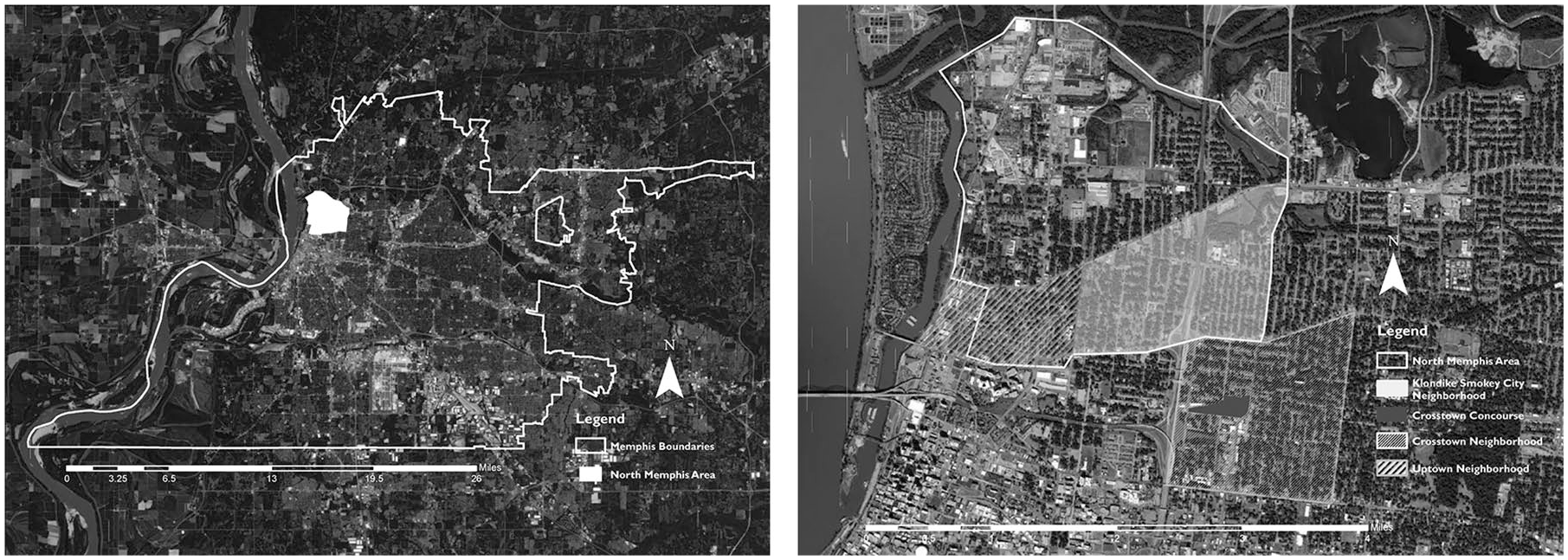
The North Memphis Area located within the municipality boundaries (on the left).
While KSC is publicly known as a severely distressed African American community, its morphological analysis and the community-engagement process revealed a starkly different narrative over time. Contrary to public perception today, the KSC neighborhood evolved to its current physical form through a process of transformation triggered by the merging of two different urban tissues: Smokey City and Klondike (Figure 2). This investigation revealed some of the most relevant differences in the community’s lives in what is generally considered the traditional neighborhood (Smokey City) and the Black counter-traditional neighborhood (Klondike), which reflects an urban fabric that does not exhibit typical so-called traditional neighborhood features.
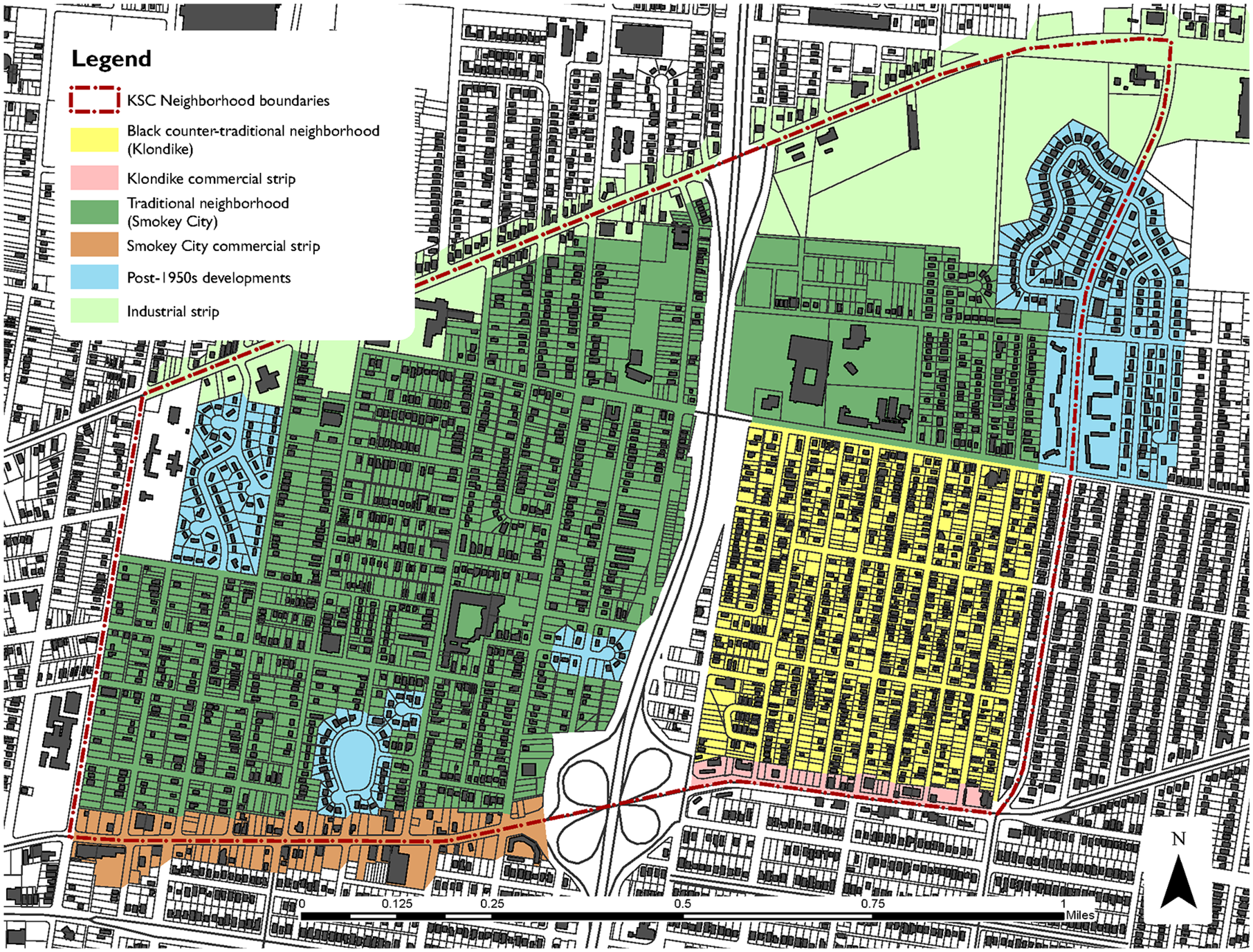
Klondike Smokey City neighborhood urban tissues pre-1960s identified in a contemporary base map.
Smokey City, whose first phase of urbanization started at the end of the nineteenth century on the west side of the I-40 and I-69 highway strip (cutting across the area as indicated in Figure 2), was and partially still is characterized by a highly diverse composition of physical elements comprising its urban fabric. A high percentage of the lots range in size between 6,000 and 10,000 square feet, while fewer have smaller dimensions ranging from 1,000 to 5,000 square feet. The neighborhood’s physical appearance exhibits a rich diversity of lots interspersed throughout the urban fabric. Single-family and fewer multi-family houses, which were mostly demolished over the years, use to occupy larger lots. Cottage-style houses were built on smaller parcels. Last, two types of shotgun houses were designed for the neighborhood’s smallest lots: those developed on foundations and built with bulky bins, gabled rooftops, and decorated features, and those constructed with rudimentary wooden structures. The latter sat on tiny lots and do not exist today; they have been replaced by new developments that are visible on the current map (“Post-1950s Developments” in Figure 2). However, the presence of those older structures is documented on the historic Sanborn Maps (zoom on Figure 3), along with a network of pathways and alleys connecting relevant subsections of the neighborhood that no longer exists.
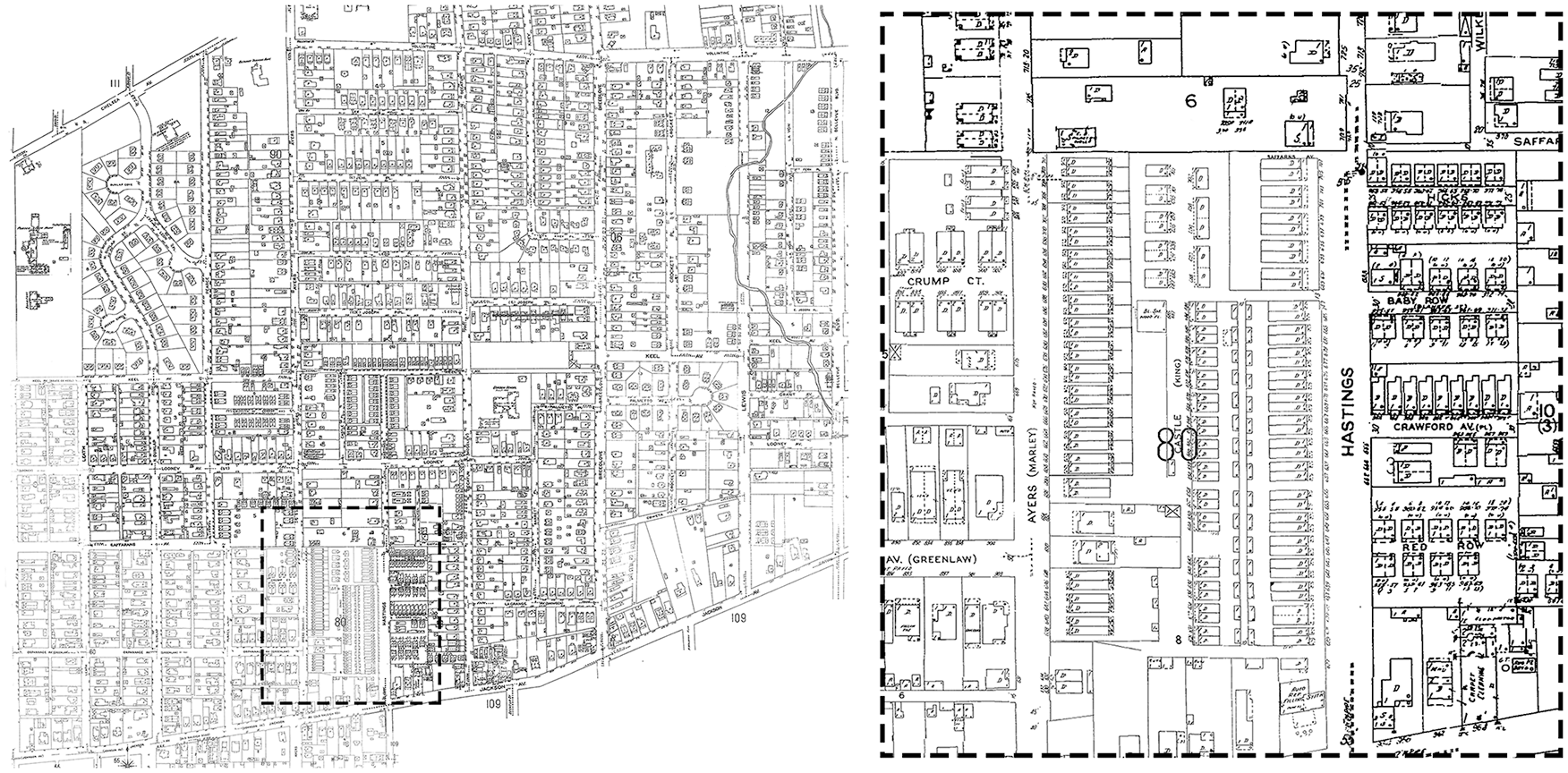
Collage of 1907–1952 Sanborn Maps (on the left), composing the western side of the KSC neighborhood; before being unified with its eastern side, this area was known as the Smokey City Community.
Klondike’s first phase of urbanization started at the beginning of the twentieth century at a location near the eastern part of the I-40 and I-69 highway corridor. Lots composing the urban fabric of this area are generally smaller than those in Smokey City, and they are almost all identical in size: each parcel is roughly 5,500 square feet, with frontages from 45 to 50 feet and depths of 95 to 100 feet. This tissue exhibits a general consistency in the type of houses, mostly single-family cottages, and a lack of the pedestrian paths and alleys that characterized the traditional Smokey City neighborhood.
Place and Society of the Traditional Neighborhood
Based on this morphological analysis, Klondike and Smokey City are two fundamentally different neighborhoods. Smokey City was settled just outside Memphis’s urban core. Its boundaries (green area in Figure 2) contained an urban fabric reflecting a mixed racial and class makeup and a physical form typical of a traditional neighborhood. Although physically connected, this intertwined system of spaces and communities in Smokey City was not reflected in strong social connections. Interviews with former residents featured stories of economic struggle, rivalrous relationships, and strong aspirations for emancipation.
Small residences and big mansions were built in the same neighborhood where whites, Blacks, Jews, and Italians coexisted in the same urban area. [The neighborhood was named Smokey City because] of the smoke coming from the blacksmith shop and from all of those African American houses without electricity that burned wood at home. (Smokey City former resident) Large houses and mansions were aligned on the main streets and were owned by the white community. Blacks lived either within the same predominantly white blocks in small shacks or in nearby areas designated only for African Americans. [In this latter case], all the shotgun houses were next to each other in an area that looked like a slave quarter. All those houses were grey and double tenanted, like the ones appearing on the TV show Roots. (Smokey City former resident)
The challenge of urban living for Blacks was evident in Smokey City, and interviewees’ stories reflect this through references to the general urban fabric of the neighborhood as well as to particular areas.
[The] “fish brothers” managed the property comprised at the intersection of Ayers Street and Hasting Street (callout in Figure 3). [There was a large ditch going through this big property, and, when it rained], this ditch used to rise and smell bad. Every summer, rather than filling the ditches and the mud holes, the “fish brothers” had a contract with a pecan factory to bring truckloads of pecan shells and just lay them on the property. [It was their approach to address the flooding problem in this area] to keep mosquitoes and the rain down. They were slumlords, and they were supported by Mr. Crump or other well-established white families close to Mr. Crump’s circle. (Smokey City former resident)
E. H. Crump was mayor of Memphis for five years, although he actively controlled local politics in the city and county for nearly forty years as the region’s most powerful Democratic Party leader. Long-time residents’ stories reflect how the Crump political machine was able to control the social dynamics in neighborhoods like Smokey City. 2
[It was about] controlling rental units in the shanty areas of the neighborhood. [It was more about a pervasive and distorted mechanism of control] that slowly allowed the liberation of the Black community from the white establishment. Only Mr. Crump and his close entourage had the power to give houses to the Blacks. If Blacks had some pull or political clout with someone that was connected to Mr. Crump, they would have had the possibility to buy a real house in the neighborhood or renting better ones than those in the ghetto with ten or more people living in two rooms. “Mrs. Rose,” for instance, used to work at “Mount Incorporated” and “Mr. Mount” was one of Mr. Crump’s cronies, so she could buy a house. [Some of the employees laboring in factories located nearby such as Firestone or International Harvester] could get to the good ol’ boys system, and Crump would allow them to rent or buy. Those who were still employed as maids, butlers, or drivers were out of the system, and they had to live in the shanty section of the community. (Smokey City former resident)
These testimonies document an arrangement of neighborhood spaces embedded in a dynamic of persistent power subjugation, which reproduced a system of white control of Black neighborhoods. As a result, the everyday public life of blacks living in Smokey City were particularly challenging.
There were no parks, community centers at that time for Blacks. [Residents of Smokey City used] to gather together and barbeque while their kids played all kinds of games and tricks. [The entire urban fabric was designed] for the white community. There were alleys everywhere in the community because those were the only walking pathways that Black people could use to move through the neighborhood. As young children, many of the African American residents going to Klondike school, rather than go through all the whites streets, had to take a shortcut through the alleys and the bayou, walking on those stones. In going to school, they had to avoid the whites because the white boys and kids would be waiting on the corner of Breedlove and Vollentine and Bellevue and all that to fight them, so they had to go through that creek. (Smokey City former resident)
Place and Society of the Black Counter Traditional Neighborhood
The Klondike neighborhood features different stories. On the other side of the highway corridor, Klondike was settled as one of the first African American communities in Memphis. It was one of the first examples in Memphis of a new neighborhood where African American families were permitted to own their property. For those families who could access the housing market, the dynamics of the traditional neighborhood became only a distant and unpleasant memory. Emancipation from power subjugation was visible in land and housing ownership patterns, which paralleled job opportunities not only at nearby facilities but also in the neighborhood. Klondike was one of the first Black neighborhoods where African Americans were able to become entrepreneurs.
[Numerous members of those Klondike households] used to work in major companies [that, over time, settled and] grew in North Memphis such as Firestone, International Harvester, Fisher Body Plant, and the Wood Lumber Company. For those families, Klondike was a prosperous neighborhood and one of the most prosperous Black communities in the city of Memphis because African Americans had jobs in those factories and industries. (Klondike former resident) Businesses on the north side of Jackson were owned by people of color. These were very different from those on the other side of the street owned by whites [see Klondike commercial strip in Figure 2]. [There used to be] shoe shops, barbershops, beauty shops, drugstores, grocery stores, and cleaners that provided the majority of all the basic needs that community residents had to have. [Klondike was a] self-contained community with a few professionals and skilled laborers and many self-trained individuals who did not have the opportunity to go to school but who constituted the community’s labor force. (Klondike former resident)
Even though Klondike’s houses and the urban fabric did not appear as diverse as those in the Smokey City, it represented a place where social connections and dynamics reflected a strong sense of community. Similar buildings sitting on identical parcels characterized the urban fabric from N. Belleview Boulevard on the west to Mansfield Street which was the last street of Klondike confining with the conterminous neighborhood on the east side. Mansfield St., in particular, was Black on its west side, but white on its east side with houses faced back toward Klondike, a physical mark of its separation from it (see highlighted strip blocks in Figure 4). Klondike can be considered a poster child for an urban fabric embodying aspirations of emancipation and communicating a strong sense of community both socially and physically at a time in American history when the community organizing efforts of people of color were fiercely opposed, especially in the American South. This narrative is exemplified in the life stories of Klondike residents such as Jesse James.
Jesse James, a neighborhood resident and community activist, had his own Klondike Food Center [on] Vollentine Avenue at the north edge of Klondike. [Since he first moved to Memphis], he was one of the community’s gatekeepers and most civically engaged citizens. In 1927 and later, flooding from the Wolf River came, so that a group of residents led by Jessie James went to the mayor to ask for immediate solutions. Under his leadership, the city installed pumps [in the neighborhood to address the issue of recurring flooding]. (Klondike former resident) He led the campaign for the formation of the Klondike Civic Club. Jesse James organized and became the president of the club, remaining in charge of it for twenty-five years . . . He organized the community going house to house, church to church, and business to business to raise funds to build the first Klondike Civic Club House in the early 1970s. The club advocated for effective solutions to poverty, hunger, racial violence, and any other community need. (Klondike former resident)
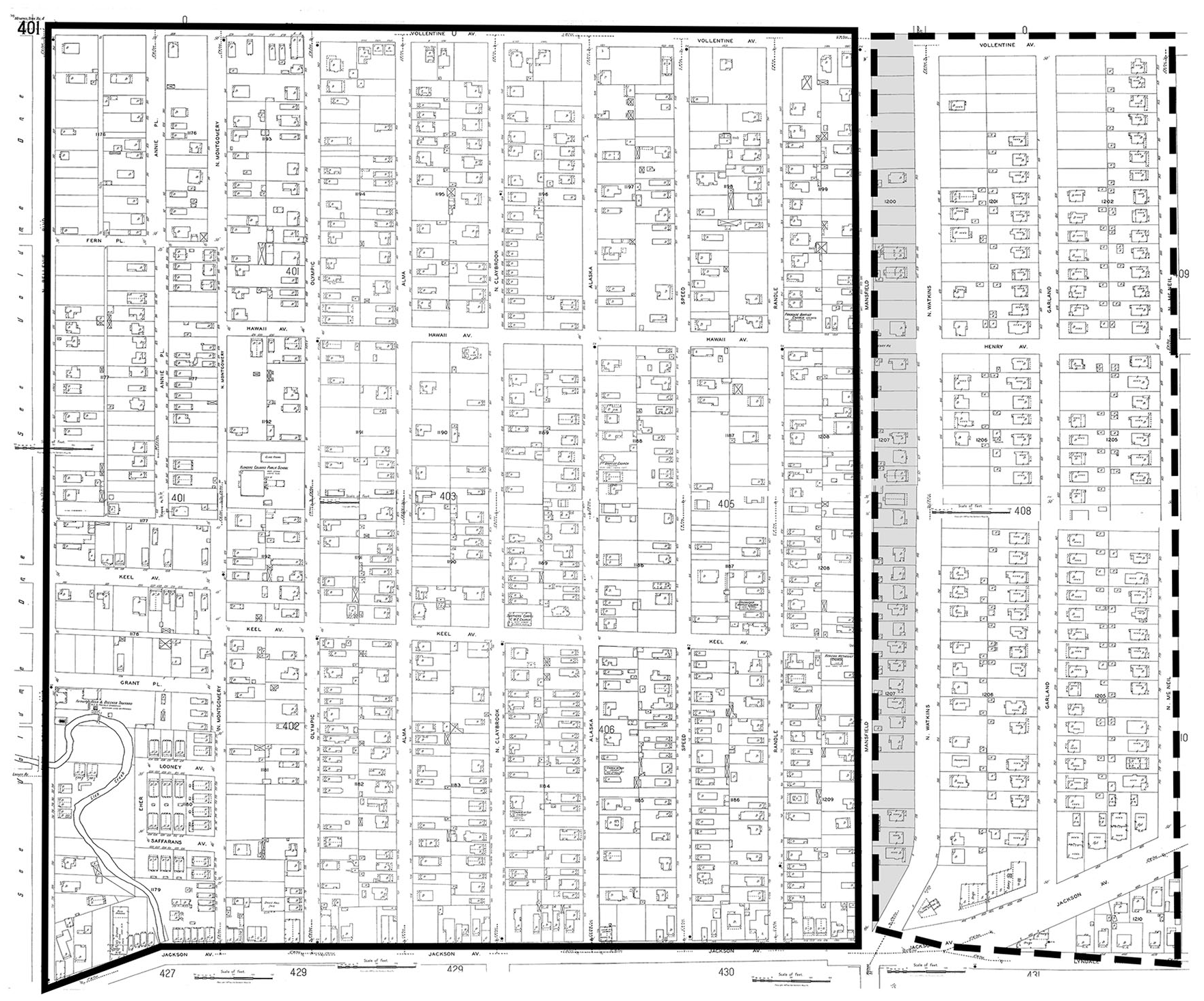
Collage of 1927 Sanborn Maps, composing the eastern side of the KSC neighborhood; before being unified with its western side, this area was known as the Klondike Community.
Blocks in Klondike were owned by African American families who, for the first time, had stable jobs in the manufacturing firms located just outside of the neighborhood. When the Civil Rights Movement started to gain momentum across the United States, Klondike was one of the main sites where residents, business owners, and institutional leaders came together to support the growing Memphis Freedom Movement. During that time, the construction of the I-40 highway physically divided the Klondike community from the rest of the city. After desegregation, however, the neighborhood changed dramatically. Black residents moved from Klondike to Smokey City as white flight created new housing options. Similar to other parts of the city, Black residents seeking improved housing, neighborhood services, and schools relocated from North Memphis to South Memphis. One KSC resident explained how the two neighborhoods over time merged into a single one to become the community that is struggling today.
Banks also started approving home loans to African Americans [that allowed many families] to move into previously owned white homes. African Americans moved to Smokey City and many other parts of Memphis to [secure bigger houses]. That was a major thing that caused the neighborhood to change, and with that change came transient people that move and rent. So those houses that were owner occupied, at a certain point, became rented homes. (KSC resident)
Data from the KSC case study suggest that the traditional neighborhood in the pre-1960s era, while being desirable for whites, was not perceived the same way by members of the Black community. In their effort to challenge prevailing Black–white power dynamics, African Americans were able to emancipate themselves from an established system of economic power and social control by creating a new urban community with a profoundly different urban fabric than the community they had left. While the urban fabric of Klondike was not as physically diverse as its Smokey City counterpart, it was the product of a Black community with stable social connections which became one of the most important epicenters of the Memphis Freedom Movement. Ironically, it became one of the first African American communities in Memphis to experience significant outmigration when equal employment and fair housing opportunities became available as a result of the movement’s success.
Discussion: Is a Neotraditional Neighborhood Needed?
In reflecting on the physical form and social fabric of the traditional neighborhood of Smokey City and the Black counter-traditional neighborhood of Klondike, this paper unveils dynamic changes in race and power relations over time illustrating how the people–space–time nexus played a central role in influencing those relations. In the Smokey City context, Blacks viewed space not only as an entity superimposed on them but also as an element they could use to emancipate themselves by propounding a spatial structural modification in the context of Klondike. These insights into the social production of these spaces may help address some of the shortcomings of the NU paradigm.
Moving Away from the Old Traditional Neighborhood
In contexts where race and power have played a fundamental role in the planning and development of the urban physical environment, a return to the traditional neighborhood appears to hinder needed changes in the historical patterns of the spatial distribution of class and race. More specifically, in a context where a proposed traditional urban form is tied to unsettling power and race dynamics, the following question could be asked: Why would a return to the mainstream traditional neighborhoods contribute to real integration?
African American communities in Memphis have endured an endless fight against what has been defined as a “plantation mentality,” referring to “white racist attitudes that promoted white domination and Black subservience, which they construed as reminiscent of slavery and sharecropping” (Green 2009, 2). In the daily life of Memphis, a plantation mentality was effectively implemented through mechanisms of power subjugation exercised by the white establishment under the orchestration of a small but powerful group of white elites. This investigation into the daily life of the traditional neighborhood from a Black perspective has revealed the pervasive mechanisms of power exercised by the white leadership and the Crump political machine to maintain social control at the neighborhood level. Smokey City represents the epitome of the traditional mixed-income, mixed-race neighborhood where its social organization was reflected in the urban fabric, intentionally planned to accommodate the effect of those mechanisms.
Old alleyways, vegetated pathways, brand-new shotgun houses, and the complementary big multi- and single-family houses might be enjoyable replicas of old urban forms for outsiders. However, these might be perceived as undesirable or even sources of unpleasant memories for many insiders, especially those who formerly experienced those old spaces. The return to the vernacular, along with the old practice of living advocated by the NU paradigm, seems to reflect narratives told by the most affluent groups in the traditional neighborhood. The counternarrative reflects a life of despair in the traditional neighborhood, where conditions of acceptance of social control and racial discrimination forced the African American community to create an alternative to the traditional neighborhood model to flourish in a setting that was intentionally planned to react against the past model.
Settling a Traditional Alternative Neighborhood
The Klondike example stands as a compelling cautionary tale to the majority of the accounts and views of the world that serve as the foundation for the NU paradigm, which propose a return to the traditional neighborhood as the solution to many of the most critical problems facing contemporary U.S. cities. Reflecting on the previously raised question, the following additional question could be asked: Why are existing counter-traditional neighborhood forgotten in the name of neotraditional developments?
Everyday life experiences and small social movements in ordinary neighborhoods, such as Klondike, have been responsible for many of the advancements achieved by the Civil Rights Movement. The Black leadership who created these communities exhibited courageous and robust opposition to white leadership that embodied the plantation mentality and modeled a way to engage community members fundamentally different from the type of Black leadership co-opted by the Crump machine. While several urban scholars have discussed various forms of paternalism to co-opt emancipatory community-building efforts (Marris and Rein 1967; Piven and Cloward 1979), others have documented the transformative power of Black self-help practices carried out by religious, civic, professional, and humanitarian organizations in Southern contexts (Brondo and Lambert-Pennington 2010; Green 2009).
The social fabric shaped by this type of leadership reflected a powerful reaction to mechanisms of co-optation that dominated many African American communities in the 1950s and 1960s. The birth of the Klondike Civic Club, the fight for school integration, and the continued support for a tight community whose members, for the first time, owned houses and small businesses were the constant objects of debate and the primary concerns of local leaders. As evident in the everyday life stories of long-time residents, the Klondike community was settled by a group of individuals who believed in a different kind of society from the one represented in Smokey City. These leaders organized and built a neighborhood that reflected these commitments and was a living blueprint for this different kind of society.
Klondike did not resemble Smokey City in terms of its most important physical features: all of the houses were similar in terms of size and features, they were built on parcels that are almost identical in size, alleys were absent, and all the streets were identical. An intentionally planned diversity of the built environment did not exist because the diversity embedded in the traditional neighborhood was an ideal that the residents sought to escape. Klondike’s physical form offered a footprint of a society whose principles of democracy were reflected in its built environment so that residents of the new neighborhood could eventually emancipate themselves from a dominated lifestyle embodied in the physical designs and social customs of the traditional neighborhood.
In the KSC case, a concrete hypothesis for planning and design action eventually led to experimentation with new forms of governance ranging from common interest communities, cooperatives, and community land trusts (DeFilippis, Stromberg, and Williams 2018; Williams and Pierce 2017). These new organizational forms were designed to establish collective subjects with authority carrying out the restoration of both sections of the neighborhood regardless of their structural differences, layouts, and physical features. In practical terms, the restoration of Smokey City was not meant to resemble, in any way, old forms of the past but only to rehabilitate its degraded parts. At the same time, Klondike was planned for rehabilitation, maintaining the counter-traditional form generated in the first place by this self-sufficient Black community. In the following section, I conclude with general reflections on the contribution of the scholarship of engagement to the investigation of the production of space and how this approach can be relevant to overcoming significant shortfalls of the NU paradigm.
Conclusion: Designing Space to Learn and Coexist
[Dr.] Martin [Luther King Jr.] said that separate but equal is inherently unequal. So how do you accomplish it? I don’t know that we’ve found the answer yet. (Klondike long-term resident)
The KSC case illustrates that, on one side, traditional neighborhood design was conceived by a few elites who saw the urban form as a means to maintain rooted power and class dynamics. On the other side, the counter-traditional neighborhood emerged from social forces reacting to those dynamics through self-organizational spatial practices. In short, Klondike was a reaction to the existence of Smokey City because the so-called traditional neighborhood was not the ideal place where a new generation of Blacks wanted to live. These opposite ways of conceiving of space parallel distinct systems of values—such as individual freedom and social solidarity—underpinning the creative process of space production.
In exploring how social dynamics have shaped the traditional neighborhood and its counter-reaction over time, this exploratory case study raises important questions on the use of the NU paradigm tout court when approaching neighborhood development projects. Physical planning solutions inspired by preconceived values and beliefs might be detrimental, especially in contexts where class and race have played an essential role in the production of space. NU advocates pressure for a more rational arrangement of space to counteract suburbanization, but their work often overlooks the types of social organizations that similar arrangements have produced in the past and ignores other older types of urbanism that should be acknowledged as much as old mainstream traditional neighborhoods.
In the search for a new model of urbanism, planning and design practice and research should question the primary source of NU inspiration by reconsidering the meaning of the word tradition (from Latin traditionem that means to deliver, surrender, or hand down). Traditional neighborhood physical fabrics are passed down to generations of space producers as examples of inspired design, but this transfer is based upon limited views of the world reflecting a process of knowledge production by the most empowered groups of users and producers of space in the so-called traditional neighborhood. Perspectives of historically disempowered users and producers might offer a different meaning of what could and should be considered traditional and who should be entitled to pass down examples of mastery design.
A paradigm for a new type of urbanism aimed at producing a better future should take into account how multiple historical urban forms came to be and how these influence present ones. It should be informed by researchers and practitioners who, by critically self-reflecting on their identities (Sweet 2018), question how the mainstream notion of tradition is rooted in the conceptualization of the white neighborhood presented as the ideal standard, perpetuating the use of whiteness as a normative category to plan and design (Goetz, Williams, and Damiano 2020). Moreover, research on the social production of space can generate not only exploratory cases to enlarge the spectrum of analyses of old forms of urbanization, but it can also offer important counter-normative insights on what ought to be done to develop a more context-based and value-driven paradigm of urbanism based on these very same understandings. In other words, explaining the social production of these often-forgotten spaces in the context of a planning process can be intentionally used not just for the mere purpose of explanation but as a means to modify existing or guide the design of new urban spaces.
From this perspective, the notion of the intersection of urbanisms intended as the intentional project of understanding and acting upon those other forms of urbanism, which are the physical expressions of historically disempowered and marginalized communities, might be helpful to generate a new paradigm of urbanism. It would be instrumental in mobilizing the attention to qualities of often-forgotten places to generate “a socio-political project which involves drawing in multiple communities of interest, and creating from this a public and a political community focused on place” (Healey 2018, 69). In acknowledging that the morphology of the urban fabric makes up one of the qualities of a place, this paper suggests using urban morphology and community engagement as corroborating methods needed to develop a sociopolitical project focused on space that might be useful in generating a new, more inclusive paradigm of urbanism. Participatory techniques alone are insufficient to grasp the vast arrays of instances—carrying specific values, beliefs, and ways of living—advanced through the establishment of physical space. The intersection of urbanisms involves methods of collaborative inquiry aimed at identifying local knowledge to give meaning to physical forms and using these deep understandings to elaborate what needs to done to change those environments for the better.
In more general terms, this paper suggests that an essential line of inquiry for spatial planning and paradigm generation can be found in collective forms of research designed to establish correlations between urban forms and communities’ values, beliefs, and ways of living. These correlations can unveil how a broad range of issues on the ground—such as power, race, class, immigration status, gender, and sexual orientation—relate to space and its production. They can reveal how these factors can be taken into account in the conception of new urban forms for practitioners embarking on the rehabilitation of existing neighborhoods or the construction of new ones. Social and moral goals can be negotiated continuously in an open and collective process of discovery during the production of space by analyzing the past and the present and by exploring possibilities for future urban forms.
From this perspective, urban codes, detailed plans, and design guidelines can be formulated as the outcomes of socially produced processes aimed at addressing problematic social issues within local contexts. Currently, NU physical forms are still conceived of as representations of ideal spaces whose modification is only marginally affected by participatory practices. This does not leave room for different structural conceptualizations of those very spaces. In reflecting on these assumptions, the scholarship on NU has been focused on the relationship between the establishment of NU neighborhoods and the better quality of social and physical outcomes that the new development should entail. These concerns reflect the silver lining of NU but overlook the root causes of its failing normative space production approach. This paper argues for the need to reengage urban form theories with a more systematic investigation of the people–space–time nexus. In complementing scholarship focused on the assessment of implemented NU projects, similar investigations might address more structural issues related to space and society and offer new insights needed for a more complete context-based and value-driven paradigm of urbanisms.
Footnotes
Acknowledgements
I thank the Klondike Smokey City Community Development Corporation and all the residents of the Klondike Smokey City community who shared their touching stories on living in the Klondike and Smokey City neighborhoods. Special thanks also go to all the faculty and students who participated in this project. I thank Michael Smart for his editorial guidance and the three anonymous reviewers for their insightful feedback, comments, and reflections.
Declaration of Conflicting Interests
The author(s) declared no potential conflicts of interest with respect to the research, authorship, and/or publication of this article.
Funding
The author(s) received no financial support for the research, authorship, and/or publication of this article.
