




Abstract
This article presents the findings from interviews with thirty individuals, living in Maryland and Virginia, who received subsidized cars from a nonprofit organization to examine how their lives changed when they received a subsidized car. Having a car eased their daily travel, and enabled access to higher paying jobs, moving to neighborhoods with more opportunities, and access to education and enrichment activities for recipients and their children. I also situate the subsidized cars within interviewees’ mobility history. Most had owned cars before, and subsidized car ownership programs offer low-income consumers a safe alternative to a risky and expensive market for used cars.
Introduction
Transportation planners who want to help low-income households face a conundrum. Access to a car is associated with upward economic mobility for low-income households, yet expanding car ownership flies in the face of transportation planning goals to reduce dependence on automobiles and their negative externalities. For fifty years, scholars have wrestled with the question of whether policy makers should subsidize car ownership as a tool for economic and social mobility among the poor in the United States (Blumenberg and Manville 2004; Chapple 2006; Grengs 2010; Kain and Meyer 1970; King, Smart, and Manville 2019; Myers 1970; O’Regan and Quigley 1998; Pendall, Blumenberg, and Dawkins 2016; Taylor and Ong 1995). This challenge has only become more difficult with increasing income inequality, continued dispersal of homes and jobs, and demands to decarbonize transportation.
I examine how receiving a subsidized car changed the lives of low-income individuals and households, and situate these cars within their owners’ longer mobility biography. This research is drawn from thirty interviews with individuals who received a subsidized personal vehicle from a nonprofit organization. Interviewees paid less than $1,000 to receive a car from the largest and most established vehicle access program in the country, Vehicles for Change (VFC).
The findings enrich our understanding of how car ownership changes daily mobility and enables access to opportunities, and how these episodes of car ownership fit within longer trajectories. As expected, when interviewees obtained a car, their travel behavior changed dramatically. They transitioned from heavily relying on public transit, borrowing cars, and asking for rides to driving. As a result, their travel times were greatly reduced and travel was less difficult.
Access to a car also enabled access to employment, health care, shopping, and childcare opportunities that were previously out of reach. Interviewees explained how having a car provided upward economic mobility, enabled them to relocate, and expanded their and their children’s opportunities for education and enrichment. While these changes are dramatic, they need to be situated within a longer trajectory. Interviewees had almost all owned cars before and, without VFC, likely would have bought a car again on their own. Doing so, however, would have put them at the mercy of the open market, where they would be likely to pay more for less reliable vehicles that would not last as long. These findings suggest new directions for future research.
The following section describes the research on car access and economic and social mobility. After that, I briefly describe the nonprofit organization I worked with, Vehicles for Change, and the data collection and analysis process. Then I describe the main findings from the interviews. I conclude with a discussion of the findings and implications for research and policy.
Car Access and Economic and Social Mobility
Researchers have consistently found that having a car is associated with improved economic outcomes. When poor households have or gain a car, household members are more likely to be or become employed, keep their jobs, increase their earnings, work more hours, and leave welfare programs (Baum 2009; Blumenberg and Pierce 2017b; Cervero, Sandoval, and Landis 2002; Gurley and Bruce 2005; Ong 2002; Raphael and Rice 2002; Smart and Klein 2020).
Underlying the economic benefits of car ownership is the simple fact that one can more quickly and easily access more jobs and other opportunities by car than by other transportation modes in almost all neighborhoods in the United States (Boschmann 2011; Grengs 2010; Kawabata and Shen 2007; Shen 2001). These geographic challenges are compounded by the growth of poor and minority populations in the suburbs where access to jobs is limited without a car and by increasing gentrification in urban neighborhoods with good transit service (Allard 2017; Bischoff and Reardon 2014; McLafferty and Preston 2019).
The opportunity divide between car-owning and carless households extends beyond employment and earnings. Carless households are more likely to miss and delay medical care (Syed, Gerber, and Sharp 2013). Having a car increases school choice (Teske, Fitzpatrick, and O’Brien 2009), and children in households without cars are less likely to participate in school activities, leading to lower educational attainment, less likelihood of being employed, and lower earnings later in life (Ralph 2018). Households without cars also have fewer choices when shopping for groceries and less flexibility in what they buy and how often they shop (Clifton 2004; Widener 2017). Furthermore, given that women are responsible for a larger share of nonwork household responsibilities, women may benefit more than men when a household gains a car (Blumenberg 2016). These benefits may be less significant in households where men and women share a single car, however, given men’s and women’s different access to cars within households (Scheiner and Holz-Rau 2012).
Access to a car also shapes residential mobility. Several studies using data from the U.S. Department of Housing and Urban Development’s Moving to Opportunity experiment found that access to a car enabled low-income households to move to low-poverty neighborhoods (Blumenberg and Pierce 2017a; Dawkins, Jeon, and Pendall 2015; Jeon, Dawkins, and Pendall 2018), while those without a car faced fewer choices when moving (Rosenblatt and DeLuca 2012). Households facing housing and employment instability have even greater incentives to purchase a car despite the high costs of car ownership (Mullen and Marsden 2018; Mullen, Marsden, and Philips 2020).
Even after decades of calls to subsidize car ownership, few such programs exist, and there is scant research on them. Exceptions include M. T. Lucas and Nicholson’s (2003) analysis of thirty-four individuals who received cars from the Good News Garage in Burlington, Vermont. The authors focused on the effect on incomes and found that car recipients’ incomes increased roughly $125 per month ($177 in 2020 dollars) after they received their vehicles. Brabo et al. (2003) surveyed thirty-four individuals who received cars through the JumpStart program in Wisconsin and found positive effects on earnings, employment outcomes, credit scores, and school opportunities for children.
Expanding car ownership seems to run counter to transportation policies focused on curtailing automobility and its consequences. Critics and proponents of car ownership programs worry that car subsidy programs will increase CO2, worsen congestion, exacerbate sprawl, undermine public health, and impose high personal costs on those owning and maintaining the cars (Clifton 2004; Jeon, Dawkins, and Pendall 2018; Pendall, Blumenberg, and Dawkins 2016; Sanchez and Schweitzer 2008). Within this context, policy makers are unlikely to promote large-scale programs to subsidize car ownership for the poor (Blumenberg and Pierce 2014).
VFC
To understand how individuals’ lives changed after they obtained a subsidized car, I interviewed individuals who received cars from VFC. Since 1999, VFC has provided more than 6,000 cars, trucks, and minivans to low-income carless households throughout Maryland and Virginia (and recently in the Detroit metropolitan area).
To receive a car from VFC, applicants need a referral from a social service agency or nonprofit organization that identifies and screens potential candidates. Potential recipients must meet income and work requirements. 1 VFC then interviews qualified applicants to match them with a car that suits their needs (e.g., larger vehicles for larger households).
The cars VFC distributes mostly come from donations. When VFC receives a donated vehicle, the staff at the VFC Full Circle Auto Repair and Training Program (a job training program for formerly incarcerated individuals) evaluate the vehicle to ensure that it will be roadworthy. VFC’s goal is for donated cars to continue to function for at least two years or 24,000 miles after the individual receives the car. Most of the cars the organization distributes are less than twelve years old and have fewer than 150,000 miles on the odometer. If the car is too new, is too old, or will not last, VFC sells the car through a subsidiary car dealership, Freedom Wheels (freedomwheels.org).
VFC partners with a local bank to offer short-term loans to help recipients pay for the vehicles and does not require a down payment. The cars cost recipients between $850 and $950, which most recipients remit in monthly payments of $50 to $100 (in the past, the cost of vehicles has ranged from $600 to $1,200). Recipients also pay for tax, registration, and title, and provide proof that they are insured. The cars also come with six months of free maintenance at VFC’s garage.
Data Collection
During fall 2018, I interviewed thirty individuals who received cars from VFC to understand how obtaining cars changed individuals’ lives. Staff at VFC assisted with recruiting interviewees from the database of vehicle recipients, with an oversample of people who received their vehicles more than five years earlier (before 2013). In addition to VFC’s recruiting, a Baltimore-based nonprofit that partners with VFC also sent a recruitment email to a small number of recipients of cars through VFC who had obtained their cars in the previous two years (I recruited five of the interviewees through this organization).
The interviews followed a semistructured interview protocol and lasted between fifteen and sixty minutes. I conducted interviews in person when possible, and over the phone when not. I conducted fourteen in-person interviews at the VFC office in Halethorpe, Maryland, and three at the office of a partner nonprofit in Fairfax, Virginia. Once I felt I had reached saturation with interviews, I stopped recruiting additional interviewees.
I began each interview by asking the participant to tell me about receiving the car from VFC. From there, I asked how their travel behavior and lives changed after they acquired a car and their history of car ownership. I recorded each interview and had them transcribed. Interviewees received a $75 gift card for participating.
I asked participants to fill out a brief sociodemographic survey. Twenty-eight interviewees who filled out the survey (two phone interviewees did not) had received cars from VFC between 2002 and 2017, and nine still had their VFC cars at the time of the interview (Table 1). The interviewees all lived in Maryland or Virginia at the time of the interview (Figure 1) and were twenty-four to fifty-eight years old. Twenty-one interviewees identified as black, and twenty-one identified as female. Seven had a household income below $20,000 in 2017, ten made between $20,000 and $40,000, and ten reported making more than $40,000 (one person did not report their income). Twenty-one had one or more children in their households, and thirteen reported that they were the only adult in their households.
Interview Participants.
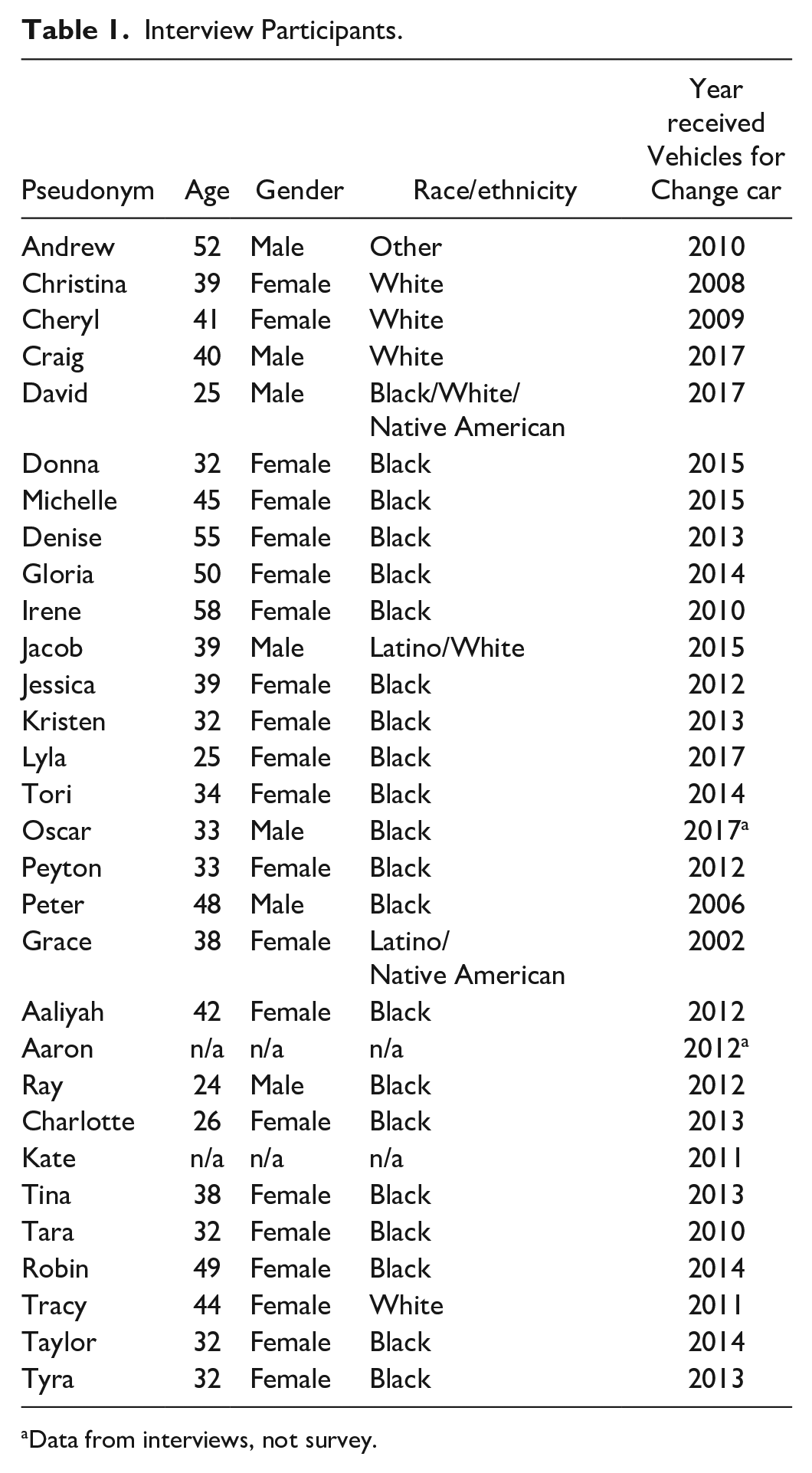
Data from interviews, not survey.
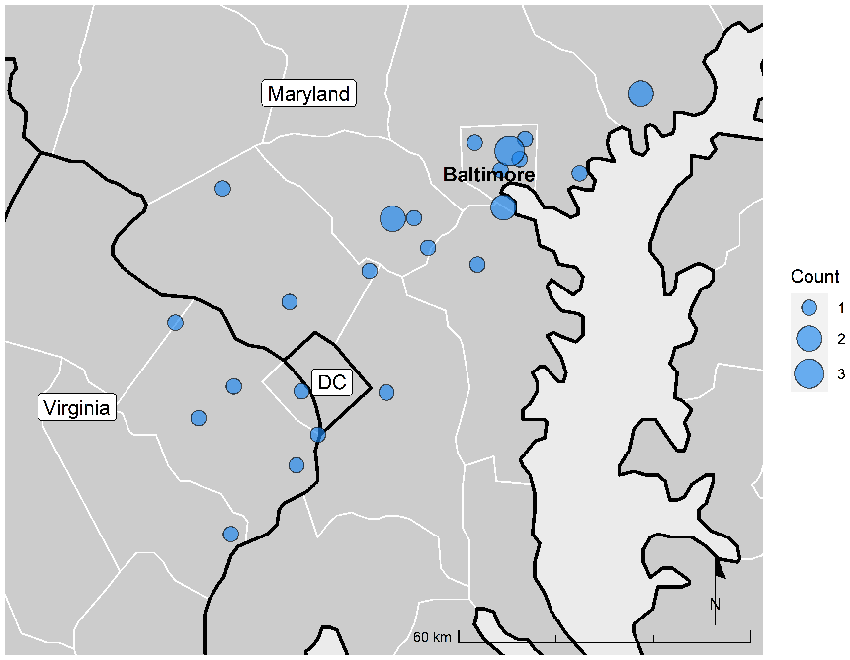
Interviewee residential locations, by ZIP Code (n = 28).
To code the transcripts, I used a combination of deductive and inductive codes. Before coding, I created a list of thirty-one a priori codes based on the literature and reviewing memos I wrote after each interview. These codes focused on the VFC car, logistics, non-VFC cars, and opportunities. I then manually coded the transcripts with the help of several research assistants in MAXQDA, adding inductive codes during the analysis and modifying codes as needed. Each interview was coded by me and at least one other member of the research team.
I acknowledge several limitations to my research. The individuals who received a car from VFC might be different from those who did not, and this may bias the results. Recipients of subsidized vehicles who had positive experiences with VFC may have been more likely to participate in my interviews. In addition, because I relied on VFC’s staff to recruit interviewees, the organization could have intentionally or unintentionally influenced the pool.
My research cannot differentiate the outcomes (what happened after receiving a car) from the impacts (the effects directly attributable to receiving a car from VFC). I may misattribute the positive changes in recipients’ lives to the effects of receiving a car. Because VFC works with social service agencies as intermediaries, almost everyone I interviewed was receiving other services at the same time.
My research may omit negative aspects of car ownership. I did not specifically ask the interviewees about changes in transportation costs before and after receiving a car from VFC. I also neglected to ask about other burdens of car ownership, such as having to give rides or lend out their car to friends and family without a car.
Finally, my own positionality likely affects this research. As a white male researcher interviewing mostly non-white female participants, there are questions that I did not think to ask, aspects of their experiences that I overlooked or ignored, and information that interviews did not reveal to me.
Findings
The following summarizes the three main findings from the interviews. I describe interviewees’ changes in travel behavior, their changes in access to opportunities, and how the cars they received from VFC fit within their history of car ownership.
Travel Behavior Changes
Before receiving a car from VFC, most interviewees were multimodal. They relied on public transit for much of their travel (twenty-seven out of thirty indicated that they used public transit for some of their travel) but also discussed borrowing cars; getting rides from family, friends, and neighbors; using taxis and ride-hail services (e.g., Uber and Lyft); and walking and bicycling. Interviewees also mentioned that they occasionally had to forgo trips when they could not borrow a car, when they did not want to burden others by asking for a ride, or when public transit was not convenient or timely. As Tracy said, Before I got the car, it was really complicated . . . If I didn’t have a car, I didn’t go. Or if I couldn’t arrange a ride, we didn’t go. That was just my life without a car. It was much harder.
Once they had their VFC cars, all interviewees except one drove for most trips.
Public transportation
To understand how their travel changed, I asked interviewees to tell me about a trip they made before and after receiving a car. Interviewees spoke about complicated one- to three-hour transit journeys that became ten- to forty-five-minute trips in a car. Taylor described her commute, which required several transfers, as going “from Peter to Paul, to John, to Jacob, the Jingleheimer Schmidt’s.” She added, “I couldn’t cut it down unless I had a vehicle.” These long transit travel times are a “time cost” (Lowe and Mosby 2016) that transit riders pay due to infrequent bus service combined with complicated journeys.
Beyond the time costs, interviewees talked about the difficulty of traveling on transit in bad weather with children. These challenges were physically unpleasant and emotionally wrenching, burdens that largely fall on women (Taylor, Ralph, and Smart 2015). Donna, one of six interviewees who brought up this topic, said traveling on transit alone in bad weather was manageable: “It’s like, ‘Okay, I can thug it out.’” But this changed once she had kids. She said, “looking at your babies freezing” waiting for the bus led her to take driving lessons and acquire a car from VFC. Similarly, Kate described a breaking point that led her to seek out a car from VFC. She recalled, I said, “Enough is enough,” the day when I got caught in a really bad storm with my daughter. We were drenched wet. I was like tears rolling down my eyes like, “This just can’t be it.”
For these and other interviewees, car ownership is bound up with their view of themselves as parents. Access to a car enabled practices they associated with “good mothering” (Dowling 2000). For Donna and Kate, good mothering meant that their children were no longer suffering in inclement weather waiting for public transit. Aaliyah said that once she obtained the car from VFC, “it made me an equal co-parent” and “gave me more confidence as a parent, as a mother.” Charlotte also mentioned her children were a motivation for getting a car from VFC, “just to provide better care for my kids.”
Shorter travel times led to other quality-of-life improvements for families. Once they had cars, children could sleep longer in the morning, and parents had more time with them in the evening. For example, before she acquired a car, Donna had to wake her children “up at 5:00 just to get everybody ready” to arrive at school on time. Breakfast was rushed: “I’m like, ‘Kids, hit the granola bar. Let’s roll.’” Once they had the car, her children were able to sleep until 7. Donna arrived home two hours sooner and could “cook dinner, help my kids with their homework, give the baby a bath.”
Interviewees’ discussions of public transit were not all doom and gloom. For example, those who had lived in places with high-quality public transit recalled fewer problems. Irene recalled living in Washington, D.C., noting that “public transportation is not an issue . . . [you can] go anywhere on the train and the bus.” A few interviewees also spoke positively about taking transit with their children for leisure trips to the zoo or elsewhere.
Getting rides, borrowing cars, taking taxi and ride-hail trips
Borrowing cars and getting rides from friends, family, and neighbors was common among interviewees prior to receiving a car from VFC. Twenty-six of the interviewees mentioned borrowing cars or getting rides, and six did so regularly to commute, chauffeur their children to school, or both, consistent with other research that has found that carless households often use cars (Lovejoy and Handy 2008; Pucher and Renne 2003). The twenty interviewees who mentioned occasionally borrowing cars or getting rides also noted that they limited how often they asked to borrow a car or for a ride, even if they offered some money for gas or the ride. Kristen said that she felt “awkward continuously having to ask people . . . you don’t even want to [ask] anymore at a certain point.” Interviewees worried about being a burden or inconveniencing others when asking to borrow a car or for a ride (see Murphy [forthcoming] for more on the social pressures involved in asking friends and neighbors for rides).
2
As Irene said, It was good to have people that you could depend on, but it’s a lot better not having to depend on anybody for a ride to take care of your business, to take care of the things that you needed to take care of.
For parents with small children, even borrowing cars or getting rides could be a challenge if they were traveling with a car seat, stroller, or both.
Twelve interviewees used taxis and ride-hailing services when borrowing a car or asking for a ride was not an option. Most limited their use of these modes because of the cost. For example, they used them when coming home from the grocery store, when the weather was bad, and for health care–related trips.
Accessing Opportunities
Receiving a car from VFC allowed interviewees to access opportunities that were previously out of reach. As Kate put it, “So many different things open up to a person that is mobile.” Interviewees described how access to a car enabled economic mobility and expanded their access to neighborhoods, education, shopping, and health care.
Economic mobility
Access to a car enabled interviewees to access more employment opportunities and increase their earnings. Interviewees’ descriptions of cars expanding their spatial search for jobs and how reliable transportation enabled them to keep their jobs, work more hours, and earn promotions are consistent with previous studies (Baum 2009; Blumenberg and Pierce 2017b; Gurley and Bruce 2005; Smart and Klein 2020). Because twenty-six out of thirty interviewees were already employed when they got a car from VFC, our conversations focused on increasing earnings rather than transitioning from unemployment to employment.
When they were without a car, interviewees’ job opportunities were limited. Tracy described how she had the education and experience to get good-paying jobs but had to work “minimum-wage jobs that were around my very own area that I could either walk to or bus to.” She characterized her situation as a “Catch-22,” explaining that “in order to get a car to go to work, you have to have a job. And in this area, unless you have a car, you can’t really get a decent job.” Others echoed Tracy, saying they accepted lower paying jobs close to their home and turned down or did not pursue job opportunities that were inaccessible without a car.
Gaining a car expanded the pool of jobs available to interviewees, and they were able to increase their earnings by switching to higher paying jobs, picking up a second job, and taking on seasonal work. Tracy was able to escape the Catch-22 by switching to a higher paying job farther from home. She said, Once I got the car and I could get the job that was farther away, I tripled my income. Then I was able to get my own place and move with my kids . . . I went from making minimum wage across the street, and I started making like 60 [thousand dollars a year at a large telecom company]. Yes, it definitely tripled my income.
Tracy’s earnings increase after receiving a car from VFC is at the high end of those reported by interviewees. More typical were the experiences of Grace and Peter. Grace transitioned from a job at a hospital in the center of Baltimore making $11 an hour to a position at a large government agency in the suburbs where she made $18 an hour. Peter switched jobs and increased his earnings from $8.75 to $12.25 an hour one month after receiving his car. Aaliyah did not increase her earnings immediately but gained valuable experience working “with a really great mentor chef,” which led to more job opportunities. She added that she did not have to “settle for working somewhere else maybe closer to home,” which she said would not have led to the same career advances.
Access to reliable transportation helped interviewees even if they stayed at the same employer. Tori said the VFC car “allowed me to keep my job” because “you need dependable transportation to keep a job, to be on time.” Taylor said that getting to work on time was “a really, really, really big issue” before she received the car from VFC; afterward, she “wasn’t getting there late every day.” For others, like Charlotte, the car cleared the way for advancement. Charlotte was promoted from housekeeping to become a dispatcher at the same hospital not long after she obtained the car because she started to arrive on time and was able to stay late and work alternate shifts. The dispatch job paid more, the hours were better, and the work was less physically demanding. Others mentioned increasing earnings by working more hours and transitioning to full-time employment.
Beyond spatial barriers, interviewees described how access to transportation was a screening question in many applications. Peter said, “I have yet to see an application that doesn’t ask . . . Do you have reliable transportation?” He speculated that employers were trying to gain “a sense of your stability, and are you going to be reliable as far as getting to work and not having to depend on public transportation or anyone else to get you there?” Regardless of whether Peter could have found his own means to get to and from a job site, he felt screened out of jobs because he did not have a car.
Moving
Sixteen of the interviewees mentioned that they moved not long after they got a car from VFC, and having a car played a role in their relocation. First, because they had a car, their earnings increased, and they could then afford to move. Tracy said, “Once I got the car, then I was able to get my own place because I had a job where I made enough money.” Second, vehicle access eased and expanded interviewees’ housing searches (Dawkins, Jeon, and Pendall 2015; Jeon, Dawkins, and Pendall 2018). For Cheryl, a car meant that she “was able to get around and check out places” in less time and with less hassle than on public transit. Finally, having a car made previously inaccessible neighborhoods accessible (Jeon, Dawkins, and Pendall 2018). Kate described the location of her new suburban neighborhood by saying, “I wouldn’t be able to live in such a place like that because there were no bus routes close to the house.” Previously, interviewees had prioritized access to transit when searching for housing (Boschmann 2011). With a car, they could prioritize factors other than transportation access, like “a safer environment” (Peter), a single-family house (Tina), “better schools” (Kate), and living closer to family (Jacob).
A few interviewees received a car from VFC because they had moved to a less accessible neighborhood. In these cases, interviewees were referred to VFC by social service agencies that helped them access housing vouchers and find housing in suburban neighborhoods where public transit was limited. Tara, who moved from Baltimore to a suburban county, said the agency she worked with “felt if you have transportation in a certain county, it’ll help you with getting a job, maintaining work.” By helping these households acquire a car after the move to suburban neighborhoods, VFC provided a service similar to “car vouchers” (funds to purchase or repair a car), which housing scholars have suggested should augment housing vouchers (Briggs, Popkin, and Goering 2010; Jeon, Dawkins, and Pendall 2018).
Education and enrichment
Acquiring a car from VFC also helped interviewees access education and enrichment activities for themselves and their children. Because school buses provide rides home only at the end of the school day, many interviewees’ children had to skip after-school programs when the family did not have a car. Children living in households that received VFC cars could participate in after-school activities and enrichment programs outside of school, which may have long-term positive benefits (Ralph 2018). Kristen enrolled her son in soccer, baseball, basketball, and karate. “Without [the car], he wouldn’t have been able to do those things,” she said. Kristen’s experience was typical, and others mentioned enrolling their kids in swimming, gymnastics, ballet, lacrosse, and chorus.
Parents also talked about attending more school events, going along on field trips, joining the PTA, volunteering at school, joining the YMCA, becoming affiliated with churches, and attending school board meetings. Beyond after-school activities, interviewees talked about being able to go to the library regularly and to travel to the Smithsonian’s National Zoo and museums in Washington, D.C., and amusement parks farther away. Several interviewees mentioned being able to attend family events that they would otherwise have missed.
Moreover, five interviewees used their cars to further their education after work. Peter and Aaliyah both said that without the car, traveling to and from school on public transit after a full day of work would have been time-consuming and exhausting.
Shopping
Without a car, nineteen of the interviewees said, they felt limited in when, how, and where they could shop. Carrying groceries on foot or transit is physically challenging; it limits which stores people can patronize and what they can purchase in a single trip (see also Clifton 2004). Interviewees who took the bus were restricted by the bus schedule. Jessica said, “We had to be on a time limit because we had an hour to shop and do everything because the next bus came exactly in that hour.”
Having a car increased interviewees’ choices about when and where to shop and allowed them to decrease their expenses. Interviewees could choose to shop less frequently, shop at hours when transit does not run, and shop at types of stores that were otherwise not easily accessible. For Oscar, whose family is vegan and shopped at specialty grocery stores, “we can’t just walk to the carry-out or to the gas station or go grab a chicken box.” Grace was also able to carry more groceries on each trip, and instead of shopping “every couple of days,” she was able to go one to two weeks between trips. Interviewees could also reduce their expenses by comparison shopping and avoiding paying for rides home with their groceries. Peyton was able to quantify her savings. Before receiving a car from VFC, she had to budget $250 for food, but “with the car I saved. I spent a good 160-something going to three different stores versus just dealing with one.”
Health care
Having a car expanded interviewees’ access to health care, easing travel to doctors and enabling them to select doctors with more flexible hours, more expertise, and lower fees. Nineteen interviews discussed improved access to health care. Charlotte recalled that if she had to take her twins to the doctor, the trip was so time-consuming that they might miss an entire day of school. The car “made it to where I could take them to school just a little bit later and not have to worry about their education suffering.” Time spent traveling to and from doctor’s appointments and follow-up visits can quickly multiply, especially for parents of children with special needs.
Interviewees also described expanded choice in medical professionals. After Kate got a car, she started going to an urgent care center, which was farther from her home but much cheaper than the nearby emergency room. She said, “Even though I’m paying more in gas, I’m paying less in medical expenses, which is much better.” Before she had a car, Jessica was not satisfied with the medical care her family was receiving. She felt that her doctor “didn’t really pay attention to what we were saying.” With a car, she said, “I could venture out and get to a better doctor.”
Once they had a car, interviewees were more proactive in seeking out medical care and less likely to miss doctors’ appointments (see also Syed, Gerber, and Sharp 2013). Irene’s experience sums up many of the ways that having a car improved health care for interviewees. Irene was able to go to the doctor on her lunch break, and “I would never been able to do that if I had had to catch the bus.” She subsequently was diagnosed with Type 2 diabetes and began attending training sessions at a nearby hospital to learn how to manage her condition. She summed up the experience by saying, “If I had not had that vehicle and been able to go to the doctor and keep my regular appointments . . . I probably would not have been as proactive with my health.”
Accessing medical care without a car added to interviewees’ worries and anxiety. Michelle referred to this as a “stress that we carry just trying to get the support that we need.” She gave an example of getting a ride to the doctor from an acquaintance, only to find that the doctor was running late. Michelle described feeling anxious waiting for the doctor and worrying about whether her acquaintance was annoyed by the delay. Charlotte also talked about her anxiety, using the example of taking the bus to pick up her sick daughter at school. She said, “You just feel like you cannot get to your child fast enough.” She went on to contrast that example with an incident after she received the car, when her doctor said her daughter needed to go to the hospital and offered to call an ambulance. Charlotte said, “That was the best feeling, to say, ‘No, I have my own transportation, we’re going now.’”
Car Ownership History
In the months and weeks before obtaining a car from VFC, interviewees relied on public transit for most trips, combined with walking, cycling, getting rides, and borrowing cars. But a longer view suggests that, like most Americans, interviewees had owned and used cars in the past and planned to continue doing so. To understand their experiences of car ownership, I asked interviewees about their car ownership history. In-person interviewees wrote their car ownership history on a timeline.
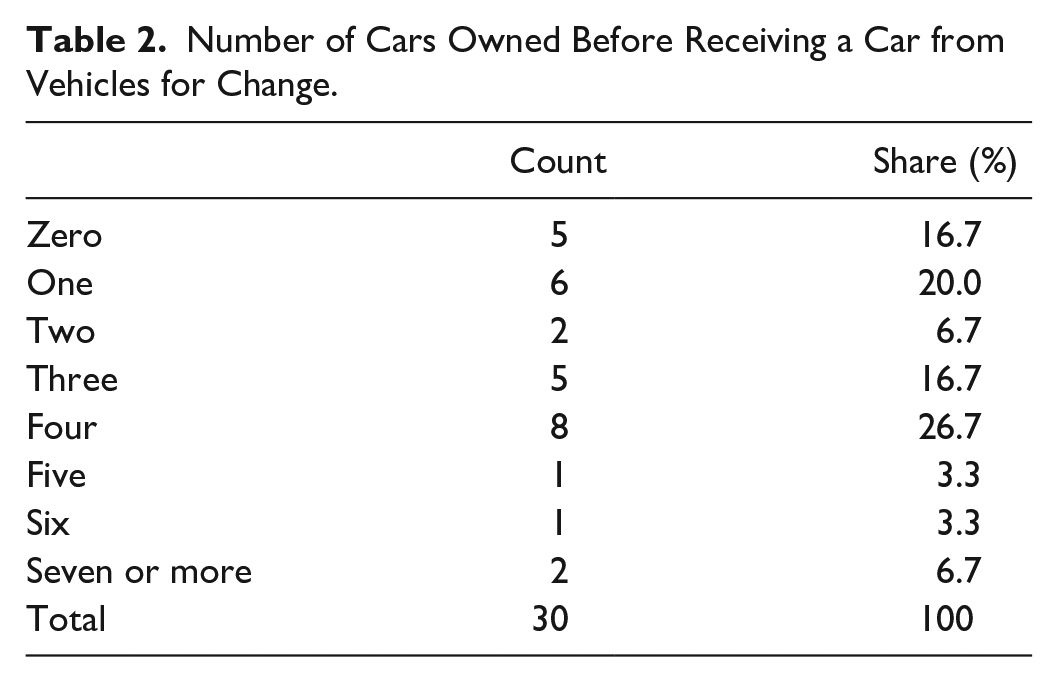
Twenty-five out of thirty interviewees said they had previously owned at least one car before getting a car from VFC. The median interviewee owned three cars prior to getting a car from VFC (Table 2). Interviewees’ car ownership histories were characterized by episodes of car ownership and carlessness. Tyra’s experience is an extreme example of this frequent churning (Klein and Smart 2017), which she illustrated on a timeline (Figure 2). Over the course of eleven years before she obtained a car from VFC, Tyra bought seven inexpensive and unreliable cars: I would get a car around the beginning of the year. If I’m lucky, it would last a year. But usually, it didn’t. So, during the time I didn’t have one, I would just catch the bus. Then, the beginning of the year, when I filed taxes, I would get another car.
Number of Cars Owned Before Receiving a Car from Vehicles for Change.
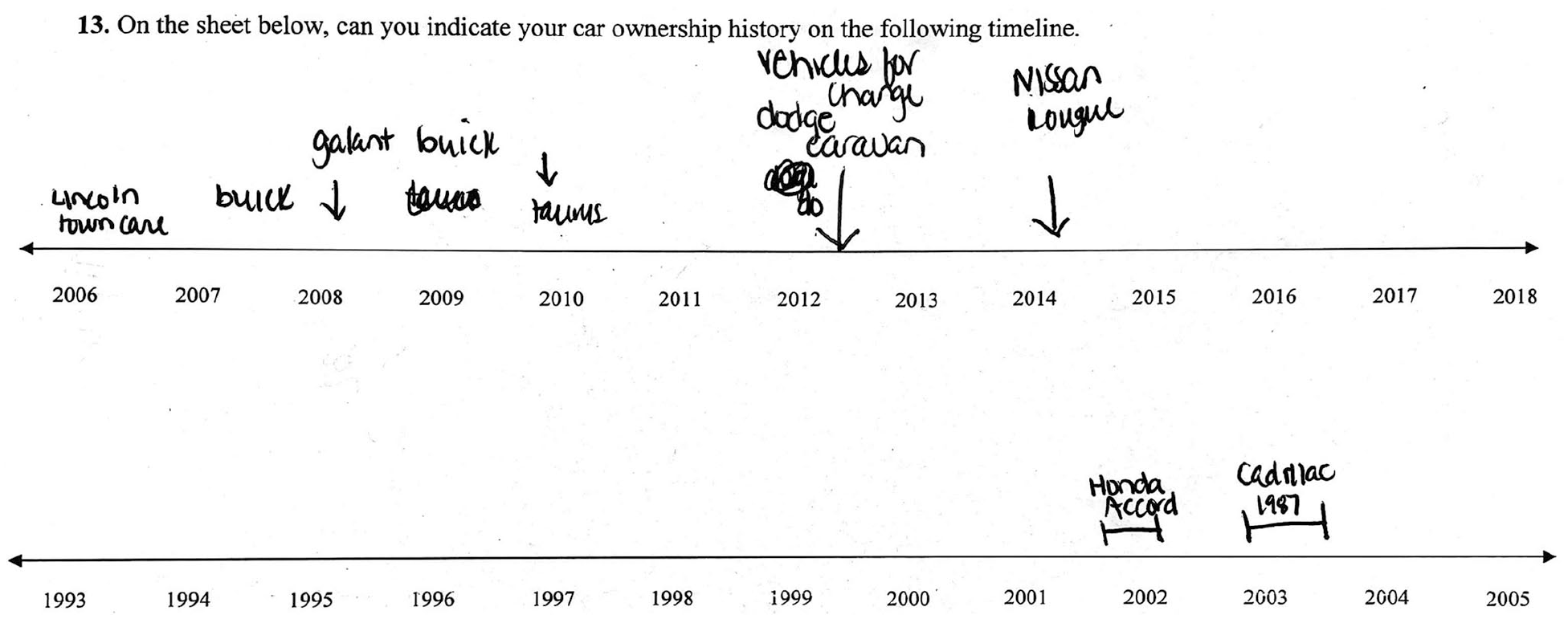
Tyra’s car ownership timeline (handwritten annotations, in chronological order: Honda Accord, Cadillac 1987, Lincoln Town Car, Buick, Galant, Buick, Taurus, Vehicles for Change Dodge Caravan, Nissan Rouge).
The most common reasons that interviewees lost access to a car were the need for mechanical repairs, car crashes, and financial difficulties. Keeping up with the payments or the costs of maintaining the car proved difficult for many people under financial stress. As the car was often purchased (and could only be afforded) at a very low price, the costs of maintaining it exceeded the value of the car itself. Other causes were family and relationship changes such as a divorce or breakup where the interviewee gave up the car voluntarily, both parties sold the car, or the former partner “ran off” with the car.
When I asked interviewees what they would have done had they not received a car from VFC, thirteen out of nineteen said they would have gotten a car on their own. Interviewees who said they would have obtained a car on their own indicated that compared with what they got from VFC, it would have taken longer, cost more, or both. As Robin put it, “I probably would have got a car that I couldn’t afford, like I did before.”
Interviewees characterized the cars they bought on their own as expensive, risky, and unreliable. They provided details on roughly half of their car purchases. The following is drawn from these descriptions. The most common source for cars was car dealerships. Interviewees mentioned buying nineteen cars from car dealers. These purchases were more expensive than cars purchased elsewhere (from $3,000 to $27,000). Next most common were purchases at car auctions (twelve mentions), followed by individual sellers (such as Craigslist and newspaper advertisements, nine mentions), and friends, family, and informal sales on the street (five mentions). Interviewees like Tori said that they relied on auctions when they were not in a financial position to “afford a car note” (loan). Cars purchased at auctions tended to be less expensive (typically between $1,500 and $3,000). The cost of cars bought from individual sellers, family and friends, and people on the street ranged widely, from $600 to $6,000.
Purchasing cars on the open market entailed considerable risks. Seven interviewees had cars repossessed. In four of these cases, the car was repossessed after the interviewee lost a job or experienced another crisis. In the other three cases, the cars stopped working within several months of the purchase. Charlotte’s experience of buying a car for $9,000 from a car dealer is illustrative. After paying a $1,500 down payment, “the engine died on me six months later.” Charlotte eventually had the car voluntarily repossessed but was “stuck with the full balance,” and the lender subsequently garnished her bank account. At the time of our interview, more than a year after the car was repossessed, Charlotte was still paying $300 per month, making it difficult for her to buy another car. Reflecting on her situation, Charlotte lamented, It’s already stressful, I live in poverty, but I do need a car. . . . I need better transportation but at the same time, I need it affordable. That never goes hand-in-hand with transportation.
Interviewees also faced risks buying cars from other sources. For example, Tara bought a minivan after seeing an ad on Craigslist, but the car lasted only a few weeks. She said, I guess, the guy put, I don’t know, sawdust or something in the transmission. So, within weeks, the transmission completely gave away. . . . It’s horrible because you think you’re getting something decent and reliable. You spent your money and you can’t get it back.
Interviewees routinely characterized the cars they bought on the open market as unreliable and requiring ongoing upkeep. As Ray explained, “Right after you bought the car, you had to go right back in your pocket to do maintenance.” Oscar characterized the four minivans he bought before getting a car from VFC by stating that they were “very cheap and didn’t really last for long, [and a] lot of maintenance . . . Most of them didn’t even last for a year.” As a result, these car ownership episodes typically ended in an involuntary manner, after a car crash, a car being stolen or beyond repair, the costs climbing too high, and the like.
In contrast, interviewees reported that the cars they received from VFC were less expensive and more reliable than those bought on the open market. Interviewees described the cars as “very dependable” and in “great condition.” When they talked about repairs and maintenance, interviewees mostly focused on things like oil changes, not unexpected repairs. Tracy described her car by saying, “It was definitely reliable, definitely well maintained; it’s not like they just gave you some random car.” This is expected because VFC subsidizes the cars and ensures that they meet vehicle age and mileage requirements, and VFC mechanics thoroughly examine and repair vehicles.
When interviewees gave up their VFC cars, almost all did so voluntarily. On average, interviewees kept their VFC cars for thirty-two months (excluding the seven interviewees who still had their VFC cars at the time of the interview), and nineteen out of twenty-three quickly transitioned to another car. Tori’s example is typical: “when I sold it, it was nothing wrong with the car. It was just at that time, I needed a bigger car, and I could afford a car.” Interviewees traded in their cars, sold them, or gave them to friends and family. Those who sold or traded them in obtained $300 to $2,500 for their cars. Most received at least as much as they paid VFC to purchase the car. Kate noted, I went straight to a car dealership and . . . they gave me, I would I say, roughly like $1,000 for the car. Actually, it’s more than what I paid for it. Wink wink. I’m like, “This is good.” [laughs] You don’t hear that; you hear cars depreciating their value, depreciating, so then you lose your money. I actually gained $200.
Two interviewees had VFC cars for less than a year. Both lost the car after a crash. One was able to use the car insurance payment to help pay for a replacement vehicle. The other, Ray, said, “I had the car for approximately six, maybe seven months. On the Fourth of July, somebody really hit me, rear-ended me. I’ve been struggling all over ever since then.” After the crash, in 2018, Ray could not afford to repair his car. He has been without a car since then. Ray’s example reinforces the importance of access to a car but also the fragility of car access.
Discussion
Subsidized access to an automobile led to better outcomes for the individuals I interviewed. At the most basic level, having a car made interviewees’ daily travel quicker and more manageable. They had more time at the beginning and end of the day to spend with family, and they participated in more activities. Gaining a car enabled interviewees to take advantage of previously inaccessible employment opportunities and increase their wages.
Travel behavior and economic mobility are only part of the story. Interviewees’ descriptions of how their lives changed once they received a car demonstrate how involuntarily carless households experience limited accessibility and suppressed travel, which has broad impacts on their well-being. When interviewees moved, having a car meant they could prioritize other attributes, like safety, schools, and proximity to family, rather than being close to transit. Interviewees’ descriptions of the changes to their shopping behavior and access to health care are also indicative of expanded spatial access. Having a car enabled the recipients and their children to participate more fully in school-related activities. By highlighting these non-economic outcomes, this work adds to scholarship on the social goals of transportation (Lowe and Mosby 2016; K. Lucas 2012; Martens 2017).
Many transportation planners worry that subsidizing car ownership for low-income households will increase already unsustainable car travel and impose financial burdens on recipients. The findings from my interviews with recipients of subsidized cars suggest reasons to question these assumptions. First, the idea that subsidizing car ownership is environmentally unsustainable assumes that the recipients would travel in more sustainable ways had they not received a subsidized car. While interviewees traveled in more sustainable ways in the weeks and months before obtaining a car from VFC, a longer view is more nuanced. Like most Americans, most interviewees owned cars before obtaining one from VFC, and most would have obtained one without VFC. My interviews with thirty people are not sufficient to answer whether these programs put more cars on the road or increase greenhouse gases, but they suggest that the answer to this question is not so clear-cut. Furthermore, this view suggests a need to justify helping low-income households access a car but not asking more affluent households to justify their car ownership, despite low-income households traveling less and emitting less CO2 (Büchs and Schnepf 2013; Gössling and Cohen 2014).
Second, the assumption that subsidizing car ownership imposes a financial hardship on recipients fails to consider what happens in the absence of these programs. My research suggests that, if they had not received a car from VFC, most interviewees would have sought a car on the open market. The question researchers should be asking is whether subsidizing car ownership is a financial burden relative to buying cars on the open market. Most interviewees were already taking risky bets buying cars from used car dealers, at auctions, and from individual sellers. The financial burdens, risks of repossession, and the likelihood of buying a lemon appear much greater on the open market compared with receiving a subsidized car. VFC and similar programs offer more than just mobility: they offer low-income consumers a safe alternative to a risky and expensive market for used cars.
Many of the questions my research raises, about environmental and financial impacts, could be addressed with larger samples and a control group. Ideally, researchers would conduct a randomized control experiment where the treatment is subsidizing car access. Such experiments can help identify causal relationships but have rarely been used in planning (Honey-Rosés and Stevens 2019). Yet even a large survey of beneficiaries of car ownership programs, along with a control group, could help evaluate the financial and environmental impacts of programs that subsidize car ownership. Surveys along these lines could evaluate the cost-effectiveness of subsidizing access to car ownership compared with alternatives such as doing nothing (status quo), subsidizing transit passes, providing transportation vouchers, or some combination of those options.
Although this research focuses on car ownership programs, the takeaway should not be that cars are always the solution. The fact that car ownership leads to better outcomes is not an inherent attribute of cars but a result of decades of transportation and land use policies in the United States that favor car travel over other modes (King, Smart, and Manville 2019). Transportation planners should seek to create a more just and environmentally sustainable transportation system by improving urban transit, improving existing expanding pedestrian and cycling infrastructure, curtailing car use in cities, and increasing affordable housing near transit and job centers. Given the decades spent building the system of automobility, unwinding it will not be quick.
In the near term, policy makers should work to expand low-income households’ access to cars, given that a small share live in places where public transit can provide the same benefits as car ownership. First, policy makers should increase the supply of cars to programs like VFC. One approach is to increase incentives for individuals to donate cars to organizations that subsidize car ownership for poor households. Cities can also channel their impounded vehicles to these types of organizations rather than selling them at auction. Second, policy makers should also help low-income households keep the cars that they already own. The Tune In & Tune Up, in the San Joaquin Valley of California, is a model of such a policy (Pierce and Connolly 2018). The program subsidizes repairs of vehicles that fail smog tests, helping low-income families keep their cars while reducing their emissions. Third, policy makers can decrease the financial burden of car ownership for low-income households by expanding pay-per-mile insurance and other low-cost insurance programs. Finally, planners should advocate for expanded consumer protection in the used car market. Existing regulations are limited and focus on car dealers, but many low-income households are buying cars elsewhere.
Finally, I want to end on a methodological note. The qualitative data used in this paper—and the rich reflection of people’s lived experience that they provide—raise a call for action in transportation research and methodology. My research benefited directly by using a qualitative approach. Without qualitative methods, I would not have grasped how the subsidized cars participants received from VFC fit within their evolving history of car ownership, their plans for future car buying, or the risky market for inexpensive cars. As described above, the findings suggest new directions for future research. My interviews with participants also enrich our understanding of the ways that car access expands opportunities for employment, residential relocation, grocery shopping, education, and health care. In addition, when we talk to participants about the travel behavior changes, we learn about how they use the time they no longer spend on transit, how having a car changed their view of themselves as a parent, and the social challenges of having to ask for rides or borrow cars.
Transportation scholars rely too much on quantitative methods and not enough on qualitative methods. Quantitative analyses are informative, yet they are a poor substitute for qualitative methods when we want to understand questions of how and why. Quantitative methods cannot, for example, provide rich explanations of existing behaviors, policies, and experiences. They miss nuances, omit storytelling, and struggle with theory generation and identifying new hypotheses to test. Without qualitative research, we may be asking the wrong questions entirely.
Qualitative research compels us to listen to our research participants in ways that numbers and models in quantitative research do not. As researchers, we should all be thinking carefully about how the tools we use enhance or inhibit research progress, our understanding, and the voices of participants. A qualitative approach is part of a politics of representation and voice. There are already many excellent examples of qualitative transportation research, but qualitative research in transportation is too often questioned or overlooked for not being rigorous or generalizable. Instead, it may be what transportation research needs most.
Footnotes
Acknowledgements
This work would not have been possible without the help and support of the staff at Vehicles for Change, especially Marty Schwartz’s invaluable guidance and feedback throughout the process. I am also in debt to the exceptional research assistants who helped with this project: Minh Tran, Senna Phillips, Samantha Matuke, Ayana Smith, and Alekhya Mukkavilli. Thanks also to Anne Brown, Daniel Chatman, Michael Smart, and Andrew Zitcer for comments. Thank you to the JPER reviewers who greatly improved this manuscript.
Declaration of Conflicting Interests
The author(s) declared no potential conflicts of interest with respect to the research, authorship, and/or publication of this article.
Funding
The author(s) disclosed receipt of the following financial support for the research, authorship, and/or publication of this article: Funding for this research was provided by the Institute for the Social Sciences (ISS) at Cornell University, the David R. Atkinson Center for a Sustainable Future at Cornell University, and the Center for Transportation, Environment, and Community Health (CTECH) at Cornell, a University Transportation Research Center. The contents of this report reflect the views of the author, who is responsible for the facts and the accuracy of the information presented herein. This document is disseminated in the interest of information exchange. The report is funded, partially or entirely, by a grant from the U.S. Department of Transportation’s University Transportation Centers Program. However, the U.S. Government assumes no liability for the contents or use thereof.
