




Abstract
Delivering quality is a central goal of planning. A substantial share of planning work involves private practitioners working in consulting firms. Accordingly, there is a need to contemplate the achievement of quality through complex modes of practice, such as work performed by temporary project teams drawn across client, consultant, and stakeholder organizations. Through a review of management and planning literature, and drawing on practice, we synthesize core concepts of quality in planning consultancy. We distill guidance for achieving many forms of quality through meeting diverse publics’ interests, and through the continual improvement of the standards and standing of our profession.
Introduction
A significant share of planning work is performed by or through private practitioners working within consultancy firms (Loh and Norton 2013; McCann 2001; Stapper, Van der Veen, and Janssen-Jansen 2019). This work, delivered to both private clients (such as developers and property owners) and public sector agency clients (government planning and infrastructure agencies), is occurring within the context of “projectification” of planning (Fred and Hall 2017), and as novel technologies and professional specializations are emerging (Perl and White 2002). In many countries, the expanded roles of consultants—especially in delivering work for governments—has seen increased attention on how such arrangements are governed, both in terms of basic performance, and for broader questions of public value (see Kettl 2002; Sclar 2000; Wargent, Parker, and Street 2020). Public sector agencies may engage consultants to obtain access to specific skills or tools, to dynamically assemble temporary project organizations, and to transfer risk. Consultants also represent a wide range of parties interacting with planning systems. While the broader implications of the privatization of planning through consultants are complex and controversial, 1 there is a pressing need to generally conceptualize how quality may be delivered where consultants are involved in planning processes.
Planning practice fundamentally relates to projects. Directly, planning concerns the capital development projects of private developers, and the infrastructure investment and policy projects of governments. Planners also shape development projects through regulatory, public engagement, and design functions. Best practices in the management of projects to deliver quality outcomes are of interest to researchers and practicing professionals alike (Carmona and Sieh 2004; Connell and Daoust-Filiatrault 2018). For clients—especially those with novel problems seeking specialized assistance—understanding quality management is of central concern in handling risks and achieving strategic objectives. For private practitioners, the demonstrated relationship between quality management and firm performance provides a compelling basis for applying lessons to continually improve their competitiveness (Kaynak 2003; Momparler, Carmona, and Lassala 2015; Samson and Terziovski 1999).
For planners concerned with the complex practices of shaping the built environment, quality may be a generic or nebulous concept, which may be challenging to define and operationalize (Connell and Daoust-Filiatrault 2018, 267). There is also a need to understand why some consultancy projects that meet stated objectives are perceived to substantively fail. Accordingly, research to understand what and how quality can be achieved through planning consultancy is timely, and should offer practitioners new perspectives on how to shape their practice (Parker, Street, and Wargent 2018, 747). To date, the main focus on quality in planning has related to evaluating the contents of plans themselves, and their implementation (Baer 1997; Berke and Conroy 2000; Godschalk and Rouse 2015; Guyadeen 2018; Lyles and Stevens 2014), with comparatively less focus on the quality of the inputs and processes in developing the plans, and with limited reference to the specific roles of planning consultants (see Oliveira and Pinho 2010a). Approaching this topic in a divergent fashion to the plan evaluation literature, and reflecting broader quality theory, this article explores the nature of how the requirements which define quality originate and become integrated through and into planning, rather than explicitly adopting any existing plan evaluation framework. Following a review of concepts and definitions of quality in planning, we apply the Shewhard/Deming cycle of continuous improvement—a central element of quality management—to examine how the practices of planning performed by consultants can best deliver quality.
Review Approach
This review draws upon a wide corpus of quality management, project management, and planning literature to synthesize conceptual understandings for “quality” in planning, with specific reference to planning consultancy. This paper does not aim to outline the relevance of any specific evaluation tools to the practice of planning—rather, we aim to collate definitions of quality, highlight core concepts of competent practice, and synthesize their application to any planning process or organization. In this review, we do not seek to evaluate the many possible divisions of planning work between public sector agencies and private planning consultants—rather, we aim to reflect upon the delivery of quality in consultancy work, including that commissioned by government agencies.
This review article has been developed through an extensive review of the research literature, which was interpreted through the authors’ own professional experiences working as planning consultants. The literature was iteratively searched, collated, and reviewed over a period of approximately two years, during which this article was drafted. We undertook systematic database searches for papers related to private practice roles in planning. Our sampling of the quality and project management literature was purposive and iterative; we aimed to achieve coverage of the major theoretical contributions to the quality management literature, particularly those which informed the development of the ISO 9000 Standards for Quality Management. Sources were snowballed over the two-year review period, and supported by database searching. Our aim was not to exhaustively review entire bodies of literature, but to collate major contributions in order to synthesize key thematic findings as they relate to planning consultancy. A total of fifty three sources about planning consultancy and 119 sources about quality and project management were collated through this review, of which eighty eight are cited in this paper.
The remainder of this article is as follows. The next section explores the diverse meanings of “quality” in planning. We then collate best practices in understanding and meeting quality requirements in planning consultancy, devising a conceptual framework building upon the established Shewhard/Deming continuous improvement cycle, which is central in the quality management literature. Finally, conclusions and suggestions for further research are presented.
Concepts of Quality in Planning
Quality control (and later, quality assurance, and quality management) emerged initially in mass manufacturing, and enjoyed a period of interest in management studies through the late decades of the twentieth century. Through this, quality management became routinely applied to service industries (Parasuraman, Zeithaml, and Berry 1988), and in more bespoke practices of design (Juran 1992; Samson 1994; Stasiowski and Burstein 1994), and in project management (Kloppenborg and Petrick 2002). Later, quality became of interest specifically in planning (Baer 1997; Carmona 2003; Carmona and Sieh 2004), with a heavy emphasis on public sector planning roles. Vocabularies and parlance about quality differ widely, which underlines much confusion for what “quality” is intended to be achieved.
Planning is arguably one of the most context-specific and knowledge-intensive professions, which works to simultaneously represent and serve many interests, requiring an immense breadth of skills and interdisciplinary capabilities (Hopkins 2001; Newman 2008)—the polar extreme to standardized mass manufacturing. Unsurprisingly then, planning consultancy itself varies widely between contexts, projects, and tasks. Commonly, though, planning consultancies tend to specialize in the translation of specific forms of knowledge, technology, or research to assist clients with specific challenges relating to geographies (Bessant and Rush 1995; Hurley et al., 2016; Loh and Norton 2013). Looking at consultancy work generally, Funtowicz and Ravetz (1993) present the concept of “Professional Consultancy” as a practice forming a broader shell around “Applied Science,” because consultants have to deal with layers of institutional complexity surrounding practical problems, compared with scientists who may enjoy a more controlled analytical environment. Furthermore, much of the literature relating to management consultancy—concerned with strategy, planning, and optimization for private firms (see Jang and Lee 1998; McLachlin 2000)—is directly transferable to practices of spatial planning, acknowledging that the notion of clients must be widened to incorporate many diverse public interests (Loh and Arroyo 2017).
The Universe of Possible Requirements
Planning is a profession that uniquely requires contemplation of diverse public and private interests both intertemporally and interspatially, within the challenge of improving future conditions through integration of the best present knowledge (Davoudi 2015; Hopkins 2001). Inevitably, then, planning consultants must serve multiple clients—multiple clients both within client organizations (Alvesson et al., 2009), and duties to wider publics (Loh and Arroyo 2017). This requires a blurred distinction between parties such as “end-users,” “stakeholders,” and “community,” as these are often constituted by similar groups within “the public.” Planners must also take a broader view than conventional narrow “stakeholder management,” because the people and entities planners aim to serve may not even exist at the time of the commission. For instance, the needs of future residents of a greenfield housing project are planned for, even though their identities are not known and may not become self-represented until well after project completion.
In the quality literature, parties who care about the quality of something are generically termed “customers” (Carmona and Sieh 2004; International Organization for Standardization (ISO) 2015a; Kloppenborg and Petrick 2002). In planning, all parties with interest in an initiative or decision could be considered to be customers, including those who may not be recognized as stakeholders because they exist intertemporally. We adopt this definition of “customers” and reserve the term “client” to describe the purchaser of planning consultancy services.
Understanding the universe of possible requirements desired by all customers is central to delivering quality (Oakland 2014, 16). The International Standards for Quality Management, including ISO 9000:2015, define requirements as needs, being explicitly stated, implied, or obligatory—such as required in law (ISO 2015a, 19). Hence, requirements may be political, institutional, and arise from sources not initially expected by planners. Divergent requirements (and thus perceptions of quality) among stakeholders is a common source of difficulty in managing public projects (Basu 2014, 179), often necessitating trade-offs (Koppenjan, Charles, and Ryan 2008). Identifying and managing requirements is a challenging task, because the needs of different users, organizations, and stakeholders may not be evident early in projects, and customers’ needs can change rapidly (Barkley and Saylor 1994, 227). Perceptions about requirements also arise through theory, ideology, and practitioners’ own planning tuition. Famed quality evangelist Philip Crosby (1989, 61) described requirements as “answers to questions and the agreements that result from those answers,” reflecting the nature of requirements as arising through investigation. The continual collection of requirements is therefore a critical competency in delivering any form of project (Winch, Usmani, and Edkins 1998).
Planning as “Front-End” Projects
Quality materializes at different time scales. Planning decisions are important because they are typically irreversible, and may commit permanent allocation of immense quantities of resources into projects, which ultimately determines future public welfare and standards of living (Deming 1986; Hopkins 2001). Quality outcomes therefore relate to the costs borne by individuals and society inter-temporally. Even if customers are satisfied at project closure, but problems with the end product occur later, “external failure costs” are incurred (Feigenbaum 1956). External failure costs can impact both upon customers’ later satisfaction, wellbeing, financial return, and the actual “total costs of ownership” associated with a consultancy, project, product, initiative, or object (Ellram 1995; Flyvbjerg 2013).
Pruitt-Igoe is the archetypical example of external failure costs incurred by end-user customers. The modernist Pruitt-Igoe public housing project in St. Louis was widely acclaimed at opening, but quickly spiraled into an icon of urban decay, before being demolished less than twenty years after completion (see Heathcott 2012). These failure costs—particularly those borne by residents—resulted in very high total costs of ownership associated with not meeting customers’ requirements. Such losses of welfare for people or other entities in the future may be difficult to perceive, which underlines the need for ex-post plan evaluation (Baer 1997; Oliveira and Pinho 2010b).
Planning, most basically, is the early part of any substantial activity. Planning is itself often structured within initial projects, which define and shape work if the concept progresses. These initial projects, commonly referred to as “front-end” projects (Edkins et al., 2013), may involve commissions termed “Strategies,” “Feasibility studies,” “Concept Development,” “Due Diligence,” “Appraisals,” and “Assessments” (see Parker, Street, and Wargent 2018, 741). The project management literature has seen much focus on the quality of front-end projects, particularly because early project planning is frequently too optimistic, which risks the selection of disastrous projects for investment (Edkins et al., 2013; Flyvbjerg 2013). In front-end planning, both divergent and critical thinking is a valuable part of discovering opportunities for significant improvement in proposed concepts and designs (Nobelius and Trygg 2002). Hence, the management of requirements, stakeholders, risks, and opportunities in front-end projects may initially be quite abstract (Edkins et al. 2013), but must then become grounded in factual information as the best available knowledge is collated (Flyvbjerg 2013).
The quality of planning projects is thus mostly realized after they are used to inform or shape investment decisions, of which the resulting products yield benefits through their lifespan of practical use (Basu 2014, 179; Juran 1992, 78). However, other quality attributes of planning work—such as the deliberative validity of the plan—are realized before or during the work itself. Accordingly, Table 1 represents different categories of “quality” outcomes, ordered approximately in chronological order in which they may become evident.
A Generic Typology of Quality Applied to Planning Consultancy.
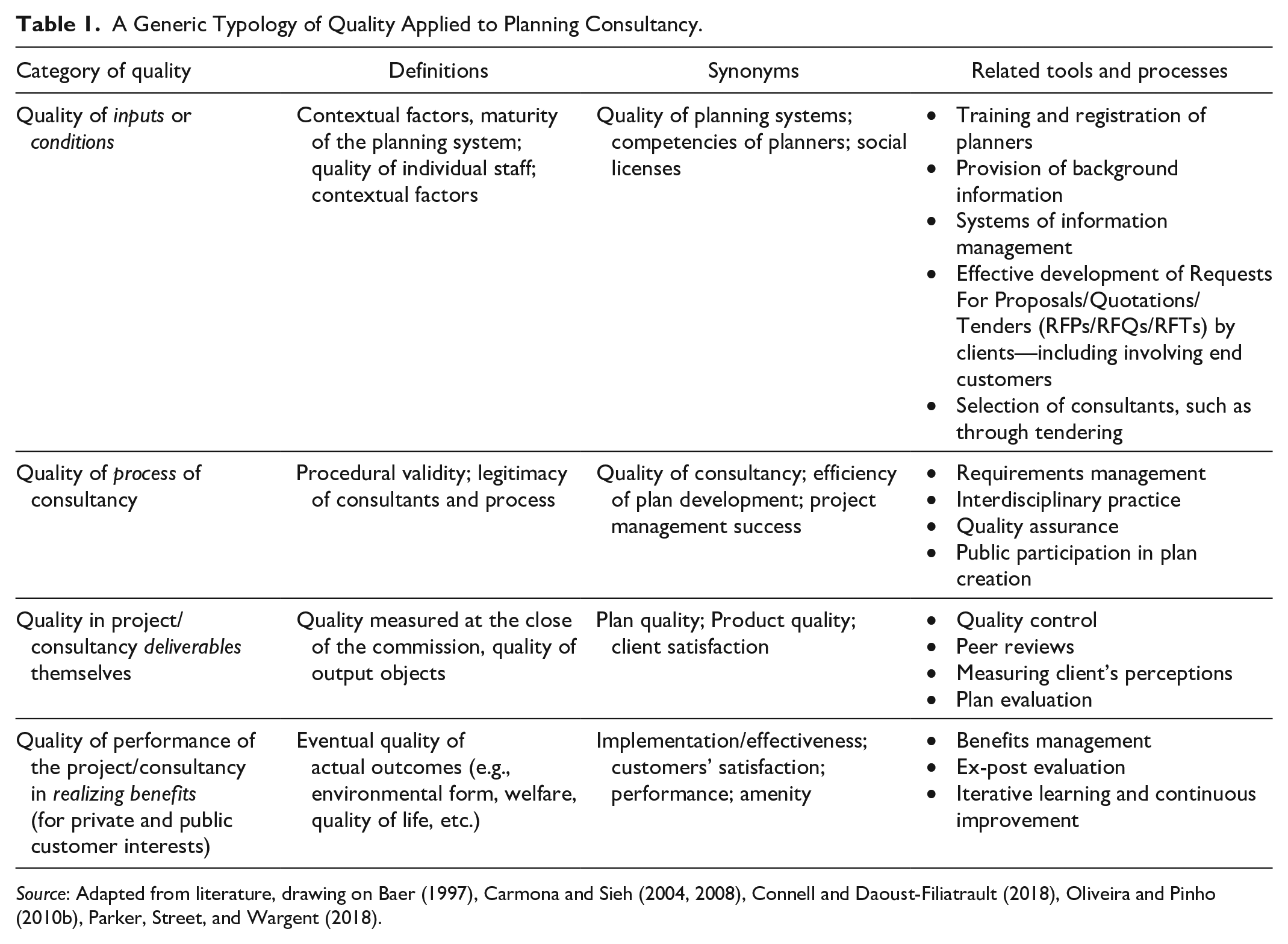
Source: Adapted from literature, drawing on Baer (1997), Carmona and Sieh (2004, 2008), Connell and Daoust-Filiatrault (2018), Oliveira and Pinho (2010b), Parker, Street, and Wargent (2018).
Differentiation between Consultancy Services for Public and Private Clients
Delivering planning consultancy to private clients (such as developers and interest groups) differs from commissions to public sector agencies. Both involve the application of existing knowledge and skills—but dimensions of representation and policy interaction differ. Consultants may serve as expert representatives prosecuting the case on behalf of private interests within planning systems (Loh and Arroyo 2017; Steele 2009), independently devising new policy on behalf of governments, or contracted directly as substitutes for planning staff in public-sector planning organizations (Loh and Norton 2013). Consultants may import new ideas and values, potentially redesigning policy, and re-framing planning processes (Linovski 2018; Parker, Street and Wargent 2018). Consulting firms offer value through the integration of a wide range of professional capabilities, which may not all be held within public sector planning organizations. Consulting firms are also commonly the vehicle through which emergent technologies are developed and marketed (Bessant and Rush 1995), potentially superseding the existing capabilities of government agencies. In particular, larger firms can invest in new technologies and assets due to their broad portfolios of clients, who may each benefit from the new capabilities in different ways. Consultants trade these capabilities and associated services on reputations based on perceived quality and networked trust (Momani and Khirfan 2013, 396).
Asymmetric Information with Clients
Planning projects are fundamentally concerned with compiling, synthesizing, and applying knowledge in decision-making (Davoudi 2015); they seek to enable change and capture windows of opportunity (Newman 2008). In this sense, planning consultancy could be conceptualized as “just in time” provision of knowledge and skills to meet the client’s particular needs. Unsurprisingly then, the capabilities of individuals working as the consultant are critical to success (Momparler, Carmona and Lassala 2015). Through this review, we identify the following attributes of consultants which support their employment by clients: formal training and accreditation; knowledge of context-specific institutional processes; familiarity and relationships with decision-makers; organizational and individual reputation; independence and credibility; unique competencies associated with a specialization (efficiency, access to already embodied knowledge, etc.); access to specific technologies, data, and associated capabilities to meaningfully apply them; ability to rapidly form and disband interdisciplinary teams; separation from clients’ hierarchies and conventional practices; capacities to manage risks; and mediation skills, especially relating to values and interests of stakeholders.
Most consultancy engagements—in which specialized skills and services are purchased—by nature are transactions with asymmetric information (Loh and Arroyo 2017) and asymmetric skills (Wargent, Parker, and Street 2020)—akin to a doctor–patient relationship (McLachlin 2000). Generally, the client is seeking to purchase access to capabilities or information they do not hold. However, reverse information asymmetries also exist, as clients have specific project-related background information and access to resources that differ from those of the consultant. Bridging these asymmetries is a critical part of achieving quality—because the client requires particular assistance, and the consultant needs context-specific information and supportive resources to provide it (Jang and Lee 1998).
Clients may also engage consultants to transfer risk. A client may seek to have a consultant handle an issue which is undesirable, complex, or sensitive; appoint an external party to do work which is not likely to go well—and to whom blame can be directed; insure against the financial ramification of major risks, by transferring liability for them in a contract; or appoint a consultant who holds liability insurance, which provides a clear line for compensation if the consultant performs negligently in managing risks (Bovaird 2004; Kubr 2002, 145).
Conceptualizing Projects Successes and Failures
Because quality in planning means meeting client’s and customers’(including stakeholder and public interest) requirements, an essential prerequisite for achieving project success is understanding explicit (stated) and implicit requirements (ISO 2015a). McLachlin (2000) differentiates quality in consulting projects in two ways: whether the client’s stated expectations are met, and whether their core underlying needs are addressed. A commission may be unsuccessful even if the client is satisfied at its conclusion. Consultants also face substantial reputational risks when delivering projects, especially for commissions which might meet client expectations, but enrage public customers. This is because the intertemporal nature of quality in planning influences costs and benefits across very long time frames. Accordingly, drawing on the work of McLachlin, a framework for planning consultancy success is presented in Table 2. We extend the framework by reinterpreting McLauchlin’s “Core Needs” to encapsulate the needs of public interests, and by presenting examples for public-sector and private clients.
Planning Consultancy Engagement Outcomes Types and Example Scenarios.
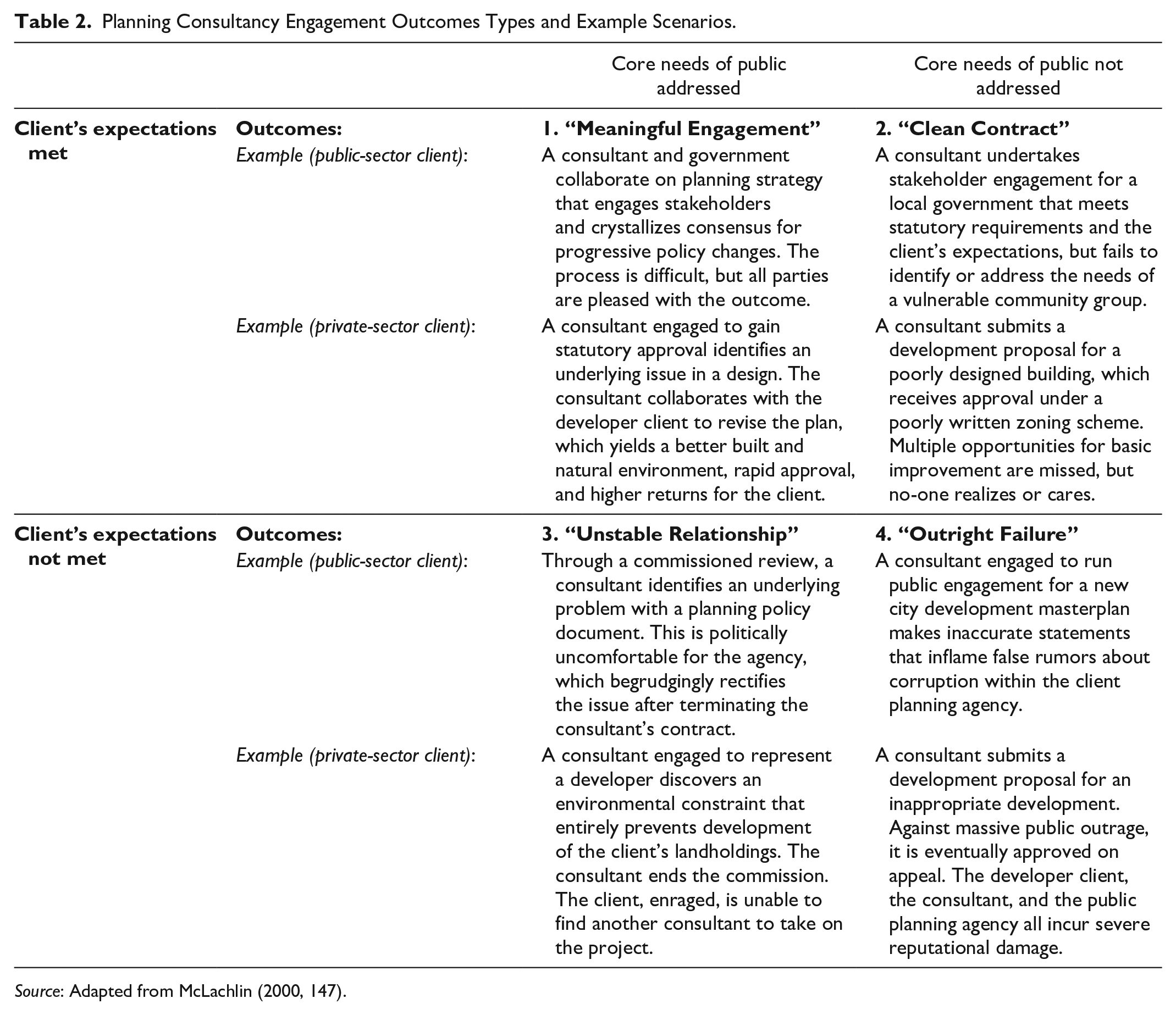
Source: Adapted from McLachlin (2000, 147).
It is widely acknowledged that insufficient effort is invested in benefits management and ex-post reviews of planning outcomes (Breese et al., 2015; Carmona and Sieh 2004, 56–68; Nicolaisen and Driscoll 2016). The cyclical accumulation of knowledge and its application to future work is widely recognized as a defining element of professional practice (Berke and Godschalk 2009; Zollo and Winter 2002). This “continuous improvement” is a central tenet of quality philosophy (ISO 2015a; Juran and Godfrey 1998). Accordingly, it is pertinent to examine how actions in managing planning consultancy projects can facilitate incremental learning, and the translation of prior learnings to more effectively meet quality requirements in future practice.
Achieving Quality in Planning Consultancy
Achieving quality in planning consultancy depends on practice committed to understanding, managing, and meeting requirements that reflect and meet intertemporal and interspatial interests. This fundamentally necessitates collaborative and sharing dissemination of information and knowledge (Bettencourt et al. 2002; Jang and Lee 1998). Working relationships need to effectively bridge information asymmetry, enable discovery and informed prioritization of requirements, and capture contextual opportunities that arise through time. To achieve this, supportive contractual and organizational structures must be in place, and realized through cultures of sharing.
Client-Consultant Relationship
Clients and consultants share an obligation to make consultancy projects successful (Jang and Lee 1998; Mitchell 1995). They share in the successes of delivering quality, but the actions of either can trigger failure. A respondent quoted in the work of Momani and Khirfan (2013, 404) reflected,
The biggest issue when hiring outside consultants is project management. Municipalities frequently do not devote the internal resources needed to project manage outside consultants, which can lead to overruns on budget, poor product due to miscues in understanding the deliverables and lack of quality control.
Excessively adversarial approaches to managing consultancy projects are likely to inhibit the bridging of information asymmetry, the discovery of requirements, and the capture of learning opportunities (Nesheim and Hunskaar 2015; Xue and Field 2008). For small and simple projects, this may be of limited consequence. But as the topic of the consultancy becomes more abstract, ambiguous, or complex, clients and consultants must move from transactional ways of working to forming more team-like temporary organizations (Jang and Lee 1998; Kerzner 2003, 755). Relationships must also be adaptive to enable responsiveness to emerging and conflicting requirements. The involvement of public-sector representatives through projects is also an essential element of verifying integration of public interest requirements in consultants’ work (Linovski 2016).
Importance of Proposals
Irrespective of procurement and contract type, planning consultancies typically involve some form of negotiation process to set the scope, objectives, and terms of the engagement. In many cases, competitive tendering is used to select a consultant based on the quality of written proposals, the competitiveness of proposed terms, and the degree of innovation offered. Reflecting the initial asymmetry of information, consultants writing proposals have a limited knowledge about client’s needs, wants, and underlying drivers, so project scope in consultants’ proposals are often a “best guess” based on the brief and any other client communication (Cicmil 2000; Mitchell 1994; Sturdy, Werr, and Buono 2009). Unsurprisingly, planning consultants who have particular insights into client requirements have an inherent competitive advantage in developing proposals that clients find compelling (Mitchell 1995).
What is promised to be delivered sets one baseline for evaluating quality (Juran and Godfrey 1998; Koskela and Howell 2002; Mitchell 1994), and quality requirements give further definition to the actual scope of consultancy engagements (Turner 2009, 141). Hence, the tendering process significantly influences the eventual quality of the consultancy. Information asymmetry during consultant selection also creates moral hazards to fair competition and ethical practice (Loh and Arroyo 2017). Clients may be tempted to purchase lower quotation offers with limited consideration of proposed scope and exclusions (Drew and Skitmore 1992, 228). Some vendors seek to profit through winning under-scoped proposals (Flyvbjerg 2009). These unethical bait-and-switch contract tactics depend on extracting additional revenue through contract variation claims as the project progresses. Highly defined and excessively qualified scope statements can also scare some clients. Each of these practices may set the stage for problems with managing quality later on. Ultimately, realistic scope and requirements planning and a shared working definition of the consultancy agreement (beyond the explicit contract) is critical in establishing understanding, trust, and shared objectives between the consultant and client (Atkinson, Crawford, and Ward 2006; Diekmann and Girard 1995; Mitchell 1994). For planning in particular, there needs to be trust between the client and consultant to ensure the agreed scope is sufficient to allow for contemplation of public interest issues (Loh and Arroyo 2017, 171).
Economic theory recognizes that all contracts are incomplete, that is, it is not feasible to formalize arrangements for all scenarios within written agreements (Hart 2017). Stapper, Van der Veen, and Janssen-Jansen (2019, 4) draw attention to the need for citizens’ requirements to become translated into consultancy contracts, noting that the agreement constructed between a consultant and public agency client is more formal and prescriptive than the tacit governance agreements which exist between the planning agency and the citizens it serves. To this end, the current literature does not seem to extensively explore how consultant’s proposals are critical as a foundation for delivering quality planning.
Rapid, Iterative, and Dynamic Management of Requirements
Managing a vast, uncertain, and competing universe of possible requirements presents a significant challenge for all planners, including those in private practice. The management literature suggests that many professionals managing projects may have only an illusion of control, while individual staff and customers fundamentally drive decisions that determine project success (Cicmil 2000). Recognizing the boundedness of working in practice, exact requirements often become discovered, commonly through the results of the consultancy work itself (Ojasalo 2001; Turner and Cochrane 1993); projects always become more defined as they are progressed (Cicmil 2000; Winch, Usmani, and Edkins 1998).
Because both consultant’s proposals and the contracts that arise from them are incomplete, and new requirements inevitably arise, planning consultancy must adeptly handle changing requirements. This can challenge traditional “fixed” project management practices, especially those commonly applied in more routine or defined projects. Most research and planning projects with fuzzy objectives and diverse requirements inevitably incorporate some level of management agility (Wells 2012). The practices of traditional and “Agile” approaches are compared in Table 3. We contend that front-end projects, by nature, demand Agile requirements management, through which learnings of early stages of work inform later decisions, especially with regard to conflicting requirements.
Management Practices.
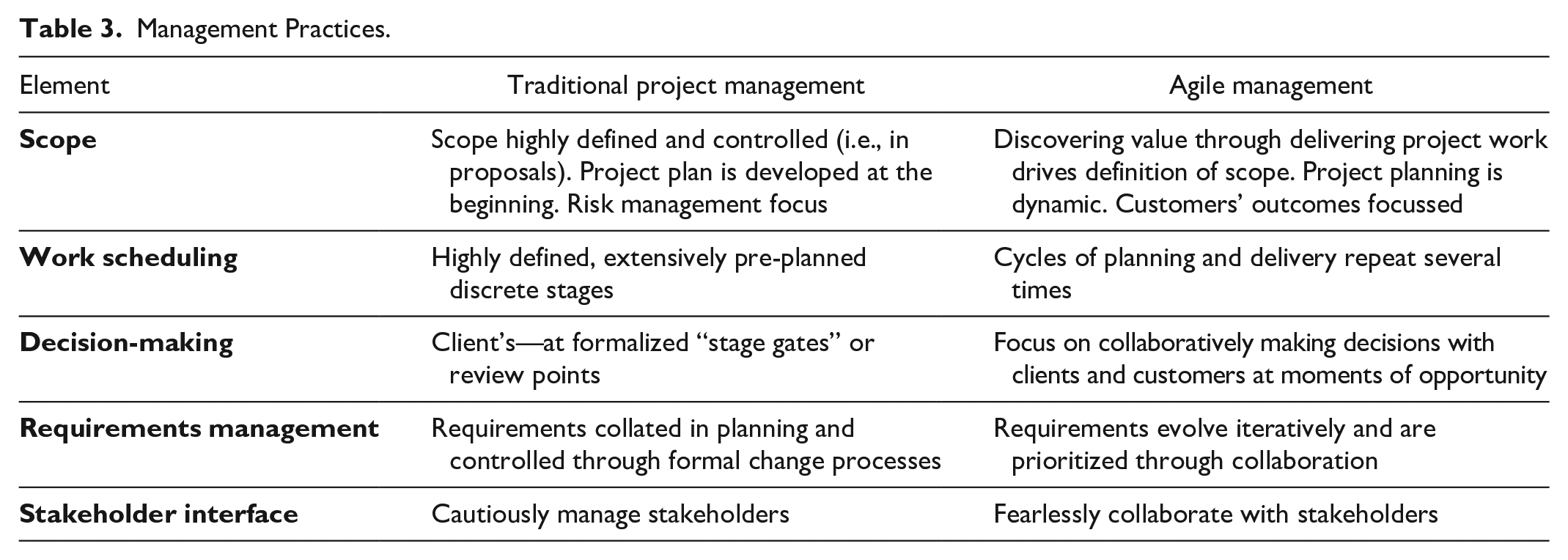
The handling of requirements is essential in both managing the reasonableness of client and stakeholder expectations (Ojasalo 2001), and in managing the inevitable conflicts between interests and values that become sharply evident in the form of clashing requirements (Cicmil 2000, 556; Koppenjan, Charles, and Ryan 2008). The discovery, evaluation, integration, and fulfillment of requirements must be continuous to capture opportunities to redefine and improve the planning task. Requirements management is, therefore, an inherently iterative process. This continuous improvement cycle is the basis for quality management, initially outlined by Shewhart and later popularized by Deming (1986, 88), and adopted as a central component of ISO 9001 (ISO 2015b). Figure 1 shows how this iterative process, inherent to any planning, involves identification, application, testing, and learning based on the relevant universe of possible requirements surrounding an initiative. This conceptual frame can be applied at the level of a project, project phase, or even in the short intervals between communications with stakeholders or between consultants and clients. Since communication is critical in competent consulting (Samson 1994), and public deliberation almost always an essential process in establishing the legitimacy of proper planning (Baum 1999; Legacy 2012), it is often desirable to accelerate this iterative cycle to discover, refine, and achieve requirements through shared learning.
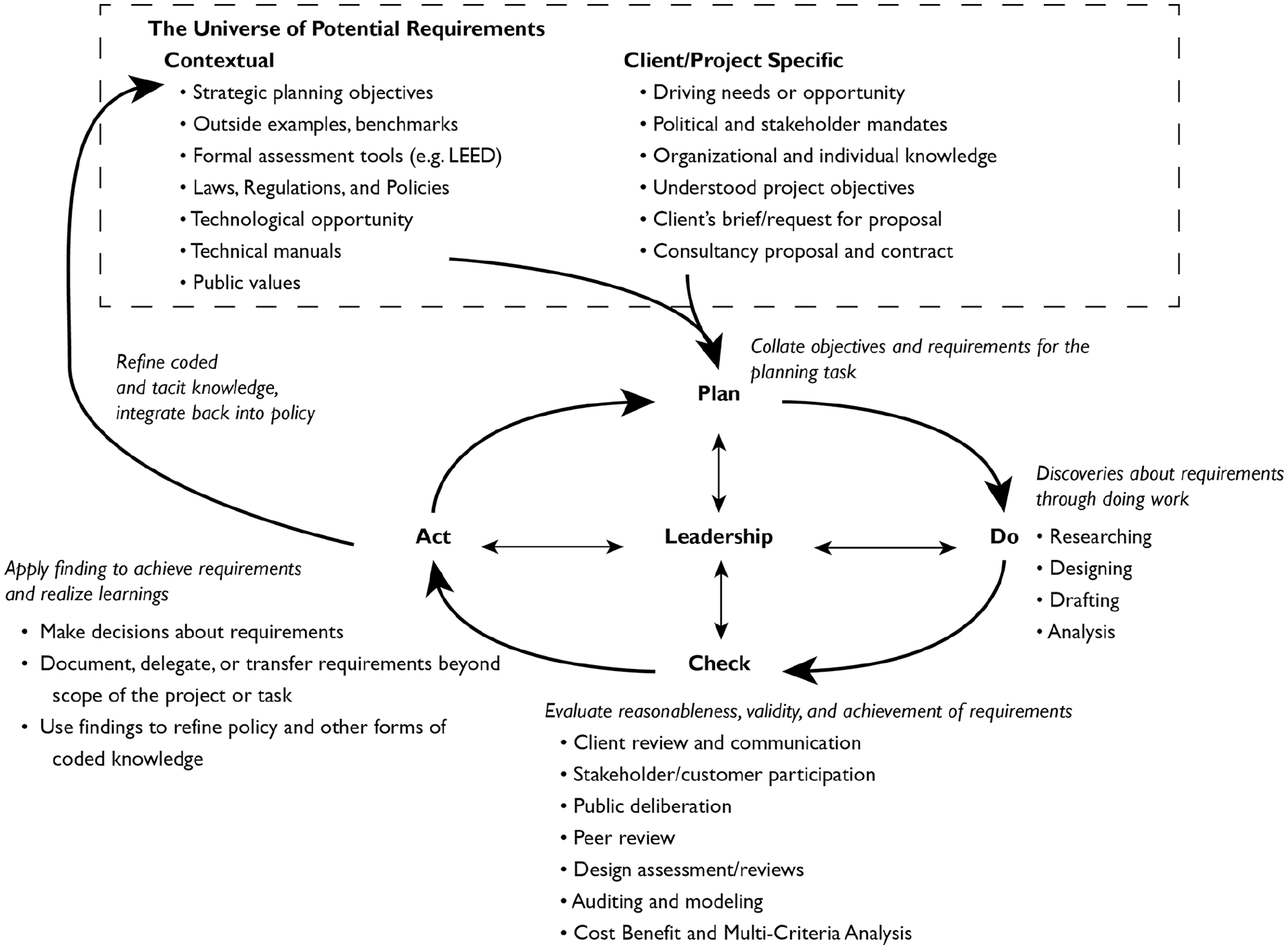
Shewhart/deming cycle applied to requirements in planning.
Shewhart/Deming cycle: Planning
As the outset, the set of possible requirements surrounding a project must be collated, and each initially assessed as to whether they might be reasonable. While initial requirements tend to be defined by the client and refined through the consultant’s proposal, understanding the root genesis of requirements is a critical part of understanding how they may reflect client, stakeholder, and public interest needs. Planning policy and the institutions of planning fundamentally exist to encode public interest requirements to govern human and natural environments. These formalized requirements are typically central to any planning process. Since requirements embed values and priorities, they are also inherently political.
Requirements may originate from: political mandates and declarations; visioning; deliberative strategic planning; written policy and law; shareholder aspirations; stakeholder preferences; accreditation and certification standards (e.g., LEED certification criteria); technical manuals; perceived best practices; opportunities posed by new technologies; comparative benchmarking; inter-jurisdiction learning and policy transfer; and as compiled in prior work to date. The broad universe of possible requirements is itself a useful environment for managing reasonableness, because requirements provide the basis for comparison against each other. In planning, comparative evaluation of requirements often happens both in initial decisions about project scope, and in the doing and checking components of completing project work.
Shewhart/Deming cycle: Doing and checking
The work of “doing” planning involves the tasks in which requirements are applied and potentially achieved. In the planning literature, evaluation is often considered to be a formal rational and technical process (see Baer 1997). However, it is now increasingly recognized that the informal evaluations are continually drawn by people who interact with the planning system, which are a critical form of quality assessment, which can underpin plan legitimacy (Connell and Daoust-Filiatrault 2018; Legacy 2012). Hence, we contend that planning is characterized by extremely short intervals between “doing” planning (developing and refining plans and designs) and some “checking” activities (in which work is, in some present form, evaluated). Figure 1 thus illustrates an extensive set of conventional and more tacit checking mechanisms, each of which may be used to assess, inform, and refine planning practices as they progress.
Through this process, conflicts between requirements and the values which support them become apparent. Planning work itself, when conducted closely with stakeholders, can reset and reframe stated requirements, especially when planners are able to lucidly define the nature of collective public policy problems (Baum 1999). Collaborative processes also enable parties to identify opportunities to simultaneously meet many values and requirements (Koppenjan, Charles, and Ryan 2008). Such methods of collaboratively managing requirements fundamentally require clear visibility of the quality of the process through which clients and other types of customers are involved (Winch, Usmani, and Edkins 1998). For technical professionals, more accustomed to working insulated from the messy processes of stakeholder empowerment, this can be a daunting proposition.
The language used in planning processes can blur the meaning of requirements and their fulfillment (Carmona and Sieh 2004, 259). This is especially the case where communication about requirements and their handling are vague (Carmona and Sieh 2008). For instance, in some planning systems, the expression “due regard” is often used to state that a requirement has been considered in a decision, leaving the degree to which it has actually been fulfilled ambiguous. Similarly, the notion of “orderly and proper planning” commonly cited in some planning contexts can give weight to privileged or normative requirements, potentially at the expense of the requirements of more marginalized parties.
Shewhart/Deming cycle: Acting
Findings about requirements present opportunities to refine the project, to re-integrate learnings back to policy, and to improve future practice for the client and consultant. Difficulty handling requirements may present windows of opportunity to improve awareness of the universe of possible requirements, and to re-shape how they are integrated within planning policy and processes (see Figure 1). Through design challenges, conflicts, and eventual outcomes, planning projects lay bare systematic issues and opportunities for improvement (Carmona and Sieh 2004).
Inevitably, some requirements will be identified and satisfied through project work. Others will inevitably be found to be unreasonable (such as stakeholders making unrealistic requests), or insufficiently represent public interests (such as narrow interest groups seeking to establish a requirement for their exclusive benefit), and will need to be discontinued. Other requirements will fall beyond the scope, resourcing, or decision-making remit of the specific project or planning process, but may be transferred to prompt an improvement elsewhere. For instance, community engagement about a development proposal may identify concerns about a separate planning issue, in which case the project planners share a duty to refer the community on to engage with the relevant office or in the applicable planning process. In this way, consultants and public-sector planners have a responsibility to assist the public in directing their engagement with planning systems.
In worse cases, requirements may be ignored or actively evaded. For example, strong public values for an area that are not recognized by any formal statute may be lost as development is allowed to proceed. Another example may be where the housing needs of vulnerable people may not be met as narrow interest groups lobby against affordable housing. Such cases, while often highly political, may represent a failure of existing planning systems and policies, and should be recognized as a critical opportunity to enact corrective change to ensure requirements are more effectively met in the future.
Review, Continuous Improvement, and Systematic Change
Because of their novelty and the nature of repetition between them, projects offer immense opportunity for learning and improvement of quality through the Shewhart/Deming Cycle. This continuous learning is a central rationale for formal Quality Management Systems, such as ISO 9001 (2015b)—to which many consultancies are accredited. 2 Since projects are (to some degree) unique, they enable consultants to develop specialized capabilities and advantages which are costly for others to replicate (Peteraf 1993; Teece, Pisano, and Shuen 1997).
For clients, projects can likewise enable learning and the further development of internal capabilities through the Shewhart/Deming cycle. Close working relationships with consultants is critical for the crystallization of project learnings (McLachlin 2000). In contrast, clients who oversee a commission which they regard purely as a “clean contract” to realize a single outcome (without consideration of the quality of the process) are likely to forgo many of the intangible benefits of the planning exercise. This potentially asymmetric learning dividend is a common criticism of having public-sector planning work delivered by consultants, and may perpetuate low organizational capabilities within public planning agencies (see Linovski 2018; Perl and White 2002).
Lastly, because planning is intertemporal—and a large subset of quality is realized only through time—initiatives to revisit the outcomes of planning processes are critical. External failure costs may be discreet, concealing planning failure. Through time, the benefits of quality planning are realized as end-user satisfaction, improved environments, increased efficiency, sustainability outcomes, and higher standards of living (Carmona and Sieh 2004; Crosby 1989; Deming 1986; Juran 1992). Exceptional quality also elevates the reputation of client organizations, consulting firms, and the standing of our profession more broadly (Guyadeen 2018). For consultants, following up with clients after project completion presents opportunities to strengthen relationships, identify potential new commissions (such as to evaluate the completed project), and to share opportunities to improve future work. For clients, applying learnings from past projects is a critical part of developing their organizational capabilities (Nesheim and Hunskaar 2015).
Conclusions and Future Research
Understanding how the design and management of the environment is governed (and how a complex universe of case-specific requirements influences these processes) is fundamental to delivering quality in professional planning. As the complexity of planning problems increases, and as new technologies and professional specializations emerge, the way that planning delivers quality is of critical importance to the profession, and the diverse publics we serve. Exploring the many dimensions and contextual meanings of quality is an essential pre-requisite in the further development of our profession. We concur with Guyadeen (2018) that additional focus on “quality” in planning education is needed. Furthermore, we suggest that “quality” in private practice should specifically be introduced to students who, in many countries, are increasingly likely to either work as, with, or supervising consultants.
This paper has drawn together planning, quality, and management literature to synthesize frameworks for conceptualizing quality in planning, with specific reference to private practice. The rich quality literature has been applied to relate a conceptual model for managing requirements through iterative planning practice, based on the Shewhart/Deming cycle of continuous improvement. Through this, we stress the importance of collaboratively decoding and re-coding requirements through interfacing with policy (and related sources of potential requirements) as a core process of the planning profession.
The interdisciplinary professional consultancy firm is of increasing importance in the practices of shaping the built environment, and more research attention to understand their complex interactions and potential is warranted. While the quality management literature has been the focus in this paper, additional primary research and the application of different analytical frames to understand the practices of consultants is likely to yield new and valuable knowledge for how project-based planning may best deliver outcomes to meet public interests. Research into consulting firms, particularly drawing on the longer-term results of planning projects, will be of particular value in equipping graduate planners, and in assisting all planners continually improve how we meet our obligations to the clients, customers, and publics we collectively serve.
Footnotes
Acknowledgements
Sam McLeod would like to thank Frank Krause for his enthusiastic and insightful evangelism of quality, which inspired this paper. The authors would also like to thank the four anonymous reviewers for their constructive comments.
Declaration of Conflicting Interests
The author(s) declared following potential conflicts of interest with respect to the research, authorship, and/or publication of this article: Both authors have worked as planning consultants.
Funding
The author(s) received no financial support for the research, authorship, and/or publication of this article.
