




Abstract
This study evaluates the state of traffic impact assessment (TIA) practice at the local level in North Carolina and the Washington D.C. metro area. Using semistructured interviews and surveys of staff involved in the development review process in sixty-three jurisdictions, we conclude that the conventional, automobile-oriented approach to TIA remains the dominant model in the study area, although our research reveals efforts to modify practice. Content analysis of interviews in thirty-six jurisdictions indicates lack of information and technical capacity are substantial barriers to change, highlighting areas in which planning education and research could better support practice.
Introduction
State and local governments across the United States have come to rely on traffic impact assessment (TIA) to predict increases in automobile traffic generated by new developments and to inform negotiations with private developers to mitigate adverse impacts from that new traffic. The conventional approach to TIA, which relies on vehicular trip generation models calibrated with data collated by the Institute of Transportation Engineers (ITE), has been adopted widely as part of the development approval process across many U.S. states and cities. The conventional, auto-oriented approach to TIA (which we abbreviate “C-TIA”) is considered standard policy for development in many U.S. states.
Underlying C-TIA is a philosophy of predicting and accommodating increased automobile demand in order to mitigate traffic congestion, reduce congestion-related emissions, and minimize vehicular delay. Because of the process’ emphasis on improving vehicular flow, C-TIA has often been criticized as prioritizing cars at the expense of other modes, undermining efforts to build more sustainable, multimodal transport systems (DeRobertis et al. 2014). C-TIA is also thought to encourage single-use development in suburban and peripheral areas, where existing surplus traffic capacity minimizes the need for mitigation, over infill projects (Walters, Bochner, and Ewing 2013). Furthermore, many argue the data from which ITE’s trip generation estimates are derived are outdated, coming largely from auto-oriented suburban developments that likely don’t reflect contemporary urban travel patterns in areas with substantial demand for non-car travel modes (e.g., DeRobertis et al. 2014; Shoup 1997; Steiner 1998). Research suggests C-TIA practices overestimate the traffic impacts of developments in dense, mixed-use urban neighborhoods, leading to an oversupply of roadway capacity that detracts from the urban fabric and undermines efforts to improve livability (e.g., Clifton, Currans, and Muhs 2015; Millard-Ball2015; Schneider, Shafizadeh, and Handy 2015).
Following shifting priorities away from congestion mitigation and toward sustainable transportation, livability, and urban revitalization, there have been increasing efforts by ITE, government agencies, transportation planning and engineering practitioners, and the research community to develop new ways to quantify and mitigate mobility impacts of compact, mixed-use development. For example, California has moved away from a development review process focused on vehicular delay to one focused on total vehicular travel. Outside a few locations, however, there has been little study of whether and how local traffic impact practices are evolving (Currans 2017). The current research begins to address this gap by examining the state of local TIA practices, as described by local government staff involved in the development approval process in sixty-three medium and large cities and counties in the U.S. states of North Carolina, Virginia, and Maryland. Through content analysis of semistructured interviews in thirty-six of those jurisdictions, we develop a typology of TIA practice across the study area. In jurisdictions that have adopted or are considering adopting alternative approaches to C-TIA, we also explore factors motivating those changes, barriers that may be hindering such changes, and sources from which local governments seek information about C-TIA alternatives.
This area of the country is a particularly interesting place to explore this topic. Many of the region’s larger cities have been experiencing rapid urban growth and development and a growing demand for public transportation, walking, and bicycling in their urban centers in recent years. Yet the majority of developed areas of these states, including peripheral regions of larger cities, are characterized by lower density automobile-oriented land use patterns. Our results improve understanding of the perceived traffic and congestion challenges faced by growing communities in this region and others with similar characteristics, and the strategies local governments use to deal with those challenges.
This paper is organized as follows: the next section presents a brief background on C-TIA and efforts to develop alternative approaches, summarizes the study area, and introduces our specific research questions. We then describe our research design and methods. Next, we present selected findings from our analysis of interviews with local officials, followed by a discussion of how those findings address our research questions. We conclude with implications for research and practice and suggestions for further exploration.
Motivation and Research Questions
TIA emerged as a tool for local government to share or transfer the burden of providing transportation infrastructure to developers in the 1970s (DeRobertis et al. 2014). Communities recognized that new development generated traffic that could lead to localized congestion. Engineers began projecting development-induced automobile trips based on data collected from previous—typically suburban—developments, and quantifying how they would impact level of service (LOS) (Currans 2017; DeRobertis et al. 2014; Millard-Ball 2015). LOS is a grading system introduced by the Highway Research Board (now the Transportation Research Board, or TRB) in 1965 to assess the degree to which a roadway facility provides for speed, maneuverability, safety, comfort, and operating costs of motorists (Lee and Handy 2018). LOS has conventionally been used in TIA to gauge whether new traffic would lead to an increase in vehicular delay beyond established acceptable levels. This approach provided a quantitative basis to negotiate with developers over required roadway improvements as part of the development approval process. ITE and TRB have been critical in standardizing the methods used in this practice. ITE has regularly published trip generation guides; the most recent 10th edition was published in 2017 (ITE 2017). The Highway Capacity Manual (HCM), first published in 1950 and most recently updated in 2016, also addresses calculation of LOS.
Efforts to modify TIA practices have been underway since at least 1980, when the HCM first included data on non-car trip generation (DeRobertis et al. 2014). These efforts have focused on making the process sensitive to the land use context, and making it incorporate more multimodal travel behaviors. For example, United States Environmental Protection Agency’s (U.S. EPA 2017) Mixed-Use Trip Generation Model (MXD) provides estimates of trip generation appropriate for mixed-use developments and environments with substantial transit use. Others have been working to provide more information on how developments will affect all modes and to provide opportunities that ensure proposed mitigation strategies to not adversely affect non-car travelers (e.g., Fehr and Peers 2014; TRB 2010).
Efforts to re-envision TIA have gained the most traction in California, where the passage of SB 743 in 2013 led to the eventual replacement of delay-based LOS in favor of more holistic assessments that incorporate changes in vehicle miles traveled (VMT) and vehicle trip generation (Governor’s Office of Planning and Research 2019). California’s move to VMT-based impact metrics also reflects efforts to reduce greenhouse gases through efficient transportation and land use strategies (Lee and Handy 2018). The rationale for this change is characterized by the environmental review for the Van Ness Bus Rapid Transit project in San Francisco. The goals of the project included “improving the experience for transit patrons” and “raising the operating efficiency of Van Ness Avenue” (San Francisco County Transit Authority 2011, S2–3). The only identified “significant and unavoidable” impact was to traffic circulation at six to eleven intersections along the corridor (San Francisco County Transit Authority 2011, S11). Significant analysis, time, and cost was required to evaluate this impact on vehicles even though the project radically improved transit in the corridor and likely resulted in an overall decrease in VMT.
Washington D.C. has also received attention for their efforts to improve the TIA process. In 2012, the District Department of Transportation (DDOT) issued draft guidelines emphasizing the need to consider multimodal impacts during the TIA process (DDOT 2012). DDOT has also developed new protocols to develop automobile trip generation rates better-suited to urban areas that are well-served by transit and highly walkable (DDOT 2014). The District has recently released new TIA guidelines that create incentives to improve the design of the street environment near new projects (DDOT 2019). D.C.’s approach maintains the TIA process but addresses identified deficiencies by improving estimation methods and considering multimodal travel.
Yet, beyond these exemplars there is little evidence of widespread deviation from C-TIA at the local level (Currans 2017; DeRobertis et al. 2014). The apparent overall lack of adoption of innovative practices at the municipal level suggests a mismatch between what researchers and regulators view as progressive urban policy driven by contemporary ideals and what “works” in the eyes of local officials. This mismatch is particularly relevant in the three states in our study, all of which are characterized by rapid urban and suburban growth and top-down transportation planning systems in which the majority of public roadways are controlled by state DOTs.
The research presented in this paper is largely exploratory, guided by three research questions:
Frameworks for Understanding Policy Change
We address our research questions through semistructured interviews and surveys with key informants knowledgeable about their city’s or county’s TIA practices and, where those practices have shifted from C-TIA, factors influencing that change. Our data collection procedures and interpretation of our findings are guided by a large body of research on public sector policy innovation. We summarize this research briefly below.
Policy Innovation
“Innovation” in the policy adoption literature is a catch-all term referring both to new ideas, concepts, or epistemologies and to specific policies, practices, or behaviors an entity (local government in this case) can adopt and implement. Much of the planning-relevant literature focuses on the latter sort of innovation, particularly with respect to externally developed and packaged policies meant to address a gap in governance capacity or respond to a previously unrecognized need for regulation. Walker (2006) refers to these as “product innovations.” Examples include Steel and Lovrich (2000) and O’Connell (2009), who examined the factors explaining local adoption of smart growth policy, and Brody, Carrasco, and Highfield (2006), who analyzed the presence of sprawl-reduction policies in local comprehensive plans in Florida. In California, Lubell, Feiock, and Handy (2009) measured the number and types of local governance policies related to sustainability, while Bassett and Shandas (2010) studied local adoption of climate change mitigation policies.
In contrast to product innovation, “process innovation” represents a change in existing policies, practices, or processes, including changes in behaviors and communications as well as changes in the technologies, tools, and knowledge used to drive practice (Walker 2006). In this research, we hypothesize that if local TIA practices differ measurably from C-TIA, those differences likely arose through process innovation rather than product innovation, as they reflect not an effort to fill a capacity void but to adapt and update existing practice to meet contemporary ideals. Unlike product innovation, process innovation in U.S. cities has been less well-explored, although it’s likely many of the factors driving product innovation are also relevant for process innovation.
Emergence and Uptake of New Practices in the Public Sector
This study focuses on a specific form of process innovation: evolution of established local-level TIA practices. In this section, we briefly discuss some of the more commonly used approaches for identifying and describing the mechanisms by which local governments identify, evaluate, and adopt changes to existing practices (whether they be homegrown or adapted from other contexts).
Some scholars have applied a rational-actor lens to policy adoption, positing that innovation in local government is driven by the recognition of an objective need to take action. Feiock and West (1993) use the term “need/responsive policymaking” to describe this approach. The “internal determinants model” builds on needs/responsive policymaking by introducing endogenous community characteristics, couching policy innovation as a function of the political and social receptivity to innovation; the technical, administrative, and financial capacity to innovate; and the recognition of the utility of the innovation (Bassett and Shandas 2010).
A third approach focuses on “exogenous influence,” tracking the roles of interest groups, higher level regulatory bodies, peer communities, policy entrepreneurs, and specific events on innovation. This approach includes the “regional diffusion” model, which suggests a community is more likely to innovate if its neighbors are also innovating, especially if the community is in a cluster of communities that (1) communicates or is connected via professional networks, (2) is approached by the same policy entrepreneurs, and/or (3) is subject to similar top-down pressures (Bassett and Shandas 2010). Other exogenous influence models include “windows of opportunity” and “punctuated equilibrium,” which posit that natural, incremental policy evolution can be hastened or “punctuated” by specific events, following which a community is more likely to welcome change (Boushey 2012; Tyre and Orlikowski 1994; Weber 2014).
“Diffusion of innovation” (DOI) theory integrates the concepts described above into a single framework. DOI explicitly focuses on the spread and uptake of externally developed ideas and practices across networks (De Vries, Bekkers, and Tummers 2016). However, it is also useful for framing a more general discussion on how communities recognize a need to make a change, identify, and choose among possible actions to bring about that change, and then bring those changes to fruition. DOI generally recognizes that the probability a new idea or practice—an innovation—is adopted and implemented depends on that innovation’s “relative advantage over the status quo, ease of application, trialability, and the observability of results of implementation”; the degree to which it is perceived by the community to be consistent with “commonly held values” (endogenous community characteristics); and the effectiveness or persuasiveness of policy entrepreneurs and external advocates (exogenous influences) (LaJeunesse et al. 2018).
In reviewing these models, we identified a number of key factors influencing the emergence and adoption of alternatives to C-TIA:
whether the jurisdiction (referring here to the decision-making authority and existing power structure) recognizes an issue as problematic and if so, how they frame that issue (e.g., congestion, undesired land use patterns, housing shortages);
whether the jurisdiction’s political and regulatory frameworks support change;
whether the jurisdiction has access to information about relevant innovations;
whether those innovations are perceived as viable solutions to the issue at hand;
whether those innovations are perceived as compatible with the jurisdiction’s vision or plans;
who or what is driving and/or impeding adoption of the innovation;
whether there is a window for taking action (as might arise after a focusing event such as a particularly undesirable outcome arising from prior practices or an enactment of enabling policy at a higher level);
the technical and administrative staff as well as financial capacity to act;
the regional context.
These key factors guide our research methods and interpretation of our findings, as described in the remainder of this paper.
Research Design and Methods
Our research design is guided by the grounded theory approach to qualitative research as described by Corbin and Strauss (2008). We use a general inductive content analysis approach, with directed and conventional coding of transcripts of semistructured interviews and surveys with local officials involved in the development review process in our study jurisdictions to uncover themes related to our research questions.
Study Area
Our study focuses on sixty-three jurisdictions representing a diverse set of cities and counties in North Carolina and the Washington D.C. metro area. All sixty-three jurisdictions are experiencing population growth and land development pressures. In NC, we included the state’s thirty largest cities (based on 2015 population) plus two smaller towns of special interest (rapidly growing college towns with heavy development pressures). These thirty-two sites comprise the state capitol, two mountain towns, one coastal port city, two cities in the largely rural eastern portion of the state, and a large handful of cities and towns located along the state’s principal economic spine (an approximately 170-mile corridor connecting the state’s two largest cities, Charlotte and Raleigh). In VA and MD, we examined thirty-one cities and counties in the greater Washington D.C. area, which ranged in contexts from sparsely populated rural counties to booming edge communities to established cities. Much of the existing research on TIA has been conducted elsewhere; it is not clear if the findings from those studies transfer to the high-growth, auto-oriented context of southeast and southern mid-Atlantic states. The NC-VA-MD setting is also somewhat unique in that in all three states, the majority of public roadways are controlled by the state department of transportation (Maryland Department of Transportation [MDOT] 2017; NCDOT 2018; Virginia Department of Transportation [VDOT] 2018).
Data Collection
We reached out to local government staff involved in the development review process in all sixty-three cities and counties in the study, requesting their participation in an interview with our research team regarding their jurisdiction’s approach to TIA. In communities in which no appropriate staff member (i.e., someone involved in development review and knowledgeable about their jurisdiction’s current and, where relevant, past development review practices) was available or willing to participate in the interview, we requested participation in a brief survey about current TIA practices instead. We received positive responses to the interview request in thirty-six jurisdictions and conducted the brief survey in all of the remaining twenty-seven, yielding an overall response rate of 100%.
The interviews were audio recorded, transcribed via Trint, quality-checked by the research team, and then imported into Atlas.ti 8.2 for analysis. All interviews were conducted and analyzed in 2018. The findings reported in this paper are derived largely from the coded interviews and focus on interviewees’ perceptions of TIA practices in their own municipalities, the role of innovation in those practices, and the processes, drivers, and challenges associated with adopting and implementing those innovations. The interview instrument is available as an online supplement to this article.
We followed up in the remaining twenty-seven jurisdictions (those in which no one responded to our emailed interview requests) via phone call to the number connected to the jurisdiction’s development review office. We confirmed the individual answering the phone was a staff member involved in development review and asked whether they would be willing to answer a three-question survey over the phone about their jurisdiction’s TIA practices. We received positive responses in all 27 cases.
The survey included the following questions: (1) Does your city or county have a policy regarding assessment of traffic impacts of new developments? (2) If yes, please briefly describe your process. (3) Does your jurisdiction’s approach significantly differ from ITE or your state DOT’s guidelines? Responses to these questions were recorded in writing by the interviewer. Survey responses were used to supplement interview data to allow us to build a more robust picture of the state of TIA practice in the southeast, but were not included in our content analysis of TIA innovation types, and drivers and barriers of innovation in TIA policies. Surveys also enabled a cursory evaluation of response bias in our interview sample.
Survey jurisdictions tended to be geographically smaller, less dense, and more rural than the interview jurisdictions. Table 1 lists the jurisdictions that participated in the study by state and by participation method (interview or survey).
Participating Cities and Counties.
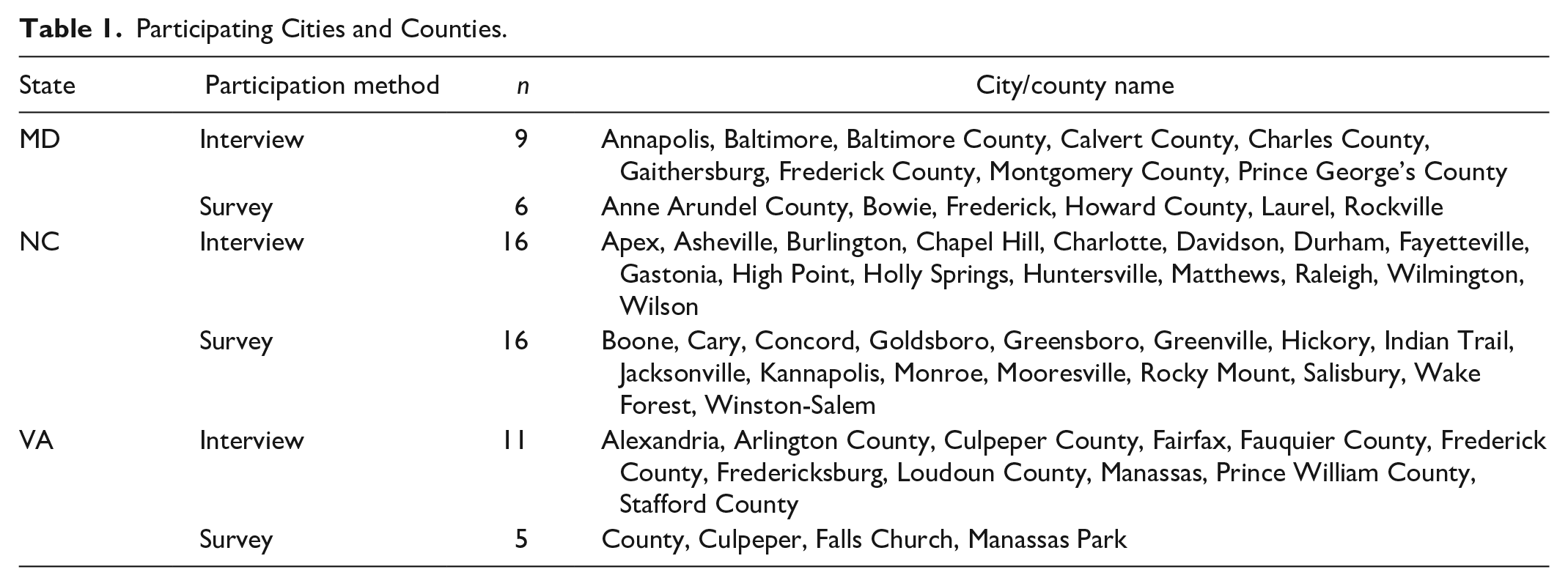
All of the individuals with whom we spoke were professional planners, engineers, or development review officials and spoke to us in their official capacities as city or county employees. The project was thus determined to be exempt from institutional review by the University of North Carolina’s Institutional Review Board.
Content Analysis of Interview Transcripts
We analyzed interview transcripts in Atlas.ti 8.2 using an iterative process of directed and open coding. We began with a preliminary set of codes and code families that aligned with our research questions, derived from the literature review and pilot interviews, and built on that list to identify relevant passages from the interview transcripts. When different codes and linked passages reflected similar concepts, we merged the codes in order to achieve a more parsimonious and generalizable list. Finally, we generated tables showing types of changes adopted, information sources, criticisms of C-TIA practices, motivations for change, and barriers to change by jurisdiction. We used these tables to aid in the identification of themes, which we used to build the narrative summaries presented in the “Discussion” section.
Findings
Our findings are organized as follows: first, we provide an overview of the state of the practice, based on interview and survey data on current approaches to TIA in NC, MD, and VA. We then narrow our focus to the thirty-six jurisdictions in our interview sample and assess the types of practice changes they are adopting, as well as motivations, catalysts, and barriers to change.
State of TIA Practice
Of the sixty-three jurisdictions in our sample, thirty five (56%) rely on the C-TIA approach. Sixteen percent use models that largely fit the criteria for C-TIA but may have minor modifications to a limited set of component practices. The remaining twenty-nine percent have adopted at least moderate changes to the C-TIA model. We did observe some response bias in our sample: forty-four percent of the thirty-six interviewed jurisdictions had incorporated alternative TIA practices (i.e., more than minor adjustments to C-TIA), compared to just seven percent of the twenty-seven jurisdictions that declined the interview and completed the three-question survey instead. The survey jurisdictions’ apparent reluctance to participate in the interview may reflect a lack of interest in the topic, which could help explain the lower uptake of alternative TIA practices. However, the 100% response rate by these jurisdictions once they were offered the brief survey as an alternative to the longer interview may be due to lack of staff capacity, which could also help explain the greater reliance on established practices.
Changes to C-TIA
Across the thirty-six jurisdictions participating in the interviews, we identified thirty-eight distinct ways in which TIA practice differed from C-TIA; we distill these into eight families of change (Figure 1). While none of the changes we identified involved wholesale abandonment of TIA, we did identify several instances of conditional abandonment of TIA—these make up the family of changes we call “waivers.” We also observed adoption of alternative practices and processes within the general TIA framework. Other changes include changing the way information generated by a TIA was used and adding new requirements to the development approval process that are layered on top of, rather than incorporated into, the TIA. We describe all of the changes we observed below.
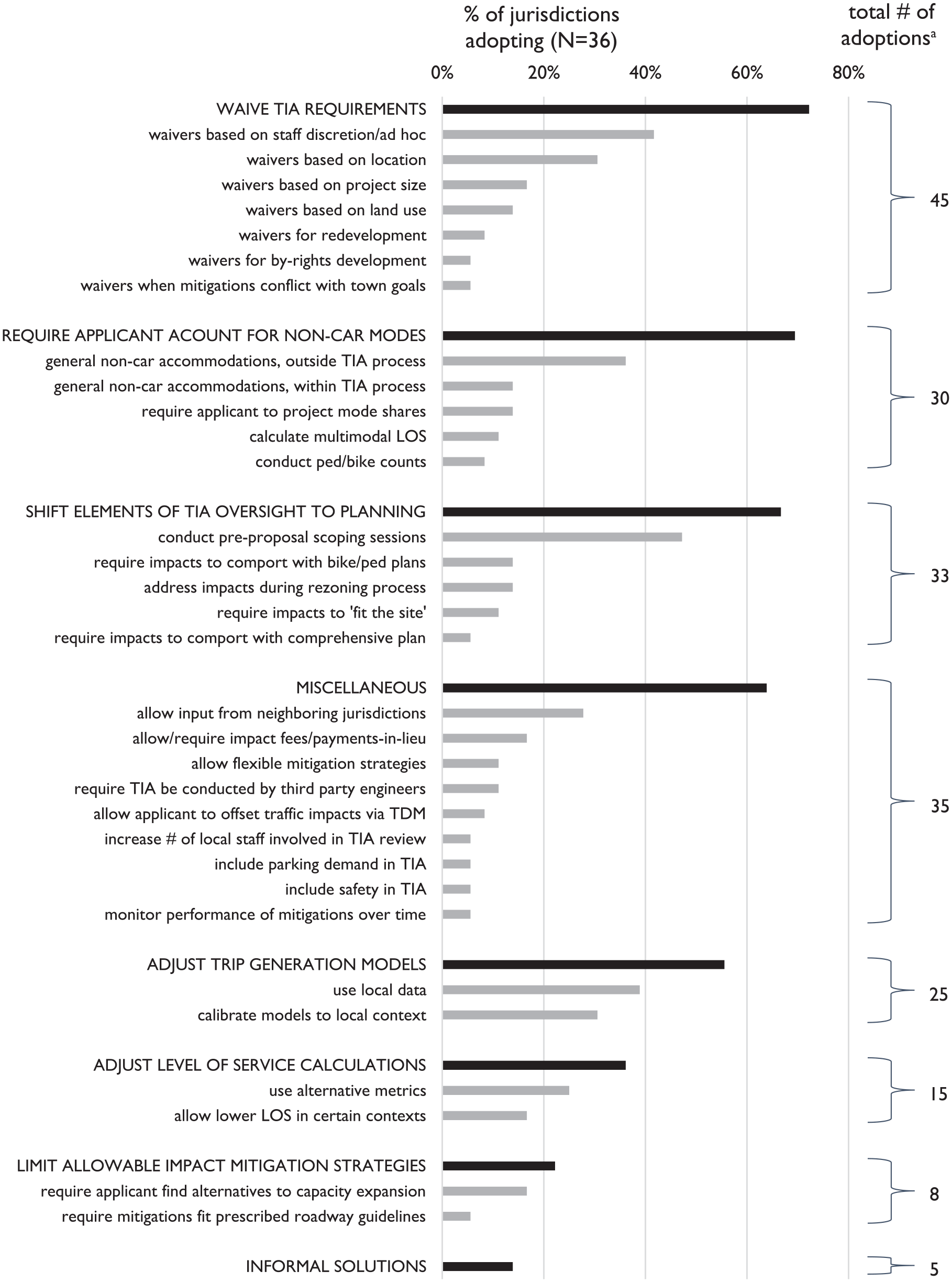
TIA change families by total number of adoptions.
The most common type of change is via conditional abandonment of TIA (i.e., waivers), in which projects meeting certain criteria may be eligible for a partial or full waiver of TIA requirements. Waivers were present in twenty-seven of thirty-six jurisdictions (75%). Jurisdictions employ waivers based on land use, location, project size, anticipated impacts on non-car modes, and staff judgment.
Twenty-five jurisdictions (69%) require applicants to measure, include provisions for, or mitigate impacts to non-car travel modes (non-car). Practices in the non-car family are typically layered on top of the TIA process; rarely are non-car requirements integrated into the TIA analysis. Examples of non-car measures include requiring applicants to provide pedestrian and bicycle facilities as part of the development approval process, requiring the applicant to project non-car trip generation and/or person-trip generation, assessing multimodal levels of service, and allowing the applicant to propose creative or unconventional approaches to accommodating non-car travel modes.
Twenty-four jurisdictions (67%) have strengthened the role of planning in TIA administration (planning), including moving TIA into the rezoning process, integrating TIA requirements into the Comprehensive Plan, requiring traffic impacts or mitigations to be in accordance with adopted bicycle/pedestrian or comprehensive plans, and ensuring planning staff are involved in preproposal scoping sessions with the applicant.
Twenty jurisdictions (56%) adjust the data and/or models behind trip generations estimates in order to better fit the local context (trip gen). This family includes adjustments to ITE’s trip generation estimates, requiring or encouraging the use of locally collected data and/or locally calibrated trip generation models, and redefining “peak” travel in order to reduce the apparent impacts of new auto trips on LOS calculations.
Thirteen of the sites (36%) have either adjusted the way they calculate LOS or adopted alternatives to LOS in order to determine when/to what extent congestion mitigation is necessary (LOS). Most of the adjustments to LOS in our study are intended to raise congestion tolerances, allowing greater increases in congestion or vehicle travel delay before mitigations are required. In a few cases, jurisdictions have opted to use alternative rating systems, such as seconds of delay and critical lane volume.
Eight jurisdictions (22%) either require applicants to restrict the number of new automobile trips their projects will produce to fit within a prescribed set of mitigation strategies, require applicants to provide alternatives to expanding roadway capacity, or simply reject proposals outright if they result in auto trip generation beyond pre-set limits (limits). In the limits family, TIA is used not just to determine what mitigations a proposed development will require, but also to guide the proposal to ensure it fits within the mitigations allowed.
Five jurisdictions (14%) allow the applicant to negotiate mitigations outside of formal TIA processes, relying on, for example, “reasonableness clauses” or insisting “all parties use good judgment” as the primary means for achieving mutually beneficial outcomes. We classified these sorts of changes as “informal solutions.”
The final code family is comprised of miscellaneous, one-off strategies not fitting neatly into other families. Twenty-two jurisdictions (61%) have adopted miscellaneous strategies, including requiring impact fees or payments in lieu of mitigating traffic impacts, shifting responsibility for performing TIA to third party, improving coordination with bordering jurisdictions, increasing the number of staff members reviewing TIAs, and allowing staff to choose from a suite of traffic mitigation strategies on case-by-case bases.
Figure 2 shows the numbers and types of changes adopted within each jurisdiction (organized from top to bottom in descending order of the number of changes adopted), as well as the overall distribution of change types across our sample.
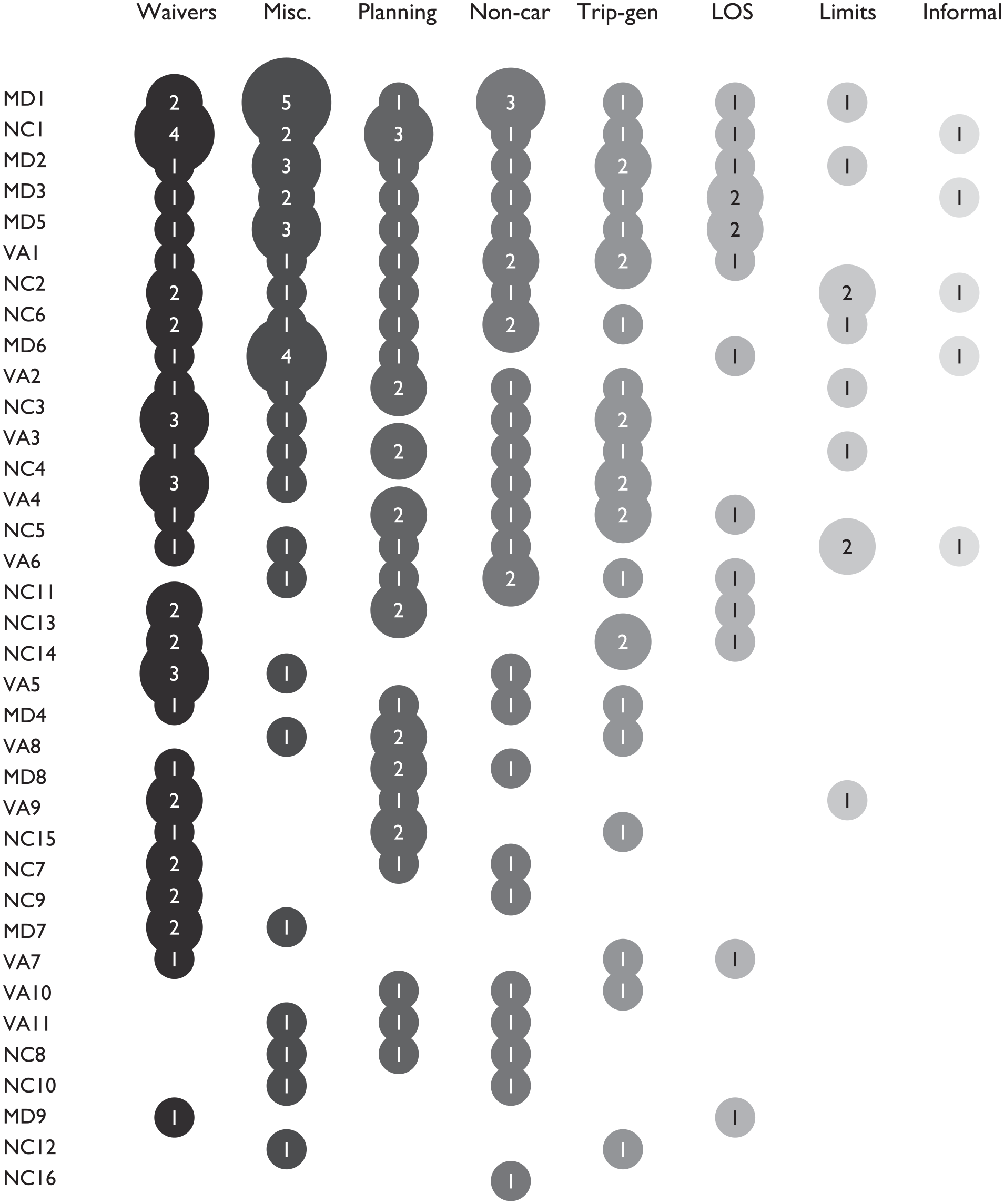
Frequency of adoption of TIA alternatives by jurisdiction and family.
The ultimate impacts of these changes on development patterns, supports for multimodal transportation options, or other intended outcomes are unclear. However, we can anticipate that some of the reported changes, such as requirements to account for non-car travel modes, align mitigations with pedestrian and bicycle plans, or adjust trip generation estimates based on local context, likely support planning goals associated with compactness, walkability, and/or sustainability. Other practice changes will have less predictable effects; these include many changes in the “miscellaneous” family, such as allowing input from neighboring jurisdictions, shifting the performance of the TIA onto third-party engineers, and increasing the number of staff involved in the review process.
Motivations for Changing TIA Practices
Interviewees across jurisdictions provided a wide range of criticisms of C-TIA. We observed a similarly diverse array of reasons for adopting alternative approaches. Collectively, we label these responses as “motivations for practice change.” The vast majority (80%) of our interviewees were able to express some sort of motivation for moving away from the conventional approach to TIA. The most common motivations for practice change included the sense that C-TIA does not provide useful or actionable information, often coupled with a desire for alternative approaches that generate more useful information about the potential impacts of new developments. Criticism over the lack of utility of information derived from C-TIA is exemplified by comments from interviewees in NC5 and VA1: [The developers’] concern was our code was a little bit too strict. It was producing information that really wasn’t helping anyone make decisions. (NC5) [C-TIA] clearly missing the boat in terms of both telling the story to the public about what the level of impact is at this building versus something else in another place, and telling us what we need to prepare for, what we should be putting in our capital improvement program, or what kinds of services we should be providing that building. (VA1) . . . staff realized we were really missing something in the way we communicate and the kind of information we get out of these analyses in order to tell the multi-modal story of development approvals in [our community]. So there were definitely developments that began to help us turn that corner and realize not only did we need better information from [TIA] but they need to be communicating their information differently too. (VA1)
Recognition of a need to improve accommodations for non-car modes and a desire to promote land use patterns that were more compact, sustainable, and/or better served non-car travel patterns were also common motivations for change. The desire to improve non-car accommodations through TIA innovation is illustrated below: I felt I needed additional tools to measure pedestrian level of service to give a different input on pedestrians separately. (NC2) [Civic leaders] want to see a more multi-modal view a way of looking at transportation in the area. And I think what they are looking for is a process that accomplishes those objectives. (MD2)
The desire to move toward a mechanism that led to more compact, sustainable land use patterns was perhaps most strongly expressed by the interviewee from NC1: . . . we needed to change the way we thought about things. And I wanted to be part of shaping something that allowed us to have more urban environments and activity center environments and transit station area environments. Our traffic study needed to adapt to reflect that . . . What do we want our cities to become? (NC1)
Other criticisms of C-TIA include that it undermines progressive planning efforts, has too narrow a focus, fails to account for atypical land uses, and relies on incorrect vehicular trip generation estimates. Some interviewees also expressed a desire to move toward practices that better enable them to keep pace with changing conditions and to better align outcomes with community plans and values.
Catalysts for Change
Changing practice requires a catalyst, that is, someone or, in some cases, something to prompt and drive the movement. Sixty-four percent of our interviewees were able to point to individuals or groups playing a critical role in instigating and/or driving change. The most common, present in nearly half of our jurisdictions, is local government staff. Interviewees were quite clear on the importance of staff in driving change: . . . we knew we wanted to go in this direction. There was support throughout the department to do that . . . (NC1) We were front and center really in helping to draft that legislation. (MD5) Basically I was looking into . . . Because I’m the one who reviews all the reports and everything . . . (NC2)
Elected officials or bodies are also common catalysts, followed by the public, appointed committees, developers, and coalitions, advocacy groups, or homeowners’ associations. A few interviewees also described specific phenomena (in addition to human catalysts) that spurred practice change, including controversial developments and similar focusing events triggering widespread interest in change: There was a specific rezoning . . . for a residential and multifamily or single family residential and a multi-family project. That triggered a lot of the concerns and highlighted the need for the changes. (NC11) There was actually a development near [a] metro station that precipitated that thinking. (MD5) And suddenly with this new bridge that opened just a couple of years ago here was this 10′ wide route for people to walk with a certain level of dignity. And that was a huge . . . . The community saw the city paying attention to their needs and it was it was just a huge development and a huge response. So we’re on a roll—it’s unreal . . . (VA8)
These reports correspond with the California experience where controversies around the building of an arena for the Sacramento Kings in downtown Sacramento were a catalyst to the movement away from LOS (McGreevy 2013).
Local regulatory updates also provided natural opportunities for change in a handful of jurisdictions, including in VA5, where our interviewee felt local attitudes in favor of inclusion of non-car modes have been spurred by a change in VDOT policy to provide sidewalks on state roadway projects as a matter of course.
Barriers
We asked interviewees what barriers they faced in their efforts to move away from C-TIA, as we were interested in understanding the obstacles jurisdictions have to overcome, work around, or avoid in their efforts to adopt new or innovative practices. Over half of the jurisdictions in the study (58%) listed at least one barrier to change, with one of the most common, listed in seventeen percent of our jurisdictions, being a lack of data, guidance, technical assistance, or tools, as suggested in the passages below: If there is some kind of local data that can be used then we use that instead. It’s just hard to get. (NC4) We haven’t found a real good model that’s not data intensive on collecting data on the front end—which might be overly burdensome to the development community or even our data collectors—and also consistent with state statutes . . . (NC7) We’re looking at other measures of effectiveness that we can use. It’s hard though for a jurisdiction our size. There is not a lot of data or performance standards for the measures we would like to use. But hopefully in the future there will be more ways we can improve our guidelines. (MD6)
A perception that developers would push back against new practices was equally common. Interviewees also cited political challenges (including a lack of interest by elected leaders, lack of willingness by leaders to stray from standard practices, and/or political differences), state DOT regulations, fear of increased congestion, and opposition from the public as barriers to change. There was also a general sense of inertia or friction expressed by a handful of interviewees, particularly among those adopting a greater number of alternative practices: I think there was a little bit you know from the industry folks that do this. The easiest thing to do is keep doing what you’ve been doing for 10 or 20 years. (NC1) It’s a difficult process because our standards are so well documented it would have to be a pretty big and laborious official process to update our standards. Yeah, really it’s just . . . it could be costly and time consuming. And we don’t have a huge staff and there really hasn’t been a huge push for it yet. (VA2)
Information Sources
Finally, in jurisdictions that had considered or adopted at least minor changes to the C-TIA approach, we asked where they look for information about new or innovative practices. The most common responses were neighboring or peer jurisdictions and consultants (each present in 44% of jurisdictions interviewed) and professional development (e.g., conferences, webinars, reports, and academic literature; 36%). Less common sources of information included internal staff knowledge, guidance or advice from the state DOT, the ITE handbook, the public, and the Internet.
The percentage of jurisdictions reporting motivations for change, catalysts of change, barriers to change, and sources of information about change are shown in Figure 3.
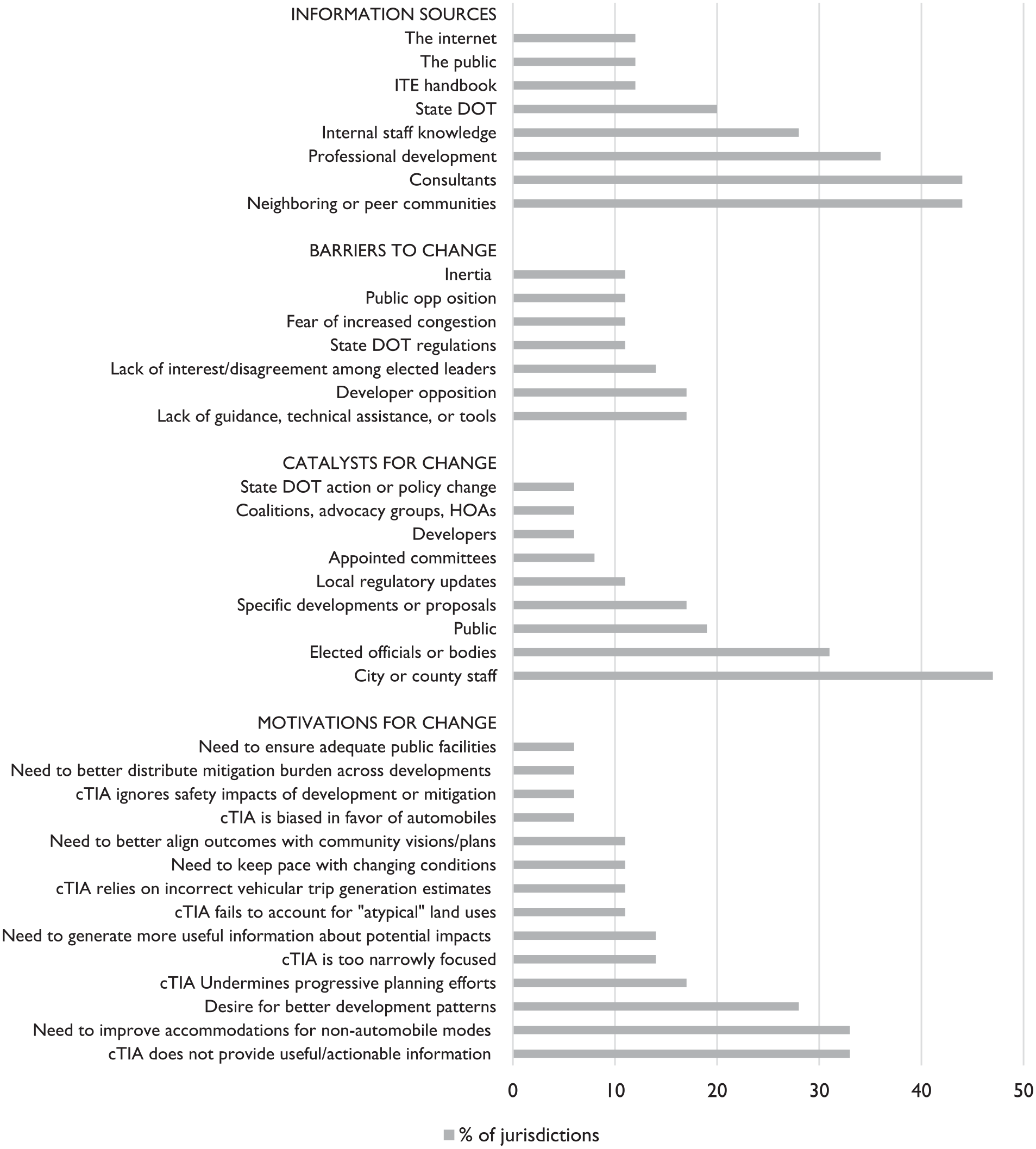
Percent of jurisdictions reporting factors of change.
Discussion
Overall, we find the conventional approach to TIA appears to remain the dominant model among the jurisdictions we studied. However, interviewees in the majority of those jurisdictions were quick to point out shortcomings of C-TIA and clear justifications for attempting to move away from that model. The most commonly expressed motivations for change include the need for better, more actionable information from analyses, and for practices that will help jurisdictions achieve more desired land use patterns, accommodate non-car modes, and better support progressive planning efforts.
Despite the apparent persistence of C-TIA, a number of jurisdictions are taking steps to change their practices. These steps are not as clear cut as what is described in the literature on policy adoption. Rather than discrete policy adoptions meant to fill a clearly defined capacity gap, we find a more heterogenous landscape of policy change. The most common changes include waivers, in which proposals meeting certain conditions are exempt from the TIA process, and shifting more of the development review process under the purview of planning departments. While these two families of changes are quite distinct, they appear to have an important commonality: they are technically easy to implement in that they don’t require changes to how the analysis is conducted. Similarly, many jurisdictions have changed practices by supplementing the TIA through the imposition of additional requirements for estimating and accommodating non-car traffic—again, no changes to the mechanics of TIA, rather an imposition of an additional requirement to gain project approval.
The preponderance of these more superficial changes is interesting, given the primary barriers interviewees most commonly decried: developer opposition—often stemming from the perceived expense involved in changing analysis practices—and lack of tools, guidance, and technical information to support alternative analyses. Rather than changing the process of TIA itself, the pursuit of lower hanging fruit may be a signal that jurisdictions are better equipped to work around barriers than dismantle them.
How are cities and counties addressing the barriers they face?
Lack of information is a barrier to change, and interviewees are looking broadly for new information. The findings here showcase the importance of consultants, neighboring jurisdictions in providing information and facilitating innovation. This is consistent with predictions by Bassett and Shandas (2010) and LaJeunesse and colleagues (2018) that consultants and neighbors might serve as boundary spanners or policy entrepreneurs, helping advocate for innovations across municipal boundaries. Another common source of information for staff was professional development, which included attending conferences and being afforded opportunities to keep abreast of academic and practice-focused literature. Improving outreach through conferences and publications and identifying mechanisms for tapping into policy entrepreneur networks may provide potential avenues for disseminating information about alternative TIA techniques. While our interviewees did not explicitly describe interaction with planning educators as an avenue for learning about new practices, their references to new staff and professional development activities suggest planning educators could play a role in disseminating critical information on this topic (Wachs 2016).
The most common drivers of change are staff and elected officials; the importance of these roles was particularly apparent among jurisdictions with more innovative TIA practices. We view this as evidence planning educators have the potential to influence the adoption of progressive planning practices through education of future planning practitioners and through more community-engaged scholarship and liaison with elected officials.
While we did not probe for information on institutional structures or management practices, our findings on the role of staff support the notion that environments in which staff are empowered to think about and advocate for change might be better able to adapt to changing conditions and ensure better compatibility between governance practices and community values.
Levers for planning scholarship?
The most common barriers to change are resistance from developers and lack of guidance, technical knowledge, or support tools. These barriers are relevant for planning research because of their actionable implications: better tools and guidance can help communities understand and communicate the alternatives available to them, and also lessen the burden on the development community for integrating new standards or modeling approaches into their development proposals. More tailored information and context-sensitive technical guidance from the research community may also be useful in helping communities frame their needs with respect to TIA as well as aid in the recruitment of more effective catalysts. But the complexity of this task should not be underestimated. California has been working steadily on how to implement VMT-based metrics, yet still took seven years to go from the passage of SB 743 (mandating the shift toward VMT-based metrics) and its 2020 statewide implementation in 2020. As Lee and Handy (2018) note, questions remain regarding how to estimate VMT and how to define criteria for significant impacts thresholds.
The role of state DOTs
We did not observe any apparent patterns with respect to TIA practice and the state, nor did the state appear to be related to the motivations, barriers, or drivers of change in practices. We were somewhat surprised the state was not listed more frequently as a barrier in NC and VA (only two interviewees in each state listed the state as an impediment to change). In both states, the state DOT maintains control over the majority of public roadways, including some roadways within major cities, and in both cases enforces strict guidelines on TIA practices for developments affecting those roadways. The lack of mention of the state as a barrier raises the question of whether interviewees in those states have simply internalized top-down regulation as immutable parameters of practice, and not something that can be dismantled or overcome. We only observed one instance in which a change in state policy functioned as a catalyst to enable (rather than inhibit) changes in local practice. This may represent a missed opportunity for state DOTs to shape a movement to more progressive local TIA practices.
Limitations and Directions for Future Research
We note a few limitations in this study that could be addressed in further research. First, we assumed our informants adequately represented shared values and perspectives within their institutions and were capable of recalling and describing changes in practice accurately. While we are unable to test this assumption, we follow the lead of Vonk and Geertman (2008), who used a similar data collection method to evaluate barriers to adoption of planning support systems in European cities.
Furthermore, while we did collect data on the profession and position of the informant within the development review process, we did not explore relationships between informants’ role, tenure, or status within their organizations and their views on TIA and the innovation process in their jurisdiction. The validity of this research could be improved by exploring such relationships and/or adding multiple perspectives (i.e., interviewees) within each jurisdiction.
Finally, we did not evaluate the impacts of any changes to practice on development patterns, and thus are unable to make judgments on whether changes were successful in helping cities and counties meet their stated objective. We do note the majority of TIA alternatives being pursued are political or institutional in nature, rather than technical or analytical, and we wonder whether real, substantive change in outcomes would be more prevalent if communities were better supported in their efforts to change the technical or analytical aspects of TIA. Future research focusing on the impacts of various TIA practices should further assist planning researchers and educators in identifying ways to better support practitioners’ efforts to align practice with shared community visions.
Conclusion
This study analyzes interview and survey data from local government officials involved in the development review process in sixty-three cities and counties in North Carolina, northern Virginia, and Maryland. Interview and survey participants were asked to describe their jurisdictions’ current approach to TIA. Interview participants also provided information on any perceived shortcomings to the conventional approach to TIA, as well as—in jurisdictions that had taken steps away from the conventional approach—motivations for and barriers to doing so.
While the conventional approach to TIA remains the norm in the states we examined, our study does reveal evidence of efforts to move away from that model. Cities and counties have multiple reasons for adjusting this critical aspect of the development review process, but the most common motivations seem to align with goals about accommodation of non-car modes and supporting more compact, sustainable land use patterns. This finding concords with academic and advocate critiques of TIA as a process that—by focusing on mitigation of automobile congestion—can create environments that lack vibrancy or character and are hostile for pedestrians, bicyclists, and transit users.
But the actual changes to TIA practice reported by jurisdictions follow no simple patterns. We see little evidence of a simple DOI (or best practices) process. Recent guides to TIA practice from the ITE and TRB promote multimodal LOS analysis and the adjustment of trip generation rates based on local data. We observe some jurisdictions making these changes, but we also observe jurisdictions creating a rich set of practice changes. Implemented changes range from decreasing the prevalence of TIAs, for example, waivers, to reorganizing the staff involved in reviewing TIAs. Jurisdictions are learning about ways to adjust processes from consultants, neighbors, and professional development of staff.
Based on our study, we believe southeastern and south mid-Atlantic jurisdictions are likely to continue adjusting the TIA process to meet development goals. Change is most likely to come incrementally through lower-cost efforts. States, universities, professional organizations, and regional planning entities should focus on encouraging better information exchange on what changes jurisdictions have made to the TIA process and the impacts of these changes.
A key takeaway from this study is that evidence-based guidance and planning support tools matter to staff involved in the development review process. Thus, this research should inform the development and distribution of alternative strategies for assessing and/or mitigating the traffic impacts of development, for example, by identifying legal, political, or other contextual parameters into which innovative approaches must fit and by identifying preferred and trusted information channels through which knowledge on innovative approaches can best be distributed to the target audience.
Supplemental Material
TIA_interview_guide_3_20_18 – Supplemental material for Evolution in Local Traffic Impact Assessment Practices
Supplemental material, TIA_interview_guide_3_20_18 for Evolution in Local Traffic Impact Assessment Practices by Tabitha S. Combs, Noreen C. McDonald and William Leimenstoll in Journal of Planning Education and Research
Footnotes
Acknowledgements
The authors would like to thank the planners and engineers in thirty-six cities and counties who shared their knowledge and experience with us. We are also grateful for feedback on our research from Ruth Steiner, and for comments from three anonymous reviewers.
Declaration of Conflicting Interests
The author(s) declared no potential conflicts of interest with respect to the research, authorship, and/or publication of this article.
Funding
The author(s) disclosed receipt of the following financial support for the research, authorship, and/or publication of this article: This research was made possible through support from Southeastern Transportation Research, Innovation, Development, and Education (STRIDE) Center (USDOT Grant 69A3551747104).

Supplemental Material
Supplemental material for this article is available online.
Author Biographies
References
Supplementary Material
Please find the following supplemental material available below.
For Open Access articles published under a Creative Commons License, all supplemental material carries the same license as the article it is associated with.
For non-Open Access articles published, all supplemental material carries a non-exclusive license, and permission requests for re-use of supplemental material or any part of supplemental material shall be sent directly to the copyright owner as specified in the copyright notice associated with the article.
