




Abstract
New technologies have significant effects on travel behavior, attitudes, habits and potentially future travel demand. Effects may be more prominent for Millennials. Little empirical research has investigated these relationships, mainly due to data limitations. This study focuses on the potential influence of using the Internet while traveling on Millennials’ plans for car ownership. We examine two questions: Does using the Internet while traveling influence trip frequencies? and Does it affect Millennials’ intention to purchase a car? Results suggest that Internet use while traveling is positively associated with travel demand and the intention to purchase a car in the near future.
Keywords
Introduction
Information and communication technologies (ICT) have transformed the way people live. Mobile technologies and the expansion of Internet access in particular have had a transformative effect on many aspects of people’s daily lives. For example, people can now access real-time travel information for their journeys and communicate on the go. This enables them to make ad hoc adjustments to their travel plans, from mode shift to rescheduling activities.
This also offers new possibilities for combining travel, work, and leisure (Sheller and Urry 2006). For example, people can work while traveling using mobile devices such as laptops or smartphones, allowing travelers to make more productive use of their time (Lyons and Urry 2005; Banerjee and Kanafani 2008). These new opportunities to use travel time productively have had profound implications for the way we think about the value of travel time (Lyons and Urry 2005), and may influence future travel demand. Although some evidence supports an increase in work activities due to ICT in private cars (Laurier 2004), the effects are expected to be more noticeable on public transport given that options for using ICT while driving are limited. This may increase people’s preference for public transport, and even generate additional trips (Lyons and Urry 2005).
A shift in preference toward public transport due to mobile Internet access may be stronger for the Millennial generation. 1 The adoption and use of ICT varies substantially across the population (Schleife 2010; Verdegem and De Marez 2011; Verdegem and Verhoest 2009). Typically, the younger generation is more likely to embrace new technologies and go online (Lenhart et al. 2010). With regard to transport, van Wee (2015) indicated that ICT could influence the travel behavior of younger adults more than the older generations because they are digital natives who grew up with ICT.
One issue that has not been considered, mostly because of data limitations, is the impact of ICT use on the intention to purchase a car in later life. Such an intention is important for planners and policy makers as it may tell us something about future travel demand. Therefore, this study aims to analyze the impact of Internet use while traveling on Millennials’ future car ownership plans. In addition, we will examine how Internet use may be associated with trip frequencies.
Literature Review
The use of ICT while traveling, particularly on public transport, has received some attention in the literature. Many existing studies have focused on rail and the provision of Wi-Fi (Banerjee and Kanafani 2008; Zhang et al. 2006; Kanafani et al. 2006). Dong et al. (2015) examined the effects of Wi-Fi on trains running in the California Capital Corridor. They considered the effect on train ridership, including both current and new riders. Based on their survey results, they argued that Wi-Fi had a positive and significant impact on ridership, and was especially effective at attracting new riders.
Using a survey of rail passengers in Norway, Gripsrud and Hjorthol (2012) found that the majority of commuters and business travelers brought mobile devices (e.g., a mobile phone or laptop) and used them to work. Only a small portion of passengers reported no use of their time. While rail travel has tended to be a focus, some studies also indicate benefits of Wi-Fi for bus users (Twichell et al. 2008; Fischer et al. 2011).
The effects of mobile Internet access could extend beyond simply changing the relative attractiveness of different modes. Dal Fiore et al. (2014) discussed several ways in which mobile technology may influence travel behavior. ICT may lead to the formation of new habits and attitudes to public transport. According to the theory of planned behavior (Ajzen 1991), behavior can be predicted by looking at attitudes, subjective norms, and perceived behavioral control.
Bamberg, Ajzen, and Schmidt (2003) showed that an intervention which encouraged a switch of transport mode could have permanent effects on future behavior by changing people’s attitudes, norms, and perceived behavioral control. Goetzke and Weinberger (2012) highlighted the importance of norms in influencing car ownership. The ability of interventions to influence behavior in this way may have profound effects on future travel behavior (Bamberg, Ajzen, and Schmidt 2003; Fu and Juan 2017), including car ownership rates and car dependency.
Recently, interest in the Millennial generation has increased, not least because their travel behavior appears to be different from that of previous generations (Ralph 2016). In particular, car use is increasing at a lower rate and even decreasing in some countries. In a study of six industrialized countries (Germany, France, the United Kingdom, Japan, Norway, and the United States), Kuhnimhof et al. (2012) find that most have decreasing levels of access to motor vehicles. In some of the countries, this is associated with a fall in the overall level of travel demand. Interestingly, the trend seems to be led by men.
Kuhnimhof, Zumkeller, and Chlond (2013) investigate the “peak car” phenomenon in France, the United States, Germany, and the United Kingdom. They confirm that in France and the United States, declining car use has been driven by falls in the overall demand for travel. In Germany and the United Kingdom, switches to other modes of transport have been primarily responsible for changes in car use.
In an editorial overview to a special edition on peak car, Goodwin and Van Dender (2013, 251) note that “there is now little doubt that the changing propensity of young people to drive is a very widespread phenomenon of great potential importance.” However, the explanations are still unclear.
Different theories have been proposed to explain this trend (McDonald 2015; Polzin, Chu, and Godfrey 2014). One is related to demographic change. For example, Millennials are less likely to be employed, married, or have children. The important implication of this theory is that these factors can reduce the need for travel now, but are likely to change as they age and become employed, married, and parents.
This view is supported by recent work by Klein and Smart (2017) using data from the United States, which suggests that while Millennials own fewer cars than previous generations, once they become independent of their parents they tend to own more cars. They concluded that economic constraints seemed to dominate the explanation of why they have lower rates of car ownership. As their economic fortunes improve, car ownership may rise. Garikapati et al. (2016) conduct a longitudinal study of time-use patterns of Millennials compared to the previous generation. They find that as Millennials age, their activity patterns more closely resemble those of the previous generation. They cite delays in lifecycle milestones as an explanation. Again, this suggests that some of the observed changes in travel behavior may diminish over time.
Other work contradicts the view that Millennials’ future behavior will come to resemble that of previous generations. Delbosc and Currie (2013) provide a review of the evidence from fourteen countries for declining youth licensing rates. They identify that affordability has been proposed as an explanation. However, they note that in Sweden licensing rates fell before the recession in the 1990s, and that the trend continued afterward (Berg 2001). Similarly, in the United States and Australia, travel demand began to decline before the financial crisis (Davis, Dutzik, and Baxandall 2012; Newman and Kenworthy 2011). In the United States (Davis, Dutzik, and Baxandall 2012) and Unied Kingdom (Stokes 2012), it seems that young people on high incomes are more likely to use public transport, or travel less. In a similar vein, Delbosc and Currie (2013) note that the real cost of motoring has actually declined, largely the result of falling purchase prices (Noble 2005).
Another theory is associated with attitudinal changes. For example, Millennials are more likely to have affirmative attitudes toward active travel and public transport, live in urban areas, and use new technologies than previous generations (McDonald 2015). Even though attitudes may have changed, we might expect to be able to achieve a lower level of car use in the future relatively easily if proper travel demand policies are adopted.
There are a growing number of empirical studies related to Millennials’ travel behavior; however, the impacts of new technologies on their travel behavior have not been examined thoroughly. For example, Garikapati et al. (2016) notes that there is a lack of evidence about the relationship between ICT use and travel. Blumenberg et al. (2012), one of the few studies on this topic, seems to suggest that ICT use (measured as daily web use) increases the demand for travel for younger people.
The main hypothesis we wish to test is that Millennials who access the Internet while traveling may be less inclined to purchase a car in the near future. In addition, we examine the hypothesis that using the Internet while traveling will increase the demand for trips by public transport relative to trips by private vehicle. These hypotheses have been difficult to test in the past because of data limitations. In this article, we use a unique data set that can help to address some of these limitations.
We begin by examining the impact of ICT use (in particular mobile Internet use) while traveling on trip generation. Trips by public transport and private vehicle will be considered separately. Models will be estimated for a full sample of adults and then for Millennials only. This will reveal whether, and by how much, the effect may differ in these groups. Our attention next turns to how this affects Millennials’ future plans (over the next five years) for car ownership. This may give an indication of whether we should expect to see car ownership change in the future as a result of people using the Internet while traveling.
Study Area, Data, and Methods
Study Area
We choose Glasgow, United Kingdom, as our study area. Glasgow makes an interesting case study and has the added advantage of having unique data available. Glasgow is Scotland’s largest city, with a population of around 615,000, and is the third largest in the United Kingdom. It has an extensive road, bus, and urban rail network in addition to the world’s third oldest subway system. According to the 2011 census, 25 percent of people in Glasgow traveled to work by foot, 20 percent by bus, 41 percent by car, 2 percent by bicycle, and 10 percent by train.
The city is characterized by significant social inequality. For example, according to Understanding Glasgow: The Glasgow Indicators Project, 2 more than 47 percent of Glasgow’s residents live in the 20 percent of most deprived areas in Scotland. In 2014, only 80 percent of the population said that they were coping financially. In total, 34 percent of children were estimated to be living in poverty.
According to National Records of Scotland, 3 23.9 percent of Glasgow’s population was aged between 16 and 29, compared with 18.2 percent for Scotland, and 21.8 percent were aged between 30 and 44, compared to 18.9 percent for Scotland. Having a higher proportion of Millennials makes the area more appropriate for our study. The city and its surrounding area is home to four universities and several collages.
Glasgow has also been heavily investing in new smart city technology. In 2013, the city was awarded £24 million from the Technology Strategy Board to explore innovative ways in which new technologies can improve the lives of its citizens and visitors.
Data
The Urban Big Data Centre (UBDC) at the University of Glasgow conducted an integrated multimedia city data (iMCD) survey to collect representative information of residents in the Glasgow metropolitan area. 4 The survey includes diverse questions about sociodemographics, literacy, sustainability, ICT use, and civic and cultural activities. In addition, a one-day travel diary for all household members over the age of 16 was completed. The data were collected over an eight-month period and a total of 2,095 people from 1,505 households completed the survey.
Several ICT-related questions are included in the survey. Specifically, one asks if the person uses the Internet or not. If they do, one additional question about how often the person uses the Internet while commuting or traveling is asked. The answer is measured using a four-point Likert scale, anchored by never and almost always. These two questions were combined to create an Internet variable; that is, if someone reports that he or she does not use the Internet, we assume that person never uses it while traveling.
Two attitudinal variables are also included in the analysis. The survey asks how much the person agrees or disagrees with statements about public transport, driving, and active travel modes (e.g., “For me, to use public transport for regular or daily journeys is something I like”). For this study, we only included the two questions related to public transport and driving. The answers are measured using a five-point Likert scale, anchored by strongly agree and strongly disagree.
The trip frequencies for public transport (i.e., bus, train, and underground) and car (i.e., private car and taxi) trips were calculated from the one-day travel diaries. These were used as dependent variables to examine how using the Internet while traveling influences trip frequencies. After removing all missing values, a total of 1,445 and 375 observations were included in the analyses of full and Millennial samples, respectively.
Finally, the intention to purchase a car in the near future was employed to examine how using the Internet while traveling is associated with future car dependency. The survey asks if the person intends to purchase a car within the next five years. This question is only asked to people between the ages of sixteen and thirty-six who do not have their own car (i.e., either having no car or not being a main driver of one of the household’s cars). After removing all missing values, 238 observations were included in this part of the analysis.
It is worth noting that there are limitations to the interpretation of this variable. We are adopting a stated preference approach and assuming that their stated intention will be correlated with future behavior. It is however known that there can be deviations between stated intention and actual behavior (Fujii and Gärling 2003). In the case of this variable, there is no incentive for the person to deliberately deceive as is the case with policy response bias.
Table 1 presents summary statistics for the full and Millennial samples. These are further broken down by transit users and non–transit users. Separate summary statistics are shown for Millennials who do not have their own car. The average age of the participants in the full sample (i.e., users and nonusers of public transport) is about 49 years. Overall, 46 percent are male and half of the observations are workers. These results are consistent with 2011 Scotland Census data. 5 On average, a household has 1.15 private cars in the full sample. The total net annual individual income, after all deductions, is £15,770. 6 Note that this average includes people with no income, which is why it appears low. Almost half of our observations in the full sample have more than two adults without any children in their households.
Descriptive Statistics for Full and Millennial Samples.
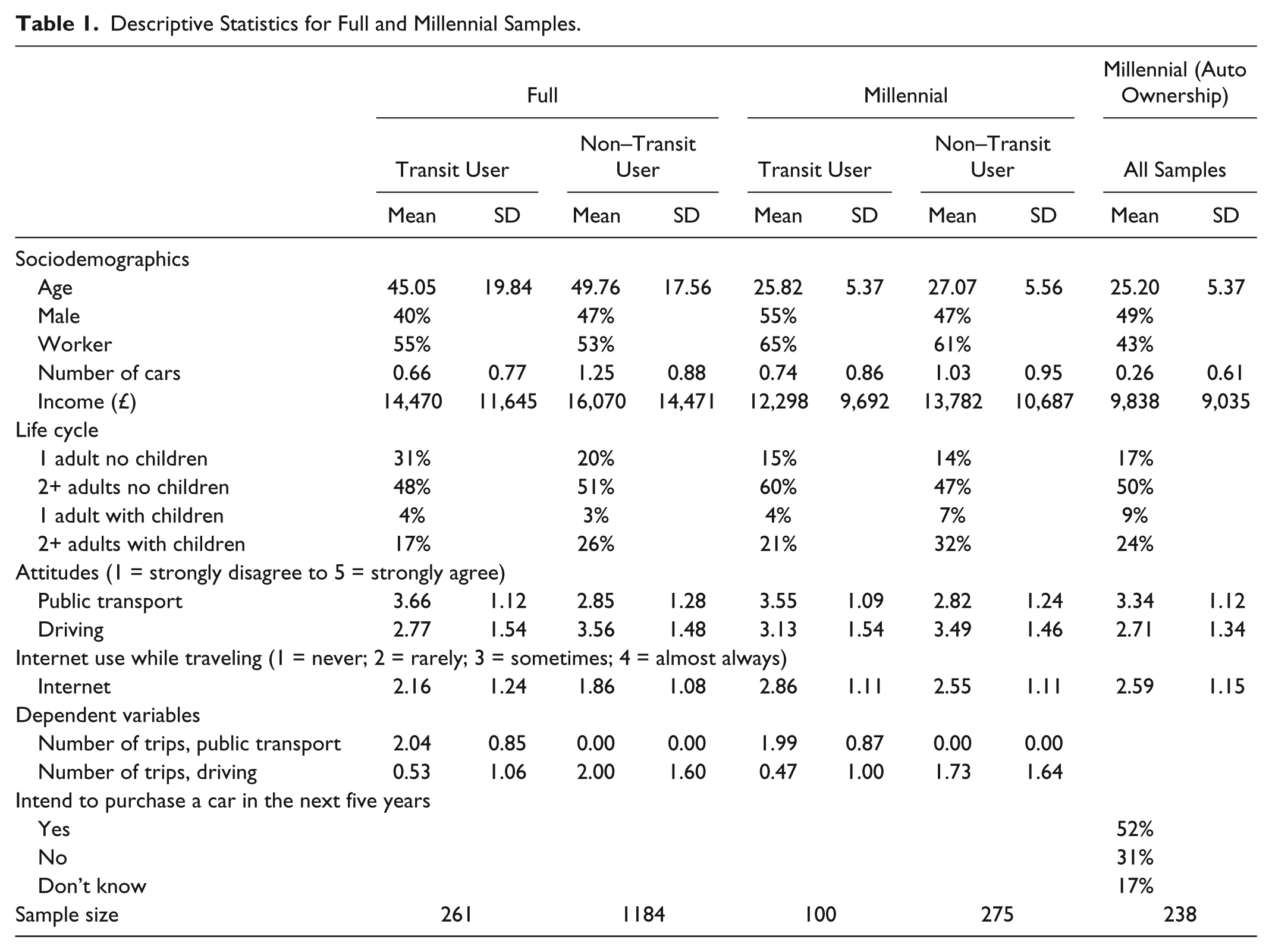
Attitudinal factors show that more people prefer driving to riding public transport, and most people rarely use the Internet while traveling. The statistics from the Millennial subsample are different from those of full sample. It supports the hypothesis of differences in ICT use and attitudes between the Millennials and previous generations. Note also the differences in socioeconomic factors. For example, Millennials tend to have lower incomes, are less likely to live alone, and are more likely to live in a household with children.
Analytical Model
The main objective of this study is to examine the relationship between using the Internet while traveling and the intention of Millennials to purchase a car in the next five years. To help provide context for this decision, and considering the discussion of Millennials’ travel behavior in the literature, we also examine trip frequencies by public transport and private vehicle. Negative binomial regression models have been widely used to examine trip frequency for several decades and were employed to examine the relationship between using the Internet while traveling and trip frequencies of different transport modes for this study. Specifically, we assumed that trip frequency is a function of sociodemographic factors, attitudes, and Internet use while traveling.
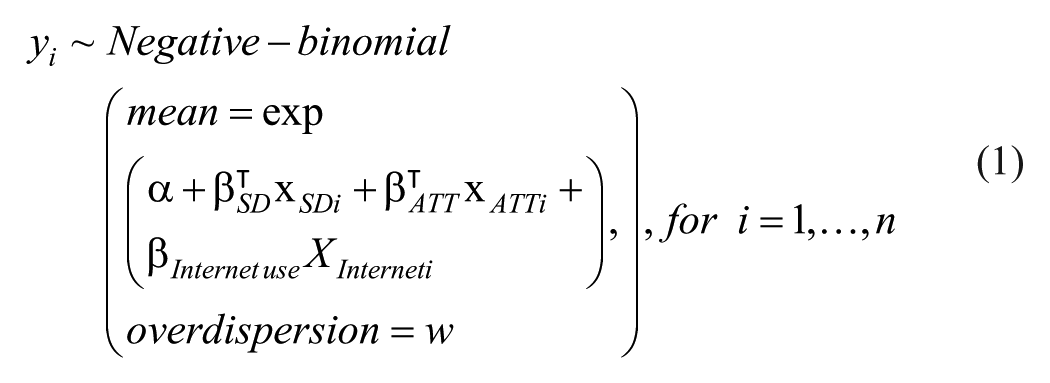
where
To examine the association between Internet use while traveling and future car ownership by Millennials, a multinomial logistic model (MNLM) was employed. The probability that y is equal to one of the outcomes (e.g., m) can be written as follows:

where x includes
Results
We begin by examining the relationship between accessing the Internet while traveling and people’s demand for travel, measured by the number of trips they took. The demand for trips was estimated separately for trips by public transport and trips by private vehicle. Negative binomial regression models were used. Results are presented in Table 2.
Negative Binomial Regressions for Trip Generations with the Full Sample.
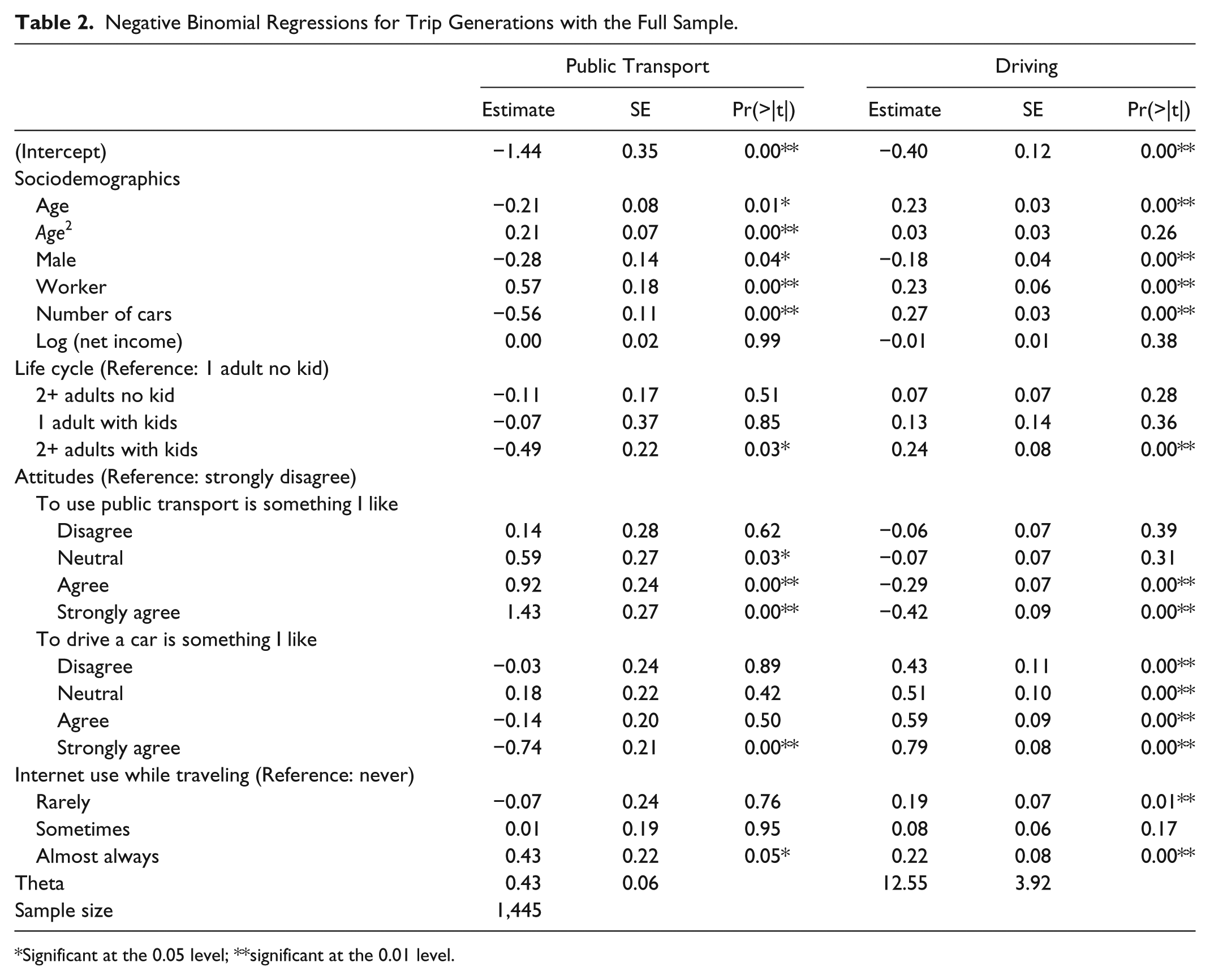
Significant at the 0.05 level; **significant at the 0.01 level.
A degree of caution should be exercised in the interpretation of the results. The models have been set up with the Internet use variable included as an explanatory variable. Our argument is that using the Internet while traveling may influence trip frequencies by, for example, changing the time cost of traveling. However, it could also be argued that people who travel a lot (particularly by public transport) are more likely to use the Internet to pass the time. As the main focus of this article is the intention of Millennials to purchase a car, we do not fully address the possibility of endogeneity here and instead interpret the results as associations and not causal effects. The model was reestimated with an instrumental variable approach (presented in the appendix) and the results seem to be robust.
All sociodemographic and attitudinal factors show results that are consistent with previous studies. The three variables measuring Internet use while traveling are of interest here. The reference category is people who never access the Internet while traveling. We begin by looking at the influence on traveling by public transport. The coefficients for those who rarely or sometimes access the Internet are insignificant. However, the coefficient for those who almost always use the Internet while traveling is positive and significant at the 5 percent level of significance. This indicates that people who almost always use the Internet are expected to make 54 percent (i.e., exp(0.43)) more trips by public transport compared to people who never use it while traveling.
Turning our attention to trips made in a private vehicle, we see a slightly different pattern. All three coefficients attached to the dummy variables representing Internet use while traveling are now positive, with two of them also being significant at the 5 percent level of significance. Interestingly, the association appears to be non-monotonic. This may suggest that people who use the Internet while traveling make more trips by private vehicle than those who do not, but that it is not clear how the size of the association relates to the frequency of use. People who use the Internet rarely or almost always while traveling make more trips compared with those who never use it. The effect is strongest for those who use the Internet most often, with this group expected to make 25 percent more trips by private vehicle compared with those who never use the Internet while traveling.
The overall pattern to emerge from Table 2 is that people who almost always use the Internet while traveling make more trips by public transport and private cars than those who never use the Internet while traveling. The increase in demand is, however, highest for public transport. This is in line with expectations given that traveling by public transport offers more opportunities to access the Internet and utilize mobile technology.
In Table 3, we estimate the same model but now restrict the sample to include only Millennials. This should allow us to see whether the effect of using the Internet while traveling varies by age group; given that we know younger people are more likely to embrace new technologies.
Negative Binomial Regressions for Trip Generations with the Millennial Sample.
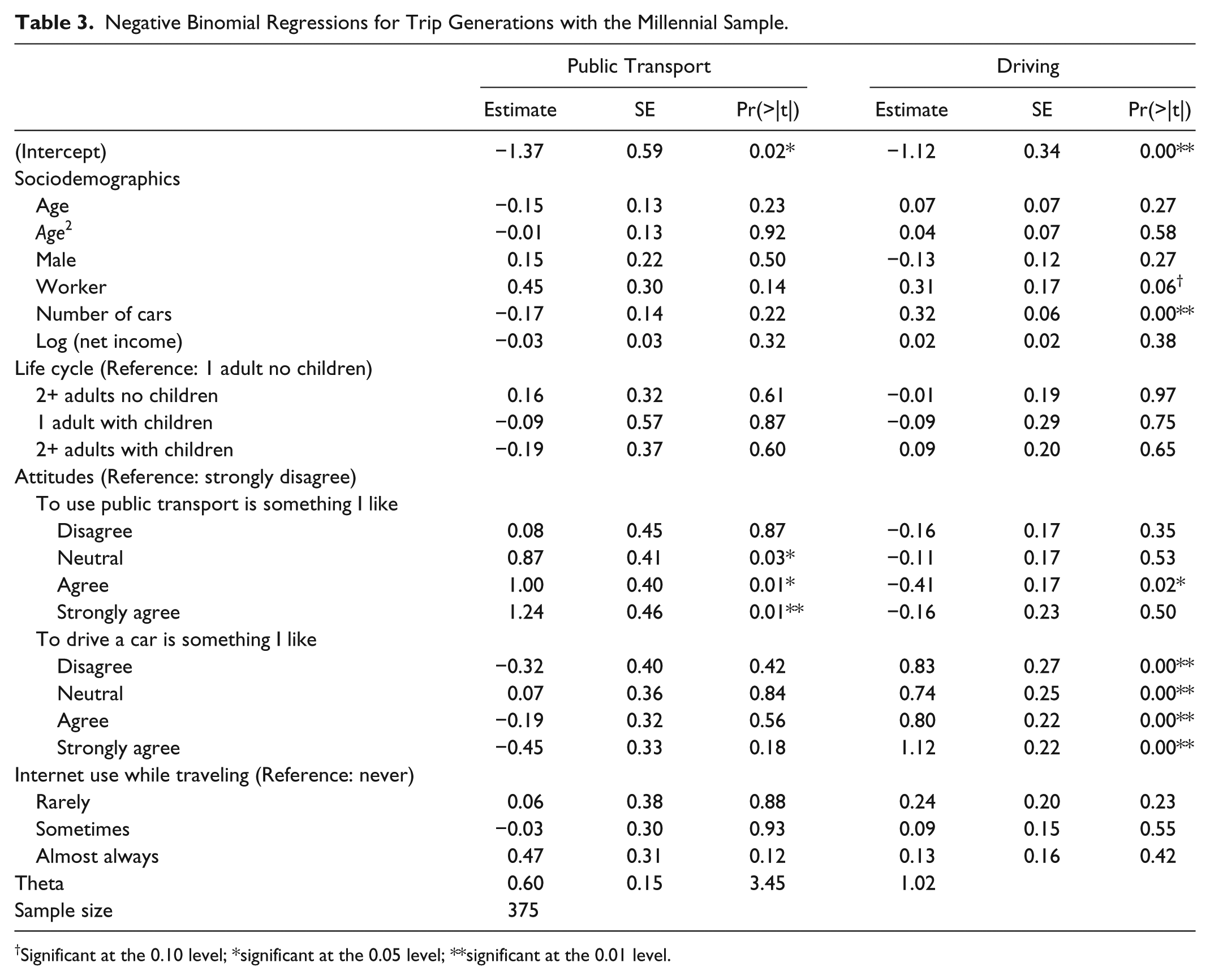
Significant at the 0.10 level; *significant at the 0.05 level; **significant at the 0.01 level.
In the model using only Millennials, there is no statistically significant association between trip frequency (by either mode) and Internet use while traveling. It is worth noting that these models have a substantially reduced sample size, which may be partly able to explain for the lack of significance. Note also that many of the other regressors that were significant in the full models are no longer significant.
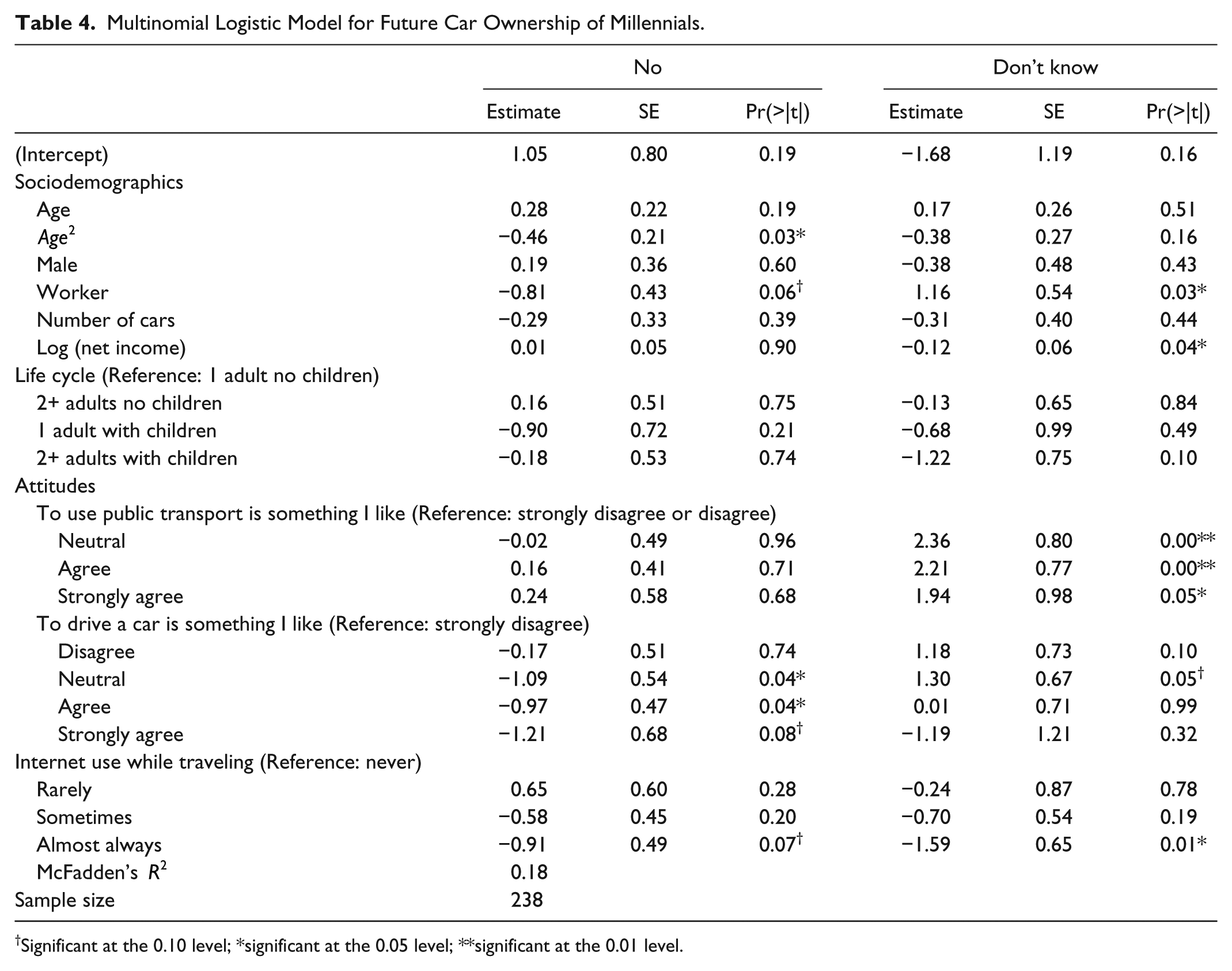
Our attention now turns from exploring the current behavior of Millennials to the main focus of this article; looking at how they might behave in the future based on their current intentions. As part of the survey, respondents who did not currently have access to their own vehicle were asked if they planned to get one in the next five years. They could give three responses to this question: yes, no, or don’t know. Their response is modeled using a multinomial logistic regression. 7 We are interested in whether Millennials’ current use of the Internet while traveling affects their intention to buy a car in the near future.
Multinomial Logistic Model for Future Car Ownership of Millennials.
Significant at the 0.10 level; *significant at the 0.05 level; **significant at the 0.01 level.
The results, presented in Table 4, seem to indicate that people who almost always use the Internet while traveling are less likely to respond either “no” or “don’t know” to the question of whether they intend to get a car within the next five years; that is, they are more likely to say yes. The likelihood of saying no seems to fall as the Internet is used more, although these results are not statistically significant at the 5 percent level. When it comes to responding “don’t know,” people who use the Internet while traveling almost always are less likely to respond that they don’t know, and that coefficient is significant at the 5 percent level of significance.
While we include attitudes as a control in our model, some of the results are worth commenting on. Millennials who do not have their own car and who have favorable attitudes toward driving are unsurprisingly more likely to indicate that they intend to purchase a car in the next five years. However, those with more favorable attitudes to public transport are more likely to respond that they don’t know if they will purchase a car in the near future.
This has some potentially important policy implications. For example, Beirao and Cabral (2007) suggest that improving people’s attitudes toward public transport may encourage switching away from travel by car. However, our results suggest that for Millennials who do not have their own car, despite a positive attitude toward public transport, they are not necessarily less likely to buy a car. While this does not mean that they will travel more by car, owning a car is a strong predictor of car use (Goetzke and Weinberger 2012).
The overall picture emerging from the results is that use of the Internet while traveling does not seem to have a strong association with the intention to buy a car in the near future. However, the results seem to suggest that people who almost always use the Internet while traveling are more likely to express an intention to purchase a car in the next five years. This may be the result of the increased travel demand of this group that we found in our travel demand models. For example, if the more people use the Internet while traveling the more they travel, then they may value the flexibility that can come with car usage.
Conclusion
Our results are not optimistic with respect to the idea that the increased use of mobile technologies will reduce travel demand by private vehicles or car ownership rates. Our first hypothesis was that using the Internet while traveling would increase the demand for travel by public transport relative to travel by private vehicle. The results seem to support this hypothesis. For the full sample of individuals, increased Internet use was associated with increased travel by both public and private transport. However, the association appeared to be stronger for public transport.
Our main hypothesis was that increased Internet use while traveling would be negatively associated with the intention to purchase a car in the near future. The results contradict this hypothesis. Intensive use of the Internet while traveling is associated with a higher probability of purchasing a car in the near future. This supports other work in the literature suggesting that talk of peak-travel and peak-car may be premature.
These results have some important implications for travel demand forecasting. It has been argued that new ICT may have negative effect on travel demand and encourage the use of public and active travel. However, our results coupled with other recent studies suggest that this may be an overly optimistic view.
There are limitations in the current study. One particularly important point to note is that the results presented here should not be interpreted as causal relationships. For example, it seems that people who use the Internet most while traveling also generate additional demand for trips. It could also be argued that people who make a lot of trips are more likely to use the Internet. If they spend a lot of time traveling, then they may need to utilize that time more efficiently by accomplishing other tasks while traveling. However, our instrumental variable model suggests that such endogeneity is not a serious issue.
Another limitation is that we do not have information on what people do while accessing the Internet on their mobile devices. One example of this is that the sorts of things a car driver uses the Internet for while traveling is likely to be very different from the sorts of things a public transport passenger would use it for. Future research could investigate the association between car ownership intentions and different types of mobile Internet use.
While our data have allowed us to explore some important questions, it is worth noting that we only had a relatively small sample size for our models considering only Millennials. A larger sample would have allowed us to give more definitive answers to our research questions. However, we were still able to observe some interesting and important patterns in the data.
Footnotes
Appendix
We experimented with an instrumental variable approach to explore the possibility of endogeneity in the model with the full sample (i.e., not only the Millennials). For our instrumental variable, we use a question from the survey that asks how confident the person is in online activities such as making online profiles and uploading videos. Answers are measured by a four-point Likert scale, anchored by not at all confident and very confident. We treat it as a continuous variable here.
We aggregate our variable describing how often the person uses the Internet while traveling into a binary variable, which takes a value of zero if the person never uses the Internet while traveling and a value of one otherwise. This was done to improve the chance of a good correspondence between the instrumental variable and our variable of interest. It also allowed us to make use of existing analytical models. This approach should allow us to get an unbiased estimate of the effect of Internet use while traveling on trip frequency. First, we assumed that the Internet use while traveling (I) is a function of sociodemographic factors (SD), attitudes (ATT), and computer skill (CS). The following probit model was utilized:
where
Second, a Poisson model was used to analyze trip generation using the sociodemographic, attitude, and the Internet use while traveling variables.
where y, u, and
If
The results are presented in Table A1. We still find that Internet use while traveling is positively associated with driving frequency. The likelihood-ratio test of
Acknowledgements
This work includes use of the iMCD (iMCD Household Survey [anonymized version 2] and Travel Diary) data collection, which was created by the Urban Big Data Centre at the University of Glasgow, supported by the Economic and Social Research Council (grant number ES/L011921/1).
Declaration of Conflicting Interests
The author(s) declared no potential conflicts of interest with respect to the research, authorship, and/or publication of this article.
Funding
The author(s) received no financial support for the research, authorship, and/or publication of this article.