




Abstract
Does a state's increased use of a minority language affect the political attitudes of minorities using that language? To explore the impact of minority language recognition on minority individuals’ political attitudes, we conducted an online survey experiment in Turkey, recruiting citizens of Kurdish origin. Our results point to a recognition paradox. While Kurdish people in Turkey become more satisfied with state services when these services are provided in the Kurdish language, this satisfaction does not increase trust in state institutions. On the other hand, the recognition of the minority language further increases demands for policies regarding that ethnic language.
Keywords
Introduction
In 2009, the Turkish state, ruled by the then Prime Minister Recep Tayyip Erdoğan and his Justice and Development Party (AKP), initiated the Democratic Opening Process to end its long-standing conflict with the PKK, the Kurdish militant insurgent organization. 1 In the following years, the Turkish state took unprecedented steps toward the recognition of the Kurdish cultural and political demands, extending from the increased usage of the Kurdish language by the state institutions to negotiations between the Turkish state and the PKK. Yet President Erdoğan abruptly ended the Peace Process in 2015, right before the June 2015 general election. Arguably, the Process failed because its political results did not match Erdoğan's expectations. Contrary to the purported aim of Erdoğan, the Process had strengthened the Kurdish movement rather than building a closer relationship between the government and Kurdish voters. This example illustrates a puzzle that is addressed in this study. Does the state's recognition of minority languages help to build political trust between minority individuals and state institutions? Or, rather, does it deepen the ethnic divisions in the country and strengthen the ethnic movement?
Nation-states diverge in the extent to which they allow the use of minority languages in state services, extending from official recognition and use at the national level to limited or no recognition even at the local level (Brown and Ganguly, 2003; Liu, 2017; Liu et al., 2018; Safran and Liu, 2012; Wimmer, 2002). Minority language recognition (MLR) is a highly contested issue, especially in countries with a history of ethnic conflict. Based on the individual-level perspective, it can be argued that the denial of state services in the mother tongues of minority individuals violates a basic human right (Dunbar, 2001; Phillipson and Skutnabb-Kangas, 1995; Skutnabb-Kangas, 1994) and that MLR is necessary for social equality (De Varennes, 1998). Many scholars argue that MLR creates positive effects on inter-group relations (Kumove, 2022) and helps build trust in state institutions (Liu and Medeiros, 2020; Reny, 2009), as it is the provision of basic human rights. On the other hand, other scholars, and arguably the majority of policymakers in nation-states, believe that recognizing ethnic differences via MLR will only encourage further ethnic demands and strengthen ethnic divisions in the country (Grigoriadis and Elitsoy, 2021; King and Samii, 2018; Mylonas, 2013).
Given that more than half of the civil conflicts that erupted after World War II have included some level of the language issue (Liu, 2011), it is crucial to examine which of these contradictory approaches is valid. While the normative literature on language policies is rich, the empirical literature stays limited (Medeiros et al., 2020). 2 Furthermore, existing works exploring individual-level effects of MLR rely entirely on observational data (see, for example, Kao et al., 2023; Liu et al., 2015; Safran and Liu, 2012). While these works have contributed immensely to theory building in this field, their causal claims need to be tested with studies using experimental designs. 3 Our paper relies on an online survey experiment conducted in Turkey, an authoritarian country with an ongoing ethnic conflict, to directly test the causal effects of MLR on minority individuals’ political attitudes.
We conducted the survey experiment between 17 September 2022 and 6 October 2022. In this survey experiment, we randomly assigned 1557 Kurdish people in Turkey to watch two short videos prepared by state institutions, introducing state services in Kurdish for the treatment group or Turkish for the respondents in the placebo group. 4 This design successfully manipulated respondents’ perceptions of the change in the Turkish state's use of the Kurdish language during the last decade. Respondents assigned to the treatment group rated the frequency of the Turkish state's use of Kurdish in the recent period to be higher than those in the placebo group. We tested the effects of our experimental manipulation at three levels. Firstly, we examined the effects of MLR on Kurdish individuals’ satisfaction with state services in Turkey. Secondly, we asked a series of questions to measure the impact of MLR on their trust in state institutions. Finally, we asked our respondents about their ethnic grievances and demands.
Our findings reveal a recognition paradox. The increased use of the minority language for the provision of state services increases individuals’ satisfaction with those services. However, these effects do not improve attitudes toward the national political system. On the other hand, the increased use of the minority language by the state further strengthens demands for the state's use of the minority language. We do not note any significant effects of MLR on ethnic grievances and ethnoterritorial demands. We conclude that language concessions, i.e. the limited steps toward minority language recognition taken in an authoritarian and conflictual setting, may not be sufficient to build positive relations between the state and minority groups.
Our paper contributes to three distinct pieces of literature. First, it contributes to comparative politics literature on MLR and political trust (e.g. Kao et al., 2023), confirming that the effects of minority language recognition depend on the context and can be paradoxical, as Kao et al. (2023) argued. It also contributes to political psychology literature on minority language use and ethnic attitudes (e.g. Darr et al., 2020; E. O. Pérez and Tavits, 2019). In addition, this paper also contributes to the ethnic conflict literature of international relations. Reducing the grievances and establishing trust between the conflicting parties are essential for settlement and reconciliation. Therefore, theoretically, if minority language recognition by the state can reduce grievances among minority individuals and foster trust between the conflicting groups (Kumove, 2020), it may facilitate reconciliation. Nevertheless, some real-life examples contradict this common expectation, and our findings from Turkey show the difficulty of building trust through language concessions.
From a macro-historical perspective, this study helps us better understand the failure of the Democratic Opening and Peace Process in Turkey. This political project included various reforms to the Kurdish language policy in Turkey. However, rather than bringing a permanent end to the ethnic conflict in Turkey, the Process ended with violent urban warfare. Our results explain a crucial factor that contributes to the failure of the Peace Process by noting that the Turkish state's steps toward the increased use of the Kurdish language do not necessarily help build trust between the state and minority individuals. As a result, this study lets us better understand the dilemma of policy-making on ethnic issues in conflictual and authoritarian settings.
The rest of our paper is composed of four sections. First, we develop our hypotheses by building on the theoretical literature on MLR. Following this, we introduce our research design. Results are presented in the fourth section. We conclude by discussing the implications of our findings.
Minority language recognition and its effects: theory and hypotheses
Scholars of civil conflict search for the causes of conflict in two rival explanations: greed and grievances. The existence of incentives such as an intention to gain a share of natural resource rents or of opportunities for rebels to fight is what the “greed” explanation offers as the origin of civil war, whereas grievances literature focuses on the motive that pushes individuals to rebel (Collier and Hoeffler, 2004). These motives for rebellion emerge from grievances in response to discrimination. As the individuals’ perceived deprivation rises, their degree of discontent also escalates. As a result of the increased dissatisfaction, grievance, and resentment, ethnic minorities mobilize (Gurr, 1970, 1993).
Restricting the use of minority language is considered one of the main sources of ethnic minority grievances. The language division in a country may be a powerful catalyst for civil conflict since this division can transform ethnic grievances into opportunities for rebel groups to take collective action (Bormann et al., 2017). Since language is a main communication tool that is used in everyday life between the state and minorities, minority individuals are daily reminded of their grievances, anger, and resentment that are sourced from this restriction of their language. This is why intrastate conflicts are more closely associated with language issues than religious issues (Bormann et al., 2017).
However, states have their own reservations about recognizing and using minority languages. First, costs, efficiency, and practicality are usually referred to explain the “official language problem” (Pool, 1991). Recognizing, teaching, and using the minority language is costly, while the political benefits of minority language recognition for governments are argued to be low (Liu, 2011). Since it is financially and politically costly for governments to make every language “official” within the state, they usually decide on one language as the state's official language over the others. This decision results in “linguistic disenfranchisement”, which creates difficulty for speakers of minority languages in terms of access to state services, media, education, and judiciary (Ginsburgh et al., 2005).
Second, policymakers in multi-ethnic countries may have a genuine fear of triggering ethnic divisions and be concerned that giving more rights to minorities, such as MLR, might encourage minorities to demand ethnoterritorial rights. Giving in to minority demands might represent an overstretch of the central state, which can enhance the relative strength of the minority group vis-à-vis the central state (Jenne, 2007). When there is already a conflictual relationship between the state and minority group, states are more unwilling to recognize minority languages since doing so could be seen as a compromise or a concession by the conflicting parties or the citizens.
Nevertheless, recognizing minority languages or allowing minorities to use their own language might reverse this relationship between minority individuals and the state. When a minority group's language is finally recognized, especially after a long period of restriction, the grievances of minority individuals might be reduced, and minority individuals might develop an appreciation and trust toward the state and the government. The literature explains two distinct impacts of language on intergroup relations for rebuilding relationships and facilitating reconciliation between conflicting groups (Kumove, 2022). One of these effects is the communication effect. Within the communication channel, usage of the minority language can reduce the communication cost between the conflicting groups so that building trust between the majority and minority ethnic groups might be less costly and so more attainable (Buzasi, 2015; Kumove, 2022). The second channel is the identity effect. The identity effect occurs when shared language between the groups signals cultural similarity, generating intergroup trust (Delhey, 2007; Gerritsen amd Lubbers, 2010).
In addition to the intergroup relations between different ethnic groups, these mechanisms can also be at work in the relationship between the government and minority individuals in conflictual settings. Based on the communication mechanism, having state services available in minority languages can reduce the communication cost between the government and minority individuals, so building trust between minority individuals and the state might be less costly. On the other hand, the identity effect occurs when the state signals that it cares about minority individuals by offering services available in their languages. When the state makes services available in minority languages, minority individuals may feel that their identity matters to the state and grow in trust and appreciation toward the state.
While MLR may help build trust between the state and minority individuals via communication and/or identity channels, conversely, it may also create or deepen ethnic and political division. If, as a result of MLR, minority individuals believe they could gain more of their demands regarding autonomy, independence, or territorial demands in general, and as some nation-states presume, the tension between the state and minority groups might escalate.
To understand if MLR increases the trust toward the state or increases the ethnic demands and attitudes among minorities, this study examines the effects of MLR on minority individuals’ attitudes at three levels: evaluations of state services, attitudes toward the state, and ethnic demands and attitudes. Below, we discuss each of these levels.
Minority language recognition and satisfaction from state services
For a minority individual to trust the state as a result of MLR, the individual must acknowledge that the service is presented in their own language and must be satisfied with the presentation of this service in their language. Therefore, to begin with, we would expect that the introduction of state services in the minority language would have immediate effects on the perception of these services by minority individuals. More specifically, minority individuals’ satisfaction with a state service would increase if the service was presented in their own language.
Increased satisfaction with state services can be linked to practical reasons. Minority individuals who are more comfortable in their native language than the majority language will feel more comfortable using the state service if the service is presented in their native language. Thus, they will be able to express their problems better when dealing with state officials and better understand what the state official is saying, thereby resulting in more effective communication.
Beyond this, offering a state service in a minority language also signals to minority individuals that the state institution providing this service will be welcoming toward them during the service provision. Thus, for example, even if the minority individuals have an excellent command of the majority language, they may still find the use of the minority language in the state service as a positive development and feel that state officials will be less likely to discriminate against them because of their ethnic identity.
These two arguments lead us to our first hypothesis:
Minority language recognition and political trust
Do the immediate positive effects of MLR on satisfaction with state services contribute to building trust among minority individuals toward state institutions in a conflictual environment?
A common phenomenon in many countries, including Turkey, is that minority individuals harbor less trust in state institutions than individuals belonging to the majority ethnic group (Karakoç, 2013; Wilkes and Wu, 2018b). The trust gap is a significant problem, as it can have adverse effects on minority individuals’ well-being, their integration into the country's political institutions, and the ethnic peace in the country. Furthermore, the trust gap can be a consequence of the structures of democratic institutions that give more political power to more populous ethnic groups (Wilkes and Wu, 2018a). Yet the history of discrimination and repression by state institutions may also explain lower levels of trust in state institutions among minority individuals (Sahin and Akboga, 2018). Increased levels of grievance as a result of discrimination against and repression of ethnic minorities by the state leads to a lower level of trust toward the state, which, in turn, causes conflict.
MLR is usually offered as a remedy to improve the minority individuals’ trust in state institutions (Harel-Shalev, 2006; Liu and Medeiros, 2020). This argument is intuitive. The immediate positive effects of MLR on satisfaction with state services can build a positive association between minorities and the institutions that use the minorities’ native language. Minority individuals may take MLR as a signal of the state's commitment and respect for the interests of the minority group. This can improve the relationship between minority individuals and state institutions.
There is already some research suggesting that MLR improves minority individuals’ attitudes toward state institutions. Using World Values Survey data, Liu and Baird (2012) find that the recognition of either a minority language and/or a third-party's language during judicial proceedings increases the confidence in the judiciary. Darr et al. (2020) find that, among Spanish-speaking Latinos in the United States, seeing a political news article option in Spanish increases feelings of inclusion and belonging. Following these studies, we develop our second hypothesis as follows:
The direction of the relationship, however, could differ based on the regime type or the existence of conflict in a country. Kao et al. (2023) have recently argued that the effects of MLR can be moderated by the regime type. These authors distinguish between states’ symbolic gestures toward minority individuals and substantive concessions. They argue that MLR under authoritarian regimes is regarded as a symbolic gesture rather than substantive concessions by minority individuals as it does not correspond to any substantial change in existing power structures. Their analysis, which relies on World Values Survey data, shows that there is no relationship between MLR and political trust under electoral authoritarian regimes (Kao et al., 2023: 9).
In addition to Kao et al.'s (2023) findings, we also consider that MLR could not increase trust among minorities in a country with an ongoing ethnic conflict. After a long repression and conflict process, MLR alone is not enough to rebuild trust as improving trust takes long-term efforts and processes, and requires other political recognitions and redistribution. Following Kao et al.'s (2023) broader argument regarding the effect of MLR in authoritarian countries, we also consider that it might be more difficult to shift attitudes in a positive direction in countries with an ongoing ethnic conflict. Processes of repression and conflict can trigger increased threat perception among minority individuals and polarize political attitudes (Laebens and Öztürk, 2021; Nugent, 2020). In countries where the regime keeps the minority ethnic group and its political representatives under political repression, the positive effects of MLR on satisfaction with state services may fail to generate broader attitudinal shifts, including political trust. Building on these arguments, we formulate a new hypothesis:
Minority language recognition and ethnic attitudes
Most scholars working on language policies emphasize the impact of these policies on minority individuals’ attitudes toward national institutions. However, policymakers in conflictual settings, like Turkey, are especially concerned about the effects of these policies on minority individuals’ ethnic attitudes, and they deny or deliver these rights on the grounds that these rights will institutionalize the ethnic divide in the country (Grigoriadis and Elitsoy, 2021; King and Samii, 2018; Mylonas, 2013). Does the increasing use of minority language in state services increase the role of ethnicity in politics?
We argue that MLR can increase the role of ethnicity in national politics through two different mechanisms: normalization and salience. First, the state's increasing use of minority languages can normalize the use of minority languages in public, especially among minority individuals. While individuals from majority groups can react negatively to the use of minority language by the state, individuals from the minority groups will be quick to adapt to the new status quo that will, at the very least, improve their daily experiences of state services. To summarize:
We would expect the MLR's effects through the normalization mechanism to be primarily limited to the area of language demands, as this is the area in which citizens take cues about the acceptable norms of ethnic politics. On the other hand, MLR can also trigger broader political effects by highlighting ethnic differences in the country. Language is the key marker of the ethnic problems in many countries, including Turkey. A radical change in the state's language policies and increasing use of the minority language by the state may draw attention to the ethnic question and lead minority individuals to become more attentive to the role of ethnicity in politics. This heightened salience of ethnic issues could also lead to increased ethnic and political demands. We call this mechanism the salience mechanism.
We expect to see the effects of increased interest in the ethnic question in two different ways. First of all, in a country in which social and economic inequalities between ethnic groups still continue alongside the ethnic conflict, we expect to see an increase in perceptions of ethnic discrimination (Kao et al., 2023):
Perception of ethnic discrimination is one of the main correlates of political demands among ethnic minorities. (Sarigil and Fazlioglu, 2014). Thus, we would expect an increase in ethnoterritorial demands as well:
Research design
In order to test the hypotheses we posited above, we conducted an online survey experiment in Turkey between 17 September and 6 October 2022. Our participants were Kurdish individuals living in Turkey. We received ethical approval for this research from the University of Glasgow and pre-registered the experimental design before the data collection started. 5 The research data and codes required to replicate the empirical analysis are also available online. 6
The case: the Kurdish question in contemporary Turkey
In terms of minority language recognition, Turkey is a case of denial of language rights in the context of an ongoing ethnic conflict and an authoritarian political system (Kao et al., 2023; Somer, 2022; Zeydanlioğlu, 2012). 7 Kurdish minorities living in Turkey form around 20% of the population in Turkey. Despite this, Turkish has been the only official language of the state since the foundation of Turkey. State services are not offered in any language but Turkish and compulsory education is taught only in Turkish, starting from primary school. This denial of minority language rights, such as the Kurdish language in Turkey, is built on the systematic exclusion of Kurdish minorities from state services in Turkey (Tezcür and Gurses, 2017).
Turkey is a typical case where language policy is a contested issue and part of the conflictual situation between the state and the minority people. While the Kurdish movement has been raising more than language demands, language recognition is the most salient demand of Kurds in Turkey (Karakoc and Ozen, 2020). The majority of the Kurdish people want Kurdish to be used in state services and education, as Table 1 indicates.
Furthermore, Turkey is a case in which ethnic issues even led to armed conflict. During the last four decades, the PKK, an armed insurgent group agitating for the political demands of the Kurds, has contested the Turkish state's authority in the southeastern region of Turkey, which is historically populated by the Kurdish people, through violent means. Besides this armed conflict, the Kurdish political movement has also gained ground in legal politics during this time despite frequent bans and party closures. The political parties of the Kurdish movement have been represented in the Turkish parliament since the 1990s, voicing demands for political and language rights (Gunes, 2020). In its response to the Kurdish movement, the Turkish state relied primarily on military options and did not avoid adopting repressive measures against the Kurdish people living in the region as well (Belge, 2016). The conflict between the PKK and the Turkish state is one of the most prolonged ongoing ethnic conflicts in the world, and it has led to the death of more than 40,000 people, including civilians, soldiers, and PKK militants.
Recep Tayyip Erdoğan, Turkey's current leader, came to power in 2002 with free and fair elections. Since then, the country has gone through a process of autocratization, especially in the last decade. This process has ended with the establishment of a personalist authoritarian regime, similar to the ones in Russia, Venezuela, and Hungary (Cleary and Öztürk, 2022; Öztürk and Reilly, 2022). Multi-party elections for executive and legislative branches still take place in Turkey, and opposition parties have gained some critical victories recently at the local level (Demiralp and Balta, 2021). Yet, Erdoğan's regime uses a variety of tactics to undermine electoral competition and deny opposition parties the chance to gain political power at the national level (Yesil, 2014; Yeşil, 2018).
Even when Turkey was still a functioning electoral democracy in the 1990s and early 2000s, parties that represented the Kurdish political movement were banned by Turkey's constitutional court on the grounds that they were affiliated with “terrorism”. Many leaders and members of these parties were jailed. Erdoğan's regime in Turkey has also adopted similar repressive tactics against the Kurdish political movement and its political party, the People's Democratic Party (HDP), especially after 2015 when the HDP managed to surpass the electoral threshold in the June election. Selahattin Demirtas, who was the HDP's charismatic leader, has also been in jail since 2016 despite the decision of the European Court of Human Rights ordering the immediate release of Demirtas. Other leaders of HDP, who were elected as mayors, have also been targeted. In the 2019 local election, HDP won around 70 municipalities. Since the local election in 2019, nearly all 70 mayors elected from the HDP were removed and replaced with state-appointed trustees (Tutkal, 2022). Additionally, the Constitutional Court temporarily suspended the payment of the treasury fund of HDP just a few months before the upcoming election owing to the party's alleged ties with the PKK.
A process of de-securitization in Turkey's Kurdish policy started in 2000 as part of Turkey's European Union membership process (Weiss, 2016). This policy increasingly continued under Erdoğan. Some early steps included restoring Kurdish names to Kurdish villages and passing legislation enabling Kurdish language broadcasting. Erdoğan's government started secret talks with the PKK in 2008, and publicly announced the “Democratic Opening Process” in 2009, making this the center of its policy agenda. Although the Democratic Opening Process ended in 2009, it was followed by the Peace Process in 2012. Important steps were taken during these processes with respect to the recognition of the Kurdish language. Some restrictions against the use of the Kurdish language in public spaces were removed (Weiss, 2016). Universities and private schools were allowed to open institutes, language departments, or elective courses for the study of the Kurdish language. Kurds have been allowed to use their language since 2013, despite Kurdish still being listed as an “unknown language” by some public institutions (Derince, 2013). Perhaps most importantly, the state television TRT launched a new TV channel that provides exclusive coverage in Kurdish.
Arguably, Erdoğan's primary goal in investing in the Democratic Opening and Peace Processes was political. He expected to consolidate his support among the Kurdish people by promoting a religious–national interpretation of Turkey's identity (Aktürk, 2018). Yet these processes resulted in the increased political power of the Kurdish movement. 8 By 2015, the HDP had built enough public support among the voters in Turkey to ensure the party would clear the 10% electoral threshold for the first time in its history. Worried about the electoral and political results of this process, Erdoğan ended the Peace Process in 2015. Shortly after, the ethnic conflict between the PKK and the Turkish state started again.
An unexpected result of the Peace Process was that it strengthened both Kurdish political actors and the ethnic demands among the Kurdish people. In the general election held in June 2015, the HDP achieved its highest vote share ever, getting 13% of votes. Looking at the public opinion data during this process, as presented in Table 1, we see that this political success accompanied the increasing confidence in expressing ethnic demands among the Kurdish people. Public opinion surveys recorded a consistent increase in Kurdish individuals’ demands for language and political rights from 2011 to 2015.
The shift in the Kurdish people's support for ethnic and political demands during the Peace Process
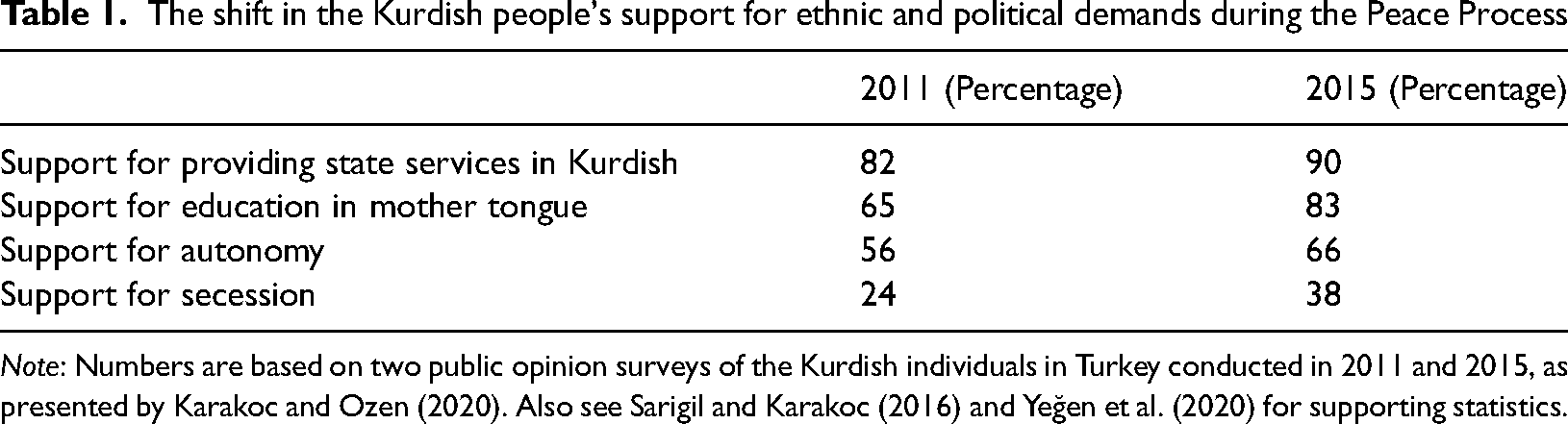
Note: Numbers are based on two public opinion surveys of the Kurdish individuals in Turkey conducted in 2011 and 2015, as presented by Karakoc and Ozen (2020). Also see Sarigil and Karakoc (2016) and Yeğen et al. (2020) for supporting statistics.
This shift in Kurdish public opinion has been influential in determining the fate of the Peace Process in Turkey. However, why did we see such a shift in the first place? The results presented below explore the effects of MLR on ethnic demands, as well as political trust and satisfaction with state services.
Sample
We recruited survey participants through paid advertisements published on Meta's social media platforms, including Facebook and Instagram. Paid advertisements on social media are becoming increasingly common for comparative political scientists to recruit participants for online surveys (Neundorf and Öztürk, 2023). We published our advertisements in 13 provinces located in the Southern Eastern and Eastern regions of Turkey. 9 These are the provinces that are historically populated, to a significant extent, by Kurdish-speaking individuals living in Turkey. These are also provinces in which the Kurdish political movement in Turkey is the strongest. 10
Our study was limited to Kurdish individuals living in Turkey. We wanted our definition of Kurdishness to be external to individuals’ subjective perceptions of themselves. Being a Kurd is not a legal status in Turkey. For this reason, we used a definition of Kurdishness based on the Kurdish language. This is arguably the most defining sign of belonging to the Kurdish ethnic group in Turkey since no other ethnic groups except Kurds speak Kurdish and since Kurdish is still used for daily communication in Turkey's eastern provinces, which are heavily populated by the Kurdish people. We asked all our survey participants if their mother or father could speak Kurdish. Only respondents who replied that at least one of their parents could speak Kurdish were accepted into the study. Given that Turkish is imposed in schools and the media, many young Kurds might not speak Kurdish. However, the previous Kurdish generation, who reside particularly in the Eastern provinces of Turkey, still overwhelmingly speak Kurdish in their daily lives. This is why our ethnic identification question focused on the respondents’ parents’ proficiency in Kurdish rather than the respondents’.
Overall, 1557 Kurdish individuals living in Turkey were assigned to one of our two treatment groups. 11 While our sample was not probability-based, as we relied on social media advertisements, it was diverse enough to allow causal inference through experiments. Of our sample, 40% comprised women, and 62% did not have a college degree. Unsurprisingly, most of our respondents were proficient in the Kurdish language and were more likely to vote for the HDP.
In terms of geographical distribution within Turkey's Kurdish-majority provinces, our sample had a balanced distribution. Nearly one-quarter of our respondents were from Diyarbakir, which is the most populated province in the region and is usually considered the centre of the Kurdish movement in Turkey. About 13% of the respondents were from Sanliurfa and about 11% of them were from Van, which are other metropolitan provinces in the southeast and eastern regions of Turkey. 12 The remaining respondents were distributed across all other provinces in the region. We provide descriptive statistics in Online Appendix Section 1. 13
Experimental treatment
The goal of the experimental design was to manipulate the perceptions of Kurdish people living in Turkey regarding the state's use of the Kurdish language in service provision. Provision of public service in the minority language is a form of minority language recognition. This is also one of the contested dimensions of ethnic politics in Turkey. The law does not require the Turkish state to provide state services in Kurdish, and only in rare circumstances is Kurdish used in state services. While the Kurdish political movement demands the increased use of Kurdish in state services, Turkish nationalists categorically reject these demands. One of the promises of the AKP during the Peace Process was to prepare a legal ground for providing state services in Kurdish (Habertürk, 2012; Sözcü, 2012). During that process, several state institutions also started to offer their services in Kurdish (TRT, 2013). Since the collapse of the Peace Process, however, state institutions have been reluctant to offer services in Kurdish even when they serve in foreign languages. This drew strong criticisms from the Kurdish movement and the political opposition in Turkey. 14 Our treatment focuses on this contested dimension of language politics in Turkey.
In our survey experiment, we prepared a setting in which participants were randomly assigned to watch two public service announcements, introducing some services offered by state agencies, either in the Kurdish or the Turkish language. These public service announcements were short videos, each lasting less than 2 minutes. They were originally prepared in Turkish by Turkish state institutions. For the purpose of experimental manipulation, we had both videos translated into Kurdish. We worked with a non-governmental media education institution and a civil society organization, both located in the Kurdish-populated region of Turkey, during this process. 15 After participants in the treatment group had completed the entire survey, we informed them that these videos were voiced in the Kurdish language for this study and that we had informed the relevant state institutions about using their resources.
We decided which public service announcements to use based on the salience of various issues in Turkey during the data collection period. The first video was prepared by the Health Ministry of Turkey, and it introduced a phone call service that provided citizens with information about their health conditions. We selected this video because, owing to the COVID-19 pandemic, health was one of the main issues in the country during the data collection process. The second video was prepared by the Turkish Employment Agency, and it explained how this state institution could help citizens to find a job. We decided to use this video because the economy and unemployment were among the leading problems in Turkey owing to the ongoing economic crisis since 2018. We combined the two videos, showing one after another, to create a stronger treatment effect and prevent the treatment's effect from being dependent on a specific issue, such as health or the economy. Respondents in the placebo group watched both videos in Turkish; respondents in the treatment groups watched both videos in Kurdish.
The survey language was Turkish for all respondents. Right before the Kurdish videos were shown to the respondents in the treatment group, a statement indicated that the public announcements were prepared by the Ministry of Health or the Turkish Employment Agency and that these announcements would be in Kurdish. 16 Our goal was to draw attention to a state institution's use of the Kurdish language.
To check whether the randomization worked as intended, we conducted two steps of bias analysis. First, to check whether randomization had worked properly, we ran regression models, in which assignment into the Kurdish treatment was the dependent variable and pre-treatment questions were independent variables. None of the pre-treatment variables were significant at the conventional levels of statistical significance. Second, to check whether dropouts from the survey had created an attrition bias, we ran the same regression models, limiting the sample to respondents who had completed the entire survey. Again, none of the pre-treatment variables were significant at the conventional levels of statistical significance. We concluded that there was no bias that could threaten the causal inference in our study. More information about our bias analyses can be found in Online Appendix Section 2.
Assessing the success of experimental design: manipulation checks
Did our experiment successfully manipulate experiences and beliefs regarding the Turkish state's use of Kurdish? Our experimental design required us to increase the perception that the Turkish state has recently used the Kurdish language more frequently in state services but not increase the perception that the Turkish state has recently provided more services. To test the success of our videos in creating this desired outcome, we used two questions posed to respondents as part of the post-treatment questionnaire. The first question asked respondents how much the Turkish state's use of Kurdish has changed during the last 10 years compared with previous periods. Our second question asked respondents how much the Turkish state's services to people have changed during the last 10 years compared with previous periods. For both questions, the response scale went from 1 (much less) to 5 (much more).
Figure 1 presents the results of these two questions, comparing the group of respondents assigned to Kurdish videos with the group of respondents that were assigned to Turkish videos. The results show that our experimental design worked as intended. There was no difference between the treatment and placebo groups regarding the perceptions of the amount of the Turkish state's services. However, there was a difference regarding the use of Kurdish in these services; respondents assigned to the treatment group rated Turkey's use of Kurdish as higher than respondents assigned to the placebo group.
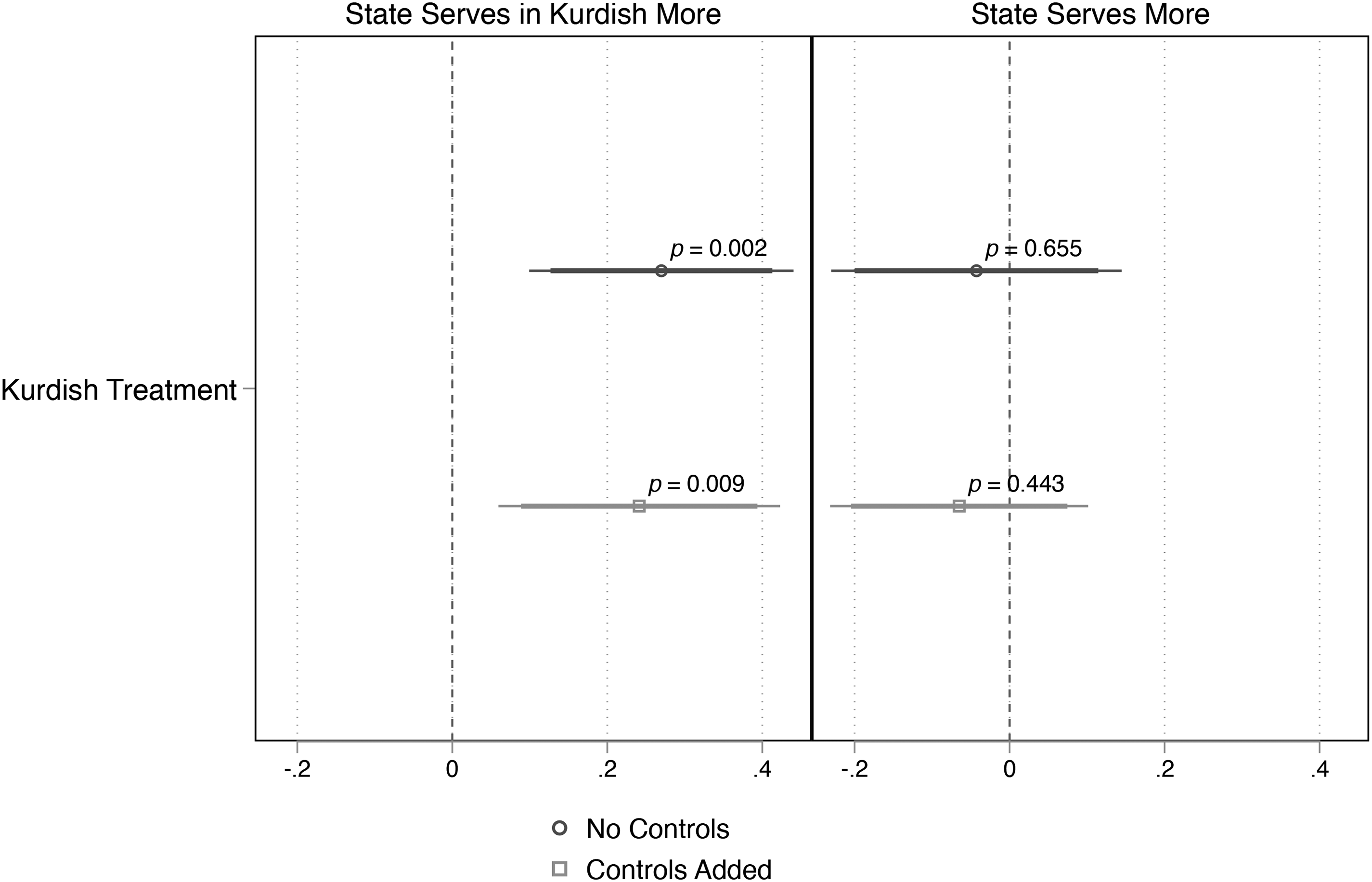
Manipulation checks. Note: 95 and 90 significance levels are presented on the graph. We provide the full table in the Online Appendix Section 3.
Results
We present results both for base models, in which there are no controls, and complete models, in which all pre-treatment variables are added as control variables. Adding pre-treatment variables as control variables usually increases the precision of estimates in experimental studies. On the other hand, however, the sample size becomes smaller in these models because of the item-non response in pre-treatment variables. A rule that we rely on as we interpret our results is that consistency across both types of models is necessary to be confident about our findings.
Effects on satisfaction with state services
Before discussing any political effects of state services, it will be helpful to look at the effects on the evaluation of state services introduced in these services. Do minority individuals find state services more useful when they are introduced in their languages?
To answer this question, we use an index that is formed of four questions. After each of the two videos, respondents were asked two separate questions. First, we asked them to what extent they thought that the service introduced in the advertisement was useful for citizens. Second, we asked them how likely they would be to use that service if they needed it. As described in the registration plan, we created the index based on the row averages of responses to these four questions.
The results are presented in Figure 2. There is a statistically and substantively significant effect of watching videos in the Kurdish language on finding the state service introduced in the video more useful and in expressing an increased likelihood to use that state service.
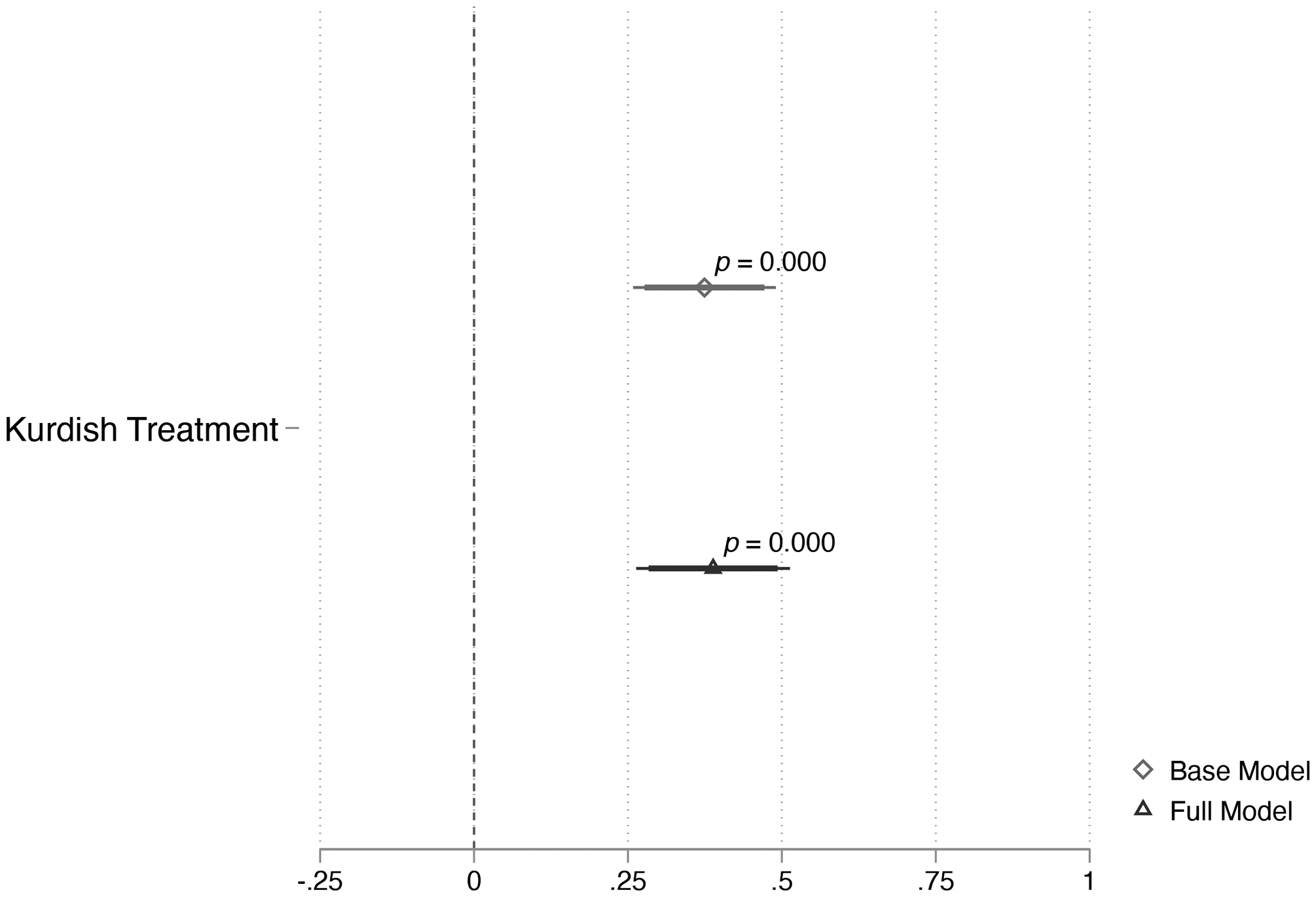
The effect of treatment on satisfaction with state services. Note: The full table is presented in Online Appendix Section 4.1.
Effects on political trust
Are positive reactions evoked at the personal level channelled into trust toward state institutions? Our analysis in this section engages with this question.
We use three variables of political trust at changing levels of generalization. First, we asked respondents to report their trust toward the institutions in the videos, i.e. the Ministry of Health and Turkish Employment Institution. We created a variable called specific trust, taking the row averages of responses to these questions. Second, we asked respondents to report their trust in the government and the presidency. We then created a variable called executive trust, taking the row averages of responses to these questions. Finally, we asked respondents to report their trust in the parliament and the state officials. Diffuse trust is the name of the variable we created by taking the averages of responses to these two questions.
The results are presented in Figure 3. We consistently find that positive evaluations of state services that are offered in the Kurdish language are not transferred to the attitudes at the national level. We see no effects at all on any of the three trust variables. Thus, we conclude that MLR does not increase political trust, at least in a conflictual and authoritarian setting like Turkey. 17
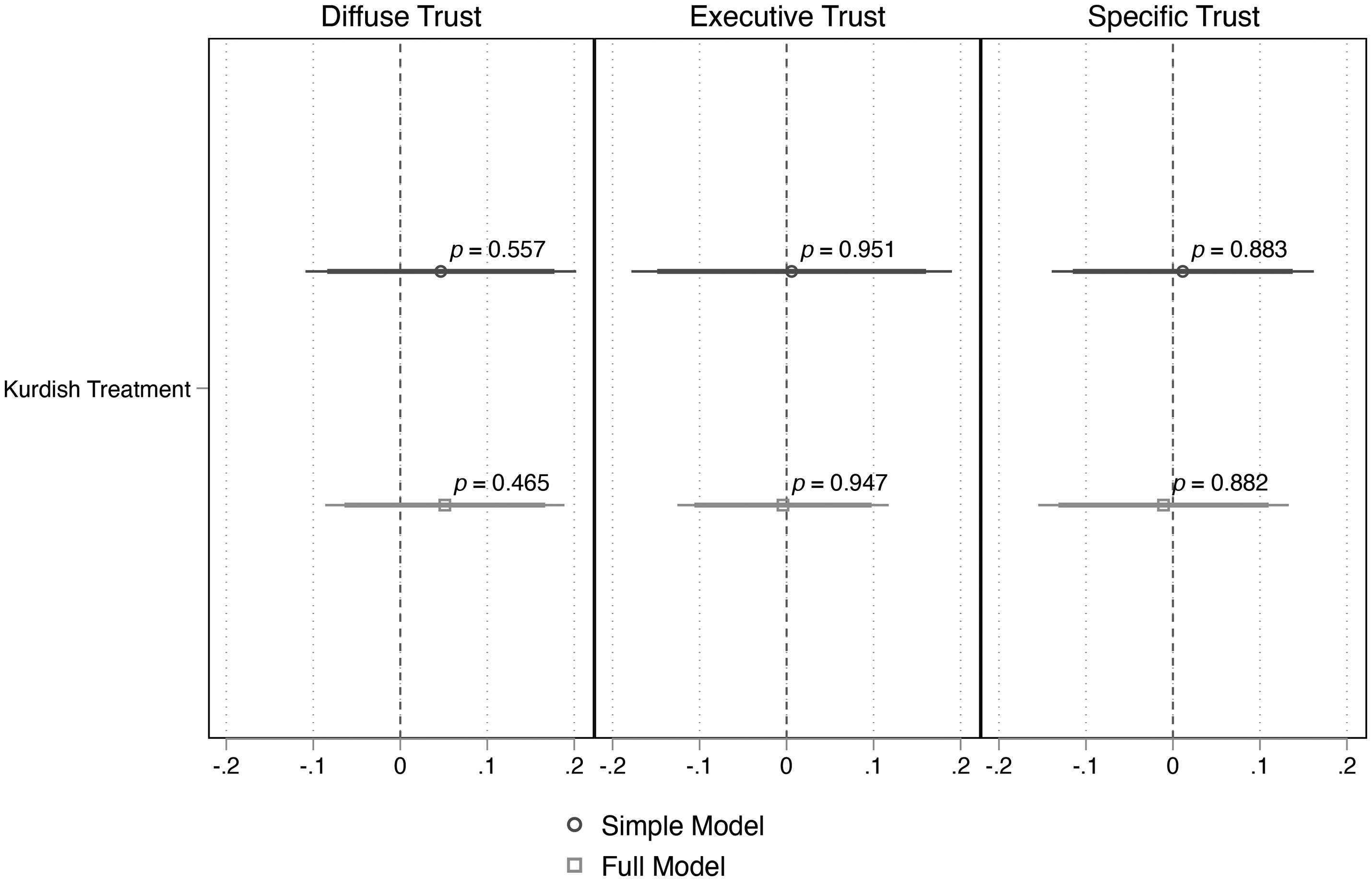
The effect of the treatment on political trust. Note: The full table is presented in Online Appendix Section 4.2.
Effects on ethnic attitudes: language demands, ethnic grievances, and ethnoterritorial demands
We measured the effect of Kurdish videos on ethnic attitudes through three variables. Our first variable is the strength of language demands. We asked our respondents to what extent they agreed with the statements “Kurdish language should be used more in state service,” and “Kurdish should be used as an education language in schools.” Our second variable is the strength of ethnoterritorial demands. We asked our respondents to what extent they agreed with the statement, “An autonomous rule should be established in the Kurdish-populated cities of Turkey.” Our third variable is ethnic grievances. We measured this variable by taking the average of two questions: “do Turks and Kurds have equal rights in the country,” and “are Kurds discriminated against in Turkey”? As presented in Figure 4, we reached mixed findings regarding the effects of MLR on ethnic attitudes.
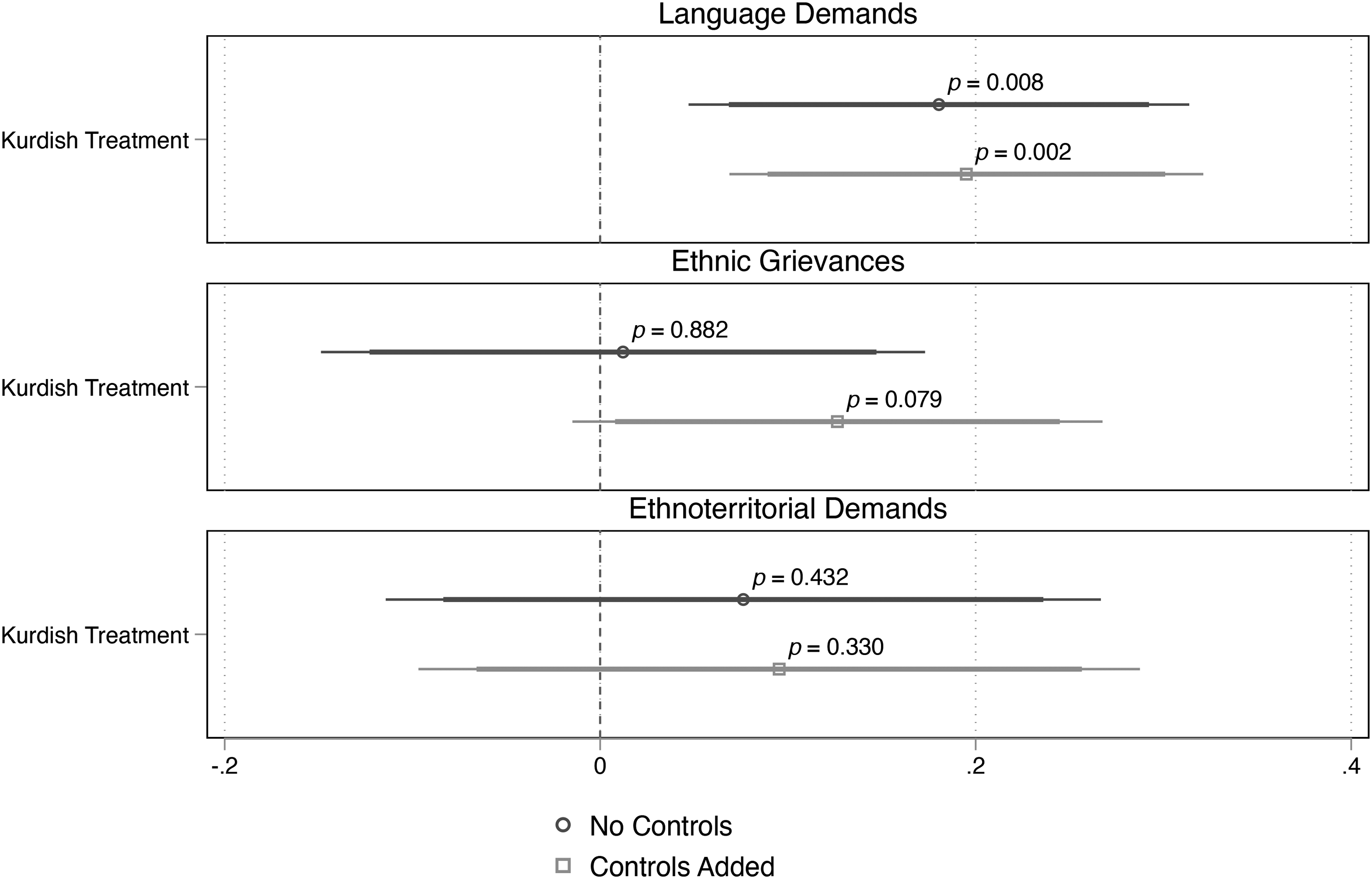
The effect of the treatment on ethnic attitudes. Note: The full table is presented in Online Appendix Section 4.3.
First, the treatment has no significant effect on ethnoterritorial demands. The perception that the state uses the Kurdish language more often does not automatically trigger ethnoterritorial demands. Interestingly, one of our models found a positive relationship between minority language recognition and ethnic grievances (p = 0.079). However, this effect did not reach the conventional level of statistical significance and was not replicated in the model without control variables. For these reasons, we cannot confidently reject the null hypothesis that there is no relationship between minority language recognition and ethnic grievances. Finally, we find that the treatment significantly increases the expression of language demands. This finding is statistically and substantially significant and consistent across the two models.
Why does MLR only increase language demands and not influence ethnoterritorial demands? One explanation could be that the MLR reactivated the grievances of minority individuals regarding the language issue. For this reason, we cannot reject the null hypothesis that there is no relationship. On the other hand, we believe that the normalization mechanism can explain this finding. Moderation analyses presented in the Online Appendix Section 4.5 demonstrate that the effect of MLR on language demands was most powerful among the Kurdish individuals who are the least likely to vote for the pro-Kurdish political party and among the Kurdish individuals who are more likely to vote for the government parties. Based on these results, we infer that the Turkish state's use of the Kurdish language makes Kurdish language demands acceptable even in the eyes of Kurdish people distanced from the Kurdish political movement.
Conclusion
Our paper asks whether a state's recognition of a minority language would improve the minorities’ political trust toward state institutions by diminishing the grievances among minority individuals or whether it would further deepen the ethnic divisions in the country by increasing the ethnic demands. Our findings show that while minority language recognition does not improve minority individuals’ trust in state institutions, it may increase the language demands of minority individuals. Furthermore, we find evidence that minorities are more satisfied with state services when these services are offered in their native language.
This study makes three distinct contributions to the literature. First, with respect to political trust, our paper supports the main finding of Kao et al.'s (2023) cross-sectional research, confirming that MLR does not increase political trust in an authoritarian country. Kao et al.'s (2023) finding was against the common wisdom defended by many scholars. Yet the reliability of its causal claims was limited owing to the observational nature of the data. Here, we test the effect of MLR by the experimental data, which adds an individual-level and causal dimension to this analysis, and we confirm that minority language recognition does not improve the trust of minorities in an authoritarian and conflictual setting.
Second, we find that MLR increases the ethnic demands to a certain extent rather than reducing them. Significantly, however, the increases in ethnic demands are primarily limited to language demands, and there is no significant effect on ethnoterritorial demands or ethnic grievances. We also analyze if the MLR increases ethnic salience but find that it does not have an impact on the salience of the Kurdish issue as well. 18 These findings show that the argument that language recognition would lead to more political and territorial demands and contribute to ethnic conflict is not entirely valid. In other words, MLR does not act as a trigger for ethnopolitical demands in general, as it only increases language demand among other ethnic demands.
Another significant contribution of our paper is that we demonstrate that minority individuals value state services presented in their own languages, even under authoritarian and conflictual settings. Thus, even if MLR does not make positive contributions to political trust, as many assume, there is still a normative value in promoting it as a policy. It will increase the well-being of some of the most discriminated individuals in many societies directly or indirectly, as some studies also show that minority language recognition is associated with higher voter turnout (McLaughlin, 2015) and can diminish the negative impact of ethnic diversity on socio-economic development (Csata et al., 2023). Our finding contradicts Kao et al.'s (2023) claim that minority individuals in authoritarian settings regard minority language recognition simply as “window-dressing”. It is better to say that they value and benefit from the use of the minority language in state services, but that does not suffice to update their political evaluations.
Two policy implications can be drawn from our findings. First, the recognition of minority languages by the state is important, but it is not a mere solution to the conflict between the state and minority groups. Our results clearly show that offering state services in minority languages increases minority individuals’ satisfaction with these services. On the other hand, it does not help to resolve the conflict between the state and minorities by rebuilding trust between them. The Democratic Opening Process and Peace Process in Turkey are concrete examples of this situation. The government of Erdoğan proposed some reforms during these processes, primarily on the usage of the Kurdish language. As our findings demonstrate, these reforms can not be sufficient on their own to develop trust between the state and the Kurdish minority individuals. Moreover, some reforms have only been partially implemented in practice. For example, while the usage of the Kurdish language in courts is legally allowed, some Kurds may not benefit from this service owing to their alleged Turkish proficiency or financial constraints. If this partial implementation of the Kurdish language produces any disappointment among Kurdish individuals, this discontent might also lead Kurdish people to distrust state institutions even when services are offered in Kurdish.
Second, it is noteworthy that it cannot be inferred from our findings that MLR fuels conflict by elevating ethnic demands and ethnic salience. Our findings show that MLR only increases language demands among other ethnic demands. The claim that accommodating the rights of minorities, such as language recognition, could lead to ethnoterritorial demands is not supported by empirical evidence in our study.
As with any other study, this study also has some limitations. Experimental studies, when taken on their own, are usually limited in terms of external validity. The findings of our study primarily apply to Kurdish individuals living in Turkey's ethnically Kurdish-majority provinces. The conflict between Turkey and the Kurdish people has been one of the most prolonged conflicts in history. Therefore, rebuilding the trust of Kurdish individuals in Turkish state institutions might be more difficult than in cases where language grievances did not lead to any ethnic conflict or the conflict occurred at a shorter life span and lower intensity. Furthermore, the government competes with the Kurdish political movement for the hearts and minds of the Kurdish individuals in Turkey. Thus, the extent to which our findings apply to non-conflictual settings or settings without an ethnic political movement is a question for future research.
Supplemental Material
sj-pdf-1-cmp-10.1177_07388942241292201 - Supplemental material for A paradox of ethnic politics? Minority language recognition and political trust in an authoritarian setting
Supplemental material, sj-pdf-1-cmp-10.1177_07388942241292201 for A paradox of ethnic politics? Minority language recognition and political trust in an authoritarian setting by Sevinç Öztürk and Aykut Öztürk in Conflict Management and Peace Science
Supplemental Material
sj-dta-2-cmp-10.1177_07388942241292201 - Supplemental material for A paradox of ethnic politics? Minority language recognition and political trust in an authoritarian setting
Supplemental material, sj-dta-2-cmp-10.1177_07388942241292201 for A paradox of ethnic politics? Minority language recognition and political trust in an authoritarian setting by Sevinç Öztürk and Aykut Öztürk in Conflict Management and Peace Science
Supplemental Material
sj-do-3-cmp-10.1177_07388942241292201 - Supplemental material for A paradox of ethnic politics? Minority language recognition and political trust in an authoritarian setting
Supplemental material, sj-do-3-cmp-10.1177_07388942241292201 for A paradox of ethnic politics? Minority language recognition and political trust in an authoritarian setting by Sevinç Öztürk and Aykut Öztürk in Conflict Management and Peace Science
Footnotes
Acknowledgments
The earlier versions of this study were presented at Politics and International Relations Visiting Scholar Seminar at Dundee University in 2023, at the mini-conference on Politics of Identity Across Subfields within the 80th Annual Meeting of Midwest Political Science Organization in 2023, at the Kurdish Studies Center in Diyarbakır, at the POLSTALKS seminar in the Department of Political Science and Public Administration at Bilkent University, in the Department of Political Science and International Relations at Izmir University of Economics, and at the 8th International Meeting on Experimental and Behavioral Social Sciences, 2024. We would like to thank all the participants of these events for their comments and Dr Avital Livny for her feedback on a previous version of this study. We also would like to thank the reviewers for their very helpful reviews.
Funding
The authors received no financial support for the research, authorship, and/or publication of this article.

Supplemental material
Notes
Biographical Note
References
Supplementary Material
Please find the following supplemental material available below.
For Open Access articles published under a Creative Commons License, all supplemental material carries the same license as the article it is associated with.
For non-Open Access articles published, all supplemental material carries a non-exclusive license, and permission requests for re-use of supplemental material or any part of supplemental material shall be sent directly to the copyright owner as specified in the copyright notice associated with the article.
