



Abstract
Do more weapons in the hands of rebel groups escalate civil wars? We address this question using a recently published dataset on the armaments of 270 non-state actors. We provide a comprehensive overview of their arsenals and utilize this information in a dyadic analysis that also considers the effects of governments’ weapons stock. We show that better-armed rebel groups are involved in higher-intensity conflicts only if they receive no external support. Moreover, conventional warfare is related to higher casualty numbers and the impact of arms provision to governments is conditional on the relative military strength of the opposing rebels.
Introduction
In 2012 the USA launched a secret initiative to supply Syrian rebel groups with weapons such as rifles, mortars, and anti-tank weapons. Run by the Central Intelligence Agency, this program, called “Timber Sycamore”, was supported by other countries such as Saudi Arabia, Jordan, and the UK (Mazzetti and Apuzzo 2016). The aim was to enable the rebels to escalate the civil war to pressure Syria's president Bashar al-Assad to resign (Mazzetti and Younes 2016). In 2015 at the annual Munich Security Conference, German Chancellor Angela Merkel drew the ire of American Senators John McCain and Lindsey Graham over her reluctance to provide weapons to the Ukrainian government in its fight against Russian-backed separatists in the Donbas region. Fearful of further escalation, Merkel doubted that further arms would solve the conflict and instead pushed for a Franco-German peace plan. The American senators strongly disagreed, with Senator McCain exclaiming: “The Ukrainians are being slaughtered and we’re sending them blankets and meals. Blankets don’t do well against Russian tanks” (Brown and Barkin 2015).
These episodes surrounding two recent (internationalized) intrastate wars highlight an important foreign policy conundrum: does arming a rebel group or a government further escalate a civil war; and depending on the specific strategic goals, should one do so? These two fundamental questions are relevant not only to external powers but also to the conflict parties themselves. Both governments and rebels may seek to arm themselves to achieve their goals. They have to calculate if this will further escalate the violence and whether an escalation is in their best interest. Unfortunately, conflict research has struggled to empirically address the issue of how the availability of arms to both governments and rebels affects intrastate conflicts. Answering this question presupposes that we know the answers to several related questions: what types of arms do rebels and governments possess? How large are their arsenals? How does the availability of certain military hardware affect strategies of insurgency and counterinsurgency, and hence the escalation of violence? This paper aims to begin to address these crucial but hitherto open questions.
While previous research has accentuated the importance of “conflict technologies” (Kalyvas and Balcells 2010; Balcells and Kalyvas 2014) and the relative military strength of rebel groups (Cunningham et al. 2009), it was hampered by a lack of data on rebel groups’ armaments. Consequently, studies such as the one by Kalyvas and Balcells (2010) had to rely on the case study literature and expert interviews to determine whether certain types of weapons were used in a conflict. Another important study by Mehrl and Thurner (2020) used governmental arms imports and relative rebel strength as an approximation for armament levels of both sides. None of the previous studies had precise information about the number and kinds of weapons available to both rebels and governments.
To systematically assess the role of rebel armaments, this paper utilizes the recently published Rebels Armament Dataset (RAD) which contains detailed information on rebel groups’ possession of military hardware (see Mehltretter et al. 2023a). Furthermore, unlike the studies which relied on arms transfers (e.g. Pamp et al. 2018; Magesan and Swee 2018; Mehrl and Thurner 2020; Mehltretter 2022; Gallea 2023) or on force mechanization (e.g. Sechser and Saunders 2010; Mehrl 2022; Van Wie and Walden 2022; Choulis et al. 2023) as proxies for government military capabilities, we use data provided by Gannon (2021), which we complement with more recent information from the “Military Balance+” database of the International Institute for Strategic Studies to capture the entire government stocks of major conventional weapons. As a result, this is to our knowledge the first paper to thoroughly take the armament levels of all conflict parties into account.
We therefore contribute to the existing literature in two important ways. First, we provide a quantitative assessment of the military arsenals of 270 rebel groups. This also allows us to quantify different conflict configurations between governments and rebels. Second, we analyze how rebel and government armaments are associated with the severity of military fighting. 1 Our argument, in a nutshell, is that while higher armament levels (including all types of weapons) may be associated with a higher conflict severity, the effects of major conventional arms are more nuanced and conditional. In particular, whether a higher number of major conventional weapons in rebel hands escalates the fighting depends on whether the rebels receive foreign support. Moreover, the type of conflict configuration and the relative strength of the conflict parties are also important factors moderating the effect of heavy weapon systems. Using changes in the number of battle-related deaths as an indicator of intrastate conflict escalation, we empirically test these propositions. Our dyad-level analysis employs a truncated fixed effects Poisson regression approach and reveals indeed a highly conditional relationship between armament levels and conflict escalation. Higher levels of rebel heavy weapon stocks are only associated with more intense fighting if the rebels receive no external third-party support. If rebels receive foreign assistance, larger stocks of major weapons do not seem to escalate the violence. For governments, we find that only if they face rebels with similarly high levels of major weapons is there a clear positive association between an increase in the availability of major weapons and conflict escalation. This corroborates the conclusions reached by Balcells and Kalyvas (2014) about the importance of technologies of conflict and in particular the large-scale use of heavy weapons in conventional warfare. Furthermore, our results also support the findings by Mehrl and Thurner (2020) who show that the effect of governmental imports of major conventional arms on conflict intensity depends on the relative strength of the rebels.
The paper is structured as follows: the next section uses the Rebel Armament Dataset to present stylized facts about rebel armaments, lists the types of weapons they possess, and presents some specific cases. We then provide a theoretical explanation of how military armaments may affect conflict escalation. The fourth section explains our empirical design and presents the estimation results. The final two sections discuss our findings and provide some overall conclusions.
Measuring rebel armaments
We define the term “armament” as military equipment including all types of major conventional weapons (MCW), small arms (SA), light weapons (LW), and explosives. 2 So far there has been only limited knowledge on the availability of these types of weapons to rebel groups. Existing datasets have previously only included ordinal measures of relative rebel strength in comparison with the government forces, rebel troop numbers and procurement capabilities (see the Non-State Actor dataset by Cunningham et al. 2013) or focused on whether there is military or non-military external support available to them as reported in the Non-State Actor dataset (Cunningham et al. 2013), the Uppsala Conflict Data Program (UCDP) external support dataset (Meier et al. 2023) and the Nonstate Armed Groups Dataset (San-Akca 2016). These datasets include neither aggregated nor disaggregated information on the military arsenals of rebel groups.
To address this impediment to systematic empirical research, the new Rebel Armament Dataset (RAD) by Mehltretter et al. (2023a) collected information on the specific military hardware of non-state actors. It was assembled by a multi-step content analysis comprising (1) standard sources of conflict-related information like the UCDP Conflict Encyclopedia, (2) the NISAT document library (Norwegian Initiative on Small Arms Transfers n.d.), (3) Google and Google Scholar search of a standardized catalog of queries, and (4) the Nexis research database using the same queries and focusing on news agencies such as the BBC, Associated Press and Agence France-Press (Mehltretter et al. 2023a: 9). This resulted in 10898 data entries. These were then classified into 14 different categories of SA, LW, explosives, and MCW. 3 The data covers 270 rebel groups for the period 1989–2020 and contains group-based aggregates but also records armament levels on an annual basis. Given some imprecision in the data regarding the overall volumes 4 of different weapon types in rebel hands, the authors have converted the metric variables into five-point ordinal scales (for details see Mehltretter et al. 2023a, b). A zero means that there is no record that a group possesses any weapon of a particular category, while “1”, “2”, “3”, and “4” stand for estimated volumes of 1–9, 10–99, 100–999, and over 1000 respectively. The authors recommend using the ordinal variables instead of the metric ones (Mehltretter et al. 2023b) to account for noise in the data.
Figure 1 presents the armament levels in different weapon categories for the 270 rebel groups. As a point of comparison, we also present the ordinal MCW armament levels of governments at the start of a conflict. 5 The group-level data show that many rebels have considerable numbers of small arms, with 116 groups scoring either a 3 or a 4, confirming the general assertion that most rebel groups are well-equipped with small arms. There are 31 groups with no records of small arms. This does not mean that they do not possess any such weapons. The RAD has been assembled based on publicly available information. The smaller a group's arsenal, the less likely there will be information on it. Hence, a 0 on small arms usually indicates either a very low number of small arms or the fact that a group has not used them in the conflict. 6 Compared with SA, the average stockpile of light weapons is somewhat lower with 76 groups having high stockpiles as shown by a score of 3 or 4. The majority of groups surveyed possessed explosives. Most of them had substantial quantities, with 100 groups having the highest or second-highest score. In contrast to the other categories, the use or possession of major conventional weapons, such as tanks, artillery, or aircraft, is recorded for a much smaller number of groups. More than half of all groups had no access to major weapons, while 36 groups scored a 3 or a 4. Matters are very different for governments. The sixth histogram in the bottom right indicates the MCW levels of government forces and clearly shows that in the vast majority of cases, governments possessed very high numbers of MCW. There are no governments without at least some MCW in the data. This is in stark contrast to the MCW levels of rebels and demonstrates that in most conflicts, the government is superior militarily at the onset of the war. Finally, the category “Other weapons” includes diverse systems such as electronic warfare units like the “Repellent-1” to counter Unarmed Aerial Vehicles, radio monitoring stations like the “R-381 T Taran” or smoke grenades, and tear gas. We find only very little evidence for these technologies with 220 groups having none of these weapons.
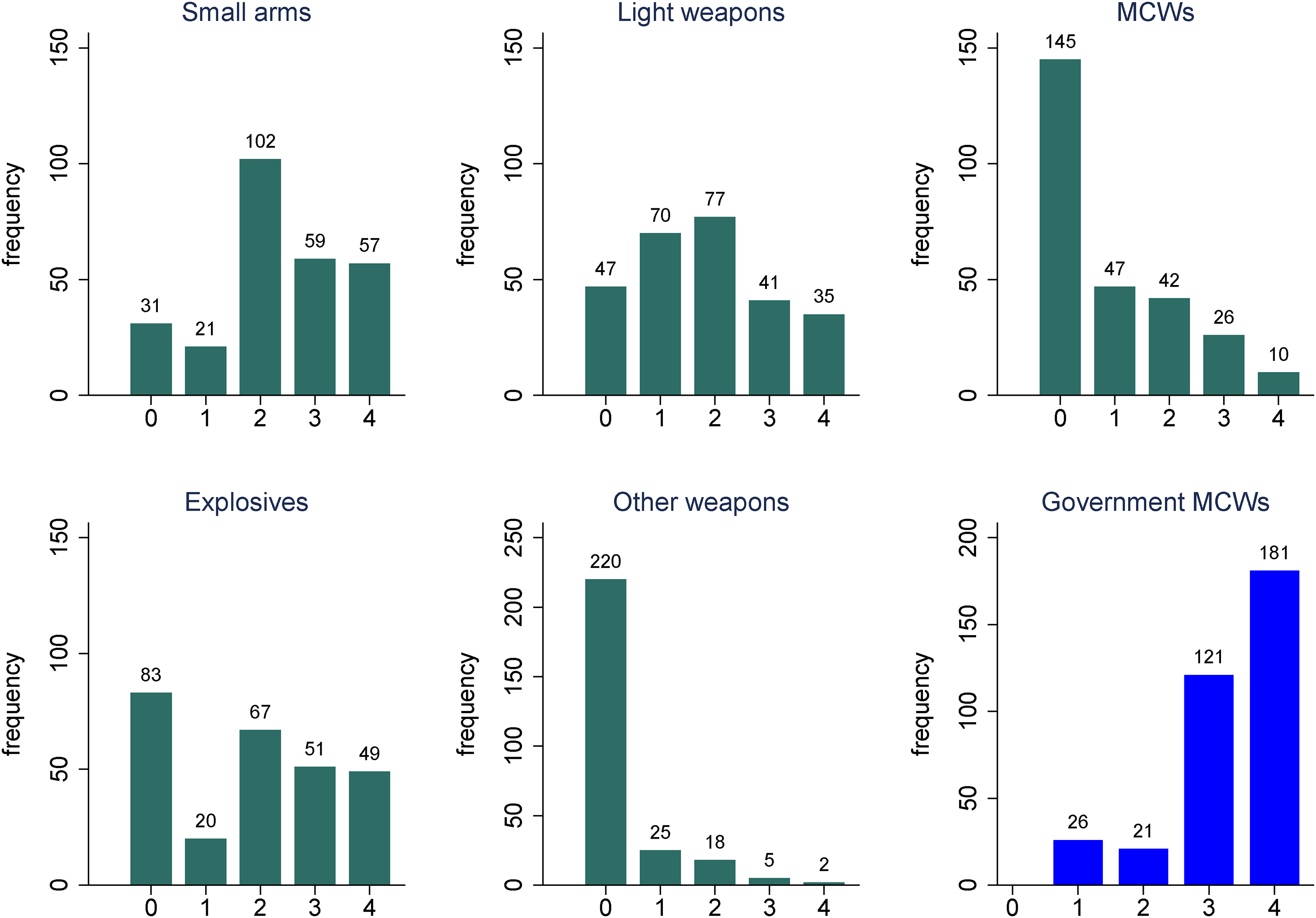
Distribution of ordinal armament levels of main weapon types per group, and government major conventional weapons.
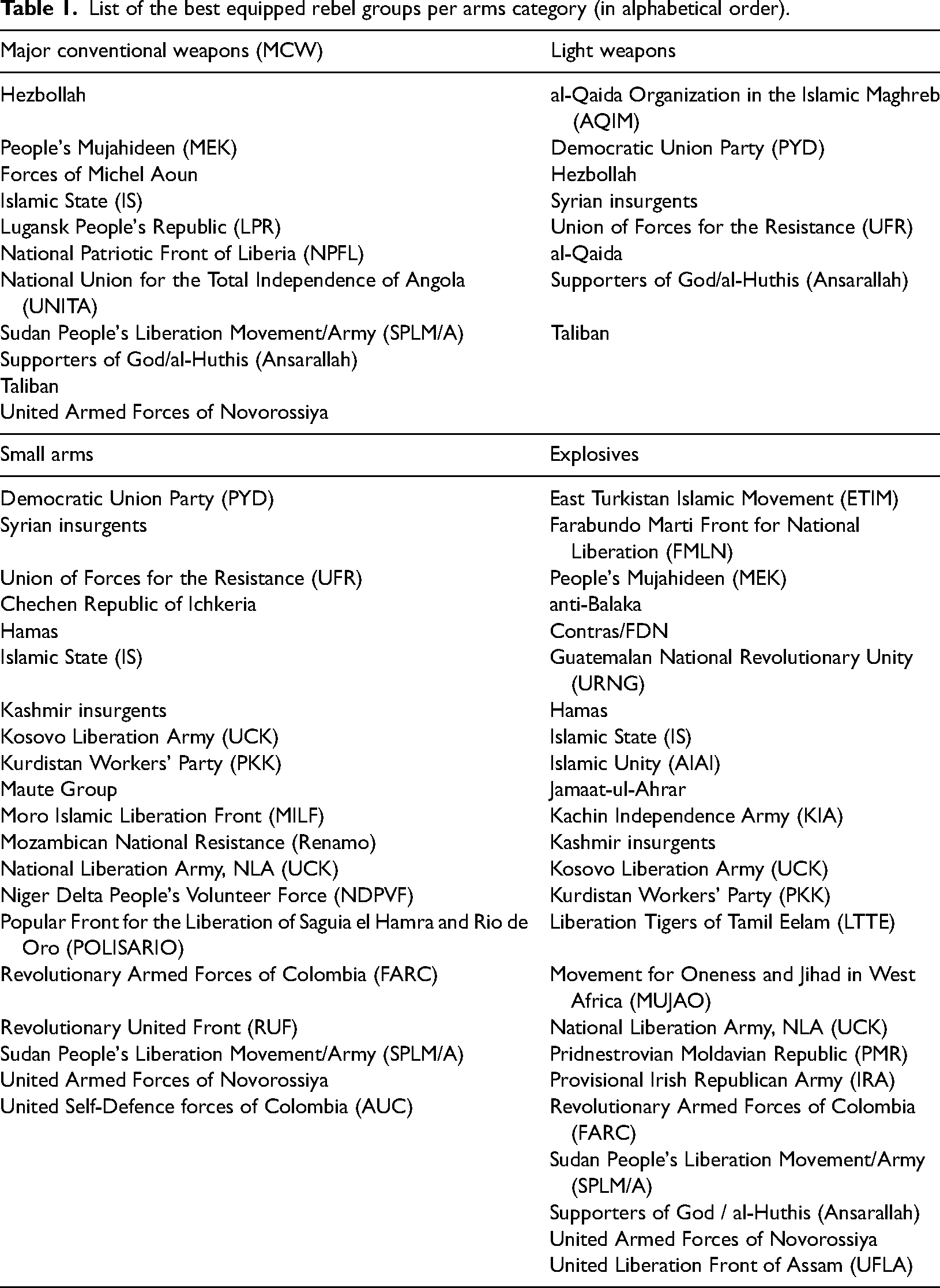
Using these ordinal measures, we can also identify the best-equipped rebel groups. Table 1 presents all groups that scored a 3 or 4 on MCW or a 4 on small arms, light weapons, or explosives. Major conventional weapons are certainly the most important category in terms of the military capabilities they confer. Here we find among others the “Islamic State” (IS), the UNITA of Angola, Hezbollah, the Ukrainian separatists of the “Lugansk People's Republic” (LPR), and the “United Armed Forces of Novorossiya”. The IS, the Sudan People's Liberation Movement/Army (SPLM/A), and the “United Armed Forces of Novorossiya” are also among the groups with the highest levels of small arms and explosives, making these three the best-equipped groups in the data.
List of the best equipped rebel groups per arms category (in alphabetical order).
These arms categories are, of course, highly aggregated and contain several different weapon technologies. The ordinal measures for these different arms types are shown in Figure 2. The figure underlines that rebels have greater access to small arms and light weapons than MCW. Particularly noteworthy is the plentiful evidence for rockets, missiles, and grenade launchers, especially MANPADS. A large number of groups are well equipped with these systems, with Hezbollah standing out with well over 100,000 units. Overall, 209 groups have a moderate to high (score > 1) number of these weapons available. Also, machine guns as well as rifles and shotguns figure quite prominently, with 94 groups scoring at least a 2 in the former category, and more than 189 in the latter. The number of groups that are well equipped with MCW is, unsurprisingly, much smaller. Most ubiquitous are artillery and tanks where we have 49 and 34 groups scoring at least a 2, respectively. We find that only a few groups possess ships 7 or aircraft. The highest score for ships is a 2, involving four groups (“Republic of Abkhazia”, “Somali National Movement”, “Niger Delta People's Volunteer Force”, and “Ansarallah”). According to the data, the “Niger Delta People's Volunteer Force” possessed the largest fleet with approximately 67 vessels during the period between 2002 and 2006. Regarding aircraft, two groups scored a 3 (“Islamic State”, “Chechen Republic of Ichkeria”), with the IS having the most aircraft in 2016. This category includes planes, helicopters, and drones. Note that both combat and transport aircraft are included in this category. A group with some aircraft, such as the “Revolutionary Armed Forces of Colombia” (FARC), may therefore not necessarily possess significant air power.
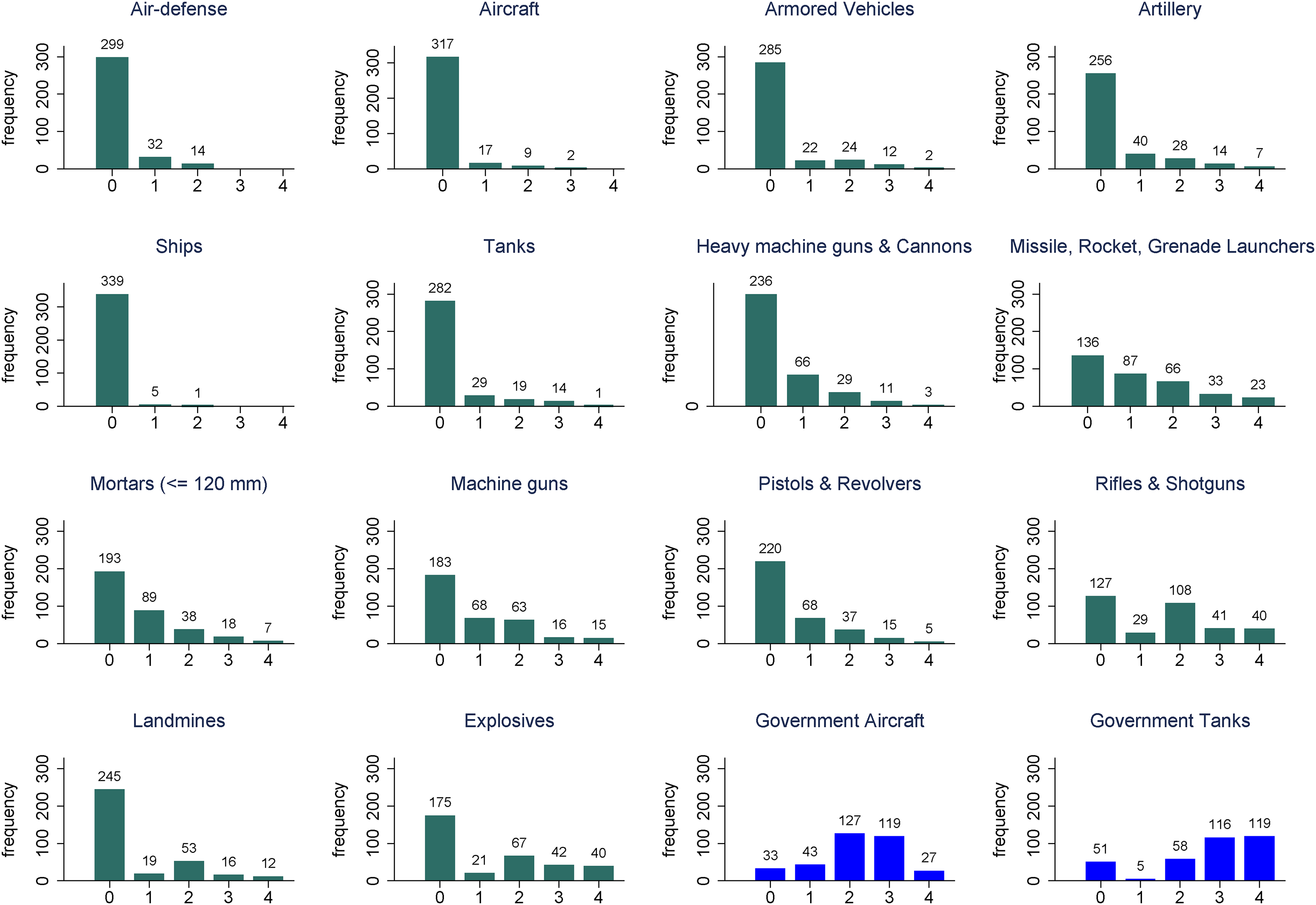
Distribution of ordinal measures for the main weapon types for rebels and government forces.
The figure also presents in the lower right panels the equipment levels for tanks and aircraft (including transport and combat purposes) of government forces at the beginning of the conflicts they were involved in. The contrast is unsurprising and quite stark. The vast majority of government armies score at least a “2” in these categories. In 68% of all conflict onsets, the government side had a high number of tanks, scoring at least a “3”. This underlines again that, in most cases, governments have an overwhelming advantage at the start of the conflict.
We can use the available information to profile the military equipment of the 270 groups. To give but two examples, Table 2 provides the ordinal scores and volume estimates of the 14 weapons categories for the “United Armed Forces of Novorossiya” of the Ukrainian Donbas region and the FARC. We chose these two groups because the former has very high military capabilities and a large stock of MCW, while the latter relies mainly on small arms and explosives. Furthermore, the Donbas separatists were involved in conventional warfare, whereas the FARC was part of a long-running, lower-intensity conflict that involved mainly irregular fighting.
Armament profiles of the FARC and United Armed Forces of Novorossiya, ordinal scores and estimated armament volumes (in parentheses).
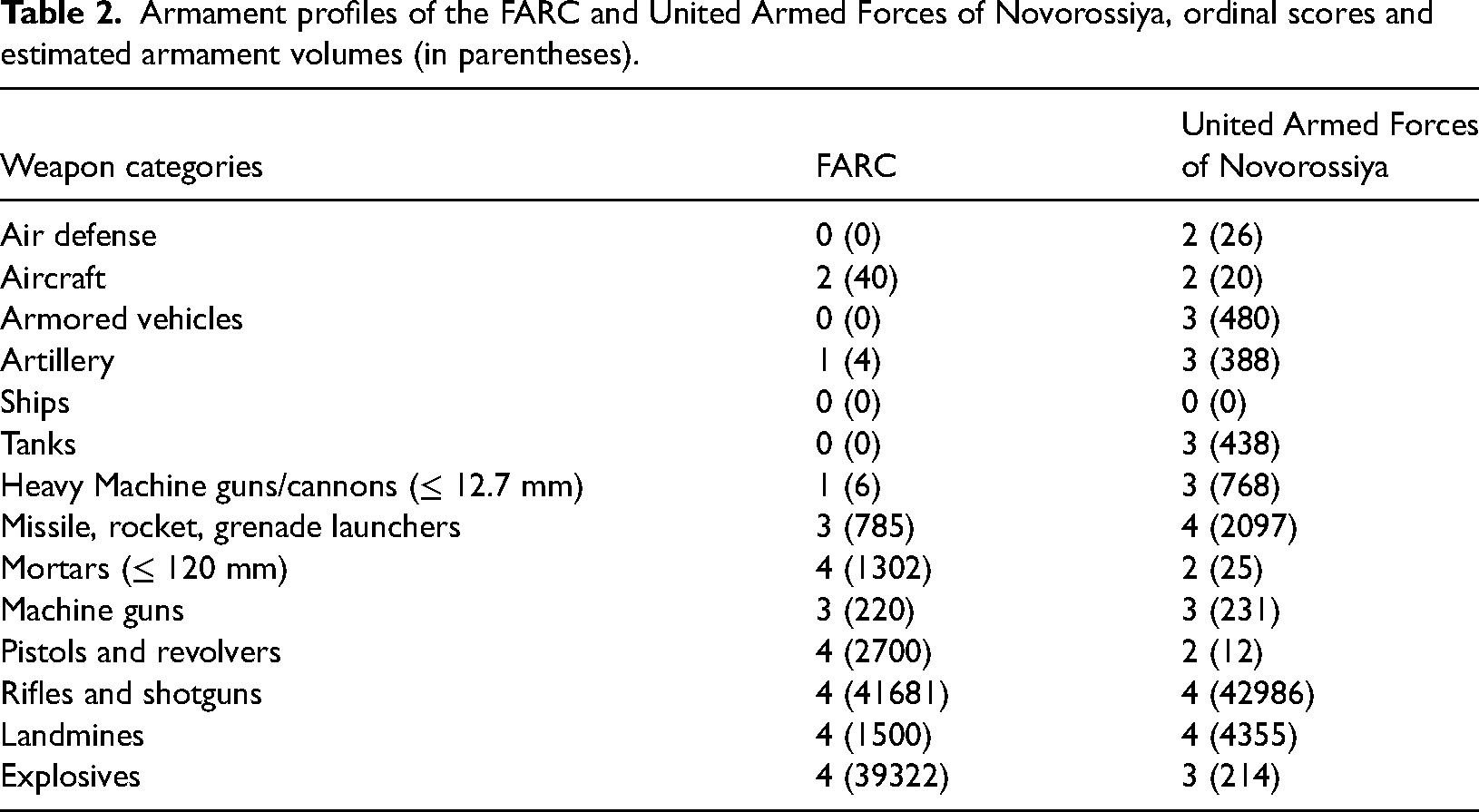
The numbers in the table show that the FARC relied heavily on small arms, light weapons, and explosives. According to the ordinal scores, they matched, in terms of group-level aggregates, the United Armed Forces of Novorossiya in these three categories, with both groups scoring a 3 or a 4. It has to be noted, of course, that these weapons have been accumulated over a longer period for the FARC (1989–2017) than for the Donbas separatists (2010–2019). The big difference between the two groups, however, is that the FARC had very few MCW. In contrast, the United Armed Forces of Novorossiya possessed sizable stocks of all types of MCW (except ships), including some aircraft and significant numbers of tanks, armored vehicles, and artillery. Our data thus show that the Ukrainian rebels were well equipped for open, conventional warfare, whereas the FARC had military hardware more suitable for guerrilla tactics.
Of course, the military strength that certain rebel armament levels entail ultimately depends on the military capabilities of the opposing government forces. Unfortunately, the International Institute of Strategic Studies (IISS) data on government stocks only contain major conventional weapons. We therefore focus our comparisons on MCW, which include, of course, the most potent weapons. Figure 3 presents different configurations of rebel and government MCW armament levels and how often we observe them in terms of dyad-years. The histograms at the top and on the left again show the distributions for the two ordinal MCW variables. We can see that the most common conflict dyad-years (673) involved a rebel group with no MCW at all, whereas the government side always possessed at least some MCW. There were 793 dyad-years where both conflict sides were well equipped with MCW (sore 3 or 4). These are the instances where conflict technologies allow for conventional warfare. We found a well-equipped government fighting rebels without any MCW in 603 dyad-years. These were civil wars where we would expect mostly irregular warfare.
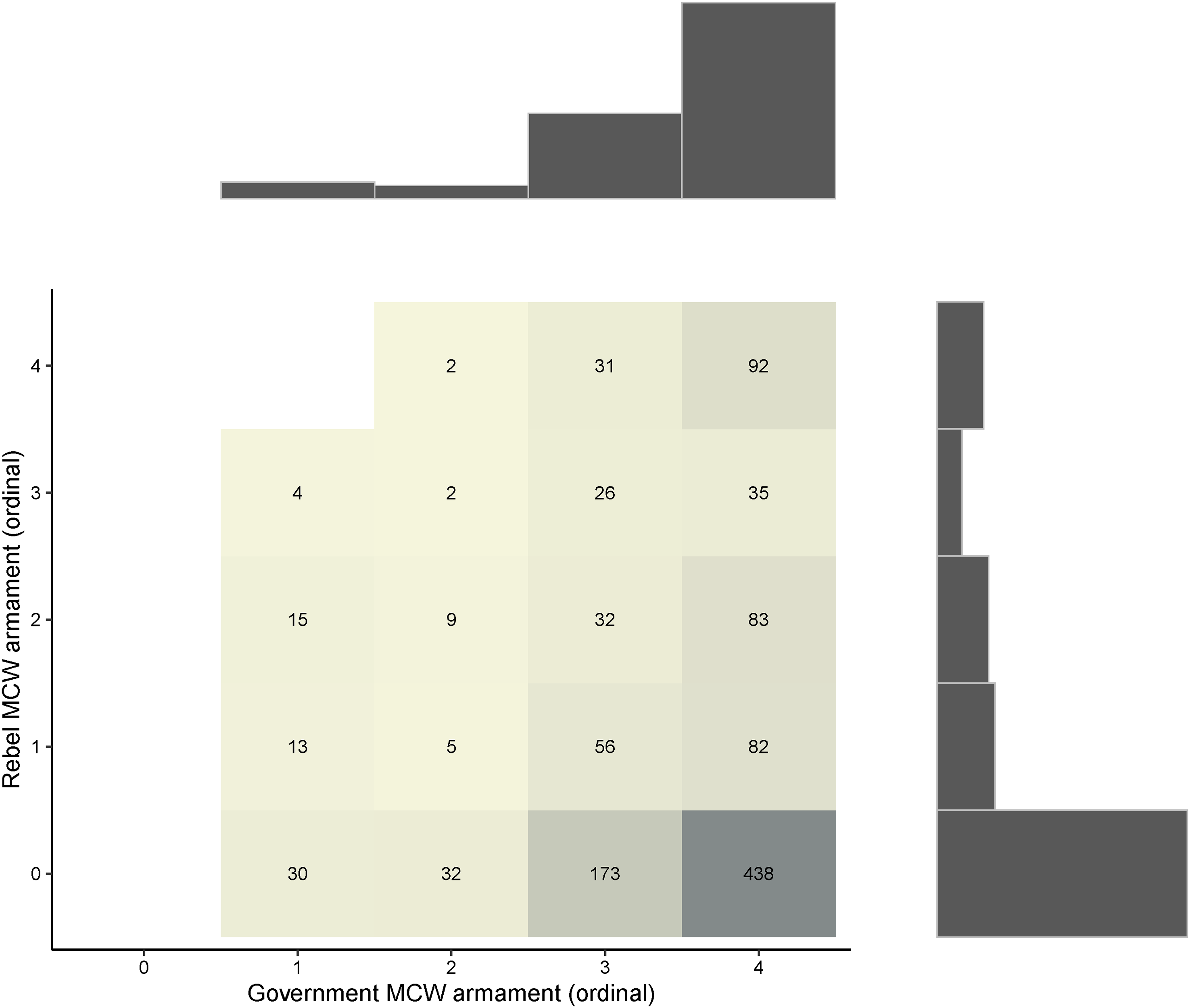
Configurations of relative rebel and government MCW armament levels and number of dyad-years.
Overall, the data suggest that most rebel groups rely not only on small arms but also heavily on light weapons, especially rocket and grenade launchers, as well as explosives. We find that a significantly smaller number of groups have sizable stocks of major conventional weapons, including artillery, tanks, and aircraft.
Theoretical framework—how military technologies escalate violence
In this paper, we define escalation as an increase in the intensity of military fighting and, thus, more battle-related fatalities. At any point, there is also the potential of a reverse dynamic of de-escalation, where fighting severity decreases. Intuitively, one would expect that more weapons always means more intense fighting. However, this view neglects the strategic nature of conflict and negotiation and the conditions under which deterrence is effective. A useful approach to understanding how the availability of arms could shape conflict processes is to apply insights from crisis bargaining frameworks (see Fearon 1995; Meirowitz and Sartori 2008; Powell 1999; Slantchev 2011; Walter 2009a, b; Jackson 2010; Lichbach 2012). A central implication of these models is that rational actors should always prefer a peaceful settlement over the costly gamble of war if the bargaining range is not empty. The size and location of the bargaining range are determined by both the costs of fighting and the relative military capabilities. The military capacities of all conflict parties depend crucially on the size and composition of their respective arsenals. Hence, the negotiated outcome reflects the relative military strength of both sides. A high level of MCW armaments, in particular, indicates great military capabilities. While the use of high-powered weapon systems allows a conflict party to inflict heavy casualties, it also affects the other side's military strategy and willingness to negotiate a settlement.
As we will demonstrate in this paper, the notion that more heavy weapons always lead to an escalation in military fighting is not borne out by the empirical evidence. There are compelling theoretical reasons to believe that the relationship between the conflict parties’ MCW stocks and conflict severity is conditional upon some important factors. In particular, we explore two mechanisms through which changes in MCW armament levels could affect conflict intensity. First, we discuss how the availability of foreign support to rebel groups conditions the willingness of both sides to (de-)escalate the conflict. Second, armaments shape the conflict technologies employed, which determine the intensity of the fighting. Here, we will also focus on how changes in government armaments affect the intensity of violence given the technologies of conflict employed by the rebels. While the first approach is firmly based on a crisis bargaining framework, the second one refers to the role of conflict configurations, as emphasized by Kalyvas and Balcells (2010).
First, rebels usually cannot produce or “officially” import arms. They are reliant on theft, leakage, and illicit cross-border trades. This makes the acquisition of SA, LW, and explosives easier than that of MCW. External support by foreign governments or other non-state actors is therefore crucial. Foreign actors with stakes in the conflict
8
or for humanitarian reasons may have an interest in intervening by providing arms, money, troops, or intelligence to rebels. Furthermore, the use of sophisticated MCW requires training, expertise in maintenance, and the availability of spare parts plus a steady flow of ammunition that foreign supporters can provide or finance. Some have argued that this kind of involvement of foreign actors may create a moral hazard problem. Expecting more external support, rebels have the incentive to become reckless and further escalate the conflict (e.g. Cetinyan 2002; Kuperman 2008). Sawyer et al. (2017) have cautioned that external support, especially if it is fungible like money or arms, will make it much harder for governments to observe rebel military capacities and therefore prevent a negotiated settlement. However, there are several theoretical arguments as to why foreign support in cases where groups are very well equipped with MCW may have a moderating effect on conflict severity. The support of an external power should not make it harder for domestic governments to observe the high rebel capabilities but rather signal their sustained provision into the future. If the government cannot expect the balance of power to improve, it has no incentive to escalate further and look for a settlement. Thus, strong rebels backed by foreign parties may be able to deter government forces from open warfare and succeed in pushing the government to the negotiation table. Recent research by Ruhe (2021) suggests that negotiations through third-party mediation are accompanied by a decrease in conflict intensity. If external mediation is more likely in internationalized conflicts, foreign support could sometimes even reduce intensity via this channel. Moreover, external powers may have an interest in restraining the rebels for reputational reasons, thus preventing them from intensifying the conflict. Based on this discussion, we arrive at our first hypothesis:
The corollary to this hypothesis is that absent third-party support, both parties have incentives to escalate the military fighting when rebel MCW levels increase. Governments aim to defeat the insurgents without external support or degrade their military capabilities to improve their bargaining positions. Rebels, on the other hand, are not constrained by an external power. They furthermore have an incentive to escalate the violence in the hope of defeating the government or attracting additional internal or external support. Hence, we have the following expectation:
Regarding the second theoretical mechanism, as Kalyvas and Balcells (2010) and Balcells and Kalyvas (2014) have argued, conflict intensity corresponds to specific configurations of military technologies. These depend on the availability of certain weapon types to both government forces and rebels. Rebels choose their insurgency strategies based not only on their manpower but also on whether they have to rely solely on SA, LW, and explosives or whether they succeed in gaining access to more powerful MCW. Rebels’ armament levels also determine, to a large extent, the counterinsurgency strategies employed by the government side: this includes the types of arms that are considered necessary to engage the rebels effectively, the scale of the military operations, and the question of how easy it is to target insurgents as opposed to civilian populations (Berman and Matanock 2015; Berman et al. 2018; Lyall 2010). The resulting strategic interdependence highlights why a state-centric view on arms procurement may be misleading. A dyadic conception of conflict implies that military capability is a relational concept. It is, therefore, important to examine how armament levels and the type of available weaponry determine all sides’ combat strategies. Many studies that focused on how MCW flows to governments affect intrastate conflict have not taken this into account sufficiently.
Lightly armed rebels will choose to engage in irregular warfare. To compensate for their inferiority in military equipment, they will use guerrilla and terrorist tactics. By avoiding open battles where the government military would hold a decisive advantage (Kalyvas and Balcells 2010; Mehrl and Thurner 2020), the number of casualties is kept low. Conventionally fought conflicts, in contrast, require both the government and the rebel side to have a high number of heavy weapons. This leads to more intense fighting and a heavier number of casualties. Thus, groups relying on SA and explosives have to resort to irregular combat strategies associated with fewer battle-related casualties than conventional warfare. This can be observed in longer-running conflicts such as the Sri Lankan Civil War, which lasted from 1983 to 2009. Fighting for an independent state, the Liberation Tigers of Tamil Eelam (LTTE) mainly used suicide campaigns in the early phases of the conflict. In 1987, for instance, the LTTE used explosives on a truck to kill 40 soldiers (Waldman 2003). As the LTTE's arsenals of LW and MCW grew, they also resorted to more conventional warfare, which led to several large-scale battles in the 1990s. For example, in the Battle of Mullaitivu in 1996, the LTTE attacked and successfully captured a military base. Around 1500 Sri Lankan soldiers and 315 rebels were killed in the fighting (US State Department 1997). In that year, according to RAD, the LTTE scored a “2” on MCW and a “4” on LW, clearly showing that the LTTE had acquired the necessary armaments.
Whether higher MCW armament levels of governments escalate the violence depends, therefore, on the insurgency strategies chosen by the rebels, which, in turn, are conditioned by their military arsenals. Only in conventionally fought conflicts would we expect more MCW to have an impact on the severity of fighting. This leads to our next hypothesis:
Finally, as Mehrl and Thurner (2020) have argued, the impact of additional major conventional weapons on conflict severity should be conditional on the relative strength of both conflict sides. From the perspective of a simple contest success function (see Hirshleifer 1989; Skaperdas 1996), the probability 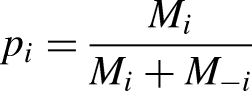
Note that hypothesis 3 is a refinement of hypothesis 2. In cases where rebels have MCW to engage in conventional warfare but are outmatched by state forces, it predicts that increases in government MCW stocks do not affect the intensity of military fighting. Only if both sides are evenly balanced do we expect additional MCW to matter.
In sum, armament levels and their composition are intricately linked to the intensity of intrastate violence. They facilitate the escalation of conflicts but also determine the military tactics employed. As this theoretical discussion has emphasized, this relationship may be highly conditional on several factors, which we explore in the following empirical analysis.
Estimating the effects of armament levels on conflict escalation
Empirical design
Our empirical design follows a dyadic approach to fully exploit the new rebel armament data. This allows us to distinguish between different groups and their armament levels in the same country and, therefore, also captures conflicts where a government is fighting more than one rebel group in a given year. The analysis uses dyad-years as a unit of analysis and includes 236 conflict dyads for the period 1989–2018. 9 We measure conflict escalation by the number of battle-related deaths 10 in civil conflicts that have at least 25 deaths a year. We, therefore, include both low- and high-intensity years of violence. We follow the vast majority of the empirical literature and use the best estimates of battle-related deaths provided by the Uppsala Conflict Data Program Battle-Related Death Dataset version 21.2 (Pettersson et al. 2021).
In the first step, we use total rebel armament levels that include small arms, light weapons, major conventional weapons, and explosives. In the second step, we focus on the role of major conventional weapons. Note that we will use the ordinal variables of the rebel armament dataset in all our analyses. For government armament levels, we use information on their active stocks of MCW. This data comes from the Distribution of Military Capabilities Dataset assembled by Gannon (2021) for 1989–2013. They compiled this information from the “Military Balance” yearbooks produced by the IISS. For 2014–2018, we directly accessed IISS's “Military Balance +” database. Since there were still some missings in these data for individual country years, we used data on the import of MCW provided by the Stockholm International Peace Research Institute (SIPRI) Arms Transfers Database (SIPRI 2021) to calculate the missing armament levels. This allowed us to retrieve an additional 48 observations. The resulting variable is the logged total number of government MCW equipment.
The set of control variables included in our models is drawn from the literature on conflict intensity to facilitate comparability with previous results (e.g. Lacina 2006; Moore 2012; Mehrl and Thurner 2020). As socioeconomic measures, we include the population size of a country as well as its real GDP per capita (in 2011 US Dollars). Both variables have been logged and are provided by the Maddison Project (Bolt et al. 2018). We account for conflict duration by including the logarithm of the number of years that have passed since the beginning of a conflict. To control for the political system of a country, we use the Polity score made available by the Polity5 Project (Marshall et al. 2019) in its non-transformed version, ranging between −10 and 10. We also include two dummy variables to indicate whether rebels and governments received any kind of external support using UCDP's External Support Dataset (Meier et al. 2023). Finally, previous research has argued that there could be outbidding dynamics in conflicts involving several rebel groups. Competing for support and resources, rival militant groups are incentivized to demonstrate their effectiveness by escalating acts of violence (Nemeth 2014). We, therefore, included the number of rebel groups as our final control. 11
Regarding our statistical approach, the dependent variable, battle-related deaths per dyad-year, calls for a count model (for an overview see Hilbe 2011). We used a truncated Poisson regression model with dyad-fixed effects to capture unobserved, time-constant dyad heterogeneity. The truncation accounts for the fact that the lowest possible number of battle-related deaths is 25. While for a pooled model an argument could be made for the use of a negative binomial (NB) regression, we are interested in estimations using fixed effects (FE). Unfortunately, the FE NB estimator suffers from several weaknesses. It demands very restrictive distributional assumptions (conditional independence, no serial correlation), requires a very specific type of overdispersion that is not present in most cases, is not robust to the failure of any of its assumptions, and will often fail to converge. Owing to these issues, some have recommended against using an FE NB regression (see Wooldridge 1999). In contrast, a Poisson model with FE and robust standard errors is flexible, valid under very general assumptions, and robust to failures of these assumptions. The specification of our Poisson model with all control variables is
Empirical results
Table 3 presents our first set of estimation results, where we test whether overall rebel armament levels are associated with higher conflict intensity. The ordinal rebel armament variables in Models 1–3 include all weapon types, i.e. MCW, SA, LW, and explosives. Note that all rebel groups have at least some armament recorded in the dataset. The reference category of the included set of dummies is, therefore, a group with a very low level of military equipment. The coefficients have been converted into incidence rate ratios (IRR) and confirm that higher armament levels, including SA, LW, explosives, and MCW, are associated with more intense fighting. Controlling for government MCW levels, conflicts involving rebel groups with the highest ordinal score of 4 have, on average, around five times as many battle-related fatalities compared with conflicts with poorly equipped rebels. The coefficients are statistically significant without controls (Model 1), with controls (Model 2), and if we use a dynamic specification that includes a lagged dependent variable in Model 3. 12 For the MCW armament levels of government forces, we find a positive association, which, however, is only statistically significant in the model without controls and the (possibly biased) model that includes a lagged dependent variable.
Armament levels and conflict intensity.
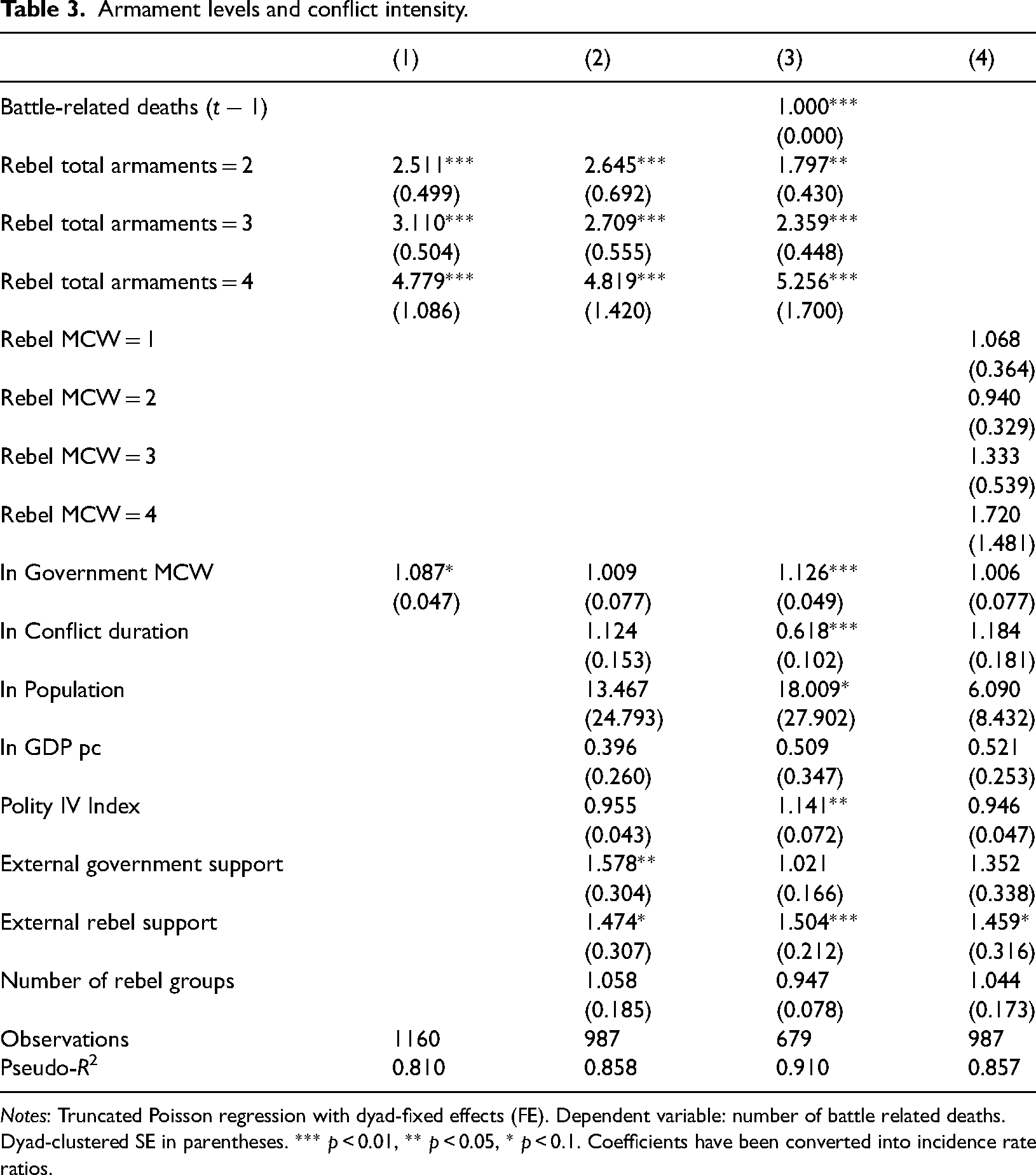
Notes: Truncated Poisson regression with dyad-fixed effects (FE). Dependent variable: number of battle related deaths. Dyad-clustered SE in parentheses. *** p < 0.01, ** p < 0.05, * p < 0.1. Coefficients have been converted into incidence rate ratios.
One could be tempted to conclude from the first three models that it must be mainly MCW driving the strong results for total rebel armaments. However, as seen in Model 4, none of the dummies for MCW are close to reaching statistical significance in a specification with control variables. In our theoretical discussion, we have argued that the effect of MCW could be conditional upon the existence of external rebel support. We therefore turn next to testing hypotheses 1a and 1b. When estimating models that interact rebel MCW armament levels with the dummy on external support, we find clear evidence for the conditional effects described in the two hypotheses. Figure 4 illustrates this by presenting the plot of the model coefficients 13 for rebels with and without external support. 14 The difference between the two groups is quite striking and shows that higher levels of rebel MCW are associated with more intense fighting only if the rebels receive no external help. Transforming the coefficients of the interaction effects into IRRs, we find that a conflict involving a group without external support and the highest MCW level has on average 4 times as many fatalities as a conflict involving rebels without support and any MCW. On the other hand, there is no significant effect in cases of externally supported rebel groups with lower or medium levels of MCW. However, supported rebels with the highest MCW score are on average in conflicts that have less than one-fifth of the number of fatalities compared with supported groups without any MCW. This negative relationship is also statistically significant. We tested this relationship also for different types of support and found this pattern most clearly in cases where rebels received funding, weapons, and/or training. Note that there is no such conditional effect for governments. The model interacting the level of government MCW with a dummy variable indicating whether or not there is external support to the government yields no significant results. 15
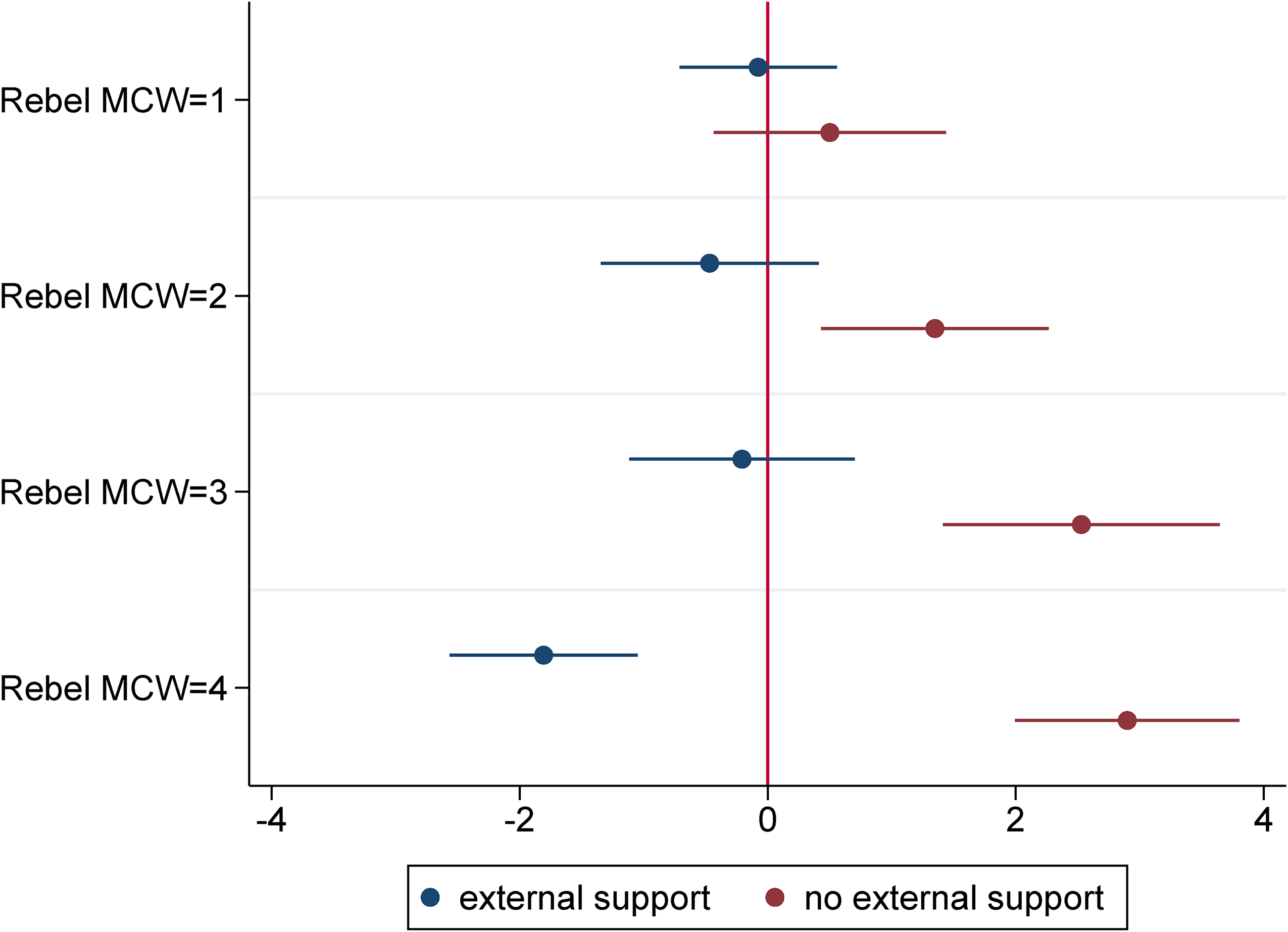
Effect of rebel MCW levels with and without external support (x-axis displays untransformed coefficients).
Next, we turn to hypotheses 2 and 3, which deal with the role of conflict configurations and the relative strength of government and rebel forces. Table 4 presents the different configurations, how often they occur in our data in terms of dyad-years, and the average number of battle-related deaths associated with these configurations. Conflicts with strong rebels and governments are cases where both sides score at least a 3 for MCW armaments. The second scenario involves a strong government (MCW ≥ 3) and a weaker rebel group (MCW ≤ 2); the third involves weak governments (MCW ≤ 1) and weak rebels (MCW ≤ 1); and finally, the fourth case involves weaker governments (MCW ≤ 2) vs. strong rebels (MCW ≥ 3).
Different conflict configurations, average number of fatalities and number of dyad-years.
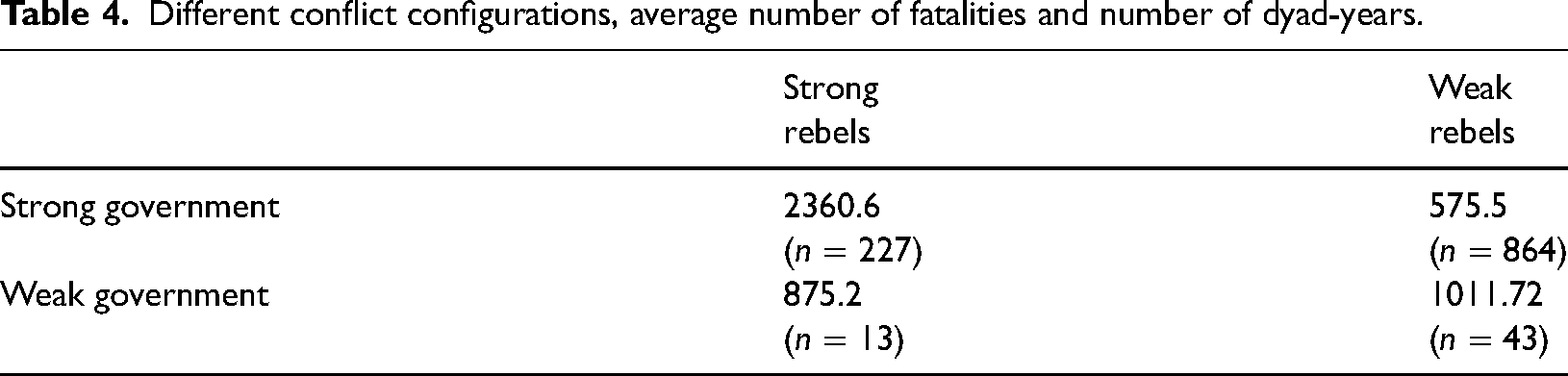
The table shows that in the vast majority of dyad-years, the government was stronger than the opposing rebel group. The second most important scenario involves two conflict sides that are equally well equipped with MCW. Cases where both sides had almost no MCW or where a government with few MCW faced rebels with a large amount of MCW were quite rare in contrast. Quite striking also are the large differences in the average number of battle-related deaths, which are all statistically significant. Unsurprisingly, conflict years that involve two well-equipped parties produce the most intense fighting. The second highest number of fatalities involves dyad-years where both sides are equally weak in terms of their MCW levels. Note that the lowest number of deaths is associated with conflicts where the government forces have a clear edge in terms of their MCW armaments. These descriptive statistics lend clear support to hypotheses 2 and 3.
We have estimated models for different sub-samples to further investigate the importance of these configurations. 16 Table 5 presents our findings for three scenarios: (1) irregular warfare, where a well-equipped government faces a rebel group without any MCW; (2) conventional warfare, where both sides score at least a “3” in terms of their MCW; and (3) for cases where rebels have either no or fewer MCW than the opposing government forces. The results again are in line with hypotheses 2 and 3. In cases of irregular warfare, higher government MCW levels are not significantly associated with more intense conflicts. If, on the other hand, rebels also possess a high number of MCW, then higher government MCW further escalate the conflict. Note that the first two models do not allow us to properly discriminate between hypotheses 2 and 3. In other words, it is not quite clear whether it is the availability of MCW, as Balcells and Kalyvas (2014) argue, that affects intensity or whether relative rebel strength has an additional independent effect, as pointed out by Mehrl and Thurner (2020). Model 3 in the table, therefore, presents the results for a subset of dyad-years where both sides could possess MCW, but the government is superior. 17 The IRR for the logged government MCW is lower than 1, indicating a negative relationship with conflict intensity, which is, however, not statistically significant. Comparing the results of Models 1 and 3 with Model 2 lends credence to Hypothesis 3 and corroborates Mehrl and Thurner (2020). Hence, it is not the mere availability of MCW that is important but the relative strength of both sides. The results in Table 5 underline that additional MCW procurement by governments is only associated with further escalation if it faces a rebel group with similar military capabilities.
Different conflict configurations and intensity.
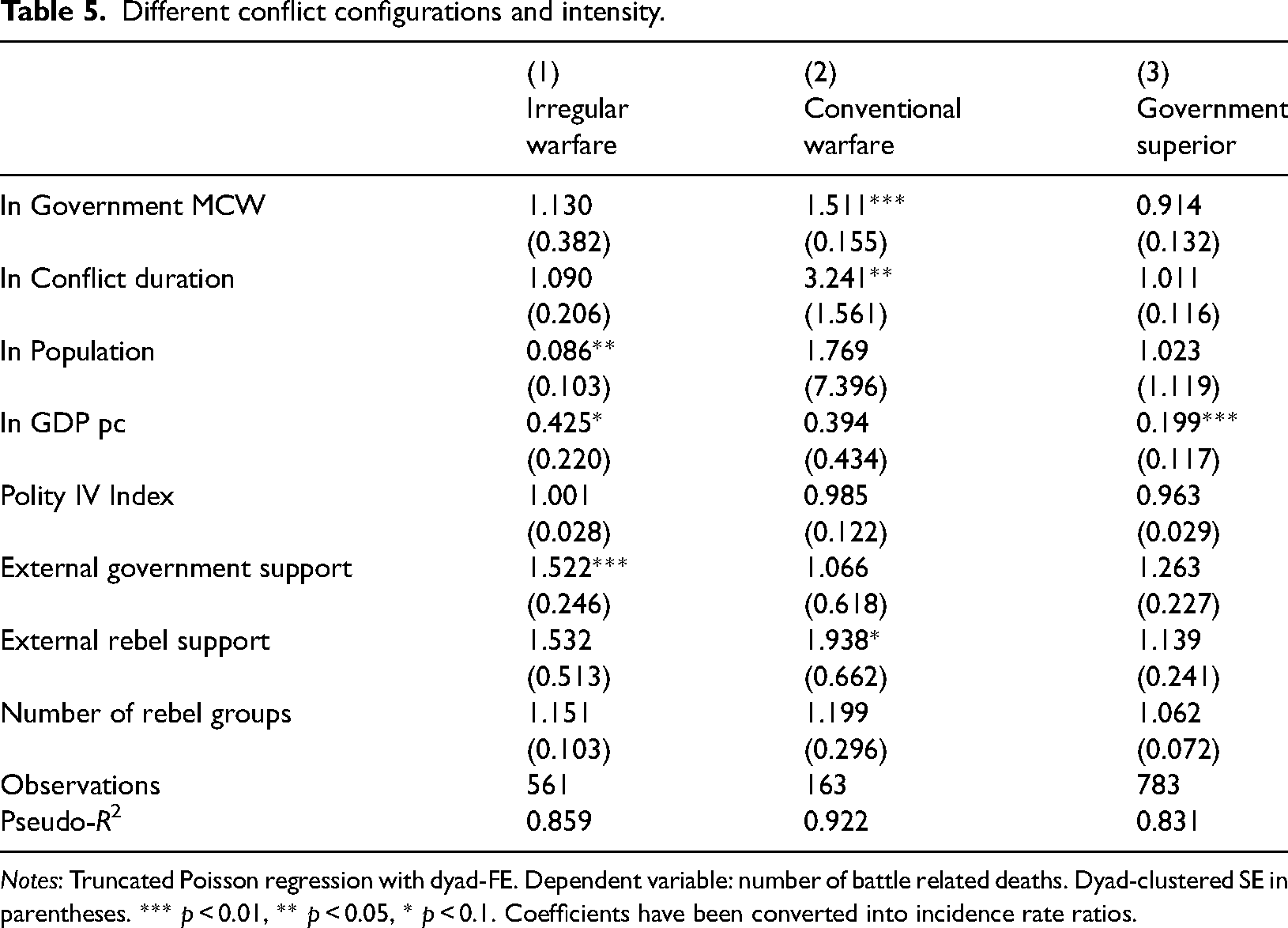
Notes: Truncated Poisson regression with dyad-FE. Dependent variable: number of battle related deaths. Dyad-clustered SE in parentheses. *** p < 0.01, ** p < 0.05, * p < 0.1. Coefficients have been converted into incidence rate ratios.
The relationship between government MCW and conflict escalation is further explored in Figure 5, which presents the predicted number of battle-related deaths for the three scenarios. 18 The convex red line shows the dramatic escalation in violence for conventionally fought conflicts as government MCW levels increase. At the highest MCW levels, the predicted number of annual fatalities exceeds 1000. In irregular warfare, i.e., where a government faces a rebel group without any MCW, there is only a slight increase in conflict severity at higher levels of government MCW (blue line). If the government is superior in terms of MCW armament levels, we find a negative relationship with higher levels of government MCW associated with a reduction in the number of battle-related deaths (green line).
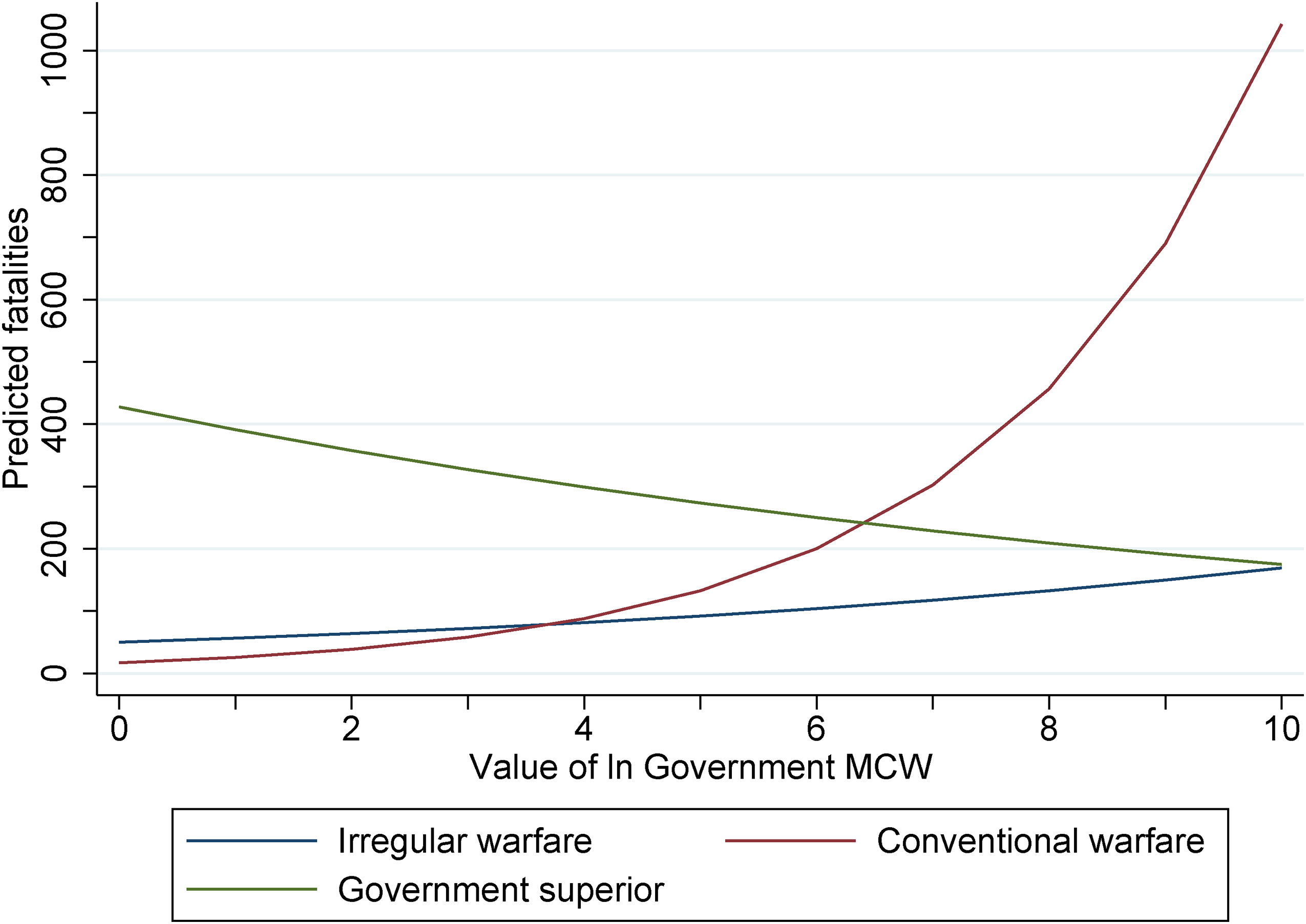
In-sample predictions of battle-related deaths.
Robustness tests
We tested the robustness of our findings in several ways, with the corresponding results displayed in the Online Supplementary Material. None of these alternative approaches fundamentally changed our conclusions. First, we re-ran all our estimations using the rebel armament variables that present a lower bound number (Tables S2 and S3). The lower bound variables only include information from sources that provided exact numbers, whereas the best estimates we used in our previous models make use of all the available information, even if they are less precise regarding overall volumes. While these lower bound numbers probably underestimate true rebel armaments in some cases, they also represent more conservative numbers because the best estimates tend to report larger volumes that have a little more noise (Mehltretter et al. 2023b). Second, we also estimated the same specifications using linear regression models with the log of the number of battle-related deaths as the dependent variable (Tables S4–S6). Third, we included several alternative controls, such as a country's military expenditures, government MCW imports, rebel troop size, as well as measures of ethnic discrimination (Tables S7–S9). None of the variables mattered consistently, nor did their inclusion change any of our results.
Fourth, it could be possible that choices to increase armament levels may be driven by expectations of further conflict escalation. Furthermore, very lethal conflicts may also attract more sophisticated and devastating MCW. 19 Therefore, we cannot rule out that there is endogeneity owing to simultaneity arising from these two sources. Note that our empirical analysis is not a dedicated causal analysis. We investigate whether armaments are associated with more intense violence. Ultimately, the availability of weapons is a necessary condition for military fighting to take place. However, we still explored these issues using some Instrumental Variable (IV) regressions (Tables S10–S12).
The logic requires a brief discussion. If these reverse causal mechanisms exist, it is usually via the flow of arms from abroad. However, most rebels are limited in their procurement options and must take what they can get. They are, therefore, very constrained in their ability to choose armament levels in line with conflict expectations. Furthermore, we had the opportunity to analyze the origins of rebel armaments using RAD's source data (see also Mehltretter et al. 2023a). They show that arms imports play only a minor role in rebel organizations’ sourcing of arms. Expectation effects are, therefore, more likely to be found for governments. They usually can choose their armament levels by deciding how many weapons to import. If endogeneity affects our results, we would expect this to be particularly the case for government armaments. Thanks to SIPRI, we have very good data on weapon transfers to states. This allowed us to explore models instrumenting arms imports. We followed Pamp et al. (2018) and Mehltretter (2022) as well as Mehrl and Thurner (2020) and used types of MCW usually not used in intrastate conflicts (e.g. ships, anti-aircraft, anti-ship) as an instrument for relevant MCW that are used in civil wars such as aircraft, tanks, armored vehicles, artillery, and missiles (Pamp et al. 2018). In line with Mehrl and Thurner (2020), we find that using this instrument does not change any of our conclusions.
Finally, as there are some uncertainties about the precision of annual armament observations in RAD (see Mehltretter et al. 2023a), we also conducted robustness tests using the Group-dataset version. It records each group's aggregate armament values but does not contain any temporal variation. Again, the pattern of results using these data does not change compared with our main models.
Discussion
Research on insurgencies and civil wars has long emphasized the importance of military strategies and conflict technologies when analyzing conflict escalation. We argue that how rebels conduct their insurgencies is determined by the types of weapons that are available to them. It is commonly assumed that fights involving better-equipped conflict sides will lead to deadlier conflicts. This leads to the conclusion that one way to reduce civil violence is to deny conflict parties access to arms via embargoes and other measures. Information on rebel groups’ actual arsenals and armament levels has notoriously been hard to come by, however. It was, therefore, not possible so far to test whether conflicts with better-equipped insurgents lead to escalation and, thus, more intense fighting that entails higher casualty numbers. This paper aimed to fill this gap by making two important contributions. First, based on a recently published dataset, we provide an overview of the armaments of 270 rebel groups. Second, we used this data to test the conditional relationships between conflict escalation and armament levels of both government and rebel forces. This paper is the first empirical study to draw on quantitative armament data for all conflict parties.
Surveying rebel groups worldwide yielded a nuanced picture. Rather unsurprisingly, small arms, light weapons, and explosives are found most often. Many groups are particularly well equipped with missiles, rockets, and grenade launchers. A comparatively lower, yet still surprisingly large, number of groups possess at least some major conventional weapons. Some groups, for example, the “Islamic State” or the “United Forces of Novorossiya” had well-rounded arsenals of heavy weaponry that included tanks, artillery, aircraft, armored vehicles, and air defense.
Our statistical analysis used group-level data on rebel armaments and also took the MCW stocks of governments into account. Our empirical analysis produced four key insights.
(1) Higher total rebel armament levels, which include all types of small arms, light weapons, explosives, and major conventional weapons, are associated with more battle-related fatalities. (2) The relationship between the intensity of conflict and rebel MCW arsenals is conditional upon whether rebels receive outside support. Conflicts involving groups that can rely on outside help are not associated with more intense fighting as rebel MCW levels increase. The results even suggest a negative effect for groups with the highest levels of MCW armaments. Conversely, conflicts featuring rebels without external support experience an escalation as MCW armament levels go up. (3) Our results are compatible with the insights by Balcells and Kalyvas (2014) that conventional warfare, i.e., high stockpiles of MCW on both sides, is associated with a higher intensity of the fighting. (4) We also find supporting evidence for Mehrl and Thurner's (2020) argument that more MCW in the hands of government forces leads to a further escalation of violence only if the opposing rebels have roughly similar military capabilities.
In sum, our empirical estimations reveal that there is a highly conditional relationship between armament levels and conflict escalation. The findings of this paper, therefore, call for nuance when discussing how arming a government or a rebel group may affect the intensity of a conflict.
Conclusion
In 2017, the USA decided to phase out “Timber Sycamore”, which was widely seen as a concession by the Trump administration to Russia (Jaffe and Entous 2017). However, the program also turned out to be ineffective in empowering the Syrian rebels to force out Bashar al-Assad. This was in no small part because in September 2015 Russia intervened militarily and also heavily armed the Syrian forces. The result was that the rebels, mainly armed with SA, LW, and explosives, faced an opponent well-equipped with MCW. In line with the results of this paper, such an asymmetry in terms of MCW equipment and overall military capabilities led to a reduction in battle-related deaths. While annual fatalities increased to over 80,000 in 2013, they were reduced to half that number in 2016 and a little over 10,000 in 2018. As for Ukraine, the three Russian-backed separatist groups (Donetsk People's Republic, Luhansk People's Republic, and United Armed Forces of Novorossiya) possessed very high numbers of MCW during the most intense phase of the intrastate conflict in 2014. This allowed them to engage the Ukrainian military using conventional warfare. Consequently, the number of battle-related deaths exceeded 4200 that year. With the Russian invasion on 24 February 2022, the civil conflict eventually turned into a conventional interstate war with very high casualty numbers on both sides.
We believe that our analysis provides valuable insights not only into these two cases. The empirical results presented here explain patterns of conflict severity quite well and also highlight the policy relevance of a research program that focuses on the militarization dynamics of all conflict parties. It allows us to address hotly debated questions about the effects of arms provisions on government forces and rebel groups. Future research should analyze how the rebels’ sources of arms procurement affect their conflict strategies. A particular theoretical focus should be put on the role of third parties in the militarization strategies of rebels (Meirowitz et al. 2022). While we provide some theoretical rationales for why externally supported, well-equipped groups might be involved in less intense fighting, more rigorous work is needed. Given that external actors are very important in the provision of MCW to governments, and in particular to rebel groups, their motives and degree of control over the conflict parties need to be taken into account more explicitly.
Supplemental Material
sj-pdf-1-cmp-10.1177_07388942241263028 - Supplemental material for Arming to fight: Rebel-government militarization and the escalation of violence in civil wars
Supplemental material, sj-pdf-1-cmp-10.1177_07388942241263028 for Arming to fight: Rebel-government militarization and the escalation of violence in civil wars by Oliver Pamp, Paul W. Thurner, Paul Binder and Andreas Mehltretter in Conflict Management and Peace Science
Supplemental Material
sj-do-2-cmp-10.1177_07388942241263028 - Supplemental material for Arming to fight: Rebel-government militarization and the escalation of violence in civil wars
Supplemental material, sj-do-2-cmp-10.1177_07388942241263028 for Arming to fight: Rebel-government militarization and the escalation of violence in civil wars by Oliver Pamp, Paul W. Thurner, Paul Binder and Andreas Mehltretter in Conflict Management and Peace Science
Supplemental Material
sj-dta-3-cmp-10.1177_07388942241263028 - Supplemental material for Arming to fight: Rebel-government militarization and the escalation of violence in civil wars
Supplemental material, sj-dta-3-cmp-10.1177_07388942241263028 for Arming to fight: Rebel-government militarization and the escalation of violence in civil wars by Oliver Pamp, Paul W. Thurner, Paul Binder and Andreas Mehltretter in Conflict Management and Peace Science
Footnotes
Declaration of conflicting interests
The authors declared no potential conflicts of interest with respect to the research, authorship, and/or publication of this article.
Funding
The authors disclosed receipt of the following financial support for the research, authorship, and/or publication of this article: This work was supported by the Deutsche Stiftung Friedensforschung (grant number FP 08/16-SP 08/12-2015).

Supplemental material
Supplemental material for this article is available online.
Notes
References
Supplementary Material
Please find the following supplemental material available below.
For Open Access articles published under a Creative Commons License, all supplemental material carries the same license as the article it is associated with.
For non-Open Access articles published, all supplemental material carries a non-exclusive license, and permission requests for re-use of supplemental material or any part of supplemental material shall be sent directly to the copyright owner as specified in the copyright notice associated with the article.
