




Abstract
Feminist scholars have long debated quantification trends in the social sciences. Of particular concern has been the extent to which the prestige assigned to quantitative methods may reinforce ‘malestream’ dynamics in academic knowledge production. ‘Malestream’ dynamics include the (implicit or explicit) privileging of a male-centric lens in the research process and the association of ‘hard’ numerical data with notions of ‘scientifically superior’ masculinity. We build on these discussions by asking how the rise in quantitative writings may affect gender disparities in the civil war literature. Using descriptive data from a newly coded dataset that contains 1,851 articles published in high-ranking journals between 1998 and 2018, we, firstly, illustrate how – in the generally male-dominated field of civil war research – the author gender gap is particularly pronounced among quantitative writings. Secondly, we present an in-depth discussion of three articles that use statistical analysis to test the effects of violence on prospects of post-traumatic growth. A distinct difference between the three articles is that they tend to be more sceptical of arguments on ‘positive change’ following violence the more account they take of gender differentiation in their theoretical framing and/or empirical identification strategy. All in all, our arguments call for greater awareness of gender bias in quantitative research, and for more rigour in currently hegemonic standards of what ‘counts’ as reliable evidence.
Introduction
Since at least the 1960s, feminist writers have provided a substantial amount of evidence that demonstrates how the research process – from the choice of research topic, through the framing of research questions and methodological considerations, to the analysis and communication of empirical results – is affected by researchers’ gendered positionality (Hesse-Biber, 2014; Leung et al., 2019; Oakley, 1998, 2000). More recently, an increasing number of scholars in our own disciplines – economics and political science – have highlighted the prevalence of sex-based inequalities in the publication and citation of academic findings (e.g. Dion et al., 2018; Hengel, 2017; King et al., 2017; Shames and Wise, 2017).
We build on insights from these distinct but interrelated bodies of scholarship, by exploring how the rise in quantitative writings may affect gender disparities in the civil war literature. We focus on two specific manifestations of gender disparities, by asking, firstly, what is the proportion of female authors among quantitative as opposed to qualitative or mixed method writings? Secondly, how does the prestige assigned to quantitative methods affect manifestations of ‘malestreaming’ in the content of civil war research? We use the terms ‘malestream’ and ‘malestreaming’ in our arguments, as they emphasise the impact of gender dynamics on perceived hierarchies of knowledge in mainstream academic debates. Central aspects of ‘malestream’ dynamics include: the privileging of a male-centric lens in the research process, for instance, by focussing on men's (rather than women's) experiences when analysing topics relating to war and security (Youngs, 2004); and the association of quantitative data with notions of ‘scientifically superior’ masculinity, by virtue of their ‘hard’, ‘rational’ and ‘objective’ qualities (cf. Oakley, 1998). 1
To answer the first question, we code a new dataset that provides information on authors’ gender and research method for 1,851 civil war-related articles that were published in 113 high-ranking (Q1) social science journals between 1998 and 2018 according to the Web of Science. We focus on the field of civil war studies, as it is currently “one of the most vibrant literatures in political science and the related social sciences” (Cederman and Vogt, 2017: 1993; see also Figure 1 2 ).
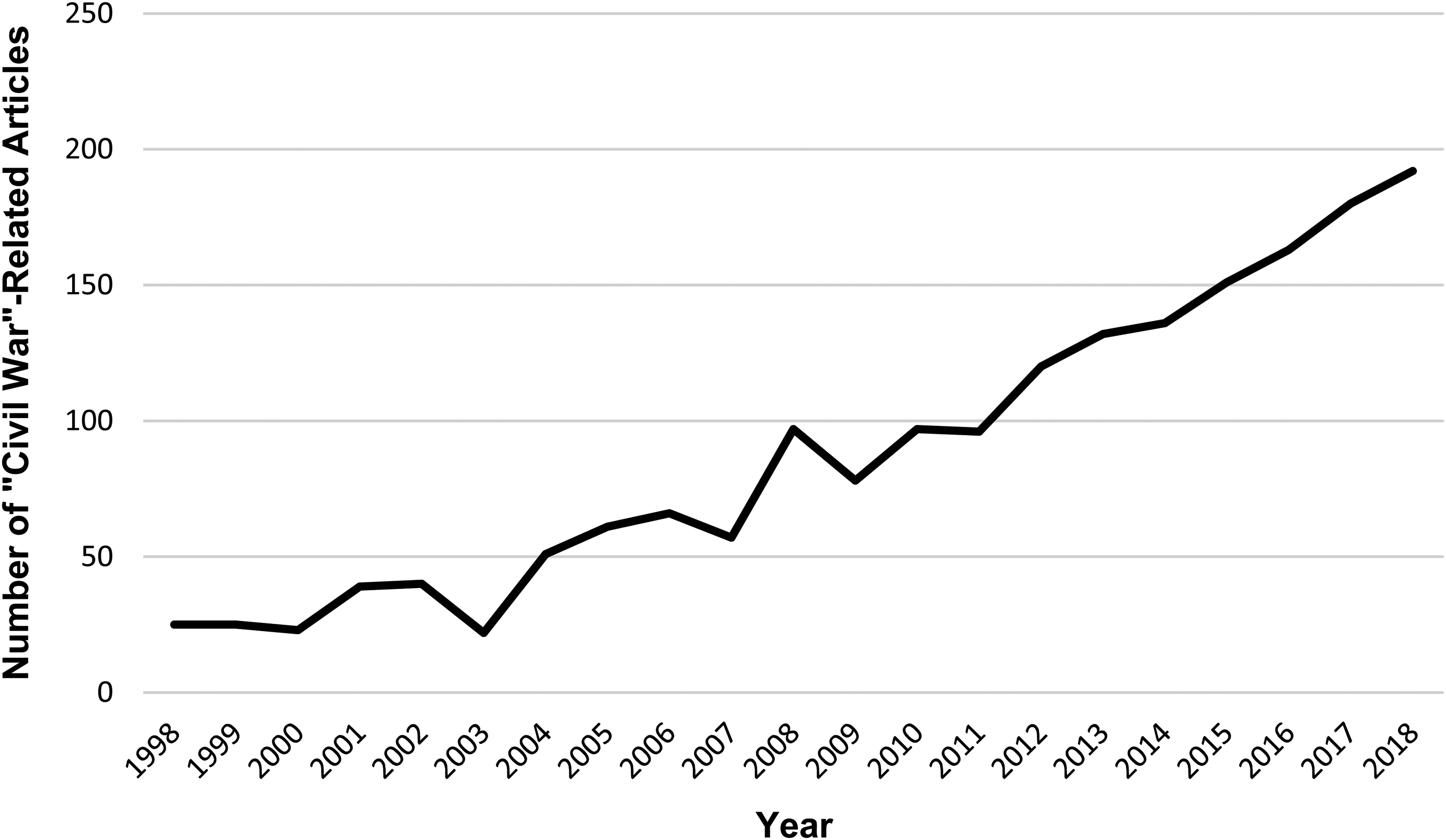
Number of articles on “civil war” between 1998 and 2018, based on Web of Science keyword search.
To answer the second question, we discuss three articles that use statistical analysis to test arguments on post-traumatic growth in the aftermath of violence. We focus on analyses of post-traumatic growth because they constitute a growing subfield in civil war research (Kijewski and Freitag, 2018; Price and Yaylacı, 2021) that challenges the canon of peace and conflict studies. This canon typically has emphasised the negative direct and legacy effects to which large-scale violence 3 can lead, in areas such as economic growth, interpersonal trust, political regime developments and physical as well as mental health (Collier et al., 2003; DeRouen, 2014). Proponents of post-traumatic growth arguments, in contrast, state that the incidence of violence can have (statistically significant) positive effects on social and political development indicators (see e.g. Bellows and Miguel, 2009; Koos, 2018; Rapp et al., 2019). The three articles on which we centre our discussion – by Blattman (2009), Bateson (2012) and Kijewski and Freitag (2018) – have been selected because they are the three most highly cited writings on post-traumatic growth and civil war in our dataset.
It should be noted that we neither make generalised claims about all writings that discuss post-traumatic growth in the aftermath of violence, nor about the interplay between quantification trends and malestream dynamics in other areas of peace and conflict studies. Examples of quantitative writings that challenge the male-centric lens – but whose discussion would go beyond the scope of this article – include, for instance, statistical analyses by Alexis Leanna Henshaw (2016a, 2016b) on women's participation in armed rebel groups, by Theodora-Ismene Gizelis (2011) on women and peacebuilding, and by Lihi Ben Shitrit et al. (2017) on gender differences in attitudes towards political aggression in the context of protracted conflict.
In a novel contribution to existing scholarship on gender dynamics in academic knowledge production, we, firstly, illustrate with findings from our dataset that – in the generally male-dominated field of civil war research – the author gender gap is particularly pronounced among quantitative writings. Secondly, our discussion of Blattman (2009), Bateson (2012) and Kijewski and Freitag (2018) illustrates how ‘malestream’ dynamics affect the content of academic research: all three articles rely on ‘hard’ numerical data, and have been published in high-ranking journals (the American Political Science Review and the Journal of Conflict Resolution) that are known for their quantitative orientation (Lima et al., 2018; Teele and Thelen, 2017). All three articles, however, suffer – to different extents – from analytical blind spots, as there is insufficient gender differentiation in their theoretical framing and/or empirical identification strategy. From the three articles under discussion, we find that they are more sceptical of arguments on ‘positive change’ following violence, the more they acknowledge that men and women 4 may experience violence differently. As our selection of articles illustrates, male as well as female researchers may fall into the malestream trap if they advertently or inadvertently perpetuate research biases in favour of men.
In the following sections, we discuss feminist arguments on quantitative methods and the academic ‘malestream’; present publication patterns according to our dataset; and critically assess Blattman's (2009), Bateson's (2012) and Kijewski and Freitag's (2018) articles, before concluding with some reflections about the practical implications of our research.
Feminist debates on quantitative methods and ‘malestream’ dynamics
Feminist discussions about quantitative methods rose to prominence during the second wave of feminism in the 1960s (Cohen et al., 2009; Oakley, 1998). Expanding on themes from the so-called ‘paradigm debate’, which pitches quantitative against qualitative methods to assess their respective strengths and weaknesses (Cohen et al., 2009; Oakley, 1998), these discussions have tackled multiple issues, such as: the ability of quantitative methods to ‘suitably’ capture women's voices and experiences (including complex dynamics of intersectionality); the meaning of ‘objectivity’; and the role of quantitative methods in supporting or hindering efforts to overcome structural violence against women and girls (Fonow and Cook, 2005; Scott, 2010; Scott and Siltanen, 2017).
A central point in these discussions is the recognition that researchers’ gendered positionality affects all stages of the research process, including the theoretical framing and empirical identification strategy they adopt (Hesse-Biber, 2014; Leung et al., 2019; Oakley, 1998, 2000). As a general trend, these gender dynamics have favoured a male-centric lens and masculine notions of academic knowledge production, which has led some authors to use the moniker of ‘malestream’ rather than ‘mainstream’ academic debates (such as Cohen et al., 2009; Duriesmith, 2020; Hearn, 1997; Warren, 1989; Youngs, 2004). For instance, it is common for topics such as the exercise of state power, security concerns or the dynamics of war to be analysed through an analytical framing that predominantly focuses on men's – rather than women's – roles, experiences and perspectives (Celis et al., 2013; Enloe, 2014; Hearn, 1997; Hudson et al., 2009; Youngs, 2004). Such ‘malestream’ analyses are problematic, because they not only render women invisible, but also fail to learn one of gender studies’ fundamental lessons: that men's and women's social, political and economic experiences are inextricably fused, as one does not exist, and thus cannot be understood, without the other (Enloe, 2014; Runyan and Peterson, 2014).
‘Malestreaming’ dynamics become exacerbated when researchers over-sample men (Hearn, 1997; Henshaw, 2016b), lack gender disaggregated data (Perez, 2020) or fall into the trap of “mathematical machismo” (Kingsley, 2018: 206). This ‘machismo’ is directly linked to the elitism of numerical methods, that is, the tendency to treat numerical methods as highly prestigious and ‘scientifically superior’ to their qualitative counterparts, but only accessible to (i.e. well understood by) a small group of experts due to their technical nature (Kingsley, 2018; Shames and Wise, 2017).
The prestige assigned to quantitative methods in our own disciplines (economics and political science) becomes evident through the “excessive use of mathematics, statistics, [and] methodological individualism” (Fine and Milonakis, 2009: 138) and the increasingly widespread view – by scholars, funders and policy-makers – that academic research is more ‘scientific’ the more it relies on complex mathematical or statistical techniques (McGovern, 2010; Mosse, 2011; Rudolph and Rudolph, 2010; Sartori, 2004). This view of the ‘scientific superiority’ of quantitative methods is gendered in two key regards: on the one hand, it is based on an epistemology that invokes masculine norms of ‘objectivity’, ‘rationalism’ and ‘certainty’ (cf. Leung et al., 2019; Oakley, 1998; Stauffer and O’Brien, 2018); on the other, it reinforces – or at least lacks reflexivity about – power asymmetries within the academic profession, since the predominant beneficiaries of the status assigned to quantitative methods in the Euro-American realm have been white, male researchers (Engeli and Mügge, 2020; Monroe, 2005).
As recent analyses of gender disparities in the demographic composition of disciplinary fields, publication and citation patterns have shown (Dion et al., 2018; Hengel, 2017; King et al., 2017; Maliniak et al., 2013; Roberts, 2018), ‘malestream’ dynamics continue to affect academic knowledge production. 5 We highlight how these dynamics manifest in authorship patterns (in the section on “Gender disparities in civil war studies: Evidence from our dataset”) and analytical blind spots (in the section on “Quantification, malestreaming and post-traumatic growth arguments”) among high-ranking civil war publications.
Gender disparities in civil war studies: Evidence from our dataset
Evidence by multiple authors has shown that, in the Social Sciences, male academics are more likely than female academics 6 to employ quantitative methods in their research, and hence more likely to publish in (what are seen to be prestigious) quantitative-oriented journals such as the American Journal of Political Science, the American Political Science Review or The Journal of Politics (Dion et al., 2018; Lima et al., 2018; Saraceno, 2020; Shames and Wise, 2017; Teele and Thelen, 2017). We add to this evidence by asking how high the proportion of female authors is among quantitative (as opposed to qualitative or mixed method) writings in the field of civil war studies.
To identify patterns in civil war publications, we code a new dataset on all civil war-related articles published in high-ranking (Q1) journals between 1998 and 2018 according to the Web of Science. Our dataset contains information on authors’ gender and the research method that they used for 1,851 articles published in 113 journals. We coded authors’ gender as female, male or non-binary, based on publicly available information about their personal pronouns. We chose 1998 as starting point for our dataset, because it coincides with the emergence of the greed vs. grievance debate which has stimulated a notable growth in civil war research since the late 1990s (Berdal, 2005). We set 2018 as the end date of our dataset to avoid distortions in publication patterns caused by COVID-19.
In the case of single-authored articles, we coded the sole author as the corresponding author. In the case of co-authored articles, we coded the corresponding author based on their identification in the article. In cases where none of the authors was explicitly named as corresponding author, we coded the first-listed author as corresponding author. In the following paragraphs, we outline descriptive patterns based on our dataset.
As Figure 2 illustrates, the number of male corresponding authors in our dataset – that is, the sum of male authors in single-authored articles and male corresponding authors in co-authored articles, irrespective of the method that they use – has been higher (often by a considerable proportion) than that of female or non-binary corresponding authors in every year between 1998 and 2018.
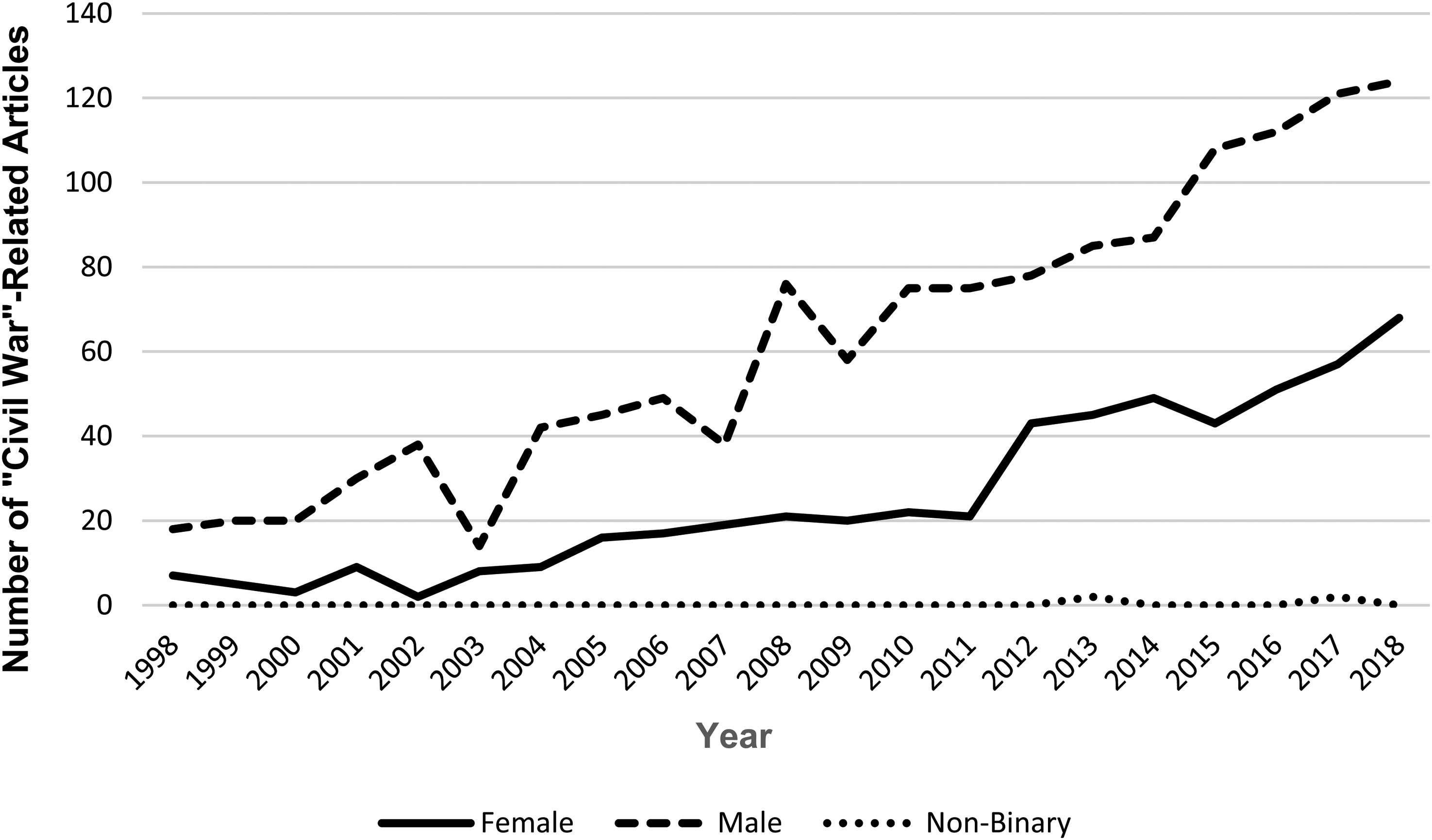
Number of articles on “civil war” with a male, female or non-binary corresponding author between 1998 and 2018, based on Web of Science keyword search. The figure depicts the aggregate number of single- and co-authored articles.
Looking at patterns of research methods, our data show that 62.9% of civil war-related articles published in Q1 journals between 1998 and 2018 have relied on quantitative methods, 33.4% on qualitative methods and 3.7% on mixed methods. If we restrict our sample to the four journals with the highest numbers of civil war-related articles (>100 each) – Conflict Management and Peace Science, International Studies Quarterly, the Journal of Conflict Resolution and the Journal of Peace Research – the figure changes to 82.8% of articles in these four journals based on quantitative methods, 13.4% on qualitative methods and 3.8% on mixed methods. Figure 3 illustrates the growth of publications based on quantitative methods in our full sample (of 1,851 articles) over time, with an overall widening gap between quantitative- and qualitative-based articles since 2007.
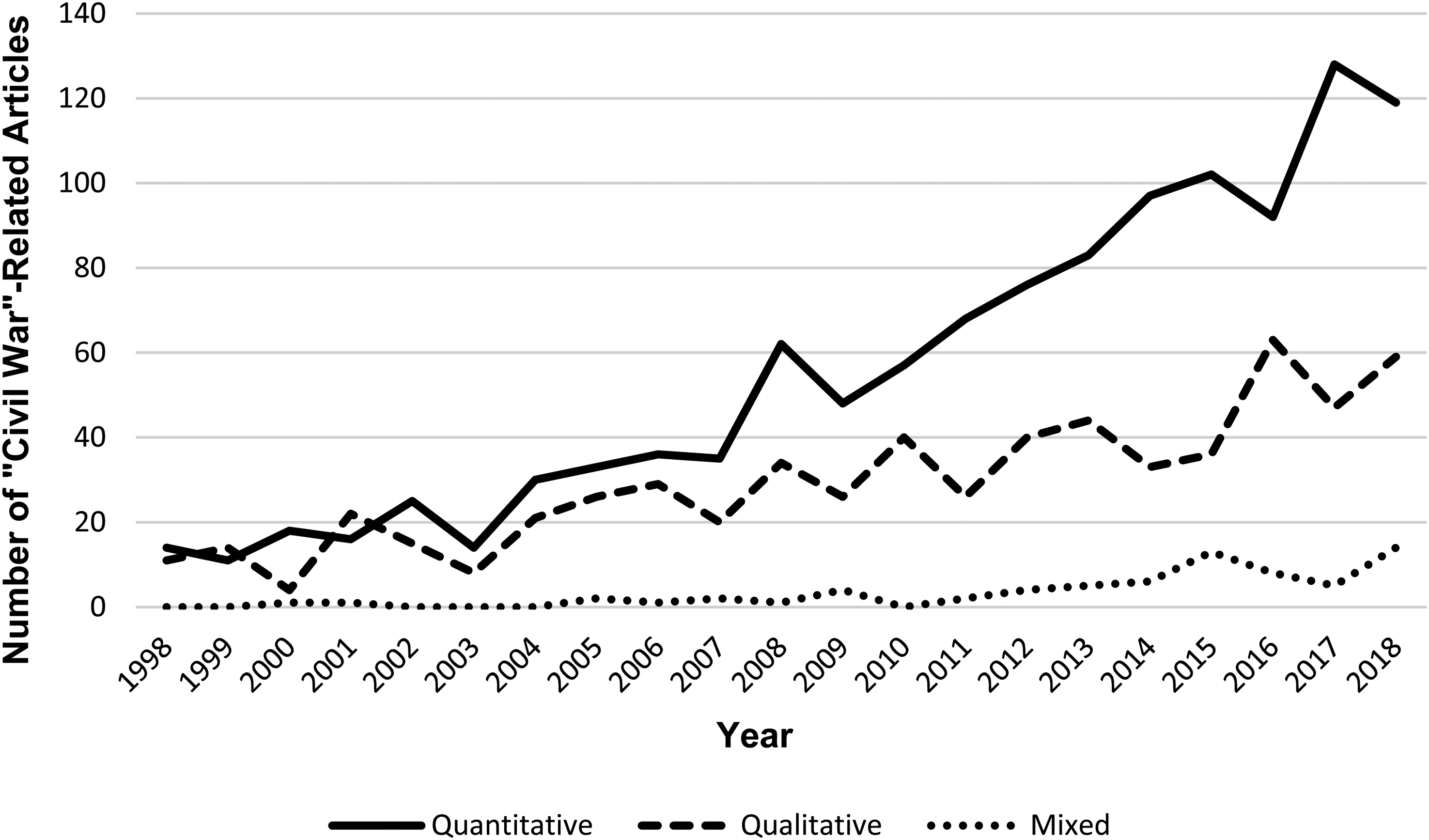
Number of articles on “civil war” using quantitative, qualitative or mixed methods between 1998 and 2018, based on Web of Science keyword search. The figure depicts the aggregate number of single- and co-authored articles.
Turning to the association between corresponding authors’ gender and the method on which their article is based, the first impression is one of male domination irrespective of the method being used: 73.3% of all quantitative-based articles in our dataset have a male corresponding author, compared to 66.7% of all qualitative-based articles and 69.6% of all mixed-method-based articles. While the over-representation of male corresponding authors is indeed highest amongst quantitative-based articles, one might argue that the percentage difference to qualitative- or mixed-method-based articles is not that large. Such an argument, however, would be misleading, as it fails to consider both over-time trends and the ratios of male to female authorship.
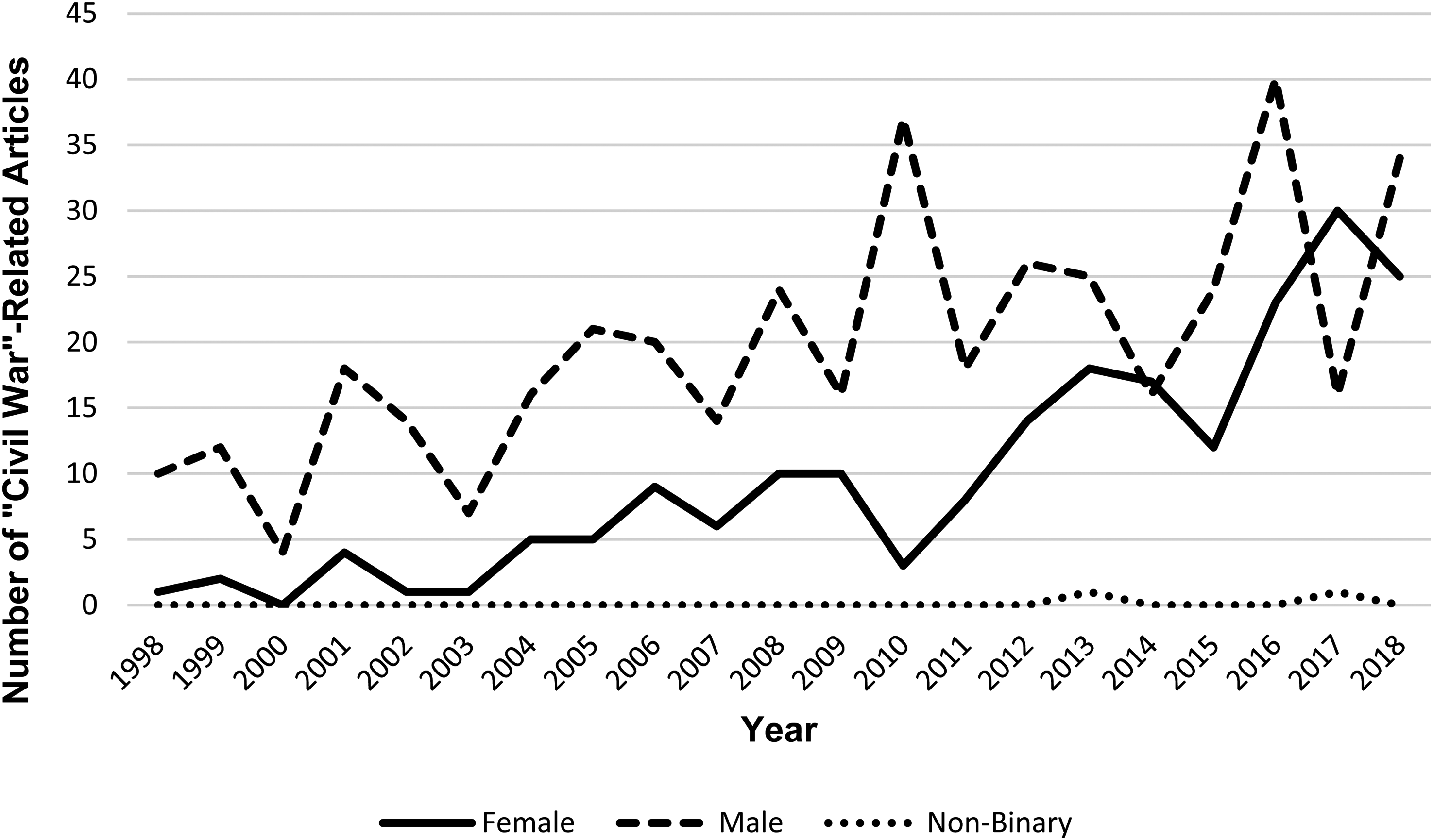
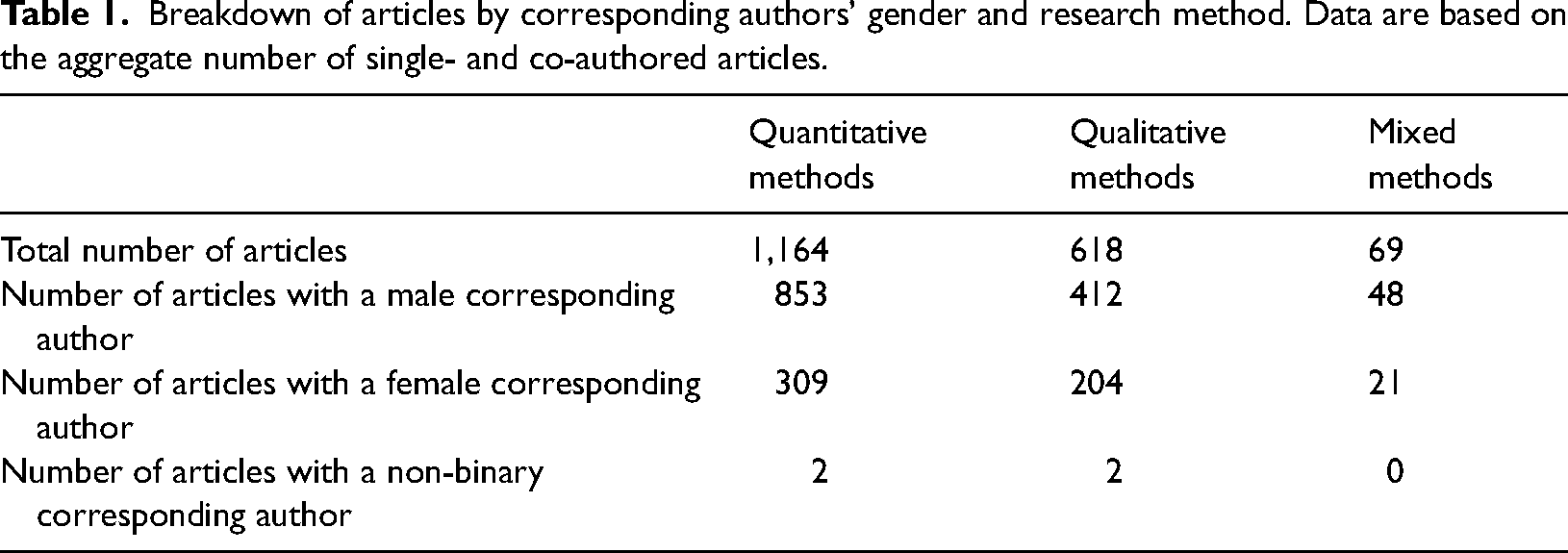
As illustrated by Table 1, the ratio of male corresponding authors to female corresponding authors is 853:309 for quantitative-based articles, and 412:204 for qualitative-based articles. The rate of male corresponding authors thus is 2.8 times higher than that of female corresponding authors for quantitative-based articles, and 2.0 times higher for qualitative-based articles – meaning that the gap between male and female authorship increases from twice as many male corresponding authors for qualitative-based articles to nearly three times as many male corresponding authors for quantitative-based articles. This is a notable difference, 7 which highlights that the demographic over-representation of male scholars in civil war studies is particularly pronounced within quantitative research. Figures 4–6 further substantiate that the gender gap is most prominent amongst quantitative-based articles.
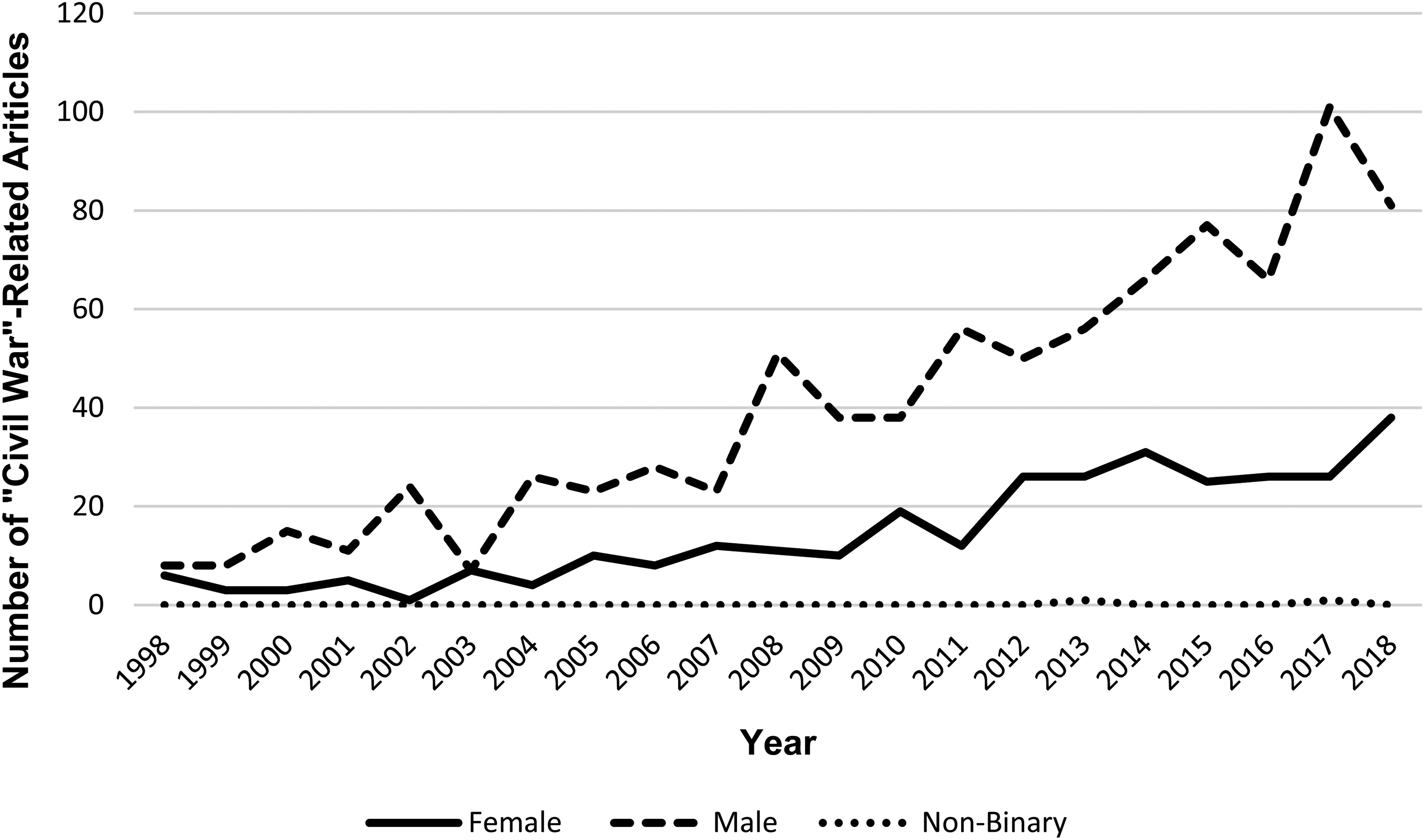
Number of articles on “civil war” using quantitative methods with a male, female or non-binary corresponding author between 1998 and 2018, based on Web of Science keyword search. The figure depicts the aggregate number of single- and co-authored articles.
Number of articles on “civil war” using qualitative methods with a male, female or non-binary corresponding author between 1998 and 2018, based on Web of Science keyword search. The figure depicts the aggregate number of single- and co-authored articles.
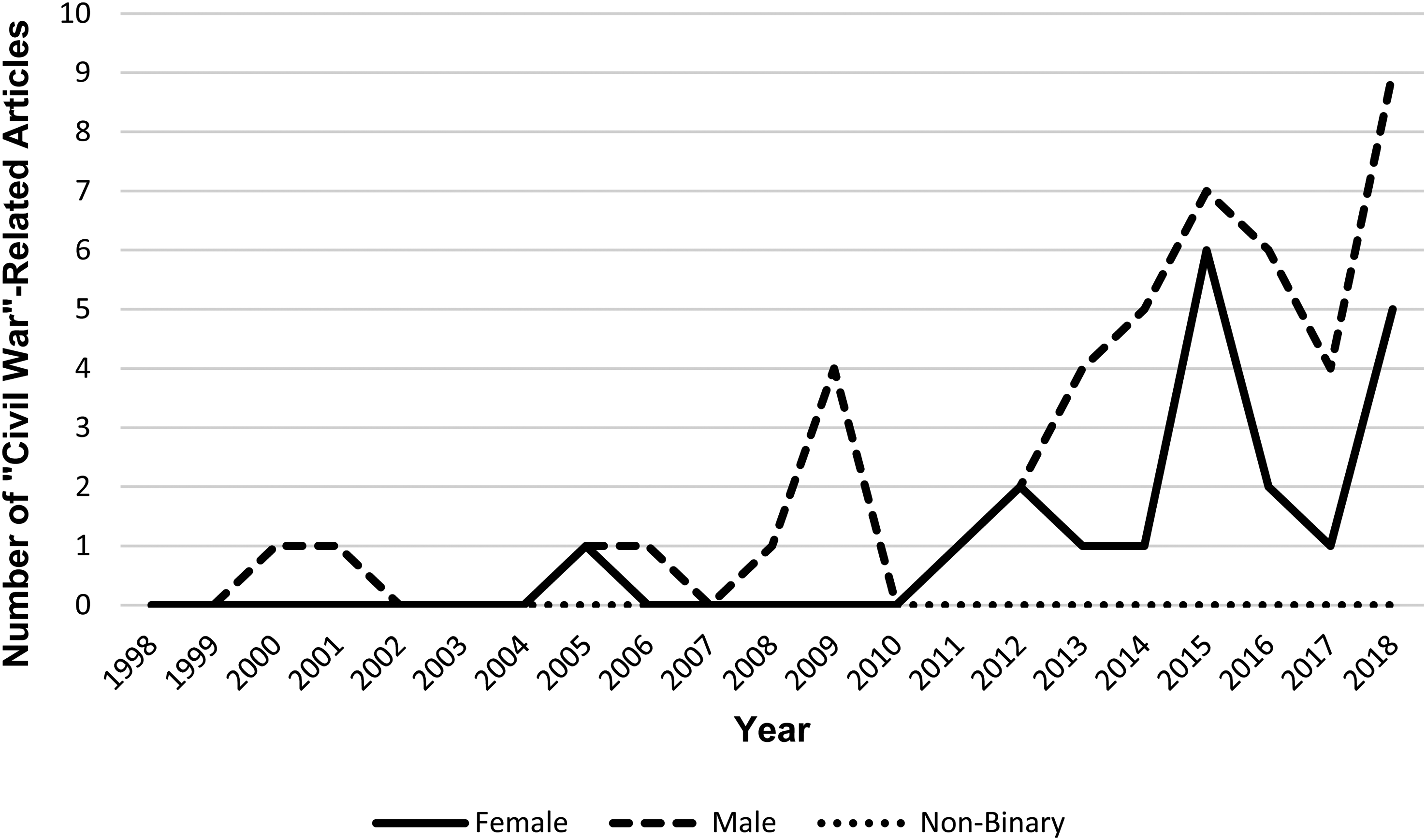
Number of articles on “civil war” using mixed methods with a male, female or non-binary corresponding author between 1998 and 2018, based on Web of Science keyword search. The figure depicts the aggregate number of single- and co-authored articles.
Breakdown of articles by corresponding authors’ gender and research method. Data are based on the aggregate number of single- and co-authored articles.
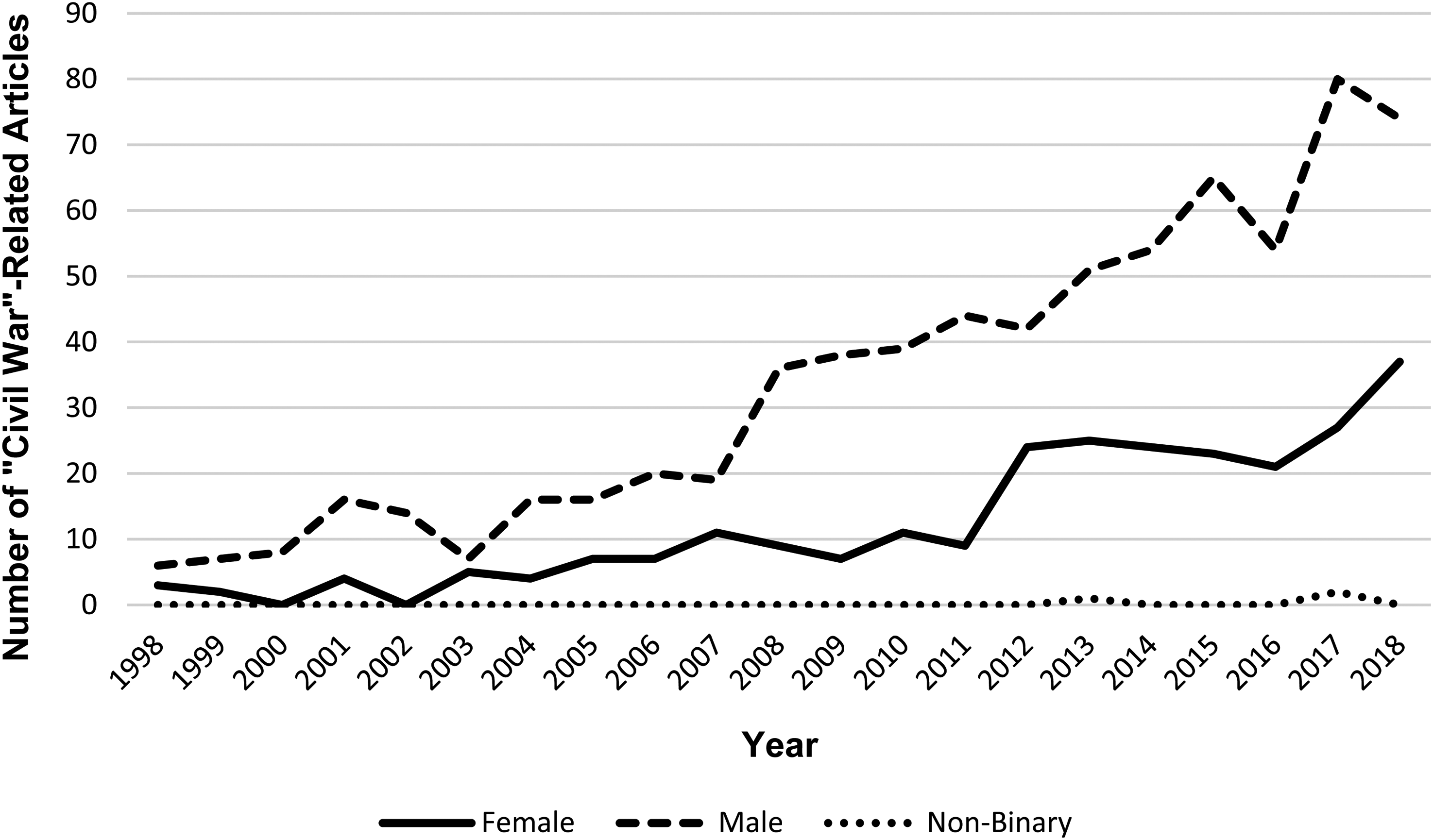
It sometimes is argued that co-authorship might help to reduce the gender gap in academic knowledge production (Maliniak et al., 2013). Descriptive patterns from our dataset, however, indicate that this may not be the case for high-ranking civil war publications: out of the 1,851 articles in our dataset, 881 (i.e. 47.6%) have been single-authored and 970 (i.e. 52.4%) have been co-authored. Taking together single- and co-authored articles, women represent 28.8% of all corresponding authors. Separating single- from co-authored articles, the number of female corresponding authors in co-authored articles is lower than the number of female single authors in absolute as well as relative terms: 273 (i.e. 31%) of single-authored articles had a female author, compared to 261 (i.e. 26.9%) of co-authored articles that had a female corresponding author.
Figures 7 and 8 illustrate that male scholars have dominated both single- and co-authored articles, with no indication in our descriptive data that there is a reduction in the corresponding author gender gap among co-authored articles over time. Further analysis of networking and collaboration practices – which are beyond the scope of this paper – would be needed to understand why this is the case.
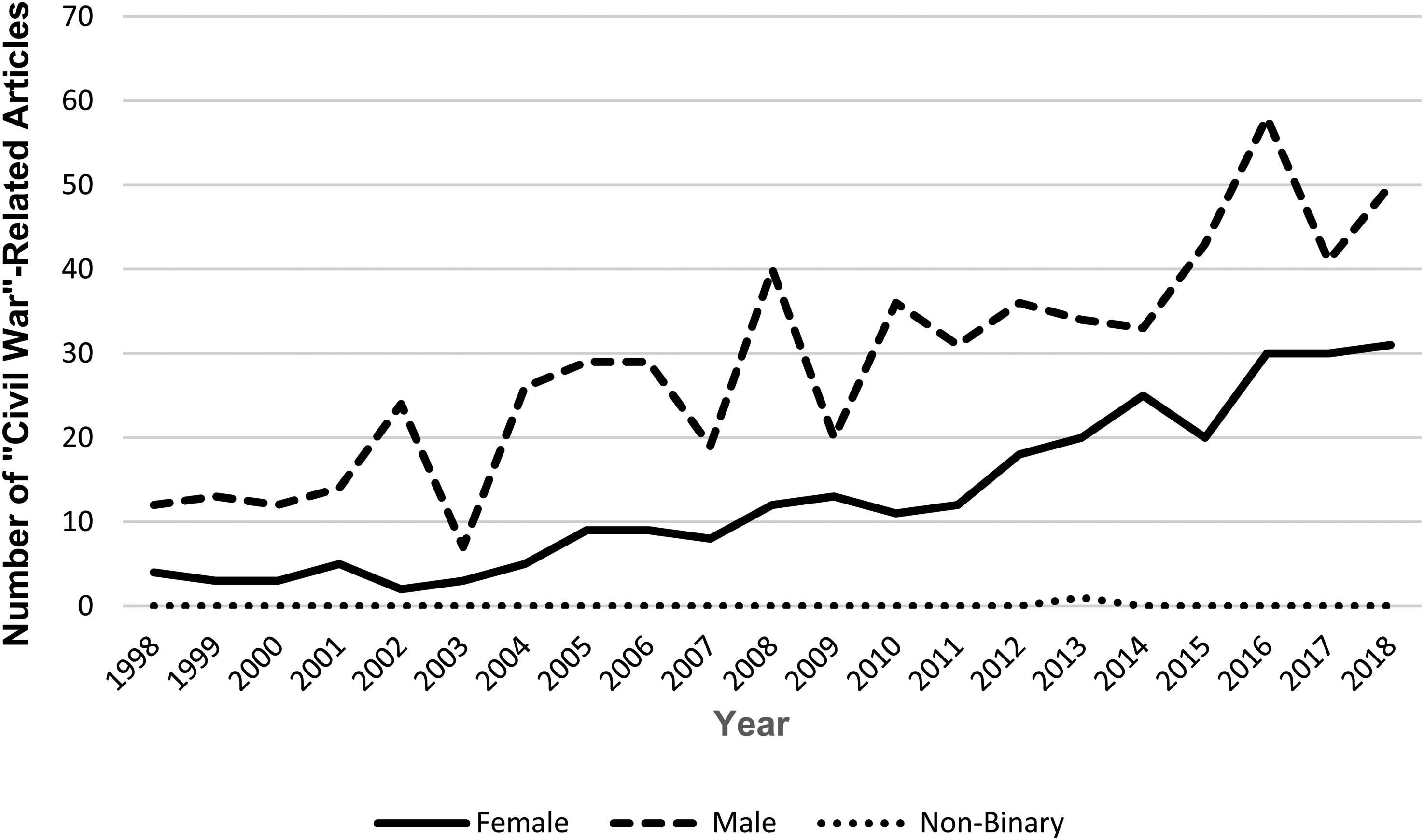
Number of single-authored articles on “civil war” with a male, female or non-binary author between 1998 and 2018, based on Web of Science keyword search.
Number of co-authored articles on “civil war” with a male, female or non-binary corresponding author between 1998 and 2018, based on Web of Science keyword search.
Narrowing our focus to articles with a quantitative research design only, we find that 29.5% of single-authored articles had a female author, while 24.8% of co-authored articles had a female corresponding author. Both percentages are lower compared to articles with either a qualitative or mixed method research design: 32.2% of single-authored qualitative-based articles had a female author, as did 34.5% of single-authored mixed-method-based articles. 34.7% of qualitative-based co-authored articles had a female corresponding author, as did 27.5% of mixed-method-based co-authored articles.
Of the 970 co-authored articles in our dataset, 51% had an all-male author team. Male-only author teams are most common among quantitative-based articles (constituting 53.4% of co-authored quantitative-based articles), followed by mixed-method-based articles (52.5%) and qualitative-based articles (41.3%) – highlighting a noteworthy difference especially between quantitative and qualitative research. As Figure 9 illustrates, the gap between male and female corresponding authors in quantitative-based co-authored articles seems to be widening overall since 2003.
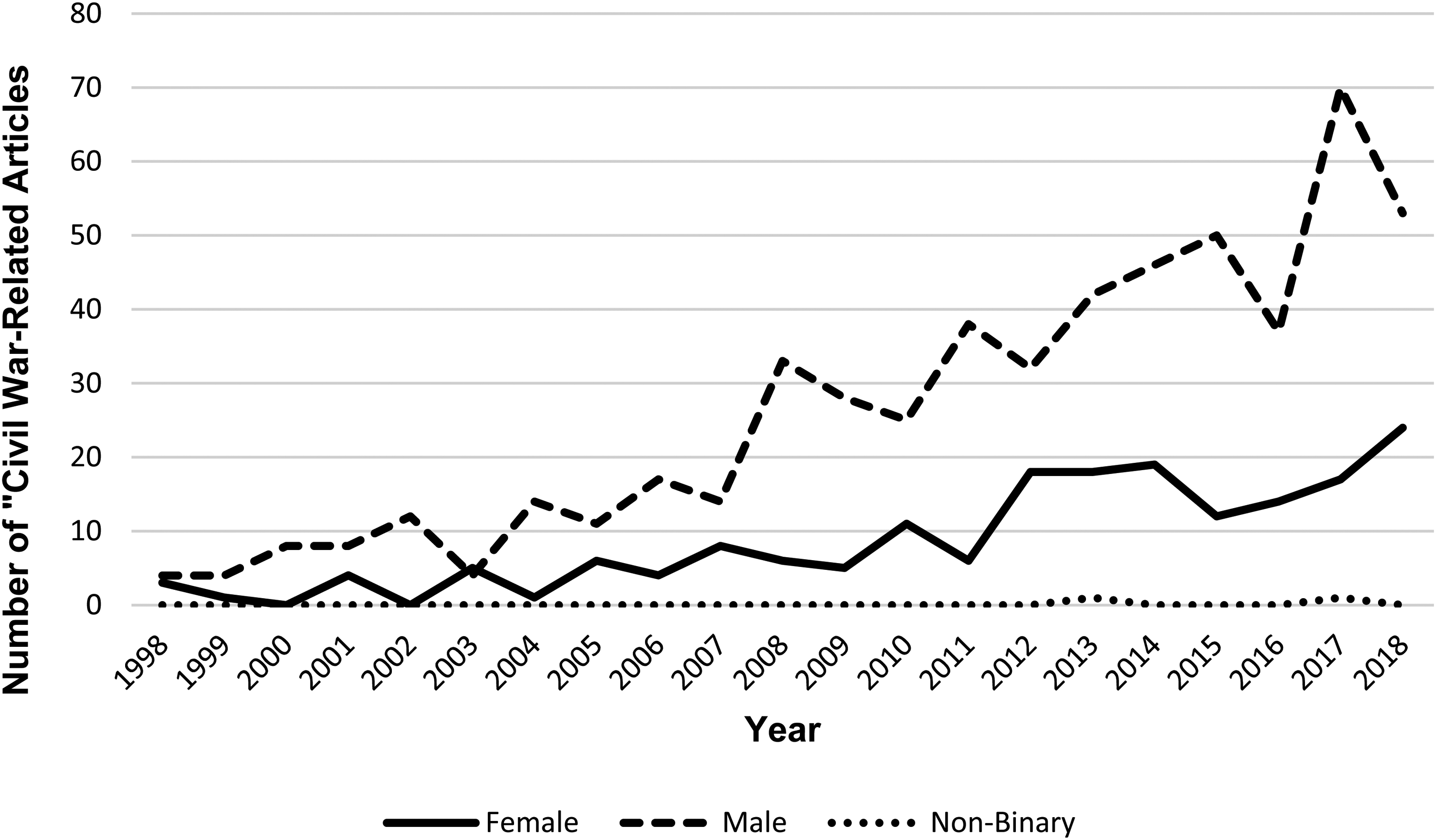
Number of co-authored articles on “civil war” using quantitative methods with a male, female or non-binary corresponding author between 1998 and 2018, based on Web of Science keyword search.
Of course, as the preceding figures show, not all male researchers use quantitative methods, and not all female researchers use qualitative methods. Hence, we need to avoid essentialist simplifications of ‘what male researchers do’ and ‘what female researchers do’, since there is no biologically pre-determined relationship between one's sex and preferences for (or aversion to) numerical methods. Rather – as noted in feminist debates on research methods (discussed in the section “Feminist debates on quantitative methods and ‘malestream’ dynamics”) and substantiated by a considerable amount of constructivist literature – gendered attitudes towards quantitative techniques are the outcome of cultural norms, socialisation processes and social interactions that take place during and after adolescence (Breda and Napp, 2019; Shames and Wise, 2017; Thelwall et al., 2019). This includes, for instance, selection and socialisation processes in higher education that create systematic disincentives for women to join advanced quantitative fields (Bansak and Starr, 2010; Bayer and Rouse, 2016; Meade et al., 2021; Shames and Wise, 2017).
To fully understand the gender dynamics of quantification trends, we need to consider the symbolic dimension of socially constructed gender norms that are associated with different types of knowledge production, based on culturally determined, context-dependent qualities that are seen to define (various forms of) masculinity and femininity (Momsen, 2010; Pankhurst, 2003; Runyan and Peterson, 2014). Through this lens of gender symbolism, quantitative research methods tend to be regarded as a masculine form of knowledge production, as their generation of ‘hard’ data based on ‘objective’ numerical techniques invokes notions of ‘tough’ and ‘rational’ masculinity (cf. Oakley, 1998; Rudolph and Rudolph, 2010; Stauffer and O’Brien, 2018). Qualitative research methods, by contrast, are more likely to be perceived as feminine, since they collect and analyse ‘soft’ data that tend to be seen as more ‘gentle’ and ‘emotive’ than their numerical counterparts (cf. Oakley, 1998; Shames and Wise, 2017; Stauffer and O’Brien, 2018). The beneficiaries of socially constructed hierarchies in favour of quantitative methods thus are not ‘just men’, but rather those scholars who – irrespective of their biological sex – conduct masculine ‘hard data’ research.
At this point, it should be noted that questioning the gender dynamics of quantification trends does not mean questioning quantitative methods per se – numerical methods play an important role in advancing social science research, owing to their theory-testing functions and ability to obtain generalised findings that (at least in principle) lend themselves to greater transparency and replicability than their non-numerical counterparts (Lamont, 2015). Rather, the primary concern that should be taken from our and other scholars’ critique is the cult-like obsession with complex statistical or mathematical methods (Kingsley, 2018; Ziliak and McCloskey, 2008) and the exclusionary hierarchies to which they can lead. These hierarchies affect both research topics and researchers themselves, if certain subject areas (such as, for instance, party and voting behaviour) rank higher in the socially constructed pantheon of ‘hard science’ by virtue of their quantifiability, and if the status assigned to numerical methods benefits some social identity groups (typically: white, male researchers) more than others (Engeli and Mügge, 2020; Hengel, 2017; Monroe, 2005; Shames and Wise, 2017).
Taken together, the demographic over-representation of male scholars and perceived masculinity of numerical techniques are contributing to the malestreaming of quantitative research, as they create obstacles for (often female) scholars who research women's experiences in traditionally male-centric topics (such as security) to make their arguments heard (Hudson et al., 2009). The question that arises from these points is: does this matter for the content of civil war research? Put differently: how, if at all, do gendered quantification trends affect the types of arguments that are published in high-ranking journals?
We answer these questions with reference to post-traumatic growth arguments in civil war research. Given the somewhat provocative implications of post-traumatic growth arguments – that there can be positive social and political outcomes following the incidence of violence – one might have expected them to be subject to particular scrutiny. With few exceptions (such as Kijewski and Freitag, 2018 or Lowes et al., 2020), however, their critique in peace and conflict studies has been relatively tame so far.
Our discussion below centres on the articles by Blattman (2009), Bateson (2012) and Kijewski and Freitag (2018). We selected these articles because they are the three most highly cited articles on post-traumatic growth in our dataset. 8 Since citation count was our sole selection criterion, we did not consider – and thus do not make any claims about – whether these articles represent different ‘stages’ in the post-traumatic growth debate, nor do we seek to explain why some articles have been cited more than others. For the purpose of our analysis, and in line with conventional (albeit contested) practice (Maliniak et al., 2013), we take the articles’ citation numbers as a sign of their impact on the academic debate, but leave it to other publications (e.g. Maliniak et al., 2013) to explain the different factors influencing citation trends.
Quantification, malestreaming and post-traumatic growth arguments
Post-traumatic growth arguments originate from the field of psychology, where they are most famously associated with the work by Tedeschi and Calhoun (1995, 1996). Simply put, they describe how some individuals who experienced traumatic events – that is, situations of “crisis, highly stressful events … that represent significant challenges to the adaptive resources of the individual” (Tedeschi and Calhoun, 2004b: 1) – may report positive changes in their aftermath, including “improved relationships, new possibilities for their lives, a greater appreciation for life, a greater sense of personal strength, and spiritual development” (Tedeschi and Calhoun, 2004a: 406). Tedeschi and Calhoun recognise that traumatic events such as sexual assault or military combat are distressing experiences which can cause long-lasting damage, and thus are keen to emphasise that their arguments are not meant to imply that trauma can be a ‘good’ thing (Tedeschi and Calhoun, 2004a, 2004b). Yet, according to their studies, “suffering sometimes yields strengthening and growth” (Tedeschi and Calhoun, 2004a: 405), as some of their research participants noted positive emotional and social transformations about themselves during their attempts to cope with major crises (Tedeschi and Calhoun, 1995, 1996, 2004a, 2004b).
Post-traumatic growth arguments have been subject to multiple critiques within psychology since they rose to prominence in the 1990s (see, for instance, Frazier et al., 2001; Maercker and Zoellner, 2004; McFarland and Alvaro, 2000; Wortman, 2004). Concerns about post-traumatic arguments include inter alia that they risk exaggerating the notion of ‘positive change’ while understating the multiple negative effects to which traumatic events can lead (Wortman, 2004). This risk is exacerbated by the lack of a generally agreed-upon definition of ‘post-traumatic growth’ or consensus on what counts as ‘positive change’ (Jayawickreme and Blackie, 2014; Ulloa et al., 2016; Wortman, 2004). Consequently, data on post-traumatic growth have been put into question, as there are doubts about how to measure experiences of ‘growth’ (Frazier et al., 2009; Jayawickreme and Blackie, 2014; Ulloa et al., 2016; Wortman, 2004), and to what extent different types of traumatic life events may lead to different effects (Coyne and Tennen, 2010; McFarland and Alvaro, 2000; Ulloa et al., 2016). Further concerns about the empirical foundations of post-traumatic growth arguments include the use of small sample sizes, inappropriate methodological choices, inconsistent research designs and the over-interpretation of weak findings (Coyne and Tennen, 2010; Jayawickreme and Blackie, 2014; Ulloa et al., 2016; Wortman, 2004).
Contested in their field of origin (psychology), post-traumatic growth arguments nonetheless have made their way into academic debates of other disciplines. They have been used to argue that the incidence of large-scale political violence can have positive effects on social and political development, as attempts to cope in the aftermath of traumatic events may lead to “increased [political] participation” (Blattman, 2009: 244), “higher levels of political mobilization and engagement, as well as higher local public goods contributions” (Bellows and Miguel, 2009: 1155) and “high levels of prosocial behavior” (Koos, 2018: 195).
The three publications on which we focus our discussion are Christopher Blattman's 2009 article “From violence to voting: War and political participation in Uganda”, Regina Bateson's 2012 article “Crime victimization and political participation”, and Sara Kijewski and Markus Freitag's 2018 article on “Civil war and the formation of social trust in Kosovo: Post-traumatic growth or war-related distress”. Both Blattman's (2009) and Bateson's (2012) articles have been published in the American Political Science Review (APSR) which, according to its website, is “political science's premier scholarly research journal” (APSR, 2023a: n.p.), with a 5-year impact factor of 8.5 in 2023 (APSR, 2023b). The article by Kijewski and Freitag (2018) has been published in the Journal of Conflict Resolution (JCR), a Q1 journal with a 5-year impact factor of 4.1 in 2023 that describes itself as “a leading international forum for the systematic study of war and peace” (JCR, 2023: n.p.).
All three articles use statistical analysis to test the effects of violence. Based on information about their disciplinary backgrounds and personal pronouns provided on their websites (Bateson, 2022; Blattman, 2022; Freitag, 2023; Kijewski, 2023), Christopher Blattman is a male economist and political scientist, Regina Bateson a female political scientist, Markus Freitag a male political sociologist and Sara Kijewski a female political scientist. As we highlight in the following paragraphs, the three articles differ in the extent to which they account for gender differentiation in their theoretical framing and/or empirical identification strategy, and the degree to which they embrace arguments on ‘positive change’ following violence.
Of the three articles under discussion, Blattman (2009) uses the most visibly male-centric lens and takes the most outspoken stance in favour of post-traumatic growth arguments. His central finding is that the likelihood of voting, the likelihood of being a community leader and the likelihood of membership in a peace group are higher among research participants who had been forcefully recruited into the Lord's Resistance Army (LRA) compared to those who had not. To interpret his results, Blattman (2009) draws on post-traumatic growth arguments to suggest that there is a causal link “from past violence to increased political engagement among excombatants” (Blattman, 2009: 231). The ‘malestreaming’ features of Blattman's article manifest in three key ways: a male-centric sampling choice; the production of male-biased findings; and the assertive presentation of ‘masculine’ hard data with an understated recognition of the article's theoretical and methodological “limits” (Blattman, 2009: 245).
Blattman's (2009) data are gender-biased, as he studies the political legacy effects of civil war with “data on
Blattman's male-only sampling choice is problematic, as it perpetuates the malestream's association of war and violence with men and masculinities (see e.g. Alison, 2009; Henshaw, 2016a, 2016b), and ignores the lived realities of female fighters and female abductees in the LRA. Blattman acknowledges the latter's existence when he notes that, even though “the majority [of abductees] were adolescent males, … men and women of all ages were commonly taken” (Blattman, 2009: 232). Yet there is no discussion of female abductees and/or fighters in the article, how their experiences may differ from that of men and boys (see e.g. Gustavsson et al., 2017; Kiconco and Nthakomwa, 2018; Komakech, 2019), and how these experiences, in turn, may affect gendered patterns of social activity and political engagement. Even from a purely ‘technical’ point of view, the male-only sampling choice weakens the article's purported rigour, as it creates issues for the use of propensity score matching (PSM): to produce reliable results, PSM requires large data samples, as the matching process typically discards observations that do not match (Zhao, 2004). In its current format, Blattman's quantitative analysis draws on a rather small sample of 741 male research participants (462 of whom had been abducted by the LRA) which, presumably, could have been increased if it had also included women and girls.
The article's production of male-biased findings is further exacerbated by the lack of gender differentiation in its conceptual framing and variable selection. Although the PSM approach would benefit from a rich set of variables that provide solid contextual background to reduce the risk of biasing one's findings (Stuart, 2010), the only gender-related variables in Blattman's (2009) analysis are on the socio-economic background of research participants’ mothers and fathers (Blattman, 2009: 236). There is no discussion in the article of how gender dynamics may influence the results, for instance, through the manifestation of different types of masculinity among research participants (Myrttinen et al., 2017) or the intersection of gender and ethnicity (Oosterom, 2014).
The lack of gender differentiation becomes especially problematic in the conceptual lumping together, in a brief footnote, of sexual with other types of violence such as “regular gunfire, beatings or torture, … killings … and the torching of occupied homes” (Blattman, 2009: 234). This failure to clearly distinguish different types of violence in the article's theoretical framing is problematic in several regards: on the one hand, it ignores the aforementioned critiques in psychology circles that different types of traumatic events may lead to different effects (Coyne and Tennen, 2010; Ulloa et al., 2016). On the other, it disregards the distinct symbolic and strategic functions that conflict-related sexual violence can serve, due to its impact on the de- and re-construction of gender identities (Féron, 2018; Nordås and Cohen, 2021; Schneider et al., 2015; Skjelsbæk, 2001). Since Blattman mentions that the underlying dataset contains separate indicators for different types of violence (Blattman, 2009: 234), it is somewhat surprising that the article contains no discussion about the conceptual and theoretical relevance of distinguishing these types of violence from each other.
The lack of gender differentiation in the article's theoretical framing and empirical identification strategy is not ‘just’ a feminist concern, but one about the quality of scientific research more broadly: the male-centric lens creates sample bias, weakens Blattman's PSM results and may lead to omitted variable bias because of insufficiently disaggregated or specified variables. Analytical limitations, however, are hardly mentioned in the article, as the author dedicates little space to theoretical elaboration and critical reflection. Instead, quantitative evidence (derived from regression-based approaches and propensity score matching) clearly takes centre stage in the main body of the article, its six tables, one figure and appendix – making it a prime example of an assertive, ‘masculine’ hard data publication, which relies on the perceived scientificness of numerical methods (Kingsley, 2018; Ziliak and McCloskey, 2008) to emphasise its relevance for academics and policy makers (Blattman, 2009: 231, 244–245). In addition to the aforementioned points, the lack of theoretical elaboration and critical reflection become evident in the only two sentences dealing with the limitations of post-traumatic growth arguments (Blattman, 2009: 244), and the brevity with which qualitative evidence from semi-structured interviews is discussed.
‘Malestreaming’ features lead Blattman (2009) to make strong assumptions about weak empirical relationships 9 (Manski, 2019) and to overclaim causality based on limited evidence. Yet the seeming scientificness of the article's quantitative approach and its publication in a high-ranking journal may contribute to the dissemination of its problematic message: that violence can have ‘positive’ political effects. As we have shown, this message is based on analytically shaky grounds, so that Blattman's claim about the “(hopeful) implications” (Blattman, 2009: 245) of his findings – that the experience of violence may lead to “personal growth and political activation” (Blattman, 2009: 231), and thus can be “good news for policy makers in wartorn nations” (Blattman, 2009: 231) – should be treated with caution.
Bateson's 2012 publication on “Crime victimization and political participation” is the next most highly cited article on post-traumatic growth in our dataset. Strictly speaking, Bateson's (2012) article is adjacent to – rather than firmly rooted in – the civil war literature, as it analyses the effects of crime (rather than war) victimisation on levels of political participation. It is, however, included in our dataset and appears in our Web of Science key word searches on ‘civil war’ and ‘post-traumatic growth’ because of its theoretical framing: Bateson (2012) explicitly draws on writings about post-traumatic growth following civil war, and pitches her own results as expanding on these arguments (Bateson, 2012: 571, 584).
Similar to Blattman (2009), Bateson (2012) presents her article as a ‘hard data’ publication that prioritises information about numerical techniques and results over theoretical elaboration and reflection. On the one hand, this becomes evident in the amount of quantitative information included in the main body of the article, its four tables and two figures. On the other, the author notes herself that her article is a “primarily empirical” (Bateson, 2012: 571) exercise.
Bateson (2012) uses a variety of regression and matching techniques – such as ordinary least squares, probit and ordered probit regressions, and nearest-neighbour matching – to obtain her results. She makes a strong claim about causality, as she argues that “crime victimization is an important cause of political participation” (Bateson, 2012: 570) and that “the impact of crime victimization [on levels of political participation] is generally equivalent to about 5–10 years of additional schooling” (Bateson, 2012: 575). By acknowledging that instrumental, emotional and expressive motivations may have a multicausal impact on political participation by victims of crime, Bateson (2012) takes a somewhat more qualified view of post-traumatic growth arguments compared to Blattman (2009). Yet because she leaves the “disentangling” of this multicausality to “further qualitative research” (Bateson, 2012: 584), and because she does not engage with the controversy surrounding post-traumatic growth arguments in the psychology literature, this qualification remains rather ambiguous. Instead, she explicitly positions herself in the camp of post-traumatic growth proponents by stating that her “results demonstrate that the positive downstream consequences of victimization identified by … Blattman (2009) [and others] … are not limited to survivors of civil wars or confined to specific countries” (Bateson, 2012: 584).
Given the apparent rigour with which Bateson (2012) presents ‘hard’, ‘scientific’ data, it is not surprising that her findings have been published in a leading political science journal and even won the prestigious 2013 Heinz Eulau Award for the best APSR article published in 2012 (Bateson, 2022). Upon closer inspection, however, also her findings stand on theoretically and empirically shaky grounds, which – unlike Blattman (2009) – is not due to the absence of gender differentiation, but rather its insufficient elaboration. This includes limited information about sex or gender ratios in the article's underlying data; the lack of theoretical elaboration why gender matters; and – similar to Blattman (2009) – an assertive overclaiming of causality.
The article's underlying data are based, primarily, on Afrobarometer, Asian Barometer, Eurobarometer and the Latin American Public Opinion Project/AmericasBarometer surveys. Bateson repeatedly mentions that her statistical results are consistent for “men and women” (Bateson, 2012: 578, 584), and thus goes beyond Blattman's (2009) male-only lens. However, there is no descriptive information in the article about the proportion of male and female respondents in each survey, and how this may (or may not) affect sample bias in different world regions. Details included in Table 2 of Bateson's (2012) article note that victims are more likely to be male in all regions apart from Asia – but the extent to which this implies a male-biased lens in her findings is not discussed.
The degree of gender-disaggregated analysis in the article is similarly limited, as it mainly consists of one control variable on survey respondents’ sex (Bateson, 2012: 575) and two briefly discussed figures that jointly consider research participants’ gender and nationality (Bateson, 2012: 576, 577). There is no theoretical elaboration why gender matters, no distinction of different types of masculinity or femininity, and an allusion to, but lack of exploration of, issues of intersectionality. This creates an impression of only superficial engagement with the relevance of gender dynamics, in both the framing of the research project and the interpretation of empirical results.
This impression is exacerbated by the lack of theoretical elaboration on how male and female experiences of crime may differ from one another, and why it thus makes sense to distinguish them in one's analysis. In her discussion of “intractable issues” (Bateson, 2012: 518), Bateson writes that “like all victimization surveys, the regional barometers likely miss domestic violence, child abuse, and discrimination based on gender, sexual orientation, and race …, as well as corporate fraud and state violence” (Bateson, 2012: 582). This lumping together of various types of violence and discrimination in short sequence, coupled with a potential oversampling of men, indicate ‘malestreaming’ dynamics in Bateson's publication. The article's male-centric lens is less pronounced than Blattman's (2009), but persists in the form of underdeveloped gender differentiation in both its theoretical framing and its empirical identification strategy.
Bateson (2012) acknowledges potential “threats to [her article's] causal inference” (Bateson, 2012: 578) and discusses over several pages how she addresses them. Other limitations of her empirical identification strategy, however, are hardly mentioned, such as the comparability of the survey data that she uses (given differences in their question phrasing and the years that they cover) and the predictive power of her models. 10 In light of these limitations, one might have expected a word of caution not to over-interpret the article's quantitative results and to be careful about the (ethically dubious) policy implications that could be drawn from ‘hard data’ which describe the ‘positive’ effects of crime victimisation as statistically “equivalent” (Bateson, 2012: 570, 575) to 5–10 years of education. Such a call for caution, however, is absent from the article, which instead relies on the perceived scientificness of its numerical approach to assertively overclaim causality.
Overall, the article's analytical shortcomings owing to insufficient gender differentiation illustrate how – irrespective of their biological sex – both male and female scholars may fall into the ‘malestream’ trap of current quantification trends, if they prioritise masculine notions of ‘hard’ and ‘scientific’ data over theoretical elaboration and critical reflection in the presentation of their arguments.
Finally, we turn to Kijewski and Freitag's (2018) publication on “Civil war and the formation of social trust in Kosovo: Posttraumatic growth or war-related distress?”. Out of the three articles under discussion, this is the only one with an explicit recognition that “some kinds of war experiences … differ among men and women” (Kijewski and Freitag, 2018: 725) and that “women and men are … known to have different psychological reactions to traumatic events” (Kijewski and Freitag, 2018: 725).
Kijewski and Freitag use ordered and multilevel ordered logistic regression analysis to test the effects of civil war experiences on social trust in Kosovo. Individual-level data for their analysis are sourced from a nationwide survey that – unlike Blattman's (2009) male-only sample and Bateson's (2012) lack of clear sample information – is female-biased: according to Table 1 of their article, 56.3% of respondents included in their sample are female (Kijewski and Freitag, 2018: 726).
In the theoretical framing of their article and the interpretation of their empirical results, Kijewski and Freitag (2018) express scepticism about post-traumatic growth arguments: in the literature review leading to their hypothesis, the authors mention the difficulty of conceptualising and measuring post-traumatic growth, which has been a central critique in the psychology debate noted above (Jayawickreme and Blackie, 2014; Ulloa et al., 2016; Wortman, 2004). They cite multiple writings that contradict the claim of ‘positive change’ in the aftermath of violence, including scholarship on ‘war-related distress’. Kijewski and Freitag present this scholarship as the counterpart to post-traumatic growth arguments, due to its emphasis on the “negative psychological state … [that may] result […] from the exposure to traumatic war-related events” (Kijewski and Freitag, 2018: 721).
Following their statistical analysis of both individual- and municipal-level data, Kijewski and Freitag find that the war in Kosovo from 1998 to 1999 “is related to lower social trust in the postwar period … [with] no indications of war having a positive influence on social trust” (Kijewski and Freitag, 2018: 718). Their results are particularly robust at the individual level, and they repeatedly pitch their article as a direct “challenge” (Kijewski and Freitag, 2018: 717, 718, 723) to post-traumatic growth arguments. At the same time, the authors caution against an over-interpreting of their statistical results, since “the causal impact of war experience on social trust cannot be estimated with cross-sectional data” (Kijewski and Freitag, 2018: 725).
Unlike Blattman (2009) and Bateson (2012), Kijewski and Freitag take an unambiguously critical view of post-traumatic growth arguments. The extent to which this view may be driven by their female-biased sample or their recognition of gendered experiences of violence, however, is unclear: overall, gender differentiation is still underdeveloped in both the theoretical framing and empirical identification strategy of Kijewski and Freitag's article, as gender dynamics are mentioned in only a few sentences; their statistical analysis only considers gender in the form of one control variable; there is no discussion why the oversampling of women or men may matter for one's findings; and no distinction of different types of masculinity and femininity. Similar to Bateson (2012), there is an allusion to issues of intersectionality – specifically of gender and ethnicity – but this is not explored any further.
Like Blattman (2009) and Bateson (2012), Kijewski and Freitag (2018) do not provide a separate discussion on gender-based violence. In line with the secondary data that they use (by the Armed Conflict Location & Event Data Project), they lump gender-based violence together with other violent acts, including them in one list of “house burnings, forced expulsion, harassment, robbery, air strikes and rapes, and other sexual assaults that involve casualties” (Kijewski and Freitag, 2018: 725). This lack of critical engagement with the data that they use is surprising, as their argument on “selective victimization for some kinds of war experiences” (Kijewski and Freitag, 2018: 725) could allude to the symbolic and strategic functions of conflict-related sexual violence (Schneider et al., 2015; Skjelsbæk, 2001).
Kijewski and Freitag (2018) could have turned these points – on gendered experiences of violence, the relevance of sample bias and intersectionality – into an explicit critique of ‘malestream’ dynamics in research on the effects of civil war. Because of the brevity with which they mention them, however, this potential is not realised.
Instead, Kijewski and Freitag (2018) resist ‘malestream’ dynamics in a different way: compared to Bateson (2012) and Blattman (2009), they put less emphasis on the assertive presentation of ‘hard data’, are careful not to overclaim causality and dedicate more space to theoretical elaboration and critical reflection (approximately four out of 26 pages). Because of this, the article exhibits a lower degree of “mathematical machismo” (Kingsley, 2018: 206) and greater sense of reflexivity – although, of course, statistical analysis still stands at the centre of its research design.
In sum, Kijewski and Freitag (2018) avoid some of the ‘malestream’ issues in Blattman's (2009) and Bateson's (2012) work, although there is still plenty of scope for further gender differentiation.
Conclusion
The descriptive data from our dataset on civil war articles published in Q1 journals between 1998 and 2018, followed by our discussion of three articles from this dataset that deal with post-traumatic growth arguments, have highlighted the following manifestations of gender disparities in civil war research: in the generally male-dominated field of civil war writings, the author gender gap is particularly pronounced – and persistent – among quantitative publications. In the discussion of ‘positive change’ following violence, the use of advanced numerical techniques can mask theoretical and empirical blind spots that perpetuate the male-centric lens. These findings indicate problematic malestream trends in the quantification of high-ranking civil war publications, where quantitative writings may benefit from the ‘masculine’ air of academic ‘rigour’, ‘rationality’ and ‘objectivity’, while providing only partial insights due to their lack of gender differentiation.
Our article leaves ample scope for future research: since we focus on quantification trends and their implications, we did not discuss the ways in which malestream dynamics affect qualitative research processes. Since we focus on post-traumatic growth arguments, we are not making claims about male-centric bias (and the ways in which it may be challenged or perpetuated) in other subfields of peace and conflict studies. Since our dataset relies on published articles – and we are unable to gather information on gendered processes that might precede the publication of these 1,851 articles – we do not know about the dynamics that have affected their preparation, submission and review, nor do we analyse what strategies authors and journals have used to disseminate the articles’ findings, and with what intentions. Since the end point of our dataset is 2018, we cannot assess how the APSR's all-women editorial team that took office in June 2020 may have affected the journal's publication trends (Wright Austin et al., 2019), nor do we analyse the different forms that resistance against gendered quantification trends might take. All of these points leave room for further analyses.
Within the scope of our article, however, there is a clear indication that gendered quantification trends may perpetuate – rather than challenge – the male-centric lens. Put bluntly, our findings illustrate the downsides of supposed economic truths and the need for greater awareness of gender bias in quantitative research. Insufficient gender differentiation in the theoretical framing and/or empirical identification strategy of academic research not only creates analytical blind spots, but – because of these blind spots – also weakens scientific rigour. This is especially concerning when research deals with ethically sensitive topics such as the effects of violence.
There is no panacea to solve the problems of gendered quantification trends. Based on our discussion, however, the main recommendations that we propose are to:
◼ be more cautious of the male-centric lens, by asking for greater reflexivity amongst quantitative researchers about how their own positionality and biases in their disciplinary field may influence their academic practice; ◼ be more aware of limitations in the quantification of different social science phenomena, including data availability and reliability; ◼ be more critical of socially constructed hierarchies of knowledge, and of the prestige that may be assigned to methodological style over theoretical and empirical substance; and ◼ avoid the temptation of overclaiming causality.
These points matter not only for more awareness of gender bias in the social sciences, but also for the credibility of quantitative research results (Manski, 2011).
Supplemental Material
sj-docx-2-cmp-10.1177_07388942241244962 - Supplemental material for Why gendered quantification trends are a problem: Post-traumatic growth arguments and the civil war malestream
Supplemental material, sj-docx-2-cmp-10.1177_07388942241244962 for Why gendered quantification trends are a problem: Post-traumatic growth arguments and the civil war malestream by Maren Duvendack and Ulrike G Theuerkauf in Conflict Management and Peace Science
Supplemental Material
sj-xlsx-3-cmp-10.1177_07388942241244962 - Supplemental material for Why gendered quantification trends are a problem: Post-traumatic growth arguments and the civil war malestream
Supplemental material, sj-xlsx-3-cmp-10.1177_07388942241244962 for Why gendered quantification trends are a problem: Post-traumatic growth arguments and the civil war malestream by Maren Duvendack and Ulrike G Theuerkauf in Conflict Management and Peace Science
Footnotes
Acknowledgments
We gratefully acknowledge funding by the University of East Anglia to support this project, and would like to thank Alena Mizinova and Touseef Mir for their research assistance in identifying relevant articles for our dataset. Dr Mona Morgan-Collins, Professor Laura Camfield and the chairs and participants of the ‘Governance at the Margins’ panel at the Development Studies Association Conference 2021 provided very helpful feedback on previous ideas and versions of this paper. We are indebted to the anonymous reviewers and editors of Conflict Management and Peace Science, especially Dr Megan Shannon – their thorough and constructive engagement with our arguments has been invaluable. Thank you very much to everyone who has given up their time and head space to help us improve our manuscript. All errors and omissions are our own.
Declaration of conflicting interests
The authors declared no potential conflicts of interest with respect to the research, authorship, and/or publication of this article.
Funding
The author(s) disclosed receipt of the following financial support for the research, authorship, and/or publication of this article: This research was supported by the University of East Anglia Faculty Discretionary Funds, funding number FF1120-2.

Supplemental material
Supplemental material for this article is available online.
Notes
References
Supplementary Material
Please find the following supplemental material available below.
For Open Access articles published under a Creative Commons License, all supplemental material carries the same license as the article it is associated with.
For non-Open Access articles published, all supplemental material carries a non-exclusive license, and permission requests for re-use of supplemental material or any part of supplemental material shall be sent directly to the copyright owner as specified in the copyright notice associated with the article.
