




Abstract
A now extensive literature examines effects of international peacekeeping on conflict-affected countries’ war-to-peace transitions. Still, we know little about how impactful peacekeeping is in stemming a wider set of hardships affecting host communities, such as hunger. Addressing this gap, we theorize and empirically examine the relationship between local UN peacekeeping deployment and food security in the Democratic Republic of the Congo, Mali, and Liberia. The results suggest an overall positive but substantively modest association between peacekeeping presence and more food secure communities—proxied by stunting rates in children—and point to context-specific variation. We conclude by discussing implications for future research.
Keywords
Introduction
Recent years have seen hunger on the rise. Armed conflict constitutes one of the main drivers of this development; for 139 out of 193 million people in acute food crises in 2021, for example, conflict was identified as the primary cause (FSIN, 2022). To stem armed conflict and help manage its devastating consequences, the deployment of peacekeeping operations constitutes one of the international community's primary and most impactful instruments. For its part, the United Nations (UN) often deploys so-called multidimensional operations, large-scale missions that join military and civilian capacities to pursue wide-reaching sets of efforts to promote peace and stability. The effects of UN peacekeeping operations on political and security outcomes are widely studied (Walter et al., 2021), but multidimensional missions also engage in a range of peacebuilding efforts, including related to humanitarian delivery and economic development. Although some foundational evidence supports UN peacekeeping's contributions to peacebuilding (Doyle and Sambanis, 2000), a full range of such aspects of peacekeeping effectiveness are less well studied. The effects of UN peacekeeping on food security constitute a particularly significant gap since sufficient food is a most basic human need and fundamental for development at large (Adair et al., 2013; Martorell, 1999).
To contribute to narrowing this knowledge gap, we examine associations between UN peacekeeping presence and proximate communities’ well-being, focusing on food security outcomes. In the context of large-scale, robust and multidimensional UN missions, we expect that localities with a peacekeeping troop-presence should fare comparatively better than areas without. Peacekeepers’ presence, we posit, should enhance local security conditions necessary for, for instance, agricultural production, market access and transportation—key components for food-secure communities. Such a presence may also carry direct, positive impacts for communities, through the roll-out of and support for activities to target food insecurity specifically.
We test our theoretical expectation at the subnational level focusing on UN peacekeeping interventions to Liberia, Mali and the Democratic Republic of the Congo (DRC), matching fine-grained peacekeeping deployment data—the Geocoded Peacekeeping Operations dataset (Cil et al., 2020)—with household survey data from the Demographic and Health Surveys (DHS). Specifically, we make innovative use of age-specific data on stunting rates in children—stunting being an indicator of severe nutritional deficits with grave development consequences—allowing us to study changes over time. Using this data, we apply a two-pronged empirical approach to study changes pre- and post-deployment, combining regressions on matched observations complemented with regressions including mother-fixed effects.
Our findings point to only modest improvements in children's food security status in relation to peacekeeping deployment, with results sensitive to adjusting time spans and accounting for migration patterns. Indications of positive local associations are stronger for the DRC than for Liberia and Mali. Taken together, the study's results suggest that any localized food-security-enhancing effect on behalf of peacekeeping troops specifically is neither straightforward nor uniform. Our study advances the research-frontier in two main ways. First, we add to a now-emerging strand of systematic studies on peacekeeping's wider potential to shape health and economic outcomes (e.g. Beardsley and Beardsley, 2023; Bove et al., 2022; Caruso et al., 2017; Mvukiyehe and Samii, 2021), which have often focused on single countries. Suggestive of differential local patterns across country contexts, our findings can inform more contingent expectations for future work to build on. Second, a focus on food security advances knowledge by adapting established theories on peacekeeping effectiveness to outcomes highly consequential for war-affected host communities, as well as by combining data sources in a novel way. Given that many UN peacekeeping operations deploy with pronounced responsibilities related to peacebuilding, evaluating their performance across a more comprehensive set of outcomes should be a priority. Policy moves to further integrate peace and security, humanitarian and development portfolios, alongside recognition of growing pressures of climate change and associated food insecurity where peacekeepers are present, further underscore this point.
Peacekeeping interventions and host community well-being
UN missions often operate in contexts characterized as complex humanitarian emergencies, where life-threatening risks of violence and humanitarian need intersect. Peacekeeping thus comes into close contact with problems of food insecurity and carries important associated responsibilities. 1 Noting this obligation, the UN Security Council affirms its “primary responsibility for the maintenance of international peace and security and, in this regard, reiterates its commitment to address conflict-induced food security, including famine, in situations of armed conflict” (UN, 2020; also UN, 2023a).
Contemporary peacekeeping is guided by principles of human security, which promotes the meeting of basic human needs including through intervention (Peou, 2002). Communities’ ability to meet basic needs in peacekeepers’ presence becomes a marker of the intervention’s legitimacy and relevance; owing to its fundamentally humanitarian imperative, peacekeepers’ intervention should reduce suffering and improve conditions for communities (Kim, 2017). More tangibly, duties related to humanitarian delivery and economic development regularly form part of mission mandates, thus falling within the scope of peacekeepers’ repertoire of authorized tasks. Yet much comparative research focuses on political and security outcomes of peacekeeping (Walter et al., 2021). Given its emphasis on security promotion, this focus is natural but underplays other outcomes associated with peacekeepers’ presence, several of which are mandated and can thus be seen as expected. To contribute to addressing this omission, we draw from two strands of research as points of entry.
A first strand focuses on peacekeeping's economic impacts. Countries hosting UN missions are often characterized by limited state capacity, poverty and large informal markets (Tejpar, 2009), making the insertion of international personnel and resources non-negligible. Observers often emphasize peacekeeping's unintended, predominantly negative impacts in creating so-called “peacekeeping economies” oriented to interveners’ needs (Jennings and Boås, 2015). Noted economic distortions include price-hikes in housing or market prices for food (UN, 2008: 82), salary inflation and corruption risks (Ammitzboell, 2007). 2 Other work studies peacekeeping's potential to stimulate economic growth in host states. Although findings are mixed (cf. Bove and Elia, 2018), studies have identified certain positive economic effects from peacekeeping (Carnahan et al., 2007). Cross-country evidence shows greater economic growth in host-countries compared with non-peacekeeping countries, at least in the short term (Beber et al., 2019).
A second strand orients to micro-level approaches to study economic and health effects, emphasizing peacekeeping's potential to improve communities’ well-being. Studying cross- and within-country effects of UN deployments on maternal health in African countries, Gizelis and Cao (2021) find evidence of a positive effect from peacekeeping presence. Beber et al. (2019) combine cross-country evidence with findings from Liberia to highlight positive economic effects associated with peacekeeping. Other work in this strand focuses chiefly on individual countries. For South Sudan, Caruso et al. (2017) show a positive association between peacekeeping deployment and increased agricultural production, attributing this to security improvements in those areas. Bove et al. (2022) find that a proximate peacekeeping presence improves households’ economies via improved—observed and perceived—security. Mvukiyehe and Samii (2021) study local effects on both security and development outcomes in Liberia with less encouraging results: peacekeepers’ presence was not found to associate with enhanced local security and showed only modest improvements along socio-economic indicators. Still, other evidence from Liberia suggests that peacekeepers’ presence improved civilians’ economic situation, especially by creating demand for low-skills jobs (Beber et al., 2019). Recently and closely relevant, Beardsley and Beardsley (2023) find that peacekeepers’ presence tempered the impact of conflict on malnutrition levels in Côte d’Ivoire, reducing the propensity for adult women to be underweight. They add to this a cross-national test using an alternative indicator of food security, finding some evidence that the association they observe is more widely generalizable.
This latter strand reflects a view that more can be expected from peacekeeping and the relevance of subnational approaches for identifying such associated effects. Several studies point to peacekeeping's potential to contribute to civilians’ well-being but also raise questions related to whether findings are generalizable across different outcomes and cases. While economic development broadly correlates with other aspects of economic and physical well-being (Hegre et al., 2020), it often exhibits large differences within countries and population groups (e.g. Osgood-Zimmerman et al., 2018). Further, determinants of specific dimensions such as food security, poverty and health partly diverge (Vollmer et al., 2014). Evaluating whether peacekeeper presence enhances food security seen across three UN intervention contexts, we contribute to understanding peacekeeping's local influence on a central facet of communities’ well-being.
UN peacekeeping presence and local-level food security
UN peacekeepers’ presence tends to shape its surrounding environment in noticeable ways, including to impact host communities’ day-to-day lives. Certainly, not all impacts are positive (Beber et al., 2017). Yet we anticipate that the overall impact of UN peacekeeping presence on local-level food security should be. This is through both direct and indirect means, specifically, stemming indirectly from peacekeepers’ function as security providers and also from their more direct efforts to meet local needs and stem hunger. We proceed to outline each prospective pathway.
Fundamental to large-scale and robust UN peacekeeping's envisaged function in conflict-affected contexts is its security-enhancing role. Some measure of security is a pre-requisite for peacebuilding efforts to take hold, yet hostilities often persist post-intervention. Numerous studies have shown the presence of UN peacekeepers to be associated with reduced violence at the local level (Bove et al., 2020; Fjelde et al., 2019), while other studies call these results into question by forwarding results from individual cases (Costalli, 2014; Mvukiyehe and Samii, 2021) or nuance findings by highlighting conditions under which missions are effective (Cil et al., 2020). Still, most results point to peacekeeping's potential to at the subnational level curb civilian targeting (e.g. Fjelde et al., 2019) and prevent, contain, or limit the duration of armed clashes (Beardsley and Gleditsch, 2015; Ruggeri et al., 2017; Smidt, 2020). In all, a UN mission can contribute to stability and security through different means at the local level, which is important for our argument.
For communities residing in areas where peacekeepers are present, how can establishing a more secure environment affect their food security? Armed conflict and insecurity are associated with many adverse consequences for communities’ ability to feed themselves. The destruction of land, crops, infrastructure or key assets, explosive ordnances contaminating farmland, the displacement of farmers, the withdrawal of state or non-governmental organization (NGO) services and other forms of direct and downstream disruptions to the production, delivery and access to food and water (Tranchant et al., 2019; UN, 2023b), carry implications for malnutrition in communities. Key to mitigating drivers of conflict-related food insecurity is enhancing physical security (Corley, 2021). A measure of security is for instance essential for farming and trade—both key for enhancing food security. During conflict, communities often deliberately shift to economic activities that are less profitable but minimize conflict-related risks, such as the looting of stocks and assets. In conflict-affected northern Uganda, for illustration, considerable changes occurred within local households’ livestock and crop portfolios that reduced the size and value of their herds (Rockmore, 2012). Conflict-related curfews or security operations may reduce mobility and add transportation costs, disrupting food supply chains; concerns for safety can reduce market viability for traders and customers alike (Dunn, 2018; Tranchant et al., 2019). Combatant war-time tactics may involve deliberately impeding communities’ access to food (UN, 2023b).
A securitizing peacekeeping-presence may increase communities’ ability and willingness to return to more profitable and food-security-enhancing activities, including returning to farm land abandoned during conflict or pursuing other livelihood activities. Using patrols or checkpoints, peacekeepers can help secure market access and road networks necessary for food production and distribution. This in line with the so-called “security bubble” hypothesis (Mvukiyehe and Samii, 2021), whereby peacekeeping deployments create local pockets of security that promote socio-economic revitalization in the surrounding area. 3 Peacekeepers can act to restore access for communities cut off by violence or repression through dismantling illegitimate checkpoints or otherwise dislodging armed groups from areas under their influence, and can also intervene more directly to protect communities at risk of violence by armed groups. This effect should be pronounced given the primacy of civilian protection in contemporary UN peacekeeping, with missions authorized under Chapter VII mandates to protect civilians including up to and including the use of armed force. Localized effects carrying positive impacts for community-level food security are therefore expected from actual or perceived improvements to security conditions in areas where peacekeepers are present.
Our second pathway emphasizes peacekeepers’ more direct impacts for food security via measures by interveners and partners at the subnational level that support hunger-reduction and stimulate local economies, focusing on three main facets of peacekeeper presence.
First, peacekeepers engage in a range of activities and efforts to meet communities’ needs and target food insecurity where deployed. Although not a principal task, peacekeepers have come to subsume greater responsibilities as direct aid-providers (Diehl and Druckman, 2013: 18); if needs demand this can include tasks such as to transport, accompany, guard or themselves even provide basic services. One such case is the UN protection camps established in South Sudan where the UN mission went beyond providing camp security to distributing food and other forms of basic service delivery (Kugel, 2016). Other times, peacekeepers will guard food storage or distribution sites, serving a central role in aid delivery. The presence of a UN peacekeeping operation in a country is associated with greater inflows of multilateral aid overall (Maekawa, 2024); missions also facilitate different forms of programming and funds that may be leveraged for food security-related efforts, including at the local level. For example, the UN mission in Mali administered funds from the UN Peacebuilding Fund, the Trust Fund for Peace and Security in Mali, and implemented so-called Quick Impact Projects (QIPs), a funding mechanism for small, short-term projects to directly benefit local communities. Applied across multidimensional UN missions, QIPs have included agriculture, food production, water management and economic reconstruction projects (UN, 2012). Additionally, UN peacekeepers frequently engage in more ad hoc efforts to mitigate food insecurity. 4 Informed also by findings on aid impacts we expect the typical effects of such ad hoc measures and funding mechanisms to be small and localized (Briggs, 2018).
Second, we expect that other humanitarian and development actors are likely to operate in areas where peacekeepers are present. Enhanced security should draw in and concentrate other forms of aid by allowing better access to needy communities (Stoddard et al., 2017). Insecurity can be hugely limiting for aid operations—access constraints and threats on humanitarian workers often result in the suspension of activities and, not rarely, the withdrawal of aid personnel. A peacekeeping presence should contribute to a more conducive environment for aid delivery to take place. Moreover, a peacekeeping presence also often leverages existing capabilities to serve aid providers with infrastructure and logistics, such as access to UN flights and escorts, or other support to bolster effective delivery (Kugel, 2016). Indeed, these are now articulated tasks for most UN missions. 5
Finally, a peacekeeping presence may also directly contribute to community-level food security by stimulating the local economy. Such impacts can take many different forms (e.g. Bove and Elia, 2018), owing to dedicated economic recovery programming or the—often less intentional yet impactful—influx of funds that follows. A mapping of nine UN missions by Carnahan et al. (2007: 384–385), highlights three main, immediate impacts for local economies. First, international staff spending directly inserts money into local economies, particularly via services such as housing and restaurants (also Beber et al., 2019). Second, missions’ local procurement carries important local economic impacts such as by increasing demands for food stuffs, stimulating the agricultural sector (Caruso et al., 2017; also UN, 2015: 89). Third, peacekeepers’ positive economic impact is attributed also to salaries paid to locally contracted staff. Such salaries are typically sufficiently large to also benefit extended family and are likely to be inserted into the local economy through local goods and services purchased (Carnahan et al., 2007). A similar effect is expected from cash-for-work programs implemented in several UN mission contexts, including as part of disarmament programming (e.g. UN, 2016). Each form of economic impact from intervention outlined here should manifest chiefly locally, in proximity to where peacekeepers have a presence (Jennings and Boås, 2015).
We have presented two main pathways and associated mechanisms through which UN missions may contribute to enhancing food security conditions where they are present. We expect that direct and indirect pathways outlined here are both closely linked and difficult to disentangle, and that they may work in combination but also independently to influence food security outcomes at the local level. Taken together, our reasoning leads us to formulate an overarching expectation: UN peacekeeping presence increases local-level food security.
Empirical context
Evaluating our overarching expectation requires the identification of cases experiencing peacekeeping interventions of a type consistent with our theory—large-scale UN missions operating under multidimensional mandates that provide for both security-enhancing and humanitarian roles—and for which disaggregated food security data collected at appropriate intervals are available. After imposing these two criteria, we arrive to focus on three countries that currently host, or have recently hosted, UN missions: Liberia, Mali and the DRC. UN peacekeepers were in each case deployed in response to civil wars, often prolonged if episodic, placing civilians at risk. The countries also have in common that a significant share of the population is food insecure, reflected in high stunting rates deemed as at least in part related to conflict (FAO, 2021). In each country, comprehensive household survey data on food security were collected at intervals suitable for studying the short- to medium-term effects of peacekeeping deployment.
Interventions to Liberia, Mali and the DRC each reflect central features of contemporary UN peacekeeping and share characteristics relevant to the plausibility of our theory. First, peacekeepers operated under multidimensional mandates and within integrated mission structures, joining uniformed and civilian efforts (including from other UN agencies) to deliver intended outcomes. Second, mandates comprised pronounced aims for humanitarian efforts, including provisions for serving roles outlined as part of our direct pathway. Peacekeepers in the DRC were, inter alia, authorized “to facilitate humanitarian assistance” (UN, 2000) and ensure the protection of humanitarian personnel (UN, 2013a). In Liberia, peacekeepers were authorized “to facilitate the provision of humanitarian assistance, including by helping to establish the necessary security conditions” (UN, 2003). UN peacekeepers in Mali were requested “to contribute to the creation of a secure environment for the safe, civilian-led delivery of humanitarian assistance” (UN, 2013b). Each mission was specifically tasked with creating a secure environment for the purpose of humanitarian delivery. Finally, missions were authorized under Chapter VII of the UN Charter, allowing “all necessary means” up to and including the use of armed force to implement their mandates. Taken together, we can be confident that each intervention was authorized to serve the securitizing role the indirect pathway of our theory is premised on. 6
Research design
We seek to investigate the association between UN peacekeeping presence and food security outcomes. We opt for a geographically disaggregated approach as food security and child growth specifically is characterized by “striking subnational heterogeneity” (Osgood-Zimmerman et al., 2018: 41). This approach allows us to account for spatial and temporal variation in peacekeeping deployments and thus presence in a host state, which is typically quite localized and cannot be assumed to equally impact populations in all parts of a country (Cil et al., 2020). To test our expectation that areas with a peacekeeping presence fare comparatively better than areas without, we identify food security indicators among host communities using household survey data, and match survey cluster locations with subnational peacekeeping deployment data.
Dependent variable: stunted growth
For our dependent variable, we rely on established indicators of food security based on anthropometric indices; namely, the World Health Organization (WHO) Child Growth Standards (Pangaribowo et al., 2013). Specifically, we focus on stunting outcomes among children under 5 years of age as the most prevalent form of undernutrition, strongly related to insufficient dietary diversity and food access (Gassara and Chen, 2021; Prendergast and Humphrey, 2014). Stunted growth is a particularly severe consequence of food insecurity with long-lasting health and socio-economic implications, such as by leading to impaired brain development, lower IQ and a weakened immune system, and is associated with lower productivity in adults (Martorell, 1999; Mendez and Adair, 1999). Beyond the immediate importance for individuals and communities, stunting thus has implications for a country's opportunities to develop and prosper (Dewey and Begum, 2011; Mary, 2018). We prefer stunting over other measures of food insecurity owing to its crucial importance for development but also because it has advantages for our research design, allowing us to study changes over time, as we discuss below. As our main proxy for food insecurity, we rely on height-for-age measures provided by the DHS since food security occurs along a continuum (Adair et al., 2013; Fink et al., 2016). The variable Ht/age gives the height-for-age Z-score. One step on the continuous measure is equivalent to 0.01 standard deviations from the median on the WHO Child Growth Standards. As a complement, we use the dummy variable Stunted coded “1” if the child is below 2 standard deviations from the median of WHO Child Growth Standards and “0” otherwise. 7
Our data are based on household surveys from the DHS that are routinely conducted in several developing countries covering population, health, and nutrition indicators. Surveys are representative at national, residence (urban–rural) and regional levels (first-level administrative units), with enumeration areas drawn from census files and households randomly selected from updated lists of households. We use the geo-referenced DHS data to identify locations of survey clusters (DHS, 2010). 8 Specifically, we use successive DHS rounds conducted in 2007 (round V) and 2013–2014 (round VI) for Liberia and the DRC. For Mali, we use survey rounds conducted in 2012–2013 (round VI) and 2018 (round VII). For reasons owing to security concerns, the earlier survey round (VI) conducted in Mali does not cover the whole country. It excluded the northern regions of Gao, Kidal and Timbuktu and included only partial coverage of Mopti: areas experiencing especially high levels of insecurity at time of survey implementation. For Mali, we are thus forced to limit our sample to the areas where we have coverage in both survey rounds, which still allows for relevant insights as this captures more than 90% of the total population of the country (Assaf and Pullum, 2016).
Independent variable: peacekeeping deployment
We obtain monthly information on subnational peacekeeping deployments from the Geocoded Peacekeeping Operations dataset v.1.2 (Cil et al., 2020). Derived from UN mission deployment maps, the dataset provides spatial coordinates for locations where peacekeepers are present. Our theoretical argument emphasizes peacekeepers’ primary function as security-providers, in addition to their potential to serve additional duties and enabling functions relevant more directly to enhancing food security. On this basis we select deployment locations consisting of military troops and exclude deployments only composed of civilian substantive and support staff, civilian police units or military observer units. 9
Determining the geographical area that peacekeepers can be expected to access or influence is not altogether straightforward. We expect that peacekeepers affect not only the immediate area where stationed but may also secure larger areas through patrols or checkpoints. Yet, while UN peacekeepers may conduct long-range vehicle patrols, these appear considerably rarer than short-range patrols (e.g. Dabanga, 2010; Duursma, and Karlsrud, 2019). Informed by discussions with experts and peacekeeping personnel, we opted to draw a 20 km radius as a conservative zone of reach, which we extend to 30 km in alternative specifications, and specify binary variables (Pkdummy20, Pkdummy30). The specification aligns with some other studies on economic and health effects of peacekeeping (cf. Gizelis and Cao, 2021; Bove et al., 2024). Gizelis and Cao (2021), for example, draw a 25 km circle around bases, arguing that this is often the maximum distance that beneficiaries may travel in a day by foot.
Empirical strategy
While we only have data on food security indicators collected around every sixth year, we innovatively exploit the fact that in each survey round, children to up to 5 years of age are covered. This means that we can investigate the age-adjusted food security status of children up to 5 years before a survey was implemented. In total, this gives us a set of age cohorts of children and their respective age-specific deviations from normal height from a full sample of children covered in the stunting measurement by the DHS, for the DRC and Liberia (each 2002–2014) and Mali (2007–2018). 10
Specifically, we measure the food security status of children born before and after peacekeepers are deployed locally during this time period. For instance, a child that is 5 years old at the time of the 2007 survey round implementation in Liberia, was born before a peacekeeping deployment in 2004, while her 2-year-old sibling was born after deployment. Owing to the permanence and irreversibility of stunting if exposed to food insecurity in early life (Mendez and Adair, 1999; Shrimpton et al., 2001), the 5-year-old would likely exhibit stunted growth relative to their age group owing to food insecurity as a toddler, despite potential improvements in food security by the time of the survey. In contrast, if our theoretical expectation is supported, the 2-year-old sibling born after the arrival of peacekeeping troops should be in a more favorable situation than a child of the same age outside of the peacekeeping zone.
If there are several bases within a peacekeeping zone as defined above, as is the case in eastern DRC, for example (see Figure 1), the earliest date of deployment of any peacekeeping troop presence is taken to distinguish whether a child was born before or after a base was established. This measurement reflects the assumption that once within reach of a peacekeeping deployment, a household will benefit.
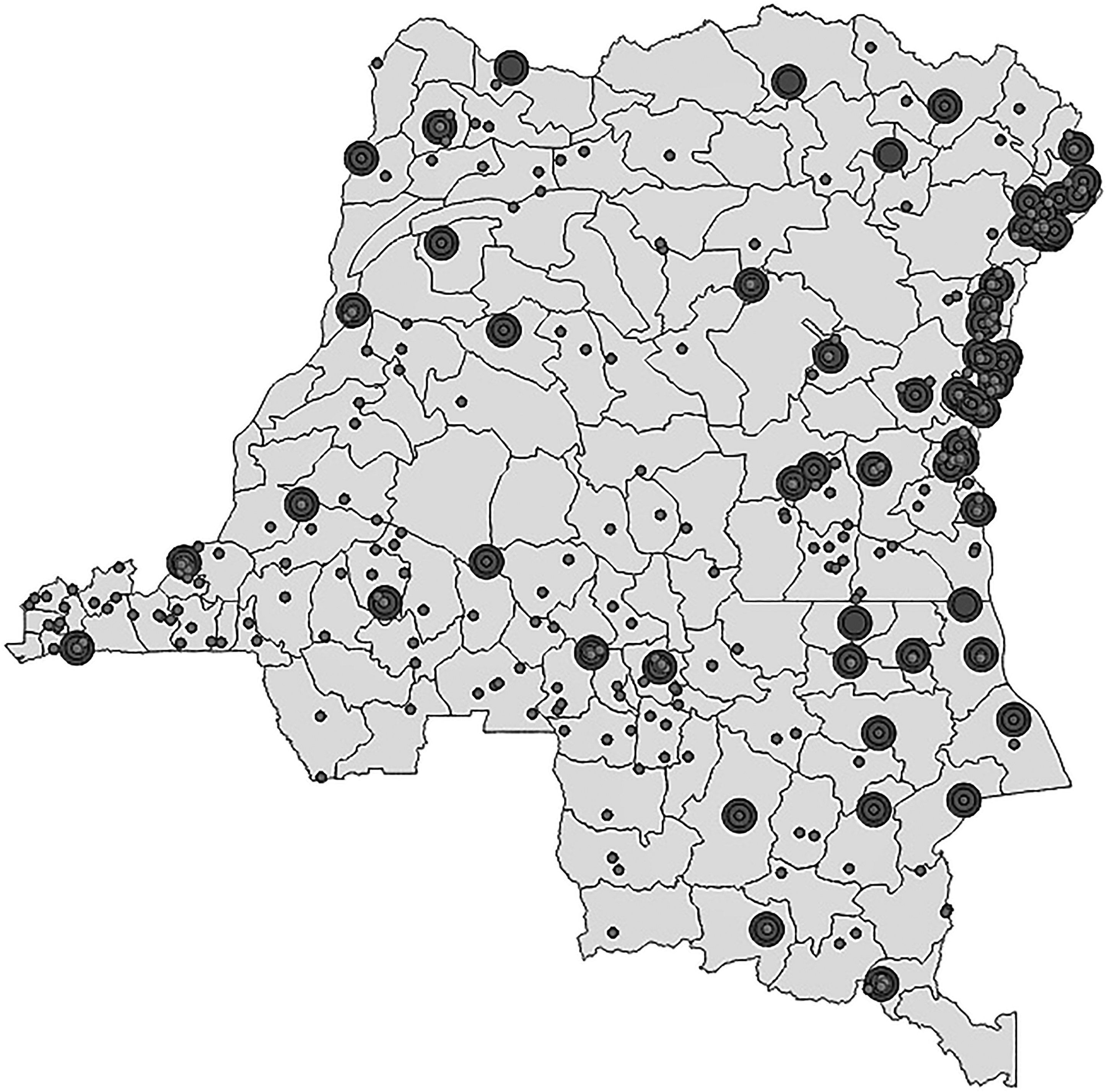
Illustration of data allocation in the Democratic Republic of the Congo. Peacekeeping deployment (circles with 20–30 km radius around base locations) and survey cluster locations (points) in 2007 and 2013–2014 respectively.
Plotting the height-for-age scores in all countries we observe that food insecurity is widespread (Figure 2). Across the countries included, children are on average too short for their age as indicated by negative deviations from globally normal according to WHO standards (see also Supplementary Figure A1). It is also notable that children in areas with eventual peacekeeping deployment tend to be more food secure than others, even before deployment. Peaks in recorded height-for-age scores observable for all countries in the data can be attributed to the timing of DHS rounds and differences in age in children in the sample. Children that are born in the same year as or the year before data collection are probably partly protected from food insecurity owing to breastfeeding (Corley, 2021). Importantly, overall, when accounting for these age-specific differences we observe a positive trend towards greater food security—most significantly in Mali and Liberia. In the post-deployment period all children are better off, on average (see also Supplementary Figure A4). This positive trend is in line with documented general improvement in food security in almost all African countries during this period, albeit often with high within-country inequalities (Assaf and Pullum, 2016; Osgood-Zimmerman et al., 2018). Importantly, in Liberia and Mali—both countries where mission deployment took place over a relatively concentrated period of time—the figure indicates a convergence: post-peacekeeping deployment we see greater improvements in areas outside than within peacekeeping zones. Convergence between the two groups is particularly pronounced in Liberia; following deployment, food security levels in areas with peacekeeping deployments and those without become nearly identical.
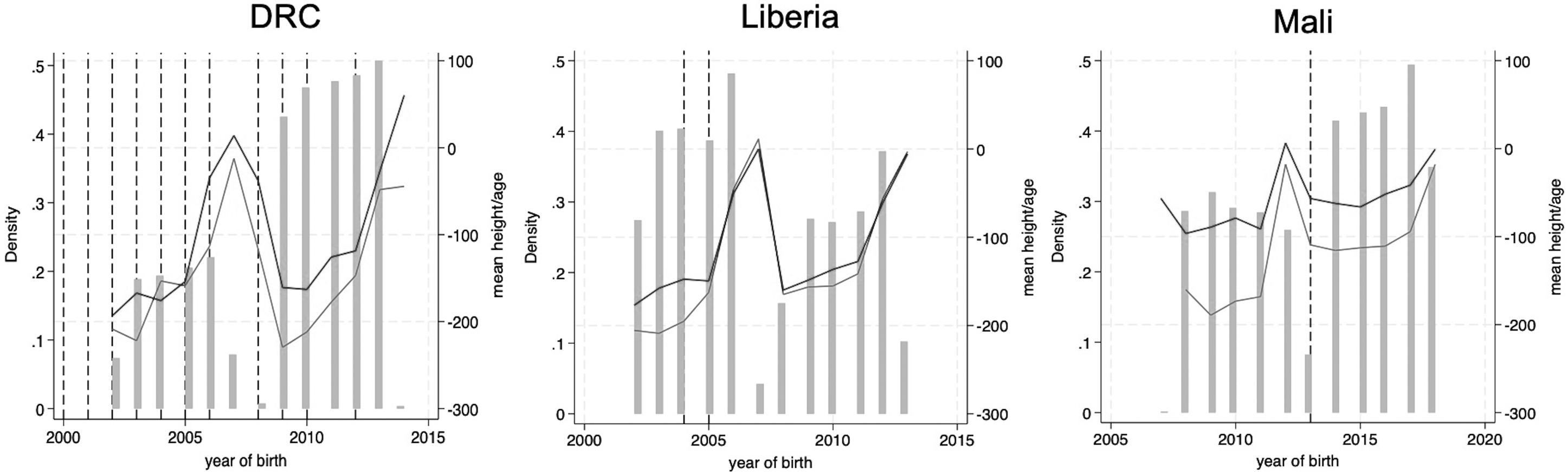
Average height-for-age by year of birth of children for areas with eventual peacekeeping deployment (black solid line) and outside (grey solid line) for all countries in the dataset. Dashed reference lines indicate years when peacekeepers were deployed in any new location in each respective country.
A challenge for estimating subnational effects of peacekeeping is the non-random assignment of deployment. From earlier studies, we have learned that peacekeepers tend to go to the most violence-affected areas, albeit often with some delay (Costalli, 2014; Ruggeri et al., 2018). The identification of a control group needs to account for the non-random assignment of peacekeepers. To achieve this, we use two different strategies: regressions on a matched sample and mother-fixed effects regressions comparing siblings. For the first strategy, we use coarsened exact matching (CEM) (Iacus et al., 2012). Coarsened exact matching is an imbalance-reducing matching method that has been used in earlier work on peacekeeping effects (e.g. Bakaki and Böhmelt, 2021). In our study, it is applied to account for potentially confounding systematic time-invariant differences between areas with peacekeepers present and those without. The choice of covariates matched on is informed by the broader literature on peacekeeping, food security and child mortality (e.g. Akresh et al., 2012; Gizelis and Cao, 2021; Rustad et al., 2020). First, we include the mother's height in standard deviations from normal growth as a proxy for a history of food insecurity, and the mother's highest level of education (Ikeda et al., 2013; Keino et al., 2014). The education variable has four possible levels: no education, primary, secondary or higher education. We account for the history of violence in the proximity of DHS clusters using data from the Uppsala Conflict Data Program Georeferenced Event dataset (UCDP GED) v. 20.1 (Sundberg and Melander, 2013). For this variable we aggregate data on all forms of organized violence recorded as occurring within a 20 km radius around a DHS cluster in the 5 years before the survey was implemented. If history of violence shapes food security trends in a region, this variable will account for it. We use thresholds of 0, 25, 1000 and 2000 fatalities from organized violence for grouping observations in the CEM algorithm. We also add a variable indicating whether the child was living in an urban or rural household (Guilkey and Adair, 1997; Keino et al., 2014). 11
After the data have been matched, we use the CEM weights to estimate the effect of peacekeeping via regression analysis, controlling for individual level time-variant controls (variable names provided in italics). Specifically, we control for the Age of the child, measured in years. Including age accounts for potential cumulative effects of prolonged exposure to less-than-ideal food security conditions (Dewey and Begum, 2011). In line with the literature on child development, we identify some age-specific trends in our data. Specifically, there is a sharp increase in stunting after completing 1 year of age across the dataset (see Supplementary Figure A3). This ostensibly reflects the cessation of breastfeeding, which we account for through the dummy variable Below 1 year. In addition, we include two binary variables: Male, capturing the sex of the child, and Multiple birth, capturing whether a child is a twin, for example. Both conditions are expected to affect food security (Hong et al., 2006). We also control for survey round fixed effects.
For our second strategy, mother-fixed effects, we compare siblings only. This means that crucial differences related to the characteristics of the household and location are held constant. For example, local ethnic groups may differ in average height and mothers have also to different degrees been exposed to conflict in the past, differences that the use of mother-fixed effects accounts for. This approach has been used in several works on food security and child mortality (e.g. Bundervoet et al., 2009; Kotsadam et al., 2018). As location-specific differences are accounted for by the mother-fixed effects, we only control for the children's age (continuous variable) and add the variable Below 1 year in line with the models on matched samples. By design the survey round is held constant. We again control for multiple births and the child's sex. Descriptive statistics are found in Supplementary Table A1.
Results
Do we see enhanced food security conditions in areas where UN peacekeeping troops are present? Moving to results, we estimate models on stunting on pooled as well as country-specific samples. Table 1 displays results of our regressions on matched samples.
Food security and peacekeeping—matched sample.
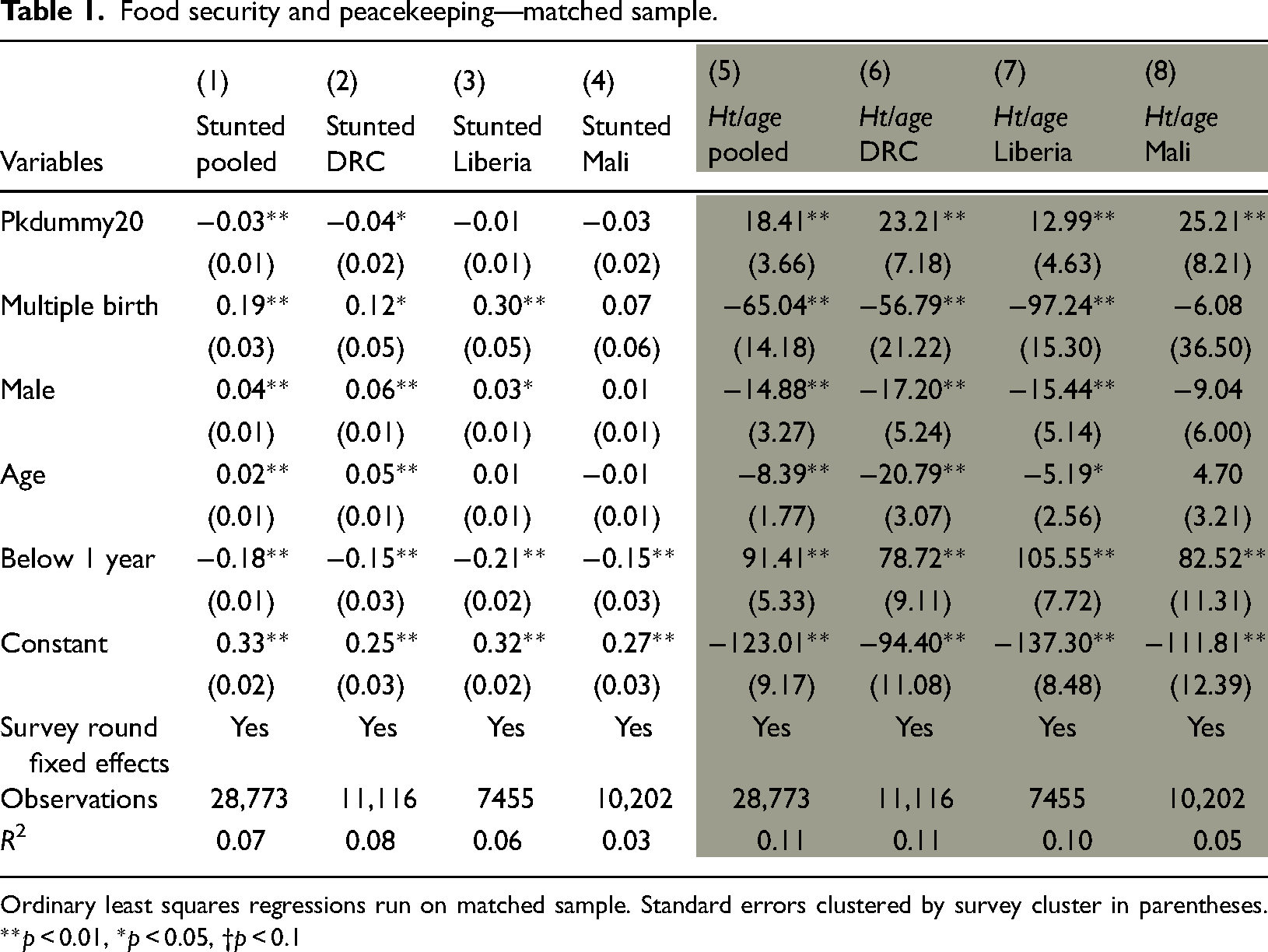
Ordinary least squares regressions run on matched sample. Standard errors clustered by survey cluster in parentheses. **p < 0.01, *p < 0.05, †p < 0.1
In the pooled sample (Model 1), the coefficient reflecting peacekeepers’ proximate presence (Pkdummy20) is negative as expected and significant, showing that peacekeeping deployment in an area is associated with a 3 percentage point lower rate of stunting. Country subsamples show this pattern is driven by the DRC (Model 2), for which the peacekeeping coefficient is negative and significant, indicating a 4 percentage point decrease in stunting rates. The results are thus indicative of a tendency toward more food secure communities in areas where peacekeepers are present in the DRC. In contrast, the Liberia and Mali samples (Models 3 and 4) do not reflect significant local peacekeeping effects on stunting rates, even though coefficients are negative in line with our theory. In Models 5–8 we instead use the full, continuous height-for-age range as dependent variable, which is more fine-grained than the coarse stunting dummy. In all these models the peacekeeping coefficient is positive and statistically significant. This suggests a minor but substantively positive association between peacekeeping presence and child development across the sample: children within peacekeepers’ reach are indeed taller for their age than are children in other areas. Much like our stunting-rate models, however, the coefficients do not point to a substantively strong correlation.
While matching allows us to capture correlations over the full time period covered by the data, we may be concerned about variables omitted in the models that could bias the estimate. As an alternative empirical strategy, we compare siblings born before and after peacekeeping deployment using only mother-fixed effects in Table 2. We thus compare siblings with the same mother and hold constant factors that relate to family context and location. This strategy is helpful for having a good basis for comparison; however, the inclusion of mother-fixed effects means that the estimation relies only on mothers surveyed who have at least two children below 5 years old born before and after peacekeeping deployment. As a result, we capture only shorter-term associations between peacekeeping and food security (within a 5 year timeframe) and a specific subset of mothers with several small children. We find that the association is considerably weaker than in the first set of models without mother-fixed effects, and only significant at the 90% level in the pooled sample and when using height-for-age instead of stunting rates.
Food security and peacekeeping—mother-fixed effects.
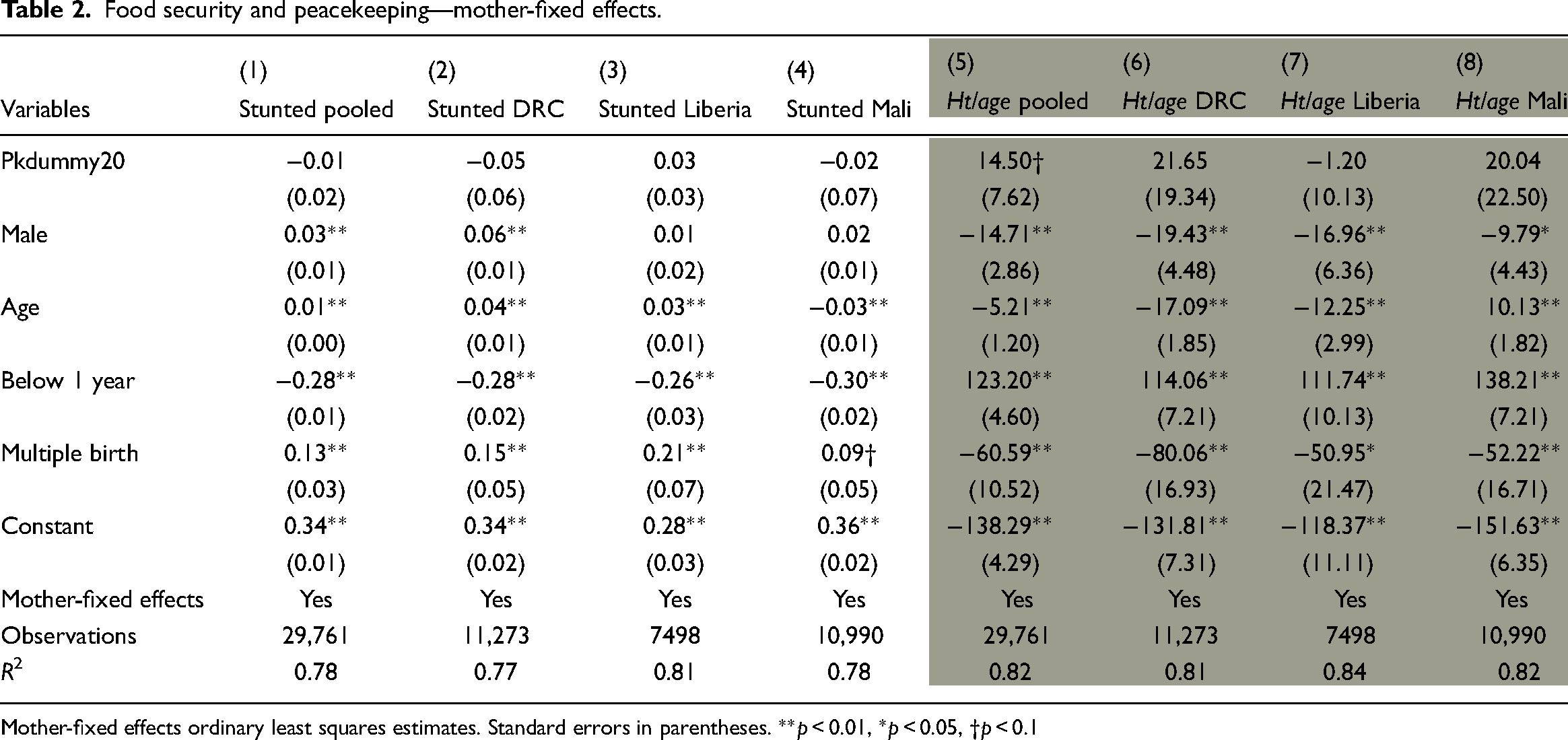
Mother-fixed effects ordinary least squares estimates. Standard errors in parentheses. **p < 0.01, *p < 0.05, †p < 0.1
What could explain these mixed patterns in our sample and variation across different estimation techniques? Indeed, sample restrictions seem to explain the difference at least partly: when restricting the matched sample to mothers of several children below the age of 5, significance levels change (Supplementary Table A3). The duration of exposure to a peacekeeping presence thus seems to matter. Overall, we interpret Tables 1 and 2 to provide support for a weak, positive association between peacekeeping deployment and food security that takes some time to develop. We further subject this estimation to several sensitivity tests documented in Supplementary Materials—including to change the assumed reach of peacekeepers to 30 km around their base—and logistic regression models (Supplementary Table A2 and A4), which leave results substantively unchanged. Where such data are available, we also drop migrating populations from the estimation. These results indicate that mobility affects results, albeit in opposite directions in different contexts (Supplementary Table A5 and Figure A6).
Discussion
In the context of UN peacekeeping interventions to the DRC, Liberia and Mali, we find some evidence of a positive association between peacekeeping deployment and food security. Across both a matched sample and mother-fixed effects specifications, however, relationships appear substantively rather weak. While a modest positive relationship in the hypothesized direction can be detected in a large sample pooling all observations, this relationship is not consistently found across interventions and is sensitive to model specifications, specifically, to changing the sample to mothers with two children and dropping recent migrants from the estimation (Supplementary Table A5 and Figure A6). What may account for these results? We turn now to consider potential alternative or complimentary explanations relevant to our association of interest and, where such is available, examine additional evidence.
First, migration dynamics and diffusion effects pose challenges for studying subnational peacekeeping dynamics (Beber, 2021) and associations between peacekeeping presence and food security are no exception. Peacekeepers’ presence may shape civilians’ incentives to migrate, and we cannot fully account for movements in and out of peacekeeping localities. There is some evidence to suggest that the presence (and size) of deployments is associated with greater returns; in other words, a peacekeeping base is more likely to serve a “pull” rather than a “push” function (Costalli et al., 2023; Sundberg, 2020). From investigating subsamples in our data for which information on migration experience is available, we learn that in the DRC, migrant children around peacekeeping bases are more food insecure than host populations (Supplementary Figure A6). This suggests that peacekeeping sites may in this context attract more food-insecure populations. Focusing on stationary host populations, the association between peacekeeping and food security is stronger (Supplementary Table A5). However, the pattern is reversed for Liberia, where migrant children around peacekeeping bases instead are slightly more food secure. This, in turn, resonates with findings from migration research emphasizing the capacity and resources required for moving as decisive for who will leave and who will stay, pointing to the complexity of migration decisions (de Haas, 2021). As more fine-grained data on subnational migration patterns become available, context-specific interactions between hunger, peacekeeping and population movements will warrant closer attention.
A second possibility for why a prospective association between peacekeeping presence and food security is not coming out more strongly is if it operates differently than expected. Linking to wider debates on peacekeeping effectiveness, does peacekeeping chiefly work at the micro- or macro-level? While we see developments toward more micro-level theories to try to isolate peacekeeping's local effects, other dominant peacekeeping mechanisms situate at the macro-level and “can confound the local level mechanism” (Phayal, 2019: 760). It is thus possible that peacekeeping is “working” but that effects are not mainly playing out locally. Our findings for Liberia—often heralded a peacekeeping “success”—may speak to this possibility. While our study does not convincingly identify strong local-level effects for Liberia, our knowledge of the case reflects peacekeepers engaging extensively in food security-promoting activities relevant to our direct pathway, and others have shown positive local economic impacts from peacekeeping in Liberia (Beber et al., 2019). A combination of permissive post-conflict conditions and high peacekeeping concentration likely created conditions for a peacekeeping presence with a strongly held deterrent capacity and where peacekeepers’ impact could have transcended the stipulated zones of influence (also Mvukiyehe and Samii, 2021). Consistent with this interpretation, it is noteworthy from our results that not only did food insecurity overall lessen in Liberia, but the average food security status of children within and outside of peacekeeping zones converged quickly after the peacekeepers’ arrival (see Figure 2).
A third consideration is whether peacekeepers’ ability to work to enhance local-level food security is conditional on wider conflict dynamics. Seen across our cases, Liberia remains largely stable post-intervention, whereas Mali and the DRC constitute more difficult security environments. Security in Mali, specifically, by some measures worsened over the course of peacekeepers’ presence in the country, including in Mali's central and surveyed parts (ICG, 2016). Shaping peacekeepers’ reach and ability to operate, these conditions would have inhibited food security-enhancing activities by communities and interveners alike (e.g. Cold-Ravnkilde et al., 2017; NRC, 2021). 12 Often static UN peacekeeping presences in contested areas themselves drawing attacks may instead have created “insecurity-bubbles” in the Mali-context (cf. Mvukiyehe and Samii, 2021). Investigating this possibility, we test how peacekeeping was associated with security conditions overall using local infant mortality as a proxy (Supplementary Table A6). We find that, if anything, more infants perished following proximate peacekeeping deployment in Mali, providing some further indication that the presence of peacekeepers did not effectively curb or halt ongoing conflict where present during the studied timeframe.
In the DRC, security conditions have remained difficult with several ebbs and flows since intervention, impinging on the delivery of different services (Mclean, 2017). Still, the DRC is a case where we do see stronger evidence of a positive association between peacekeeping presence and local food security in several models, included in the Supplementary Materials. Absent convincing progress away from a state of conflict and in a context where the UN struggles to deliver on its mandate overall, it may be in contexts like the DRC where differences between treated areas—proximate to peacekeepers—and non-treated areas are most evident (also Gizelis and Cao, 2021). Further heighthening such differences may be that reliance on humanitarian interventions and food aid specifically is described as extremely high in the DRC (Kandala et al., 2011).
It is also important to highlight that these associations are time-bound and reflect a window in time in each country-case. As evident from comparing our models, the results point to a stronger association between peacekeeping presence and reduced stunting rates in the medium term (reflected in our matched samples) as compared with the shorter term (exhibited in our mother-fixed effects models, naturally delimiting the analyzed time period). This may point to the time it takes for some of the posited mechanisms to unfold (cf. Bove et al., 2024; Mvukiyehe and Samii, 2021). While beyond the scope of our study, we may with time also observe any effects from peacekeeping efforts to support policy and institutional development for economic growth in a host country, often part of mission mandates and viewed as central for securing a self-sustaining peace (Sambanis, 2008).
Pointing to the possibility of context- or timing-specific dynamics shaping these associations, scholars can build on these findings for future work. This could include, for instance, affording further attention to temporal effects and exploring whether more conditional effects are at play, including to develop more bounded theoretical expectations, as well as more in-depth attention to specific causal pathways linking peacekeepers’ presence to food security outcomes. Importantly, also, all troop presences are not alike, and scholars have identified impacts owing to mission composition as relevant for outcomes (e.g. Bove et al., 2020; Dworschak and Cil, 2022; Hultman et al., 2016). In various ways such studies seek to proxy peacekeepers’ expected capacity, leverage, or reach—factors relevant also for our argument that warrant further attention. Extending the scope of empirical analysis further as more data become available is another research priority that could allow for systematically identifying local and country-level factors that condition peacekeepers’ positive impacts on communities’ well-being.
That said, there may also be wider factors at play outside the study's scope that are contributing to our results. Notably, we cannot rule out the possibility that peacekeepers’ efforts could generate unintended effects with potential adverse consequences for surrounding communities’ food security. First, peacekeepers are not lone, external actors operating in these contexts. We expect a peacekeeping deployment to concentrate efforts also by international governmental organizations or NGOs to enhance the humanitarian impact in these areas, but cooperation also poses challenges (Kugel, 2016). Aid actors may opt to concentrate elsewhere to retain independence owing to concerns that aid may otherwise be co-opted for political ends, undermining their neutrality. In exceptionally insecure and robust intervention contexts such as Mali, we may thus see less humanitarian engagement in peacekeeping areas. Indeed, recent evidence points to “shrinking humanitarian space” and an aid relocation effect in Mali, away from peacekeepers (Sauter, 2022). While data constraints did not allow for examination of this in the context of our study, the degree to which aid is provided by peacekeepers and other actors is a relevant area of work. Second, the introduction of peacekeepers into a setting may, at least initially, create new instability. Peacekeepers’ presence may challenge a status quo that is favorable to armed actors. After UN peacekeepers’ efforts to dismantle armed group roadblocks and toll stations in Kaga Bandoro in northern Central African Republic, for instance, tensions rose between groups who turned to targeting humanitarian organizations. Looting, robberies and direct attacks on humanitarians led major NGOs operating in the area to suspend operations, a move then-estimated to have deprived 120,000 people of emergency aid (RFI, 2016). The presence and activities of peacekeepers and aid workers may also introduce potential rents for armed groups to compete over. Where armed groups bargain through violence, aid has the potential to incentivize and stoke further hostilities (Stearns, 2022).
Conclusion
This study constitutes a first systematic examination of associations between peacekeeping-presence and local food security outcomes proxied by stunting rates in children, focusing on three UN peacekeeping contexts: the DRC, Mali, and Liberia. We find mixed evidence for a positive association between peacekeeping deployment and food security. Across both a matched sample and mother-fixed effects specifications, relationships are positive in line with our expectation but substantively modest. Indications of potential local-level effects are stronger for the DRC than Liberia and Mali. Taken together, our results indicate positive associations that are most consistently found in samples covering comparatively longer timeframes and that are influenced by population movements, emphasizing the need for further studies on the peacekeeping–migration nexus and greater attention to temporal dynamics. With further data on food security and related facets of human well-being becoming available (e.g. Burke et al., 2021; Osgood-Zimmerman et al., 2018), we hope that such examinations will become possible in the future.
We view our results as in line with and adding to an emerging set of studies documenting both positive and more mixed knock-on effects of peacekeeping on economic and health outcomes (e.g. Beardsley and Beardsley, 2023; Caruso et al., 2017; Gizelis and Cao, 2021; Mvukiyehe and Samii, 2021). Using an innovative design allowing us to track changes over time and across contexts, we have uncovered partial evidence in support of our hypothesized association between peacekeeping and food security, attended to important potential alternative explanations, and outlined several promising directions for future research.
Civilian protection duties central to current-day UN peacekeepers’ work tend to emphasize protection from violence; still, it is notable that recent policy moves now link conflict-induced food security more tightly to the protection of civilians agenda (UN, 2023b). Principles of human security guiding contemporary UN peacekeeping also embody a broader duty to protect and peacekeeping's relevance derives in no small part from its ability to improve the lives of conflict-affected communities for whom concerns over food insecurity are often paramount. Such concerns are amplified now, in the face of added challenges posed by climate change—many countries hosting UN missions are among those rated “most exposed to climate change” (Krampe, 2021). Mission mandates increasingly acknowledge the adverse effects of climate change, including on food security specifically, and a need to provide meaningful action to address this challenge (Security Council Report, 2021). Links between conflict, climate and food security establish their continued relevance for peacekeeping, and for research evaluating peacekeeping effects.
Supplemental Material
sj-pdf-1-cmp-10.1177_07388942241237727 - Supplemental material for UN peacekeeping presence and local food security outcomes
Supplemental material, sj-pdf-1-cmp-10.1177_07388942241237727 for UN peacekeeping presence and local food security outcomes by Sara Lindberg Bromley and Nina von Uexkull in Conflict Management and Peace Science
Supplemental Material
sj-zip-2-cmp-10.1177_07388942241237727 - Supplemental material for UN peacekeeping presence and local food security outcomes
Supplemental material, sj-zip-2-cmp-10.1177_07388942241237727 for UN peacekeeping presence and local food security outcomes by Sara Lindberg Bromley and Nina von Uexkull in Conflict Management and Peace Science
Footnotes
Acknowledgments
Authors are listed in alphabetical order; equal authorship is implied. We thank Kyle Beardsley, Jessica Di Salvatore, Emma Elfversson, Sabrina Karim, Joakim Kreutz, Sabine Otto and Sebastian van Baalen, the editor and two anonymous reviewers for helpful comments, along with participants at conferences and workshops including the Jan Tinbergen European Peace Science conference, International Studies Association annual meeting, Uppsala University—Development Research seminar, and the Swedish Defence University—Peace Research in Sweden conference. We also thank Agnese Loy for research assistance. Financial support is gratefully acknowledged as follows: SLB, Swedish Research Council, SIDA, and FORMAS (grant no. 2016-06389), Swedish Research Council (grant no. 2018-06603); NvU, MISTRA Geopolitics Research Program funded by the Swedish Foundation for Strategic Environmental Research MISTRA.
Funding
The authors disclosed receipt of the following financial support for the research, authorship, and/or publication of this article: This work was supported by Vetenskapsrådet (grant numbers 2016-06389, 2018-06603) and Stiftelsen för Miljöstrategisk Forskning MISTRA Geopolitics Research Programme.

Supplemental material
Supplemental material for this article is available online.
Notes
References
Supplementary Material
Please find the following supplemental material available below.
For Open Access articles published under a Creative Commons License, all supplemental material carries the same license as the article it is associated with.
For non-Open Access articles published, all supplemental material carries a non-exclusive license, and permission requests for re-use of supplemental material or any part of supplemental material shall be sent directly to the copyright owner as specified in the copyright notice associated with the article.
