




Abstract
Research has shown that international actors can contribute to resolving violent conflicts. In this article, we focus on conflict prevention, and argue that tools that are relatively non-invasive and rapid to deploy are effective at preventing conflict from escalating. We identify two tools that meet these criteria—rhetorical and diplomatic action, and argue that regional organizations are particularly poised to deploy these tools successfully. Drawing upon new data, we find that rhetorical and diplomatic actions deployed by the Economic Community of West African States (ECOWAS) are generally associated with reductions in violent events as well as fatalities in the following month.
Many regional organizations, such as the Economic Community of West African States (ECOWAS), express a commitment to preventing violent conflict and have established early warning systems designed to facilitate their ability to do so. There are a few prominent cases frequently brought up as examples of successful prevention by regional organizations. For instance, in 2017, ECOWAS intervened militarily in The Gambia after President Yahya Jammeh refused to step down following an electoral defeat. That intervention led Jammeh to flee the country, and the elected president Adama Barrow was able to take power. Yet we know relatively little about whether such organizations successfully engage in conflict prevention beyond these few cases and which strategies prove effective more generally.
A large and growing academic literature has examined the effect of activities such as mediation and peacekeeping that can broadly be thought of as international conflict management. 1 In general, this literature is quite optimistic about the effects of these actions. 2 Some studies look specifically at the role of regional organizations and argue that they can be particularly effective at conflict management. Gartner (2011) and Duursma (2020) argue that regional organizations (ROs) make particularly effective mediators. 3 Bara and Hultman (2020) compare UN and non-UN peacekeeping and find that peacekeepers from regional organizations are just as effective at decreasing state violence against civilians as UN peacekeepers (although they are less effective at decreasing non-state armed group violence against civilians).
There is a much smaller literature on conflict prevention, with much of it focused on identifying what prevention is, 4 or on qualitative studies of specific prevention efforts. 5 There is little systematic analysis of efforts at conflict prevention and, while the literature on conflict management is generally quite optimistic, scholars’ views of the success of prevention efforts seem much more mixed. 6
In this article, we argue that conflict prevention strategies are more likely to be successful if they are non-invasive and can be rapidly deployed. We contend that both rhetorical and diplomatic tools meet these criteria and that regional organizations, such as ECOWAS, are well poised to deploy them. Our primary focus, both theoretically and in the empirical analysis, is on how and whether ECOWAS can prevent escalations of violence. 7
We examine the effect of rhetorical and diplomatic action by ECOWAS using new data we have collected on conflict prevention and resolution activities by the organization in all member states from 1997 to 2018. These data represent a contribution to existing data on conflict management, because virtually all existing cross-national datasets focused on peacekeeping, mediation, peace processes, or negotiations start with a set of armed conflicts and code conflict management activities during, after, or (in a few cases) before these conflicts. 8 We do not center our data collection around armed conflicts, but rather code all conflict management activities by ECOWAS across all member states. These data allow us to examine the effect of these activities on levels of violence in contexts before, during, and after armed conflict, but also in cases where armed conflicts never break out.
To analyze the effect of these activities on violence, we use data from the Armed Conflict Location and Event Data (ACLED—Raleigh et al., 2010) to measure levels of violence in each country-month. ACLED is useful for this analysis because its data collection is not built around armed conflicts. Instead, ACLED codes a wide range of conflict events across all country-years, with fine-grained temporal and geographic information about where the events take place. We conduct statistical analyses examining how diplomatic and rhetorical action by ECOWAS in one month affects the number of violent events and the number of fatalities in the subsequent month. We find strong support for the argument that rhetorical activities are associated with lower levels of violence and fatalities. We find more limited support for the effect of diplomatic action on preventing violent escalation. In further analyses, we examine the effect of specific categories of rhetorical and diplomatic action and find that negative rhetoric and mediation in particular have strong violence-reducing effects.
These findings contribute to our understanding of international organizations’ role in preventing political violence. The quantitative literature on conflict management has tended to focus on high-profile actions like peace processes and the deployment of peacekeepers. Our analysis suggests that relatively low-cost activities such as rhetorical action and mediation can be effective at reducing violence across a variety of contexts. Regional organizations such as ECOWAS are well positioned to engage in these actions, and thus can play a key role in conflict prevention. We elaborate on these contributions in the conclusion, and lay out an agenda for further research.
ECOWAS and conflict prevention
Regional organizations such as ECOWAS have a range of tools which they use to try to resolve disputes within member states and to convince governments and dissidents to reduce their use of violence while these disputes remain unresolved. These include rhetorical tools, diplomatic activities, military actions such as peacekeeping, and economic tools such as sanctions and foreign aid. We argue that the tools that will be most effective at preventing violent conflict are those that are relatively non-invasive and can be rapidly deployed.
Tools of conflict prevention need to be relatively non-invasive because, while states are always hesitant to allow others to engage in their internal affairs, they are generally even more opposed to this involvement before a conflict has escalated. When a country is in civil war, it is obvious that the government's monopoly on the use of force has broken down and that there are dissidents with substantial differences from the government willing to incur costs in the pursuit of their goals. In that environment, governments may still not want international involvement, but it can be difficult for governments or dissidents to refuse to participate in negotiations or peace processes, or to allow the deployment of military forces such as peacekeepers, because they risk international costs for refusing to cooperate in efforts designed to end or reduce the violence of civil war.
Before violent conflict escalates, however, governments are generally hesitant to have outside actors intervene to manage conflicts in their country. This intervention implies that the government is incapable of managing its internal affairs and can potentially grant some international legitimacy to dissidents by including them in a peace process. Actors seeking to prevent violent conflict will be better able to overcome this hesitance when they engage in ways that governments perceive as less invasive.
Conflict prevention strategies should also be able to be deployed quickly, since violence within disputes can escalate rapidly. While violent conflicts generally arise out of long-lasting grievances, they often escalate quickly in response to unforeseen triggers, such as the outbreak of protests, natural disasters, economic shocks, internal challenges within the regime, conflict in the region, and others. Conflict prevention strategies will be more effective if they can be put into place after these triggers emerge and before escalation takes place, which is often just a matter of days.
We argue that regional organizations, in general, are poised to use non-invasive, rapidly deployed tools, and that ROs such as ECOWAS which are well-institutionalized and have a history of engaging in conflict management are particularly well suited to do so. Regional organizations are not immune to concerns of external involvement in internal affairs, but their involvement is likely to be perceived as less of a threat to member states than that of more distant actors, such as the United Nations. Duursma (2020) emphasizes that African ROs hold common norms of anti-imperialism and a commitment to African solutions to African problems, and thus are seen as more legitimate by actors in African disputes. In addition, ECOWAS regularly facilitates diplomatic interactions among member states, and so its involvement is more routine. As such, when ROs engage in countries to try to prevent escalation of conflict this engagement is typically seen as less intrusive than it would be for other, distant actors such as the United Nations or major powers.
Regional organizations like ECOWAS are able to respond rapidly for several reasons. First, they are not as constrained by bureaucratic processes as actors like the United Nations. Second, the costs of failed prevention are sufficiently high to incentivize engaging in rapid action. Because ECOWAS is made up of regional states, it is those actors that will most directly bear costs from violent conflicts in the region. Civil wars often lead to the flow of refugees, and most of these refugees end up in neighboring states. Rebel groups often operate across borders as well, which can create security threats for neighboring states (Salehyan, 2009). At the extreme, this can lead to conflict diffusion, in which a civil war in one country helps to cause a civil war in another (Salehyan and Gleditsch, 2006). Economically, civil war in the region can lead to declines in trade and investment that affect all countries in the region. These negative effects of civil war are felt most profoundly by neighboring states, who are generally also in ECOWAS, and give the organization substantial incentive to work to prevent regional civil wars from occurring.
Rhetoric and diplomacy: How ECOWAS can prevent violent conflict
Our argument to this point has focused on why ROs like ECOWAS are able to rapidly engage in conflict prevention in ways that are seen as non-intrusive. We further argue that they generally have two categories of tools at their disposal that they are most able to use rapidly and which are perceived by governments as relatively non-intrusive—rhetorical action and diplomatic action. Rhetorical action involves statements targeted toward the behavior of actors in disputes. These can include resolutions urging the actors involved to cooperate or condemnations of specific actions such as state repression or the use of terrorism by non-state actors. In line with the criteria above, rhetorical action is relatively non-invasive. While the targets of these rhetorical actions may not like them, they do not require their consent in the way that more high-profile activities like peacekeeping and mediation typically do. Rhetorical action can also be carried out rapidly because it does not require mobilization of significant resources, hiring personnel, or establishing a new office.
Given that rhetorical actions like condemnations, threats, and urging cooperation are often relatively costless for organizations like ECOWAS to make, it may seem that disputants would just ignore them, viewing them as “cheap talk.” However, while rhetorical statements do not typically bind the organization to some specific action, there is still a diplomatic process within ECOWAS that must occur for them to be issued. If member states are opposed to them, they can block them internally if this opposition cannot be overcome. As such, rhetorical statements send a signal that ECOWAS member states are paying attention, have aligned preferences related to the disputes, and that more costly action—such as economic pressure or even military engagement—is likely coming next if disputants stay on the path to escalation. 9 In addition, disputants know that the member states have incentives to engage in conflict management and the texts of resolutions can provide signals for how they intend to do so.
When these rhetorical statements are issued, then, states and dissidents can anticipate that they will bear costs from the continued use of (or escalations of) violence. These costs can lead them to choose means other than violence to try to pursue their goals in the dispute. This argument aligns with expectations established by the literature that outside actors can manipulate the costs and benefits of violence, relative to other strategies, through actions such as economic sanctions, foreign aid, and interpositional peacekeeping missions. 10 By making violence more costly and other strategies less costly, they can reduce or prevent violence even in cases in which the issues underlying the disputes remain unresolved.
ECOWAS's actions in the context of the 2012 coup d’état in Mali illustrate the impact that rhetorical actions can have. ECOWAS had issued rhetorical statements in Mali regarding the Tuareg rebellion several times prior to March 2012. However, the organization escalated its use of these tools drastically when military officials took over the government in a coup d’état on March 21. 11 Immediately, ECOWAS strongly condemned the coup and urged the leaders to return the country to civilian rule. Within one week of the coup, ECOWAS was able to issue multiple threats of sanctions and condemnations, and also held several meetings to determine the next course of action for resolving both the political crisis and the Tuareg rebellion. These rhetorical actions targeted the military junta for their coup and the root causes of the coup by pushing the Tuaregs to reduce their violence with threats (Aning and Edu-Afful, 2016). Their work on both aspects of the Malian crisis helped propel their mediation efforts forward as the coup leaders agreed to a transitional government at the beginning of April. Rhetorical actions like this are commonly used by ECOWAS to widely express its position and wanted outcome.
This leads to our first empirical prediction about ECOWAS’s conflict prevention activities. While rhetorical strategies on their own are unlikely to convince actors to choose compromise over armed conflict, they can lead states and dissidents to reduce their use of violence as they assess the signal the rhetorical strategies send and the potential for further international involvement. Our expectation is that rhetorical action by ECOWAS, ceteris paribus, will be associated with lower levels of violence.
A second strategy that meets the criteria above is diplomatic action. Organizations like ECOWAS have a range of diplomatic actions that they can take to try to help states and dissidents to resolve disputes and de-escalate conflicts. The organization frequently appoints envoys to deal with a specific situation and deploys fact-finding missions designed to establish what is happening on the ground. Diplomatic action can also involve conducting shuttle diplomacy, organizing bilateral talks with governments and/or dissidents. The most direct diplomatic action focused on conflict prevention is mediation.
Like rhetorical action, diplomatic action also meets the criteria for conflict prevention, albeit to a lesser extent. While diplomatic action can be more invasive than rhetorical action, it is still far less invasive than the deployment of peacekeepers or the imposition of economic sanctions. Diplomatic action can also be used quickly, since ECOWAS meets frequently, and regularly scheduled meetings can provide a forum to discuss a regional response to an escalating crisis. Further, the type of diplomatic action that ECOWAS engages in is also quite routine for the organization, and part of what it typically does. As such, it generally does not involve trying to fundraise from member states or having to hire new personnel.
During the 2012 Malian crisis explored above, ECOWAS was able to hold multiple meetings between the conflict actors and amongst its member states within one week of the March 21 government takeover. These meetings occurred without any special circumstances, and they included a fact-finding mission by ECOWAS member states’ chiefs of defense. The political crisis in Mali was largely resolved in April 2012 when the military agreed to a transitional government and a return to civilian rule.
Diplomatic action can serve to prevent escalation of violent conflict primarily by helping states and dissidents to resolve the issues in the dispute which lead them to use violence. One of the key goals of these diplomatic actions is gathering information and providing it to the disputants. Diplomatic envoys who engage in fact-finding can facilitate this information revelation. This can help disputants to identify potential areas of compromise, as well as to minimize distrust about the activities of the other parties. In addition, diplomatic action, such as mediation, can help parties to identify substantive and creative ways to resolve disputes. The large academic literature on mediation has shown that mediators can frequently help parties to reach agreements that they had difficulty reaching on their own. In addition, several studies show that mediators that share characteristics with the disputants are often seen as more legitimate and so can be more effective. Reid (2017), for example, shows that what she calls “credibility leverage” is more important than “capability leverage” at mediation success. Duursma (2020), in a similar vein, shows that African mediators are more effective than non-African mediators in mediation efforts in civil wars.
Diplomatic action, like rhetorical action, can also have an effect of signaling to states and dissidents that further costly action may be coming in response to escalations of, or the continued use of, violence. Diplomats deployed by ECOWAS can use these threats and promise of costs/benefits to try to incentivize peace, and are well positioned to do so because of their knowledge of the region, country involved, and disputants. This knowledge puts them in a position to target potential costs and benefits more effectively, which can lead states and dissidents to choose means other than violence in disputes that are not resolved.
This discussion leads to our second hypothesis, about the effects of diplomatic action on levels of violence. As with Hypothesis 1, we expect that diplomatic action will lead to reductions in violence in contexts of civil war, low intensity armed conflict, and periods without violence because we anticipate that diplomatic action can both help parties resolve the disputes which lead to the potential for violence, and provide a signal that the use of violence in these disputes will be costly.
Data on rhetorical and diplomatic action by ECOWAS
We test these hypotheses using new data we have collected on the use of rhetorical and diplomatic tools by ECOWAS across all member states. ECOWAS is an organization that was founded in 1975, with 15 member states, including Benin, Burkina Faso, Cape Verde, Côte d’Ivoire, The Gambia, Ghana, Guinea, Guinea–Bissau, Liberia, Mali, Niger, Nigeria, Senegal, Sierra Leone, and Togo. The organization was originally founded to focus on economic issues, particularly regional economic integration. However, with the emergence of several civil wars in West Africa in the 1990s, ECOWAS became much more active in armed conflict in the region (Bolaji, 2011, Khadiagala, 2018), reflecting a broader trend of regional economic organizations becoming involved in matters of security (Haftel and Hofmann, 2017). At first, ECOWAS's conflict management strategy was reactive, with its attention primarily focused on ongoing civil wars in Liberia, Sierra Leone, and Côte d’Ivoire. Over time, the organization developed a more proactive strategy of addressing conflicts before they escalated. In 1999, it adopted the Mechanism for Conflict Prevention, Management, Resolution, Peacekeeping and Security and in 2008, it unveiled the ECOWAS Conflict Prevention Framework (ECPF). The mechanism allows the organization to proactively intervene in member states that are prone to instability and the ECPF provides an operational strategy for doing so. Over the last 25 years, ECOWAS has responded proactively in several countries in West Africa, particularly in response to coup d’états, which are quite common in the region.
Our focus on ECOWAS allows us to examine a range of activities by one organization that has both a commitment to and an institutional infrastructure for conflict prevention. By focusing on one organization, we can hold constant a variety of organizational and regional factors that could influence whether and how rhetorical and diplomatic activities work.
That being said, focusing on one organization limits the generalizability of our study to a certain extent. ECOWAS is quite advanced among regional organizations in its expressed commitment to conflict prevention, its institutionalization of conflict prevention, and its track-record of involvement in regional conflicts. Existing comparative research on regional organizations’ involvement in conflict management identifies security commissions, ministerial councils, conflict early warning systems, and frameworks for joint military exercises and joint military forces as types of cooperation that allow regional organizations to manage conflict effectively (Haftel and Hofmann, 2017). ECOWAS exhibits all of these competencies, along with several other ROs such as the Southern African Development Community and the Gulf Cooperation Council. We anticipate that our findings extend to other ROs that have similarly advanced methods for preventing and managing conflict. However, only future research can determine the transferability of our results to ROs with fewer competencies—a point we return to in the conclusion.
Testing our hypotheses about the effect of rhetorical and diplomatic action on levels of violence requires systematic data on the use of these strategies by ECOWAS. Several data collection efforts present information about conflict management activities in civil wars and violent conflicts more generally, including the Civil War Mediation Dataset (DeRouen et al., 2011), the Managing Intrastate Conflict Dataset (Croicu et al., 2013), the Peace Accords Matrix (Joshi and Darby, 2013), PA-X (Bell and Badanjak, 2019), and the African Peace Process dataset (Duursma and Gamez, 2022). These data have been used to examine whether and how international conflict management contributes to the resolution of violent conflicts.
In this article, we are interested in the effect of conflict management by regional organizations in disputes that have just emerged, low-intensity disputes that are either not violent or at a low level of violence, as well as in periods before, during, and after armed conflict. Data that are limited to periods in and around armed conflict do not allow us to test the effect of ECOWAS rhetorical and diplomatic action in all of these contexts. In addition, because we are interested in the effect of these actions in general, we cannot limit our search to periods when negotiations or peace processes more broadly are ongoing.
To address these gaps, we have collected new data on a large range of conflict management activities by ECOWAS. These data cover ECOWAS activities in all member states for the period 1997–2018. We collected these event data using searches of news articles from the news aggregation services Factiva and Nexis Uni. We conducted searches in Factiva and Nexis Uni using 50 search terms that captured a variety of actions related to conflict management, and then human coders read the articles that were generated by this search string. These keywords were identified using two methods. We began with a list of keywords drawn from the literature on conflict management. We then added keywords based on preliminary reading of articles from these search strings. 12
After all relevant events were gathered, they were classified as rhetorical or diplomatic. Rhetorical actions include both negative rhetoric, like accusations or condemnations, and positive rhetoric like praise or endorsements. Diplomatic actions include mediation, envoy appointments, fact-finding missions, bilateral talks with country leaders and politically relevant non-state actors, and meetings between member states on how to address conflicts. 13 Figure 1 shows the frequency of the different types of rhetorical and diplomatic action in which ECOWAS engages. Detailed examples of each of the types of actions illustrated in Figure 1 can be found in the Online Appendix.
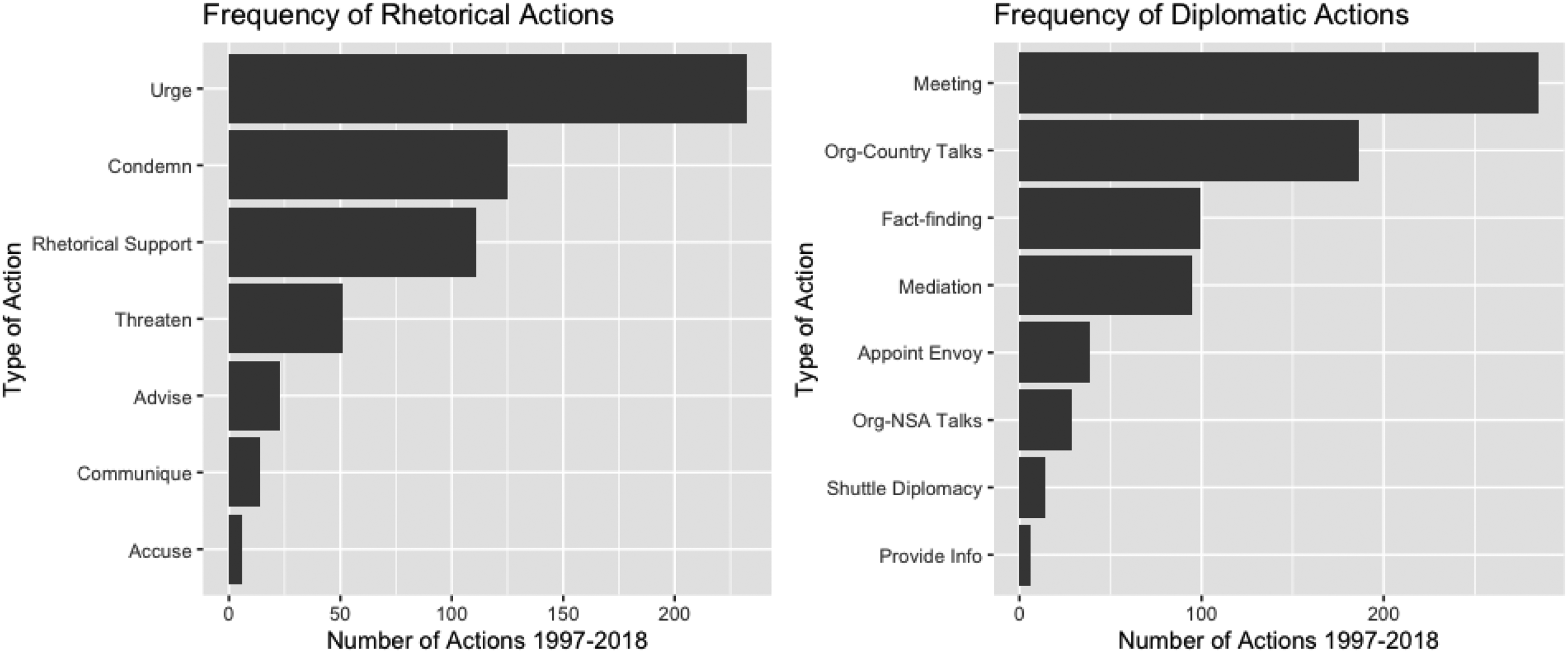
Rhetorical and diplomatic actions used by ECOWAS.
Figure 1 shows that the three most frequent types of rhetorical and diplomatic action that ECOWAS engages in across all country contexts are meetings (diplomatic), urging parties to take a certain action (rhetorical), and talks with member countries (org-country talks) (diplomatic). The high frequency of meetings supports the reasoning that regional organizations may be in a good position to respond quickly to escalating crises because regional organizations tend to have regularly scheduled meetings, which provide a frequent forum to coordinate regional responses to conflicts in the region. Indeed, the main focus of most meetings of ECOWAS was security concerns in the region, and the products of these meetings were often concrete actions such as sending mediators or peacekeepers, or rhetorical action to prevent or manage conflict.
Urging parties to take a certain action is the second most frequent activity in which ECOWAS engages. This type of rhetorical action could speak to a range of topics, again urging mediation or the resolution of a coup, as well as for parties to respect a ceasefire or stop the use of violence. This is a low-cost action that may still send a signal to state and non-state actors that the organization is monitoring their activities and may take direct action in the future.
Talks with member countries (org-country talks) are the third most frequent type of action, and typically take place in the context of formal or informal mediation. ECOWAS sends an envoy or delegation to discuss conflict management in the country, for instance trying to convince the government to enter into talks with an armed group, resolve a coup, or stop repressive action against civilians. In conducting these meetings, ECOWAS is probably able to be more responsive to tensions in member countries than the United Nations. Indeed, often as tensions arose within a member state, ECOWAS sent representatives within a couple of days.
In our data collection, we did not differentiate between actions that are taken in response to ongoing violent conflicts and those that take place prior to the outbreak of conflict. In some cases, the distinction between conflict prevention and conflict resolution is clear-cut, but in many cases it is not. Civil wars are often preceded by a period of low-level violence that eventually escalates, and we could think about international actions in these periods as either “prevention” or “resolution.” Likewise, lingering violence often follows negotiated agreements in civil war, and international actors can stay engaged for years. Additionally, many outbreaks of civil war actually involve the recurrence of a previous conflict following a period of dormancy, meaning that actions taken in the post-conflict environment can, in some cases, be thought of as both conflict prevention and conflict resolution as well. In our data, close to half of ECOWAS’ diplomatic actions and over half of rhetorical actions are carried out when countries are not in civil war, as illustrated in Figure 2. 14
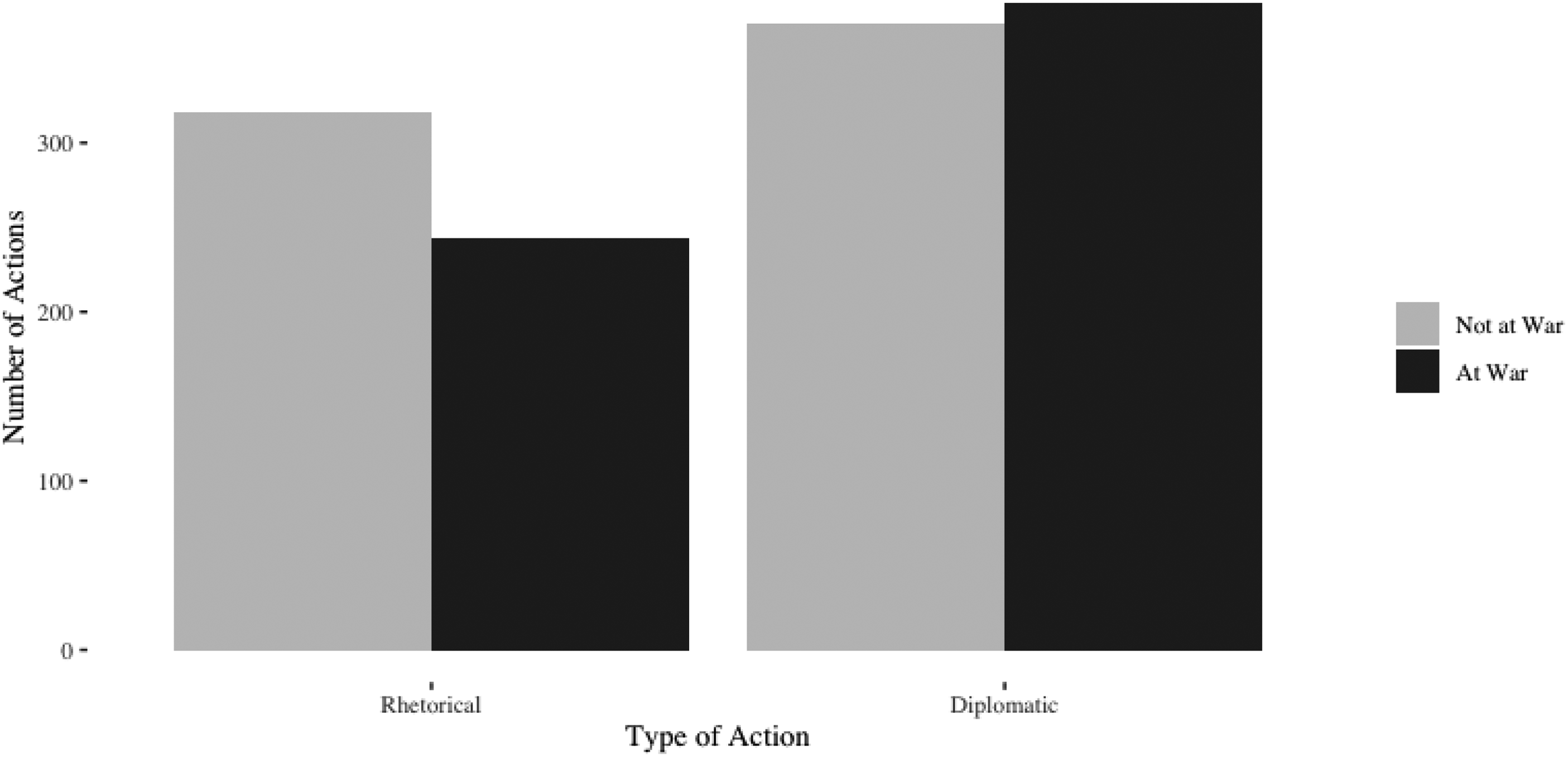
Regional organization actions in war and out of war.
Empirical analysis
We use these data to test the effect of ECOWAS rhetorical and diplomatic actions on levels of violence by examining the relationship between the monthly counts of rhetorical and diplomatic actions, violent events, and fatalities in each ECOWAS member state from 1997 to 2018. 15 We include all country-months, including those that follow months with no violent events or fatalities. This setup allows us to examine the impact of ECOWAS action in cases where there is no violence, low levels of violence, and full-scale civil war. However, we investigate the relationship within various subsets of the data following the main analysis.
We conceptualize the “success” of conflict prevention as reductions in violence, and so our empirical analysis is structured to examine whether rhetorical and diplomatic activities are associated with lower levels of violence in the following month. We use two general measures of violence—the number of violent events that occur in the month and the number of fatalities owing to violence in each month. Fatalities are the most direct measure of the level of violence, and data on armed conflict typically use a battle-death threshold to measure whether civil war is occurring. As such, reducing fatalities is a key component of conflict prevention. At the same time, many violent events do not lead to fatalities, particularly when the country is not in armed conflict. Looking at violent events more generally allows us to examine patterns of violence in cases which are not in civil war.
Our measures of violent events and fatalities are built using the Armed Conflict Location and Event Data (ACLED) (Raleigh et al., 2010). Several datasets can be used to measure violence; however, ACLED is one of the most comprehensive in that it captures violence at all stages of a conflict, including low-level violence that falls below the threshold of “civil war”. This is crucial to capture the ways in which ECOWAS actions may prevent low-level violence from escalating to higher levels of violence. Violent events is a count of the number of events identified as battles, explosions/remote violence, and violence against civilians in the country-month in the ACLED data. Fatalities is a measure of the total number of fatalities identified by the ACLED data across these events in a country-month. We log-transform both the number of violent events and the number of fatalities in the analyses since both variables have a substantial skew.
Our independent variables—rhetorical and diplomatic actions—are original measures of the number of ECOWAS actions taken toward a country in each month, which in our data ranges from 0 to 10 for rhetorical actions and from 0 to 13 for diplomatic actions. Each action represents an instance in which ECOWAS engaged in a distinct behavior that was motivated by a desire to prevent or manage a conflict within one of its member states. For instance, in The Gambia in January 2017, after President Yahya Jammeh refused to step down, rhetorical action takes a value of 4, which comprises ECOWAS urging the President to step down and threatening military intervention early in the month, then hailing the President's decision to step down at multiple points later in the month. In the same country-month, diplomatic action takes a value of 6, which comprises four meetings, some among countries’ leaders, others by military officials, as well as two episodes of mediation.
Our operationalization of ECOWAS rhetorical and diplomatic action weighs each activity equally. While we acknowledge that all RO actions are unlikely to have an equal effect on conflict prevention, we do not have enough information to weight actions based on their type. As a result, our findings should be interpreted with our approach of weighing all actions equally in mind. In further analyses presented below, we disaggregate rhetorical and diplomatic actions into specific types of activities, to examine the patterns across these activities.
Figure 3 illustrates the violent events over time in black and months with RO actions in red from 1997 to 2018. The figure demonstrates that in some cases, ECOWAS diplomatic and rhetorical action aligns with violence to a high degree, for instance in Côte d’Ivoire, Liberia, and Mali. However, in other instances, increases in violence are not associated with action on the part of ECOWAS, such as in Niger and Burkina Faso. Despite this variation, it is clear that endogeneity is a concern when seeking to understand the relationship between ECOWAS action and violence, as ECOWAS is very likely to engage in rhetorical and diplomatic action in response to violence, or at least the threat of violence.
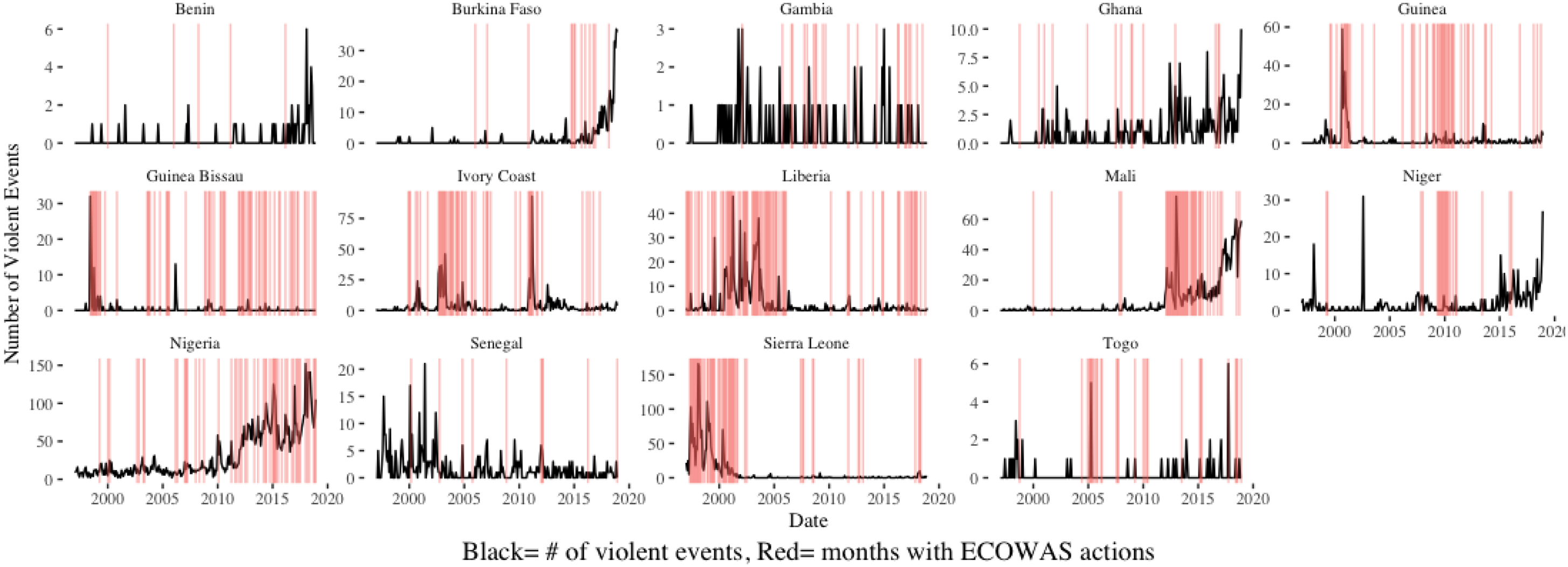
Violent events and regional organization actions.
As such, we need to examine the impact of violence on ECOWAS action to properly examine how that action influences violence. To do so, we include a lagged dependent variable in each model. In the models where (logged) fatalities in the next month is the dependent variable, we include (logged) fatalities in the current month, and in the models where (logged) violent events in the subsequent month is the dependent variable, we include (logged) violent events in the current month.
We also include other control variables to address alternative explanations that may drive the relationship between RO action and violent conflict. Four of these control variables include information about other conflict prevention/management activities that may be occurring in the country at the same time. In at least some of the periods when ECOWAS engages in rhetorical and diplomatic action, ECOWAS and/or other actors are also engaging in other activities. These other activities might lead to reductions in violence and, if we do not include measures of them, we might incorrectly attribute a violence-reducing effect to ECOWAS’s rhetorical and diplomatic action. To deal with this, we include a binary variable indicating whether the country was targeted with sanctions in the year, 16 a logged count of United Nations Peacekeepers deployed to the country in the month, 17 a logged count of regional peacekeepers deployed to the country in the year, 18 and a binary measure of whether there were ongoing negotiations mediated by a third party who was not ECOWAS. 19
We include several additional control variables to deal with factors that could drive both violence and ECOWAS action. We include a linear indicator of the year, as news reporting has improved over time, making event measures based on news reports able to capture greater numbers of events over time. We also include a trend of ECOWAS action, capturing the average number of rhetorical and diplomatic actions taken by ECOWAS in the country over the past three months. Finally, we include country fixed effects in all models. As can be seen in Figure 3 above, ECOWAS member states vary greatly in the average number of events they have over time. We are interested in the impact of ECOWAS action on the timing of events and including country fixed effects gives us the best approach to modeling that relationship. In addition, including fixed effects allows us to account for any confounding owing to non-time-varying country characteristics, ECOWAS action and violence. Table 1 shows the descriptive statistics for each variable used in the main analysis.
Descriptive statistics.
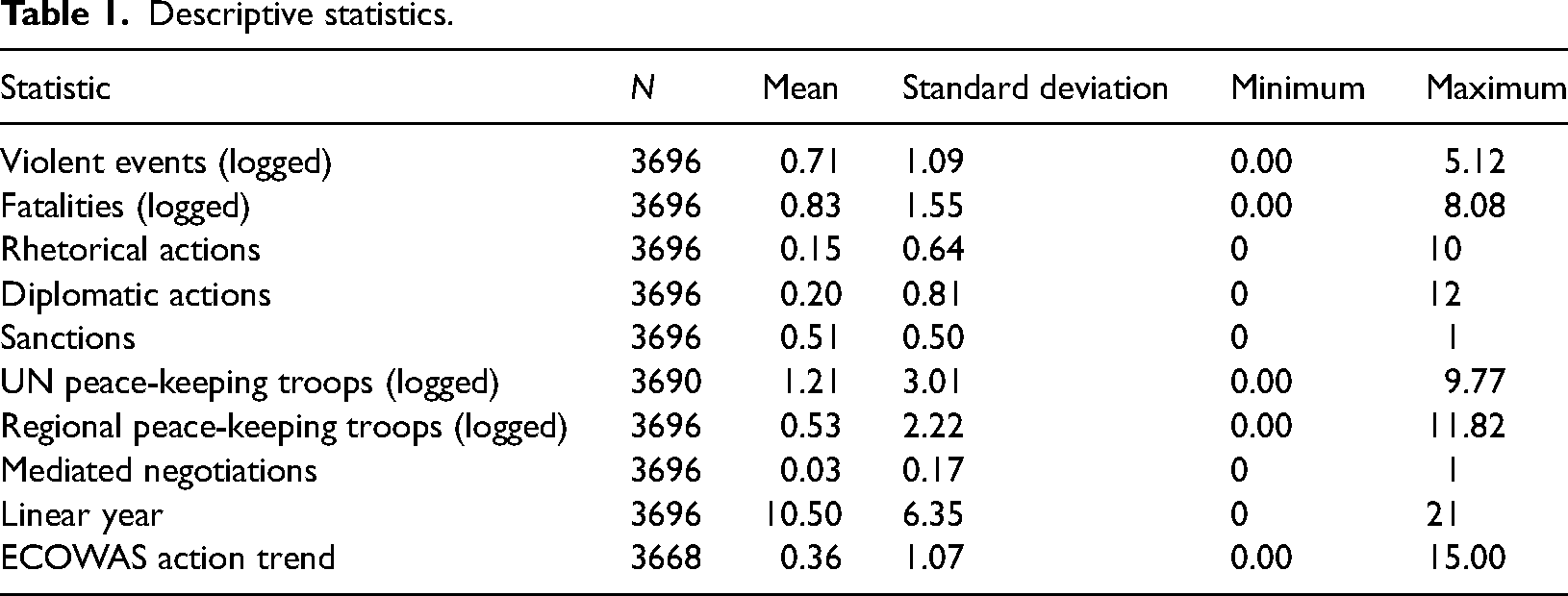
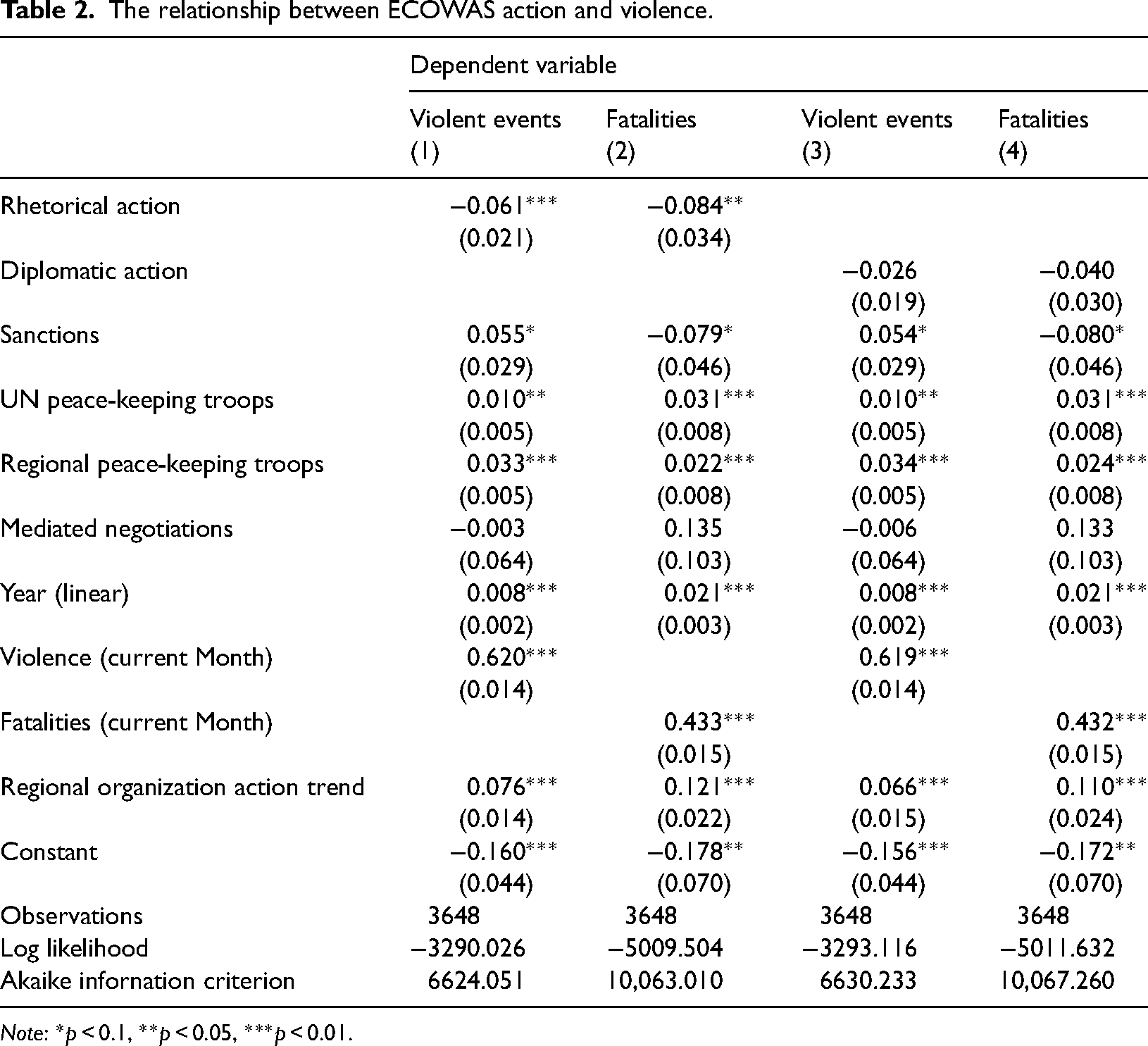
Table 2 shows the results of four regressions. The first model shows the relationship between rhetorical action in the current month and (logged) violent events in the following month. The second model shows the relationship between rhetorical action in the current month and (logged) fatalities in the following month. The third model shows the relationship between diplomatic action in the current month and (logged) violent events in the following month, and the fourth model shows the relationship between diplomatic action in the current month and (logged) fatalities in the following month. All relationships are modeled using generalized linear models. 20
The relationship between ECOWAS action and violence.
Note: *p < 0.1, **p < 0.05, ***p < 0.01.
Models 1 and 2 strongly support our expectation that ECOWAS rhetorical action leads to reductions in violence. The coefficient for rhetorical action is negative and statistically significant for both the number of violent events and fatalities. In Models 3 and 4 the sign on ECOWAS diplomatic action is also negative, but neither coefficient is statistically significant at conventional levels. This suggests that an increase in diplomatic action was followed by a reduction in violence, but our confidence in these estimates is low.
We will not interpret the effect of the control variables, since they are included to examine the effect of ECOWAS activities and do not themselves have controls (Hünermund and Louw, 2020). Some of these variables—particularly UN and regional peacekeeping—have coefficients that might appear surprising given the large existing literature showing them having a violence reducing effect. However, given that our analyses include all country months, not just those in and around armed conflict, and that we do not specify the model to try to isolate the impact of strategies like peacekeeping we in no way see these as contradictory of the existing literature on its effect. Rather, we see the consistent negative relationship between ECOWAS rhetorical action in one month and the number of violent events and fatalities in the subsequent month when controlling for current violence, past ECOWAS action, the linear year, and country-level fixed effects as strong evidence that these actions can lead to reductions in violence on a month-by-month basis.
To examine the substantive significance of the relationship between ECOWAS rhetorical and diplomatic action and violence, we calculate predicted violence in month t + 1 based on the number of rhetorical and diplomatic actions in the current month (according to the models in Table 2). Figure 4 shows the predicted values.
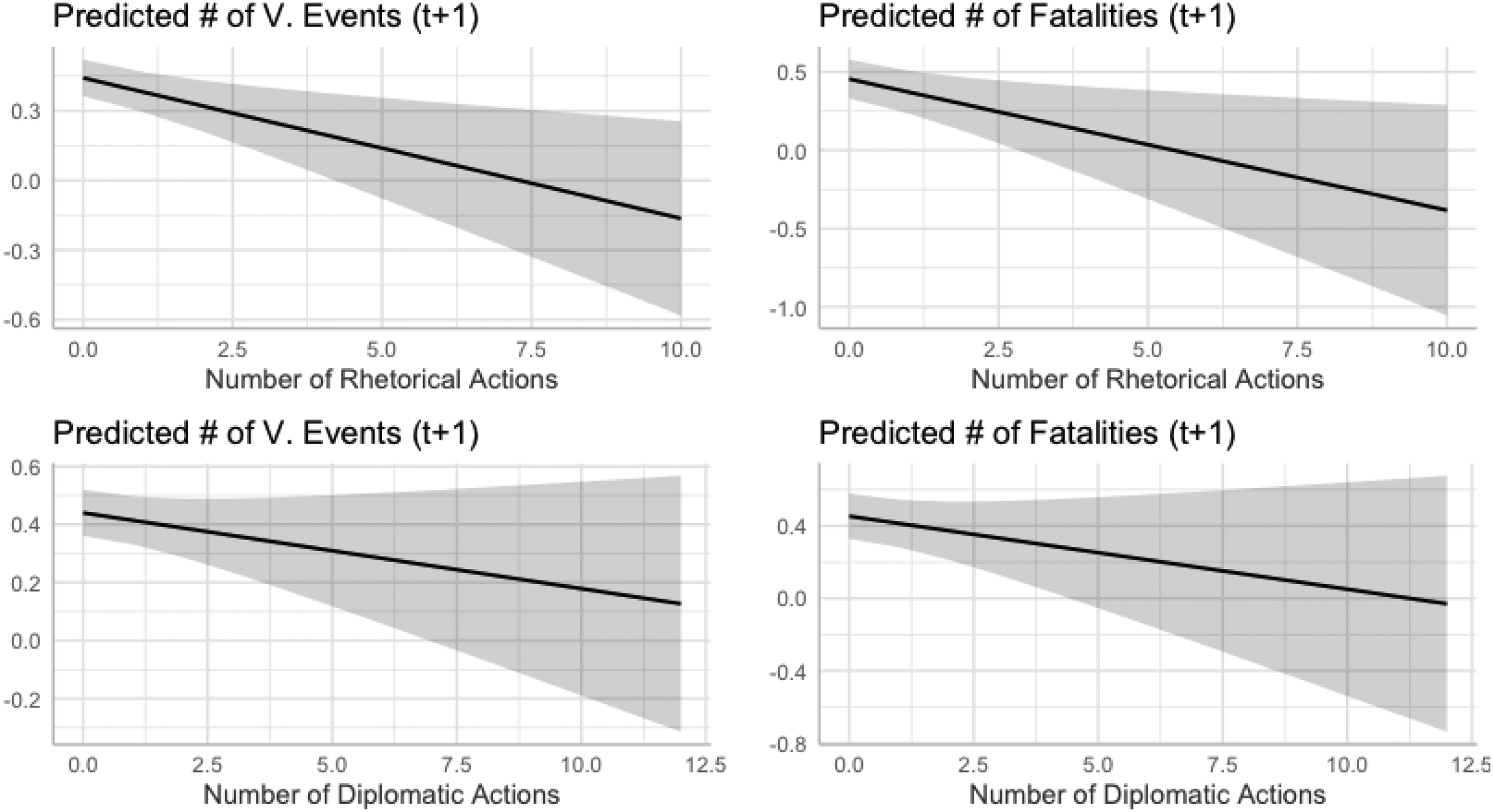
Predicted effects of rhetorical and diplomatic actions.
Figure 4 shows that rhetorical actions can have a substantial violence-reducing effect. Going from 0 to 5 rhetorical actions leads to a more than 41% decrease in the predicted number of logged violent events and a 55% decrease in the number of logged fatalities, on average. The measures of diplomatic action show a smaller effect, and the confidence intervals around the predicted effects get large very quickly.
The effect of specific rhetorical and diplomatic actions
The measures of rhetorical and diplomatic action that we include in Table 2 are both made up of various types of actions. In our next series of analyses, we disaggregate rhetorical and diplomatic action into types of action to see if specific activities have differential impacts on violence. For rhetorical action, we generally group them into positive/neutral rhetoric—which includes rhetorical support, advice, or a communique, and negative rhetoric, which includes urging, condemning, threatening, and accusing. We divide diplomatic action into three types—meetings, mediation, and information provision (which includes fact-finding or the publication of reports on conflict-related events). In the example of The Gambia in January 2017 described above, we identify two examples of negative rhetoric and two of positive rhetoric, the meetings variable is coded as four, and the mediation variable includes two instances of mediation. We model the relationship between the number of actions in each category and violent events and fatalities using the same specification as in the main models in Table 2. 21
Figure 5 shows the relationship between these activities and violent events (logged) as well as their relationship with fatalities (logged). 90% and 95% confidence intervals are shown. The figure shows that when examining each category separately, two specific actions—negative rhetoric and mediation—are significantly associated with reductions in violent events and fatalities. Negative rhetoric involves statements that comprise urging, condemning, threatening, and accusing the target. The relationship that we see here provides support for our argument that negative rhetoric can play a role in violence reduction by demonstrating that ECOWAS member states have aligned preferences and signaling that further, more costly, intervention may be coming. While we do not find a statistically significant violence reducing effect of positive rhetoric, this may be because in some cases positive rhetoric comes in response to de-escalation of conflict, as we see in the example of The Gambia in January 2017. In cases like this, positive rhetoric would occur when violence was already trending down.
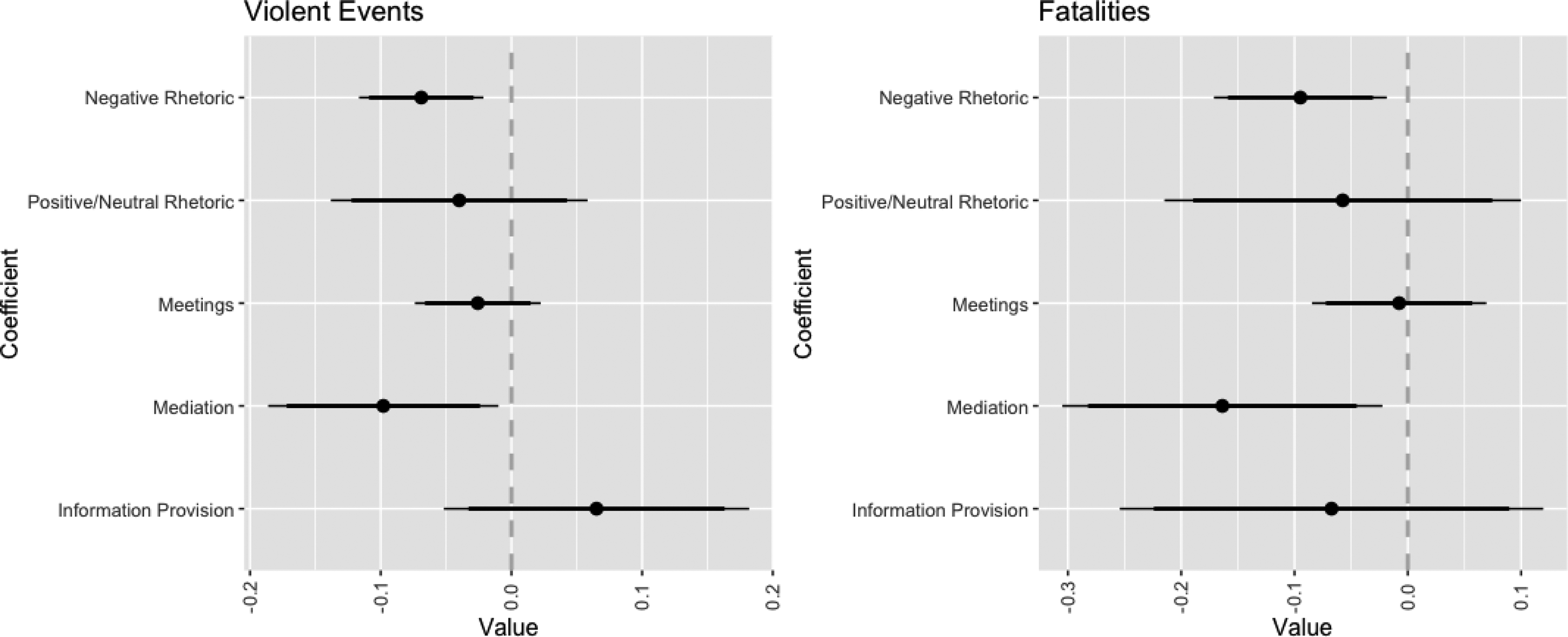
Categorized ECOWAS actions and violence.
The finding regarding mediation is also important. In the main analysis in Table 2 we do not find a statistically significant impact of diplomatic action generally, and in the analysis in Figure 5 we do not find that meetings and information provision have a significant impact on either violence or fatalities. Mediation appears to be the one diplomatic strategy that has a consistently negative effect. There is a large literature on mediation, and that literature generally shows that mediation can lead to reductions in violence. However, quantitative studies in that literature almost always focus on periods in and around civil war, and thus primarily examine the impact of mediation of negotiations between armed combatants. Our data includes many instances of mediation that take place outside the context of civil war. The finding that this broader measure of mediation, across all country months in ECOWAS member states, is associated with reductions in violent events and fatalities suggests that mediation can be an important tool of conflict prevention as well.
ECOWAS action in Côte d’Ivoire and Togo
Our statistical tests show that, on average, rhetorical action by ECOWAS and specific types of diplomatic action, particularly mediation, can lead to reductions in violence in subsequent months. To further probe this relationship and to examine the mechanisms through which these actions lead to reductions in violence, we briefly discuss two cases of ECOWAS involvement.
ECOWAS was very active in responding to a political crisis in Côte d’Ivoire in 2010 and worked closely in conjunction with the African Union and UN there. ECOWAS was well positioned to respond quickly because it had established a mission—the ECOWAS Mission in Côte d’Ivoire—during the Ivorian civil war of 2002–2007. This mission allowed ECOWAS to convene an emergency summit in response to a power struggle following a contested two-round election in which President Laurent Gbagbo was defeated by Alassane Ouattara. The organization quickly formed a contact group and facilitated a mediation process which resulted in a ceasefire and subsequent peace talks. ECOWAS’s roadmap for peace was ultimately unsuccessful at resolving the dispute between supporters of Gbagbo and Ouattara on its own, and the organization sought the assistance of the UN and African Union in managing the conflict. Together, the three organizations were able to combine diplomatic action, economic pressure, and a peacekeeping mission to pressure Gbagbo to accept the electoral defeat, which ultimately brought about a resolution to the conflict (Aning and Edu-Afful, 2016).
Togo is a lesser-known case of ECOWAS intervention. There were protests and a political crisis in Togo in 2005 after the President died and the military unconstitutionally installed his son, Faure Gnassingbe, into office in advance of upcoming elections. ECOWAS responded quickly, immediately condemning the move, blocking Togo from participating in ECOWAS activities, and threatening sanctions if the new leader did not return the country to civilian rule. The organization also started a mediation process. These actions led Faure to resign as the interim president and to allow new elections to be held (Odobo et al., 2017).
Both of these cases show ECOWAS’s ability to respond quickly to political crises, and the range of tools that the organization uses. In both, the organization used rhetorical tools—including condemnations and the threat of sanctions—and organized diplomatic meetings. In Côte D’Ivoire, these efforts on their own were insufficient, and ECOWAS was able to work with other international organizations to bring about a resolution of the dispute. Even prior to the resolution, there was probably less violence in Côte d’Ivoire because of ECOWAS’s efforts. In Togo, meanwhile, the organization was able to use rhetorical and diplomatic tools to resolve a political dispute before it turned into a full armed conflict.
Additional analyses
We further investigate the effect of ECOWAS diplomatic and rhetorical action on violence through several additional tests. First, because the chair of ECOWAS rotates through member states, and these member states can have different preferences about how and where to engage in conflict prevention, we investigate whether the effectiveness of ECOWAS’s actions depends upon who leads the organization. Thus, in one set of models, we include a variable that indicates the nationality of the ECOWAS chair, and in another, we interact ECOWAS actions with a binary variable that captures whether a Nigerian was chair at the time. We focus on Nigeria in that interaction model, because it is by far the most powerful member state in ECOWAS and the organization has its headquarters in Abuja. The coefficients for rhetorical and diplomatic action do not change substantively when controlling for the nationality of the chair and the interaction term for Nigeria as chair and ECOWAS's actions is statistically insignificant across most of the models. Further, in the interaction model, the constituent terms for rhetorical and diplomatic actions remain similar to the main models, indicating that when a Nigerian is not the chair, rhetorical and diplomatic action are still associated with lower levels of violence. Finally, we run models that include a control that indicates whether the country in the observation was chair of ECOWAS, which also does not substantively change the relationship between ECOWAS action and violence. In sum, none of these models indicates that who is chair has an effect on the relationship between ECOWAS action and violence in the following month. The coefficients along with their confidence intervals are shown in Figure 6.
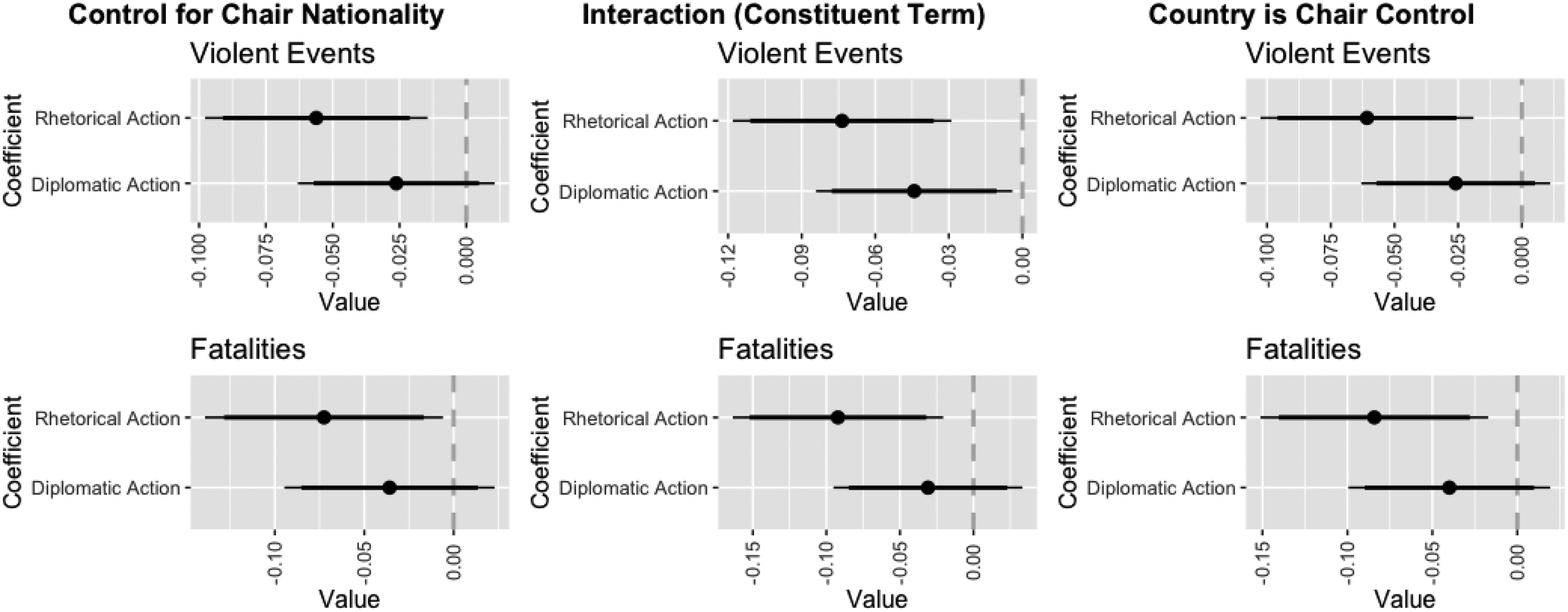
Robustness checks: ECOWAS chair.
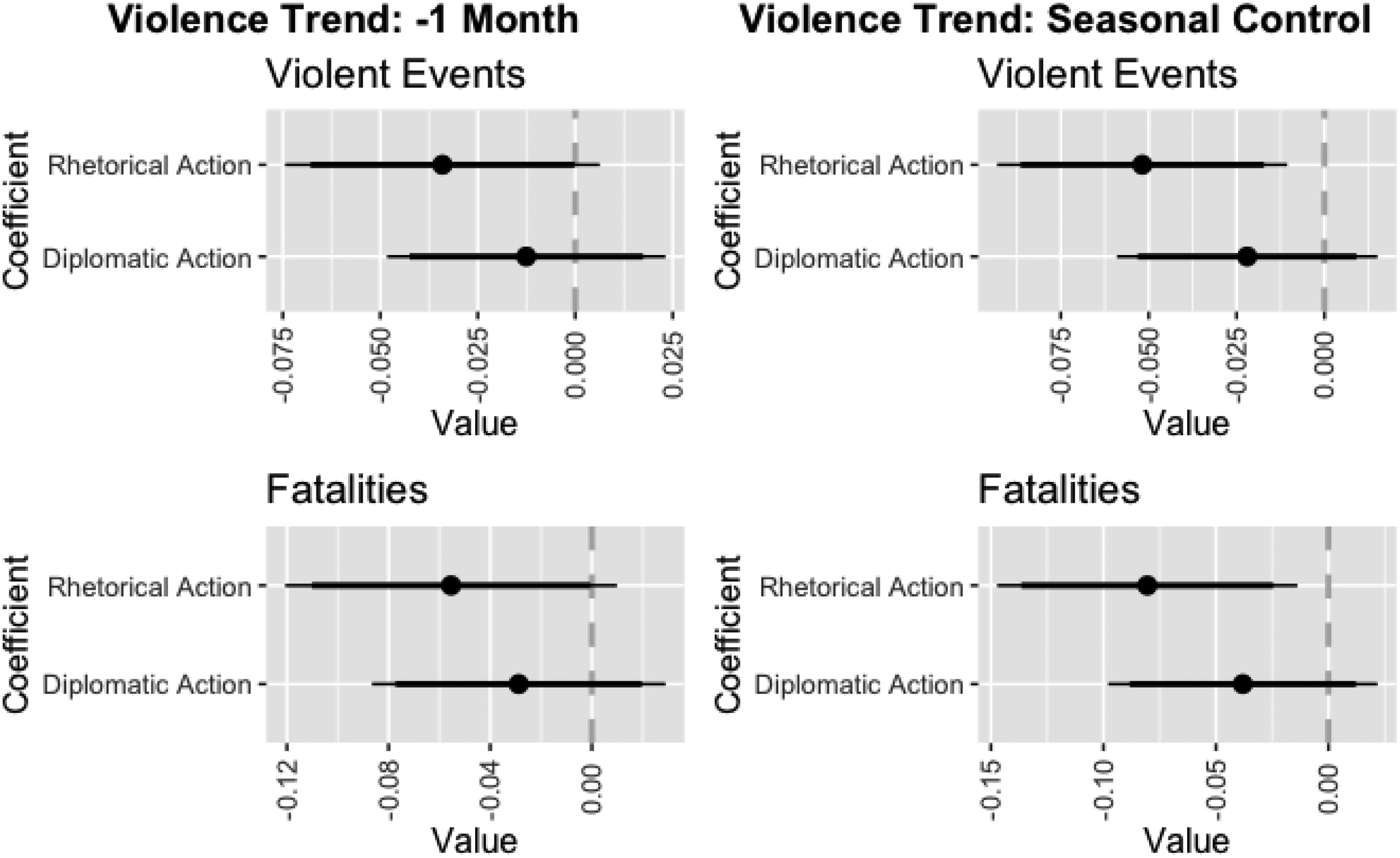
Our second set of tests provide further examination of trends in violence. These trends almost certainly shape the relationship between RO action and changes in violent events and fatalities. In the main analysis we control for the number of violent events and fatalities in month t to capture trends in contention. Here, we include two additional specifications. In the first, we add a control for the level of violent events or fatalities (logged) at t − 1. In the second, we control for seasonal trends in violence by including a variable for the number of violent events and fatalities (logged) in the same month in the prior year. The direction of the coefficients remains negative; however, the p-value for rhetorical action increases to p < 0.1 in the models including the measures of violence/fatalities in the previous month. The coefficients along with their confidence intervals are shown in Figure 7.
Robustness tests: violence trends.
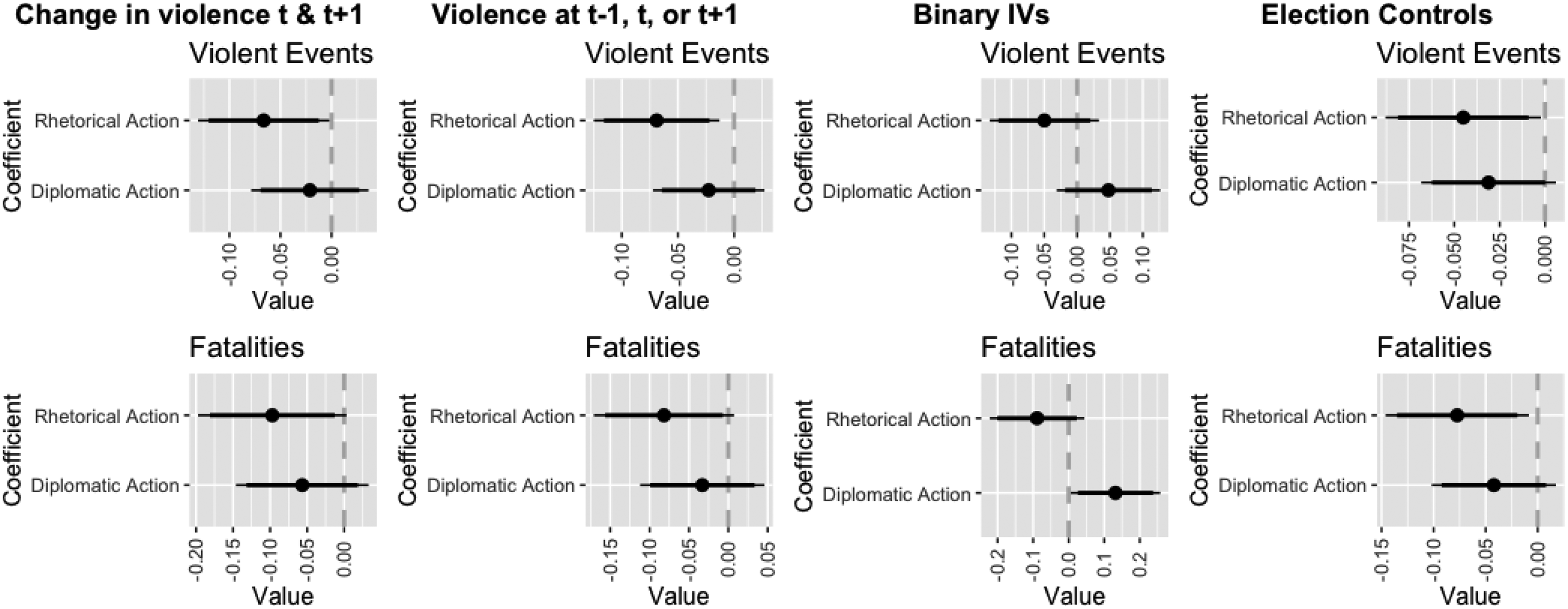
The third set of tests addresses the many periods of no activity in our data. Our original sample includes all country-months from 1997 to 2018. However, many of these months are defined by no RO actions and no violence. To investigate the robustness of our results, we run our models on two different subsamples. First, we drop all cases in which the change in violent events between t and t + 1 is zero, meaning that the subset only includes cases in which violent events either increase or decrease between t and t + 1. Second, we subset our data to cases characterized by at least one violent event at time t − 1, t, or t + 1. Our findings remain largely unchanged with this focus on violent contexts, dropping uneventful months from our analysis.
We run a number of additional robustness tests. In our main analysis, we conceptualize RO actions as a count variable. In a different specification, we include a model that uses a binary measure of RO action, capturing whether ECOWAS took any action in a country month, rather than how many actions the organization took. These models do not show a statistically significant relationship between RO action and violence in most models, except for one which actually shows a positive relationship (between diplomatic action and violent events). This pattern suggests that the quantity of RO action is central to ROs’ effectiveness in curbing violence. Finally, we include a model with election-related controls, since elections can be especially contentious times, a dynamic that we saw in the case of Nigeria. 22 The coefficients along with their confidence intervals are shown in Figure 8 below.
Robustness tests: subsets, binary outcome, and election related controls.
Conclusion
Violent conflicts, such as civil wars, cause immense suffering and pose significant challenges for their neighbors, countries in the region more broadly, and the international community. For the past 30 years, international actors have worked to manage these conflicts, with the United Nations at the forefront. This has included high-profile actions such as deploying tens of thousands of peacekeepers to countries such as the Democratic Republic of the Congo and South Sudan, or coordinating high-level talks in Geneva, Arusha, and other prominent locations leading to comprehensive peace agreements. A large body of academic research has suggested that these high-profile conflict management activities—particularly UN peacekeeping and mediation of comprehensive negotiations—can lead to longer-lasting peace agreements and reductions in violence.
Beyond the UN, actions by organizations like ECOWAS have received significant attention. ECOWAS played a prominent role in contributing to the end of several civil wars in West Africa in the late 1990s/early 2000s, and more recently its actions in The Gambia have been lauded. There is much less academic work on the overall effect of conflict management by regional organizations like ECOWAS, but that literature has suggested that these organizations may be well suited to respond to some of the most difficult civil wars.
We look beyond these high-profile military and diplomatic responses to civil wars, and examine a much larger range of conflict management activities that ECOWAS engages in to prevent violence from escalating. In particular, we do not look just at actions that take place in and around armed conflict, but rather we examine all actions that the organization engages in. This setup allows us to analyze how and to what degree ECOWAS acts to prevent violent conflict.
The findings of our statistical analyses make key contributions to our understanding of conflict management. We find a consistent violence-reducing effect of rhetorical actions, and particularly of negative rhetoric. Studies of human rights have examined the effect of condemnations by actors such as the UN on aid levels and the human rights behavior of governments. However, these rhetorical actions generally receive much less attention in studies of conflict management. Our analysis suggests that organizations like ECOWAS can facilitate reductions in violence by condemning signs and acts of escalation and threatening further action if that escalation occurs.
We also find that mediation leads to reductions of both violent events and fatalities. Unlike rhetorical actions, mediation as a strategy of conflict resolution has generated a very large academic literature, and that literature generally shows that it can help parties negotiate comprehensive agreements and lead to reductions in violence. Quantitative studies, however, have almost entirely focused on the effect of mediation across a set of violent conflicts. Our analysis here shows that mediation can also play an important role in preventing escalations of violence in low-intensity disputes which have the potential to become civil wars.
These findings have important implications for both scholars trying to understand political violence and practitioners working to reduce it. Further research can provide more insights into these dynamics. We identify three main avenues for future research. First, in this article we focus specifically on ECOWAS. That organization has a long history of working to manage violent conflicts, and has established and invested in institutions to facilitate identifying potential signs of escalation and intervening in potential conflicts. We anticipate that other regional organizations will be able to play similar roles, particularly those that have also established protocols and mechanisms for conflict prevention, such as the African Union, the Inter-Governmental Agency on Development and the Southern Africa Development Corporation. Indeed, we see the results of our analyses as providing empirical support for these organizations' investment of resources into conflict prevention. Because our data collection is limited to ECOWAS, we cannot conduct a similar analysis of the effect of rhetorical and diplomatic tools by these and other ROs. Research looking at a wider set of organizations would be very fruitful as it would provide further insight into when and how these organizations can contribute to reductions in violence.
Second, the link between rhetorical action, mediation, and violence reduction could be probed with further research on the conditions under which these actions are particularly effective. Our analysis shows that, on average, these actions are associated with reductions in violence. Specific mediators differ in their effectiveness, however. In addition, rhetorical action may be more or less effective depending on how widely it is supported by ECOWAS member states. Research focused specifically on the impact of these strategies under different conditions would provide greater insight into their relative effectiveness.
Third, in this article we examine how rhetorical and diplomatic actions affect levels of violence generally, but in some cases these activities are more focused on states or dissidents. The literature on international action generally suggests that certain states and dissidents are more or less responsive to international pressure and incentives. Further analysis could examine how these diplomatic and rhetorical actions affect the decision-making by each of these actors, which would add to scholars and policymakers’ understanding of how they can be used to most effectively de-escalate potential crises and prevent violence.
Supplemental Material
sj-docx-1-cmp-10.1177_07388942231209730 - Supplemental material for Regional approaches to conflict prevention: The effectiveness of rhetorical and diplomatic tools
Supplemental material, sj-docx-1-cmp-10.1177_07388942231209730 for Regional approaches to conflict prevention: The effectiveness of rhetorical and diplomatic tools by Jori Breslawski, David Cunningham and Madeline Fleishman in Conflict Management and Peace Science
Footnotes
Declaration of conflicting interests
The author(s) declared no potential conflicts of interest with respect to the research, authorship, and/or publication of this article.
Funding
The author(s) received no financial support for the research, authorship, and/or publication of this article.

Supplemental material
Supplemental material for this article is available online.
Notes
References
Supplementary Material
Please find the following supplemental material available below.
For Open Access articles published under a Creative Commons License, all supplemental material carries the same license as the article it is associated with.
For non-Open Access articles published, all supplemental material carries a non-exclusive license, and permission requests for re-use of supplemental material or any part of supplemental material shall be sent directly to the copyright owner as specified in the copyright notice associated with the article.
