




Abstract
Preferential trade agreements (PTAs) are generally understood to promote political cooperation between members. I argue that institutional exclusion can damage political cooperation between members and non-members. Preferential trade agreements reflect strategic considerations, enabling countries to promote new trade norms, strengthen diplomatic networks, and redirect commercial flows to allies. Excluded countries are denied these benefits and may possibly be targeted by members. Thus, excluding PTAs may be perceived as threats. The record of the Trans-Pacific Partnership illustrates the theory. Statistical analysis of the near-universe of PTAs and countries’ voting affinities in the United Nations General Assembly supports the argument.
Keywords
Introduction
Global economic governance currently faces more uncertainty than at any time since the end of the Cold War. In some issue-areas, states debate the reform of existing multilateral institutions, like the World Trade Organization (WTO). In other areas, states have created new institutions as alternatives to existing bodies, like the China-led Asian Infrastructure Investment Bank. These institutional developments have prompted concern over the future of global cooperation (Morse and Keohane, 2014).
Alongside this contestation over multilateral institutions is another trend: the proliferation of bilateral or regional trade agreements (Dür et al., 2014). It is generally understood that preferential trade agreements (PTAs) are cooperative institutions akin to, if an inferior option to, the WTO (Mansfield et al., 2002). This emphasis on the cooperative benefits of PTAs overlooks their exclusionary nature: they are preferential because they extend cooperation to some partners, but not to others. In this article I explore the implications of preferentialism for global cooperation. Specifically, I ask, how might exclusion from preferential institutions shape states’ international relations?
Looking to the topical example of the trade regime, I argue that the creation of PTAs can affect the political ties between non-members and members because of the strategic value attached to PTAs. The formation and membership of PTAs reflects political economy drivers, but also strategic drivers. Membership has long-lasting benefits, including the ability to advance preferred new norms in the trade regime, the strengthening of diplomatic networks between ideological allies, and the strengthening of allies’ economies through trade and investment liberalization. Non-member “outsiders” are denied these benefits and may also suffer economically harmful trade and investment diversion. In response, an outsider might seek membership or association with the excluding institution. In this case, institutional exclusion might encourage outsiders to seek to improve the quality of their political ties with institutional members. Yet outsiders might not have a realistic prospect of accession to the excluding institution; preferential institutions may even be used strategically against economic or geopolitical rivals. In response, outsiders might respond by establishing their own rival institution. Exclusion may in such cases widen political disaccord between members and non-members. In this way, ostensibly cooperative institutions may sometimes worsen the prospect for cooperation between members and non-members.
In short, PTA non-membership may be perceived as a threat to excluded countries (Peterson, 2015). What accounts for when an excluding institution will be perceived as threatening? I argue that variation in threat perception is driven by pre-existing characteristics of the countries in the dyad like their ideological similarity and whether the pair has an existing PTA. Variation in threat perception is also driven by the nature of the excluding institution: deeper agreements are likely to be more threatening.
After developing my argument in Section 2, I present qualitative evidence in Section 3. The negotiations for the Trans-Pacific Partnership (TPP) agreement illustrate how exclusion from international economic institutions might be perceived as a threat that drives a political reaction. The TPP was presented as a deal that would set in place an ambitious approach to regulating trade and trade-related issues. It would provide a US-led template for the subsequent development of the trade architecture of the Asia-Pacific in the context of competing ideas from other major players, notably China. The TPP represented a clear threat to China's role in the Asia-Pacific, and Chinese non-membership in the TPP coincided with a more assertive effort on the part of China to promote alternative institutions in which it has a greater leadership role, including several PTAs as well as the Belt and Road Initiative. Institutional exclusion has appeared to heighten political tensions between rival states. In an ironic twist, China applied in September 2021 to join the Comprehensive and Progressive agreement on Trans-Pacific Partnership (CPTPP), the revised version of the deal negotiated by the 11 countries that remained after the US withdrew from the TPP in early 2017. Observers suggest that China's move is an effort to further displace the US from its position of strategic influence in economic rulemaking in the Asia-Pacific, and an attempt to isolate Taiwan (which applied, reactively, a week after China) from regional economic institutions.
Quantitative analysis of the trade regime, presented in Section 4, further supports the argument. I examine the effects of PTA creation on foreign policy similarity between members and non-members, as proxied for by voting affinity in the United Nations General Assembly (UNGA) (Bailey et al., 2017). The argument predicts that institutional exclusion should be associated with more divergent foreign policy orientations between members and non-members. Results from regression analysis on panel data support this prediction.
Moreover, the results indicate that the effect of exclusion is strongest precisely in these instances where exclusion should constitute the greatest threat. Non-members and country-pairs that are ideologically dissimilar and that lack an existing PTA may experience institutional exclusion as more threatening, since they have fewer options to mitigate the effect of exclusion.
As a robustness check, I use a Heckman selection model to account for selection processes driving PTA exclusion, and an error-correction model (ECM). This allows me to distinguish between long- and short-run effects of exclusion and to address the possibility of cointegration in the data, namely that countries’ ideal-point differences and the likelihood of institutional exclusion might both change in similar ways over time. I focus on assessing whether the depth of the excluding agreement makes a difference in the long term. I differentiate between exclusion from any PTA, and exclusion from a PTA that is more ambitious than average in that year. In the aggregate, exclusion from a PTA is associated with closer UNGA voting behavior in the long run, but exclusion from more ambitious PTAs is associated with a long-run worsening of ties. These results further support the argument: when the stakes are high, institutional exclusion deepens divisions in world politics. Exclusion from economic institutions comes with economic costs. Worryingly, it may also come with political costs.
PTAs and inter-state relations
The effects of PTAs on economic ties between members and non-members have been amply explored. The effects on political and security ties between members and non-members have been less well established. In addition to the conventional political economy explanations for PTAs, I argue that states also sign PTAs to strategically position themselves in the global trade regime. Preferential trade agreements can establish beneficial templates for new norms, can strengthen alignment between ideological allies, and can create security externalities. Because non-members do not receive these strategic benefits, PTA exclusion may be perceived as threatening. I argue that the extent of the threat is likely to be driven by the nature of the excluding agreement (deep or shallow) and the quality of ties between members and non-members. While “friendly” outsiders may be motivated to improve their ties to seek membership, “rivalrous” outsiders may be motivated to create competing initiatives. In this way, institutional exclusion may deepen existing divisions within world politics.
The political effects of institutional exclusion
Non-membership in trade agreements has well-documented economic effects. The potential distributive impact of trade diversion on non-member producers may create political economy pressures in non-member countries. Trade barriers create negative externalities in the form of welfare losses for economic actors. These economic actors seek to “internalize” these externalities and pressure their governments to reduce barriers to exchange. Where the creation of an integration initiative creates negative economic externalities for non-members in the form of trade diversion, outsider governments may face domestic pressure to join the institution.
Yet if membership is rejected (or rejection is anticipated), or if the conditions of membership are too high, states may seek instead to establish an alternative institution (Mattli, 1999: 59–64). Even states that had no specific ex-ante desire to join an institution may become worse off following its creation (Gruber, 2000), meaning that institutions may have an ex-post effect on non-members. Exclusion from economic institutions like trade agreements thereby has demonstrable third-party political economy effects.
This focus on the political economy effects of non-membership in PTAs is not well reflected in the literature on the relationship between economic institutions and states’ political relations. With a few exceptions (Peterson, 2015), research has focused on how joint membership affects members’ political ties. We see this focus in research on trade agreements specifically (Mansfield, 2003). Preferential trade agreements are usually seen to support the relationship between international commerce and peaceful relations (Hegre et al., 2010). Other scholars caution that unequal bargaining power may enable more powerful states to use PTAs to secure broader policy objectives (Feinberg, 2003: 1020), or that PTAs may provide powerful states with coercive power by reinforcing antagonistic hierarchies between states (Hafner-Burton and Montgomery, 2012). Again, the focus has been on joint membership.
This lack of attention to the political effects of PTA non-membership is problematic because PTAs have become the dominant tool for negotiating trade liberalization (Dür et al., 2014). The proliferation of PTAs represents the spread of a mechanism by which inter-state rivalries may be deepened and states’ strategic objectives may be achieved. This is suggested by the case of the TPP negotiations (to which I return in Section 3), where the strategic dimension was explicit. In the next section, I outline the logic by which non-membership in institutions may affect the quality of political ties between members and non-members.
The theory: how PTA non-membership may be threatening
Why should PTA exclusion be threatening? In one of the few treatments on the topic, Peterson describes how exclusion from a PTA might result in distorted trade between members and non-members. Where a new PTA takes trade away from non-members towards members, this might “evoke zero-sum behavior, induce hostility, and promote conflict” (2015: 702). As trade declines in relative terms, the pacifying effects of dyadic trade might be reduced as the opportunity costs for engaging in costly conflict go down. As Peterson argues, exclusion might foster more extreme (hawkish) views within the excluded state, leading to a greater risk of conflict (2015: 705–706). Importantly, it is the perception of threat that is central to the mechanism: even where absolute values of trade between non-members and members increases, a new PTA may still be perceived as a threat if trade between members and non-members declines in relative terms. And indeed, where exclusion results in trade distortions, there is a higher risk of conflict between excluded countries and PTA members.
I build on this prior work in two respects. First, the prior work relies on the insight that there are “security externalities” of trade liberalization. Because trade liberalization creates economic surplus, tariff reductions are therefore more likely between military allies (Gowa and Mansfield, 1993). Even as allies may benefit, non-members may experience trade diversion—or distortions—that are perceived as harmful. I point to additional (strategic) reasons why countries might care about exclusion from a PTA. Second, I extend the threat perception framework by discussing how variation in threat perception might be driven by the nature of the excluding institution (in addition to the impact on trade flows) as well as by the character of the non-trade relationship between PTA members and excluded non-members.
Looking first to the reasons countries may care about exclusion, in addition to security externalities there are at least two strategic dimensions to PTAs that might make them threatening to non-members. The first relates to the “precedential” impact of economic institutions. Legal rules established in international economic agreements are “sticky” (Allee and Lugg, 2016; Morin et al., 2017), and negotiators may strategically “sequence” agreements to establish precedent (Castle, 2023). As in the case of standard setting (Mattli and Büthe, 2003), members of an innovative PTA may benefit materially because economic actors in rule-making states have lower (or no) adjustment costs to new rules, while economic actors in rule-taking states must adapt to new rules. 1 Where an institutions’ rules are expected to be influential, non-members are more likely to be rule-takers than rule-makers. In this way, the architects of economic institutions may be able to promote their preferred norms, creating a disadvantage for excluded countries (who may prefer competing norms).
Second, members of a PTA can deepen diplomatic networks and benefit from enhanced political cooperation with ideologically similar states. Ravenhill documents how political economy dynamics do not seem to support the pattern of membership in East Asian PTAs. Instead, Ravenhill argues that states have sought membership in PTAs for political-strategic reasons, notably to benefit from strengthened diplomatic relations with co-members (Ravenhill, 2010). More generally, Voeten argues that ideology underpins patterns of institutional creation and membership: members of the same institutions are more likely to share ideological commitments, and institutions may be created to advance states’ ideologies (Voeten, 2021). Excluded states may therefore view new PTAs as threatening to the extent that these institutions reinforce a competing ideology.
What of non-members’ response to an excluding PTA? In some cases, non-members may seek to improve or maintain the quality of their strategic or economic relationships with insiders by seeking institutional entry or a series of individual deals with members. 2 In this case, political ties and general foreign policy orientations may converge between members and non-members. Yet in other cases, non-members may instead create alternative institutions that counter a possible decline in the security relationship with insiders. 3 States may also pursue negative behavior in domains that are different from that of the excluding institution to punish institutional members, but the observable implications for political ties are likely to be similar. 4 In the latter case, non-members’ political ties and general foreign policy orientations are likely to diverge from those of members.
When might non-members welcome or be agnostic about a new PTA, and when instead might non-members view an excluding PTA as provocative? The above discussion about the strategic dimension of PTAs points to reasons why countries might be threatened by non-membership in a new PTA, but it also suggests explanations for variation in threat perception. First, the nature of the institution itself should matter. Agreements that seek to significantly advance new norms in multiple issue-areas are likely to prompt a greater response from non-members. New issues in the trade regime have proven most politically contentious in recent years (Castle and Pelc, 2019), and it is precisely in these new issue-areas that excluded countries might be concerned about the promotion of new, potentially competing, norms.
Second, non-members may view new institutions differently depending on the character of their relationship with members. If ideology drives institutional membership decisions (Voeten, 2021), non-members with very different ideologies from members may be less inclined to (or less welcome to) join the excluding institution. For instance, Spilker et al. show that countries with similar regime types are more likely to seek cooperation through a trade agreement. As they argue, similar regime types are likely to indicate a “common sociopolitical value system” that may make the costly commitment to a PTA easier (2016: 709). Similarly, if excluded countries already have institutionalized cooperation with PTA members, they may have opportunities or incentives to mitigate against the effects of exclusion. Most obviously, countries with pre-existing PTAs may be less threatened by a new PTA and may indeed welcome it as a new opportunity for trade cooperation.
One may object that since larger agreements may be more influential, only exclusion from an agreement with many members should be threatening. Yet bilateral agreements also advantage members vis-à-vis non-members, especially in regions where there are high levels of economic interdependence. The evolution of negotiations on the North American Free Trade Agreement during the 1980s to 1990s is illustrative. Initial negotiations were between the US and Mexico; Canada joined out of concern that a bilateral US–Mexico agreement would reduce the benefits of the previously negotiated Canada–US free trade agreement (CUSFTA).
One may also wonder whether states forego the benefits of any strategic rule setting if they accede to an agreement after it has already been negotiated, and so diminish the political effects of non-membership. Yet accession enables states to reap the economic benefits of the PTA (avoiding possible diversion), as well as the diplomatic benefits. Moreover, deals can be “living agreements” that are designed to be updated to reflect economic changes and evolving best-practice, 5 and even latecomers can influence rules where they are updated. Potential accession countries thereby have incentives to promote good political ties with current members in the hope of easing entry.
In sum, the formation of economic institutions like PTAs can be strategic as well as reflecting conventional political economy drivers. Exclusion from economic institutions may accordingly be perceived as a threat that prompts non-members to adopt more different foreign policy orientations from members. The extent to which exclusion is viewed as a threat is likely to be driven by the nature of the excluding PTA and by the character of the relationship between members and non-members.
Empirical expectations
Given the above discussion, my first empirical expectation is that all else equal, exclusion from an agreement is associated with more different foreign policy orientations between members and non-members (H1).
Yet as above, the effect of exclusion should be more pronounced for those agreements that are more ambitious. The level of ambition can be captured by the widely-used metric of “depth” (Dür et al., 2014). Hence, the effect of exclusion will be stronger where the excluding agreement is deeper (H2).
A further set of considerations relates to the prior relationship between members and non-members. As above, I expect that countries with different ideological orientations should view exclusion as a greater threat: as the difference between countries’ regime-types increases, the impact of PTA exclusion on foreign policy divergence will increase (H3a). Similarly, countries’ prior institutional cooperation should moderate the effect of institutional exclusion. This effect should be most evident where it relates to a prior PTA, since an existing agreement should mitigate the economic and diplomatic effects of exclusion, and may offer a pathway to future membership. Thus, the existence of a prior PTA will reduce the impact of PTA exclusion on foreign policy divergence (H3b).
Qualitative evidence from the Asia-Pacific illustrates the argument
This section presents the case of the TPP. Given the unusually high degree of contestation over the agreement, it is not a typical case of PTA exclusion, and insights from the case may not be fully generalizable. As such, I use the case as a plausibility probe (Levy, 2008) for the claim that exclusion from international economic institutions may have political effects. In line with the theoretical discussion above, the TPP illustrates how preferential trade agreements may be threatening for non-members. In particular, the TPP reveals the strategic dimensions of institutional creation: the TPP explicitly aimed at setting influential standards; the deal had security externalities given its explicit link to the US’ strategic pivot to Asia; and trade and investment diversion was a concern given that the TPP included important economies with some historically well-protected sectors (for instance, the Japanese agricultural sector). The agreement was also widely described as a means for the US to counter Chinese influence in the Asia-Pacific precisely by excluding China, illustrating the importance of narrative and the state of prior cooperation for understanding reactions. Chinese exclusion from TPP appeared to encourage reactive Chinese institution building. China advanced its own strategy to boost its influence in Eurasia, with the Belt and Road Initiative as the flagship policy. China's September 2021 application to join the CPTPP, the TPP's non-US successor, can be seen as an attempt to mitigate against the costs of exclusion from the TPP or even an effort to exclude other non-members.
The Trans-Pacific partnership
The TPP began as a four-member agreement (the Trans-Pacific Strategic Economic Partnership or “P4” agreement) between Brunei, Chile, New Zealand, and Singapore, which entered into force in 2006. The US, Australia, Peru, and Viet Nam joined negotiations on expanding the P4 agreement to include financial services and investment in 2008. During subsequent negotiation rounds, Malaysia (2010), then Canada and Mexico (2012), and finally Japan (2013) joined the agreement. The TPP was signed in February 2016 and was ratified domestically by New Zealand and Japan. The US withdrew from the agreement when Trump gained office, but the 11 remaining countries negotiated some minor amendments to the TPP, and the agreement survives as the CPTPP.
For much of the negotiation period of the TPP, the agreement was presented politically as the economic counterpart to former President Obama's “pivot” to Asia, aimed at countering China's influence in the Asia-Pacific. Political and journalistic statements from the US and China support a geo-strategic reading of the TPP, in which the Obama administration's negotiation of mega-regional deals were attempts to contain the influence of rising powers and to reassert traditional US alliances (Griffith et al., 2017). Former US Secretary of Defense Ash Carter stated that the passage of the TPP was as important for the US “rebalance” to the Asia-Pacific as adding another aircraft carrier to the military (Carter, 2015), while Obama warned that without the TPP Beijing would “write the rules of the global economy” (Obama, 2015). 6 On his departure as US Trade Representative, Michael Froman said of the TPP, “There simply is no way to reconcile a get-tough-on-China policy with withdrawing from TPP. That would be the biggest gift any U.S. President could give China, one with broad and deep consequences, economic and strategic” (Froman, 2017). The Obama administration reportedly emphasized the geostrategic aspect of the deal during Congressional lobbying efforts to achieve a Trade Promotion Authority, which would allow the President to present the finished deal to Congress for a simple up-or-down vote (rather than allowing amendments). Senior Democrat Charles E. Schumer (NY). noted, “When the administration sells me on this, it's all geopolitics, not economics: We want to keep these countries in our orbit, not China's … I agree with that. But I need to be sold on the economics” (Bradsher, 2015).
US leadership in mega-regional agreements would also enable the US to once again take a lead role in crafting global trade rules (to its advantage) as it had during the General Agreement on Tariffs and Trade (GATT) and WTO period (Griffith et al., 2017: 3). 7 Even those who stress the strategic aspect of TPP caution that “comparing TPP to a kinetic weapon misses the actual geopolitical impact of the agreement, which is likely to be much broader and more diffused. TPP needs to be understood in terms of regional order, the balance of power, and the influence on a rising China” (Green and Goodman, 2015: 24).
What of China's reaction? Earlier Chinese commentary, particularly prior to around 2014, reflected a “strategic” view of the TPP. State media outlets regularly denounced the TPP as an American strategy to achieve commercial encirclement of China. The statement by one Chinese journalist for the People's Daily that “[the] TPP is superficially an economic agreement but contains an obvious political purpose to constrain China's rise” is illustrative (Griffith et al., 2017). During the later years of TPP negotiations the dominant perspective appears to have been one of (cautious) acceptance of the TPP (Naughton et al., 2015). Chinese Foreign Minister Wang Yi stated in 2014 that “China will face the member states of the Trans-Pacific Partnership talks with an open attitude, as well as other regional or cross-region FTA initiatives” (Ching, 2014).
Notwithstanding this somewhat less competitive reading, TPP negotiations seem to have prompted more assertive Chinese efforts to establish international economic institutions in which it has a major role. In trade, Chinese proposals to revitalize a long-mooted Free Trade Area of the Asia-Pacific (FTAAP) and Beijing's focus on the Regional Comprehensive Economic Partnership (RCEP) were both perceived as reactions to the TPP. Thus, Beijing's endorsement of FTAAP at an Asia-Pacific Economic Cooperation Summit in November 2014 served “to prevent the Trans Pacific Partnership (TPP) from becoming the focal point of economic integration efforts and a reaffirmation of America's leadership as a Pacific power” and to enable “China to carve a much more proactive role in drafting the new rules of the economic order—from a position of equal standing with the United States” (Solis, 2014). Since Trump's TPP withdrawal, FTAAP continues to be promoted by Beijing as a “manifestation of China's steadfast effort to promote globalization” which “has been envisioned as a major instrument for realizing Asia-Pacific economic integration” (Chen and He, 2017).
The RCEP, while technically an effort led by the Association of Southeast Asian Nations and initially pushed by Japan, has been portrayed as the Chinese strategic counter to the TPP (Chunding and Whalley, 2016). The RCEP and FTAAP suggest the Chinese focus on maintaining influence over trade policy developments in the region considering Beijing's non-membership in the TPP. As Li Daokui notes, “The Chinese government's response is to build the free-trade agreements that it can influence” (Sanger and Wong, 2015).
What of China's application to join the CPTPP, the revised version of the TPP that was signed by the 11 TPP signatories remaining after the US’ departure from the deal? China applied to join on 14 September 2021. The UK had previously applied in February 2021, and China's application was followed by that of Taiwan on 22 September (as well as Ecuador in December 2021 and Costa Rica in August 2022). As of early 2023, the task remains for the 11 current members to determine whether they will proceed with accession negotiations with China and Taiwan (the UK completed these negotiations in March 2023). It is less evident that China would have applied to join the CPTPP had the US remained inside. Yet it is worth considering how we should interpret China's application from the perspective of this paper's theory.
As an initial caveat, accession will be conditional on China meeting the standards of the CPTPP and on the unanimous agreement of all current members. Trade and diplomatic tensions between China and several CPTPP members, notably Canada, Australia, and Japan, mean that accession is far from guaranteed, and members may eschew the sorts of flexibilities offered to Vietnam (e.g. on state-owned enterprises) on issues where China does not meet CPTPP standards. Representative news headlines described Canada giving China the “cold shoulder” (The Canadian Press, 2021). Australia's Trade Minister was clear that Australian support for China would depend on the resumption of Ministerial dialogue between Canberra and Beijing, on China demonstrating a “track record of compliance” with existing trade agreements, and on China's ability to comply with the strict CPTPP rules (Piper, 2021). Newly elected Japanese Prime Minister Kishida was similarly flinty, using his first press conference to question China's ability to meet CPTPP standards and to outline concern over China's aggression in the region (Nikkei Asia, 2021). Given the extent of trade between most CPTPP members and China, an immediate rejection of China's application is unlikely (Schott, 2021), but as one veteran East Asia observer suggests, a “fast pass” is also unlikely given the combination of tensions with CPTPP members and the challenges China will face in meeting CPTPP standards (especially in areas such as state-owned enterprises, labor rights, and e-commerce) (Solis, 2021).
These points aside, there are two reasons why China's application to the CPTPP is consistent with this paper's argument: China may be attempting to reduce the costs of its own non-membership; and China may be attempting to impose costs of non-membership on others. A membership bid may be an attempt to mitigate against the costs of non-membership in the CPTPP by reducing the extent to which the CPTPP establishes influential new norms that are not preferred by China. According to this logic, China's application may be a strategic attempt to undermine the CPTPP. Beijing may hope to water down the commitments of the agreement through concessions during accession negotiations. By influencing the CPTPP rules in areas noted above where it will have difficulty in complying, China may create normative space for its own model of economic regulation, reducing the precedential impact of CPTPP norms. More speculatively, Beijing may also be attempting to discredit the CPTPP's supposed inclusivity. One observer writing in the Japan Times suggests that Beijing's application may be an attempt to “gum up the works”, allowing it to “maintain the high ground on trade issues” (in contrast to the US), and to complain in the event of non-membership that “high-minded talk about inclusivity was a sham, and the CPTPP was intended, like other U.S.-designed institutions, to draw a line through the region” (Glosserman, 2021).
A membership bid may also reduce China's political costs of non-membership by allowing China to proclaim its normative leadership in trade. In this view, China's application may be aimed at improving the international perception of China as a supporter of multilateralism and the rules-based global order. This motivation does not require China to be accepted into the CPTPP: simply applying achieves the objective of bolstering Beijing's credentials. Chinese media supports this view, with the Global Times announcing that Beijing's application “cements [China's] leadership in global trade” (Global Times, 2021).
While China may be attempting to mitigate against the costs of its own non-membership, it could also be attempting to use its CPTPP application to marginalize other states. The move may reflect an effort to sideline the US following the Trump administration's withdrawal from TPP and the Biden administration's reluctance to re-engage with the CPTPP. Official Chinese media is suggestive, depicting the US as “isolated on trade” and noting that China's application “attests to the country's commitment to global trade liberalization despite the impact of the COVID-19 pandemic and intensifying efforts by the US to isolate and contain China's development” (Global Times, 2021). One Canada-based observer worried that China is seeking to replace the US as the economic center of gravity in the agreement, and that “[g]reater dependence on the Chinese market means greater vulnerability to an increasingly authoritarian and aggressive Chinese state” (Hopewell, 2021). China's application may be an effort to divide the US from its allies given the constraints on Washington rejoining the CPTPP imposed by US domestic politics.
China's application may also be an effort to further shut Taiwan out from economic institutions in the Asia-Pacific. Taiwan had been informally discussing CPTPP membership for some time with members and had begun to align domestic legislation with CPTPP standards. Yet domestic concerns, such as allowing greater entry for Japanese food products (the subject of barriers following the Fukushima disaster), contributed to Taiwanese hesitancy (Lester and Zhu, 2021). Should China join the agreement before Taiwan, it could veto Taiwanese membership. However, China might also hope that by applying to join the CPTPP, it could prevent Taiwanese membership by placing pressure on CPTPP members to choose between Beijing and Taipei. This calculation comes in the context of increased tensions between Beijing and Taipei and the specter of Taiwan's non-participation in existing economic institutions in the Asia-Pacific, notably the RCEP. The Wilson Centre's Shihoko Goto suggests for instance that “Taipei finds itself amid a newly emerging regional trade architecture from which it is increasingly at risk of being marginalised” (Goto, 2021).
The politics of membership
In the TPP we see how an (explicitly) exclusionary institution seemed to spur the creation of competing institutions from a notable excluded state, with strategic implications and an associated increase in political tensions between (CP)TPP members and China (as per H1).
This qualitative evidence allows us to explore the causal mechanisms at play (Seawright and Gerring, 2008: 299). We see that the “anti-China” narrative of the TPP has been contested, with officials in the US and in China alike oscillating between viewing the TPP as a geo-strategic tool and as an opportunity for future cooperation between Washington and Beijing. This latter view stresses that the TPP aimed ultimately at setting high standards and that any country willing to meet them was welcome to apply for membership, including China. In line with the reasoning outlined earlier, whether agreements are deemed “inclusive” or “exclusive” is likely to be contingent on political ties and narrative. Non-membership in PTAs may sometimes lead to closer ties between states (likely when they already have close political ties), but may sometimes sour relations between states (likely when they already have poor political relations). To evaluate the argument more comprehensively, the following section turns to quantitative analysis.
Quantitative evidence
Using data on states’ voting patterns in the UNGA, I show that non-membership in trade agreements is associated with a decline in subsequent voting affinity between members and non-members. This evidence supports the argument that exclusion from a trade agreement is associated with a worsening of political orientation between members and excluded third countries. Yet I also show that the nature of the PTA matters (exclusion from more ambitious agreements has a stronger effect), as does the character of pre-existing ties between members and excluded third-countries. Where excluded countries have very similar regime types, PTA exclusion is associated with closer foreign policy orientations. Yet, where members and non-members have very dissimilar regime-types, exclusion from a new PTA corresponds with a stronger decrease in voting affinity. Further, while countries with an existing PTA appear to draw closer in foreign policy orientation following PTA exclusion, the opposite holds for countries with no prior PTA.
Data
Existing research on the political effects of international institutions focuses on inter-state conflict as the outcome of interest. Yet inter-state conflict would be an extreme reaction to exclusion from a trade institution (although see Peterson, 2015). Moreover, while the proliferation of PTAs provides us with good variation to leverage, there is less variation in the case of conflict—wars are fairly rare. I turn instead to a forum where repeated interactions over many years provide measurable variation: the UNGA. Erik Voeten and co-authors use latent trace analysis of voting records to infer states’ preferences over time (Bailey et al., 2017). This captures changes in state voting behavior as well as the voting affinity of two states. I attach monadic panel data on state voting behavior in the UNGA to a gravity dataset built at the undirected dyad-year level.
The UNGA vote data I use are the mean scores of a country's “ideal point”, based on UNGA voting records (Bailey et al., 2017). These data are a measure of a country's foreign policy orientation. Because the data have been mapped onto a single, standardized dimension, they enable comparisons between different countries’ foreign policy preferences over time. The data are not only a valuable measure of political orientations, they are also grounded in countries’ foreign policy decisions. Governments take UNGA vote records seriously and use them to make decisions on issues such as aid and loans (Davis et al., 2019: 416). In line with other researchers, I therefore use the distance between countries’ ideal points as a proxy for countries’ bilateral political affinity (Davis et al., 2019), where a larger (smaller) score proxies for more distant (closer) political affinity. In the context of the theory, a reduction in ideal-point distance might indicate an effort to smooth the way to negotiation of entry into an excluding PTA, or negotiation of a new PTA with the excluding partner.
For the construction of the gravity dataset, import and export figures are from the IMF's Direction of Trade Statistics (1950–2021); 8 gross domestic product (GDP) data are from the World Bank's World Development Indicators; 9 distance and other geographic measures are from the CEPII database (Mayer and Zignago, 2011); regime type is measured using Polity 5 (Marshall and Gurr, 2020); and data on PTAs use the Design of Trade Agreements (DESTA) dataset (Dür et al., 2014). I use alliance data from the Correlates of War dataset (Gibler, 2009). Data on countries’ participation in the GATT/WTO is retrieved from the country pages of the WTO website. 10
The identification strategy rests on the assumption, drawn from empirical analyses of trade relations, that countries in the same geographic region are likely to feel the effects of trade diffusion more strongly given that they are more likely to trade with one another. 11 Accordingly, I code (in a given dyad-year observation) country A as “excluded” from its partner B's PTA if country B signed a PTA with countries in the same region as country A, and vice-versa. This reasoning leads to my independent variable, Exclusion. Given that non-membership in an agreement is likely to be especially politically motivating when the agreement is ambitious, I use data on PTA depth drawn from the DESTA dataset. I use the “rasch” measure of depth, which provides a score for a PTA based on overall cooperation in multiple issue-areas (Dür et al., 2014). In some specifications I include this variable directly, but I also use the mean rasch depth of PTAs signed in a given year (to account for increases in depth over time) as a baseline: an agreement with a higher-than-average depth is identified as “ambitious”.
The factors that predict the formation of a PTA between two countries probably also predict good relations between those two countries, so I control for a range of economic and political “gravity” variables. These include each country’s (logged) GDP and (logged) exports. I also include regime type and alliance, as well as geographic variables—distance (logged). I control for institutional membership in the GATT and WTO. I lag all variables (except the dependent variable) by one year to address possible reverse causation.
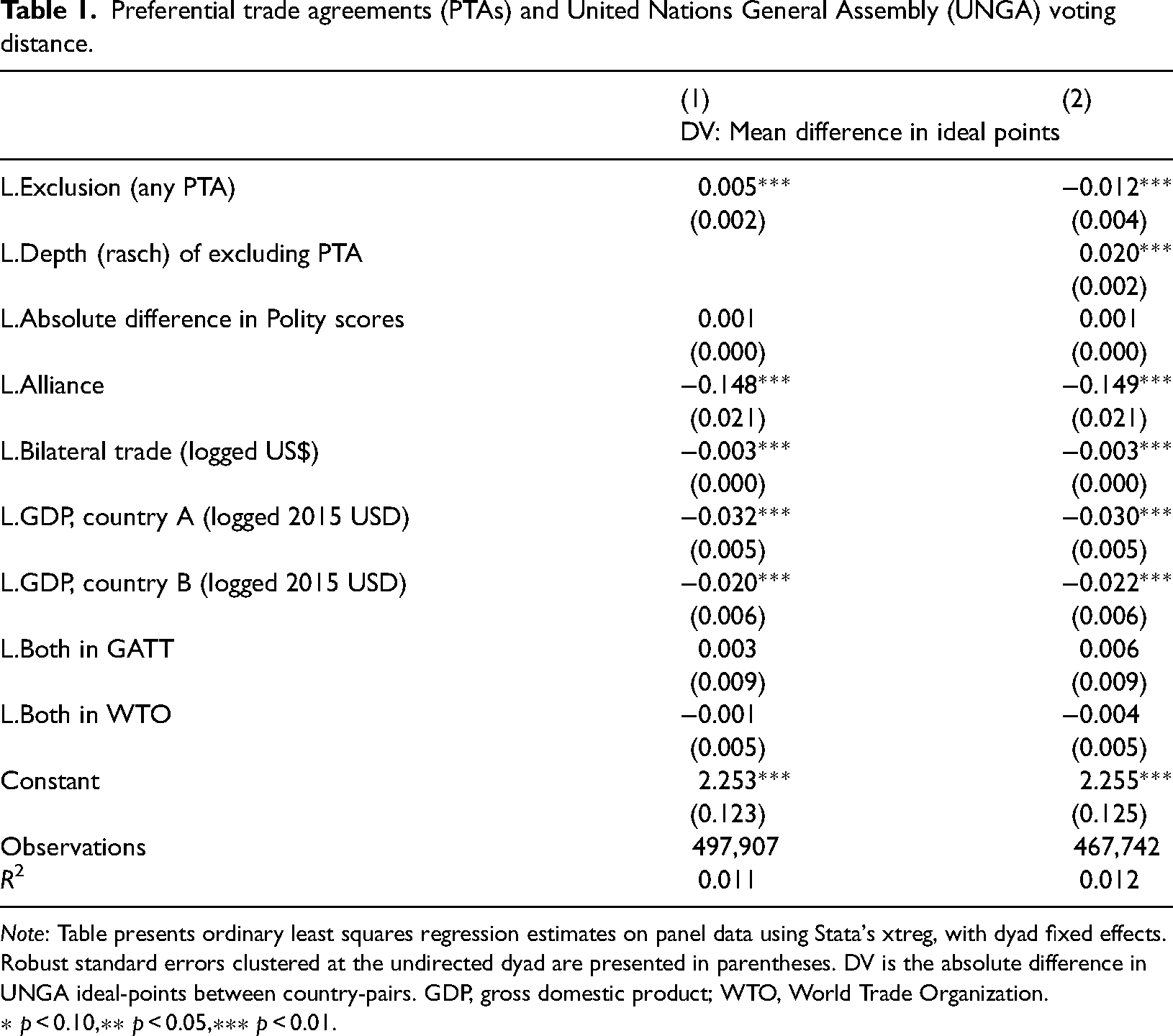
Before describing the empirical strategy, some descriptive statistics are helpful to illustrate the article's intuition. To start, let us look a little more closely at exclusion from a PTA. Exclusion from an agreement is identified in around 19.13% of undirected dyad-year observations from 1961 to 2021 for those observations included in the baseline regression specification (column 1 of Table 1).
Preferential trade agreements (PTAs) and United Nations General Assembly (UNGA) voting distance.
Note: Table presents ordinary least squares regression estimates on panel data using Stata's xtreg, with dyad fixed effects. Robust standard errors clustered at the undirected dyad are presented in parentheses. DV is the absolute difference in UNGA ideal-points between country-pairs. GDP, gross domestic product; WTO, World Trade Organization.
∗ p < 0.10,∗∗ p < 0.05,∗∗∗ p < 0.01.
We can also put a number on PTA enlargement, as one of the possible outcomes from exclusion is that countries seek entry into the exclusionary PTA. I refer to the list of PTAs from DESTA (Dür et al., 2014). 12 On 1091 “base treaties”, PTA enlargements have occurred 207 times in the database (19.0%) in a way that would be predicted by the theory.
Method
I use two estimation strategies to model the effects of exclusion on the political affinities between states, as measured by the distance between ideal points. I first estimate the relationship using an ordinary least squares (OLS) regression setup. A Hausman test confirms that a fixed-effects rather than a random-effects model is more appropriate.
There is a potential concern about selection bias for the models where I am interested in assessing the effects of the depth of the excluding agreement, since this depth variable is non-zero only for dyads where there is an excluding PTA. This may result in selection bias if there is an underlying factor driving both PTA exclusion and changes in UNGA voting affinities. I run Heckman selection models to address this, estimating PTA exclusion and UNGA ideal-point distance simultaneously.
I also turn to an ECM. This allows me to estimate the effects of PTA exclusion on a change in voting affinity in both the short and long run: does non-membership push countries closer towards institutional members, or further away? In addition to providing the short- and long-run effects, the ECM addresses the problem of spurious correlation created by cointegration in time-series data (Chow and Kono, 2017: 898–99). The results from the ECM can reassure us that there is not an underlying, unobservable process driving both changes in UNGA voting behavior and the likelihood of PTA exclusion, leading to inferential bias. Moreover, since the ECM model assesses the change in UNGA voting similarity rather than the level of UNGA similarity itself (through first-differencing), the observed effects on UNGA vote difference are more likely to be a function of PTA exclusion.
Results
Table 1 presents the results from OLS regressions on dyad-year panel data. The dependent variable is the mean distance in ideal points between two countries making up a dyad. The binary explanatory variable is PTA Exclusion (described above). To address the possibility of reverse causality, all regressors are lagged by one year.
The results presented in columns (1) and (2) support H1 and H2. We can see in column (1) that exclusion from a PTA is associated with larger UNGA ideal-point distances in the following year. As per H1, PTA exclusion is associated with more different foreign policy orientations between members and non-members. The results in column (2) suggest that this finding appears to be driven by higher-depth agreements. When I include the depth of the excluding PTA as a regressor, 13 the coefficient on the Exclusion variable turns negative, but the coefficient on the depth variable is positive. This indicates that as the depth of the excluding PTA increases, there is a corresponding increase in the effect of exclusion on UNGA ideal-point distances (H2).
In these two models, we see that non-membership in a new institution is associated with subsequent weaker political affinities between countries. Because I use dyad fixed effects in all specifications except for the interaction model, the effect shown is the within-dyad variation in the outcome (voting distance).
I then turn to tests of the hypotheses about the drivers of threat perception (H3a and H3b). Figure 1 presents the results from a model in which I retain the same specification as in column (1), but interact PTA exclusion and regime-type difference (regression results presented in the Appendix). I present the marginal effects of PTA exclusion across the range of the values taken by the polity difference variable (the minimum, one standard deviation below the mean, the mean, one standard deviation above the mean, and the maximum). We can see that in line with H3a, PTA exclusion is associated with narrowing UNGA ideal-point differences where regime types are similar, but with widening UNGA ideal-point differences where regime types are more different. Thus, the impact of PTA exclusion on foreign policy divergence increases as countries are more dissimilar in regime type (H3a).
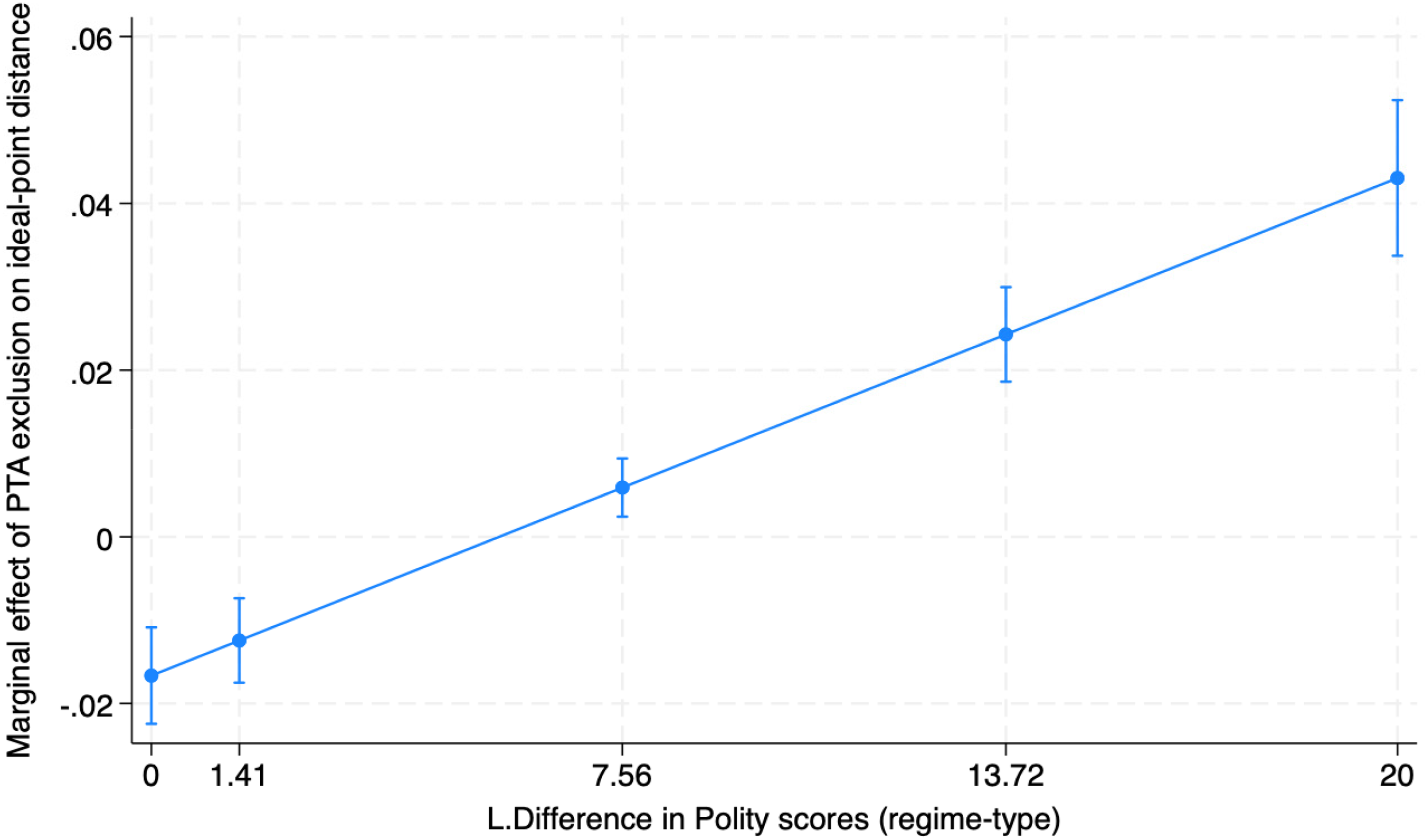
Marginal effects of preferential trade agreement (PTA) exclusion on United Nations General Assembly (UNGA) voting distance, at different levels of regime-type difference.
Similarly, I show in Figure 2 the marginal effects of PTA exclusion under the condition of having a prior PTA and not having a prior PTA between the excluded country and the other country in the dyad. Again, the underlying model is the same as in column (1), with an added interaction between Exclusion and the Prior PTA binary variable (results in the Online Appendix). We can see that as expected, having a prior PTA moderates the effects of PTA exclusion. Preferential trade agreement exclusion has a positive effect on UNGA ideal-point distances where countries do not have a prior PTA, but a negative effect on UNGA ideal-point distances where they do have a prior PTA. Thus, more than simply reducing the impact of PTA exclusion on foreign policy divergence (H3b), PTA exclusion results in more similar foreign policy orientations when countries already have a PTA.
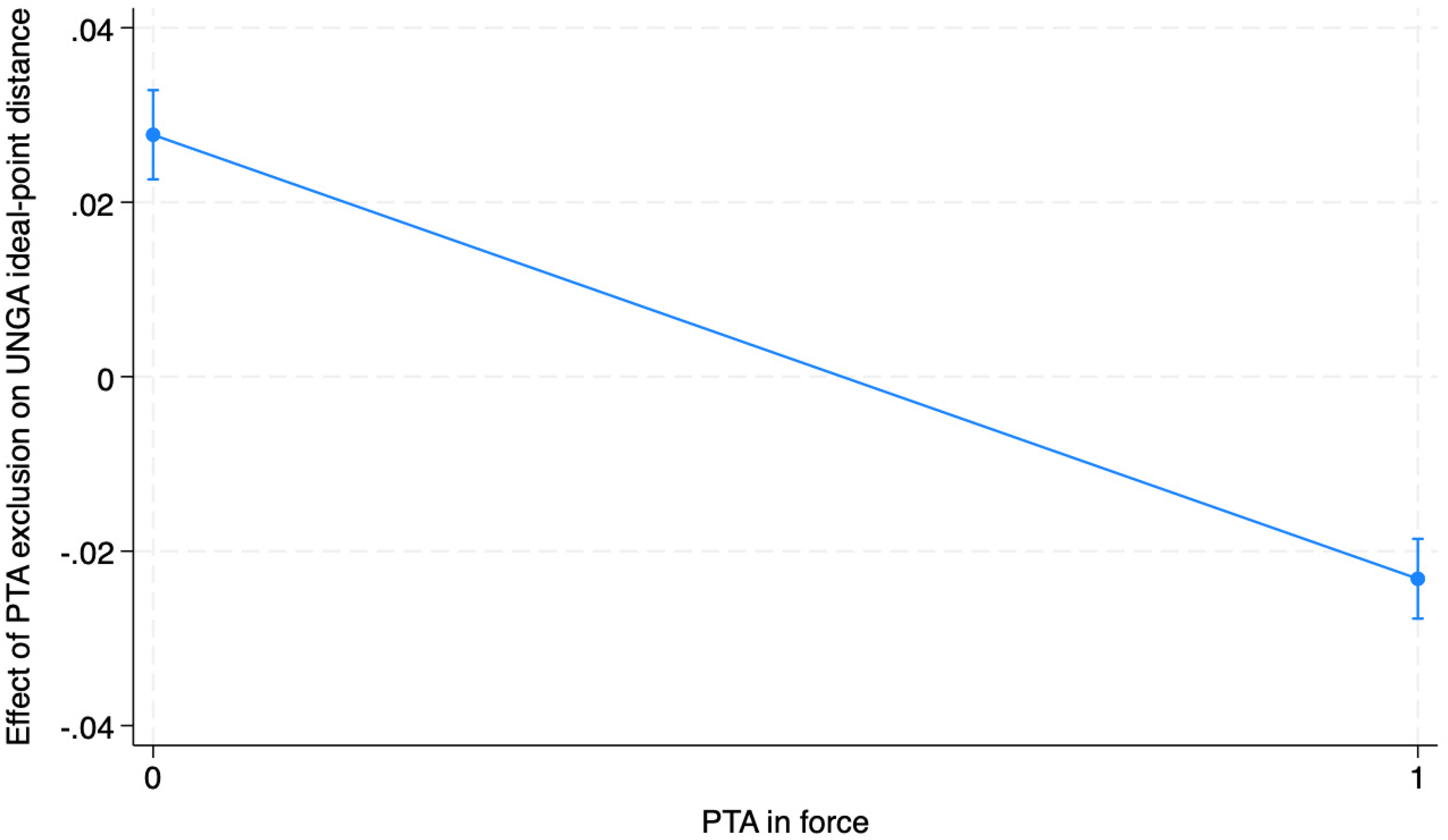
Marginal effects of PTA exclusion on UNGA vote distance, with and without a prior PTA.
How big are the effects? The mean of the outcome variable (mean difference in ideal points) is around 0.98, with a standard deviation of about 0.80. 14 This would suggest that the effects reported in Table 1 are modest. However, this does not take into account that there is considerable stickiness in the voting difference within country pairs, meaning that the variable does not move around as much for individual country pairs. Consider the US and China, two countries where we might expect large shifts in voting distance over time. The standard deviation for just these two countries is much lower at around 0.54. Furthermore, the differences in voting behavior that we might expect year-on-year (say, in response to a policy shift or a new PTA) are smaller again. In the decade between 2010 and 2020, the voting distance between the US and China ranged between a minimum of 2.82 (in 2015) and a maximum of 3.49 (in 2014), with a standard deviation of 0.23. Even accepting that the effects of exclusion are modest, however, they hold up strongly given that they account for numerous control variables that we would expect to account for much of the variation in countries’ political affinities.
Robustness checks
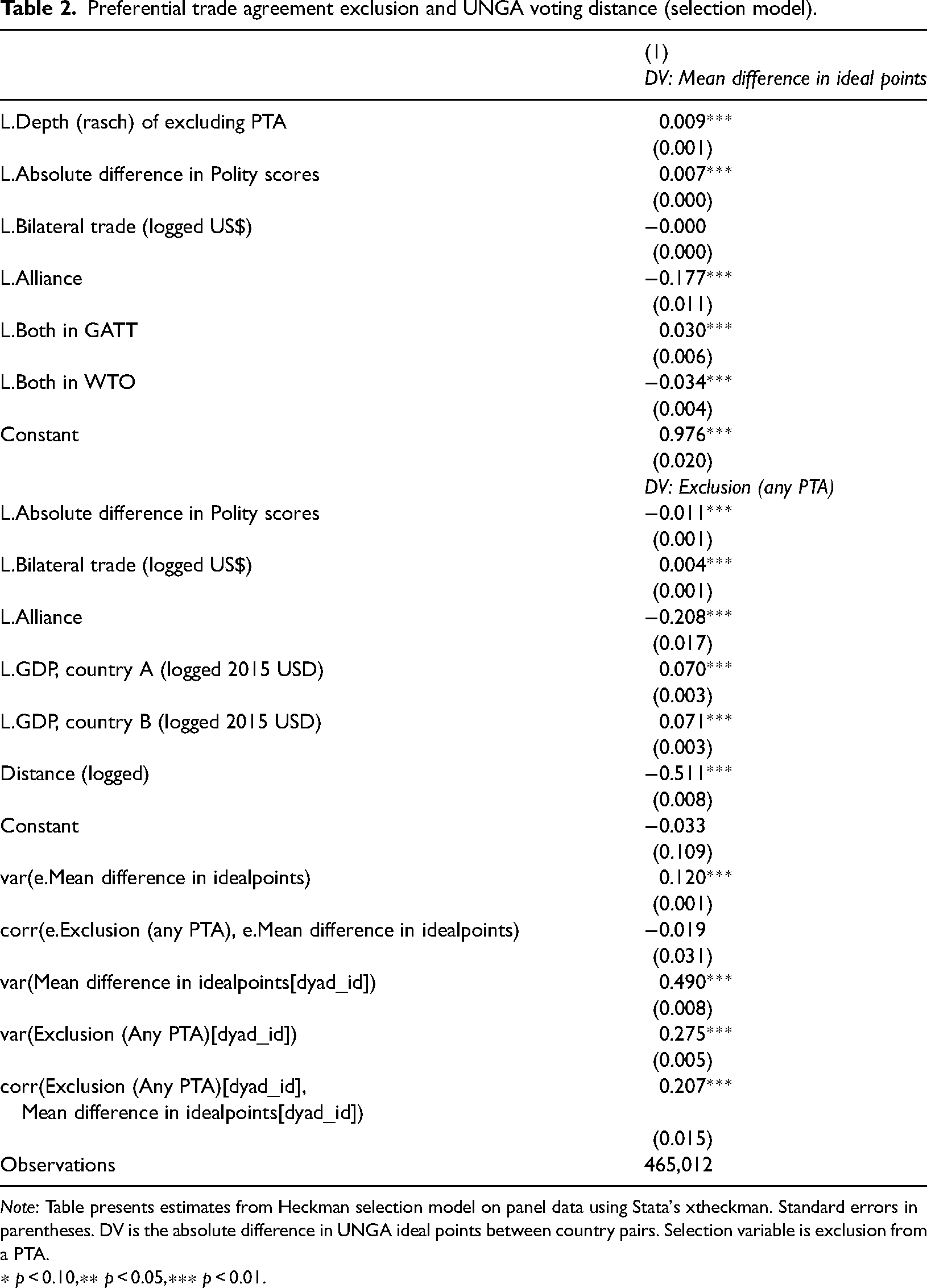
In Table 2 I present results from a Heckman selection model to account for possible selection bias. I simultaneously predict PTA exclusion and UNGA voting distance. My main independent variable in this model is depth of the excluding PTA (similar to column 2 of Table 1). Accounting for the selection process of PTA exclusion, the depth of the excluding PTA continues to have a positive (widening) effect on UNGA ideal-point distance. As the depth of the excluding PTA increases, excluded countries and PTA members vote less similarly in the UN.
Preferential trade agreement exclusion and UNGA voting distance (selection model).
Note: Table presents estimates from Heckman selection model on panel data using Stata's xtheckman. Standard errors in parentheses. DV is the absolute difference in UNGA ideal points between country pairs. Selection variable is exclusion from a PTA.
∗ p < 0.10,∗∗ p < 0.05,∗∗∗ p < 0.01.
In Table 3 I present the results from the error-correction model. This model includes differenced and lagged variables, including the dependent variable. The differenced variable also captures the shift from PTA exclusion (coded “1”) to a normal state of affairs (coded “0”), and renders it as “−1”. The reduction from “1” to “0” has no theoretical value, and so I follow the lead of Chow and Kono and create a differenced variable that takes the value of “1” in the first year of PTA exclusion, and “0” otherwise (Chow and Kono, 2017: 898). The short-run effects are given by the coefficient on the differenced variables. The long-run effects and their statistical significance can be calculated using Bewley's transformation (Bewley, 1979): the linear prediction of the differenced DV is included as a regressor in a second-stage model predicting the un-differenced DV. Long-run effects and their statistical significance are then given by the coefficients and errors on lagged variables.
Exclusion from PTA and UNGA voting: 2000–2015 (ECM).
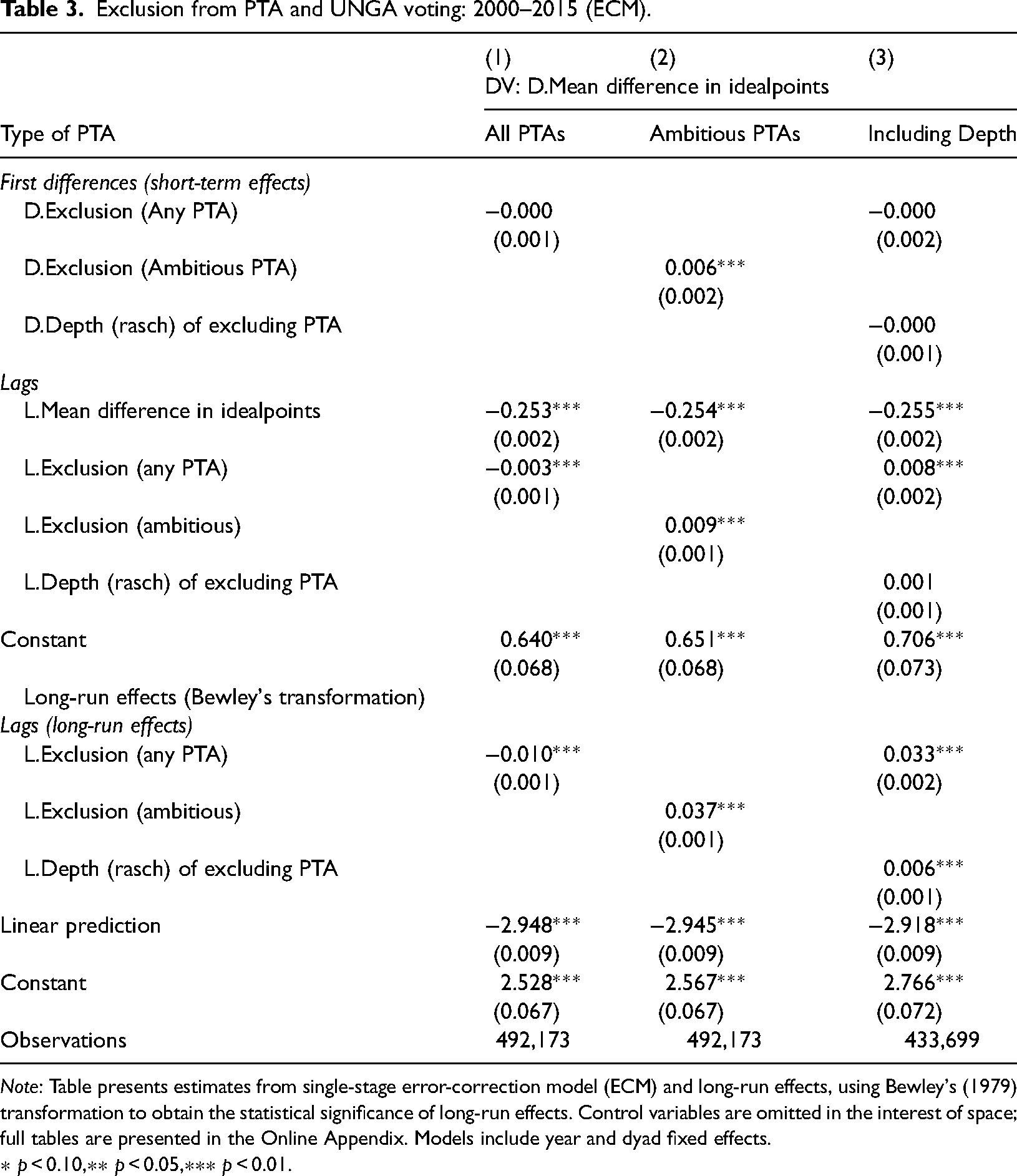
Note: Table presents estimates from single-stage error-correction model (ECM) and long-run effects, using Bewley's (1979) transformation to obtain the statistical significance of long-run effects. Control variables are omitted in the interest of space; full tables are presented in the Online Appendix. Models include year and dyad fixed effects.
∗ p < 0.10,∗∗ p < 0.05,∗∗∗ p < 0.01.
Table 3 presents estimates for the short- and long-run effects of PTA exclusion on UNGA voting similarity. I focus on assessing the impact of different levels of ambition of the excluding agreement. I estimate effects for all agreements (column 1) and agreements at a level of depth that is higher than average for that year (column 2), and then I include the depth variable directly in addition to the exclusion variable (column 3). I present models with dyad and year fixed-effects, so the results reflect within-dyad variation and account for unobserved shocks associated with yearly events. Here, I present the main variables of interest from the first- and second stage estimations; the full results are presented in the Online Appendix.
The results are broadly consistent with the findings previously presented: exclusion is associated with worsening political ties where agreements are “high stakes”. The results in column (1) show that exclusion from a PTA has no short-term impact, looking at all agreements together. In the long run, however, exclusion from a PTA is associated with more similar voting behavior at the UNGA, when looking at PTAs in the aggregate. When I focus on high-ambition agreements (column 2), this finding is reversed. Here, there is a widening in UNGA ideal-point distances in both the short term and the long run; both results are significant above the 99% confidence level. Similarly, in column (3), although there is no short-run effect of the depth of a PTA (on the depth variable), we can see that there is a long-run widening of UNGA ideal points associated with both exclusion in general (given by the positive coefficient on the Exclusion variable) and higher depth (given by the positive coefficient on the depth variable).
The size of the effect is considerable. In column 2, the long-run effect of exclusion from an ambitious agreement on UNGA ideal-point differences is a widening of 0.035, all else equal. To put this in perspective, this is around a third of the impact (in absolute terms) of entering into a military alliance: the latter reduces ideal-point distances by around 0.11.
Conclusion
Multilateral economic institutions have become increasingly contested, and multilateral trade liberalization has stalled. Meanwhile, countries have turned to negotiating preferential trade agreements, which include some states but exclude others. How does the emergence of PTAs as the major venue for trade liberalization shape global politics?
I argue that the promotion of new norms, the strengthening of diplomatic networks, and the ability to inflict harm through trade diversion combine to make PTAs a means by which states may strategically position themselves in the global trade regime. This strategic dimension means that exclusion from economic institutions may be viewed as a threat by non-members. Yet this threat is not likely to be perceived equally by all countries that are excluded from a PTA. The threat should be sharpest precisely where the stakes are highest: where an agreement is more ambitious and where excluded countries and PTA members lack pre-existing affinities that might enable excluded countries to mitigate against the effects of exclusion. Whether by design or incidentally, exclusion widens the political affinities between members and non-members.
Qualitative evidence from the Asia-Pacific supports this argument. China's non-membership in the TPP was viewed by observers and presented by officials as a deliberate attempt by the Obama administration to counter Beijing's influence in the Asia-Pacific. China countered with institutions in which it was able to take a leadership role, and which were in turn met with concern from China's regional rivals. This qualitative evidence suggests how exclusion from economic institutions may be associated with increasing tensions between members and non-members.
Evidence from statistical analysis of PTA exclusion and countries’ voting affinity in the UNGA supports the argument. I show that exclusion from a PTA is associated with a worsening of political affinity between the excluded country and the members of the agreement (H1). The effect is more pronounced for those agreements that are “deeper” (H2), in line with the idea that states should be more threatened by exclusion from more ambitious deals. The results also support the argument that countries’ prior relationship should make a difference to the reaction to exclusion. Countries that share a similar ideological orientation, measured by regime-type, appear unthreatened by PTA exclusion (H3a), in line with the notion that ideologically similar countries might be more likely to cooperate to mitigate against the effects of exclusion. And similarly, countries that already have a PTA in force also appear unthreatened by PTA exclusion: in this case, exclusion is associated with closer foreign policy orientations. The opposite is true of those country-pairs that do not share a prior PTA.
A final comment is on the extent to which these findings might travel to other areas of international politics beyond PTAs. In the paper, I focus on PTAs as an example of preferential institutions par excellence. However, the findings clearly have a bearing on our understanding of the politics of international institutions more generally. Across different areas of international politics, from development financing (the China-led Asian Infrastructure Investment Bank) to supply-chain restructuring and economic cooperation (the US-led Indo-Pacific Economic Framework for Prosperity), exclusionary institutions are an important part of the landscape of international cooperation. In these non-PTA examples as well, non-members may perceive the new agreement as a threat, and take action to mitigate against that threat.
International economic institutions like trade agreements are usually considered as cooperative. However, cooperative benefits for members may come at the expense of non-members and may thereby worsen political ties between rivalrous insiders and outsiders. Specifically in the trade regime, membership of PTAs is likely to be increasingly political if PTAs become further entrenched as the dominant venue for the development of new trade norms. This finding suggests the importance of further research on the causes and consequences of the evolution of global regimes. The form of institutions that constitute regimes matters not only for the way members manage to achieve cooperation with one another, but also for patterns of global cooperation in the broadest sense.
Supplemental Material
sj-pdf-1-cmp-10.1177_07388942231195302 - Supplemental material for The politics of non-membership: How exclusion from international institutions shapes international relations
Supplemental material, sj-pdf-1-cmp-10.1177_07388942231195302 for The politics of non-membership: How exclusion from international institutions shapes international relations by Matthew A Castle in Conflict Management and Peace Science
Supplemental Material
sj-zip-2-cmp-10.1177_07388942231195302 - Supplemental material for The politics of non-membership: How exclusion from international institutions shapes international relations
Supplemental material, sj-zip-2-cmp-10.1177_07388942231195302 for The politics of non-membership: How exclusion from international institutions shapes international relations by Matthew A Castle in Conflict Management and Peace Science
Footnotes
Acknowledgments
For helpful feedback on prior versions of this paper, I thank Krzysztof Pelc, Wolfgang Alschner, Vincent Arel-Bundock, Leo Baccini, Mark Brawley, Alice Chessé, Arc Zhen Han, Lauren Konken, Manjeet Pardesi, T.V. Paul, Vincent Pouliot, Ben Thirkell-White and participants at workshops and conferences at McGill, the Université de Montréal, and the New Zealand Political Science Association annual conference (2019). I thank Steve Bowe and Lisa Woods for statistical advice. I am grateful to the Associate Editor Megan Shannon and to the anonymous referees for very attentive and constructive comments on the paper. I accept responsibility for any outstanding errors.
Funding
I gratefully acknowledge funding from the Fonds de recherche du Québec—société et culture in the form of a Bourse de doctorat en recherche pour étudiants étranger (file no. 193907).

Supplemental material
Supplemental material for this article is available online.
Notes
References
Supplementary Material
Please find the following supplemental material available below.
For Open Access articles published under a Creative Commons License, all supplemental material carries the same license as the article it is associated with.
For non-Open Access articles published, all supplemental material carries a non-exclusive license, and permission requests for re-use of supplemental material or any part of supplemental material shall be sent directly to the copyright owner as specified in the copyright notice associated with the article.
