




Abstract
Can military training decrease human rights violations by security forces? The case of foreign military training is a complicated one because often the aim of the training itself is to address human rights violations. In this paper I explore whether US military training is effective in promoting respect for human rights in the recipient country. States that receive human rights-focused military training and education only see an improvement in respect for human rights by members of security forces in very limited cases. I use global data as well as newly-coded data from a Latin America sample to evaluate this proposal empirically.
US foreign policy has traditionally given human rights promotion a secondary role to security concerns such as preventing aggression and countering the expansion of influence by US rivals (Kiyani, 2021). At the same time, in recent decades we have gained an increased understanding that repression by the state and its security apparatus leads to instability, which in turn can result in negative externalities such as terrorism and civil war (Young, 2013). Further, recent cases tying foreign military operatives trained by the US military to notorious killings, such as the 2021 assassination of Haiti's president by US-trained Colombian mercenaries, have brought to light questions about the ways in which the knowledge gained from US military training is applied by the recipient forces (Horton, 2021).
The Leahy Laws passed by the US Congress state that US military aid, including training, should not be provided to states that egregiously violate human rights. The US government removes military aid with the intention of discouraging human rights violations by security forces in recipient countries. Yet the question of military training is a more complicated one.
The problem with removing military training from a recipient as punishment for the security forces violating human rights is that one of the major purposes of foreign military training provided by the US is indeed to promote human rights through training and education (McLauchlin et al. 2022). As noted by Joyce (2022), transmitting liberal norms to trainees is “a primary policy objective to nearly half of all states that receive [US] military training” (p. 49). The US military's own documents support this, as the Department of Defense's Defense Security Cooperation University, a directorate within the Defense Security Cooperation Agency that specifically educates and trains those that engage in security assistance, notes that “Members of the security cooperation community, in particular, should understand and appreciate the importance accorded human rights and civilian control of the military in our relationships with other nations” (p. 16-1, Security Cooperation Management, ed. 41, 2021). Referring specifically to military training and education, it states that “International students attending US military schools under the International Military Education and Training (IMET) and Foreign Military Sales programs are purposely exposed to human rights policies and issues as part of their studies” and that “partner nation military or security forces receiving capacity building assistance are required to participate in training covering respect for human rights, the law of armed conflict, and the rule of law” (p. 16-1 Security Cooperation Management, ed. 41, 2021).
Thus, one view holds that rather than remove military training from human rights violators, the training itself should be used to correct the problem (Burchard and Burgess, 2018). In fact, both the State Department and Department of Defense versions of the Leahy Laws allow for military training to continue in the case of human rights violations if adequate steps are being taken to address the violations. In addition, the National Defense Authorization Act of 2015 allows the Department of Defense to conduct military training with a specific focus on human rights promotion even in countries that under the Leahy Law would not be eligible to receive foreign military aid (Leahy Fact Sheet, 2018).
The US often provides military training to those states whose militaries have a history of human rights violations specifically as a way to address that problem. Military training is thus different from other types of military aid when it comes to oversight, as it can be a way to address the root cause of the problem. Laurienti (2007) notes, “Similar to the notion of criminal rehabilitation, as opposed to choosing between simple incarceration and acquittal, today the United States approaches the difficult problem of human rights abuses with something akin to a prescription” (p. 45). The question that remains is whether US military training is in fact effective at preventing human rights violations in the recipient countries. In other words, if military training is not removed from human rights violators, but rather altered to address the violations, is the “prescription” actually achieving its goal of decreasing human rights violations?
The section that follows reviews existing work on the effects of US military training. The next section then develops a theoretical argument for the settings in which we should expect to see a decrease in repression by the armed forces in countries in which the US engages in human rights-focused military training. These expectations are then tested in both a global context, using events data and data on human rights-specific military training coded by McLauchlin et al. (2022) as well as in a narrower Latin American context using the same military training measure and a new measure of human rights violations by the armed forces coded specifically for this project. The final section concludes and discusses policy implications and future avenues of research.
The effects of US Military Training
Previous work by Bell et al. (2017) shows that a US military presence is actually correlated with greater respect for physical integrity rights in the host country under certain limited circumstances. Part of the reason for this expectation is that some of the deployments are explicitly sent to train host country troops. In these cases, and particularly in the post-Cold War era, trainees receive explicit human rights training that in some cases combines classroom theoretical learning with role-playing exercises in which trainees simulate being in a situation in which they are expected to follow proper procedures when encountering human rights violations.
Work specific to the effects of recent US military training is inconclusive with regards to the effect it has on civil–military relations as well as on respect for human rights. Ruby and Gibler (2010) argue that US military training can effectively professionalize the military and lead to better civilian control of the military. In contrast, Savage and Caverley (2017) suggest that military training is a form of increasing human capital, which shifts the balance of power between the civilian government and the military in favor of the military, although Scharpf (2020) argues that this is a risk some governments are willing to take in order to better counter guerrilla threats and build stronger relations with the US. In addition, Grewal (2022) finds that in the specific case of Tunisia, US-trained service members are more likely to be supportive of military political involvement than their French-trained counterparts.
Focusing on training's effects on human rights, Atkinson (2010) finds that military exchange programs are more effective than civilian exchange educational programs in promoting respect for human rights (but only empowerment rights, not physical integrity rights), as well as leading to the creation of more democratic institutions in the trainees’ home countries. Yet Joyce (2022), studying the case of Liberia, finds that without robust liberal defense institutions in place, US military training is ineffective at transmitting liberal norms to trainees. Broadly, it appears to be the case that longer-term commitments that emphasize both political and military strategies, and in which US military personnel interact with host state militaries, also are more effective at reducing political violence in the state that receives the training (Watts et al., 2018).
What previous studies have in common is the conclusion that the effect of training and education on liberal norms in the recipient state is a nuanced one. There are also different paths through which this effect could take place. US military training could lead to increased respect for human rights by including actual human rights training in its courses, but also by giving the US influence over the recipient state. Bell et al. (2017) argue that US troop deployments can allow the US to demand greater respect for physical integrity rights because the troops represent a form of military aid. The troops are there providing security for the host state, thus freeing up its resources to be spent on other needs (Martinez Machain and Morgan, 2013). In the case of military training, it not only benefits the host country to have more effective troops (enhanced as human capital) (Scharpf, 2020), but it can also save the recipient the cost of actually paying for the training (in the case of some programs, such as IMET). At the same time, when the US provides military training to a foreign military there are several, often competing, interests at play, and security interests may trump concerns for human rights when it comes to policy execution (Kiyani, 2021).
Human rights and US military training
In the past, the US not only trained militaries that engaged in human rights violations, but even sponsored training that taught them how to do so, such as the School of the Americas’ training in methods of torture (Scharpf, 2020). These outcomes, while often seen as a necessity in achieving the geostrategic aims of various US presidential administrations during the Cold War, generally did not align with the preferences of the US public, who expressed a distaste for the use of American resources leading to human rights violations (Laurienti, 2007; Tate, 2011; Burchard and Burgess, 2018).
Since the end of the Cold War, the US military has changed its approach significantly, now explicitly integrating human rights promotion into the military training of foreign troops. In particular, Congressional legislation has ensured a consideration of human rights for any type of military aid, including military training (Epstein, 2012). Members of Congress can be actively lobbied by their constituents and pressured to act to reduce human rights violations associated with US military training (Apodaca, 2019).
The first time that the US Congress passed legislation to prevent military aid to human rights violators was in 1973 through Section 32 of the Foreign Assistance Act. This was motivated in part as a reaction to the discovery that US military aid had allowed the overthrow of Chilean President Salvador Allende through a military coup that led to the establishment of the repressive military regime of Augusto Pinochet. The 1973 legislation directly addressed the Chile case by prohibiting military aid to states that engaged in political imprisonment, as the Pinochet regime had done (Laurienti, 2007). The rest of the 1970s saw continued action by Congress to restrict foreign aid, and specifically military aid, to states that violated human rights.
The Leahy Law of 1997, first passed as an amendment to the Foreign Operations Appropriations Act, prohibits the provision of assistance to foreign security forces that have engaged in violations of human rights, and it applies to assistance provided by both the State Department and the Department of Defense (Tate, 2011). Congress passed the Leahy Law in large part as a reaction to the human rights violations of Colombian security forces that had been trained in counternarcotics operations by the US military.
As Laurienti (2007: 74) points out, simply considering a correlation between respect for human rights and US military training would show a negative relationship. This is because US military training is not completely driven by high levels of respect for human rights. In fact, it can often follow the opposite pattern because part of the aim of military training by the US is to actually promote respect for human rights. Thus, it means that it makes sense for the US to train the militaries of countries that have had problems with human rights violations in the past.
Colombia itself is a clear illustration of this dynamic. It has had a troubled history of human rights violations by its security forces and also has received the largest amount of military aid and training in Latin America from the US in recent decades. A major aim of the training (besides combating rebel forces and drug traffickers) is to remedy the problem of human rights violations.
At the same time, if respect for human rights in the recipient country consistently lacks improvement, or worsens, then the US could see its efforts as not being successful. It may even come under pressure from NGOs that spotlight the human rights violations and question why the US is supporting these regimes. Given the history of human rights violations by US-trained militaries, there is even the possibility that the US military gets blamed for some of the human rights violations. How then can US military training improve the armed forces’ respect for human rights?
There are two avenues through which the human rights record of a recipient state can be improved by US military training. The first follows a training-as-aid framework, in which military training is seen as a form of military aid that is desirable to the recipient state (Martinez Machain, 2020). Military training increases human capital in the recipient state, making the recipient state's military more effective (Ruby and Gibler, 2010). It thus holds utility for the recipient. In turn, it gives the US influence over the recipient state, as the US could threaten to remove the training if the recipient state does not carry out policies that are not desirable to the US. In the human rights context, the US could threaten to remove training from states that do not show improvement in respect for human rights by security forces. If this is the case, we should see an improvement in human rights in states that receive US military training, regardless of the content of that training.
The second mechanism through which US military training could lead to improvement in respect for human rights by security forces is through the actual training itself (Bell et al., 2017). US military training involves a large human rights component, both in the classroom and in field exercises. This means that if the US military is explicitly teaching a human rights curriculum, a key component of US military training in the post-Cold War era, we should expect to see an improvement in respect for human rights by security forces in recipient countries as they receive US military training that focuses specifically on human rights.
1
This thus leads to the two following related hypotheses:
Beyond these considerations, the US has a clear interest in promoting its interests in areas that are considered to be of high security salience. Training foreign troops is a cost-effective way of providing “local solutions to local problems” and obtaining desired outcomes without incurring the political costs of putting American boots on the ground (interview with former CGSC Program Coordinator, 24 February 2019; Burchard and Burgess, 2018). Burchard and Burgess (2018) find, when studying a series of case studies in Africa, that those states that are of high security salience to the US are less likely to be punished (through the removal of military training) by the US after they violate international norms, particularly if those norms are what they classify to be “low” ones, such as extrajudicial killing (as compared to “high” norm violations like invading a neighboring country). Similarly, Bell et al. (2017) find that states that receive US military deployments in a non-invasion setting are more likely to respect physical integrity rights, but that this is only the case when these countries are of low security salience to the US. Their logic is similar to that of Burchard and Burgess (2018): that these are the countries that the US has the least leverage over, as it needs their cooperation in order to achieve its aims in the international system.
Thus, by this logic, we should expect that those states of higher security salience to the US should be less likely to see improvements in the human rights records of their militaries after receiving training from the US. In fact, as suggested by Bell et al. (2017), in a most pessimistic scenario we might even expect their human rights records to worsen, as their militaries gain more resources and become more effective at repressing the population, without being held accountable by the US. At the same time, a competing dynamic may be at play.
Burchard and Burgess (2018) also argue that those training missions that are under the most international scrutiny are also the ones that the US will be more likely to punish for norm violations through the removal of training. If we think about which missions are the ones that are most likely to face scrutiny and be subject to the most oversight, they probably are the ones that are receiving the most attention from the media and from the general public. It is in the interest of legislators to address the problems that their constituents care the most about in order to maintain their political survival (McCubbins and Schwartz 1984). Thus, the cases that will receive the most oversight, and thus the ones that will be least likely to be associated with human rights violations after receiving training, are those that receive media attention, which are also the high-security salience ones.
As an illustration, the murder in 1989 of six Jesuit priests as well as their housekeeper and her daughter by members of El Salvador's military who had received training at the School of the Americas set off an intense backlash against military training being provided to human rights violators. As a reaction to these murders, the group School of the Americas Watch was established. School of the Americas Watch actively lobbied Congress to prevent future such actions. As investigations into the School of the Americas and the training it was providing to its students progressed, Congress was under constant pressure to intervene, to the point where in 2000, Congress passed legislation that closed the School of the Americas and replaced it with what is now the Western Hemisphere Institute for Security Cooperation located at Fort Benning in Georgia (Laurienti, 2007).
It is of note that the legislation passed by Congress in 2000 did not eliminate professional military training by the US in the Americas, but rather replaced it with education that emphasized democracy and human rights (Laurienti, 2007). The US thus did not step away from exerting influence over Latin American states and their security policy, but rather altered the content of the training in a way that is meant to address concerns about human rights violations. Similarly, the Leahy Law allows for the US to continue to provide assistance to a military unit that has been accused of human rights violations if it can be determined that the specific unit is taking steps to prosecute those accused of crimes and that the government of the country has taken corrective steps to address the human rights violations. In addition, the National Defense Authorization Act of 2015 allows the Department of Defense to conduct military training with a specific focus on human rights promotion even in countries that under the Leahy Law would not be eligible to receive foreign aid (Leahy Fact Sheet, 2018).
In the case of Colombia, which was the case that motivated the Leahy Law, existing military units faced too many allegations of human rights abuses, and thus became ineligible for military training under the Leahy Law. Rather than remove aid from Colombia, at least until the problem was addressed, the Department of Defense worked directly with the Colombians to create new “clean” military units that would be able to receive aid. Colombia in the 1990s was clearly a case of a high security salience case for the US: it was a state in the Western Hemisphere facing a threat from a leftist guerrilla and also producing drugs that were being exported to the US. Note that human rights violations did not cause Colombia to lose its military training, but neither did the US Department of Defense allow them to go unchecked.
While, following the expectations of Burchard and Burgess (2018) and Bell et al. (2017), Colombia did not lose its military training because of human rights violations by the military, the human rights violations were also addressed directly. Congress’ constituents, which included human rights groups such as Amnesty International, were shining a light on these human rights violations in a way that motivated Congress to keep the focus on them. The solution was to have the Department of Defense actively work with the Colombian military to address the problem, resulting in an eventual decrease in human rights violations by the military. 2
Given these expectations, I present the following hypothesis:
Data and research design
To test the hypotheses I use data on foreign military training by the US, the human rights record of recipient states, and the security salience of the recipient. The sample includes all states that could have been potential recipients of US military training in the time period between 2000 and 2016 (the temporal constraint is due to the availability of the military training data, though some of the robustness checks extend the time period to 1998–2017). The data is cross-sectional time series. The unit of analysis is the country-year and the sample includes 2902 cases once observations with missing data are dropped.
Dependent variable
The dependent variable is human rights violations by the security forces of the state. In particular, I focus on human rights violations specifically carried out by the military and the change in respect for human rights by the military.
I measure human rights violations by the military through two different approaches that are intended to make up for each other's weaknesses. The first is by using event data from the Integrated Crisis Early Warning System (ICEWS) dataset (Boschee et al., 2015). The ICEWS dataset uses news reports to code the actors that engaged in a certain action directed at a different actor. It uses the Conflict and Mediation Event Observations (CAMEO) system to determine the categories of actors and actions in involved in an event (Gerner et al., 2002). The ICEWS dataset includes unique event IDs for each event and does not double-count events when they are reported more than once in different news sources. In this case, I restrict the observations to acts of repression (CAMEO code 175) defined as “Actively repress collective actions of dissent by forcing subjugation through crowd control tactics, arrests, etc” (CAMEO codebook p. 82; Schrodt, 2012). I consider actions by both the military and police forces, and code them separately in order to have a point of comparison of repressive actions taken by non-military security forces (although the analysis presented in this manuscript refers specifically to repression by the military). The CAMEO framework does not include a source sector category for paramilitary forces (they are listed as “unidentified forces”), but I include a measure of actions by paramilitary forces if the name of the source actor (the one carrying out the action) includes the term “paramilitary” in it.
I include only cases in which the military carrying out the repressive act was that of the country in which the repression happened. This keeps the focus on internal uses of repression and human rights violations as opposed to actions such as war crimes, which would fall into potentially different categories of training. I do not distinguish whether the act of repression was carried out against citizens of a country or foreigners within a given country (such as targeting refugees), as both actions would qualify as a repressive internal act by a state's military.
It is important to note that there are some inherent problems associated with events data (Wang et al., 2016; Zeitzoff, 2018). One that could be problematic is systematic underreporting of events. This can be due to many factors, including media censorship in more repressive states (which is likely to bias results) and areas that are strategically important to the US receiving more coverage in English-language media, which is where the more commonly used events datasets are derived from. In addition, there is a time bias, where events are more likely to be reported in recent years, owing to both technology and globalization. As an example, the ICEWS data reports 448 incidents of repression by security forces in 1998, whereas 20 years later, in 2018, it reports 1283. Given existing findings about the general trend of improvement in respect for human rights, it seems unlikely that security forces across the world became three times more repressive in those 20 years (Fariss, 2014). Rather, the higher number is probably due to increased reporting.
Given this concern, I use only a dichotomous measure of repression that is coded 1 if there was at least one repressive act by the military and 0 otherwise. This thus measures whether the military is repressive or not, without making a call as to the amount of repressiveness. While there is certainly information lost by dichotomizing the measure, I believe this to be the safer route when dealing with data that may be unreliable across time and space. Using a cut-off of 1 may seem like it is losing a lot of information, but I note that the mean value of the count variable is 1, and both its mode and median are 0. It is not until the 75th percentile that we see cases with more than one repressive act. Police repression is somewhat more common, while paramilitary repression is much less common. Table 1 shows some summary statistics on these measures.
Summary statistics, repression events data.

Given the limitations of events data, I also use a newly coded, original to this project, alternative measure of the dependent variable. This is an index that measures the level of physical integrity rights violations by members of the military. While existing measures, such as the CIRI physical integrity rights index (Cingranelli et al., 2014) and the latent variable measure by Fariss (2014), as well as the newer HRMI dataset (Clay et al., 2018) measure respect for physical integrity rights, they do not specify which actor carried out each human rights violation. Thus, it would not be possible to specifically measure whether the military is violating human rights or if another actor, such as the police, is the one doing it.
I thus create an index based on the CIRI dataset (Cingranelli et al., 2014) that measures whether the military never (0), occasionally (1) or frequently (2) violates physical integrity rights (engages in extrajudicial killings, forced disappearances, torture or political imprisonment). Each physical integrity right is coded independently by student coders using the original State Department human rights reports for each country-year such that each country can have a value ranging from 0 (no physical integrity rights were violated by the military) to 8 (all four physical integrity rights were frequently violated by the military). 3 Although the measure is based on similar criteria to the CIRI Physical Integrity Rights Index, it is not the same. The newly coded military physical integrity rights violations index and the CIRI index have a correlation coefficient of 0.54 (once I invert the new measure to be in the same direction as the CIRI index).
Figure 1 shows the necessity of measuring military human rights violations in different ways. The panel on the left shows the case of Colombia. Because the events data measure repression by actively repressing actions of dissent, something that was rare in Colombia in this time period, Colombia shows almost no military repression. At the same time, we know that the Colombian military did engage in human rights violations, and when these are measured through the new human rights index based on the CIRI-type format, we do observe the Colombian military having human rights violations. In contrast, other cases, such as that of Mexico (shown as the right-hand panel) match up better, probably implying that the military was used to repress dissent and that they also engaged in other human rights violations.
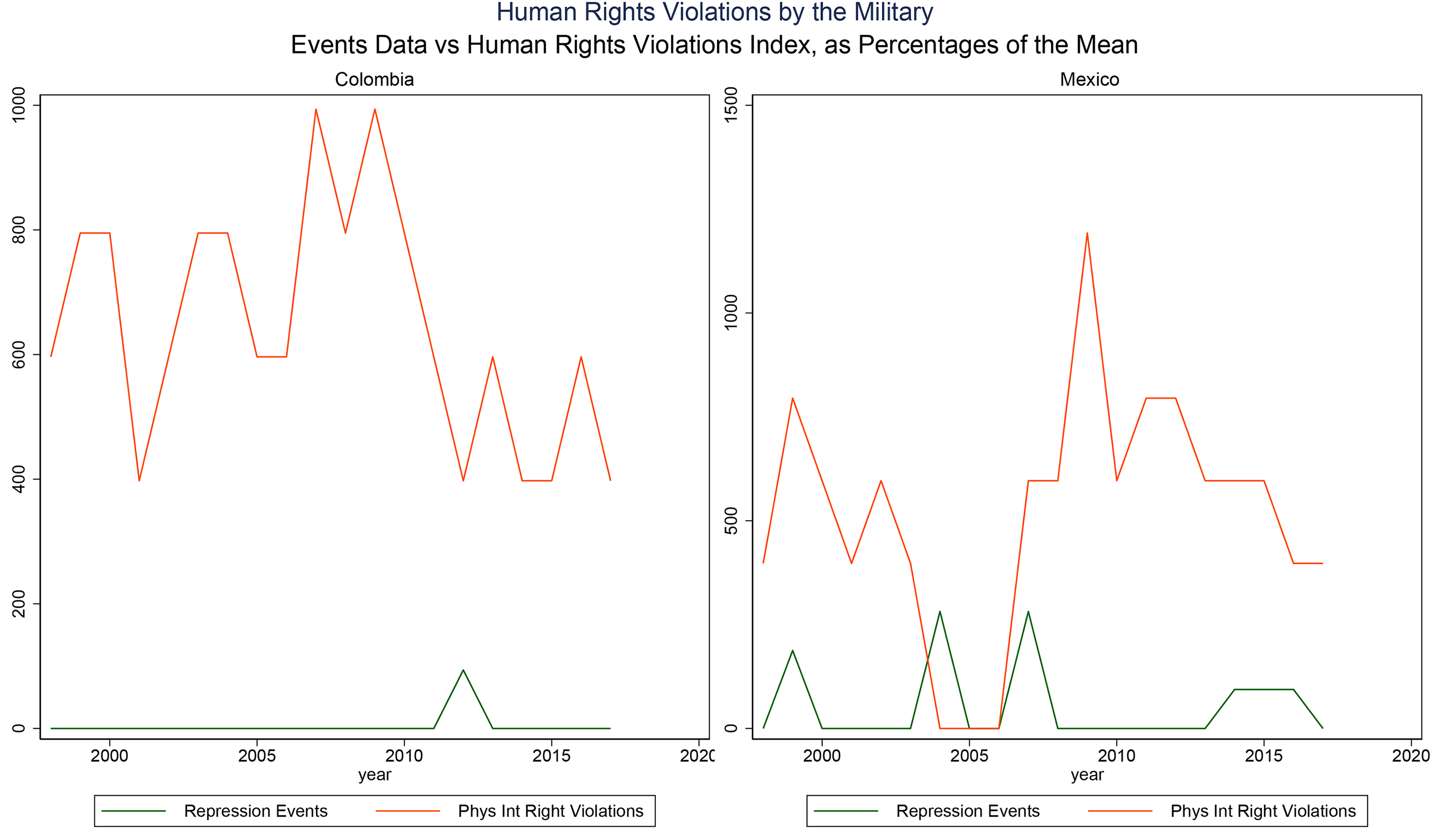
Comparison of military human rights violations measures.
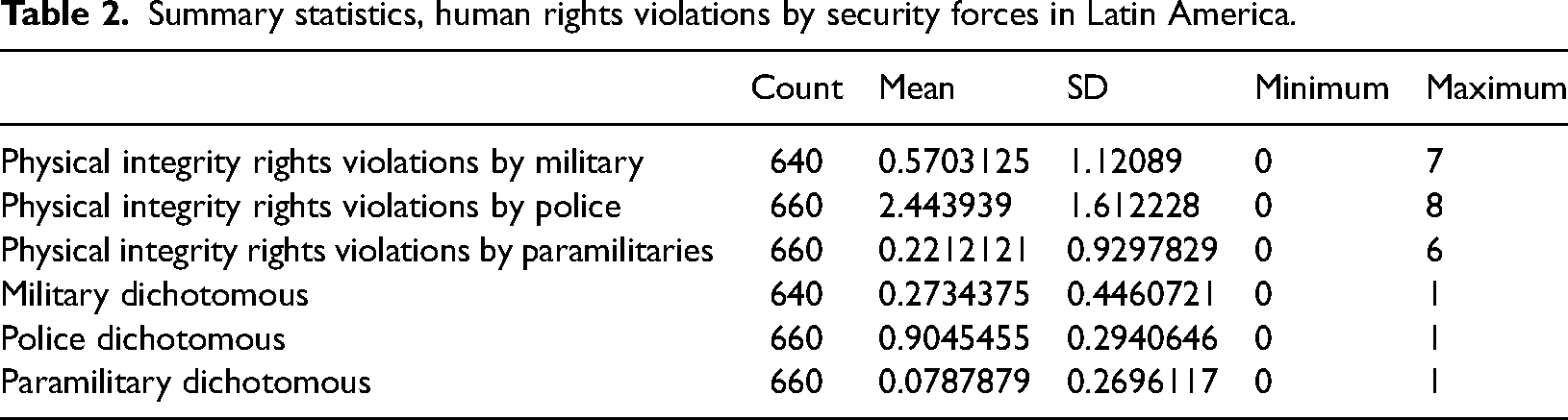
I restrict the sample to all Latin American states (including the Caribbean), for the same years included in the previous section. Focusing on one region does away with the heterogeneity that comparing cases across regions brings about. Given that Latin America has been the region that has motivated much of the US Congress’ oversight legislation regarding military aid (Chile motivating the 1973 legislation, Colombia motivating the Leahy Law), the region provides a particularly interesting subset of states to study. Latin America is also a region that is mostly democratic (thus allowing for better comparisons across states, given that regime type is a strong predictor of respect for physical integrity rights), but also has wide variation in the number of troops that are trained by the US every year (Scharpf, 2020). The cases were coded using the US State Department's annual human rights reports following the codebook and procedure that are included in Appendix B. Again, the codebook is strongly modeled after the CIRI codebook to follow convention on measuring physical integrity rights (Cingranelli and Richards, 2014) (Table 2).
Summary statistics, human rights violations by security forces in Latin America.
Independent variables
The main independent variables are the amount of (a) all military training and (b) human-rights focused military training that the US provides for a country in a given year. To measure this I used data from McLauchlin et al.'s (2022) International Military Training Activities Database-USA. The dataset provides information on the US’ foreign military training activities between 2000 and 2016, drawing from the State Department's Foreign Military Training Report and the Department of Defense's Engagement of Activities of Interest Report, with additional US government documents used to supplement missing information (McLauchlin et al., 2022). 4
Specifically, I measure military training as the total number of individuals who received military training from the US in a given year. 5 I exclude police training and include only the training of the armed forces. To distinguish between the two different mechanisms discussed in the lead-up to Hypotheses 1a and 1b, I consider both all military training and only the training that McLauchlin et al. (2022) code as having human rights training as an objective. I convert the number of trainees to a proportion of the size of the military as whole. 6 I use data from the Correlates of War National Capabilities dataset to measure the total number of military personnel (Singer, 1988; Singer et al., 1972). Because the dataset only goes until 2012, I use the 2012 values for the years 2013–2016. While this is less than ideal, it seems unlikely that the size of many states’ militaries will vary dramatically in 4 years.
I use a proportion as a measure because the same number of trainees will have a much larger influence in a country with a smaller military than in one with a large one. This measure (in the case of human rights training) ranges from 0 to 68, with the mean being close to 1. The countries with the highest percentages tend to be smaller ones and many of them are in Africa, such as Benin, which averages a US training rate of 14% for its military, and are receiving peacekeeping training from the US.
These numbers include both programs funded by foreign countries (which are listed under Foreign Military Sales, which involves foreign states directly paying for military education and training), programs funded by the Department of State (such as IMET and Peacekeeping Operations), programs funded by the Department of Defense (such as the Counterterrorism Partnerships Fund), and programs funded by the Department of Homeland Security. Because it can take some time for the effect of military training to take hold in the recipient country, and because a consistent effort is needed to actually produce results from training, I use a 5 year moving average, meaning that I average the current value as well as the first four lagged values.
I also consider the security salience of the recipient state to the US. As suggested by Hypothesis 2, the effect of human rights violations on training may be different in states that are of high strategic importance for the US. There are many ways to capture security salience (see Stravers and Kurd (2020) for a discussion of this). I aim to capture the multidimensional aspect of security salience for the US. I thus choose to use a measure created by Bell et al. (2017) which measures a state's security salience to the US by considering four factors relevant to the US in this time period: proximity to a US rival (as a way to counter the rival's influence), proximity to a leftist rebellion or Marxist government (proximity to a Communist state allows the US to counter Communist influence—a priority that remained relevant even in the post-Cold War era), and proximity to a conflict that the US is involved in (willingness to intervene being indicative of a country, and by extension its neighbors, being security salient for the US). The variable treats all four dimensions equally, measuring salience as a yearly minimum distance in kilometers. Smaller distances imply greater security salience. Because the Bell et al. (2017) measure is only coded until 2006, I use their same coding rules (and where possible the same sources) to extend the measure to 2016.
Control variables
In terms of control variables, I focus on variables that are likely to affect both whether a state sends its forces to train with the US as well as that state's respect for physical integrity rights (Clarke, 2005). I control for the GDP per capita of the potential partner state, as wealthier states are more likely to have the capacity to enforce laws that protect individual citizens from abuse (World Development Indicators, 2017). When it comes to the relationship between GDP per capita and US military training, I remain agnostic as to its potential direction. As mentioned earlier developed countries may not be eligible for programs such as IMET which are, at least partly, based on need. This means that we may expect developing countries to have a greater amount of US military training. At the same time, wealthier states also have a more longstanding tradition of educating their military officers abroad and in the US in particular (interview with former CGSC Program Coordinator, 24 February 2019). I thus allow this question to be answered empirically without suggesting an expected relationship.
I consider the size of the country, measured as its population, as larger countries simply present more opportunities for repression to occur, and may also be more significant players in the international system that the US will be more willing to train (World Development Indicators, 2017).
I also consider how democratic the recipient state is, as there is ample evidence that democracies, and in particular the militaries of democracies, are more likely to respect physical integrity rights (Laurienti, 2007). In addition, democratic states are also more likely to have their militaries trained in the US (although of course there are plenty of non-democratic trainees in the US programs) (Laurienti, 2007; interview with former CGSC Program Coordinator, 24 February 2019). It is important to use a measure of democracy that is not created by measuring respect for physical integrity rights, as that would make the measure circular. To measure the level of democracy of the potential partner state I use the Varieties of Democracy (VDEM) Polyarchy measure (Coppedge et al., 2018).
I also consider the level of instrastate and interstate conflict in a given year, as countries that are experiencing an interstate or civil war are also more likely to have their militaries violate the physical integrity rights of their citizens. In addition, it is likely that countries that are facing an internal or external conflict will be more likely to receive military training from the US in order to combat a domestic threat. Colombia being the country in Latin America that receives the highest amount of military training during its civil war is a prime example of this. To measure intrastate conflict I use the PRIO/UCDP conflict data (Gleditsch, Wallensteen, Eriksson, Sollenberg and Strand, 2002; Pettersson et al., 2019).
Further, conflict in the past 20 years has involved more than interstate conflict. In particular, since 2001, the US has found itself involved in a “War on Terror” in which it has attempted to eradicate transnational terrorist organizations that are a threat to the US or its allies. While some of these terrorist organizations are directly related to countries in which the US has fought a conflict (such as Afghanistan), in many cases their reach goes far beyond that. For example, al-Qaeda and its affiliates have expanded their presence in sub-Saharan Africa vastly, leading the US to invest in greater amounts of military aid to sub-Saharan African states that were previously mainly the recipients of development aid (Heinrich et al., 2017).
Terrorism is particularly likely to lead to states receiving US military training. In fact several of the military training programs are geared specifically at counterterrorism training. It is thus expected that as states are the victims of terrorist attacks they are more likely to receive military training from the US. In addition, terrorist attacks are often used as justification for having the military violate the human rights of the civilian population, and we can thus expect that a higher amount of terrorist attacks will also influence respect for human rights in the recipient states. I thus include a count of the terrorist attacks that took place in a given year, using the Global Terrorism Database (GTD) (The Global Terrorism Database, 2019). I note that I exclude all cases coded by GTD as potentially not being terrorism. In addition, because ethnic fractionalization is also associated with terrorism and could also influence a state's probability of receiving training (as a way to address the security implications of the fractionalization), I also include an index of ethnic fractionalization developed by Dražanová (2020).
Another important factor to control for is the general level of respect for human rights in the country, beyond what just the military is doing. A general environment of repression is probably correlated with the military engaging in repression. In addition, countries that have poor human rights records in general are also less likely to receive any type of aid from the US, all else being equal. To measure general respect for human rights, I use the measure created by Fariss (2014). Following the template of the measures of human rights violations by the military, I also use a 5 year moving average of this measure, as it may take some time for these effects to develop. 7
Finally, as there have been studies about there being trends of improvement in respect for human rights throughout the world (e.g., Fariss, 2014), as well as there being trends in the amount of US military training provided to foreign countries in general, I also include a time measure in the model. All control variables except for the time measure are lagged by one year. I also include a lag of the dependent variable in the model, as states that receive training in the past are likely to continue receiving it.
Analysis
The data are in cross-sectional time-series format with the country-year as the unit of analysis. Because the dependent variable is dichotomous, I use logistic regression (logit) models with robust standard errors. 8
Results
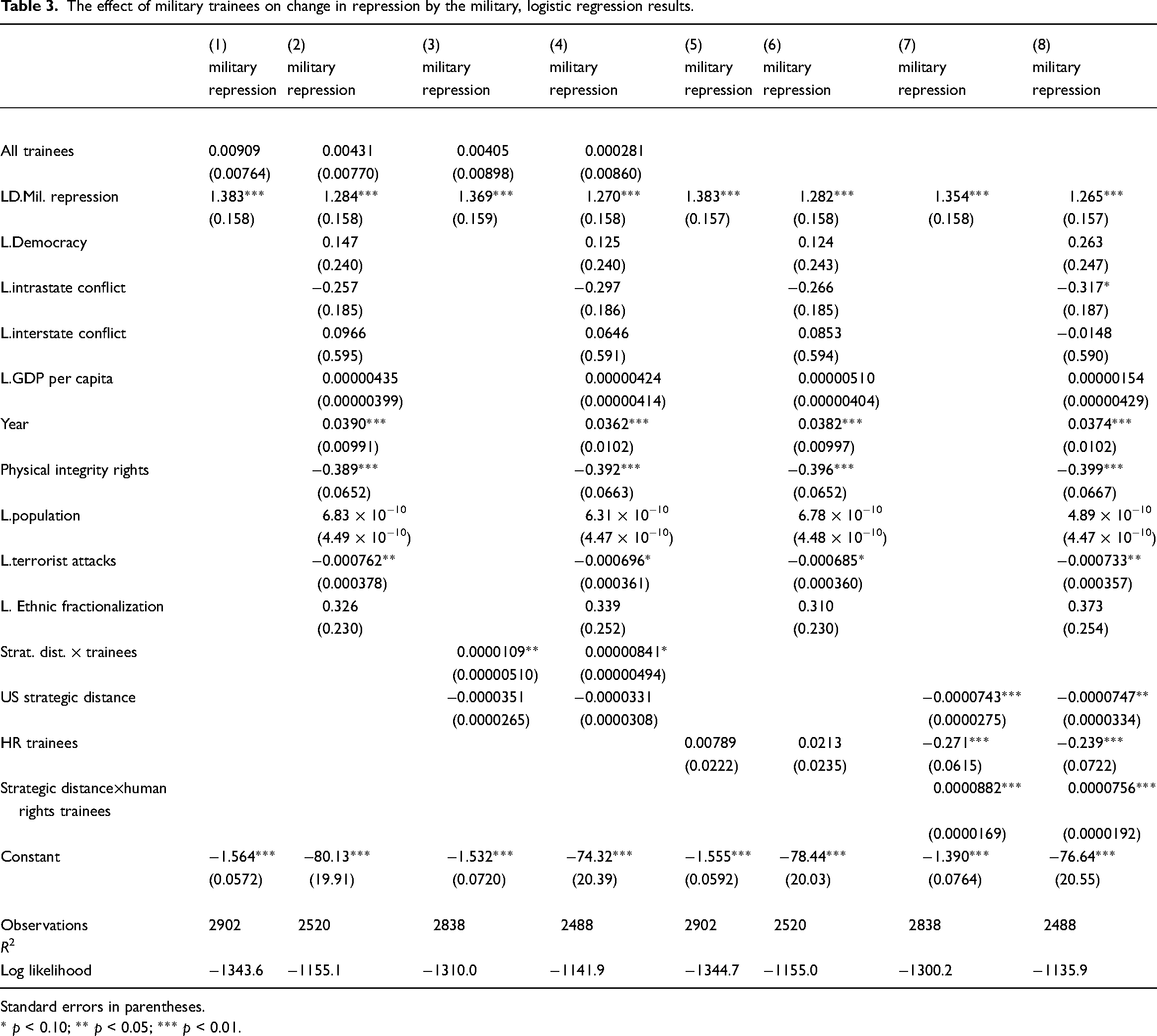
Table 3 presents the results of the first set of logit models, which use the events data-based measure of repression as the dependent variable, specifically considering the change in the level of repression as the dependent variable. 9 Models 3.1–3.4 consider all US military training received (to test Hypothesis 1a), while Models 3.5–3.8 consider only human rights training (to test Hypothesis 1b). Model 3.1 is a basic model with the only independent variables being the level of general trainees and the lagged dependent variable. Model 3.2 adds the control variables. Models 3.3 and 3.4 are analogous, but include the security salience measure as well as the interaction term between trainees and security salience. Models 3.5–3.8 follow the same pattern, with human rights trainees as the main independent variable.
The effect of military trainees on change in repression by the military, logistic regression results.
Standard errors in parentheses.
* p < 0.10; ** p < 0.05; *** p < 0.01.
The models show limited support for Hypotheses 1a and 1b, which predict a negative relationship between the level of US-trained members of the military and repression, whether it is all trainees or human rights-focused trainees, respectively. There is more support for Hypothesis 2, which states that this relationship will be more likely to hold once we consider the security salience of the trainees’ home state to the US, although this is only the case when considering human rights-focused trainees. 10 Given the problems with interpreting the constitutive terms of an interaction term, I present the results graphically in Figure 2 (based on Models 3.4 and 3.8; Brambor et al., 2006). Figure 2 shows the average marginal effect that a one unit change in the percentage of the military that is trained by the US has on the probability of the military engaging in repression, at varying strategic distances. The panel on the left refers to all trainees, whereas the one on the right includes only human rights-focused trainees.
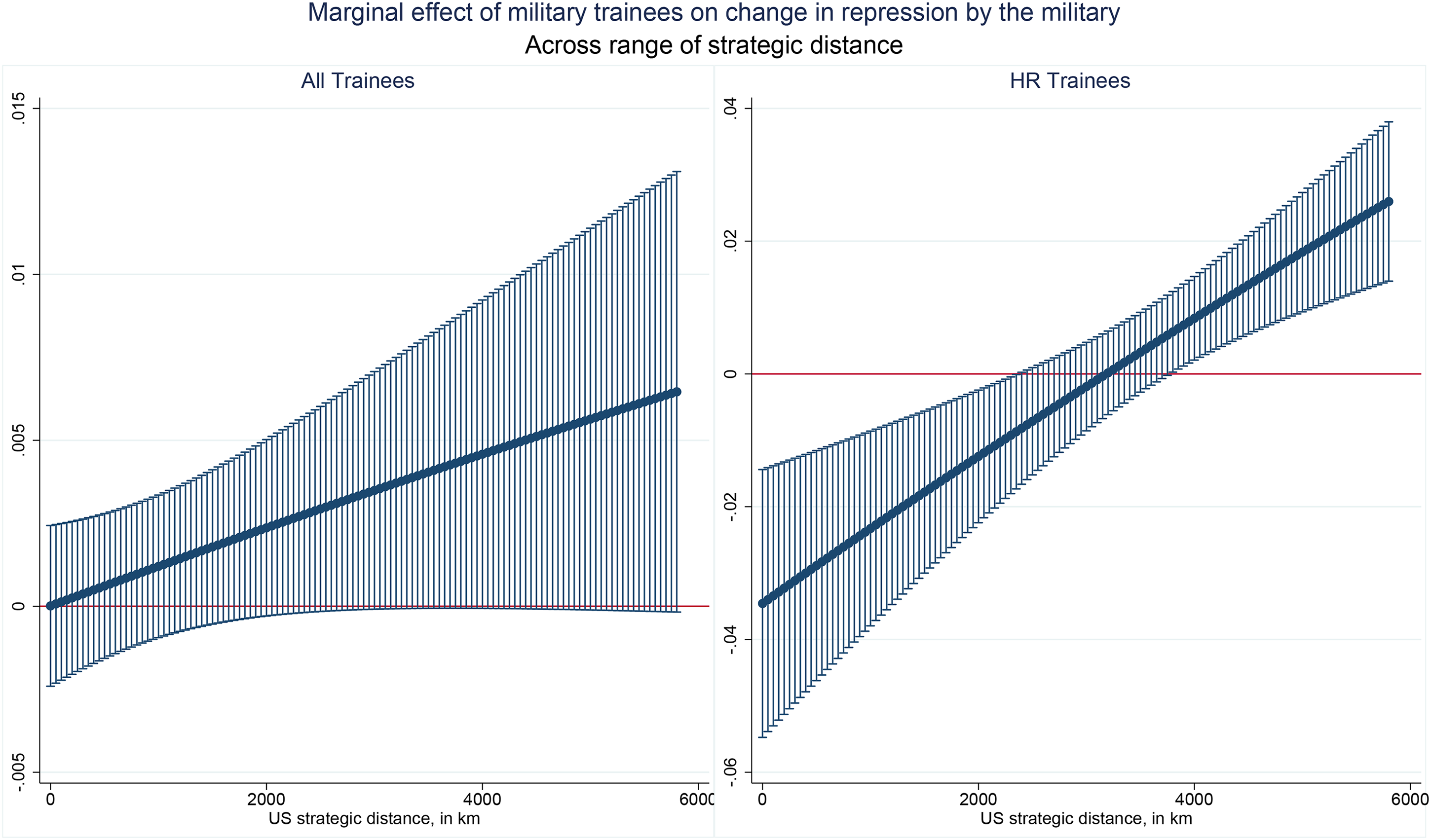
Marginal effects models 3.4 and 3.8.
Figure 2 shows that when considering all trainees, there seems to be no significant effect on repression by the military, regardless of strategic distance. In contrast, in the case of human rights-focused trainees it shows that when the strategic distance to the US is smaller, up to approximately 2000 km, increasing the proportion of military members trained by the US reduces repression by the trainees’ military. 11 These findings thus lend some support to the second proposed mechanism for how it is that US military training can influence respect for human rights. 12 If the influence followed a “training as aid” mechanism in which the fear of losing training made recipient states change their behavior, then we should see an effect for all types of training, regardless of their human rights content. Instead, we seem to see support for the possibility that the content itself of the military training may be influencing the behavior of the security forces in the recipient state. I caveat this finding by noting that Figure 2 also shows that for states with a higher strategic distance to the US (states that are less strategically salient), there is actually a positive correlation between the proportion of trainees and repression. This is an unexpected finding that I will further discuss in the conclusion section. 13 The following section continues to explore this dynamic in a more focused Latin America sample.
An alternative measure of physical integrity right violations in Latin America
Table 4 presents the summary statistics from the alternative measure of physical integrity right violations. As previously mentioned, the index measure can range from 0 (no physical integrity rights violations) to 8 (the highest level of physical integrity rights violations). Overall, the mean level of rights violations by the military is 0.57, which is lower than the level for the police, which is 2.44. Paramilitaries, which are relative rare, have a lower level of violations at 0.22. The dichotomized measures, used in the analysis to be comparable with the results from the repression measure based on the events data, show a similar pattern.
Summary statistics.
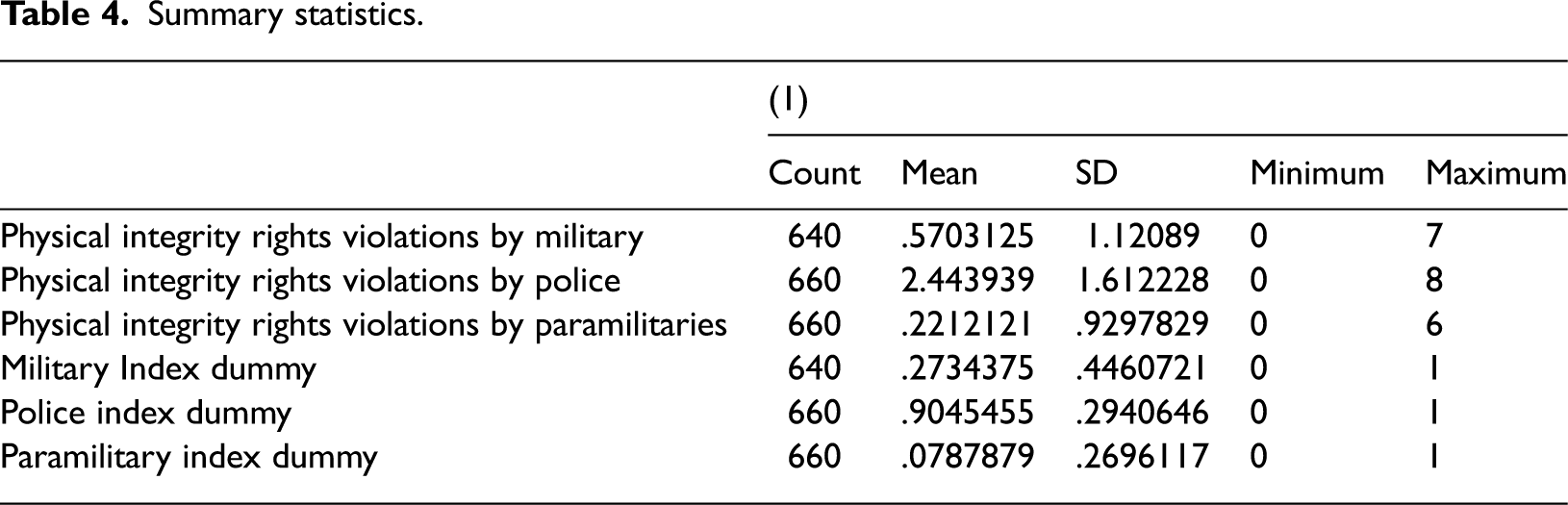
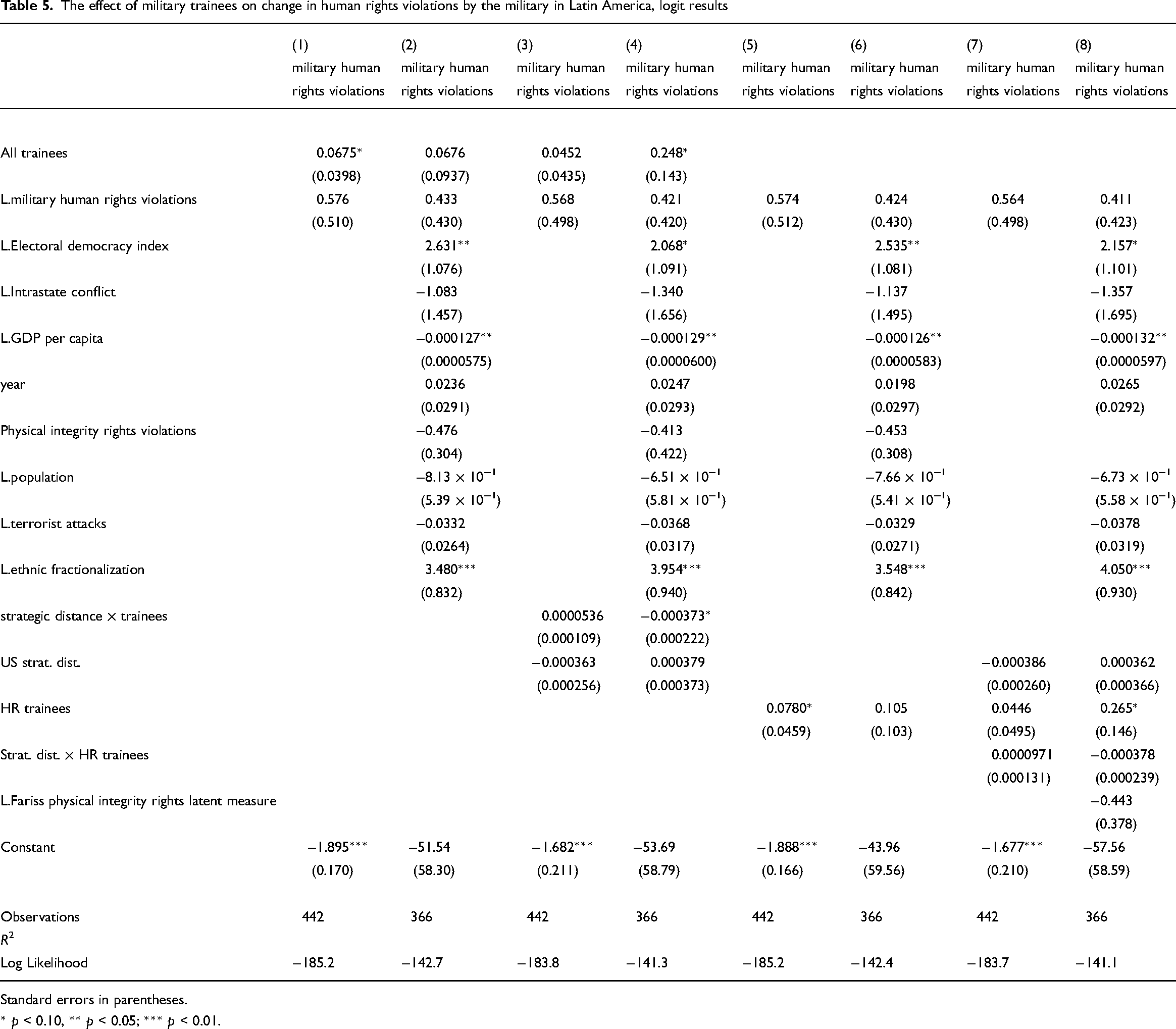
Table 5 presents the results of the set of models which use the change in physical integrity rights violations by the military as the dependent variable. Similarly to Table 3, Models 5.1–5.4 include all military trainees, while Models 5.5–5.8 include only human rights-focused trainees. Model 5.1 is a basic model with the only independent variables being the level of trainees and the lagged dependent variable. Model 5.2 adds the control variables. The only differences are that interstate war, which Latin America does not experience in this time period, is excluded, and I add a dummy variable for Colombia to make sure that the Plan Colombia observations are not driving the results. Models 5.3 and 5.4 are analogous, but include the security salience measure as well as the interaction term between trainees and security salience. Models 5.5–5.8 follow the same pattern, but including only human rights trainees. 14 Figure 3 presents the marginal effect of trainees on human rights violations at varying levels of strategic distance, based on Models 5.4 and 5.8.
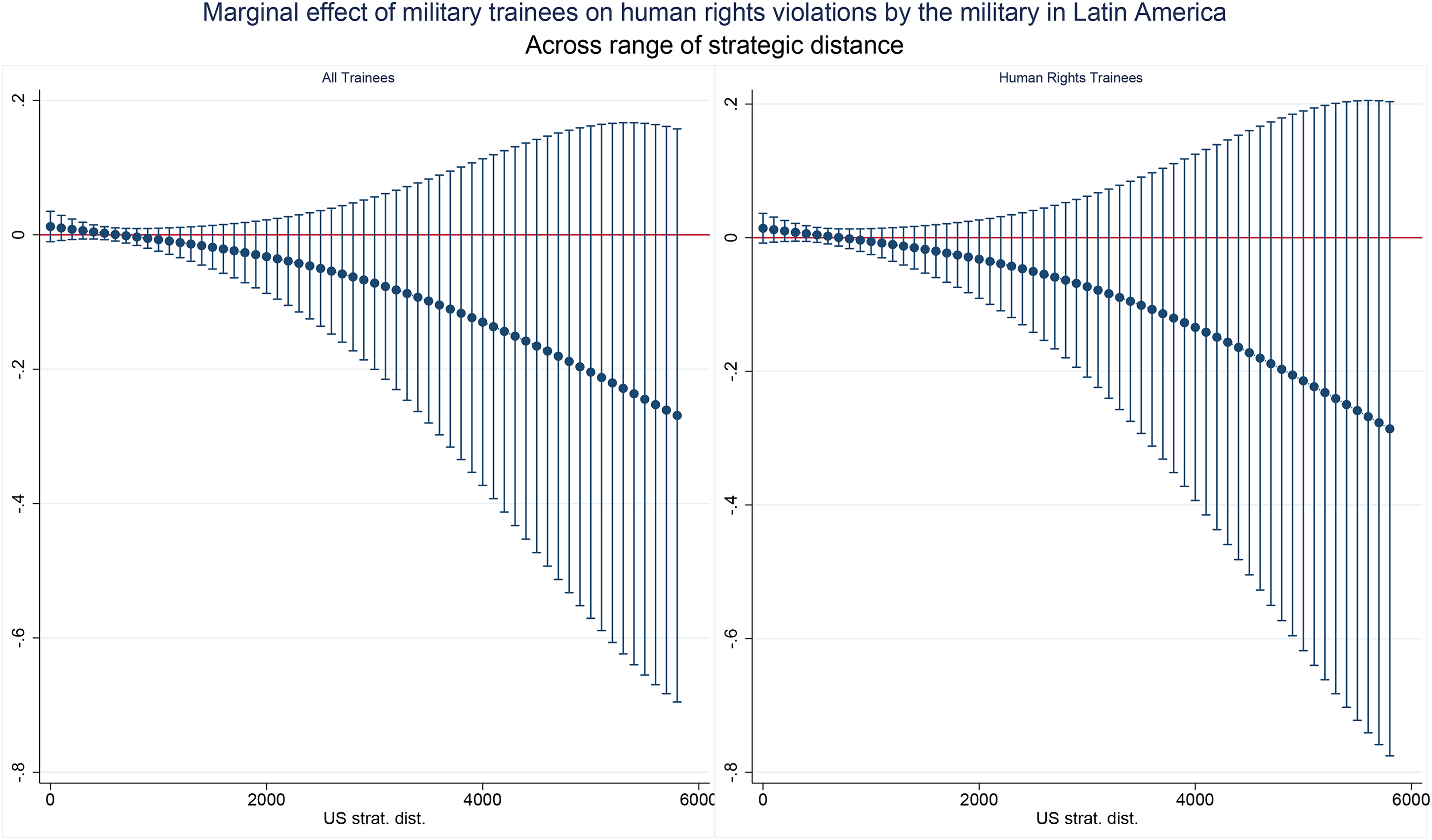
Marginal effects models 5.4 and 5.8.
The effect of military trainees on change in human rights violations by the military in Latin America, logit results
Standard errors in parentheses.
* p < 0.10, ** p < 0.05; *** p < 0.01.
In contrast with the models that use levels of repression as the dependent variable, these models show essentially no evidence for US military training being associated with lower levels of human rights violations, regardless of whether it is human rights-focused and of the recipient state's strategic distance. 15 Thus it appears to be the case that, at least in the limited sample of Latin American states between 2000 and 2016, US military training is not associated with higher or lower levels of human rights violations by the military.
Conclusion
The US Congress has passed various forms of legislation to ensure that states that violate human rights do not benefit from US military aid. At the same time, the case of military training presents the US with a conundrum: military training is itself intended to remedy human rights violations, such that cutting human rights violators off from training would in part defeat the purpose of the training. The question that remains is whether training can indeed help to improve the human rights records of a state's security forces.
I found that military training faces a difficult challenge in addressing human rights violations, and that more often than not, the answer to this question is a no. The narrow cases in which there is indeed a positive relation between training and the military respecting humans rights depend on (a) the type of military training offered, (b) the strategic importance of the recipient state, and (c) the measure of human rights used. The more general models that included all types of training showed no significant relationship between the number of trainees and human rights violations, whereas the ones that used human rights-focused training did in some cases find a negative relationship between training and repression by security forces. This offers some support for the idea that foreign military training and education can decrease repression by the armed forces when it includes human rights topics in its curriculum. The finding that this effect is largest in strategically important countries emphasizes that it is the follow-up dynamic of checking for improvements that is producing this effect, more than the threat of the removal of training.
One possibility that future research should consider is whether a type of “Hawthorne effect” is at play, where militaries that receive human rights training do not necessarily internalize these norms against repression, but become aware that the US places importance on them and will be watching for violations. In this case, the change in behavior would happen because recipients are aware of being observed. This type of dynamic would fit well with the finding that the more closely monitored high-salience states are the ones that show a significant relationship between training and decreases in military repression. 16
Importantly, these relationships only hold when measuring human rights violations as repressing collective actions of dissent. In contrast, the set of models that used an alternate measure of human rights violations that is based on reports of physical integrity rights violations presented in the State Department Human Rights reports shows that at least in the case of Latin America, there is no statistically significant relationship between US military trainees and physical integrity rights violations by the military. Thus, under this measure, military training does not appear to be as effective at promoting human rights.
The difference between the two measures may be based on the higher visibility of actively repressing dissent, such as breaking up protests, as opposed to physical integrity rights violations such as disappearances or torture, which can be easier to hide from international observers. In addition, the multivariate probit analysis presented in Appendix Table A4, shows some evidence of substitutability between physical integrity rights violations by military and paramilitary forces. This analysis thus shows some support for the possibility that, at least in the case of Latin America, reductions in military repression may be associated with increases in paramilitary repression, thus implying a potential substitution effect (Kiyani, 2021). Much like occurred in the case of Colombia, recipient countries under pressure to improve the human rights record of their militaries may be shifting repression over to other security agents. Future work should continue to explore this dynamic.
The unexpected finding of the positive relationship between US military training and repression in low-salience states (which was not observed in the case of the Latin America sample) is one that should be further explored in future research. It may be the case that this is not necessarily showing that military training is leading to greater human rights violations, but is rather an illustration of the selection bias that occurs when human rights violators are more likely to receive training in the first place. States that are not of high security salience to the US are also less likely to receive as much media attention as the high-salience ones, and thus are less likely to show improvement. In addition, the conditional findings of this analysis suggest that there is a need for more detailed study of the relationship between foreign military training and repression. As Dillon Savage and Scharpf (2022) have done in studying political militarization, it will be helpful for future work to study the specific content of foreign military training courses to determine in more detail what type of content can influence the actions of the trainees.
Supplemental Material
sj-pdf-1-cmp-10.1177_07388942231159582 - Supplemental material for School of influence: Human rights challenges in US foreign military training
Supplemental material, sj-pdf-1-cmp-10.1177_07388942231159582 for School of influence: Human rights challenges in US foreign military training by Carla Martinez Machain in Conflict Management and Peace Science
Supplemental Material
sj-do-2-cmp-10.1177_07388942231159582 - Supplemental material for School of influence: Human rights challenges in US foreign military training
Supplemental material, sj-do-2-cmp-10.1177_07388942231159582 for School of influence: Human rights challenges in US foreign military training by Carla Martinez Machain in Conflict Management and Peace Science
Supplemental Material
sj-dta-3-cmp-10.1177_07388942231159582 - Supplemental material for School of influence: Human rights challenges in US foreign military training
Supplemental material, sj-dta-3-cmp-10.1177_07388942231159582 for School of influence: Human rights challenges in US foreign military training by Carla Martinez Machain in Conflict Management and Peace Science
Footnotes
Acknowledgement
The author would like to thank three anonymous reviewers and the CMPS editorial team, Sam Bell, Rich Frank, Tobias Heinrich, Dursun Peksen, Leah Windsor, and Asif Efrat and the participants of the “Democratic and Rule-of-Law Implications of Military Deployments Abroad” workshop for their help in preparing the manuscript, as well as Kaitlin Stanley, Dietra Sober, Lexi Finley, Emily Featherston, Duru Dogan, Harris Sheikh and Jahanzib Masjidi for their work as coders. All remaining errors are my own.
Funding
The author received no financial support for the research, authorship, and/or publication of this article.
Supplemental material
All data, replication materials, and instructions regarding analytical materials upon which published claims rely are available online through the SAGE CMPS website: https://journals.sagepub.com/doi/suppl/10.1177/07388942231159582

Notes
References
Supplementary Material
Please find the following supplemental material available below.
For Open Access articles published under a Creative Commons License, all supplemental material carries the same license as the article it is associated with.
For non-Open Access articles published, all supplemental material carries a non-exclusive license, and permission requests for re-use of supplemental material or any part of supplemental material shall be sent directly to the copyright owner as specified in the copyright notice associated with the article.
