




Abstract
Recent research examines when and why women join rebel groups as combatants. However, we are only beginning to understand how their presence affects rebel group behaviour and conflict dynamics more generally. I address this gap by analysing how women's participation influences two dimensions of rebel behaviour: their relationship to civilians and their fighting performance. I argue that a greater number of female rebels decreases civilian victimization, but also reduces rebel combat performance. I test these propositions using time-varying district-level data from the Nepalese civil war. The results support both expectations. These findings increase our understanding of the effects of women's participation in civil war.
Keywords
Introduction
In contrast to many popular depictions, civil wars are not only fought by men. While most combatants are male, women participate in armed conflict not only as victims but also as perpetrators of violence. For example, women have played a prominent role in Kurdish forces’ military activities in northern Syria, e.g. the recapture of Kobanê in 2015 or the resistance against Turkey's ongoing military intervention. They also fight or fought in the armed conflicts in Colombia, Sri Lanka and eastern Ukraine (Alison, 2003; Trisko Darden et al., 2019). As a result, numerous qualitative studies provide in-depth examinations of women's recruitment and roles in specific civil wars 1 and quantitative work is increasingly asking more broadly why women fight in some but not all civil wars (e.g. Henshaw, 2016; Thomas and Bond, 2015; Thomas and Wood, 2018; Wood and Thomas, 2017). A nascent literature also considers how the presence of female combatants in rebel groups affects the behaviour of that group and conflict dynamics more generally. Rebel groups where women voluntarily participate may be more enduring and less likely to be defeated in civil war (Braithwaite and Ruiz, 2018; Giri and Haer, 2021; Wood and Allemang, 2021), while the presence of female combatants among rebels may be associated with decreased conflict-related sexual violence (Loken, 2017; Mehrl, 2020). Furthermore, a group of recent studies claims that the presence of women increases group legitimacy, and allows rebels to mobilize larger fighting forces, peacekeeping missions, and third-party support (Loken, 2021; Manekin and Wood, 2020; Mehrl and Dworschak, 2021; Wood, 2019).
I seek to contribute to this debate by analysing how the participation of female combatants influences two crucial dimensions of rebel behaviour, namely their relationship to civilians and their fighting performance. These dimensions are important because, in order to win any war, an armed group must defeat the enemy on the battlefield but also win and keep the support of the civilian population. Taking up the suggestion that female recruits are ‘specialized labour’ for rebel organizations (Thomas and Bond, 2015: 490), I argue that their presence has diverging effects on two dimensions of group behaviour.
First, I propose that civilians view female rebels as less dangerous than male ones, providing them with better access to and rapport with especially female civilians. This increased contact with civilians should make the relationship between rebels and civilians more amicable, result in civilians voluntarily providing resources and thus reduce rebels’ incentives for coercion. In addition, it should result in civilians sharing more information with rebels, allowing better targeting of politically suspect civilians such as informers while refraining from indiscriminate violence. This induces a negative effect of female combatants on lethal rebel violence against civilians.
However, second, I also expect that the presence of female combatants lowers rebels’ fighting performance. Gender inequality is a persistent feature of most countries experiencing civil wars and, in this context, many male-rank-and-file combatants will view the participation of women in fighting units as a threat to their status and hence push back against it. This male backlash reduces unit cohesion and thus combat effectiveness. At the same time, female recruits may seek to introduce gender issues as an additional organizational goal at the risk of creating further internal conflict and disagreement. Against the backdrop of pre-existing gender inequalities, I thus expect that women's presence in rebel groups decreases rebel combat effectiveness.
I test these two arguments using quantitative microlevel data from the Nepalese civil war. I accordingly examine variation in the share of female combatants over fighting units of one rebel group, the Communist Party of Nepal – Maoist (CPN-M), and how it affected these units’ victimization of civilians and fighting performance. This subnational research design addresses a number of group- and country-level determinants of both dependent variables such as ideology and target government while allowing me to go beyond rough categorical indicators for measuring women’s participation in rebellion. Nepal is an interesting case for this purpose. Its society is ridden with various forms of gender discrimination, such as forced marriage and the use of menstruation huts (Goswami, 2015; Jolly and Venema, 2017). However, the CPN-M explicitly counted the fight against these practices among its objectives, resulting in substantial female recruitment and up to 40% of its active members being women (K.C. and Van Der Haar, 2019; Sharma and Prasain, 2004). This is counterintuitive because women are more likely to join armed groups in more gender-equal societies (Thomas and Wood, 2018). My results provide support to both of my expectations. These findings should generalize well to other cases of substantial female participation in ideologically rooted insurgencies such as those in El Salvador, Colombia or India's Red Corridor.
Theoretical framework
While Thomas and Wood (2018) argue that the supply of female recruits for insurgencies is more likely in societies that are gender equal in terms of social and economic activities, there are also various demand-side factors that structure women's recruitment. Rebel groups’ willingness to recruit females plays a role as women particularly join leftist groups or those with a gender ideology (Henshaw, 2016; Thomas and Bond, 2015; Wood and Thomas, 2017), but are hardly recruited into Islamist groups (Wood and Thomas, 2017). Rebel demand for female recruits is also determined by strategic factors. Larger rebel movements that need to mobilize more fighters are more likely to consider recruiting women (Thomas and Bond, 2015) and women may serve as ‘an important type of specialized labour’ owing to the stereotypes generally associated with femininity (Thomas and Bond, 2015: 490). I use this idea of women as ‘specialized’ rebel recruits as a starting point to develop my argument on how females should affect two key dimensions of rebels’ strategic behaviour in armed conflict: relations with civilians and fighting performance.
Thomas and Bond focus on female membership in terrorist organizations when testing their specialized labour argument as women may be more effective suicide bombers (see also Alakoc, 2020). However, they acknowledge that being perceived as ‘more pacific, more caring, and less physically dangerous than men’ (2015: 490) should also provide women with better access to and rapport with civilians in their area of operation. This should hold for all civilians but especially be the case for interactions with female civilians. Civilian women should perceive a bigger difference in the physical danger posed by male and female rebels owing to differences in physical strength as well as the added possibility of falling prey to sexual violence. 2 In addition, societal gender roles may make it generally frowned upon for women to interact with male strangers, thus further limiting male rebels’ possible rapport with female civilians and providing female rebels with a comparative advantage.
Relatedly, Karim (2017, 2019) finds that contact with female peacekeepers and police officers increases civilians’ trust in and demand for these security forces and that it leads civilians to regard female peacekeepers as ‘better’ than male ones. However, her results also indicate that women generally prefer female peacekeepers and that the effect on demand for security services is mostly driven by women (see also Córdova and Kras, 2020). This substantiates the idea that female members of military organizations are seen as more approachable and trustworthy by civilians generally but by women especially. At the same time, it is argued that their inclusion boosts rebels’ legitimacy and support among civilians as women are perceived to fight only when facing legitimate grievances (Braithwaite and Ruiz, 2018; Loken, 2021; Manekin and Wood, 2020).
This is not lost on rebel organizations: Colombia's FARC and the El Salvadorian FMLN, but also Mao's Chinese Red Army, relied on women to engage with civilians, even creating majority- or all-female squads for this specific purpose, 3 because of them seeming less threatening and being better communicators than men (DeGroot, 2001; Herrera and Porch, 2008; Viterna, 2013). The FMLN, CPN-M and Sri Lanka's LTTE even had specific women's organisations working to mobilize support among female civilians (Alison, 2003; Sharma and Prasain, 2004; Viterna, 2013). These higher levels of interaction, legitimacy and trust achieved by rebel forces which include women should result in more amicable relationships and cooperation with local civilians, thus decreasing the potential for conflict between them.
Specifically, civilians should not organize collective, potentially violent resistance, e.g. self-defence militias, when their relationship with the rebels is positive. However, they should also be more willing to voluntarily provide resources such as information, recruits, shelter and food to rebels. As such, rebels would have little need to resort to violence against these civilians but instead an incentive not to victimize them as doing so would endanger the positive relationship and hence result in less resource provision down the line (Wood, 2010). If, in contrast, rebel–civilian relations are hostile, rebels will have to engage in violent coercion to obtain resources, going as far as to kill non-combatants and loot their belongings. In Nepal, CPN-M fighters credited women's presence in the group as a reason for recruitment (Subedi, 2013), while the CPN-M women's association organized well-attended political classes for civilian women, mobilizing them to join the group, provide food or produce ammunition for it (Onesto, 2005: 177–178). Female combatants also played key roles in the CPN-M cultural squads performing at village mass gatherings which combined Maoist propaganda with songs and performances, attracted even civilians initially opposed to the rebels, and convinced many to join the group (Dahal, 2015; Pettigrew, 2003). This suggests that at least in Nepal, women's participation facilitated positive relations with civilians, resulting in material support and recruits for the rebels, and thus reduced rebels’ incentive for violence against civilians.
In addition, there is another reason to think that women's presence in rebel organizations should decrease the extent to which they victimize civilians. If female rebels do indeed have better access to civilians than male ones owing to being seen as more trustworthy and less dangerous, they should also be able to obtain more and better information from them (see Wood, 2019: 88). Rebel organizations with female members should thus suffer less from ‘information starvation’ (Lyall and Wilson, 2009). Indeed, studies on the CPN-M, FARC and FMLN indicate that female rebels successfully worked to obtain intelligence from civilians (Herrera and Porch, 2008; K.C. and Van Der Haar, 2019; Viterna, 2013). This should have allowed them to better identify and target individuals that collaborate with the enemy, in turn making indiscriminate violence against groups suspected of this less necessary (see Kalyvas, 2006). Women's participation in rebellion should thus decrease rebels’ incentives for coercion to obtain resources from civilians and decrease their need for indiscriminate targeting as a tool of deterrence. As a result, I expect:
Specifically, the inclusion of female combatants may decrease combat units’ fighting effectiveness by reducing their internal ability to cooperate and coordinate. Women face inequalities in their economic, societal, political and educational opportunities in many, especially economically less-developed, societies (Jayachandran, 2015; World Economic Forum, 2019). As a result of this discrimination, some female combatants may find it hard to trust and cooperate with male soldiers, resulting in reduced unit fighting performance (Lyall, 2020). More importantly, however, such inequalities may lead privileged individuals to agitate against the inclusion of members of the discriminated group in order to protect their status (Lyall, 2020: 57–58). While female combatants may thus see combat participation, especially within rebel organizations with emancipatory goals, as a way to improve their situation, male fighters may find this threatening and hence push back against it. This threat perception should be particularly high when women become both quantitatively and qualitatively more prominent in the group as they not only fill support roles, leaving the fighting to the men, but also actively participate in combat in large numbers.
As a result, women's participation in fighting units should decrease units’ ability to cooperate, coordinate and fight effectively. However, this would not be due to the actions of women or that of the rebel leadership which, as in many emancipatory groups, actively seeks to integrate women for ideological and strategic reasons. 4 Instead, this decreased cohesion would be due to the pushback of male lower-status individuals, rank-and-file fighters who see women as a threat to their status. 5 In this vein, research on state militaries documents significant pushback from male soldiers against serving with women and the negative effects this has on unit cohesion (Heinecken, 2017; MacKenzie, 2015; Rosen et al., 1999, 2003). Such pushback has also been reported for prominent examples of non-state groups that incorporated women, e.g. FARC, LTTE and the Kurdish PKK (Alison, 2004; Haner et al., 2020; Herrera and Porch, 2008). In the CPN-M, some men sought to limit women to their traditional roles and opposed women commanders (Onesto, 2005: 181), leading even the leader of the CPN-M to openly acknowledge that the party had ‘tried to develop the leadership of women comrades’, but that it remained a ‘very big problem’(Onesto, 2000).
The inclusion of women in military organizations should only have a more prominent effect on fighting performance if these recruits seek to shift organizational goals. Thomas and Bond (2015) suggest that the recruitment of female combatants may cause internal rifts in a rebel group as these recruits may call for gender issues to be an additional group goal (see also Wood, 2019: 32–33). Along these lines, the CPN-M only started seriously discussing women's rights after the onset of the war owing to the heavy participation of women (Onesto, 2000). This would in turn anger elements inside the group that are opposed to female empowerment or see it as a subordinate issue, inducing internal conflict over group objectives and thus decreasing members’ shared commitment to what have suddenly become ambiguous goals.
In this vein, Olsson (2005) points to Namibia's SWAPO movement avoiding the question of gender equality to preserve internal unity. In addition, the main Kurdish groups in Iraq, the KDP and PUK, have been much more hesitant to integrate women into their combat forces than their Turkey- and Syria-based equivalents as doing so would upset their conservative, mainly rural support base (Trisko Darden et al., 2019: 46–48). Accordingly, the few women who have joined these forces see it as an opportunity to increase societal gender equality but regularly meet pushback from patriarchally minded male soldiers as further recruitment of women was even stopped in 2015, allegedly owing to a lack of funding (Nilsson, 2018; Trisko Darden et al., 2019: 45). Finally, Thomas and Bond demonstrate how such conflict over gender equality and the integration of women led to the splintering of the Eritrean Liberation Front and its year-long conflict with the off-shoot Eritrean People's Liberation Front (Thomas and Bond, 2015: 500–502). Women's participation in military organizations may thus not only decrease these groups’ ability to cooperate and coordinate but also to what extent their members agree on and are willing to fight for common goals.
As the ability to cooperate efforts in pursuing a common goal is a key prerequisite of fighting effectively (see e.g. Lyall, 2020; McLauchlin, 2015; Pilster and Böhmelt, 2011; Shils and Janowitz, 1948), I expect:
Civil War in Nepal
The Nepalese Civil War began as an armed insurrection when members of the Communist Party of Nepal – Maoist (CPN-M) attacked police stations in February 1996. These assaults followed government repression of the party and a Maoist catalogue of demands that the government had ignored. In its first years, the conflict was largely concentrated in rural areas in the country's Midwest and fought with low intensity between CPN-M members operating as guerrillas and Nepalese police forces (Mehta and Lawoti, 2010). The Nepalese army only got involved after the Maoists had proclaimed the second phase of their insurrection in November 2001, switching from pure guerrilla tactics to more open warfare and attacking military barracks (Eck, 2014; Mehta and Lawoti, 2010). This shift caused a significant increase in fatalities as more were recorded in 2002 alone than in the preceding six years of conflict. A state of intense warfare continued until 2006 when the conflict ended with a peace deal between CPN-M and the government, having killed almost 15,000 people (Joshi and Pyakurel, 2015).
Linking Maoist tenets to existing grievances of the indigenous and low-caste segments of Nepal's rural population, the CPN-M mainly mobilized support among rural individuals with a variety of ethnic and caste backgrounds, casting their experience of inequality and underdevelopment vis-à-vis ruling upper-caste elites as a class struggle (Joshi and Mason, 2010). This ideology was emphasized both in recruitment and afterwards as new recruits had to prove their political values before being allowed into the group's military wing (Eck, 2014).
The CPN-M based its political and military structure to a large degree on geography, eventually dividing Nepal into three divisional commands, several regional and sub-regional bureaus, and the districts (ICG, 2005). Within this structure, major political and strategic decisions were made at the top while district commanders had considerable autonomy regarding day-to-day operations and could decide on military targets and tactics within their areas of responsibility (ICG, 2005; Jackson, 2019). CPN-M ancillaries, such as its women's association, were organized similarly. As the war continued, higher-level structures such as the division and bureaus were also repartitioned or newly created at times whereas the district organizations had existed already before the war, underwent little change throughout it and recruited most members from within their district (ICG, 2005; Onesto, 2005: 76–78). Accordingly, most operational units were based in one district which was the centre of their activities and rarely, if ever, crossed district borders (Holtermann, 2016; Onesto, 2005: 134–135, 154, 204). These units included pure fighting units, but also the cultural squads responsible for outreach (Pettigrew, 2003). Individual unit members also tended not to move around a lot, as even a divisional commander remained in the same location in the Terai running an intelligence operation for over two years (Jackson, 2019). Similarly, Onesto (2005: 139–140, 208) points to two Maoists who had joined the party long before the start of the insurgency, participated in first attacks in 1996 and remained active in their home districts at the time of reporting in spring 1999.
Since its onset, the war has been the subject of various subnational studies of armed conflict. 6 Most of these studies focus on how structural conditions such as economic inequality, agricultural subsistence patterns or geography affected the fighting (see e.g. Do and Iyer, 2010; Holtermann, 2016; Joshi and Mason, 2010; Murshed and Gates, 2005; Nepal et al., 2011). Two other studies investigate the logic of the CPN-M's and the government force's civilian targeting, focusing on battlefield dynamics and the victims’ demographic characteristics (Holtermann, 2021; Joshi and Quinn, 2017). In contrast, there are no quantitative studies focusing on women's participation in the CPN-M, even though this aspect had already been discussed by early publications on the conflict (see Sharma and Prasain, 2004).
Women were recruited into the CPN-M's fighting forces from the onset of the insurgency, often joining because of family ties or witnessing propaganda displays (K.C. and Van Der Haar, 2019; Onesto, 2005; Shrestha-Schipper, 2008). This mobilization was the result of gender discrimination being highly prevalent in Nepalese society, e.g. in the form of forced marriages, menstruation huts and laws prohibiting most women including widows from inheriting property, which the Maoists promised to change (Goswami, 2015; Pettigrew and Shneidermann, 2004; Sharma and Prasain, 2004). Within the CPN-M, all positions were open to women with many serving as combatants and some rising into commanding positions (K.C. and Van Der Haar, 2019; Onesto, 2005). Female combatants fought both in mixed and all-female units, in the main forces and auxiliary militias, as well as in rank-and-file and commanding positions, accounting for up to 30–40% of recruits (Goswami, 2015; Onesto, 2005; Sharma and Prasain, 2004; Shrestha-Schipper, 2008). Duties such as cooking and washing clothes were carried out by both men and women and the Maoists helped civilian women by, for example, punishing and trying to prevent sexual violence (K.C. and Van Der Haar, 2019; Sharma and Prasain, 2004). While the ultimate level of gender equality inside the CPN-M remains contested (Pettigrew and Shneidermann, 2004; Shrestha-Schipper, 2008), it is also clear that female combatants there experienced more social freedom and equality than they did before, or indeed after, demobilizing (K.C. et al., 2017; K.C. and Van Der Haar, 2019).
This combination of women's substantial mobilization into the CPN-M and Nepalese society being very patriarchal makes Nepal a relevant case to test female combatants’ effect on rebel behaviour as, on average, female recruitment into armed groups is more likely in more gender-equal societies (Thomas and Wood, 2018). Given the similarities in terms of societal organization and the ideological origins of both rebel groups, the results of this test should inform our understanding of women's participation in the Naxalite-Maoist insurgency in neighbouring India (see Maheshwari, 2018; Shekhawat and Saxena, 2015). At the same time, these results should also be generalizable to other cases of ideologically similar rebel groups with substantive female participation in patriarchal societies such as Colombia and El Salvador. In contrast, women's effect on group behaviour may well be different for groups that base recruitment not on ideology but on coercion, such as the Ugandan Lord's Resistance Army, or Islamist groups which are unlikely to recruit women in the first place (Wood and Thomas, 2017).
Data and empirical strategy
To test the propositions, I construct district-level panel data from a dataset that provides the date, location, demographic background, political alignment and way of being killed for 13,230 fatalities of the Nepalese civil war, 1996–2006 (Joshi and Pyakurel, 2015). Focusing on a single civil war allows me to hold a number of important confounders, including ideology, organizational culture and societal norms, constant. These data come from a Nepalese human rights organization, INSEC, which collected reports of killings from local newspapers, its field offices and a wide network of contacts in civil society and in both fighting parties. INSEC staff visited the site of all reported killings to verify the incident, documenting information about the event and its victims in the process. The data thus contain detailed information on fatalities’ individual attributes and should be of comparatively high quality regarding issues such as combatant identification or politicized reporting. Specifically, INSEC did not rely only on news-media reporting to identify candidate events, triangulated information on these events by interviewing people who knew the victim, and had access even to otherwise off-limits areas owing to its rapport both with Maoist and government forces 7 (Joshi and Pyakurel, 2015). These data should thus provide accurate information on fatalities’ identity and circumstances of death. This fatality census also does not exhibit the problems associated with the combatant surveys often used by similar studies (e.g. Humphreys and Weinstein, 2006; Oppenheim and Weintraub, 2017), i.e. non-random sampling of respondents, recall bias and interviewees’ hesitancy to answer sensitive questions on wartime behaviour.
I aggregate individual observations to the district-quarter year, which I use as unit of observation to test my hypotheses. I conceive of these district-quarter year observations as ‘quasi-units’ representing the military activity of rebels and security forces in a small geographic zone during a relatively short period of time. This approximation of fighting units follows from the CPN-M basing its military structure on geography and its pre-existing district organizations. District commanders had considerable decision-making powers while Maoist combatants were often highly mobile within but not outside their base districts. Using the district as the geographical level of observation thus allows me to identify quasi-units, i.e. combatants active within the same geographically confined area who received their day-to-day orders from the same commander.
To test hypothesis 1, I measure Maoist violence against civilians by counting the number of civilians killed by the Maoists in a given district-quarter year. I record 1764 district-quarter year observations of this variable instead of a possible 3300 as many district-quarter years did not experience any conflict incidents and are thus not part of my data. Its values range from 0 to 41 but more than 75% of observations take values from 0 to 2.
To test hypothesis 2, I require a measure of the Maoists’ combat performance. For this, I use the loss exchange ratio (LER), which explicitly relates Maoist combat fatalities to battle deaths incurred by the security forces. It measures units’ ability to destroy enemy forces while preserving their own and is calculated as
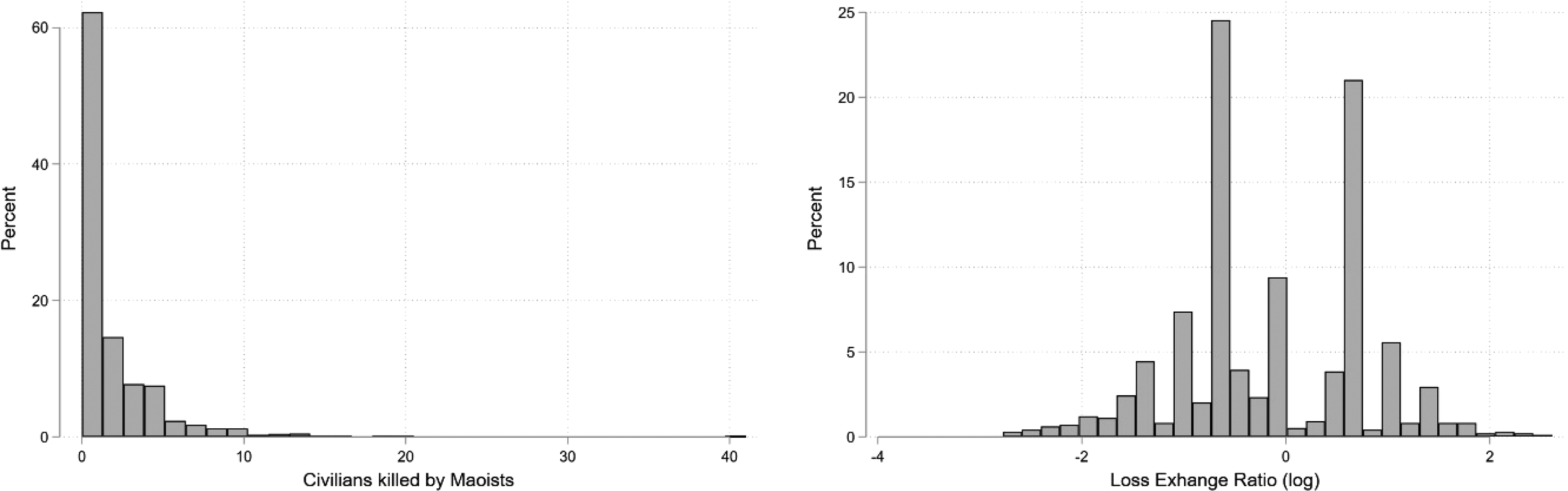
Histograms of the dependent variables. Note: Histogram of Maoist Violence against civilians (left) and of logged Loss Exchange Ratio (right).
I also construct the variables used to test my hypotheses from this dataset, meaning that I use data on killed combatants to approximate the attributes of the general rebel and security forces population. I thus assume that a unit's fatalities are broadly representative of its members more generally. This assumption should be relatively unproblematic as members of the same fighting units should not substantively vary in their exposure to combat and risk of being killed in it. This assumption allows me to create time-variant measures of unit characteristics in the Nepali civil war. Of course, it should be noted that the resulting numbers are estimates, not precise measures. I cannot use observations that are concurrent with the dependent variable to construct these variables as their possible values would depend on how many combatants were killed at that point in time.
10
Instead, I use the variables’ averages over the three district-quarter years preceding an observation,
I thus estimate the participation of female combatants in a Maoist unit as the average share of women among its fatalities during the period
At the same time, it needs to be emphasized that this potential systematic undercounting, while a form of measurement error, should not affect estimation results. For the measurement error to affect the estimation results, it would need to vary across units and, because I employ district-fixed effects (see below), within units across time. If that is not the case, the undercounting would only affect the district-specific intercepts but not the substantively interesting coefficient estimates. Women may be withheld from combat and instead serve in other roles due to several factors, e.g. organizational guidelines, societal norms or physical characteristics. Yet as these factors are very unlikely to temporally vary within districts over the period of observation, the resulting undercount of female participation in the Maoists will not affect the substantive estimation results but instead be captured by the subnational research design and district-fixed effects. 12 While women's fatality share may thus systematically undercount their participation among the CPN-M, this measurement error, owing to a lack of variation, should not affect the substantive results.
I use this variable to examine the effect of women's participation on violence against civilians. For combat effectiveness, an additional step is required. As that dependent variable, LER, is a dyadic measure of Maoist fighting effectiveness against the security forces, I also construct the independent variables in a dyadic fashion. I thus take the ratio of the Maoists’ and security forces’ values for a variable, that is
I use only the Maoists’ values on group-level variables when examining violence against civilians but employ the ratio between the Maoists’ and Security Forces’ values when examining combat performance. Summary statistics for the dependent variables and the two versions of female participation are presented in Table 1. 13 Women's share among Maoist fighting units is estimated to be 15% on average, well below existing estimates of 30–40% female membership (Sharma and Prasain, 2004). This indicates that the measure proposed here underestimates women's true participation rate, possibly owing to them occupying more non-combat roles than men.
Summary statistics of key variables.
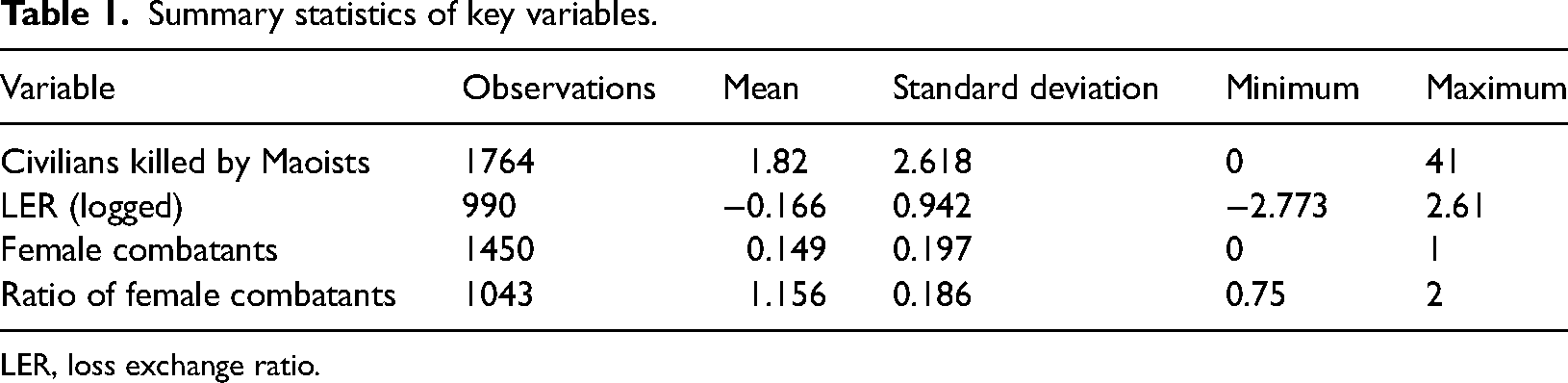
LER, loss exchange ratio.
Since lethal violence against civilians is a count variable, I use Poisson regression models. In contrast, I use ordinary least squares (OLS) to examine combat performance since the logged LER is a continuous outcome variable. Both analyses include district-fixed effects, which control for time-invariant features of a district that may affect both rebel behaviour and female participation, e.g. its local norms, political history, terrain, ethnic makeup and wealth (Angrist and Pischke, 2009: 221–224). In the case of violence against civilians, I use fixed effects Poisson because fixed effects negative binomial models either do not purge the effect of time-invariant predictors or lead to inconsistent and biased coefficient estimates owing to the incidental parameter problem (Allison and Waterman, 2002; Lancaster, 2000). In contrast, fixed effects Poisson models are consistent and robust even when the conditional mean and variance are unequal (Lancaster, 2000; Wooldridge, 1999). While conventional standard errors would be too small for these models, I correct this by clustering them on the district (Allison, 2009; Wooldridge, 1999). To account for within-unit dependences, I also cluster standard errors on the district in the OLS models and further include the average value of the respective dependent variable in the previous three periods z as a control variable. 14
In addition, I control for a number of time-varying unit and district characteristics that may be correlated with female participation as well as one or both outcome variables. Unless noted otherwise, these variables are constructed from the panel dataset based on Joshi and Pyakurel (2015). First, as discussed above, the Nepalese Civil War had two distinct phases which differed in their intensity and military tactics. I thus construct a dummy that takes the value 1 if a district-quart year observation happened after October 2001. 15 After this date, the Maoists increasingly asked households to contribute one member as a recruit and reports indicate that this was often a woman rather than a man (Becker, 2010; Goswami, 2015). At the same time, both outcome variables should be affected because of the conflict spreading beyond key areas of Maoist support and owing to the Nepalese army getting involved in the conflict.
Second, more socially heterogeneous fighting units have been found to be less cohesive and responsible for more violence against civilians (Costa and Kahn, 2003; Humphreys and Weinstein, 2006; McLauchlin, 2015). At the same time, Sharma and Prasain (2004) suggest that female recruits mostly belonged to indigenous groups, implying that their units were usually socially heterogeneous. I thus code fatalities’ membership in one of the five broader groups usually identified as politically relevant in Nepal and compute unit fractionalization scores as well as their ratio. 16
Third, a unit's fighting experience should affect its behaviour as veterans should be better at fighting but may also increasingly victimize civilians (Manekin, 2013). And while women participated in the CPN-M from the start of the insurgency, their recruitment may have increased after November 2001, implying that on average, women may have had a shorter participation period. Unfortunately, I cannot directly measure how long individuals fought with the Maoists. Instead, I approximate this via mean age – and its square – as older fighters, on average, should have more combat experience. 17
Fourth, the CPN-M recruited substantial numbers of child soldiers and they may increase both combat effectiveness (Haer and Böhmelt, 2016) and violence against civilians (Mehrl, 2021). As command positions tend to be filled by male adults, largely restricting women and children to the rank-and-file (Henshaw et al., 2019), one may expect a threshold to women's and children's participation in a unit and their shares to thus be interrelated. I hence control for the unit-share of child soldiers.
Fifth, the intensity of fighting should decrease the combat performance of organizations often using guerrilla tactics such as the CPN-M who may then react with increased violence against civilians (Hultman, 2007). In addition, higher battle loses should lead to more aggressive recruitment and, if households mainly contributed women when asked to send one member to the rebels, increased female participation. I thus employ the total number of combat fatalities in a district to control for the intensity of fighting.
Sixth, I include a dummy indicating when and where there were Maoist district people's governments. 18 These indicate territorial control and substantial support in these districts but also that the Maoists moved from pure guerrilla tactics to providing governance and services to communities. Hence, this factor may be related to their recruitment but also their behaviour towards civilians and combat effectiveness.
Finally, I control for a district's logged population size as it may correspond to an increased presence of the security forces but also a larger pool of male recruits. It is taken from the Nepali censuses of 1991 and 2001 (Central Bureau of Statistics, 1991, 2001); I use the 1991 values for the years 1996–2000 and the 2001 ones for 2001–2006.
I include these seven controls both when modelling Maoist violence against civilians and combat performance. In addition, models of the former include governmental violence against civilians as belligerents often respond to the other side's violence with more violence (Wood, 2010), but this also motivated women to join the Maoists (Sharma and Prasain, 2004). Models of combat performance further comprise a unit's share of high school graduates and recruits hailing from the district they are active in. Human capital in the form of education is a key driver of fighting effectiveness (Biddle and Long, 2004) and should also correlate with combatants’ gender because some families may be unable to send girls to school. The access to place-specific information and knowledge of the terrain available to locals are are key factors in (counter-)insurgency as they help with identifying enemies and with finding hideouts or places to avoid or ambush the enemy (Lyall, 2010). Women may be more likely to have such knowledge as they may exhibit less geographic mobility, to find work for example. I thus estimate the following two linear models:


Empirical results
Table 2 presents the results of the two models. The results in column 1 support the proposition that female combatants decrease a rebel unit's use of violence against civilians. Female Combatants exhibits a negative effect on Maoist violence against civilians which is statistically significant below 5%. To examine this effect substantively, Figure 2 plots the predicted number of civilians killed by the Maoists over the range of females’ share in a unit: perfectly balanced units kill approximately 0.6 civilians less per quarter-year than all-male units. While this effect seems small, note that 604 out of 1764 observed district-quarter years (34.24%) experience no violence against civilians and that in another 494 (28%), only one civilian gets killed. The effect of female participation on rebel violence against civilians is thus substantively quite significant. This result corroborates my claim that increasing female participation in rebel units decreases their level of civilian victimization.
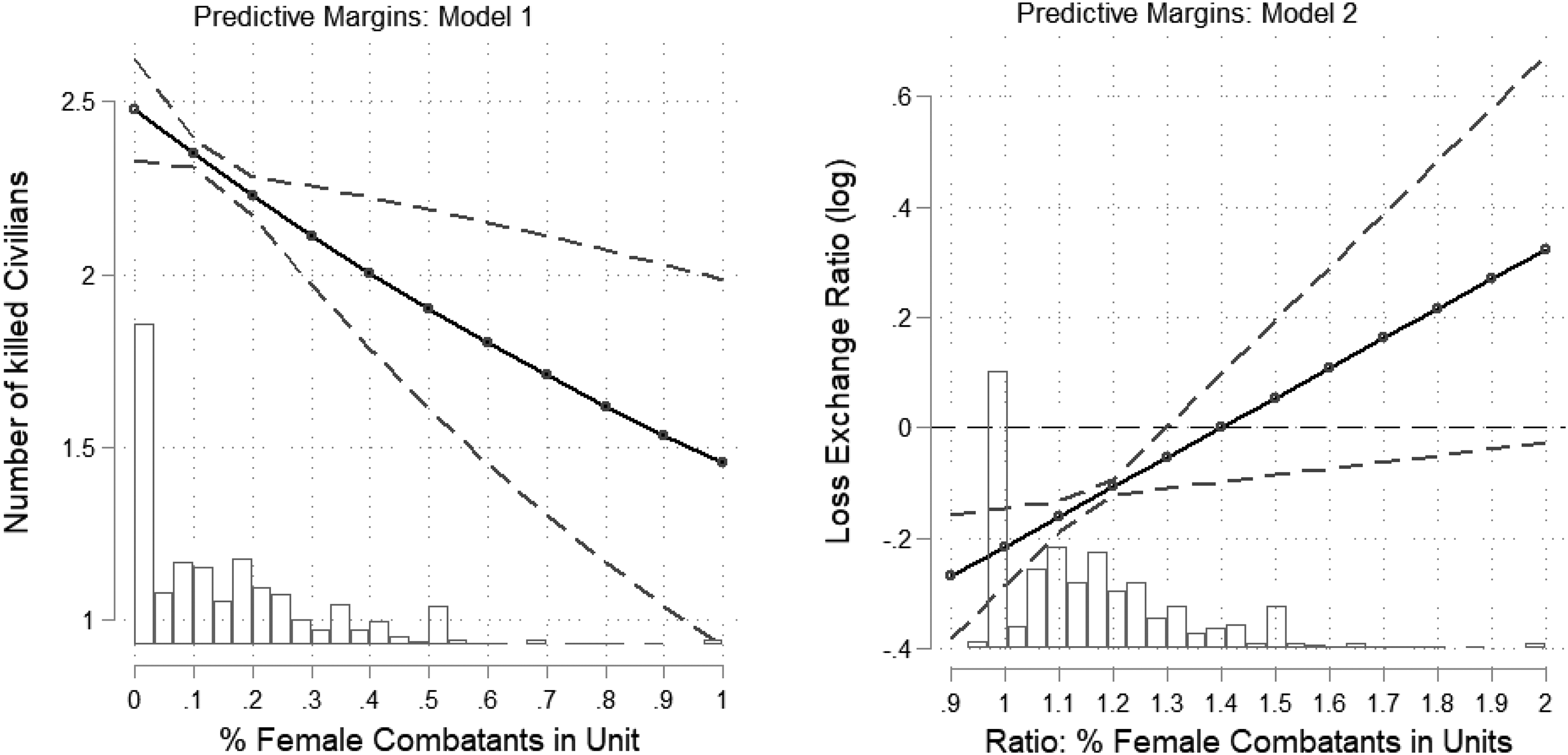
The substantive effects of female combatants on conflict dynamics. Note: Predicted number of civilians killed by Maoists over the observed range of female combatants (left panel); predicted LER values over the observed range of ratio of female combatants – horizontal dashed line indicates logged LER of 0 (=a LER of 1) (right panel). Grey dashed lines represent 90% confidence intervals. Histogram bins represent the share of observations with respective value.
Female combatants and conflict dynamics.
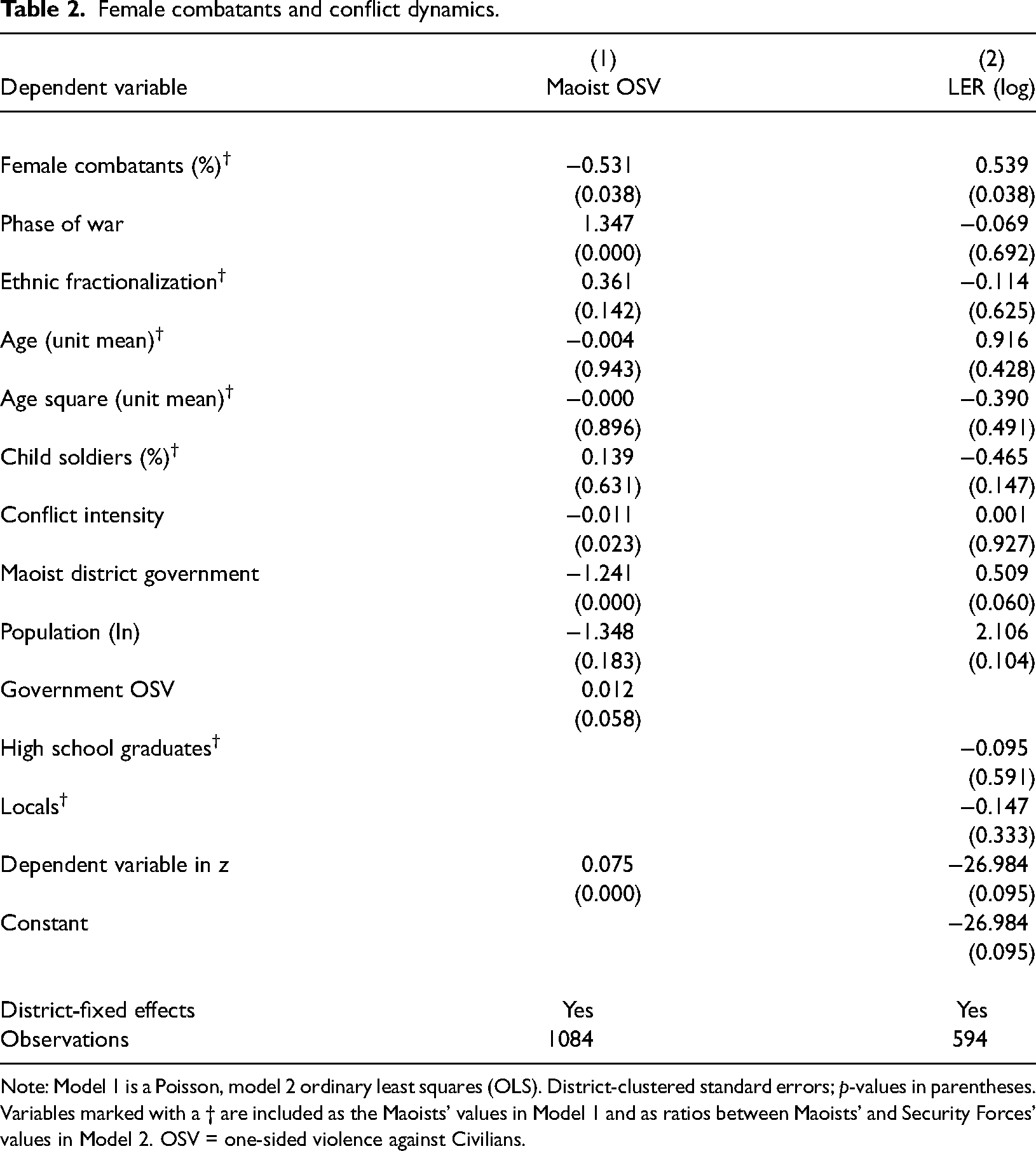
Note: Model 1 is a Poisson, model 2 ordinary least squares (OLS). District-clustered standard errors; p-values in parentheses. Variables marked with a † are included as the Maoists’ values in Model 1 and as ratios between Maoists’ and Security Forces’ values in Model 2. OSV = one-sided violence against Civilians.
Turning to hypothesis 2, note that a higher Loss Exchange Ratio indicates decreased combat effectiveness on the part of the Maoists as the LER is the number of rebel fatalities divided by the number of government fatalities. The results in column 2 support the expectation that female combatants also decrease a rebel units fighting performance. Female Combatants exhibits a positive effect on Maoist unit's Loss Exchange Ratio which is statistically significant with a p-value of 0.038. This indicates that, as the rebels have a comparatively higher share of females than the security forces, their ability to eliminate enemy forces while preserving their own decreases.
To examine this effect substantively, I also plot the predicted LER between Maoists and security forces over the observed range of ratios between women's share in Maoist and Security Forces units in Figure 2. This figure shows that rebel units that include less, as many, or slightly more women than the opposing security forces are predicted to achieve LERs significantly below 1, i.e. they incur fewer own fatalities than they inflict on the enemy. For instance, engagements where equally many women participate on both sides should result in an LER of ∼0.8, meaning that for each Maoist fatality, 1.25 government combatants were killed. This picture changes once Maoist units include more than 1.25 as many women as the security forces they are fighting. These units’ LERs cannot be statistically distinguished from a symmetrical LER of 1 even though their point estimates are bigger than 1 for rebel units with more than 1.4 times as many women as present in the enemy unit. This result indicates that rebel units with none or only few women fight more effectively than ones with more female participation as, in Nepal, they were better able to destroy enemy forces while preserving their own.
These results corroborate the idea that female combatants influence two important dimensions of rebel behaviour, violence against civilians and combat performance. They also provide support to the expectations that these women serve as specialized rebel labour who decrease civilian victimization but also diminish rebels’ combat performance. These findings should credibly not result from omitted variable bias. The research design focusing on one rebel organization in one country purges the effects of numerous potential group- and country-level confounders such as societal gender equality or rebel ideology. Using district-fixed effects also purges the effect of any time-invariant district-level confounders such as local gender customs, thus further isolating the effect of female combatants on rebel behaviour.
However, these findings may still result from excluding time-varying district-level confounders, outliers, multicollinearity, sample selection and estimator choice. I thus run a number of additional specifications which address these concerns. There, I include neighbourhood averages of the dependent variables to account for spill-over effects, include year-fixed effects, remove outliers, drop possibly multicollinearity-inducing variables, use negative binomial instead of Poisson models, employ genetic matching (Diamond and Sekhon, 2013) to reduce sample imbalance, and account for additional potential confounders. I also drop the lagged values of the respective dependent variable owing to the potential for Nickell (1981) bias and allow for non-independent error terms as violence against civilians and fighting effectiveness may be related processes. Because government forces probably were quite mobile across districts, implying that district-fixed effects do not capture unit-specific factors influencing women's participation, I re-estimate model 2 using the share of women among CPN-M fatalities as main independent variable without dividing it by women's share among security force fatalities. The results mirror those in the main specifications and are presented in full in the Online Appendix. 19
Conclusion
A substantial literature studying why women participate in organized intrastate violence and what roles they take up in armed non-state groups has recently emerged. However, little is known about how they affect the behaviour of the rebel groups they participate in. This paper contributes to filling this gap by studying how female participation affects two dimensions of rebel behaviour – violence against civilians and combat performance. On one hand, I argued that female rebels should decrease civilian victimization because they are better able to peacefully engage with and obtain resources and information from civilians owing to being perceived as less dangerous than male combatants. On the other hand, I posited that, owing to backlash from male fighters, the presence of female combatants also results in lower unit cohesion, thus decreasing rebel combat effectiveness.
I test these expectations using micro-level data from the Nepalese Civil War, 1996–2006, and find considerable support for them. All-male rebel units were responsible for 25% more killings of civilians than perfectly balanced ones. However, all-male units were also able to eliminate 12.25 enemies for 10 own fatalities whereas rebel units with more than 25% estimated female participation incurred at least as many fatalities as they caused. These findings thus corroborate the notion that female combatants appear more trustworthy and approachable for civilians but that their presence also decreases fighting unit cohesion. More generally, they indicate that women's participation has a substantial effect on rebel behaviour.
This study thus contributes to the literature on women's participation in armed conflict by providing some first evidence on how female combatants affect fighting units’ behaviour beyond the use of rape. The argument that female combatants decrease violence against civilians because they increase rebels’ rapport with civilians suggests that including women may have overall positive consequences for insurgent organizations that outweigh any negative effects on combat performance. Specifically, women's presence appears to boost both relations with civilians and the availability of external support (Manekin and Wood, 2020), thus increasing rebels’ political and strategic success. Along these lines, including women may also increase rebels’ likelihood of being extended negotiations or mediation (see Manekin and Wood, 2020; Mehrl and Dworschak, 2021; Wood, 2019). Because better relations with civilians should increase the availability of committed recruits, women's participation may even have an indirect positive effect on rebels’ overall ability to fight in the long run. As such, the results presented here provide insights into why rebel groups including women may be harder to defeat (Braithwaite and Ruiz, 2018; Giri and Haer, 2021; Wood and Allemang, 2021), but also suggest further research on the sources of these groups’ military effectiveness.
These results further contribute to a growing literature on the effects of rebel force structure by introducing women's participation as a new factor. Finally, I provide an innovative research design as I do not rely on costly combatant survey data but instead employ a socio-demographic census of conflict fatalities to analyse the micro-level dynamics of armed conflict. This approach comes without some of the issues combatant surveys have such as recall or social desirability bias and may also provide benefits in terms of the randomness of ‘sampling’, i.e. entering the dataset.
At the same time, this study has at least five clear limitations. First, its results are based on a fatality census, meaning that only killed combatants are observed and used to approximate all combatants. Second, it uses the CPN-M's geographical organizational structure to identify units as systematic unit-level data does not exist. Third, the results pertain only to the Nepalese Civil War, a conflict that was arguably similar to emancipatory insurgencies in gender-unequal societies such as India or Colombia, but is also very different to many other contemporary civil wars. In particular, group ideology may serve as an important scope condition to these results. Fourth, the narrow focus on combat effectiveness ignores other parts of a wider concept of military effectiveness in which women's presence may boost instead of reduce unit performance, e.g. reconnaissance. This focus follows from previous studies of military effectiveness but also is due to data limitations. And fifth, my results provide evidence in line with the hypotheses but of course cannot provide certainty about the underlying mechanisms. For instance, the finding that units with more women exhibit lower combat effectiveness may also be due to combatants’ lower professionalism or other factors uncaptured by my empirical strategy. Together, these issues point to the importance of future studies which may seek to reinvestigate the results presented here while addressing these weaknesses by, for instance, studying other cases using archival material allowing them to trace mechanisms and investigate killed and surviving combatants, real instead of geographically approximated units and more complex measures of fighting effectiveness.
In the meantime, this study also has practical relevance. The finding that female combatants decrease fighting units’ extent of civilian victimization adds to results that policewomen and female peacekeepers are seen as more trustable and approachable than their male counterparts (Córdova and Kras, 2020; Karim, 2017, 2019) and has significant implications both for future research and for policy. If further studies in settings during counterinsurgency or peacekeeping operations could replicate the finding that fighting units with female participation have less hostile relations with civilian communities, practitioners should consider making all-male units a thing of the past. This is the case even if future research corroborates the result that such units are less effective in combat as the success of these operations should ultimately rest on winning ‘hearts and minds’, not fighting engagements (Galula, 2006).
Supplemental Material
sj-docx-1-cmp-10.1177_07388942221082234 - Supplemental material for Female combatants and rebel group behaviour: Evidence from Nepal
Supplemental material, sj-docx-1-cmp-10.1177_07388942221082234 for Female combatants and rebel group behaviour: Evidence from Nepal by Marius Mehrl in Conflict Management and Peace Science
Footnotes
Declaration of conflicting interests
The author declared no potential conflicts of interest with respect to the research, authorship, and/or publication of this article.
Acknowledgement
I am grateful to the editors, Scott Wolford and Nikolay Marinov, and four reviewers for their helpful comments. I also thank Lasse Aaskoven, Zorzeta Bakaki, Marco Binetti, Tobias Böhmelt, Alex Braithwaite, Daina Chiba, Christoph Dworschak, Kristian Skrede Gleditsch, Evelyn Pauls, Marina Petrova, Brian Phillips, Sara Polo, Marius Radean, Gerald Schneider, Martin Steinwand and audiences at the 2019 Conflict Research Society conference and the 2019 AK Methoden workshop of the German Association for Peace and Conflict Studies for very useful feedback on earlier versions of this paper.
Funding
The author received no financial support for the research, authorship, and/or publication of this article.

Supplemental material
Supplemental material for this article is available online.
Notes
References
Supplementary Material
Please find the following supplemental material available below.
For Open Access articles published under a Creative Commons License, all supplemental material carries the same license as the article it is associated with.
For non-Open Access articles published, all supplemental material carries a non-exclusive license, and permission requests for re-use of supplemental material or any part of supplemental material shall be sent directly to the copyright owner as specified in the copyright notice associated with the article.
