




Abstract
We study whether religious anti-violence norms can reduce violent attitudes in settings of deep religious divisions. Our study context is a neighborhood in Nairobi with a history of religious violence. We randomly expose 576 Christian and Muslim respondents to anti-violence norms drawn from religious sources and find that the primes reduce violent attitudes by 0.2 standard deviations. We find no evidence, however, that highlighting the norms’ religious source increases their effectiveness. Rather, we show that subjects apply the norms in a literal manner, suggesting that it is the norms’ content that make them effective.
Introduction
In settings of religious conflict, leaders frequently draw on religious sources in an attempt to reduce tensions and make a case for peace (Hackett, 2011). President Obama, for instance, ended his speech at Cairo University in 2009 by quoting from the Qur’an, Talmud and Bible to underline the necessity of brokering peace between the West and the Arab world. More recently, Israel's president Netanyahu, when signing the peace agreement between Israel and the United Arab Emirates and Bahrain, quoted the Bible, saying “may God bless his people with peace”. And Iran's president Khamenei, in an influential speech at the UN general assembly in 1987, referred to Abraham, Jesus and Muhammad to call for international cooperation.
Can such references to religious anti-violence norms effectively change attitudes toward violence? If so, do subjects follow such norms because they are drawn from religious sources or because the content is persuasive or both? Answering these questions is not only relevant to policy-makers, but also of immediate theoretical interest. A skeptic might say that references to religious anti-violence norms are ineffective because believers already know their respective holy books by heart. In contrast, a defender might note that references to religious anti-violence norms can act as welcome reminders to believers that their religions reject violence. Even if persuasive, it also remains unclear how references to religious anti-violence norms work. Perhaps the norms persuade listeners because of their actual ethical content. Alternatively, references to anti-violence norms may work because they are taken from religious sources, which leads the listener to acquiesce.
This paper explores whether and, if so, how religious anti-violence norms are an effective tool to soften pro-violence attitudes. We study these questions using a survey with two embedded experiments administered in a frontline setting of religious extremism: the Eastleigh suburb in the Kenyan capital Nairobi. Described by the Washington Post as a “breeding ground” for terrorism, Eastleigh is known as a base of support for the Somali-based Harakat al-Shabaab al-Mujahideen terrorist group (Marchal, 2009; Shinn, 2011). The district is an appropriate laboratory for our research because references to religious norms are central to appeals by radical clerics (Anderson and McKnight, 2015) as well as peacebuilders in the respective Christian and Muslim communities. To reach individuals most at risk of harboring violent attitudes, we randomly sampled 576 Christian and Muslim young adults below the age of 35.
Our empirical strategy was as follows. In a first step, we assessed whether religious anti-violence norms can successfully reduce violent attitudes. To do so, we randomized whether subjects were read one of two anti-violence quotes drawn from religious sources or not. The first quote forbade the killing of innocents, while the second forbade suicide. The norms thus mapped onto two core strategies of religious extremists: terrorism more broadly and suicide attacks in particular. Enumerators then read out vignettes, discussing hypothetical acts of violence, and subjects were asked to what degree they tolerated the violence.
Our evidence shows that exposing subjects to religious anti-violence norms reduced support for violence by 0.2 standard deviations (p = 0.026). Effect sizes were similar across both primes (i.e. “no killing” and “no suicide”), suggesting that religious anti-violence norms more broadly can soften pro-violent attitudes. We also detect little effect heterogeneity, including for respondents’ religion, religiosity and prior exposure to violence. The finding, in other words, is not the product of one highly specific norm, nor is it only detectable amongst a specific subset of respondents.
How do religious anti-violence norms reduce pro-violent attitudes? To answer this question, we fielded two additional survey experiments. First, we explored whether making the norms’ religious sources explicit makes them any more persuasive—perhaps because this sets in motion an immediate form of acquiescence. To test this hypothesis, we randomized whether the norm was prefaced as being drawn from religious sources (e.g. the Qur’an or a saint) or whether it was espoused by “some people”. Interestingly, we find no differences across the two conditions. Explicitly informing subjects that the anti-violence norm is from a religious source does not make it any more effective. While the “religious source” prime did reduce support more strongly among believers who perceived greater distance with the outgroup—suggesting that the primes worked as intended—the average treatment effect in the sample is isomorphic across the two conditions and among Muslims and Christians.
Second, we explored whether the anti-violence norms worked because they persuaded listeners of the actual content. To do so, subjects were assigned to an anti-violence norm that clearly forbade one specific type of violence. Enumerators then read subjects two additional vignettes that described violent actions such that the outcomes of the violence was highly similar in both cases, but only one case involved a type of violence forbidden by the norm. We find that subjects follow the specific content of the norms: the anti-violence norms only work in reducing the specific type of violence they prohibit and not other types of violence that are not forbidden by the norm. Taken together, the finding suggests that religious anti-violence norms work because the doctrinal content resonates with believers, not simply because they are gleaned from religious sources.
The findings presented in this paper contribute to the study of ethnic and religious conflict in three ways. First, we present novel evidence that religious anti-violence norms can shift attitudes toward peace. As such, we complement existing studies showing that religious appeals can affect outcomes in different domains, including support for gender equality (Masoud, Jamal and Nugent, 2016), charitable giving (Condra, Isaqzadeh and Linardi, 2019), tolerance (Hoffmann et al., 2020) and political activism (McClendon and Riedl, 2015). Second, our evidence shows that making the religious source explicit does not make the anti-violence appeals any more effective. The finding thus helps refine approaches to conflict mitigation that emphasize the use of symbolic appeals (Kaufman, 2006). Third and related, our study contributes a novel theoretical insight: individuals apply references to norms in far more precise ways than previously appreciated. As an example: one appeal in our survey expressly prohibited suicide. Subjects exposed to this norm significantly reduced their support for a suicide attack, but not for an attack in which a perpetrator did not commit suicide—despite both events leading to the same number of casualties. In showing that the content of the norms matters in this way, our study helps explain the persuasiveness of religious appeals and also informs the literature on why religious doctrine matters in conflict settings (Brubaker, 2015; Grzymala-Busse, 2012; Fearon and Laitin, 2000; Appleby, 1999).
Theoretical background
Religious violence is on the rise (Isaacs, 2016). According to the Global Terrorism Index, terrorism related to religious identity has outpaced other categories over the past two decades (Arnett, 2014). In South Asia, the Middle East, North Africa and SubSaharan Africa, terrorist group ideology is far more likely to be religious in nature than secular (Arnett, 2014). More broadly, the Pew Center has documented rising trends in social hostilities related to religion (Grim and Cooperman, 2014). And, writing on civil wars, Walter (2017: 471) notes that “[w]e are now in a new phase of civil war where religion and ideology appear to play a predominant role” (see also, Laitin 2000, Toft 2007, Basedau, Pfeiffer and Vüllers 2016).
Religious doctrine as a cause of violence
A well-known feature of religious conflicts is the use of religious sources by elites to incite violence (Brubaker and Laitin, 1998: 442). Evidence for the centrality of religious references in spurring conflict comes from a variety of settings. Writing on Sri Lanka, Kapferer (2011) argues that Buddhist myths played a crucial role in radicalizing the Sinhalese public to take part in violence against Tamil Hindus (see also, Denich, 1994). Focusing on the same case, Tambiah (1992) uses fine-grained qualitative evidence to make the case that Buddhist bhikkus, or monks, justified violence against the Tamils as a means of bringing about the peaceful end-state that their religion required. The very title of Tambiah's book, Buddhism Betrayed?, illustrates the cynical manner in which the norms of a religion proclaimed to be based on peace were manipulated to incite hatred.
Evidence on the relevance of religious scripture in driving attitudes toward violence also extends to the Muslim world. Nielsen (2017) studies a sample of declassified US government documents featuring accounts by detainees on why they turned to Islamic extremism. What emerges from multiple anecdotes is an attestation to the effectiveness of messaging by extremist clerics who explicitly reconstruct religious norms regarding jihad to make the case that violent resistance against the USA is obligatory. In another study focusing on terrorist recruitment, Hegghammer (2013) describes how extremist clerics in Saudi Arabia exploited private meetings, religious sermons and the media to transmit detailed theological justifications for violence as a means of radicalizing followers. The author writes, In the late 1990s and early 2000s there emerged a community of scholars in the cities of Burayda and in Riyadh who produced increasingly radical fatwas and books denouncing US foreign policy and what they saw as the social liberalization of Saudi Arabia. […] Their writings were disseminated on the Internet and attracted the attention of Saudi Islamists nationwide. (Hegghammer, 2013: 73)
A number of studies have used large-N evidence to probe the impact of religion and religious doctrine in particular on violence. Sørli, Gleditsch and Strand (2005) study the Middle East and find no evidence that Islam significantly predicts the incidence of violent/armed conflict, once a number of plausible confounders are controlled for (see also, Woltering 2002 and Karakaya 2015). In contrast, a more recent study by Svensson and Nilsson (2018) demonstrates that conflicts over Islamist claims have, indeed, become more prevalent. In line with this finding, Basedau, Pfeiffer and Vüllers (2016) provide a data set of 130 developing countries from 1990 to 2010 and demonstrate that religious leaders’ calls for violence positively predict armed conflict.
Religious doctrine as a cause of peace
While religious doctrine is widely studied as a cause of conflict, it is also invoked as a stepping stone toward peace. Scholars have presented growing evidence that religious leaders use doctrine and myths to make a case for tolerance. Highly influential is Scott Appleby's Ambivalence of the Sacred (1999) in which he draws on a number of cases to argue that religion can both be pro-peace and pro-conflict (see also Philpott 2007 and Hoffmann et al. 2020). Studying religious violence in India, Nandy (1988: 188) notes that “Gandhi derived his religious tolerance from Hinduism, not from secular politics” (see also, Jaffrelot 1998 and Gaborieau 1985). Religious doctrine has also been shown to affect outcomes pertaining to broader issues of social justice. Focusing on Egypt, Masoud, Jamal and Nugent (2016) find that religious quotes from the Qur’an are an effective tool to advance attitudes toward gender equality. Related, Adkins et al. (2013) use a priming experiment to show that Americans are more likely to support government assistance for African Americans when such policies are supported by Catholic clergy. Condra, Isaqzadeh and Linardi (2019) show that authorities dressed as clergy are more effective at spurring charitable giving as compared with secular authorities. McClendon and Riedl (2015) demonstrate that religious messages that contain positive self-images can work as stimulants for broader forms of political participation. More broadly, a recent meta-analysis across 93 studies shows that religious primes can spark pro-social behavior (Shariff et al., 2016). Closest to our study, Hoffmann et al. (2020) show that universalist religious ideals, indeed, promote tolerance.
Despite the growing body of evidence on how religious doctrine can engender positive attitudinal change, we currently lack evidence on whether references to (religious) anti-violence norms can effectively reduce violent attitudes. We are not aware of any study that scrutinizes whether religious anti-violence norms work via the specific ethical principle they invoke or via a broader acquiescence mechanism. As Hoffmann et al. (2020: 603) note, “specific religious ideas have hardly been tested”. This lack of evidence is surprising given the prominent role that references to anti-violence norms in the Bible, Qur’an and Talmud take in the speeches of heads of states, but also those of local power brokers or peacebuilders. Indeed, deradicalization programs around the globe specifically engage with religious sources in order to reduce violent attitudes (Koehler, 2016).
Why might one expect religious anti-violence norms to succeed at reducing pro-violent attitudes? The academic debate raises at least two major mechanisms of how religious anti-violence norms affect attitudes, which we discuss below. The two main mechanisms are also motivated by our own qualitative field work. When probing local clerics, non-governmental organization workers, academics and journalists as to why references to religious norms are an effective lever to change attitudes (whether pro- or anti-violence), we were presented with two common refrains. The first mechanism—best labeled the “content”-channel—stipulates that subjects actually find the norms persuasive because of the precise ethical content. The second mechanism—best labeled the “source” channel—stipulates that religious followers rather blindly follow norms once they know that they are drawn from scripture. Here, the content matters less; it is the source that drives the appeals’ effectiveness.
Before laying out both mechanisms in more detail, we must caution, however, that the two are neither mutually exclusive nor collectively exhaustive. See above, exploring the mechanisms of why a treatment, in this case anti-violence norms, works is inherently difficult because one cannot be sure whether priming one mechanism does not set in motion another. As Green, Ha and Bullock write “it is seldom easy to design an experiment that manipulates only M and not some other M′ that might also mediate the effect of X” (2010: 204). With these cautionary remarks in mind, we will now lay out two potential mechanisms that explain why religious anti-violence norms may affect pro-violent attitudes.
Mechanism 1: Religious norms persuade because of their content
The first mechanism through which religious anti-violence norms may reduce violent attitudes is by persuading the listener that the norm is the right thing to do. That is, believers may listen carefully to the norm and, if it accords with their belief system, implement it. This mechanism is, of course, not unique to religious norms. Any person and any norm can be persuasive. Religious individuals, however, are typically well versed in listening, interpreting and discussing religious texts. Both Islam and Christianity provide believers with a set of clear, written rules, or norms, that govern behavior in more specific situations (Noble, 1979). Norms derived from religious sources motivate religious practices, highlighting their behavioral relevance within the respective religious communities. The relevance of norms and the discussion of theological topics cannot be overstated. As Nielsen notes in his book Deadly Clerics “Muslim clerics often understand themselves to be academics and deploy a variety of symbols to signal their belonging to and status within Islamic legal academe” (2017: 14). In Christianity and, in particular Protestantism, too, there is a pronounced focus on religious sources and ethical prescriptions. As Rink (2018: 485) writes, “Protestant [missionaries] are known to propagate that the scripture is adequate for addressing all issues of life”—a description that also fits to our own study context. Indeed, in Eastleigh (as we detail below), Protestant churches, particularly of the pentecostal kind, are growing and a majority of residents attend such churches. Providing believers with a (religious) norm may thus be effective simply because the norm is persuasive. The fact, then, that local residents in Eastleigh are well versed in discussing and contemplating such norms makes this mechanism theoretically plausible. Importantly, and as stated, this mechanism operates independently of the norm's religious source (more below). It simply states that religious norms can work because of their content, to which religious individuals may pay particular attention. Evidence for this mechanism is, inter alia, provided in the aforementioned study by Hoffmann et al. (2020), who show that universalist religious ideals, indeed, promote tolerance.
Mechanism 2: Religious norms persuade because of their source
The second mechanism through which religious anti-violence norms may reduce violent attitudes is by referencing its religious source. As stated in the beginning, when leaders reference religious anti-violence norms they typically explicitly mention the source. In President Obama's case, he references three sources at once: the Talmud, the Bible and the Qu’ran. Why might the mentioning of the source make the message more effective? While it is difficult to ascribe a precise mechanism, one possibility is that the mentioning of a source leads subjects to simply acquiesce to the norm. Referencing the religious source arguably alerts the audience to the “cosmic nature” of the appeal (Juergensmeyer, 2003). Indicating that a message is a dictate from religious sources, mythology or a holy saint is thus a way to nudge listeners to perceive a message in moral terms and obey it. Experimental evidence from social psychology supports such a reading. Johnson, Rowatt and LaBouff (2010) demonstrate that explicit references to religious primes shift prejudice toward outgroup members more strongly than neutral primes. Arguably, we would expect this acquiescence mechanism to be reinforced if the norm's religious source is made explicit as it affords the message particular sway. Such an argument is supported by research on the cognitive representations of Gods “who sanction violators of interpersonal social norms” (Purzycki et al., 2016: 327). Such sanctions by religious authorities have been shown to affect attitudes toward outgroup members. In laboratory experiments among American and Dutch university students, for instance, Preston and Ritter (2013) find that individuals are more willing to hypothetically assist outgroup members when asked who God would want them to support. Political psychologists have analyzed separate but related themes. How, for instance, do references to religious or divine authority shape outcomes like aggressiveness or prejudice? In one laboratory experiment, researchers showed subjects a passage depicting violence and manipulated whether the text stated that the passage came from a holy text or not. Priming subjects on divine sanction for violence, the study showed, increased their willingness to participate in aggressive behavior toward a confederate (Bushman et al., 2007). A religious anti-violence norm may thus set in motion a rather mechanistic following of the message's content because it nudges the listener to consider the norm's moral dimension, leading them to obey the message.
Context and sample
Context
To explore whether and, if so, how anti-violence religious norms can reduce support for violence, we study the case of Kenya. After centuries of peaceful coexistence, the last three decades have seen increasing religious tensions between Muslims and Christians. Kenya has witnessed a number of brutal terrorist attacks, most recently by the Islamist organization Harakat al-Shabaab al-Mujahideen (henceforth, al-Shabaab). Originally from Somalia, al-Shabaab is a terrorist organization with close ties to al-Quaeda. In the early 1990s, al-Shabaab began recruiting young Muslim men in Kenya who were then deployed to fight in Somalia's civil war. Many men ultimately returned to Kenya, some with the explicit goal to commit terrorist attacks (Wairuri, 2018: 136). A particularly gruesome event was al-Shabaab's attack on the Westgate shopping mall in 2013, which left 67 innocent people dead (Ndili, 2016: 3). In 2015, another brutal attack led to the death of 147 students when al-Shabaab attacked Garissa University (Kamindo, 2016: 11).
To counter al-Shabaab's terror, the Kenyan police put in place a number of high-profile anti-terrorism measures. In 2013, the government launched the so-called “Sanitization of Eastleigh” operation, which was ultimately cancelled owing to complaints about ethnic profiling (Ndili, 2016: 5). In 2014, the Kenyan government started the “Operation Usalama Watch”, deploying over 6000 security officers into high-risk areas, including Eastleigh (Wairuri, 2018: 136). While the measures were prominently featured in Kenyan media, commentators largely described the operations as ineffective. According to Shonhayi (2019: 62), the measures proved useless: “The efforts put in place so far are not bearing much fruit”. As such, Kenya continues to be plagued by “religious extremism, [which has] extreme economic, political, and social implications on the region and on the nation of Kenya” (Shonhayi, 2019: 62).
Perhaps the most important focal point depicting religious tensions in Kenya is the suburb Eastleigh in the capital Nairobi. Situated in the heart of Nairobi, the neighborhood is known for its bustling economic activity and a large number of Muslim (especially Somali) residents, but also widespread poverty. A variety of studies depict Eastleigh as a particularly important place for the radicalization of young Muslims (and, to some extent, Christians; Rink and Sharma 2018). Shonhayi, for instance, writes that “[t]he problem of the continued radicalisation of the youth into religious extremism in Kenya and specifically in Eastleigh is alarming” (2019: 62). Ndili seconds: “Eastleigh area within Nairobi County has been identified by security agencies as a prime base for youth recruitment into radicalization” (2016: 9).
In Eastleigh and elsewhere, violent attitudes are particularly pronounced among young adults. Indeed, al-Shabaab's name—which translates as “the Youth”—showcases the group's unmistakable focus on young adults (Bwire, 2019). According to Botha, 98% of al-Shabaab members join the organization before they turn 35 and more than half of them (52%) between the ages of 15 and 24 (2014: 909). In a survey of government security officers, Shonhayi (2019: 70) finds that 80% of security officers believe that young adults are the main victims of radicalization in Kenya. One reason for al-Shabaab's focus on young adults is youth unemployment. Studying Islamic radicalization in Garissa county, Haji and Juma write “youths who are not employed are easy target[s] for radicalization and as such it is imperative to note that these youths can easily be recruited into terror organizations” (2019: 5770).
Importantly for our case, Eastleigh is not only a focal point of religious violence, but it is also an area where religious beliefs and sources have been highlighted as direct causes of pro-violent attitudes (Mwakimako, 2007). Botha finds that 73% of al-Shabaab members are entirely intolerant of other religions (2014: 902). A survey of Eastleigh-based residents revealed that 57% of respondents opined that religion mattered “to a very great extent” as a cause of terrorism and another 28% “to a great extent” (Kamindo, 2016, 39). The latter study explicitly mentions the purposeful misinterpretation of religious sources in order to spark violent attitudes: “they purposely misinterpret religio-cultural doctrines [exacerbating a] ‘We’ versus ‘Them’ feeling” (Kamindo, 2016, 37). In a survey of police officers in Eastleigh, Ndili finds that 97% of officers point to religious ideology as a driving force behind youth radicalization (2016: 69).
However, religious scripture is not only used to spark violence; it is also behind efforts to build peace in the area. Shonhayi, for example, highlights that “the most effective way to which the religious leaders can reach the youth is through language. […] [L]anguage [is] a tool for religious leaders in curbing radicalisation and religious extremism” (2019: 62). In our own interviews, pastors and clerics stated that references to anti-violence norms in the Qur’an or Bible worked “very well at convincing young adults to stand up for peace”, as one pastor put it. Huka, Gacheru and Alio, too, stress that Islam has numerous norms that demand peace (we provide more examples below). They write: “[f]indings from the interviews with key informants were in agreement that Islam is a religion of peace, thus, it plays an important role in curbing terrorism” (2020: 95).
Sample
Sampling individuals who hold pro-violent attitudes is no trivial undertaking and may put researchers’ and enumerators’ safety at risk. In an ideal situation, we would have obtained up-to-date population registries and would have drawn a random sample. Such data, however, is not available in Eastleigh. A second strategy would have been to randomly sample apartments and conduct interviews at a time when most residents are at home, which typically is at night or in the early morning. This strategy, although initially discussed, was dismissed for three reasons. First, given our empirical focus on young adults who endorse violent views, approaching interviewees at home would have meant that parents or elders would probably have interfered in the survey. The resulting measurement error could have led to significant bias in our estimates, which we wanted to avoid. Second, interviewing individuals who espouse violent attitudes in their homes would have put enumerators at risk. The risk of encountering actual cells of Al-Shabaab was not trivial. To maintain the safety of enumerators, we therefore advised against approaching respondents in their homes. Third, interviews in the early mornings or at night take much more time and, in the case of night-time interviews, present additional safety risks.
To avoid these challenges, we therefore devised a street-level sampling procedure (cf. Lazarev and Sharma 2017). In particular, enumerators were instructed to survey individuals outside of their homes—e.g. on the streets, in cafes or in small shops—between 9:00 a.m. and 5:00 p.m. (a map of the area is provided in Figure 1). To ensure a random sample of the population, the sampling strategy included four levels of randomization. First, we recruited a representative sample of enumerators, balancing women and men as well as Christians and Muslims. Second, the enumerators were then randomly assigned to blocks within Eastleigh and to random streets within the blocks. Once on the streets, the direction in which to go was also randomly determined by spinning a pen. Third, enumerators were provided with a randomization dictionary, which pre-specified the age bracket, religion and gender of the next respondent. This allowed us to control for enumerator- or gender-related effects by balancing enumerator characteristics to respondent characteristics. Fourth, the dictionary instructed enumerators to find the next x-th person that fit the pre-specified characteristics in order to increase the randomness of the sampling strategy and to avoid geographical clustering of observations.
Overall, we surveyed 576 individuals between the months of July and August in 2015. The sample included equal numbers of Christian and Muslim as well as male and female respondents. As stated, our focus was on young adults—the population most vulnerable to extremism. We therefore only sampled subjects under the age of 35. In doing so, our study focused on the population of interest across a broad range of studies on extremism. Interviews were conducted in places that granted sufficient privacy, including coffee shops and restaurants. We took care to ensure that the language of survey administration did not favor participation by individuals with particular ethnic or religious backgrounds. Enumerators were instructed to administer surveys in the language preferred by the subject. Enumerators reported that subjects were primarily administered in a mixture of English and Kiswahili.
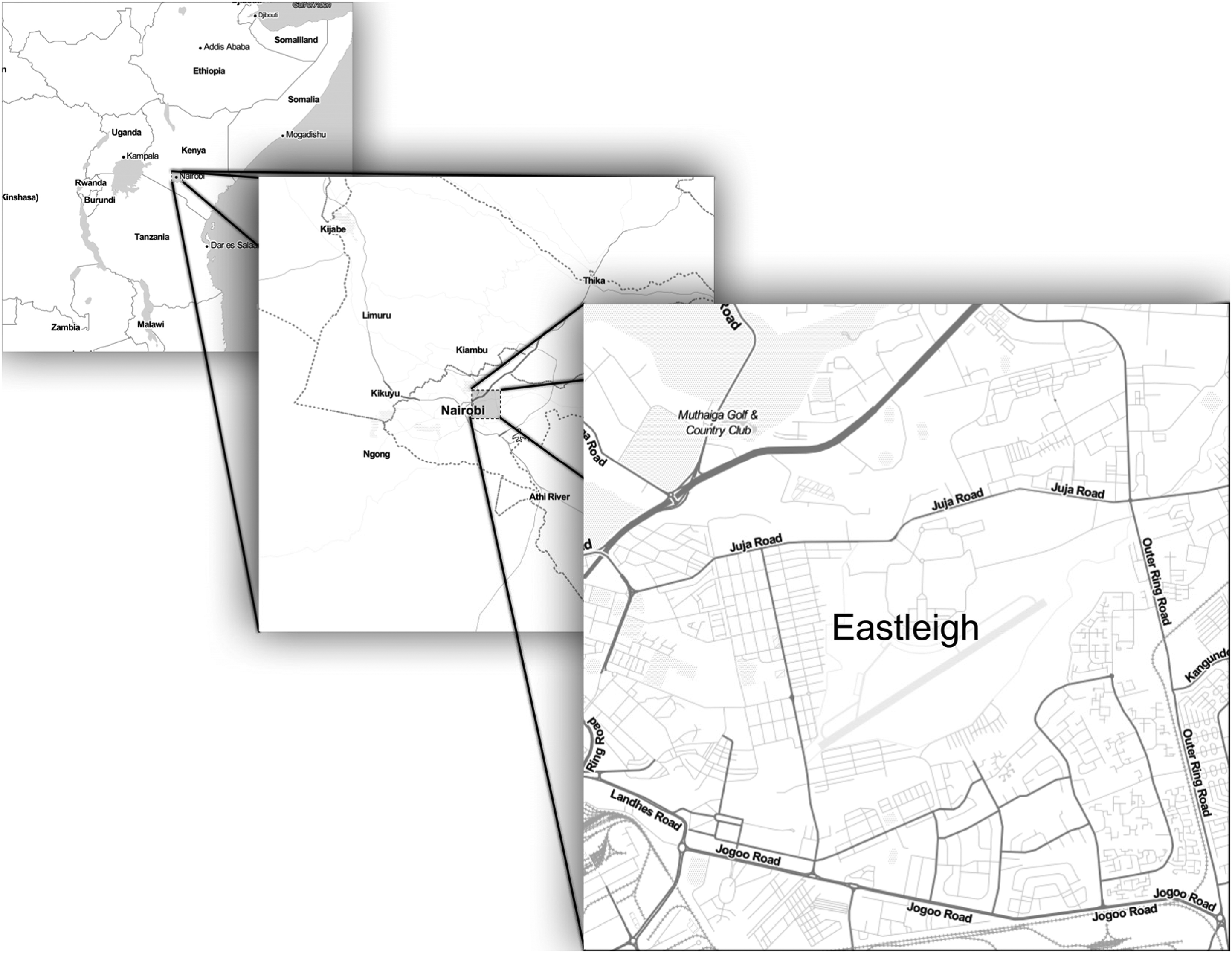
Map of Kenya, Nairobi and the sampling area (Eastleigh).
Our sample is arguably representative of the street population of Eastleigh, but not of the overall population of Eastleigh. However, given our focus on young adults, the resulting bias is likely not highly consequential. While there can be no doubt that older, conservative women spend less time on the streets, this see above does not apply to young adults. The streets of Eastleigh are shaped by a healthy mix of young men and women, there is a culture of being outdoors (given the population density), and both conservative and more liberal individuals frequently go outside to go shopping, work or engage in leisurely activities. We must reiterate, however, that our sample is not representative of Eastleigh and can thus only afford a limited degree of external validity.
Ethical concerns
We designed our experiment and survey to mitigate potential risks to research staff and subjects. Overall, we reiterate that the experiment manipulated anti-violence—rather than pro-violence—appeals not only because it is important to understand anti-violence appeals in the real world, but also for ethical reasons. Exposure to religious appeals that promote violence might reasonably put subjects and staff at physical risk in addition to potentially radicalizing subjects.
Additional steps addressed ethical concerns regarding the survey implementation and question set. Survey questions were worded based on input from our interviews with community leaders and non-governmental organization officers working in Eastleigh. Such input probably helped to reduce the chance of complaints regarding questions on religious identity or violence. Second, we recruited the team of enumerators from the local Christian and Muslim communities of Eastleigh. In doing so, we helped overcome potential suspicions that would have been likely if our enumerators had been Kenyans from another part of Nairobi or the country.
Third, we trained enumerators to follow US federal regulations regarding human subjects research. We supplemented the standard guidelines with additional measures to safeguard the privacy of subjects’ survey responses, including the decision to pay subjects for their time via a mobile payment system. In doing so, we eliminated the chance of subjects transferring cash face-to-face, which could have made subjects the targets of robbery. Lastly, we organized a constant response system to monitor the location and status of our enumerators while they were in the process of administering surveys.
Descriptive statistics
The descriptive statistics of the sample are given in Table 1. Columns 2–3 refer to the full sample, columns 4–5 refer to the Muslim subsample, while columns 6–7 refer to the Christian subsample. We report the sample size, mean and standard deviation. Owing to the pre-specified sampling strategy, the samples are balanced across the gender, age and religion variables (Male, Age, Muslim). Both samples included some converts (Convert)—15% in the Muslim sample and 8% in the Christian sample. Roughly half of both samples were married (Married—44 and 45%, respectively), and the number of years in marriage, on average, is 2.5 (Years married). Muslims were slightly less likely to be employed (Employed—44 and 51%, respectively). Some 40% of the sample report income (Any income) and the average monthly income in Kenyan shillings is 6,776 (6,869 among Muslims and 6,684 among Christians). Regarding respondents’ tribal backgrounds, most Muslims were Somali (31%), while Christians came mostly from the Kikuyu tribe (25%).
Descriptive statistics.
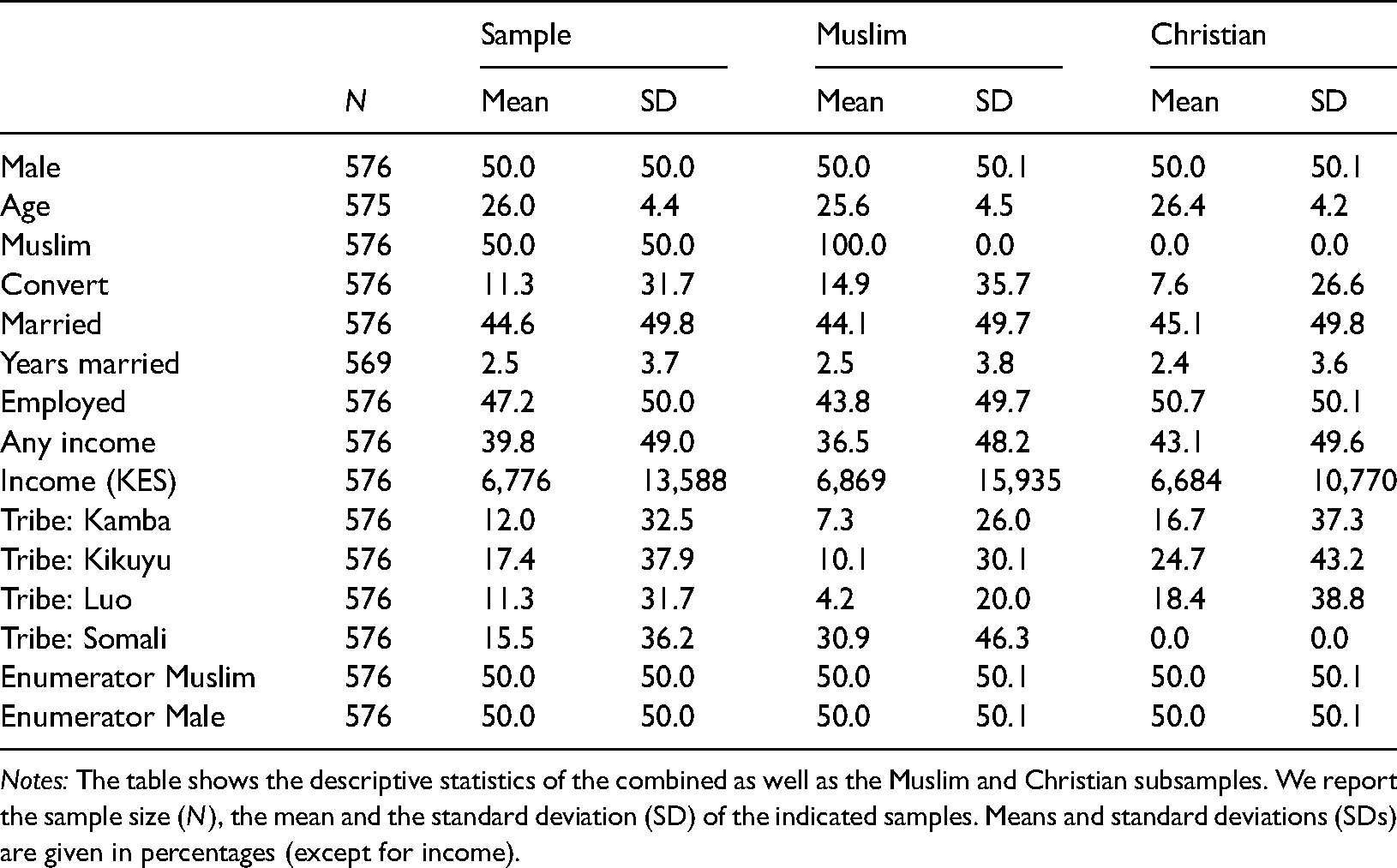
Notes: The table shows the descriptive statistics of the combined as well as the Muslim and Christian subsamples. We report the sample size (N), the mean and the standard deviation (SD) of the indicated samples. Means and standard deviations (SDs) are given in percentages (except for income).
Experimental design
To explore whether and, if so, how religious anti-violence norms can soften pro-violent attitudes, we designed two interrelated survey experiments, which were embedded toward the end of the survey (the survey instrument is provided in Section 7). We discuss both experiments in turn.
Main treatment: priming religious anti-violence norms
In the main experiment, subjects were randomly assigned to an anti-violence norm gleaned from religious sources (treatment) or no norm (pure control). 1 In order to better understand the role of specific norms, we randomly assigned subjects to one of two norms. The anti-violence norms forbade either (a) the killing of women, children, the old or the sick (henceforth, “no killing of innocents”) or (b) suicide (henceforth, “no suicide”). Overall, subjects thus had a 1/3 chance of being shown either of the two religious anti-violence norms and a 1/3 chance of being exposed to no norm. Because the outcome measurement—violent attitudes—corresponded to the primed anti-violence norms (more below), the design thus has two separate control groups, one for each norm (see Table 2). Given that we recruited Muslim and Christian respondents, we adjusted the wording of the norms to the respective religions. The exact anti-violence norms are provided in Table 2. The full design is shown in Figure 2. 2
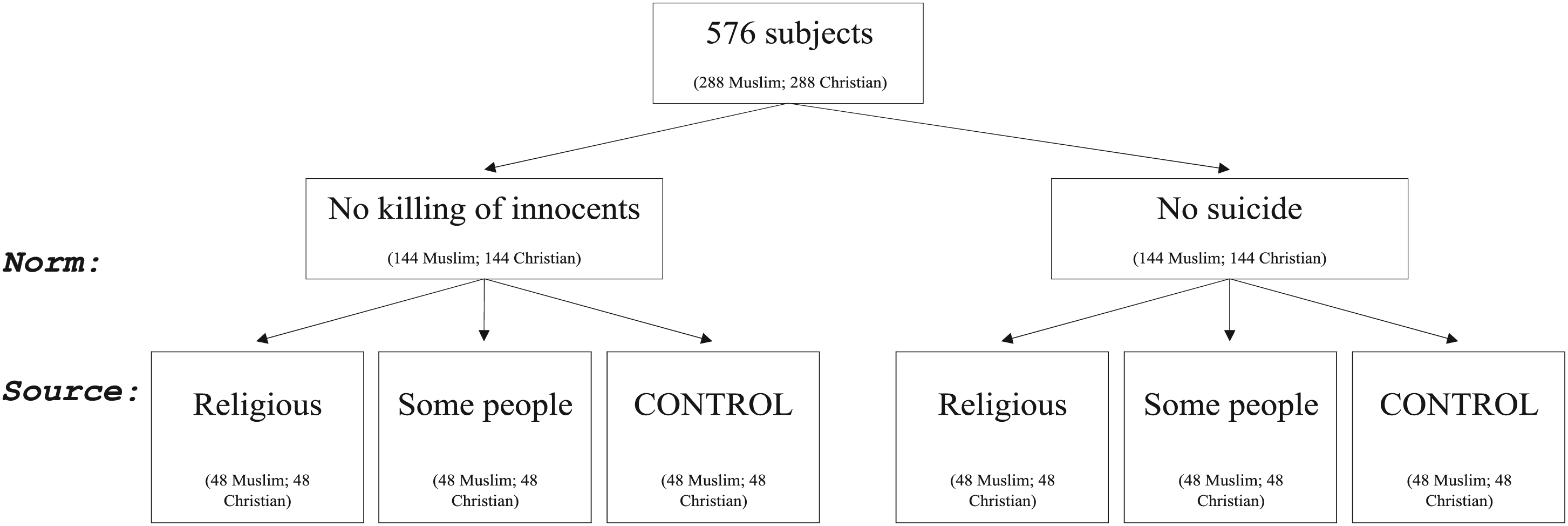
Flow chart of the assignments in experiment 1. Note that the pure control group was not read out an anti-violence norm. The control group is, however, grouped under a norm because individuals in this condition, too, were administered an outcome corresponding to the specified norm in order to facilitate comparisons within the norm conditions.
Primes: anti-violence norms.
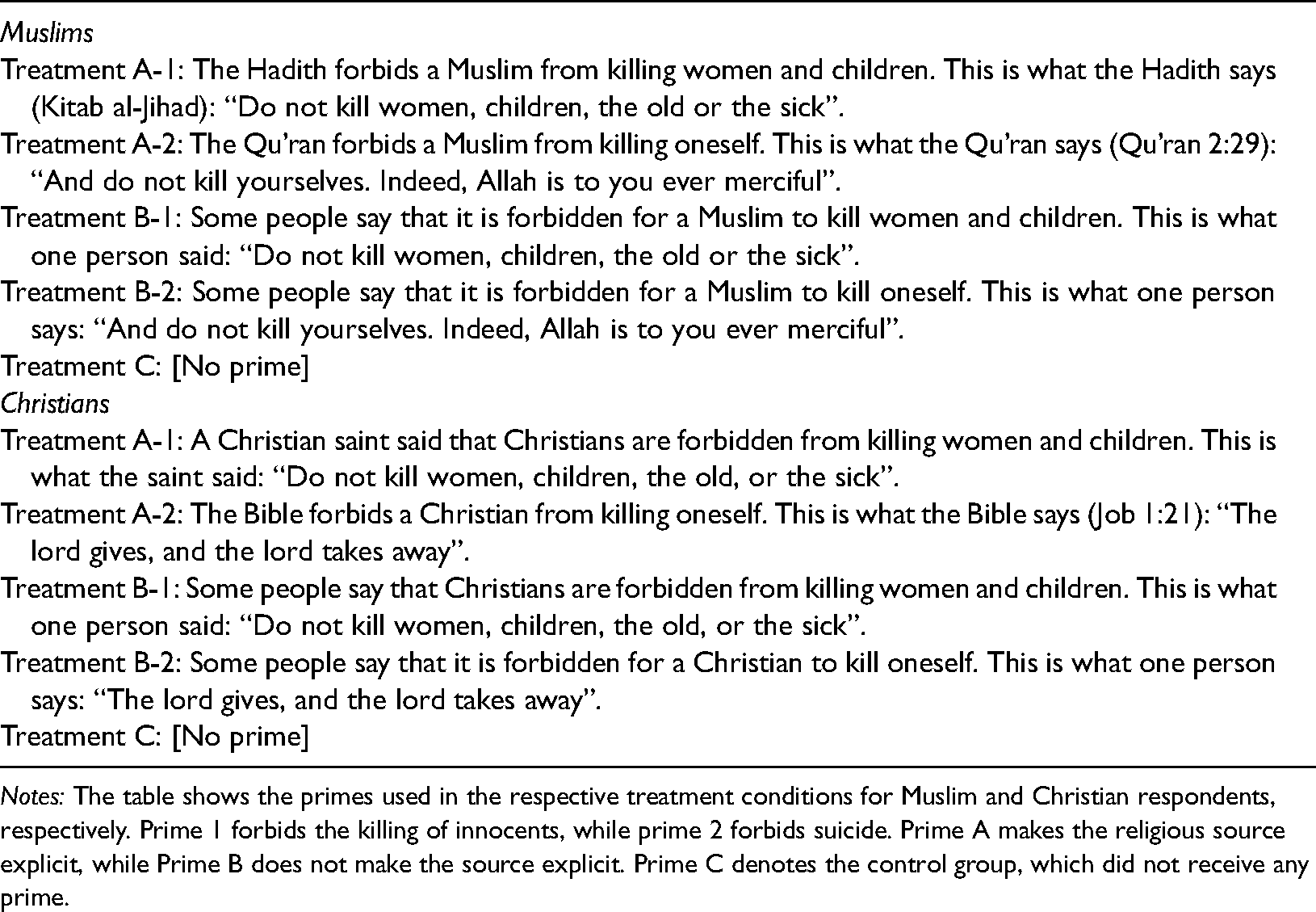
Notes: The table shows the primes used in the respective treatment conditions for Muslim and Christian respondents, respectively. Prime 1 forbids the killing of innocents, while prime 2 forbids suicide. Prime A makes the religious source explicit, while Prime B does not make the source explicit. Prime C denotes the control group, which did not receive any prime.
The two norms were chosen owing to their immediate relevance for preventing religious violence in Kenya. The first anti-violence norm (no killing of innocents) directly opposes terrorist attacks—a prominent strategy of religious extremists in Kenya. The second anti-violence norm (no suicide) opposes suicide attacks, a particularly gruesome variant of terrorism, which has also taken its toll on Kenya (e.g. the 2002 suicide bombings in Mombasa). Thus, rather than prime individuals with broad pro-peace appeals such as “to you your religion and to me mine” (Qur’an 109:1–6), we focused on two targeted anti-violence norms that directly oppose two brutal and highly relevant forms of religious violence in our study context. The norms also represent common strategies by local pro-peace clerics to diffuse tensions, as our own interviews showed.
Where do the two norms fall within the broader universe of anti-violence appeals found in Christian and Islamic sources? Sources across both religions offer countless examples of anti-violence norms (Takim, 2011; Hays, 2019). In the Bible, God is described as “the God of peace” (Philippians 4:9 NIV) and the “Lord of peace himself” (2 Thessalonians 3:16 NIV). Jesus states that “blessed are the peacemakers, for they will be called children of God” (Matthew 5:9 NIV). In the Qur’an [10:25], it says that Allah “invite[s] (people) to the abode of peace and brings whom he wills to a straight path”. Believers are asked to “[s]tand out firmly for justice, as witnesses for the sake of God, even (if this may go) against yourselves, or your parents, or your kin” (Qur’an; 4:135). Indeed, the root of the word Islam in Arabic is salama whose origin lie in the words “peace” (Islam, Sharma and Ganai, 2014).
It should be noted, however, that the two anti-violence norms we chose arguably diverge from archetypical religious pro-peace norms in two ways. The first is the level of specificity. Rather than broadly espouse peace, we wanted to provide subjects with precise ethical norms that rule out a specific type of violence. This decision was taken for two reasons. First, we wanted to directly tackle two existing kinds of violence in a targeted manner (i.e. terrorism and suicide terrorism). Moreover, we wanted to use specific norms so as to parse out whether the actual content of the norm is followed (more below). Second, the norms are somewhat unusual in that they are anti-violence, not pro-peace. This, too, was a product of the fact that we wanted to address real behavior. That said, both the Qur’an and Bible (as well as other salient sources) include numerous norms that rule out violence. Perhaps most famously, the Bible states “Thou shalt not kill” (Exodus 20:13 NIV), while the Qur’an states “whoever kills a soul […] it is as if he had slain mankind entirely” (Sura 5:32).
We must caution, however, that the two norms are not exclusively religious. Nor can we claim that the norms are somehow representative of what is taught in the salient religious sources of Islam and Christianity. That said, the norms are religious in the sense that they are espoused by religious sources. The religious source was important inasmuch as we wanted to explore whether religious norms can be used to soften violent attitudes. Yet this is not to say that the norms do not also exist outside of Christianity and Islam. Importantly, however, there is arguably variation in how “religious” the two norms are. The first norm (no killing of innocents) maps onto a global norm forbidding the killing of innocent persons during war. 3 The second norm (no suicide), in contrast, is not a global norm. Indeed, while suicide is frowned upon among most committed believers, this is not the case amongst non- or weakly religious people (Neeleman, Wessely and Lewis, 1998). As such, the first norm is arguably more religious compared with the second. The difference in the degree to which both norms can be classified as “religious” is further underlined by the fact that the first norm (no killing of innocents) also does not reference any holy source (unless in the religious source condition; more below). In contrast, the second norm (no suicide) does refer to Allah and the Lord, respectively. While there are undoubtedly other differences across the two norms, their exclusivity as a religious norm does equip us with an opportunity to search for heterogeneity across the two primes, which we take advantage of below.
Outcome: attitudes toward violence
After enumerators administered the main treatment, subjects were read out a vignette that corresponded to the randomly assigned norm. The purpose of the vignette was to assess whether respondents would follow the anti-violence norm in a hypothetical situation involving violence. To make the thought experiments as realistic as possible, the vignettes depicted realistic scenarios that—although explicit in nature—have repeatedly taken place in Kenya. Interviews with local experts also suggested that these scenarios were salient and ethically appropriate. The vignettes, corresponding to norm 1 or 2, are given in Table 3. After the vignette was read out, respondents were asked the following question: “To what extent do you find this acceptable?” The answer options, scored on a seven-point scale, ranged from “totally unacceptable” to “totally acceptable”. As such, our outcome measure thus captures violent attitudes.
Outcome measurement.

Notes: The table shows the vignette outcomes, which were shown to individuals assigned to norm 1 or 2, respectively. Note that outcomes were also shown to the control group, which is why there are two control groups—one for norm 1 and one for norm 2.
Mechanism treatment 1: making the religious source explicit
To explore whether explicitly referencing the source increases the treatment effect, subjects were also randomly assigned to either a religious source or a boilerplate “some people” source. In condition A, subjects were explicitly informed about the religious source of the norm. As can be seen in Table 2, for the Muslim sample the religious source was taken from either a Hadith or the Qur’an. For the Christian sample, the religious source was either the Bible or a saint. 4 In condition B, subjects were informed that the source was “some people”, which we constructed in order to have a valid placebo condition.
Importantly, all primes—whether cueing the religious source or not—make reference to the group of believers (Christians or Muslims, respectively). One may therefore be concerned that the prime “some people” may be too mild or insufficiently different from the religious source. Specifically, respondents may have interpreted “some people” to mean “clerics”. While we cannot rule out this concern conclusively, we must underline that Christians and Muslims are not a homogenous group in Eastleigh or elsewhere. Some Kenyan Christians are anabaptists (i.e. they believe in repeated baptisms), others strongly reject this idea. Kenyan Sunnis believe in the primacy of the Sunnah, Kenyan Shias do not. This very heterogeneity is crucial because it means that the prime “some people” is unlikely to have granted the message similar religious legitimacy to the “religious source” prime.
Mechanism treatment 2: probing the norm's content
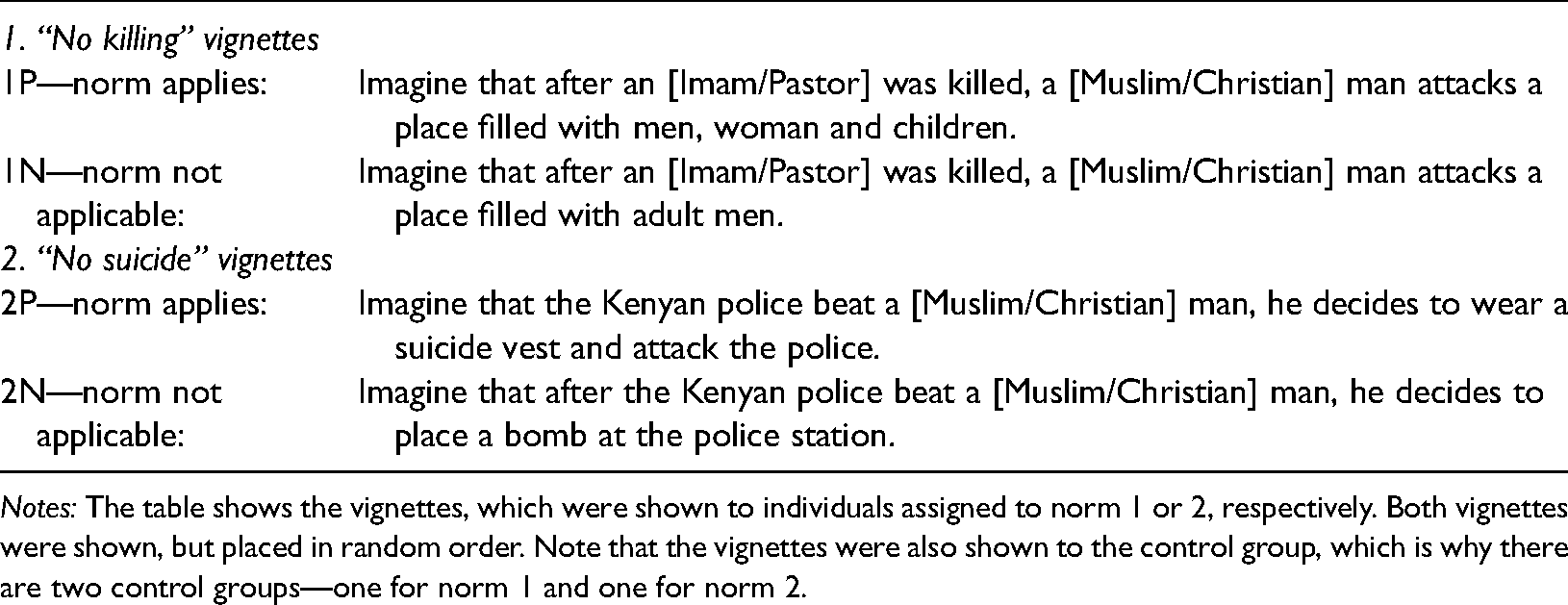
After the first main experiment—including the first mechanism treatment—concluded and outcomes were measured, enumerators implemented a second survey experiment. The experiment was interrelated with the first in that it relied on the specific anti-violence norm respondents had been assigned to. Subjects were read out the respective norm once again. Importantly, this time the prime was also administered to the control group in order to afford a within-subjects design. Enumerators then read out two additional vignettes. These vignettes described violent situations with near-identical outcomes that differed in one crucial way: one vignette described a type of violence expressly forbidden by the randomly assigned anti-violence norm, while the other vignette described violence not expressly forbidden by the norm. If religious anti-violence norms work via the specific norm—i.e. by persuading listeners of its content—our expectation is that exposure to the “no killing of innocents” or “no suicide” norms, respectively, should only reduce support for this specific form of violence. To avoid ordering effects, we placed these two vignettes in random order.
The two vignettes corresponding to the two primed anti-violence norms are shown in Table 4. Regarding the “no killing of innocents” norm, the two vignettes were as follows. The first vignette (1P) depicts a situation where the norm applies. Specifically, subjects are exposed to a situation of religious violence in which a man, after an Imam/Pastor was killed, wages a terrorist attack on a place “filled with men, women and children”. The second vignette (1N) depicts a situation where the norm does not apply. Here, subjects are exposed to a situation in which a man attacks a place “filled with adult men”. Thus, the two vignettes describe highly similar situations that share a common outcome: violent destruction. However, they vary whether the primed religious norm applies or not.
Vignette outcomes.
Notes: The table shows the vignettes, which were shown to individuals assigned to norm 1 or 2, respectively. Both vignettes were shown, but placed in random order. Note that the vignettes were also shown to the control group, which is why there are two control groups—one for norm 1 and one for norm 2.
Regarding the “no suicide” norm, the two vignettes depict a situation of police brutality in which a man, after a co-believer was mistreated by the police, wages a terrorist attack. In the first vignette (2P), the primed norm applies. Here, the man “decides to wear a suicide vest and attack the police”. In the second vignette (2N), the primed norm does not apply. Specifically, the man “decides to place a bomb at the police station”. Once again, the two vignettes depict situations that share a near-identical outcome, namely, destruction; but they differ with regard to the applicability of the primed norm.
After each vignette was read out, respondents were once again asked the following question: “To what extent do you find this acceptable?” The answer options, scored on a seven-point scale, ranged from “totally unacceptable” to “totally acceptable”. Note, again, that the two vignettes use the same introductory sentence to ascertain comparability. What is more, both vignettes arguably lead to similar outcomes, i.e. the killing of people. The method, however, is different. In vignettes 1P and 2P, the method of violence introduced in the vignette corresponds to the primed norm. In contrast, in vignettes 1N and 2N, the method of violence does not correspond to the primed norm. Under this setup, the treatment is thus defined as whether the religious norm—to which subjects were randomly assigned—applies in a given vignette. If individuals follow the primed norms literally, one would expect them to change their stated pro-violence preferences from vignette 2 to 3. If they abstract from specific norms, we would not expect such a change in attitudes across the two vignettes.
Main effect
We begin by assessing whether religious anti-violence norms can soften attitudes toward violence. To do so, we estimate the following linear model using ordinary least squares:
Impact of religious anti-violence norms on violent attitudes
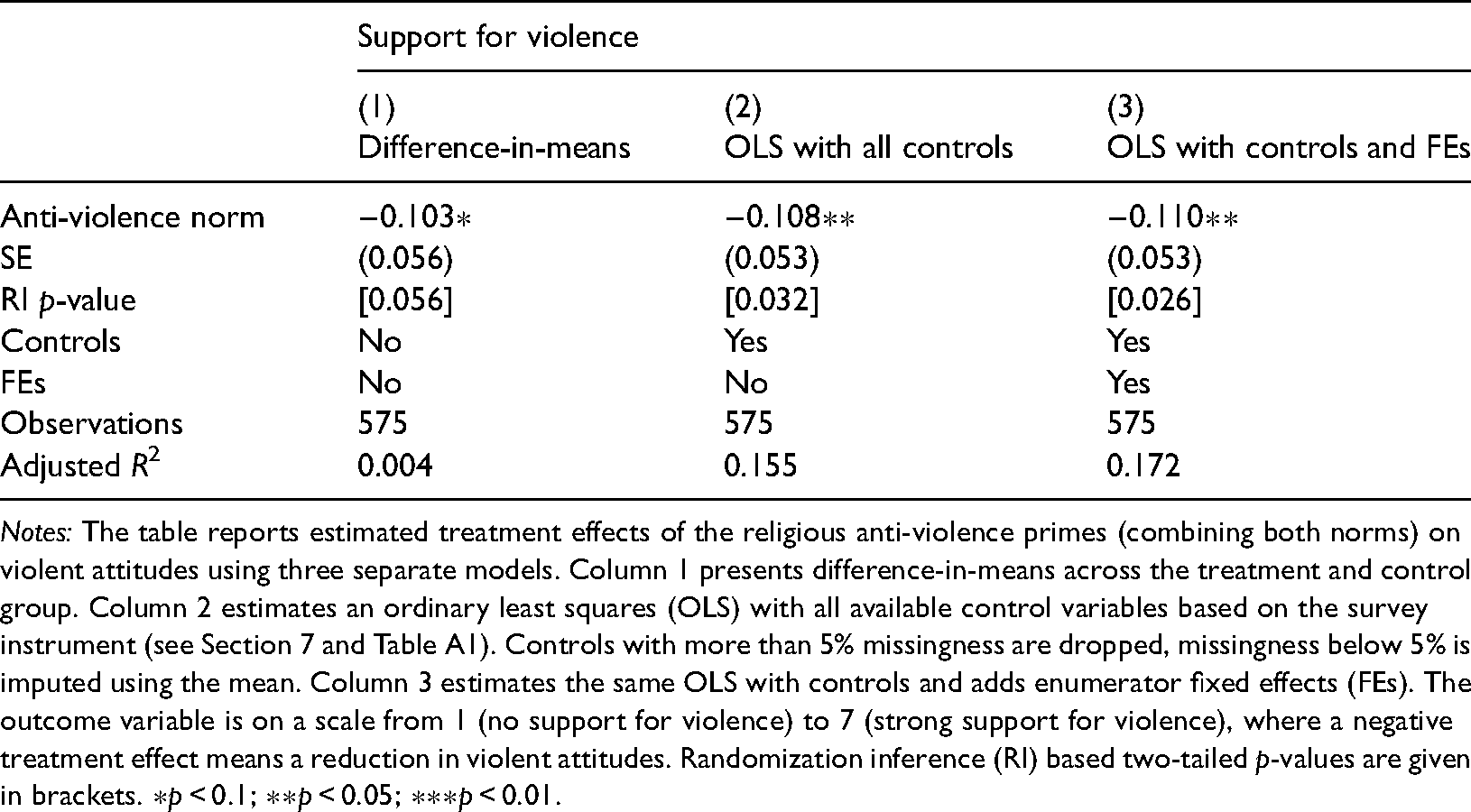
Table 5 reports the estimated treatment effect of priming respondents with anti-violence religious norms. On average, the anti-violence norms reduced support for violence by 0.10 points on the 1–7 scale (or 0.2 standard deviations). This represents a statistically significant and substantively sizable reduction, particularly when considering a rather low baseline rate of approval for violence of 1.4 points. As such, the results show support for the hypothesis that religious anti-violence norms can reduce support for violence. Reassuringly, the coefficients are virtually unchanged across the three models, as one would expect in a randomized experiment. The only difference is that the inclusion of control variables tightens the estimates considerably, producing a randomization-inference p-value of 0.026 in the most comprehensive model (column 3).
Effect of anti-violence norms on pro-violent attitudes.
Notes: The table reports estimated treatment effects of the religious anti-violence primes (combining both norms) on violent attitudes using three separate models. Column 1 presents difference-in-means across the treatment and control group. Column 2 estimates an ordinary least squares (OLS) with all available control variables based on the survey instrument (see Section 7 and Table A1). Controls with more than 5% missingness are dropped, missingness below 5% is imputed using the mean. Column 3 estimates the same OLS with controls and adds enumerator fixed effects (FEs). The outcome variable is on a scale from 1 (no support for violence) to 7 (strong support for violence), where a negative treatment effect means a reduction in violent attitudes. Randomization inference (RI) based two-tailed p-values are given in brackets. ∗p < 0.1; ∗∗p < 0.05; ∗∗∗p < 0.01.
Differences in effects across anti-violence norms
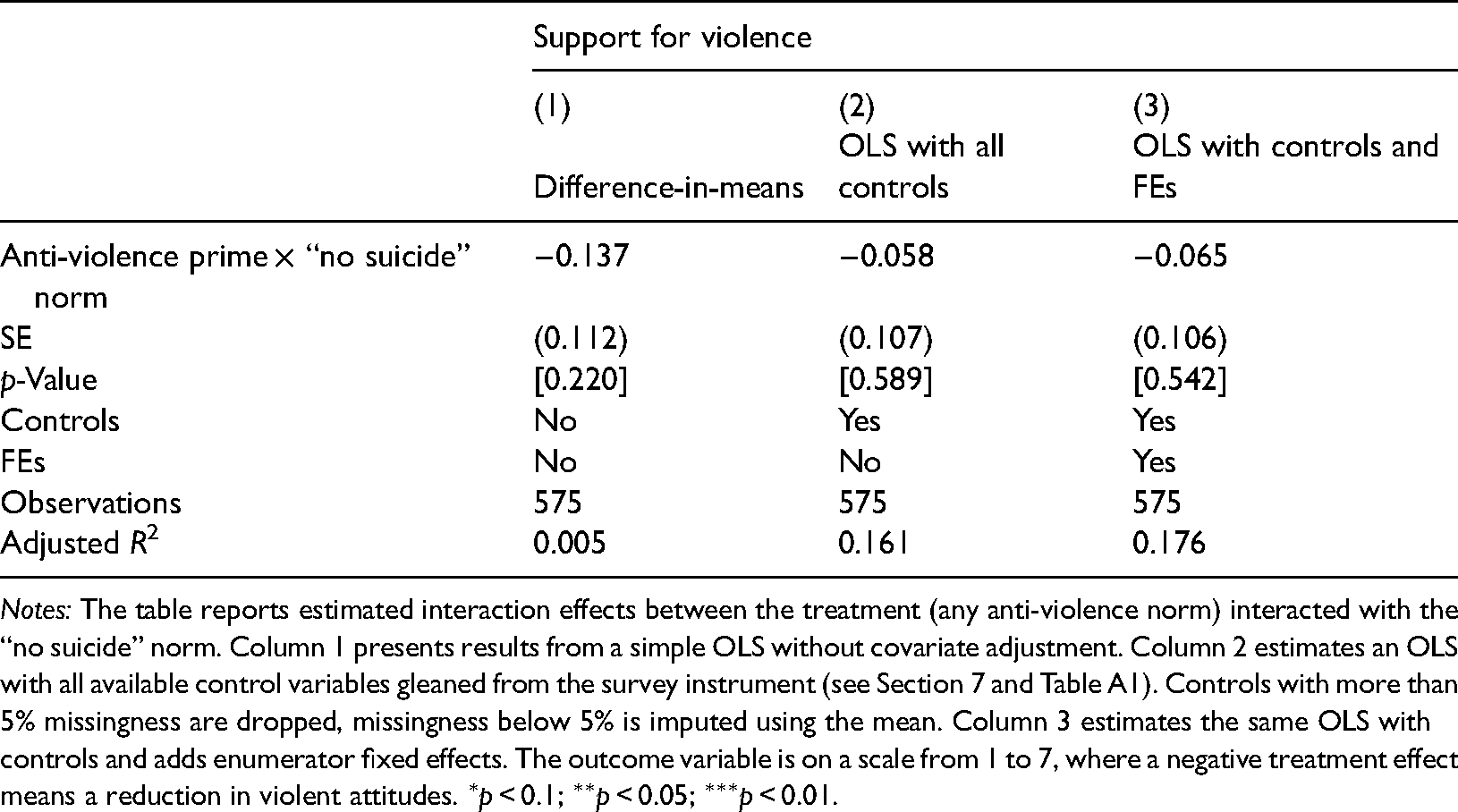
Table 6 reports results across the two anti-violence norms, i.e. the “no killing of innocents” norm and the “no suicide” norm, separately. The table reports comparable linear models where we interact the treatment (any prime) with the “no suicide” norm. 5 We do not detect significant differences between the two anti-violence norms. While the estimated interaction is negative—implying that the “no suicide” norm reduced attitudes toward violence more strongly than the “no killing of innocents”norm—the difference is not statistically significant. Put differently, the reduction in violent attitudes in the treatment group is not significantly different between respondents exposed to the “no suicide” norm vs. the “no killing of innocents” norm. The null result implies that the two norms are similarly successful at reducing violent attitudes. We thus find no evidence that the main finding is the result of one specifically worded prime. This is reassuring inasmuch as the two anti-violence norms are not perfectly symmetric (as discussed above). We should caution, however, that interaction effects are quite demanding in terms of statistical power. Were the sample size bigger, the difference across the primes might well be statistically significant. 6
Interaction effect across the two religious anti-violence norms.
Notes: The table reports estimated interaction effects between the treatment (any anti-violence norm) interacted with the “no suicide” norm. Column 1 presents results from a simple OLS without covariate adjustment. Column 2 estimates an OLS with all available control variables gleaned from the survey instrument (see Section 7 and Table A1). Controls with more than 5% missingness are dropped, missingness below 5% is imputed using the mean. Column 3 estimates the same OLS with controls and adds enumerator fixed effects. The outcome variable is on a scale from 1 to 7, where a negative treatment effect means a reduction in violent attitudes. ∗p < 0.1; ∗∗p < 0.05; ∗∗∗p < 0.01.
Heterogeneity in treatment effects
Did the treatment work more effectively among some respondents? Based on our theoretical expectations, four dimensions of heterogeneity are of particular interest. The first theoretically salient dimension of heterogeneity is respondents’ religious affiliation. For one, we used slightly different wordings across the Muslim and Christian samples, which may engender different reactions. From a theoretical perspective, there are a number of additional hypotheses one could make. Perhaps Muslims in Kenya—who are the minority group—are more likely to react to anti-violence messages because they are particularly committed to signal cooperation. Alternatively, our survey shows that extremist attitudes are slightly more pronounced in the Muslim subsample, 7 which means that there is more room to soften violent attitudes. A second theoretically important dimension of heterogeneity is respondents’ religiosity. Non-religious subjects may not be inclined to follow religious anti-violence norms. The case is arguably different for religious individuals. This holds particularly true for converts. Individuals who convert to Christianity or Islam may follow such norms more stringently in order to signal their belonging to the new religious community (Moosavi 2013; Karagiannis 2012: 102; Bartoszewicz 2013: 17; Cesari 2008). Third, one may expect respondents who have had exposure to violence to be more likely to react to the anti-violence norm. Theories of mortality salience, for instance, stipulate that individuals exposed to violence show a greater dislike toward individuals with alternative world views (Arndt et al., 1997). A fourth theoretically important dimension of heterogeneity is respondents’ religious fundamentalism. Since the norms are, nominally, “religious” and make reference to the group of believers, individuals with a more fundamentalist interpretation of their religion may be more likely to apply the norm and soften their violent attitudes.
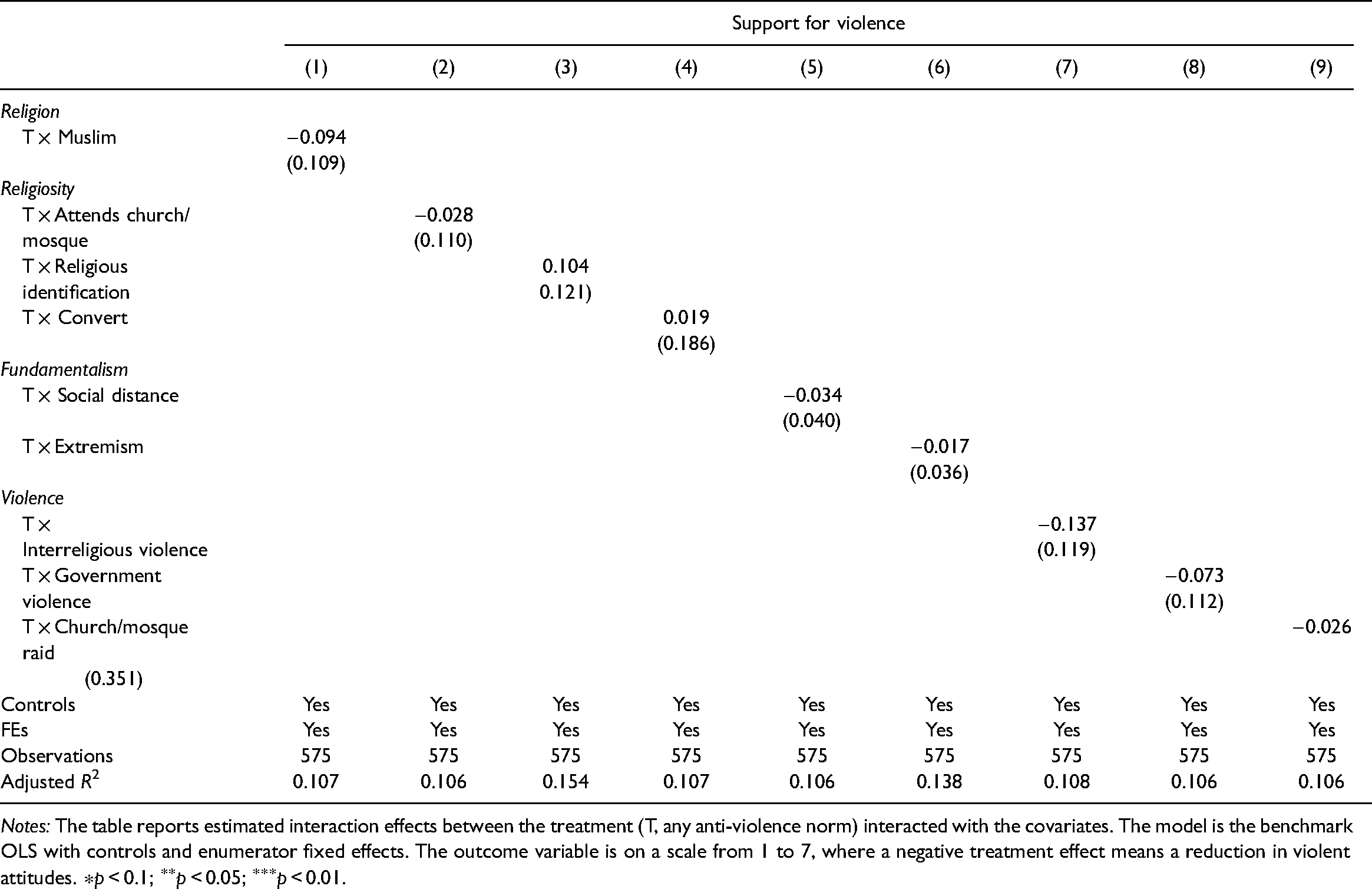
To search for heterogeneity along the aforementioned covariates, we regress the main outcome on the treatment dummy, which we interact with a covariate capturing the proposed mediator. We capture respondents’ religion by including a Muslim dummy. We capture exposure to violence by drawing on three survey items measuring individuals exposure to (a) interreligious violence, (b) state violence against Muslims or (c) state raids in respondents’ house of worship and we operationalize fundamentalism using a Bogardus social distance scale as well as an item capturing religious extremism. We report the results in Table 7. Interestingly, we find no significant interaction effects. Not one of the nine interactions points to any meaningful differences. The result is thus in line with the similarity in effect sizes across the two norms. It implies that the treatment effect works similarly across norms and subgroups, pointing to a general process by which anti-violence norms reduce violent attitudes.
Effect heterogeneity.
Notes: The table reports estimated interaction effects between the treatment (T, any anti-violence norm) interacted with the covariates. The model is the benchmark OLS with controls and enumerator fixed effects. The outcome variable is on a scale from 1 to 7, where a negative treatment effect means a reduction in violent attitudes. ∗p < 0.1; ∗∗p < 0.05; ∗∗∗p < 0.01.
Mechanisms
We have provided evidence that exposing Eastleigh residents to religious anti-violence norms, on average, reduces violent attitudes. How did the primes achieve this goal?
Mechanism 1: religious source
We begin by scrutinizing whether making the religious source explicit reinforces the treatment effect. In the theoretical section, we proposed one important mechanism: acquiescence. By highlighting that an anti-violence norm is derived from religious sources, individuals may feel obliged to follow the norm. To explore this conjecture, we next assess whether framing the anti-violence norm as drawn from “religious sources”—as opposed to a boilerplate “some people”—reduces pro-violent attitudes more effectively. To do so, we estimate the following linear model:“
Table 8 shows the treatment effect of the anti-violence norms on pro-violent attitudes across the “religious source” and “some people” groups. Cueing subjects about the norms’ religious source—as opposed to informing them that the norm is espoused by “some people”—yields highly comparable effect sizes. Explicitly communicating the religious source of the norm reduces support for violence by 0.108 points. When the same norm is provided with emphasis that it is espoused by “some people”, the reduction in violent attitudes is a highly comparable 0.099 points. Effect sizes are highly similar across the simple ordinary least squares (OLS) model without covariate adjustment (column 1), OLS with a set of comprehensive controls (column 2) and OLS with controls and enumerator fixed effects (column 3). In sum, emphasizing the religious source of the anti-violence norm does not lead to a greater reduction in pro-violent attitudes.
Effect of informing about an anti-violence norm's religious source.
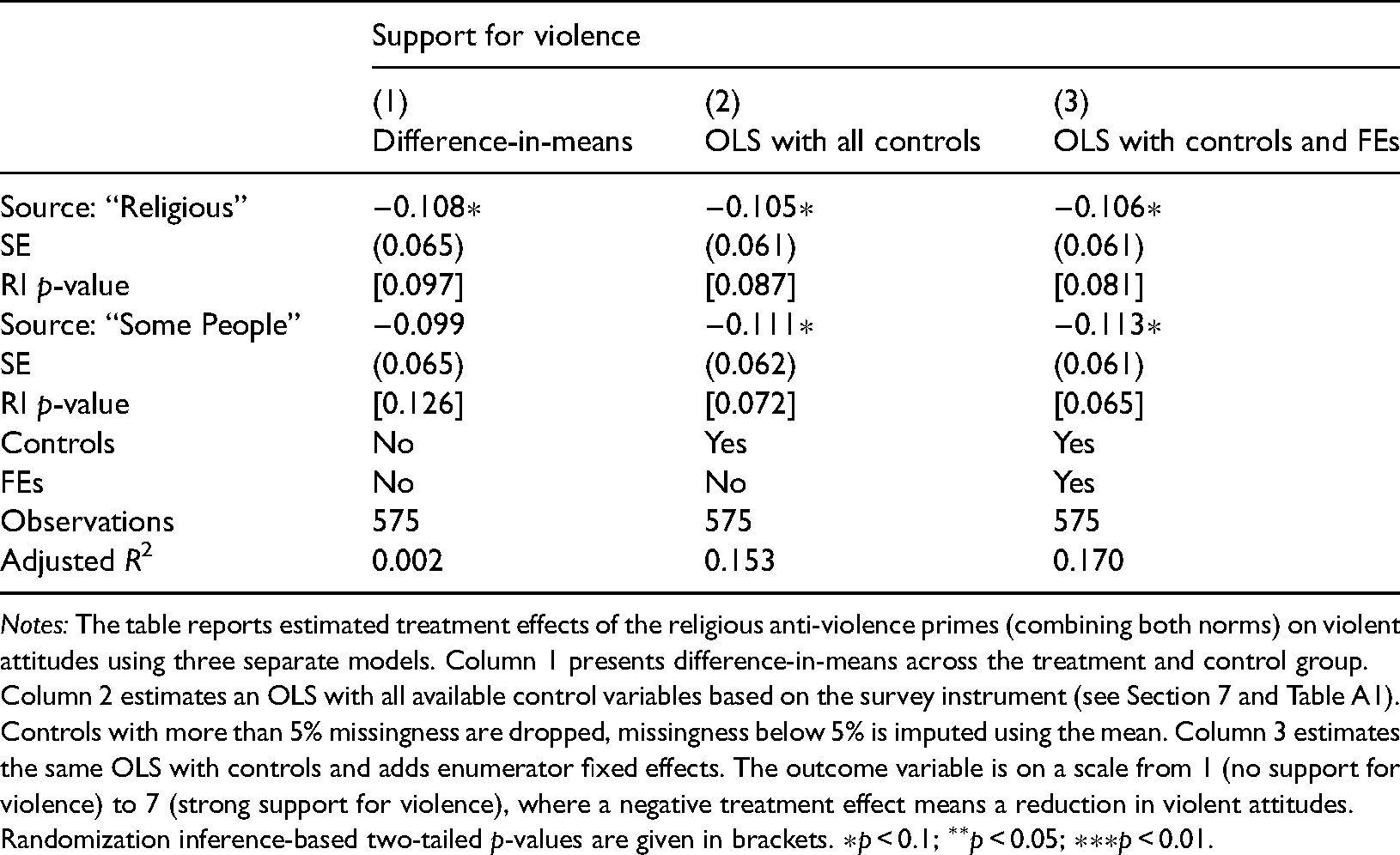
Notes: The table reports estimated treatment effects of the religious anti-violence primes (combining both norms) on violent attitudes using three separate models. Column 1 presents difference-in-means across the treatment and control group. Column 2 estimates an OLS with all available control variables based on the survey instrument (see Section 7 and Table A1). Controls with more than 5% missingness are dropped, missingness below 5% is imputed using the mean. Column 3 estimates the same OLS with controls and adds enumerator fixed effects. The outcome variable is on a scale from 1 (no support for violence) to 7 (strong support for violence), where a negative treatment effect means a reduction in violent attitudes. Randomization inference-based two-tailed p-values are given in brackets. ∗p < 0.1; ∗∗p < 0.05; ∗∗∗p < 0.01.
What explains this noteworthy null finding? Two explanations are conceivable. On the one hand, one may interpret the absence of any treatment effect as evidence that cueing the religious source of the norm does not make it any more persuasive. An alternative explanation is that the primes were too mild. That is, the two conditions—“religious source” vs. “some people”—may have been interpreted similarly by respondents. After all, the “some people” source prime also made reference to the group of believers. Perhaps, respondents therefore inferred that “some people” meant “religious sources”, in which case the treatments would not have been different.
Understanding the mechanism of the null finding is beyond the scope of this study. However, there are two reasons that make the second interpretation—i.e. the primes being interpreted similarly—rather unlikely. First, as we show below, subjects followed the anti-violence norms in an impressively precise manner. Respondents did not simply acquiesce. Given this high degree of attention, it strikes us as unrealistic that believers take “some people” to mean “the Qur’an/Bible”. Second, “some people” explicitly does not mean everyone. Indeed, there can be little doubt that Muslims and Christians—in Eastleigh or elsewhere—are not a homogenous group. This very heterogeneity is crucial because it means that the prime “some people” could not have granted the message automatic thrust.
One piece of evidence in favor of the arguments that respondents probably did not interpret “some people” and “religious source” in a similar manner is provided in Table 9. The table makes use of a survey item measuring respondents’ social distance to the religious outgroup (using a standard Bogardus scale; see Section 7). We then interact the two source primes (religious or some people) with a dummy variable indicating that respondents are more socially distant to Christians/Muslims than 50% of the sample (median split). The variable thus captures individuals for whom religion is an important part of their identity. Interestingly, the analysis shows that believers with strong antipathy toward the religious outgroup are significantly affected by the religious source prime, while no effect is detectable for the “some people” prime. Put differently, among respondents for which we have good theoretical reasons to believe that the “religious source” and “some people” are interpreted quite differently, we find significantly different treatment effects.
Effect of informing about an anti-violence norm's religious source and respondents’ outgroup distance.
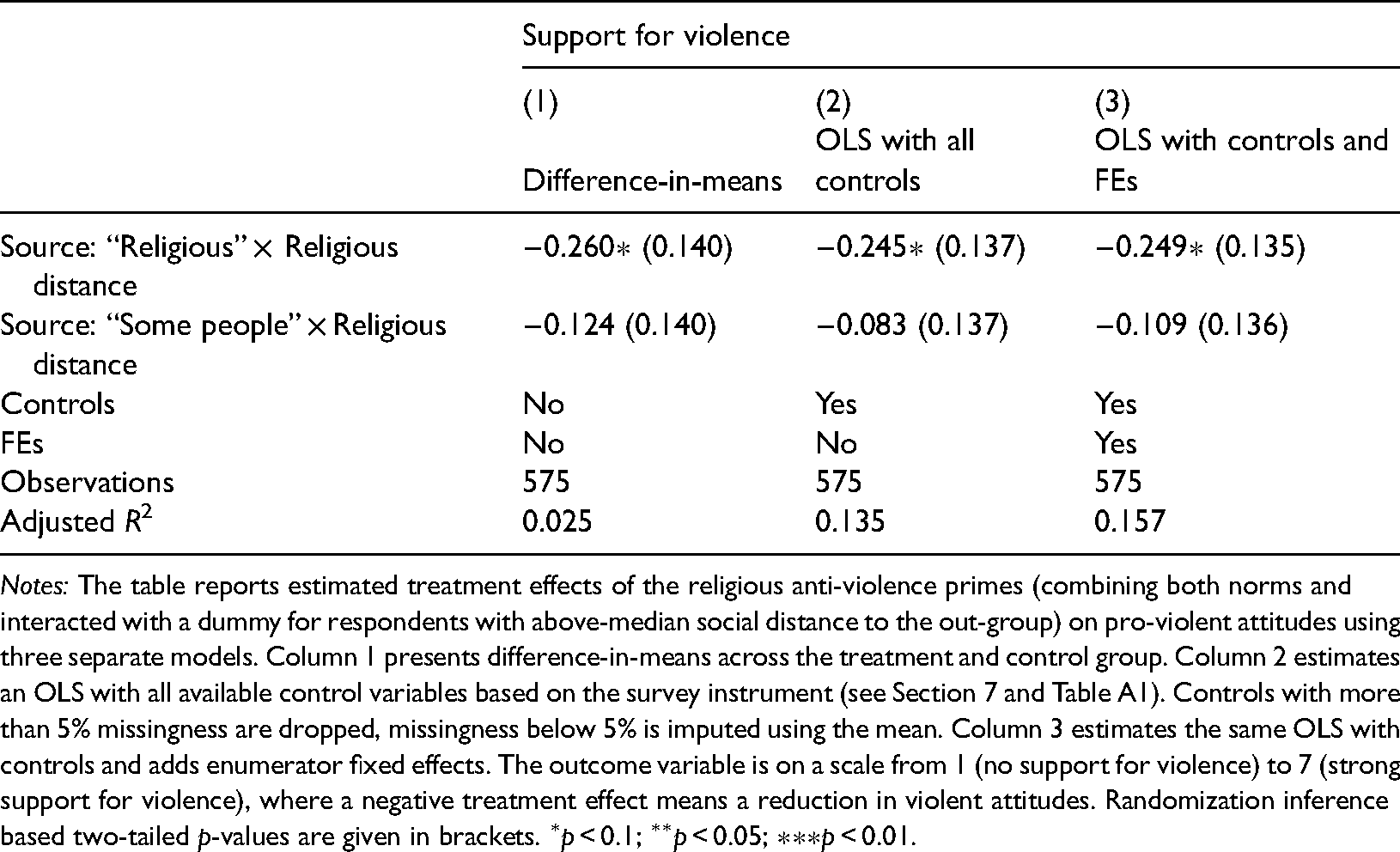
Notes: The table reports estimated treatment effects of the religious anti-violence primes (combining both norms and interacted with a dummy for respondents with above-median social distance to the out-group) on pro-violent attitudes using three separate models. Column 1 presents difference-in-means across the treatment and control group. Column 2 estimates an OLS with all available control variables based on the survey instrument (see Section 7 and Table A1). Controls with more than 5% missingness are dropped, missingness below 5% is imputed using the mean. Column 3 estimates the same OLS with controls and adds enumerator fixed effects. The outcome variable is on a scale from 1 (no support for violence) to 7 (strong support for violence), where a negative treatment effect means a reduction in violent attitudes. Randomization inference based two-tailed p-values are given in brackets. ∗p < 0.1; ∗∗p < 0.05; ∗∗∗p < 0.01.
Viewed more broadly, the evidence thus showcases that, on average, cueing respondents about the religious source does not make the message more effective. However, there is important heterogeneity within the sample, which is masked by the average treatment effect. For individuals with strong negative religious outgroup affect, the religious source is important. In contrast, for individuals with no pronounced negative outgroup affect, the two sources are equally important. The finding thus echoes the theoretical arguments. If cueing an anti-violence norm as religious, indeed, grants the message particular thrust, such an effect would, arguably, be more pronounced among individuals for whom religion plays a greater role in structuring their world view and belief system. That said, on average the treatment does not reinforce the main effect. This, then, underlines the difficulty of parsing general mechanisms for the full population even in a relatively confined context.
Mechanism 2: message content
Next, we turn to the second proposed mechanism, namely, the norm's content and its ability to persuade listeners. As stated above, we study this mechanism by examining whether or not the content of the message is strictly followed by respondents. If the precise content is persuasive, our expectation is that it will reduce support only for the type of violence expressly prohibited by the norm. In contrast, no attitude change is expected with regards to a near-identical type of violence that does not explicitly violate the norm. To explore if subjects follow the primed appeal in such a precise manner, we assess whether the fact that a norm is applicable in a given vignette softens attitudes toward violence differentially more as compared with a vignette where the norm does not apply—despite nearly identical outcomes. To do so, we estimate the following linear model using ordinary least squares:
Table 10 demonstrates that the treatment (i.e. making a norm applicable) reduces support for violence differentially more. In addition, given that the vignettes were put in random order, the coefficient can be interpreted as a causal effect. Specifically, we estimate that the treatment reduces support for violence by 0.14 points on our seven-point scale. In the second and third columns of Table 10, we repeat the same analysis for the two norm subsamples. We find that the treatment effects are roughly similar across both norms. For the “no killing” norm, we estimate a reduction of 0.12 points compared with 0.16 points in the “no suicide” condition. The result thus shows that exposure to the anti-violence norm reduces support for the type of violence especially prescribed by the norm. The evidence thus supports a persuasion mechanism: the religious anti-violence norms seemingly worked because the content persuaded listeners.
Effect of making a principle applicable.
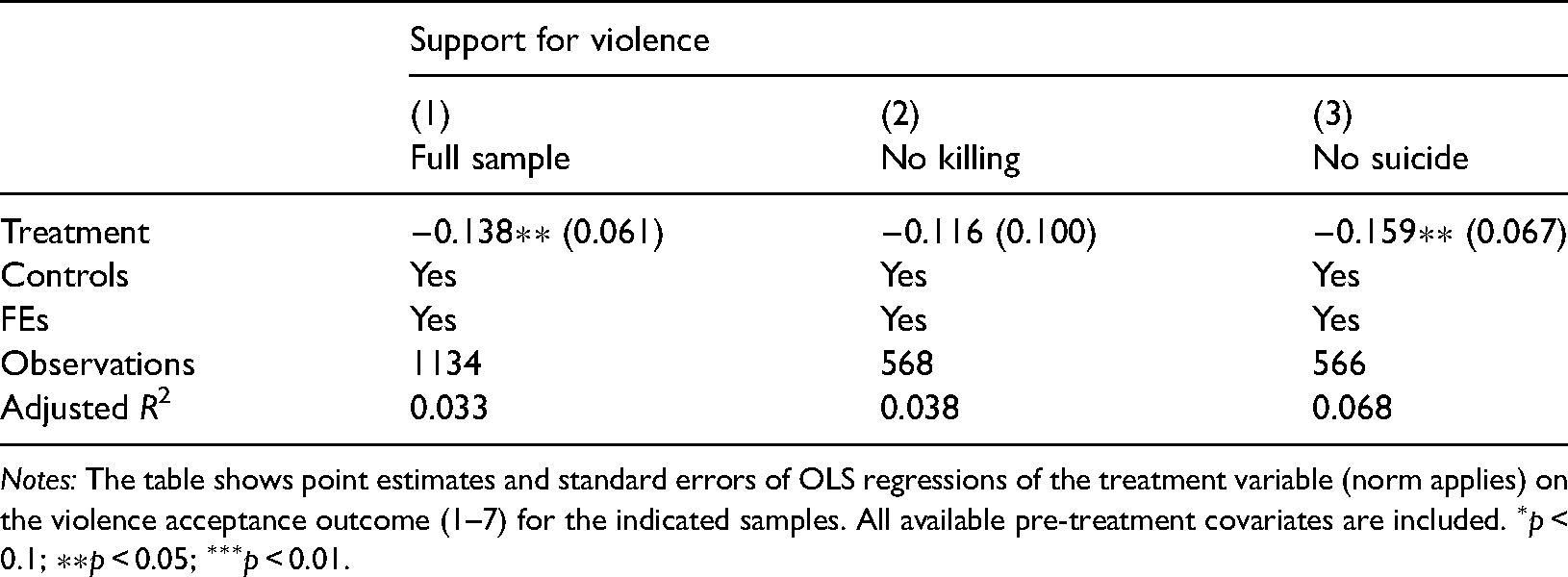
Notes: The table shows point estimates and standard errors of OLS regressions of the treatment variable (norm applies) on the violence acceptance outcome (1–7) for the indicated samples. All available pre-treatment covariates are included. ∗p < 0.1; ∗∗p < 0.05; ∗∗∗p < 0.01.
Discussion and conclusion
Focusing on Christian–Muslim tensions in Kenya, this paper presents evidence from a survey with two embedded experiments to unpack whether and, if so, how religious anti-violence norms affect support for violence. To conduct a hard test of religious messaging in this domain, we implemented the survey face-to-face on the small side streets of Nairobi's Eastleigh District—an area known as a breeding ground for extremist groups in East Africa. The main finding of the study is that religious anti-violence norms can reduce support for violence, at least in the short run. The second insight is that making the norm's religious source explicit does not reinforce the treatment effect. Third, we found that respondents followed the anti-violence norms in a literal manner: respondents are more likely to follow the norms in hypothetical situations where they strictly apply. What can these findings teach us about the study of religion and violence? What potential limitations exist in our study, and which avenues for future research do we see?
The first main lesson of our study is that religious anti-violence norms can be an effective way to reduce violent attitudes. Our research in this regard fills an important gap: most political scientists have focused on how religious or ethnic appeals shape political attitudes and behaviors unrelated to extremism (McClendon and Riedl, 2015; McCauley, 2014). Our study joins an emerging line of scholarship that focuses on how such appeals shape tolerance or extremism involving religious groups in conflict zones (Hoffmann et al., 2020; Sharma, 2018; Chang and Peisakhin, 2019). A worthwhile extension of our research would be to examine how appeals shape attitudes in cases where conflict is not organized along religious lines. Additional research could test, for instance, if appeals to non-violence rooted in the history of tribal, racial or linguistic groups are also effective, or if they work differently than the patterns shown here. Doing so would also allow one to better unpack the role of “religion”, which we were only able to address by making the religious source explicit. The second main take-away from our study is that anti-violence norms are differentially more effective with respect to the specific type of violence they prohibit. This finding matters for three reasons.
First, the fact that believers follow religious norms in a literal manner underlines that the content of such appeals is taken seriously. Subjects applied the norm in a precise manner. For instance, exposing subjects to a religious norm prohibiting suicide was much more effective in reducing support for a suicide attack than for an equally fatal attack that did not involve suicide. In our view, this pattern suggests that, in conflict settings like Eastleigh, the faithful exhibit a tendency toward rigid interpretations of religious appeals.
Second, the finding that norms are applied literally helps make sense of a number of cases that underline the impact of scripture on conflict (McCants, 2015; Juergensmeyer, 2003; Kaufman, 2001). In Eastleigh and other parts of Kenya, our field interviews emphasized how literal interpretations of doctrine regarding alcohol consumption sparked Muslim–Christian violence. Kenyan Muslims pointed to a Qu’ranic prohibition on alcohol as the basis for their view that alcohol sale and consumption should be forbidden. This justification has been used by the Islamic terrorist group al-Shabaab, for instance, in its attacks on bars, nightclubs and shopping malls across Kenya, and serves as a local point of contention in Eastleigh. Kenyan Christian interviewees, in turn, expressed anger that Christians in a Christian-majority country have to worry about attacks on bars and nightclubs from extremists in the Muslim community. Our finding that norms are applied literally to situations of hypothetical violence helps make sense of such anecdotal evidence about the role of doctrine in religious conflicts. We must caution, however, that we scrutinized anti-violence norms (not pro-violence norms). While this was undoubtedly the right ethical choice, it does raise the question whether our findings extend to settings where doctrine is used to spark violence.
Lastly, the finding offers an insight into a central process in conflict: elite usage of religious sources to incite violence and peace. If it is true that religious norms matter to the faithful, it becomes less surprising that religious clerics or political leaders employ religious rhetoric to mobilize political behavior among followers. The fact that such appeals work and are followed in a literal manner raises an important challenge. If true, such a pattern would raise the question of how to reduce support for types of violence that are not explicitly banned by any religious or otherwise ethical norm. It also suggests that the ability of a mobilizer to leverage religious appeals is constrained to a fixed set of texts, sayings or parables, so that a believer cannot be manipulated into adopting any position on violence.
We want to conclude by briefly discussing three shortcomings of our study. First, as with any experimental case study, our findings are only valid within the immediate study sample. Within the street-level population of Eastleigh—given the random sampling strategy—our study can credibly claim that religious anti-violence norms are an effective way to decrease violent attitudes. However, whether this result also generalizes to other study contexts is beyond the scope of our paper and a matter of speculation. We do believe, however, that Eastleigh is not a highly unusual case. The area and its sociodemographic structure are comparable with a diverse set of towns, including Mombassa, Mogadishu and parts of Dar es Salaam—cities that have faced similar challenges relating to religious extremism. Further evidence, however, is necessary to explore whether religious anti-violence norms can decrease violent attitudes in other contexts. We should also point out that we have demonstrated a noteworthy absence of treatment effect heterogeneity. This finding implies that the treatment worked in a rather straightforward manner among the sampled population, and not just for a highly selective subgroup.
Second, we used relatively mild primes and measured outcomes immediately after exposure to treatment. This raises the question of whether the observed treatment effects map onto real-world behavior. As researchers, we felt an ethical obligation to administer primes that are large enough to trace causal effects, but small enough to not arouse suspicion or outright tensions. While we hope to have struck an appropriate balance, we were unable to measure real behavior. Even so, religious violence—in Eastleigh and in other parts of Kenya—is often sparked by similarly brief appeals delivered in religious sermons. Radical clerics use religious sources to incite violence, while moderate clerics use religious sources to build tolerance. Our study thus follows the real world in administering a relatively short scriptural intervention to a highly relevant sample. We should also point out that the link from attitudes to behavior has been unpacked by a number of scholars (Neumann and Kleinmann, 2013). Still, we must reiterate that our findings only speak to short-term attitude formation.
A final potential limitation relates to the manipulation regarding the religious source of the norm. Our manipulation used a relatively subtle way to emphasize the religious source of the appeal, while keeping the rest of the message unchanged. It may be the case that a treatment that more starkly emphasizes the religious source of an appeal would have been more effective in changing attitudes than the treatment employed here. Future research could thus extend our work by using treatments that make more intensive references to the religious source or by finding ways to examine religious and secular appeals on the same issue.
Footnotes
Acknowledgement
The authors are grateful to Macartan Humphreys, Diego Gambetta, Max Schaub and participants at the Contemporary African Political Economy Seminar for help and feedback during different stages of the project. This study was approved by Columbia University’s Institutional Review Board (AAAP8701).
Declaration of conflicting interests
The authors declared no potential conflicts of interest with respect to the research, authorship, and/or publication of this article.
Funding
We acknowledge generous funding from The Project on U.S. Relations with the Islamic World at The Brookings Institution.

Supplemental material
Supplemental material for this article is available online.
Notes
References
Supplementary Material
Please find the following supplemental material available below.
For Open Access articles published under a Creative Commons License, all supplemental material carries the same license as the article it is associated with.
For non-Open Access articles published, all supplemental material carries a non-exclusive license, and permission requests for re-use of supplemental material or any part of supplemental material shall be sent directly to the copyright owner as specified in the copyright notice associated with the article.
