




Abstract
We investigate the potential relationship between female combatants and conflict duration. We contend that recruiting female combatants extends war duration via its influence on state–rebel bargaining. The recruitment and deployment of female combatants contribute to divergent perspectives between the rebels and the incumbent regarding the rebel group’s capabilities and the depth of its resolve, which impedes successful bargaining and extends the duration of the conflict. Results from duration analyses using data on the estimated prevalence of female combatants in rebel groups active between 1964 and 2011 support our central hypothesis and suggest that the use of female fighters is associated with longer conflicts.
By the early 1980s, the survival of the Farabundo Martí National Liberation Movement (FMLN) appeared tenuous. The rapidly escalating conflict produced extremely high mortality rates among the guerrilla forces, resulting in severe personnel shortages. These acute resource pressures, coupled with the group’s broadly egalitarian ethos and Marxist ideology, incentivized the FMLN’s leadership to expand women’s roles in the rebellion and further encourage female recruitment. In response, thousands of Salvadoran women left their villages and returned from refugee camps to “bend gender” and take up arms with the rebel movement (Viterna, 2013: 64). Joining the rebellion dramatically altered the identities of many female recruits, from mother, daughter, and caregiver to guerrilla fighter. This transition came at great personal cost for many women as they abandoned traditional home and family life—and sometimes their own children—to help advance the FMLN’s revolutionary goals. The large number of female recruits, which ultimately composed roughly a third of the group’s combat force, also had an indelible influence on the movement: they provided organizational stability and cohesion and were essential to the FMLN’s ability to “maintain a large and committed rebel army over the twelve years of conflict” (Viterna, 2013: 220).
Female combatants had a similar impact on the Liberation Tigers of Tamil Eelam’s (LTTE). The combination of a permissive gender ideology and acute resource pressures contributed to the large-scale recruitment of female combatants (Alison, 2003; Samarasinghe, 1996). As with the guerrilleras of the FMLN, female Tamil Tigers faced substantial costs for transgressing the gender norms of their traditional society (Friedman, 2018). Moreover, the mobilization of large numbers of women generated tensions with the Tamil community and threatened to undermine the group’s legitimacy among the population (Terpstra and Frerks, 2017). Despite the potential costs associated with this decision, female combatants represented a significant source of recruits for the LTTE throughout the war. Thousands of Tamil women took up arms during the two-decade independence struggle, representing a fifth of the group’s guerrilla fighters (Alison, 2003; Stack-O’Conner, 2007).
These examples illustrate several important features of rebel efforts to mobilize women for war. First, female fighters play important roles in many armed rebellions, and their recruitment can bolster the group’s overall capabilities by substantially increasing the number of troops it can deploy against the incumbent. Yet, mobilizing women for war can also generate significant costs, potentially creating tensions with the local population and forcing female recruits to abandon their traditional roles in society. These observations raise important questions regarding the repercussions of female recruitment and its broader strategic implications. Despite rising scholarly interest in identifying and explaining patterns of women’s participation in armed conflict, few cross-national studies have investigated the potential influence that armed group gender composition and gendered recruitment strategies might have on conflict dynamics, group behaviors, or war outcomes. To our knowledge, a recent study by Braithwaite and Ruiz (2018), which finds that incumbents are less likely to defeat rebel groups that include female fighters, represents the only existing research that explicitly examines these relationships.
We seek to address this gap in the literature. Borrowing insights from the bargaining model of war, we develop a theoretically grounded perspective on the potential relationship between female combatants and conflict duration. We contend that the presence of female combatants, particularly in large numbers, extends war duration through its influence on state–rebel bargaining. Specifically, the decision to recruit and deploy female combatants contributes to divergent perspectives between the rebels and the governments regarding the rebel group’s capabilities and the depth of its resolve. While the incumbent may observe the presence of female fighters among the rebels, their aggregate contribution to the group’s fighting capacity and their relationship to group resolve represent private information that is only (partially) revealed as the conflict unfolds. Government uncertainty regarding the meaning and impact of female recruitment impedes successful bargaining, thereby extending the duration of the conflict.
We assess the empirical validity of our arguments using data from the Women in Armed Rebellion Dataset (WARD), which provides information on the prevalence of female combatants for a global sample of contemporary rebel organizations. Results from a series of survival models support our central argument. Even after accounting for confounding factors commonly associated with conflict duration and addressing multiple possible sources of potential bias, we find that a higher prevalence of female fighters is strongly correlated with the duration of the conflict. In other words, rebel groups that include a higher proportion of female combatants tend to fight longer wars than those that exclude them.
The manuscript proceeds as follows. We first briefly summarize the bargaining model of war, devoting particular attention to the manner in which the resolve of the weaker party and uncertainty over its capabilities can hinder bargaining in asymmetric conflicts. We then discuss how recruiting female fighters, which often occurs during periods of intense rebel resource demands, exacerbates uncertainty and contributes to divergence in the actors’ beliefs about the distribution of capabilities and rebel resolve, thus impeding bargaining and extending the duration of the conflict. Next, we describe our research design and present our results. In order to contextualize these findings and further illuminate the proposed mechanisms, we then present a brief sketch of female recruitment by the LTTE and its implications. We conclude by discussing the academic and policy relevance of these findings and suggest a number of potentially fruitful avenues for future research.
Bargaining and war duration
The stylized model of the bargaining process involving rebels and the incumbent regime routinely assumes that the two sides engage in an iterative process of demands made by the former (for resource redistribution, electoral reform, regime change, etc.) and a decision by the latter to either refuse or concede to those demands (e.g. Powell, 2003; Slantchev, 2003). Where the incumbent acquiesces to the challengers’ demands, the conflict ends; where the it refuses, the conflict persists. Scholars often further assume that both the scope and scale of the demands made by the rebels, as well as the decision by the incumbent to acquiesce to those demands, are informed by each actor’s perceptions of the relative distribution of power between them, their own willingness to endure the costs of ongoing violence and their beliefs about their adversary’s ability to absorb costs (e.g. Sullivan, 2007; Walter, 2009).
When these factors are observable and mutually agreed by the parties, bargaining is more efficient than (ongoing) warfare. More militarily capable rebels that can credibly threaten to impose higher costs on the incumbent are able to make substantial demands that are commensurate with their strength, and the incumbent is more likely to concede. For these reasons, stronger rebellions tend to fight shorter wars and achieve more of their war aims (Clayton, 2013; Cunningham et al., 2009). Previous studies also highlight the influence of actors’ cost tolerance on bargaining. In particular, superior resolve can allow the weaker party in an asymmetric conflict to achieve concessions that exceed those predicted solely by the relative distribution of power between actors (e.g. Mack, 1975; Sullivan, 2007; Walter, 2009: 252). Problematically, both capabilities and resolve often represent information that is privately held or intentionally obscured by the actors involved—conditions that impede successful bargaining and thus contribute to longer wars (Bapat, 2005; Powell, 2002).
Fighting partially reveals privately held information, potentially improving the odds of successful bargaining (e.g. Filson and Werner, 2002; Powell, 2003). However, challenger demands and target willingness to concede are endogenous to the conflict environment, and actors tend to increase their demands as their perceived odds of victory improve (e.g. Filson and Werner, 2002). This feature of war contributes to bargaining failure and extends the duration of conflict. For example, Bapat (2005) contends that if rebel groups survive beyond their initial period of weakness, they may reject later government concessions that accurately reflect the distribution of capabilities in favor of a strategy of complete victory, thus producing a protracted conflict. Additionally, the “noisy and imprecise” nature of battlefield learning often fails to negate the challenges associated with asymmetric information and uncertainty (Slantchev, 2003: 628). Thus, incumbents often remain uncertain about the rebel capabilities and resolve even after repeated battlefield encounters.
The complex and fluid nature of civil wars, in which armed groups fragment and unite, foreign powers intervene, and resources rapidly shift, further exacerbates information asymmetries and impedes the convergence of beliefs about the actors’ utility for war relative to settlement. Previous studies illustrate how such group- or conflict-level characteristics can obscure information and promote divergent beliefs. For example, rebel access to foreign territories impedes the ability of governments to attain reliable information about the group’s capabilities, thus resulting in longer wars (Salehyan, 2007). Similarly, the provisions of certain types of external support to rebels can undermine bargaining and prolong violence by exacerbating government uncertainty about their effect on the balance of power in the conflict (Sawyer et al., 2017). These insights lead us to consider the potential role that rebel recruitment strategies—in particular, the recruitment of female combatants—play in determining the duration of the conflict.
Female recruitment as a source of uncertainty
As the previous section highlights, uncertainty often impedes successful bargaining and extends the duration of war. In this section, we propose that female recruitment serves as an additional source of uncertainty that complicates rebel–state bargaining. This uncertainty stems from the combination of informational deficits about the contributions that female combatants make to an armed groups’ capabilities, military leaders’ skepticism about women’s combat competence and their effects on group cohesion and preparedness, and failure on the part of the incumbent to interpret female recruitment as a signal of rebel resolve. While both sides are initially unsure of the contributions female fighters make to rebel capabilities, rebel leaders update their beliefs more rapidly and more accurately than their government counterparts because they directly observe the fighters that they recruit. While governments observe female recruitment, the effectiveness of female fighters and their ability to augment rebel capabilities is only (partially) revealed over time through repeated battlefield interactions. Similarly, rebels are acutely aware of the costs associated with female recruitment and have priced these into their decision to mobilize women for war. However, these costs represent private information that the government is typically unable to observe, leading it to underappreciate the signal of (group and individual) resolve that female recruitment represents. The divergent beliefs that governments and rebels hold over these factors impede successful bargaining and may ultimately extend the duration of the conflict.
Rebel capabilities
Capabilities are a critical determinant of both the length and the outcome of civil conflicts. More capable armed groups are less likely to suffer defeat and more likely to achieve their goals (e.g. Cunningham et al., 2009). Similarly, groups that mobilize substantial numbers of recruits and rapidly replenish their forces after losses are better able to mount an effective resistance against the regime’s forces and to sustain themselves over a longer period of time. For these reasons, rebel leaders typically seek to maximize the number of acceptable troops under their command. Able-bodied adult males are the preferred recruits for most rebel groups (and state militaries) (Goldstein, 2001). 1 However, during periods of intense fighting the demand for these recruits can rapidly outstrip their supply, particularly where extended periods of violence and repression have led to the displacement, death, or detention of large numbers of younger males. The combination of rising resource pressures and constraints on the supply of preferred recruits encourages the leadership of some rebel organizations to recruit among the female population and to expand women’s roles within the organization, including deploying them in combat roles (Alison, 2003: 39; Stack-O’Connor, 2007: 47; Wood, 2019). 2
The relatively low rate of female recruitment among non-state armed groups suggests that rebel leaders seldom view women as optimal combatants. 3 Nonetheless, female fighters constitute a substantial proportion of the combat forces of a subset of effective and highly resilient rebel movements. In addition to the examples provided in the introduction, women accounted for at least a fifth of the fighters in the Eritrean People’s Liberation Front in Ethiopia, the Kurdistan Worker’s Party in Turkey, the Revolutionary Armed Forces of Colombia and the Mujahedin-e-Khalq in Iran. 4 For each of these movements, incorporating women contributed thousands of additional troops to the group’s overall fighting force. Prior studies further suggest that female fighters can confer substantial strategic benefits on the groups that recruit them. At minimum, the decision to recruit women widens the pool of potential combatants available to a rebel group, allowing it to field more troops than it otherwise would and facilitating its ability to replace troops injured or killed in combat. Wood (2019: 170–171), for example, finds that the estimated troop size is larger for groups that include female combatants than for those that exclude them. Similarly, Israelsen (2020: 128) suggests that recruiting women provides short-term infusions of resources that allow rebels to achieve strategic goals. Given the highly asymmetric nature of civil conflicts, the additional resources resulting from female recruitment—possibly hundreds or thousands of fighters—should also increase the group’s ability to mount an effective challenge to the incumbent regime. It is arguably for this reason that incumbents are less likely to defeat rebel movements that (voluntarily) recruit female combatants (Braithwaite and Ruiz, 2018).
The tactical and strategic benefits of female fighters extend beyond the additional troop numbers that their recruitment provides. The FMLN, for example, identified early on that women “brought skills and knowledge to the war effort that men simply did not have” (Viterna, 2013: 67). Likewise, leaders of the LTTE explicitly acknowledged the tactical advantages and improved ethos female combatants brought to their group (Stack-O’Connor, 2007: 44). Gender norms that assume women’s peacefulness and passivity may also make it easier for female combatants to successfully conduct lethal clandestine operations (O’Rourke, 2009; Thomas, 2021). The presence of female fighters may also indirectly influence rebel capabilities. Evidence from a diverse array of cases suggests that female combatants are highly effective as recruiters because they both generate sympathy among local populations and shame reluctant males into joining the rebellion (e.g. Weiss, 1986: 80; Viterna, 2013). Women in the Palestine Liberation Organization (PLO), for example, acted as “organizational brokers” who brought in new recruits through “quotidian networks,” which enabled the PLO to adapt and persevere following “extreme disruption” (Parkinson, 2013: 424). Similarly, several studies demonstrate that rebel efforts to highlight women’s contributions to the movement can help rebels solicit sympathy and support from domestic as well as international audiences (Loken, 2021; Manekin and Wood, 2020). Although the Zimbabwe African National Union (ZANU) began recruiting female combatants in response to massive losses of male soldiers, the group exaggerated women’s participation as part of a strategy to win support from the local populations (Mudeka, 2014: 89; O’Gorman, 2011). The presence of female fighters may therefore positively influence resource mobilization more broadly, thus reflecting an additional avenue through which female combatants enhance group capabilities.
Problematically, rebels and the incumbent are likely to disagree about the expected contributions of female combatants to the group’s capabilities. Military leaders and policymakers (both predominantly male) often contend that women are ill-suited for the rigors of war and make poor soldiers (e.g. Goldstein, 2001: 101; MacKenzie, 2015)—a factor that they use to justify women’s exclusion from combat. The pervasive gender biases that leaders hold may therefore distort the government’s perception of the relationship between female recruitment and rebel capabilities. For instance, US Defense Secretary James Mattis has expressed that he is unsure whether the inclusion of women in combat roles represents “a strength or a weakness” (Mattis, 2018). Such attitudes, coupled with the timing of female recruitment, which often occurs during periods of relative strategic disadvantage for the rebels, are likely to convince governments that the decision to mobilize women is borne of rebel weakness. The incumbent may therefore misjudge the potential military contributions of female fighters and underestimate the utility of female recruitment as a strategy for alleviating acute resource demands. The perception that female fighters signal desperation, combined with a belief in women’s inferiority as combatants, therefore encourages incumbents to revise downward their perceptions of rebel strength and thus their expectations of rebel victory. This perception should subsequently reduce the concessions that the incumbent is willing to offer the rebels to terminate the conflict.
For their part, rebels adopt a more sanguine view of the implications of female recruitment. Once rebel leaders open recruitment opportunities to women, they have already priced in the costs associated with this strategy. Mobilizing women represents a gamble for rebel movements; yet implementing this strategy implies a belief among the rebel leadership that training, arming, and deploying women in combat represents a reasonable (if not ideal) means of addressing human resource shortfalls and bolstering the group’s capabilities. To the extent that expanding opportunities for women represents an effective strategy of group preservation and a means of augmenting group capabilities, rebel groups that recruit women are likely to maintain (or possibly revise upward) their expectations of longer-term survival and victory. As rebel and government beliefs regarding the effects of female combatants on rebel capabilities increasingly diverge, the prospects for bargaining success decline, thus extending the conflict.
Commitment and resolve
Strength of resolve is often viewed as another important determinant of conflict duration, particularly in the context of asymmetric conflicts (e.g. Mack, 1975). As we argue here, the presence of female combatants is indicative of rebel resolve and therefore represents a costly—although unintentional—signal of a group’s willingness to endure high costs in pursuit of its goals. For the organization, the costs associated with female recruitment include threats to group cohesion, public backlash, and the potential for delegitimation. For individual female members, these costs include intense gender-specific personal sacrifices as well as the potential for alienation from their families and communities. While rebels directly observe or experience these costs, they are less obvious to the incumbent. Consequently, incumbents are likely to overlook or misunderstand the meaning of female recruitment, thus contributing to divergent beliefs about the depth of rebel resolve and impeding bargaining.
Even faced with rising resource demands and internal pressure from female members, rebel leaders remain wary of the potential consequences of arming and deploying women in combat roles (Gayer, 2012; Wood, 2019: 38–39). The same gendered attitudes that shape leaders’ beliefs about the appropriateness of deploying women in combat generate concerns over the organizational implications of introducing women into the hyper-masculinized culture that pervades military organizations. In particular, leaders fear that opening combat roles to women will adversely impact group cohesion, preparedness, and combat effectiveness (e.g. Goldstein, 2001: 183, 203; MacKenzie, 2015; Ministry of Defense, 2010). Such fears are largely unsupported by existing data (MacKenzie, 2015), including evidence from the many successful guerrilla movements that have relied heavily on female fighters. Nonetheless, the ubiquitously male leadership of armed groups tends to perceive incorporating women as a costly decision that risks undermining the group’s fighting capacity.
In addition to the (perceived) challenges that they potentially present to the group’s combat capabilities, female fighters are often perceived as a threat to prevailing social hierarchies (Elshtain, 1987). Rebel leaders therefore fear that training and arming women will provoke social backlash and alienate important local constituencies, thus undercutting an important source of rebel support (Wood, 2019: 40). For example, during the Zimbabwean Liberation War, the leadership of the Zimbabwe African National Liberation Army which recruited large numbers of female fighters, began to curtail or downplay women’s roles in the face of complaints and criticisms from village chiefs and other local leaders (Kriger, 1992: 194–196). Similarly, conservative Tamil families feared the social ramifications of the LTTE’s recruitment of women and were “displeased” with the roles their daughters would take up (Terpstra and Frerks, 2017: 299). For these reasons, rebel leaders often undertake legitimation efforts intended to reassure local communities that women’s participation and the social sacrifices embedded within it represent a deepened commitment to their political struggle against the incumbent regime (Terpstra and Frerks, 2017). LTTE leaders attempted to quell social backlash for recruiting female combatants by discursively presenting these women as “brave mothers,” and “virgin warriors,” thus highlighting traditional Tamil expectations of women’s chastity and reproductive duties (Friedman, 2018: 637).
Given the potential costs associated with this decision and the anecdotal evidence that leaders seldom arrive at it quickly or lightly, the recruitment of female fighters should be viewed as a costly signal of the group’s commitment to achieve their war aims. In particular, rebel groups that opt to recruit female fighters—especially in large numbers—reveal that they are willing to risk social backlash and accept the costs associated with upsetting deeply embedded social norms and hierarchies. To the extent that rebel leaders realize the potential repercussions of mobilizing women for war, they signal a willingness to abandon the pre-war status quo. Rebels that engage in large-scale female recruitment are therefore, in a sense, committed to an all-or-nothing strategy. Given the frequently cited relationship between resolve and conflict duration, to the extent that female fighters are indicative of group resolve, their presence in large numbers is likely to be associated with longer, more protracted conflicts.
The costs associated with women’s participation in organized violence may also reflect the commitment of the individual women who take up arms on behalf of the group. For all members of rebel movements, participation represents a costly investment in the acquisition of a particular set of socio-political goals through violent collective action. For many women, however, joining an armed movement often necessitates personal sacrifices that are both different from and more intense than those experienced by their male counterparts. The high level of gender-specific costs that women experience is therefore likely to produce a positive selection mechanism through which the most committed supporters of a cause respond to a recruitment offer. In other words, gender-based differences in the costs of recruitment should result in higher levels of commitment among female recruits compared with male recruits. Gowrinathan (2017), for example, finds that although women’s individual reasons and mechanisms for joining rebel movements may differ, these experiences are gendered and have a powerful influence on levels of commitment. However, this selection mechanism is probably most evident in the subset of highly ideological movements that draw recruits primarily from activist movements. It may also be less applicable when women join principally for safety and self-preservation or where the group relies heavily on forcible recruitment. 5
The unique costs that female fighters typically bear stem from the incompatibility of women’s traditional roles within society and the duties and aspirations associated with their membership in an armed resistance movement. Once women leave their communities to join the rebellion, their new identity of guerrilla fighter supersedes their previously dominant identities as homemakers and caregivers (Viterna, 2013: 54; see also Gayer, 2012; Veale, 2003). This radical identity transformation represents a challenge to the established social order and often generates substantial social costs for the women who undertake it. In Nepal, for example, female former Maoist rebels are perceived as social aberrations “because they crossed the limits of a socially acceptable gender-based division of labour” (Dahal, 2015: 192). Similarly, female rebels in the Revolutionary United Front in Sierra Leone were “far removed from a submissive feminine ideal,” and they consequently risked social stigmatization for their participation in violence (Cullen, 2020: 117). Female fighters in the Democratic Forces for the Liberation of Rwanda likewise felt marginalized, and many perceived that they had few life options besides remaining the group (Hedlund, 2018: 124). The post-conflict costs imposed on female fighters are likely highest for those who return to their communities when the armed movement for which they fought suffers defeat. Particularly for the movements most likely to recruit women, defeat implies the persistence (and in some cases) reinforcement of the pre-war social order. As such, the post-conflict fates of women who join armed movements are intertwined with the success of the movement and its ability to challenge and revise the pre-war status quo. 6
The identity transformation that comes with joining a rebel movement also represents a form of personal sacrifice for many women. Female combatants often choose (or are forced) to forgo motherhood out of commitment to the rebellion (Gayer, 2012; Veale, 2003). As a former M-19 combatant explained: “Being in the guerilla group did not mean that you did not want to be a mother…but the movement, the country, and the goal of changing society were more important” (Florez-Morris, 2010: 225). Similarly, Viterna (2013: 166) contends that most female guerrillas “sacrificed the identity of mother in order to stay active in the FMLN,” representing a visible and costly signal of the female guerrillas’ deep commitment to the movement. The costliness of this identity transformation is also evident in the backlash many women receive from their families and their communities. A female ex-combatant for the PLA in Nepal recalled: Being a girl holding guns and living with unknown people in the jungle was a big deal for my family … I remember my grandmother was very much disturbed by my decision. She was convinced that marriage is the only salvation for women. (Dahal, 2015: 189)
As these accounts demonstrate, women who challenge gender norms and reject familial expectations by joining an armed group often experience intense social costs and psychological stress.
The observation that female combatants face particularly high costs for participation in organized violence relative to their male counterparts also has specific implications for their attitudes and behaviors once they take up arms. Principally, these costs create profound incentives for female combatants to fight harder for the groups they join and to remain committed to the movement and its goals even as costs mount. In short, we argue that the costs associated with participating in rebellion signal a particularly high level of commitment among female combatants. Combined with the increased resolve of rebel groups who have elected to incorporate female combatants, the individual commitment of the group’s fighters incentivizes the armed group to persist in its campaign against the government, despite mounting military costs.
Hypothesis
The discussion above suggests a link between the large-scale recruitment of female combatants by a rebel movement and the duration of the conflict. We argued that the prevalence of female combatants creates uncertainty and contributes to divergent rebel and state perceptions of the rebel group’s capabilities and resolve. More specifically, rebels view the recruitment of female combatants as a strategy of self-preservation that bolsters the group’s capabilities and allows it endure the rising costs of war over a longer period of time. Furthermore, the rebel leadership perceives female recruitment as a potentially costly decision that is indicative of the group’s (and its members’) commitment to achieving their political and military objectives. The government, however, is typically more uncertain about the influence of female fighters on rebel capabilities and resolve. Consequently, the divergence between rebel and government beliefs about the association between female combatants and rebel capabilities/resolve hinders the bargaining process and increases the duration of civil wars.
In constructing this argument, we highlight multiple mechanisms connecting female combatants and war duration, including their effect on group capabilities as well as the group- and individual-level costs associated with female recruitment. We view these mechanisms as mutually reinforcing. However, we do not attempt to adjudicate among them; nor do we assume that each must be simultaneously present in order to produce the observed outcome. For example, the infusion of resources that occurs from female recruitment may be sufficient to extend the lifespan of some groups; for other groups, particularly those that experience less intense resource constraints or recruit relatively fewer female fighters, the level of resolve indicated by their willingness to mobilize women may facilitate survival. Regardless of the strengths of the specific mechanism, we generate the following testable hypothesis regarding the relations between the prevalence of female combatants and the duration of the conflict:
Empirical approach
We assess this hypothesis quantitatively using data on women’s participation in armed resistance movements, which comes from the WARD (v.1.3; Wood and Thomas, 2017), and detailed information on the duration of armed conflict between relevant rebel–government civil conflict dyads taken from the UCDP’s Dyadic Conflict Termination Dataset (v.2-2015; Kreutz, 2010). 7 Combining the variables in the WARD with the UCDP dataset yields a sample of 296 rebel groups (389 dyad-episodes) active in 75 countries between 1964 and 2011. The data structure of the sample is a cross-section of dyad-episodes in which each distinct episode of conflict between a state and rebel groups is represented as a single, independent observation in the analysis. We structure the data in this way because the measures included in the WARD are time invariant, and the indicators accounting for group-level characteristics, which we take from the Non-State Actor (NSA) Dataset (Cunningham et al., 2013), vary only across discrete conflict episodes rather than annually.
For our analysis, we rely on Cox Proportional Hazard models (CPH) using the time (in days) between the recorded date that a conflict episode surpassed the 25-battle death threshold required for inclusion in the UCDP dataset and the date of its termination as recorded in that dataset. We select the semi-parametric CPH over other classes of duration model because of its superior flexibility, such as necessitating fewer assumptions about the baseline hazard. 8 Conflict termination is defined as the date at which the level of violence in a rebel-government dyad falls below the UCDP’s 25 yearly battle death threshold. 9
Conflicts can terminate in various ways, including decisive defeat of one party, peace agreement, or low activity. Following recent studies (e.g. Sawyer et al., 2017), we focus our attention on the factors that contribute to the duration of conflict rather than attempting to examine each type of conflict outcome. This is because successful bargaining is not exclusively related to success during formal negotiations. Concessions made outside of the context of formal negotiations can bring a conflict to an end; moreover, peace talks often entail inter-related stages involving a wide range of actors that only formalize the end of the war at some later date (Sawyer et al., 2017: 1184). Lastly, regardless of whether the conflict terminates via a formal settlement or through another means, the persistence of violence at each discrete time point reflects the actors’ willingness in that moment to continue fighting rather than concede to their opponents’ demands. Consequently, longer wars inherently reflect persistent bargaining failure. Nonetheless, we also evaluate the influence of female recruitment on specific forms of conflict termination and provide those results in the Online Appendix.
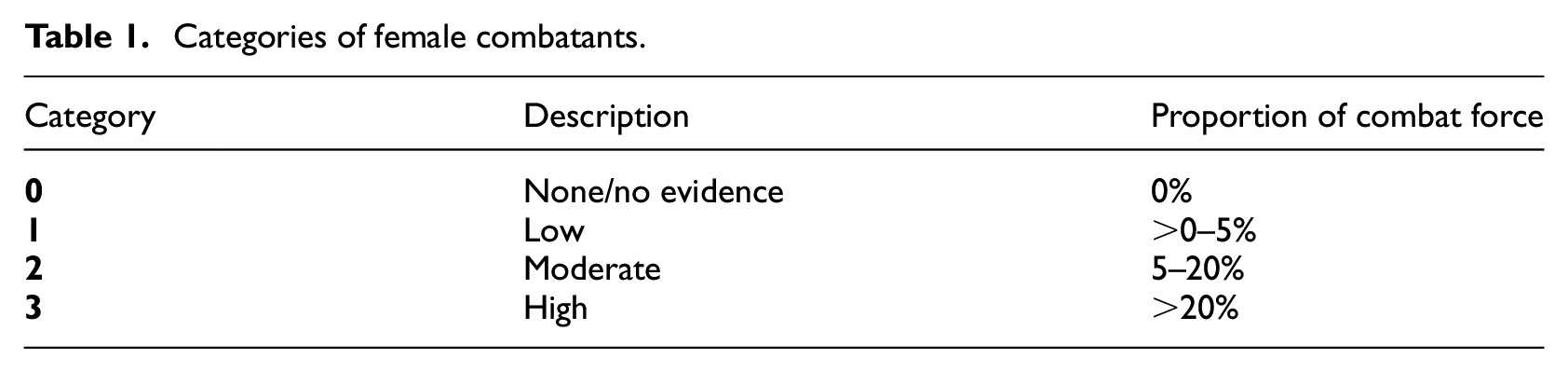
Data on the prevalence of female combatants come from the WARD. Female fighters are defined as women employed in frontline combat operations, as suicide bombers, and in armed auxiliary and civil defense forces. We rely on the variable Female Combatants, which is a categorical indicator accounting for the estimated proportion of women constituting the group’s combat force. 10 Table 1 describes each category of the variable.
Categories of female combatants.
We include a number of relevant control variables reflecting group, conflict, and state-level characteristics. First, we account for the group’s military capabilities using information available in the NSA dataset (Cunningham et al., 2013). We expect a curvilinear relationship between capabilities and conflict duration, with very weak and very strong groups fighting short wars. We therefore include two dichotomous variables in the analysis to account for relative rebel capabilities, both of which are based on the “Rebel Strength” variable included in the NSA dataset. Low Capabilities is coded 1 if the group was coded as “much weaker” than the government in the dataset and 0 otherwise. High Capabilities is coded as 1 if the group was coded as “stronger” or “much stronger” than the government in the dataset and 0 otherwise.
We also include binary indicators accounting for external intervention. Rebel External Support accounts for any external support provided to the rebels by a foreign government, including military support (weapons, etc.), non-military support (financial resources, intelligence, etc.), and the provision of troops. Government External Support reflects the provision of any of these forms of support to the incumbent. 11 Previous studies have also found that rebel groups with a legal political wing fight shorter wars (Sawyer et al., 2017; Cunningham et al., 2009). We therefore include the binary measure Legal Political Wing. As we noted above, rebel access to foreign sanctuaries creates uncertainty and shelters rebels from war costs, therefore prolonging conflict (Salehyan, 2007). External Base is a binary variable indicating that rebels stationed troops in a foreign country or had extensive access to extraterritorial bases. Secessionist Conflict reflects whether the central demand of the rebel groups involved in the conflict focused on independence or autonomy from the central state. We take these indicators from the NSA dataset.
We control for a country’s level of economic development using the variable GDPpc. This indicator reflects the natural log of the state’s mean real per capita gross domestic product. Population Size reflects the natural log of the population. Both estimates are taken from Gleditsch (2002). Because our data is largely time invariant, we take the mean value of these measures for the years of the conflict episode. The variable Democracy accounts for the presence of these institutions. We construct this indicator by computing the median value of the Polity2 score from the Polity IV dataset (Marshall et al., 2019) for the years of the conflict episode, then assign a value of 1 to cases with median Polity2 score of 6 or greater and 0 otherwise.
The binary indicator Forced Recruitment is taken from Wood and Thomas (2017), who adapted it from Cohen (2013). This variable indicates whether these strategies were used by any of the rebel factions active during a given conflict episode. Finally, we include variables representing group political ideology. In addition to influencing female recruitment, ideology might also influence the duration of the conflict, particularly if it influences the groups’ resolve, recruitment potential, or ability to acquire external support. In order to ensure that the prevalence of female combatants is not serving as a proxy for ideology, we therefore include controls for Islamist and Leftist political ideologies. These binary indicators come from Wood and Thomas (2017).
Empirical results
We report the results of our CPH models in Figure 1. 12 For ease of interpretation, we report coefficient estimates and confidence intervals in the figures. Positive values (right of the zero line) indicate that a variable corresponds to an increase in the hazard of observing a given outcome while negative values (left of zero) reflect a decrease in the hazard. Model 1 reports a base model including only a subset of group- and conflict-level indicators. Model 2 introduces controls for forced recruitment and ideology. Model 3 adds state-level controls. Across the specifications, Female Combatants is negative and achieves statistical significance. These results imply that rebellions that include a higher proportion of female combatants survive longer than those that exclude them or include them in smaller proportions.
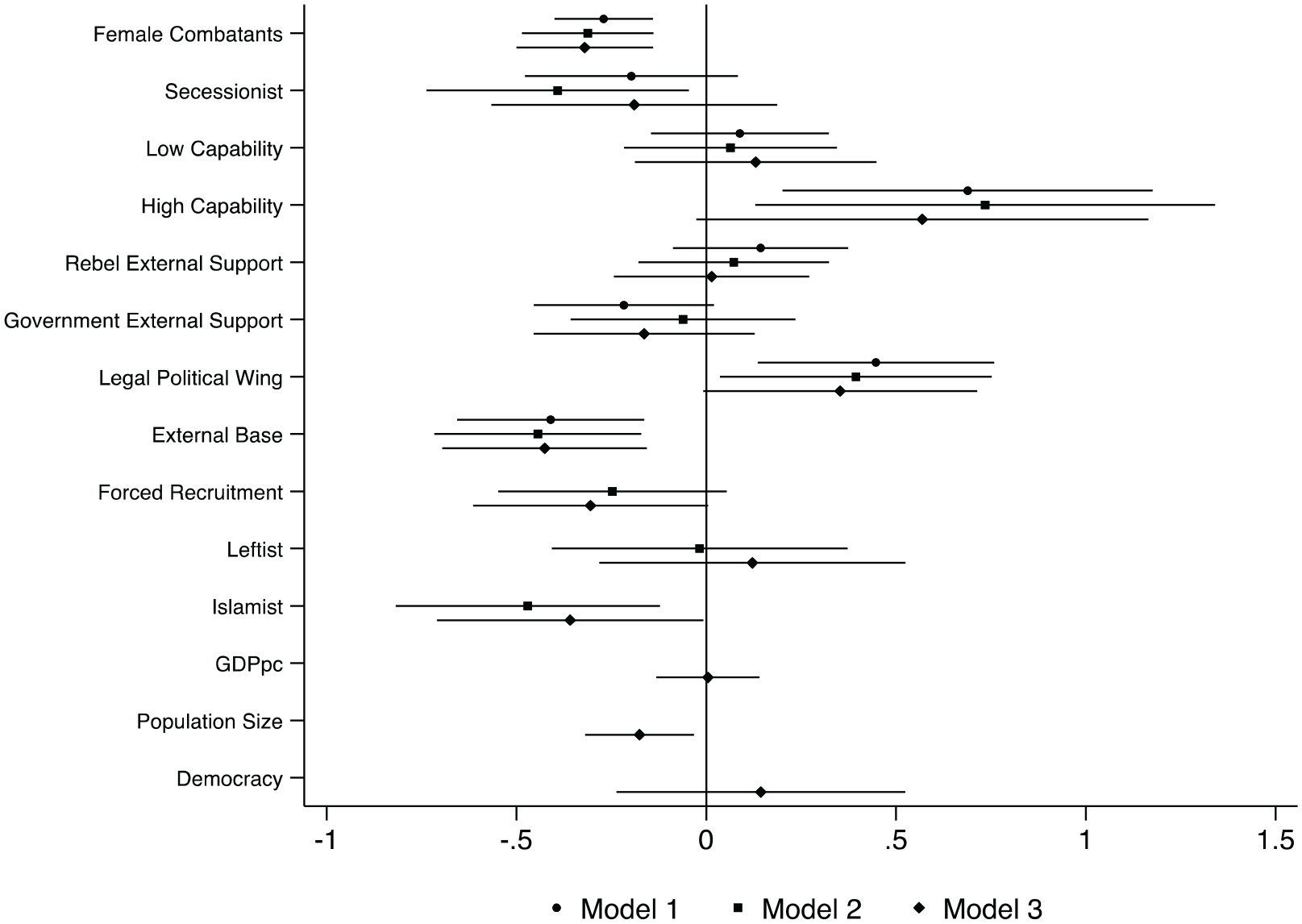
Effect of female combatants on conflict duration.
These results are consistent with our central hypothesis. Armed groups that utilize female combatants fight longer wars compared with groups that eschew women’s participation or deploy them in only very small numbers. As we argue above, this occurs because of the divergent beliefs that rebel and government forces hold over the effects of female combatants on rebel capabilities and resolve. Because the government is uncertain about the influence of female fighters and is likely to underestimate their contributions, it will often fail to offer the level of concessions necessary to resolve the conflict. Conversely, rebels are aware of the contributions that female fighters make to the group’s capability; moreover, given the costs associated with female recruitment, they understand female fighters as a reflection of their resolve to fight despite rising costs—a signal that governments often fail to appreciate.
Figure 2 illustrates the substantive effect of Female Combatants on conflict duration. The graph shows the predicted effect of the variable when it is set at either 0 (“None/No Evidence”) or 3 (High Prevalence) on the survival function for conflict termination via any cause. The survival functions represent the proportion of groups with a given characteristic (e.g. female combatant prevalence) that survived (y-axis) until a specified time t (x-axis). For ease of interpretation, we display the time in years rather than days, which is the temporal unit for the duration analysis. Consistent with our expectations, the survival function suggests that armed groups that include large numbers of female combatants survive longer—and are therefore less likely to successfully negotiate an end to the conflict—compared with those that do not include female combatants. For example, roughly 30% of armed groups that had no female combatants (solid line) survived at least five years; in contrast, 57% of groups that had a high prevalence of female combatants (dashed line) survived at least 5 years. This difference persists as the hypothetical conflict time increases: conflicts involving groups that include female combatants end at a substantial lower rate than conflicts involving comparable groups that completely excluded women from combat roles.
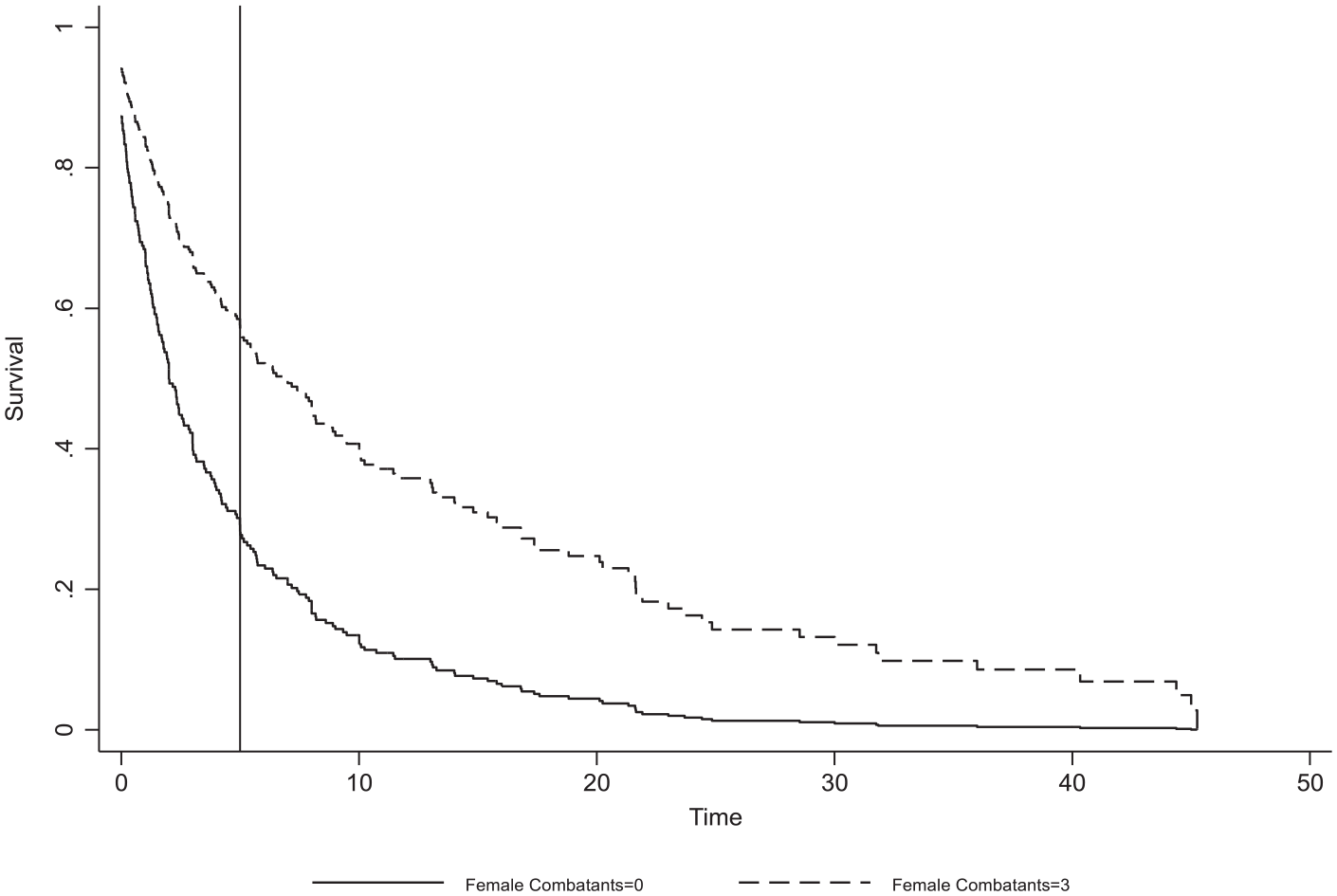
Survival functions by female combatant categories.
Robustness checks and extensions
In a series of robustness checks, we also attempt to correct for potential bias introduced by the heterogeneity in data availability in the groups included in our sample as well as potential endogeneity resulting from female recruitment often occurring only once a group is relatively well established. 13 We first address the possibility of an endogenous relationship between female recruitment and the duration of the conflict. Owing to the gender biases of male leaders, female recruitment may occur later in the rebellion’s life cycle. The timing of female recruitment could therefore bias our results. Ideally, time-varying data on the prevalence of female combatants would allow us to directly assess whether female recruitment varies over time. Unfortunately, the data included in the WARD is largely time-invariant, complicating efforts to address the possibility of reverse causality. One strategy for addressing this potential bias is to exclude cases that rapidly failed from the analysis, thus reducing the number of groups that might have failed before they made the decision to recruit women. Even after excluding cases that terminated within 3 years of conflict onset, 14 Female Combatants remains a significant predictor of conflict duration. 15
Challenges in collecting accurate information on female combatants represent an additional potential source of bias. Female combatants may be overlooked in less visible armed groups that receive less academic scrutiny or media coverage. Such oversights are most likely to occur in the context of relatively weak and short-lived rebel movements because they are also the most likely to fail early. To address this issue, we conduct an additional set of analyses that exclude cases designated as “low information” in the WARD. This binary indicator denotes cases where little to no information on women’s involvement could be located despite substantial information regarding other group characteristics. 16 The results are robust to this alternative sample as well. Together, these results should help alleviate concerns that endogeneity bias drives our results. We present these results in Figure 3.
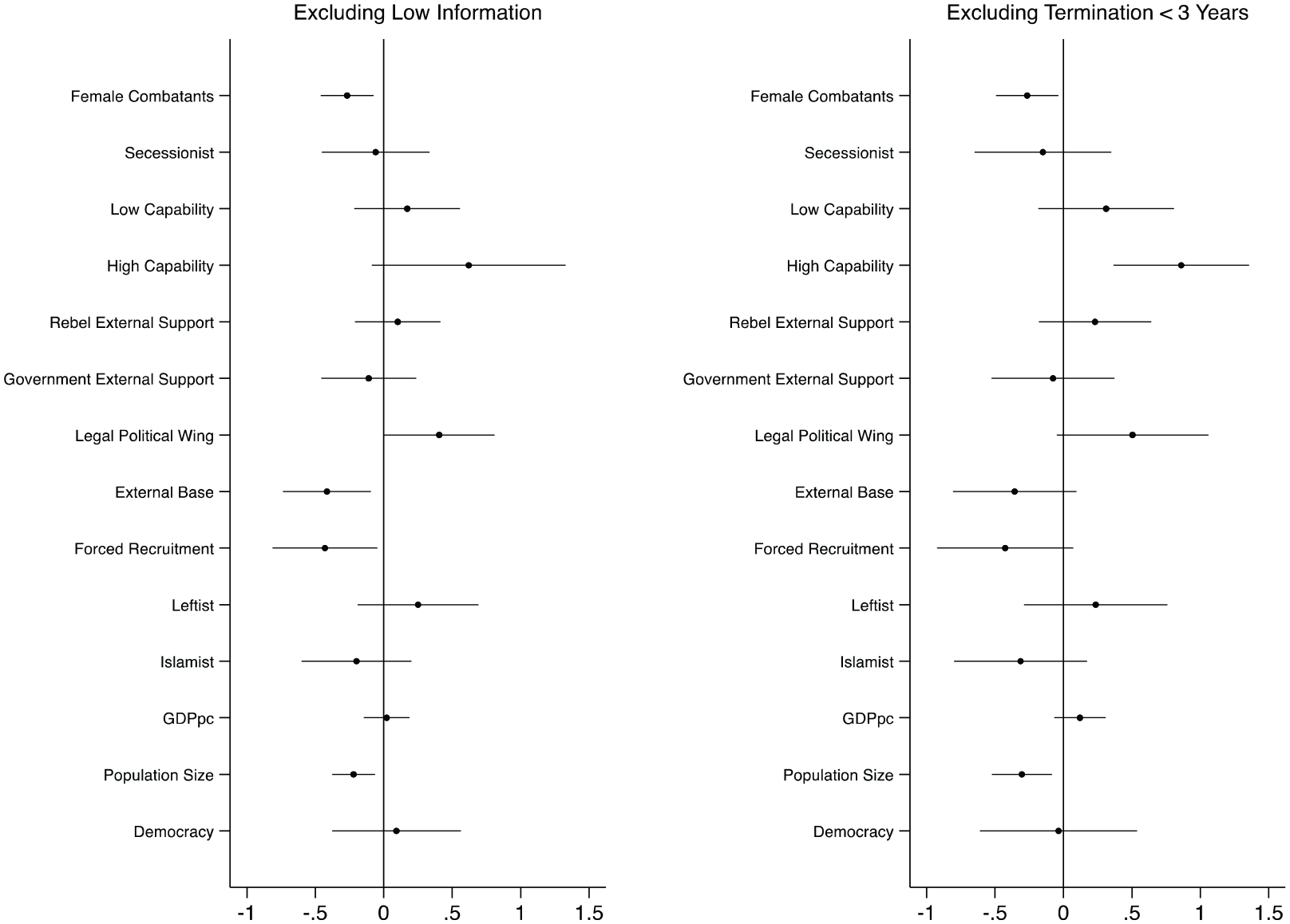
Results from restricted samples.
Insights from the LTTE
In this section, we return to the LTTE as an illustrative example of the effects of female recruitment on group capabilities and to highlight how the social costs that rebel groups and individual female fighters bear for recruiting female combatants reflect their commitment and resolve. As the case exemplifies, female combatants often play an important role in helping the group meet its resource demands and positively contribute to its fighting capacity. Moreover, it demonstrates the costs associated with this decision, which can be viewed as indicative of group resolve and individual commitment.
Although not typically viewed as explicitly Marxist, like many leftwing movements the LTTE espoused rhetoric in favor of expanding women’s rights (Hellmann-Rajanayagam, 1994). Likewise, women’s participation as combatants in the LTTE was not necessarily a result of individual political commitments. While some argue that the nationalist sentiment of the LTTE individually motivated Tamil women, others argue that nationalist goals were a “meta-reason” for women’s enlistment in the movement, and that communal suffering and oppression more directly drove women to join (Alison, 2003: 40). For example, one female combatant from the LTTE explained that the deaths of her family members in the early years of the war were what motivated her to enlist: “My brothers were killed, and out of rage, I joined the movement … I wanted to die as my brothers died” (Alison, 2003: 40). Other women have also cited family displacement and fears of the sexual violence perpetrated by the Indian Peacekeeping Force and the Sri Lankan military as their motivation for joining the armed ranks of the LTTE (Alison, 2003).
Despite the common experiences that motivated many women to fight for the LTTE, social expectations for Tamil women nonetheless demanded that they remain at home as wives and daughters and not participate as soldiers in the war. Adele Balasingham, wife of the LTTE’s chief political advisor, described female combatants’ contributions to the group as “ripp[ing] open the straight jacket of conservative images of [Tamil] women” (Stack-O’Connor, 2007: 46). Yet, many local Tamils viewed women’s deployment in combat roles as a “violation of Tamil traditions and a threat to the purity of the LTTE” (Stack-O’Connor, 2007: 50). Thus, female combatants simultaneously faced backlash from their local community and were told that their participation was dismantling the gender norms fueling that backlash. Once part of the LTTE, female fighters were taught that It is only the women with a revolutionary consciousness who could become a revolutionary force. Only such a revolutionary force can destroy the shackles of oppression … The Tamil Eelam revolutionary woman has transformed herself as a Tiger for the Liberation of our land and liberation of women. (Alison, 2003: 45)
While political commitment to overturning traditional social structures may not be what motivated many Tamil women to join the LTTE, once enlisted, commitment to the group’s goals became their only option for achieving liberation from the restrictive gender norms that threatened their ability to return to civilian society without social backlash. Interviews with female LTTE combatants reveal that their awareness and commitment to improving life for Tamil women grew throughout their participation in the rebellion (Alison, 2003: 44).
The local Tamil community often resisted the policies and reforms from the LTTE that directly challenged the social conservatism that many Tamils supported. Local communities especially contested the LTTE’s agenda for women’s involvement in the movement, and conservative families were “displeased with the new roles their daughters would have to take up” (Loken, 2021: 24; Terpstra and Frerks, 2017: 298–299). Terpstra and Frerks (2017) ultimately conclude that the LTTE’s radical position on women’s inclusion in the movement, along with other social reforms, did not help legitimize the LTTE to the surrounding community. Rather, the LTTE enhanced its legitimation through claims to common Tamil descent and a Tamil nation, martyrdom, sacrifices, charismatic leadership, and its narrative of being the “protector” against Sinhalese aggression (Terpstra and Frerks, 2017: 300).
As separatist conflict intensified in the late 1980s causalities mounted and the group’s combat forces were depleted at a rapid rate. Moreover, the LTTE had also lost support from India and faced the arrival of the Indian Peacekeeping Force, which intended to disarm the group. By this point in the conflict, the LTTE had lost approximately 8% of its membership (Stack-O’Connor, 2007: 47). Therefore, a major component of understanding why the LTTE decided to open combat roles to women—and why in the 1980s instead of a decade earlier—lies in the “supply and demand for fighters” (Stack-O’Connor, 2007: 47). To meet these challenges, the LTTE’s leadership doubled down on recruitment efforts and expanded the deployment of female combatants. Given the potential for backlash from the local Tamil community discussed above, this decision should be viewed as an indication of the group’s commitment to its political goals. In other words, the group was willing to risk alienating substantial segments of the primary constituency it claimed to represent in order to address the immediate human resource needs imposed by rising conflict intensity.
This decision also returned strategic dividends by growing the overall size of the group’s combat force. The number of female recruits also increased over time, rising from some 3000 troops in 1992 to almost 5000 troops in 2001, thus representing a nearly 70% increase in the rate of female recruitment over the decade (Gonzalez-Perez, 2008: 62). At the peak, female fighters constituted as much as a quarter of the group’s combat force. Both in terms of raw numbers and as a proportion of the group’s fighting force, the decision to expand female recruitment and more fully incorporate women into its ranks resulted in a tangible increase in the LTTE’s overall capabilities. Moreover, the LTTE leadership established the Black Tigers—an elite suicide force—in July 1987 (Stack-O’Connor, 2007: 52). Women were overrepresented in the Black Tigers relative to their prevalence in the rest of the LTTE forces, ultimately forming about one-third of this brutally effective force that was responsible for hundreds of highly lethal suicide attacks over the course of the civil war (Gonzalez-Perez, 2008: 62). Rebel leaders also recognized the potential propaganda value of female combatants, eventually leveraging the visible presence of women in combat roles to garner support for the group through its image as an all-encompassing social movement (Stack-O’Connor, 2007: 48; Terpstra and Frerks, 2017: 300). Tamil propaganda featuring female fighters ultimately helped strengthen local and diasporic support for the movement, as women’s increased participation also incited feelings of shame in the broader Tamil community for relying on women – who ought to be at home, not on the battlefield – to fight the war (Hellmann-Rajanayagam, 1994).
While recruitment of female combatants expanded group capabilities and reflected the commitment of the LTTE and its membership to achieving the group’s stated goal of Tamil independence, the Sri Lankan Civil War persisted after several failed negotiation attempts between the government and the rebels (Stack-O’Connor, 2007: 45). It is perhaps unsurprising that the Sri Lankan government failed to perceive the LTTE’s increased use of female combatants as a signal of increased rebel capacity, given that state military leaders were generally skeptical of women’s abilities to perform in combat roles (see Goldstein, 2001). The government did not initially view the influx of female combatants to the LTTE as a threat because, “women were assumed to be non-threatening, [due to] their inherent nature (weak and soft) and social roles (subservient to males)” (Stack-O’Connor, 2007: 47). Indeed, because the LTTE began recruiting women for combat roles in response to extreme resource shortages, the decision to incorporate female fighters may have served as a signal to the Sri Lankan government of the rebel group’s overall fragility. Thus, while the recruitment of female combatants led to increased capabilities and resolve for the LTTE, these benefits may not have been interpreted as such by the state. The strategic advantages of incorporating female combatants as well as the costs the group and its female members faced as result of its recruitment strategies potentially remained private information held by the LTTE leadership. The government’s inability to appreciate this information therefore impeded the bargaining process, leading it to under estimate the group’s capabilities and resolve and thus allowing the war to persist for decades.
Conclusion
While women’s participation in violent political organizations is well documented, scholars have only recently begun to systematically investigate the factors that explain variations in the presence or prevalence of female fighters (or other female members) across these groups. With few exceptions (e.g. Braithwaite and Ruiz, 2018), cross-national evaluations have overlooked the ways in which gendered recruitment might influence the survival of armed groups, their effectiveness in the battlefield, or the ultimate outcome of their violent campaigns. This manuscript therefore represents among the first attempts to explicitly theorize about the potential influences of the gendered composition of armed groups on conflict duration utilizing a large sample of diverse conflicts. The argument and the empirical evidence that we muster suggest that the degree of gender diversity within an armed resistance movement represents another important attribute that may have substantial implications for how wars are fought and how they end.
The argument and findings we present also dovetail with existing studies that highlight the important—but often overlooked—implications of rebel recruitment strategies (e.g. Cohen, 2013; Haer and Böhmelt, 2016; Weinstein, 2007). In particular, a growing body of evidence suggests that how an armed group recruits as well as who it recruits may subsequently influence its behaviors during the conflict and the manner in which the conflict unfolds. Future research may wish to further explore the extent to which rebel recruitment decisions, the specific resource mobilization strategies the group adopts, and the constituencies from which it recruits influence the dynamics of armed conflict. Owing to the endogenous relationship between recruitment strategies and conflict dynamics, teasing out causal relationships will probably prove challenging; nonetheless, such relationships are undoubtedly relevant to scholars who wish to understand patterns of wartime violence and the duration and termination of violent conflicts.
In a related manner, one potential limit of this study is its inability to disentangle the group’s motives for recruiting female combatants from the influence of these recruits on conflict processes. In particular, secular armed groups—and particularly those that embrace leftist ideologies—are the most likely to recruit female fighters. Political ideology influences both the group’s objectives and its recruitment strategies, both of which in turn shape the bargaining process between the rebels and the government and thus determine the duration of the conflict. While we control for group ideology in our empirical model and find no systematic relationship between leftist ideology and conflict duration, we note that the overwhelming majority of the illustrative examples that we use in our study, including our mini-case study, feature armed groups that espouse some form of leftwing political ideology. 17 It is therefore possible that despite controlling for ideology, the effect of female combatants on conflict duration is closely intertwined with the group’s ideology and may be most apparent in the case of leftist rebellions. Future studies may wish to disentangle this relationship.
Finally, from a policy standpoint, our findings should provide outside observers with important clues regarding the expected duration of armed conflicts. External actors should perhaps view the presence of substantial numbers of female combatants—or the onset of rebel efforts to mobilize women for war—as predictive of a conflict that will endure and become increasingly difficult to successfully resolve. They may therefore wish to incorporate this information into their mediation efforts. In particular, external actors may find it helpful to attempt to disabuse the incumbent of the notion that female recruitment signals rebel weakness and adopt other strategies that can help minimize uncertainty about the meaning and implications of female recruitment.
Most importantly, perhaps, our argument joins a large of body literature that highlights the important roles that women play in armed rebellions. In so doing, it also recognizes women as both perpetrators and victims of wartime violence and calls attention to the associated need for more effective strategies to assist the reintegration of former female fighters into post-conflict society. As we demonstrate, the wars in which female combatants participate tend to be longer and more difficult to resolve. As such, the reintegration challenges faced by all former combatants are likely to be greatest following these conflicts. This is especially true for women, who have often transgressed cultural norms and rejected social and familial obligations as a result of their decision to take up arms. Indeed, former female combatants often face the twin challenge of social stigmatization for participating in organized violence (e.g. Freidman, 2018; Veale, 2003) and the de-emphasis of their roles as fighters in the years following the resolution of the conflict (e.g. MacKenzie, 2009). This confluence of processes, which (intentionally) overlooks and rewrites their contributions during wartime and yet still punishes them, can produce devastating long-term psychological, social, and economic costs for demobilized women. Despite the gender-specific challenges that former female combatants face, disarmament, demobilization, and reintegration efforts have historically excluded women, especially those affiliated with rebel organizations (e.g. Henshaw, 2020; MacKenzie, 2009). Consequently, our findings provide additional urgency to efforts to more fully appreciate and respond to the complex needs of female veterans of protracted civil conflicts.
Supplemental Material
sj-docx-1-cmp-10.1177_07388942211034746 – Supplemental material for Female fighters and the fates of rebellions: How mobilizing women influences conflict duration
Supplemental material, sj-docx-1-cmp-10.1177_07388942211034746 for Female fighters and the fates of rebellions: How mobilizing women influences conflict duration by Reed M. Wood and Lindsey Allemang in Conflict Management and Peace Science
Footnotes
Acknowledgements
The authors wish to thank the participants of University of Maryland Department of Government and Politics / CIDM research colloquium for their helpful comments and suggestions.
Funding
The authors received no financial support for the research, authorship, and/or publication of this article.

Supplemental material
Notes
References
Supplementary Material
Please find the following supplemental material available below.
For Open Access articles published under a Creative Commons License, all supplemental material carries the same license as the article it is associated with.
For non-Open Access articles published, all supplemental material carries a non-exclusive license, and permission requests for re-use of supplemental material or any part of supplemental material shall be sent directly to the copyright owner as specified in the copyright notice associated with the article.
