



Abstract
The UN has developed a diverse range of peacemaking tools, including different forms of political initiatives (diplomatic, technocratic, and political-development missions) and peacekeeping operations. Yet we know surprisingly little about when and why we observe the onset of different types of UN missions. Examining an “escalatory trajectory,” we analyze the United Nations Peace Initiatives data, a new dataset providing information on all different types of UN engagements. Our main contributions are that we provide insights into how the different types of missions relate to one another and conceptual clarity about what the different types of missions are.
Keywords
Introduction
The United Nations (UN) is the principal organization tasked with maintaining international peace and security. Over time, it has developed a diverse range of peacemaking tools, including political initiatives (diplomatic, technocratic, and political-development missions) and peacekeeping operations. Existing research has extensively studied the determinants of the latter, i.e. UN peacekeeping (for overviews, see de Jonge Oudraat, 1996; Di Salvatore and Ruggeri, 2017), reporting robustly and consistently that peacekeepers are deployed to so-called “hard cases.” In such conflicts, the level of violence and limited capabilities of the target state make it more challenging to resolve conflict and establish lasting peace—all of this raising the need for UN peacekeeping to intervene (e.g. Sambanis and Doyle, 2000). That said, a shortcoming of existing research is that cases where peacekeepers are not (yet) deployed are largely overlooked or treated as having seen no UN engagement at all.
We contribute to this research by studying when and why different forms of UN peacemaking are deployed, offering one of the first analyses of political initiatives and peacekeeping operations jointly. Specifically, the core contribution of this research is two-fold, i.e. we provide insights into how the different types of missions relate to one another and we offer conceptual clarity about what the different types of missions are. En route, we answer why one form of intervention is adopted over another, and to what extent the presence or absence of other UN missions influences the future choice of operations. 1 Accordingly, we explore the conditions shaping the UN’s choice between political and peacekeeping missions. Scholars increasingly examine possible interdependencies between different conflict-management tools (Diehl and Regan, 2015; Melin, 2015; Owsiak, 2014, 2015; Owsiak et al., 2021) as well as their complementarities (Beardsley et al., 2019; Clayton and Dorussen, 2021; DeRouen and Chowdhury, 2018; Greig and Diehl, 2005; Kathman and Benson, 2019). Thus, our work also adds to the empirical assessments of the interdependencies across UN peacemaking tools.
Political missions or initiatives generally pertain to those UN institutions and operations issued by mandates that focus on peace and security, but that do not primarily involve military or police forces. 2 Table 1 summarizes the different types of UN peacemaking tools based on their primary purpose, area of operation, and actors involved. Along those criteria, we define four broad types of UN missions, which map onto the categories used by the UN in its budgetary process: (1) diplomatic missions; (2) technocratic missions; (3) political-development missions; and (4) peacekeeping operations. Diplomatic, technocratic, and political-development missions are varieties of (largely civilian) political initiatives in contrast to more military-oriented peacekeeping operations. 3 To unpack the process underlying the selection between different UN peacemaking tools, we undertake one of the first empirical analyses of the new UN Peace Initiatives (UNPI) dataset (Clayton et al., 2021), which covers all UN political initiatives and peacekeeping operations since 1946.
Categorizing UN missions.
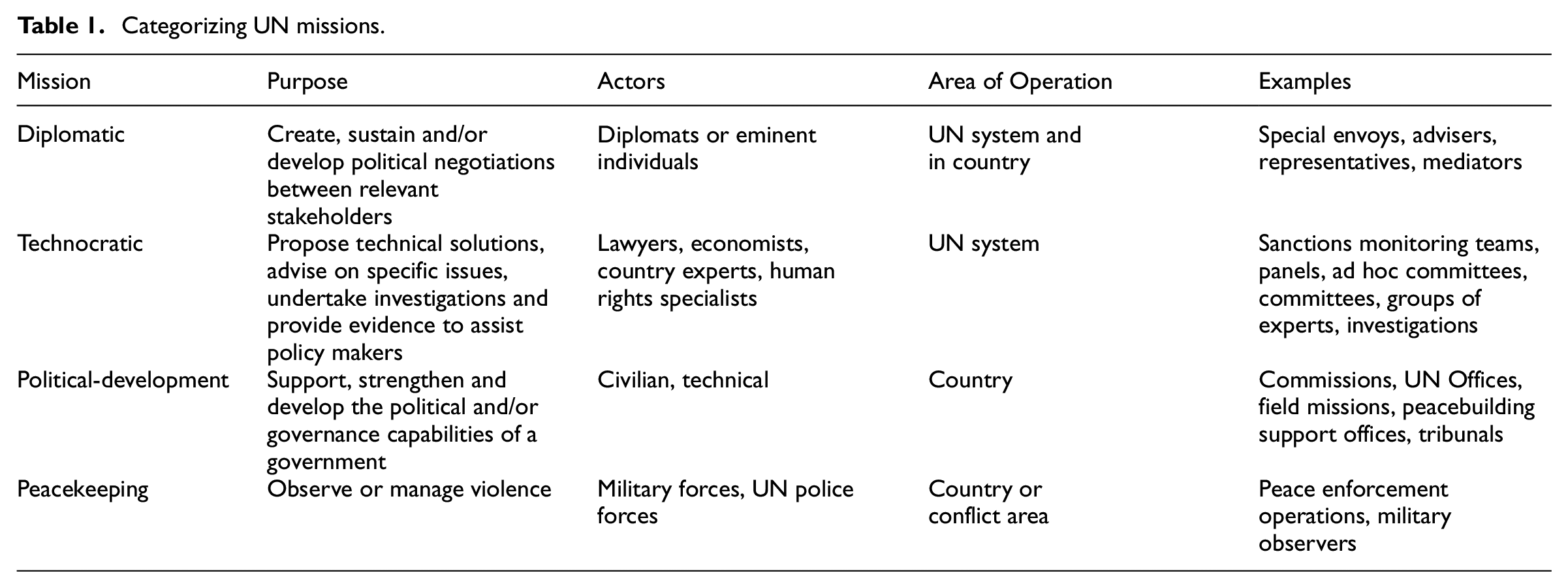
Diplomatic missions can encompass special/personal envoys, advisers, representatives of the Secretary General, or mediators. Their main purpose is to assist belligerents with resolving incompatibilities through dialogue. For example, in Myanmar in 2018, the UN responded to the Rakhine crisis by dispatching a diplomatic mission in the form of a special envoy mandated to provide good offices and promote a more inclusive peace process. Technocratic missions comprise groups, committees, and commissions of technical experts who advise or support peacemaking activities, i.e. sanctions-monitoring teams, committees, or expert panels. The Panel of Experts on Iran was an independent expert body that investigated the Iranian nuclear program. This mission, based in the UN headquarters in New York and comprising eight experts from different member states, supported UN decision-making by providing information and advice to the Security Council. Political-development missions are in-country operations that support, strengthen, and develop the political and/or governance capabilities of a state. These can be small civilian missions (e.g. Burundi or Haiti) or multidimensional state-building projects such as in Afghanistan. The UN Assistance Mission for Iraq (UNAMI) is another example of a large, costly, and more interventionist political-development mission that has been mandated since 2003 to inter alia advance inclusive political dialogue, assist in the electoral process, protect human rights, and promote gender equality. Finally, in contrast to these predominantly civilian political missions, peacekeeping operations are more military in nature, seeking to observe or physically manage the interactions between armed forces.
What are the systematic drivers behind the choice of a particular mission? We advance the key proposition that political and peacekeeping engagements are linked to different costs of intervention and that, following the requirements on the ground, the UN and hosting states aim at minimizing these costs. Comparing peacekeeping operations with political missions, we find that the latter are more likely to be implemented when conflict has not (yet) escalated and longer peace durations have passed since the last hostilities. States with a history of conflict are also more likely to initially host a political mission. Further, the UN commonly fields multiple missions in a sequence of interventions. Consider, for example, Timor Leste where a diplomatic mission preceded a peacekeeping mission. 4 Accordingly, we also examine how the deployment of missions is shaped by the existence of other UN missions. Recognizing the variation in costs of deploying different missions, we argue that there is an underlying “escalatory” logic to subsequent mission onsets. Once a particular type of peacemaking tool is deployed, the UN is more inclined to escalate to a costlier mission if fighting continues. 5
In the next section, we identify three factors that have previously been shown to influence the onset of UN missions: the authorization process, funding and personnel supply, and belligerent consent. We then focus individually on each of the three factors and demonstrate the differences between political missions and peacekeeping. These differences, we contend, produce an escalatory trajectory where a greater threat to the international community is required to activate more significant and costly UN missions. In turn, we focus on the transition between missions, and set out how the escalatory logic also shapes subsequent mission deployment.
The conditions of UN political interventions
As the leading global international organization, UN crisis intervention is generally considered a legitimate response of the international community. To manage conflict, the UN can rely on its diplomatic and technical expertise and, if necessary, has access to notable military and economic resources. Much existing research focuses on the most militarized UN peacemaking response: peacekeeping operations (see de Jonge Oudraat, 1996; Di Salvatore and Ruggeri, 2017). The UN deployed more than 100,000 (military) peacekeepers in 2019; the missions are contentious political topics, and they clearly affect the conflict space (see Freedman, 2018; Hultman et al., 2014).
Beyond peacekeeping, there is also prominent research on the UN’s diplomatic activities and its role as a mediator (e.g. Beardsley and Schmidt, 2012; Beardsley et al., 2019; Svensson, 2009). These works, however, largely overlook the wider array of diplomatic engagements, such as special representatives of the Secretary General who frequently perform important peacemaking functions beyond “mediation only.” A similar kind of neglect applies to technocratic and political-development missions, despite the frequency with which they occur. While we have gained a better understanding of the processes determining the choice of conflict managements tools (e.g. Melin, 2015) and the conditions under which certain tools are more likely to occur (e.g. Greig and Regan, 2008; Melin and Svensson, 2009), our knowledge of when and why the UN adopts which peacemaking tool remains limited.
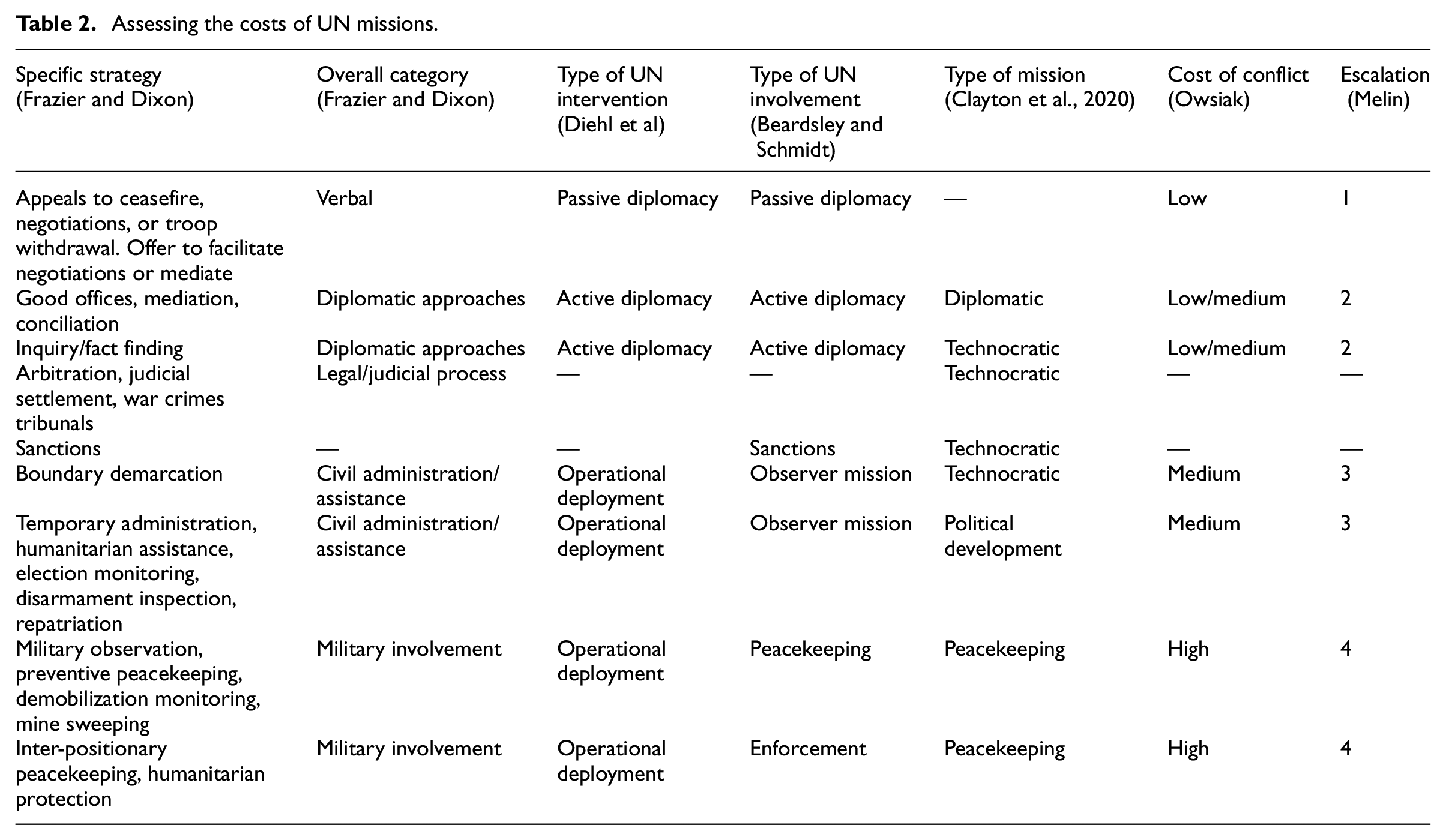
Existing research points to the importance of costs as a determinant of conflict management tools. In this context, for example, mediation (e.g. Clayton, 2013, 2016; Melin and Svensson, 2009) and peacekeeping (e.g. Fortna, 2004; Ruggeri et al., 2017) both tend to occur in the more challenging contexts: the relevant parties are more willing to bear the costs associated with such peacemaking instruments when the costs of continued conflict are higher. Examining different types of UN engagements, it is thus crucial to rank such conflict management tools in terms of their costs. Frazier and Dixon (2006: 395) define verbal expressions, diplomatic approaches, legal/judicial processes, civil/administrative assistance, and military involvement as overall categories of third-party conflict management. They also identify specific strategies or tasks within each category. Good offices, mediation, and conciliation are seen as least costly diplomatic approaches. Diplomatic approaches further include inquiries and fact-finding, while specific strategies of legal processes comprise arbitration, judicial settlements, and tribunals. Alongside sanctions, these strategies are key elements of what we define as technocratic missions. Owsiak (2014: 54) identifies their costs as low to medium, while Melin (2015: 31) considers them an escalation from verbal expressions.
According to Frazier and Dixon (2006), the provision of civil administration and assistance encompasses tasks such boundary demarcation, temporary administration, humanitarian assistance, election monitoring, temporary administration, disarmament inspection, and repatriation. These tasks are the focus of political-development missions and also covered by peacekeeping operations. Owsiak (2014: 54) classifies them as more costly, and Melin (2015: 31) treats them as an escalation from diplomatic approaches. Finally, military involvement includes specific strategies ranging from military observation, preventive and inter-positionary peacekeeping to demobilization and humanitarian protection. In line with our arguments, peacekeeping operations are considered as most costly (Owsiak 2014: 54) and as the highest level of escalation (Melin 2015: 31). 6 Building on this work, and the UN’s own guidance, we set out an argument for why the choice of UN peacemaking is shaped by the costs associated with the different missions. Table 2 summarizes what we contend and compares our ranking with other studies. We identify three key factors that shape the costs and, thus, the selection of UN missions: authorization, funding and supply, and belligerent consent for UN missions.
Assessing the costs of UN missions.
Authorization
Following Article 99 of the UN Charter, the Secretary General can “bring to the attention of the Security Council any matter which in his or her opinion may threaten the maintenance of international peace and security.” Good offices and mediation have been established under Article 99 by various UN Secretary Generals and apply to missions created directly by the Secretary General (as well as those mandated by the Security Council; Kugel, 2011: 2). The UN Secretariat can deploy and authorize technical missions to analyze and assess the security, political, military, humanitarian, and human rights situation (United Nations, 2020) without an explicit vote of the Security Council. The General Assembly mandates political missions 7 and occasionally authorizes subsidiary organs with a peace and stability mandate by majority vote, e.g. the Special Committee on Decolonization. 8 In contrast, the authorization of peacekeeping missions requires a resolution of the Security Council, thus, in practice avoiding a veto by one of the permanent members. While political missions can be relatively easily authorized for a range of issues, the threat must be sufficiently high to galvanize and unite the permanent members of the Security Council without impinging on their core interests for peacekeeping to be implemented.
Funding and supply
Political missions are comparatively small and inexpensive (United Nations Department of Political Affairs, 2017: 6). Field missions have generally fewer than 500 staff members, while fewer than 50 people commonly support a special envoy. Hence, deploying additional political missions, even when they are relatively large, field-based operations, is less of a burden on UN staff and budget than peacekeeping operations. In contrast, peacekeeping missions are costly to deploy and they take up a significant part of the UN funds. Whereas the burden of traditional peacekeeping missions remains manageable, transformational interventions 9 impose a considerable strain on the UN. For example, MINUSMA in Mali, UNMISS in South Sudan, and MONUSCO in the Democratic Republic of the Congo deploy up to 20,000 personnel and have an annual budget of more than $1 billion each. In general, the UN spent approximately $6.5 billion to deploy almost 100,000 peacekeepers to 13 missions in July 2019 to June 2020.
Peacekeeping comes with considerable risks in executing a mandate (Duursma, 2019). Since 1948, there have been almost 4000 fatalities in peacekeeping operations (Bromley, 2018; Fjelde et al., 2016; Salverda, 2013). Peacekeeping ineffectiveness, e.g. the failure of peacekeepers to protect civilians, can lead to notable political and reputational damage. The same is increasingly true for (sexual) misconduct by individual peacekeepers (Freedman, 2018; Karim and Beardsley, 2017). While political missions share some of these risks when based in the field, their political (rather than military) character and deployment away from the battlefronts significantly lower these. In sum, the initiation of political missions probably requires a significantly lower financial and material investment on the part of the UN and its member states, while carrying a lower risk than peacekeeping missions.
Consent
Political missions more clearly respect the autonomy of parties involved, in particular the sovereignty of the incumbent government. Political envoys and good offices depend on the willingness of the parties to engage in the peace process, but even sanction committees ultimately rely on actors’ willingness to comply with inspections. Political missions never compel a belligerent to alter their behavior under the threat of force. Legally and practically, consent is not a fixed entity, meaning it can be withdrawn over time (Piccolino and Karlsrud, 2011; Tull, 2013). As a result, the political costs of hosting a political mission are lower for hosting countries. Gaining consent for a peacekeeping mission is a more challenging task. Having to accept an external force is a serious constraint on state sovereignty. Except for Chapter VII missions, peacekeeping depends on the consent of the warring parties. 10 Once deployed, peacekeeping tends to limit the ability of the (former) belligerents to withdraw their consent (Piccolino and Karlsrud, 2011; Tull, 2013). 11
Ultimately, considering the arguments for authorization, funding and supply, and consent, political initiatives are less costly for the UN than peacekeeping operations. Countries should find it easier to finance and staff political missions, while potential hosts are likely to be more willing to accept them. It follows that political initiatives are the preferred instrument when the UN perceives a threat to international peace and stability, but not sufficiently high to trigger action from the Security Council. In contrast, it may be more challenging to authorize peacekeeping owing to higher costs and invasiveness. Hence, the Security Council is likely to deploy a peacekeeping rather than a political mission only when a dispute poses a threat to international peace and security that outweighs the costs associated with a mission. From this discussion we derive the first hypothesis:
Escalation across UN interventions
In any conflict, information about the capabilities, resolve, and intentions of the fighting parties is often sparse, especially at the start of a dispute. Earlier diplomatic interventions can reveal information that calls for a reassessment of the initial approach. The situation on the ground may also simply change over time. Thus, rather than focusing only on the initial choice for the and onset of missions, we also have to consider how earlier missions impact later mission deployments—potentially of a different type than before.
A growing body of literature focuses on what Owsiak (2014, 2015) terms conflict management trajectories, i.e. the sequencing of third-party interventions. Over the course of a dispute, there are regularly multiple interventions with different techniques. Moreover, subsequent efforts by the same, or different, peacemakers are clearly not independent from prior ones (see also Aduda, 2019; Böhmelt, 2014; Corbetta, 2015; Diehl and Regan, 2015). The level of initial interventions signals the willingness or resolve of the peacemaker, while subsequent, more costly interventions respond to experiences with earlier interventions (Owsiak 2014: 66). Melin (2011, 2015) also observes that the selection and escalation of third-party intervention strategies reflects the failures and successes of earlier interventions. Escalation across interventions results from a commitment to conflict management. Until now though, the literature mainly focuses on conflict management trajectories in the context of militarized interstate disputes (MIDs). We argue that a similar escalatory logic underpins subsequent UN peacemaking tools, where increasingly costly methods become more likely over the course of continued UN involvement. This rationale suggests escalation to higher-cost missions or initiatives following an initial, less costly, intervention.
Political missions probably carry fewer costs than peacekeeping with regard to authorization, funding and supply, and belligerent consent. Given a first engagement, if conflict continues, the UN has to decide whether to sustain its efforts (continuing the mission), to scale them back, or to increase them by implementing a more costly initiative. The decision to increase effort constitutes escalation (Zartman and Faure, 2005: 7). The escalatory rationale is that, as involvement progresses, the UN will either sustain or escalate engagement. We contend that when faced with a challenge, the UN is most likely to escalate to a more costly higher-effort mission. As long as a dispute poses a threat to international peace and stability, actors will continue to rely on the UN. Sustained UN involvement and commitment to conflict management facilitates escalation. 12
Diplomatic and technocratic missions are often required to agree to a framework for further meaningful intervention (United Nations, 2020). Mediation is the primary tool of a diplomatic mission for identifying possible solutions to a conflict and for helping parties to overcome issues of commitment and information asymmetries (Fearon, 1995). Technocratic missions provide technical information, which helps to determine the size and scope of subsequent initiatives (United Nations, 2020). Political missions may allow parties to identify a self-sustaining peace, but a peace agreement could well be only feasible with the deployment of peacekeeping missions (Beardsley, 2011).
Peacekeeping and political-development missions allow the UN to have an impact on the situation on the ground more directly. This is particularly relevant when the legacy of conflict requires more direct involvement, e.g. when the UN is tasked to implement demobilization and security sector reform. Peacekeeping and political-development missions can enhance the credibility of commitments made by the warring parties when an agreement is fragile (Walter, 2001). Combining the “escalatory logic” with the ordering of effort for different types of UN mission, i.e. diplomatic missions as the least costly initiatives, followed by technocratic, development, and peacekeeping interventions (in that order), suggests that subsequent UN interventions are more likely to escalate from political missions to peacekeeping operations:
Research design
Dependent variables and methodology
We rely on the UNPI dataset (Clayton et al. 2020). The UNPI defines a peacemaking initiative as any subsidiary organ, temporary or permanent, created by the UN under a peace and security mandate, to address, prevent, manage, or resolve conflict. It covers all UN missions during 1946–2015 and includes information on the onset and termination of missions, the mandated functions, and actors involved. To the best of our knowledge, UNPI is the first dataset covering the full range of UN peacemaking activities, which also facilitates the analysis of selection and sequencing of missions. In particular, the inclusion of political missions is a notable extension to the growing number of peacekeeping datasets that are limited to the more militarized forms of intervention (see Bara and Hultman, 2020; Clayton et al., 2017). Similarly, the data extend previous collections that only capture UN mediation episodes (e.g. DeRouen et al., 2011). And unlike event-based conflict management data (e.g. Melander and von Uexkull, 2011), the UNPI contains information on bodies and organs that may undertake multiple events and exist for longer periods.
The mission is the unit of analysis for the analysis pertaining to first hypothesis (H1) and we only focus on the onset of new or “first” initiatives. Follow-up missions or those that are merely renewed are initially omitted owing to persistent cross-unit (path) dependencies. This setup has several advantages in that we can focus on missions as such, while avoiding potential case linkages biasing our estimates. At first, we thus exclude no-mission cases, i.e. years, conflicts, or countries in which a mission could have been established, but never materialized. We include all missions regardless of whether a conflict is ongoing. 13
For the analysis pertaining to the second hypothesis (H2), we concentrate on those interventions that are tied to a conflict as defined according to the Uppsala Data Program (Gleditsch et al., 2002). Linking missions to conflicts is crucial for identifying their sequence—the core of this part of the empirics. That is, while UN missions can occur without actual fighting taking place, it is difficult to identify whether a mission is a follow-up to another one under those circumstances, making it even more challenging to code any real sequence of interventions. Focusing on conflict environments circumvents this issue, albeit at the expense of several non-conflict cases (N=184) being omitted from our second analysis. We initially also omit no-mission cases, but we consider the inclusion of no-interventions after discussing the main results for our first hypothesis.
For the first analysis, there are 462 unique new or first missions, while we capture 414 missions, some of which are follow-up missions to previous ones, for the second analysis. The dependent variable for testing H1 is nominally scaled and distinguishes between different mission types: 82 are peacekeeping operations, 89 are political-development interventions, 62 are of a diplomatic nature, and 229 are technocratic missions. As a result, our first analyses are based on multinomial logit regression models. 14 Here, we begin by considering all missions using peacekeeping operations as the baseline category, which allows us to identify any systematic differences between peacekeeping operations and political missions. In turn, we omit the peacekeeping category and estimate a series of models that focus on diplomatic missions, technocratic missions, and political-development interventions only (with varying baseline categories for reference).
For the analysis of H2, the final data comprise 139 peacekeeping operations, 104 political-development interventions, 41 diplomatic initiatives, and 130 technocratic missions. We have created two different dependent variables. First, there is a first-difference measure, which captures the escalatory logic. That is, assuming that diplomatic, technocratic, political-development, and peacekeeping missions follow an escalatory trajectory, the first dependent variable captures whether a follow-up mission is, in comparison with the preceding mission, more (1) or less costly (−1), or at the same level (0). A mission is coded at the same level (i.e. 0) when a new mission of the same type is formed, or if the mission is given a new mandate (i.e. UNAVEM I to UNAVEM II). Recall that diplomatic missions are the least costly initiatives, followed by technocratic, development, and peacekeeping interventions (in that order). In light of this dependent variable, we use ordered logistic regression models. Second, we created a nominally scaled variable that simply distinguishes between mission types and, thus, use again multinomial logit regression.
Explanatory variables—Hypothesis 1
We focus on three main explanatory variables: the link to an active conflict, the duration of peace since the last conflict, and a country’s war history. First, as indicated above, missions may be, but do not have to be, established during active conflicts. In several instances, missions are created for cases short of actual or intense clashes. Arguably, however, cases will be more complex to solve and more protracted once they have escalated to real fighting. To this end, we created Conflict Link, which captures in a binary fashion whether a specific mission was linked to a conflict as identified by the Uppsala Data Program (Gleditsch et al., 2002).
Second, cases with longer peace durations tend to be the more settled ones, where grievances that may have led to the original outbreak of a dispute have been more fully addressed. Hence, longer peace durations should stand for the “easier” cases. We measure this with a variable counting the number of years elapsed since the last conflict. As before, conflict is defined by the Uppsala Data Program (Gleditsch et al., 2002). If a country has never seen any conflict, our peace-year counter starts in 1946.
Finally, next to an active-conflict link and peace durations, the war history of a country may signal whether a case is an easier or more difficult one. Using the Uppsala data again (Gleditsch et al., 2002), we created an item on the number of conflict onsets a state has previously seen and turned this into a binary variable receiving a value of 1 if at least one war broke out in the past (and 0 otherwise). We opted for a dichotomous measure to ease interpretation. All else being equal, countries with a war in the past will be part of the more difficult cases. The underlying rationale is, however, different from active conflicts in the present or the duration of peace since the last conflict (Table 3).
Descriptive statistics for H1 analysis.
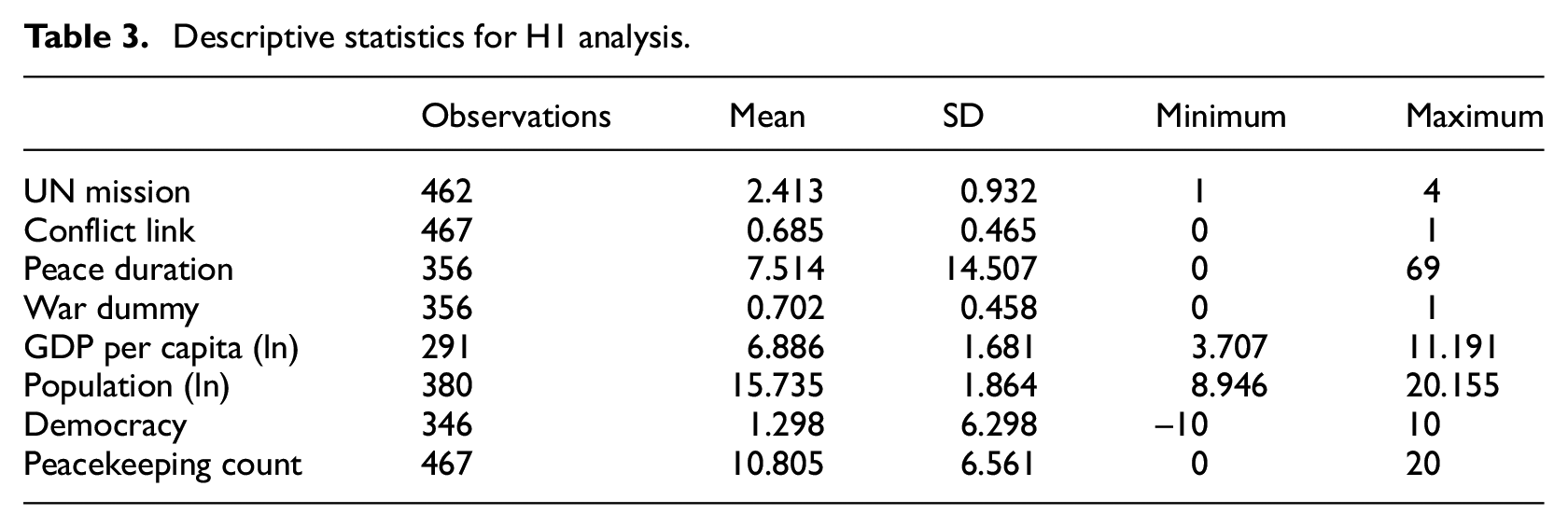
As control variables, we consider standard covariates used in the study of conflict and peacekeeping. In our case, these variables either capture alternative mechanisms leading to the establishment of a specific mission type or correlate with our main explanatory variables. We eventually include four such items. First, there is GDP per capita. Income is one of the most robust determinants of conflict outbreaks in that wealthier states are less likely to see conflict emerging (e.g. Ward et al., 2010). Subscribing to this pattern, wealthier states belong to the easier cases. The data are taken from the World Bank (2018). Second, we include the natural logarithm of population. We again draw on data by the World Bank (2018). Theoretically, more populous states are potentially more heterogeneous in ethnicity, interests, actors, etc., and thus constitute more difficult cases (Fearon and Laitin, 2003). Third, we expect that regime type matters—not only for conflict outbreak and dynamics, but also for mission allocations. Using data from the Polity IV Project (Marshall and Jaggers, 2002), we employ the polity2, in which higher values represent more democratic countries. Finally, we include the count of the number of peacekeeping operations in a given year. The variable is based on information from the United Nations (2019) and ranges between 0 and 20. In essence, the additional costs of setting up another peacekeeping mission should be lower the more missions the UN currently has running.
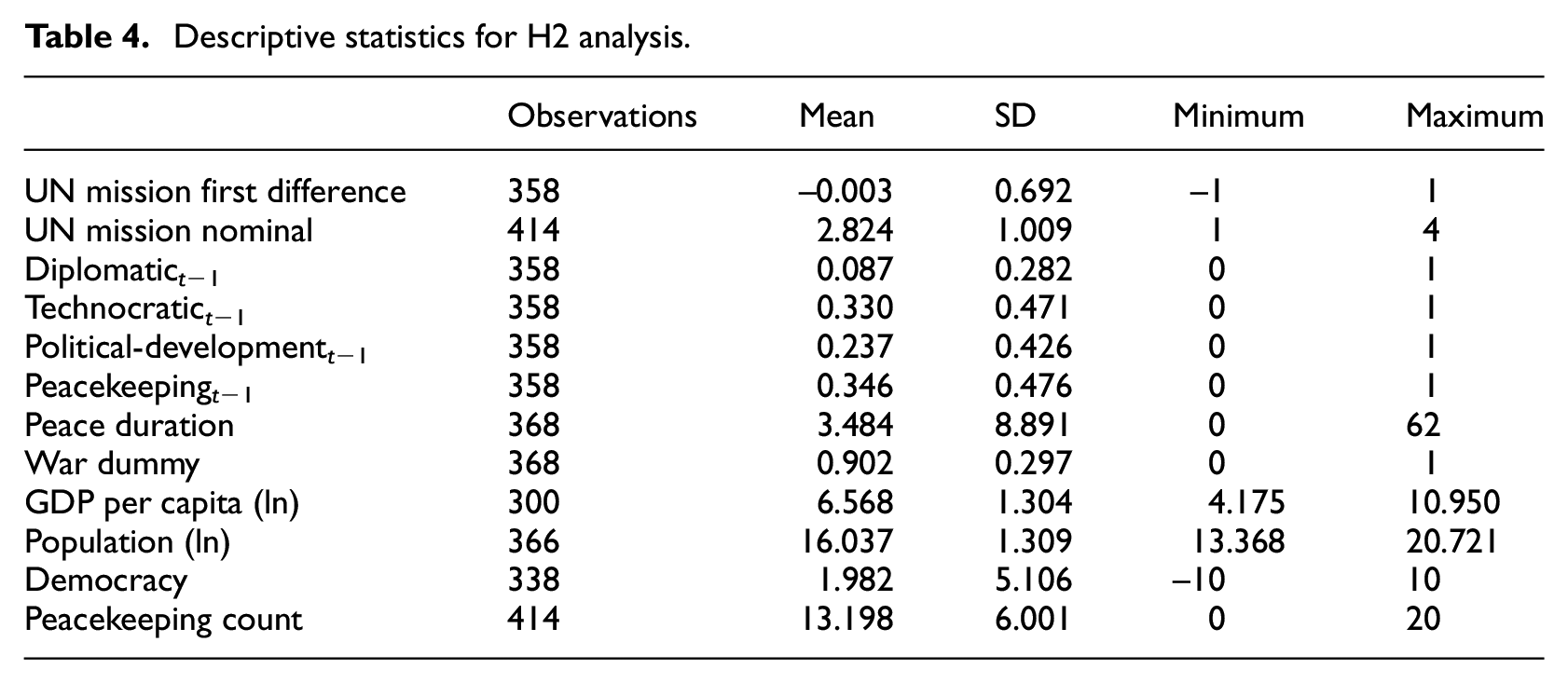
We control for temporal dependencies in the current setup via standard approaches in categorical dependent variable models (Beck et al., 1998): the peace duration variable, although also a substantively important predictor, is the crucial variable here (Table 4).
Descriptive statistics for H2 analysis.
Explanatory variables—Hypothesis 2
Our main explanatory variables for the second analysis are based on the mission data, but we focus on the type of mission employed prior to the intervention under consideration. That is, using three dichotomous variables, we distinguish between diplomatic, technocratic, and political-development missions (using peacekeeping as the reference category) and employ these as determinants of either moving on the escalation trajectory in the next round (order logistic regression model) or the specific mission type being initiated in the next step of a sequence (multinomial logit model). The controls we include here are the same as used for the first set of models (for H1).
Empirical findings
Table 5 summarizes our main model for testing H1. We use peacekeeping operations as the reference category and, thus, compare all three types of political missions with these. The coefficients in Table 5 can be interpreted along the direction of their impact and statistical significance. The substantive quantities of interest are presented in Figures 1 and 2, which depict changes in the probability of scoring a certain outcome. Importantly, the key aspect is whether the confidence intervals overlap across outcome categories or not.
The determinants of UN missions—main model.
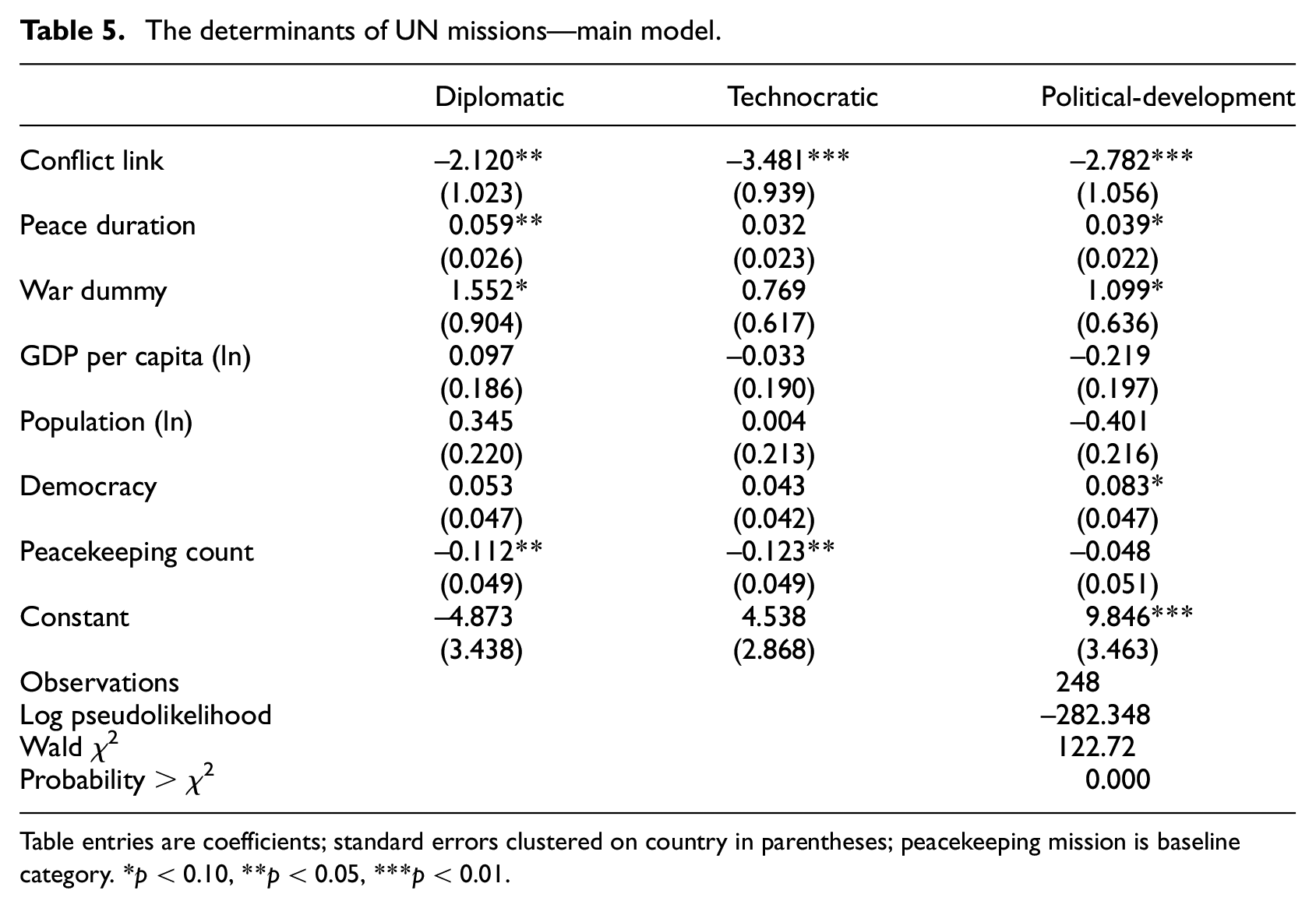
Table entries are coefficients; standard errors clustered on country in parentheses; peacekeeping mission is baseline category. *p < 0.10, **p < 0.05, ***p < 0.01.
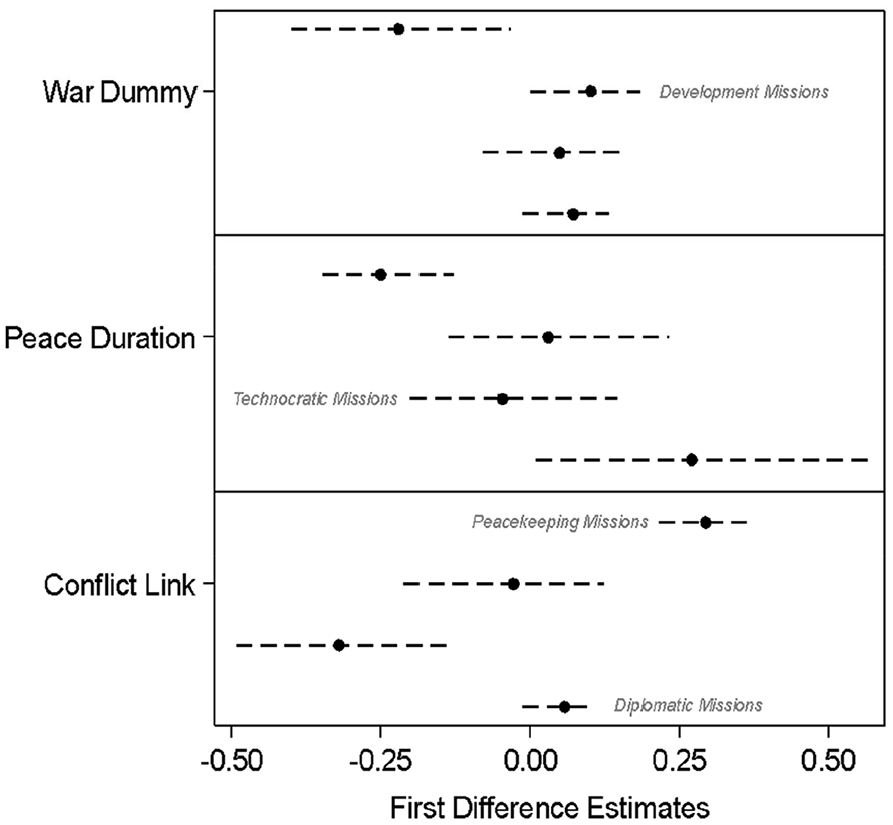
Core variables’ first difference estimates.
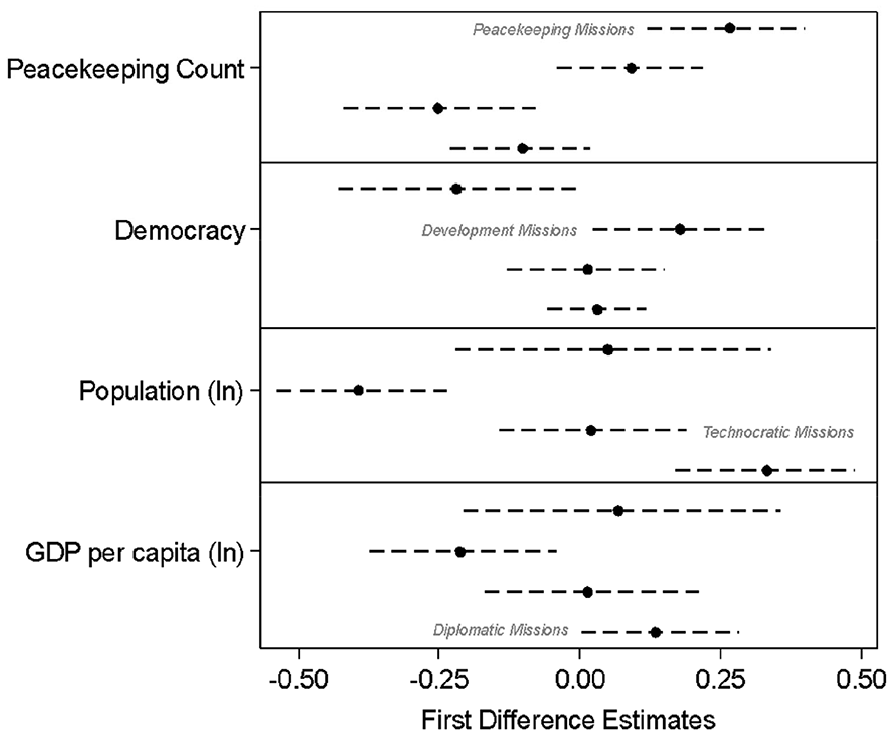
Control variables’ first difference estimates.
We obtain evidence that political missions differ from UN peacekeeping interventions in important aspects. First, a link to an active conflict generally lowers the likelihood of seeing diplomatic, technocratic, or political-development missions. The coefficient estimate of Conflict Link is consistently negatively signed in Table 5 and significant at conventional levels. In more substantive terms, Figure 1 plots the changes in the predicted probability of seeing a specific outcome value when altering Conflict Link. Our estimate for peacekeeping statistically differs from the political missions. In fact, an active conflict increases the likelihood of a peacekeeping mission by almost 30 percentage points. For diplomatic and political-development missions, the estimates are insignificant, but they differ from peacekeeping operations (as shown in Table 5 as well). Finally, a conflict link even decreases the probability of observing a technocratic mission in absolute terms by about 32 percentage points; this estimate also differs from the observed first difference for peacekeeping.
Second, the longer peace lasted since the last conflict, the less likely peacekeeping operations become. The item Peace Duration is positively signed for all categories of our outcome variable in comparison with peacekeeping in Table 5, suggesting that political missions are, all else being equal, more likely to emerge than peacekeeping operations the more time has elapsed since the last fighting. The coefficient estimate is not statistically different from technocratic and peacekeeping missions, however. The substantive quantities of interest (Figure 1) underline this: increasing Peace Duration from its 5th to its 95th percentile lowers the chances of peacekeeping onset by about 25 percentage points. The estimates for political-development and technocratic missions are indistinguishable from 0, but the former’s confidence interval does not overlap with the one for peacekeeping missions. In terms of diplomatic missions, their likelihood increases by about 26 percentage points when changing Peace Duration from its 5th to its 95th percentile.
Third, a general history of war decreases the likelihood of peacekeeping missions in comparison with the political missions. As shown in Figure 1, the chances of peacekeeping are lower by 22 percentage points compared with a country without any prior conflict. The point estimates for seeing any of the political missions are higher, while their confidence intervals do not overlap with that of peacekeeping. Having said that, all political missions’ estimates do not significantly differ from 0. This finding is contrary to our expectations where we deemed countries with a history of conflict to be “harder” cases. Possibly, however, a country without any prior war history that suddenly sees the outbreak of a conflict may well be classified as a more difficult case, rendering peacekeeping operations the more suitable choice. Other forms of intervention, such as political missions, then have—in comparison—a higher chance of being implemented when there is a history of conflict. Admittedly, this is an ad-hoc explanation and, in absolute terms, the effect is negligible as the probability point estimates do not differ from 0.
We also examined the differences among political missions when excluding peacekeeping as an alternative. We thus re-estimate Table 5, while excluding peacekeeping missions and altering the reference category. Table 6 summarizes our results. The only key difference is given for technocratic vs. diplomatic missions and for Conflict Link: an active conflict lowers the chances of a technocratic mission in comparison with a diplomatic initiative. The results for Peace Duration and War Dummy are inconclusive, though, suggesting that the main “cleavage” seems to be between peacekeeping and political missions. Within the category of the latter, minor differences do exist, but our main determinants do not identify much of a systematic difference among them in general. In other words, diplomatic, technocratic, and political-development missions seem much alike, but they significantly differ from peacekeeping interventions as such.
The determinants of UN political missions.
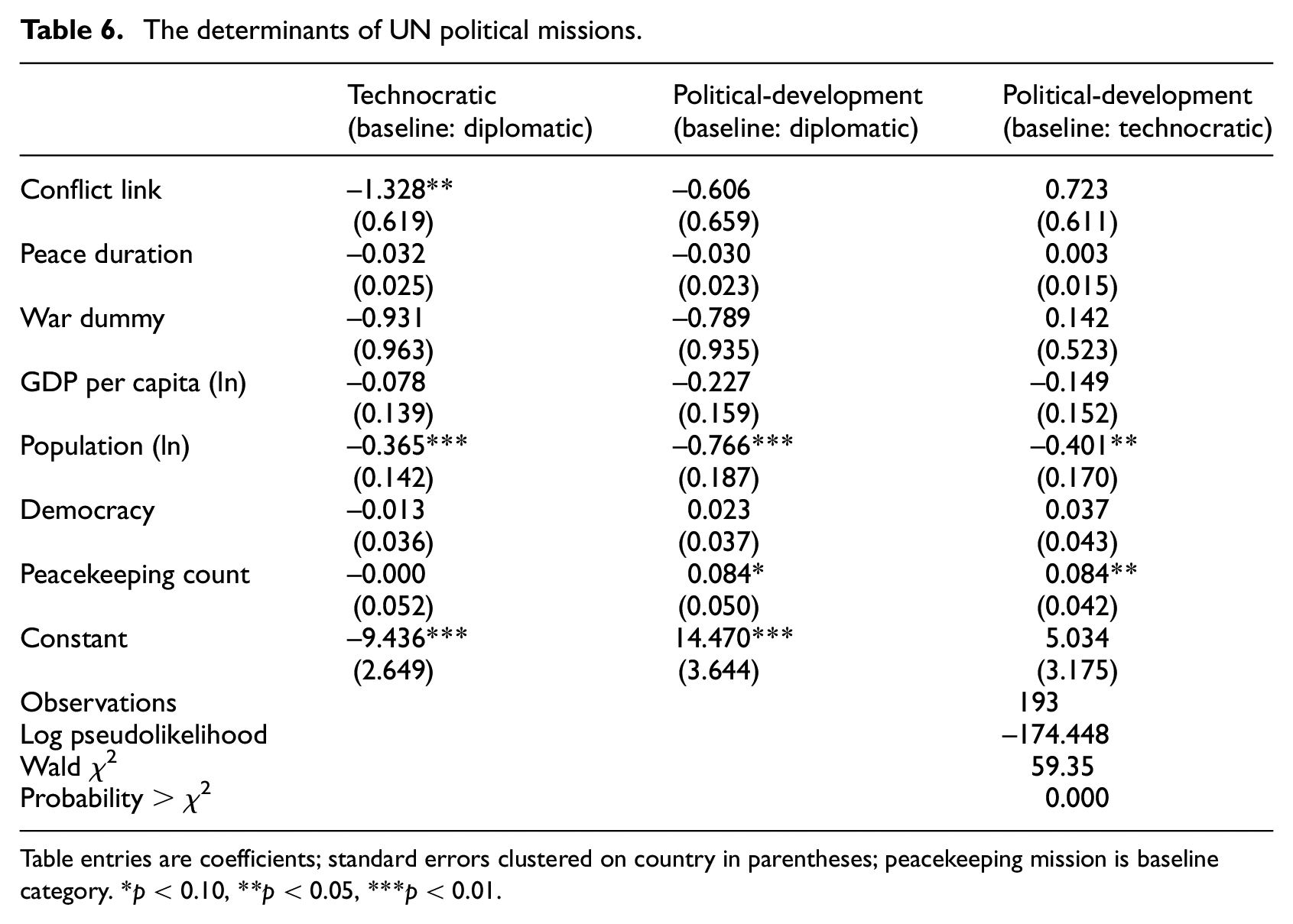
Table entries are coefficients; standard errors clustered on country in parentheses; peacekeeping mission is baseline category. *p < 0.10, **p < 0.05, ***p < 0.01.
Interesting differences among the political missions emerge in light of our control variables. While these, except for Peacekeeping Count, cannot explain much of the difference from the establishment of peacekeeping operations (Table 5), they allow us to get a more fine-grained understanding of when a particular type of political mission is created. In particular, more populous countries are more likely to attract diplomatic missions. Technocratic missions are also more likely than political-development missions in larger states. The first difference calculations in Figure 2 also mirror this. Finally, coming back to Peacekeeping Count, it seems that the more active peacekeeping operations there are in a given year, the less difficult it is to create yet another such mission, making it more likely that a peacekeeping operation is established compared with all of the other available choices.
So far, we have focused on interventions as such owing to parsimony and to facilitate interpretation. However, omitting non-conflict and non-intervention cases can still induce bias. In the following, we seek to assess this bias and, if necessary, correct for it. First, as political missions can be sent to countries without an active conflict along the lines of the Uppsala Data Program (Gleditsch et al., 2002), simply adding conflict country-years without UN intervention is likely to be incomplete. Instead, our starting point for considering non-intervention cases is a monadic, country-year dataset that we created using the Uppsala Data Program (Gleditsch et al., 2002). For this dataset, we specify with a dichotomous variable whether armed conflict was present in a country-year or not. In turn, we merged in the information about missions and replaced any missing information there by 0s. Effectively, we thus consider political missions and peacekeeping missions next to non-interventions. In a third step, using the same data sources as described in the main text, we merged in the control variables.
With that data material at hand, we seek to estimate a two-stage process: initially, whether the UN considers any intervention at all as opposed to doing nothing; and, afterwards if an intervention is the chosen option, we want to model which of the possible options is likely to be the most preferred one. To this end, we have opted for the “classical”Heckman (1979) Selection Model, in which the estimated mean function in the outcome stage is conditioned on the first stage selection process and, thereby, provides a consistent estimate for the truncated distribution of the second stage sample.
The correlation of the error terms in the two stages, ρ, and its significance can be interpreted in line of how important selection in the particular context really is. Its estimation, however, can be highly sensitive to model specifications. In practice, the Heckman Selection Model is commonly implemented as a two-step model, in which step one consists of estimating a probit model for the selection equation. The second step involves estimating a corrected version of the outcome equation using ordinary least squares (OLS). It is important for the identification of the Heckman model that at least one variable should be found that influences only the selection into the sample but not the outcome of interest.
Despite a strictly speaking nominally scaled outcome variable, we believe that the Heckman model with its corrected OLS-based second stage can be applied. That is, theoretically, we do contend for an escalatory logic surrounding UN missions, and the OLS setup imposes the corresponding hierarchy in missions. The model in Table 7 considers some of the controls only for the selection stage and also includes variables for temporal correction in this equation (Carter and Signorino, 2010).
Heckman selection model.
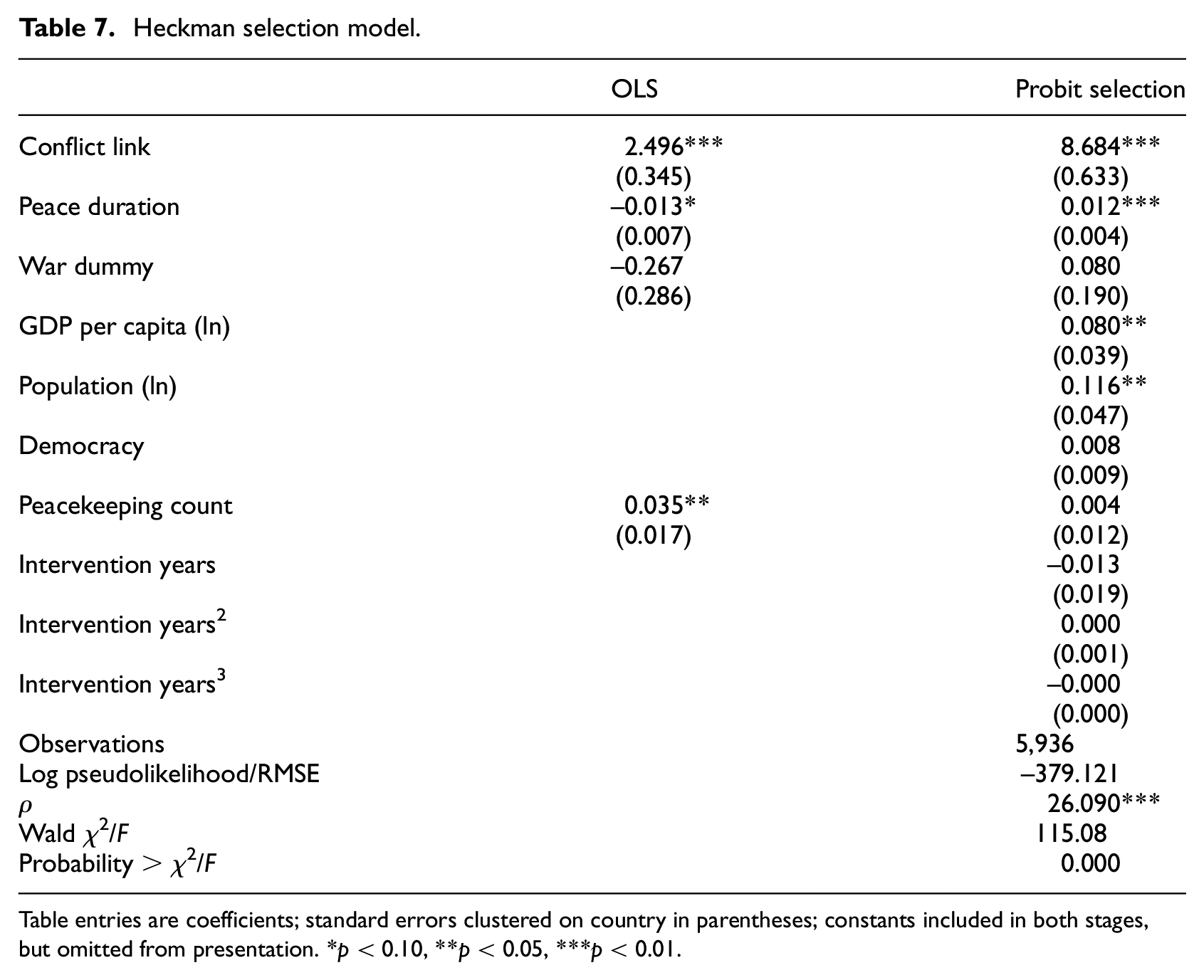
Table entries are coefficients; standard errors clustered on country in parentheses; constants included in both stages, but omitted from presentation. *p < 0.10, **p < 0.05, ***p < 0.01.
Table 7 summarizes the Heckman results. Several interesting findings emerge. First, selection is probably an issue. The ρ coefficient is positively signed and significant, which highlights that UN interventions are not randomly allocated to country-years and, more specifically that unobserved influences increasing the changes for intervention in general also increase the likelihood of seeing more “escalated,” i.e. enforcing and costly, missions. Second, even when controlling for sample selection and considering non-intervention cases in our data, the outcome stage of the Heckman model presents results that are nearly identical to the ones presented above. A conflict association makes it more likely to see more enforcing missions, including peacekeeping operations, but the more time that has elapsed since the last dispute, the more likely it is to see less enforcing missions such as diplomatic, technocratic, and development interventions.
Table 8 summarizes the empirical results of our ordered logistic regression model (H2). We use peacekeeping operations as the reference category and, thus, the effects of all three political missions on the first-difference outcome variable must be interpreted with reference to peacekeeping interventions. 15 We obtain strong evidence for an escalatory logic. The coefficient estimates of all political-mission dummies are positively signed and statistically significant. This suggests that all of these political missions, in comparison with peacekeeping in the previous round of the sequence, increase the likelihood of raising the escalation of enforcement in the next step, leading to a more substantive mission being implemented. In substantive terms, a diplomatic mission in t−1 is associated with a probability of around 90% of having a more costly mission in the next round (i.e. a technocratic, development, or peacekeeping mission). For technocratic missions, this probability is at around 43% (i.e. to see a development or peacekeeping intervention), while we estimate a 9% chance of seeing an even more costly or escalating mission (i.e. peacekeeping) in the next round when having a political-development mission in the current round of the sequence. Conversely, the likelihood estimates for actually staying at the same escalation level for a mission in t+1 are almost all insignificant, while our calculations highlight that moving down on the “escalation ladder” for any mission is associated with negative statistically significant probability estimates: −40% for diplomatic missions, −36% for technocratic missions, and −21% for political-development interventions.
The escalatory logic of UN missions.
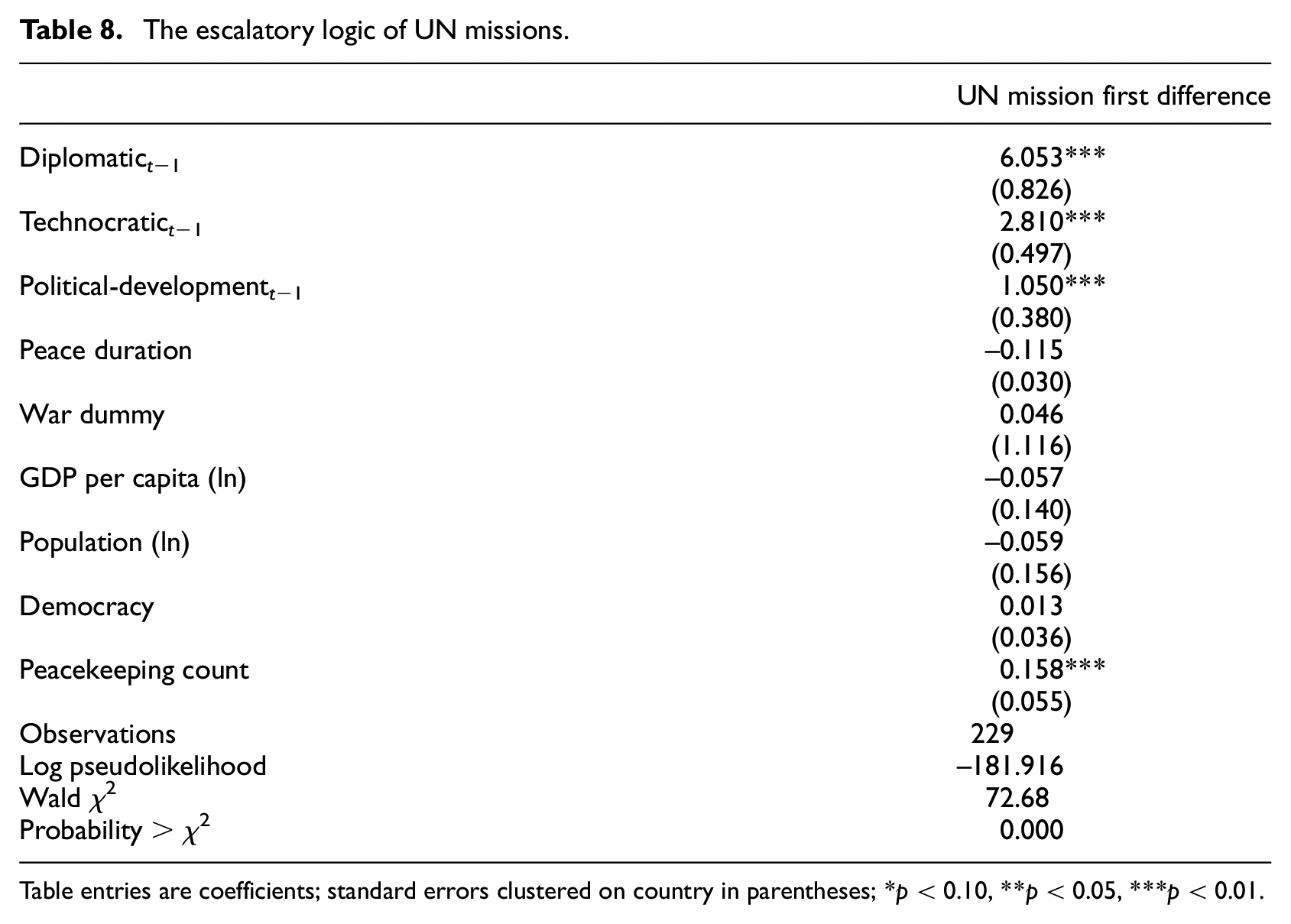
Table entries are coefficients; standard errors clustered on country in parentheses; *p < 0.10, **p < 0.05, ***p < 0.01.
To shed more light on mission implementation in light of the previous round’s initiative, consider the multinomial logit model (Table 9) with Figure 3 plotting predicted probabilities for the mission in the current round given a particular type of initiative in the previous one. 16 In general, our argument for an escalatory logic holds and it now becomes clear that this is driven by specific missions. Specifically, diplomatic missions do not seem to be primarily responsible for initiating escalation, as the coefficient estimates of Diplomatict−1 in Table 8 are all statistically insignificant. However, technocratic missions are more likely to see follow-up missions at either the same or more costly level. Political-development missions are also positively linked to technocratic missions in the next round, which is an instance of de-escalation.
The determinants of UN missions—sequencing.
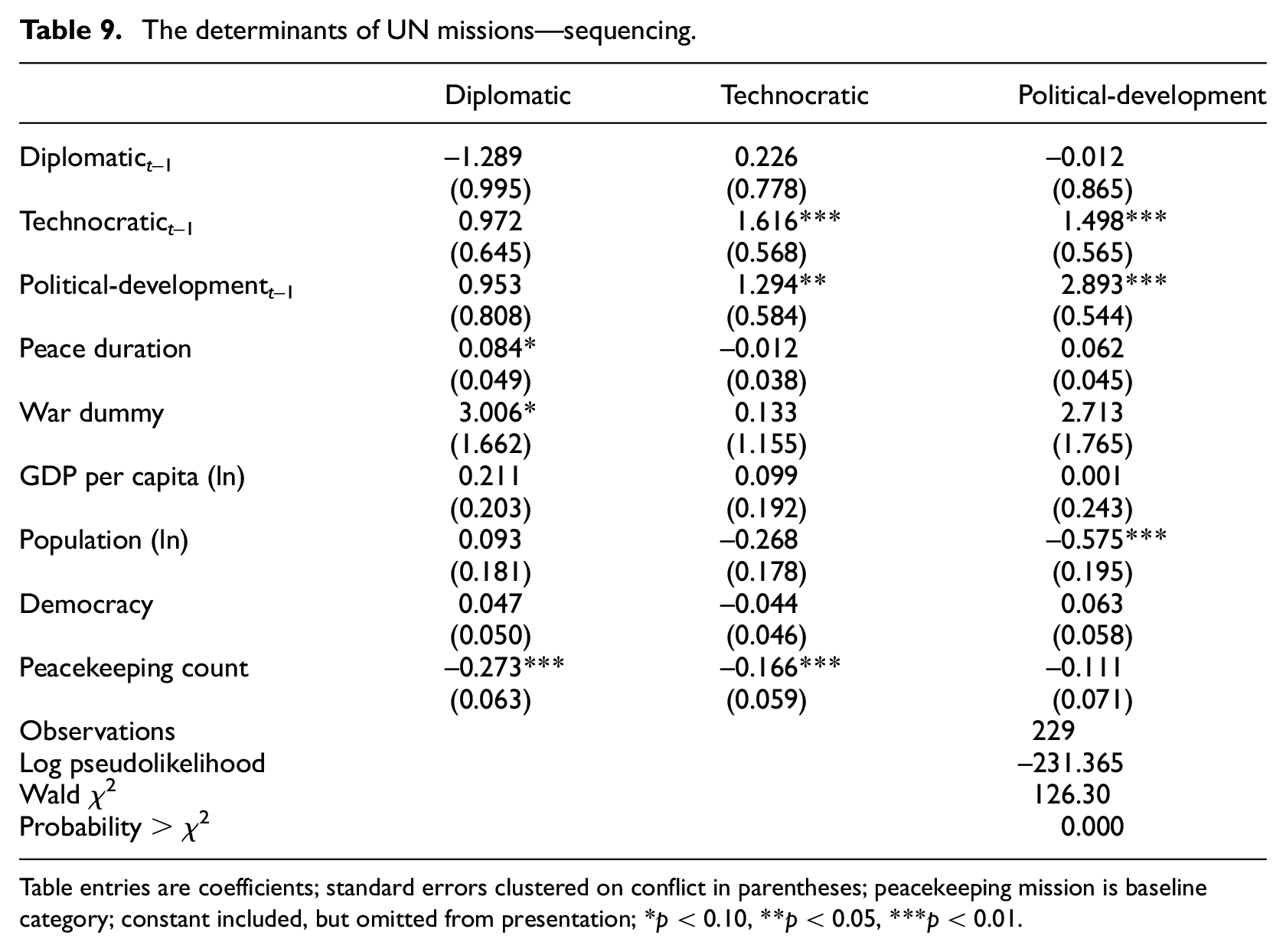
Table entries are coefficients; standard errors clustered on conflict in parentheses; peacekeeping mission is baseline category; constant included, but omitted from presentation; *p < 0.10, **p < 0.05, ***p < 0.01.
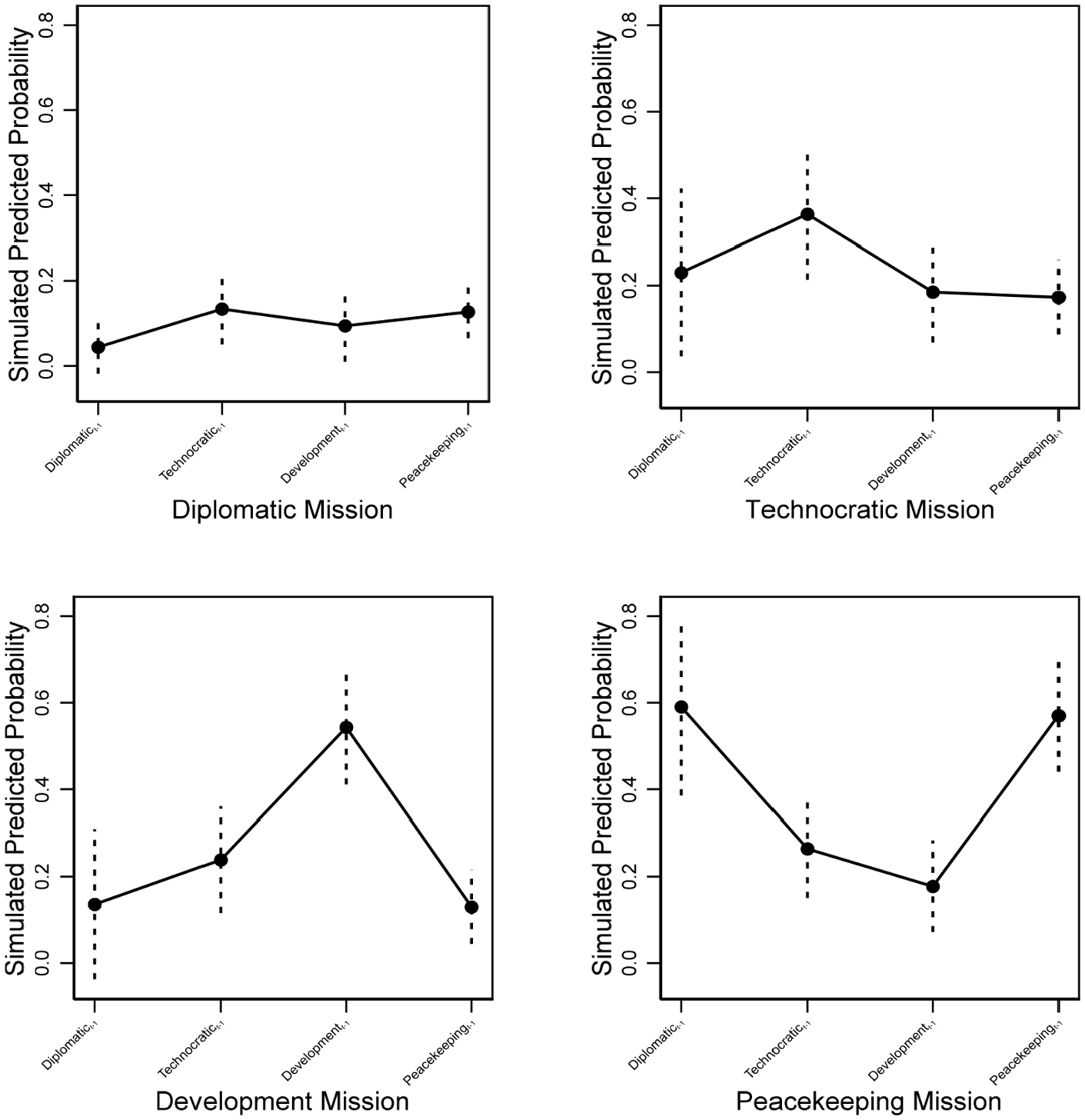
Simulated predicted probabilities.
Figure 3 plots predicted probabilities for each mission type (i.e. the categories of our outcome variable for the multinomial regression analysis) given a certain type of mission in the previous round. Starting with the plot in the upper left-hand corner, i.e. the probability of a diplomatic mission, we see relatively low probabilities, some of which are even insignificant. Diplomatic missions are often the starting point for UN action, and consistent with our argument that when having a technocratic, political-development, or peacekeeping mission in the previous round, the chances of moving down on the “escalation ladder” is low. As shown by the upper right-hand plot, technocratic missions are primarily a function of technocratic or diplomatic missions in the previous round. The probability estimates when having seen either a political-development or a peacekeeping mission in t−1 are less strongly pronounced. A similar picture emerges when studying the lower left-hand corner, which pertains to the probabilities of seeing a political-development initiative. The lowest probability estimate is given for peacekeeping in the previous round, standing at around 13%. Hence, de-escalation from peacekeeping to a political development mission is rare. Having had a diplomatic, technocratic, or political-development mission before is more strongly associated with a political-development mission in the next phase. Finally, the lower right-hand corner shows that peacekeeping is driven by previous peacekeeping or diplomatic missions, which is also in line with our escalatory logic. Technocratic or political-development missions in the previous round are only weakly linked to peacekeeping in the next round. This is an interesting finding and suggests that a common escalatory trajectory is for peacekeeping to follow a prior diplomatic intervention—rather than other forms of political mission.
The control variables are generally insignificant, except for the peacekeeping-count item: more peacekeeping missions worldwide are more likely to lead to yet another peacekeeping intervention. Less escalatory missions are not more likely to occur, and, in fact, diplomatic and technocratic missions are associated with negative probability estimates when having established more peacekeeping missions already.
Conclusion
Increasingly detailed data and sophisticated analyses have provided us with a better understanding of the determinants of peacekeeping. However, much less attention has been paid to political missions. The risk is that peacekeeping is compared with a broad and relatively poorly understood reference category of “no peacekeeping.” Here, our main contribution is to add to unpacking of the baseline by considering political missions as distinct instruments of UN peacemaking. Analyzing the UNPI dataset on political missions, we find strong support for treating them as separate from peacekeeping missions as well as “non-interventions.”
Peacekeeping missions are not always a feasible, or even the most appropriate, response to situations that may threaten international peace and security. Over time, the UN has developed and extended different options enabling it to engage with a variety of conflictive situations. We categorized such political missions as diplomatic, technocratic, and political-development. It follows that rather than a binary choice between peacekeeping and doing nothing, the UN has to decide between a variety of options and the question of which factors determine the choice for a particular type of mission becomes pertinent.
Arguably, different types of political missions impose distinct costs on the UN system as well as on countries contributing to supplying or hosting missions. Whether it is appropriate to accept these costs depends on the potential benefits of a mission relative to contextual needs. Not intervening at all may well turn out to be the costliest option. That said, after considering the costs of authorization, funding and supply, and belligerent consent, peacekeeping stands out in being more expensive than political initiatives. Given budgetary and political constraints, we expect the UN and hosting states to minimize intervention costs. Put simply, peacekeepers will only be deployed when such costly intervention are required. We empirically assessed the impact of different conflict characteristics on the onset of different mission types and found that political missions are more likely to occur than peacekeeping missions when a conflict has not (yet) escalated and more time has passed since the last fighting. Our results further suggest the UN is more likely to opt for a peacekeeping mission in conflicts that are “new.” It is plausible that such conflicts indeed present a larger risk to international peace and security and need to be addressed urgently.
Political missions are not only generally less costly than peacekeeping missions, but there is also variation in the likely costs of diplomatic, technocratic, and political-development missions. Considering the relative costs of different political missions,political-development missions are more costly than technocratic and diplomatic missions, respectively. Political-development missions are usually field missions, while diplomatic and technocratic missions face lower barriers for authorization. 17 Our analyses do not necessarily support such conjectures. The impact of key conflict characteristics does not vary much on various political missions. Control variables, such as population size and wealth, affect the choice for political mission differently, but not in a way that seems related to their relative costs. At the same time, we find evidence for the escalatory logic underlying political missions. Less costly missions tend to set the framework and requirements for costlier efforts in the future.
Future work might then seek to explore the wider range of factors that lead to the adoption of one form of political mission over another. So far, we have been primarily interested in the onset of missions—not the incidence, duration, or termination (withdrawal) of initiatives. While these are interesting research questions on their own, and they mirror the agenda on, e.g. civil conflict over the past two decades (i.e. civil conflict onset, duration, and termination), addressing them goes beyond what we can cover here. Third, employing social network analysis (see Böhmelt, 2009) or sequence analysis (e.g. Blanchard and Fillieule, 2011) for the UNPI data may be an effort worth making, potentially allowing us to uncover interdependencies across missions that we may not even have anticipated. Finally, while a growing body of research has convincingly showed the effectiveness of peacekeeping in managing civil violence (Fortna, 2008; Hultman et al., 2013, 2014; Ruggeri et al., 2017), it remains unclear if and in what ways political missions are effective conflict management tools.
Supplemental Material
sj-pdf-1-cmp-10.1177_07388942211000678 – Supplemental material for Sequencing United Nations peacemaking: Political initiatives and peacekeeping operations
Supplemental material, sj-pdf-1-cmp-10.1177_07388942211000678 for Sequencing United Nations peacemaking: Political initiatives and peacekeeping operations by Han Dorussen, Tobias Böhmelt and Govinda Clayton in Conflict Management and Peace Science
Footnotes
Funding
The authors received no financial support for the research, authorship, and/or publication of this article.

Supplemental material
Notes
References
Supplementary Material
Please find the following supplemental material available below.
For Open Access articles published under a Creative Commons License, all supplemental material carries the same license as the article it is associated with.
For non-Open Access articles published, all supplemental material carries a non-exclusive license, and permission requests for re-use of supplemental material or any part of supplemental material shall be sent directly to the copyright owner as specified in the copyright notice associated with the article.
