




Abstract
Previous research has shown that successful non-violent resistance (NVR) campaigns promote democracy compared with violent revolutions and top-down liberalization. However, research to date has not examined the character and quality of the democratic regimes following NVR campaigns, or evaluated the mechanisms that produce this effect. In this paper, we address this gap by analyzing the effect of NVR on the quality of democracy, using the Polyarchy index from the Varieties of Democracies project and its sub-components: (1) elected executive; (2) free and fair elections; (3) freedom of expression; (4) associational autonomy; and (5) inclusive citizenship. Using kernel matching and differences-in-differences estimation we find that initiating a democratic transition through NVR improves democratic quality after transition significantly and substantially relative to cases without this characteristic. Our analysis of the Polyarchy index’s sub-components reveals that this positive effect comes about primarily owing to improvements in freedom of expression and associational autonomy. This finding speaks to the strength of NVR in promoting expressive dimensions of democracy.
Introduction
A growing number of scholars have argued that the international system has entered an age of “democratic decline” (e.g. Diamond, 2015). Diverse processes are behind this decline, from rising populism and erosion of democratic norms in advanced democracies to a closing of political space by semi-democratic and authoritarian regimes. Yet one key factor has been the failure of many recent democratic transitions to result in democratic regimes of high quality. While numerous transitions have increased the absolute number of ostensibly democratic regimes, many of these regimes are far from the ideal conception of democracy, and remain highly restrictive in their levels of political representation and protection of human rights. There are exceptions—countries whose transitions have resulted in highly developed democracies. Yet these success stories exist in the context of many optimistic democratic breakthroughs followed by disillusionment. If we are interested in reversing democratic decline and ensuring democratic political representation we must examine the causes of variation in democratic quality.
What explains this variation? One growing body of research points to the power of non-violent resistance (NVR). 1 Multiple studies have shown that NVR is more effective not only in deposing dictators but also in improving long-term democratic governance relative to violent revolutions or top-down liberalizations (Bayer et al., 2016; Chenoweth and Stephan, 2011). The decentralized structure and pluralistic practices of non-violent campaigns serve as a template for future politics and reconfigure power during and after transition, making NVR a powerful means of consolidating democracy and stemming democratic decline.
However, previous studies say little about the character and quality of democratic regimes following NVR movements, and have left many of the mechanisms through which NVR affects future democracy untested or not clearly articulated. Scholars have either focused on the durability of democracy after NVR (Bayer et al., 2016) or the degree of democracy on a very general level (Chenoweth and Stephan, 2011). In this paper, we fill this gap by performing the first analysis of NVR’s effects on democratic quality that disaggregates relationships based on specific dimensions of democracy.
We make the following contributions: first, we provide more stringent and extensive tests of NVR’s effect on the quality of democracy using comprehensive data on regime transitions after World War II and an index of democracy and its sub-components. Second, compared with previous studies, we advance causal identification of NVR’s effect on democratization through a research design that combines matching with differences-in-differences (DiD) estimation. Our analysis provides strong evidence that initiating a democratic transition through NVR substantially improves democratic quality. Third, we articulate theoretical mechanisms linking NVR to specific democratic dimensions. We perform the first analysis of NVR’s effect on the democratic dimensions of: (1) elected executive; (2) free and fair elections; (3) freedom of expression; (4) associational autonomy; and (5) inclusive citizenship. Through our analysis, we find that improvements in freedom of expression and associational autonomy largely explain the NVR’s positive effect on democratic quality. The other dimensions of democracy appear to be less affected.
Related literature on non-violent resistance and democratization
The literature on NVR has had a longstanding concern with democracy. Early works by seminal scholars argued that non-violent resistance was inherently democratizing (Sharp, 1973). These arguments were given credence by transformative historical events such as the mostly peaceful transitions in Eastern Europe at the end of the Cold War (e.g. Hadjar, 2003). In this context, numerous studies empirically analyzed the consequences of NVR for democratization, in other words, if and how non-violent campaigns induce transitions from autocracy to democracy and influence subsequent political development. 2
Ackerman and Karatnycky (2005) conducted the first comparative study on the relationship between NVR and democratization. They found that countries improved in terms of political rights and civil liberties more substantially after “bottom-up” non-violent transitions as compared with “top-down” or violent transitions. This finding was later replicated by Johnstad (2010) using different measures of democracy. However, neither study employed multivariate analysis. Given the complexity of democratization, numerous confounding factors could make the relationship spurious.
Chenoweth and Stephan (2011) substantially advanced this literature by providing accurate data on more than 300 resistance campaigns in their Non-Violent and Violent Conflict Outcome (NAVCO) database. Using this data, Chenoweth and Stephan (2011: 213) find that NVR campaigns significantly increase the degree of democracy and the probability of a country being minimally democratic five years after the end of the conflict. However, their study only compares the consequences of NVR campaigns relative to violent campaigns, omitting cases of elite-led democratization. Moreover, their sample also includes resistance campaigns in states that were already democratic.
Celestino and Gleditsch’s (2013) later study accounts for some of these limitations by focusing on democratic transitions occurring in autocratic regimes. Their work confirms that the presence of an NVR campaigns increases the odds of transition towards democracy. However, they did not investigate how resistance campaigns affect political development after democratic transition.
In proposing causal mechanisms for how NVR advances democracy, scholars have predominately focused on its benefits for civil society (Celestino and Gleditsch, 2013; Chenoweth and Stephan, 2011). While participation in violent campaigns is typically limited to a small cadre of primarily young men, participation in civil resistance is open to much larger segments of society, regardless of age, gender, and physical ability (Schock, 2005: 40). This participation advantage helps NVR achieve success through exacerbating elite divisions and undermining the state’s material bases of support. It also promotes democracy following a successful campaign, as large and diverse campaigns provide a check on the new regime’s power and constrain the elite’s ability to defect from democratic norms. However, this theoretical argument has not been tested systematically.
In addition, many studies have incorporated a limited number of control variables, or in some cases simply not accounted for alternative explanations. This is a critical omission as an extensive literature on the structural preconditions of resistance campaigns indicates that NVR and democratization share common predictors. Nepstad (2011), for instance, argues that economic decline and the existence of free spaces for organizing are crucial in the emergence of non-violent resistance. Ritter (2015) argues that an “iron cage of liberalism” fostered by authoritarian regimes’ connection to the West facilitated the emergence and success of non-violent action, and Lawson (2015) argues that the primarily non-violent “Arab Spring” revolutions succeeded in part because of the characteristics of the preceding regimes. Thus, accounting for structural alternative explanations is crucial for making causal inferences about NVR and democratization.
The broader democratization literature has also looked at non-violent resistance, and includes studies that control for some of these alternative explanations. Initially, the democratization literature focused on processes of elite interaction. Scholars considered negotiations between different factions of hard-liners and soft-liners within the regime and the opposition respectively as the most important factor determining transitional outcomes (Higley and Burton, 1989; O’Donnell and Schmitter, 1986; Przeworski, 1991). Mobilization from below, while common during transitions, was assumed to be epiphenomenal to democratization or even potentially dangerous to a transition’s stability (Karl, 1990: 8).
Instances of democratization in which mass resistance was crucial, such as those after the end of the Cold War in Eastern Europe and Sub-Saharan Africa, inspired a shift in focus. Bratton and van de Walle (1997) showed how protest was central in the Sub-Saharan African transitions. Using a collective action model, Oberschall (2000) explained how popular movements could depose communist regimes in Eastern Europe and highlighted the importance of NVR for the subsequent democratic deepening in these states. Ekiert and Kubik (1998) demonstrated how collective protest influenced post-transition political development in East Germany, Hungary, Poland, and Slovakia. Their findings suggested that protest activity fosters democratic consolidation if it becomes an institutionalized way of participating in politics. Analyzing democratization with a large sample of states from 1955 to 2002, Ulfelder (2005) found that events of non-violent contentious collective action promote democratization in single-party and military regimes. Likewise, Teorell (2010) investigated the impact of popular mobilization on democratization. His results suggested that peaceful anti-government protest effectively increases the level of democracy in the short and the long run. Similar to the NVR literature, Teorell (2010: 104–107) also highlighted the number and diversity of participants as the crucial mechanism that explains how non-violent protest fosters democratization. However, both Ulfelder and Teorell rely on event data from the Cross-National Time-Series Data Archive (Banks, 2011 [1979]) to measure popular mobilization. This data has been criticized for various reasons, including geographic bias and lack of transparency (Celestino and Gleditsch, 2013: 387; Woolley, 2000), and its reliance on newspaper reports may make it particularly ill-suited to capturing data on NVR (Day et al, 2015).
The potential importance of NVR during a political transition is also powerfully reinforced by research on the democratizing impact of particular modes of transition. In this approach, the transition process is interpreted as a critical juncture that shapes subsequent political development in a path-dependent way (Guo and Stradiotto, 2014; Karl and Schmitter, 1991; Munck and Leff, 1997). Guo and Stradiotto (2014) test this assumption empirically using data on all democratic transitions since 1900. They conceptualize four modes of transition: conversion, cooperative, collapse and foreign intervention. 3 Their findings suggest that a cooperative transition process increases both the quality and duration of the democratic successor regime. However, like others, Guo and Stradiotto (2014) rely on a minimalist definition of democracy, measuring the level and duration of democracy using the Polity IV index (Marshall et al., 2010). Furthermore, their categorization of modes of transition does not account for the presence or absence of resistance campaigns and the use of violence during transition.
Similarly, Haggard and Kaufman (2016) examine the differential impact of “elite-led” or “distributional conflict” transitions from 1980 to 2008, with the distinctions between these two modes based on mass mobilization and meaningful pressure on elites to democratize because of this mobilization. They suggest that transitions initiated through distributional conflict advance democratization because countries that have experienced distributional conflict advance a more robust defense of freedom of association, assembly, and speech. However, the aggregate nature of their data does not allow them to systematically test this contention, nor do they examine the differences between non-violent and violent resistance, which the literature on NVR would strongly suggest would have relevant effects.
Cervellati et al. (2014) examine if violent conflict during democratic transition influences subsequent democratic development. They find that it has a negative effect on democracy relative to peaceful transitions. However, their results are based on a limited sample of regimes that democratized between 1972 and 2003, and focus solely on protections of civil liberties to measure the quality of democracy. Moreover, they combine transitions initiated by NVR with those initiated by elite-led liberalization, obscuring the important distinction between top-down and bottom-up transitions identified by Haggard and Kaufman.
Integrating work from the literature on NVR and studies of transition modes, Bayer et al. (2016) analyze how transitions induced by NVR affect democratic survival relative to violent and elite-led transitions. Their findings suggest that democratic regimes where the transition process was induced by NVR survive substantially longer than regimes without this characteristic. However, Bayer et al. (2016) only test the impact of NVR on the duration of democracy after transition (i.e. whether regimes maintained the minimum requirements of democratic rule) and do not address democratic quality and its subcomponents.
To summarize, the extant work provides robust evidence that NVR increases the odds of a successful democratic transition and benefits subsequent democratic development. Similarly, empirical studies on democratization and political development after different modes of transition also highlight the importance of popular mobilization. Yet there are several gaps in the existing literature.
Owing to data limitations, previous studies tend to measure democratization very abstractly, often using democracy indexes that scholars have critiqued for possessing measurement error (Coppedge et al., 2011). Aggregated measures of democracy tell us little about the character of the regimes that follow NVR. To understand the mechanisms underlying this relationship and the nature of the democratic regimes that follow successful NVR campaigns, it is crucial to investigate these regimes’ character and quality. An important study on the structural determinants of non-violent resistance, many of which are similar to the determinants of democracy, also makes it clear that research on this topic must take into account the potential for omitted variable bias and endogeneity, which many existing studies have only done to a limited extent (Chenoweth and Ulfelder, 2017).
Theoretical approach
Democratic transitions and subsequent political development
Our theoretical approach links the mode of democratic transition to the subsequent development of democratic quality in a political regime. To conceptualize events of democratic transition, we build on Boix et al. (2013), who classify regimes on the two dimensions of political contestation and participation. Participation refers to a minimal level of suffrage (i.e. a majority of adult men has the right to vote). Contestation consists of two conditions: (1) the executive is directly or indirectly elected in popular elections and is responsible either directly to voters or to a legislature; and (2) the legislature (or the executive if elected directly) is chosen in free and fair elections. If these conditions are met, a democratic transition occurred and a formerly autocratic regime is considered democratic (Boix et al., 2013: 8–9).
We consider democratic transitions as critical junctures where political actors’ choices have an enduring impact on political development (Capoccia and Kelemen, 2007: 341; Soifer, 2012: 1572–1573). Our main interest is in explaining whether democratic transitions initiated by NVR have beneficial effects on post-transition democratic quality. Specifically, we distinguish transition modes regarding the relevance of a resistance campaign and whether that resistance campaign was primarily violent or non-violent. 4 We assume that transitions shaped by NVR systematically differ from transitions either shaped by violent resistance or without a resistance campaign. By shaping democratic transition, NVR campaigns set the subsequent regime on a path favorable for democratic development. The relationship is not deterministic. Events may interfere with the mechanisms linking non-violent resistance and democratization (Chandler, 2018). Yet on average, NVR will incline democratic transitions towards more democracy.
To specify what we mean by democratic political development we build on the quality of democracy literature. Research on the quality of democracies compares existing empirical manifestations of democratic regimes with an ideal type of democracy (Diamond and Morlino, 2004; O’Donnell et al., 2004; Munck, 2016; Przeworski, 2010). To assess the quality of democracy after transition, we build on Teorell et al.’s (2016) account of Dahl’s (1971: 1989) concept of polyarchy. While there is significant disagreement among scholars concerning the crucial elements of democracy, Robert Dahl’s (1971) seven principles—which he terms “polyarchy”—are an area of widespread agreement. According to Dahl, democracy relies upon the following principles: (1) government by constitutionally bound elected officials; (2) the regular practice of free and fair elections; (3) citizens having universal suffrage; (4) the right to run for public offices; (5) freedom of expression; (6) access to alternative sources of information; and (7) the right to form autonomous associations (e.g. political parties or non-governmental organizations).
Teorell et al. (2016) collapse Dahl’s seven principles into five dimensions of democratic quality. The first dimension, “elected officials,” evaluates how the chief executive is elected. Depending on the system of government it also uses information on other political institutions such as the proportion of legislators that is elected. The second dimension, “free and fair elections,” addresses whether elections can be considered free and fair, which refers to an absence of registration fraud, systematic irregularities, government intimidation of the opposition, vote buying, and election violence. The third dimension, “freedom of expression”, addresses to what extent a government respects press and media freedom, the freedom of expression for ordinary citizens, as well as the freedom of academic and cultural expression. The fourth dimension, “associational autonomy”, measures freedom of association for political parties and civil society organizations. Finally, the fifth dimension, “inclusive citizenship,” captures the share of adult citizens that have the legal right to vote in national elections.
We distinguish between conditions that are necessary and sufficient for democratic transition, which is binary, and the quality of democracy after transition, which is a matter of degree. To observe a democratic transition requires that the conditions of political contestation and participation are satisfied. However, achieving these minimum conditions says very little about the democratic quality of the resulting regime. For instance, a free and fair founding election is a necessary condition for democratic transition but regimes display different degrees of freedom and fairness at the ballot. Using this conceptualization, we seek to answer this question: given a successful transition to democracy, indicated by the accomplishment of a minimal amount of political contestation and participation, to what extent do post-transition democratic regimes match the ideal type of democracy, both as a whole and in regard to each of its individual dimensions?
How NVR improves democratic quality
We argue that democratization via NVR improves subsequent democratic quality through an organizational spillover effect. The democratic organizational culture of NVR movements spills over to the post-transition political environment (Della Porta and Diani, 2006: 245–249; Sharp, 2005: 428), advancing a democratic civic culture (Almond and Verba, 1963). NVR movements are diverse, and their organizational culture will vary from case to case. Hence our arguments are probabilistic, rather than deterministic. However, as we show below, there is good evidence to believe that the process of non-violent resistance tends to systematically push movements, and the political systems in which they operate, in a democratic direction.
This effect comes about through mechanisms of both socialization and selection. Non-violent action tends to create large, inclusive, and diverse movements composed of broad segments of society. Accordingly, NVR campaigns often develop a culture of compromise to balance the diverse interests of the participant groups. As Chenoweth and Stephan (2011: 207) point out, participation in NVR campaigns “encourages the development of democratic skills and fosters expectations of accountable governance.” One prominent example of this cooperative culture is the Velvet Revolution in Czechoslovakia, in which leaders such as Vaclav Havel developed a practice of holding daily plenums during which the voices of all of the groups involved in the revolution could be heard and decisions made only after the groups came to consensus. 5 The non-violent campaign prefigured a democratic culture in which the interests of ordinary people from diverse backgrounds were important for political decision-making.
In contrast, pacted transitions, while encouraging cooperation among a small group of elites, tend to focus on excluding the interests of those outside of this limited circle. O’Donnell and Schmitter (1986) highlight this dynamic. Pacts socialize participants not into long-term cooperation in pursuit of a shared public good, but rather into pragmatic deal-making to protect private interests. Related work by Albertus and Menaldo (2018) shows how pacted transition, under certain conditions, can lead to an elite-biased democracy, which favors the interests of former autocratic elites and business elites over ordinary citizens’ demands for popular representation and redistribution.
In addition to these socializing effects, non-violent resistance is also likely to select for participants who already hold these values. As Jeremy Weinstein’s work shows, different types of resistance campaigns attract different types of participants. The profile of the average participant then shapes the campaign’s future actions (Weinstein, 2006). We argue that individuals predisposed to favor inclusion, oppose violence, and support consensus-based decision-making are more likely to choose to participate in a non-violent resistance movement. Contextual factors such as the prior regime type and levels of repression will affect the pool of potential campaign participants. However, the commonalities of non-violent resistance movements such as their reliance on a particular tactical repertoire and basing in widespread popular support rather in small cadres of highly motivated supporters, will tend to direct a similar group of people towards participation.
The Philippines’ “People Power” revolution shows both mechanisms at work. From 1983 to 1986 opposition forces organized non-violent resistance to the Ferdinand Marcos regime, peaking in massive demonstrations that, together with military defections, brought down Marcos’s government in 1986. Many of this movement’s leaders were long-time political elites interested in a return to political competition who found a non-violent struggle against the Marcos regime more appealing than armed struggle. Yet three years of involvement in non-violent resistance further increased their democratic preferences, for example by convincing many to run political campaigns that did not rely on traditional mechanisms of bribery and intimidation but instead employed appeals to moral authority and the public good (Thompson, 1995: 134; Zunes, 1999). The Philippines’ transition came with many challenges, including several attempted military coups by the revolution’s erstwhile military allies, and some degree of continued political corruption. Yet the dynamics of the People Power revolution significantly pushed the country in a democratic direction.
After successful democratization through NVR both elites and civil society are well equipped to foster improvements in democratic quality. After transition, participants of the NVR movement often obtain influential governmental or administrative positions. They can then use these offices to spread the ideals they either learned while participating in non-violent resistance or which attracted them to non-violent resistance in the first place. At the same time, the experience of NVR strengthens civil society, creating conditions that empower citizens to actively participate in politics and hold elites accountable. Specifically, we expect the following effects of NVR on each of the sub-dimensions of democracy.
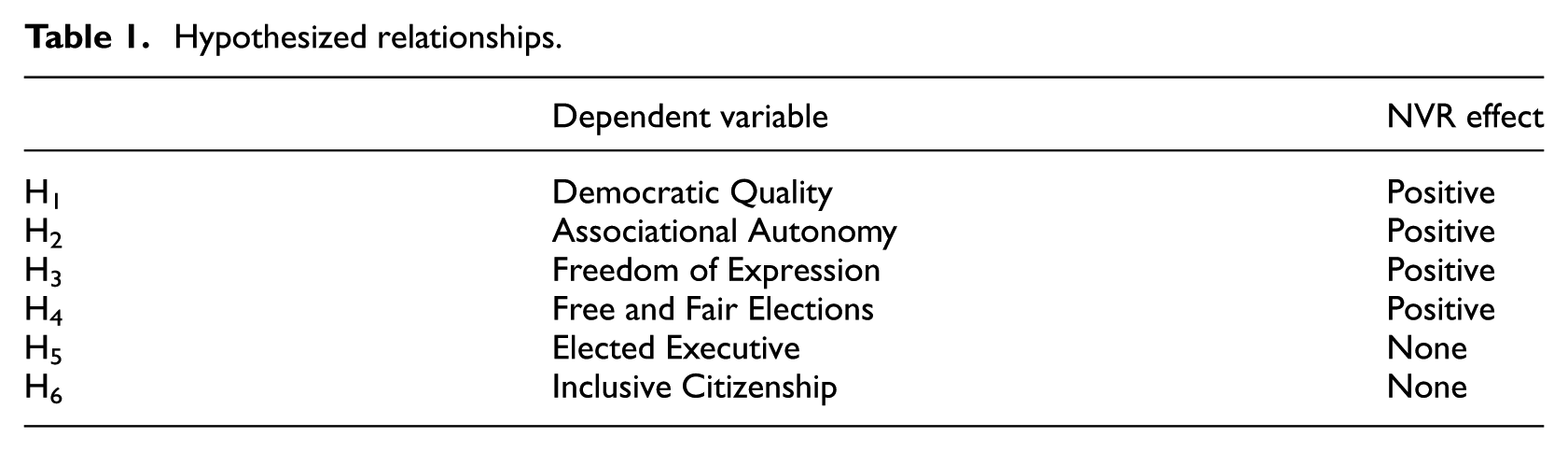
First, we expect that NVR-induced transitions will specifically foster associational autonomy, which refers to low entry barriers for political parties and civil society organizations, as well as the degree of autonomy of these groups from the state. During NVR-induced transition, civic forces have the opportunity and capacity to advance institutional reform to improve freedom of association (e.g. by being involved in a National Conference or drafting a new constitution). Political elites are also ill advised to exclude civic forces from transitional reforms, because they depend on this constituency in upcoming elections. The experience of NVR inherently involves widespread mobilization beyond and in opposition to the state. Thus, it creates numerous constituencies with experiences that will cause them to place a high value on freedom of association and the capabilities to hold the state accountable to protect this value (Sharp, 2008: 53; Tarrow, 1998: 165). Related to this mechanism, Murdie and Purser (2017) show that a country’s experience with non-violent protests advances individual support for freedom of association. Successful democratic transitions induced by NVR become a collective memory that fosters individual willingness to protect democratic rights.
In Benin, which achieved democratic transition through NVR in 1991, political elites opted for an integrative transition process with many civil society organizations involved in drafting a new constitution. As a result, the constitution highly values freedom of association and the right to resist unconstitutional behavior by the government. Accordingly, civil society remobilized and engaged in non-violent protest in 2006 and 2016 against attempts to amend the constitution to allow a third term for the incumbent president. 6
The Polish experience illustrates how NVR becomes a “collective memory” that operates even decades after a political transition has concluded. After democratic transition in 1990, protest became an institutionalized method for articulating grievances and thereby advanced democratic consolidation (Ekiert and Kubik, 2001; Landé, 2001). In July 2017 the Polish “rebellious civil society” protested again against a judiciary reform threatening democratic checks and balances. During the protests, Lech Wałęsa, the former Solidarność leader, addressed the crowd, arguing that it was necessary defend the democratic rights that they had achieved through non-violent resistance in 1989. After days of mass street protests, the Polish president Duda felt compelled to veto the reform bill put forward by the Polish government.
Second, transitions induced by an NVR campaign are also likely to be particularly beneficial for improving freedom of expression. Non-violent resistance achieves its leverage through the widespread communication of often dangerous or unpopular preferences. Accordingly, if leaders and organizations involved in the NVR campaign can exercise influence during transitional democratic reforms, they will tend to advance constitutional rights of freedom of expression. Moreover, transitions initiated by NVR may provide particularly powerful environments for dealing with the abuses of the past. In many elite-led transitions, certain “authoritarian legacies” may retain influence through pacts. A key aspect of these pacts is often protection from an accounting for the old regime’s abuses. For instance, in the Spanish transition to democracy elites engaged in a Pacto del Olvido (Pact of Forgetting), whereby discussion of the abuses of the past was actively suppressed for the sake of placating old regime members who remained influential during the transition period (Encarnación 2008: 131–149; Fernandes, 2015: 1087–1088). In contrast, in countries such as South Africa, where NVR played a key role, the post-Apartheid government instituted a process of Truth and Reconciliation whereby the grievances of the Apartheid area could be directly addressed (Gibson, 2006). This necessity of protecting political pacts means that elite-led transitions are more likely to suppress freedom of expression, restricting the ways in which media and individuals can use speech to affect the political order. NVR campaigns, on the other hand, tend to encourage a diverse, participatory culture of expression of grievance that strengthens freedom of expression.
Given that a culture of dialogue and inclusiveness is a crucial feature of NVR campaigns, and that transitions brought about through NVR are less likely to have pacts protecting members of the old regime from scrutiny of their past misdeeds, we expect more substantial improvement of press freedom and freedom of expression for civil society organizations if transition was induced by an NVR campaign, relative to cases of democratic transition without this characteristic.
Third, cultural spillover from the NVR campaign to the post-transition environment may also advance the quality of subsequent democratic elections. Former participants of the NVR movement that attained political office may improve the quality of elections through electoral reforms. For example, Jerzy Regulski—an activist in the Polish Solidarity movement—used his position as minister of local government reform in the first government after Poland’s democratic transition in 1989 to advance major decentralization reforms, inspired by Solidarity’s idea of “the self-governing republic” (Regulski, 2003). In elite-led transitions, in contrast, there are few incentives to engage in such reforms. Additionally, NVR campaigns such as Otpor! in Serbia or the People’s Power movement in the Philippines trained citizens in election monitoring to prevent fraud during the elections that initiated democratic transition. Successful monitoring of elections by activist groups sends a strong signal to future governments that manipulation of election results will be uncovered.
We expect that NVR-induced transitions do not significantly affect the sub-dimensions of elected officials and inclusive citizenship. While NVR movements certainly often push for reforms that advance democratic executive selection and universal suffrage, we have no reason to believe that violent resistance movements or elite-led democratization efforts will attribute less importance to these dimensions of democratic quality. Additionally, both of these dimensions of democratic quality refer to formal-institutional criteria, which allow little variation across democratic countries in terms of quality. Since the end of World War II universal suffrage has been adopted almost globally, even in autocratic regimes. Moreover, our definition of democratic transitions also entails criteria of a minimal level of suffrage and elected officials and thereby further reduces potential variation in the quality of these two sub-dimensions.
In sum, we assume that the spillover of civic culture from the campaign to the post-transition environment is beneficial for the quality of democracy in general, but promotes the sub-dimensions of associational autonomy, freedom of expressions, and free and fair elections most substantially. Table 1 summarizes our hypothesized relationships between NVR and the particular dimensions of democracy.
Hypothesized relationships.
Research design
Using data from Boix et al. (2013) on democratic transitions and data on resistance campaigns from Chenoweth and Lewis (2013), we created a dataset that combines information on democratic regimes with information on the presence of NVR during these regimes’ transitions. Our dataset consists of all democratic regimes that succeeded an autocratic regime between 1945 and 2006. Whereas the dataset by Boix et al. (2013) on transitions covers the time-period 1945–2007, the dataset by Chenoweth and Lewis (2013) accounts for the period 1945–2006. Therefore, our sample includes only regimes that originated after 1945 and before 2007. 7 Our full sample consists of 101 democratic regimes.
We coded a campaign as relevant for the transition if it was present in the year of the transition or the year before the transition and aimed at political change of the incumbent autocratic regime. More specifically, we considered campaigns where NAVCO coded the campaign goal as “regime change”, “significant institutional reform”, or “policy change”. Correspondingly, we did not consider campaigns where the goal was coded as “territorial secession”, “greater autonomy”, or “anti-occupation”. Furthermore, to ensure the validity of this coding, we inspected for each case if the form of resistance was violent or non-violent and also checked whether there was indeed a causal link between the resistance campaign and the transition process. We distinguish between (1) regimes whose transition process was induced without a resistance campaign (i.e. elite-led top-down transitions), (2) regimes whose transition process was induced by a violent resistance campaign, and (3) regimes whose transition process was induced by an NVR campaign. 8 Table 2 describes the frequency of these categories. Few democratic transitions in our sample were induced by violent resistance campaigns, in line with earlier findings on the rarity of violent resistance leading to democracy (e.g. Celestino and Gleditsch, 2013).
Categorical coding of resistance campaigns during transitions.
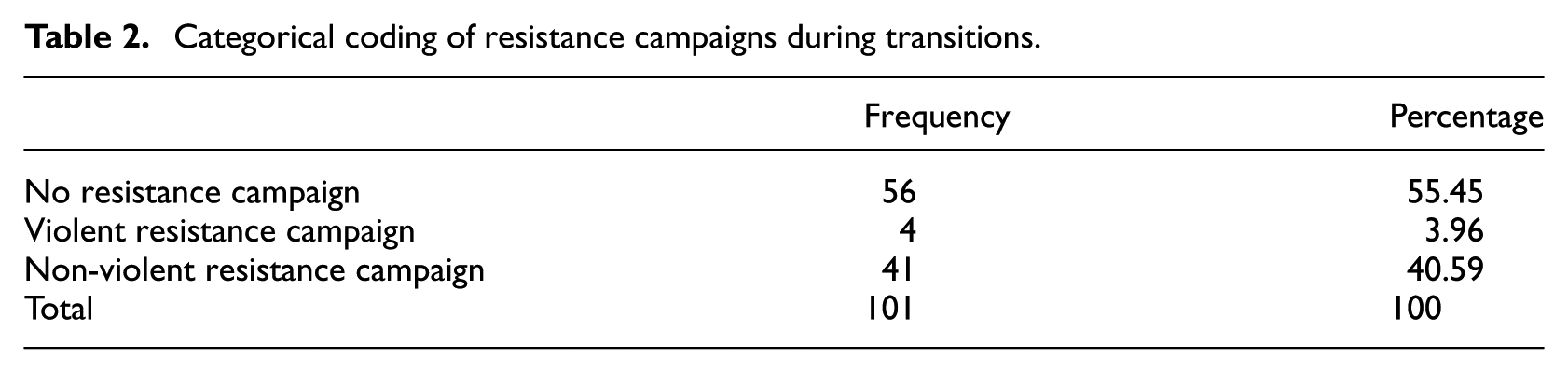
More than half of the sample consists of regimes with no resistance campaign (i.e. elite-led top-down transitions) and roughly 40% of the cases experienced an NVR campaign during transition. Because of the rarity of transitions initiated by violent resistance, in our main analysis we use a combined category for transitions that were induced without a resistance campaign or by a violent resistance campaign. For our treatment indicator, we only distinguish whether the transition was induced by an NVR campaign or not. 9
Our dependent variable is the quality of democracy. We use both an aggregate measure of democratic quality and separate measures of each of its components. We take our data for the different outcome variables from the Varieties of Democracy dataset (Coppedge et al., 2016). 10 Our primary operationalization is the polyarchy index, which, as described above, is based on the following five components: (1) elected officials, (2) free and fair elections, (3) freedom of expression, (4) associational autonomy, and (5) inclusive citizenship. To test our hypotheses on the mechanisms through which NVR affects democratic quality, we also use each component as a dependent variable. All dependent variables range from zero to one, with higher values indicating a higher quality of democracy. 11
We account for the following confounding and prognostic factors identified as most important in previous studies (Chenoweth and Stephan, 2011; Gassebner et al., 2012; Chenoweth and Ulfelder, 2017; Teorell, 2010): GDP per capita, military legacy, previous instability, proportion of neighboring democracies, and urbanization. 12
Our variable measuring the level of GDP per capita uses an updated version of the “Expanded Trade and GDP Data” compiled by Gleditsch (2002), transformed using natural logarithms. Resistance campaigns may be more likely to occur when economic grievances are more prevalent among the population (Celestino and Gleditsch, 2013; Chenoweth and Lewis, 2013; Chenoweth and Stephan, 2011). Moreover, GDP per capita is also an important predictor of democratization (Boix and Stokes, 2003). The variable military legacy is a binary variable indicating whether the pre-transition autocratic regime was a military regime, as coded by Geddes et al. (2014). Previous studies have shown that if a military regime preceded a democratic transition there is an increased risk of future political instability, which harms democratic quality (Cheibub, 2007). Using the Boix et al. (2013) dataset, we measure previous instability by counting the number of regime changes from 1900 until the transition in question. A history of political instability is potentially related to both the onset of resistance campaigns (Chenoweth and Lewis, 2013) and difficulties in democratic political development (Boix and Stokes, 2003). To measure how widespread democracy is in a regime’s geographic environment, we use the variable neighboring democracies, which is simply the proportion of democratic states in the region. 13 Empirical studies have found that democratic development is affected by international and regional factors. Democratic quality is generally higher in a geographic environment where democracy is widespread, i.e. most of the neighboring countries are democratic states. Neighboring countries serve as role models and thereby trigger the diffusion and spillover of democratic ideas and norms (e.g. Gleditsch and Ward, 2006). Urbanization is the percentage of the population living in cities with more than 100,000 inhabitants. We obtain our data for this variable from the National Material Capabilities dataset version 4.0 (Singer, 1987). In the context of modernization theory, urbanization is considered a social requisite for democracy (Lipset, 1959), indicating that citizens develop liberal preferences and beliefs. Urbanization also facilitates mobilization of participants in resistance campaigns (Chenoweth and Stephan, 2011). We report summary statistics for all outcome measures and covariates in the Online Appendix.
To analyze the effect of NVR-induced democratic transition on the quality of democracy in the post-transition regime we use kernel matching in combination with DiD estimation. This approach is a potent method for achieving causal inference with observational data (Heckman et al., 1998; Smith and Todd, 2005).
With kernel matching we account for observable heterogeneity across countries/regimes. We use kernel matching to create a sample, where our groups of treatment and control cases (i.e. regimes where democratization was induced by NVR and similar regimes where NVR was not relevant for the transition) are as similar as possible with respect to observed baseline characteristics, namely the control variables described above. 14
However, numerous unobservable factors may also bias our estimates of NVR’s effect on post-transition democratic quality. For instance, one potential unmeasured factor is a democratic political culture. Countries with positive attitudes toward democracy among elites and the population should be more likely to experience the occurrences of NVR-induced transitions and also more likely to improve in democratic quality after transition. Similarly, countries with pre-existing active civil societies or less repressive past regimes may also be more likely to experience both NVR and democratization. 15
To address this unobserved heterogeneity, we use a DiD specification to estimate the effect of NVR on improvements in democratic quality. In the DiD setup we observe the outcome for two groups at two points in time. Our groups are regimes where democratization was induced by an NVR campaign and regimes without this characteristic. In both groups we observe democratic quality before and after transition. For each outcome variable we create indicators that measure the difference between its level before the transition and up to five years after the transition. We consider the transition process itself as an intervention at which regimes in the treatment group experience NVR and regimes in the control group do not. To obtain the DiD effect we subtract the mean change from pre- to post-transition democratic quality in the non-NVR group from the mean change in the NVR group.
Thus, while kernel matching addresses issues of confounding and selection bias caused by observable characteristics, DiD estimation accounts for unobservable but time-invariant differences between regimes that did and did not experience NVR-induced transitions. By looking at difference in improvements instead of difference in levels of democratic quality after transition, the DiD approach accounts for variation in democratic predisposition across countries. 16
Empirical analysis
Before moving into the results of our DiD design, we first simply descriptively compare the development of democratic quality for regimes induced by NVR to regimes without this feature. Figure 1 shows the average score of the polyarchy index and its subdimensions for these two groups from one year before the democratic transition until five years after the democratic transition occurred.
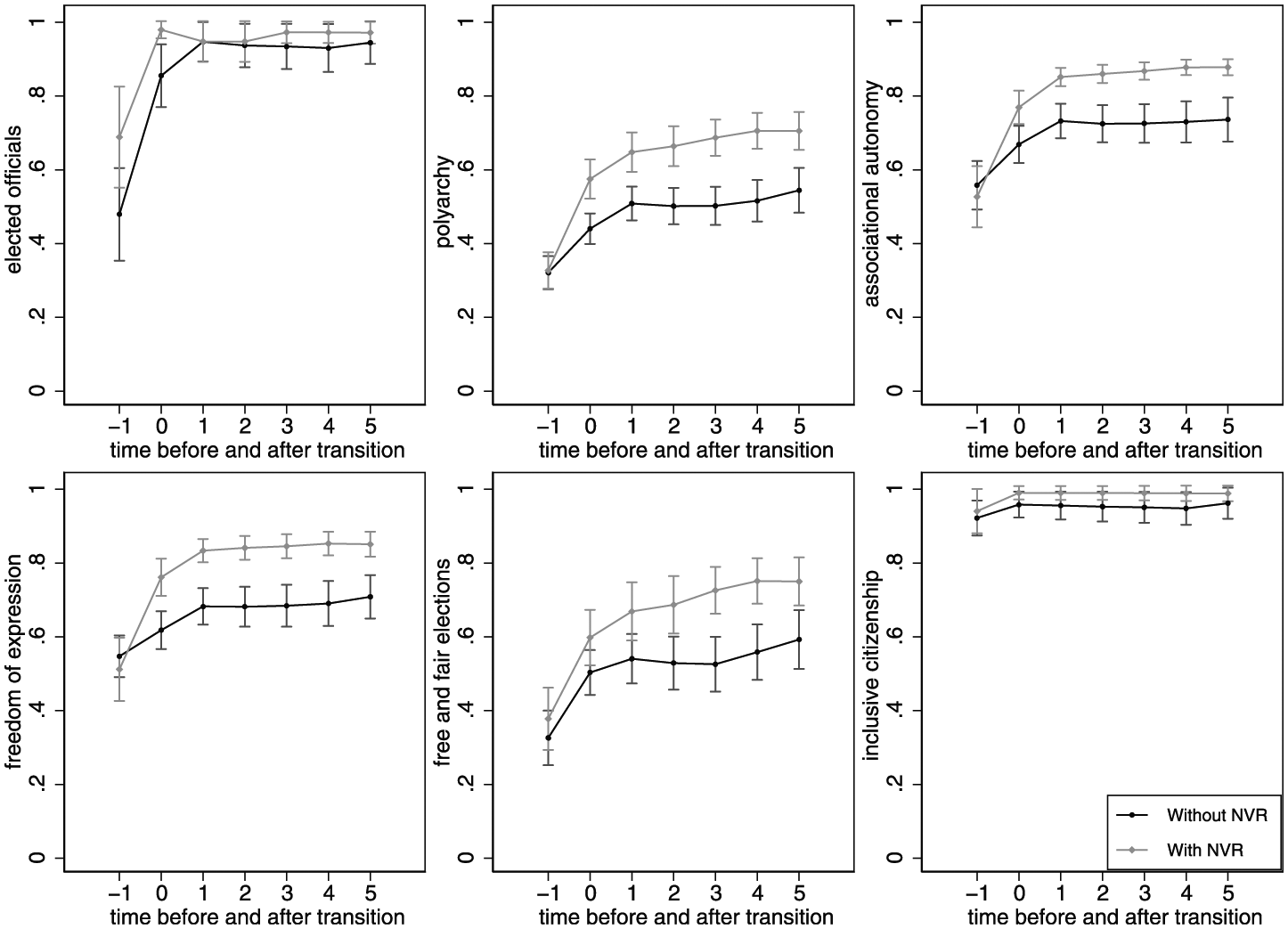
Average level of democratic quality before and after transition.
We report the results for the polyarchy index in the upper middle panel of Figure 1. As shown there, regimes where the transition was induced by an NVR campaign on average achieve substantially higher levels of democratic quality after transition than regimes without this feature. While both groups are at about the same level of democratic quality one year before the transition (i.e. about 0.32), NVR-induced regimes one year after transition reach a polyarchy level of 0.65. Regimes where transition occurred without NVR only attain an average level of 0.51. This difference remains substantive through five years after transition.
The results for the subdimensions indicate that the positive effect of NVR on polyarchy mainly comes about owing to improvement in freedom of expression and freedom of association, and to some extent the quality of elections. On these dimensions NVR-induced regimes have higher democratic quality than regimes where democratization occurred by violent means or owing to elite-led transition. However, the effect of NVR on the quality of elections is not significant at all time periods after transition, as indicated by the overlapping confidence intervals.
There appears to be no effect of NVR on the subdimensions of elected officials and inclusive citizenship. After transition most regimes achieve high quality on these sub-dimensions, regardless of their mode of transition. We obtain substantially the same results when we use regression models and weights based on kernel matching to account for observable confounding factors in the estimation of the effect of NVR on the level of democratic quality and its subdimensions after transition. We report detailed results from this analysis in the Online Appendix. Thus, our analysis of post-transition levels of democratic quality provides initial support for our hypotheses.
However, as discussed above, these estimates do not account for potential unobserved heterogeneity across regimes/countries. Therefore, we move from descriptive comparison of post-transition levels of democratic quality to our DiD with kernel matching estimation. In Figure 2, we report the DiD estimates for the matched samples. The figure shows point estimates along with bootstrapped confidence intervals. As discussed above, we analyze changes in the respective outcome variable from the year before the transition until up to five years after the transition.
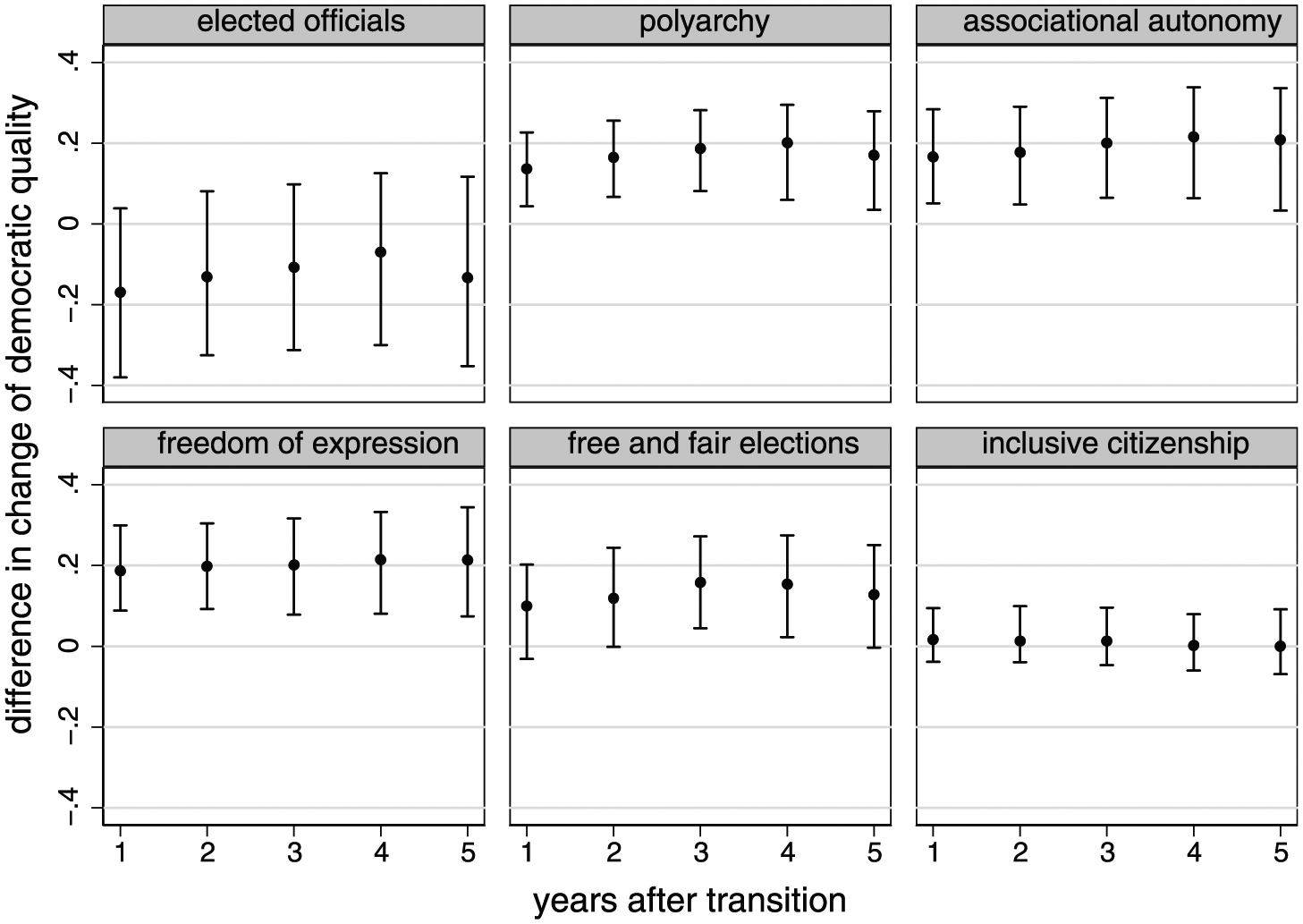
Differences in change of democratic quality.
The point estimates in Figure 2 are average treatment effects on the treated. The average change in polyarchy score is between 0.14 to 0.20 units higher in regimes with transitions induced by NVR over the five years following transition compared with regimes without NVR. This is a substantial difference, given that the scale for change in polyarchy ranges from −1 to 1. For comparison, a difference of 0.2 is roughly equivalent to the difference in level of democracy between the United States and Nepal in 2017. As also shown in Figure 2, the lower bound of a 95% bootstrap confidence interval is above zero for the five years following the transition, meaning that for this time period we are 95% confident that a non-zero difference in changes of polyarchy between treatment and control group falls into this interval.
The bulk of this difference in polyarchy scores can be explained by associational autonomy and freedom of expression. There is no conclusive evidence regarding differences between NVR and non-NVR regimes for the dimensions of elected officials and inclusive citizenship. For elected officials point estimates are negative, indicating that NVR-induced regimes improve less on this dimension than regimes without this feature. However, confidence intervals for this outcome are large and include zero. Thus, we do not identify any significant effect for this dimension. For inclusive citizenship point estimates are close to zero, suggesting that there is no substantial effect of NVR on this sub-component. For free and fair elections, the effect is positive and substantial, but only significant when changes are measured three or four years after the transition.
In contrast, the DiD effects of NVR on freedom of expression and associational autonomy are substantial, significant and robust across all five time periods. For associational autonomy point estimates range from 0.17 to 0.22, which implies that depending on the time period the average change of the associational autonomy score is between 0.17 and 0.21 units higher for regimes where transition was induced by NVR relative to regimes without this feature. For the freedom of expression dimension, point estimates are similar, ranging from 0.19 to 0.21.
Robustness of the results
To evaluate the robustness of the results discussed above, we conducted a sensitivity analysis for the DiD specifications, in which we repeated the analysis with different datasets measuring transition events and different parameter specifications for the matching procedure. We used three datasets on the occurrence of transitions, varied coding rules for these transitions and used different bandwidth specifications for kernel matching, The results of the sensitivity analysis support the findings described above. The effect of NVR on changes in polyarchy, freedom of expression, and associational autonomy is robust to changes in the data and parameter specification. In contrast, the effect of NVR on changes in free and fair election is sensitive to specification changes, with statistical significance depending on the dataset used to measure transitions. The results for the elected officials and inclusive citizenship subdimensions suggest no clear relationship with NVR. Additional simulation results indicate that these main findings are also probably unaffected by unmeasured confounding variables that are not captured by the DiD approach. Detailed results for all robustness tests are reported in the Online Appendix.
Discussion
We find strong evidence that initiating a democratic transition through NVR increases democratic quality after transition relative to transitions without NVR. This effect is substantial and robust for at least five years after the transition. Thus, our results support and expand upon previous studies showing that NVR fosters democratization (Chenoweth and Stephan, 2011). Furthermore, through examining democratic sub-dimensions we find evidence for the specific mechanisms whereby NVR improves democratic quality. The positive effect of NVR is not uniform across all aspects of democracy. Instead, it can largely be attributed to improvements in freedom of expression and associational autonomy. Changes in other dimensions of democracy either do not appear to be affected by NVR, as with elected officials and inclusive citizenship, or our findings are not robust and thus do not allow a definite judgment, as with improvements in free and fair elections.
The results have important implications for theories of (non-violent) resistance and democratization. Our findings support the arguments made by scholars of social movements and non-violent resistance that resistance campaigns have spillover effects on post-transition political developments (Della Porta and Diani, 2006: 245–49; Sharp, 2005: 428). This is most visible in an active civil society that raises its voice to protect and advance democracy and by facilitating norms of free expression. However, the results also indicate that NVR is not a democratic panacea. While NVR’s effect on more “expressive” dimensions of democracy is consistent and powerful, it does not make much difference on more procedural and institutional dimensions, and is inconsistent on free and fair elections. This is surprising, considering how frequently unfair elections are a critical spark in initiating NVR movements (Tucker 2007), and highlights the importance of disaggregating the mechanisms whereby non-violent resistance affects political processes and institutions.
Still, it is important to reconsider the identifying assumptions of these findings and discuss alternative explanations. Most importantly, an alternative explanation for our findings is that some temporally prior political dynamics foster both the occurrence of NVR and democratization. We do not argue that the occurrence of an NVR campaign is a fully exogenous shock to a country’s political system. Campaigns of non-violent action have their sources in prior political dynamics, social structures, and histories of political contention. We address this problem through our empirical strategy of combining matching with DiD estimation. Matching ensures that cases of NVR-induced transitions and cases of transitions without NVR are similar regarding the observable factors of economic development, military legacy, previous instability, urbanization, and democratic neighborhood. DiD additionally accounts for static unobservable differences between countries/regimes. However, although our robustness tests indicate otherwise, we cannot rule out the possibility of unobserved political dynamics biasing our findings.
To address these general caveats about the internal validity of our findings, we suggest the following two areas for further research. First, while we have offered theoretical mechanisms derived from prominent historical cases as to why NVR so strongly impacts particular dimensions of polyarchy, further research, including detailed case-specific evidence, is needed to substantiate this theory and further our knowledge of NVR’s specific mechanisms of impact. Micro-level process tracing could provide more detailed evidence on the sequencing of non-violent protest events and liberalization measures by autocratic regimes, which occur during democratic transition. Thereby, the direction of cause and effect could be identified more clearly.
Second, more research is needed to disaggregate the population of democratic transitions following NVR. As seen in prominent examples such as Poland, the Philippines, and South Africa the population of NVR-induced transitions is highly heterogeneous. What factors interfere with the generally pro-democratic effect of NVR? Are there systematic differences in campaign strategies or transition styles that influence democratic political development? These questions remain to be answered.
Keeping these caveats in mind, for policymakers interested in democratic development these results speak powerfully to the importance of focusing on popular resistance rather than top-down elites’ moves towards liberalization. While elite-led approaches can lead to successful democratic transitions, the quality of the subsequent democracy is often severely lacking. In contrast, when the transition comes from the bottom up, based on non-violent mass mobilization, democratic quality is generally strengthened for the long term. Specifically, civil society organizations and citizens’ freedom of expression will improve. In a time when the prevalence and quality of democracy may be in decline, non-violent resistance may help encourage its resurgence.
Supplemental Material
CMP855918_Appendix – Supplemental material for Non-violent resistance and the quality of democracy
Supplemental material, CMP855918_Appendix for Non-violent resistance and the quality of democracy by Felix S Bethke and Jonathan Pinckney in Conflict Management and Peace Science
Supplemental Material
Replication_files – Supplemental material for Non-violent resistance and the quality of democracy
Supplemental material, Replication_files for Non-violent resistance and the quality of democracy by Felix S Bethke and Jonathan Pinckney in Conflict Management and Peace Science
Footnotes
Acknowledgements
We are grateful to Markus Bayer, Charles Butcher, Véronique Dudouet, Alexander De Juan, Daniel Lambach, Susanne Pickel, and the anonymous reviewers for their insightful comments and suggestions.
Funding
Felix S. Bethke acknowledges funding from the German Research Foundation, project number 266771653.

Supplemental material
Notes
References
Supplementary Material
Please find the following supplemental material available below.
For Open Access articles published under a Creative Commons License, all supplemental material carries the same license as the article it is associated with.
For non-Open Access articles published, all supplemental material carries a non-exclusive license, and permission requests for re-use of supplemental material or any part of supplemental material shall be sent directly to the copyright owner as specified in the copyright notice associated with the article.
