



Abstract
A central issue in sociology concerns motivation. Generally, sociologists have followed Mills’s lead in emphasizing motive-talk, or post hoc explanations, over the “springs” of action themselves. Drawing from the interdisciplinary science of motivation, this article argues that we can tease motives apart from motive-talk by incorporating the affective disposition to seek into a theory of motivation. Seeking involves three dissociable phases—wanting, liking, and learning—each of which is intrinsically pleasurable. This suggests three things. First, mundane activities related to anticipation or learning are affective in nature. Second, not only does each phase of seeking involve different motives, but also, any given phase contains sequences of activities, likely indicating mixed motives. And third, people commit to routines and roles not because of their habits or automatic cognition but because of the affective urgency and expectation they feel in their bodies. Implications for the sociological literature on pleasure and for a sociology of motivation are discussed.
Understanding motivation is critical to sociology’s ability to understand and explain social action. However, since the collapse of functionalism in the 1970s, motivation has remained largely peripheral to theories of action (Turner 1987). This is despite the implicit and sometimes explicit centrality of motivation to myriad social-psychological traditions (Burke 2018), cultural sociology (Lizardo 2021; Vaisey 2009), and the discipline writ large. In the place of motivation, sociology has generally leaned on Mills’s (1940) argument favoring “motive-talk,” or ex post facto justifications or accounts of action (Scott and Lyman 1968), over the “springs” of action themselves. Consequently, sociology remains largely wedded to binary explanations of social action that either fall back on presumably internalized, distal macro forces (e.g., interests, values, and goals; Franzese 2013) that are difficult to verify empirically (Lizardo 2021; Vaisey 2009) or that imagine a reactive human acting only when their routines are disrupted (Gross 2009; Joas 1996). Critics of this binary approach note that its lack of empirical veracity and its arm’s-length treatment of psychological sciences oversocialize agents (Wrong 1961), substituting political commitments for explanation (Martin 2011). Other scholars argue that this approach conceptualizes actors as reactive, passionless, and pain-avoidant (Lizardo 2021; Silver 2011).
The problems with this binary approach are clear: It presents actors as largely reactive, reducing their pleasures, desires, and passions to systematic forces beyond their reach. Few motives or motivations are their own. Moreover, although the binary acknowledges the role of emotions, as in Vaisey’s (2009) evocation of Haidt’s emphasis on intuition, action continues to be “identified solely with the process of thinking, anticipating, planning, deliberating, and calculating” (Campbell 1999:50; see also Abrutyn and Lizardo 2023; Campbell 1996). Finally, this perspective is poorly aligned with the interdisciplinary science behind motivation, reward, decision-making, and action (Berridge and Kringelbach 2008; Damasio 1994; Di Domenico and Ryan 2017).
Unsurprisingly, sociologists have identified several examples that defy the cognitivist bias and reactive model of motivation. These cases are broadly related to creativity (Brett 2022; Leschziner 2015), embodiment (Winchester and Pagis 2022), aesthetics (Pagis and Summers-Effler 2021), sexual pleasure (Jones 2020), and moodiness (Silver 2011), with each pointing to disjuncture with the binary model and its cognitivist biases (Leschziner and Brett 2019). This article argues instead that these activities, and many more, fall outside the near binary because they are activities that feel good, outcomes aside, and consequently would benefit from a conceptual framework offered by an affective theory of motivation.
Affectivism accepts the basic emotions approach that favors common vernacular for labeling emotions (happy, sad) but distinguishes affect from emotion (schema; Davidson 2003)—something sociology has largely failed to do (Turner 2009). Affectivism also does away with the mind/body duality that still lurks in sociology, emphasizing affective consciousness that is prereflexively tied to attention, perception, memory, and even the social self (Asma and Gabriel 2019; Izard 2009; LeDoux and Brown 2017). 1 This is not to say that human affectivity is a priori to our cognitive or linguistic capacities or those capacities’ influence over our action, but affectivity is older, inextricably tied to these processes, and often in command. 2 Motivation, consequently, is revealed as embodied, processed in affective systems that are not just signals but also forms of sentience (Frijda 2007). In short, affectivism is a promising agenda that complements the conventional binary without substituting motive-talk for the springs of motivated action or the “impulsion” (Martin 2011) that energizes action (Turner 1987).
This article stakes out an affectivist position that begins with Hume’s ([1738] 1978:413) argument that “[r]eason is, and ought only to be, the slave of the passions, and can never pretend to any other office than to serve and obey them.” Drawing from a diverse body of research that I refer to as “motivation science,” I find affectivism can be incorporated into sociology in many ways. However, for the sake of brevity and coherence, I focus here on a single affective system devoted to motivation and reward called the “seeking system” (Panksepp 1998), or anticipatory phase (Berridge and Kringelbach 2008), preceding action.
This may seem strange at first because emotions are usually incorporated into sociology in the form of “basic” emotions, such as happy or sad (see Turner 2009), or social emotions, such as shame and pride. Yet motivation science expands our palate of emotions, pointing out, for instance, that hunger, pain, and certain affective systems found in all mammals predate our cognitive and linguistic capacities (Panksepp et al. 2017); motivation science can thus elude the pitfalls of relying on words with lexical weaknesses (Fiske 2020). This science shows that seeking or “wanting” (the folk term for anticipatory processes) is driven by a dopaminergic subcortical system that is continuously active, meaning mammals are motivated to seek nearly all the time (Asma and Gabriel 2019). Because dopamine is a pleasurable chemical, the dispositions, activities, and learning tied to seeking can be placed at the root of affective motivation. In other words, we seek because it feels good, and that feeling, often in the form of precognitive embodied sensations, not only becomes a signal about our body and mind’s relationship to the environment but also simultaneously acts as a form of consciousness (Di Domenico and Ryan 2017). Ultimately, seeking is the source of intrinsic motivation (Berridge 2023; Ryan and Deci 2000). Most surprising, then, is the fact that affective action is not what sociologists usually think it is (see e.g., Weber 2019). Rather, the activities that cause dopamine to increase or to pulse offer a set of intrinsic motives for a panoply of activities that happen to overlap with the sorts of phenomena studied by those unsatisfied with the binary model.
Certainly, the idea that pleasurable things are motivating is not entirely absent from the sociological perspective, but it remains “an understudied motivation for social behavior beyond some important sex work studies” (Jones 2020:9; see also Regan 2023). Some of this work emphasizes pleasure-seeking, at least in the hedonic sense (Duff 2008), but the typically narrow focus on erotic or pharmaceutical activities falls short of Jones’s (2020) argument that pleasure, as a generic motivation of most things social, needs greater attention (see also Lorde 1984). Seeking as pleasurable and as impelling us toward things we think will be pleasurable presents an opportunity to begin to realize a broader sociology of pleasure in which pleasure does not imply normative values; motivation science does not see pleasure as good or bad (in fact, it finds that pleasure as a motivation can lead to healthy or harmonious forms of pursuits as well as psychologically unhealthy forms or obsessive passions; Vallerand et al. 2024). In addition, the affect of pleasure has obvious but relatively unexamined associations with emotions such as joy—an emotional dynamic that has grown in emphasis in the sociological study of marginalized communities and the positive sources of community, solidarity, and common purpose vis-à-vis the usual negative narratives (Combs 2023; Ghaziani 2024; Luna et al. 2024). In the spirit of Shuster and Westbrook’s (2024) argument that any science of society must take seriously the positive as well as the negative, this timely article expands the common conceptual frame around pleasure and joy.
In what follows, I sketch an affective theory of motivation. First, I discuss action, motivation, and motive-talk. The principle innovation in this section, beyond establishing clarity, is in the importation of twin insights from motivation science: that action or activities are not unitary but consist of sequences of intermediate activities and that this suggests mixed motives (a point made by Goffman [1959:15, 1974:126ff.] but largely sidestepped in his other arguments). My second step involves identifying the motivational dispositions and activities related to seeking. This comes in the service of demonstrating what affective action and motivation are and the fact that sociologists already study many of these things without thinking of them as either affectively laden or focal activities for study. At the end of this article, I revisit how an affective model builds on and extends the growing sociological interest in positive aspects of social organization, and I discuss the broader implications an affective sociology has for the study of motivation and social behavior.
Motivation Science and the Sociology of Motives
The sociology of motivation is currently undercut by three principle shortcomings: It leans too heavily on cognition at the expense of affect, it posits mono-motive explanations for action, and it frequently downplays proactive agency that is pleasurable, passionate, desireful, and so forth (Abrutyn and Lizardo 2023, 2024; Campbell 1996; Green 2008; Jones 2020).
Since its foundations, sociology has generally accepted the Cartesian duality of mind and body, rationality and emotion. Weber (2019:102), for instance, placed affectual action “at the boundary and often beyond, of what is consciously ‘meaningfully’ oriented [because] it can be uninhibited reaction to some exceptional stimulus.” Mead (1934:173), too, placed affectual action on the periphery when he wrote, “the core and primary structure of the self [is] essentially a cognitive rather than an emotional phenomenon.” 3 In these traditions and others, the primary ingredients for motivated action, including the meanings we mobilize to make decisions and set goals, the vehicles of structure and culture (e.g., the self, roles, or status), and internalized stocks of knowledge, such as cultural schema (Vaisey 2009) and frames (Goffman 1974), are cognitive accomplishments. Understandably, sociologists have followed Mills’s (1940) advocacy for reliance on motive-talk, itself reliant on vocabularies or dictionaries (Scott and Lyman 1968), because self-reports often draw on declarative, cognitive knowledge (Lizardo 2017). It is similarly unsurprising that sociologists typically treat emotions as dependent variables, products of structural (Kemper 1978) or cultural (Hochschild 1979) forces that construct, constrain, and facilitate how we feel (Turner 2009). In symbolic interactionist traditions, such as affect control or identity control theories, emotions become mediating signals between the interpretation of dissonant external and internal appraisals and the subsequent sifting through of behavioral responses (Burke 2018). Put differently, if motive-talk is the gold standard data for studying motivation, “emotion-talk,” or what neuroscience calls “emotion schema,” is the gold standard for sociology (Stets 2010).
A fear schema, for example, would include factual information (semantic memories) about harmful objects and situations, and about behavioral and body responses that occur in such situations. . . . The schema will also include factual memories about how to cope with danger, and episodic memories about how you cope with such situations, which will bias the particular thoughts and actions used to cope. . . . As one becomes more emotionally experienced, the states become more differentiated; fright comes to be distinguished from startle, panic, dread, and anxiety. (LeDoux and Brown 2017:E2022)
Unfortunately, for nearly 30 years, this conventional sociological approach to emotions and their role in motivation has been, in the face of neuroscientific research, all but untenable (Franks 2019; Turner 2007).
Furthermore, sociological explanations tend to hew toward mono-motives, committing to a “silver bullet” explanation of action. Many symbolic interactionist traditions assume people have a need to maintain consistency, whether in terms of identity, situational definitions, trust, or facticity (Turner 2010). In some cases, these mono-motives are presumed need states, such as a “need” to seek status (Wrong 1961), which may or may not rest on empirical evidence that supports the fundamentality of such needs. Mono-motives are often theorized as operating within homeostatic control models in which humans internalize a cognitive standard or set point, and when reflected appraisals move the set point up or down, we are motivated to return our internal thermostats to their resting points (Burke 1991; Robinson and Smith-Lovin 2006). Yet need-state and control models have found scant empirical support in motivational science, which has largely abandoned them (Berridge and Kringelbach 2008, 2011; Ryan and Deci 2017).
The third major shortcoming of the current sociological study of motivation is related to the first two: The bracketing of emotions in favor of cognition and the tendency to emphasize mono-motives has led to the institutionalization of the action binary. To wit, habitual action that is conditioned by some sort of distal mechanism (Franzese 2013), such as class interests (Bourdieu 1984) or value orientations (Parsons 1937), motivates us to act in ways that consciously or unconsciously realize our interests or values. Strategic, deliberate action, although reproductive and patterned, is constrained by our habitus. Thus, when we face a novel situation, a dilemma, or an incongruence or dissonance, our “set point” is disrupted and our cognition activated as we sift through existing behavioral responses or creatively combine and recombine responses (Gross 2009; Joas 1996). In this conception, to be meaningfully oriented is to be the big-brained humans we are (as though primates who lack language and the ability to express inner subjective states are not actors; de Waal 2019).
To be sure, there are limitations to sociology’s methodological approaches to understanding action that make motive-talk more convenient and accessible than the springs of action or impulsions (Martin 2011). Yet, as I will demonstrate, sociologists are not without tools to shift toward the latter; indeed, sociologists have become more attuned to the creative incorporation of unconventional tools for studying what Bentham called “motive ‘in esse’ . . . or an event prior to the action in question” (Campbell 1996:102). Motivation science challenges us to move past the post hoc explanation to conceptualize motivated action in a much more extended set of foci: the affective dispositions to act; the cues or stimuli of environment and social objects; the sequential chains of activities that reveal mixed motives; the updating, reinforcing, and learning phases of action; and the retrospective retrieval of memories (itself stimulating motivation processes).
Motivation Science as Corrective
Motivation science offers a corrective for all three problems sociology makes. First, it teaches that motivation is affective in several ways. It is embodied, meaning we often anticipate, experience pleasure, and learn prereflexively before we become cognitively aware of embodied, sensory, and affective responses (Berridge 2023). Knowledge, then, is initially affective, often eluding cognition until we are able to reflect on what is happening. This, of course, tracks with sociological scholarship on sexual (Jones 2020) and aesthetic (Pagis and Summers-Effler 2021; Summers-Effler 2022) pleasures. As Katz (1988) argued in his chapter on “sneaky thrills,” it underscores the need to reframe motive-talk questions to not just ask why but to also ask how, which seems designed to include the body and its unique affective way of knowing.
Second, motivation is affective in so far as it is located in older, subcortical regions of the brain that evolved long before cognition and language (Davidson 2003; Davies 2011). This means, first and foremost, that humans learn to think and talk through affective sentience, or the basic affective systems designed for neophytes to navigate a world sans conceptual schema and language (Decety and Howard 2013). Human infants are moral, cooperative, capable of discerning and developing preferences for prosocial people over antisocial people, and “feel” the same things adults (and other primates) feel; they simply do not yet have emotion schema (Tomasello and Vaish 2013). We never really “lose” this form of sentience, even as we acquire declarative knowledge about the universe because affective systems continue to coordinate (with our developing and developed cognitive capacities) how we apprehend the world and act within it. Likewise, we may acquire granular distinctions about fear (nervous vs. scared vs. terrified) that have qualitatively different outcomes in thoughts and actions, but the signal of fear remains an adaptive tool that through socialization can be honed to fit different environments.
Third, because affect is embodied and located in specific regions of the brain, affective consciousness coordinates, commands, and sometimes controls decision-making (Damasio 1994; Lerner et al. 2015), attention and perception (Izard 2009), memory (Holland and Kensinger 2010), and the social self (LeDoux and Brown 2017). Asma and Gabriel (2019:27) define affect as “a neurophysiological state that tracks the relationship between the organism and its environment and as a primary form of sentience—in other words, as the intentional core of the organism.” Affect is, as sociologists have argued, a signal or appraisal or warning system, but it is also a way of knowing, perceiving, and experiencing the world, both as embodied and (affectively) conscious. In this model, intrapersonal aspects often left to the domain of psychologists, such as pain (Abrutyn 2023) or trauma (Abrutyn 2024), are actually shaped by social forces that channel, trigger, dampen, or harness them. Things we often think of as unique to our cognitive capacities are, despite Weber’s and Mead’s protestations, affective projects.
Perhaps more tellingly, in place of mono-motive arguments, motivation science offers a set of physiologically and chemically dissociable subcortical systems, each designating the affective dispositions or action tendencies common to affective action. Panksepp (1998) identified seven of these systems: seeking, rage, fear, panic/grief, play, lust, and care. 4 Each is a signal system and form of sentience, generally operating with regard to coordinating our body and self in relation to objects and environments. Some objects are innately tied to these systems. All mammals, when born, have poor eyesight and thus are motivated to seek their primary caretaker for the sake of sustenance. Likewise, they are hardwired to experience panic when they lose sight of their caretaker. (No child needs to be taught to go into a state of panic when they lose their parent in a crowded supermarket, just as no parent needs to be taught to panic when they lose their kid.) But importantly, these systems are plastic, and just about any object can become significant in the sense that we seek it, feel rage or fear when it is threatened, experience grief when it is presumed to be lost for good, and so on. Our cellphones, lovers, libraries, careers, birthplace, homeland, and even imagined objects, such as freedom or democracy, can all become affectively important objects. The motivational dispositions remain the same.
Consequently, this suggests we revisit Goffman’s (1959:15, 1974:126, 220) often ignored critique of the usual action explanations, which he characterized as tending to emphasize instrumental or normative drivers. Instead, Goffman (1974:126) notes that any given situation or occasion is replete with mixed motives: “Lectures and talks provide a very mixed class in regard to performance purity, in brief, a variable mixture of instruction and entertainment.” Some sociologists have heeded this observation. Jones’s (2020) research on sex work, for instance, finds pleasure can be both the initial motivating force in entering the sex business and, though money matters, pleasure remains over time, the primary motive for staying in it. Obviously, opera fanatics find aesthetic pleasure in virtuoso performances (Benzecry 2011), and beer aficionados find hedonic pleasure in drinking ales and lagers (Maciel and Wallendorf 2016). However, both report that the love of learning about their respective passions is just as key to their continued enjoyment as the object of consumption.
Importantly, I find that the seeking system, as explored in motivation science, helps extend the idea of mixed motives while also dealing with the problems of reactivity and the lack of pleasure, passion, or desire in current sociological inquiry. Motivated action, or seeking, occurs over the course of three phases: wanting (anticipatory), liking (consummatory), and learning (satiatory; Berridge and Kringelbach 2008, 2011; see Figure 1).
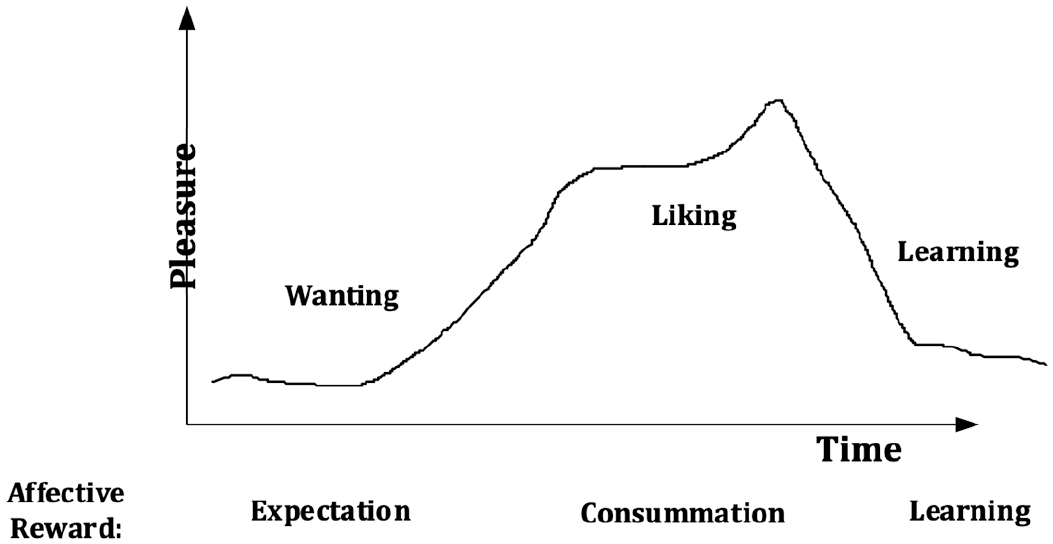
Affective motivation process.
These phases are dissociable, with the first and last tied to a sprawling mesolimbic dopamine system that is tonic, or continuously dripping dopamine. Dopamine neurons on the front end signal incentive salience, or provide embodied signals anticipating rewards, a response that is a pleasurable reward in itself (Di Domenico and Ryan 2017). As people get closer to manipulating, using, touching, eating, or interacting with a given object, more dopamine is released; this makes the lead-up exciting, pleasurable, and again, rewarding (Schulz 2016). After we attain the object, dopamine neurons related to value produce pleasure that is associated with learning, be it updating or reinforcing extant memories, or encoding and indexing new memories, which, in turn, motivate future actions and cycle us back to wanting more. Learning, like anticipation, is intrinsically motivating, especially when the expected reward is greater or lesser than we thought, causing our value-coding neurons to pulse rather than tonically flow; this intensifies and narrows our attention, perception, and memory (Di Domenico and Ryan 2017). In that sense, surprises, novelty, and challenges are all inherently motivating.
Conversely, the intermediate, liking phase is characterized by a sharp drop in dopamine, replaced by an increase in opiates. The hedonic hot spots are small, fragile, and with recurring exposure to an object, apt to release fewer and fewer opiates until we become addicted to an object or activity yet experience little to no hedonic pleasure (Flores Mosri 2021). The addiction, in this case, is in the pleasure found in wanting. The myriad environmental stimuli that make dopamine flow increase; the sights, smells, sounds, and tactile experiences that switch the tonic flow to phasic pulses of dopamine; and the expectation that physical or social pain will be mitigated and temporary relief acquired are motivating.
Motivation science crucially does not premise or hierarchicalize a motive or specific set of motives but posits a conceptual frame for how affective dispositions and affective motives emerge in different ways and in different mixtures at different periods of time. Motivated action is not a unitary thing but, rather, a sequence of activities, each with different rewards, dispositional motivations, and likely, motives. These are all tied together by the pursuit of pleasure, sometimes in subjective desires for sex or love or comfort but often only through affective consciousness and embodied experiences that “urge” us on through the experience of pleasurable feelings (Berridge 2023)—not just the hedonic pleasures many sociologists associate with the term “pleasure” (Regan 2023) but mundane ones as well.
Seeking as Affective Motivation
Affectively motivated seeking allows us to think about motivated action driven by feeling good in many taken-for-granted ways. We look forward to a date we have put on our calendar, imagine the fun we will have playing video games after work, or discuss happy hour with a colleague hours before work ends. This anticipation drives us to prepare because preparation feels good for many people (Fine 1996; Sennett 2008). Let us say the date was for an expensive steak dinner. We arrive, and the sights, sounds, smells, company, and buzz intensify our affective response. This response grows as we sit and settle into the menu, and as food arrives at neighboring tables. While this example may feel asociological because its hedonic, why should we expect this affective response to be limited to hedonic pleasures such as gustation, sex, drugs, and the like? Dopamine flows in an array of situations related to aesthetics, embodiment, creativity, and physical activity. The multiphasic, mixed-motives nature of activities suggests things that seem to have clear conventional sociological explanations, such as the “girl hunt” (Grazian 2008) or big wave surfing (Corte 2022), have mixed motives, some of which have to do with seeking.
Motivation science also holds a valuable lesson about goals, rewards, and motivation. Some people like the prolonged anticipation of bondage or of fishing; many of these people like that pleasure more than the hedonic hit they get when they acquire what they desire. The journey matters as much if not more than the destination (Simmel [1911] 1919). That the journey matters introduces a wrinkle to the usual sociological explanations for motivated action. We do not always or necessarily interact with others for collective effervescence or cultural capital, to satisfy expectations or to maintain consistency, although these may be anticipated or unanticipated outcomes of our interactions.
Additionally, research shows that some activities can temporarily shutter the cycling of dopamine and opiates, leading to one or the other driving all the action. Over time, repeated use of an object leads to sluggish pleasure hot spots; more and more, environmental stimuli become the dopamine-inducing cues (Berridge 2023). Drug abusers are, to be sure, driven to kill the pain of withdrawal and the social pain of stigma, but their craving is also the closest affective reward they get from their addiction (Flores Mosri 2021). Conversely, research shows that people immersed in artistic experiences cease to feel wanting or the urge to seek; they sit in an indefinite state of liking or opiate release (Chatterjee and Vartanian 2016)—what Csikszentmihályi (1990) might have called “flow.” Put in sociological terms, some people may be motivated by seeking and others by the possibility of aesthetic or hedonic pleasure.
Notably, none of this denies that some people and even some environments can motivate extrinsic reward-seeking, or seeking toward rewards separable from the activity itself (Ryan and Deci 2000). Merton (1979), for instance, argued that this possibility was precisely why institutional norms in scientific communities needed to be buttressed by sanctioning systems and institutional guardrails for the deviant who transcend normative violations. Indeed, this presents rich research opportunities for studying why some scientists, athletes, doctors, or politicians find strong intrinsic motivation in their work, whereas others do the same work in pursuit of more extrinsic rewards (or a combination of the two). This twist on the study of institutional deviance (Messner and Rosenfeld 2009) recenters the idea that lots of people find pleasure in some aspects of their work, perhaps enough to see work in a positive light, yet others are denied those same pleasures (Abrutyn and Lizardo 2023). It is an empirically interesting question. Yet, although it is interesting to study the “abnormalities” because they are both instructive and sometimes more exciting than the regularities, both require the attention of a comprehensive sociology.
To that end, the next section delineates the specific affective motivations and motives tied to seeking. Notably, neuroscience does not have the sociological theory or empirics to make the jump from the basic mammalian motive to seek to the sorts of seeking activities humans engage in all the time. However, in connecting the fundamental biological process to mundane activities, one may sketch the outlines of a more systematic research agenda: an agenda that continues to favor the usual reliance on self-reports but also encourages innovative methods designed to observe affect more intensely (Summers-Effler, Van Ness, and Hausmann 2015).
Forms of Seeking
Conceptual Frame
I have referred to seeking as pleasurable because pleasure, broadly defined, is a “positive evaluation of sensations, objects, one’s movements, people, and events” (Frijda 2009:99) related to seeking and the activities that trigger opioid responses (Berridge and Kringelbach 2008). That is, seeking encompasses the panoply of motivations and motives associated with pursuit and the physical, social, and ideational objects we predict will give us pleasure. Seeking is, inherently and intrinsically, a rewarding action tendency; otherwise, the pursuit and the object are merely means to some separable ends (Ryan and Deci 2000). Seeking is closely tied to pleasure in the widest of meanings (see Jones 2020:25; Regan 2023) while maintaining some connection to the emotion schema of happy, including emotional distinctions such as satisfied, joyous, elated, and ecstatic. But as Jones (2020:26; see also Duff 2008) makes clear, “[p]leasure is not a direct route to happiness”; separating the pursuit, the reward, and an outcome such as happiness is important (Berridge 2023). As an affective motivation, seeking or pleasure-seeking is a mood, or impulsion, more than an emotion in the lexical sense (Silver 2011).
For clarity, I define desire as the pursuit, deliberate or otherwise, of specific objects, whether hedonic or aesthetic, believed to trigger opioid responses (see Frijda 2007:25–62, 63–92). People desire the bodily release of sexual orgasm, the high of cocaine, and the savory flavor of food (Duff 2008; Green 2008), but they also desire states of experience related to transcendence, liminality, and being in ritual (Turner 1969), artistic (Hennion 2001), and creative (Leschziner 2015) experiences. As will be clear, desires, or their subsidiary types, are affective “motives” and not affective “motivations.” The same is true of passions, which I believe are the pursuit, purposive or not, of embodied and cognitive pleasures related to learning, mastery, and discipline. Research on Olympic swimmers (Chambliss 1989) and nascent nuns (Lester 2005), for instance, reveals the pleasure actors get from mundane activities that require repetition, narrow attention, and the channeling of desire into practice and discipline that make them passionate agents attuned to their bodies and social spaces. Again, passions, like desires, translate into affective motives propelling action but fall under the general rubric of seeking.
Affective Motivation
Motivation science does not explicitly identify specific motivations, although studies in this vein tend to emphasize activities that are rewarding (Berridge 2023). Frijda (2007) argues that affects are action tendencies, or the sorts of motivations we are disposed toward—whether because of an environmental trigger, deliberate goal setting, or no purposive reason at all. Consequently, seeking presents us with three broad dispositions: curiosity/learning, anticipation, and creativity. Affective motivational dispositions, in turn, manifest in a set of related activities (I discuss these shortly).
First, humans are naturally curious and get pleasure early in life from basic seeking, which leads to finding objects, activities, and experiences that deliver hedonic, aesthetic, and other sorts of pleasures. The objects are things we desire and that have pleasurable outcomes, but it is imperative to keep in mind that curiosity and adjacent aspects of seeking are pleasurable in themselves (Litman 2005). Of the three seeking dispositions, social science has generally ignored curiosity and has struggled with learning; still, some scholars have started to observe how curiosity “motivates . . . open exploration [and] aesthetic engagement” distinct from cognitive goals, such as uncertainty reduction or evaluation (Pagis and Summers-Effler 2021:1372). Open exploration further expands this disposition through embodied, usually prereflexive (at least, initially) knowledge (Jones 2020).
As we acquire this corporeal knowledge, we may begin to sharpen our purpose through reflection, recurrence, and practice. This is especially the case with novelty; so long as something is not too new or too hard, narrowed affective attention and perception feel good (Schulz 2016). Curiosity and learning also have a pleasurable outcome in the form of updating or reinforcing memories and schema, both driven by the dopaminergic system (Berridge and Kringelbach 2011). In particular, surprises and unexpected outcomes cause dopamine to pulse and motivate seeking surprises, especially structured surprises that are not too surprising, exciting, and motivating (Di Domenico and Ryan 2017). For instance, Benzecry (2011:67, 133) found that opera fanaticism is fueled, in part, by “the role of surprise . . . in enjoying performance”:
Many of my interviewees indicated that moments of surprise in an opera performance lead to the ultimate abandonment of self, even more than crying. . . . Since they are overprepared for most operas [the] surprise (a rarely performed or never-recorded opera, a contemporary work they have been wary of, a forgotten or long-overdue piece) allows them to “enjoy the show 100 percent, without worrying about any ghosts.”
Similarly, Corte’s (2022:128) study of big wave surfers shows how they become deeply committed to the activity because of novelty and challenge: “[N]o wave is the same as another. . . . With surfing you simply cannot approach a problem with the same kind of repetitive approach. This means you have to solve it on the spot, you feel rewarded not only for your exploit, but also by the difficulty in replicating the experience [italics added].”
A second motivational disposition is found in anticipation. Thinking, imagining, planning, and even just intuiting what might come releases dopamine, which propels action (Linnet 2014; Schulz 2016). Anticipation, however, is motivating in prereflective ways because cues are embedded in the material and symbolic environments that surround us (Berridge 2023) and in our own embodied habits developed in practice, experience, and learning. Unlike curiosity, which tends to motivate activities in the present, anticipation can marshal our memory and various cognitive processes, such as imagination and executive planning: Dreaming about the future can trigger dopaminergic pleasure (Cerulo 2018).
Anticipatory motivation is perhaps most aligned with the notion of intermediate action, where preparatory behaviors occur in different situations and time scales in a lead-up to the thing we are looking forward to. These moments are pleasurable, perhaps even more so than the actual event itself, and they influence how we update and remember activities. A date may go awry, but the buildup motivates us to try again; some people find bondage and domination more exciting than the consummation of the sexual act precisely because it is preparatory; and of course, addictions, whether drug abuse (Bourgois and Schonberg 2009), pornography (Perry 2019), or gambling (Linnet 2014), are all pleasurable (not necessarily in the normative sense of pleasure equals good but, rather, in the embodied and affective signals that come with finding things interesting, being focused, losing oneself in preparation, losing track of time in the pursuit of something, or imaging the outcome). Of course, less “deviant” activities also involve anticipatory pleasures: Opera fanatics listen to music before a concert, sitting by their stereos reading the libretto (Benzecry 2011:133; see also Hennion 2001), and surfers wax their boards, study the weather, and plan their efforts (Corte 2022:60). Likewise, restaurant cooks use the routines of preparation as part of the anticipation of the “the emotional ‘high’ of the performance” to come in each service (Fine 1996:60):
It’s very much like an actor preparing to go onstage and go into work and start in a quiet place and figure out what you are going to be doing. You get your equipment ready, sharpen knives, cut meats, trim your fish and make your vegetables and make your sauces and get everything set up.
Third, people are affectively disposed toward creativity, whether “the intentional combination of symbols, ideas, and objects in a way that is unexpected for a given audience” (Wohl 2022:2) or simple spontaneity or impulsivity. Creativity mixes many affective motives: To bend the rules requires learning and mastery (Sennett 2008), it requires curiosity in seeking out novelty and challenge (Leschziner 2015; Ocejo 2017), and it requires anticipation, in the form of imagining how a crowd will respond to one’s ingenuity and in taking the role of the audience and experiencing the surprises vicariously. Interestingly, creativity has received the most sustained attention of the three seeking dispositions, although usually within a cognitivist framework (Gross 2009; Joas 1996; Leschziner 2015). Certainly, creativity is partly due to our big cortex and the ability to imagine combinations that previously did not exist, but creativity seems eminently affective given that it is just as likely an attempt at expressing some subjective feeling as it is an intellectual project.
Sociology might consider focusing anew on curiosity, anticipation, and creativity if only because they are easy pathways into a more affective sociological theory of action. Too often, we turn a critical lens on these motivations, focusing on the negative sides (e.g., curiosity is inequitably distributed by class and race; Lareau 2003). This may be the case and thus warrants sociological inquiry, but as Shuster and Westbrook (2024) implore us to consider all facets of society, such as trans joy, so too should we be asking questions about what working-class or Black or trans curiosity and creativity look like. We can accept that opportunities and resources are unequally distributed while also exploring how affective motivations enact and embody mundane pleasures and our compulsion to seek. So, where might sociologists look for affective motives?
Affective Action for the Sake of Action
Perhaps my most crucial take-home point is that sometimes people are motivated to act for the sake of that action feeling good. They are not always driven by needs related to moral meaning or in dutiful fulfillment of their habitus or reference group’s expectations. Doing crossword puzzles, taking long walks, writing blogs or poetry, and consuming news are solitary pleasures that are nonetheless sociologically interesting because they are affectively motivated (Cohen 2015). If we accept this premise, then it is possible to believe that many activities that fall outside the neat binary of habitual-deliberate action are activities that feel good, outcomes aside.
Olympic swimmers, for instance, are different from other swimmers in so far as they enjoy the mundane drudgery of practice, finding pleasure in small wins, such as disciplining their body until they see tiny results (Chambliss 1989). This is not to suggest that winning and losing do not matter or that the swimmers do not find pleasure in other aspects of their sport (e.g., the competition). It simply suggests that in some cases, we become committed to and engrossed in our roles, identities, and statuses through seeking activities related to “training, care, and patience” (Pagis and Summers-Effler 2021:1373). To some, practice or rehearsal is boring, stressful, exhausting; to others, repetitive practices constitute what Dewey ([1934] 2005) called “recurrence,” or affective action that “allows for surprise, as each cycle is both the same and different from the next.” Recurrence combines the release of endorphins impassioned people feel when movement becomes rhythmic and attention entrained (Cohen 2015) with the bracketing of thinking to allow embodied, aesthetic pleasures to dominate (Frijda 2007). However, seeking for the sake of seeking is usually supplemented or supplanted by affective motives derived from the three dispositions common to seeking: curiosity, anticipation, and creativity.
Affective Motives
The fact that these motives are not original or special may be striking to the reader. These motives are phenomena generally known to sociologists and lay people alike but rarely categorized as affective. The most obvious, and perhaps only, motive that is clearly affective is what we usually call “desire.” Desire, as defined previously, is the conscious or unconscious pursuit of the opiate response that arises when we obtain, manipulate, touch, eat, or absorb an object that is rewarding in the affective sense. Orgasms, savory gustation, and normal drug or alcohol use are basic or biological objects of our desire, but a person, place, or thing can predictably or surprisingly trigger opiates. As argued earlier, I hesitate in calling these “hedonic” pleasures because this narrow term obscures aesthetic pleasures, or pleasures arising from “objects or events in which one has no personal stake” (Frijda 2007:80) and that “usurp interest [and] grip the body . . . not merely by speeding up breathing or heartbeat [but through] full control precedence. One is engrossed, fascinated, or spellbound, at the exclusion of everything else” (Frijda 2007:38). For instance, some veterans suffering posttraumatic stress disorder find fly fishing groups that provide the context for this sort of intentional affective pursuit:
Kind of just like being out there and being in a place rather than like . . . catching a fish or something like that. . . . I know I’m not going to catch any fish [but] you just do it because you’re working on something and you’re in nature and you’re sitting there and you’re watching the water. (Pagis and Summers-Effler 2021:1386)
The fishing is, in sociological parlance, a sustained state of disinterestedness.
A set of interrelated motives involves danger, risk, and pain. On the one hand, a lot of seeking involves courting danger; research shows that fear and anxiety are intimately tied to the opiate hit people feel in thrill-seeking (Buckley 2016). Edgework, or activities that are thrilling, at least in part, because one lives on the edge of life and death, is one example (Lyng 1990). But risk is inherent in a much wider range of activities, including sex work (Jones 2020), porn addiction (Perry 2019), and just about any creative endeavor (Wohl 2022). On the other hand, much seeking is tied to pain. Pain can sometimes be interpreted as growth, learning, and maturation, as in religious practices such as fasting (Winchester and Pagis 2022) or secular activities such as martial arts (Green 2011). In other cases, affective motives drive us to manage, mitigate, or avoid pain (or anticipated pain).
An obvious example can be found among drug abusers who suffer severe physical withdrawal symptoms and are compelled to find a temporary release but who also experience “social” pain in their lives that requires its own management (Flores Mosri 2021). One of Perry’s (2019:58) evangelical men addicted to porn remarked that his cravings “made [him] feel like a failure as a Christian,” a feeling that was paradigmatic for most of Perry’s respondents and seemed to be one motive for wanting to feel that hedonic pleasure once more. Separation, isolation, and alienation can be powerful forces for pleasure-seeking. As Corte (2022:127) concludes with regard to big wave surfers, “many of these individuals don’t feel as comfortable socially in their normal lives on the land.”
Exploration, a third motive, highlights the affective appeal and reward of novelty, challenge, and surprise (Di Domenico and Ryan 2017). Clearly, not all people like change, risk, or newness, but astronauts, explorers, and even serial monogamists find pleasure in the journey or adventure (Simmel [1911] 1919). Exploration often goes hand in hand with creativity and innovation given that some institutionalized forms of seeking offer pathways to novelty becoming the rule and mundanity the exception. Benzecry (2011:67) describes this first moment, when the aesthetes in his study “feel an intense attraction that they are compelled to explore and organize in order to maximize the pleasure it produces . . . [an] active intention to find a more complete effect.” This compulsion to explore resonates, too, with how respondents in a study of craft beer aficionados described their ceaseless pursuit of experience and knowledge (Maciel and Wallendorf 2016).
A fourth set of motives might be called “eudaimonic”; these are affectively motivated actions toward higher-order pleasures such as meaning and purpose (Higgins 1997, 2019). I prefer this term for two reasons. First, “eudaimonic” offers a counterbalance to “hedonic/aesthetic” pleasure. Neuroscientists recognize eudaimonia has some ontological reality, but it is not located in the opioid hot spots (Berridge and Kringelbach 2011). As such, identifying the basic motives and activities sociologists, such as Weber, have recognized as central to meaning-making (Kalberg 1990) grounds eudaimonia in seeking activities that motivational scientists would recognize. Second, this distinction between purely embodied and sensory pleasures and those that deliver psychological rewards moves us away from affectively motivated action for the reward outcome in the form of hedonic pleasures, the fix, or the hit to activities whose embodiment aligns with a sense of purpose, meaning, or the sorts of rewards Weber saw as motivating (Barbalet 2000).
Eudaimonic pursuits are sensuous, corporeal, and as Weber argued, baked into practical ethics that presumably connect daily activities to much more distant, intangible, but substantive values. This is especially the case with discipline (a keen interest of Weber’s) but also mastery and innovation. Each of these affective motives build a motivational causal chain that sidesteps the necessity or importance of the liking stage, linking wanting and learning together in an often institutionalized process. Consider, for instance, a slew of ethnographies on craftspersons (Ocejo 2017; Sennett 2008), chefs (Fine 1996; Leschziner 2015), chess players (Fine 2015), Olympians (Chambliss 1989), and academics (Merton 1979), each of which underscores the sort of pleasure that pursuit and exhibition of mastery delivers contra extrinsic rewards, such as money or fame.
Often, mastery requires or demands discipline of the body and mind, although the two are independent of each other. To become a better member of a religious organization, whether as a congregant or in an official capacity, requires “we discover those things in control of us . . . our passions [and make them our] ultimate goal to tame” (Winchester 2016:596). Nuns, for example, do not rid themselves of lust or desire but are compelled to channel these affects into the discipline found in their vows and in the quotidian work demanded by the convent (Lester 2005).
With mastery and control come opportunities for innovation because mastering the norms and techniques around practices allows for deliberate manipulation:
The belief in and search for correctness in technique breeds expression. . . . Of course, spontaneous discoveries and happy accidents inform what a musical piece should sound like. Still the composer and the performer must have a criterion to make sense of happy accidents, to select some as happier than others. (Sennett 2008:159)
Furthermore, “[t]he art of doing [craftwork] means learning how to follow, bend, and sometimes break a set of rules [so one can] improvise” (Ocejo 2017:180–81). This is true of creative institutions more generally (Crane 1976), where norms of techniques demand conformity but also provide a place to take risks in front of an audience (Sudnow 1978) or opportunities to express subjective experiences in novel ways (Wohl 2022).
Any analysis of seeking would be remiss in omitting a set of intrinsic social rewards that can be important to people. Since Simmel (1949), sociologists have recognized the pleasure in pure, aimless sociality. Our bodies, minds, and emotional arousal sync up into a rhythm that compels us to stay focused and maintain the encounter (Collins 2004). Enduring social relationships are rewarding in themselves (Cozoline 2014) because they provide opportunities for touch, reciprocity, trust, consistent verification and gratitude, and a slew of other rewards microsociologists have written about for decades. These relationships also provide safety and other practical needs when pursuing pleasures that can be dangerous or risky (e.g., some thrills [Corte 2022] or addictions [Bourgois and Schonberg 2009]); even Grazian’s (2008) hustlers find safety in numbers. Of course, some hedonic or aesthetic pleasures are intensified in the company of others. Chefs can cook by themselves, opera fanatics can listen at home with state-of-the-art equipment, improv comedians can practice among their fellow performers (Brett 2022), and craftspeople can apply their trades in a workshop. However, being in or serving an audience intensifies one’s subjective pleasurable experience (Collins 2004) while also altering the context by introducing new risks and dangers.
Intrinsic social rewards deserve our attention, especially because they are often overlooked by motivation science, but I suggest they should not be considered primary to the other motivations discussed here. Keeping in mind the mixture of motives in any given situation, it behooves us to expand our research questions if we are to understand why people do what they do. Benzecry’s (2011:131) opera fanatics, for instance, report that “[t]he presence of others is absolutely secondary as the fix can be achieved by the extension of opera experience to other media and formats that are portable and individualized.” But not in every case. A recent examination of queer nightlife in London reveals that some things we do, we do purely for pleasure—and this pleasure requires other people (Ghaziani 2024).
Implications
Contribution 1: The Springs of Action
I can now elucidate the contributions to a sociology of motivation that the aforementioned theoretical model of affective action provides. First, a long-standing question posed by functionalists, pragmatists, and cultural sociologists begins with rejection of the rational-choice model of action as too simplistic: Why do people act? As noted, the usual suspects are habits or automaticity (Lizardo 2021) or when these habits are disrupted, deliberate, quasi-rational action that sifts through the scripts, frames, schema, or norms one has internalized (Campbell 1996, 1999). Action, for a sociologist, is rarely proactive, passionate, desireful (Abrutyn and Lizardo 2024). This model works when we delimit what is “serious” action. For many sociologists, only political, economic, or religious action are serious because of the assumption that these spheres of social life are the most consequential, the most morally fraught. They certainly are important. And they tend to highlight the empirical disconnect between beliefs or internalized distal explanations and actual behavior (Vaisey 2009), calling into question the habitual explanation. Alternatively, mundane things, such as practice or discipline, have mostly been ignored (Silver 2022), as have the myriad things we do alone, which comprise a significant portion of our waking lives (Cohen 2015).
Affective action, I would wager, has not been looked at closely because it is deemed reactive (Weber 2019) and lacking in “consciousness,” or more accurately, cognitive meaningfulness (Mead 1934). The best current affective work has sought to remedy the “pleasure deficit” (Jones 2020; Regan 2023), and it has presented empirical evidence that sex workers, for instance, are not purely or primarily motivated by economic or political forces but also by pleasure; the more pleasure they experience, the more committed they become to the work. Sex, or hedonic pleasure in general, triggers sociology’s puritan ethic, which may explain why it has been, beyond Weber’s scattered writings on the erotic sphere and a few outliers in the field (Wohl 2021), a mostly moot topic in the discipline.
The case made here, however, suggests motivation science offers a vocabulary and theoretical framework for transcending the binary explanation of action and bringing emotions as causal forces into the foreground. This argument begins with the insight that mammals appear to have evolved (at minimum) seven subcortical (i.e., precognitive) affective systems (Davies 2011; Panksepp 1998) that provide a set of affective dispositions or motivational tendencies that are both signals—sometimes prereflexively in embodied and aesthetic form and other times coordinating, commanding, or even controlling cognitive processes interpreting these signals—and forms of sentience. Humans are natural seekers; we do not need to be taught to trigger fear or rage when cherished objects are threatened, we experience panic and grief when those cherished objects are believed to be lost, and we build social relationships through play, lust, and care. The innate nature of these systems does not negate the facts that (1) affective systems are inextricably tied to learning, which means socialization, enculturation, indoctrination, and so on work hand in hand with these systems, and (2) all cultures have vernaculars (or emotion schema) that describe certain feelings attached to certain situations and the expected or appropriate responses in those situations.
The bigger point, for the sake of argument, is that affectivity is a motivating force. It supplies the energy moving our bodies and minds toward or away from things, retrieving and making memories that can energize us in the future, predicting rewards and updating predictions, and finally, providing the attention, perception, and accomplishment of a social self. We are proactive not usually or necessarily because of a deliberate goal, although we might set a larger goal based on structural and cultural beliefs. Thus, a person may say “I want to go to graduate school and become a professor.” But as most of us know, this vague, long-term goal is not where the action is at. It is the narrative we publicly and privately proclaim as we anticipate and move toward transforming our identity (Strauss 1962), and it is how we thematize our biographies post hoc in memoirs, conversations with graduate students or colleagues, and well-worn scripts, schema, frames, and so forth. The nitty-gritty path is not linear, nor are the ultimate ends evoked in daily life, something Weber (1946) recognized (hence his interest in the practical ethics people use as proxies for the substantive values from which they presumably emerged).
Contribution 2: Mixed Motives and Intermediate Action
An affective theory of motivation elevates the often ignored Goffmanian argument that any given situation involves a mixture of motives, some of which may be used in motive-talk for various strategic or nonstrategic reasons. Much of this gets into methodological and analytic questions: What exactly are we studying? Or in Goffman’s terms, where is the action? We need not all become phenomenologists or dramaturgists, but it behooves us to divide larger action units such as “going to college,” “being an athlete,” “converting to Judaism,” or “going on a ‘girl hunt’” into smaller units. A macrosociological approach is still warranted, just as a demographic approach to morbidity and mortality provides useful information. But a microsociology that cares about motivation needs to move toward a more granular sequence of situations or moments that reveals what motivates people to actually hunt for girls or become a bartender. This shift helps supplement self-reports that compress time and space and construct biographical memory after the action (Strauss 1962).
A potential benefit in emphasizing mixed methods is that it reconnects us to an older form of institutionalism (Merton 1979; Parsons 1990). Institutions, such as science or religion, were conceptualized as reward systems shaped, in part, by the Weberian notion of ultimate or substantive ends. Science, or the communities of practitioners and their day-to-day activities, was governed by the intangible pursuit and rewards of “truth” (Luhmann 1995), whereas religion was premised on intangibles such as salvation, piety, and the supranatural. Weber recognized that the “spirit” or value orientations were only as effective as the ethics that governed people’s practices and material/ideal interests; after all, not everyone had the time or luxury of being a virtuoso or elite. To that end, Parsons (1990) imagined institutions as being built up around intermediate chains of action. Science, then, may be about truth in the abstract, but much of our lives are shaped by instrumental, normative, moral, and yes, affective motives, depending on the moment or situation.
One might inquire more systematically as to which motives and intermediate chains matter most to whom. Not every academic, for instance, is a researcher or likes research, which is why teaching, service, and administration are alternative paths in academic careers. Motives shift in ways that create both communities of like-minded folks and sources of conflict and contestation. Weber anticipated this in his tripartite model of social spheres—virtuosi, elites/officials, masses (Sharot 2001)—although I would posit a much more complex, richer set of categories of actors that varies depending on the institution and the time and place. These are all empirical questions. They are not directed toward some sort of predictive law-like models but are meant to carve out research agendas that pay closer attention to affectivity, whether seeking or not, and its role in informal and formal social life.
Contribution 3: Affective Motives
Affectively motivated seeking begins with three sorts of action tendencies or motivational dispositions—curiosity, anticipation, and creativity—that, in turn, translate into a set of motives including desire, danger/risk/pain, exploration, mastery, discipline, innovation, and so on. When we examine Grazian’s (2008) account through these affective motives, we find an incredibly diverse chain of intermediate activities and mixed motives behind the girl hunt. In chapter four, Grazian describes the preparatory rituals and anticipatory experiences of men and women, which he labels a “masquerade of doing gender.” We see Abigail describing a laundry list of preparatory rituals for getting ready to go out (Grazian 2008:95–96). We never hear whether Abigail abhors this prep work or whether there is something pleasurable about it, but another interlocutor (Martin) describes preparation as exciting, energizing, and pleasurable (Grazian 2008:141).
Two things stand out from this example. First, a key motivation (anticipation) and motive (preparation) drives the prehunt phase of action, and second, like most ethnographers, Grazian does not view rehearsal or preparation as central to our mobilization of energy—it is only the prologue to the meat of his study; it is a by-product of ideological commitments unwittingly made. Of course, the ethnographic record is full of preadult men and women “playing” or rehearsing adult sexuality in various guises and contexts, suggesting ideology may be only one smaller reason for why and how youth seek desire, play, lust, and “feeling like an adult” (Fox 1967; Malinowski 1929). We hear, for instance, that Eve “couldn’t stop thinking about what [she] was going to wear” (Grazian 2008:99), in part because of gender norms but also because role-playing, even something as mundane as adulthood, is affectively pleasurable.
Through the lens of affective motivation, Grazian’s (2008) chapters four and five can be read as seeking or pleasure-seeking in the form of anticipation and preparation. When Abigail offers an elaborate recounting of her routine, it suggests she may enjoy these moments as much as Joey, who seems as excited to be “having fun with my boys . . . drinking, dancing, and joking around” as doing gender (Grazian 2008:140). Embodied experiences, especially those that enact the anticipated events, are positively affective even if the event never happens or does not happen as we expected (Berridge and Kringelbach 2008).
Again, this argument does not deny there is a mixture of motives, nor does it insist that all sociological explanations are ill-fitting. Distal forces such as class or gender may condition or shape the opportunities people have and the things they are exposed to, but affectively motivated seeking is a ubiquitous set of motives that may or may not align with structural or cultural constraints. Evangelicals may live in a world of piety and purity but still be unable to resist the danger, risk, and pleasure of anticipation and preparation porn addictions facilitate (Perry 2019). High-risk financial managers, like Matt, may offer motive-talk that reveals truth when they say “I did choose this demanding job because I knew I could earn a lot of money in it” (Schulz 2012:17). But we are forced to reconcile this with the affective motivations expressed when answering questions besides why he chose the work: “I actually don’t have much trouble working long hours. . . . In the heat of battle there’s just so much adrenaline over such an extended period of time. That’s why it’s easy for the work to really take over your life” (Schulz 2012:17). Jones’s (2020) sex-cam workers expressed a similar sentiment: Many described money as important, but they also noted that pleasure and power were essential motives for continuing to do the work.
Contribution 4: Toward a Theory of Pleasures and Their Pursuit
Sociologists have sought to remedy the discipline’s lack of attention to inequality, with some arguing that sociology is “the study of social inequalities” despite the reality that it is “[a]ctually the study of society [of which] negative experiences are only part” (Shuster and Westbrook 2024:791). Both things can be true. Oppression, marginality, and stigma can be harmful, and one’s marginal identity may provide opportunities to find joy in solidarity, community, and resistance (Combs 2023; Luna et al. 2024). Pleasure as distinct from desire, as Jones (2020) reminds us, exists in nearly every social relationship and, as I have suggested throughout, in intermediate situations in which opportunities for learning, mastery, and discipline bring sometimes subtle, sometimes ecstatic affective feelings in embodied and aesthetic forms.
The affective theory crafted by way of seeking builds on and extends the critical work of studying joy, pleasure, and happiness regardless of how challenging it may be to measure these things. As Jones (2020) and Regan (2023) argue, sexual or pharmaceutically induced pleasures are merely the tip of the iceberg. In that spirit, I offered three dispositions that feel good—curiosity, anticipation, and creativity—and a panoply of motives these dispositions manifest (e.g., preparatory or mastery activities that take us out of the bedroom and into the boardroom, the factory, the workshop, the kitchen, the church, and just about anywhere people congregate). A research agenda that takes the ordinariness of pleasure seriously can focus on the mundanity of pleasurable seeking.
We may be motivated to seek joy or pleasure because it feels good—and we should at least trust our interlocutors when they tell us as much. This should not stop us from interrogating the structural or cultural worlds that constrain and facilitate pursuits of pleasure, but it should invite us to simultaneously accept that people feel good about things they do. People may need others not because the company fulfills a functional need or is requisite for group life (Fine and Corte 2017) but because they need other people to feel good. This may be for practical reasons, at least partially: Big wave surfing can kill a person, so to get one’s hedonic fix, a surfer needs the brute fact of safety provided by others (Corte 2022). It may be that others amplify our own experience, such as opera fanatics heightening their own aesthetic experience in the company of others during an opera (Benzecry 2011) or bartenders needing customers to serve (Ocejo 2017). And of course, social rewards may be one or even the most important motive for pleasure-seeking. As Panksepp’s (1998) model of affective neuroscience shows, play, lust, and care are powerful affective motivational systems impelling us to find, maintain, and expand social relationships.
A final point that helps segue into a broader sociological discussion centers on the distinction between affective motivations, such as desire or control, and emotion schema, such as joy (LeDoux and Brown 2017). Scholars interested in joy are, of course, interested in phenomena closely related to pleasure, or what are usually called affects related to seeking (Berridge and Kringelbach 2008; Frijda 2007). One of sociology’s most enduring contributions to the study of emotions comes in Hochschild’s (1979) seminal work on feeling and framing rules that suggests how, why, when, and who expresses or suppresses certain emotions in certain situations is culturally conditioned. Despite Hochschild having written about these insights five decades ago and despite the growing importance of emotions, such as joy and shame, to sociological inquiry, sociologists of emotion have largely failed to systematically study emotion schema.
We presume fear and anger are caused by structural or cultural forces (Kemper 1978) or that shame is the product of an intense feeling of failing coupled with the ensuing sense we are corrupted or polluted (Scheff 1988). Yet we have not compiled data about American or Canadian, White or Black, or Southern or Northern shame or fear or joy cultures. We intuitively know these are real constructs, but we do not have a strong sense of what stimuli trigger them under what conditions, what responses are normal, and what meanings people assign to them, let alone how they vary in time or space. The same can be said of affects such as pleasure. To best understand how emotions or affects are dependent, independent, or mediating variables, we need to treat them as specific units of analysis rather than things we are required to include in our analyses of the phenomena that really interest us. Indeed, it is in the clarity gained from studying affective motives and emotion schemas more closely that motive-talk can be better understood and our observation of the interplay between emotions and cognition made more efficacious.
Final Thoughts
In many ways, social science will always be better at motive-talk than motive because surveys and ethnographic interviews are the bread and butter of research. Indeed, we may never be able to predict what motivated people to act in the first place or identify the hierarchical ordering of motives that impelled action. But given what we know about affectivity and what affective motivation and motives (at least with regard to seeking) look like, we can be sure that affect is at the heart of impulsion. In many moments, affective consciousness (often, at least initially, prereflexive) is sensitive to the environment and objects around us, which trigger subtle emotional sensations that make us act even when we are not cognitively conscious. Eventually, these affective signals coordinate, command, and even (sometimes) control our cognition and subsequently, behavior.
All this suggests sociology can study mixed motives through creative, innovative research agendas focused on more than just the subjective and cultural components of affects and emotions (Paul et al. 2020). Observational techniques (Summers-Effler et al. 2015) and participant methods (Winchester 2022) are promising avenues for examining behavioral, chemical, and physiological components (Kalkhoff et al. 2020; Parker et al. 2020), and some adventurous sociologists may find ways to leverage neuroscientific instruments (Firat 2021). Avoiding the insights neuroscience offers seems impossible given the myriad ways motivation science supports, extends, and sometimes challenges central sociological tenets (Franks 2019), just as neuroscience has much to learn from sociologists (Turner 2013).
Ultimately, sociology is primed to expand the sociological approach to motivation and action by incorporating biological processes and social conditioning without denying the importance of post hoc motive-talk. The simple binary in which habits give way to deliberation only under duress or dilemma is neat and tidy but loses sight of pleasure-seeking and that some action and activities are motivating because they feel good, outcomes aside.
Footnotes
Acknowledgements
I would like to thank the editor, three anonymous reviewers, Dan Chambliss, Clayton Childress, Brett Gordon, Iddo Tavory, and Jonathan Wynn for their thoughtful comments and critiques on earlier drafts.
