




Abstract
I outline four temporalities that appear in highly regarded explanatory historical social science. Given William Sewell’s centrality to the literature, I do so through a critique of his proposition that there are “three temporalities”—experimental time, teleology, and eventfulness—and that only the last of them is valid. I concede that his rejection of “experimental” time is justified. But I argue that the category of “teleology,” which Sewell rejects, encompasses two forms of transitional change—“tendencies” and “thresholds”—that are coherent and defensible. I further argue that his preferred category of “eventfulness” really refers to two distinct temporalities—“coincidences” and “contrivances”—rather than just one. I illustrate tendencies, thresholds, coincidences, and contrivances in the works of John Veugelers, Ivan Ermakoff, Marshall Sahlins, and, of course, Sewell.
More craft than formula, historical sociology can seem fickle. It is perhaps equally committed to the study of unique events and the use of general categories to study them (Clemens 2007; Elias 1983; Mannheim [1924] 1952; Steinmetz 2004). It insists in one breath on the importance of structural constraints and in the next on the importance of flux and fluidity (Adams, Clemens, and Orloff 2005; Hirschman 2021; Sewell 2005). It appeals on the one hand to intentionality and on the other to fateful accidents (Abbott 2001; Hall 2009; Sewell 2005; Xu and Reed 2023). To outsiders, it may sometimes seem as though the field asserts provisional commitments only to revoke them.
But most historical sociologists share a broad quasi-consensus: a commitment to narrative-causal explanation of significant episodes of over-time change. This broad theme, straddling the intersection of history and social theory, is routinely called “temporality” and is intimately related to questions of structure and action (Abbott 2001, 2016; Archer 1995; Callinicos 2009; Postone 1993; Sewell 2005). Most of the time, most sociologists privilege the latter categories, perhaps even letting their preferred theories of structure and action determine their temporality (for a survey, see Tavory and Eliasoph 2013). This may be the optimal default setting, at least for those who are not especially interested in significant episodes of change.
But privileging the categories of structure and action independently of the sequences into which different forms of each combine to produce change represents a problem for historical sociologists and fellow travelers: It casts temporality in the dark. Temporality can, of course, be conceptualized in a variety of ways. The philosophy of history, focused on the social ontology of time, conceives of it in terms of becoming. But if Elias (1992:12) is correct about the social ontology of time—that “people reflect on it without really knowing what kind of phenomenon they are dealing with”—we may for practical purposes have to render it as something else. Historical institutionalism emphasizes the timing, duration, and sequencing of political-institutional change (Pierson 2004). But this work sometimes downplays sociological factors, both emergent and individual. Sewell (2005) points to a third alternative. He focuses on sequences but only insofar as they are comprised of a given structural configuration followed by a specific kind of action; and of course, taken together, structure and action arranged into a sequence could be viewed as becoming. I proceed similarly in this article. But I do so to identify several distinct forms of over-time change. The idea is that there is variation in both the structure and action dimensions of narratives, and they can therefore comprise a variety of different sequential concatenations, or temporalities. My proposal consists of a simple typology of these temporalities.
It is perhaps mainly for epistemic reasons that we should recognize and typologize such temporalities. There is perhaps little to be gained from refining our context-independent beliefs about the way time matters for society, in pursuit of a social ontology of time. There are also broadly recognized normative problems associated with championing certain kinds of “meta-narratives.” But there are strong epistemic reasons to map out some quasi-temporal aspects or facets of social ontology, at least in the form of “meso-narratives.” In general, as social scientists, what we know about social ontology should inform our epistemology. As it stands, our theories of structures and action clearly inform epistemologies. So too could theories of temporalities. The typology offered here may help with that.
Indeed, the literature points to the epistemic importance of a typology of temporalities. Hirschman and Reed (2014) help set the agenda for theoretical historical sociology, focusing on causation. They observe that an excessive focus on what they call “forcing causes” in contemporary sociological research leaves a broad swathe of historical causation unaccounted for—a swathe they call “formation stories.” They recommend study of these formation stories. Hirschman and Reed (2014:274) note that “for a formation story to be taken as a causal story, the author of the claim must show plausible other ways the formation could have gone and then account well for the difference between the plausible and the actual within the case under study.”
That is where this article’s contribution—to typologize temporalities—comes in. 1 Although surely only provisional until a better catalogue can be developed, the typology may prove epistemically useful in at least two distinct ways. 2 First, it may help open research vistas. Simply by virtue of existing, the typology may enable us to take temporalities “off the rack” and see how they “look” when applied to a case of interest. This may yield an increase in vantage points, imparting a net increase in insight. Recourse to different vantage points may also be important because different conceptions of a given substantive phenomenon sometimes rely on different temporalities (Desan 2023), which implies that reserving conceptual space for multiple temporalities may be a prerequisite to preserving multiple substantive theories—which we might also like to “try on,” if not for the case at hand then for a future study.
The second reason a typology of temporalities may prove epistemically useful is to discipline inquiry. If we can choose between several temporalities, we may be able to determine that one of them fits a case of interest better than the others. This will likely support greater precision in our formation stories: By having recourse to a common temporological vocabulary, we may be able to better communicate our findings to one another. This might support the scientific ideal of better positioning our contributions in a growing literature. Precision about temporal questions can also impart practical advantages: the ability to clearly convey how the temporality of one’s case differs from those cherished by others may help researchers guard against others’ attempts to assimilate them to their own temporal camp (Sewell [2000] 2005a:213). These possible uses of a typology of temporalities may serve a spectrum of epistemic ends: on the one extreme, allowing us to purge prejudices from our epistemic field of vision to facilitate fresh insights, and on the other, helping us defend our substantive conclusions in the face of skepticism from theoretical opponents.
How should we develop a typology of temporalities? To do so, it is worth revisiting Sewell’s ([1996] 2005c) classic essay, “Three Temporalities.” Deemed perhaps “the most important agenda-setting piece in historical sociology” (Hirschman 2021:48), Sewell’s essay has profoundly shaped how sociologists think about temporality. Ironically, however, it has preemptively narrowed the range of temporalities to which historical sociologists normally make recourse (even though Sewell [2008] himself tried to reverse this effect in later work and even though his followers sometimes follow him precisely by breaching the bounds of his conception of eventful temporality [Xu and Reed 2023]). In brief, Sewell rejects both “experimental temporality” and “teleological temporality,” championing what he calls “eventful temporality” alone. I think he is justified in rejecting experimental temporality, but his narrowing of the debate is excessive in at least two important ways. First, although a certain category of “teleology” probably should be rejected, as Sewell recommends, another category, which I call “transitional change,” should not. Transitional change disaggregates, in turn, into two types of temporalities. Second, there are also at least two different types of eventfulness, the class Sewell endorses but compresses into a single temporality. Correcting for both shortcomings, it becomes evident there are at least four distinct types of temporalities.
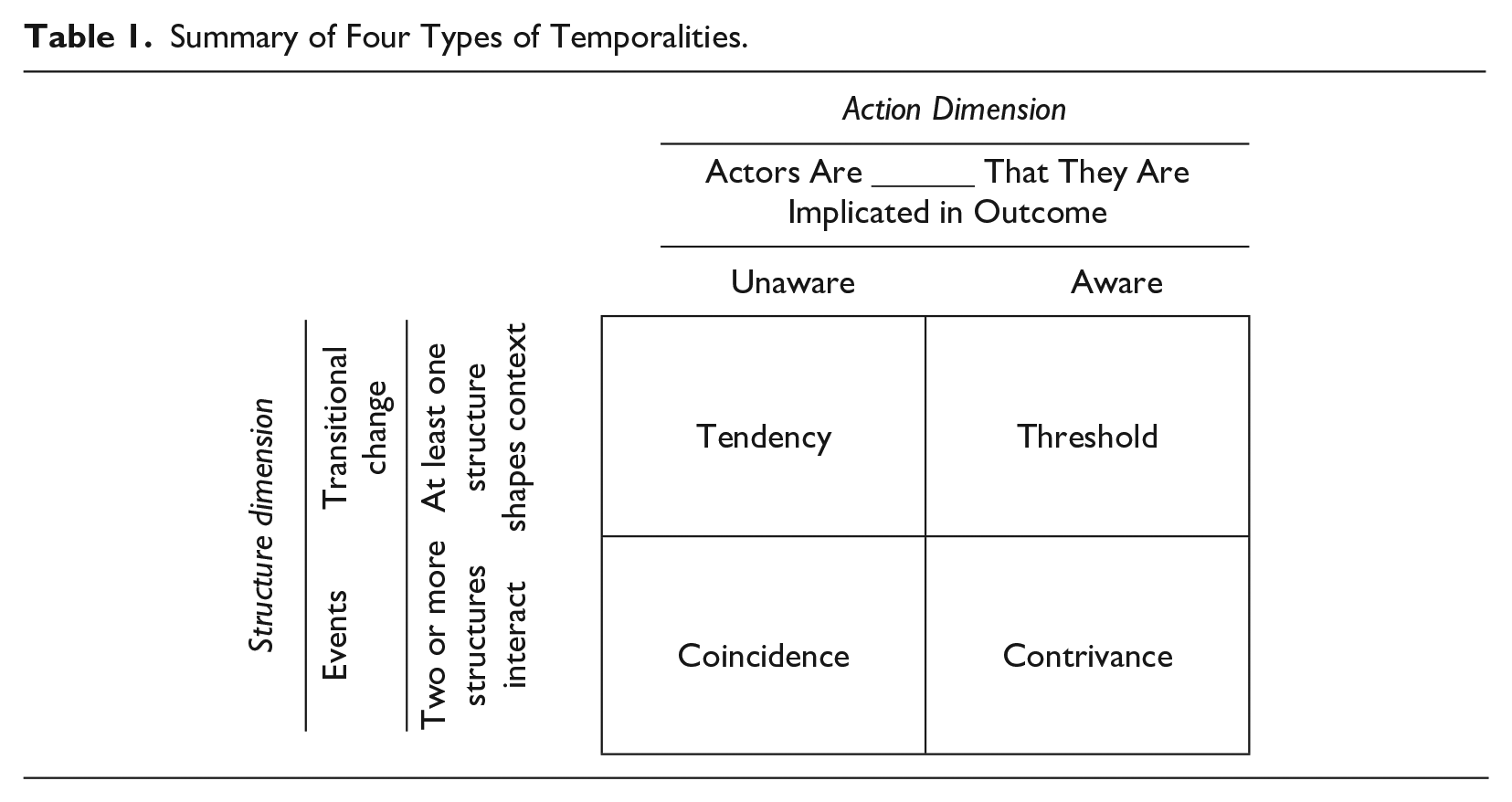
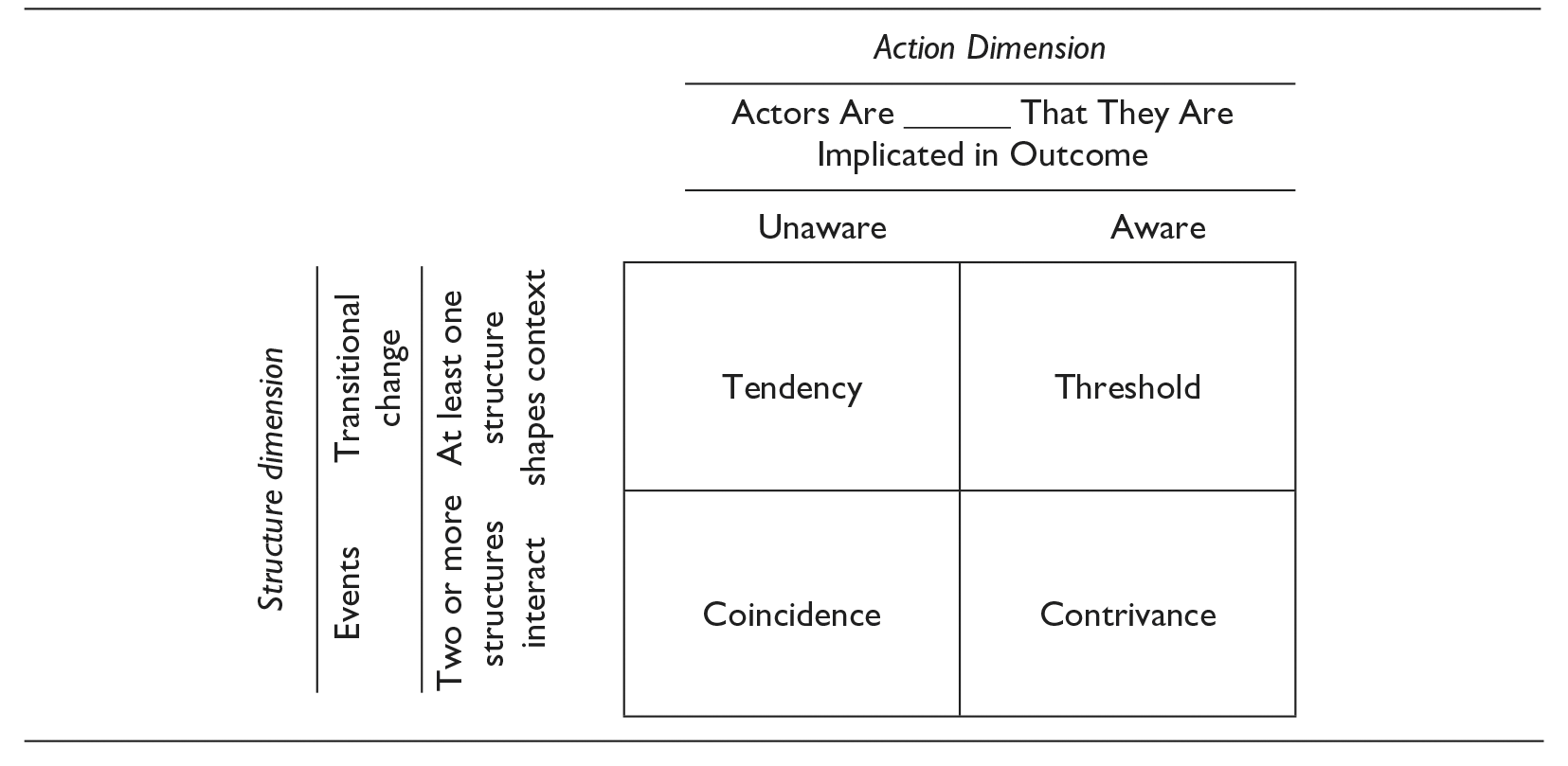
I call the four temporalities “tendencies,” “thresholds,” “coincidences,” and “contrivances.” Each type involves a multistep narrative form of causation featuring at least one structure and some form of action, be it oriented toward or oblivious to the resulting change. Table 1 summarizes the four types according to their structure and action dimensions. Let us start with the first row, in which at least one structure shapes the context. If agents are unaware of changing their stances over time but nevertheless do so in some specified way, leading to a different social configuration, the type of temporality in question is a tendency; if agents are aware of changing their stance, it is a threshold. 3 In the second row, two or more structures interact or overlap. If agents are unaware that after such an interaction or overlap arises, their action—rooted in and routine amid one structure—will cause another structure to change, but nevertheless undertake the action, the type of temporality is a coincidence. 4 If structures cancel one another out and thereby diminish constraints on action and if actors thereafter act in view of goals that are consistent with the outcome, it is a contrivance.
Summary of Four Types of Temporalities.
Because social temporalities themselves concern the way structures and actions concatenate into distinct forms of over-time change, there is a significant substantive difference between structures and actions, on the one hand, and the temporalities into which they can combine, on the other. It is precisely because of this difference that we may benefit from the typology offered here. True, with enhanced awareness of the temporal dimension of social ontology, it may be possible to choose between types of temporalities on substantive grounds, ensuring that the temporological features of what we study inform our epistemology. Moreover, in the absence of such a map, researchers would have to choose between epistemic alternatives somewhat blindly, that is, independently of much consideration of the temporal nature of the objects they study (perhaps based instead on the nature of the structure[s] or the action in question). But even with such a typology in hand, the problems are not solved; they are merely clarified. Thus, the typology developed here only serves to bring underappreciated epistemic problems to the surface, allowing me to further explore them but certainly not resolve them in the discussion.
This is especially so for cases in which multiple temporalities co-occur. Historical sociologists often make explanatory recourse to a concatenation of causal factors (Clemens 2007; Gorski 2018; Ragin 1987; Steinmetz 2004). Insofar as temporalities themselves “concatenate” in a given case, this points historical sociologists to significant unresolved epistemic challenges. If we find a given case is characterized by the simultaneous co-occurrence of two or more types of temporalities that fall on opposite sides of the action dimension, we are in uncharted epistemic territory. Ought we to use a meaning-centric approach to study a case displaying both a threshold and a tendency? Ought we to apply a culture-external analysis to one featuring a contrivance and a coincidence? How about when a threshold and a coincidence co-occur, or a contrivance and a tendency? When does a meaning-centric analysis trump a culture-external one and vice versa? By elaborating the fourfold typology, this article points to but certainly does not answer these kinds of questions.
I proceed as follows. I briefly summarize Sewell’s proposal. After conceding that one kind of teleology is indeed pernicious, I defend another kind of transitional change that Sewell subsumes into that category, disaggregating it into tendencies and thresholds and furnishing examples of each drawn from exemplary historical sociology studies by John Veugelers and Ivan Ermakoff. I then discuss the two kinds of events—coincidences and contrivances—by elucidating the temporality of Marshall Sahlins’s work (Sewell’s putative inspiration) and that of William Sewell himself, before discussing epistemic implications.
From Three Temporalities to Four
Sewell ([1996] 2005c) identifies three temporalities. The first is experimental temporality, which assumes that for a given pair of independent and dependent variables recurring in multiple cases, each cause-effect sequence is equivalent regardless of the context in which the independent variable affects the dependent variable. The second is teleological temporality, which describes processes exhibiting directionality and attributes causation to the directionality per se. The third is eventful temporality, which, Sewell argues, emphasizes actors’ creative abilities to make change during periods of historical flux.
Sewell ([1996] 2005c:95–96) rejects experimental temporality with a cogent argument that it denies “historical time.” It requires the assumption that different cases obey “identical causal laws,” thereby denying that insofar as things change over time, this can change the conditions under which the relationships between variables are causal. 5 Sewell thinks this is a problem for two related reasons. First, scholars who adopt experimental temporality assume that variables that do not appear in all cases, even though they may appear in one or more cases, are causally unimportant. This assumption is generally untenable outside of closed systems (i.e., laboratory-like conditions); in open systems like societies, variables that are present in one or more cases but not all cases often do affect the outcome of interest in the cases in which they are present. This is especially important precisely to the degree that we admit things can change significantly over time—which is a ubiquitous assumption in historical work. 6 Second, this view requires that the researcher deny that cause-effect sequences that take place earlier in one case can affect another case later in time, instead assuming that cases are totally isolated from one another. This is erroneous insofar as cases are typically not completely isolated, at least when separated in time (because separation in time often enables actors in one case to learn from other cases). 7 Because it leads to such underspecified explanations (see Newman 2024:241–43), I think Sewell is justified in his rejection of experimental temporality.
Sewell also rejects teleological temporality. Here, however, his reasoning is more convoluted. On the one hand, he offers a definition of teleology—the idea that “events in some historical present . . . are actually explained by events in the future” (Sewell [1996] 2005c:84)—which represents a position that no sociologist I have met holds and that seems relatively easy to reject. On the other hand, he offers evidence that historical sociologists embrace a form of teleological temporality that only fits a different definition—that “abstract transhistorical processes” can cause “some future historical state” (Sewell [1996] 2005c:84)—and which corresponds to positions that some historical sociologists do hold. Despite the divergence between these two definitions, Sewell essentially argues that we should reject the entire category of teleological temporality on the grounds of the implausibility of the former. Because this completely overlooks the latter definition, denying the temporalities of the sociologists who subscribe to it, I do not think Sewell is justified in this conclusion. Indeed, Sewell (2008:521–24) later partially recanted this position, although students often only read his “Three Temporalities” essay (Sewell [1996] 2005c) and conclude it represents his considered view on the matter. If we join the mature Sewell in refusing to hastily dismiss teleology whole-cloth, instead probing the category for defensible types of temporalities, we can identify at least two coherent forms of transitional change: tendencies and thresholds. I discuss each in the following.
Finally, Sewell advocates eventful temporality. By now, it is widely recognized that not all historical change is best conceived of in terms of events (Assis 2023) but that some historical changes clearly are best conceived in such terms. The problem is Sewell fails to acknowledge that this broad category encompasses at least two types of events. One centers on how oblivious actions contribute to historical change; the other sees goal-oriented actions as difference-makers. I call these coincidences and contrivances, respectively. Both kinds of eventful temporalities appear in prominent historical social science research: They appear in Sewell’s putative inspiration (Sahlins 1985) and in his own elaboration of eventful temporality (Sewell [1996] 2005b), respectively. I argue that although quite distinct, both are defensible.
Recovering Defensible Teleologies: Forms of Transitional Change
Recall that Sewell lumps together two different kinds of teleology and after criticizing one, rejects both. His whole-cloth rejection of teleology is not cogent because there are two kinds of teleology but only one displays the problems Sewell successfully impugns. The intellectual inspiration for the first kind of teleology is a caricature of Hegel’s ([1837] 1988:35) cunning of reason; the idea is that something from the future essentially reaches backward in time to the historical present to arrange people or things in service of a future fate. Let us call this “teleology1.” The intellectual touchstone for the second kind of teleology is perhaps Aristotle’s distinction between potentiality (dunamis) and actuality (entelecheia); the proposition is that although potentiality does not determine actuality (a plurality of kinds of things can be made, e.g., from a piece of wood), it does potentially influence it (a piece of wood can only be made into certain things, not just anything). 8 Potentialities may even be imbued with “latent” tendencies—which can be counteracted but not absented—to become “manifest” in the form of specific actualities (e.g., an acorn has a tendency to become an oak tree, and although this tendency can be counteracted or diverted by numerous factors, it will not disappear entirely unless the acorn is destroyed because of what the acorn is). 9 Historical processes can display these same qualities. Let us call this view “teleology2.”
The distinction between teleology1 and teleology2 is crucial, but sometimes even the greatest of minds elide it 10 —among them, the Sewell of “Three Temporalities” Sewell ([1996] 2005c). As noted previously, Sewell ([1996] 2005c:84) offers two definitions of teleology, mapping roughly onto the distinction between teleology1 and teleology2. But he ultimately elides the distinction and after raising valid criticisms just of teleology1, dismisses both teleology1 and teleology2 on the basis of a guilt-by-association fallacy. 11
We should not dismiss teleology2 so quickly, as other incisive minds have noted (Hall 2010; Mische 2022; Postone 1993). For example, Hirschman (2021) arrives at a version of this conclusion, albeit based on a different sort of argument. With regard to what he calls “transitional temporality,” Hirschman (2021:48, italics added) is explicitly concerned with “how fast societies move from one set of structures to another” and endeavors to excavate the explanations Polanyi ([1944] 2001) offers for “fast versus slow” transitions. This discussion assumes teleology2: that sometimes history moves in a definite direction (i.e., through a “transition”) not because this was fated (i.e., not because of teleology1) but because of something about how the constitutive factors aggregate (Hirschman 2021:52). For Hirschman, this points to questions concerning speed.
I want to suggest there are actually two different kinds of questions here and that Hirschman (2021) only addresses one. The first is a quasi-quantitative question of speed and outcome: How much time is necessary to effect the transition in question, and do fast transitions harbor social implications that differ from those of slow transitions? The second question is quasi-qualitative and process-focused: What kinds of constitutive factors aggregate into the historical processes that move, through transitions, in a determinate direction (whether fast or slow)? In other words, beyond fast and slow forms of teleology2, can different ingredients combine to produce different kinds of transitional temporalities? I posit that indeed they do.
Before addressing the matter substantively, it is worth discussing terminology. How should we refer to the kind of processes I have been calling “teleology2”? There is obviously a debate about the word “teleology,” with some historical sociologists finding it a valuable term for referring to the directionality of certain historical developments (Arjomand 2019:38) or initiatives (Mische 2022). Granting that this is one of the term’s assets, others (e.g., Hall 2010; Hirschman 2021; Postone 1993:377) refer to directionality without embracing the term “teleology”; thus, even when denoting directionality is desired, the term does not seem necessary. Moreover, for better or worse, most sociologists seem to consider “teleology” and its cognates to be terms of derision: More than a few use the adjective “teleological” as an epithet, to shut conversations down rather than sustain them. Thus, in addition to the fact that some definitions are deeply problematic, “teleology” is also a loaded word. Naturally, the alternatives are not flawless either. Hirschman’s (2021:48–49) term “transitional temporality” is the least problematic, but as he defines it, the term is concerned mainly with the speed of change and the outcome. Given that we are not concerned with speed or outcome per se, let us instead reference the concept of teleology2 by using the expression “transitional change.” Bearing in mind there are also drawbacks to this term, it does have the clear advantage of shedding the baggage associated with “teleology” without restricting focus to the speed of change or outcome. Thus, moving forward, I use “transitional change” to refer to the kind of change I have been calling “teleology2.”
Can transitional change be disaggregated into distinct types of temporalities? Having impugned it, Sewell’s ([1996] 2005c) “Three Temporalities” naturally fails to probe the category to specify how it might be disaggregated. Hirschman (2021) tackles the category in terms of speed and outcome but brackets qualitative differences between distinct types of processes or temporalities. I submit that “transitional change” may refer to at least two types of temporalities. The first is tendencies, a type of temporality in which the outcome evolves from a latent to a manifest state even though actors remain largely oblivious to their contribution to it, thus rendering actors’ goals of potentially little “scientific value” for an explanatory account (Desan 2023:601, italics removed). The second way transitional change can be disaggregated is as thresholds, in which changes in the causal factor are the result of intentional, meaningful behavior. Meaningfulness, in turn, makes progress toward the threshold in question empirically verifiable through evidence about “actors’ behaviors, motivations, or beliefs” such that actors’ intentions—be they goals or “imaginative engagement with future scenarios” (Mische 2022:415)—are of monumental scientific value (Ermakoff 2019:595).
An analogy may aid in distinguishing tendencies from thresholds. The difference is akin to that between walking off a cliff blindfolded versus doing so eyes wide open. In both cases, there is a cliff and the person in question walks headlong off the edge, but in one, the person may not even be aware of the existence of the cliff, whereas in the other, they are aware of precisely when they take their fateful last step. In both, the structure of the situation and the relationship between the behaviors and the outcome are essentially the same, but the intentionality and meaning the actor attaches to their behavior diverge sharply. This analogy is a mere hypothetical example; in real cases, the duration of change and a host of other things may set tendencies apart from thresholds. But the hypothetical example does highlight what is perhaps the most important substantive difference—whether or not the action is accompanied by intentionality—between these types of temporalities, which has important epistemic implications.
Tendencies
Tendencies have long featured in Marxian social theory, appearing, for instance, in Marx ([1894] 1991), Harvey (1989), Postone (1993), and even in Sewell’s (2008:522) later work. But the idea of tendencies is not limited to Marxism, and in recent years, it has even come to increased prominence in the philosophy of causation (Anjum and Mumford 2018). In a case of this type of temporality, the human actors implicated are not necessarily aware of (or may hold inaccurate beliefs about) how their immediate conduct relates to the tendency and its eventual effects.
A major work exhibiting this type of temporality is Veugelers’s (2020) Empire’s Legacy: Roots of a Far-Right Affinity in Contemporary France. Veugelers argues that ex-colonial Europeans who repatriated from Algeria and settled in southern France (pieds noirs) constituted a latent source of support for the far right and that the French National Front party’s (FN) twenty-first-century electoral success—especially in Toulon, which they turned into “a fascist city” (Veugelers 2020:124)—resulted from the actualization of this latent potential. The pieds noirs had a tendential inclination to far-right politics, which eventually helped give rise to a far-right political project.
This far-right potential arose through a two-step process. First was colonialism, premised on ethnic rule or “ethnocracy.” This meant that during the war of national liberation (1954–1962), “every unknown Arabe became a potential terrorist” in the mind of the colonial (Veugelers 2020:35). Second was the experience of decolonization, especially colonials’ perception that the moderate right had abandoned them. Colonials held high hopes when center-right president Charles de Gaulle came to power. They were thus especially disappointed when he acquiesced to Algerian self-determination. Repatriating to France, they settled mostly in the south, concentrating in the Var district, especially Toulon—France’s leading military port city. The result was “a far-right potential” (Veugelers 2020:29).
During the potential’s incubation period, the pieds noirs constituted a potent minority in Toulon. Amounting to only about 15 percent of the population, they could not call the shots politically. But as a unified bloc, they could decide elections. The implications were twofold. In the short term, the pieds noirs helped ensure there was political space for a range of anti-de Gaulle right-wing politics. In the medium term, the pieds noirs gravitated toward a far-right agenda. The relationship between the far right and the pieds noirs was one of “elective affinity”: They reinforced one another without fusing. 12
Initially, non-Gaullist center-right politicians, like Toulon mayor Maurice Arreckx, tried to secure the support of the pieds noirs through patronage. Moderately successful, such politicians “shunted a far-right potential away from the far right” for a time (Veugelers 2020:48). But symptoms of the far-right potential were present, especially after Gaullism lost the political initiative. During his presidential campaign, Valéry Giscard d’Estaing promised that if elected he would redress pieds noirs’s grievances. Repatriates’ “mood relaxed” upon hearing his promises (Veugelers 2020:84), but they were not about to line up behind him. To the contrary, they presented Giscard with an ultimatum: They would vote against his party “unless he promised more generous compensation for their property abandoned in Algeria” (Veugelers 2020:83). In essence, Giscard was unable to get pieds noirs to behave as he desired, but they were successful at getting him to respond favorably to them.
Meanwhile, the far right had evolved and “moved down the class scale” (Veugelers 2020:95), eventually acquiring electoral weight. Local center-right politicians, like Arreckx and his successor François Trucy, responded by adopting far-right rhetoric and negotiating political deals with the far right. Soon, under the leadership of Jean-Marie Le Chevallier, the FN’s Var district organization threw itself into “grassroots activism,” infiltrating center-right civic associations (Veugelers 2020:118). As a result, in the 1995 elections, FN presidential candidate Jean-Marie Le Pen came in first in the Var, and the FN won the mayoralty of Toulon. Upon taking power, the Le Chevallier government adopted a series of racist public policies that earned Toulon international recognition as “a fascist city” (Veugelers 2020:124). 13
The advent of the “fascist city” had everything to do with the realization of the far-right political potential latent in the pieds noirs. This was therefore a case of tendential temporality. After the potential’s formation in the colonial crucible, the center-right was able to suppress it but not eliminate it. Having laid dormant for a time, when conditions were right, the potential was actualized, resulting in the FN electoral victory and the rise of the “fascist city.”
Perhaps relatively few tendencies originate in colonial crucibles as this far-right potential did. But no matter their provenance, they all harbor the potential to pass from latent to manifest phases. Veugelers (2020:177) points to White people in the Jim Crow-era United States and individuals disadvantaged by German unification. Just as the center-right counteracted the far-right tendency for a time in Toulon, so too can other such far-right potentials be countered without necessarily being absented. The same goes for other sorts of tendencies, as has long been recognized in the debate surrounding Marx’s theory of the tendency for the rate of profit to decline (Appelbaum 1978:76–79). For instance, the tendency for political identification in nationalist terms was counteracted for a time during the existence of the Soviet Union, until this latent potential manifested with the collapse of that political system.
Thresholds
Threshold models are a staple of sociological theory (Granovetter 1978; Simmel 1950:135–44) and have even spread into popular scientific literature (Gladwell 2006). They capture an important type of temporality. Thresholds are similar to tendencies in that they describe processes with distinct before and after stages, propelled by endogenous forces, 14 except that actors are conscious of the implications of their behavior in the case of thresholds: “[G]roup members look around to see what others are doing before deciding to join in” (Macy and Evtushenko 2020:629). It is meaningful individual actions that trigger change after aggregating and exceeding some limit. Thresholds thus describe changes in which agents are aware of the immediate implications of their actions—although not necessarily the ultimate implications—and manifest behaviors informed by this awareness as they bring about the change in question.
A major exemplar in historical social science is Ermakoff’s (2008) Ruling Oneself Out: A Theory of Collective Abdications. Ermakoff embraces a threshold temporality to explain why the German Center Party abdicated power by passing the bill that granted Hitler the power to decree constitutional amendments. 15 It was clear to everyone that the Nazi party had dictatorial ambitions, 16 ambitions that were arguably contrary to the Center Party’s modal interests. But almost unanimously, the Center Party capitulated. To explain why, in an over-time manner, amounts to specifying how heterogeneous opinions among party officials were homogenized in favor of the enabling bill. Ermakoff’s account shows that two mechanisms related to structure and action—tacit alignment and local knowledge—made the initially heterogeneous delegate positions tip in favor of the enabling bill.
The Center Party was closing ranks in preparation for elections, so its leaders were expected to compromise (Ermakoff 2008). Delegates “realized that they would have to reach a consensus” on the bill, but they also “realized that each one ultimately would bear the responsibility of his or her vote” (Ermakoff 2008:258). This led to a process of tacit alignment wherein delegates tried to “infer the position which their peers are likely to take,” based on information available to everyone, and then voted accordingly (Ermakoff 2008: 249). To whom did delegates pay particular attention, and in what ways? Three Center Party leaders were particularly important: (1) Ludwig Kaas, who was well respected within the party and who acquiesced to Hitler’s demands; (2) Joseph Wirth, an “outlier” who opposed Hitler’s demands (Ermakoff 2008:246); and (3) Heinrich Brüning, a highly respected leader who opted to exercise little influence.
Immediately after Hitler delivered his speech outlining his vision for the Third Reich, Center delegates had to decide whether to vote for or against the enabling bill. They were not uniformly disposed one way or the other (Ermakoff 2008:264). Kaas gave a speech that, although ambiguous to outsiders, clearly displayed his favorable opinion to those with local knowledge. In response, Wirth gave an hour-long speech against the bill; it produced no noticeable party disunity. This was because Wirth was not thought to represent the delegation leadership’s general threshold of opinion—Kaas was. Wirth’s speech did not persuade many delegates because he was an outlier; as each delegate projected forward in time to try to determine how most other delegates would vote, the modal party leader could not use Wirth’s opinion to predict how others would vote. But they were able to use Kaas’s opinion to make such predictions, and his discourse was in favor of the bill (Ermakoff 2008).
Soon, a sequence of events allowed delegates to use their local knowledge to tacitly align their votes. Kaas proposed that they bring the enabling bill to a straw vote, which forced delegates to “situate themselves [politically] vis-à-vis their peers” (Ermakoff 2008:270). Support for acquiescence was at about 80 percent (Ermakoff 2008:271). Then, Kaas asked the delegates to remember party unity and to vote again, this time anonymously. This sequence allowed “individual responsibilities” to “dissolve” and for the delegates to homogenize their votes, aligning with one another (Ermakoff 2008:273). Brüning fell into line; Clara Selbert tacitly coordinated her vote, reasoning that “I do what Brüning does” (Ermakoff 2008:275); and even Wirth voted “yes,” with tears in his eyes—in other words, aware of the implications of his behavior (Ermakoff 2008:273). Consequently, Hitler had his bill.
The reason why delegates homogenized their votes over time had everything to do with their local knowledge of what specific statements meant in terms of the modal opinion and with their tacit attempts to scout out and then align with how others would vote. In other words, their behavior was meaningful, and the meaning they attributed to their actions was consistent with the outcome. This made it a case of threshold temporality: Although delegates were initially divided, the mechanisms of tacit alignment and local knowledge, applied and reapplied to the specific conjuncture, led them, as time passed, to unite in favor of a “yes” vote.
Few cases of thresholds have anything to do with enabling legislation. But many are likely to feature tacit alignment and local knowledge or something very much like them. This is because thresholds are, by definition, a type of change in which actors act, aware of the implications of their actions, in a context of constraints and enablements borne of at least one structure, doing something meaningful to them that brings about an intentional change. Thresholds are thus a general type of temporality, one that Sewell overlooks and, along with tendencies, implicitly rejects by dismissing the entire category of transitional change as so much teleology. To appreciate thresholds and to appreciate tendencies as well, we must not be as rash as “Three Temporalities” (Sewell [1996] 2005c) proposes, as Sewell (2008) himself acknowledges in later work (see also Hirschman 2021). There are good reasons to entertain transitional change in the form of both tendencies and thresholds. In the same spirit, there is more to events than Sewell acknowledges.
Disaggregating “The Event”: Temporalities Involving Exogenous Shocks
“Events” are quite different from transitional change. Whereas cases of transitional change involve combinations of structure and action that display a definite directionality, events are marked by fluidity and open-endedness. 17 But of course, this can take different forms. Thus, just as transitional change disaggregates into at least the two temporalities discussed previously (tendencies and thresholds), so too does the fluidity and open-endedness of events accommodate at least two quite different temporalities: coincidences and contrivances.
Sewell draws inspiration for his concept of “eventful temporality” from Sahlins (1985). But these two scholars actually disagree about the nature of events. Sewell oscillates between capacious and narrow conceptions of “eventfulness,” depending on whether he is discussing a framework for both his and Sahlins’s “events” or one that accommodates only his own. Broadly, Sewell defines events as “happenings that transform structures” (Sewell [2000] 2005a:218; see also Sewell [1996] 2005b:227–28, 255). What qualifies as such a transformation? Changes in “the very logic by which consequences follow from occurrences or circumstances” (Sewell [1996] 2005c:101). At their most capacious, events are episodes in which structures no longer support mainly the reproduction of the status quo, allowing actions to have novel or unanticipated effects. This meaning of “event” fits both Sahlins and Sewell.
But the two conceptions take opposite positions on the question of intentionality and meaning vis-à-vis the outcome of interest. Sendroiu’s (2022:301–302, 2023) recent work highlights this especially well by distinguishing events that are not constructed as crises from those that are. For Sahlins (1985), events are instances in which actors, who ordinarily do things to one structure—things that normally serve only to reproduce it—come, for essentially accidental reasons, into contact with another structure, in the context of which they do those same things and thereby unintentionally change the second structure. (In Sendroiu’s [2022, 2023] terminology, this would be an event that is not constructed as a crisis.) For Sewell ([1996] 2005c:101), in contrast, events are instances in which at least two structures interact by canceling one another out, loosening constraints on actors’ behaviors and giving rise to situations of “radical contingency” that allow actors to both perceive opportunities and undertake novel initiatives that are ultimately successful at achieving structural change (see also Sewell [2000] 2005a:213). (In Sendroiu’s [2022, 2023] terms, this would be an event that is constructed as a crisis.) The first involves cases in which although they may try to pursue projects, actors do not coordinate futures to make them come to fruition (see Tavory and Eliasoph 2013); the second involves cases in which actors do successfully pursue projects (Mische 2009). The difference is monumental, distinguishing a coincidental accident from a successful contrivance.
Thus, Sahlins and Sewell disagree about the nature of the change-making action in question. Sahlins views the important features of action as lying in their accidental or non-goal-oriented aspects, whereas Sewell views the decisive action as intentional or goal-oriented. Because they adopt a similar constraint-generating conception of structure but each pair it with a different notion of action, their conceptions of events are distinct. Sahlins is interested in how the convergence of structures affords actions that despite not being goal-oriented, are grounded in one structure and serve to transform the other; I call these “coincidences.” Sewell, in contrast, examines how the convergence of at least two structures can lead them to cancel one another out, allowing effects flowing from goal-oriented action vis-à-vis one to affect the other and thereby make history; I call these events “contrivances.”
Coincidences
When two narrative streams inadvertently converge, the result can be a coincidence. Take a hypothetical example. In the first stream, a man takes a walk through a neighborhood. In the second, a heavy tile is dislodged from a building and tumbles to the ground. When the two streams converge—when the man walks by the building and when the tile falls at exactly the time the man passes—“the result is calamitous,” precisely because the two coincide (Pierson 2004:57). Beyond this toy example, coincidences are a generic type of temporality. They need not harm anyone physically—and they are not necessarily calamitous. But as defined here, they do precipitate change—and thus give rise to winners and losers.
It is important to note that a coincidence does not have to result when two narrative streams intersect. There are “conjuncture[s] with no enduring consequence[s]” (Mahoney 2000: Figure 2). The concept of an “affordance” helps distinguish coincidences from such inconsequential conjunctures. Affordances are the set of real opportunities and obstacles that inhere in a given constellation of social relations, system of symbols, or physical objects that make certain dynamics, interpretations, or applications possible. Facile examples include things that are eat-able or throw-with-able, like apples (Scarantino 2003:950–51). Somewhat more complex examples include social systems, such as transportation logistics, which have bottlenecks affording disruptive protests (that labor organizers may want to highlight and Amazon.com may try to obscure). Only certain things have affordances of a given kind; some things are eat-able or disrupt-able, but not everything is, and importantly, these limitations and possibilities are independent of people’s knowledge of them. This helps highlight the causal claim inherent to coincidences: When two or more narrative streams or structures converge, even when the people who comprise each merely undertake forms of action that are routine or expected in each respective structure, the conjuncture can make possible—that is, afford—new or unexpected outcomes.
The argument in Sahlins’s (1985) Islands of History takes this form. Here, Sahlins argues that contingent events—“change initiated from the outside” (Reed 2006:159)—can help rearrange social structure. Sahlins calls these instances “events.” His conception of events can only occur in societies with practiced structures or narrative streams. In these societies, structural relationships flow from practice—which is independent of awareness of the structures as such. Consequently, insofar as something changes these practices, it thereby also changes the structures they reproduce (Sahlins 1985:xiii, 28–29, 148–49). 18
Sahlins (1985:19) elaborates the coincidental type of event in his study of the effects of Captain Cook and his men on Polynesian society. He describes pre-Cook Hawaiian society as a “political economy of love,” a practiced historicity in which sexed and gendered conduct constituted the basis of political organization. It forbade, for example, men and women from eating in one another’s company—a proscription that was consequential because it was practiced, that is, because it was a norm that was followed. 19 But Captain Cook happened to arrive in Polynesia during the annual Makahiki ceremonies, dedicated, in part, to the Lono god. Two structures converged, and Cook was thought to be Lono himself. 20
In this convergence of two structures, the “structure of the conjuncture” afforded novel change. Rather than suffer an ambush, as would normally befit uninvited intruders, 21 Cook’s men found themselves greeted by Hawaiian women who offered themselves up as part of the ceremony befitting the entourage of this god. The men and women had intercourse, and the men requested the women dine with them as well. By accepting the request, the women deviated from extant Polynesian proscriptions on eating in the company of men (Sahlins 1985).
Of course, the cross-cultural interactions meant very different things to Cook’s men and to the Polynesian women, although no party was trying to advance women’s rights. Still, Cook’s propitiously timed arrival together with Polynesian annual rituals brought together these two groups of people, people whose respective actions were guided by distinct structures. Cook’s men presumably dined with women whenever and wherever they could, at least when intercourse was part of the equation; normally, this was not a source of social change, but it did afford interactions with unfamiliar women. Polynesian women, normally kept separate from men, were expected to offer themselves during Makahiki; normally, this would not have changed Polynesian society, but it did afford the possibility for unfamiliar men to fraternize with them. Thus, due to the affordances of these respective structures, their conjuncture produced an event that changed the political economics of love in Polynesian society: Cook’s men and Hawaiian women dined together—a novel practice. Thereafter, it was no longer taboo for Polynesian women and men to eat in one another’s company.
Cook’s men did not know their actions would contribute to this transformation. They had goals and protentions, to be sure, but these had nothing to do with women’s rights. Nor did the Polynesian women aim to change the political economy of love as such, according to Sahlins (1985); they were expected to offer themselves to men during Makahiki, which they dutifully did—also obliging the request to dine afterward.
None of these actors sought the eventual outcome. Instead, Sahlins (1985:xiv) explains the change on the basis of the coincidence of two structures and the forms of action associated with each, action that was not oriented toward the ensuing change: The change flowed from “the practical realization of the cultural categories” that the combination of the two structures afforded. The confluence of these two structures was thus a coincidental event: It unintentionally changed Polynesian society in a way that was at odds with the intentions of those involved. One set of actors, pursuing other ends, did things with another set, who had very different goals. The ensuing change was afforded due to the structures from which each set of actors hailed and the fact that they overlapped. It was due to this background that their concerted actions had the unanticipated effect of changing the political economy of love.
Coincidences affecting gender relations are perhaps rare. But surely it is not uncommon for two structures to converge and for people to do things that would normally only reproduce the one structure in such a context and to thereby unintentionally bring about some change. Insofar as it is common for structures to overlap and for people’s understanding of the implications of their actions to remain rudimentary, coincidences are also likely to be common—although probably also quite difficult to study. The pathway to uncovering them might involve identifying the universe of cases with “practiced” structures, looking for instances in which structures overlap, and probing for the historical consequences of unintentional action.
Contrivances
A final type of temporality involves instances in which two or more structures interact, not to bring about new affordances, as in Sahlins’s (1985) structure of the conjuncture, but in such a way that they cancel one another out, leaving actors free to successfully pursue goals and thus bring about new contrivances. Such contrivances might range from the mere coordination of everyday projects and trajectories (Tavory and Eliasoph 2013) to the world-historical revolutions in which historical sociologists are more interested (Fenster 2008:8, 295, note 25). Sewell ([1996] 2005b:246) is interested in precisely this sort of process in his classic study of the taking of the Bastille during the French Revolution, in which he examines the origins of the concept of revolution and, more concretely, the origins of the principle of popular sovereignty (Sewell [1996] 2005b:236, 243, 257).
The empirical context is well known. In 1789, the French monarchy faced a fiscal crisis and was compelled to call the Estates General—a meeting of the three estates: the clergy, the nobility, and the catch-all Third Estate—in an effort to agree to new forms of taxation. This reinvigorated political-philosophical debates about who should rule. It was evident to all, Sewell ([1996] 2005b:230) argues, that the Estates General would lead to some kind of representative government. The question lay in precisely what this would mean. To decide, three major causal factors came to the fore: the Louis XVI monarchy, urban mass mobilization (especially in Paris), and the Third Estate. In brief, urban mass mobilization stalemated the monarchy, enabling actors in the Third Estate to champion the principle of popular sovereignty.
This contrivance materialized after the Third Estate took the radical step of declaring itself to be the National Assembly (NA) and then inviting the clergy and the nobility to join it. The king initially bided his time, presumably under the influence of his pro-NA minister Jacques Necker, by recognizing and asking the nobility to join the NA. But Louis XVI then had a change of heart, dismissed Necker, and prepared his troops to suppress the NA militarily. Upon hearing of Necker’s dismissal, the inhabitants of Paris, who overwhelmingly supported the NA, responded with a wave of contentious mass mobilization. This was of a piece with the populace’s long-standing repertoire of contention (Sewell [1996] 2005b:235), making it a structural factor—although of course it was far more volatile and less constant than the monarchical government structure. 22 Inhabitants began to free prisoners, requisition arms, organize a popular militia, and form a new municipal government. Then they took the Bastille—a fortress symbolically freighted as an artifact of despotism—in an effort to acquire ammunition.
This mobilization changed the balance of political forces, giving rise to a “dual power” configuration. Some of the monarchy’s men defected to the insurgents, and Louis XVI—clearly worried the military campaign might backfire and heighten opposition to the monarchy—had little choice but to withdraw his troops from the Paris region, scrapping his plan for repression. He then formally acknowledged the popular militia and the new municipal government. Of course, this was not an abdication; the Parisian masses had not triumphed over the king. Rather, the urban mass mobilization stalemated the monarch’s repressive initiative. This, in turn, created an opening for the NA.
The NA only gradually came to perceive the unprecedented opportunity that lay before it. Members were initially ambivalent about how to respond to the taking of the Bastille, thinking that both endorsing the insurgent act and “embracing the king against the Parisians” would have “negative utility” (Sewell [1996] 2005b:264). Before long, however, the NA championed the revolutionary process, initiating “a high-stakes political game with the king” (Sewell [1996] 2005b:263–64). The NA displayed considerable creativity. It combined the concept of popular sovereignty with the realpolitik fact of the urban mass mobilization. Jean-Joseph Mounier was central in ensuring the NA coordinated its project with the trajectory of the mass mobilization, thereby championing popular sovereignty. He made an exuberant speech to the NA after visiting Paris, and the NA as a body soon viewed the taking of the Bastille not as an act of mob violence but as a just act of liberty in the face of despotism.
The NA as a whole soon accepted the moral value of the taking of the Bastille and deemed the revolution a legitimate act of the sovereign people. The NA’s orientation to popular sovereignty allowed “the myth of the Bastille as a revolution of the sovereign people to become the political truth of the incidents of July 14, 1789” (Sewell [1996] 2005b:248). This position also had other effects, leading to the Great Fear, the last hurrah of the old regime, and eventually to the abolition of feudal obligations and privileges and the enshrinement of equality before the law in the legislative session of August 4.
This outcome was only possible given the specific kind of interaction that took place between two structures—the monarchy and the urban mass mobilization—and a specific kind of goal-oriented action. The structural interaction was not a “structure of the conjuncture” in the sense Sahlins (1985) uses the term (which assumes two structures interact but both remain robust). To the contrary, here, one structure counteracted the other, reducing constraints and opening political space for new initiatives.
Thus, the form of action featured in Sewell’s ([1996] 2005b) contrivance event is different from that in Sahlins’s (1985) coincidence. For Sahlins, a familiar kind of action, which only serves to reproduce the structure in which it is rooted, can unintentionally bring about change when it comes into contact with a new structure that requires different sorts of action for its reproduction. But for Sewell, because mass urban mobilization jeopardized the reproduction of the monarchical structure, it made politics extremely fluid, enabling the possibility of goal-oriented action yielding profound, intentional change. The structural deadlock enhanced the Third Estate’s creative ability. NA actors like Mounier combined protentions and projects (Tavory and Eliasoph 2013) and benefited from contingent accidents as they intervened in the fluid situation by drawing on the symbolism of the Bastille to champion the principle of popular sovereignty.
There is thus a major difference between Sewell’s and Sahlins’s respective events as regards action. Sahlins’s (1981:7) is at odds with utilitarianism. Sewell’s ([1996] 2005b:268), in contrast, relies on it explanatorily, albeit with the caveat that “arguments about rational calculation of advantage need to be joined to arguments about semiotic structures.” Amid structural abeyance, it is this aware action that leads to successful contrivances. Such change is most iconic in the case of revolutions but probably far more ubiquitous in a variety of other developments that flow from the coordination of projects and trajectories (Tavory and Eliasoph 2013). Nor are revolutions necessarily best thought of in terms of contrivance events; some scholars suggest they are better thought of in terms of directionality (Arjomand 2019; Lawson 2019) and would thus normally fall within the category of transitional change rather than that of events. Furthermore, revolutionary developments do not inevitably enhance revolutionaries’ ability to pursue their chosen goals in all cases of event revolutions, as in the case of the French Revolution contrivance; given the high degree of fluidity characteristic of such events, dynamics can just as well undermine revolutionaries’ goals, giving rise instead to a coincidence (Xu and Reed 2023). But when structures do cancel one another out, whether amid a revolution or not, there is a greater chance that actors will pursue their protentions and projects, and it is at least possible that this will produce novel contrivances.
Discussion: Epistemic Implications
With this typology in hand, we are able to discuss the epistemic implications of the idea that different forms of structure and action can combine in different ways into distinct temporalities. First, types of temporalities vary in terms of the avenues of epistemic access to them. Seeing only contrivances in “Three Temporalities,” Sewell (1996 [2005c]) fails to acknowledge there is even a question here. In the absence of a typology, then, we are not only liable to fail to appreciate the temporalities of cases unlike those we study. More importantly, we are likely to misapprehend the epistemic requirements of other cases or even obscure avenues of epistemic access to them other than the one most suitable to our preferred temporality. Second, in the absence of a typology, we are potentially unable to appreciate cases that call for combinations of temporalities. That is, we can benefit from a typology not only so that we can consider “plausible other ways the formation could have gone” in order to “account well for the difference between the plausible and the actual within the case under study” (Hirschman and Reed 2014:274) but also to conceptualize the co-occurrence of multiple temporalities. The discussion here highlights unfamiliar problems in this connection, with the hope that this can support future contributions.
Avenues of Epistemic Access
Let us first take avenues of epistemic access. Geertz (1980:5) posited that transitional change is more difficult to study than events because in the former but not the latter, it is very difficult to determine “the point at which things stopped being what they were and became instead something else.” 23 The typology outlined here allows us to revisit this idea. First, we should acknowledge that it is also difficult to delineate a subset of the relevant occurrences as events of interest per se and that this is “a matter of judgement” (Sewell [1996] 2005b:260–61). But it does seem right to say that the study of lengthy processes presents difficulties unlike those that accompany the study of shorter-term events. This is perhaps the case mainly because longer-term processes are often affected by a complex amalgam of “flotsam and jetsam” flowing from previous developments (Schneiberg 2007:70). It also seems true that long duration and tendencies go together: Lengthy delays are likely or at least possible before latent potentials eventually become manifest.
But it does not seem necessary to define temporalities principally in terms of duration. Indeed, the fourfold typology developed here suggests otherwise. It suggests that one kind of transitional change—thresholds—can be, and probably often is, relatively quick. Moreover, it suggests that in the case of events, it may not always be possible to immediately discern “the point at which things stopped being what they were” (Geertz 1980:5). Indeed, the substantive importance of the historical changes flowing from both coincidences and contrivances can take a long time to become apparent, and it is sometimes only when these implications have had a chance to reveal themselves that we are justified in calling sets of occurrences “events” (cf. Assis 2023:13–14; Sewell [1996] 2005b:260–61).
Regarding avenues of epistemic access, duration is probably less important than whether or not actors actively try to bring about the outcomes in question. Actors’ perspectives are important for one kind of transitional change—the threshold—but not the other (the tendency) because in the first but not the second, agents are aware of and intend to bring about the change. Similarly, actors’ perspectives are more important in one kind of event—the contrivance—than the other (the coincidence), again because only in the second must agents have awareness of and direct their intentionality toward the change they bring about. In both cases in which actors’ perspectives are central, as Geertz (1973:6) suggests in his distinction between the twitch and the wink, there are important epistemic implications: Actors’ perspectives (e.g., as recorded in their diaries) may give us relevant evidence of their motivations and goals. This evidence can help the researcher reconstruct actors’ tacit alignment on the basis of local knowledge, in the case of tipping points (Ermakoff 2008), or their goal-oriented creativity, in the case of contrivances (Sewell [1996] 2005b).
But actors’ perspectives are not important to all temporalities. To turn Geertz on his head, sometimes the twitch—the behavior per se, even if mistaken or just ignorant of implications—is important unto itself. Sometimes the social world is not a text awaiting our interpretation but, rather, a series of what humans might deem calamitous accidents. That is, for one type of transitional change—the tendency—but not the other (the threshold), actors’ perspectives are not necessarily important, and this is also true of one type of event—the coincidence—but not the other (the contrivance).
The epistemic implications are, in nuce, that distinct methodological orientations seem to apply to the temporalities in the “unaware” action versus “aware” action columns of Table 1. Both thresholds and contrivances, in which goal-oriented action is causally important, seem to call for meaning-oriented analysis, as Weber and other historicists might recommend (Desan 2023). Students of thresholds and contrivances may fruitfully exploit actors’ traces by focusing on actor-understood indeterminacy (between research subjects; Ermakoff 2015), which may call for humane sympathy (between researcher and research subject; Abbott 2016:chapter four) or at least require attention to meaning-making (among research subjects; Geertz 1973; Tavory and Timmermans 2014:chapter six).
Conversely, tendencies and coincidences, which do not rely on goal-oriented action, seem to call for a culture-external mode of analysis, as Bachelard and some realists would recommend (Desan 2023). Students of these temporalities may be better off using an against-the-grain interpretation of evidence that actors, who are unwittingly involved in the processes in question, generate about themselves and others (between research subjects; Benjamin [1955] 1969), premised on an epistemological break (between the researcher and research subject; Bourdieu, Chamboredon, and Passeron 1991:11) and perhaps accompanied by attention to mechanisms such as denial and sublimation (within research subjects; Steinmetz 2013). In sum, very different epistemic suites are called for when attempting to gain epistemic access to two of these temporalities versus attempting to gain access to the other two.
Combinations of Temporalities
The question of epistemic access grows vexing in cases in which a single avenue of analysis is not enough and multiple avenues are not necessarily compatible. In elaborating each type in the previous sections, I selected examples in which one temporality seemed by far most important in the respective analyses. But this does not imply those were the only temporalities that mattered in the historical cases in question. Veugelers (2020) relegated shorter-term events to the background in his longer-term examination of the origins and development of the far-right potential, whereas Sewell ([1996] 2005b) focuses almost entirely on a short, 12-day period, bracketing most longer-term factors, including tendencies. Ermakoff (2008) focuses on the decision-making process in his examination of the Center Party’s alignment in favor of the enabling law, generally ignoring the structural contradictions latent in the Weimar republic tending toward its collapse, and the crisis itself, whereas Sahlins (1985) focuses entirely on the structural level and on practices, providing no information about the agent-level decision-making process. There are arguably good reasons for each of these analytic foci, although they are not the only possible decisions to make.
Because processes may intermingle and combine in the real world, in some cases it may behoove us to incorporate multiple types of temporalities in a particular study (Hall 2009; Xu and Reed 2023). Of course, considerable progress has already been made on this front: A variety of combinations appear in prominent works of historical sociology. On my read, Dobbin (2009) combines contrivance and tendency in his study of the origins of affirmative action policies in the postwar United States, whereas Xu (2013) combines coincidence with contrivance in his study of the emergence of the Chinese Communist movement. Meanwhile, Bourdieu ([1984] 1988) combines coincidence and threshold in his study of the relationship between students and workers in the May 1968 contention in Paris, and Abbott (1988) combines threshold with contrivance temporalities in his study of the development of American professions.
If different temporalities sometimes call for different epistemic avenues of access and if multiple temporalities combine in a given case of interest, we are confronted with a significant problem for which we lack well-developed solutions. Surely it is often the case that transitional change (tendencies and thresholds) characterizes the periods of time between events (coincidences and contrivances; Hirschman 2021:52). But ought we to study a process in which, say, a tendency and a threshold co-occur by using a method that embraces an epistemological rupture or a meaning-centric one? This and analogous questions are often present, albeit often only implicitly, in historical sociology. Weber’s ([1905] 1930) The Protestant Ethic and the Spirit of Capitalism combines these two temporalities by arguing that Calvinist Protestantism had the tendency to manifest as this-worldly asceticism and that this drove adherents past a threshold, leading to a society-wide transformation in the direction of capitalism. As some of the many controversies surrounding Weber’s account may suggest, specific epistemic approaches such as this are likely to be contested, perhaps precisely because social processes are often themselves comprised of multiple, interrelated temporalities that may be best examined in almost mutually incompatible ways. These questions should receive more attention to the degree that we view society in thoroughly processual terms and grant that multiple temporalities sometimes co-occur.
When studying processes that fall on either side of the distinction captured in the structure dimension of Table 1, the problem grows more vexing. One combination—coincidence and tendency—may be inherently difficult to identify. The only examples I can think of are Marx’s ([1867] 1977, [1894] 1991) Capital and Polanyi’s ([1944] 2001) The Great Transformation. There may be so few studies in this vein because the work necessary to uncover such a combination is so formidable: It involves nothing less than showing (a) that people were unaware of the implications of what they were doing, (b) that at least two structures were present and overlapped or interacted, (c) that one of those structures exhibited a directional dynamic characteristic of a tendency, and (d) that in spite of their lack of awareness, the tendency borne of the latter structure impelled these people to intervene in the other structure with actions significant enough to change it.
As a bundle, these qualities can make such phenomena (e.g., climate change) seem “inevitable” (Hirschman 2021:55)—or, perhaps, difficult to recognize as a “crisis” (Sendroiu 2022:317). The combination therefore seems epistemically indispensable, at the very least, for a sociology of a certain class of phenomena of monumental importance. Although the epistemic barriers to this combination may be especially formidable, so too may the significance of such contributions be especially great.
Conclusion
This article has contributed to historical sociological theory by furnishing a typology of narrative forms. In combination with related work (Hirschman 2021; Sendroiu 2022), this enables the field to move beyond Sewell’s ([1996] 2005c) proposal in his “Three Temporalities” essay, which advocates for just one type. I have tried to show that at least four temporalities—that is, ways in which structures and action concatenate into narratives—feature in the historical social sciences. Tendencies involve transformations of the state of social configurations from latent to manifest, resulting in historic change; this transformation involves actors, but ones who are unaware of the historic implications of their actions as they contribute to this outcome. Thresholds describe situations in which actors manifest one pattern of behavior up to a certain point in time, but then, as a result of their self- and other-awareness, they manifest another pattern of behavior; the ensuing change stems from actors’ understandings of the implications of their actions. Coincidences can occur when agents, whose ordinary action is informed by their location in one structure, apply what would be structure-reproducing actions to an unfamiliar structure; they do occur when the other structure is changed by these actions. Finally, contrivances take place when two or more structures interact to mute one another’s constraining effects, leaving actors with more room to embark on novel initiatives; they result when those actors pursue new goals in such a context and thereby successfully produce historical change.
Because Sewell champions just one temporality, he does not address the specific difficulties inherent to studying social phenomena that exhibit distinct types of temporalities. Hirschman and Reed (2014:274) say that one should compare “the case under study” with “plausible other ways the formation could have gone.” But they stop short of a typology that would allow one to make such comparisons. The typology offered here picks up where they left off.
In so doing, it points to different features that are distinctive of each temporality examined. This may help guide inquiry. When studying tendencies, one looks for genesis and incubation phases and determines whether countervailing factors were sufficient to suppress the tendency or weak enough to allow it to realize its latent potential. To grasp thresholds, the researcher can look for local knowledge and tacit coordination flowing from goal-oriented action until some homogenization state is achieved. To expose coincidences, one must identify cases in which two or more structures overlap and identify ways that unintentional action, which would normally serve only to reproduce one of them, changes the other. Finally, in cases of contrivances, one must show how multiple structures dampen their respective constraining properties, leaving actors relatively free to pursue novel goals—and that they succeed.
The typology also refines and raises a series of epistemic problems. First, it casts long-standing questions about vying epistemic proposals—meaning-oriented versus culture-external approaches—in a new light. It also suggests grounds on which we might opt for one over the other. For substantive reasons, processes that adhere to a threshold or a contrivance temporality are perhaps better studied according to a meaning-oriented method, whereas ones adhering to tendency or coincidence types ought perhaps to be examined through a culture-external one.
Second, in the real world, processes may co-occur; the implication is, depending on our theoretical interest, that a given case may be best studied with two or more temporality types. This may be straightforward when each of the types call for the same epistemic avenue; but when one calls for a meaning-oriented one and another a culture-external one, this presents epistemic challenges for which we seem to lack good solutions. Additional research could further probe this problem in search of better solutions.
Third, one combination of two temporality types—tendencies and coincidences—seems to be especially significant. On the one hand, the epistemic requirements are formidable, and little work has been able to satisfy them with much success. On the other hand, the substantive theoretical payoffs are possibly higher with this combination than with the others. It would seem social theory and historical sociology may benefit most from contributions that combine tendencies and coincidences.
Footnotes
Acknowledgements
I appreciate the comments, criticisms, and suggestions I received from Randeep Hothi, Ioana Sendroiu, Jack Veugelers, and Robin Zheng, as well as the participants in the Social Theory Workshop at the University of Michigan’s Sociology Department and the attendees at the Kontinuität und Permanenz conference at the Humboldt-Universität zu Berlin’s Insitut für Sozialwissenschaften.
