




Abstract
The visibility of populations, policies, and the state matters greatly for questions of power, inequality, and democratic life. This article builds on existing scholarship by examining how visibility operates as a lever and effect of social control in a racially and economically stratified society. By doing so, the article identifies a paradox. Race- and class-empowered groups often pressure state actors to implement punitive policies or otherwise visibly contain and control disadvantaged populations. But they also tend to decry and disavow the necessary public costs of these disciplinary interventions. This creates a conundrum for authorities: how to satisfy popular demands for social control while concealing resource commitments. We use the term disciplinary tensions to describe the contradictory political desires that state actors must navigate to maintain legitimacy with privileged constituents. We examine two state projects that, in different ways, crystallize this dilemma: the expansion of low-income housing development in New York in the 1960s and 1970s and state prison construction in California in the 1980s and 1990s. In both episodes, officials responded to disciplinary tensions by turning to covert public finance options: specifically, revenue bonds, which seemingly detach policy from conventional tax-and-spend public finance. We argue that these cases shed light on the shifting nature of power as finance has come to pervade all aspects of government and covert governing tactics supplement and supplant society’s more direct practices of social control. Revenue bonds, in particular, allow governing actors to appease and placate the populace by reconfiguring the state’s disciplinary power so that social control appears to pay for itself.
The politics of visibility—how we see and are seen by others and by the state—matters greatly for questions of power, inequality, and democratic life (Brighenti 2007a, 2007b; Browne 2015). As a matter of statecraft and policy design, indirect policies and stealthy governing techniques distort people’s perceptions of the state’s role in society and of who benefits from state activity and how (Howard 1997; Mayrl and Quinn 2016, 2017; Mettler 2011; Quinn 2019). The invisible state drives race and class disparities and erodes democracy by masking and obscuring unequal public provision (Brown 2015; Callaghan and Olson 2017; Hacker and Pierson 2010; Jenkins 2021; Michener 2019; Michener, SoRelle, and Thurston 2022; Thurston 2018a, 2018b). Simultaneously, race and class stratification produces a very different visibility-related harm: Stigmatizing policies, practices, and discourses render marginalized populations hyper-visible in the public sphere (Gilens 1999; Rosenthal 2019, 2021, 2023; Soss, Fording, and Schram 2011; Soss and Weaver 2017; Wacquant 2009). That hyper-visibility, according to Browne (2015:16), operates as a “technology of social control” where, through their “practices, policies, and performances,” state actors “exercise a ‘power to define what is in or out of place.’” These two dimensions of political visibility—the relative invisibility of some policies and the hyper-visibility of marginalized populations—interact in the domain of poverty governance, including housing and carceral policies. There, state actors face conflicting demands to project order and control while minimizing taxpayer costs.
In this article, we build on existing literatures by identifying and theorizing cases where these two aspects of political visibility converge and intersect in state projects. Specifically, state actors increasingly use covert public finance instruments to shore up overt displays of social control over status-marginalized groups. We explore this phenomenon through a comparative look at the expansion of covert public finance tactics in the underwriting of two poverty governance projects: low-income housing in New York in the 1960s and 1970s and prison construction in California in the 1980s and 1990s. In both cases, state actors used bonds—instruments that generate revenue by issuing public debt to private buyers—to fund construction of public facilities. And authorities in both cases followed a similar progression from more to less visible funding structures: that is, from direct spending (e.g., regular budgetary appropriations), to semi-indirect spending (e.g., general obligation bonds), to fully indirect spending (e.g., revenue bonds).
We argue that in both cases, such progression resulted, in part, from stalled efforts on the state’s part to contain and control status-marginalized populations. Constituents pushed state actors to establish order and project control over race- and class-disadvantaged populations widely viewed as unruly or prone to crime and violence. But many of these same constituents also loudly rejected the idea of using taxpayer money to fund the resulting policies. State actors faced competing demands for stronger social control and less government spending. In response, they turned to revenue bonds. Following Gilmore (2007), we highlight bond finance—revenue bonds especially—as a governing “fix” that helped state actors navigate political crisis and instability (see also Krippner 2012), which, in turn, changed how capitalism incorporated lower-income and racial minority populations. Specifically, we argue that revenue bonds helped state actors better navigate and resolve conflicting political demands, in part by reconfiguring how they financed and underwrote projects of social control.
This article offers two main contributions. First, it synthesizes and extends theories of visibility as a feature of political domination along race and class lines. Specifically, we elaborate the concept of performative social control. We use it to describe power relations in which state actors appeal to privileged constituents through outward displays of surveillance and punitiveness aimed at marginalized groups (see Chatterjee 2004).
Governance necessarily involves making populations visible and legible (Scott 1998) and constructing them through performative acts (Reed 2019), but these processes affect status-marginalized populations in distinct and exceptional ways. As our cases illustrate, privileged groups look to the state to ensure and maintain order, which often means managing “social problems” like poverty, crime, and homelessness—and the people associated with them (Katz 1996; Piven and Cloward 1971). The purpose of such management is to “secure, in politically viable ways, the cooperation and contributions of weakly integrated populations” (Soss et al. 2011:1). But for state actors to satiate demands for social control, they must make this control visible. In other words, social control is not just imposed by state actors for the benefit of privileged groups, but rather, it is performed for the audience of privileged groups.
Our analysis shows how state actors construct status-marginalized populations in the public sphere through hyper-visible performative acts of discipline, containment, and control. That hyper-visibility activates and channels other coercive forces, from street-level forms of surveillance and mistreatment (Gilliom 2001; Gustafson 2011; Headworth 2021) to “frontlash” and “backlash” mobilizations by powerful interest groups and mass constituencies (Anderson 2016; Kruse 2005; Quadagno 1996; Weaver 2007). Visibility is thus a lever and an effect of performative social control. Prison policies more obviously exemplify overt racialized control and containment (Garland 2002; Gilmore 2007), but housing policies often serve a similar function. Historically, housing policies have enforced segregation, fueled displacement (Hirsch 1983; Massey and Denton 1993; Sugrue 1996), and exposed recipients to surveillance and coercion (Goetz 2013; Hinton 2021; Kurwa 2015, 2020; Rodriguez 2021; Sullivan 2018; Williams 2004).
Second, the article explains why state actors increasingly use covert governing tactics—such as revenue bonds—in their efforts to control and contain status-marginalized groups. These tactics reduce the visibility of policies by detaching them from conventional tax-and-spend structures (see Mettler 2011; Quinn 2019). Our explanation highlights the role of disciplinary tensions: Status-privileged groups often demand more social control but disavow responsibility for its costs. State actors are caught between these opposing demands. Gilmore (2007) shows that these political tensions and contradictory preferences gave rise to new kinds of predatory industries and exploitative relations. We characterize these tensions as a key feature of poverty governance in the United States. Our cases show how revenue bonds—as covert public finance instruments—help resolve this tension across two parallel poverty governance fields, enabling state actors to appeal to constituents by granting them an impossible wish: a social control apparatus that seemingly pays for itself. Separate literatures have examined the shifting politics of social control (Soss et al. 2011; Wacquant 2009) and the growing effects of stealth governing techniques (Howard 1997; Mettler 2011; Quinn 2019), but few problematize empirically or theoretically the growing intersection between the two (cf. Jenkins 2021; Michener et al. 2022; Thurston 2015, 2018a). We identify this juncture as pivotal in shaping political and economic life for disadvantaged populations.
Additionally, these contributions offer new insights into the politics of visibility within a racialized polity (Hanchard 2018; Michener et al. 2022; Rosenthal 2021; Thurston 2018a, 2018b). That is, bond finance reveals the thorny dilemma facing marginalized groups: Covert governing tactics are problematic in their evasion of democratic accountability, but the public eye can be equally harmful as a mechanism of coercive power. Public visibility, in practice, often operates in service of white supremacy and anti-democratic ends. Hence, by examining the state’s use of overt and covert governing tactics in poverty governance, our cases help reveal how race- and class-inflected legacies of social control continue to define U.S. politics and impede larger possibilities for democratic transparency and balance.
The article proceeds as follows. The next section lays out our theoretical account of visibility politics and its connection to social control. The following section provides some background on bond finance as it pertains to our theory and cases. Subsequently, we dive into our empirical case studies, which provide further elaboration. Finally, we conclude with a discussion on the relevance of our analysis to other areas and substantive implications.
Social Control and the Watchful Public Eye
We explain transformations in the public financing of social control projects by drawing insights from relevant literatures to theorize how visibility connects to social control. In the broadest terms, visibility, as Brighenti (2007a, 2007b) argues, is both perceptual and political. It points to deep “asymmetries” in public life. At one pole are those empowered to see others and to command the recognition of being seen on their own affirming terms. At the other pole are those relegated to invisibility and nonrecognition, or to being seen through an objectifying and distorting lens and therefore made subject to control.
As Brighenti (2007b) notes, these “asymmetries between seeing and being seen” intersect with race and class inequalities. This is a key theme in research on the political struggles of racial minorities and lower-income groups. That literature often highlights the close connection between policy and social control (Quadagno 1996). Governing actors often traffic in alarmist race and class stereotypes such that populations and policies are symbolically linked together (Brown 2013; Schneider and Ingram 1993). Policies, in turn, make the affected populations hyper-visible to the public, enabling and amplifying social control (Gilens 1999; Gordon 1994; Lara-Millán and Gonzalez Van Cleve 2017). That disciplinary symbolism follows a long legacy of anti-Black and anti-poor surveillance (hooks 1992). Where the public sphere is “shaped for and by whiteness,” as Browne (2015:17) writes, some categories of people and policy “are abnormalized by way of racializing surveillance and then coded for disciplinary measures that are punitive in their effects.”
These racialized and classed asymmetries mean race- and class-marginalized populations have distinct experiences of the state, especially in terms of their visibility as citizens and policy recipients (Browne 2015; Rosenthal 2021; Soss and Weaver 2017). On the one hand, they must continually fight to make themselves visible to others as legitimate and worthy members of the polity (Michener et al. 2022) and find ways to make otherwise hidden channels of public provision visible and responsive to their demands (Thurston 2018a). On the other hand, these populations remain hyper-visible to the public in many ways and are subject to exceptional forms of rebuke, surveillance, and coercive treatment both at the street level and within the mass public sphere (Gilliom 2001; Handler and Hasenfeld 1997; Headworth 2019, 2021; Katz 1996; Michener 2018). At the street level, for example, Piven and Cloward’s (1971) well-known study of poor relief administration calls attention to the “dramaturgy” and “ritualized degradation” inherent in such administrative practices. Gustafson (2013) draws similar conclusions, highlighting the “degradation ceremonies” directed at poor women across multiple settings where street-level bureaucrats perform “administrative statecraft” (see also Soss et al. 2011). Likewise, in the mass public sphere, race- and class-marginalized populations face perpetual frontlash and backlash (Gilens 1999, 2009; Manza 2000; Neubeck and Cazenave 2002; Quadagno 1996; Weaver 2007). To transform the welfare state, for example, governing actors “put on a spectacle” to “orchestrate, exaggerate, dramatize, even ritualize” the sense that poor, Black, and Brown communities threaten societal order (Wacquant 2009:xii). Right-wing groups mobilize “race-coded” appeals about poor Black people to forge White mainstream political coalitions (Mendelberg 2001; Soss et al. 2011). The “strategic utility” of such appeals helps governing actors “exploit post-1960s popular anxieties” while “distract[ing] attention from policy agendas that attracted far less public support” (Soss et al. 2011:32).
Our approach zooms in and expands on this symbolic element of social control (Soss and Schram 2007). We use the “performative” descriptor to specify that such political appeals do not simply hold and express symbolic meanings. Rather, the officials who make them deploy meanings to construct, engage, and mobilize the gaze of specific political audiences and constituencies. In this way, performances are less about shared meanings than about actors cultivating audiences (Goffman 1959). Ultimately, this article explains how and why covert maneuvers, such as revenue bonds, have become such a critical part of the performative toolkit for governing actors. We acknowledge that existing literatures conceptualize “visibility” at different scales: from street-level surveillance, to mass-level politics, to societal constructions of human normality and difference. But we identify a throughline: Across all these scales, race and class disadvantage often entails visibility asymmetries.
Additionally, the previously cited literatures focus on the political visibility of populations, but they equally highlight how that is connected to the visibility of policies (see Schneider and Ingram 1993) and how conflicts over public funds take on special salience in the making of policies and populations (Quadagno 1996). These insights apply to the administration of programs (Soss et al. 2011) and to public opinion about them (Gilens 1999; Neubeck and Cazenave 2002). We advance these literatures by putting them into explicit dialogue with research on public finance and statecraft. Toward that end, we develop three main points, which also help illuminate the cases presented in the following.
First, we argue that visibility asymmetries result, in part, from governing dynamics that encourage public and overt displays of discipline and domination that negatively affect some for the benefit of others—what we refer to as performative social control. Drawing inspiration from Chatterjee (2004), we theorize visibility politics as a form of social control rooted in the multidimensional interplay between governing actors, status-privileged groups, and status-marginalized groups. Chatterjee (2004:40–41) explains how governing actors gain legitimacy by showing deference to status-privileged groups (e.g., the middle classes), treating them as favored “civil society” honorees while treating “the poor and the underprivileged” as social problems requiring disciplinary management (see also Levenson 2021).
In other words, status-marginalized groups are constructed as “other” to the populations that state actors regard as their core constituents and the primary audience for their appeals and accomplishments. We emphasize the relational nature of this political inequality. That is, state actors do not merely treat marginalized groups differently; they maintain influence, in part, by performing discipline and control—through their policy actions and choices—for a dominant gaze that is largely White and affluent (Anderson 2016). 1
We theorize visibility as a lever and an effect of these performative acts. On the one hand, state actors are often deeply invested in cultivating a public image of social control over some for the benefit of others. On the other hand, their policy actions and choices amplify and exacerbate visibility asymmetries, fashioning a polity in which marginalized groups tend to “stand out,” drawing exceptional, often harsh, public scrutiny. For example, being on welfare, as Sarat (1990:344) writes, amounts to “having a significant part of one’s life organized by a regime of legal rules invoked by officials to claim jurisdiction over choices and decisions which those not on welfare would regard as personal and private.” Sarat’s analysis captures how, due to backlash and culture wars, status-marginalized populations become hyper-visible to the state itself (Soss and Weaver 2017). We add that state actors—with their power to define public agendas—influence and reinforce how privileged constituents and wider societal audiences perceive and form beliefs about others (Campbell 2012; Schneider and Ingram 1993). Such power ultimately subjects marginalized groups to the gaze of mainstream overseers and mass publics who view policies “less for their tangible achievements than for what they affirm about ‘us’ versus ‘them’” (Soss and Schram 2007:123). The “public eye” becomes another word for the dominant gaze. Performative social control inevitably shapes what that public eye “sees”—how it apprehends policies and populations. “Invisibility makes people powerless,” Brighenti (2007a:2) concludes, “but supra-visibility may be no less paralyzing.”
Second, we argue that bond finance in general—and revenue bonds in particular—highlight an element of performative social control that differs from what is typically discussed in the poverty governance and social control literatures. Our cases chart a gradual shift from more to less visible public finance options: from direct subsidies to bond finance in general and from general obligation bonds, which require public approval—often via voter referenda—to revenue bonds, which do not. Put simply, in both cases, the shift to revenue bonds reduced the visibility of housing and prison policies as well as the populations targeted by them. It muted public attention and conflict around poverty governance efforts.
Here, our account diverges from the themes that recur in the poverty governance and social control literatures, which focus on overt state power, the disciplinary turn, hyper-visible policies and populations, and well-known controversial episodes, such as welfare reform in the 1990s. Instead, researchers of indirect governance and public finance describe bonds as the opposite of “hyper-visible.” They situate bonds alongside other statecraft techniques that allow state actors to manage public impressions in ways that evade accountability, depoliticize conflict, and keep policy operations hidden from the public eye (Quinn 2017; Radford 2013). This work uses a bevy of terms to describe how these policy tools make governance and the state less visible: “submerged” (Mettler 2011), “subterranean” (Hacker 2002), “hidden” (Howard 1997), “stealthy” (Page, Seawright, and Lacombe 2018), “delegated” (Morgan and Campbell 2012; see also Clemens 2006), and “politically light” (Quinn 2019).
This world of covert public finance generally benefits the haves rather than the have-nots. It is upwardly redistributive, anti-democratic, exclusionary, and generally bolsters a winner-take-all status quo in political and economic life (Hacker and Pierson 2010; Radford 2013). It reflects the experiences of many in the largely White and affluent mainstream (Callaghan and Olson 2017; Jenkins 2021; Michener 2019; Michener et al. 2022; Rosenthal 2019, 2021; Thurston 2018a). The façade of invisibility masks stark disparities along race and class lines in access to public resources, and it naturalizes specific understandings of which citizens can lay claim to them (see Geertz 1980; Reed 2019). Status-privileged groups can extract and hoard public resources because their source of provision is often expansive but nominally classified as “private” and therefore less visible. Status-marginalized groups are deprived of public resources because their source of provision is often an explicitly public one and therefore one that remains stunted, hyper-visible, and mired in bitter culture wars.
This article advances literatures on indirect governance and public finance in two main ways. First, we borrow the insight that state actors can alter politics and the visibility of specific interest groups by remaking statecraft and public finance techniques. We apply this insight to discussions of poverty governance and social control, which rarely conceptualize visibility in explicit terms as a feature of contentious politics. Second, we call attention to the role of covert public finance options like revenue bonds: how they are increasingly used to underwrite policy endeavors aimed at race- and class-marginalized populations while generating a performative effect that is opposite to hyper-visibility.
For example, the familiar dynamics of racial backlash and contentious politics that define issues like welfare reform often center on public spending: issues such as program size, cost, eligibility, and entitlements. Status-privileged populations frequently push to deny public funds and entitlements for marginalized groups (Brown 1999), and these calls animate the more generalized and moralistic turn toward austerity and budgetary discipline (Blyth 2013; Quinn 2017). These fights reflect the politically and racially charged nature of public spending and play out in cultural and formal political arenas. By contrast, bonds—and revenue bonds in particular—detach policy from conventional tax-and-spend structures. 2 Through bonds, the state uses its taxing and credit powers to attract money from private investors and markets, and officials then use that money for policy endeavors. Bonds thus make revenue appear less “public,” come with fewer strings attached, and face fewer democratic hurdles (Quinn 2019). Bonds do not frame public spending in any particular way so much as they depoliticize policy by altering how the state generates revenue, deflecting cultural and political attention.
Third, we argue that state actors’ shift to covert governing techniques points to tensions and challenges that are inherent to performing social control. So far, we have suggested the shift to revenue bonds in housing and prison policies should be understood as a shift in how governing actors manage relations between status-privileged and status-marginalized groups. Our cases help explain how and why governing actors shifted in this way: They did so in response to stalled efforts to manage and contain marginalized groups in moments when they felt pressured to project a sense of order.
Our cases reveal a key set of tensions inherent to performative social control: Status-privileged groups desire overt control and containment of marginalized groups, but they often wish to avoid covering the costs of such performative displays (Gilmore 2007; see also Hagan et al. 2015; Liebman and Clarke 2011). That is, these groups often scorn public spending on disadvantaged groups, even to satisfy their desires for social control. Hence, governing actors looking to pander to favored constituents can easily run up against the “politically contradictory limit,” as Gilmore (2007:97) calls it, “to taxpayers’ willingness to use their own money to defend against their own fears.” These disciplinary tensions—that is, contradictory mainstream desires for social control without public expenditure—represent a critical facet in the politics of social control and its visibility-related effects. But they remain mostly implicit in existing literatures.
On the one hand, disciplinary tensions are not always apparent or acute in policy matters. State actors can often keep them subdued or latent. Sometimes that means persuading constituents that policy efforts are worth the cost, as in welfare reform. 3 Other times, it means opting for parallel tactics of control and containment that garner more support from favored constituents, as in the expansion of prisons and punishment while dismantling social programs (Kohler-Hausmann 2017; Wacquant 2009). But as Gilmore (2007) shows, and as we reiterate, voters have opposed spending for popular prison policies, creating an opening for private funding channels.
On the other hand, studies that focus on covert governing tactics tend to view politics largely as a matter of blame avoidance as opposed to credit claiming (see Weaver 1986). Pierson (1996:145), for example, argues that openly punitive or disciplinary policies are considered “treacherous” for governing actors, “impos[ing] tangible losses on concentrated groups of voters in return for diffuse and uncertain gains.” But for status-marginalized populations, the reverse is often true: Race and class backlash and scapegoating are often popular. Compared to targeted polices, such scapegoating may generate more political energy, in part because such measures “evoke and affirm dominant societal values” while displacing harm “off in ‘other’ communities” far removed from the “unaffected publics” (Soss and Schram 2007:124). Hence, we argue that the deeper issue at play here is the contradictory pressure for governing actors to avoid blame for some things and claim credit for others. This tension requires a delicate balancing act where failure risks loss of legitimacy.
We thus characterize the state’s adoption of revenue bonds as a “fix” to a governing crisis. As Gilmore (2007:23) explains, acute crisis leads people “to develop and modulate their expectations about what the state should do,” and those expectations, “promoted or abhorred by media, intellectuals, and others, guide how and under what conditions, social fixes come into being.” A “fix” therefore implies “developing new relationships and new or renovated institutions out of what already exists” (Gilmore 2007:26; see also Harvey 1982:431–38). In Gilmore’s crisis, the state lost legitimacy but retained surplus capacity, which it then lent to private profiteers who invested in revenue bonds. We emphasize, however, that state actors maintain conditional legitimacy with status-privileged constituents—often via their ability to control and contain populations that constituents view as undeserving and threatening in some way.
Additionally, whereas Gilmore’s (2007) research explains profiteers’ role in prison expansion, we argue that the tensions it brings to light hold broader relevance for poverty governance and the politics of visibility as a feature of political domination. Revenue bonds conceal the unpopular spending that housing and prison policies necessitate, enabling state actors to reconfigure their performances of social control—that is, to hide expenditures from desiring constituents and better sustain an image of budget sensitivity. By doing so, state actors show deference to these constituents via legal and political maneuvers that play up or downplay the visibility of various aspects of public provision. This cultivation of “strategic ignorance” (McGoey 2012, 2019; see also Rappert 2012) within the polity serves the interests of authority figures who want to make the state legible in some ways and illegible in others (Rodríguez-Muñiz 2017).
Ultimately, through revenue bonds, state actors grant status-privileged groups an impossible wish: They can avoid facing the costs—both political and economic—of their own desires and preferences. Marginalized groups continue to bear the brunt of those costs, getting far less from the public sector than they contribute to it.
Background: Bond Finance in Housing and Prison Policies
Since the 1960s, poverty governance in the United States has witnessed a sharp turn toward “neoliberal paternalism” (Soss et al. 2011), a paradigm of reforms centered on the idea of coercing marginalized groups into market participation (see also Gilmore 2007; Wacquant 2009). This article highlights bond finance—and revenue bonds in particular—as a critical but overlooked element of that broader policy turn. In this section, we briefly describe how bonds work as public finance instruments in housing and prison policies.
For much of the twentieth century, state actors largely funded poverty governance (including housing and prisons) via direct appropriations but funded general-purpose public works and infrastructure through general obligation bonds (GOBs; Radford 2013). GOBs were fully backed by government credit and therefore deemed particularly safe by buyers. 4 Because they were backed by government credit, GOBs typically required public approval, often via direct referenda. Historically, these referenda were nonevents, attracting little publicity and functioning as rubber stamps for approval (Robinson 1958). The projects were usually noncontroversial, and GOBs were shepherded by professionals who secured approval beforehand by mobilizing favorable constituencies to vote and preventing broader public input. Consequently, referenda were largely just “an artifact of technocratic decisions and expert screenings” (Jenkins 2021:91). GOBs thus offered state actors a covert, “politically light” alternative to taxation (Quinn 2019). GOBs mostly benefited White Americans, forging a “debt compact” between White elites and White middle/working classes: The former got massive tax relief, and the latter received a generous but hidden “racial welfare state” of infrastructural provisions, all “while requiring people of color to service debt through various taxes” (Jenkins 2021:77, 218).
At the same time, as our cases indicate, state actors increasingly used GOBs to fund poverty-governance-related facilities, especially housing and prisons. Much of New York’s public housing, a program state actors wielded as “the most direct government mechanism” for segregating and forcibly displacing minorities and the poor (Vale 2000:5), was financed by GOBs along with direct funding. In the prisons case, California state officials turned to GOBs in the 1980s to finance massive prison expansion as constituents both called for ramping up incarceration and fomented a growing tax revolt (Gilmore 2007; Hagan et al. 2015). As our cases show, GOBs grew increasingly contentious over time. Beginning in the 1960s, White voter bases participated in bond elections in larger numbers, expressing popular opposition and rejecting bond issues for wasting their money on failing, rebellious Black cities (Jenkins 2021). Decades later, similar backlash derailed GOB issues for prisons (Herivel and Wright 2009).
The bond rejections marked souring relations between White elites and middle/working classes, sparking a new order in which bonds would “rely ever more on debt that voters had not approved” (Jenkins 2021:17). In both our cases, state actors moved from direct spending and GOBs to revenue bonds, which, unlike GOBs, are backed by future project revenue. That revenue is then used to repay investors/bond buyers. By raising funds from private channels without the guarantee of taxpayer support, revenue bonds offer a far more covert public finance tool: They are largely detached from the state and taxpaying public and typically not subject to referenda. Hence, they skirt past public approval. 5 In the housing and prisons cases, revenue bonds meant higher interest rates and costs overall but fewer restrictions or limitations on overall debt issued. Revenue bonds surpassed GOBs in volume by the early 1980s (Jenkins 2021:228), comprising over 60 percent of such debt by 2002 (see Figure 1).
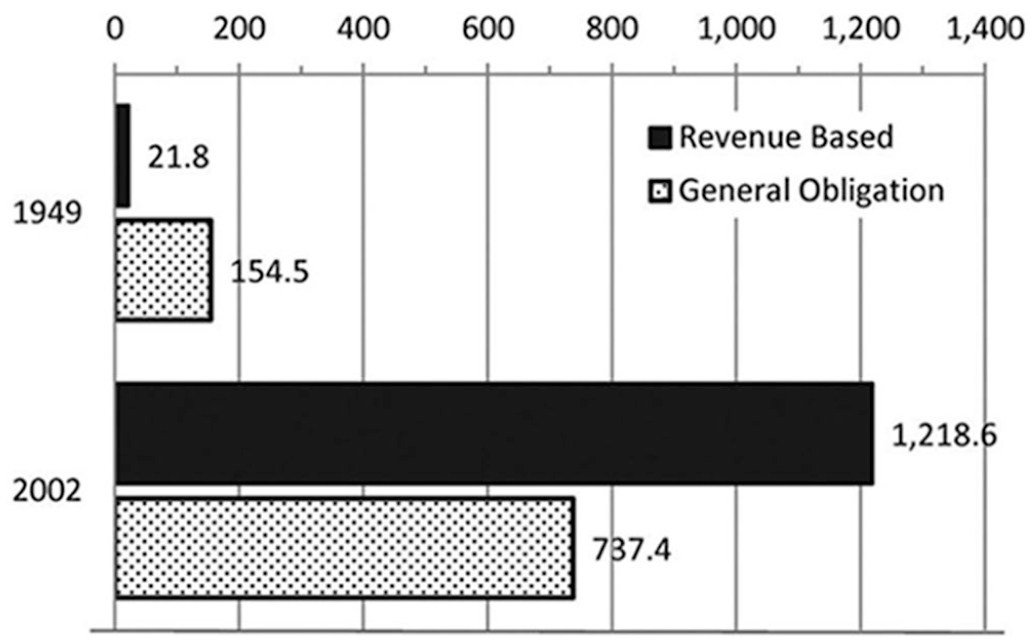
Composition of outstanding state and local debt, 1949 and 2022 (in billions of 2009 dollars).
According to recent estimates, revenue bonds now make up 68 percent of the municipal bond market, compared to 28 percent for GOBs (Howard 2023). Within the revenue bonds segment, transit, infrastructure (water, sewer, and electric), and hospital facilities constitute the largest shares; housing and prison developments each make up less than 7 percent. However, revenue bonds provide major funding for housing and prisons. Between 1960 and 1992, all 50 states created housing agencies to serve as the sole issuers of revenue bonds for low-income rental housing (Moulton and Quercia 2013; Robinson 2020). The monetary volume of bonds issued by those agencies grew (in 2020 dollars) from $3.9 billion in 1987, to $8.8 billion in 2003, to $19.4 billion in 2020—roughly equal to the federal Housing Choice Voucher program and about one-third of the total federal outlay for rental assistance for 2020 (Greulich and Quigley 2009; Lawrence 2021; Peter G. Peterson Foundation 2022; Quigley 2007). By the mid-1980s, revenue bonds had emerged as the “most widely adopted alternative financing arrangement” for prison construction (Chaiken and Mennemeyer 1987:iii). By 1996, they accounted for “more than half of new prison debt,” driven by California, New York, Texas, Florida, and several other states (Anderson 2008; Herivel and Wright 2009:65).
Data and Analytic Strategy
The empirical details of the housing case come from a larger comparative-historical study of the emergence of bond finance in housing policy. That larger study includes material focused on both national-level trends and the case of Illinois. We rely on some of the same archival sources to extend this article’s empirical focus to New York, including the Chicago History Museum collection of Robert E. Mann and the Illinois State Housing Board collections at the Abraham Lincoln Presidential Library. We synthesize details from this material on the broader history of state bond finance usage with secondary literature on the case of New York from scholarly and newspaper sources.
The empirical details of the California prison construction case come from a mixed-methods study on California prison construction (Hagan et al. 2015). This data collection involved 30 interviews with 11 key informants, including a pivotal state senator and representatives of the Legislative Analyst’s Office (LAO) and the California Department of Corrections and Rehabilitation (CDCR). Additional qualitative data came from the California State Archives, media reports, and state politicians’ oral histories. Primary quantitative data collection comprised coding of prison sitings from CDCR reports combined with data on prison construction appropriations from the LAO.
We use these cases to illustrate our theoretical argument. As theoretical elaboration, our case comparison diverges from the kinds of Millian methods commonly used in qualitative social sciences (Skocpol 1979:36). We follow recent methodological interventions encouraging expansion beyond the classical styles of strictly controlled comparison (Boswell, Corbett, and Rhodes 2019; Simmons and Rush Smith 2021). Like Riofrancos (2021), we consider our cases as interrelated sites within a much larger structural phenomenon. New York housing and California prisons are key nodes in the broader development of submerged bond-based public finance in the United States. These are “particular place[s] where we can observe a broader process unfolding” (Riofrancos 2021:115). Theoretically, we describe a process by which less visible revenue bonds came to replace direct funding and GOBs in U.S. poverty governance. We do not offer a comprehensive history of the development of visibility in the finance of poverty governance—instead, we offer these two cases as key instances that constitute and elucidate a more general process of U.S. political development.
In comparing these two cases, we use a diverse case selection method (Seawright and Gerring 2008:300–301). These cases cover quite different contexts in which officials turned to revenue bonds: The cases are separated by region, time, scale, and policy type. In both, however, states turned to revenue bonds as officials were struggling to make good on promises of order and social control without broadcasting large public expenditures. The contextual differences between the cases allow us to isolate the dynamics of disciplinary tensions as state actors manipulate public finance to perform social control for mainstream political audiences.
Although different in substantive terms and embodying what are generally understood as different kinds of policy, both cases involve a blurring of punishment and provision (Orloff 2005; Soss et al. 2011). In the housing case, which is more obviously close to provision, state actors use bonds to regulate Black communities through housing provision while maintaining patterns of racial segregation. In the case of prisons—perhaps the paragon of punitive policy—these facilities operate as an unlikely channel of provision for incarcerated individuals (Miller and Stuart 2017). We recognize these differences but emphasize the parallels. Together, our cases shed fresh light on the complexities of visibility politics and its intersection with dynamics of control, discipline, and domination.
From Overt to Covert Public Finance in Housing and Prisons
Thus far, we have argued that disciplinary tensions push governing officials to adopt covert governing tactics in performing social control. In this section, we present two case studies empirically illustrating this argument. In the first case, officials in 1960s New York turned to revenue bonds to calm White fears and contain Black unrest through housing production. In the second case, officials in 1990s California used revenue bonds to quietly underwrite prison construction to sustain popular law-and-order policies amid tax revolt.
The Case of Housing Bond Expansion
The federal public housing program in the United States was created in 1937 largely for the benefit of White veterans and labor unions. By the 1960s, however, in New York City and elsewhere, the program’s tenants were disproportionately Black and poor. In part because it operated as a welfare program, public housing became a tried-and-true instrument of social control. State officials, simply by administering housing aid, could spatially contain and forcefully ghettoize Black and poor renters through urban renewal, racial segregation, poverty concentration, and other practices (Hirsch 1983; Massey and Denton 1993; Vale 2000). In other words, public housing served a purpose not only for the tenants but also for various officials, their privileged constituents, and other power brokers.
At the same time, public housing came to be known as “a bad program,” notorious for its links to “inner city, impoverished dependency, African Americans, and crime” (von Hoffman 1996:436). In part due to public housing’s stigma and hyper-visibility as a welfare program, lawmakers often appealed to constituents by making a show of cutting or denying funds (von Hoffman 1996). 6 Such chronic underfunding often made life miserable for tenants (Bloom 2008). But it enabled officials to balance contradictory demands: Unbeknownst to many, White and affluent constituents relied heavily on public housing to fortify segregation, yet they opposed adequately funding it. Officials “protected” constituents’ taxpayer dollars by ensuring very little of it went into public housing. And segregation helped ensure the resulting problems would be confined to public housing and not spill over into White areas.
This formula largely “worked” until the 1960s: Public housing tenants protested unlivable housing conditions (Williams 2004), but officials felt little pressure to change anything. Shifts in the 1960s, however, broke the formula. The tensions inherent to the state’s use of public housing for social control became increasingly acute—the contradictory demands of White and affluent groups became harder to reconcile.
First, as many White families fled to the suburbs, residents of New York and other large U.S. cities felt the pain of shrinking tax bases, unlivable housing conditions, and police repression. The Black population’s unrest and urban riots were the most visible markers and dramatically heightened White mainstream fears of crime and disorder. Rioting broke out in Harlem and across New York in mid-July 1964. This spasm of unrest “began an era of urban violence that continued into the 1970s” and soon stretched across the nation (Pritchett 2008:273).
Second, housing programs emerged as a key concern as local officials tried to establish control and project order. Officials sought to reassure constituents they were working diligently to contain the chaos before it spilled over beyond Black areas. They voiced and responded to “fervent appeal[s] . . . for law and order” (Kihss 1964). But after an initial brutal police crackdown only further inflamed unrest, they looked to quell the dissent by ramping up housing production (Pritchett 2008; von Hoffman 2013). Government actors looked to public housing as a tool not just to segregate Black Americans but also to keep Black rebellion and discontent in check, both geographically and politically—a social control measure, but one they calculated to be preferable to outright “law and order” repression in that moment. Black residents had long called for more housing, but White middle-class fears pushed officials to act in unprecedented ways. The riots, in particular, “shifted expectations” around housing policies, which became “in many people’s minds . . . ‘something for the blacks,’” a way of subduing “the protestors in the ghettos” (Pritchett 2008:275).
Third, ongoing backlash and resistance prevented officials from ramping up housing production, which eventually prompted a shift from direct funding and GOBs to revenue bonds. In the years leading up to the riots, “outraged” White, middle-class New Yorkers used “every means at their disposal to try and stop or radically revise the project[s]” that local officials proposed (Bloom 2008:205). As a result, officials declined to spend the bulk of their available public housing funds. Of 28,000 units the federal government approved years earlier for New York City, only about 6,000 had been built by 1970. 7
It was within this context, in New York and elsewhere, that “opposition to any form of public housing” became “regular and predictable” (Clapp 1976:78). White and affluent constituents not only opposed direct funds for public housing, they also pushed back against the state’s ability to finance public housing through GOBs—historically a far less visible and controversial procedure. State and local officials issued GOBs to supplement direct public funds. Doing so often required approval through statewide referenda. But as mentioned previously, GOB votes tended to attract little public notice or opposition; they were effectively localized decisions about funding inputs, which in New York and other urban areas, ensured a far more liberal voter base. Obscure and unknown to most people, GOBs were mostly watched by the banks and insurance companies that enthusiastically purchased them—and this largely hidden source of capital flowed disproportionately into White communities (Jenkins 2021). 8 Officials sometimes used them to develop a “higher-end” style of public housing considered “ideal” for White, higher-income residents and neighborhoods—New York City officials tellingly referred to these projects as “partially subsidized” or “unsubsidized” (Bloom 2008:114). 9
Nevertheless, mounting backlash increasingly hampered GOBs, and officials struggled to use them to produce more housing. Prior to the 1960s, New York voters usually approved GOBs “by a wide margin,” including those that funded low-income housing, which amounted to hundreds of millions of dollars. The traditionally conservative upstate vote produced “favorable, if narrow, majorities,” and suburbs joined with New York City to carry the vote in favor of GOB approval (Tobier and Espejo 1988:459).
However, the 1960s brought a wider “demographic and voting power shift within the state” (Tobier and Espejo 1988:459). As voters shifted to the suburbs and upstate, “backlash . . . seemed to be in the air” (Bloom 2008:125). White voters came to “resent public housing as an instrument for breaking neighborhood walls of racial separation” and giving poor people homes “before they have ‘earned it’” (The New York Times Editorial Board 1964). Between 1960 and 1964, a sharply increasing number of “New York City voters . . . turned against funding for housing in many situations” despite approving funds for other kinds of provisions (Botein 2009:849, Note 28). Throughout the state, voters began rejecting GOBs, especially those for low-income housing, including five between 1962 and 1965 and at least one by a margin as large as 433,000 votes (Botein 2009; The New York Times Editorial Board 1964). Officials, in turn, “substantially reduced the amount of state-funded public housing . . . started in the years 1966 through 1970,” resulting “in further reductions in the amount . . . built” (Clapp 1976:78).
The public turn against GOBs highlights the conflicting desires of status-privileged groups: They often demand stronger social control but avoid facing its real costs. This stance left public housing in dire straits. Around the same time, New York’s Nelson D. Rockefeller administration pioneered a new approach to financing low-income housing through revenue bonds. This approach later took off throughout the nation. Revenue bonds emerged as the ideal solution for expanding housing provisions because they could evade much of the negative publicity that public housing—and GOBs—attracted. In short, revenue bonds reduced the visibility of housing programs and their recipient populations.
First, the Rockefeller administration started its revenue bond program as part of a much celebrated plan to expand housing for middle-income families. The plan was a public relations win and remained popular with urban voters (Kazan 1959). But no existing subsidized housing program aided middle-income renters, and there was little appetite for creating a new one becuase people widely associated such programs with poor, racial minorities (Botein 2009). Rockefeller’s team witnessed the growing tide of failed GOB votes, which nearly defeated an early version of their housing plan (Egan 1959). They “voiced doubt whether either the Legislature or the voters would approve state-backed bonds in the amount needed” (Dales 1963c:49). They fashioned the revenue bond program as an alternative. Later, as unrest in Black and poor communities became an urgent matter for officials, the Rockefeller administration “took the prototype . . . and expanded it,” quietly shifting it to focus on production of “housing . . . for minority group members and for the poor” (Botein 2009:843). They justified doing so as an “extreme measure . . . needed to save the cities” (Betnun 1975:55). In 1963, the governor convinced legislators to more than double the borrowing limit, calling it necessary to produce more housing that would “reduce ‘the stratification and segregation of low-income families from the remainder of the community’” (Weaver 1962; see also Madden 1962).
Second, Rockefeller’s team used revenue bonds specifically to downplay the financing of the housing plan. Privately, they embraced the bonds for enabling them to “avoid referenda,” “skirt divisive issues,” circumvent “debt-skittish voters,” and overcome “growing resistance by voters in State housing referendums to . . . housing programs” (Tobier and Espejo 1988:459; see also Botein 2009). But publicly, they spun the housing plan as central to the administration’s larger agenda to “restore fiscal integrity” in the state by providing services without pledging the state’s credit through GOBs and tax hikes (Robinson 1960). Rockefeller boasted that revenue bonds produced “self-liquidating” properties and therefore took “two or more billion dollars worth of public works construction off the backs of the taxpayers” (Dales 1963b; see also Hinden 1963). He held press conferences promising to use them to “accelerate” residential construction to create more “Negro jobs” without also accelerating “the rate at which the state spent money from its general fund” (Hunt 1963).
News coverage of Rockefeller’s housing plan largely echoed the administration’s celebratory language. Reports described the bonds as an innovative strategy that kept “rents within the means” of working families (Dales 1962), potentially saved the government millions (Chapman 1962), and “reduce[d] the size of the state budget” (Dales 1963c). The only public criticisms of Rockefeller’s plan came from his Democratic rivals. They called out the plan’s “indirect devices” and “fiscal gimmicks” (Dales 1963c; Hinden 1963; Kihss 1963), and they challenged the notion that the bonds were “self-liquidating” (Dales 1963a). They contended the plan violated constitutional borrowing limits, jeopardized the state’s credit, and imposed undue costs on taxpayers, likely resulting in “additional budget strain” (Dales 1963c; Kihss 1963). Ultimately, they dismissed it as “a ‘gigantic hoax’” that deceptively committed the state’s credit while claiming otherwise (Kihss 1963).
But these “attempts to tarnish Rockefeller[’s] image on his methods of bonding,” one news report marveled, met “with little effect.” The attacks never “caught the public’s ear” due to “the complexity of the subject,” which “ma[d]e it difficult to . . . dramatize the issues,” and taxpayer “resistance to [public] financing, once it is known that taxes are going up” (Dales 1963c). Ultimately, the criticisms fell flat because revenue bonds had “worked as planned,” offering “a practical way of getting needed buildings up (Dales 1963C).” In this way, revenue bonds provided officials with a “fix” to the crisis in U.S. cities: one they used to better manage contradictory desires for order and control without public cost.
The Case of Prison Bond Expansion
The California Department of Corrections was created in 1944 (Page 2011). For the following two decades, California had one of the nation’s most rehabilitation-oriented corrections systems (Simon 1993). This was a clinical approach that used individualized treatment to try to behaviorally change people convicted of crimes. California coupled this model with a commitment to indeterminate sentencing, which gave authorities discretion to change the setting and character of correctional supervision according to their assessments of people’s responses to treatment programs (Simon 1993). During this period, “the imprisonment field stayed relatively stable and insulated from political and other external pressures, and correctional experts and prison officials remained dominant actors in the field” (Page 2011:19). The comparatively small and stable number of people California incarcerated under the rehabilitative model minimized the need to construct new facilities. This allowed the state to fund prison construction initiatives through direct budgetary expenditures—the “pay-as-you-go” model.
California’s approach to criminal punishment changed dramatically in the subsequent years. A series of policy measures beginning in the late 1960s and continuing into the 1990s imposed new requirements of incarceration as a consequence for certain criminal convictions and increased the time that incarcerated Californians spent in prison. As Barker (2009:48) argues, these policy changes resulted from “the emergence of a neopopulist political order” that foregrounded sympathy for victims and embraced legal responses that would extract vengeance for crimes through harsh punishments.
California’s adoption of harsh sentencing provisions put it at the forefront of nationwide trends in criminal justice policies driving increased incarceration rates (Barker 2009; Gilmore 2007; Page 2011). Combined with its status as the most populous U.S. state, these trends established California as the country’s leading incarcerator (a title it ceded to Texas in 2010 under judicial pressure to address chronic overcrowding and consequent constitutional violations; Simon 2014). Figure 2 depicts the dramatic increases in California’s incarcerated population, particularly in the 1980s and 1990s.
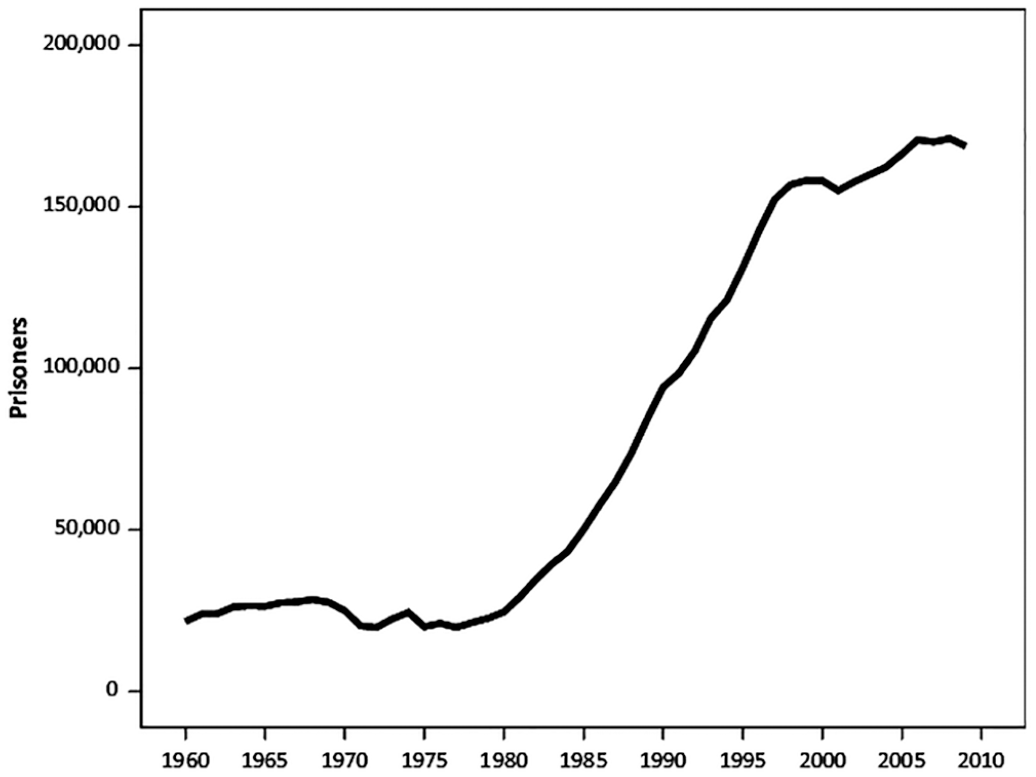
California’s imprisoned population over time.
California’s existing prison system had nowhere near the capacity required to house this exponentially expanded incarcerated population. Part of the argument for shifting from the rehabilitative model to the retributive model was the notion that harshly punishing people convicted of crimes would be less expensive than interventions aimed at addressing the social causes of crime and individualized treatment for perpetrators (Barker 2009). Before long, however, the fiscal costs of confining such large numbers of people became apparent. This brought disciplinary tensions to the forefront as California’s neopopulist push for more imprisonment confronted the expenses of mass incarceration.
In the housing case, officials found themselves pressured to respond to mainstream demands for order as well as mainstream opposition to public spending on race- and class-marginalized groups. Likewise, in the prison case, many Californians (and others elsewhere) held preferences for both punitive criminal justice policies and low taxes (Liebman and Clarke 2011). The 1978 Proposition 13 “tax revolt” emblematized anti-tax sentiment in California (Haberman 2016). To the extent they could, it behooved policymakers to identify and implement funding structures for prison construction that appealed to both of these conflicting preferences.
Democratic State Senator Robert Presley was a pivotal figure in California’s navigation of this tension. In the mid-1980s, he led the creation of an informal “crime caucus” designed to advance punitive criminal justice policies (Ingram and Gillam 1987; Presley 2001). Working in concert with Republican Governor George Deukmejian, Presley and his allies in the state legislature championed longer prison sentences and other policy initiatives that would increase incarceration rates. They also attended to these policies’ infrastructural demands, with Presley creating and leading a Joint Committee on Prison Construction in the state senate. As the chair of this committee, the Joint Prison Committee, and the Appropriations Committee, Presley was ideally situated to advance prison-centered criminal justice policy.
Presley and Deukmejian’s initial funding strategy used GOBs, which, when issued by California, are backed by the state’s “full faith and credit,” denoting the state’s pledge to repay the borrowed amount, plus interest, “from all legally available funds” (Office of the State Treasurer 2016). State GOBs also require majority voter approval under California’s ballot proposition system. But GOB propositions ask the voting public to approve borrowing money rather than approving direct tax expenditures. Thus, for the reformers, GOBs held clear advantages over the previous pay-as-you-go funding model. They obscured the budgetary and tax implications of large building projects, delaying fiscal obligations to the time of bond repayment. The informal prison construction coalition in California state politics saw great success with the GOB prison construction strategy as their prison population spiked in the 1980s. The first GOB prison construction initiative passed in 1982, and four more GOB ballot proposals passed between 1984 and 1990. In total, over $2.5 billion in prison construction funds were appropriated via this method (Hagan et al. 2015).
The political entrepreneurs driving bond-based prison construction did not stop with GOBs, however. Working in consultation with Bank of America, Merrill Lynch, Morgan Stanley, and other financial firms, the prison construction coalition quickly moved to develop a novel way to finance prison construction via bond issuance. Lease revenue bonds (LRBs) were the basis for this new, more complex funding strategy.
LRBs offered a valuable way for the prison construction coalition to navigate the tension between punitive policy preferences and growing sensitivity to mass incarceration’s costs. As bonds without the backing of the state’s “full faith and credit,” LRBs required only legislative approval, not the support of a statewide voter majority. Thus, LRBs minimized the visibility of prison construction spending and the associated public scrutiny.
The first LRB-funded prison construction proposal received legislative approval in 1985. Between 1985 and 1989, California used both voter-approved GOBs and legislature-approved LRBs to fund prison construction. This period was the peak of California’s prison construction boom, with funding for 11 new prisons appropriated over a brief five-year span (Hagan et al. 2015). But November 1990 marked a pivotal transition in California’s prison construction funding. Proposition 144 asked California voters to approve issuing $450 million in GOBs to fund the construction of new state correctional facilities. Voters rejected the measure by a margin of nearly 20 percentage points. This was the first time a GOB-based prison construction ballot initiative failed. From that point forward, LRBs achieved full dominance over prison construction funding. “Once bitten” by voters rejecting a GOB initiative, policymakers were more than twice shy, authorizing five more LRB appropriations for prison construction, totaling around $3 billion over the next decade (Hagan et al. 2015). Indeed, low-visibility LRBs provided the funding for every subsequent construction initiative as California’s prison-building boom continued through the 1990s (Hagan et al. 2015). Overall, California appropriated more than $4 billion in prison construction funding via LRBs in the 1980s and 1990s (Hagan et al. 2015).
California’s large and expensive correctional population elevated prisons to a relatively prominent place in the public eye. This, in turn, dramatically raised the profile of mass incarceration as a budget issue. The proposition system provided opportunities for direct democratic input on this matter. At first, the relatively lower visibility of prison building expenses under GOB-based funding measures, compared to the pay-as-you-go model, had sufficed to garner majority voter support for the large expenditures that prison expansion necessitated. But when voter support for even the deferred expenditures of the GOB model eroded, state lawmakers pivoted decisively toward the LRB model, which allowed them to bypass the regular budget and appropriations process altogether.
Public commentary at the time highlighted how LRBs appealed to politicians seeking to avoid the public scrutiny—and potential failure—of GOBs. Headlines characterized the bonds as “an end run around the taxpayer” (Woolley 1992). Critics blasted legislators for taking “the coward’s way out,” as one legislative analyst put it (Schmitt 1993:A1): “If they think they’re the right thing to do,” he said, “they should go full-bore ahead (to the public). You’re not being square with the public. You’re doing it by subterfuge.” For their part, legislators defended LRBs on pragmatic grounds, reasoning that “the traditional approach of seeking public approval doesn’t provide enough money, takes too much time and runs the risk that voters will turn thumbs down” (Schmitt 1993:A1). Likewise, although corrections officials “den[ied] breaking faith with the electorate,” they still advocated for LRBs, citing the “popularly supported law-and-order crackdown,” which “ha[d] left pressing needs” for more prisons (Schmitt 1993:A1). In 1996, California tried one last time to fund prisons through publicly approved GOBs; after that measure failed, policymakers declined to try their electoral luck again by proposing any new ballot initiatives (Courthouse News Staff 2008). 10
Ultimately, the effect of LRBs as a “fix” for disciplinary tensions is best exemplified in the remarkable juxtaposition of high popular support for California’s key mass incarceration policies and low support for funding prison construction. Pivotal mass incarceration policies—including the Victims’ Bill of Rights (1982), the Crime Victim Justice Reform Act (1990), and the Three Strikes Sentencing Initiative (1994)—garnered enough popular support to pass via ballot initiative (Barker 2009). The Crime Victim Justice Reform Act (Proposition 115) passed in June 1990 by a margin of over 14 percentage points. But that November, voters rejected, by an even wider margin, a ballot initiative to fund constructing the prisons these policies necessitated. A strong majority of voters continued to support tough-on-crime policies, but by the 1990s, they had begun to balk at authorizing funding measures to support the carceral infrastructure these measures required.
In the face of these contradictory desires and pressures, the covert tactic of relying on LRBs came in handy for authorities. In November 1994, a few years after California’s pivot to LRBs, the Three Strikes Sentencing Initiative (Proposition 184) passed in a landslide: Nearly 72 percent of voters supported the measure, which was arguably the harshest “three strikes” law enacted by any state. With fiscal implications out of the public eye, California voters continued to support doubling down on mass incarceration.
Discussion and Conclusions
This article shed light on the growing impact of revenue bonds in two poverty governance fields—housing and prison policies—and what these cases reveal about the politics of visibility in U.S. governance. We elaborated the concept of performative social control, highlighting it as a key factor in a larger shift: State actors appeal to status-privileged constituents in part by projecting order, control, and containment of marginalized groups, and this performative interplay generates visibility-related effects that amplify political domination. But as crises have mounted, the tensions inherent to contradictory mainstream desires—for social control without public expenditure—have become acute, demanding resolution. In this context, revenue bonds enabled officials to reconfigure the state’s disciplinary power so that constituents could avoid facing up to the costs of their desires for enhanced social control.
The shift to bond finance in housing and prison policies represents a less known chapter in the remaking of poverty governance. That larger transformation saw the rise of “neoliberal paternalism,” a “racialized political project of market discipline” (Soss et al. 2011:174). We draw from that history to conceptually model how visibility-related effects define and hinder public provision to marginalized groups. Additionally, we complicate that history by highlighting the inherent tensions of that larger turn and the covert governing tactics that enabled its overtly disciplinary policies and practices. But bond finance also reshaped the substance—not just the optics—of social control. Through revenue bonds, marginalized groups have been incorporated into a world where bondholders and ratings agencies “rule over” people and places in draconian fashion, exercising “supremacy” but flying under the public radar (Jenkins 2021; see also Hackworth 2007; Norris 2023a, 2023b; Sinclair 2014). In the housing case, revenue bonds fastened the needs of low-income renters to “the rhythms of an extractive [bond] market” (Jenkins 2021), thereby incentivizing displacement (Lubell 2016). In the prisons case, they directly expanded the state’s carceral capacities, accommodating a punitive turn in policing, prosecution, and sentencing (Gilmore 2007; Hagan et al. 2015). Further illuminating what Lara-Millán (2022) calls the “administrative disappearing of state crisis,” our analysis shows how this process opens up new extractive frontiers.
Our findings also provide further insight into the politics of covert public finance and statecraft. They suggest the shift to revenue bonds resulted not just from generic processes of conflict management, tactical innovation, or the financialization of the economy. Rather, we argue that it requires explicit consideration of how state actors perform social control for race- and class-empowered constituencies. We highlight the audience for these performative acts—their impossible desires, contradictory demands, and outsized influence. This performative interplay drives systemic inequality by naturalizing the extraction of resources from a hyper-visible “public” into a less visible “private” sector and enabling the hoarding of those resources along race and class lines (Freund 2007; Jenkins 2021; Kruse 2005; Michener 2017). In this way, we reframe concepts of “submerged” and “invisible” governance to center the mainstream gaze—the gaze of those empowered to surveil others in the public realm.
Recent work by scholars and journalists calls attention to the way public meetings often operate as barriers to just and equitable reform in policy matters (Blumgart 2022; Demsas 2022; Einstein, Glick, and Palmer 2019). The analysis presented here offers perspective on that issue. As Hanchard (2018:16) argues, race-class hierarchies have been built into democratic states as political inequalities, defining how “governments and citizens . . . distinguish among citizens, or between citizens and noncitizens” (see also Goldberg 2002; Robinson 1983). Likewise, our analysis shows how race-class hierarchies also structure notions of democratic accountability around the claims and demands of a largely White and affluent political mainstream (Anderson 2016; Olson 2004). Public participatory venues exemplify the “asymmetries between seeing and being seen” (Brighenti 2007b). The watchful public eye and the “bondholder’s veto” point to distinct but mutually reinforcing anti-democratic tendencies (Highsmith 2021). Both act as disciplining forces in struggles for justice and equal citizenship.
Beyond our focus on performing and underwriting social control, our analysis points to the more general issue of officials’ management of contradictory demands and their responses to multiple audiences. We argue that this political dance requires a mix of “backstage” and “frontstage” policy work. Alongside Weaver’s (2007) analysis of political elites’ targeted messaging on crime in the 1960s, we argue that audience-directed political communication and credit taking deserves greater theoretical attention. Drawing from Goffman’s (1959) general framework, we might look to both manifest (frontstage) and latent (backstage) dynamics in political performance more broadly. Political actors’ outward expressions often mismatch their inner machinations (Machiavelli [1513] 1988), but the dynamic between those performances is ever changing and relevant to sociologists.
We have noted the tensions between overt disciplinary interventions and covert governing tactics to illuminate the complex power relations at play in matters of visibility. One might also look to the recent rise of dark money as a parallel form of covert finance driven by the wealthiest elites. Recent studies point to the stealth tactics used by the mega-rich to coordinate and exert influence on public policy while evading public attention or accountability (Farrell 2021; Hertel-Fernandez 2019; Mayer 2016; Page et al. 2018). Combined with recent partisan polarization and ideological sorting (Grossman and Hopkins 2016; Levendusky 2009), we would expect growing partisan differences in perceptions of statecraft, including visibility-related differences, over time. Yet as Mettler (2011:17, 29) has noted, actors from both parties and across the ideological spectrum try to manipulate the visibility of policy through covert public finance. These literatures open up further avenues to explore the dynamics we highlight in this article.
Ultimately, this article aims to provoke further dialogue on the links between visibility, power, and subjugation. In today’s world, critical dynamics of punishment and provision, overt and covert statecraft, public and private sector building, and exclusion and extraction are becoming enmeshed in new ways. Hence, the language and analysis we offer in this article are likely to remain relevant for the study of politics and inequality.
Footnotes
Acknowledgements
The authors thank Marcus Mann, Dan Winchester, and the Northwestern APD Graduate Workshop for helpful feedback on an earlier draft.
