



Abstract
This article theorizes “omission,” which I define as the condition of being left out of administrative apparatuses, such as civil registers, censuses, and identity management systems. According to this theory, omission is not necessarily accidental but can constitute a political strategy. When even excluded statuses can be powerful grounds for claiming rights, resources, or membership, state actors can subvert such claims-making potential by depriving unwanted populations of the practical, material capacity to establish their legal personhood through documents and records. To situate omission, I develop a typology of documentary strategies additionally comprising “recognition,” “claims-making,” and “evasion.” Although my theorizing is informed by ethnographic research with unregistered families in Malaysia, scholars can apply this typology to multiperspectival, relational analyses of other empirical cases of documentary politics. Studying omissions has scholarly and ethical imperatives, not least to record the lives of populations denied, at times with existential consequences, the right to recognition.
The power to produce and exercise knowledge about populations, territories, and resources has been recognized as the sine qua non of state consolidation and day-to-day governance (Bourdieu 1994). Administrative systems are practical tools by which states not only amass information about their jurisdictions, but also construct the social realities in which they operate (Bourdieu 1989; Giddens 1985; Igo 2007; Loveman 2005). Maintaining civil registers, issuing identity cards, and carrying out censuses are more than mundane bureaucratic tasks: They discipline humans into political subjects and legitimize their stratification into hierarchies of membership and entitlement (Foucault 1977, 1982; Martin and Lynch 2009). In the post-9/11 era, scholars have observed how the global proliferation of increasingly sophisticated identification, surveillance, and border security technologies has endowed states with unprecedented knowledge of—and consequently power over—their domains (Breckenridge 2014; Broeders 2007; Lyon and Bennett 2008).
Why, in a world in which fewer and fewer spaces have been left unaltered by the penetrative “reach” of the state (Scott 1999), do so many people remain unincorporated into administrative systems? Worldwide, an estimated 164 million (1 out of every 4) children under age 5 have not been registered at birth (UNICEF 2022a). According to the World Bank Group (2018), 1 billion people do not possess the documentary means to prove their identities. The majority of unregistered populations today can be found in developing regions (Desai, Diofasi, and Lu 2018; UN Statistics Division 2016). More than half of the world’s unregistered children under age 5 reside in the African continent (UNICEF 2022b), where coverage can drop to as low as 3 percent (e.g., in Ethiopia; Central Statistical Agency Ethiopia 2016). Populations on the move are particularly prone to going missing from countries’ administrative systems. Since the outbreak of the civil war, for example, displaced Syrians have faced challenges securing national identity cards and other documents, including birth certificates for their children born in exile (Clutterbuck et al. 2018).
Much foundational theorizing on the state, which has taken the expansion of surveillance as a fundamental imperative, might lead one to attribute such instances of nonrecognition to failures of state capacity. Inspired by classical thinkers including Bourdieu (1994), Foucault (1977), and Weber ([1922] 1978), a large literature focuses on the administrative bases of state autonomy and power (Centeno 1997; Mann 1984; Skocpol 1985; Thomas and Meyer 1984). In this vein of thought, the survival of states is contingent on their ability to render their peoples, territories, and resources “legible” via incorporation into administrative systems (Scott 1999). Bureaucratically unincorporated populations, an increasing rarity in the modern world, might classically be considered indicative of the absence of state power being exerted over them. But while insufficient state capacity may be at play in some contexts, particularly in the developing world where capacity is uneven (Centeno, Kohli, and Yashar 2017; Pepinsky, Pierskalla, and Sacks 2017), it is not a full explanation (Hunter 2019). For one, in a comparison of Latin American countries’ wealth and birth registration rates, Hunter and Brill (2016) find that, below high-income levels, economic development is an imperfect predictor of birth registration coverage. Indeed, some populations in middle- and even high-income contexts remain out of reach from strong, bureaucratically proficient governments.
To address this gap, I build on work within political sociology, migration studies, and comparative-historical studies of ethnoracial classification that challenges traditional assumptions about the state’s “will to know” (Szreter and Breckenridge 2012:6). This scholarship has identified an array of modern cases in which state actors, rather than displaying expansionary tendencies, have chosen to hone their administrative vision in selective ways. For example, scholars and activists have highlighted the political and policy decisions contributing to the chronic undercounting of Latinos in the U.S. census (Mora 2014; Rodriguez 2000; Rodríguez-Muñiz 2021; Warren 2022). Selective oversights of peoples and categories of peoples in censuses are consequential moments of state-, race-, and nation-making across numerous temporal and geographic contexts (Hattam 2007; Kertzer and Arel 2001; Loveman 2005; Maghbouleh, Schachter, and Flores 2022; Nobles 2000; Simon 2015; Telles and Ortiz 2008; Zanger-Tishler 2022). Beyond censuses, scholars are drawing attention to cases in which populations have been purposively denied documentary proof of official recognition. Crises of administrative illegibility owing to the state’s unwillingness to confer documentation have been identified, for example, among descendants of Haitians in the Dominican Republic (Childers 2020; Hunter 2019; Petrozziello 2019), the Roma in Europe (Sardelić 2017; Sigona 2016), the Bidoon in Kuwait and other stateless populations in the Gulf region (Alshammiry 2021; Lori 2019), the descendants of migrants in Malaysia (Allerton 2020; Cheong 2022; Liew 2021), and domestically born children of undocumented immigrants in the United States (Carino 2019; Chavez 2017).
These literatures provide evidence that people may exist beyond the reach of the state not due to deficiencies in state capacity but because of concerted choices. At the same time, relative to the vast scholarship theorizing how states bureaucratically “[make] up people” (Hacking 1986), the converse has received considerably less attention. The following theoretical questions stand to be resolved: What symbolic work is being done in the creation of persons who are left out of, rather than incorporated into, official systems of government recognition? How can we make sense of these diverse forms and modes of government nonrecognition within a unified theoretical framework? How do acts of withholding or contracting the state’s administrative reach relate to the various other ways that states and people strategically interact with one another within the bureaucratic domain?
This article offers a theory of “omission” in two steps. First, I synthesize and put into dialogue the diverse literature on the politics of documentary practices to propose a typology of documentary strategies. This typology offers an integrated framework for understanding and analyzing the relationship between state and individual actors vis-à-vis forms of official recognition. This dialectic warrants teasing out because documentation and registration pose advantages and costs to actors operating from the “top-down” and from the “bottom-up” (Tilly 1999b). On the one hand, state actors seek to establish authority and pursue a range of governance objectives by making their subjects visible via incorporation into administrative structures. On the other, official recognition is a legal and symbolic resource that individuals can harness to make various claims on states, even if they are not full citizens (Ong 2005; Sassen 2005; Voss and Bloemraad 2011). I thus systematize a repertoire of strategic moves that states and individuals may make at the nexus of these tensions: namely, the comparatively well-theorized strategies of recognition, claims-making, and evasion, and what I argue to be the less well-understood strategy of omission. Researchers can use this typology to conduct dynamic, multiperspectival, and relational analyses of empirical cases of documentary politics.
Second, I theorize omission, which I define as the phenomenon of being left out of administrative apparatuses of the state, such as civil registers, identity management systems, and censuses. I deploy the language of omission purposively, differentiating its drivers and consequences from the more extensively theorized dynamics of overt forms of exclusion. With this language, I seek to name and define the “negative space” that lies beyond the bounds of documented social life (Scott 2018:5). To be omitted, in an administrative sense, is to be left outside the sociopolitical structure. Omitted persons are not subject to a process of categorization, even one that marks them for marginalization or exclusion. Omission is not just a passive, accidental state of being but can constitute a political strategy. I argue that especially in spaces with permeable borders, volatile migration flows, or bright ethnic boundaries (Alba 2005), actors may choose to withhold or contract rather than expand the administrative reach of the state, placing unwanted populations outside the domain of human political organization. I illustrate this theory using empirical examples from my ethnographic research with unregistered families in Malaysia. An insidious logic underlies strategic omission. To prevent unwanted populations from making claims for rights, resources, or membership, state actors may deprive them of a more fundamental capacity: the material, practical ability to establish their legal personhood through documents and records.
A Typology of Documentary Strategies
How do acts of withholding or contracting the state’s administrative reach relate to the other ways that states and people strategically interact with one another within the bureaucratic domain? Before defining omission, I first situate it within a typology of documentary strategies that state and individual actors may adopt vis-à-vis one another (see Table 1). This typology reflects the dynamic, dialectical nature of documentation and registration processes, and it carves out a common analytic space for considering the tensions that exist between individuals and states over the matter of official recognition.
A Typology of Documentary Strategies.
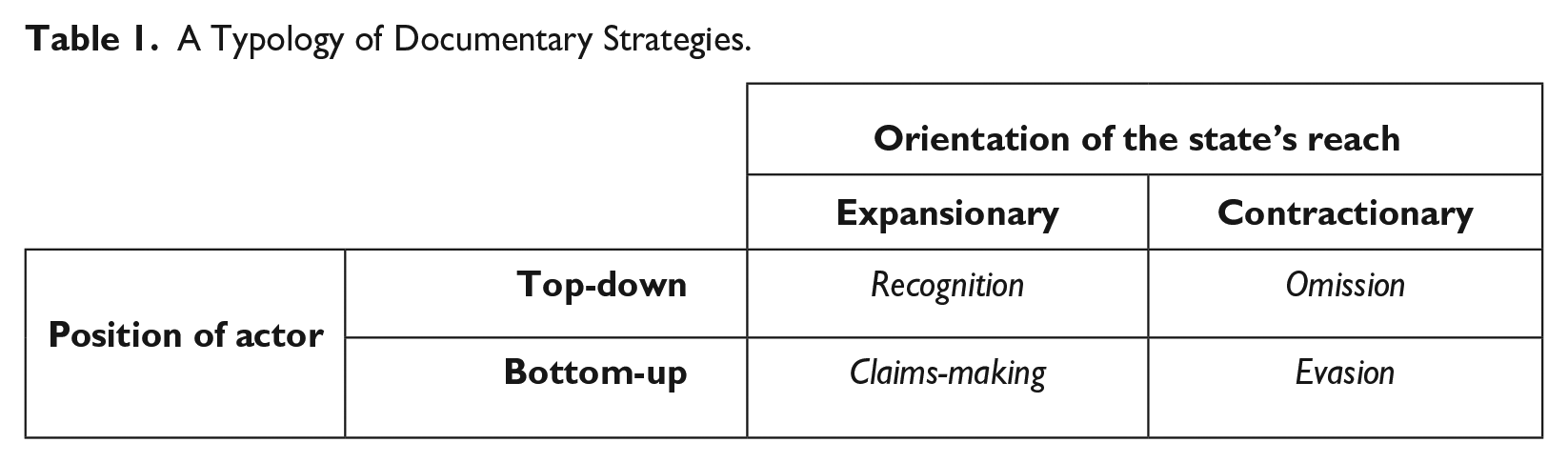
This typology follows other work that contextualizes states’ administrative practices within their wider organizational and institutional fields. I follow Caplan and Torpey’s (2001:5–6) observation that “identification and recognition are ineluctably conjoined in the modern world, and are the prerequisite for individual and collective claims against the state and other authorities.” de Souza Leão (2022:9) details the “relational dimension of legibility,” highlighting how state agencies formulate projects of legibility not unilaterally but with a mind to how they may be perceived by actors positioned domestically, internationally, and internally within the state apparatus. Brensinger and Eyal (2021) theorize personal identification systems as comprising coordination and compromise by networks of actors consisting of the surveilling and the surveilled. Kim (2016:8) balances attention to the macropolitical dynamics of transborder membership building with an “agentic portrayal” of how classification and identification regimes are contested, negotiated, and creatively subverted at the micropolitical level. In summary, actors do not wield documentation in a vacuum but do so in counteraction to, anticipation of, or correspondence with one another. By uniting top-down and bottom-up perspectives and repertoires of action within a comprehensive framework, this typology allows users to systematically understand the arrays of documentary strategies that might be at play within a given empirical case.
I highlight four main strategies that emerge from this dialectic between individuals and states:
Recognition: the expansion of administrative reach and the extension of official recognition for purposes such as inclusion, stratification, and exclusion.
Claims-making: the pursuit of inclusion within the state’s administrative gaze and the invoking of state-ascribed identities to claim rights, membership, or resources.
Evasion: the resisting of administrative incorporation to avoid surveillance, control, or exploitation.
Omission: the withholding or contraction of recognition to obviate responsibility for or obligations to unwanted populations.
The first three strategies have received considerable attention within existing work, whereas the last forms this article’s main theoretical innovation. I synthesize and build on existing literatures on documentary politics, drawing from geographically and temporally diverse empirical examples, to position omission within this typology of documentary strategies.
Recognition, claims-making, evasion, and omission vary along two main dimensions. The first axis of variation is whether these strategies are initiated from the top-down (usually by state actors) or from the bottom-up (by societal actors such as individuals or collectives). I use the language of organizational or individual “actors,” rather than “the state” or “society,” to avoid committing the fallacy of reifying these concepts as coherent, unitary entities that possess the capacity to act autonomously. As Mitchell (1999:77) argues, the notion of the state is produced and maintained through “mundane material practices”—routine administrative processes, policies, and decisions that are often subsumed under unitary scholarly caricatures of the state. “The state,” of course, is not an actor in and of itself but an institutional domain composed of multiple constituent actors who often have competing interests and varying capacities (de Souza Leão 2022; Metz McDonnell 2017; Peters 2001). Top-down documentary strategies thus can emanate from specific positions along the administrative hierarchy, from the executive down to the street-level bureaucrat (Lipsky 1980). These strategies can be micro or macro in scale, ranging from formal laws to discretionary decisions.
Bottom-up documentary strategies are carried out by individuals or collectives who are subjected to but may act back against the accordance or denial of recognition. The state-society relationship is not bounded by citizenship status. Migrants and noncitizens may also mobilize in pursuit of or against state recognition or the denial thereof (Ong 2005; Sassen 2005; Voss and Bloemraad 2011). The extent of the state’s reach is thus negotiated through political struggles between actors operating from the top-down and the bottom-up (Tilly 1999b).
The second axis of variation is whether the documentary strategy expands the state’s reach or contracts or withholds it. An expansionary orientation refers to the state’s penetration into, or capacity to “embrace,” its societies (Scott 2009; Torpey 1999:6). By contrast, a contractionary orientation is adopted through efforts to withhold or withdraw recognition.
Recognition (Expansionary, Top-Down)
Recognition here refers to efforts by state actors to expand and consolidate control over populations by incorporating them into administrative apparatuses. Scholars have long acknowledged the administrative foundations of modern statecraft. A classical theoretical touchstone is Weber ([1922] 1978), who saw the growth of bureaucracy as an inevitable response to the increasingly complex organizational demands of modern capitalist society. The knowledge-power nexus is made explicit by Foucault (1977:143): Documentary procedures, he writes, position individuals “under the gaze of a permanent corpus of knowledge,” thus making possible their subjection. The “turning of real lives into writing” (Foucault 1977:345) is an exercise of symbolic production (Bourdieu 1989) and abstraction (Scott 1999). Regarding the former, bureaucratic systems are tools by which states accumulate the “informational capital” needed to legitimize their preferred social categories and modes of perception (Bourdieu 1994:4). Regarding the latter, states organize individuals using standardized modes of classification for the purposes of extraction—traditionally, the state-sustaining endeavors of taxation and military conscription (Scott 1999). Identity documents, population registers, and censuses enhance the imperative “infrastructural power” of the state to “penetrate and centrally coordinate the activities of civil society” (Mann 1984:190).
The recording of a birth in a civil registry, a new voter in an electoral roll, or a household in a census are biopolitical artifacts instrumental to the legal conception and management of individuals and populations as a whole (Foucault 2008). States’ bureaucratic practices “make up” types of persons to which different bundles of statuses, rights, and entitlements are attached (Bowker and Star 1999; Hacking 1986). Forms of official recognition entail rendering social life into categories that are more manageable by the state, but they differ in their intended uses, the benefits and obligations they come with, and the political claims they make possible. Accordingly, they determine (1) an individual’s position within a particular society’s stratification system and the rights and responsibilities associated with that position and (2) the bureaucratic capacity and symbolic leverage a state has to regulate its membership and manage the extraction and distribution of resources within it.
Some major uses of these data collection efforts are resource redistribution and social welfare provision. One of the most ambitious expansionary schemes to date is Aadhaar, India’s first nationwide biometric system for unique identification. In 2009, the government began issuing its 1.3 billion residents unique 12-digit numbers. Touted as a tool for facilitating social welfare provision, combating fraud, and providing access to a legal identity, Aadhaar has transformed understandings of personhood, the individual, and how the state relates to its population through data (Nair 2021).
The presumed expansionary impulse of states does not necessarily mean they are acting in inclusionary ways. Recognition also enables stratification, hierarchization, and exclusion, processes that unfold differently across regime types (Slater and Fenner 2011). An individual or group can be recognized as belonging to a subjugated, minoritized, or even excluded category. Bureaucratic apparatuses of identification and surveillance make possible the social sorting of insiders from outsiders (Lyon 2003) and the maintenance of physical and symbolic boundaries that demarcate various levels of membership. As tools of surveillance and identity production, documents reify and render enforceable socially constructed differences between citizen/alien, legal/“illegal,” permanent/temporary, and so on (Massey, Durand, and Malone 2002; Nevins 2010; Ngai 2014).
Within this framework, scholars examining state responses to migration have paid attention to the use of top-down, expansionary strategies to selectively include or exclude peoples. Governments in the post-9/11 era have scaled up their surveillance infrastructures, harnessing technological innovations to collect and share personal information in far-reaching and granular ways. These technologies have diversified states’ loci of surveillance to include not only physical borders but also domestic institutions such as labor and housing markets (Broeders 2007; Broeders and Engbersen 2007; Lyon 2009). This is not to say that states always classify in discrete, internally consistent ways or that these boundaries of membership are always clearly delineated. Quisumbing King (2022) shows how the United States’s legislative and judicial arms historically strategically classified Filipinos ambiguously, making possible their flexible, situationally dependent treatment as citizens, nationals, and aliens.
In summary, the top-down, expansionary strategy of recognition has multiple uses. Actors may expand the state’s administrative reach to achieve inclusionary, stratifying, and exclusionary goals, including resource redistribution and border surveillance. According to the typology of documentary strategies, individuals have at their disposal different options for responding to such impositions of state categories.
Claims-Making (Expansionary, Bottom-Up)
Top-down efforts to enhance the state’s administrative capacity are in tension and negotiation with the populations they seek to make legible. Claims-making is a strategy that originates from the bottom-up. It is expansionary because individuals may vie to be incorporated into the body politic. Possibilities for claims-making extend below and beyond the level of citizenship. Scholars have highlighted how even marginalized and excluded groups, such as undocumented migrants and asylum seekers, can mobilize for recognition in creative, subversive ways (Abrego 2011; Gonzales 2008; Sassen 2005; Voss and Bloemraad 2011).
The most fundamental type of claims-making is for recognition of personhood, or existence as a rights-bearing subject. With the rise in liberal democracy in nineteenth-century Europe, norms of legitimate rule shifted from traditional patrimonial relations, or the divine right of the sovereign, to ideals of popular sovereignty, or “authority in the name of the people” (Bendix 1978:16). Following the adoption of the 1948 Universal Declaration of Human Rights, domestic and transnational social movements harnessed human rights treaties and discourses to dismantle the exclusivity of the citizen-state relationship and to advocate for expanding the rights of migrants and other noncitizens (Simmons 2009). Recognition of one’s personhood affords legal and symbolic capital that can be leveraged to make claims for membership, rights, and resources by actors within and beyond the state.
Individuals may mobilize for documents to obtain tangible evidence of recognition. I observed claims-making for citizenship, and explicitly for documents to prove it, being waged by stateless people of Tamil descent in Malaysia in the months preceding the 2013 general elections. Although many Malaysian Indians trace their heritage to indentured rubber plantation laborers brought to Malaya by the British colonial administration, thousands remain stateless today (DHRRA Malaysia 2022; Mohamed Razali, Nordin, and Duraisingam 2015). Known as the 12-12-12 rally, hundreds of stateless people and their advocates descended on the federal headquarters of the National Registration Department on December 12, 2012, to petition for rightful recognition as citizens and the documents to prove it (Cheong 2014). This remarkable moment of hyper-visibility risked by stateless peoples underscores the importance of documents for the practical actualization of a given legal status.
At a collective level, actors on the ground may engage in “population politics” and mobilize to be enumerated to lobby for representation and resources (Rodríguez-Muñiz 2021:3), such as Latino activist groups promoting co-ethnics’ participation in U.S. censuses (Mora 2014; Rodríguez-Muñiz 2017). Such claims-making is relevant not only for ethnoracial minorities. The “straightwashing” of the census and the resultant statistical invisibility of LGBTQ populations, Velte (2020) argues, poses social, economic, and political harms, hampering the allocation of resources and formulation of targeted policies to address inequities. Academics and civil society organizations in the United States have been advocating for the importance, from a civil rights perspective, of LGBTQ-inclusive data collection to more accurately reflect the country’s diversity along the lines of sex, gender identity, and sexual orientation (Guyan 2022; Velte 2020). In summary, mobilizing to be counted as persons and leveraging such recognition to make claims for rights and resources are strategies that marginalized and minoritized groups can wage to demand inclusion within bureaucratic apparatuses and, consequently, political communities.
Evasion (Contractionary, Bottom-Up)
Evasion, like claims-making, is a documentary strategy that originates from the bottom-up. In contrast to the expansionary bent of claims-making, evasion may result in the contraction of the state’s reach. It may be pursued in circumstances when extractive or disciplinary designs cannot be adequately countered or when alternative modes of being are preferred.
Scott’s (2009:x) history of the “deliberate and reactive statelessness” of hill societies in Southeast Asia provides an archetypical account of evasion. He argues that upland peoples’ peripherality is intentionally maintained: Their difficult-to-reach location, peripatetic lifestyles, swidden agricultural practices, oral traditions, and flexible family arrangements are designed to “avoid incorporation into states and to prevent states from springing up among them” (Scott 2009:x). Evasion can thus be preemptive as well as reactionary. Populations subjected by the state may attempt to undermine further accretions of its power via reactionary evasion. Loveman (2007) shows how the “war of the wasps,” a popular revolt in 1852 against the Brazilian empire’s attempts to introduce compulsory civil registration, exemplifies the tensions that can arise between modernizing states and unwilling subjects. The imperial government’s belief in the modernizing promise of civil registration and overestimations of its own legitimate authority rendered it “blind” to the interests and world views of the rural poor, who responded with violent uprisings (Loveman 2007).
Migrants may also render themselves illegible when it may be advantageous to be untraceable by one’s name, age, ethnicity, or national origin (Bialas 2023; Ellermann 2010). The international refugee regime has created incentives for the destruction and reinvention of identities. Papadopoulos and Tsianos (2007:226–27) describe the evasive strategies that migrants used following the Spanish government’s imposition of visa restrictions in 1991 for individuals from Maghreb countries:
They are called “Herraguas” (the burners); people prepared to burn their documents when they reach the Spanish Schengen border in order to avoid being returned to their country of origin. . . . The strategy of de-identification is a voluntary “de-humanization” in the sense that it breaks the relation between your name and your body. A body without a name is a non-human being; an animal which runs.
Punitive asylum or migration policies in other countries have also led migrants to destroy their passports or burn their fingerprints to evade identification and deportation (Hollins 2018). Evasion enables migrants to transcend, among other categorical impositions, borders that have been built on the nation-statist premise that every individual belongs to at least one state. Papers are often key to asserting fundamental rights, but this recognition may be a liability for those who have been marked as outsiders or members of states at the bottom of the global hierarchy.
Theorizing Omission
The foregoing synthesis of the sprawling literatures on documentary politics lays bare an undertheorized quadrant of the proposed typology of documentary strategies: top-down efforts to withhold or contract the state’s administrative reach. As I demonstrated in the previous section, much has been written about the symbolic stakes of top-down, expansionary behaviors of the state and bottom-up efforts by individuals to claim or evade official recognition. But despite mounting evidence of omissions happening in various forms and across diverse contexts, a holistic and systematic theorization of what omission entails, how it works, and under what conditions it might be pursued, remains insufficiently fleshed out.
I fill in this remaining quadrant of the typology by theorizing omission in three steps. First, I delineate the meaning and usage of omission from the more well-trodden theoretical terrain of the inclusion-exclusion gradient. Then, I discuss the incentives for state actors to accumulate power by strategically withholding or contracting, rather than the more conventional route of expanding, their administrative reach. Third, I describe the two major forms of omission (enumerative vs. documentary), the methods by which they are pursued, and how they affect individuals’ claims-making capacities. In doing so, I offer omission as a new theoretical object that can be used to name and interrogate the symbolic work being done in the creation of populations that are left out of, rather than incorporated into, official systems of government recognition.
I define omission as the condition of being left out of state administrative apparatuses, such as civil registers, censuses, and identity management systems. My operationalization of the word is not unprecedented, given that I draw inspiration from its usage within statistics and legal theory. In population statistics and census terminology, omissions refer to a type of coverage error whereby persons or households who should be enumerated are not, resulting in an underestimation of a given population of interest (O’Hare 2019; West and Fein 1990). In law, omission, as contrasted with commission, denotes a “failure to act” and has been the subject of legal and ethical debates over how and whether responsibility should be attributed to conduct of inaction (Nelkin and Rickless 2017). Combining and extending the technical and philosophical meanings of omission, my main focus concerns the material, practical achievement of government nonrecognition operating at the often deceptively mundane level of bureaucracy, administration, and paperwork (Berda 2022; Bowker and Star 1999; Gitelman 2014; Hull 2012b; Latour 2007; Lipsky 1980; Vismann 2008). By offering this conceptualization of omission, I underscore the positive, active political and symbolic work being done by the ostensibly negative, inactive state behaviors of not registering, not documenting, not counting, and otherwise not recognizing.
The theorizing of omission and its various forms is warranted because of mounting but also variegated evidence within studies of immigration, comparative ethnoracial classification, and political sociology revealing what Szreter and Breckenridge (2012:6) call “a misplaced certainty about the universality of the will to know.” Prior work notes a diversity of instances that could be described as omission (see Menjívar 2023). The making of omitted persons and categories of persons has been most commonly investigated in scholarship on censuses as powerful instruments of race- and nation-making. For example, “Indians not taxed,” considered to be unassimilated and therefore not fit to be part of the U.S. political community, were explicitly not enumerated in the federal census from its launch in 1790 until 1860 (Krieger 2019; Nobles 2000; Rodriguez 2000). Officials in nineteenth- and early twentieth-century Latin America routinely committed “administrative violence” in the design and implementation of censuses, omitting racial, religious, and linguistic queries to reify, through numbers, national myths of demographic homogeneity (Loveman 2014:191). France and Germany, too, have been reluctant to collect data on the ethnoracial identification of their populations (Beaman and Petts 2020; Simon 2015; Skarpelis 2021).
Scholars are increasingly paying attention to state actors’ capacities to make choices not only about who to enumerate but also who to register or document. Hunter (2019), comparing the political exclusion of persons of Haitian descent in the Dominican Republic and Nubians in Kenya, describes how “evidentiary statelessness” can be produced through intentional efforts to deprive minorities of citizenship. Haitian and Nubian minorities are disenfranchised “because the state and its agents want them to be,” but such mechanisms of exclusion are embedded within the discretionary domains of street-level bureaucrats, rendering their contestation difficult (Hunter 2019:52). To this point, Childers (2020:20) furnishes ethnographic evidence of how Dominican officials maintain and weaponize the “bureaucratic chaos” embroiling Haitian communities, using parents’ lack of documents to justify denying or protractedly deferring the birth registration of their children.
To recap, there is evidence, across various literatures, of states engaging in the concerted manufacturing of illegibility. How can these diverse instances, which occur in varying modalities and originate from different levels of the state apparatus, be made sense of within a common theoretical framework? I contend that the language of omission, which is portable across contexts and scalable to different levels of analysis, can facilitate new scholarly investigations into strategic nonseeing and how bureaucracy and paperwork are implicated in such projects. This language provides new analytic purchase because these instances cannot sufficiently be labeled as exclusion. To elaborate on this point, I make a nuanced but critical clarification: What novel insight does omission provide over the vocabularies of inclusion and exclusion that are already vernacular to the vast bodies of work on stratification and the nation-state (Brubaker 2015; Massey 2008; Tilly 1999a)?
In theorizing omission, I distinguish it from processes of inclusion and exclusion that are achieved via the sorting of populations into well-defined, institutionalized social categories. These processes have been extensively theorized. Social scientific explanations of how stratification works commonly frame inclusion and exclusion as unfolding along boundaries and categories (Barth 1969; Lamont and Molnar 2002; Massey 2008; Tilly 1999a; Weber [1922] 1978). The institutionalization of categories and the sorting of people into them are presumed to enable the unequal allocation of status, rights, opportunities, and resources within society (Massey 2008). According to the typology of documentary strategies, the use of administrative apparatuses for the purposes of exclusion falls under the category of recognition. An individual or collective can be recognized as excluded, and this exclusion is a positive process of differentiation that takes place within the bureaucratic purview of the state. Exclusion as a form of documentary recognition recalls the paradoxical figure of the homo sacer, which Agamben (1998:7) describes as a product of “inclusive exclusion.” Embodied contemporarily by the refugee and the concentration camp victim (Agamben 1996:26), the homo sacer is “included through an exclusion” whereby the very constitution of political communities necessitates the simultaneous legal constitution of the political outsider. Indeed, scholars in recent years have investigated the advent of new digital and biometric technologies for the surveillance of asylum seekers and refugees—populations whose political exclusion is reinforced through their inclusion within states’ apparatuses of control (Latonero and Kift 2018; Lemberg-Pedersen and Haioty 2020).
Examples of exclusions that take place within the administrative realm include the Malaysian state’s uses of its pervasive, technologically advanced bureaucratic arsenal for identity management and immigration control. In my ethnographic research following undocumented, stateless, and other legally marginalized families on their journeys applying for documents such as birth certificates and identity cards, I observed the administrative practices by which the National Registration Department erected various “paper walls” to separate unwanted migrants from the Malaysian citizenry (Kim 2016:28). In 2011, for example, the Home Ministry announced that birth certificates would be color-coded according to nationality status: Green certificates would be issued to Malaysian citizens, whereas red certificates would be issued to noncitizens, on which their nationality status would be specified as bukan warganegara (“noncitizen”) or belum ditentukan (“not yet determined’). In 2014, the Sabah State National Registration Department director Ismail Ahmad reiterated that the issuance of birth certificates to noncitizen children born on Malaysian soil was intended to “regulate their presence” by confirming their foreign status (Geraldine 2014). This policy change can be read as a reaction to perceived threats posed by migrants, supposedly armed with illicitly obtained documentary currency, to the Malaysian demographic and political landscape—what Sadiq (2010) calls “documentary citizenship.” The issuance of birth certificates with explicit citizenship status designations is one of many examples of Malaysian state agencies recognizing persons as excluded from the Malaysian national community, and reinforcing this exclusion using the mark of official documents.
Omission, in contrast, is a negative process of withholding or contracting the state’s reach, which leaves an individual or collective beyond the domain of official recognition. When even excluded statuses can become converted into powerful grounds for claims-making, omission negates this mobilizing potential via the withholding of recognition altogether. Omission is tantamount to the deprivation of one’s personhood status—recognition before the law as a rights-bearing subject—more fundamentally. In practical, material terms, it is the withholding or withdrawal of the documents and records that prove one’s very existence in the eyes of the state, which is the prerequisite for making other kinds of claims. To be omitted is to be unclassified and therefore unencompassed within a formal category—not even one that is marked for marginalization, subordination, or exclusion. Omission is a relegation to “bare life” that is difficult to contest in that it entails a consignment to a form of bare life not by virtue of being designated as excluded from politicized life but, rather, by not being recognized at all in the eyes of the state (Agamben 1998).
Omission is distinct from exclusion in the way it affects claims-making possibilities from the bottom-up. Although the postnational turn of the 1990s (see Jacobson 1997; Soysal 1994) has largely given way in the post-9/11 era to a reaffirmation of the primacy of citizenship as a mechanism of social closure and determinant of individuals’ life chances, the rights regime remains an integral normative framework in the contemporary international system. Human rights instruments provide vocabularies and transnational networks to normatively constrain state behavior (Keck and Sikkink 1998; Simmons 2009). In this sense, although the nation-state remains the preeminent unit of human political organization, citizenship has “mutated,” with the emergence of new opportunities to make claims to rights that are not just tied to national membership to a territorial state but increasingly more “universalizing criteria” (Ong 2006:500). This is particularly the case in liberal regimes, argues Ellermann (2010), in which sovereignty is constrained by domestic and international legal and normative obligations. Likewise, Sassen (2005:91–92) argues that the transformations of political and economic relations under globalization have brought about a “deterritorialization of citizenship practices and identities” and the emergence of “new types of political actors which may have been submerged, invisible, or without voice”:
There is something to be captured here—a distinction between powerlessness and the condition of being an actor even though lacking power. I use the term presence to name this condition. In the context of a strategic space such as the global city, the types of disadvantaged people described here are not simply marginal; they acquire presence in a broader political process that escapes the boundaries of the formal polity. This presence signals the possibility of a politics.
Sassen (2008:294) describes “unauthorized yet recognized” actors (e.g., undocumented immigrants), who may bid for regularization on the basis of integrative practices, such as long-term residence. It is this mere “presence,” which, harkening back to the typology of documentary strategies, can form the basis of claims-making and is therefore what strategies of omission may attempt to abnegate.
The strategic deprivation of the means for claims-making follows an Arendtian logic but extends below and beyond the level of citizenship. The circumstances of omitted persons share some commonalities with the mass numbers of stateless persons created after World War II that Arendt (1951:296) described, in that “their plight is not that they are not equal before the law, but that no law exists for them; not that they are oppressed but that nobody wants even to oppress them.” Arendt theorizes citizenship as “the right to have rights” because the denial of a nationality leads to having no claim to protection by any nation-state—the highest level of sovereignty in the international system. But omission can efface political relationships that are not just limited to those between citizen and sovereign, which is particularly relevant in contexts in which “novel borderings” at sub- and supranational levels are engendering new constellations of rights and obligations (Sassen 2009:567). In this sense, omission is inclusive of but not reducible to the condition of “evidentiary statelessness” experienced by “undocumented nationals” described by Hunter (2019). There is a corresponding Arendtian paradox inherent in the liberal principle that one’s status as a person naturally bears fundamental rights: Personhood can hold little bargaining power unless it is recognized and protected within the framework of the state and evidenced by official records. In rationalized societies, in which the relationships between individuals and states are substantiated by the maintenance of bureaucratic records and the issuance of documents, omission deprives persons of the symbolic and material means to substantiate their mere existence—the foundation on which claims can be made not just for citizenship but also other kinds of rights, resources, and membership.
To illustrate how omission operates distinctively from exclusion, I return to my case of Malaysia. Indeed, much of my theorizing on omission was galvanized by my ethnographic engagements with unregistered, stateless, and other legally marginalized communities in Southeast Asia, specifically Malaysia and Myanmar. While in the field, I realized that existing theories of documentary politics did not provide the appropriate conceptual language to describe the phenomena I encountered—namely, the concerted nonregistration of the very same populations that state authorities have a capacity for and vested interest in surveiling and controlling. Unregistered populations, I argue, cannot be wholly explained by pointing only to insufficient state capacities to count them, or to desires on the part of these populations to evade being seen. Rather, we must take into account deliberate choices made at various levels of the state hierarchy to bar the entry of unwanted populations from the nation via acts of omission. On a practical level, this entails heightening barriers to official recognition and the documents to prove it.
Continuing with the example of birth registration, I found that, in light of new claims-making pressures on the boundaries of Malaysian national belonging and citizenship, birth certificates and other vital documents became an intensively guarded and privileged resource despite the putatively universal and inclusionary mandate of civil registration. The 2011 introduction of color-differentiated certificates failed to assuage public fears of the demographic and political threats posed by “illegal” migrants. This is because documentation has become an “instrument and object of social closure” (Brubaker 1992:75) due in part to the legacies of a monumental controversy known as Projek IC (“Project Identity Card”). Projek IC refers to the alleged granting of identity cards to foreigners in the state of Sabah by the ruling United Malays National Organization in exchange for electoral support during the 1990s (Malaysia Royal Commission of Inquiry 2014). Responding to the 2011 birth certificate policy change, former member of parliament for Sabah’s capital of Kota Kinabalu, Hiew King Cheu, rekindled long-standing anxieties related to documents in a media statement:
We are worry [sic] about the many foreigners whether they are legal or illegal immigrants getting our nationality and become [sic] citizens through various channels. The population explosion in Sabah is a good indication of such activity. We can see the real threats and implication towards our future generations, and we can easily become the minority in Sabah especially these people are still coming in huge number and multiplying fast [sic]. The action proposed by the government will not be able to counter this problem or eliminate these people from becoming Malaysian. There is already hundred thousand and even million [sic] of them who had become Malaysian all over the country, and now they can vote too. Are we going to have a new Chief Minister of Sabah whose origin was from a foreign country? (Democratic Action Party 2011)
Expressions of anti-migrant sentiment, of which Cheu’s is just one example, show how birth certificates and other documents have acquired a new tenor in post-Projek IC Malaysia. It is also an era in which new channels of irregular migration and displacement from within and beyond Southeast Asia are challenging the original postcolonial bargain of pluralistic-but-hierarchical citizenship between the Bumiputera, Chinese, and Indians (Goh 2008; Koh 2015). Today, Malaysia is home to a “legally liminal” underclass of migrants and their descendants, many of whom have settled for generations and intermarried with citizens, creating gray areas in the interpretation of who counts as a citizen by operation of law (Menjívar 2006). Civil registration remains a primary tool by which the Malaysian state classifies and controls its population. But just as documents can materially mark one for differentiation or exclusion, as with the color-coding of birth certificates by citizenship status, they can also equip their holders with legal and symbolic currency. Vital documents provide evidence of recognized links to the nation—such as birth on the soil or blood ties to Malaysian kin—with which people on the margins are creatively asserting their right to belong at registration counters, in the courts, and in the public sphere.
While following legally marginalized families as they made claims for Malaysian belonging, I found that claimants frequently struggled not only for recognition as Malaysian citizens but also, more fundamentally, for recognition of their very existence. Through ethnographic observations, interviews, and analyses of court cases, political statements, and other textual sources, I found that politicians and registration officials, but also judges, lawyers, health care workers, and social service providers, played varying roles in enabling the omission of unwanted persons from official records, and making omittedness a consequential handicap in bureaucratic and judicial evaluations of citizenship claims.
Mechanisms for omission from the Malaysian civil register are found not in the formal letter of the law, such as the federal constitution or the acts governing registration, which mandate the counting of all persons irrespective of citizenship status. Rather, some of these mechanisms are embedded in the stringent administrative rules applied by the National Registration Department. Some rules are more manifestly discriminatory, as with the requirement of proof of parents’ legal residence in Malaysia, which legally marginalized families are likely to lack. For instance, one Filipina woman, whom I followed over the course of her pregnancy and eventual officially documented birth to a girl at a Malaysian government hospital, was denied a birth certificate for her newborn despite the provable fact that she was born within Malaysian territory. The officer refused to register the birth because her mother, as an undocumented immigrant, did not have a valid passport with an active Malaysian visa.
Other rules mask discriminatory ends behind ostensibly color-blind pretenses, such as the requirement that families provide Malaysian-issued notices of birth and mothers’ prenatal health records. Although these requirements may seem benign, noncitizen mothers have a higher risk of having pregnancies and births outside of formal health care facilities due to prohibitively high hospital fees for foreigners, leaving them without the extensive paper trails needed to register their babies (Cheong and Baltazar 2021). For example, I followed the tortuous legal journey of one boy who was abandoned by his Malaysian citizen father and undocumented mother to the care of his paternal grandmother, who was herself an indigenous Malaysian national. The boy was denied a birth certificate because he did not have an official notice of birth from a Malaysian hospital or original versions of his parents’ documents. His grandmother’s attempts to “[mobilize] alternative genres of identification” to prove his Malaysian belonging, such as a letter from the local village chief, were in vain (Kim 2016:19). His grandmother’s efforts to legally adopt him were then thwarted because of his lack of a birth certificate, leaving the boy without any form of recognition and therefore no recourse to assistance from public institutions such as education, health care, or social welfare. Given the absence of a birth certificate, I witnessed the boy, and by association his grandmother, being accused by government officials of being “illegals” trying to fraudulently claim Malaysian benefits. The boy’s omission from the civil register and his presumed illegality belied the facts that he had been born in Malaysia, was raised by a Malaysian grandmother, and had never crossed a national border.
These omissions accumulate, compound, and are disproportionately concentrated among minorities with proximity to foreignness, such as communities of Indonesian or Filipino heritage in Sabah, of Tamil descent in West Malaysia, or the traditionally nomadic Bajau Laut on the eastern frontiers of Sabah bordering the Sulu Sea (Acciaioli, Brunt, and Clifton 2017; Somiah 2021). Motivations for upholding strict evidentiary standards cannot be simplistically reduced to concerns about identity fraud or procedural fairness. Rather, I argue that these concerns are expressions of beliefs about who has a racially and morally legitimate claim to belonging to the nation (see also Chavez 2017). That is, desires to restrict access to documentation have become inextricable from fears about opening the “floodgates” of the nation to unwanted Others and destabilizing Malaysia’s already contentious racial demographic status quo (Kassim 2009).
Incentives to Omit
What motivations might drive the relinquishment of opportunities to expand the state’s administrative reach over its populations? Underscoring the epistemological dimensions of state power, I spell out the symbolic work being done in the creation of persons who are left out of, rather than incorporated into, administrative systems. In depicting omission as the bureaucratic negation of official existence, I do not suggest that the state is necessarily missing or incapacitated in such instances of negation. Omitted populations, rather than indicating an absence of state power operating over them—like the anarchic stateless peoples that Scott (2009) studies—may conversely be outcomes of the concerted accumulation and exercise of state power. It is the kind of power to determine the parameters of what statuses or identities can be claimed and who can credibly claim them. My highlighting of omissions as inherently power-laden processes parallels Bachrach and Baratz’s (1962:948) attention to what they call “the second face of power” and the “unmeasurable elements” of social and political life—that is, the use of “nondecision-making” that restricts the very scope of possibility for political action at the outset.
Building on the Foucauldian premise of the power/knowledge relationship, scholars have argued that alongside the formation and accumulation of knowledge, its rejection can also be pursued and leveraged in strategic ways (Borrelli 2018; McGoey 2007). Omission can be thought of as an act of agnogenesis, what Proctor (2008:9) and colleagues in the history and social studies of science describe as the “active production” of ignorance. “Negatively defined nothings and nobodies,” Scott (2018:4) contends, still bear social meaning and consequence to the actors involved. That ignorance can be a “strategic ploy, or active construct” is transposable from the cultural and political effects of scientific knowledge to the bureaucratic domain (Proctor 2008). Omission renders undetectable the bureaucratic awareness of a relationship between state and individual actors and its associated responsibilities or obligations. Incentives to do so are both material and symbolic.
A significant material incentive is that governments may not be obligated to extend access to rights and resources to populations that do not legally exist according to their records. Wolfe (2022), for example, argues that limited resources contributed to the reluctance of municipal police departments in the mid-nineteenth-century United States to apply the designation of “missing persons” given that such acknowledgments would necessitate the commitment of state aid to their search and recovery. Material incentives to omit have also been created by the Dublin system in the European Union, which disproportionately places the burden of asylum processing on southern European states at the frontlines of the refugee crisis. During ethnographic fieldwork conducted on the island of Lesvos, Greece, in 2015, Rozakou (2017:42) observed border officials implementing “irregular” bureaucratic practices as a migration management tactic, including the incomplete registration or fingerprinting of migrants before allowing them to “continue on their journeys” to other European destinations. Thus, actors may attempt to shunt the state’s responsibility for unwanted peoples elsewhere by making sure the state remains oblivious, in a bureaucratic sense, to their existence.
Legitimacy is also at stake, which has symbolic and material implications. Government data sources, such as civil registers and population censuses, form the bases for calculation of indicators and other quantified renderings of economic, political, and social “progress.” As a “technology of not only knowledge production but also governance,” indicators render quantifiable, and therefore visible and comparable, notions of progress along various dimensions (Merry 2011:585). Especially since the 1990s, the use of indicators by state, civil society, and private actors has proliferated rapidly worldwide (Kelley and Simmons 2015). Indicators—particularly those that measure performance in the realms of human rights and development—matter to politicians and bureaucratic officials reputationally and materially because of the symbolic power they exert with regard to “framing, establishing standards, and repeatedly engendering public comparisons” (Kelley and Simmons 2019:495).
Acts of omission shore up legitimacy in two respects. First, governments may not have to factor populations they cannot “see” into official statistics, which form the basis for the calculation of indicators and other quantified portraits of their performance. Given that the generation of official figures serves “complex political functions in the allocation of money and power, the setting of norms, the making of policy, and the evaluation of government performance” (Starr 1987:10), state actors may attempt to omit from their calculations the most disadvantaged populations. In doing so, actors can portray the state as conveniently performing adherence to Weberian norms of bureaucratic rationality when they cite a lack of appropriate documentary evidence as their reason for rejecting claims for recognition. By raising “administrative burdens” for registering or documenting persons (Herd and Moynihan 2019; Ray, Herd, and Moynihan 2022), state actors may appear to simply be upholding the law, never mind that these policies are structurally discriminatory in the first place. Omission can thus be more difficult to evidence and contest than explicit acts of exclusion given that its commission may be obscured by the black box of discretion or even dutiful adherence to rules and due process.
Forms and Methods of Omission
Omission can be pursued in a number of ways, resulting in varying outcomes and degrees of illegibility (see Table 2). Omission and recognition should therefore be thought of as gradationally rather than dichotomously separated poles and as a relational as opposed to an absolute condition. An individual can be completely omitted by being unrecognized by any government authority. But the term can also be applied situationally to describe specific sets of political relations: A person can be omitted by their receiving country but recognized by their sending one or omitted from one jurisdiction but recognized by another within the same national context. A child born to Indonesian nationals in Malaysia may be registered in the family’s Indonesian-issued kartu keluarga (family card) by consular officials but may be omitted from the Malaysian civil register due to having insufficient or unsuitable documentary requirements from the National Registration Department’s perspective (for another example of recognition challenges among binationally situated populations, see Mateos 2019). A relational conceptualization of omission takes into account the mutably salient, contingent, flexible, and sometimes fleeting nature of official recognition and enables diverse and scalable applications.
Forms and Methods of Omission.
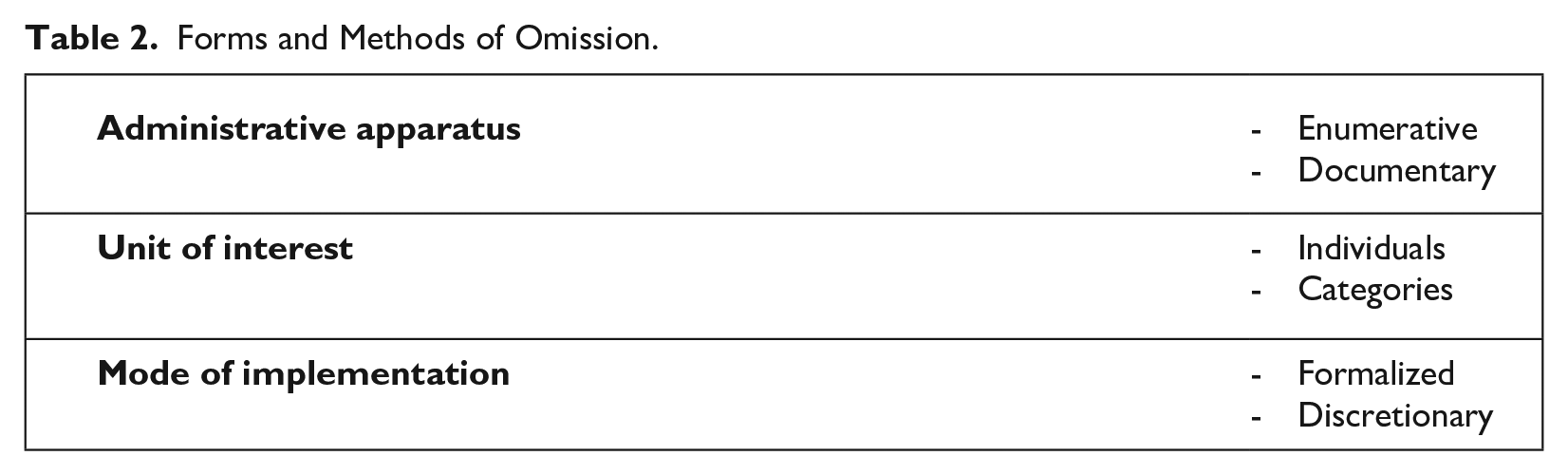
Omission can be initiated at different levels of the state’s bureaucratic hierarchy, ranging from formalized to discretionary. Formalized methods of omission refer to those enacted in the letter of the law or policy. Discretionary methods of omission refer to the subjective interpretation and implementation of policies—which on paper may not necessarily mandate omission—in ways that lead to the denial of persons from being registered or enumerated. The concept of discretionary omission reflects the reality that bureaucratic hierarchies are composed of multiple, sometimes competing actors that have differing degrees of autonomy to interpret and implement the formal requirements of their positions (Lipsky 1980; Ranson, Hinings, and Greenwood 1980).
Following Martin and Lynch’s (2009:246) definition of counting processes as “case-by-case determination[s] of what to count and, correlatively, of what counts as something to be counted,” I distinguish between two targets of omission: persons versus categories. An example of the latter can be found in legislative struggles taking place in many jurisdictions around the world over whether third gender options should be allowed on passports, birth certificates, driver’s licenses, and other official identity documents. Although a handful of countries allow citizens to identify on their passports as X (which stands for “another gender” in Canada and “non-binary/indeterminate/intersex/unspecified/other” in Australia), the majority of countries continue to use binary definitions of gender in issuing passports, thereby withholding recognition of identities that do not conform to the categories of male or female (Elias and Colvin 2020).
Documentary Versus Enumerative Omission
Omission can occur due to two “different forms of human accounting”: registration (referred to hereafter as “documentary omission”) and enumeration (referred to hereafter as “enumerative omission”; Szreter and Breckenridge 2012:18). These two forms of withholding official recognition have different consequences. By registering peoples, states are concerned with “fixing” and monitoring individual identities for the purpose of delineating their statuses and associated terms. Historically, the imperatives of taxation and conscription drove ruling elites to develop methods to reliably identify individuals (Scott 1999). The recognition that is accorded via registration, however, can be invoked by individuals to make various claims for rights such as suffrage, public benefits, lawful residence, and even citizenship. Registration is sometimes accompanied with the issuance of documents, which, depending on their type and issuing authority, can hold significant utility as material markers of identity in everyday transactions. Documentary omission, from systems such as civil registers or citizenship records, may deprive people of recognition at the individual level and, possibly, the documents to prove it.
In contrast, enumeration involves establishing official counts of a given population or categories of peoples through, for example, the administration of censuses. States count people to achieve population-level goals, such as the estimation of population projections in the areas of fertility, mortality, and migration or the drawing of constituencies. Enumeration does not necessarily grant any legal status or identity at the individual level but may provide opportunities for individuals to assert and gain recognition of collective identities along lines such as race, ethnicity, gender, religion, or indigeneity (Loveman 2014; Mora 2014; Nobles 2000). For example, Rodríguez-Muñiz (2021) detailed how Latino civil rights advocates in the United States promoted census and voter participation out of awareness of the political import of (recorded) demographic might. Enumerative omission entails the leaving out of individuals or groups from censuses and other counting apparatuses. It serves as a method by which state actors can engage in their own form of demographic engineering on paper in the interest of subduing official quantities of particular categories of peoples. The Trump administration’s ultimately failed attempt to include a question about citizenship in the 2020 U.S. census, for example, was widely rebuked for its anticipated consequence of suppressing noncitizen response rates (Derieux, Topaz, and Ho 2020).
Conclusions
In a world in which the possession of documented identity has never mattered more for survival, an unknown yet significant number of people are still living without official recognition. In this article, I name and define this phenomenon of being left out of state administrative apparatuses by theorizing “omission” as the withholding or contraction of official recognition. To undermine the claims-making capacities of individuals seeking to access rights, resources, or membership, state actors may seek to deprive them, in a practical and material sense, of the evidentiary means for substantiating their legal personhood. Omission does not happen in a vacuum but, rather, in interaction with, anticipation of, and counteraction to other documentary strategies. I offer a framework that situates omission within a typology of these strategies, which additionally comprises recognition, claims-making, and evasion.
The identification and study of omissions has methodological challenges. For one, there may be no frame from which to sample omitted persons, who are by definition liable to be missing from official records. Furthermore, the grounds for and potential intended ends of omission are likely not conveniently spelled out in the letter of the law or policy. As Michalowski (2013:21) put it, “There is often no ‘smoking gun,’ or more correctly no smoking memo, pointing to specific guilty political actors.” Omissions can be obfuscated by seemingly mundane or color-blind bureaucratic practices or by discretionary decisions, the origins of which can be hard to locate within the diffuse, often fragmented network of individuals and organizations that make up the complex architecture of the state. Studying strategic omissions, however, is not impossible. These methodological challenges demonstrate the value of organizational ethnographies of the state (Annavarapu and Levenson 2021; Auyero 2012; Hull 2012a; Mountz 2007). Ethnography can illuminate what by other methods might be the inscrutable social lives of law and bureaucracy (Latour 2010; Levi and Valverde 2008), providing insight into how policies are written and implemented, the spaces of discretion in which formal rules are interpreted and deviated from, and the mutable interests and motivations of different actors—which can bring to light the sources and processes of omission. Most importantly, although omission is a top-down process, it should also be examined from the bottom-up. More research is needed on the lived realities and perspectives of omitted persons, particularly research conducted in partnership with omitted communities. It is both a scholarly and an ethical imperative to forge beyond where official paper trails end to record the lives of people who have been denied, at times with existential consequences, the right to recognition.
The concept of omission and typology of documentary strategies have applications across contexts spanning the Global South and North. An extended example of omission can be found in Cheong (2023), in which I draw on qualitative fieldwork with Rohingya activists to examine how the Myanmar state categorically left Rohingyas out of the census and dispossessed Rohingyas of their documents to delegitimize their claims to indigeneity and thus citizenship in the period leading up to the 2015 general elections. Due to space limitations, I briefly mention two relevant cases here.
Omission is appropriate for understanding why and how, for example, the Department of State Health in Texas blocked hundreds of undocumented immigrants from obtaining birth certificates for their U.S.-born children in 2013 (Carino 2019; Liu 2016). Local Texas registrars had previously customarily recognized identification issued by foreign consulates, such as matrícula consular (Mexican consular IDs), but the state tightened their practices in 2013, claiming these consular IDs did not meet adequate security standards. Undocumented immigrants in Texas, without passports containing valid visas or other U.S.-issued IDs, were left without proof of identification. This instance of omission, occurring at a time of high anti-immigrant sentiment, was countered by legal claims-making from the bottom-up. In 2015, Central American and Mexican immigrant parents, with the help of the Texas Civil Rights Project, filed a federal suit against Texas to challenge the constitutionality of their restrictive birth registration practices. In 2016, the case resulted in a settlement that required Texas to expand the range of acceptable identification documents to register births (Preston 2016).
An ongoing case of omission may be found in the state of Assam in India, where colonial- and postcolonial-era struggles to construct Assamese indigeneity vis-à-vis Muslim Bengali foreignness have resulted in the exclusion of over 1.9 million residents from the 2019 National Register of Citizens. The fraught, years-long process of updating the register for the first time since its creation in 1951 was instigated in 2014 by the Supreme Court, which tasked itself with the responsibility of monitoring the exercise in accordance with the 1955 Citizenship Act and the 2003 Citizenship Rules. Assam’s 30 million-plus inhabitants were required to submit proof of residence prior to midnight of March 24, 1971, the date of Bangladesh’s independence (Ranjan 2021). Admissible proof included having one’s (or one’s ancestor’s) name included on the 1951 National Register of Citizens or on any electoral roll up until midnight of March 24 or a number of other documents (Ranjan 2021). Even with the criteria for inclusion institutionalized in the law, the wide variation of evidentiary robustness across applicants’ cases invited considerable discretion by local officers. Applicants left off the National Register of Citizens would have 120 days to appeal their case before a Foreigners Tribunal, with failure to do so potentially resulting in detention and deportation. An announcement from the ruling Hindu nationalist Bharatiya Janata Party that the National Register of Citizens would be extended across the country, along with passage of the Citizenship Amendment Act in 2019, incited violent domestic protests and international criticism over discrimination against Muslims.
I conclude this article by describing the micro- and macro-level consequences of protracted omission. For individuals, omission may be tantamount not only to the deprivation of citizenship but also, more fundamentally, the denial of one’s existence as a person. Theories of stratification and inequality emphasize the explicit sorting of populations into institutionalized categories. A focus on the void between recognition and omission reveals processes of stratification that unfold in different ways than those that occur explicitly across lines of race, class, and gender, although these stratification dimensions strongly influence how recognition is allocated. Omitted persons are not only at greater risk of exclusion from mainstream institutions, such as education, health care, and the formal labor market, but their marginalization often occurs without formal pathways to recourse from any governmental body.
At the macro level, although states may omit as a deliberate exercise of symbolic power, such strategies may ultimately hinder their most fundamental tasks of governance and statecraft. Passing up opportunities to gather knowledge about populations may compromise a government’s ability to extract resources, formulate targeted policies, deliver public services, and perform other essential functions. Although statistical techniques to adjust for undercounts and missing data are available, their use is contested (Anderson and Fienberg 2002). For example, the use of imputation methods for missing data, such as hotdecking, relies on information from observed respondents in a data set (Andridge and Little 2010). One risks producing biased estimates using imputation methods when data are missing not completely at random (van Buuren 2018). Given that omitted populations are sometimes systematically and categorically left out, omissions may have unintended and indirect consequences for how states construct statistical portraits of their populations.
Omission may also exacerbate population-level inequality because communities who tend to be omitted from official data collection efforts are often the most vulnerable. The COVID-19 pandemic, for example, laid bare the mortal risks to whole populations that result when certain segments are chronically marginalized. A 2021 report in The Lancet, along with other studies, raised alarm about how stateless and undocumented populations around the world may be left out of vaccination campaigns, citing challenges occurring across Europe as well as the Dominican Republic, Myanmar, Malaysia, and India (Baltazar and Cheong 2021; Burki 2021). Although the relegation of unwanted populations outside the system may be pursued by state actors seeking to assert control over the boundaries of their communities, omission may ultimately backfire by creating administrative blind spots in their visions.
Footnotes
Acknowledgements
I thank Miguel Centeno, Douglas Massey, Patricia Fernández-Kelly, Paul Starr, and past/present writing group members (Samantha Jaroszewski, Mélanie Terrasse, Kalyani Monteiro Jayasankar, Liora O’Donnell-Goldensher, Gözde Güran, Leah Reisman, Allison Kenney, Hannah Waight, Jean Nava, and David Schwartz) for their feedback. I first workshopped this article at the 2016 Strategic Citizenship conference at Princeton University, organized by Yossi Harpaz and Pablo Mateos, receiving comments from discussant Sherally Munshi and fellow participants. Anna Skarpelis and Thomas Kemple served as discussants on a later draft in the UBC Sociology Research Forum in 2021. Versions were presented at the 2017 Eastern Sociological Association Annual Meeting, 2019 Junior Theorists’ Symposium, and 2019 American Sociological Association Annual Meeting.
