



Abstract
Discussions in sociological theory often focus on ontological questions on the nature of social reality. Against the underlying epistemological realism, I argue for a constructivist notion of theory: Theories are webs of concepts that we use to guide empirical observations and to make sense of them. We cannot know the real features of the social world, only what our theoretical perspectives make us see. Theories therefore represent social phenomena by highlighting certain features and relating them in a logical system. In this system, theoretical sentences can be considered true if they meet two conditions: (1) They are consistent with the theory at hand and (2) adequately map empirically observable relations between objects denoted by theoretical constructs. Truth is therefore relative to a perspective; it is not objectively determinable. Theories should be assessed not for their ontologies but for what they allow us to see and how they connect to empirical observations.
“Since all theory is grey, my friend, and green is the golden tree of life.” – Johann Wolfgang von Goethe: Faust. A Tragedy (1808)
Theory discussions in sociology frequently resemble a shouting match. Different approaches compete with each other for attention, their proponents dismissing each other for building on faulty assumptions or for ignoring this or that important aspect of social reality. It is doubtful whether these debates yield meaningful insights. Little wonder that a meta-discourse has flourished that attempts to clarify the meaning(s) of theory and how it should be done (Abend 2008; Martin 2015; Reed 2011; Swedberg 2014). This articles aims at informing this debate by addressing the key question: How can theories represent social phenomena?
Representation is one of the chief aims in science (Frigg and Nguyen 2020; Giere 2004; Hacking 1983; Putnam 1988; van Fraassen 2008). Theories are supposed to map an array of empirical phenomena as the basis for diagnosis, critique, and intervention. My claim is that the theoretical shouting match springs in part from a widespread naïvely sanguine view of representation: Incommensurable theoretical positions claim to be right about the phenomena in view, and scholars dismiss rival approaches for being overly simplistic or for not matching the empirical world. I argue that this seriously overestimates theories: No theory can quite match the social world, and no one correct theoretical representation can rule others out. Building on philosophers of science Paul Feyerabend, Ronald Giere, Nelson Goodman, Mary Hesse, Hilary Putnam, Bas van Fraassen, and Susan Haack, I develop a constructivist account of theories. In the social sciences, theories are webs of concepts that aim at representing their subject area, that is, a range of social phenomena. Following Giere (2006b), theories are perspectives that make different aspects of the social world visible.
These perspectives only represent the data they help bring about (Hanson [1958] 1965; Putnam 1988; van Fraassen 2008). Culture, networks, roles, gender, ethnicity, and power come into view once we have a theoretical sensibility for them. Theories therefore play an active and indispensable role in sociology, as in other disciplines. They offer concepts and construct orderly patterns to make sense of a world we know nothing about without them. Theories are plural by necessity, presenting us with incommensurable social universes (Feyerabend 1962:74–76; Kuhn [1962] 2012:147–49). But theories are not all relative and without empirical reference: They represent the social phenomena they cover (and create) accurately to the extent that their statements correspond to the empirical observations they engender.
Tightly connected to the first question is a second: What are the conditions for the success of theoretical representation? When can we say that it is true? Instead of trying to evaluate whole theories, I focus here on statements as the key ingredients of theories: How can theoretical sentences be true?
The aforementioned position sketched of theories as perspectives does not square with ideas of “objective truth.” Instead, theoretical sentences first have to be true to the theory at hand, consistent with its other theoretical sentences. Second, theoretical sentences have to be true of the world in a very limited sense: They have to represent relations between features of the social world. But these features cannot be objectively identified, only constructed from the particular theoretical perspective. Theoretical sentences can be “empirically adequate” but not “literally true” of the world (van Fraassen 1980).
I develop these arguments by first identifying streaks of naïve realism in contemporary theory discourse: in the debate between individualist and processualist approaches and discussions of the places of agency and culture in sociological theories. A brief overview of meta-theoretical approaches in sociology since 2000 follows, with a focus on their stances on theoretical representation. The following two sections lay out the basic framework of theories as webs of concepts and the relativist understanding of truth. A short interlude clarifies that concepts, rather than the relations between them, are the key area of realist claims. The next two sections discuss realist arguments against the constructivist account of theories: that we can establish basic entities in the social world and that we can derive correct concepts from lay understanding or from empirical research. Finally, I stress the limited but important virtues of concepts and theories from the constructivist position: They effectively draw our attention to certain features of the social world out of theoretical interest, making for perspectives that allow us to see the social world from different angles. Multiple perspectives are possible, each offering distinct views of social phenomena with different versions of the truth.
Realist Presumptions
Most theory in the social sciences adopts a form of realism. The weak version of realism argues that (1) a social reality exists and (2) we acquire a certain degree of knowledge about it. A stronger version of realism holds that (3) the theories we construct can be, and often are, “literally true” in matching this social reality. Bas van Fraassen (1980:8) identifies this position in the philosophy of science and sketches it as follows: “Science aims to give us, in its theories, a literally true story of what the world is like; and acceptance of a scientific theory involves the belief that it is true.”
Such claims of a literally true representation are rarely advanced as deliberately as in critical realism (Cruickshank 2010; Gorski 2013). More often, authors assert seemingly indisputable claims in their own theoretical vocabulary and then point to other theories as being “wrong” about them. In the following, I focus on the debate between individualist and processual or relational positions and on discussions of agency and culture in sociological theory.
The starting point is frequently an ontological conviction about the basic constituents of social life.
1
For example, Peter Hedström (2005:28) asserts that analytical sociology is based on individual actors: [A]ctors and actions are the core entities and activities of the mechanisms explaining [social] phenomena. . . . The causal efficacy of actions would be readily seen if we were able to press a pause button that suddenly froze all individuals and prevented them from performing any further actions. All social processes would then come to an immediate halt.
Hedström (2005:3) himself stylizes this position as “realist”; in line with van Fraassen’s aforementioned criteria, he writes, “An explanatory theory must refer to the actual mechanisms at work, not to those that could have been at work in a fictional world invented by the theorist.” The aim is to discern the “actual mechanisms” at work, not to produce “fictitious accounts.” This requires that we are capable of knowing something definite about these mechanisms, as realism claims. Actors and their actions are held to be the basic entities of the social world. Any level-up social structures (collectives, states) derive from them, rather than having an independent “sui generis” existence (Hedström 2005:72).This realist belief in the causal powers of individual actions rules out alternative bases for explanations in terms of mechanisms. For instance, Charles Tilly (2005:28) advocates for mechanisms to be based on events, or “transactions” between entities. Arthur Stinchcombe (2005:150) argues that mechanisms in the social sciences can operate in a variety of “causal units”: situations, persons, social ties, cultural patterns, and organizations. Hedström’s and analytical sociology’s realist credo is that only persons (individuals) are endowed with causal powers, and any mechanisms involving other social or cultural patterns must be traced to them. John Levi Martin (2015:38) similarly insists that social action be done by individuals and only them: “There are no collective-level actors. Action is something that is done by individuals, and only them. . . . [W]hen we treat collectivities as ‘actors,’ we obscure, reify, and fetishize.” Specifically, Martin (2015:39) admonishes work that posits states as actors that could take actions “mindful of [their] own interests and resources. . . . This is untrue, and so leads to error. Specific individuals do the acting.”
The trouble is that some theorists steadfastly cling to alternative conceptions of the social world. For instance, Tilly (2005:6) “rebels” against “the claim that individual and collective dispositions explain social processes. . . . [I]nterpersonal transactions [are] the basic stuff of social processes. . . . [I]nterpersonal transactions compound into identities, create and transform social boundaries, and accumulate into durable social ties. . . . [I]ndividual and collective dispositions result from interpersonal transactions.” Similarly, Harrison White (1995:1036) writes: “Talk comes first. Talk comes much before persons.” Both Tilly and White see events (“transactions,” “talk”) as primary and individual identities and social entities as springing from the processing of these events. 2 Tilly (2002:xi, 72) advocates “relational realism” as a position that holds “transactions” and “relations” in the social world as “real and observable.” Predictably, these “eventist,” “processual,” or “relational” accounts have come under criticism from individualists. From a critical realist position, Christian Smith (2010:255–56) criticizes White’s theory as “antihumanistic”: “Take seriously the truths of stratification and emergence in reality, and persons immediately become capable of real ontological existence with definable features and capacities that cast them in a very different way from what White’s perspective allows” (cf. Donati and Archer 2015:19).
Appeals to “truth,” “reality,” and “ontology” are hallmarks of critical realists (see Donati and Archer 2015; Smith 2010). But they are not alone in advancing realist arguments, as the example of Hedström shows. Particularly contested is the notion of agency, as introduced by British critical realism and subsequently embraced by a number of writers inspired by American pragmatism. For instance, Mustafa Emirbayer and Jeff Goodwin (1994:1442) hold that human agency marks “an analytical dimension of all actual empirical instances of social action. [It] entails the capacity of socially embedded actors to appropriate, reproduce, and potentially, to innovate upon received cultural categories and conditions of action” (cf. Emirbayer and Mische 1998).
This is countered by Stephan Fuchs (2001b:27), another processualist: “That persons have free wills explains nothing by itself. If they do something, the fact that they chose to do so but could have done something different adds little or nothing to our understanding of their actions.” Note that Fuchs does not appeal to the ontological reality or absence of agency. Instead, he argues with regard to the interrelation between theory and empirical observations: Introducing agency into our theories does not improve their empirical fit.
Over and above the ground level of individuals and events, realist arguments pertain to concepts such as social relations, social structures, or culture. For instance, critical realist Margaret Archer ([1988] 1996:107) asserts the “objective existence” of culture as an “emergent entity.” This derives from the “logical relationships” among the components of culture (Archer [1988] 1996:106), which exert constraints on individual actions. Hedström (2005:72) objects to exactly these notions of “ontological collectivism” or “supervenience” of social structures and culture, based on the individualist credo. Similarly, Martin (2015:35) argues that explanations of social action in terms of culture are mistaken because “institutional culture is itself nothing other than the pattern of social action that takes place in the institutional setting.” Emirbayer and Goodwin (1994:1438–42), in contrast, agree with Archer on “autonomous cultural structures” and fault White for neglecting their independent existence. These arguments rarely address to what extent the concept of culture can help make sense of empirical observations. Instead, ontological beliefs and theoretical aesthetics take center stage.
We find similar fruitless arguments about the nature of social reality in reprimands of other approaches for not taking some vital aspect of the social world into account: agency, power, culture, material inequalities, the state, and so on (Healy 2017). The argument is more or less that agency, culture, or power are important aspects of social reality—they are real. Social research has to take these into account; otherwise, it cannot arrive at accurate representations of the social world. Emirbayer and Goodwin (1994) provide a case in point. They fault social network analysis for ignoring culture and agency; because of their importance in the social world, theory has to incorporate them. These kinds of “bringing X back in” arguments abound in sociological theory (Abbott 2001:16). In the position I sketch here, this kind of argument is legitimate if filling logical gaps in theories or aiming at better models of empirical data but not in attempting a “literally true” account of the social world.
Following the realist line of argument, it should take a few manageable steps to arrive at a “true theory” of the social. We only have to assume the following: (1) Social things like power, culture, agency, and networks are real. (2) There is a definite set of these social things, especially the ones that are important. (3) Be it from empirical study or from philosophical inspection, we can know about the importance of these things and about their relations to each other.
Few people think of social theory this way. However, the discussed examples assume, or dispute, the reality of the theoretical constructs in question. Questions of social ontology lie at the heart of these theoretical debates, with the assumption that “philosophical (armchair) methods” could lead to “a correct picture” (Lauer 2019:172).
Sociological Meta-Theory
Before reconstructing theoretical representation in the philosophy of science, it is important to take stock of the discussions about theory within sociology. After a brief discussion of postpositivism and critical realism at the end of the twentieth century, I focus on a handful of approaches from 2000 onward: Philip Gorski’s constructive realism, Isaac Ariail Reed’s interpretive approach, John Levi Martin’s call for theoretical thinking in terms of individual action, Duncan Watt’s arguments against commonsense accounts, Richard Swedberg’s work on theorizing, Gabriel Abend’s meta-discussion of theory, and Kieran Healy’s critique of calls for “nuance.” For the sake of brevity, I discuss only the similarities and differences to the approach offered here.
Since the mid-twentieth century, the two preeminent epistemological approaches of logical positivism and Karl Popper’s critical rationalism have come under sustained attack. Richard Rorty’s ([1979] 2009) iconoclastic critique has been particularly influential in the social sciences (see Gross 2008): Philosophy and scientific knowledge can not be a “mirror of nature”; they only give us different ways of seeing the world or different vocabularies for talking and writing about it. There is no absolute truth and no possibility of accurate representation in theories. Jeffrey Alexander (1995:121, 123) terms the resulting situation in the social sciences “postpositivism.” He posits that sociological theory is, and has to be, characterized by a multitude of “competing research programs” with a “perspectival quality.” Intersubjective agreement is possible among adherents of a theoretical approach, but it breaks down across divides (cf. Fleck [1935] 1979).
Critical realism is a reaction to the widespread postpositive relativism. It insists on the possibility of knowing what is real and what is not. British philosopher Roy Bhaskar advanced critical realism in the 1970s, and it was taken up by British social theorists Anthony Giddens and Margaret Archer in the 1980s (Gorski 2013). Bhaskar argues for realism in the natural sciences on the basis of their success in mastering nature. The building of rockets and computers proves that our conceptions of natural reality are by and large correct and that the things provided for in scientific theories (e.g., gravitational forces, electric currents) exist outside of these theories.
Whatever we make of it, this argument does not hold for the social sciences. Here, Bhaskar ([1979] 1998:54) reasons that social structures are real because they structure social action through the concepts actors have of them. Relatedly, Archer (1995:1) holds that we can establish social patterns and culture from the constraints experienced by individual actors. In both cases, individuals and their subjective meaning and experiences are the yardstick for assessing the reality of social constructs. This includes higher-level constructs like social structure, culture (Archer [1988] 1996), and social relations (Donati and Archer 2015): They are taken to exist objectively because people subjectively believe in them and act accordingly.
Prominent followers in the United States include Douglas Porpora, Christian Smith, and Philip Gorski. In his article on “constructive realism,” Gorski (2004:15, 17–19) terms theories “linguistic representations” and holds with van Fraassen that “empirical adequacy” is “the only standard” to evaluate them. Gorski’s (2004:15; cf. 22) inclination toward “realism” rests on the conviction that “we know more about the underlying properties and structures of the world than we used to.” In later writings, Gorski (2013, 2018) defends Bhaskar’s ontological layers of social reality and argues for the emergence of social structures.
The critical realist assertions of the reality of social structures are criticized—correctly, in my view—by Isaac Ariail Reed (2011:57–63) and John Levi Martin (2015:94–97). It is not possible to ultimately determine whether a particular concept denotes anything real in the social world, especially not by ontological consideration. Like Rorty, Reed (2011:18–25) emphasizes that theories are “human constructions,” and theoretical concepts refer primarily to other concepts rather than to anything real “out there” in the empirical world. Against a “strong program” of theoretical representation, Reed (2011:109–17, 162) argues that theories primarily serve as “heuristics” to make sense of a “landscape of meanings.” Accordingly, theories are tools for an interpretative research program. This methodology of theories, though, again rests on a particular theory of the social world as populated by individual actors, endowed with subjective meaning that drives their social action (Reed 2011:159–61). The ontological status of “social structure” and “agency” is denied, but that of actors with subjective meaning and the capacity for social action is upheld.
Martin (2015:8, 10) does not see theory as a tool for interpretation. In a constructivist position not unlike my own, he suggests seeing theories as “vocabularies” that allow us to describe social situations in greater generality. However, he holds that we can determine whether one vocabulary is “better than another” based on “the application of ‘right reason’ to our formulations of ideas and statements.” This leads Martin (2015:38–40) to insist that action should always be individual. Notions of collective actorhood and explanations in terms of culture are dismissed (Martin 2015:34). Martin abhors the critical realist tendency to declare things like “social structure” and “culture” as real, but he sees reasons to declare some entities in the social world as basic (individuals) and others as obsolete (culture). Reed and Martin combine constructivist conceptualizations of theory with ontological commitments to individuals and their actions and with dismissals of other concepts.
In contrast, Duncan Watts (2014:327) admonishes sociologists for clinging to “commonsense theories of action.” To arrive at better, more “scientific” explanations, we should focus on modeling even counterintuitive mechanisms with computational methods. Watts thus sketches an empiricist project for theories: They are supposed to map empirical observations, even if running counter to common sense accounts.
Kieran Healy’s (2017) provocative article “Fuck Nuance” adds an important criticism to current theoretical discourse. Healy (2017:122) bemoans the frequent attacks on particular approaches for failing to take this or that social aspect into account (e.g., class, power, emotions, culture, the body) and holds these calls for “nuance” to be misled, deriving from “the relative absence of shared standards [in sociology] for the evaluation of theory.” In this vein, theories are supposed to cover everything and offer multidimensional accounts, even at the expense of clarity and interestingness. The result is frequently a “grotesquely overpowered theoretical vocabulary that allows the researcher to evade refutation and say more or less anything” (Healy 2017:123). Although he does not quite spell it out, Healy’s position implies a constructivist and empiricist vision of theory; theories should be clear and simple, and they should be empirically testable. But they should not aspire to cover the full complexity of social life, at the risk of becoming mere assemblages of concepts that can be stretched to seemingly account for all possible observations.
Richard Swedberg’s (2014) theorizing approach similarly links theory to empirical observations. He argues that we should treat theory less as prepackaged sets of propositions to test, as in Karl Popper’s deductive approach. Rather, theorizing as a process is “abductive”: It starts from observations and confronts them with established concepts from sociological theories. Concepts can come from diverse theories; they only have to fit the phenomena at hand. Ideally, theorizing arrives at an “explanation” of the phenomenon, a plausible reconstruction of mechanisms bringing it about, in accordance with empirical observations. Swedberg (2014:174–80) finds the classics (Weber, Durkheim, Simmel) useful in this regard and retains a preference for modeling mechanisms on the basis of individual preferences and actions. However, both may not be essential for his notion of theorizing. Importantly, Swedberg does not understand theories as coherent entities, but as inventories of potentially useful concepts. “Theorizing,” then, is not about constructing full-fledged theories, but about producing accounts of empirical phenomena.
The authors discussed so far all offer a particular solution to the postpositive plethora of theoretical perspectives. Gabriel Abend (2008), in contrast, notes that theoretical discussions are plagued by wildly diverging understandings of “theory.” These meanings fall into seven distinct and incompatible types: (1) logically connected systems of general propositions, (2) explanations of particular social phenomena, (3) interpretations of social phenomena (as in Reed’s), (4) the study of classical texts and authors, (5) highly general perspectives (Weltanschauung) of how to see and interpret the world, (6) normative accounts, and (7) discussions of general problems like the micro-macro link, structure versus agency, or the nature of social order. Without deciding between these meanings of theory, Abend (2008:196) argues that the notion of theory should not be tied to specific ontological commitments. This runs counter to the positions of critical realism, Reed, and Martin but aligns with the arguments of Watts and Healy.
This rather sketchy overview of meta-theoretical discourse in the United States over the past 20 years shows little agreement on what theory is or what it should do. It also has a number of gaps to fill. First, all authors offer their own visions of theory, but the question of representation is rarely picked up. Critical realism claims to be able to identify “real” units and structures in the social world without considering their fit to empirical observations. Reed draws on Rorty to argue that representation is impossible (while advancing an ontological framework of actors and meaningful orientations). Watts and Swedberg envision theory as aiming for the representation of empirical observations, but they do not dwell on whether this is possible and how.
Second, the conditions for the truth of theoretical sentences are not considered. In particular, the ontologies of critical realism and individualist approaches implicitly or explicitly tie their truth-claims to intuitive plausibility. This is explicitly rejected by Watts, who advocates a fit to empirical models.
Third, little use is made of recent developments in the philosophy of science. Sociologists prefer turning to American pragmatism, to Durkheim, Weber, and Merton, rather than picking up from general epistemology. The reception of philosophy stops in the 1960s and 1970s with the works of Kuhn, Lakatos, Rorty, and Bhaskar, with occasional references to Davidson ([1986] 2001) and van Fraassen’s 1980 book. I suggest we can learn much from more recent discussions in the philosophy of science.
Representation in Theories
To discuss the conditions and limits of theoretical representation, I first lay out my formal understanding of theories in the social sciences. The philosophy of science has a rich and varied discussion of scientific theories and representation. I selectively draw on this discussion to present a much-simplified account of my own as it applies to the social sciences.
The most prominent “semantic” approach to theories in the philosophy of science holds that theories are “families of models” (Giere 2004:247; Suppe 2000:S109; Suppes 1967:57–59). Models include mathematical equations as well as analogies, pictorial representations, and material objects like the Atomium or a wooden model of the DNA double helix. Margaret Morrison (2007:214) counters that theories are more than just sets of models: Theories like Newton’s mechanics are more abstract and general than the models they engender—they “provide a general representation of an entire class of phenomena.” Theory is what holds a family of models together.
Theories in the social sciences rarely offer such models in diagrams, analogies, or pseudo-mathematical equations, such as in the form of y = f(x). They mostly consist of words: concepts that are linked to each other in sentences. However, the conditions of theoretical representations may not differ much. Just as nobody would mistake a wooden model for actual DNA, social scientists would not argue that a company, the art world, or ethnic discrimination look anything like our verbal accounts of them.
The semantic approach argues that models have an internal structure: They contain elements (like the balls representing atoms in the model of a molecule) that are linked to each other, and this structure is supposed to correspond to the structure of the empirical phenomenon in question (here, the molecule). Philosophy of science calls this structural resemblance of theoretical relations with relations in the empirical world “isomorphism” (Frigg 2006:53; van Fraassen 1980:43). A model, or a theory, is “isomorphic” to what it is supposed to represent if and only if (iff) it has the same structure between its units. This holds for theories in the social sciences: They link concepts in a particular way, and these connections are supposed to map the relations between the features denoted by these concepts in the empirical world.
For instance, the theoretical approach of neoinstitutionalism roughly states:
N1: Social fields are characterized by cultural rules (institutions) that govern the behavior of actors in the field (DiMaggio and Powell 1983).
This theoretical sentence connects the four concepts of “social field,” “institution,” “behavior,” and “actor” in a particular way. The sentence does not quite look like what is happening in a social world, nor do the concepts resemble what they refer to. But the four concepts are supposed to be related to each other similarly to their empirical referents. In this formulation, theories represent their subject area less in its important features than in the structure between them.
These formulations suggest regarding theories in the social sciences as networks of concepts (Hesse 1974:24–37; Quine 1951:39–41). Turning to an analogy, we can imagine theories as webs of terms that we weave around the empirical world (see Figure 1). The world itself remains complex and amorphous and only acquires a recognizable structure by virtue of the webs of terms attached to it. This particular example connects (1) culture and meaning to agency in a central triangle and groups other triangles around it: (2) culture, power, and the state, with (3) the latter two also linked to organization; (4) power, agency, and the body; and (5) agency, meaning, and network. In addition, organization and network form a “weak tie,” and other concepts (e.g., gender, institution, class) lurk on the backside. This theory is completely fictitious, but the linkages resemble frequent arguments in contemporary discourse.
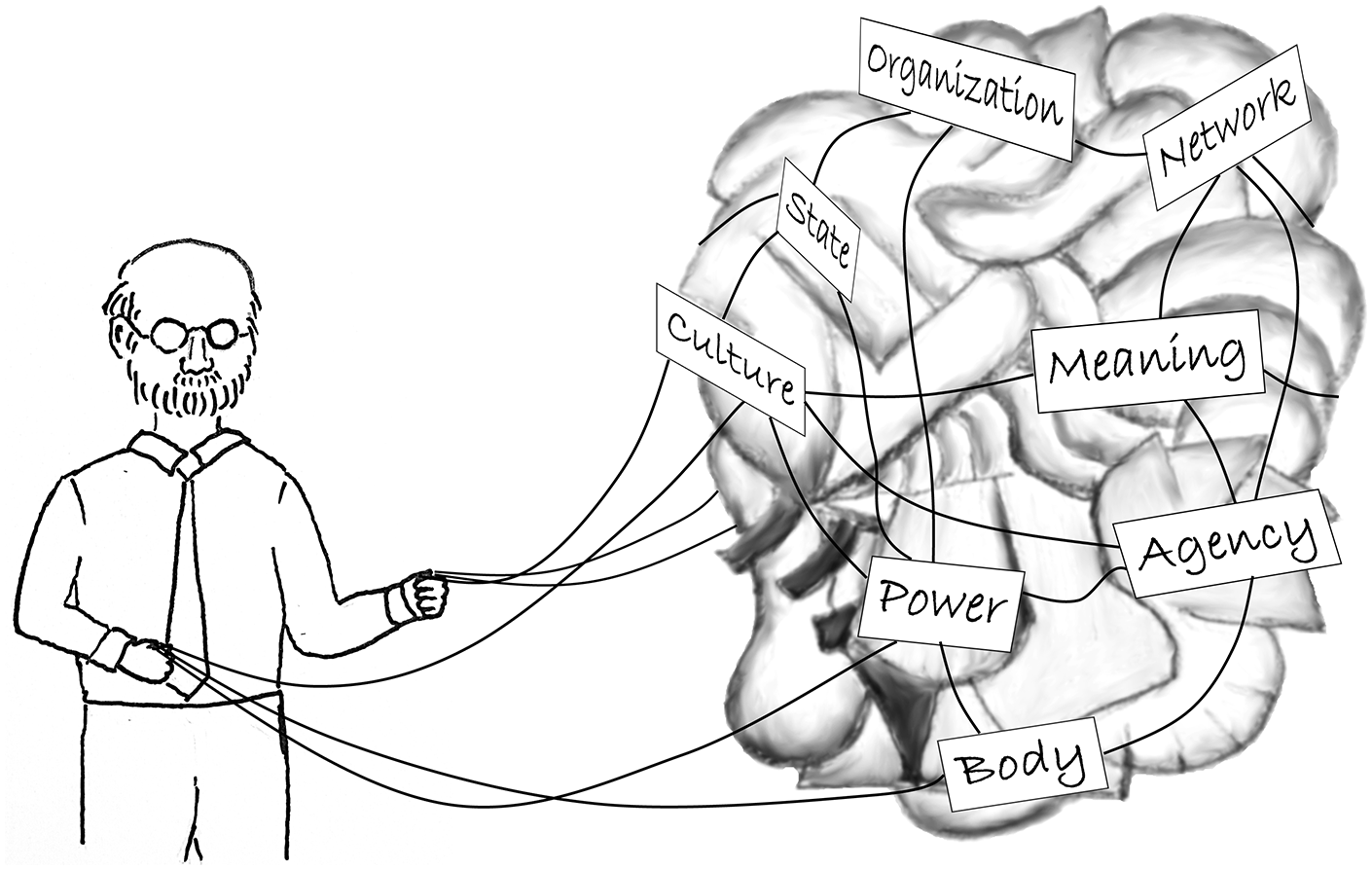
Weaving a web of concepts around a complex and amorphous social world.
The network concept fits the structure of theories in the selectivity of connections. Just like not all children in a school class are friends with each other, not all concepts in a theory are directly connected to each other. In the example of neoinstitutionalism, the social field guides the behavior of actors via institutions, not directly. Theories specify which concepts have links to each other and which ones only indirectly connect through their relations to other concepts. But theories are not quite networks, as the formal network concept implies that the ties between nodes are similar. We can look at the network of friendships in a class but not at a network that covers friendships, romantic relationships, crushes, and conflicts indiscriminately. The relations between concepts in a theory, however, differ profoundly. In the case of neoinstitutionalist statement N1, social fields and institutions mutually define each other (“are characterized”), whereas institutions are supposed to have causal effects on the behavior of actors (“govern”). We can think of theories as web-like structures but not strictly as networks.
According to W. V. Quine (1951:39–41), this network of theoretical sentences is divided into core and periphery (cf. Fuchs 2001a:280–84). Sentences in the periphery can be discarded on the basis of empirical evidence while shielding the core of the theory from challenges. This roughly corresponds to Karl Popper’s ([1935] 2002) architecture of theories. Popper views theories as composed of general assumptions (axioms), bridge sentences that define terms and their relations to empirical observations (correspondence rules), and conjectures that can be tested. Assumptions and definitions mark the core of a theory; correspondence rules and conjectures are more peripheral. According to Popper, conjectures are the only theoretical sentences that carry a truth-value, that is, they can turn out true or false empirically.
I find Popper’s three-fold typification of theoretical sentences heuristically useful. However, it relies on the clear division of analytical and synthetic statements from modern philosophy (Hume [1777] 2007:25). Analytic sentences are purely theoretical, such as in mathematics, and concern the relations between ideas. Synthetic sentences, in contrast, are observational and about the world or “matters of fact.” This requires that theoretical constructs and relations are either observable and part of the empirical world or are unobservable and belong to the world of theoretical ideas. This dichotomy is effectively dismissed by Quine’s (1951) argument that we cannot clearly distinguish between theory and empirical observations.
For instance, physics has few constructs we can measure directly, like time and space, and even these become tricky in extreme circumstances (very small/short, very large/long). But physical instruments now allow for reliable measurements of otherwise unobservable constructs, from temperature (from the extension of a mercury scale), force (elongation of a spring), and mass (force divided by gravitational constant) to the mass of electrons or quarks and the velocity of light. Few things in the natural sciences remain totally unobservable, but most empirical identification and measurement of theoretical constructs (electrons, mass) rely on a lot of auxiliary theory. This makes it almost impossible to distinguish assumptions and conjectures, in principle.
Turning to an example from sociological theory, we can reconstruct parts of Pierre Bourdieu’s field theory ([1980] 1990; Bourdieu and Wacquant 1992) as follows:
B1: The distribution of specific types of capital (economic, cultural, social, symbolic) determines the relative positions of actors in fields.
B2: The habitus is an incorporated complex of cognitive schemata and scripts of action.
B3: Individuals acquire their habitus out of their social positions.
B4: Individuals perform social practices mostly unconsciously following the schemata and scripts of their habitus.
Sentences B1 to B4 connect a number of concepts. In Bourdieu’s work, the habitus is a classic example of an unobservable construct. We can think of ways of measuring cognitive schemata and scripts, but Bourdieu tells us they remain unconscious. He uses the habitus to relate two observables: the relative distribution of various types of capital and social practices. In the sense of Popper, B3 and B4 would be untestable core assumptions of Bourdieu’s theory; B2 is a definition, and B1 is more of a definition than an assumption. All of this would be undeniably and trivially true within the theory, as part of a logically connected network of concepts. However, the four theoretical sentences combine to a fifth:
B5: Social practices follow the positions of actors in fields, as per the distribution of specific types of capital.
This makes for a testable conjecture: Actors with similar positions in the sense of comparable possession of economic, cultural, social, and symbolic capital should display similar behavior in a field, in contrast to actors with different amounts and composition of capital(s). This is again consistent with the theoretical structure, but it can also be checked against empirical evidence. Following Popper, the conjecture can be tested and, if it survives attempts to falsify it, provisionally accepted as true. This would obviously be a stronger candidate for a true theoretical sentence than B1 to B4, given it is not only “defined” or “assumed.” However, this changes if we find ways of measuring the “habitus.” This would convert B3 and B4 to conjectures.
The five sentences from Bourdieu’s theory can be depicted in a network model (see Figure 2). The notions of field, capital, and position are related in B1. B2 defines the habitus, and B3 specifies its relation with position. Habitus and practices are connected in B4. The combination in B5 adds the links from position and capital to practices.
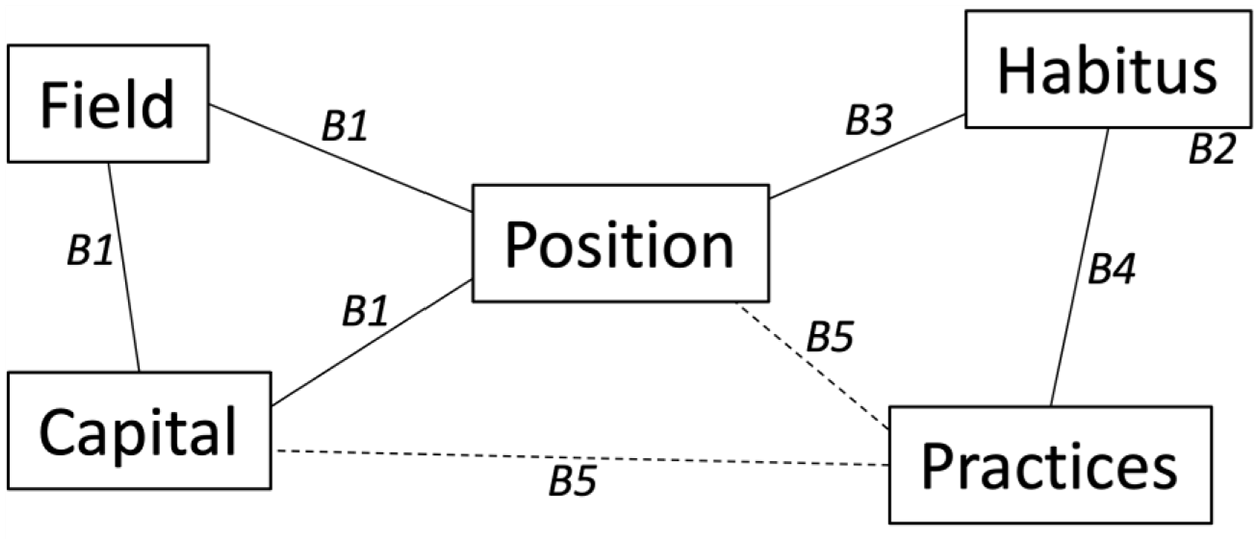
Network of terms in Bourdieu’s theory.
Overall, the network model suggests theories represent social phenomena in terms of conceptual structures that can be isomorphic to them, or not. So far, this account contains no arguments concerning the realist claims from the previous section. But it allows us to discuss the conditions (and the limits) of representation. What are the conditions of success, or failure, of this representation? When can we say that theory is true or false?
Two sides of truth
Instead of addressing the issue of truth for full theories, I discuss the possibility of identifying singular statements in a theory as true. In the philosophy of science, the standard reference for truth is Alfred Tarski’s (1944) “semantic conception.” According to Tarski, the “truth” of a sentence has to be distinct from the statement itself—it is a meta-commentary. He gives the example of the sentence: “Snow is white.” This statement is different from the meta-claim: “It is true that snow is white.” The latter sentence is a meta-statement about the correct use of language in the first sentence. In this sense, Hilary Putnam (1988:115; italics in original) offers the following formula: “[A] statement is true of a situation in case it would be correct to use the words of which the statement consists in describing the situation.”
As I understand it, we have to assess the truth of a theoretical sentence in two ways. First, a sentence has to show a “correct” use of words within the language at hand. It has to follow its rules and therefore be true to the theory. In the sense of Ludwig Wittgenstein’s ([1953] 1968) theory of language games, the statement has to conform to the rules of the theoretical language. This is the “coherence” side of truth (Davidson [1986] 2001). Theories are much more rigid with regard to the combination of concepts than general language. For example, Bourdieu’s concept of “practices” has to be linked to the other terms in his theory (field, position, habitus) in a very specific way, whereas the everyday notion of “practices” is much more flexible and ambiguous. Formulations that actors reflexively maximize their expected utility (rational choice) or that they creatively combine different cultural patterns (agency) in their practices are not compatible with Bourdieu’s position (Bohman 1997). Such statements have to be assessed as false by this criterion—but only relative to his theory. This coherence principle implies that many sentences from one theory will be “false” from the standpoint of a rivaling theory. The dismissal of theoretical claims for not cohering with another theory is trivial, unsurprising, and uninformative.
This first sense only concerns the logical consistency of the theory, not its capacity to represent phenomena accurately. The sentence “Snow is white.” follows the grammatical rules of standard English, but this does not mean it is factually true. Similarly, followers of Bourdieu know that social practices have to follow our habitus. This is undoubtedly true within the theory. Rather than speak of “truth” in general here, this first assessment can be termed “correctness” of a sentence in a theoretical system (Luhmann 1987).
Second, in Putnam’s formulation, the sentence also has to “describe the situation” accurately. In this sense, theoretical sentences should be true of the world. The sentence “Snow is white.” becomes true if what is called “snow” in the theory shows (uniformly or probabilistically) the attribute called “white” in the theory. Note that this formulation does not require “snow” and “white” to exist independently of our usage of these terms. They only have to point to particular classes of objects and properties that are linked in empirical observations (provided we can operationalize the two constructs of “snow” and “white”) in the way ascertained by the theory. 3 This is the minimal requirement of a “correspondence” of theory to empirical phenomena. The concepts need not denote real entities or characteristics that exist independently from our theories. But the theoretical sentence has to map isomorphically an empirical relation between objects constructed by way of our concepts.
Of course, isomorphism becomes meaningless if the relation holds by definition—for example, if snow were defined by its whiteness. In this vein, Bourdieu’s definition of habitus as an incorporated complex of cognitive schemata and scripts of action (B2) is only true “to the theory,” but it cannot be true (or false) “of the world.” The same holds for the assumption that practices follow the habitus (B4). In contrast, the relations between field positions with different amounts of field-specific kinds of capital on the one hand and social practices on the other (B5) can be tested empirically. To the extent the relation can be ascertained empirically, we have to accept the sentence as true by the second criterion. This does not mean empirical phenomena can only or even best be captured by this sentence, only that the theoretically proposed causal relation from the distribution of resources (kinds of capital) to variation in behavior (social practices) holds up to empirical observations. To avoid ideas of objective truth, Bas van Fraassen (1980:84–87) terms the second criterion “empirical adequacy.”
This distinction between two criteria of truth of theoretical sentences matches the two aspects of justification of beliefs in general, according to Susan Haack’s (1993) double-aspect foundherentism. Beliefs are enmeshed in a web of beliefs, and they have to conform to them to be justified. But they also have to be founded in empirical observations. Accordingly, I will form a justified belief that a crow just flew by our house iff (1) I already have the beliefs that crows are living nearby and that crows, but not cats (also living nearby), fly like this. (2) I see a fast-moving dark shape through the window.
Haack’s “web of belief” is similar to the idea of theories as networks. She also introduces the analogy of a “crossword puzzle” (Haack 1993:81–86): To be confident of a crossword answer, a word (say, “crow”) has to (1) fit (cohere) with the other entries in the crossword, and it should (2) match the clue (correspond) given for the entry. Both of these criteria may apply to varying degrees. We may already know more or fewer entries linking with the answer in question (which we have more or less confidence in), and we are more or less certain that our word “crow” (and not another one) matches the clue. Just like the justification of beliefs, truth of theoretical sentences comes in degrees, depending on the extent to which they logically conform to the rest of the theory and on the extent of their correspondence to empirical observations.
In Haack’s account, too, there is no idea of objective knowledge, only of a relative justification of beliefs on these two grounds. The fast-moving shape might have been a blackbird or actually a cat. To determine this, we would need an outside observer with perfect knowledge. This is a luxury epistemology does not give us—there is simply no way of determining what is really there. We have to make do with the relative knowledge and certainty of particular perspectives (Haack 1993:203).
The two criteria hark back to the empiricist distinction between analytic and synthetic sentences. Criterion 1 is analytic. It requires that a theoretical sentence be checked for consistency with the theoretical system at hand. Does it conform to the rules of the theoretical language? Criterion 2 is synthetic and demands we compare a theoretical sentence against empirical observations. Does it map empirically observable relations isomorphically? As a number of critics forcefully argue, theoretical sentences are never only analytic or only synthetic (Feyerabend 1962:48–52; Hanson [1958] 1965; Hesse 1962:15–24; Quine 1951; Sellars 1956). Empirical observations come with theoretical underpinnings, and any concept and any theoretical statement builds on observations. Therefore, theoretical sentences can only count as true if they are both (1) “correct” within the theory and (2) “empirically adequate” with regard to empirical observation. Truth is about both “coherence” and “correspondence.”
Interlude
This understanding of theories suggests we should mainly discuss them with regard to the relations between concepts rather than the concepts at hand. However, ontological positions in sociological theory and the fervent discussions between them concern mostly the entities in theories. To cut through the conundrums of theoretical representation, I concentrate on the supposed “reality” or “objectivity” of entities and concepts in the following: Are they “objectively real” in the sense of existing outside our theoretical descriptions of them? Objectively real here means quite pragmatically that any scientific approach with the right tools would have to observe the same features of the social world as relevant and would have to conclude that these things are real and that they have to be represented by a theoretical concept. Actors, their agency, culture, interaction, social fields etc. either exist outside our theories or are mere “theoretical constructs.” This is, in the most basic formulation and without regard for qualifications and intermediate positions, the schism of realist positions versus constructivist or nominalist positions.
This focus on concepts assumes the relations between them are unproblematic, which of course they are not. In principle, the analytic “correctness” of theoretical sentences within a theory is a matter of logical consistency. “Empirical adequacy” as the synthetic side has to be determined on the basis of empirical research methods. Thus stated, both aspects become technical issues. Even if this is grossly simplifying, the following discussion brackets the relations in favor of the entities and concepts related. I make the case for the constructivist or nominalist position that concepts do not denote anything objectively real. Instead, they identify certain aspects of the social world as relevant based on interests and sensibilities set by the theory at hand (and by the research methods available). This position faces two objections, or counterstrategies, that could save realism, if found convincing.
First, realist positions hold that we know the basic entities of the social world (individuals, social processes, relations) and some of their key properties (e.g., agency, reflexivity, or rationality). This allows us to build theories capturing social reality accurately. This is, in different ways, the position of critical realism, Hedström’s analytical sociology, and Tilly’s relational realism.
Second, statements about features of the social world (e.g., group, organization, state) or their attributes (categories, power, resources) frequently suppose these features and attributes to be real. Theoretical concepts are held to be “natural kinds” that exist in the world quite apart from our descriptions. Theoretical statements relating these actually existing things could therefore be “literally true.”
The next two sections address these objections in turn.
Basic entities
Theories in the social sciences usually advance individual actors or the processes between them as basic entities. Can we know whether they are real and what properties they have? Eminent physicists like Heinrich Hertz, Ludwig Boltzmann, and Werner Heisenberg argue against a naturalistic understanding of theoretical terms (van Fraassen 2008:194–99). Concepts like force and field, but also atom and electron, are only images we construct to make sense of an outside world that remains fundamentally unknowable. This skeptic or “nominalist” view faces a lot of opposition upholding the basic entities of physics to be real. Grover Maxwell (1962:20, 25) exemplifies this by insisting that molecules and electrons, but also photons and fields, have an “ontological status”; the proof for this lies in the success of theories in physics: “[A]n explanation for the fact that theories ‘work’ as well as they do . . . is simply that the entities to which they refer exist.”
This is essentially the critical realist argument advanced by Bhaskar for the existence of natural entities. Ian Hacking (1983:24, 23; italics in original) professes a basic realism for similar reasons: [B]y now there are standard emitters with which we can spray positrons and electrons—and that is precisely what we do with them. We understand the causes, and we use these to find out something else. . . . So far as I’m concerned, if you can spray them then they are real.
Hacking’s (1983:31) argument is less about our theoretical terms representing something real than about them working well in interventions like physical experiments. This makes the practical success of theories the yardstick for the existence of entities (see also Cartwright 1999:23). The position comes with many questions already in physics: Are constructs like the electromagnetic field similarly entitled to “real existence,” as Maxwell argues? How do we deal with physicists having different, and sometimes irreconcilable, ideas about electrons that change historically (Putnam 1988:12)? And how about substances like phlogiston, caloric, and aether? These are now discarded, but they long had a prominent place in theories of physics. Had Hacking written in the nineteenth century, he would probably have insisted that absolute time and space exist, based on their wide acceptance and success in experiments. Einstein’s theory of relativity dismisses both.
The social sciences have been less successful at building machines and conducting experiments. We have no rockets or computers to show that we know what we are doing. Perhaps the successful implementation of policies that actually achieve their aims, or strategies of education, social work, or organizational design, would count. I am not aware of this line of argument in sociological theory, that is, we could point to our achievements in social engineering to argue for the ontologies underlying them.
Our closest sociological equivalent to the particles in physics are individual actors. Individuals are frequently held to be the basic entities of the social world. Partly, this is because we can “see” them with the naked eye, whereas we can detect electrons or electric currents only by virtue of complicated apparatus requiring a lot of auxiliary theory. However, not everything usually perceived as entities should count as ones in scientific theories. For example, rainbows are easily identifiable things, and that is how we talk about them. On closer inspection, however, they result from the combination of water drops, light, and human visual perception (van Fraassen 2008:102). Human beings similarly combine very different things: bones, muscles, internal organs, blood flows, metabolism, and neurological and mental processes. It is not even clear that my disparate thoughts (e.g., “Should I have another coffee?” “My calf itches.” “What did Wittgenstein mean with this sentence?”) form part of an integrated whole. In any case, biology, psychology, and the medical sciences have more to say about the nature of human beings than does sociology.
Sociological theories consider individuals chiefly with regard to their participation in the social world. At issue is not whether individuals, like electrons and molecules, exist. The question is what can we confidently know and say about them: How should we incorporate them in our theories? Should we treat individuals as unitary and active, as subject to power and constraints, or even as assemblages of attributes and attributions, straddling different contexts? Notions of action and agency mark an active side of human beings acting on their environment out of internal dispositions and processes. This can be modeled as stimulus-response (Homans), as driven by ideal types of action orientation (Weber), by calculations of subjective expected utility (rational choice), or by position-based habitus (Bourdieu). The passive side of individual participation in the social world includes attributions, role expectations, cultural imprints, and institutional logics. Our theories give us the concepts to see actors in a particular way, from a particular angle—rather than the supposed objective reality of individuals suggesting what concepts to attach to them.
Alternatively, we can turn from actors to individual behavior as the basic entity. Again, there are a number of different ways to conceptualize behavior, each emphasizing different aspects: behavior (Homans), action (Weber, Schütz, rational choice), practices (Bourdieu), exchange (Blau), and interaction (Mead, Blumer). Also, there is no way of determining singular instances of behavior or action (Anscombe [1957] 2000:45).
Whatever the reality of individuals and their behavior, it is impossible to say anything about them that is not already influenced by our theoretical positions. Individuals and their involvement in the social world have multiple sides, and these are regarded differently by our varying theoretical perspectives. We observe and consider individuals already equipped with theoretical concepts and sensibilities, highlighting different sides and properties. The individuals themselves evade our theoretical grasp. Also, insisting on the ontological primacy of individuals has so far not swayed theorists who insist that nonhuman entities are equally relevant (actor-network theory) or that social processes (Abbott), systems (Luhmann), or relations (relational sociology) are the basic building blocks. As I argue below, these different starting points make for different “perspectives” on the social world. They allow us to see different aspects and relations between them while remaining blind to others. I see no epistemological grounds for favoring one starting point (e.g., individuals) over another.
Natural and theoretical kinds
Most theories only build on particular ontologies for statements about social regularities and developments. We want to know about social movements, institutions, states, fields, roles, social categories, groups, networks, individual attributes, and so on. Can we say that some of these theoretical constructs are real as a prerequisite for statements about them to be objectively true? For instance, Bourdieu’s theory builds on the notions of social fields and positions in them and of different kinds of capital. For it to give us a “literally true story of what the world is like,” these features have to be real. Alternatively, in the nominalist-constructivist position, theoretical claims would be about aspects of the world identified and delimited by the theory—Bourdieu’s theory would be about “what is called field and cultural, economic, or social capital in his theory.”
In the philosophy of science, this issue is discussed under the rubric “natural kinds” (Khalidi 1998). Do things like the social fields, roles, social categories, or networks constitute natural kinds that exist before and independently of their sociological observation, or do they only have their existence in our theories? Following Tarski’s conception of truth, we cannot argue for the “reality” of the constructs in a theory from the theory itself. Therefore, different approaches see either (1) the subjective viewpoint of individuals or (2) seemingly “objective” empirical observations as grounds for accepting them as real. To keep things simple, the following discussion does not distinguish between social features like “field” or “social movement” and attributes like “unemployed” or “cultural capital.” In practice, these are mutually defined and frequently indistinguishable: If unemployment is a natural kind, then unemployed is too.
First, a number of theoretical approaches argue for the reality of social formations as grounded in lay conceptions. According to Alfred Schütz (1954:270), social scientists should draw on “common-sense constructs” for their concepts because “social reality originates” from “the subjective meaning of the actions of human beings.” This does not come from an exposition of his own theory but, rather, from a discussion of the general possibility of sociological knowledge. Schütz (1954:260) holds it is “possible to gain knowledge” about the social world from observing behavior, and he invokes a “social reality” composed of “cultural objects and social institutions.” Social entities and attributes are claimed to be real if derived from everyday understandings because individuals supposedly act on their basis.
Critical realist Roy Bhaskar advances a similar argument for the reality of social structures (see previous discussion). These shape social action through the concepts that individuals hold of them, and therefore we can determine the objective features of social reality from lay concepts. For example, “street gangs” are denoted as such by their members and observers. Accordingly, they constitute a real category of social phenomena despite their considerable differences in attributes (e.g., size, composition, activities, internal relations, relations to other social entities).
Critical realism, and the lay conceptions approach in general, conflate theory and epistemology. They start from a particular theoretical understanding of the social world of human individuals acting on the basis of lay concepts or experiencing the constraints of social structures (Cruickshank 2010). This theoretical conviction is then taken as an epistemological foundation for determining that something is real and that the social sciences have to adopt particular concepts. The argument makes for circular reasoning, with theoretical approaches pulling themselves out of the swamp of epistemological doubt by their theoretical bootstraps. This is similar to somebody shouting, “But I know that I’m right, and you are wrong.” Philosophers term this kind of maneuver as “begging the question,” which Cruickshank (2010:581, 595) convincingly applies to critical realism.
Logically, we have to derive the conditions for the truth or accuracy of theories from a meta-theoretical position, not from the theory itself. The sociological concepts derived from lay conceptions are only “true to” these theoretical approaches in the first criterion. They do not allow us to step outside our theory and establish them as objective features of the social world across theories. Empirically, we have many instances of human subjects believing in something (e.g., witchcraft, conspiracies, genetic determinism of social differences) that does not hold up to scientific scrutiny.
The second line of argument holds that we can determine the real features of the social world from empirical observations. We know that class, gender, ethnicity, and networks are real because we can measure them and because they show significant effects in our data models. This requires that empirical observations are accurate and only come out of the observed material, without interference from our theoretical approach or from research methods. This idea is embraced in the most fervent writings of logical positivism. According to Rudolf Carnap (1956:40–42), theoretical languages are fallible attempts at generalizing observations of empirical facts, formulated in atheoretical observation language. Definite empirical tests can reveal (“verify”) whether objects are “real” and whether the theoretical statements about them are “true” (Ayer [1936] 1990). Hence the logical positivist insistence on the observability of theoretical constructs: What is not observable does not exist.
Not all positivist writings show this epistemological belief in and reliance on empirical observations. And this idea was forcefully dismissed by Ludwik Fleck ([1935] 1979), W. V. Quine (1951), Wilfrid Sellars (1956), Norwood Russell Hanson ([1958] 1965), Mary Hesse (1962:15–24), and Paul Feyerabend (1962): Empirical observations build on theoretical underpinnings that make us focus on some aspects rather than others, and they require theoretical ideas for their interpretation. How does this work?
The inductive construction of concepts in logical positivism groups cases together on the basis of similarities in a multidimensional “attribute space” (Lazarsfeld 1937:126; see also Hesse 1974:12–14). In this vein, we can identify theoretical constructs like unemployment, social movements, and social fields as typical combinations of features that mark them as different from other constructs, like retirement, street gangs, and formal organizations. This typological procedure is clearly guided by theoretical sensibilities. Why do we focus on some attributes, rather than others, to construct categories?
These considerations hark back to Ludwig Wittgenstein’s ([1953] 1968:32–36) discussion of “family resemblance.” He defines the notion of “games” in terms of a “family” with “overlapping and criss-crossing” traits. Such a concept comes with “blurred edges”; rather than denoting an independently existing natural kind, it highlights the features common to the conceptual family. “Games” may seem like an exceptionally blurred concept. Saul Kripke (1980) shows similar problems whenever we construct a category: Categories always follow the interests of the researcher, not “necessity.” Paul Lazarsfeld’s attribute space is not objective but unfolds dimensions of interest. This is true even for the seemingly “natural” categories of biology (Khalidi 1998). In this sense, Ronald Giere (2006b:87) writes that “theoretical kinds . . . are defined using the principles of the relevant theory. So the theory and implied laws come first. The kinds are defined relative to the theory.”
Following this argument, Bourdieu’s notions of social field, social position, social and cultural capital, habitus, and social practices do not denote entities demarcated from each other “naturally.” Rather, they group a number of different things together based on theoretical considerations, for example, by subsuming formal education and cultural refinement under the rubric of “cultural capital” (Bourdieu 1986; Lamont and Lareau 1988). Different theories group things differently, and there is no way of establishing that one or another is correct.
Apart from theoretical interests, empirical observations are affected by the research methods available. For instance, the notion of an objective and metric scale of temperature was invented in tandem with its measurement based on the elongation of a scale of quicksilver (van Fraassen 2008:122–30). In the social sciences, party identification and occupational prestige are identified and reified as important concepts out of their established empirical identification and measurement and for their significant effects in statistical models. And Bourdieu’s notion of cultural capital is more about cultural refinement, but it is operationalized as level of education in many empirical studies because this is more easily measured. To a considerable degree, our research methods influence our concepts.
Theories generally do not represent empirical data per se, but models of the data (Brading and Landry 2006:574). For instance, a conjecture is checked by identifying significant partial effects in a multiple regression model. This regression model requires that we first identify the units of interest where the effect is supposed to hold (e.g., individuals) and measure the indicators of interests, then construct variables out of them, select the relevant effects (including control effects), identify dependent and independent variables, and assume linear or curvilinear probabilistic partial effects between them. In addition to measurement, all the steps of conversion from empirical matter to data models rest on auxiliary theory. The same holds for verbal accounts of ethnographic observations, qualitative coding, network models, or models of the placement of words in texts. None of these consist of empirical data as such, but of data translated into structural representations.
Empirical observations, then, are guided by theoretical interests and affected by the availability of methods—of gathering data and converting them into data models. Even the dimensions of Lazarsfeld’s attribute space derive from theoretical sensibilities and empirical research techniques. The entities and attributes observed are certainly not “given” by the natural world. Conversely, the empirical world does have an effect on our methodically controlled observations: It resists certain classifications and measurements and facilitates others. But it does not constitute their sole basis and give us reason to hold particular aspects as “objectively real.” Even observation statements do not give us “literally true” stories, let alone suggest particular concepts as capturing “what is really there.”
Constructivist Corollaries
The last two sections argued against the ideas of basic entities and of concepts accurately representing objective features of social reality. There is no way to discern entities or natural kinds that exist in the social world independently of our descriptions. This negative diagnosis leads to questions about the positive virtues of concepts and theories: (1) What are concepts good for? What do they do for us, if not faithfully capturing reality? (2) What is the contribution of theories to the scientific endeavor if they cannot give us accurate representations of their objects?
The Work of Concepts
I have already pointed to the arguments of Wittgenstein and Kripke that concepts group empirical referents with regard to specific features and that identification and classification follow the interests of the researcher. Concepts are not capable of capturing reality “as it is”; they capture what is of interest to us. They focus our attention, emphasizing the similarities within a category and differences between categories. At the same time, the similarities across categories and the differences within categories drop from view. In this sense, Robert Merton (1945:466) writes, “our conceptual language tends to fix our perceptions and, derivatively, our thought and behavior. The concept defines the situation, and the research worker responds accordingly.”
For example, the concept of social movements allows us to regard diverse phenomena as similar in certain regards, from protests marches to sit-ins, from online petitions to the topless Femen protests (Goodwin and Jasper 2015). Depending on our interests, even guerilla groups and terrorist attacks can be seen as social movements (Oberschall 2004:27). Alternatively, we can group terrorists together with soccer hooligans and street gangs under the header “collective violence” (Tilly 2003). Classifying terrorist groups as social movements accentuates their mobilization, ideology, and demands. Grouping them as collective violence emphasizes their illicit means and interaction with law enforcement agencies. Even the various instances called terrorist groups are rather different on further inspection (Hoffman 2006).
As this example shows, cases do not fall “naturally” under one category. Our theoretical framework groups them together by highlighting certain similarities at the expense of others. Hesse (1974:68) gives the example of flowers that are not classified by color in biology in spite of this trait’s high visibility. Color does not correlate with other important aspects; therefore, biology disregards it in favor of less obvious features. The same holds for Bourdieu’s notion of “cultural capital.” The observations covered by the term—cultural refinement and degrees of education—are grouped together for supposedly playing a similar role in relation to the other components of his theory: field, habitus, practices, and social, symbolic, and economic capital.
Concepts have to be regarded as tools in our theoretical toolkit. They reflect actual differences, but only the differences of interest based on our theory and identifiable with our research methods. Concepts do not so much match “what is out there” as focus our attention on particular aspects of the empirical world. There is no correct way to determine theoretical constructs. If we stick to commonsense concepts (following Schütz), we might be able to reconstruct the contours of meaning in the social world (Reed 2011). But this is a theoretical commitment, not an epistemological exigency. It does not guarantee finding correct entities and categories, as critical realism asserts. Also, there are no pretheoretical observations we can rely on to identify features of the social world.
Our best strategy seems to go back and forth, adapting our theoretical notions to empirical observations, and vice versa. This continuous readjustment should lead to more refined and interesting theoretical frameworks. Concepts guide our empirical research and allow us to see things we would not see without them. But we cannot determine the right concepts to represent actually existing aspects of social reality, as would be required for “literally true” statements.
Theories as Perspectives
Concepts focus our attention and make us see certain aspects of the social world as relevant. What is the role of theories? I posit that theories are “perspectives.” Sociologists frequently write of theories as perspectives, but they rarely elaborate on this. The metaphor implies that different perspectives give us different “ways of looking at the world” (Feyerabend 1962:29). One perspective is not able to determine that another is mistaken; they only see different things.
In the philosophy of science, Ronald Giere (2006a, 2006b) is the chief proponent of theories as perspectives (cf. Van Fraassen 2008:37–39). By adopting a perspective, we choose a particular angle, and we highlight certain features in our object. This allows us to see something about our object, and it leads to representing the object from our particular perspective. What are we then capable of saying about the object? Only what we see from our perspective, nothing about the object per se. Of course, multiple perspectives are possible and make us see different aspects.
According to Nelson Goodman (1978:2), scientists not only see different parts or aspects of a shared world; they construct “multiple actual worlds.” Goodman (1978:4) gives up on the notion of “the world” because we cannot compare our representations with “a world undescribed, undepicted, unperceived.” Hilary Putnam (1988:114) notes that we cannot talk about the world without choosing a (theoretical) language to talk about it: We can and should insist that some facts are there to be discovered and not legislated by us. But this is something to be said when one has adopted a way of speaking, a language, a “conceptual scheme.” To talk of “facts” without specifying the language to be used is to talk of nothing; the word “fact” no more has its use fixed by the world itself than does the word “exist” or the word “object.”
Speaking of theories as perspectives does not imply that all are equally valid. They have to be checked against empirical observations, and these will resonate more or less with the concepts and the asserted relations between them. Of course, empirical research depends on the theoretical concepts guiding it to conduct and classify observations. These arguments are consistent with the constructivist concept of truth laid out earlier. According to Giere (2006b:81), “truth claims are always relative to a perspective.”
Two theoretical frameworks can look at something, deploying different concepts and building on different methods to study different aspects, and arrive at incongruent insights. As long as these insights accurately describe the empirical observations, we have to accept the propositions from both theoretical frameworks equally as true. We then have to use criteria other than truth to assess these frameworks: simplicity, precision, scope, consistency, or fruitfulness in devising new research (Kuhn 1977:321).
Giere, Goodman, Hesse, Putnam, and van Fraassen embrace the plurality and relativity of our theoretical frameworks, but they do so by stressing the connection between theories and empirical research. If our theories are perspectives, they will not reduce to one single, overarching framework; they have to compete with each other in their engagement with empirical observations. Diverse approaches and methods in sociology make for a plurality of perspectives. In this “perspectival pluralism” (Giere 2006a), no one theory will have a privileged status as literally and uniquely capturing reality. Theoretical perspectives make certain sides of the social visible. They construct the phenomena (e.g., fields, institutions, cultural capital, social practices) that they are supposed to represent.
Conclusion
In this article, I explored some of the limitations and the virtues of theories in the social sciences. The previous sections give a somewhat unusual answer to my two guiding questions: How can theories represent social phenomena, and how can theoretical sentences be true?
I start from the idea that theories in the social sciences are just sets of interconnected words, webs of concepts that we weave to capture some aspects of the social world. There is no mistaking this web of words for the real thing. Theories are never going to be the same, or even similar, to their objects. They remain our own constructions to make sense of and guide our observations. Theories give us languages to coordinate research and to talk about our observations. Some of them will prove more fruitful than others, but no one theory will ever be objectively correct. Following Giere, theories are perspectives that offer different views of the social world, and we have to accept their pluralism. Theories cannot represent the social world accurately, as literal or objective truth (i.e., the characteristics of realism according to van Fraassen). This world has many sides and aspects to consider, and our conceptual web will never be wide enough, small-meshed enough, or precise enough to capture everything. Nor can a theoretical perspective show us all there is to see about the objects of inquiry. That is why Goodman argues for a multiplicity of worlds we create, by observing them, with our theoretical perspectives.
This constructivist account of theories leads to answers to the two guiding questions. First, how can theories represent social phenomena? I argued that concepts like culture, agency, power, networks, occupational prestige, and party identification do not mark natural kinds or entities. Rather, they subsume some observations under specific labels, sometimes even inferring from observations to nonobservable social features, like culture or power. Even a seemingly clear-cut concept like social movement serves to place a class of observations in the light of what we theoretically associate with it. In a sense, theories do not so much passively map social phenomena; they actively create them—at least in the eye of the academic beholder. Theories make the phenomena they represent.
Second, how can theoretical sentences be true? I advance two senses of the truth of theoretical statements. First, they have to be consistent with, or “or true to,” the theory. A theoretical sentence has to conform to the definitions and basic assumptions of the theory at hand; otherwise, it will be seen as incorrect within that theory. Second, theoretical sentences should be true “of the world,” in the sense of mapping empirical observations. This mapping requires an isomorphism of the relations between theoretical constructs and the observed relations between the empirical features denoted by these constructs. The concepts themselves cannot be true in this sense, only the relations between them. However, empirical observations are themselves not neutral and accurate representations of the world. They rely on theoretical notions of what is relevant and how to observe it. Propositions cannot prove to correspond with pretheoretical observations, but with observations guided by the respective theoretical vocabulary. Moreover, our research methods enable certain observations and inhibit others. This alone dismisses the idea of correct empirical observations.
These considerations lead to a few lessons for contemporary theory discourse—policy recommendations, in a sense, for theorists, editors, and reviewers on how to construct and assess theory.
First, social theory will not establish, once and for all, the correct basic entities and features of the social world. For all the effort of some of our smartest minds going into this, we have not arrived at an agreed-on framework so far. This lends some credence to the idea of theories as perspectives.
Second, theories can be wrong by being inconsistent or by failing to agree with empirical evidence. But they cannot be false by starting from the wrong premises or by discounting this or that feature of the social world: agency, power, culture, class, and so on. We should assess theoretical frameworks with regard to their merits. What do they make us see? How do they connect to empirical research, by systematizing or by guiding it?
Third, the debate between theoretical approaches should focus less on ontological convictions and normative claims and more on the relation between theory and empirical research (Merton 1945, 1948). Theoretical debate could center on how to come to terms with empirical observations and how to connect to research methods. Theories emphasize particular aspects of social reality that we can study better with some methods than with others. Theories may show the way to appropriate methods, as in the development of conversation analysis out of ethnomethodology (Heritage 1984:232–93). More often, developments in methods trigger the search for theories to systematize findings and guide research designs. Since the 1990s, formulations of “relational sociology” by Harrison White, Mustafa Emirbayer, Ann Mische, and Nick Crossley have responded to the “theory-gap” in social network analysis (Fuhse 2015). Similarly, the recent turn toward big data and computational social science is likely to spur new concepts and theoretical frameworks.
Fourth, we could appreciate the plurality of theoretical frameworks rather than straight-out dismiss approaches different from ours. Holding a rivaling perspective is not grounds enough for criticizing what others say. Such incompatibility is inevitable and ubiquitous if we think of theories as perspectives. And we have to find better ways of discussing them. Focusing on the merits of theoretical approaches and on their relation to empirical research, theoretical discourse might become less of a shouting match and more of a healthy competition between ideas. 4 Conversely, this reorientation might inspire empirical researchers to engage more with theory: less as frameworks to firmly believe in and to fight for against rivaling frameworks, but as tools for their own studies.
Fifth, just as theory should be geared to empirical research, we cannot study anything without theory. I have argued that our observations rely on theoretical preconceptions. Trying to get away from theory only leads us back to pretheoretical notions, often based on lay language (Whorf 1956). Therefore, calls to get away from abstract theory and to “stay rather closer to the ground” (Geertz [1973] 1993:24) are misled. Commonsense and lay language are more imprecise and sometimes even contradictory, and they do not guarantee more accurate observations and interpretations. Indeed, they might lead to the opposite danger of sticking to historically grown, but mistaken, understandings (Feyerabend 1962:84–91; Watts 2014). The social sciences have developed their own common sense in the form of established concepts and research findings, and we are unlikely to get away from it—unless in the form of new theory.
Finally, we should appreciate theoretical frameworks outside the familiar well-trodden paths. New, unusual perspectives might make us see something new or something familiar from an unfamiliar angle. There seems to be a general widespread action theoretical consensus in the social sciences, which holds that we should model social phenomena on the basis of subjective orientations and individual actions or practices, in the traditions of Max Weber and Pierre Bourdieu. Critical realism, analytical sociology, and the individualist approaches of Reed and Martin all embrace this consensus, albeit with important differences. In contrast, Michel Foucault’s theory of discourse, Niklas Luhmann’s systems theory, Harrison White’s theory of social networks, and actor-network theory by Bruno Latour and others all advance radically different frameworks. Their divergence from the action theoretical mainstream should not be reason enough to dismiss them. Unusual perspectives allow us to see things differently and engender insights outside the well-trodden paths of sociological common sense.
So much for a short list of lessons from the proposed perspective on theoretical representation and truth. Of course, this is just a (meta-theoretical) perspective and subject to the same limitations as every theory. This article sketches a theory of theories. Following through on my arguments, this constitutes one way of seeing, one perspective among others. However, the claim is that it is internally consistent and makes sense of the empirical evidence of how theories are constructed. This meta-perspective does not help us find out “what is really true,” as the critical realists promise. But it might prove fruitful in adding a healthy dose of reflection to our theoretical discourse and in making it more of a marketplace of ideas rather than a shouting match.
Footnotes
Acknowledgements
I thank Fabian Anicker, Robert Dorschel, Hartmut Esser, Hendrik Kühn, Simon Lohse, John Martin, Jochen Mayerl, Oscar Stuhler, and the anonymous reviewers for helpful criticisms and suggestions. Nele König helped with formatting the manuscript.
