




Abstract
Sociologists have long debated how labels are deployed to construct and exaggerate social threats but have yet to consider their use to cope with danger. I draw on qualitative fieldwork conducted in the midst of a gruesome turf war in Monterrey, Mexico, to conceptualize coping codes. These defensive labels emerge in everyday conversation and allow its users to allude to threatening actors without being explicit—in this case, violent organized crime labeled malitos, or little evil guys. They emerge from below and in relation to top-bottom labeling processes they can both challenge and reproduce. Coping codes provide symbolic security by minimizing danger, although at a cost when also used to draw symbolic boundaries between the living and the dead “accused of being into something.” The case calls for further research on coping codes in dangerous contexts, particularly at the onset of unsettled times when people tend to minimize rupture.
Vamos a jugar ahora a los buenos y malitos, ¿quién es bueno y quién malito? Echaremos un volado. . . . Vamos a jugar, todos juntos ya, nos olvidaremos de todo lo demás.
Sociologists have long debated how labels are deployed to construct and exaggerate social threats (Becker 1963; Cohen 2002; Grattet 2011b), but they have yet to consider their use to cope with danger. I draw on and extend grassroots approaches to labeling processes developed in moral panic theory (Erikson 2005; Goode and Ben-Yehuda 2009; Morin 1971) to conceptualize coping codes in dangerous and unsettled times (Swidler 1986). These labels allow people to protect themselves from harm in everyday conversation by alluding to threatening actors without being explicit. Coping codes facilitate the “domestication” (Molnár 2016) of danger by prompting symbolic security—a sense of security that stems from symbolically reordering the world into a safer place. Symbolic security involves both the creation of symbols that minimize danger and the drawing of symbolic boundaries that distance labels’ users from victims. I draw on and extend research on symbolic boundaries (Lamont and Molnár 2002; Pachucki, Pendergrass, and Lamont 2007) to explain how and why individuals experiencing extreme vulnerability come to distance themselves from the dead. Coping codes emerge from below but in relation (Emirbayer 1997) to dominant media and state narratives they can both challenge and reproduce.
The field site for this study is Monterrey, a wealthy industrial metropole located in northeastern Mexico—a lucrative global illicit market route given its shared border with the United States. In the mid-2000s, a major criminal organization called the Zetas split from their former employer, the Cartel del Golfo, raising the brutality of violence in the region to unprecedented levels (Correa-Cabrera 2017; Dudley 2012; Osorno 2012). I draw on two years of qualitative fieldwork conducted in the midst of this historic turf war to conceptualize the origins, uses, and consequences of a coping code. Faced with terrifying criminals who could be “anyone” and “anywhere,” Monterrey residents developed the code los malitos to talk about organized crime in general and in anonymity—a diminutive for evil and a reference to the villains of a popular local television show.
In contrast to previous literature, this is not a case of “moral entrepreneurs” (Becker 1963) using labels to stir fear of others, but of labels used to cope with “violent entrepreneurs” (Blok 1974; Volkov 2002) who deliberately rouse terror through gruesome and visible violence they draw economic profit from (Durán-Martínez 2018). In other words, the Zetas and the Cartel del Golfo are not socially constructed “deviants,” but dangerous criminals who engage in purposefully public acts of terror to assert control over illicit market territories. The labels applied to them in everyday speech seek to minimize their threat, and they provide users with a means of protection where explicit reference to these actors would put them in further danger. The “deviants” in this context are the dead and the disappeared. Postmortem, the victims of criminal and state violence in Mexico are criminalized from above and below—although in different ways and for different purposes.
In the first section of this article, I provide evidence of the bottom-up origins of los malitos as a new label, code, and symbol to reference and minimize a wide range of actors involved in organized crime. Los malitos is a local code, but other cities in Mexico developed an equivalent—pointing to a generalized need for codes to cope with violent organized crime in everyday life at this time. The second section reveals the defensive use of the label in practice. Los malitos was both cathartic and cautionary. It allowed locals to broadly allude to organized crime while sharing victimization stories and alerting each other of organized crime activity in an area. The third section examines how new symbols were used to draw new symbolic boundaries that both challenged and reproduced dominant state and media narratives of the “war on drugs,” its villains, and its victims. Los malitos challenged war on drugs narratives when used to encompass colluding state actors, yet it aligned with and reproduced dominant narratives criminalizing the dead when used to label victims of violence.
Coping Codes to Symbolically Secure a Dangerous World
Since the 1960s, sociologists have examined the use of labels to construct or exaggerate social threats. Becker (1963) launched this line of research with work on the social construction of “deviance” among marijuana users. 2 Cohen (2002) drew on Becker to conceptualize how the media can turn specific social groups into “folk devils,” exaggerating the threat they pose and stirring “moral panics.” Since Cohen, scholars have brought greater nuance to research on the origins and consequences of labels, folk devils, and moral panics (Hier 2011; Krinsky 2013). 3 This work places “deviant labels in a broader societal context, focusing on the symbolic universes and moral boundaries that are invoked to render certain groups folk devils and threatening enemies of society” (Grattet 2011b:190). Much has been written about labels constructing and exaggerating social threats, but sociologists have yet to consider the origins and consequences of labels used to cope with danger. Goode and Ben-Yehuda (2009:54–55) establish a “grassroots model” for moral panics “initiated and generated from the bottom up,” where labels facilitate the construction of social groups as threatening in folklore, rumors, and legends (Brunvand 2001; Erikson 2005; Morin 1971). I extend this grassroots approach to the study of labeling processes beyond the realm of moral panics to conceptualize coping codes in dangerous contexts. These labels originate in everyday conversation, allowing people to protect themselves from harm by alluding to threatening actors without being explicit.
People use “code phrases” to avoid explicitly naming someone or something in a wide range of contexts. Zerubavel (2019:62) notes that inner-city and at-risk populations are code for race in the United States (Pollok 2005), just as the war is used among Holocaust survivors to broadly allude to the horrors experienced in death camps without having to go into more detail (Stein 2007, 2014). Codes are widely used, even by organized crime (Gambetta 2011), but further research is needed to distill when and why they emerge and with what consequences. I extend this line of work by conceptualizing a set of codes specifically used to cope with danger—in this case, danger posed by organized crime. I also extend research on how people cope with organized crime. Silence, or omertá, is an established coping mechanism to “manage existence” with the Camorra in Naples and the Sicilian mafia (Blok 1974; Pardo 1996; Schneider and Schneider 2008), 4 but there are times when people need to talk about organized crime. When these violent groups erupt from the underground and impose terror on a locality, people talk to make sense of who they are, to process their victimization stories, and to alert each other of potential dangers. This study advances research on codes and on how people cope with organized crime by revealing the use of coping codes as a linguistic solution to reference dangerous actors while remaining vague about who exactly one is talking about.
Beyond allowing people to talk about danger in a veiled way, the repeated use of coping codes across all sectors of society facilitates the “domestication” of danger, or its assimilation into the symbolic structures people use to make sense of the world. Molnár (2016:206) makes a compelling case for the “domesticating power” of culture in postwar socialist Eastern Europe, where the “resuscitation” of cultural objects in everyday life constitutes an “important coping strategy to mitigate the profound cultural and psychological impact of large-scale social transformation.” I extend research on the domesticating power of culture in unsettled times (Swidler 1986) beyond material objects to codes. Monterrey residents similarly resuscitated an old villain from a lapsed television show as a collective coping mechanism, a familiar cloak to symbolize and minimize new forms of violent organized crime as less threatening villains. Los malitos provided not only a means of defense in everyday conversation but also a means of attaining what I call symbolic security—a sense of security that stems from symbolically reordering the world into a safer place through the creation of symbols and the drawing of symbolic boundaries.
This article contributes to research on symbolic boundaries (Lamont and Molnár 2002; Pachucki et al. 2007) by revealing the conditions under which people feel compelled to assert social classifications of worth and value onto the dead. Researchers are finding increased evidence of people criminalizing victims of violence in Mexico from above and below (Kloppe-Santamaría and Abello Colak 2019). Astorga (1995) and Zavala (2018) boldly posit that narco trafficking is a state myth—it creates the very reality it describes, criminalizing people, places, and practices from above. State “war on drugs” narratives affect how hundreds of thousands of its victims are perceived from below. Muehlmann (2020:332) finds that the “lack of attention to the everyday lives and experiences of those people labeled as narcos by the state has inadvertently contributed to the dismissal of their violent deaths . . . particularly when accusations of narco-involvement originate from ordinary people themselves.” Schedler (2016:1065) finds that media “frames of war” (Butler 2010) underlie citizens’ perceptions of victims of violent crime as criminals, which “provides comfort. It imposes symbolic order on a disordered reality. . . . As it blurs the line between victims and perpetrators, it reinforces the boundary between victims and citizens.” Similarly, Moon and Treviño-Rangel (2020) find that a common “defense mechanism” among Mexican citizens is to draw a symbolic boundary and claim victims were “involved in something.” Zizumbo-Colunga (2020) finds class dynamics in these victim-blaming processes given that elites are most likely to stigmatize the poor and assert “they must have done something!”
I draw on this emerging scholarship to advance a relational approach (Emirbayer 1997) to the study of coping codes that considers not only their defensive use in everyday conversation and minimizing properties but also their deployment in drawing symbolic boundaries that may reproduce and challenge dominant state and media narratives of where danger lies—in this case, the Mexican “war on drugs”. Los malitos challenged dominant state and media narratives when used to label corrupt state officials, signaling that Mexicans are not simply reproducing dominant narratives but also contesting them in everyday conversation. Yet los malitos also reproduced dominant narratives when used to label and criminalize victims of violence. In this localized approach to how people “talk of crime” (Caldeira 2000:20), and organized crime in particular, I emphasize not only the content of these conversations but also their context and what people experience as they share these stories. As Sacks (1984) notes, stories are not only told, they are also experienced. In a setting of high violence, impunity, and vulnerability such as this one, a story of a death, a kidnapping, or a disappearance can prompt listeners to feel that they are next. I argue that labeling a victim a malito is a form of everyday sentencing that “protects” storytellers from experiencing the depth of their vulnerability. It creates symbolic security at the expense of the victims. Coping codes can thus symbolically secure a dangerous world by providing a means of alluding to dangerous actors without being explicit, by minimizing danger, and by drawing symbolic boundaries that allow users to distance themselves from a threat and from its victims.
Methods and Setting
This article draws on data collected as part of a larger project on everyday adaptations to new forms of organized crime and state violence in Monterrey, Nuevo Leon, a large metropolitan area of 4.5 million inhabitants located in northeastern Mexico. In the 2000s, a new and gruesomely violent criminal organization emerged in the region—the Zetas, which is Spanish for the letter Z. This group of U.S.-trained Mexican army deserters worked for the Cartel del Golfo, an old criminal organization whose origins stem back to smuggling liquor across the U.S. border during Prohibition. Around 2006, the Zetas and the Cartel del Golfo split (Correa-Cabrera 2017; Osorno 2012). Their war over northeastern Mexico reverberated across states and cities in the region, killing, disappearing, and displacing thousands (Durin 2019; Flores Pérez 2018; Sandoval Hernández 2018). As violence escalated in nearby cities and towns, Monterrey residents assumed the economic capital of northeastern Mexico would be spared from the conflict. Monterrey is Mexico’s third largest metropolis, home to multiple transnational corporations, and one of the wealthiest cities in Latin America. Between 2009 and 2011, however, homicides in the state of Nuevo Leon increased almost ten-fold—rising from 5 to 47 homicides per 100,000 inhabitants (see Figure 1). The increase in violence was also qualitative. People were hung from overpasses and executed in broad daylight. Dismembered bodies were displayed in public space with notes for rival criminal organizations (Mendoza Rockwell 2016).
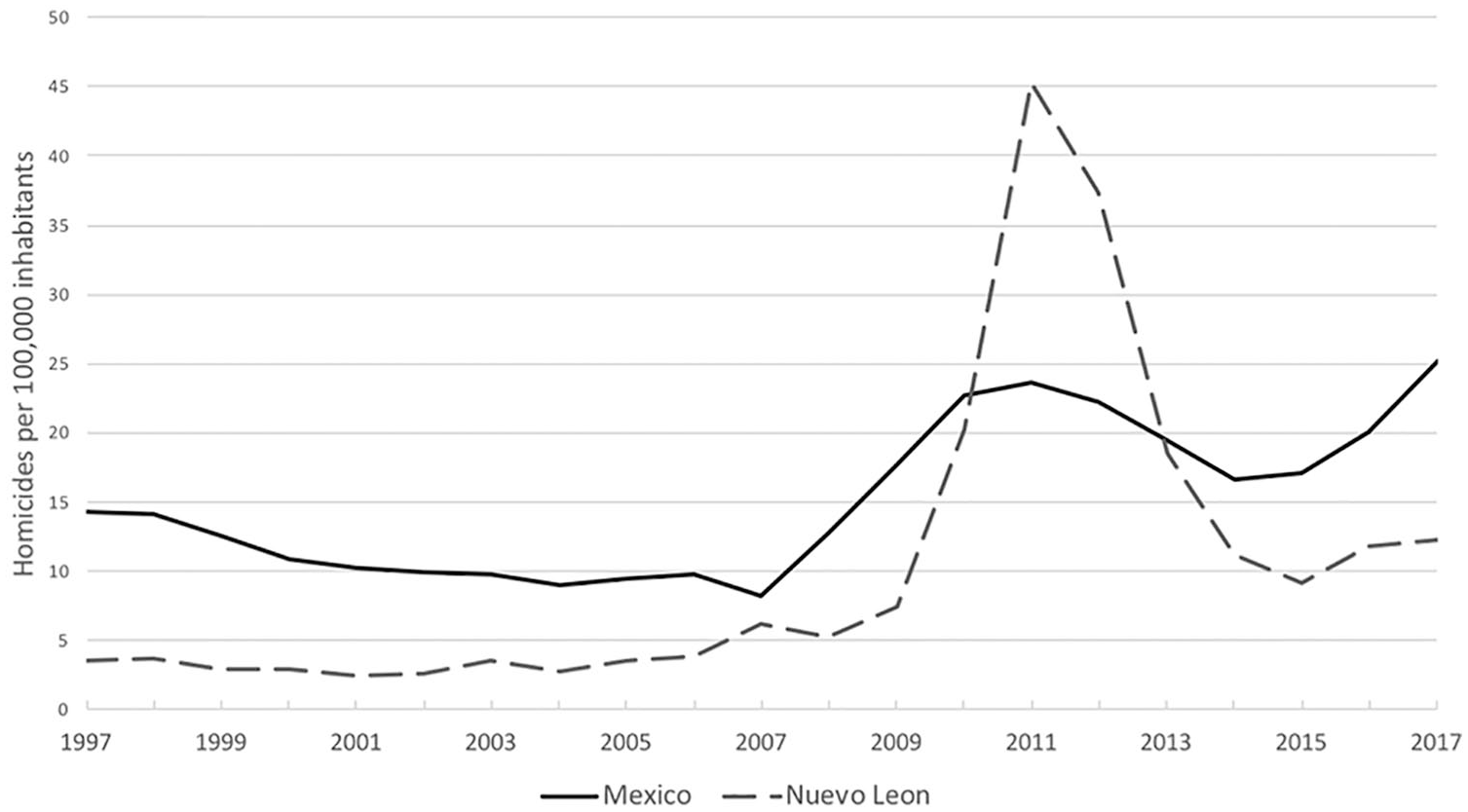
Homicide Rates for Mexico and Nuevo Leon, 1997 to 2017.
As violent organized crime erupted from the underground, the code los malitos emerged in everyday speech. I inadvertently documented the use of los malitos for the first time in my personal journal in 2010, after a routine phone call with a family member in Monterrey who reported they “heard sirens all the time” and that quintas, or country homes, in a nearby town had been abandoned and were now “inhabited by los malitos.” I was living abroad, although already “in the field.” Most ethnographers struggle to gain access to a new field site. My struggle was to gain distance. Monterrey is my hometown. I had access through growing up in this metropolis: an extended family; numerous friends and acquaintances from two decades of attending elementary school, high school, and college; and previous work and fieldwork friends and acquaintances from across the class spectrum. Returning to Monterrey in the midst of such spectacular violence (Goldstein 2004) put me in the position of an ethnographer conducting a “revisit” (Burawoy 2003). I drew on previous ties to conduct a 24-month ethnography of everyday adaptations to violence, beginning in the summer of 2011, through most of 2012 and 2013 and early 2014, with short revisits in 2015 and 2017; traditional stages of “entering” and “leaving” the field, however, do not map onto this project neatly. Not only was I in the field prior to deciding to conduct this research project, but being local meant some of the savvy advice I received on how to conduct fieldwork in high-violence environments—like scheduling the most dangerous interviews right before catching a flight out—did not apply to me.
I moved slowly through trust networks to build a sample of 154 local residents from across the class spectrum (14 working-class, 66 middle-class, 36 upper-middle-class, and 12 upper-class residents). I did not collect enough information on the education and profession of 26 more informants to assess their class position. Most of the people I spoke to were in their 30s (n = 66) and 40s (n = 35). I also spoke to people in their 20s (n = 21) and 50s (n = 17) and a few people in their 60s (n = 6), 70s (n = 1), and 80s (n = 2)—I spoke to 6 individuals without collecting data on their age. I observed 47 everyday spaces, ranging from schools to parks to violent death memorials, and 50 events, such as peace protests, civic organization meetings, political rallies, and state-sponsored social events in public spaces. I volunteered at three nonprofit organizations and participated in a year-long urban violence seminar at a public university. Most importantly for this article, I coded 163 cases of people talking about violent crime in the city in my fieldnotes and interview transcripts, including multiple cases of extortion, kidnapping, carjacking, murder, burglaries, being caught in crossfire, and shootings. The bulk of crime talk I documented was either testimonial (direct victims) or anecdotal (victims in their social networks).
From among this sample, I conducted 69 interviews with Monterrey residents in which I examined, among other topics related to adaptations to violence, how and when los malitos emerged in their narratives. If los malitos were not mentioned, I asked if interviewees had heard the term and what they thought were the main attributes of los malitos (Had they seen anyone they thought might be a malito?). Interviews confirmed that the use of the code was widespread. Even those who “hated that name” had heard it and provided some explanation for its common use. Coding my fieldnotes and interview transcripts, I noticed a significant difference in the words people used to reference organized crime depending on whether our conversation took place in private or within hearing range of others and depending on whether we had an established trust relationship or had only met briefly. Two conditions made it likely for residents to use los malitos: lack of privacy or lack of trust. Los malitos featured more prominently in fleeting conversations with people I did not know, even if we were able to talk in private. Similarly, locals were less likely to use words like narco or drug trafficker or reference the Zetas or the Cartel del Golfo when interviewed at coffee shops or restaurants, regardless of how well we knew each other.
New Dangers, New Codes
In this section, I trace the bottom-up emergence, main attributes, and minimizing traits of los malitos as label, code, and symbol. As mentioned earlier, the escalation of violence in Monterrey was quantitative and qualitative. In 2006, the local newspaper El Norte published “Escalating Crudeness: A Body Is Dumped in Three Bags,” describing one of the first dismembered bodies found behind a lake in the outskirts of Monterrey: With escalating terror, a new chapter in the war against the narcos in Nuevo León was written yesterday when the executed and dismembered body of a man was found behind the dam of the presa de la boca. . . . [I]n what seems to be the continuation of a wave of death unleashed by supposed Zetas . . . experts found a note in one of the bags threatening that “heads will continue to roll” unless the government captures members of the Cartel del Golfo listed in the note. The note also said that members of federal corporations protect that cartel. (Ramírez 2006)
In 2006, finding a dismembered body near Monterrey was an extraordinary event. The article’s tone highlights the rarity of the occurrence, framed as a “new chapter” in the history of the city and the state. The journalist provides details on a note explaining the death as an outcome of a turf war between the Zetas and the Cartel del Golfo, explicitly naming these groups of organized crime. Homicide rates were still low in 2006, but this dismembered body signaled that a major turf war was underway. Violence escalated, and such displays of gruesome death were no longer limited to the outskirts of the metropolis and the urban margins (Auyero, Bourgois, and Scheper-Hughes 2015; Wacquant 2004). At the turn of 2011, El Norte (2011) reported, After 12 months of executions, shootings and even car bombs, Nuevo Leon said farewell to 2010 yesterday with a morbid finding: the body of kidnapper Gabriela Elizabeth Muñiz Tamez, “the redhead,” hanging from an overpass on Gonzalitos Avenue, in Colonia Mitras Norte. This is the first time in the history of the state that a body appeared hanging in the streets in public—an organized crime practice that has been observed in states like Tamaulipas and Chihuahua.
Whereas the dismembered body was a threat from organized crime to state officials and criminal rivals, this public hanging in one of the most important arteries of the metropolis aimed to terrify the population at large. More public hangings followed, including live executions in broad daylight. As violence escalated, it unsettled local criminal worldviews. Interviewed in 2013, a businessman recalled this period as one in which perpetrators had no defining features: “It used to be an unknown enemy. You can’t see it, you can’t hear it, you don’t know its name, it has no shape, wears no uniform, has no tattoo, doesn’t drive any vehicle in particular.”
Beginning in 2009, the code los malitos made subtle appearances in a newspaper article and two letters to the editor of El Norte, providing evidence of its emergence in everyday conversation. A journalist caught a local resident mentioning los malitos in an account of a pick-up truck theft: “los malitos (gunmen) pointed a gun at him [her neighbor], pulled him out [of his pick-up truck] and then drove out through the same street” (Talavera 2009). The journalist felt the need to include a parenthesis to explain to the reader that los malitos were gunmen. Explanations became unnecessary as the code resonated widely among locals (McDonnell, Bail, and Tavory 2017). In 2010, two residents wrote letters to the editor to publicly complain about use of the term. One wrote, “Why call them malitos or mañosos? Call them by their name: assassins” (Guzmán 2010). Another wrote, “Why call them malitos? These are not the enemies from Pipo’s ‘little adventures,’ these are real-life criminals who do not care about anybody’s life. Call them by their name and fight them accordingly” (Moreno 2010). The second letter references the local television show the code is drawn from. 5 By 2011, los malitos caught the attention of a CNN correspondent documenting “new ways of talking about drug trafficking” in Monterrey, who noted that for locals, “drug trafficking is a great taboo. In principle, nobody knows anything and the most frequent way of succinctly ending any exchange is ‘it’s the malitos, that’s it’” (Alis 2011).
Over the course of fieldwork beginning in 2011, I documented the use of los malitos in everyday conversation and privately inquired on its traits during in-depth interviews. A middle-class tech worker in his 40s explained that due to these “new forms of violence . . . you need to protect yourself, [though] you’re not sure from what, andas cuidándote mucho, de no sabes qué, but you’re more worried about your integrity.” This “not sure from what” is a not sure from whom. The ambiguity of danger was a central feature in his definition of los malitos:
Have you heard the term los malitos?
Yes, los malitos, well, it comes from bad people, gente mala, people who are involved in illicit businesses so to speak, the drug traffickers, the snoops, los famosos halcones, who are only in charge of surveilling people, the kidnappers, the ones running the security homes, casas de seguridad [where the kidnapped are held hostage], the killers. All of them. It’s all there, the different groups, all encompassed in the term los malitos.
Have you ever seen them or seen someone who you thought might be a malito?
Hmmm. You can’t fall in the stereotype and say “this is a malito” because of how they dress or behave, but they do have some shared traits, tienen ciertas características. I know a few that are in this and let’s just say, they don’t fit the stereotype. They are educated, es gente muy preparada, people that if you see them, you won’t think that this is what they do. I’ve been close to them, talking to them, and they do have some very, very educated people, gente muy, muy preparada.
Los malitos encompasses different factions and different roles of organized crime (snoops, security guards, killers, kidnappers). In Mexico, organized crime, drug trafficking in particular, is often associated with a clearly defined set of cultural consumption and behavioral practices, broadly referred to as narcocultura or narcoculture, but this tech worker drew on his own interactions with organized crime to claim one would not be able to tell them apart based on their appearance. 6 Similarly, when anthropologist Shaylih Muehlmann met a taxi driver from Monterrey at a Caravan for Peace protest in Los Angeles—whose sister had been abducted years earlier—the driver told Muehlmann (2013:329) he was “driving narcos around” all the time in Monterrey and couldn’t help it: “You don’t choose what people you pick up. . . . And you can’t tell anyway because they could be anyone, niños y viejitos, working as narcos.”
Uncertainty of not being able to “tell” who could be involved with organized crime compels the classification of people into good and malitos. By naming a wide range of actors involved in organized crime malitos, users of this code are also minimizing the threat. A graduate student in his 20s explained in an interview: How can you live with the violence? The gunmen, los sicarios, are the violence; the drug traffickers, los narcotraficantes are the violence. They are people. I don’t look at it [the violence] as shootings; it’s about the people doing the shooting. How do you live with them? You minimize it. It’s like the guy who has emphysema; he minimizes it. “Oh, it’s a little lung infection, una infeccioncilla,” to be able to live with it. “Oh, it’s los malitos.” If I say assassins, how can I go out there if there are assassins?
Labeling murderous assassins malitos allows locals to “live with it,” but this coping code had its critics. Like the authors of the two letters to the editor cited earlier, a businessman in his 40s complained: “At school they would say, hey, this and that . . . and los narcos and los malitos . . . how I hated that name, los malitos, to minimize this shit, así como para minimizar la mierda.” Another reiterated: “I don’t like this calling them los malitos. This is organized crime, we try to diminish it; they’re delinquents.” Los malitos is specific to Monterrey, but other cities in northern Mexico developed an equivalent code. In 2013, a sociologist who conducted fieldwork in numerous border towns across northeastern Mexico recalled during a seminar how people refer to organized crime in other cities: I travel across the border . . . and I write down how people call them [organized crime] in different places and nowhere do people refer to them for what they are, en ningún lado se les llama como lo que son. Look, in Juárez its los malandros; in Monterrey, los malitos; in Matamoros it’s la maña and in Acuña, in Coahuila, its los malos . . . that is how people talk about all who are involved in illicit activities . . . in general.
Similarly, in 2010, anthropologists María Eugenia de la O and Nora Medina Casillas traveled to the border town of Matamoros, Tamaulipas, to interview male maquiladora workers for a study on gender and work. They reported seeing “large vehicles, like Lobo pick-up trucks or Suburban with polarized windows, chrome wheels and communication antennae on the roof. People explained discretely looking down at the ground that they were los mañosos or la maña” (de la O and Medina Casillas 2012: 184). At first, de la O and Medina Casillas thought los mañosos were youth harassing female maquila workers because despite being Spanish-speaking anthropologists, they were not local. Only later did they realize, “this is how they called organized crime in the city.” Polit (2013:2) notes, “Although the news constantly reminds us that narco trafficking is a global phenomenon, its human dramas, its cultural and social effects can only be understood when examining local contexts.” Codes vary from city to city, but each of these cities has a code locals use to allude to organized crime in general and in anonymity. Moreover, these codes have minimizing traits. Just like los malitos is Spanish for little evil guys, los mañosos, los malandros, and la maña are Spanish for tricksters, rascals, and tricks or bad habits. These symbols prompt symbolic security by reordering the world into a safer place with lesser villains.
Talking in Code When the Walls have Ears
Coping codes are used in contexts where people are uncertain of who might be listening and afraid of retaliation for talking. Locals from across the class spectrum used the coping code los malitos at social gatherings to defend themselves while sharing their close experiences with organized crime in public and to alert each other of potential danger.
In 2012, I attended the baby shower of a former bus line secretary I met while conducting previous ethnographic fieldwork as a bus driver in a working-class neighborhood. I arrived at the baby shower venue—a fast-food restaurant serving soups and salads in downtown Monterrey—and found her smiling as widely as her growing belly. She asked what I was up to these days. “I came back to study how Monterrey has changed in recent years,” I said casually. “Everything changed,” she replied dropping the smile, terror in her eyes. “I did not want to have a baby shower. I was afraid nobody would come to Juárez.” Juárez is the municipality where she lived with her husband, where we went out for tamales years before, and where multiple mass graves were found in recent years. She chose this fast-food restaurant in Monterrey at noon hoping people would show up. Shortly after, one of my former bus driver instructors came into the restaurant. As we caught up on what had happened in our lives since we last met years before, organized crime quickly slipped into the conversation: Not much has changed, though I’ve been robbed three times on the bus, and I was stopped by los malitos once. . . . It was 4 a.m., right at the beginning of my shift. They stopped me and I froze. . . . A private security van that was chasing them stopped in front of the bus, then turned and drove away.
The bus driver had been forced at gunpoint to block an avenue and facilitate the escape of organized crime members during a car chase—a practice locally referred to as a narcobloqueo. In this example, the bus driver clearly differentiates los malitos from the petty criminals who robbed her three times on the bus. Los malitos is not code for all forms of criminality but for all forms of organized crime in particular. I did not ask my old bus driving instructor who los malitos were, and she did not seek to clarify who los malitos were despite the fact that we had not seen each other in years. There was an assumption I would know who she was talking about.
A month later, I attended a birthday party at a gated ranch about a 30-minute drive from Monterrey. There were around 180 guests. Ten waiters served them drinks at their tables, a Mexican food buffet lined up several local specialties, and a band played live music. I joined a table with three women in their 50s and 60s, including a family member who invited me to the party and introduced me to the other two. “It’s so beautiful here, the Sierra Madre,” said one, relishing being in the countryside even if in a gated area, even if only by day. “It’s a pity we can’t access other places anymore,” said another. Within seconds, organized crime had slipped into this conversation over the beauty of a mountain range: I had to close my clinic, me cayeron los malitos, the malitos came. They threatened me saying they knew where I lived and where my kids were. I closed the clinic and sent my two sons to study abroad. . . . I would rather close my business than give one cent of the money my patients paid to improve their health to los malitos.
Organized crime attempted to extort this former clinic owner. Extortion, locally referred to as pedida de piso, is a common practice among organized crime that became widespread across the class spectrum in Monterrey, and elsewhere in Mexico, at this time. Faced with the threat of extortion and kidnapping, the former clinic owner decided to close her business and send her children abroad. To end her painful account, she picked up the lyrics of a popular song the live band was playing behind her and sang along: “Así es la vida de caprichosa, such is life, it’s capricious, a veces negra, a veces color rosa, sometimes dark, sometimes light, así es la vida, such is life.” We did not know each other. We did not know who was walking by or seated close to us, but using the code allowed the former clinic owner to continue processing her experiences in public. Singing “such is life” suggested she was accepting her losses in a context where widespread state collusion makes fighting for justice dangerous.
Three weeks later, I met a college acquaintance for lunch at a college cafeteria. We talked about how the city had changed while I was abroad, and the 33-year-old turned to shifts in her nightlife practices following a close encounter with organized crime and the local police when heading home from a bar: I stopped going out at night . . . we were just driving off when a cop signaled us to pull over. He asked if I had been drinking. I said one beer. He said “We have a zero-tolerance policy” and asked us to step out and get into his car. “Show me the zero-tolerance policy, I am not getting out of the car,” I told him. Then a malito showed up in his tall black pick-up truck. He parked the truck, approached my car window and told us to stay in the car and tell the police we were with him at a party. He was very drunk. The cop asked if we knew the man from the truck and I said we didn’t and we had not been with him. The cop had my driver’s license. The malito turned towards the cop and ordered him to let us go.
The policeman asked the college professional if she knew the man in the truck. She did not, but the policeman probably did given that he promptly obeyed. The malito in this example, identified by his tall pick-up truck, was no petty criminal. He was above the law and could order a police officer around. This brief interaction exemplifies the double threat Mexicans confront living with violent organized crime and colluding state officials as well as the specific gendered vulnerability women in such violent contexts experience. Taken together, these three examples drawn from conversations with upper-class, middle-class, and working-class locals illustrate the defensive and cathartic use of los malitos across the class spectrum. People who have been stopped at gunpoint or faced extortion and kidnapping attempts or harassment in the streets talk to share and make sense of their experiences with others.
Locals also used the code to inquire about or caution each other of organized crime activity in an area, ranging from a neighborhood block to a nearby town. A taxi driver recalled inquiring about and warning his neighbors of extortion on his block. “Hey, oye, no te han caído los malitos, have the malitos come here?,” he asked a neighbor at a hardware store. “Well, they haven’t until now. . . . Why do you ask?,” he replied. “I’m a neighbor, I live on this avenue . . . my daughter’s business, she had a taquería and the malitos came, cayeron los malitos.” Following extortion threats, his daughter closed her taco stand on the same avenue as the hardware store. The taxi driver was both inquiring how widespread extortion was on the block and warning his neighbor of a potential threat. Similarly, when describing new security practices, a motorcyclist shared he now asked locals in nearby towns whether it was safe to go for a ride: “Hey, what’s insecurity like over there? ¿Oye, cómo está la inseguridad?” He stayed away if locals replied, “not now, don’t go there, it’s very dangerous, there are a lot of malitos.” Silence is an established coping mechanism among people living with organized crime, but people also need to talk. In this section, I drew on ethnographic data to examine the defensive use of los malitos in practice as both cathartic and cautionary. I now turn to the broader societal consequences of these codes.
Impunity, Vulnerability, and Symbolic Security
In dangerous and unsettled times, new symbols can be used not only to minimize a threat but also to draw new symbolic boundaries. In this case, los malitos was used to (re)draw symbolic boundaries around criminality and victimhood that both challenged and reproduced top-down narratives of the Mexican “war on drugs”, its villains, and its victims. The threat posed by violent organized crime in Monterrey, as elsewhere in Mexico, is aggravated by widespread state collusion and impunity. Not only are local residents confronting terrifying organized crime, even the most privileged distrust state authorities.
7
For example, an upper-class resident used los malitos to reference state officials living in her exclusive neighborhood: All the malitos live there . . . the marines were just up there getting a guy, un wey, out of his house, it’s really funny, they take refuge there and people just look the other way, la gente se hace pendeja. . . . You hear [she lowers her voice] from your neighbor’s domestic worker that a state official comes home with bags full of cash, you say, wey, who are they? . . . You get this information and what do you do? I mean, o sea, it’s best not to know, but they already told you, so what do you do? Nothing, and this is what makes you feel impotent. You learn to live with it, to say, this is how it is.
In this example, los malitos challenged official “war on drugs” narratives when used to encompass state actors as well. Like the graduate student in a previous section, this upper-class resident asked, “Who are they?” “They” are not only the sicarios but also state officials coming home with bags full of cash. They are her neighbors. She relayed a dialogue she had with her husband: “They should go to the police . . . well, no, they’re all the same, son los mismos . . . or ‘you know what, maybe they should pass a law!’ . . . ‘Well yes but, who is going to enforce it?’ ‘Ah, the police again.’” She shrugged. “So, it becomes a useless exercise, because you’re also told, don’t do anything, nombre, ni le muevas wey, they’ll kill you.” Like the person singing “such is life” in the previous section, this resident detailed the multiple dead ends that brought her to shrug her shoulders and say, “this is how it is.” By encompassing state officials within los malitos, this resident is critical of the “war on drugs” narratives, but she sees no alternative but “learning” to live with it.
Residents also challenged the widespread corruption and collusion. In 2015, a civic organization launched the “Corruptour,” a tourist bus that offered a free tour of some of Monterrey’s most iconic sites of corruption. The New York Times reported that the broadside of the bus included “caricaturized faces of the state’s former and current governors. Both grin at passers-by, drawing stares at each of the 11 ‘corruption landmarks’ that the bus tour aims to spotlight, including the casino where gunmen started a fire that killed 52 people” (Villegas 2015). A local writer published a chronicle of his experience riding the Corruptour: The Corruptour made me feel particularly vulnerable. Like when [President] Calderón’s war started and we all had to stay home. Outside you were a suspect or were abducted-disappeared-killed. By whom? First, by the blue ones, los azules [the police]. Unfortunately, pedestrians cannot trust authorities. Not then, not now. Then, by los malitos, as people used to call suspects in Monterrey. Malito, what is a malito? Well, it comes from the villains from Pipo the clown’s famous television series for Televisa Monterrey. And everyone felt safe because they didn’t mention the word narco, or zeta, or this or that cartel. The Corruptour mentions these malitos but with a twist, una vuelta de tuerca, for los malitos are our politicians. (López 2015)
Once again, los malitos is used to encompass state officials and challenge dominant “war on drugs” narratives. Riding the Corruptour through the “corruption landmarks” of the city made the writer feel “particularly vulnerable,” as locals felt when they heard crime stories in their social networks. In 2012, four college students raised this point in conversation with each other:
They kill somebody and then it’s like, “well it was surely because of” or “he was surely so and so.”
“He had ties,” yeah, “he was into something.”
They kill a cop and it’s like, “of course he was part of it.”
Or they kidnapped so and so and “mmmm well it’s because he was a drug addict.”
I think that’s how it started . . . it was about drawing a line and saying, “well, he must have done something, right?”
To protect yourself, as a society, upright, I mean, to say “he was wrong, we’re still right,” I mean, “we’re pure but he was wrong.”
And people say “good.”
“It was his turn because he was a malito.”
This use of los malitos as a label for victims of violence reproduced and contributed to top-down criminalization narratives. Victims of violent organized crime and colluded state officials in Mexico are criminalized not only from above in political discourse and the media (de Lachica Huerta 2020; Mondragón n.d.) but also from below in everyday conversation. “He had ties,” “he was into something,” and “he was part of it” are everyday forms of sentencing the dead and the disappeared. The students recalling these narratives in conversation with each other highlight how this is both an individual and a collective form of protection (“to protect yourself, as a society, upright”).
To understand what people are protecting themselves from, it is important to consider that stories are not only shared but experienced (Sacks 1984). In a previous section, I used statistics and media coverage of new forms of violence to reconstruct the quantitative and qualitative escalation of violence in Monterrey. However, local narratives of new forms of gruesome violence did not start with the first media report of a dismembered body but with stories of violent crime in residents’ social networks: It all started with one or two kidnapping stories, and everybody thought it was something really strange. Little by little it became clearer, every time you would hear this happened to “the friend of a friend of a friend” and then “the friend of a friend” and then it happened to a friend. Then, yes, I began to feel a fear in me and in the collective as well, right?
For this local resident, as for others, “it all started” with “stories.” Violence escalated as these stories no longer featured “friends of friends of friends” but their own friends. Another resident who knew several people who were forced out of their vehicles, assaulted, and caught in crossfire explained, “It’s no longer ‘the friend of the friend of your compadre’s neighbor’ . . . it’s people close to you, it’s your friends. . . . You know that it is perhaps very likely that you’ll be next.”
In the midst of encroaching danger, the last line of social “defense” is symbolic. Sentencing the dead in everyday conversation “protects” the storytellers not from violence but from experiencing that they will “be next.” The victim “must have done something” because if they did not, then the person doing the sentencing is more vulnerable to a similar fate than they can bear to experience. “It was his turn because he was a malito” is a local variation of a national trend depicted by Mexican cartoonist Antonio Helguera in “To Die in Mexico” (see Figure 2). Helguera portrays several common everyday sentences as epitaphs on tombstones: “must have been into something,” “they’re killing each other,” “who knows what he was into,” “she was a whore,” and “she dressed in a provocative way.” Sentencing victims as malitos allows individuals to distance themselves not only from violence but also from its victims. It creates symbolic security at the expense of those who have fallen.
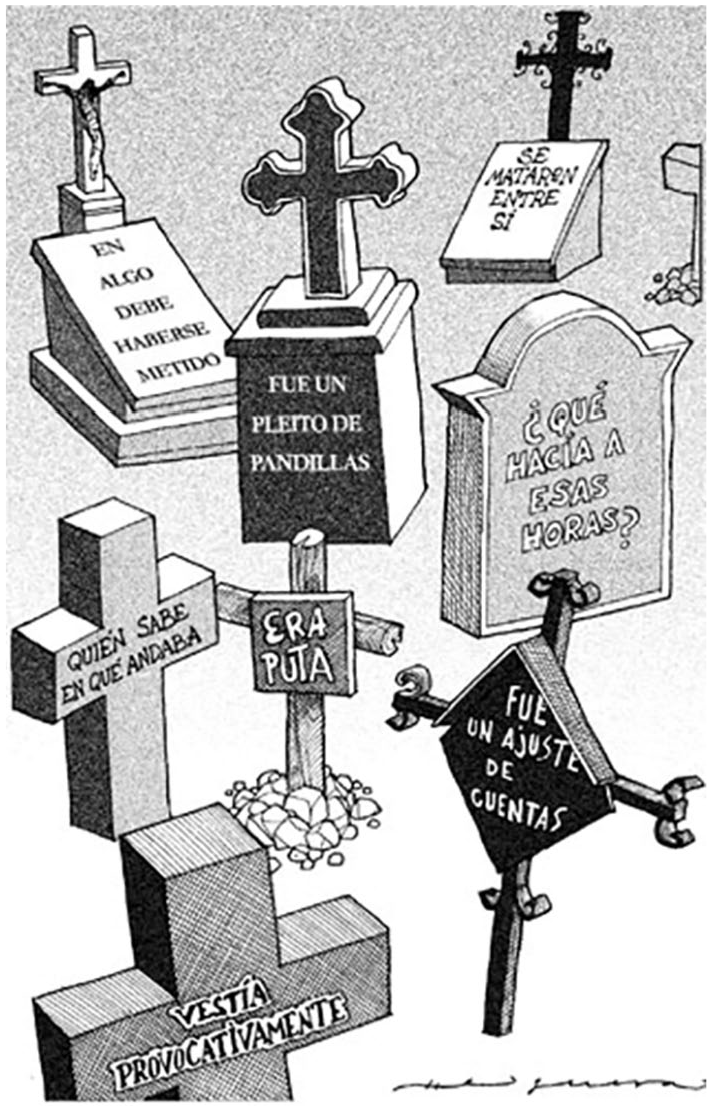
The Deviant Dead.
Domesticating Danger in Unsettled Times
Drawing on and extending grassroots approaches to labeling processes (Erikson 2005; Goode and Ben-Yehuda 2009; Morin 1971) beyond moral panic theory, I argued that labels can be used not only to construct and exaggerate a social threat but also to cope with danger. I drew on ethnographic observations of everyday conversation in the midst of a violent turf war in urban Mexico and in-depth interviews with a broad range of residents to conceptualize coping codes. These defensive labels allow individuals to allude to threatening actors without being explicit—in this case, organized crime labeled malitos. I traced the bottom-up emergence of this coping code, which allowed people to both minimize dangerous actors and share victimization stories without being explicit. Coping codes emerge from below, but they can both challenge and reproduce official narratives from the top. Los malitos challenged “war on drugs” narratives when applied to state officials, but it also reproduced and coproduced them when applied to victims of violence “accused of being into something.” I drew on research on symbolic boundaries (Lamont and Molnár 2002; Pachucki et al. 2007), including work on the effect of media and state narratives of the “war on drugs” on the criminalization of the dead in Mexico (de Lachica Huerta 2020; Muehlmann 2020; Schedler 2016), to explain how and why violence, impunity, and vulnerability converge in the everyday sentencing of the dead from below. Ultimately, I argued that coping codes can prompt symbolic security through the creation of new symbols that minimize danger and the drawing of new symbolic boundaries that allow individuals to distance themselves from both danger and its victims.
Sacks (1984:419) argues that an individual’s first reaction to rupture, as in witnessing or experiencing a catastrophic event, is to minimize it: An airplane passenger watching someone point a gun at a flight attendant might first think “he’s showing her the gun” rather than he’s hijacking the plane, just like someone hearing gunshots might initially assume they are “backfires.” Similarly, coping codes like los malitos reveal it is not only individuals but also collectives that can have a minimizing reaction to rupture. The onset of plagues and pandemics offers further evidence of this collective, minimizing reaction to rupture. Delumeau (1978:147) traced a refusal to speak of incoming plagues among residents of several European cities in the seventeenth and eighteenth centuries: A sort of unanimity in the refusal of words considered taboo. They were avoided. Or, if they were used in the beginning of an epidemic, then it was in a negative and reassuring tone such as “it’s not really the plague.” To name evil would be to lose the last resort to keep it away.
In 2020, as COVID-19 entered the Oxford dictionary, coping codes for the coronavirus emerged in everyday conversation, including “the rona” and Miss Rona (Lawson 2020; Ro 2020). Lawson (2020) argues that (re)naming practices, events, and social conditions “gives people a shared vocabulary” and “can help people cope and get a handle on really difficult situations.”
Coping codes emerge not only in the midst of tumultuous social rupture when people strive for a sense of normalcy but also in response to ongoing dangers like sexual harassment and deportation. In 2014, women gamers engaged in the Gamergate campaign protesting sexism were targeted when they used the term Gamergate in their tweets. They came up with the alternative Goobergaters to “discuss harassment without inviting it” (Mediaverse 2018). Van der Nagel (2018) conceptualizes this practice of avoiding specific names or keywords on social media as Voldemorting—a reference to Lord Voldemort, or He-Who-Must-Not-Be-Named, in J.K. Rowling’s Harry Potter. #Goobergaters was a short-lived online coping code. Other coping codes are passed down from generation to generation, like la migra, a reference to federal immigration officials Hispanics in the United States know too well—more than half fear deportation of someone they know (Pew Research Center 2017). A U.S.-born Texan recalled her mother urging her to be quiet as a child whenever la migra was near. “Shhh, no hablen, la migra anda por aquí. . . . I didn’t know what the migra was, but if mom said be very quiet, we listened” (Levi 2017). Growing up in Eastside Los Angeles, another U.S. resident explained he was aware of la migra from a young age: “These are things I heard in my neighborhood and on the streets as I played. Even though I was born here, I was afraid. The fear was always there” (Del Real 2019). Whether in unsettled or settled times, online or offline, coping codes emerge from below because they stem from a shared experience and common need to manage and circumvent danger.
Coping codes developed at the onset of major social ruptures, like los malitos and Miss Rona, capture a moment within a larger process of domesticating danger that requires further investigation. It is remarkable, as Sacks (1984:419) notes, “to see people’s efforts to achieve the ‘nothing happened’ sense of really catastrophic events.” It is even more remarkable (and distressing) to see individual and collective efforts achieve that “nothing happened” sense in dangerous unsettled times. As the “ordinary cast of mind” (Sacks 1984) incorporates los malitos and Miss Rona, as people are able to talk about, make sense of, and tell themselves “this is how it is,” a catastrophe can cease to generate events (Wagner-Pacifici 2017). Both individuals and collectives will tend to domesticate danger. They will do this in many ways, including through creating new symbols and drawing new boundaries that make them feel safer. However, as this research shows, it is vital to problematize these coping mechanisms and examine at whose expense a dangerous world is symbolically secured.
Footnotes
Acknowledgements
I am indebted to Michel Anteby, Javier Auyero, Andrea Beltrán-Lizarazo, Japonica Brown-Saracino, Teresa Caldeira, Sergio Delgado, Susan Eckstein, Mustafa Emirbayer, Laura Enriquez, Julian Go, Heba Gowayed, Ieva Jusionyte, Nazli Kibria, Malgorzata Kurjanska, Mara Loveman, Ashley Mears, Agnes Mondragón, Heather Schoenfeld, Jessica Simes, Loïc Wacquant, Kirsten Weld, and the reviewers for their helpful feedback and support. I also wish to thank participants of the Latin America Working Group at UC-Berkeley and the Latin America and Caribbean Workshop at the University of Chicago for comments on earlier drafts.
Funding
The author disclosed receipt of the following financial support for the research, authorship, and/or publication of this article: This work was supported by the Harry Frank Guggenheim Foundation, UC MEXUS, the BU Pardee School of Global Studies, the BU Initiative on Cities, and the BU Center for the Humanities. This research was also assisted by a grant from the Drugs, Security and Democracy Fellowship Program administered by the Social Science Research Council and the Universidad de los Andes in cooperation with funds provided by the Open Society Foundation and the International Development Research Centre, Ottawa, Canada.

Notes
Author Biography
References
Supplementary Material
Please find the following supplemental material available below.
For Open Access articles published under a Creative Commons License, all supplemental material carries the same license as the article it is associated with.
For non-Open Access articles published, all supplemental material carries a non-exclusive license, and permission requests for re-use of supplemental material or any part of supplemental material shall be sent directly to the copyright owner as specified in the copyright notice associated with the article.
