




Abstract
There is conflicting evidence about the pathways Street Level Bureaucrats’ (SLBs’) use to engage Innovative Work Behavior (IWB). This study uses Street Level Bureaucrat (SLB) and Conservation of Resources (COR) to examine the extent to which SLBs’ work engagement and/or burnout mediates the relationship between Psychosocial Safety Climate (PSC) and teamwork, and IWB. The methods comprised a sample of 259 healthcare SLBs (doctors, nurses, allied health) collected at two times, and analyzed using structural equation modeling. The results show that the variance of PSC and teamwork explained a third of engagement, and engagement-burnout mediated the impact of PSC and teamwork on IWB, explaining over half of their IWBs. This study contributes new information about the two pathways that SLBs use to initiate IWBs. Contrary to COR theory, this means that both work engagement and burnout are pathways for SLBs using IWBs. First, as per COR theory, SLBs use IWBs when they have sufficient organizational and personal resources to enhance their engagement to use IWBs. Second, as per SLB theory, some SLBs use IWBs as a coping mechanism to reconcile their professional/personal values and beliefs with their finite level of psychological capacities (especially energy).
Fostering Innovative Behavior Under Pressure: The Impact of Psychosocial Safety Climate, Teamwork, and Employee Well-Being
Street Level Organizations (SLOs) expect Street Level Bureaucrat (SLBs) to use Innovative Work Behavior (IWB) to circumvent inadequately funded, cumbersome, ambiguous (often) bureaucratically-laden policies and rules to deliver public services. SLBs are employees who deliver services to the public under conditions of demand exceeding supply, necessitating the use of discretionary power to develop rule-bound procedural routines as a measure for coping with the task of rationing scarce resources. IWB is recognized as the pathway for improving organizational processes so that more services can be delivered (Demircioglu & Van der Wal, 2022). There is conflicting evidence first, about the extent to which organizational factors such as Psychosocial Safety Climate (PSC) and teamwork are antecedents of Street Level Bureaucrats’ (SLBs’) Innovative Work Behavior (IWB); and second, the extent to which their work engagement and/or burnout mediates the relationship.
There are two competing theories that could explain SLBs’ pathways for using IWBs. According to the Conservation of Resources (COR) theory, humans have a finite resource reservoir, and when their resources are depleted, Hobfoll et al. (2018) argue that they are more likely to experience resource loss spirals, which then lead to increasing levels of psychological distress (de Vries & Bakker, 2022). Bakker (2015) explained that personal psychological capacities can drive work engagement UNTIL their well-being is threatened. At that point, a second continuum emerges, with two possible outcomes for employee well-being: burnout or engagement. Burnout is defined as a negative psychological strain/distress caused by over-taxing the body/mind, whereas work engagement refers to positive work behavior demonstrating highly absorbed workers (Bakker & de Vries, 2021).
Bakker and de Vries (2021, p. 2) argued that “when people burnout from their jobs, they are no longer interested in making a positive contribution,” and therefore less interested or capable of engaging in IWBs. This perspective is supported by Demircioglu et al. (2023), who argue that if the organizational environment supports employees, they are more likely to have the resources required to maintain their engagement to pursue IWBs. In particular, Demircioglu et al. (2023, p. 157) argue that “[. . .] the most important factor affecting the implementation of innovation is employees’ innovative behavior (IWB) [. . .]”; and that requires an innovation-enabling culture. Similarly, research conducted in the private sector suggests that highly engaged workers are more likely to provide recipients with a service that benefits them positively through the use of IWB (Garg & Dhar, 2017).
However, SLB theory may offer an alternative explanation for SLBs’ IWBs. It may be that SLBs who feel burnout, perceive IWBs as a coping strategy and, therefore, use their discretion to find innovative ways to modify policies by either broadening the interpretation of rules and/or breaking rules, but always within strict professional boundaries (Tummers et al., 2012; L. L. G. Tummers et al., 2015). For example, according to Lipsky (1980, p. 144), SLBs use coping mechanisms “to make their jobs psychologically easier to manage” [and] “as responses to job stress.” Similarly, L. L. G. Tummers et al. (2015, p. 1100) argue that SLBs cope with stress using strategies “[. . .] in order to master, tolerate, or reduce external and internal demands and conflicts they face on an everyday basis.”
Hence, this study examines two pathways to IWB. Using a COR perspective, we expect that PSC (demonstrating supportive leadership behaviors) combined with supportive colleagues (i.e., teamwork) will provide an innovation-enabling culture, which will limit burnout and instead drive work engagement to foster SLBs’ IWBs. PSC measures employees’ psychological risk, and high PSC is characterized by management fostering a culture of prioritizing stress prevention ahead of the achievement of performance goals (Dollard & Bakker, 2010). There is also evidence from private sector employees about the important role of teamwork (collaboration) in facilitating work engagement (Liu et al., 2022), and, most notably, the role of engagement in fostering IWB (Chang et al., 2013; Ng, 2024). There is, however, a gap in knowledge about SLBs’ pathways toward IWB. The research question guiding data collection and analysis is:
The structure of the paper involves hypotheses development leading to a testable model (Figure 1), followed by the methods, results and discussion that integrates theory and results, and discusses the contributions of the study.
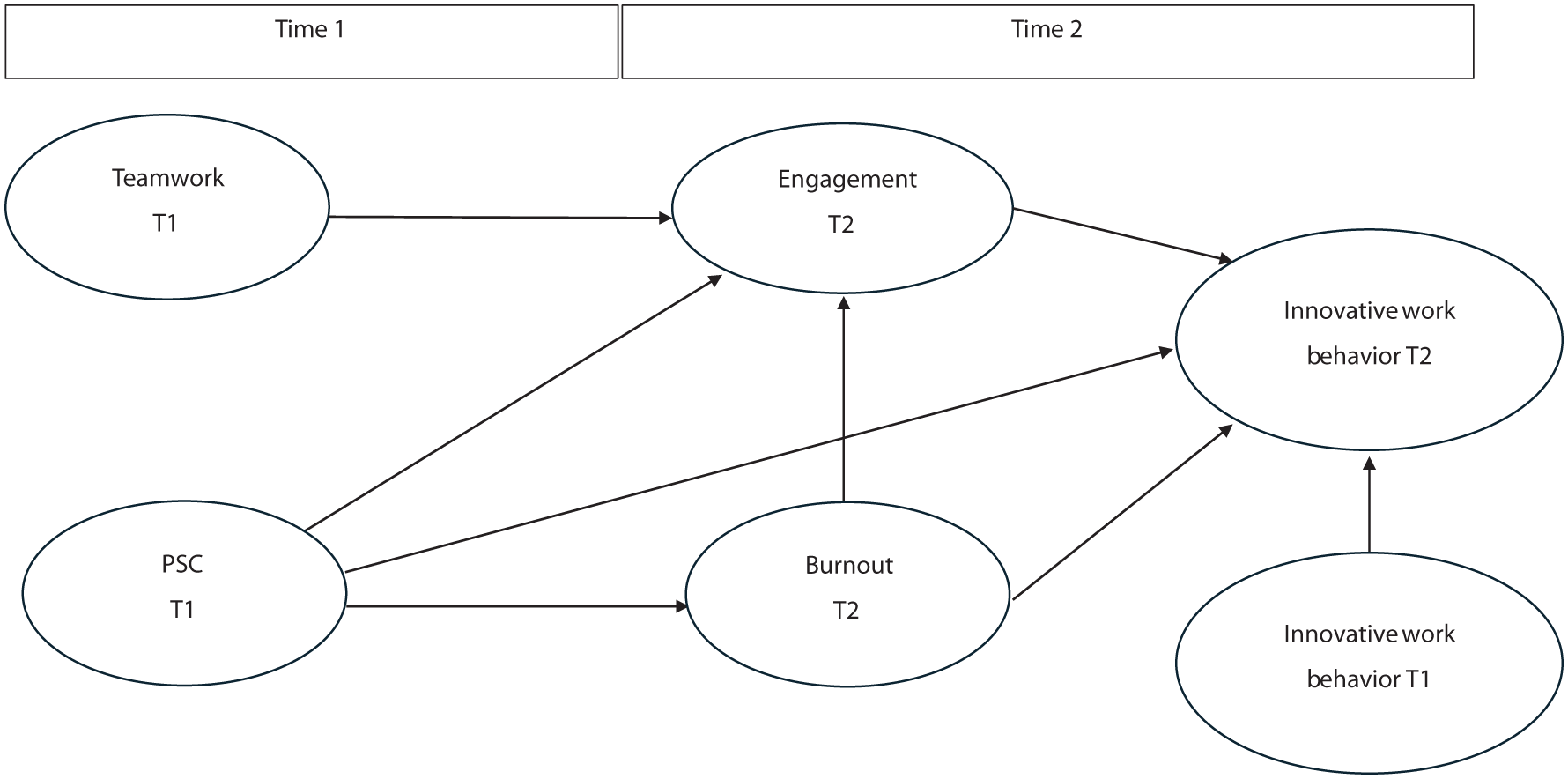
Theoretical model – hypothesized structural model
Theoretical Frameworks and Hypothesis Development
Street Level Bureaucrat Theory
Most research about public sector innovation has examined the antecedents and processes involved in organizational innovation, with the gap being about antecedents of IWBs (Demircioglu et al., 2023). There is growing evidence that an innovation-enabling culture is a significant pathway for IWBs for SLBs. For example, Brunetto et al. (2020) found that the quality of supportive management and psychological capacities explained much of the IWBs of SLBs in the USA, but very little for those in Australia. Brunetto et al. (2022) found that PSC contributed to an innovation-enabling culture during the COVID-19 crisis for SLBs. Brunetto et al. (2024) found that for SLBs working in the disabilities and aged care setting (mainly in NFP organizations), the variance of authentic leadership, age and acceptance of change explained a quarter of their IWBs. Also, Lee and Kim (2024) found that Public Service Motivation (PSM), organizational commitment and an innovative culture were predictors of IWBs for SLBs in South Korea.
L. Tummers (2011) argues that when SLBs experience incongruity between policies/rules and their beliefs, they may begin to disconnect. To overcome powerlessness, SLBs utilize their discretionary power to modify policies and rules, thereby reducing incongruity and ambiguity, which results in the likely increased meaningfulness of the service for those clients they deem the most deserving (Gofen et al., 2021; Jilke & Tummers, 2018). The act of modifying rules/polices is an IWB if it leads to a more effective use of resources and/or delivers a more meaningful service to clients, and it becomes an innovation when other SLBs use the same modifications/new processes (Demircioglu et al., 2023).
Additionally, Usman et al. (2021) analyzed and found a link between SLB’s client and societal policy meaninglessness and their psychological well-being. They identified a gap in the literature as the need to “[. . .] theorize and reveal different outcomes of policy meaninglessness . . . [especially in terms of understanding how SLBs] [. . .] develop feelings of burnout [. . .]” (Usman et al., 2021, p. 37). Previously, Lipsky (1980) and L. L. G. Tummers et al. (2015) identified that SLBs use coping measures when demand exceeds supply (public service gap), when policies are ambiguous and when bureaucratic rules make policies unworkable/meaningless (Lapuente & Van de Walle, 2020; Lavee, 2022).
If the workplace is continuously straining the well-being of SLBs, Bakker and de Vries (2021) argue that they will begin to experience psychological distress and, over time, burnout may result. These are the conditions that Lipsky (1980) argued lead to SLBs engaging in coping measures. However, an alternative view is evident using the Conservation of Resources (COR) theory (Ewert et al., 2021).
Conservation of Resources (COR) Theory
COR theory (Hobfoll, 2001) is used to explain personal SLBs’ motivation for IWB. Whilst COR theory encompasses several principles and three corollaries, Principles 1 (e.g., primacy of loss – a perceived loss of resources will impact far more than gaining resources) and two (e.g., resource investment – people must invest resources to protect against resource loss or gain new resources) and three corollaries are most relevant in explaining SLBs’ behavior. The three corollaries include: Corollary 1 – those with greater resources are more capable of gaining resources, and those with fewer resources are more susceptible to resource loss, Corollary 2 – resource loss spirals, and Corollary 3 – resource gain spirals (Hobfoll et al., 2018).
Resource loss for SLBs emerges, not only from the increased clinical safety and cleaning processes still required post the COVID-19 crisis, but also from sustained austerity-led management practices, as well as the increased number and acuity of service recipients. This placed SLBs at increased psychological distress, especially as many hospitals remain understaffed with chronic skills shortages in clinical care staff (Jobs and Skills Australia, 2023). This strain means that SLBs feel compelled to use their personal resources to address the organizational shortfall, which over time can initiate a loss spiral because of further workload increases, which likely prompts an additional resource loss – another COR Collaroy (individuals who lack resources are more vulnerable to further resource loss) (Hobfoll, 2001).
Whilst COR theory acknowledges that organizational practices (such as supportive PSC and/or teamwork) can mediate a cascading loss spiral using resource caravans (Hobfoll et al., 2018), its positive impact is limited. Hobfoll et al. (2018) describes resource caravans as a package of resources (such as supportive leadership and effective teamwork) that travel/operate together. All humans have fixed finite physical, psychological and emotional resources and when personal resources are constantly used, because organizational resources are insufficient, Corollary 3 comes into play; stating that even when resource caravans are provided, their impact is weak and slow in the face of resource loss. Hence, over time, SLBs under constant psychological strain are at greatest risk of experiencing burnout, and no longer have the capacity (drive, energy; Bakker & de Vries, 2021) and, therefore, are less inclined to engage in IWBs.
This study is guided by COR and SLB theories to better understand the workplace factors that impact employee well-being and innovative work behavior. Using COR theory, we argue that there are two potential pathways. In the first pathway, which we term the loss pathway, where SLBs lack the required resources to cope with the work environment, such loss is likely to be more salient than any potential resource gains, and create further loss over time, which may lead to burnout. In the second pathway, which we term the gain pathway, SLOs provide an innovation-enabling culture, where SLBs have adequate access to resources, which they can then apply to further gain resources (gain spiral), resulting in high IWBs (Demircioglu et al., 2023) and employee engagement. On the other hand, using SLB theory, burnout may be the reason for engaging in IWBs as a coping mechanism for reducing their burden (Lipsky, 1980). The next section provides a review of relevant literature, from which hypotheses emerge showing the gap being addressed in this paper.
Proposed Antecedents of Innovation-Enabling Culture
Psychosocial Safety Climate (PSC), Engagement, and Burnout
According to Dollard and Bakker (2010), PSC measures the extent to which management considers and subsequently prioritizes preventing employee stress when delegating work, which means that they prioritize employees’ health and safety before profit or performance; and ensure two-way feedback loops about key issues between management and employees and then take appropriate actions based on feedback. However, Safe Work Australia (2023) reports that healthcare workers still have stress levels well above the average stress levels of Australian workers. Edmondson and Bransby (2023, p. 64) identified numerous studies that showed poor PSC workplaces are characterized by high work demand, inadequate resourcing (especially in social and healthcare delivery) or poor culture evident by bullying and incivility; and all are linked to emotional exhaustion and burnout. Workplaces with poor PSC are linked to higher levels of psychological distress, burnout and an increased propensity for stress-related disease (Bakker & de Vries, 2021).
According to Bakker et al. (2014), burnout refers to a state that humans reach when their personal and job resources are insufficient to address their daily job demands. Previous research by Hernandez-Grande et al. (2025) found that PSC mediated the relationship between workplace trauma and psychological distress for Australian emergency services SLBs. The process happens over time as employees’ personal reservoir of psychological, physical and emotional resources is slowly depleted and they begin to experience more and more fatigue after work, which later morphs into increasing levels of exhaustion, ultimately making them more susceptible to chronic stress syndrome (Bakker et al., 2014). In terms of COR theory, high PSC represents an organizational resource caravan, which could result in SLBs being more capable of coping with high work demands and the steady erosion of their personal resources.
At the other end of the continuum, work engagement refers to the cognitive (also called absorption), emotional (also called dedication) and behavioral (also called vigor) relationship that employees develop with their work, which influences their attitude by influencing their psychological state (Schaufeli and Bakker (2010). Employees can then draw upon their psychological capacities to mediate between often inadequate resources and delivering the public service to recipients. In examining the link between PSC and engagement, Edmondson and Bransby (2023, p. 66) found a consistent theme linking high PSC with high work engagement, because such workplaces are characterized by “[. . .] open and authentic interpersonal behaviors, [which] increase job engagement and satisfaction, cop[ing] with stress and strain on the job, and creat[ing] a supportive and inclusive team climate.”
PSC, Burnout, Engagement, and IWB
IWB refers to employees’ ability to identify problems, generate solutions and support for the solutions (Scott & Bruce, 1994). Yuan and Woodman (2010) suggest IWB is the intention to implement new processes and procedures in the workplace. In business research, Gull et al. (2020) presented a conceptual study suggesting that engaged employees should be linked with IWB. Also, highly engaged workers are more likely to positively use IWB to give recipients a service that will benefit them (Garg & Dhar, 2017). Past research by Demircioglu et al. (2023, p158) has identified some antecedents of IWB, but they argue that there remains “[. . .] many unknowns about its antecedents” and suggests “future studies may analyze other factors, such as . . . engagement [. . .].”
Additionally, a recent meta-analysis by Edmondson and Bransby (2023, p. 64) examining the link between PSC and creativity, innovation, and, in particular, IWB, found that the key antecedents were leadership, supportive behavior and interactive communication behavior. Also, Edmondson and Bransby (2023, p. 70), in their meta-analysis, found evidence of studies showing that a high PSC created the conditions for high work engagement, which then promoted an environment for promoting IWB.
Similarly, using COR theory high PSC could be conceptualized as an organizational resource caravan, which provides the platform for employees to draw upon as a mechanism for improving their engagement, which likely will promote IWB. According to COR theory, if low PSC is evident, SLBs will increasingly have to draw upon their personal resources, which will drain their psychological capacities and erode engagement, and likely negatively impact their IWBs. In contrast, an alternative perspective, based on SLB theory (Lipsky, 1980), suggests that burnout may be a reason for engaging in IWB as a coping strategy. The hypothesis used to test this premise is:
Hypothesis 1: Employee burnout and engagement will mediate the relationship between PSC and IWB.
Relationship Between Teamwork, Employee Engagement, and Burnout
Teamwork involves individual SLBs willing to collaborate in working together to achieve common goals. It requires an understanding of each other’s skills, free-flowing communication, feedback loops, and mutual respect (Tu et al., 2020). While there is a significant body of research about teamwork, there are fewer studies that link teamwork and work engagement. One exception was the study by Brunetto et al. (2013), which examined and found a positive relationship between teamwork and work engagement among nurses in the USA and Australia. Hence, we expect to replicate similar results for healthcare SLBs working in Australia.
Hypothesis 2: Teamwork will be positively correlated with employee engagement.
The work of healthcare professional SLBs is often inherently stressful because it involves night/shift work, rigid professional disciplinary-specific protocols, and the need to make quick life/death decisions that likely impact organizational and personal resourcing. A further complicating stress is the continual lack of trained staff, making effective teamwork essential for delivering services to acute patients. Brunetto et al. (2013) found that effective teamwork, which enables nurses to achieve joint objectives, can lead to increased engagement in their work and a reduced inclination to leave. Such behavior is consistent with SLB and professional theory in that professional values would likely endorse collegiality (Chang & Brewer, 2023; Noordegraaf, 2020). However, there are limits to SLBs’ coping abilities (L. L. G. Tummers et al., 2015). Using COR theory, it seems likely that over time, without adequate rest and recuperation, SLBs likely lack sufficient personal resources, and hence, engagement would be less likely as burnout increases, and instead, more susceptible to stress-related diseases (Bakker & de Vries, 2021). Alternatively, using SLB theory, IWB may be the coping strategy used by SLBs experiencing burnout. Hence, the following hypothesis is proposed.
Hypothesis 3: Employee burnout and engagement will mediate the relationship between teamwork and IWB.
Relationships Between Employee Burnout, Employee Engagement, and IWB Innovative Behavior
There is research by Bakker and Costa (2014) showing that engagement and burnout are located at opposite ends of a continuum, which is in constant play depending on the availability of resources (energy). Hence, an inverse relationship exists, for example, high burnout leads to low work engagement. The hypothesis testing this relationship is:
Hypothesis 4: Employee burnout will be negatively correlated with employee engagement.
There is no specific research linking engagement with IWBs, and Demircioglu et al. (2023) argue that future studies should test whether engagement is an antecedent of IWBs. Using COR theory (Bakker & Costa, 2014; Hobfoll et al., 2018), we hypothesize that only SLBs with adequate personal and organizational resources are likely to engage in IWBs.
Hypothesis 5: Employee engagement will be positively correlated with IWB.
Further, if employees’ burnout, COR theorists (Bakker & Costa, 2014) argue that there is only limited personal energy available to engage in other activities such as IWB. Alternatively, using SLB theory, it may be that IWB is a strategy that SLBs employ to cope with burnout. However, the existing evidence supports a COR theory perspective; hence, we hypothesize that there is an inverse relationship between burnout and IWB.
Hypothesis 6: Employee burnout will be negatively correlated with IWB.
Additionally, using COR theory, we argue that SLBs are somewhere on the burnout-engagement continuum mediated by their supply of personal psychological resources. Bakker (2015) argues that if personal well-being resources are threatened, employees become disengaged and IWB is less likely. As such, we hypothesize the following:
Hypothesis 7: Employee engagement will mediate the relationship between employee burnout and innovative behavior.
Method
Participants and Procedure
Healthcare workers (doctors, nurses, allied health (such as physiotherapists), aged care workers) were recruited by a market research company, Qualtrics, and completed a survey at two-points in time with a 4-week time lag. They were specifically targeted because they experience higher levels of stress compared with the remainder of the population (Safe Work Australia, 2023). Australia differs from other countries in the provision of healthcare because whilst 60% of Australian hospital beds are public, there is a significant overlap between public, private and NFP settings because of the degree to which contracting out and public-private partnerships and the use of non-permanent contract staff permeates the sector (Goldfinch & Halligan, 2024). To address some issues caused by cross-sectional data, the survey was administered to the same study participants twice, collecting the independent variables at time 1, and the mediating and dependent variables at time 2 (Awan et al., 2020). Invitations to potential study participants targeted full-time, part-time, and casual employees working in the Australian healthcare and aged care public, private, or not-for-profit sectors. Any participant who was not working or worked as a contractor was removed from the study.
Several data quality checks were applied to maximize the quality of the data. First, any participant who completed the survey in less than one-third of the average time it took to complete the survey (i.e., approximately 10 min and 35 s) was identified as not engaged in the survey completion. Meade and Craig (2012) found that survey completion in significantly less time than the average is an indication that the survey was completed carelessly. We removed 17 cases in the first wave, either due to not completing the survey or speeding (less than 3 min 45 s to complete). We also checked the level of engagement in the survey response by estimating the standard deviation for each case across all study variables. From the 259 remaining responses, all cases had a standard deviation above 0.50, which is supported by Lowry and Gaskin’s (2014) recommendation to remove cases with response variances below 0.50.
The matched sample of 259 respondents included 27 (10.4%) male and 232 (89.6%) female employees from the public/not-for-profit (153) and private (106) sectors. Most employees, 170 (65.6%), were aged under 34 years; 60 (23.2%) were aged between 34 and 49 years; and 29 (11.2%) were over 49 years of age. Most respondents held their current work roles for less than 5 years (56.8%); 24.7% held their roles between 5 and 10 years; and 18.5% held their current work roles for more than 10 years. There was a good mix of full-time (49%) and part-time (42.9%) employees, with the remainder casual (8.1%) employees. The respondents comprised 110 (42.5%) nurses, 75 (29%) allied health workers, 11 (4.2%) medical practitioners, 47 (18.1%) other healthcare workers, and 16 (6.2%) personal carers in residential aged care.
Measures
All variables were assessed using pre-validated scales on a 6-point Likert scale from strongly disagree to strongly agree.
Time 1 Measures
Teamwork
We measured employee satisfaction with teamwork with a five-item organizational culture survey (originally developed by Glaser et al., 1987) by Rubin et al.’s (1994). A sample item is “People I work with are cooperative and considerate.” The composite reliability (0.86) depicts high levels of internal consistency.
Psychosocial Safety Climates
To measure psychosocial safety climate, we used a four-item scale by Dollard and Bakker (2010). A sample item includes “Senior management show support for stress prevention through involvement and commitment.” The composite reliability of this scale was 0.90.
Time 2 Measures
Employee Burnout
To measure employee burnout, we used Berthelsen et al.’s (2020) four-item scale. A sample item includes “During the past 30 days [. . .] I have often felt worn out.” The composite reliability of this scale was 0.90.
Employee Engagement
Employee engagement was measured using Schaufeli et al.’s (2003) nine-item Utrecht Work Engagement Scale (UWES-9). A sample item includes “At my work, I feel bursting with energy.” The composite reliability was 0.88.
Measured at Time 1 and 2
Innovative Work Behaviors (IWBs)
We use Scott and Bruce’s (1994) six-item measure of IWBs and modified the questions to be suitable for employee perceptions of their own innovative behavior at Time 1 and Time 2. A sample item includes “Please rate the extent to which you [. . .] generate creative ideas.” This scale had a reliability of 0.89 (Time 1) and 0.91 (Time 2).
Demographic Measures
Control Variables
We controlled for age (years) as Keyes et al. (2002) found that the chances of optimal well-being increased with age. We also controlled for gender (i.e., males = 0, females = 1), organizational tenure of participants (years), type of organization (i.e., public/NFP = 0, private = 1), employment type (i.e., full-time = 0, part-time = 1, casual = 3), and type of occupation (0 = nurses 1 = medical practitioner, 2 = allied health, 3 = personal care worker, 4 = other type of healthcare worker).
Overview of Data Analysis
We employed the two-step approach to Structural Equation Modeling (SEM) outlined by Anderson and Gerbing (1988) Arbuckle (2020) to evaluate the study’s hypotheses. Initially, we estimated both the measurement and structural models using latent variables, while control variables were measured directly with observed items. This two-step procedure involved first testing the congeneric measurement models for each construct and then estimating the combined, nested measurement model incorporating all variables. Following this, we analyzed the structural models based on the latent variables. The utilizing a bootstrapped sample of 1,000 iterations to assess the significance of the indirect effects in the mediation hypotheses. Model fit was evaluated in accordance with Hu and Bentler’s (1999) recommendations, using absolute (i.e., normed chi-square between 1 and 3, SRMR close to 0.08), incremental (i.e., comparative fit index above 0.90), and parsimony (i.e., RMSEA around 0.06) fit indices.
The minimum sample size for the stable estimation of multiple parameters using structural equation modeling requires at least 200 survey participants (Wolf et al., 2013). Due to the minimum sample size requirement, we aimed to establish the suitability for combining the public (n = 128), private (n = 106), and not-for-profit (n = 25) samples. First, we examined whether employee perceptions of all study variables were significantly different between private sector and public/not-for-profit sector employees. We found limited differences in reported perceptions, when comparing public and private employees. Specifically, an analysis of variance (ANOVA), see Table 1, met the assumption for homogeneity of variance, with no statistically significant differences in variance between the groups. The ANOVA revealed there were no significant differences between public and private sector employee perceptions of PSC, teamwork, burnout, engagement, and innovative behavior. Due to the homogeneity of employee perceptions, we combined public and private sector participants into one larger sample of 259 employees.
ANOVA – Public/Not-for-Profit and Private Sectors
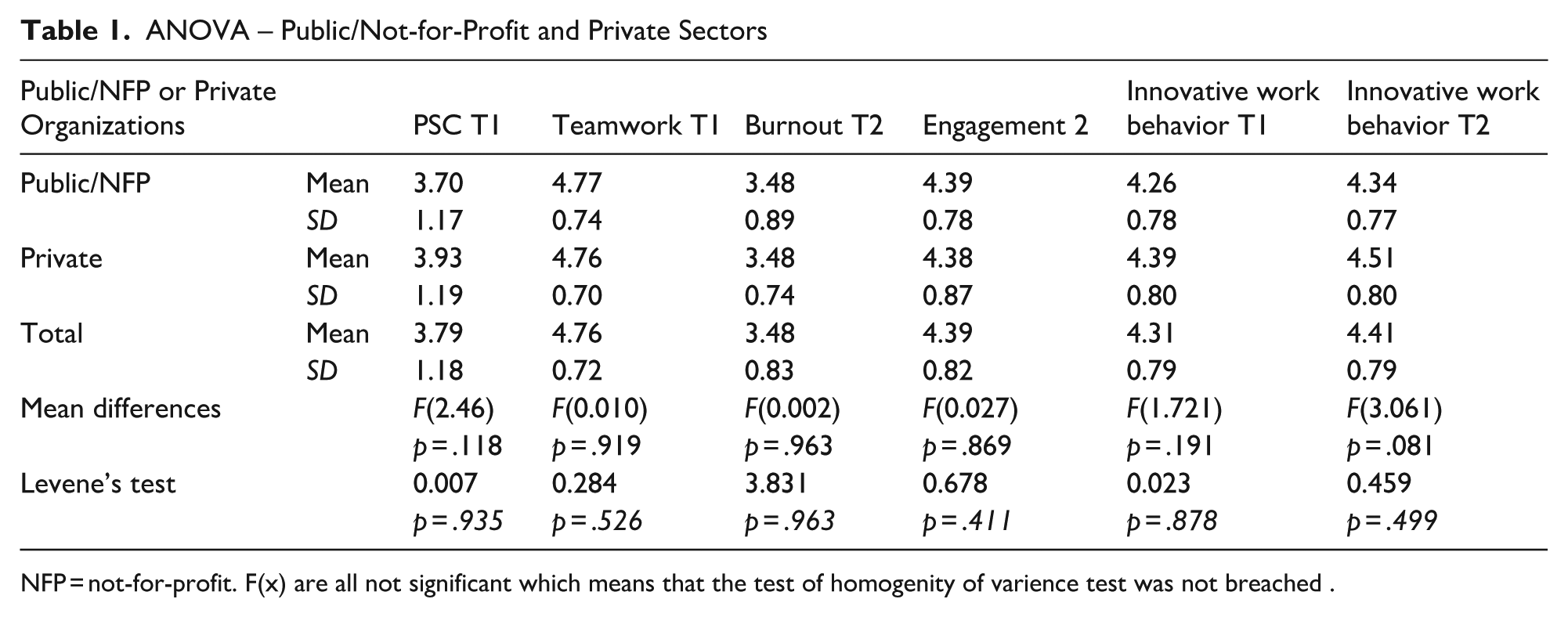
NFP = not-for-profit. F(x) are all not significant which means that the test of homogenity of varience test was not breached .
Results
Table 2 depicts the zero-order correlations for all variables in the study. The correlations provide support for the inclusion of age (group), gender, and role tenure as control variables due to their significant association with teamwork, psychosocial safety climate, burnout, employee engagement, and innovative behavior.
Descriptive Statistics and Zero-order Correlations for All Variables and Controls
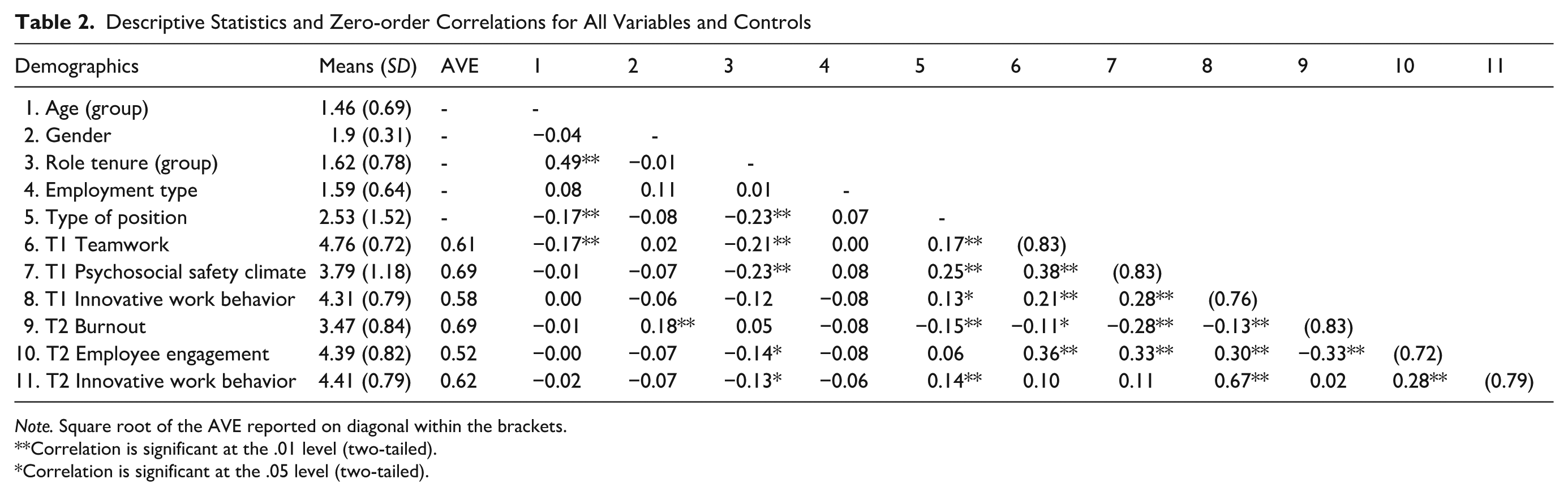
Note. Square root of the AVE reported on diagonal within the brackets.
Correlation is significant at the .01 level (two-tailed).
Correlation is significant at the .05 level (two-tailed).
Confirmatory Factor Analyses
We first estimated the congeneric measurement model for each study construct. All latent variables (study constructs) resulted in standardized factor loadings greater than 0.50, except teamwork question 5 “To what extent do you agree with the following statements - When I complete my work tasks, I am happy to help my co-workers.” And engagement question 9 “I get carried away when I am working.” In addition, employee engagement question 1 “I feel happy when I am working intensely” had extreme standardized residual covariances – ranging from −2.38 to −3.22, indicating that the model overestimates the relationships between the engagement item and other observed items. Following the removal of teamwork question 5 and employee engagement questions 1 and 9, the modified six-factor measurement model (baseline) fit the data well: χ2(474) = 792.515, p < .001, RMSEA = 0.06, CFI = 0.91, and SRMR = 0.06.
As depicted in Table 3, we compared six-factor, five-factor, and four-factor measurement models. A chi-square difference test revealed the six-factor model provided a distinct model with a significantly superior fit to the five-factor and four-factor models. Testing the six-factor measurement model, we controlled for the common latent factor and found 7.29% common method variance. As the common method variance was low, we concluded that common method bias was of minimal concern, and therefore, we did not control for the common latent factor when testing the structural models and hypotheses.
Comparison of Alternate Measurement and Structural Models
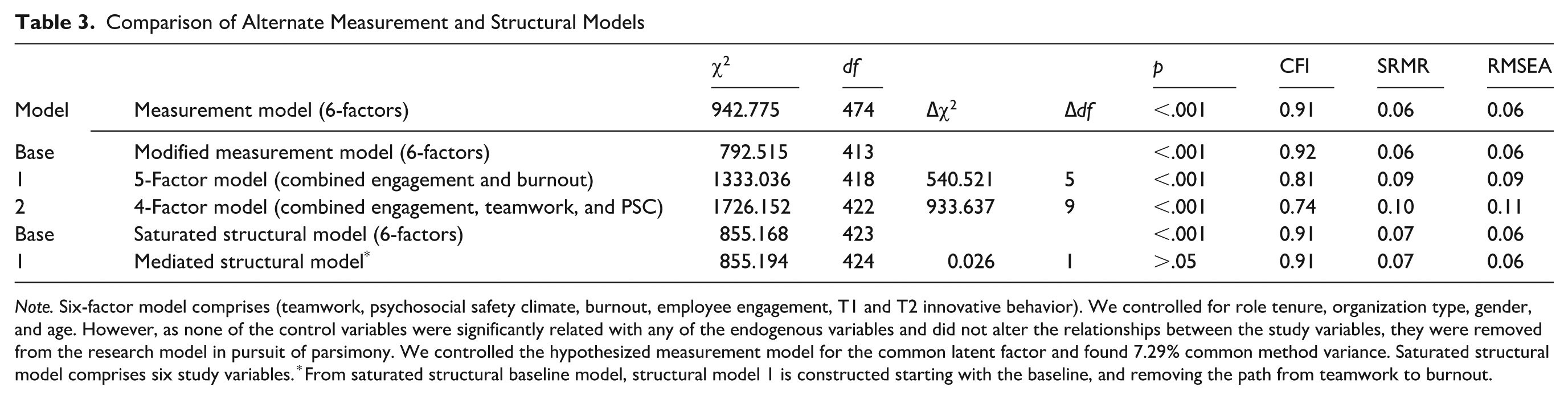
Note. Six-factor model comprises (teamwork, psychosocial safety climate, burnout, employee engagement, T1 and T2 innovative behavior). We controlled for role tenure, organization type, gender, and age. However, as none of the control variables were significantly related with any of the endogenous variables and did not alter the relationships between the study variables, they were removed from the research model in pursuit of parsimony. We controlled the hypothesized measurement model for the common latent factor and found 7.29% common method variance. Saturated structural model comprises six study variables. * From saturated structural baseline model, structural model 1 is constructed starting with the baseline, and removing the path from teamwork to burnout.
Structural Model Testing
We compared two structural models: (1) saturated structural model and (2) a hypothesized structural model (Bollen & Long, 1992). First, we estimated the saturated structural model, where all possible paths between the study constructs were estimated, except between T1 innovative behavior and burnout and engagement, as they were estimated as antecedents of T2 innovative behavior. On examining the saturated structural model, the control variables gender, role tenure, organization type (e.g., public, private, not-for-profit), and employment type (e.g., full-time, art-time, casual) were not significantly related to any of our study’s endogenous variables and did not significantly change the significance of any parameter estimates. As such, they were removed from further structural model testing. The control variable – type of position – was significantly related to one of the study’s endogenous variables (T2 innovative behavior). As a result, we retained the type of position as a control variable when testing the hypotheses.
The saturated structural model fit the data well, χ2(423) = 855.168, p < .001, RMSEA = 0.06, SRMR = 0.07, CFI = 0.91. Next, we estimated the hypothesized structural model. This model differed from the saturated model in that we removed the following direct relationship from the saturated model (teamwork to burnout). The hypothesized structural model also fit the data well, χ2(424) = 855.194, p < .001, RMSEA = 0.06, SRMR = 0.07, CFI = 0.91. Comparison of the saturated and mediated structural models revealed no significant difference between the two models. We opted to use the more parsimonious hypothesized structural model to test the study hypotheses.
Hypothesis Testing
The results using the standardized parameter estimates, including direct and indirect effects, provide support for all hypotheses (see Figure 2 and Table 4). Whilst not a hypothesis, we found that PSC (Time 1) was significantly related to burnout (Time2) (β = −.31, p < .001) and PSC (Time 1) was positively associated with employee engagement (Time 2) (β = .18, p < .05). Hypothesis 2 was supported as (Time 1) teamwork was positively associated with (Time 2) engagement (β = .28, p < .001). Together, the variance of teamwork and PSC explained 9.7% of burnout and 27.8% of engagement.
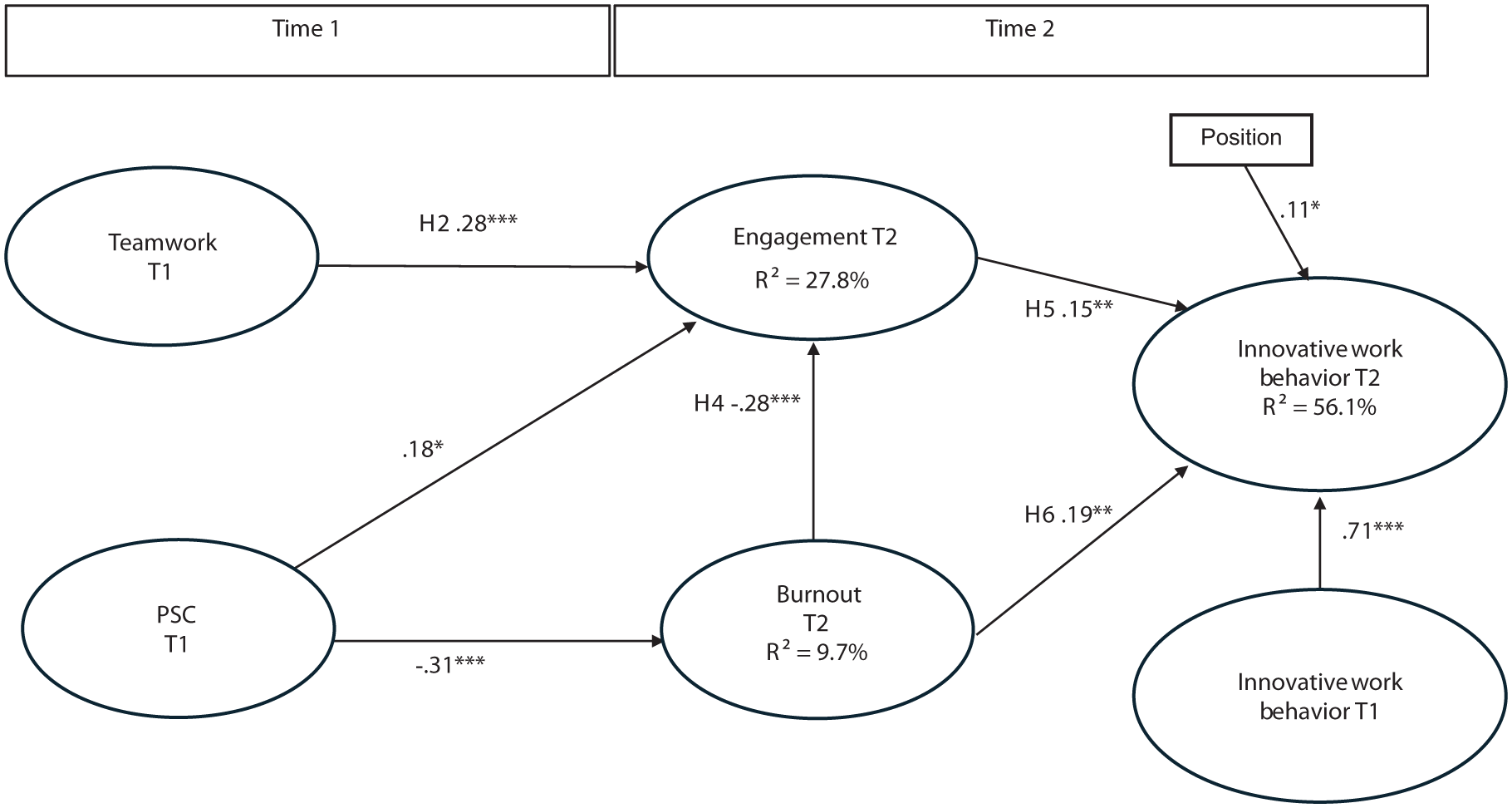
Fully mediated structural model – parameter estimates (standardized) showing findings for H2, H4, H5, H6
Hypotheses Results
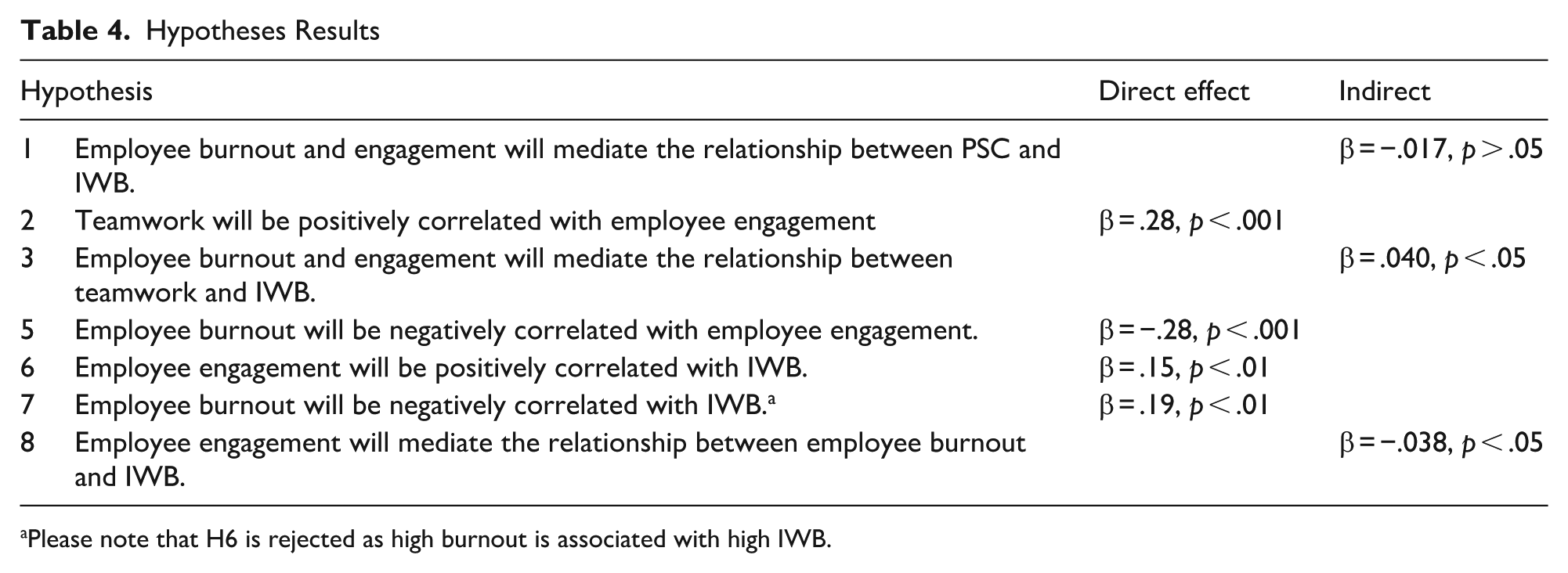
Please note that H6 is rejected as high burnout is associated with high IWB.
Hypothesis 4 was supported as (Time 2) burnout was negatively correlated with (Time 2) engagement (β = −.28, p < .001). Hypothesis 5 was supported as (Time 2) engagement was positively associated with (Time 2) IWB (β = .15, p < .01). Hypothesis 6 was not supported as (Time 2) burnout was positively correlated with (Time 2) IWB (β = .19, p < .01). To examine the direct influence of engagement and burnout, and the indirect influence of teamwork, PSC, and burnout on (Time 2) IWB, we controlled for (Time 1) IWB and found a strong positive relationship between (Time 1) and (Time 2) IWB (β = .71, p < .001). The combination of (Time 2) engagement, (Time 2) burnout, and (Time1) IWB, explained 56.1% of the variance of (Time 2) IWB.
The 1,000 bootstrapped bias-corrected percentile method supports the acceptance of hypotheses 3 and 7, and the rejection of hypothesis 1. For hypothesis 3, (Time 2) employee burnout and engagement significantly mediated the indirect relationship between (Time 1) teamwork and (Time 2) IWB (β = .040, p < .05). However, for hypothesis 1, (Time 2) employee burnout and engagement did not mediate the indirect relationship between (Time 1) PSC and (Time 2) IWB (β = −.017, p > .05). Finally, for hypothesis 7, (Time 2) employee engagement mediated the indirect effect between (Time 2) employee burnout and (Time 2) IWB (β = −.038, p < .05). We, therefore, rejected hypothesis 1, and accepted hypotheses 3 and 7 (Table 4).
Discussion
This study addressed two gaps in literature. First, it addresses a gap identified by Demircioglu et al. (2023) about the drivers of IWBs at the individual level of analysis. Building on Brunetto et al. (2022) who found that PSC was an antecedent of IWB and the research by Chang et al. (2013) and Ng (2024) who found a significant link between engagement and IWBs, this study tested and found that PSC and teamwork are antecedents of engagement, which then mediated their IWB. This finding supports COR theory (Hobfoll et al., 2018), which purports that the impact of collegiality, in addition to PSC, acts as organizational resources that SLBs can access to increase their work engagement, and this provides a pathway for SLBs to engage in IWBs.
The implication of this research finding is that if SLOs want to encourage SLBs’ IWBs, then a high PSC is part of building an “innovation-enabling” culture, by encouraging high SLB engagement as previously argued by Gull et al. (2020) and Edmondson and Bransby (2023). Additionally, when SLOs embrace professional values and practices, they are also likely to promote strong collegiality (teamwork), which will also promote high work engagement as argued by Brunetto et al. (2013). Together, workplaces with high PSC and teamwork are also likely to have SLBs with high work engagement. Such workplaces are likely to provide an innovation-enabling culture that promotes IWBs. As such, the process for developing an innovation-enabling culture is very much a function of SLOs’ strategic decisions about their objectives, resourcing and bureaucratic processes for service provision (Demircioglu & Van der Wal, 2022).
The second gap addressed in this study concerns understanding the pathways by which SLBs engage in IWBs. The findings demonstrate the impact of the engagement–burnout continuum on SLBs’ IWB supports, aligning with both COR and SLB theories. Figure 2 depicts that high engagement is associated with low burnout as proposed by COR theory. On the other hand, Figure 2 also shows that SLBs’ IWB can result from both high burnout, which is not explained by COR theory. It is a positive relationship, that is, high burnout is associated with high IWBs. According to SLB theory, SLBs employ coping measures as a means of reconciling the demand-supply dilemma (Lipsky, 1980; L. L. G. Tummers et al., 2015). The findings extend SLB theory and explain how SLBs, who perceive burnout, use their discretion to respond by modifying policies and rules in innovative ways that potentially make better use of scarce resources by circumventing ambiguous policies and/or red tape and bureaucracy. It is, however, unclear whether those outcomes benefit the clients more when the SLB is engaged or burned out. We speculate the former, but further research is required to validate such speculation.
As such, the findings contribute new information about how personal psychological drivers at opposite ends of the continuum (i.e., burnout and engagement) impact healthcare SLBs’ IWB behavior in Australia. It also addresses a gap identified by Chang and Brewer (2023, p. 16) because the study examines healthcare SLBs working in Australia. Additionally, whilst Lipsky (1980) explained that SLBs use coping strategies, this study provides new information about how SLBs cope with the chronic public sector gap by using IWBs. Additionally, since IWB was used over both periods of time, it shows that this acted as an embedding tool to support SLB coping in the workplace, both those engaged and those experiencing burnout. Future research should explore the implications for services based on whether they are delivered by engaged or burned-out SLBs.
The limitations of the study are that it is focused on only one type of SLB (healthcare workers) within a single country (Australia). Further studies are needed to test this theory across various domains and countries. In addition, to meet the minimum sample size requirements for structural equation modeling, we combined the private and public sector samples. Although we controlled for any potential differences and found no differences in an ANOVA test, further research should be conducted with a larger sample size that is more representative of the vast array of public sector organizations.
Conclusion
These findings provide clarity about the pathways for SLBs using IWBs. To ensure engagement rather than burnout, COR theory explains that an innovation-enabling culture is enhanced through supportive leadership and collegiality. The results also show that it provides a pathway for promoting IWBs as theorized by scholars such as Demircioglu et al. (2023). This approach is explained using Hobfoll et al. (2018’s) supposition that resource gain spirals are most likely to promote engagement and IWB. In this study, the variance of PSC and teamwork explained almost a third of work engagement.
However, the evidence also shows that a second pathway for SLBs using IWBs via SLB theory, which argues that burnout (because of excessive work demands/inadequate work resources; Brough et al., 2021), is also a pathway to IWB. The variance of PSC explained a 10th of burnout, and the relationship is inverse, suggesting that the poor leadership environment likely negatively impacted SLBs’ burnout. However, this situation appears unsustainable long term.
In response to a new legislative requirement that makes all workplace – public, private and NFPs responsible for enacting Safe Work Australia’s (2022) Model Code of Practice: Managing psychosocial hazards at work, organizational management must identify and eliminate psychosocial hazards in their workplaces. If it is not practical to eliminate the risk, the organization is responsible for managing the risk if exposure occurs. Safe Work Australia (2022) identifies psychosocial hazards as anything that can/may cause employee psychological harm. For SLBs, austerity-driven management models have exacerbated high workloads and harassment, bullying – often because of poor management practices (Brough et al., 2021). The problem is that the second pathway for SLBs using IWBs via burnout is also associated with rising mental health issues for healthcare SLBs (Safe Work Australia, 2023), which is a burden on the SLB, their families and communities, as well as the health and economic system supporting them. For this reason, researchers are suggesting that more sustainable Common-Good HRM models (Aust et al., 2020) are adopted that focus on reducing burnout and instead promoting employee well-being are likely to deliver better outcomes for SLBs (Farr-Wharton et al., 2023) and better clinical outcomes for patients (Xerri et al., 2019).
Footnotes
Declaration of Conflicting Interests
The authors declared no potential conflicts of interest with respect to the research, authorship, and/or publication of this article.
Funding
The authors received no financial support for the research, authorship, and/or publication of this article.
