




Abstract
There are various prima facie reasons for looking at the gratitude that citizens feel in response to government programs. Some relate to individual flourishing, others relate to moral virtue or social cohesion. We analyze survey data from 429 Australian participants (211 Indigenous and 218 non-Indigenous) in order to understand their levels of gratitude for the government support that is available to them. The data also allows us to consider their perceptions about the fairness, quality, and benevolence of government support. Such factors, according to our hypotheses, may be expected to moderate their levels of gratitude. In addition, the data enables us to see whether their levels of gratitude are associated with their levels of national pride, and whether their levels of national pride predict their levels of satisfaction with life. We find that non-Indigenous Australians are slightly more likely than Indigenous Australians to think that Australian government support is fair; Indigenous Australians, however, who perceive it as fair are more likely to be grateful for it. The fairness-gratitude relationship did not for hold non-Indigenous participants. Nonetheless, we predict that if more Indigenous Australians were to perceive Australian government support as fair, gratitude for it amongst Indigenous Australians would increase.
Introduction
The land of the Indigenous Australians was essentially colonized without consent. Such is “the origin of the fundamental grievance between the old and new Australians” (Referendum Council, 2017, p. 17). In recent years there have been concerted efforts to work out an appropriate way in which to recognize Indigenous Australians in the nation’s constitution. In 2017, these efforts culminated in the Uluru Statement from the Heart, a call by Indigenous Australians for a constitutionally enshrined “Voice,” along with “a process of agreement-making between governments and First Nations and truth-telling about our history.” 1 Our aims here, however, are independent of any calls for constitutional recognition, agreement-making or truth-telling. Like most Australians, we agree that “more needs to be done” in order to enhance the propensity of Indigenous Australians to flourish (Reconciliation Australia, 2022, pp. 153–164). But our focus is on the role that certain ordinary and ever-necessary processes of public administration may be able to play.
The need to collect public sector performance information has been stressed for many decades (Hood, 1991; Moynihan, 2008; Van Dooren & Van de Walle, 2008), the ultimate purpose being to improve performance (Behn, 2003, p. 588). Similarly, we have long heard that better measures of public administration performance are needed (e.g., Van Dooren et al., 2012). In essence, our proposal is that performance information gathered in relation to government programs should sometimes include data relating to the level of gratitude that citizens have for what is available to them.
A notable characteristic of this proposal is its modesty; it is reasonably simple and well-defined, consistent with what scholars in public administration have called for, and bound to be more-or-less cost-neutral. To the best of our knowledge, no such proposal has been made before. And for better or worse, it is not a radical proposal. It is orthogonal to the calls for decolonization (e.g., see Matsiliza, 2020; McDonald et al., 2022; Ntwanano Erasmus, 2020, p. 63) or postcolonial “global public administration” (Nisar & Masood, 2023). Moreover, as shall emerge in the discussion below, it is consistent with certain basic convictions and arguments maintained by many of those on both the left (e.g., George Orwell, Alasdair MacIntyre, Richard Rorty, Dudley Knowles) and the right (e.g., Edmund Burke, Roger Scruton, Jonah Goldberg).
Our proposal is also interdisciplinary; it draws upon history, philosophy, and the social sciences to explain how a modest idea in public administration may be expected to promote individual flourishing, moral virtue, social capital, and social cohesion. But in order to test our thinking we collected survey data from 429 participants (211 Indigenous Australians and 218 non-Indigenous Australians). This allowed us to look at whether they are grateful for the government support that is available to them, certain factors that may moderate their gratitude, whether their levels of gratitude are associated with their levels of national pride, and whether their levels of national pride predict their levels of satisfaction with life.
Literature and Hypotheses
Gratitude
As emphasized in the positive psychology literature, gratitude is widely seen as a virtue (Peterson & Seligman, 2004, pp. 553–568). There are social scientists who take it to play an important role in building and maintaining relationships (Algoe et al., 2008; Bartlett et al., 2012) and in encouraging “prosocial” forms of behavior (Bartlett & De Steno, 2006). Experimental psychologists tend to suppose that it can be found “[a]cross nearly all cultures and through most of human history” (McCullough et al., 2001). In evolutionary terms, it supports cooperative activities that have “survival value” (Bonnie & de Waal, 2004, p. 217). In the words of Georg Simmel, gratitude is “the moral memory of mankind” (Simmel, 1950, p. 388).
In addition to its moral qualities, gratitude appears to be a personally healthy attitude. With respect to factors that predict flourishing in adolescents, researchers have shown that gratitude offers marked advantages over materialism (Froh et al., 2011). It appears to be conducive to physical and mental well-being (Emmons & McCullough, 2003; Froh et al., 2007; Jans-Beken et al., 2020; Portocarrero et al., 2020), and to favourable sleep patterns (Wood et al., 2009). Researchers have also suspected indirect links between gratitude and longevity (Danner et al., 2001; Jans-Beken et al., 2020, p. 776).
Of course such observations provide good reason for researchers in psychology and physical health, for example, to be interested in gratitude. But there is also good reason for officials in public administration to be interested in it, and the rationale involved does not simply relate to any obscure programs in psychology and physical health, for example, which happen to be both focussed on gratitude and publicly-funded. For those of us who live in highly developed nations in which there are sizable systems of government support there is always a prima facie case for thinking that we ought to feel gratitude for that support. In political philosophy, Knowles (2002) argues that our civic obligations, properly conceived, are rooted in feelings of gratitude. And as he recognizes: “It is only good government that deserves the sort of gratitude which is best expressed through the recognition that the citizen owes the state the duties of citizenship” (Knowles, 2002, pp. 19–20 [emphasis added]). Knowles’s point, put simply, is that we should feel grateful for the benefits that we receive via the state. Our point, put simply, is that officials in public administration should take an interest in the extent to which its citizens are grateful for those benefits. And one reason for this is that gratitude provides an important form of feedback, with the nature of that feedback potentially being reflective of the perceived quality, fairness, benevolence or usefulness of the government support available.
National Pride
National pride, at least in its more civic and liberal forms (i.e., what Orwell (1968, p. 362) preferred to call patriotism) has long been seen as another virtue (e.g.: Burke, 1963; 2 Scruton, 1990, pp. 299–328; Hazony, 2018; Levin, 2019; Tamir, 2019).
Many argue that the creation of national identities and loyalties has been central to the development of government by popular mandate (e.g., Anderson, 1983; Bendix, 1978; Gellner, 1983). In Scruton’s (2006) explanation, national identity is what lends sense to the first-person plural of “We, the people . . . ;” it is what citizens maintain even as their national elections are contested, as the winners celebrate, and as the losers graciously concede. The basic suggestion is that only as long as that first-person plural is maintained can there be that vital sense in which both the winners and the losers share a common loyalty to the nation and to an acceptance of its democratic political process. “This first-person plural,” argues Scruton, “is the precondition of democratic politics . . . ” (Scruton’s, 2006, p. 10).
Of course there can be no denying that certain forms of nationalism or national pride are belligerent, authoritarian, racist or xenophobic. A distinction is thus often drawn between civic nationalism and ethnic nationalism (e.g., Ahlerup & Hansson, 2011, p. 433). The basic rationale behind civic nationalism is that the nation’s citizens can be united by a widely shared commitment to certain political institutions within defined territorial boundaries, perhaps along with a particular way of life or a certain set of “values.” Proponents of ethnic nationalism, by contrast, would unite the citizens against all others by emphasizing their shared ancestry and historical roots. While the concerns about belligerence, authoritarianism, racism, xenophobia and the like are commonly associated with ethnic nationalism, civic nationalism is generally taken to be far more respectable and benign.
In fact a certain amount of social science research suggests that the promotion of civic nationalism can provide a range of benefits. Ahlerup and Hansson (2011), for example, have shown that national pride predicts government effectiveness. Importantly, this insight applies only within certain parameters because of the “hump-shaped” relationship between nationalism and government effectiveness, that is, a lack of nationalism can render governments ineffective, but an excess can also be undesirable (Ahlerup and Hansson, 2011, p. 432). Ahlerup and Hansson (2011) suggest that the promotion of national pride can be especially worth considering in former colonies with fragmented populations (p. 446). Others have found a robust positive association between patriotism and tax compliance (Gangl et al., 2016; Konrad & Qari, 2012). Moses Shayo has shown—for better or worse—that national pride tends to foster tolerance of income inequality (e.g., Shayo, 2009).
Commencing his reflections upon leftist thought in the 20th century, Rorty (1998)—a staunch leftist himself—contended that: National pride is to countries what self-respect is to individuals: a necessary condition for self-improvement. . . Those who hope to persuade a nation to exert itself need to remind their country of what it can take pride in as well as what it should be ashamed of. (p. 3).
As Rorty suggests, even if a widely shared sense of national pride is difficult to achieve, it may be invaluable. It can represent a widespread recognition amongst the citizens that their nation is something to which they belong, and that it is worth embracing and fundamentally defending.
Gratitude and National Pride in the Australian Context
Having belonged to the Australian continent for 60,000 years or more, Indigenous Australians developed a remarkable and distinctive form of culture. As a single nation, however, Australia was formally federated only in 1901, and the institutions and traditions that characterize most of Australia today are European in origin. Moreover, those institutions and traditions in Australia date back to no earlier than the arrival of the “First Fleet” in 1788, and in the process of establishing them Indigenous Australians suffered from a range of injustices and forms of devastation.
Diseases to which Indigenous Australians had no immunity were introduced (Dowling, 2021). An estimated 20,000 Indigenous Australians were killed in violent frontier conflict with pastoralists (Reynolds, 1990, p. 122), while many others were forcibly dispossessed of their land and dispersed into regions that could not sustain them. Such conflict was regularly reported and widely known—from the 1820s in Tasmania and even into the 1920s in the Northern Territory (Reynolds, 1999, esp. Ch. VII–IX)—but a callous indifference to “the abos” (Duguid, 1963, p. 23) was seemingly widespread. In an early but influential 1890s work of Australian ethnology it was flatly observed that “the black fellow has not perhaps any particular reason to be grateful to the white man” (Spencer & Gillen, 1968, p. 50).
As the frontier expanded across the continent and European institutions established their dominance, the expectation placed upon public administration was to protect Indigenous Australians against the most egregious injustices that might otherwise be inflicted upon them. The underlying assumptions and attitudes, however, were melancholic and fatalistic at best; it was said that protectionism would “smooth the dying pillow” for a race of people who were supposedly destined to die out (Elkin, 1979, p. 366). The era of protectionism was followed by that of assimilation; one in which policies and programs were less coercive and more hopeful but still paternalistic. As pointedly argued by Charles Perkins, one of the most formidable Indigenous leaders and public servants of his time: “[N]ever mind all this terminology about assimilation, self-development, self-assertion . . . What I would think the Aboriginal people want . . . is dignity, self-respect and a place in Australian society under some of the terms which we dictate” (Read, 1990, p. 164).
Since the time of Gough Whitlam’s government in the 1970s, Australian officials in public administration have generally eschewed talk of assimiliation, and many have embraced notions of Indigenous “self-determination” or “self-management” instead (Hocking, 2018). While the full implications of such notions can themselves be hard to determine, the Referendum Council commissioned to provide guidance on how best to recognize Indigenous Australians in the nation’s constitution appears to counsel against anything truly radical. In their view: “There is no doubt that our constitutional system, our system of government, the rule of law, and our public institutions inherited from Britain are the heritage of the Australian people and ensure for the benefit of all of us, including the First Peoples” (Referendum Council, 2017, p. 1). One particular member of the Referendum Council was Noel Pearson, a prominent Indigenous leader and widely esteemed public intellectual. And it so happens that shortly before joining the Council Pearson famously eulogized Whitlam; he expressed his “immense gratitude” for Whitlam’s public service, praised his government, and gently mocked—with characteristic humor—those who fail to recognize the achievements of “modern cosmopolitan Australia” (Pearson, 2014). Consistent with this, it is clear that reconciliation is something that most Australians—and especially most Indigenous Australians—would like to help improve (Reconciliation Australia, 2022, p. 138).
With such developments in mind, there is perhaps some basis for hope amongst those of us who would like to believe that gratitude and national pride may be valuable, realistic, and worth fostering, even in a nation such as Australia where Indigenous Australians have not always had any particular reason to be grateful to non-Indigenous Australians. Importantly, while we remain cautious in our hopes about this, there are good theoretical reasons to think that gratitude and civic national pride are important contributors to a nation’s social capital. Furthermore, it is arguable that gratitude and civic national pride, if widely shared, may be understood as strong indicators of progress toward reconciliation.
Social Capital
Civic virtue and social capital are not to be conflated although they are closely related. As Robert Putnam explains: “The difference is that ‘social capital’ calls attention to the fact that civic virtue is most powerful when embedded in a dense network of reciprocal relations. A society of many virtuous but isolated individuals is not necessarily rich in social capital.” (Putnam, 2000, p. 19).
There is room for debate about precisely how “dense” the network of reciprocal relations is between Indigenous and non-Indigenous Australians. Formally speaking, members of both groups are Australian citizens. They are all equally compelled to contribute to the government’s taxation system. They are all equally entitled to benefit from the associated system of health, education, housing, infrastructure, income support, and social services. And in a less formal sense, there is fairly clear evidence that in both groups the vast majority agree that “the relationship” between Indigenous and non-Indigenous Australians is important (Reconciliation Australia, 2022, pp. 42–43). Such observations do not show that the network of reciprocal relations in which Indigenous and non-Indigenous Australians are embedded is particularly dense. The fostering of reciprocal relations that are denser, more powerful, and more productive of social capital, however, is something that we would like to see.
Putnam draws an important distinction between two forms of social capital: bridging (or inclusive) and bonding (or exclusive). His examples of bridging social capital include that which can commonly be found amongst those involved in the civil rights movement, many youth service groups, and ecumenical religious organizations. By contrast, prime examples of bonding social capital are said to be found in ethnic fraternal organizations, church-based women’s reading groups, and fashionable country clubs (Putnam, 2000, p. 22). Putnam neatly encapsulated the importance of each like so: “Bonding social capital constitutes a kind of sociological superglue, whereas bridging social capital provides a sociological WD-40” (Putnam, 2000, p. 23). Remarkably, and with equal felicity, Bonnie and de Waal have suggested that human society relies on gratitude “as its glue and lubricant” (2004, p. 214).
In relation to reconciliation in Australia, discussions about social capital are not new (see, for e.g., Brough & Bond, 2009). And of course such discussions have come to recognize that questions about an individual’s identity can be quite central to questions about the kinds of social capital that may be at issue in a given social context (e.g., Brough et al., 2006). While our particular interest is in the role that gratitude and civic national pride can play in the development of bridging forms of social capital, it is not that we would generally wish to see bonding forms of social capital compromised. For example, in our view the “glue” that bonds together the members of an ethnically-based sporting club is, in general, thoroughly wholesome and life-enhancing. The members of the club may be bonded by something that others cannot share, but this seldom seems to compromise the cohesiveness of the society as a whole. It is not as if the metaphorical glue that bonds together the members of each club commonly leaks out and spoils the lubricant that exists between various such clubs. Or to adopt the bridging metaphor, while each club may be thought of as an island, we see very few such islands being run like isolationist cults. Quite to the contrary, the vast majority of them seem to positively enrich the lives of those who belong to them, and to generally assist, rather than inhibit, the efforts of each islander to traverse the various bridges that connect the home island to the various others in the broader social archipelago.
In Robert Nisbet’s view, “the major objective of political democracy,” properly conceived, is “that of making harmonious and effective the varied group allegiances which exist in society, not sterilizing them in the interest of a monistic political community” (Nisbet, 2019, p. 231). Like Nisbet, we have little interest in encouraging our fellow Australians to renounce their various other affiliations and identities. Of course it is true that on occasion, a cult-like movement in favor of a monistic political community may emerge, even in long-established liberal democracies. Moreover, we recognize that such movements can be seriously threatening, perhaps especially when organized around a chauvinistic sense of ethnic national pride, with that kind of pride providing the movement with a deeply exclusionary form of bonding social capital. But there are many ways by which to respond to such movements, and a basic point that we should like to emphasize is that they can be challenged, undermined, and neutralized through bridging forms of social capital.
The creation and maintenance of bridging social capital based on gratitude or civic national pride is bound to be highly dependent on the good work of community leaders, business leaders, and political leaders. Leaders who represent faith-based groups and ethnically-based sporting clubs, for example, have a vital role to play. A few of those leaders may, naturally enough, feel tempted to lead in a relatively narrow, isolationist or even cult-like manner. This may involve, for example, seeking to appeal only to their own group, encouraging a narrow and exclusive sense of identity amongst their followers, fostering a sense fear and skepticism toward those in the broader community, and discouraging members of their own group from simultaneously belonging to other groups. Such an approach to leadership may well draw inspiration from figures such as Malcolm X or Frantz Fanon, and it can help to create a tightly bonded group. The main problem, however, is that such an approach creates no bridging social capital, and tends to erode any such capital that previously existed. By contrast, an approach to leadership that we prefer to see is one that recognizes the interconnectedness of all humanity, along with the kind of interdependence for which so many of us are grateful. Such an approach takes inspiration from figures such as Mahatma Gandhi, Martin Luther King Jr., Desmond Tutu, and Noel Pearson, and it one that is clearly more conducive to the creation and maintenance of bridging social capital.
The creation and maintenance of bridging social capital could also be something to which the ordinary processes of public administration could contribute. As indicated above, we believe that officials in public administration should, at least periodically, collect data relating to the levels of gratitude that citizens have for the various forms of service and support that are provided through public administration. It would be data that could be considered as a form of feedback when evaluating, for example, the quality, fairness, benevolence or usefulness of particular government programs or forms of support. But gratitude actually provides more than helpful feedback on specific government programs or the like. As discussed above, gratitude is itself a personally healthy civic virtue and—to all intents and purposes—a form of social capital. In fact one especially invaluable form of social capital that gratitude can provide is bridging social capital, an extraordinary asset that can be thought of as human society’s “lubricant” or “sociological WD-40.” So when we gain data on the levels of gratitude that citizens have for particular things, we also thereby gain data on a certain form of social capital. Moreover, by selectively encouraging, investing, and reinvesting in the kinds of things for which citizens are grateful, social capital may thereby be increased.
Hypothesis Development
Perceived Fairness and Gratitude
In the first three hypotheses proposed below, we consider three different influences upon the extent to which citizens feel gratitude for the government support available to them. The first of these influences relates to the perceived fairness of government support. We assume that most people are moral beings who have at least some consideration for others and a desire to see one another treated fairly, justly, or equitably. Admittedly, the kind of empirical research that may be brought to bear on that assumption tends to be context-specific; when understood as an assumption about all people in all social contexts, it therefore becomes difficult to defend. Moreover, the truth is that we are inclined to adopt this assumption not simply because of any formal research of which we are aware, but because it arguably constitutes a kind of self-fulfilling prophecy, i.e.: assuming the best in others helps to produce the best in others. In any case, questions about the basis of this assumption aside, we propose that people will care about whether the availability of government support is fair, and that in general people are more likely to be grateful for the availability of such support when they perceive it as such. Accordingly, we hypothesize as follows.
Perceived Quality and Gratitude
The second influence relates to the perceived quality of government support available. We propose that if government support is not perceived to be of reasonable quality, people will be less grateful for its availability. When the support is perceived as well designed, aptly delivered, or suitable for one’s needs, however, then there are clear reasons for gratitude. We therefore hypothesize as follows.
Perceived Benevolence and Gratitude
The third influence relates to the perceived benevolence of the government. Benevolence is crucial for trust, as has long been recognized in public administration (Kim, 2005), and unless governments are perceived to be reasonably sincere and motivated by good will, we do not expect citizens to be widely appreciative of the government services available to them. Services that appear to be accompanied by insincerity or a lack of good will are more likely to be met with suspicion, cynicism or indifference; they can easily be perceived as bribes, Trojan horses or forms of manipulation. We therefore hypothesize as follows.
Broad and Narrow Views About When Gratitude is Appropriate
Reasonable people sometimes disagree as to when gratitude is appropriate. Most notably, such disagreement can arise with regard to the issues of reciprocity, benevolence of intention, and entitlement. Gulliford and Morgan (2016), and Morgan et al. (2017) have done much to illuminate such issues, and the Multi-Component Gratitude Measure (MCGM) developed by Morgan et al. (2017) includes several items explicitly concerned with the circumstances in which a person considers gratitude to be appropriate.
With regard to reciprocity, the crucial question is that of whether a person should feel gratitude toward another even when that other person expects something in return. With regard to benevolence of intention, the question to ask is that of whether people should feel gratitude only toward those who have benevolent intentions toward them. In relation to entitlement, the question is whether people consider it appropriate to feel gratitude even for things to which they consider themselves to have some moral or legal right.
When viewed through a “wide-angle” lens (Morgan et al., 2017, p. 187), reciprocity, benevolence of intention, and a sense of entitlement are largely irrelevant to a person’s views about when gratitude is appropriate. In other words, those who adopt a very broad or unrestrictive conception of when gratitude is appropriate regard gratitude as a potentially appropriate response even if the other party does expect something in return, even when the other party does not have benevolent intentions toward them, and even when they consider themselves entitled to the goods and services involved. By contrast, those who adopt a narrow or restrictive conception of when gratitude is appropriate regard gratitude as inappropriate if the other party does expect something in return, if the other party does not have benevolent intentions toward them, or if they consider themselves entitled to the goods and services involved.
As Morgan et al. (2017, p. 187) have shown empirically, those who adopt a relatively broad, “permissive” or unrestrictive conception of when gratitude is appropriate tend to score more highly on all other components of the MCGM, as well as on other existing gratitude scales, namely the GQ6 (created by Mccullough et al., 2002), the Gratitude, Resentment and Appreciation Test, or GRAT (created by Watkins et al., 2003), and the Appreciation scale (created by Adler & Fagley, 2005).
Note that the relationship hypothesized in
Gratitude and National Pride
Various thinkers—most famously Mo Tzu and Thomas Hobbes—have envisaged life in a “state of nature” without any government; typically they have described an anarchic world of chaos and widespread enmity (e.g.: Watson, 1964, p. 34; Hobbes, 1651, Ch. 13–14). There is room for debate as to precisely how unpleasant this state of nature tended to be but it is clear that human beings were in some such state for “a very, very long time” (Goldberg, 2018, p. 6). Much of the world today, by contrast, is far more orderly and prosperous. For those of us who enjoy citizenship in a modern, secular, liberal democracy such as Australia there are various government services and forms of protection available, well-established legal rights and duties are generally enforced, and there are legitimate legal and political authorities to which individuals can appeal.
Roger Scruton is amongst those who considers this form of citizenship and nationhood to be a major achievement, and something in response to which the beneficiaries ought to have a sense of gratitude and patriotism or national loyalty (2006). While Scruton is a conservative thinker, various other theorists who are far less conservative are equally keen to emphasize the importance of patriotism. John Schaar, for example, champions patriotism principally because of the emotional bond that it can provide between people in spite of their racial, ethnic, cultural or religious diversity. He argues that in the United States it is as if citizens have exchanged promises and embraced a certain political idea or “covenant” (Schaar, 1981, p. 291). Alasdair MacIntyre presents the case for patriotism very differently, but without significantly contradicting either Scruton or Schaar. In MacIntyre’s (1984) view we are “characteristically brought into being and maintained as [moral agents] only through the particular kinds of moral sustenance afforded by [our] community” (p. 10). He takes a citizen’s loyalty to the nation to express, amongst other things, a kind of gratitude for benefits that it provides, and suggests that “patriotism and those loyalties cognate to it are not just virtues but central virtues” (MacIntyre’s, 1984, pp. 10–11).
In harmony with Scruton and MacIntyre, presumably there are many people who accept that there can be certain moral reasons to expect gratitude for government support to induce patriotism or national pride. At the same time, it may well be that the underlying causal relationships involved are bidirectional; the patriotism or national pride that some people have may induce a greater sense of gratitude for the availability of government support. As an analogy: It may be that you routinely enjoy coffee; sometimes made by your spouse, sometimes made by a barista in a local cafe. Because of your love for your spouse, however, the coffee that your spouse makes is something that you appreciate far more. Put simply: Gratitude can induce love, and love can induce gratitude.
Thus far there is scant research into the empirical basis for an association between gratitude and patriotism or national pride. The considerations outlined above, however, do provide certain moral and theoretical reasons to expect the following association between them.
National Pride and Satisfaction With Life
Morrison et al. (2011) found that satisfaction with one’s country is a strong positive predictor of subjective well-being, especially amongst the impoverished. Ha and Jang (2015) have shown a positive association between national pride and happiness in South Korea. Following the work of Morrison et al., Reeskens and Wright (2011) carried out a similarly international study while keenly distinguishing civic nationalism from ethnic nationalism. They found, as they predicted, that civic nationalism was positively associated with subjective well-being. Ethnic nationalism, by contrast, perhaps due to its “inward-looking, reactionary, anxious and authoritarian nature” (Reeskens and Wright, 2011, 1,460), was found to be negatively associated with subjective well-being. While our study is focussed on Australia, our concern is with civic nationalism and we expect these same associations to be evident. We therefore hypothesize as follows.
Indigeneity and Perceptions of Benevolence
As discussed above, in the process of establishing the Australia that we know today a range of injustices were perpetrated against Indigenous Australians. And although life expectancy appears to have increased both for Indigenous and non-Indigenous Australians since the first European fleet arrived (Blyton, 2009), there are certainly differences between Indigenous and non-Indigenous life expectancy today. For Indigenous males today life expectancy is 8.6 years lower than for non-Indigenous males, 7.8 years lower for females. Such gaps are considerably wider still for those living in remote areas (AIHW, 2023a, 2023b: p. 19). The overall employment rate for non-Indigenous Australians is around 76% but for Indigenous Australians it is around only 49% (AIHW, 2021). The experience of high or very high psychological distress appears to be significantly more prevalent amongst Indigenous Australians than non-Indigenous Australians (ABS, 2021; AIHW, 2022), and Indigenous suicide rates, particularly amongst those who are relatively young, are substantially higher (AIHW, 2023a, 2023b).
Of course there is room for disagreement as to precisely how to address these disparities, and who is responsible for addressing them. Presumably there are roles to be played not only by governments but also by individuals, families, and civic organizations, for example. But there is no doubt that Australian governments have long assumed themselves to have a considerable amount of responsibility. At federal and state levels Australian governments routinely appoint ministers with specific responsibility for Indigenous affairs, they readily embrace particular targets with respect to “closing the gap,” and for 12 consecutive years (2009–2020) an annual report was produced on their progress (or lack thereof). 3 In many respects, Australian governments have been routinely failing to meet their targets (e.g., Commonwealth of Australia, Department of the Prime Minister and Cabinet, 2016, pp. 5–6, 2017, pp. 6–7, 2018, pp. 8–10, 2019, pp. 10–11, 2020, pp. 11–13; Burney & McCarthy, 2023). With such results in mind, it is plausible to suppose that many Indigenous Australians are disappointed with their governments. And especially if an understanding of the historical injustices perpetrated against Indigenous Australians is combined with such disappointment, many Indigenous Australians may come to think of the Australian government as lacking in benevolence. We therefore hypothesize as follows.
Indigeneity and National Pride
As the frontier of European settlement expanded, Indigenous resistance could be fierce, and European “dispersals” and reprisals were often merciless (e.g., Reynolds, 1990). With such facts in mind, it may seem reasonable to think that for Indigenous Australians, national pride would seem impious on the grounds that such feelings would dishonor one’s own ancestors. Many campaigners for change have long referred to Australia Day as “Invasion Day,” and some of the more radical activists have adopted the slogan “No pride in genocide” (Parkes, 2020).
Importantly, the issues involved are not quite as simple as some political activists suggest. It is not that all Indigenous Australians actively resisted every aspect of change that the Europeans introduced. As anthropologists explain, in some regions Indigenous Australians chose to abandon various aspects of traditional life and to voluntarily migrate to white settlements (e.g., Stanner, 2010). There were those who divided their loyalties and joined the Native Police Corps (e.g., see: Fels, 1988). And to imagine that the resistance was centrally organized or thoroughly unified is to risk ignoring the adaptive and pragmatic intelligence that Indigenous Australians commonly showed (e.g., see: Reynolds, 1990, esp. Ch. 5). Moreover, Indigenous Australians today are well represented within the Australian Defence Force (ABS, 2022). In fact Indigenous Australians have long served Australia in significant numbers in war (Australian War Memorial, 2022) and the vast majority of Australians, both Indigenous and non-Indigenous, believe that official ANZAC Day ceremonies to honor such soldiers are an opportunity to celebrate Australia’s national unity (Reconciliation Australia, 2022, p. 147). While fully recognizing these complexities, we hypothesize as follows.
Indigeneity and Views About When Gratitude is Appropriate
Some deep contrasts have long been drawn between the culture of individualism as represented by the European settlers in Australia and that of reciprocity as represented so strikingly by Aboriginal Australians. The historian Reynolds (1990, pp. 68–70) has succinctly outlined some of the basic facts. From the outset, the Europeans maintained large herds of animals and were jealously possessive of them. But to Aboriginal eyes, particularly in the early decades of cross-cultural contact, this seemed greedy and unnecessary. The contrasts with respect to sharing were also reflected in contrasting expectations about expressions of gratitude. European observers were struck by the importance of sharing in Aboriginal society. “They are truly generous among themselves,” wrote William Thomas of those around Port Phillip in the 1840s. “Meanness is rarely found among these people,” noted Donald Thomson while on Cape York a hundred years later. Thomas and Thomson both observed that reciprocity was so fundamental to Aboriginal society that the clans they knew had no word meaning “thank you.” Thomas explained that while food was always distributed among those present it was not considered a gift in the European sense, rather a right “and no thanks to the giver.” He was, he thought, the first person “that taught them the meaning of the word ‘thanks’” (Reynolds, 1990, pp. 68–69).
The implication here is that Aboriginal Australians traditionally adopted a relatively restrictive or narrow conception of when gratitude is appropriate. Expectations of sharing and reciprocity were so deeply embedded in their way of life that expressions of gratitude seemed unnecessary.
It is important not to overstate the persistence of these contrasts today. Most Aboriginal Australians now live alongside non-Indigenous Australians in urban areas. In many ways, individualism has been embraced by almost everyone. English is the principal language of instruction in all Australian schools. And while it is true that Australia’s traditional Aboriginal languages do not equip their speakers with many verbal expressions of gratitude, there are some. Aboriginal children growing up in Aurukun on the Western side of Cape York will typically grow up as native speakers of Wik-Mungkan, a language that provides verbal expressions of gratitude that can be used at least in certain contexts. “Yaa(wey) menth” (said to a woman) and “Yaa(wey) thanchiy” (said to a man) are both roughly equivalent to “It’s good that you told me that.” There are also the exclamations “Nyom!” and “Yoow!,” both of which provide ways of saying “Thank goodness!” (Kilham et al., 1986, pp. 265, 158, 274). And of course it must also be remembered that gratitude, or at least something much like it, may be expressed in non-verbal ways.
Notwithstanding these qualifications, there can be no denying that many Aboriginal Australians continue to maintain a strong sense of their own identity as Aboriginal Australians. Thus, we hypothesize as follows.
Theoretical Framework
The relationships as hypothesized in
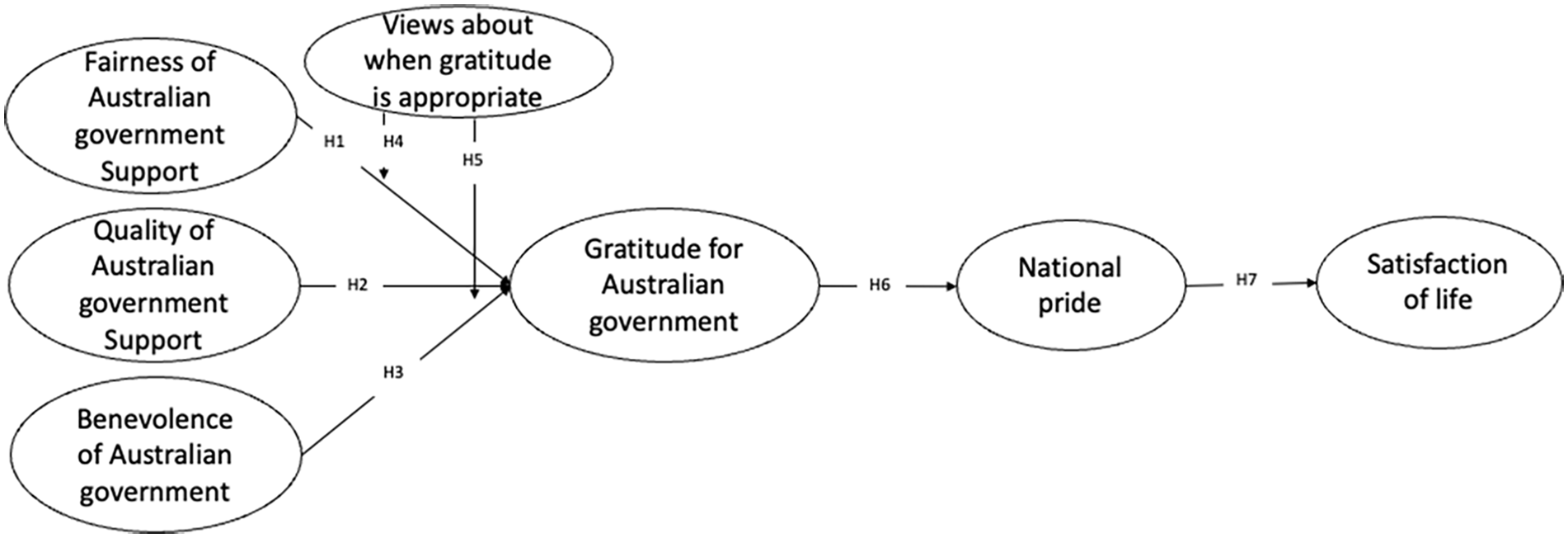
Theoretical framework
Methods
Data Collection
We collected data through an online Qualtrics survey. The research participants were individuals who had previously expressed to Qualtrics a willingness to participate in research projects, and they were all remunerated by the company, as is conventional for participation in behavioral and social science research. While our contract with Qualtrics specified a payment of A$6 800 for at least 200 Indigenous participants and 200 non-Indigenous participants, we did not determine (and do not know) the precise amount paid to each individual participant.
Screening questions were included to ensure that all participants were Australians, were at least 30 years of age, and that they had all had some direct experience of Australian government support, broadly construed, within the past two years. Data were collected for two samples: Indigenous Australians and non-Indigenous Australians. All participants identified themselves as Australians; 211 as Indigenous Australians, and 218 as non-Indigenous Australians.
It is worth noting that research projects involving such large numbers of Indigenous participants are unusual. In part, this may be due to the fact that within Australian universities ethics approval for research involving Indigenous Australian follows an especially robust process. Unfortunately, given that Indigenous Australians comprise only around 3.2% of the Australian population, it is also partly because large-scale involvement is often unfeasible due to cost. By far the largest such studies are the Australian Reconciliation Barometer reports that are conducted every two years. These are funded by the federal Australian government and that which was conducted in 2022, for example, involved 532 Indigenous participants (Reconciliation Australia, 2022: p. 7). While the Australian Survey of Social Attitudes (AuSSA) can be regarded as “Australia’s main source of data for the scientific study of the social attitudes, beliefs and opinions of Australians, how they change over time, and how they compare with other societies” (ACSPRI, 2022), it invariably involves only a very small number of Indigenous participants. In 2022, for example, only 14 appear to have been involved. 4
Scales Used
Our survey features multi-item Likert measures on a seven-point scale, with anchor points ranging from strongly disagree (1) to strongly agree (7). Our measures of perceived fairness of Australian government support are comprised of three items adapted from the scale developed by Sweeney and Soutar (2001). We adapted three items from the same scale to measure the perceived quality of Australian government support. To measure the perceived benevolence of Australian governments we adapted five items that had been developed by Kumar et al. (1995) to measure trust in a commercial partner’s benevolence. To understand the participants’ views about when gratitude is appropriate we used five items developed by Morgan et al. (2017). The three items that we adapted to measure gratitude for Australian government support were originally developed by Mccullough et al. (2002). National pride was measured using three items from the national pride scales as found in Smith and Jarkko (1998) and Smith and Kim (2006). The five items used to measure satisfaction with life are those developed by Diener et al. (1985). These constructs together with the relevant items used in our survey are spelled out in Appendix 1.
Of the 33 scale items initially used for our constructs, six were dropped after they failed to meet standard diagnostic tests in the data analysis. One item was deleted from each of the following constructs: fairness of Australian government support, quality of Australian government support, benevolence of Australian government support, and gratitude for Australian government support. Two scale items from the national pride construct were deleted.
Some of the constructs in our survey feature items that are reverse worded, the use of such items being a way by which to reduce responses that are acquiescent or insufficiently attentive (Mattila & Enz, 2002). In recent years, however, the practice has come under greater critical scrutiny with some studies finding that it leads to additional response errors and slightly different forms of distortion (e.g.: Suárez-álvarez et al., 2018; van Sonderen et al., 2013; Zhang et al., 2016). Amongst the six items that we dropped, four were reverse worded. As found in Appendix 1, the only one that we retained is: “The Australian government support that is available to me fails to meet my needs.”
Common Method Bias
We conducted, post-hoc, Harman’s (1976) one-factor test to minimize the measurement error. Less than 50% of the variance was accounted for by the first factor of both samples, which suggests that the data is not afflicted by common method bias (Harman, 1976). Common Factor Analysis (CFA) examined the possibility of common method bias using Harman’s single factor test for both samples (Podsakoff et al., 2003).
Results
Measurement Validation (Aggregate vs. Indigenous vs. Non-Indigenous)
We conducted our analyses with SEM using SPSS 27 and AMOS 28 and ran CFA using AMOS 28 on the dataset. The CFA results are acceptable, as found in Table 1. Table 1 shows that for all constructs the scores for Inter-item consistency (α) and Composite Reliability were above the suggested cut-off (i.e., 0.70; Nunnally & Bernstein, 1994). Table 1 also includes the item loading estimates that attained significance (p < .01) in support of convergent validity (Anderson & Gerbing, 1988). All constructs’ Average Variance Extracted (AVE) is greater than the threshold score (i.e., 0.50). These tests ensure the convergent validity of all constructs.
CFA (Aggregate vs. Indigenous vs. Non-Indigenous)

Note. χ2 = 1085.423 df = 606, χ2/df = 1.791, (p < .01), CFI = 0.940, SRMR = 0.059, IFI = 0.941 and RMSEA = 0.043. CR = composite reliability; AVE = average variance extracted; FairAGS = fairness of Australian government support; QualAGS = quality of Australian government support; BenAG = benevolence of the Australian government; ApGrat = views about when gratitude is appropriate; GAGS = gratitude for the Australian government support; NP = national pride; SWL = satisfaction with life. The exact survey items can be found in Appendix 1.
Our inter-factor correlation matrix (see Table 2) reveals low correlations between the constructs. The average variance of each construct is greater than its shared variance with any other construct for both samples, which suggests clear discriminant validity between them (Fornell & Larcker, 1981).
Descriptive and Correlation Analysis (Aggregate/Indigenous/Non-Indigenous)

Note. N = 429/211/218, All values are significant at p < .01, Square root of AVE in shown in parentheses, where SD = standard deviation; FairAGS = fairness of Australian government support; QualAGS = quality of Australian government support; BenAG = benevolence of the Australian government; ApGrat = views about when gratitude is appropriate; GAGS = gratitude for Australian government support; NP = national pride; SWL = satisfaction with life.
The square roots of the average variances, which represent the fairness of Australian government support in relation to the quality of Australian government support and benevolence of Australian government support, showed lower shared variance compared to other constructs in all samples. Moreover, the fairness of Australian government support exhibited lower shared variance with gratitude of Australian government in the aggregate and non-Indigenous samples. Similarly, the benevolence of the Australian government displayed lower shared variance with the quality of Australian government support in the aggregate and Indigenous samples, as well as with gratitude for Australian government support in the aggregate and non-Indigenous samples. Additionally, the shared variance between the quality of Australian government support and gratitude for Australian government support in the non-Indigenous sample was lower than the shared variance for any other construct.
A chi-square difference test as suggested by Bagozzi and Yi (1991) was used to check the discriminant validity of moderately high correlations. The chi-square results were significant for all constructs, establishing the discriminant validity of all moderately high correlation constructs. Considering the established and distinct positioning of these factors in the literature (e.g., Kumar et al., 1995; Sweeney & Soutar, 2001) and the results of the tests, we decided to retain the constructs in the study.
Path Analysis (Aggregate vs. Indigenous vs. Non-Indigenous)
We tested the effects of the predictors (i.e., perceived fairness of Australian government support, perceived quality of Australian government support, and perceived benevolence of the Australian government) on gratitude for Australian government support. We also tested the effects of participant views about when gratitude is appropriate on their gratitude for Australian government support. In addition we tested for associations in each sample between gratitude for Australian government support and national pride, and on associations between national pride and satisfaction with life. The relationships were modeled and tested using AMOS 28 (see Figure 2; we have presented estimates in this figure only at aggregate level). The adequacy of this structural model was evaluated by fit indices (same for both samples) which suggested that the structural model displayed a good model of fit to the data set with χ2 = 1429.113.079, df = 558, χ2/df = 2.561 (p < .01), CFI = 0.913, IFI = 0.913, SRMR = 0.13, and RMSEA = 0.06.
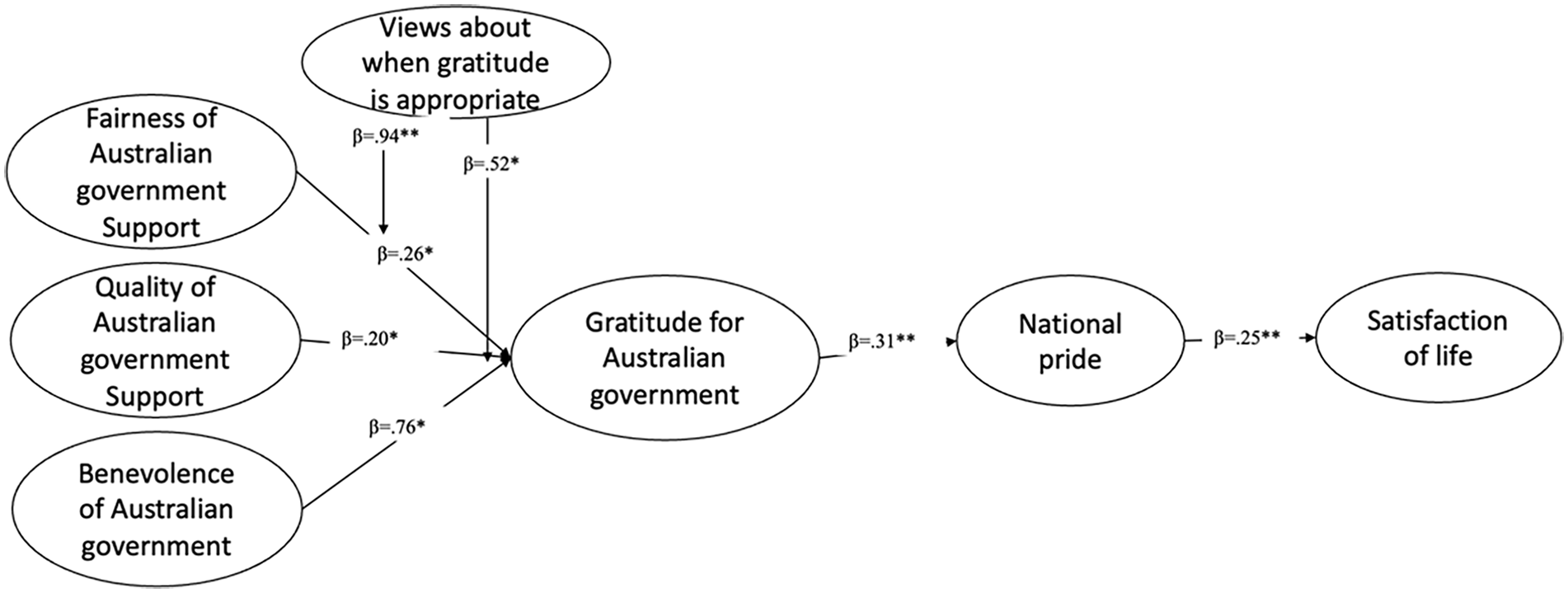
Path analysis
Table 3 indicates both the significant and non-significant relationships as revealed through path analysis and highlights those that are significant through the use of
Path Analysis (Aggregate vs. Indigenous vs. Non-indigenous)

At the aggregate level the quantified relationships that we found between the variables are represented in Figure 2 below.
Slope Analysis
Slope analysis helps to examine the effect of a moderator variable on the relationship between an independent variable and a dependent variable. It enables us to understand whether that relationship is stronger, weaker, or even reversed due to the influence of the moderator variable. Figure 3a and b each provide slope analyses at the aggregate level with respect to the moderating effects of participant views about when gratitude is appropriate. As shown in Figure 3a, a relatively broad (i.e., “high”) view about when gratitude is appropriate has a significant and strongly positive effect on the relationship between perceptions about the fairness of government support and gratitude for government support. And as shown in Figure 3b, a relatively broad (i.e., “high”) view about when gratitude is appropriate has a moderately positive but non-significant effect on the relationship between the perceived benevolence of government and gratitude for government support.
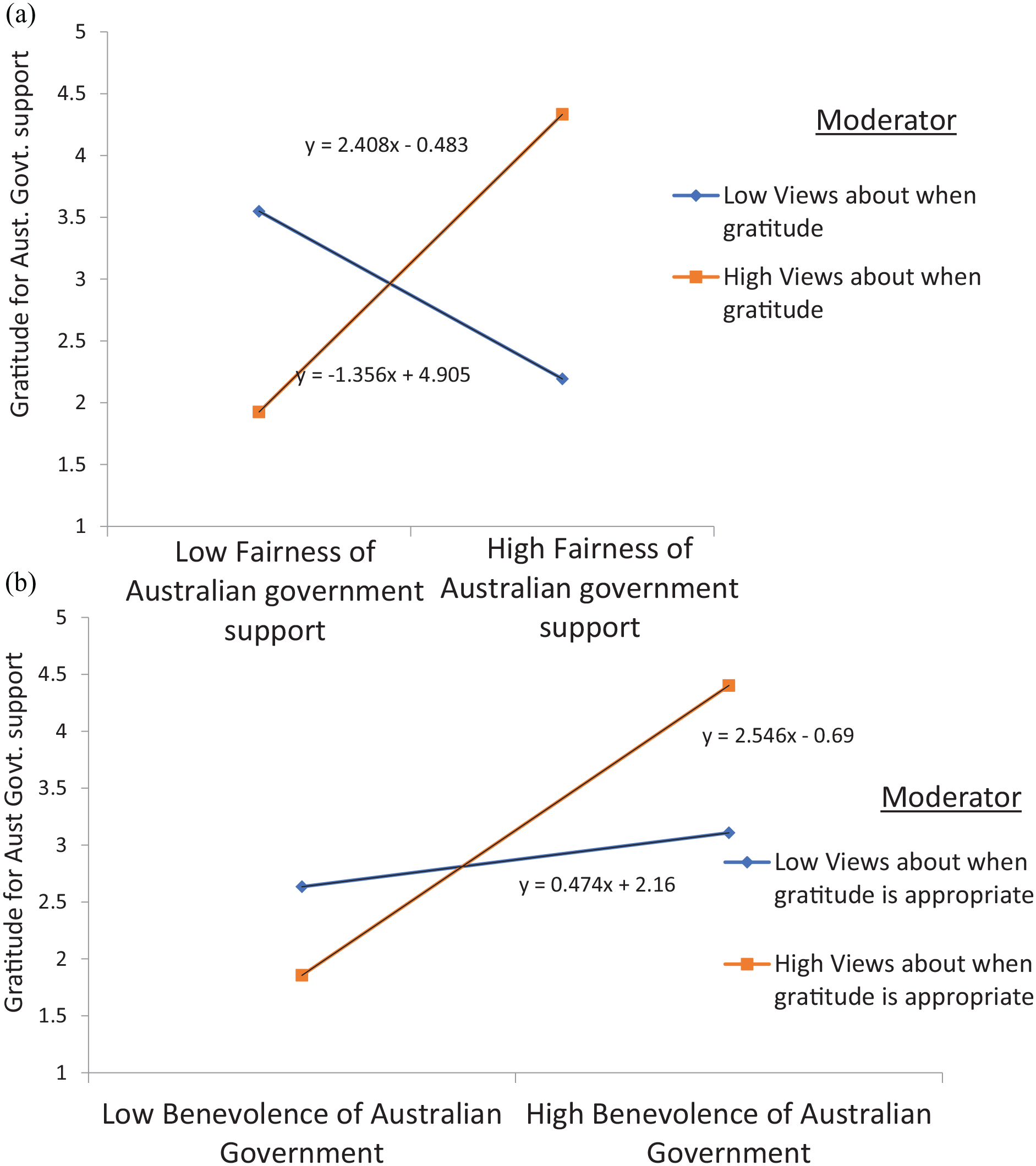
(a and b) Slope analysis
Indirect Effects (Aggregate vs. Indigenous vs. Non-Indigenous)
Consistent with Zhao et al. (2010), bootstrapping procedures in AMOS 28 were carried out to examine the significance of the mediation effects on gratitude for Australian government support and on national pride for both samples. By random sampling, we generated 2,000 bootstrapping samples from both original data sets (N1 = 211; N2 = 218). According to the results, some indirect paths are significant and some are non-significant in both samples or one sample. The mediating effects of two mediators and their associated 95% confidence intervals are displayed in Table 4.
Indirect Effects (Aggregate/Indigenous/Non-Indigenous)

Note. N = 429/211/218.
Values are significant at p < .05, **Values are significant at p < .01.
Two Samples Independent t-Test For All Variables
To test
Two Sample Independent t-test

Discussion
With respect to
In comparison with the Indigenous participants, non-Indigenous participants were more likely to consider Australian government support to be of reasonable quality (mean values: 3.55 vs. 4.04; p = .000). And with respect to
The non-Indigenous participants were more likely than the Indigenous participants to perceive the Australian government as benevolent (mean values: 3.68 vs. 3.37; p = .022), thus confirming
As expressed in
In any case, most of the associated moderating effects that we anticipated and explored do appear to be significant. With respect to
With respect to
Interestingly, we found that the Indigenous participants were more likely than non-Indigenous participants to have a strong sense of national pride (mean values: 5.24 vs. 4.94; p = .001), thus disconfirming
Finally, as per
Given that our discussion is focussed primarily on Australia, one of the anonymous reviewers for this journal suggested, quite reasonably, that we give some consideration to the relevant decolonization literature. Now we have mentioned Mahatma Gandhi and Desmond Tutu, both of whom were central to certain decolonization initiatives. They each led in a way that was conducive to the creation and maintenance of bridging social capital; and as noted, for that reason we tend to prefer their approach to leadership over that of Malcolm X or Frantz Fanon, for example. But of course there is far more to be said.
It so happens that X and Fanon have influenced some of the Australian decolonization literature. Chelsea Watego, 5 for example, articulates an ostensibly radical position that draws inspiration from both of them (Watego, 2021, e.g.: 17, 30, 42, 56, 66, 114, 142). It should be recognized, however, that in many instances her talk of violence, war, and a “burn it down” kind of “Unmitigated Blackness” (Watego, 2021, p. 195) is merely rhetorical; it is clear that no literal wars or insurrections are on her agenda. The “storytelling war” that she discusses is essentially one in which writers and scholars of literature debate an Australian literary canon that is said to have been created for little further purpose than to establish a sense of nationhood and to legitimize the nation’s institutions (Watego, 2021, esp. chapters 2 & 3). In our view, such ideas are worth serious discussion, as are many of the other aspects of her book. But while there is no doubt that Watego would like to see some kind of move toward decolonization and “Indigenous sovereignty,” underneath all the rhetoric one can look only in vain for clear and specific proposals as to what, according to Watego, this move should involve.
Some other contributors to the literature consider there to be certain respects in which Australia has been in the process of decolonizing for many decades already. Will Sanders, for example, points to the fact that various individual rights were extended to Indigenous Australians in the 1940s, 50s and 60s, and he celebrates this as part of the decolonization movement (Sanders, 2006). Of course few would deny that this extension of rights was liberating and welcome. It must be remembered, however, that such rights are enshrined in institutions originally established by colonial authorities. This being so, we struggle to see any coherent and genuine sense in which this development was a move toward decolonization.
In the teaching of public administration, decolonization is often understood to involve reduced reliance upon theories and practices developed by Western scholars and practitioners, and a correspondingly greater appreciation for local indigenous insights and practices. Thus understood, decolonizing the curricula may pose some complex challenges for all involved if the resulting curricula are still expected to meet the standards established by international accreditation agencies (van Jaarsveldt et al., 2019). In our view, it may be possible to surmount such challenges. But in any case, a separate concern that arises for us is that decolonization is often presented with a kind of ideological zeal that renders it terribly vague yet largely unquestionable. In South Africa, for example, the decolonization of university curricula is said to have “become a necessity” (Saurombe, 2018, p. 119), one for which the call is “urgent” (Matsiliza, 2020, p. 295). Or in the words of Pakistan’s Muhammad Azfar Nisar, scholars such as he “are supposed to get on the decolonization bandwagon and start screaming ‘Decolonize! Decolonize!’ at the top of our lungs” (Nisar, 2023, p. 147). Of course many decolonizing initiatives may well be worth embracing. A greater appreciation for certain relevant local indigenous insights and practices, for example, may often be welcome and long-overdue, and sometimes it may be important to apply them in the work of public administration. Given the great variety of things that decolonization may involve, however, we do not automatically assume that it is prudent to embrace it.
Limitations and Directions for Future Research
While the positive contributions of this paper are important there are some methodological limitations to acknowledge.
First, our cross-sectional data reflects the perceptions of our participants at only one moment in time. Future studies, by contrast, could gather data at several intervals and thereby provide longitudinal analyses.
Second, participant bias inevitably contributed to low loadings for some scale items, and this necessitated the exclusion of those scale items from further complex data analysis. There is no current consensus in the relevant methodological literature with regard to appropriate reliability scores for the threshold factor loadings when conducting this kind of study. While we adopted relatively high reliability scores for those threshold factor loadings, future studies may be well advised to adopt medium-level reliability scores so as to enhance the validity of their scale items.
A third kind of limitation relates to the context specificity of our study. Our theoretical framework is concerned with the civic virtues of gratitude and national pride, along with the role that such virtues can play in the development of certain forms of social capital. It is arguably a framework that should be of widespread interest, particularly in nations of ethnic diversity. But we do not unthinkingly assume that our specific findings are likely to be replicated in the context of other nations or cultures. Comparable studies in other such contexts would need to give due consideration to a variety of cultural and historical issues specific to the particular populations groups with which those studies are concerned.
Conclusion
To pay attention to gratitude is to remain alert to an important form of feedback. As we have shown, the gratitude that people feel for government support is reflective of how they perceive its quality and fairness. And if, for example, more Indigenous Australians were to perceive Australian government support as being fair, gratitude for such support amongst Indigenous Australians would increase.
Gratitude is a virtue that commonly comes with health benefits, both mental and physical, for those who possess it. Moreover, it is a conciliatory virtue, one that is both inimical to strategies of political leverage and division and conducive to the creation and maintenance of bridging social capital. For such reasons, we are inclined to think that gratitude is vital for reconciliation in Australia. Of further interest is the fact that gratitude can be associated with a welcome and healthy form of civic national pride. There have long been certain moral and theoretical reasons to expect gratitude and national pride to be associated with each other. In this study, however, we have also presented plainly empirical evidence of such an association. In fact contrary to our expectations, we found that Indigenous Australians were more likely than non-Indigenous Australians to have a strong sense of national pride. In our view, such revelations provide reasons for optimism. They point to the possibility of a future in which Australians, both Indigenous and non-Indigenous, are reconciled with one another, grateful for what they enjoy, united by a strong and healthy sense of civic national pride, and rich in social capital.
Footnotes
Appendix 1
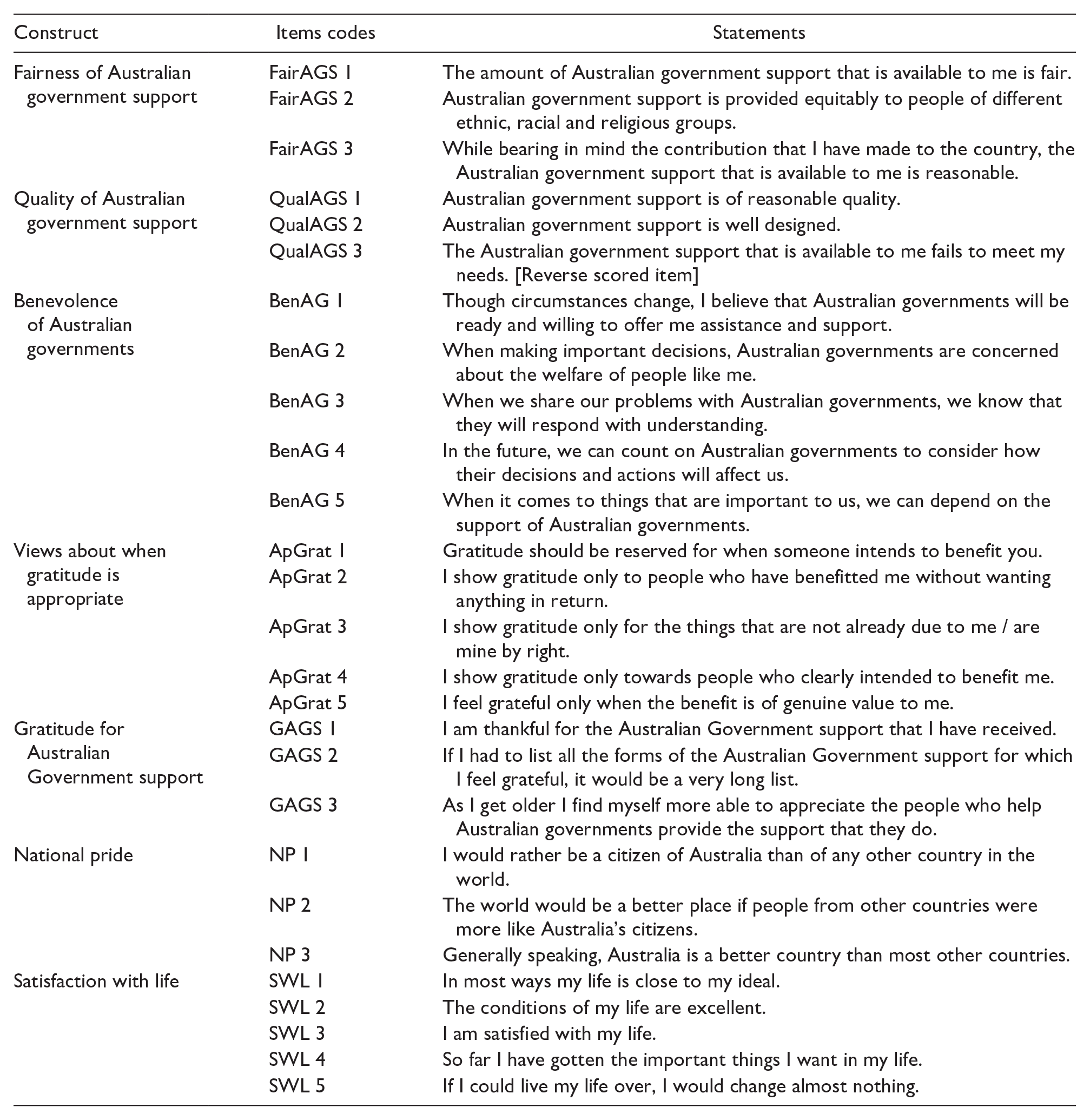
| Construct | Items codes | Statements |
|---|---|---|
| Fairness of Australian government support | FairAGS 1 | The amount of Australian government support that is available to me is fair. |
| FairAGS 2 | Australian government support is provided equitably to people of different ethnic, racial and religious groups. | |
| FairAGS 3 | While bearing in mind the contribution that I have made to the country, the Australian government support that is available to me is reasonable. | |
| Quality of Australian government support | QualAGS 1 | Australian government support is of reasonable quality. |
| QualAGS 2 | Australian government support is well designed. | |
| QualAGS 3 | The Australian government support that is available to me fails to meet my needs. [Reverse scored item] | |
| Benevolence of Australian governments | BenAG 1 | Though circumstances change, I believe that Australian governments will be ready and willing to offer me assistance and support. |
| BenAG 2 | When making important decisions, Australian governments are concerned about the welfare of people like me. | |
| BenAG 3 | When we share our problems with Australian governments, we know that they will respond with understanding. | |
| BenAG 4 | In the future, we can count on Australian governments to consider how their decisions and actions will affect us. | |
| BenAG 5 | When it comes to things that are important to us, we can depend on the support of Australian governments. | |
| Views about when gratitude is appropriate | ApGrat 1 | Gratitude should be reserved for when someone intends to benefit you. |
| ApGrat 2 | I show gratitude only to people who have benefitted me without wanting anything in return. | |
| ApGrat 3 | I show gratitude only for the things that are not already due to me / are mine by right. | |
| ApGrat 4 | I show gratitude only towards people who clearly intended to benefit me. | |
| ApGrat 5 | I feel grateful only when the benefit is of genuine value to me. | |
| Gratitude for Australian Government support | GAGS 1 | I am thankful for the Australian Government support that I have received. |
| GAGS 2 | If I had to list all the forms of the Australian Government support for which I feel grateful, it would be a very long list. | |
| GAGS 3 | As I get older I find myself more able to appreciate the people who help Australian governments provide the support that they do. | |
| National pride | NP 1 | I would rather be a citizen of Australia than of any other country in the world. |
| NP 2 | The world would be a better place if people from other countries were more like Australia’s citizens. | |
| NP 3 | Generally speaking, Australia is a better country than most other countries. | |
| Satisfaction with life | SWL 1 | In most ways my life is close to my ideal. |
| SWL 2 | The conditions of my life are excellent. | |
| SWL 3 | I am satisfied with my life. | |
| SWL 4 | So far I have gotten the important things I want in my life. | |
| SWL 5 | If I could live my life over, I would change almost nothing. |
Author Contributions
Data Availability
We are willing to make our data available upon request.
Declaration of Conflicting Interests
The author(s) declared no potential conflicts of interest with respect to the research, authorship, and/or publication of this article.
Funding
The author(s) received no financial support for the research, authorship, and/or publication of this article.
Ethics Approval
This project was reviewed and authorized by the University of New England Human Research Ethics Committee. Approval number: HE18-294.
