



Abstract
A proposal to redevelop 1.7 acres of publicly owned downtown waterfront property located in Houghton, Michigan involved a private developer replacing a decaying municipal parking deck with mixed-use taxable construction. The city’s redevelopment process and the developer’s vision for the site met opposition from a small, but well-organized, group calling for a halting of the process and the defeat of incumbent councilors in the subsequent election. Our analysis of the ballots found that challengers received more strategic votes than incumbents and that straight ticket and Election Day voters disproportionately skipped the city council race on their ballots. These results are consistent with collective action theory and rational ignorance theory.
Points for Practitioners
When proposing municipal redevelopment projects, managers and councilors need to be aware that small, organized groups are likely to emerge in opposition to the project. These small groups have a high likelihood of scuttling the project, especially if the project’s supporters are unorganized.
Managers and councilors should proactively provide accurate information early in the redevelopment process as no one else is likely to do so and voters are unlikely to seek out this information.
Opponents of the project are likely to vote strategically at the ballot box. Supporters of the project need to be made aware of opportunities to vote strategically as well.
Introduction
This case study analyzes events from April 2019 through January 2023 surrounding redevelopment of a site currently occupied by a structurally decayed municipal parking deck in Houghton, Michigan, a city with a 2020 population of 8,386 (U.S. Census Bureau, 2022). The developer chosen by the Houghton city council visualized replacing the deck with mixed-use construction consisting of a hotel, restaurant, conference center, residential units, and a smaller parking deck. The taxable portion of the redevelopment would have increased the city’s tax base by $12 million, resulting in the Downtown Development Authority’s annual tax revenue increasing by $252,000, more than doubling its 2020 tax capture (Veridea Group, 2019).
The city’s redevelopment process and the developer’s vision of mixed-use development attracted opposition from the Houghton Waterfront Redevelopment Citizens’ Group (HWRCG). The group created a Facebook group (Houghton Waterfront Redevelopment Citizens Group, n.d.) and endorsed three challengers seeking to defeat the incumbent councilors in the November 2020 election. No citizens’ group supported the city’s redevelopment process, the developer’s vision, or the reelection of incumbent councilors.
The Logic of Collective Action (Olson, 1965) states that small, organized groups will outperform their numbers politically relative to large unorganized groups. Consequently, even projects with positive net social benefits can fail at the ballot box (Wagner, 1983). Our empirical results show what transpired in Houghton was consistent with collective action theory as the incumbent councilors were defeated and the redevelopment process halted. What transpired was also consistent with rational ignorance theory (Downs, 1957), where voters deem the cost of acquiring information regarding an election to be greater than the benefit of doing so. This is evidenced by voters who left the council race blank on their ballots in the November election. Had they voted, the outcome of the election might have been different, and the redevelopment process continued. Managers and councilors should be cognizant of these theories and their implications when proposing municipal projects.
Six sections follow. A discussion of collective action and rational ignorance theories precedes a chronicle of the controversary surrounding Houghton’s project. The next two sections focus on four hypotheses. The first two hypotheses are derived from Olson (1965) involving HWRCG actions and the results of the votes cast in the 2020 council election. The third and fourth hypotheses are derived from Downs (1957) involving voters who left the council election blank on their ballots. We then discuss what our findings mean for theory and practice. Concluding remarks follow.
Collective Action and Rational Ignorance
Olson’s (1965) seminal work The Logic of Collective Action presents the paradoxical result that small interest groups are more effective politically than large interest groups. An Arkansas tree controversy (Taylor & Schreckhise, 2003) can be viewed through Olson’s lens. A citizens group numbering a few hundred, opposed to a development project involving the removal of old growth trees, organized and successfully defeated the mayor in the subsequent two-candidate election with a total of 12,094 votes cast.
Small groups have a relatively easier time than large groups solving Olson’s collective action problem. The former can more easily have its members undertake actions supporting the group’s objective(s). In contrast, a member of a large group knows that the outcome of the group’s actions will be essentially the same regardless of what that member does. Thus, each large group member contributes minimal effort supporting the group’s objectives. Denzau and North (1994) similarly argue that an individual on a committee will put forth little effort working on a solution to a problem if they cannot individually control the committee’s final decision unless this effort has benefits that carryover to the future. The individual might then treat current effort as an investment for a future personal payoff.
Members of a small and well-organized interest group are more easily monitored, thereby increasing the likelihood that each exerts effort supporting the group’s objectives. An individual member is acutely aware that the group is likely to suffer if they shirk. Small groups are also better able to offer what Olson (1965, p. 51) calls “selective incentives” for rewarding members who work toward the group’s common interest. In terms of small social and political groups, a selective incentive might merely be increased status within the group, as is particularly true with receiving “likes” on social media causing a dopamine feedback loop encouraging additional postings to get “likes” (Haynes, 2018).
Olson’s small versus large group dichotomy means that, if the project is opposed by a small well-organized group, there is no guarantee that candidates for public office supporting a redevelopment project with positive net social benefits will prevail at the ballot box. Wagner (1983) contends that majoritarian democracies may undertake negative-sum projects if the benefits are concentrated in a small subset of the population. A corollary is that positive-sum projects might not be undertaken if the benefits are dispersed over the broader population. There is asymmetry between the project’s benefits and costs and the information held by the project’s gainers and losers. The more concentrated the benefits and costs, the greater the incentive for gainers and losers to (i) acquire information, (ii) voice opinions, and (iii) cast ballots regarding the project. Consequently, a proposed project with positive net social benefits might fail at the ballot box if benefits are dispersed over a large group.
“Those who suffer in silence” (Olson, 1965, p. 165) would benefit from a particular action or policy but are unable to effectively organize due to the sheer size of the group. Olson’s examples of the suffering silent include consumers, white-collar workers, and migrant workers. Agricultural tariffs cost consumers $3.5 billion per year (Beckman & Scott, 2021), but no consumer group organizes to reduce them. Taxpayers who stand to benefit from a redevelopment project with positive net benefits could also be considered a suffering silent group. Note that suffering silently does not mean that members of this group are literally suffering. This is simply Olson hyperbolically illustrating that no individual is representing the group’s interests.
Suffering silently is related to the theory of rational ignorance (Downs, 1957). Since a single vote is unlikely to be decisive in an election, an individual voter has little incentive to undertake the cost in terms of time and effort in acquiring information regarding the candidates and issues on the ballot. Consequently, “rational ignorance became the root of (. . .) Classical Public Choice Theory” (Caplan, 2007, p. 95).
There are other reasons why people don’t vote besides rational inattention. Barriers to voting, such as conflicts with work schedules, difficulty getting to the polls, not knowing how or where to register to vote, lack of information on voting laws, and cynicism toward politics are other reasons why people don’t vote. The National League of Cities argues that a lack of awareness of local candidates and issues and how local elected officials impact daily life reduce turnout in local elections (Brennan, 2020). Rajiv Vinnakota, President of the Institute for Citizens and Scholars, notes that “many Americans are disillusioned with politics in general” (Hacker, 2022). The Center for Information and Research on Civic Learning and Engagement (2018) found that not liking candidates or issues was the most common reason given by those aged 18 to 29 years, with and without college experience, for not voting in the 2016 election.
Consistent with rational ignorance, Schaffner et al. (2001) found that a nonpartisan race depresses turnout vis-à-vis a partisan race. Party labels provide information to voters on candidate positions and thus serve as a signal on which candidate to support. Removing party labels increases the cost to voters in acquiring candidate information, making it less likely citizens will acquire this information and vote. Anderson (2010) reports that the more up-ballot races there are the less informed voters are about down-ballot local races. Bonneau and Loepp (2014) found that straight ticket voting reduces down-ballot voting in nonpartisan races because the voter who checks the straight ticket box then must proceed down the ballot to vote in nonpartisan races. Houghton’s November 2020 nonpartisan council race was placed 21st among the 23 races and initiatives on a ballot that included federal and state partisan races.
Four hypotheses derived from The Logic of Collective Action are:
Hypothesis 1: The suffering silent will not organize to support a municipal redevelopment project with positive net social benefit and relatively little positive net individual benefit.
Hypothesis 2: A small, well-organized group opposing a redevelopment project and incumbents seeking reelection will outperform its numbers in an election when it faces little or no opposition from a small, well-organized group supporting the project and incumbents.
Hypothesis 3: Straight ticket voters will be less likely to vote in a nonpartisan council race than non-straight ticket voters.
Hypothesis 4: Election Day voters will be less likely to vote in a nonpartisan council race than absentee voters.
Hypothesis 1 predicts that one should not expect a large interest group to emerge supporting a local project, but one should expect a small interest group voicing opposition to emerge. Hypothesis 2 predicts that the small opposition group has a high likelihood of achieving its objectives, which is consistent with Olson (1965).
Hypotheses 3 and 4 follow from Downs’ (1957) rational ignorance theory, which is related to the existence of the suffering silent. A straight ticket voter is less likely to proceed through the ballot to vote in a nonpartisan race, as the absence of party affiliation reduces the information provided to the voter, making information gathering more costly. An Election Day voter is more likely to suffer from ballot fatigue and thus more likely to skip a race deemed less important than an absentee voter voting at home. Some voters likely failed to vote in the Houghton council election because they were unaware of the race’s importance. The silence from the suffering silent has the effect of not getting the word out regarding the importance of down ballot races.
The theories of Olson and Downs can explain what transpires at the municipal level. Councilors and managers should be cognizant of these theories when proposing projects and anticipate pushback, even if the project has positive net social benefits.
A Chronicle of the Redevelopment Controversy
Houghton (henceforth, “the city”) has a council-manager governmental structure. The council consists of seven nonpartisan, at-large, 4-year term seats contested biennially in general elections held in even numbered years. Three (four) council seats are contested in presidential (midterm) elections.
In the 1970s, the city purchased parcels of downtown property totaling 1.7 acres along the city’s waterfront. In October 1978, the city dedicated a 702 foot-long, two-level, public parking deck occupying the 1.7 acres. The winter climate in Houghton averages over 200 inches of snow annually. Snow removal and deicing contributed to the deck’s structural decay. A 2011 report commissioned by the city contained cost estimates of $1.7 million and $2.3 million for extending the deck’s use for 10 and 20 years, respectively (Comprehensive Engineering and Restoration Engineering Tech, 2011). The city settled for a smaller bandage spending $1.3 million on parking deck maintenance from 2012 to 2014, extending the deck’s life for fewer than 10 years (City of Houghton Community Engagement, 2021).
At the February 13, 2019, council meeting, city manager Eric Waara stated developers are interested in redevelopment projects on the city property occupied by the parking deck. He requested authorization to solicit redevelopment proposals for the property. A motion authorizing him to do so passed on a 7-0 roll call vote (council meeting minutes are available at https://houghtoncitymi.documents-on-demand.com/).
In April 2019, the city manager posted a Request for Qualifications (RFQ) to learn what private options were available for redeveloping the parking deck site (City of Houghton, 2019). The RFQ stated the city aimed to “. . .identify a developer with the resources, experience, and vision to work with the City on the eventual purchase and redevelopment of the property into a desirable addition to Downtown Houghton. . .,” but “. . .not seeking any form of partnership role in commercial aspects of the development itself.” Thus, the city was not seeking a long-term, public-private partnership described in Xu and Morgan (2012).
The city received three statements of qualification. At the August 19, 2019, council meeting, each developer presented their vision for redeveloping the site:
Vision 1: An 80–110 room hotel, restaurant, conference center, residential units, and new parking deck (Veridea Group, 2019).
Vision 2: A 70 room hotel, conference center, retail and office space, and new parking deck (Moyle, 2019).
Vision 3: A hotel, residential housing allowing for aging-in-place, retail and office space, and new parking deck (Julien & Julien, 2019).
The absence of conflict on the council allowed city manager Waara, a professional civil engineer, to exercise leadership at the outset of the redevelopment project in posting the RFQ and obtaining the three redevelopment visions, both of which are consistent with the findings of Demir et al. (2019) concerning power and leadership. The former displayed expertise in the city’s administrative apparatus and discretion in implementing policies, while the latter displayed the manager’s ability to work directly with the community and stakeholders on potential public projects.
At its meeting on August 28, 2019, the council received 11 letters from the public and heard 12 oral comments regarding the three visions. Written and oral comments expressed the lack of need for another hotel, an insufficient proposed amount of green space, blocked scenic views, and inadequate proposed parking. Overall, the tone of written and oral comments was unfavorable toward each of the three visions. During the meeting, a motion was made to authorize a redevelopment committee consisting of the city manager, a city councilor, and the chairpersons of the city’s Downtown Development Authority and Planning Commission to negotiate redevelopment details with the Veridea Group, the developer of Vision 1. The motion passed on a 5-2 roll call vote with minimal discussion among the five councilors as to why Vision 1 was preferred to the other two visions. The city and the Veridea Group then commissioned a new report to assess the condition of the parking deck (Pierce Engineering, 2020). The assessment found numerous instances of severe structural decay.
During the November 13, 2019, council meeting, a HWRCG representative read a letter requesting that two HWRCG representatives be appointed to the redevelopment committee and more public engagement be included in the process. Attached to the letter were names and residencies of 73 individuals agreeing with the two requests, of whom only 37 (51%) resided within the city. The city manager declined to make the requested appointments but ensured the petitioners that the process moving forward would provide opportunity for public input.
During the December 4, 2019, council meeting, the HWRCG circulated a petition calling for the sale of the property to be delayed (Neese, 2019). The petition resulted in this advisory question being placed on the August 4, 2020, primary ballot:
Should the sale of the waterfront parking deck property be postponed until the citizens of Houghton and other stakeholders are able to participate in an open decision-making process about future use of the property that explores other options besides a sale to a single private developer.
As an advisory measure, the council was not legally bound to abide by the outcome.
A total of 1,125 city residents voted, a turnout rate of 42% of the 2,678 registered voters. The outcome on the advisory measure was 830 yes and 226 no. While the yes votes represented 78.5% of the total votes on the advisory measure, they were cast by just 31% of the city’s registered voters. Sixty-nine voters did not vote on the advisory question (Houghton County Clerk, 2020).
The margin of victory and soon-to-be competitive race for open council seats pointed toward councilors complying with the request of the August 4 yes voters, while the low voter turnout coupled with the complexity of the proposed project that might not be fully understood by yes voters favored councilors not adhering to the request (English & Peretz, 2004).
It was difficult for councilors to judge the degree to which the 830 voters opposed redeveloping the site. The advisory question said to “postpone” the sale of city property so citizens could “participate in an open decision-making process.” Hastings & Cann (2014) note the importance the framing of a ballot question has in determining the outcome. The August 4 voting might have been quite different if the advisory ballot had read: Should the Lakeshore Avenue Redevelopment process continue if citizens of Houghton and other stakeholders are able to voice opinions on related matters? Ultimately, the city manager and councilors chose to move forward with the redevelopment ensuring residents that the process would allow for plenty of time for more public input (Neese, 2020a). The city manager’s adherence to the city’s redevelopment process despite the results of the ballot question was consistent with Zwikael’s (2020) recommendation of following a structured, formal development process for a complex redevelopment project, in contrast to a less formal, more flexible process.
On the November 3, 2020, ballot, two councilors were seeking reelection (Phillip Foltz and John Sullivan) along with three HWRCG endorsed challengers (Virginia Cole, Brian Irizarry, and Joan Suits). At the time of the November election, the city had 2,933 registered voters (Houghton County Clerk, 2020). Table 1 reports the election results. A total of 2,260 ballots were cast for a registered voter turnout rate of 77%.
Houghton City Council Election Results
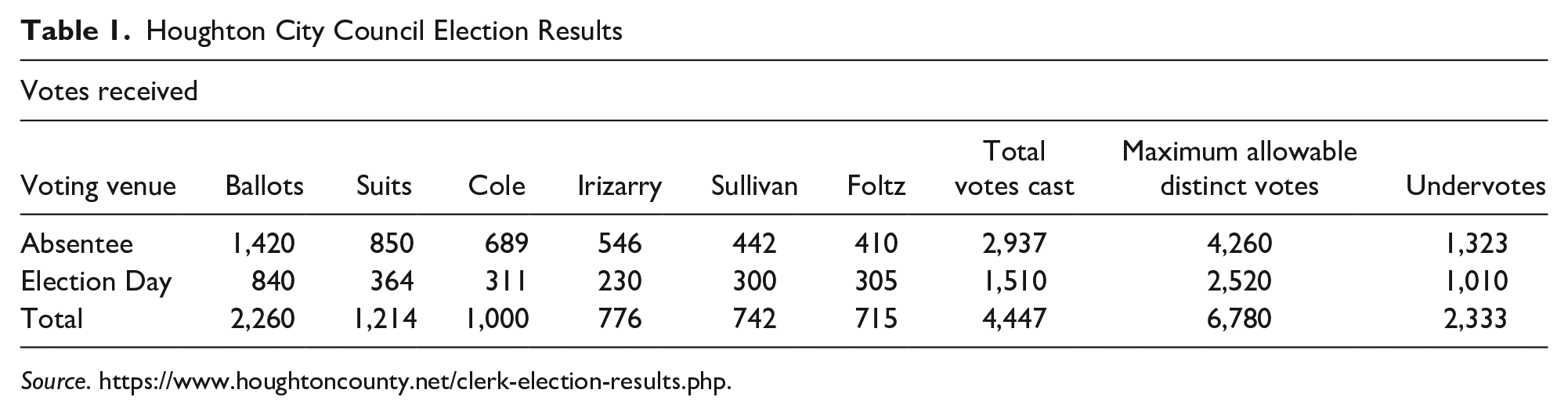
Since there were three open council seats, each voter was entitled to vote for up to three council candidates. Thus, there was a total of 6,780 (=2,260 × 3) allowable votes in the council election. Not every voter used all three of their allowable council votes; some voters either skipped the council race or voted for one or two candidates. A total of 4,447 council votes were cast. Of the 2,260 ballots, 459 (20%) had no votes marked for council candidates. Only 1,801 ballots had at least one council vote resulting in a council voter turnout rate of 61%. The high council voter turnout is consistent with Brennan (2020) that in-cycle local elections boost voter turnout rates. The 2,333 undervotes are attributed to the 459 voters who skipped the council election and the 1,874 unused votes resulting from voters who voted in the council election but did not cast all three of their allowable votes. The three challengers were elected to the council, with just 34 votes separating the third-place challenger (Irizarry) and the fourth-place incumbent (Sullivan).
At the December 16, 2020, council meeting, the city manager presented four options related to the parking deck:
1. Continue to repair the deck with continued maintenance projects. This will cost approximately $250,000 annually for the big deck and there are still the maintenance costs of the other decks. This could be paid for by: a. Raising parking rates to $1,000 per year. b. Increase the city’s property tax millage by 2 mills. c. Levy special assessments on those property owners who “use” the deck. 2. Take the deck down and eliminate the ongoing expense. This would cost over $1 million dollars and would result in decreased parking and no rear access to the businesses currently with such access from the deck’s upper level. 3. Replace the deck with something new, but very similar. This would cost about $1 million to demolish the existing deck and another $7 million to rebuild a new one. 4. Work with a developer to leverage the growth in the downtown to replace the deck with other parking options and build something of value to increase the downtown tax base and remove a burdensome legacy cost from the city’s taxpayers.
The city manager then requested authorization to move forward with the city attorney in defining the property, getting it appraised, and putting together a draft purchase and development agreement, which was aligned with option 4 above. A motion to do so was made by Councilor Mike Needham and seconded by Councilor Dan Salo, neither of whom were on the November 3 ballot. Newly elected councilors Cole and Suits stated that the public needed to be more engaged and now was not the time to vote. A motion to table the request was then made by newly elected councilor Irizarry and supported by councilor Suits. Prior to voting Suits stated: “The city manager will continue to work on this [issue] because it was part of his job.” The city manager replied “[I’m] looking for an affirmation for the developer that has worked in good faith for over a year.” Needham withdrew his motion. He then stated “. . .the council need not make a motion to continue working because the city manager will continue working.” Councilor Irizarry withdrew his motion. The meeting abruptly adjourned. Having the manager continue along a path that was unworthy of formal council support was a subtle way of signaling a lack of support for the path.
The developer’s response to the council’s inaction on December 16 was conveyed in a December 21, 2020, letter to Houghton City Hall stating, in part: After listening to the December 16th Council meeting, it is clear the City has no defined process in place that can move this project forward at this time. This is disappointing, especially in light of the fact that we have invested several hundred thousand dollars to-date. With no clear path forward, we have no choice but to withdraw from the project at this time (“Square One,” 2021).
On July 28, 2021, believing that the public had enough time to provide input on the deck’s future, the council voted 6-1 instructing the city manager to begin the process for removing the parking deck without a formal redevelopment plan in place. On February 9, 2022, the council voted unanimously for the city manager to begin the process of issuing $1 million in bonds to pay for its removal.
In 2020, the city’s general fund captured $108,000 per property tax mill. If borrowing $1 million for 10 years would mean payments of $130,000 annually for 10 years, 1.2 additional mills (=$130,000/$108,000) would be needed to pay off the debt. This would result in an additional $1.20 per $1,000 of taxable property. A homeowner with a house of $50,000 taxable value (equal to $100,000 market value) would have an annual tax increase for 10 years of $120 (=$100,000 × 0.0012). For a homeowner whose home has a taxable value of $150,000 the 10-year annual tax increase would be $360.
Empirical Analysis: Small Versus Large Groups (Hypotheses 1 and 2)
The Logic of Collective Action defines two groups relevant to this study: (i) Small, organized, and vocal—the HWRCG and (ii) large, unorganized and suffering in silence—Houghton taxpayers. The HWRCG (i) placed a non-binding advisory measure on the August 2020 ballot, (ii) endorsed the three non-incumbent candidates, and (iii) conducted a social media campaign voicing opposition to Vision 1. Indicators that HWRCG’s membership was small are (i) only 37 residents signed the letter presented at the November 13, 2019, council meeting and (ii) the HWRCG’s Facebook group had less than 300 members (Houghton Waterfront Redevelopment Citizens’ Group, n.d.).
Despite small numbers, the group was successful in achieving its goal, which is consistent with The Logic of Collective Action – small interest groups have an easier time organizing than large groups. Experiencing individual effort stalling redevelopment can serve as a selective incentive for members working in small groups. No taxpayer group organized in favor of moving forward with the redevelopment despite it potentially saving the typical homeowner hundreds of dollars annually, which is consistent with The Logic of Collective Action’s concept of the suffering silent. Thus, Hypothesis 1 is supported.
In the context of this study, there is a third group that does not neatly fit into The Logic of Collective Action, namely the small, unorganized interest group comprised of the two incumbent councilors seeking reelection. Unlike the three challengers, the incumbents, individually or jointly, placed no ads in the local newspaper soliciting voter support. Incumbents placed few campaign signs throughout the city, while the challengers had numerous signs displayed. On Election Day, only challengers’ signs were displayed near the polling stations.
It is somewhat surprising that the two incumbents did not organize. Not organizing appears to contradict The Logic of Collective Action, as selective incentives are feasible for such a small group. A group of two actively campaigning mitigates shirking since individual effort plays a large role in the outcome.
Why didn’t the incumbents put forward more effort seeking reelection? A plausible answer is burnout. Kaatz et al. (1999) found that political conflict amongst council factions leads to city manager burnout. Councilors can also experience conflict induced burnout reducing the motivation to actively pursue reelection. Houghton councilors are not professional politicians; they receive annual, taxable compensation of approximately $3,000. Perhaps the possibility of facing heightened political conflict and continued personal attacks dampened enthusiasm for actively campaigning. One of the defeated councilors told the third author, “I gave it my best while serving and I think I did a good job. If that was not good enough, so be it.”
Burnout is also evidenced in the developer’s withdrawal letter. Early December 2020 postings on HWRCG’s Facebook group alleged corruption between the developer and city officials. One posting read: “Maybe I’m stepping outside my knowledge or bounds but this whole thing feels near criminal and I don’t think I’m the only one that feels it.” A group member replied “My honest opinion is that there’s some under the table deals and payoffs going on, not like I could ever prove it. . .” In the December 2020 withdrawal letter, the developer stated: We recognize that a development project of this magnitude deserves close scrutiny and active participation. However, it should not devolve into spreading misinformation, false data, outright lies, and personal attacks as has been the conduct of many opponents of this project. Challenge our plans, not our people and integrity (“Square One,” 2021).
Dear (1992, p. 290) describes three phases of conflict involving development projects: youth, maturity and old age. The youth phase occurs when the project is announced, where “opposition tends to be confined to a small, vocal group” and “sentiments are usually expressed in the rawest, bluntest of terms.” Once the initial emotions subside, the project shifts to the maturity and old age phases, where opinions are more measured, concessions are made, and a conclusion or stalemate is reached. The allegations of corruption and personal attacks were consistent with the youth phase of Houghton’s redevelopment process. The process never shifted to the maturity and old age phases due to the results of the council election followed by the developer’s withdrawal.
Hypothesis 2 states that a small, well-organized opposition group will outperform its numbers in an election if it faces no opposition from an opposing small, well-organized group. To test this prediction, the authors examined each ballot cast in the November 2020 election. Michigan’s straight ticket voting allows the voter to fill in a ballot party oval that automatically casts a vote for every candidate in the chosen party in all partisan races leaving the voter deciding whether to vote in nonpartisan elections like the Houghton council election. Michigan also has no reason absentee voting. In the November election, nearly 57% of Michigan (Mack & Levin, 2020) and 63% of Houghton city ballots were absentee. The first mailing of absentee ballots occurred 45 days prior to election day.
Bullet voting is the strategy of voting for fewer candidates than an individual is allowed to vote for (the number of open seats). Since there were three HWRCG endorsed candidates for three open council seats, a vote for each of these candidates technically would not be a bullet vote but would be an indication of a voter’s discontent with the incumbents. Since there were two incumbents, a vote for each of them and no third vote would be a bullet vote for the incumbents. Henceforth, both types of votes are labelled strategic votes.
Under Hypothesis 2, there should be statistically significantly more strategic votes for challengers than incumbents. However, one might reasonably argue that it is too restrictive to limit strategic incumbent votes to two incumbent votes and no third vote. Thus, we also conducted the analysis where a strategic incumbent vote is revised to mean two incumbent votes, regardless of what the voter did with their third vote. Since HWRCG was very active with the petition drive culminating in the August 2020 advisory ballot question, the difference between strategic challenger votes and strategic incumbent votes should be the largest in the absentee ballots.
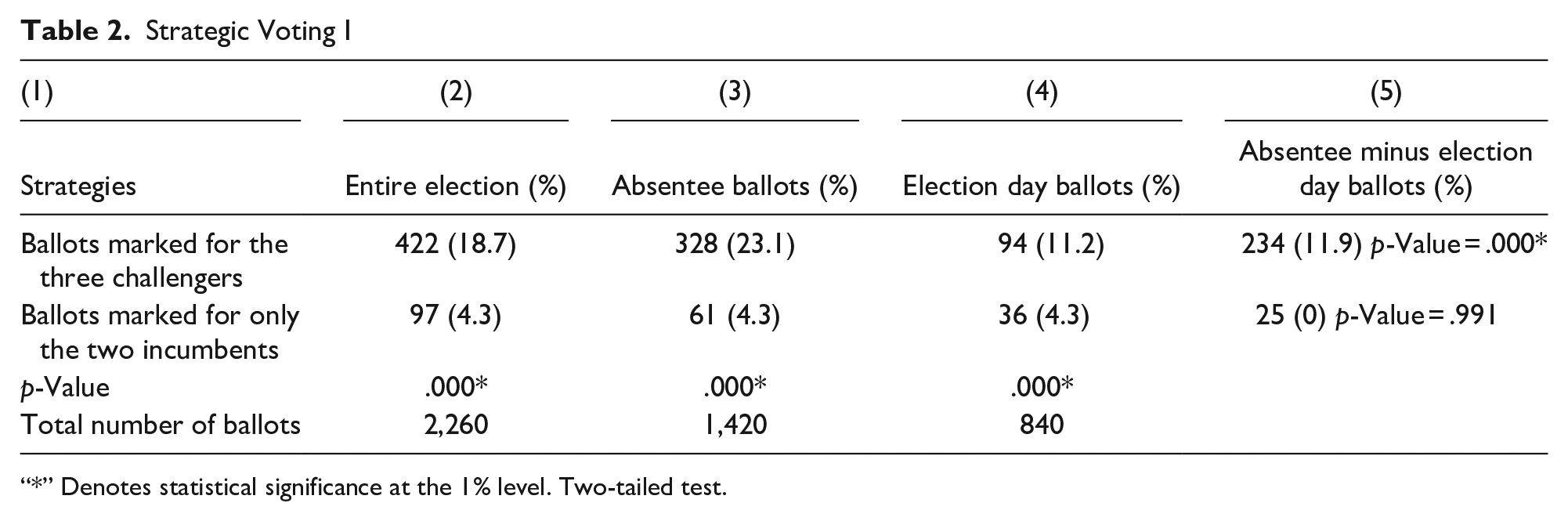
Table 2 presents the percentage of votes that were strategic votes for challengers and incumbents and differentiates between absentee and Election Day votes. Column 2 indicates that of the 2,260 ballots 422 (18.7%) were strategic votes for the challengers, while 97 ballots (4.3%) were strategic votes for the incumbents. This difference is statistically significant.
Strategic Voting I
“*” Denotes statistical significance at the 1% level. Two-tailed test.
Column 3 shows that there were 1,420 total absentee ballots with 328 (23.1%) being strategic votes for the challengers and 61 absentee ballots (4.3%) being strategic votes for incumbents, a difference that is statistically significant. Column 4 shows that there were 840 total Election Day ballots with 94 (11.2%) being strategic votes for challengers compared to 36 ballots (4.3%) being strategic votes for incumbents. This difference is statistically significant. The statistically significant larger percentage of strategic challenger votes compared to strategic incumbent votes is evidence supporting Hypothesis 2 that small, organized groups will outperform their numbers in the election.
HWRCG activity was prevalent during the months leading up to the August advisory ballot question. Absentee ballots for the November election were available just 6 weeks later. Thus, the percentage of absentee ballots that were strategic challenger votes should be larger than the percentage of Election Day strategic challenger votes. Column 5 reports that they were. Only 11.2% of Election Day ballots were strategic challenger votes compared to 23.1% of absentee ballots, a difference that is statistically significant. There is no statistical difference in the percentage of absentee and Election Day ballots that were strategic incumbent votes (p = .991). Table 2 results support Hypothesis 2.
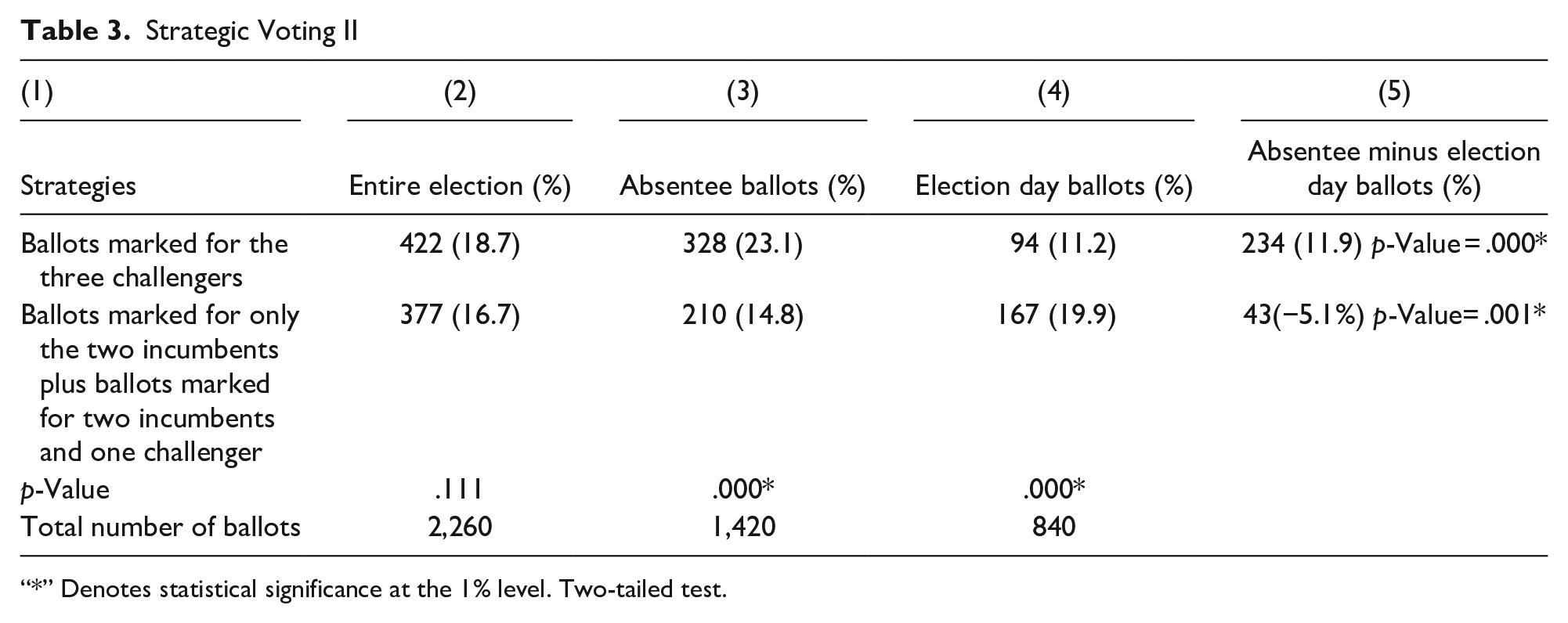
Table 3 conducts the analysis with the broader definition of a strategic incumbent vote consisting of two incumbent votes, regardless of what the voter chose to do with their third allowable vote. Column 2 shows that a larger percentage of ballots contained strategic challenger votes than strategic incumbent votes (18.7% vs. 16.7%).
Strategic Voting II
“*” Denotes statistical significance at the 1% level. Two-tailed test.
Unlike Table 2, this difference is not statistically significant (p = .111). Column 3 reports that the advantage for the challengers came from the absentee ballots, which were 63% of the total ballots. Three hundred twenty-eight absentee ballots contained strategic votes for all three challengers, corresponding to 23.1% of all absentee votes. In contrast, only 210 absentee ballots (14.8%) contained two votes for the incumbents, a difference that is statistically significant.
As shown in column 4, the incumbents won the Election Day strategic votes. Ninety-four Election Day ballots (11.2%) contained strategic challenger votes compared to 167 Election Day ballots (19.9%) that contained strategic incumbent votes. This difference is statistically significant. Strategic challenger voting was the highest in the absentee voting, which began only a few weeks after the advisory ballot. In contrast, Election Day was 3 months after the August advisory ballot and thus further removed from the start of organized activity favoring the challengers. Column 5 also illustrates this. A statistically significant larger percentage of absentee votes were strategic challenger votes. In contrast, a statistically significant larger percentage of Election Day votes were strategic incumbent votes.
Strategic challenger voting on the absentee ballots without a countervailing presence for the incumbents during that time likely cost at least one incumbent the election. On absentee ballots, there were 118 more strategic challenger votes than strategic incumbent votes (Table 3). Had each of the two incumbents also obtained 118 votes from the 459 ballots with no councilor votes and thus broke even with the challengers on the strategic absentee ballots, the outcome would have been Suits (1,214), Cole (1,000), Sullivan (860), Foltz (833), and Irizarry (776). Incumbent Sullivan would have been reelected. Alternatively, if the incumbents had been able to obtain an 8.7 percentage advantage in absentee ballots as they did on Election Day (Table 3), the outcome would have been Suits (1,214), Cole (1,000), Sullivan (985), Foltz (958), and Irizarry (776).
Empirical Analysis: Ballots Without Councilor Votes (Hypotheses 3 and 4)
The 2020 Houghton council election was on the same ballot as national and statewide partisan elections. By examining each ballot, we were able to record whether each voter voted straight party and/or skipped the council election.
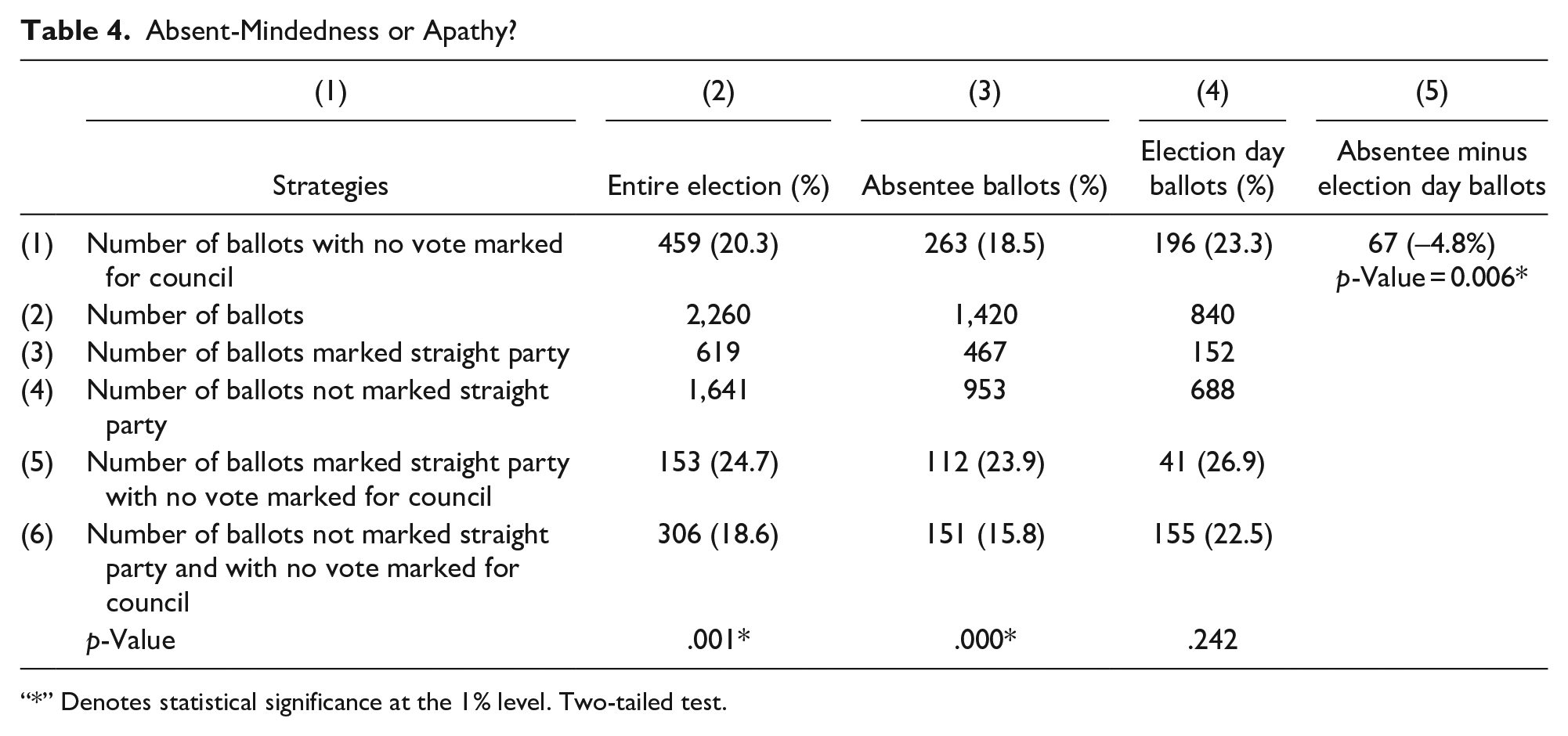
Rows 3 and 4 of Table 4 report the number of voters who did and did not vote straight party, irrespective if they voted in the council race. There were 619 straight party voters, with 467 voting absentee and 152 voting on Election Day. Of the 1,641 voters who did not vote straight party, 953 (688) voted absentee (Election Day).
Absent-Mindedness or Apathy?
“*” Denotes statistical significance at the 1% level. Two-tailed test.
Rows 5 and 6 report the number and percentage of straight party and non-straight party voters, respectively, who left the council race blank for the entire election (column 2) and broken down between absentee and Election Day ballots (columns 3 and 4). Column 2 shows that 24.7% of straight party voters in the entire election left the council race blank compared to 18.6% of non-straight party voters, a difference that is statistically significant.
Column 3 shows that for absentee voters, 23.9% of straight party absentee voters left the council race blank, compared to 15.8% of non-straight party voters, a difference that is also statistically significant. This is consistent with the results of Bonneau and Loepp (2014) that straight party voters are less likely to make it to the nonpartisan races on the ballot. Thus Hypothesis 3, which states that straight party voters are less likely to vote in nonpartisan races than non-straight party voters is supported in the absentee ballots.
The Election Day ballots for both straight party and non-straight party voters support Hypothesis 4, which states that Election Day voters are less likely to vote in down-ballot races due to ballot fatigue. Column 2 reports that 459 of the 2,260 total ballots (20.3%) were without votes in the council race. Column 5 reports that a statistically significant larger percentage of Election Day voters left the council race blank than absentee voters (23.3% vs. 18.5%).
Column 4 reports that 26.9% of straight party Election Day voters left the council race blank compared to 22.5% of non-straight party Election Day voters, a difference that is not statistically significant (p = .242). Thus, a statistically significantly larger percentage of Election Day voters left the council race blank compared to absentee voters and there is no statistically significant difference between the straight and non-straight party Election Day voters who did so. Hypothesis 4 is supported.
Voter fatigue and straight party voters ignoring down-ballot races might have been moderated had incumbents informed taxpayers that, if the redevelopment process were halted, they would likely be on the hook for the cost of removing the parking deck. Ex post, the ballots reveal a squandered opportunity for the incumbents. The incumbents could have countered the challengers’ campaign by urging voters to cast votes for only the two incumbents. If 64% of the 459 ballots with no councilor votes instead had only votes for the two incumbents, the three candidates receiving the most votes would have been Suits (1,214), Sullivan (1,035), and Foltz (1,008).
The adages that elections have consequences and are “. . .determined by details of voting (to which few people pay attention) as much as by public will” (Poundstone, 2008, p. 181) are apropos to the political outcome reported in this study.
Discussion
No group emerged in support of the redevelopment project, despite the project negating the city’s need to borrow $1 million and avoiding the need to raise taxes or cut public services to make bond payments. This is consistent with Hypothesis 1. Olson (1965) argued that no group would emerge to work on behalf of a project or issue that resulted in benefits dispersed over a large group.
The HWRCG was small but contributed to defeating the two incumbent councilors, as evidenced by the support of Hypothesis 2. Absentee ballots were made available beginning 45 days prior to Election Day, which was when the HWRCG’s activity was prevalent. The absentee ballots were crucial in the success of the three challengers. Newly elected councilor Irizarry voiced the importance of small, organized groups when stating, “The clean sweep was quite strong, and I think we always did have a lot of momentum and when we worked together and supported each other, I think that increased our chances of winning” (Neese, 2020b).
The result supporting Hypothesis 3 was that straight party voters were more likely than non-straight party voters to skip the council election. This is consistent with Schaffner et al. (2001) that party labels contain information and absent this information voters are less likely to vote in a nonpartisan race. Bonneau and Loepp (2014) found that straight-ticket voting reduces down-ballot voting. The result supporting Hypothesis 4 was that Election Day voters were also less likely to vote in the council race, consistent with Anderson (2010) who found that voters are less informed about down-ballot races the more up-ballot races there are and thus are more likely to skip that race. Recall that the Houghton council election was placed 21st out of 23 races and ballot initiatives. Results supporting Hypotheses 3 and 4 are consistent with Brennan’s (2020) point that voters lack information about the importance of local officials and issues in their daily lives.
When a project is proposed, managers and councilors should expect opposition from a small, organized group (or groups) whose actions could include inflammatory comments posted on social media involving allegations of corruption and personal attacks. Even if this information is false and the project has benefits that exceed its costs, managers, and councilors cannot assume these will be evident to voters. Managers and councilors should proactively provide accurate information to taxpayers because no one else is likely to do so (Olson, 1965) and voters are not likely to actively seek out information (Downs, 1957).
Schaffner et al. (2001) found that voters rely more on incumbency in nonpartisan elections than in partisan elections as incumbency provides information to voters. Thus, incumbent campaigning has a high likelihood of being effective in a local election, and the Houghton incumbent councilors did not take advantage of this. Voters are often uniformed in local elections (Brennan, 2020), thus “[i]n such low information environments, even a modestly effective campaign might have substantial effects where voters have few readily available pointers on who they should support” (Schaffner et al., 2001, p. 26).
Managers cannot actively campaign on behalf of incumbent councilors seeking reelection but can still fill an information void by providing accurate, unbiased information to taxpayers early in the redevelopment process to preempt misinformation. English and Peretz (2004) stress the importance of transmitting information early in the planning process. In May 2021, the local newspaper published a two-part letter to Houghton taxpayers authored by the city manager (Waara, 2021). He outlined issues related to the parking deck, the options to deal with them, and the costs associated with each option. Had the letter appeared in spring 2019, the public would have been better informed about the deck’s issues earlier in the redevelopment process and perhaps been more supportive of the three submitted visions.
Support for this view stems from a recent controversy in Royal Oak, Michigan regarding the moving of a veterans’ memorial as part of redevelopment project (Martindale, 2021). Opponents of the project formed the Facebook group Save The Royal Oak Veterans War Memorial (n.d.). The mayor and city commission organized. As per a conversation between the first author and a Royal Oak resident, the mayor and commissioners sent a mailer to residents explaining the benefits of the project. In 2021, the mayor and four city commissioners were easily reelected while challenged by candidates endorsed by the Facebook group (Oakland County Clerk, 2021).
Conclusion
This case study examined the intersection of a municipal government’s process and politics surrounding the demolition of a structurally decayed parking deck and the redevelopment of the site. Empirical results support the related theories of collective action (Olson, 1965) and rational voter ignorance (Downs, 1957). Managers and councilors should anticipate that the process and politics surrounding proposed redevelopment are likely to be contentious. Academics can use this case study as support for these theories while practitioners can use it as a guide to navigate through similar contentious issues.
We conclude with a brief update on the status of the parking deck. Appointing a replacement to fill a Houghton vacant councilor seat is normally a routine event. Such was not the case surrounding the vacancy stemming from a councilor’s resignation on October 29, 2021 (Neese, 2021b). There were eight applicants for the open seat. At the November 17, 2021, council meeting, five of the eight applicants received a nomination and support (Neese, 2021a). Roll call voting commenced to appoint one of the five remaining applicants. Fifteen rounds of voting occurred each ending in a 3-3 tie. The council meeting minutes report each councilor’s yes or no vote, and the minutes show no councilor was willing to compromise and cast a decisive fourth “yes” vote despite several opportunities to do so. As a result, a May 3, 2022, a special election was held to fill the open seat. The ballot consisted solely of the three candidates running for the council vacancy. Six hundred forty votes were cast, for a registered voter turnout rate of 22.1% (Houghton County Clerk, 2022). The winner’s 272 votes provided a 10-vote margin over the second-place finisher, both of whom were among the five applicant finalists at the November 17, 2021, council meeting. The Houghton city clerk informed the authors that the special election cost the city $6,119 ($9.56 per vote cast). The failure to appoint a councilor can be viewed as a continuation of the council’s inability to move forward on an issue before them. This inability contributed to the Veridea Group’s December 21, 2020, withdrawal from consideration for redeveloping the parking deck site.
On February 9, 2022, the Houghton city council adopted a resolution to begin the process for borrowing $1 million to remove the parking deck and site restorations. On April 27, 2022, the city manager informed the council that the notice of intent was published for the bond issuance—the process by which the city raises money by borrowing. The bonds would be issued without a vote of the electors unless a valid petition requesting such a vote signed by no less than 10% of the city’s registered voters was filed with the city clerk. The filing deadline was June 22, 2022, at 4:00 p.m. and no petition was filed.
In September 2022, the city was awarded a $1 million grant from the Michigan Economic Development Corporation’s Revitalization and Placemaking Program to be used to rehabilitate the site once the deck is removed (“Houghton receives $1 million grant,” 2022). On October 12, 2022, in anticipation of the deck’s removal in spring 2023, the Houghton council voted to abandon an easement it held on private property that provided pedestrian access to the upper level of the parking deck from Houghton’s main street, Shelden Avenue. After the parking deck is removed, the easement would serve no public purpose. The property the easement is on is in the process of being redeveloped by its owner. The abandonment of the easement prompted a lawsuit from an adjacent property owner, resulting in a court-ordered stay to that redevelopment (Fournier, 2022). The minutes of the March 8, 2023 council meeting report that the 12th Circuit Court Judge “affirmed the decision of the planning commission” in approving the site plan for the proposed building.
Finally, on January 25, 2023, the city manager informed the council that, due to increasing costs, $1.5 million in bonds would need to be issued to remove the deck (Neese, 2023). The council unanimously authorized the issuance of the bonds. The expected removal date of the parking deck remains late spring 2023.
Footnotes
Acknowledgements
The authors thank Terry Monson, Kimberly Saks, Dennis Sullivan, and two anonymous referees for their comments on various drafts of the paper, City of Houghton Clerk and Assistant City Manager, Ann Vollrath, for providing information, and Jack Ochs for sharing constructive thoughts on the topic. The authors take responsibility for any mistakes.
Declaration of Conflicting Interests
The author(s) declared no potential conflicts of interest with respect to the research, authorship, and/or publication of this article.
Funding
The author(s) received no financial support for the research, authorship, and/or publication of this article.