



Abstract
As election officials have come under increased scrutiny in the wake of the 2020 presidential election, research considering poll workers’ motivations offers a window into the human dimension of election administration. As public employees that work infrequently, poll workers perform their roles as government agents a few times a year (at most) for long hours and very low pay. Drawing upon original survey data collected from more than 1,000 poll workers in four Arizona counties between April and May, 2019, this study utilizes public service motivation (PSM) as a theoretical framework to explore whether and to what extent election workers express PSM. Ultimately, concepts of civic duty, social engagement, compensation, and social desirability are uncovered as factors motivating front-line election workers. The findings offer actionable insight on how workers can be better recruited to implement U.S. elections.
Points for Practitioners
Election workers are motivated to serve in a variety of ways; one size does not necessarily fit all
To meet future election workforce needs, administrators should consider recruitment strategies that appeal to an individual’s sense of duty to civil society
Financial compensation should not be overlooked as a poll worker recruitment and retention strategy
Reporting the findings of the 2016 Election Administration and Voting Survey, the U.S. Election Assistance Commission (EAC) noted that during the 2016 federal election cycle more than 900,000 poll workers served in nearly 117,000 voting sites across the country. At the time, a majority (53%) of these election workers were age 61 years or older and about 65% of election jurisdictions reported having a “very difficult” or “somewhat difficult” time recruiting poll workers (Election Assistance Commission [EAC], 2017). Election officials are raising the alarm: the problem of poll worker recruitment is more than a localized problem—it is a timely concern for democracy (Clark & James, 2023).
U.S. democracy depends on the efficacy of elections administered by an aging army of citizen poll workers. As current poll workers age out of service and threats of violence on individuals on the front-lines of elections increase, a workforce crisis looms—renewing scholarly and practitioner interest in the individuals responsible for election administration. Although many individuals operate the electoral process, occupying different roles and considered broadly as “election administrators,” this study investigates whether and to what extent public service motivation (PSM) accounts for election poll workers’ motivation to serve.
Setting the Stage: Elections Require Poll Workers
Unlike most democracies, which rely on a central government to deliver elections, election administration in the U.S. is decidedly local. Successful elections rely upon the “army of poll workers” who directly interface with voters at the polling place (Burden & Milyo, 2015). A consequence of their direct citizen-agent interactions with the public on Election Day, Hall et al. (2009) note that “the poll worker has the opportunity to act as a street-level bureaucrat” (p. 509). As street-level bureaucrats (Lipsky, 1980) of the electoral process, poll workers are the individuals responsible for the execution of election policy, and therefore are ultimately responsible for its success or failure (Authors Redacted). Yet, unlike other street-level bureaucrats such as caseworkers and teachers who engage with their constituents regularly (Maynard-Moody & Musheno, 2003), poll workers interact with voters only infrequently and are generally not conceptualized as public employees.
Highlighting their vital role in the electoral process, the EAC (2017) notes that “polling places and the poll workers who run them are the front lines of American elections” (p. 2). How poll workers are recruited, the jobs they fulfill, and how they are utilized, as well as statutes regulating who is qualified to serve as a poll worker, vary by state, and sometimes between jurisdictions within the same state. The decentralized nature of U.S. elections is exemplified by the heterogeneity in how voting sites are operated and their workforce recruited across more than 10,000 jurisdictions. Broadly, poll workers are responsible for some or all of the following: opening, closing, and setting up the polling site; signing-in registered voters; checking and verifying voter identification; explaining voting procedures and equipment; distributing ballots; assisting people who are elderly, who have disabilities, or are non-English speakers in voting; updating voter registration information; enforcing election procedures (e.g., electioneering areas and poll watchers); answering voter questions; and, in states with same-day voter registration, poll workers may even register voters at the polls. Outside of their duties at the voting site, poll workers may be involved in processes including: opening and preparing absentee ballots for counting; vote canvassing; vote count or tabulation; signature verification; and more.
The diversity of poll worker responsibilities and administrative processes governing elections belies a crucial, universal commonality: poll workers are “temporary workers, employed to help deliver [the] election” (Clark & James, 2023, p. 3). Traditionally, the workforce that staff polling places are thought of as kindly, local volunteers engaging in a civic duty (Hall et al., 2009, p. 509; Kropf & Kimball, 2012). Though they may receive a small stipend and be nominally compensated for attending mandatory training(s), poll workers are not regular professional staff (Favreau & Hanks, 2016). At the same time, the Internal Revenue Service (IRS) considers poll workers “individuals hired by government entities. . .employed by the government” and the compensation they earn wages for income tax purposes (IRS, 2021). Articulating the tension between volunteer and employee, McAuliffe (2009) concludes that poll workers are a “singular hybrid of volunteer and public servant” (p. x). Elections, and their workforce, present a unique administrative arrangement because the street-level bureaucrats operate with little supervision at the worksite and do not perform their jobs on a regular basis (Hall et al., 2007).
The pathway to becoming a poll worker varies. In many cases, poll workers self-select to participate in the electoral process. In other circumstances, poll workers are appointed by local- or county-level officials or selected by an election board to work a given election. In some instances, (e.g., certain jurisdictions in Nebraska) poll workers are selected via a draft, similar to the jury duty process. Requirements or qualifications to serve as a poll worker are not uncommon (Montjoy, 2008), including residency, partisan balance, 1 language fluency, age, and training attendance, among others.
Public Service Motivation
Responsible for an essential public good, election poll workers act fundamentally in the public’s service, occupying an essential citizen service role upon which American democracy is built. Yet, what influences these individuals’ motivation to serve is broadly unstudied. Citizens that cast their ballot in-person, via an early voting location, precinct polling place, or vote center, likely interact with poll workers who are temporary government employees, have received little training, and work very long shifts on Election Day(s). Suttmann-Lea (2019) considers this arrangement, explaining, “by virtue of their temporray status, they are not likely to be part of the organizational culture of higher levels of election administration. And unlike career street-level bureaucrats, poll workers are less likely to have a shared set of norms or sense of conformity, and are not subject to consistent and direct oversight” (p. 8). In addition, poll workers are likely to be on the receiving end of displeasure from individuals that have unfavorable experiences with the electoral process, from waiting in line to cast their ballot to missing a registration deadline.
Reviewing the public service delivery literature, Tummers et al. (2015) conclude that front-line workers are driven by public service motivation (PSM) to perform job tasks that require interaction with citizen-clients in stressful situations. It follows that as the front-line workers of elections, poll workers may be motivated by PSM. Perry and Wise (1990) introduce PSM as “understood as an individuals’ predesposition to respond to motives grounded primarily or uniquely in public institutions or organizations” (p. 368). Drawing upon the typology of PSM motives (Perry & Wise, 1990), Perry (1996) identifies four PSM constructs that together comprise a measurement scale: (1) attraction to public policymaking; (2) commitment to the public interest; (3) compassion (“patriotism of benevolence”); and (4) self-sacrafice.
Attraction to public policymaking includes participation in the formulation of policy, proximity to policymaking, and “a strong commitment to a bureaucratic work ethos, which highly values democratic governance principles” (Ritz, 2011, p. 1142). Probing the components of this construct, Ritz (2011) suggests that the phrase “interest in politics and public-policy making” is better suited to explain the concept (p. 1143). DeHart-Davis et als. (2006) finding that women express a greater attraction to public policymaking is notable as a substantial majority of poll workers in the U.S. are women (Clark & James, 2023; Hall et al., 2007; Hall & Moore, 2011).
Commitment to the public interest is historically considered a normative dimension of PSM. Scholars have concieved of this compoenet of PSM as relating to “meaingful public service” (Houston, 2000) and “doing work that is useful for society” (Leisink et al., 2021). Commitment to the public interest establishes the alturistic desire of serving the public as a component of PSM. Further, this component of PSM “denotes the deisre to serve socity based on values and duty” (Andersen & Zhang, 2011, p. 4). In many PSM studies (e.g., Clerkin et al., 2009; Kim & Vandenabeele, 2010), commitment to the public interest is articulated as “civic duty,” a helpful shorthand.
The third component of PSM, compassion, is derrived from Frederickson and Hart’s (1985) moral supposition of love for every member of a society, a commitment to basic rights, and a “heroism” caring for and about the welfare of others. Clerkin et al. (2009) establish that PSM influences how individuals make the choice to volunteer, donate, and maintain the status quo. An individual’s inclination to serve as an election worker may be motivated by a commitment to universal suffrage, and may be considered an expression of compassionate motivation within the PSM taxonomy.
Finally, the fourth PSM component, self-sacrafice, is the defined by the willingness to occupy a public service role with the knowledge that in doing so one forefits some tangible personal rewards. Perry (1996) calls upon President Kennedy’s call to “ask not what your country can do for you; ask what you can do for your country” as an appeal to self-sacrafice. Although most election workers receive compensation for their work, 2 the pay is seldom substantial. Combined with the increased frequency of threats and violence committed on election administrators, election poll workers may self select into service out of a sense of self-sacrafice.
Studies concerning PSM have primarily focused on public sector employees. Leisink et al. (2021); however, suggest PSM is likely to influence the attitudes of people in both civic and volunteer communities. Recent studies (Clerkin & Fotheringham, 2017; Leisink et al., 2021) have begun to explore PSM and volunteering. Notably, Leisink et al. (2016) find that their measures for commitment to the public interest (CPI) are significantly related with individual volunteerism. At the same time, Ritz et al. (2016) note that “people often misconstrue public service motivation as a purely altruistic concept. What they fail to account for is that individuals often perform meaningful public service for rational, self-interested, or instrumental reasons” (p. 423). Election poll workers neither neatly fulfill the “volunteer” role as they receive nominal monetary compensation for their work nor the classification of public employee, by nature of their limited and irregular tenure.
Street-level research and PSM literature do little to account for the unique employment circumstances of election poll workers. The factors that lead to poll worker participation in the electoral process are understudied and ill understood. Using the responses of nearly 1,100 Arizona election poll workers, this study seeks to uncover whether and to what extent PSM motivates these front-line workers to public service.
Methodology
Building upon the work of Atkeson et al. (2008) and Brodkin (2008), this study employs a case county approach for applied street-level analysis. To gain the perspective of election poll workers, a survey instrument was designed around three broad nodes: (1) experiences and motivations to serve as a poll worker; (2) perceptions of election site interactions, including the use of discretion; and (3) general demographic information. Components from the civic entrepreneurship and street-level bureaucracy frameworks (e.g., Jewell & Glaser, 2006) and select questions from the poll worker survey developed by Atkeson et al. (2008) informed the survey design. The preceding analysis considers original survey data collected from 1,064 poll workers in 4 of Arizona’s 15 counties: Coconino County, Maricopa County, Pinal County, and Yavapai County.
Arizona is a dynamic state within which to investigate election administration, broadly, and poll workers specifically. From the election of the first Legislative Assembly in the Arizona territory (1864), claims of fraud, administrative reform, and an ever-changing legal landscape have been part of the Arizona election story. Moreover, Arizona’s legacy of fighting federal oversight of election laws and history of voter disenfranchisement makes the motivations of the front-line election workers’ responsible for the implementation of the state’s laws a rich area of study. Recent high-profile fiascos in Arizona’s elections including long lines that were televised nationally in 2018, the Cyber Ninja “audit” of the 2020 presidential race, and a 2022 gubernatorial contest where each candidate has introduced a platform of reforming election administration showcase the state’s position as a microcosm of the issues facing America’s electoral processes today.
County Selection
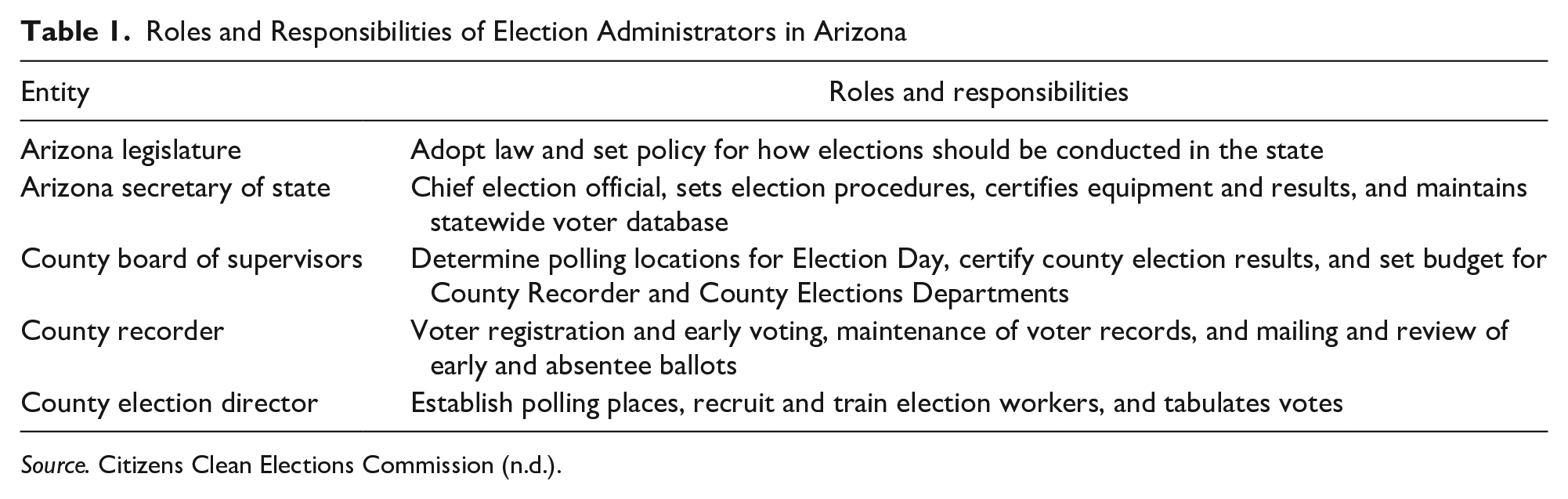
While Arizona is home to the second most populous election jurisdiction in the country (Maricopa County), much of the state is rural and sparsely populated. As a result, there is significant diversity in how elections are delivered, strengths, and challenges facing administrators. Election officials from each of Arizona’s 15 counties were invited to participate in the study. County selection was initiated by these officials’ opting into the project. Each county has an elected Board of Supervisors, an elected County Recorder, and an appointed (by the Board of Supervisors or Recorder) Elections Director. Together, these entities are responsible for administering elections in Arizona. Table 1 details the responsibilities of the various actors responsible for election administration in the state.
Roles and Responsibilities of Election Administrators in Arizona
Coconino County. In the northeastern section of the state, Coconino County is the gateway to Grand Canyon National Park and home to segments of four national forests and five federal Indian reservations. Of the approximate 142,250 people residing in the County, 92,988 are registered to vote. To serve is population, Coconino County recruits around 400 poll workers for each county-wide election. Nearly 28% of Coconino County residents identify as American Indian and/or Alaska Native, and the County Elections Department actively seeks to recruit poll workers with specific language fluency (e.g., Navajo).
Maricopa County. For the past 6 years, Maricopa County has led the nation in population growth. Home to approximately 4.5 million residents, the Maricopa County election administrators serve 2,474,077 registered voters across 748 voting precincts. In total, nearly 60% of all voters in Arizona cast their ballots in Maricopa County. The County recruits “thousands” of community members to staff elections. For a recent federal primary, the Maricopa County Elections Department planned to hire 2,148 poll workers for polling locations and 438 temporary election worker positions at the Department.
Pinal County. Suburban growth from the greater Phoenix and Tucson regions makes Pinal County a place where urban Arizona meets rural Arizona. Of the close to 450,000 Pinal County residents, 257,234 are registered voters. Each election, between 750 and 850 poll workers are recruited to serve at 98 precincts in Pinal County.
Yavapai County. Widely regarded by peers as home to election innovation (Author Redacted), Yavapai County is home to 242,253 residents. Each election, County election administrators recruit more than 300 poll workers who serve 161,391 registered voters across 45 precincts.
Participant Recruitment and Survey Distribution
Recruitment of survey participants relied heavily local election officials. Local election officials from case counties utilized existing poll worker e-mail distribution lists or compiled new lists and removed poll workers who had not served in an election since November 2014. Local election officials then distributed a single-wave survey recruitment message and link to the instrument to their list of poll workers. Survey distribution was staggered as a result of coordinating across multiple jurisdictions and working with local election officials to collect survey responses. The first recruitment messages were sent on April 8 and the web-based survey closed for all counties on May 13, 2019. In total, more than 3,000 recruitment messages were delivered and 1,064 responses were received and included in this study, representing a 30% response rate.
Respondent Demographics
Overall, poll workers included in this study are older and less diverse than the population they serve. A majority of respondents are retired, consider themselves ideological moderates, identify as women, and are over the age of 54 years. Survey respondents align with national EAC research, which found in 2018 that the majority of election poll workers are 61 years of age or older while fewer than one-fifth are under the age of 41 years. That most survey respondents identify as women confirms the Hall et al. (2007) “folk wisdom” that poll workers are more likely to be women than men (Table 2).
Poll Worker Survey Respondent Demographics
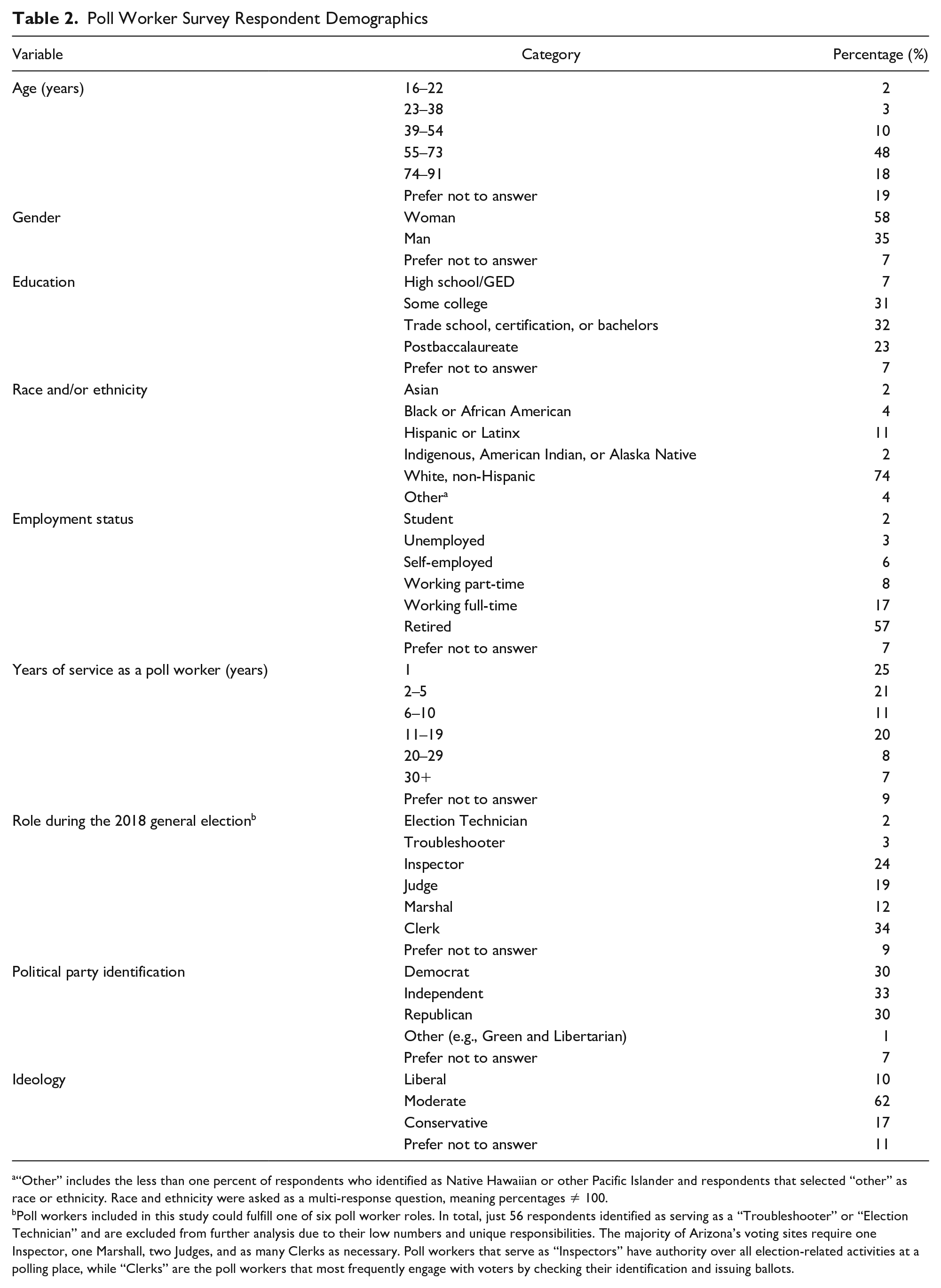
“Other” includes the less than one percent of respondents who identified as Native Hawaiian or other Pacific Islander and respondents that selected “other” as race or ethnicity. Race and ethnicity were asked as a multi-response question, meaning percentages ≠ 100.
Poll workers included in this study could fulfill one of six poll worker roles. In total, just 56 respondents identified as serving as a “Troubleshooter” or “Election Technician” and are excluded from further analysis due to their low numbers and unique responsibilities. The majority of Arizona’s voting sites require one Inspector, one Marshall, two Judges, and as many Clerks as necessary. Poll workers that serve as “Inspectors” have authority over all election-related activities at a polling place, while “Clerks” are the poll workers that most frequently engage with voters by checking their identification and issuing ballots.
Analysis
Responses from 1,064 election poll workers are considered to address whether, and to what extent, PSM factors motivate election poll workers . Below, the motivational factors influencing poll workers’ decision to serve are considered. Survey respondents were asked to indicate the importance of 11 factors on their decision to become a poll worker using a 4-point Likert scale. 3 The 11 factors (see Figure 1, below) are drawn from Alvarez et al. (2007, 2009) and Atkeson et al.’s (2011) considerable work investigating electoral performance in New Mexico.
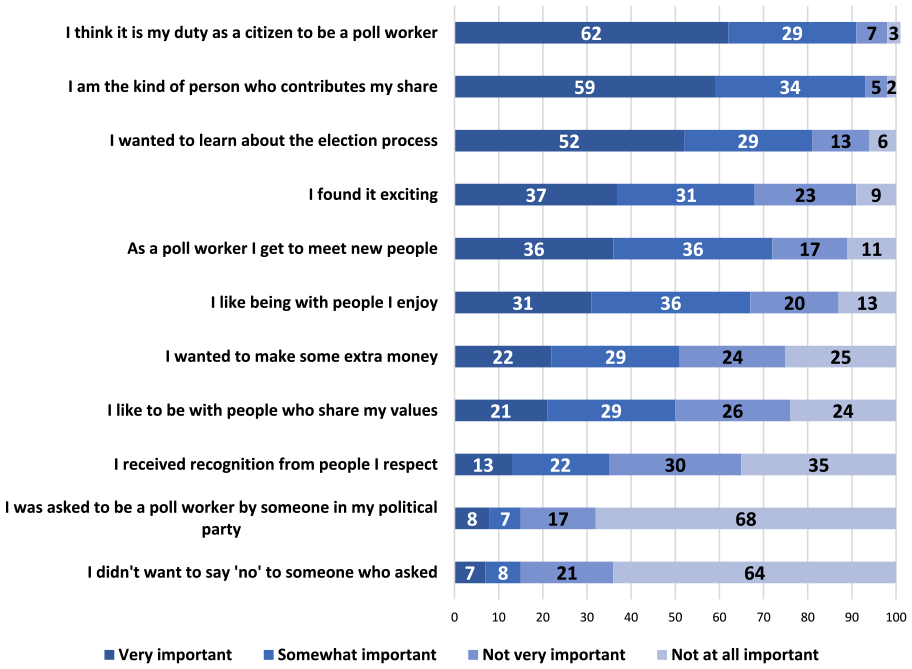
Degree of importance of factors in becoming a poll worker
Findings echo Atkeson et al. (2011), with survey respondents expressing (1) civic duty, (2) contributing their share, and (3) the desire to learn more about the electoral process as of the greatest importance in their decision to serve as an election poll worker.
Like Mac Donald and Glaser in their 2006 study of California poll workers, Arizona poll workers were asked a series of questions related to social benefits. These “social motivations” were of varried importance. Factors concerning personal (“I received recognition from people I respect”) or monetary (“I wanted to make some extra money”) compensation were important to 35 and 51% of respondents respectively. Personal pressure or social desierablity (“I didn’t want to say ‘no’ to someone who asked” and “I was asked to be a poll worker by someone in my political party”) were important to a minority of survey respondents, with 15% indicating each of the aforementioned factors were somewhat or very important.
Civic Responsibility
Perry and Wise (1990) define PSM as “an individual’s predesposition to respond to motives grounded primarily or uniquely in public institutions or organizations” (p. 368). The strong prevelance of contributing one’s share and civic duty as important factors motivating poll workers to serve appear to algin with this definition. Mac Donald and Glaser (2007b) caution; however, that the PSM literature is illuminating primarily to full-time workers “rather than those who volunteer for a modest stipend as to provide government services for one day” (p. 2). Regardless, civic duty, contributing one’s share, and learning about the electoral process together construct a concept of community service, expressed as significantly important to why individuals included in this study decided to become poll workers. In short, survey respondents articulate the importance of a commitment to the public interest in their decision to work in Arizona elections.
To futher investigate the motivations of election poll workers, survey respondents were asked to identify what they believe is more important: (1) ensuring that everyone who is eligible has the right to vote, or (2) protecting the electoral system against fraud. This question uncovers how poll workers think about the rancor surrounding claims 4 of voter fraud and explores whether poll workers consider themselves commited to basic democratic rights.
Commitment to basic rights is related to the PSM component of compassion. Considering Frederickson and Hart (1985), compassion is comprised of substantial benevolance for all people, commitment to basic rights, and a heroic service to others. The right to vote, and ballot access, are basic rights enshrined in the foundational documents and legal history of the nation. A strong majority (76%) of survey respondents indicaterd that ensuring access to the vote is of greater importance than protecting the electoral system against fraud (see Table 3). This finding indicates that compassion motivates election poll workers to serve, based upon their belief in enfranchisement and service to the democratic system.
Importance of Accessing the Vote or Protecting the Electoral System

Note. N = 973.
Commitment to the public interest and compassion are broadly conceptualized as “civic responsibility.” Three variables related to civic responsibility were identified by survey respondets as having the highest level of importance in their becoming a poll worker: (1) civic duty, (2) contributing one’s share, and (3) learning more about the electoral process. Together, these three variables reflect “civic responsibility” as a factor that motivates people to serve as poll workers. These findings appear to confirm Mac Donald and Glaser’s (2007b) conclusion that poll workers are motivated by a sense of community service.
As previously established, poll workers represent a unique segement of the public sector workforce. The two remaining components of PSM, attraction to public policymaking and self-sacrafice, are better suited to exploring the motivation of career public servants than infrequent government agents, like poll workers. To uncover what motivates election poll workers to their roles, this study now turns to a series of social motivation variables unrelated to PSM.
Social Engagement
Conceptually, four variables that seek to understand the degree to which each is important in motivating a poll worker to serve appear to address a similar facet: (1) I found it exciting; (2) as a poll worker I get to meet new people; (3) I like being with people I enjoy; and (4) I like to be with people who share my values. Survey respondent mean scores for the reported degree of importance of each vairable are close together, ranging from 3.0 (variable 1 and 2) to 2.5 (variable 4). Previous scholarship has suggested that social benefits motivate election poll workers to serve (Mac Donald & Glaser, 2007b). To determine whether the aforementioned variables indeed represent four facets of the same concept (social motivation), the author built a 4-item scale and conducted a reliability analysis. The scale demosntrated strong internal consistency (Cronbach’s alpha of .805), validating the measure.
Each of the four items in the scale relate to the social dimension of poll workers’ responsibilities. As street-level bureaucrats, poll workers serve as the public face of government on Election Day and during early voting periods. Three scale items reflect the human dynamics of the voting site as motivational elements while the fourth item, relating to excitement, suggests to the desire for social connectivity—perhaps as a result of social isolation. Therefore, the four-item scale comprised of social motivation varaibles is considered to represent “social engagement” factors.
The distribution of survey respondent scores along the social engagement scale is provided in Table 4. Thirteen percent of respondents report social engagement as unimportant to their motivation for poll work, while 36% of respondents report some social engagement motivation. Fifty-one percent of survey respondents reported moderate or high degrees social engagement motivation, highlighting the important role it plays in poll worker motivation.
Social Engagement as a Motivational Factor for Poll Workers
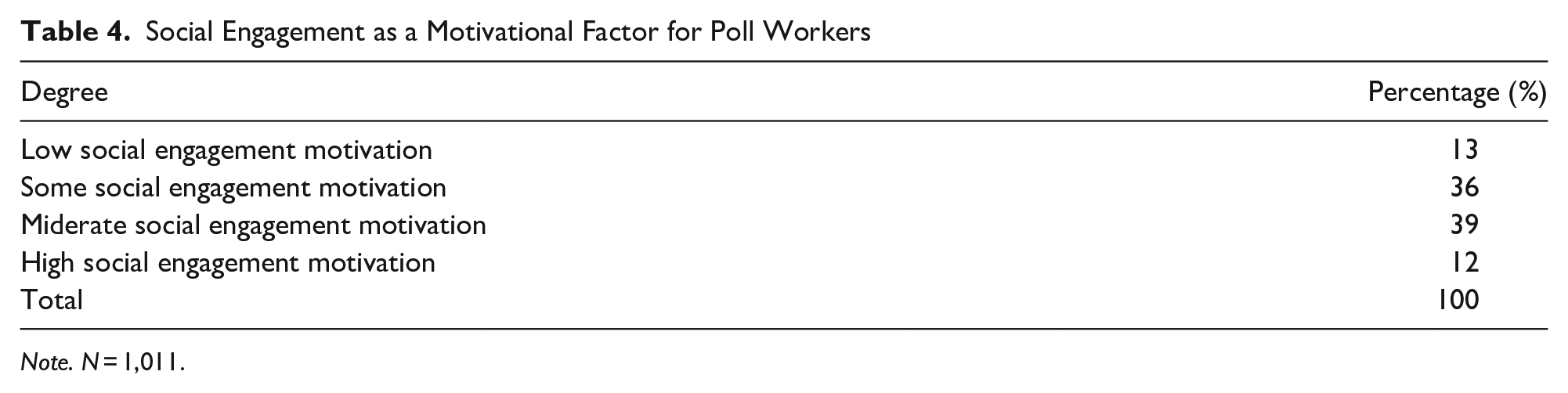
Note. N = 1,011.
Social Desierability and Compensation
The final four 5 elements concerning motivation of Arizona poll workers center on concepts of social desierability and compensation. Of the four elements, only monetary compensation 6 received a majority (51%) of respondents indiciating it was an important motivator for their service. Thirty-five percent of respondents identified compensation (in terms of social benefits) as important to their service as a poll worker. Previous scholarship (Crewson, 1997) suggests PSM largely is expressed by individuals’ eschewing extrinsic rewards (e.g., a pay raise and job security) in favor of intrinsic rewards (e.g., a sense of accomplishment). Conversely, respondents included in this study identify extrinsic rewards, like making extra money and enhanced status via praise, as motivators for their service. This appears to suggest that Clark and James’ (2023) finding that money is an important motivator for poll worker service in the British context holds true in Arizona. A minority (15%) of respondents indicated that not wanting to say “no” to someone who asked them to be a poll worker and being asked to serve as a poll worker by someine in their political party, were important motivational factors (Table 5).
Remaining Motivation Varaibles—Social Desierability and Compensation

In sum, poll workers included in this study expressed civic responsibility and social engagement as two significant factors motivating their service. Civic responsibility appears to align with two PSM factors: commitment to the public interest and compassion. While the importance respondents attributed to their election poll work as fulfilling civic duty (91%) and contributing their share (93%) is notable, it is unclear if poll workers have an attraction to the PSM factors of public policymaking and self-sacrafice. Instead, findings indicate that social engagement is a substantial motivating factor for survey respondents.
Discussion and Implications
Poll workers are critical to the successful administration of American elections. Yet, reports of poll worker shortages are well documented and in many jurisdictions election officials struggle to recruit an adequate number of poll workers. Current poll workers are aging out of service and increased threats from the COVID-19 pandemic and partisan political rhetoric raise serious concerns for the future. Understanding what motivates individuals to serve as election poll workers is crucial for the continued success of American democracy.
The findings from this study of Arizona poll workers indicate that PSM does not fully explain poll worker motivation. Election poll workers indicate being motivated by a concept of civic responsibility, broadly representing two PSM factors (compassion and commitment to the public service). Election officials responsible for recruiting poll workers would be wise to include appeals to an individual’s sense of duty to society in future recruitment efforts. Further study of how election poll workers conceptualize civic duty would add depth to understanding why people serve. Uncovering what civic duty means to poll workers, in their own words, would further enhance recruitment and retention efforts in the field, and may be more broadly applicable across other areas of community service.
Previous study assumes that the role of financial compensation is insignificant for motivating poll workers (Burden & Milyo, 2015). Employing the “stipended volunteer” literature (Mesch et al., 1998; Tschirhart et al., 2001), Clark and James’ (2023) study of British election workers finds the opposite. Analysis of poll workers’ motivations in Arizona uncovers the importance of financial compensation in the American context. Notably, the nominal pay provided to election poll workers contributes substantially to their motivation to serve and should not be overlooked. Current increasing costs of living, inflation, and economic precarity in the U.S. may only futher the importance of financial compensation for potential poll workers. Election officials should communicate the financial benefits of poll work clearly in their workforce recrutment. Additional research exploring financial motivations for poll workers is necessary, and must take into account issues of response bias and social desierability in its design.
While social engagement emerged as a relatively minor factor motivating election poll workers, it should not be overlooked. Previously identified by Mac Donald and Glaser (2007b), social benefits are important for election poll workers, and at least some of the poll workers in this study express the importance of social engagement to their service. Showcasing social benefits of poll work may aid in future recruitment and retention efforts. Leveraging the social environment of voting and poll work can aid in the transfer of knowledge in the highly-technical election space.
This study has implications for both the emerging election administration scholarship and the management of the electoral process in practice. Notably, election poll workers across the nation and those included in this study are older and less diverse than the population they serve. This raises questions about representativeness in the administrative bureaucracy of elections. Future researchers would be wise to investigate the motivations of poll workers who are members of marginalized communities. There is reason to believe that a more representative election workforce may strengthen public trust and confidence in the electoral system.
In studying whether and to what extent election poll workers express PSM, this study attempts to understand what motivates people to work for long hours and low pay on the front-lines of democracy. Findings uncover civic responsibility, financial compensation, and social engagement are important factors motivating individuals to serve as election poll workers. Future research is needed to learn more about what civic duty means to poll workers and dive deeper into financial compenstion as a motivational factor. Implications from this study of Arizona poll workers are explored in the next section of this article.
This research examines what matters to those operating on the front-lines of democracy. The findings above contribute to the scholarship by empirically studying the motivations of the crucial human resources of the electoral process. As the current population of election poll workers ages out of service, this study is timely in providing insight into worker motivations. By surveying poll workers in a large, and diversifying state, this study offers insight into the street-level bureaucrats of the electoral process.
Conclusion
This study presents a first-of-its-kind investigation into the factors that contribute to individuals’ motivation to serve on the front-lines of U.S. democracy. Representing poll workers from both a large urban jurisdiction (Maricopa County) and counties spanning rural and small-metro geographies, the findings presented are broadly informative to those county administrators responsible for recruiting election poll workers. Understanding and acting upon what motivates individuals to work election polls can mediate the crisis of an aging election workforce, even as that workforce comes under increasing public scrutiny. This study provides a baseline for future work studying motivations of front-line public employees, and may be of particular interest for those exploring the motivational factors of civil servants with unique employment situations (e.g., infrequent activation and irregular work).
It is understood that “elections depend on the thousands of people who give up their time to administer this crucial public service” (Clark & James, 2023, p. 1). Yet, the majority of U.S. election jurisdictions report difficulty obtaining a sufficient number of poll workers to effectively administer elections (EAC, 2018). Without adequate numbers of poll workers, election administrators may be forced to reduce the number of voting locations available to their community and voters could face additional burdens including longer lines and wait times. Poll workers are the linchpin in today’s electoral system. Understanding what motivates these fundamental public servants is necessary to ensuring the maintenance and delivery of America’s fundamental democratic promise: free and fair elections.
Footnotes
Declaration of Conflicting Interests
The author declared no potential conflicts of interest with respect to the research, authorship, and/or publication of this article.
Funding
The author received no financial support for the research, authorship, and/or publication of this article.