




Abstract
As modern governments face increasing pressure to meet citizens’ rising expectations, innovation has become a central focus for public organizations. While job autonomy is a well-established antecedent of individual innovative behavior, the moderating role of organizational culture in shaping this relationship remains underexplored. Public organizations often embody different types of culture, such as performance-oriented culture that emphasizes efficiency and adherence to predefined indicators, and innovation culture that encourages the generation and promotion of new ideas. Using data from the South Korean government and a competing values framework theory, this study examines the differential impacts of innovation culture versus performance-oriented culture on innovative behavior and assesses how these cultural orientations moderate the effect of job autonomy. Innovation culture not only directly fosters innovative behavior but also enhances the beneficial influence of job autonomy on such behavior. Conversely, a strong performance-oriented culture diminishes the positive relationship between job autonomy and innovative behavior.
Keywords
Introduction
In response to increasing expectations and demands for government services, innovation and ways of fostering innovative behavior have become a key focus of public organizations, managers, and principals (Demircioglu, 2017; Grimmelikhuijsen, 2012; Kim, 2010; Nemet, 2009; Van De Walle et al., 2008; Van Der Wal & Demircioglu, 2020a). Indeed, research suggests that, to address the intricate socioeconomic issues they are currently facing, modern governments are constantly pursuing innovation in the public sector (OECD, 2017; Sørensen, 2017; US-Government, 2013; UK-Government, 2014). This innovation agenda is often implemented through top-down approaches, including leadership shifts, new executive agendas, or changes in organizational structures (Osborne et al., 2020; Scupola & Zanfei, 2016).
In addition to these top-down approaches, it is important to note that governmental innovation is hard to achieve without employees’ voluntary efforts. For this reason, public management scholars have sought to understand how organizations could facilitate innovative behavior among public employees. One way to enhance innovative behavior is to tap into the power of job autonomy (see De Vries et al., 2016; Kwon & Kim, 2020). By allowing employees to craft their jobs at work, they are able to adopt creative ideas using their expertise and skills (Bakker & Demerouti, 2017). Job autonomy has been established as a precursor to innovative behavior among employees in the private sector across various industries (De Spiegelaere et al., 2012; De Spiegelaere et al., 2016) and similarly among public sector employees (Cho & Song, 2021; Kim, 2024; Ryu, 2022).
Despite growing recognition that organizational-level factors—particularly culture—can shape employees’ innovative behavior in conjunction with job autonomy, these influences remain understudied. Drawing on the competing values framework developed by Quinn and his colleagues (Cameron & Quinn, 2011; Quinn & Rohrbaugh, 1983), this study investigates how different types of culture within the same organization (i.e., innovation culture and performance-oriented culture) affect the innovative behavior of public employees. Additionally, this research examines whether an innovation culture not only increases innovative behavior but also amplifies the positive effect of job autonomy, whereas a performance-oriented culture decreases innovative behavior and weakens the role of job autonomy. To address these research questions, two repeated cross-sectional datasets from the Public Employee Perception Survey (conducted by the Korea Institute of Public Administration) were integrated. Organizational culture variables were measured using the 2018 dataset by calculating the mean responses of organizational members, while individual-level variables were derived from the 2019 dataset, helping to reduce common source bias.
Although calls to reform organizational culture as a means of enhancing performance or fostering innovation are common, theoretical inquiry in public administration remains limited. By employing the competing values framework, this study shows that a strong innovation-oriented culture bolsters the innovative behavior of public employees and magnifies the positive effects of job autonomy, whereas a performance-oriented culture may diminish the influence of autonomy on creative and innovative behavior. This finding suggests that placing excessive emphasis on performance can hamper public sector innovation. The study concludes with a discussion of the implications of these findings for organizational culture in public sector innovation more broadly.
Theoretical Approaches and Hypotheses
Innovation in Public Organizations
Modern public organizations face challenges that demand greater efficiency, effectiveness, speed, and cost reduction compared to past administrations. To meet these rising expectations, governments need innovative policies, processes, implementation methods, and service delivery. Consequently, innovation has become a significant focus in public management and policy studies (see De Vries et al., 2016; Van der Wal & Demircioglu, 2020a). Innovation can be defined as an idea, practice, or object that is perceived as new by the adopting unit (Rogers, 2003, p. 12). Several types of innovation have been introduced: service innovation, which refers to new services provided by governments; process innovation, which encompasses new methods of internal management; and ancillary innovation, involving changes in partnerships or policy networks (Bekkers & Tummers, 2018; De Vries et al., 2016).
At the individual level, innovative behavior refers to employees’ actions that generate and implement new and useful ideas (Farr & Ford, 1990; Kwon & Kim, 2020; Scott & Bruce, 1994). Innovative behavior differs from creativity, as creativity often stops at generating new ideas, while innovative behavior involves promotion and implementation (De Jong & Den Hartog, 2010; Scott & Bruce, 1994). Research has shown that both organizational innovation and employees’ innovative behavior correlate with improved performance in public organizations (Borins, 2014; Damanpour et al., 2009). Public management studies show that public service motivation (Miao et al., 2018), a strong connection with colleagues (Lee & Jung, 2024), and higher education (Van der Wal & Demircioglu, 2020b) can all promote innovative behavior.
The Impact of Job Autonomy on Innovation
Among job characteristics, job autonomy is a well-established predictor of employees’ innovative behavior (see systematic reviews of Bos-Nehles et al., 2017; De Vries et al., 2016; Kwon & Kim, 2020). Job autonomy refers to the level of freedom employees have in deciding how to plan and execute their tasks (Hackman & Oldham, 1976). Job autonomy is a significant job resource for managing job demands, fostering employee motivation, and ultimately promoting positive employee behavior (Bakker & Demerouti, 2007; Demerouti et al., 2001). Additionally, it encourages employees to craft their jobs to align with their expertise and interests, thereby enhancing intrinsic motivation (Abstein & Spieth, 2014; Bakker & Demerouti, 2017). This control and ownership over their tasks motivate employees to try out new ideas, take thoughtful risks, and develop innovative solutions to challenges (Cho & Song, 2021; De Spiegelaere et al., 2012). Conversely, when job autonomy is limited, public employees encounter greater resistance to implementing new approaches in their work.
Abundant studies have highlighted the positive effects of autonomy on public employees’ innovative behavior. Job autonomy has been consistently identified as an antecedent of innovative behavior among private sector employees across various industries (De Spiegelaere et al., 2012; De Spiegelaere et al., 2016; Orth & Volmer, 2017), as well as among public employees (Kim, 2024; Ryu, 2022). Similarly, Bysted and Hansen (2015) demonstrated that in Scandinavian countries, job autonomy significantly enhances innovative behavior across diverse sectors, including both public and private organizations. Taken together, this research posits the following hypothesis regarding the relationship between job autonomy and innovative behavior:
Effects of Organizational Culture on Innovative Behavior
While job autonomy is considered as a predictor at the individual level, scholars highlight that organizational culture is associated with innovative behavior (Cameron & Quinn, 2011; Chenhall et al., 2011; Hartnell et al., 2011; Quinn & Rohrbaugh, 1983). Organizational culture is defined as the shared perceptions—encompassing norms and values—among internal members of an organization (Schein, 2016; Schneider et al., 2013). To analyze the effects of organizational culture on innovation, this study draws upon the Competing Values Framework (CVF) proposed by Quinn and his colleagues (Cameron & Quinn, 2011; Quinn & Rohrbaugh, 1983). Quinn and his colleagues developed a typology of organizational culture, asserting that different perceptions and behaviors among employees are shaped by these cultural types (Cameron et al., 2006; Cameron & Quinn, 2011; Quinn & Rohrbaugh, 1983).
According to the CVF, innovation culture and performance-oriented culture aim for distinct external outcome behaviors of employees: innovation culture fosters organizational innovation and transformation, while performance-oriented culture drives employees to focus on achieving established organizational goals. 1 This study sets aside the other two dimensions of culture suggested by the CVF—clan and hierarchy cultures—because these dimensions primarily produce internal processes rather than outcome behaviors. Clan culture encourages collaboration and commitment, whereas hierarchy culture promotes monitoring and adherence to timelines.
To foster innovative outcomes, public organizations are encouraged to build innovative supportive culture that nurtures and supports employees’ efforts to explore new ways of working (Lægreid et al., 2011). In such a supportive culture, employees are more likely to take the risks involved in innovative behavior because they feel a sense of psychological safety (Edmondson, 1999). An innovation-supportive environment also enhances innovative behavior through knowledge management. When an organization has such an environment, employees tend to communicate and share diverse knowledge conducive to innovation (Huang & Li, 2021). Previous research has found that an innovation-oriented culture promotes the innovative behavior of employees, including among bureaucrats in South Korea (Ryu, 2022), teachers in Taiwan (Chang et al., 2011), and energy sector employees in Pakistan (Zeb et al., 2021). Building on the foregoing discussion, this research proposes the following hypothesis regarding the relationship between innovation culture and innovative behavior:
The New Public Management (NPM) movement, which has championed business-like reforms and emphasized making public managers outcome-driven (Hood, 1991; Lapuente & Van de Walle, 2020), has fostered the development of performance-oriented culture in public organizations (Lee et al., 2020; OECD, 1997). To achieve organizational goals, this type of culture underscores the importance of competition, a focus on task performance (Tepeci, 2001; Quinn & Rohrbaugh, 1983), and clear objectives and guidelines for employees (Schneider et al., 2013). For the sake of efficiency and accountability, a performance-oriented environment often results in the elimination of slack resources, which are a necessary cost of experimentation (Potts, 2009). Under a high level of performance-oriented culture, when individuals perceive clear goal setting and performance indicators, employees tend to focus on work that is closely related to performance evaluation, performance-based rewards, or making a better impression (Bolino et al., 2013; Wright et al., 1993). Consequently, employees are less likely to engage in innovative behavior, as it is not often associated with predefined evaluations. Therefore, the third hypothesis thus stated as follows:
Moderating Effects of Organizational Cultures on the Link Between Job Autonomy and Innovative Behavior
While job autonomy is an essential job resource, previous literature has not extensively examined how its effects change under different organizational cultures (see the systematic review by Kwon & Kim, 2020). Among the studies available regarding the moderation between autonomy and another variable, Cho and Song (2021) found that the positive effect of job autonomy on innovative behavior is weakened by a lack of organizational support, whereas Orth and Volmer (2017) showed that it is strengthened by creative self-efficacy. In organizational behavior, organizational culture functions as a moderator, rather than a mediator, providing a stable framework of assumptions, beliefs, and norms that shapes the relationship between organizational settings and individual behavior (Schneider et al., 2013).
The CVF model provides an explanation for the moderating effects. According to the CVF model, an innovation culture promotes a learning orientation and encourages risk-taking to explore new ideas (Cameron & Quinn, 2011). Innovation culture highlights organizational learning and adaptability in various situations (Hartnell et al., 2011). A strong innovative environment enhances public employees’ empowerment to adopt new ideas at work by reinforcing their willingness to leverage job autonomy (Sinha et al., 2016). When job autonomy is coupled with an innovation-supportive environment, employees are more likely to learn and apply new ways of working. Consequently, job autonomy may have a greater impact on innovative behavior in the presence of a robust innovation culture. However, empirical evidence on this topic is limited in the field of public management. Among the few studies available, Ryu (2022) found that the interaction between innovation culture and job autonomy was negatively associated with innovative behavior, although the result was statistically insignificant. Based on this notion, this study develops the following hypothesis:
On the other hand, a high level of performance-oriented culture can restrain the role of job autonomy in fostering innovative behavior. The NPM movement promotes explicit performance standards and output control to improve efficiency (Christensen, 2012). Generating, promoting, and implementing new ideas requires significant cognitive effort, which is not limitless (Janssen, 2004). Employees feel overcontrolled under the pressure of time management and evaluation, which dampens their intrinsic motivation for innovation (Amabile, 1998). Therefore, in an environment highlighting performance, individual employees are more likely to use their discretion to improve performance indicators rather than engage in innovative behavior. As employees focus on meeting established targets, innovative ideas are overlooked during the evaluation process. Zhang et al. (2017) found that, when organizations pressure performance, the positive association between job autonomy and engagement is attenuated. Therefore, this study hypothesizes the following:
Data, Variables, and Analytic Method
Data and Creating Organizational Level Variables
Data Source
This study uses two repeated cross-sectional surveys in 2018 and 2019 from the Public Employee Perception Survey by the Korea Institute of Public Administration. The first wave of the survey was collected from August 12 to September 30, 2018, and the second wave was conducted from August 1 to September 30, 2019. The Public Employee Perception Survey surveyed 4,000 public employees in 2018 and 4,111 public employees in 2019. The survey respondents are resampled every year, employing a repeated cross-sectional survey design. To ensure the representativeness of the sample, the Korea Institute of Public Administration conducted stratified random sampling at the team level in 46 central agencies and 17 local governments, totaling 63 organizations. 2 Across two time periods, 2018 and 2019, the same survey items were used for research variables, such as organizational culture and individual level variables.
The Public Employee Perception Survey started in 2017, but this study restricted the time period to 2018 and 2019. The decision to use survey data from 2018 and 2019 is justified for two reasons. Firstly, these years provide a crucial baseline for understanding organizational culture and individual level variables in a pre-pandemic context, which is essential for accurately measuring the impact of COVID-19. Additionally, the absence of major elections—presidential, national assembly, and local elections—during these periods means the data is free from the influence of significant political events, offering a clearer and more stable picture of the organizational environment. Because the dataset cannot name organizations, the research model circumvents unobserved external factors, including leadership change and the outset of the pandemic.
Creating Organizational Level Variables
This study constructs variables for innovation culture and performance-oriented culture at the organizational level by calculating the mean of individual responses from the 2018 dataset. By subsequently merging the 2018 organizational level dataset with the 2019 individual level dataset, the study aims to mitigate common source bias and establish the temporal precedence of organizational culture measurements over individual behaviors.
In line with the referent-shift model proposed by Podsakoff et al. (2014), we tested whether aggregated individual measures could accurately represent organization-level factors. Before aggregating the 2018 survey data, we first assessed within-group agreement (
The average
Conceptual Model
By combining the organizational level dataset from 2018 with the 2019 individual level dataset, this research enables cross-level analysis, which examines the effects of organizational level factors on individual level factors. The article provides evidence for a conceptual model in which organizational cultures (i.e., innovation culture and performance-oriented culture) moderate the relationship between job autonomy and innovative behavior among public employees (Figure 1 illustrates the research model). Job autonomy enhances innovative behavior, with innovation culture strengthening this relationship and performance-oriented culture weakening it. Additionally, innovation culture is positively associated with innovative behavior, while performance-oriented culture is negatively associated with it.
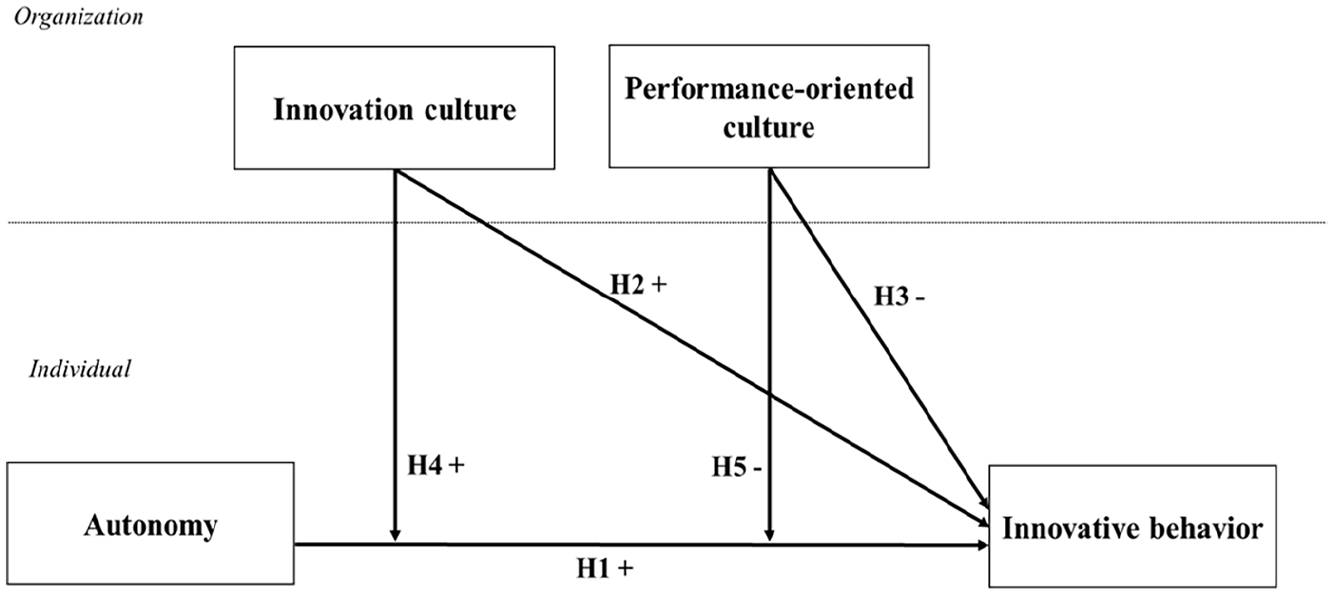
Research model.
Variables and Measurements
The survey questionnaire items used in the study are presented Table A1. Survey items are measured with a five-point Likert scale (1 = “strongly disagree”, 5 = “strongly agree”).
Job Autonomy
The independent variable, job autonomy, included three survey items, covering the method autonomy, scheduling, and criteria autonomy (e.g., “I can revise work performance evaluation indicators/standards”) suggested by Breaugh (1983). The scale indicates high reliability, as evidenced by Cronbach’s alpha (α = .80).
Innovation and Performance-oriented Culture
The key moderating variables are innovation culture and performance-oriented culture. The innovation culture and performance-oriented culture indicators grew out of Quinn’s CVF model (Cameron & Quinn, 2011; Quinn, 1988). The questionnaire items reflect risk taking and resource acquisition for problem solving in innovation culture, and competition and result-orientation in performance-oriented culture (Kaarst-Brown et al., 2004; Wang et al., 2012). Drawing upon the referent-shift model (Podsakoff et al., 2014), the current study aggregated individual responses on innovation culture and performance-oriented culture into their organizational levels. The Cronbach’s alpha for these scales at organizational level indicates: innovation culture is .92, and performance-oriented culture is .88.
Innovative Behavior
The dependent variable in this research, innovative behavior, was measured with two items on idea generation and idea realization (“I try to invent/apply new and original ways of doing work,” and “I develop new ideas to solve problems that arise during work.”) based on previous studies (Janssen, 2001; Scott & Bruce, 1994). The scale indicates a high reliability in the current study (α = .88).
Control Variables
Five control variables at individual level were included in this study: organizational commitment, public service motivation, gender, years of service, and rank. Organizational commitment used four items to measure affective commitment (Allen & Meyer, 1990). Organizational commitment contained the scales regarding employees’ sense of belonging and loyalty. Previous studies indicate that affective commitment may ignite public employees’ innovative behavior by producing favorable emotional experiences in organizations (George & Zhou, 2007; Jafri, 2010). Public service motivation was measured with the 5-global scale item that grew out of Wright et al. (2013). It has been reported that public service motivation has positive effects on innovative behavior (Cho & Song, 2021; Miao et al., 2018).
As additional control variables, the study included demographic factors, such as gender, years of service, and rank. Previous findings proposed that these demographic variables could influence innovative behavior (Demircioglu et al., 2021; Van Der Wal & Demircioglu, 2020b). Gender is measured as a binary variable with male and female. Year of service is measured as an ordinal variable in 5-year increments (i.e., less than 5 years, 6–10 years, 11–15 years, 16–20 years, 21–25 years, and more than 26 years). Rank is an ordinal variable, which has nine orders coded as a higher order is a higher rank.
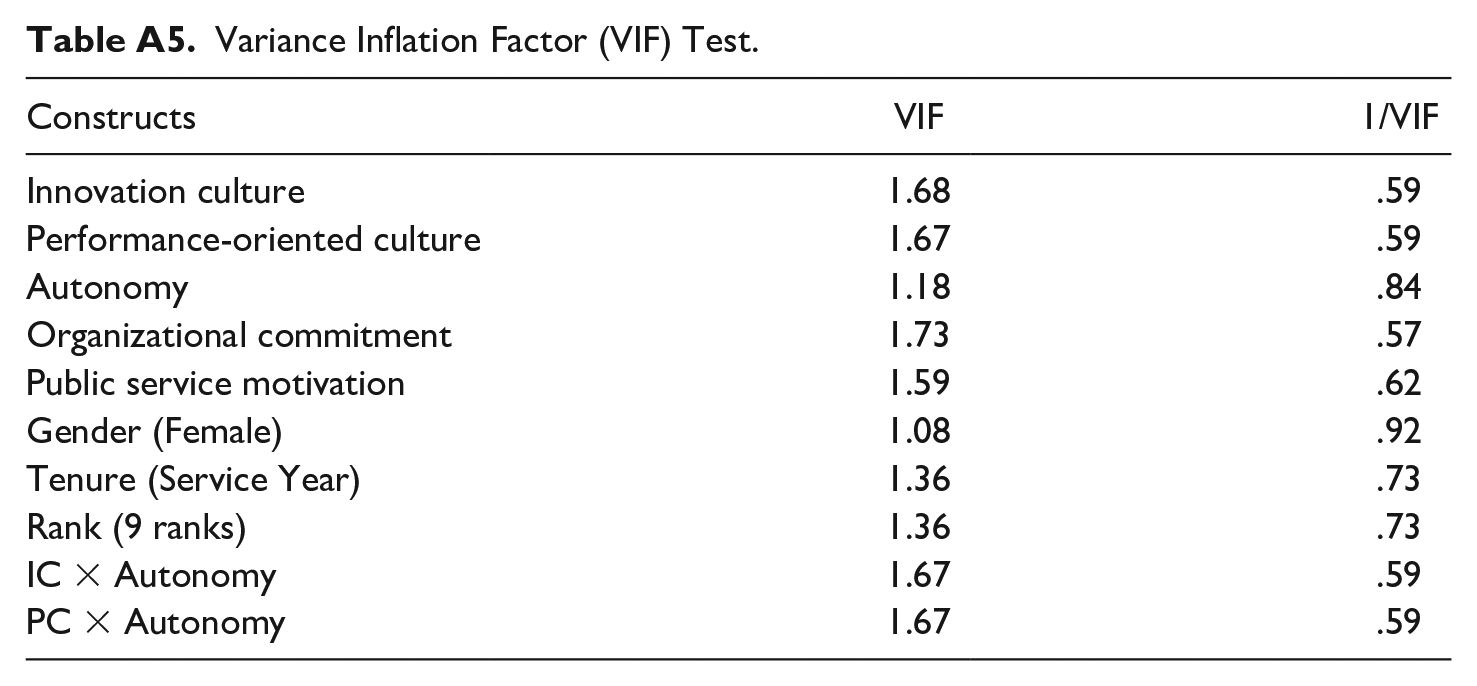
Because the current research uses many variables from one survey questionnaire (i.e., 2019 Public Employee Perception Survey), it has to be checked whether the common method bias may affect the result. To test the common method bias, Harman’s single-factor test is conducted. The test indicates that the common method bias is not an alarming issue. The biggest factor takes up 30% of the total variance, which does not exceed the unacceptable threshold (50%). Additionally, to check for multicollinearity in the regression model, the Variance Inflation Factor (VIF) was calculated. All VIF values are between 1 and 2, indicating that they are acceptable, and that multicollinearity is not a major issue in the model (see Table A5). 3
Empirical Findings
Descriptive Statistics
Table 1 shows the correlation and descriptive statistics of variables in this study. The dependent variable, innovative behavior, has a mean which is 3.38. It is above the mid-point (i.e., 2.5) of a 5-Likert scale. Organizational commitment and public service motivation, control variables in the model, also have means of 3.34 and 3.45 above the mid-point. The mean of autonomy is 3.01 and slightly lower than other variables. Those variables are all positively correlated. In terms of the demographics, 36% of respondents are females in the sample. In the statistics of organizational culture variables, innovation culture has a lower mean (i.e., 3.14) than performance-oriented culture (i.e., 3.62), but innovation culture has a larger standard deviation (i.e., .18) than performance-oriented culture (i.e., .14). Innovation and performance-oriented culture have a positive correlation. Additionally, the skewness and kurtosis of variables are checked in Table A3.
Descriptive Statistics and Bivariate Correlations.
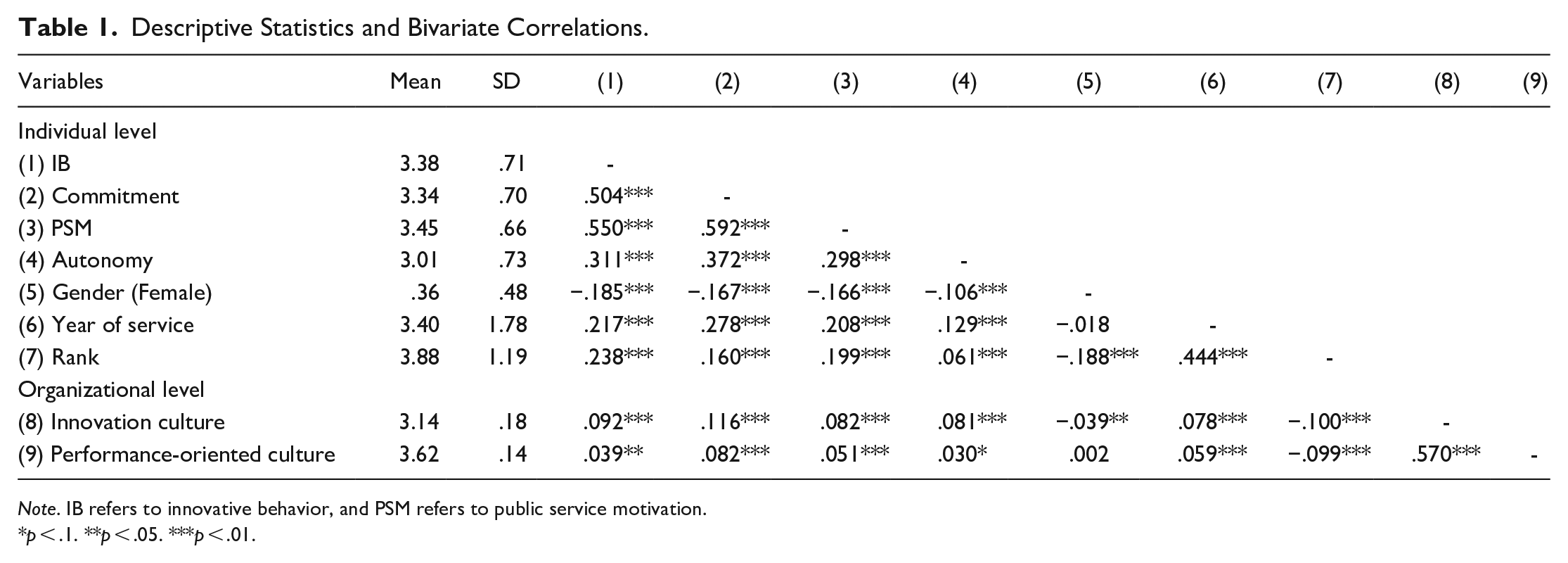
Note. IB refers to innovative behavior, and PSM refers to public service motivation.
p < .1. **p < .05. ***p < .01.
Cross-Level analysis
Table 2 presents the cross-level regression analysis. 4 Model 1 indicates the direct effects of innovation culture and performance-oriented culture on public employees’ innovative behavior, whereas Model 2 includes the interaction terms between innovation culture and autonomy, and between performance-oriented culture and autonomy. In those models, moderation variables (i.e., innovation culture, performance-oriented culture, and autonomy) are mean-centered for the analysis (Dawson, 2014).
Cross-level Regression Analysis.
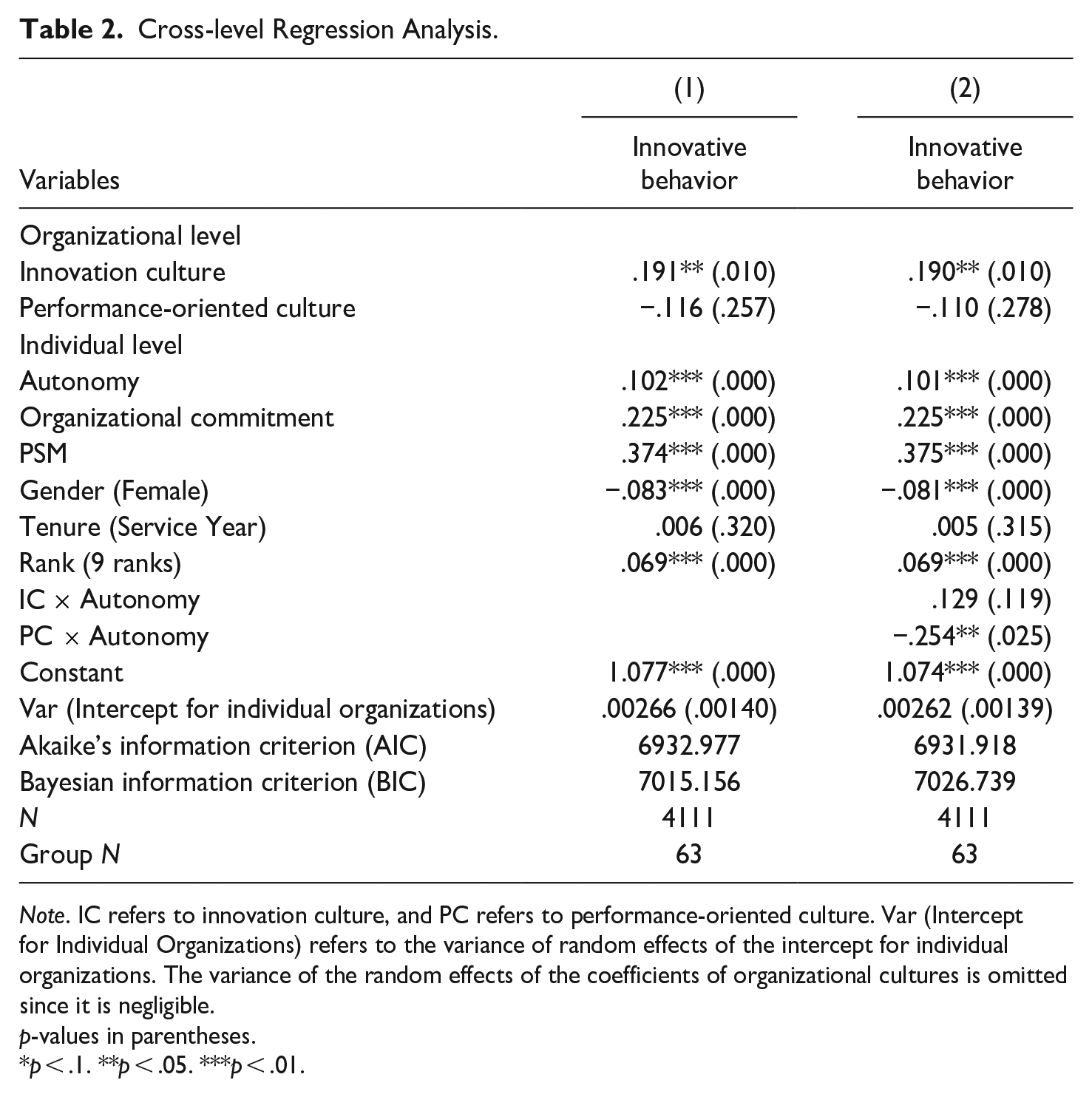
Note. IC refers to innovation culture, and PC refers to performance-oriented culture. Var (Intercept for Individual Organizations) refers to the variance of random effects of the intercept for individual organizations. The variance of the random effects of the coefficients of organizational cultures is omitted since it is negligible.
p-values in parentheses.
p < .1. **p < .05. ***p < .01.
In Model 1, autonomy at the individual level shows statistically significant and positive effect on innovative behavior of public employees. A one-unit increase in autonomy is associated with a .102 increase in innovative behavior on a 5-point scale. Autonomy consistently demonstrates a significant positive association with innovative endeavor in both Model 1 and Model 2. At the organizational level, innovation culture has a positive and significant effect on innovation, while performance-oriented culture does not appear to have significant direct effects on innovative behavior. A one-unit increase in innovation culture is associated with a .191 increase in innovative behavior on a 5-point scale. Thus, when it comes to net impacts of the two cultures on innovative behavior in Model 1, the innovative behavior is increased. The coefficient of innovation culture is almost double the size of the autonomy coefficient on innovative behavior. Organizational commitment and public service motivation are positively and significantly correlated with innovative behavior in all models. For demographic variables, being female has a negative and significant relationship with the dependent variable, while higher rank is positively associated with innovative behavior. Years of service has an insignificant effect on innovative behavior in two models.
Model 2 includes the interaction terms between innovation culture and autonomy, and between performance-oriented culture and autonomy. The moderation between performance-oriented culture and job autonomy has a significant and negative coefficient, supporting the hypothesis. On the other hand, the effect of innovation culture on innovative behavior does not appear to moderate autonomy. This finding regarding the interaction term suggests that a performance-oriented culture weakens the influence of job autonomy on innovative behavior. Along with Model 1, the innovation culture variable has a significantly positive association with the dependent variable, and the effect of performance-oriented culture on innovative behavior is insignificant. Consistent with Model 1, a one-unit increase in innovation culture is associated with a .190 increase in innovative behavior on a 5-point scale.
Figures 2 and 3 illustrate the moderating effects of two types of organizational culture and autonomy. To examine the moderating effect of innovation culture, one standard deviation below and above the mean of organizational culture is estimated in Figure 2. Predictive margins are based on a 90% confidence interval. Although the interaction term is not statistically significant in the multilevel regression in Model 2 of Table 2, Figure 2 shows that public employees are more likely to act innovatively when they experience both high job autonomy and a strong innovation culture. The statistical insignificance may be attributed to the substantial overlap at low autonomy levels, where the distinction between high and low innovation culture is minimal. In an organizational culture that assumes innovation and change as standard practice, public employees with high job autonomy have greater freedom to implement their creative ideas in public service processes. The observed trends in Figure 2 have practical implications for fostering innovative behavior in public organizations.
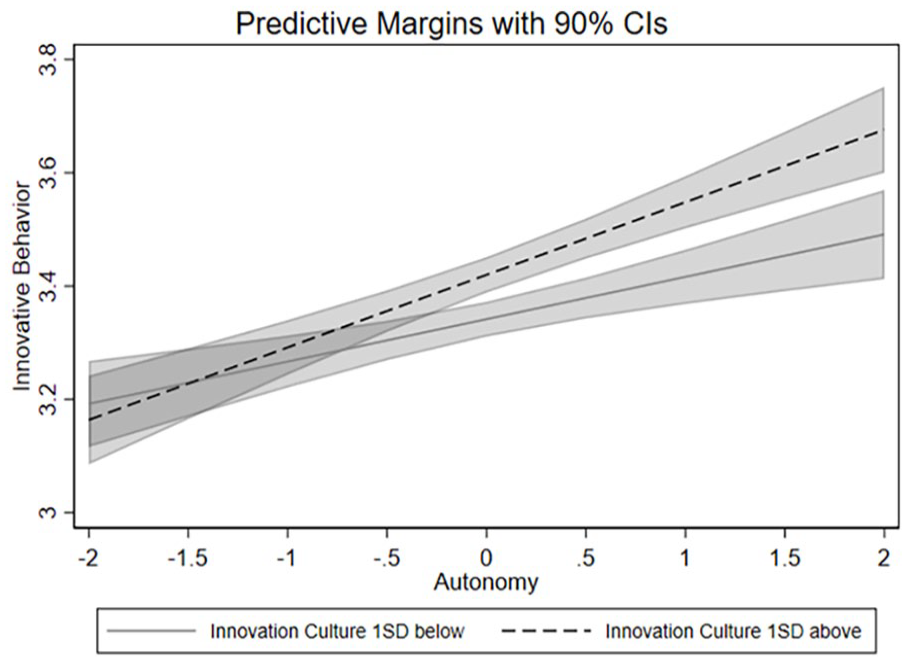
Cross-level effect between autonomy and innovation culture.
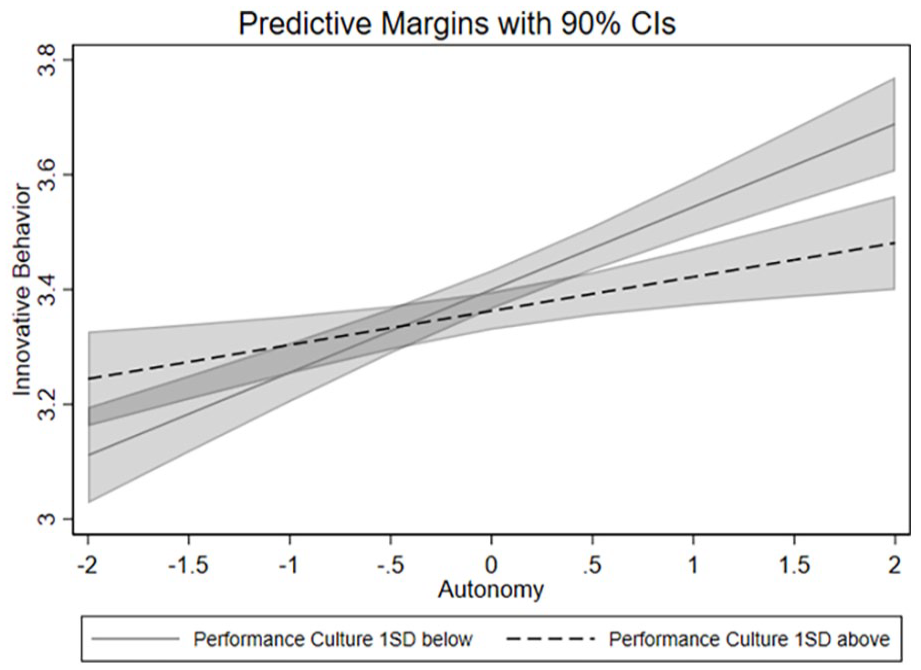
Cross-level effect between autonomy and performance-oriented culture.
Figure 3 depicts the significant moderating effects between performance-oriented culture and job autonomy. It reveals that public employees tend to behave more innovatively when they experience strong job autonomy in an environment with a lower level of performance-oriented culture. This finding implies that the positive effects of employees’ job autonomy on innovative endeavors can be hindered in organizations with strong performance-oriented management practices, whereas a reduced emphasis on strict performance management may encourage creative acts through enhanced job autonomy. Additionally, considering that a solely performance-oriented culture is not statistically significant in the multilevel regression models (Model 1 and Model 2 in Table 2), it appears that performance-oriented culture primarily influences innovative behavior through its interaction with autonomy rather than as a direct effect. Therefore, Figures 2 and 3 empirically support the moderation hypotheses established in the previous section based on the CVF model, highlighting how autonomy and organizational culture interact to shape innovative behavior in public employees.
Discussion and Conclusion
Consistent with existing research (De Vries et al., 2016; Kwon & Kim, 2020), autonomy is an effective stimulus for innovative behavior. The research confirms the different functions of innovation and performance-oriented culture. Innovation culture both directly increases innovative behavior and strengthens the positive effect of job autonomy on innovative behavior, whereas performance-oriented culture does not have a significant direct impact on innovative behavior. However, performance-oriented culture weakens the positive effect of autonomy on innovative behavior.
In addition to the careful application of CVF, this article suggests a range of significant theoretical and practical implications. First, drawing upon CVF (Cameron & Quinn, 2011), this article categorizes innovation culture and performance-oriented culture, highlighting their distinct roles in influencing innovative behaviors. In line with CVF, an innovation-oriented culture encourages public employees to engage in creative thinking and consistently translate new ideas into actionable initiatives. By providing an innovation-supportive environment, organizations not only embolden employees to experiment and collaborate but also sustain their motivation to pursue innovative solutions. Conversely, when an organization places excessive emphasis on performance, it may impose rigid procedures and short-term targets that can dampen employees’ willingness to take calculated risks. Under these circumstances, employees may hesitate to utilize their autonomy for experimentation, thereby curtailing the generation and implementation of novel ideas.
Second, this article makes methodological contributions to empirical studies on organizational culture. This research uses the mean of individual responses within each agency to capture variables of different types of organizational culture. South Korea’s centralized governmental structure enables the development of comprehensive survey data from 46 central agencies and 17 local governments. Previous studies conducted in federal systems (Jung, 2014; Jung & Ritz, 2014) have employed multilevel modeling. Drawing on goal-setting theory and utilizing the 2005 Merit Principles Survey, Jung (2014) aggregated goal specificity at the organizational level to examine its influence on turnover intention. Similarly, Jung and Ritz (2014) used the 2009 Swiss Public Personnel Survey, aggregated goal ambiguity to the organizational level, and found a negative effect on organizational commitment. To extend the CVF to multilevel modeling in other contexts, future research may benefit from collecting customized survey data. For instance, Langer et al. (2024) administered a CVF-based survey measuring four types of organizational culture across six nonprofit organizations in Illinois, although they were unable to conduct multilevel regression due to the small number of organizations. A more robust example is provided by Shim et al. (2023), who analyzed data from 80 workgroups within a single local government in South Korea. Their study employed multilevel regression using aggregated measures of performance-oriented climate, ethical climate, and servant leadership. Building on their study, future research may focus on the workgroup level, thereby allowing researchers to practically collect survey data on culture as it is nested within different workgroups in an organization or government agency.
Thirdly, from the perspective of practitioners, in terms of the role of performance-oriented culture on innovative endeavors of bureaucrats, public managers should consider the moderating effects between autonomy and multiple cultures. Strong performance-oriented culture acts as a suppressor of the positive effect of autonomy on innovative behavior. Following CVF, performance-oriented culture is effective in achieving specified organizational goals, but focusing on performance indicators may have negative impacts on innovative behavior. In this article, the moderation between performance-oriented culture and job autonomy decreases the innovative endeavors of public employees. Thus, assessing the level of performance-oriented culture and individual’s job autonomy can provide top management officials with insights into fostering innovation. One important practical implication of this study is that it expands managers’ professional toolkit for encouraging individual innovative behavior. For public organizations with strong performance-oriented cultures, senior managers might consider adjusting performance evaluation practices and temporarily relaxing expectations to fully leverage the positive effects of job autonomy on innovation. Such flexibility in evaluation practices may help to unlock the potential of employees’ autonomy, thereby enhancing innovative behavior.
This study uses data from the South Korean government, which has a centralized administrative structure and hierarchical organizational traditions. It offers a theoretically transferable framework that can be adapted to various organizational and national contexts by measuring organizational culture along two dimensions: innovation culture and performance-oriented culture. Standardized pay systems in South Korea permit this study use proxies, including rank and years of service. By contrast, in more decentralized systems, pay and working conditions could differ more greatly, therefore affecting employee behavior. These factors should not only be regarded as control variables but also be investigated as possible resources that could mitigate the negative consequences of a performance-oriented culture on innovative behavior (Amabile, 1996). Competitive pay, generous benefits, and favorable working conditions could buffer the innovation-suppressing effects of strict performance systems, thereby enabling workers to engage in innovative behavior (Bakker & Demerouti, 2007). Including these elements in upcoming research will help researchers to better understand how organizational setting and employee resources together shape public sector innovation.
Despite the theoretical and practical implications of this study, it is not without limitations. Regardless of the implications and contributions of this study, future studies should address how other dimensions of organizational culture affect the innovative behavior of public employees. For example, CVF suggests other dimensions, such as clan and hierarchy culture which focuses on internal integration of organizations (Cameron et al., 2006; Cameron & Quinn, 2011).
Because this study uses perceived measures of organizational culture and innovative behavior, it involves social desirability bias. Innovative behavior questions may be subject to social desirability bias, particularly in organizations that emphasize their innovative cultures and take great satisfaction in them. This study took several steps to mitigate the potential impact of social desirability bias. Recognizing the tendency for respondents to provide socially desirable answers, anonymous surveys were used to encourage honest responses. Additionally, this study used temporal precedence by measuring organizational culture variables 1 year earlier than job autonomy and innovative work behavior. Furthermore, multilevel mixed regression explicitly modeled the nested structure of our data, recognizing that individuals are nested within organizations. This approach allowed for a more accurate estimation of the effects at each level, separating individual level variance from organizational level variance. In the multilevel regression, the individual responses to organizational culture were aggregated to the organizational level, mitigating social desirability bias at the individual employee level between the independent variable, organizational culture, and the dependent variable, innovative behavior. Despite these efforts, it is acknowledged that the limitation of social desirability bias exists, but the methodological choices in this study helped to reduce its impact.
Lastly, dependent variables after innovative behavior can be further investigated, including individual and organizational performance as well as public sector innovation. This approach can mitigate the social desirability bias. Innovative behavior is regarded as an important antecedent of governmental innovation, but the mechanism between those two variables should be further studied to corroborate the path. Despite the need for future studies, this research still contributes to the literature of public management from the perspective of organizational culture and public sector innovation.
Footnotes
Appendix
Variance Inflation Factor (VIF) Test.
| Constructs | VIF | 1/VIF |
|---|---|---|
| Innovation culture | 1.68 | .59 |
| Performance-oriented culture | 1.67 | .59 |
| Autonomy | 1.18 | .84 |
| Organizational commitment | 1.73 | .57 |
| Public service motivation | 1.59 | .62 |
| Gender (Female) | 1.08 | .92 |
| Tenure (Service Year) | 1.36 | .73 |
| Rank (9 ranks) | 1.36 | .73 |
| IC × Autonomy | 1.67 | .59 |
| PC × Autonomy | 1.67 | .59 |
Declaration of Conflicting Interests
The author declared no potential conflicts of interest with respect to the research, authorship, and/or publication of this article.
Funding
The author received no financial support for the research, authorship, and/or publication of this article.
