



Abstract
Although approximately a quarter of the world’s countries are officially bilingual or multilingual, the relationship between linguistic diversity and human resource management has largely been overlooked. This article advances research by theoretically considering, and empirically investigating, whether public servants’ ability to use their official language of choice at work is related to their turnover intentions, and whether this relationship is moderated by one’s linguistic minority status. Analysis of survey data from Canada’s full-time permanent public service shows a statistically significant and substantive relationship between public servants’ ability to use their official language of choice at work and their internal and external turnover intentions. Moreover, the results from various hierarchical sequential multivariate models, which build-up to control for employees’ personal characteristics and work environment, suggest that the relationship language of use has with turnover intention is important regardless of whether one is a linguistic minority or a linguistic majority.
Keywords
Introduction
Close your eyes, open your ears, and imagine: Each morning in your country’s capital, as thousands of public servants make their way into their buildings, settle down into their offices, and begin to tackle the essential work of planning, implementing, and evaluating state policies and programs, how do they greet each other? When public servants follow-up on last week’s meetings, discuss pressing problems, and propose solutions, what language do they speak? Simply put: What does your country’s bureaucracy sound like?
For approximately a quarter of the world’s countries who are officially multilingual 1 (Leclerc, 2017), this is not a trivial question, but rather an essential matter tied to issues of inclusion and legitimacy (Gazzola et al., 2018). However, it is also an issue that goes beyond questions of identity and representativeness. For civil servants in many of these countries, working in the language of their choice is a right they possess as government employees. As such, the inability to work in one’s official language of choice can constitute a “psychological contract breach” (Rousseau, 1989) between an employee and their employer. Such breaches, research shows us, can lower employees’ job satisfaction and increase their desire to quit their job (Cooper & Turgeon, 2021; Lemire & Rouillard, 2005).
Given that over two billion people reside in an officially multilingual state, and that over half of the world’s population speak two or more languages each day (Grosjean, 2010), it is striking how language use at work has been relatively understudied by public administration scholars (important exceptions include, Binderkrantz, 2011; Ritz & Alfes, 2018). We still know too little about whether, and how, language use at work influences employees’ attitudes and behaviors within the public service in multilingual states.
This article addresses this gap by investigating whether, in a multilingual state, linguistic diversity influences a central human resource component of any well-functioning organization: permanency and employees’ turnover intentions (Boyne et al., 2011; S.Lee, 2018). Two central questions guide our analysis. First, is difficulty to work in one’s language of choice positively associated with higher internal or external turnover intention? Second, is the relationship between language use and turnover intention different according to whether one is a linguistic minority or a linguistic majority?
Using a survey of Canadian federal public servants—where French-speaking Canadians constitute a linguistic minority vis-à-vis an English-speaking majority—we test our hypotheses with multinomial logistic regression models in a hierarchical sequential manner. Our results suggest that in multilingual states, when it comes to the antecedent factors affecting public servants’ behavior and attitudes, linguistic diversity does matter. Specifically, the ability to use one’s official language of choice at work is an important predictor of public servants’ internal and external turnover intentions. Moreover, this relationship is present regardless of one’s linguistic minority status. Within Canada’s federal public service, the more Francophone and Anglophone public servants feel that they can use their official language of choice at work, the greater is their intention to stay within their present job, the smaller is their intention to quit their job for something else within the public service (internal turnover), and the smaller is their intention to quit their job for something outside of the public service (external turnover).
This article contributes to public administration scholarship by drawing attention to the importance of language diversity for human resource management in multilingual states. But more than this, we offer a theoretical explanation as to why language impacts public servants’ behavior and attitudes that goes beyond important matters of inclusion and representativeness (Gazzola et al., 2018), to consider how in multilingual states language diversity can create expectations between employees and employers, which if not met, can negatively impact employees’ behavior and attitudes toward their organization.
The remainder of this article is divided into five sections. The first section presents the context of language use in Canada. The second section presents the theory guiding our hypotheses between public servants’ ability to use their official language of choice at work and their turnover intention. The third section describes the data and methods used to test our hypotheses. The fourth section presents and interprets the empirical results. The conclusion identifies this article’s main theoretical and empirical contributions, considers the limitations of this study, and in light of these, offers some questions for future research.
Official Language Diversity in Canada
Language of Work in Canada’s Bilingual Public Service
In this study, we explore the relationship between linguistic diversity and bureaucrats’ turnover intentions in Canada, where French and English are the two official languages. Historically, Francophones were severely underrepresented in the federal bureaucracy, which tended to predominantly work in English (Laframboise, 1971). In 1944 to 1945, 12.5% of federal public servants were French-Canadian, and no senior public servant was Francophone, despite the fact Francophones represented around 30% of the Canadian population (Wilson & Mullins, 1978, p. 520). The rise of Quebec nationalism in the 1960s led to important changes regarding the place of French in federal institutions and especially the federal public service (Gaspard, 2019; Turgeon & Gagnon, 2013). In 1969, the Official Languages Act was adopted, making French and English the official languages of the bureaucracy. Measures to ensure a right to work in French were also gradually adopted.
In 1973, the Federal Parliament adopted a resolution on the official languages in the public service confirming public servants’ right to work in the official language of their choice, subject to certain conditions (Hudon, 2009, p. 1). It also made individual bilingualism a merit criterion for a growing number of positions. Resulting from the higher rate of bilingualism among Francophones than Anglophones, this measure contributed to a significant increase in the representation of Francophones in the federal public service and the end to their historical underrepresentation. 2 In 1977, the federal government adopted a series of measures to facilitate the implementation of bilingualism in the public service. These measures included an annual bonus for bilingual employees and the expansion of language training. In 1981, new regulations were introduced that required bilingualism for all senior managers (except the highest-ranking deputy minister level) working in a bilingual region, including the federal capital. When it comes to the language of work, the most important reform was perhaps the adoption of the Official Languages Act, 1988, which affirmed that English and French were the official languages of the public service and that employees had the right to work in the language of their choice in bilingual regions. Moreover, the Official Languages Act (1988) allowed for remedies to be sought if any part of the Act was not respected.
The Unequal Costs of Bilingualism in the Canadian Public Service
At first view, the cost of bilingualism requirements, both in terms of the opportunity to join, and advance in the federal public service, might be seen as higher for Anglophones than for Francophones. After all, the rate of French-English bilingualism in Canada among Francophones in Quebec is much higher than for Anglophones outside Quebec, 42.8% versus 7.4%, respectively (Patrimoine Canada, 2024). 3 As a result, most positions requiring bilingualism in the federal public service are occupied by Francophones (Public Service Commission of Canada, 2011) and, every year, a large number of mostly Anglophone civil servants hoping to move up into the senior ranks of the public service are sent to language schools to learn French. As such, it is perhaps not surprising that Anglophones are slightly more likely than Francophones to state that bilingualism requirements have impeded their career advancement (Borbey & Mendelsohn, 2017).
However, the daily reality of inter-linguistic communication still falls disproportionately on the shoulders of Francophones, as exemplified by the frustrated remark from a long-serving Canadian politician during the proceedings of a parliamentary committee, in which witnesses (comprising senior public servants, partisan advisors, and cabinet ministers) were exclusively submitting written documents in the majority language: “I’ve been in Parliament for 35 years, and I understood a long time ago that the two official languages are English and translation” (House of Commons Justice Committee, 2019). More systematically, a 2002 study by the Office of the Commissioner of Official Languages found that Francophones working in a bilingual setting spent approximately 43% of their time using English, meanwhile Anglophones in a similar setting spent approximately 14% of their time using French (Office of the Commissioner of Official Languages, 2003, p. 94). Moreover, a recent survey conducted by the Office of the Commissioner of Official Languages (2021, p. 6) found that 44% of Francophone respondents in bilingual regions stated unease with using French or asking to use French in their current job, compared to 15% of Anglophones with regards to English. Such results are also shown in a report by two senior public servants on the state of bilingualism in Canada’s public service (Borbey & Mendelsohn, 2017). The report largely confirms the unequal costs of bilingualism stating that “English is the dominant language for most daily activities and Francophones employees do not feel they can work in the language of their choice” (p. 16). The report also stated that “(. . .) in order to be understood on important issues, Francophone employees feel they must work in English” (p. 16).
Literature Review and Hypotheses
Turnover Intention: Why it Matters
Before discussing the relationship between language diversity and turnover intention, it is worth asserting why such a relationship is important. First, while some turnover is undoubtedly beneficial for organizations—introducing new ideas, energy, and enthusiasm ( S.Lee, 2018; Wynen et al., 2019)—a large body of research shows turnover to negatively affect organizational performance—by depleting organizational memory (Boyne et al., 2011; Mahmalat & Zoughaib, 2022), weakening social cohesiveness and consuming time and financial resources (Kangas et al., 2018). Moreover, with respect to the public service, turnover can negatively impact the overall quality of governance—by weakening accountability, expertise, and the public servants’ willingness to speak truth to power (Cornell, 2014; Nistotskaya & Cingolani, 2016). Second, with specific reference to multilingual states, language diversity is often highly controversial, and the inability of bureaucrats to work in their language of choice, and their subsequent desire to leave the public service (if such a relationship exists), might contribute to political instability (Laframboise, 1971). For example, French Canadians’ difficulties to be served in French, to obtain employment in the federal public service, and to work in their own language (in the public and private sector), were all contributing factors to the growth of Quebec nationalism in the 1960s (Royal Commission on Bilingualism and Biculturalism, 1969), and remain issues of frustration to this day (Martin & Trépanier, 2020).
Language of Use at Work and Turnover Intention
There are several reasons why language diversity, as it relates to the ability of an employee to use their official language at work, might be an especially sensitive issue in public organizations and contribute to employees’ turnover intentions. Language policies are intrinsically linked to questions of national identity and recognition. Employees who are unable to work in their official language of choice might view this as a broad rejection of the linguistic group to which they belong. In that regard, language is very much a marker of identity like age (Cho & Lewis, 2012; H.-W.Lee, 2020); race (Chordiya, 2022; Hofhuis et al., 2014; Tsui et al., 1992), gender (Moynihan & Landuyt, 2008) or sexual orientation (Sabharwal et al., 2019), which can lead to discrimination and, ultimately, turnover intentions. However, research studying the impact that belonging to a minority, or a historically marginalized group, has on an employee’s turnover intention has produced conflicting results. Indeed, some studies have shown no relationship between turnover intention and belonging to a minority, or a historically marginalized group (Bertelli, 2007; S.-Y.Lee & Whitford, 2008), while others have found turnover intentions to be lower among these groups (Moynihan & Landuyt, 2008; Pitts et al., 2011).
However, the question of language of work, we believe, is not solely related to questions of identity. 4 As we argued in the introduction, in many multilingual countries, the ability to use one’s language of choice at work is very much also related to the workplace rights that public servants possess because of their country’s official language policy (Gaspard, 2019; Turgeon & Gagnon, 2013). Accordingly, the inability for public servants to work in their language of choice can be perceived as constituting an important “psychological contract breach,” which occurs when an employee believes that their employer has not fulfilled a promised obligation (Rousseau, 1989).
As argued by Robinson (1996, p. 576), a psychological contract breach is a subjective experience and “[i]t is an employee’s belief that a breach has occurred that affects his or her behavior and attitudes, regardless of whether that belief is valid or whether an actual breach took place.” There are two factors that might account for such a breach according to Robinson and Wolfe Morrison (2000). First, a breach might occur when a representative or an agent of the employer knows or recognizes that an obligation or a right exists, but knowingly and purposely fails to meet such obligation or enforce such right. Second, a breach might occur when an employee and the employer disagree on the existence of an obligation or about the nature and consequences of such an obligation. The impact of a psychological contract breach is likely to be even more significant when a perceived promise is clearly verifiable, as it is the case for language policy and language rights. According to Rousseau (1989, p. 124), drawing on social information processing theory, “overt and public commitments exert more influence on cognitions and behavior than subtle or private ones.”
Several studies have demonstrated that a perception of a contract breach is associated with turnover intentions (Clinton & Guest, 2014; Cooper & Turgeon, 2021; Welander et al., 2017). While, to the best of our knowledge, no studies have directly explored the relationship between psychological contract breach as it relates to language of work and turnover intention, a few studies have explored how language of work might affect employees’ satisfaction with their work or their turnover intentions. First, in a qualitative study of public service employees in Greenland, where employees speak either Danish or Greenlandic, Binderkrantz (2011) found that an employee’s inability to speak in their own language at work was associated with discontent. Second, in a study of private multinational firms in South Korea, Froese et al. (2016) found that expatriate workers’ turnover intentions were affected by their ability to communicate in English with other workers; English being viewed as the language of intercultural communication. As such, considering both psychological contract breach theory and previous studies on the impact of language of work, we propose the following first hypothesis:
H1: Difficulty to use one’s official language of choice has a positive relationship with internal and external turnover intention.
We posit that the strength of the relationship between the ability to use one’s language of choice and turnover intentions might differ, however, according to whether an employee belongs to a linguistic minority or to the linguistic majority. While different theoretical approaches and previous studies lead us to make such a prediction, ultimately there is no consensus as to whether this might impact more the linguistic majority or the linguistic minority. First, still drawing on psychological contract theory, it can be argued that difficulty to work in one’s language of choice is much more likely to impact members belonging to the linguistic minority. Indeed, a body of literature has increasingly discussed the importance of what has been presented as an employee’s perception of a “breach in diversity promise fulfillment” (Holly Buttner et al., 2010) or “diversity-related psychological contract breach” (Tufan et al., 2019). Such a breach occurs when an employer fails to provide “a positive and supportive diversity climate” (Holly Buttner et al., 2010, p. 502).
Language policies in a public service, to the extent that they are geared toward ensuring both a higher representation of members of a linguistic minority and their ability to work in the language of their choice (Turgeon & Gagnon, 2013), can undoubtedly be seen as being a central element of a diversity-related psychological contract for linguistic minority employees. In short, it is not solely perceived as a question of language of work, but as also one of recognition and respect of a minority group by the employer. As such, an inability to work in one’s language of choice might be perceived by members of a linguistic minority, as argued by Tufan et al. (2019, p. 2927) in relation to ethnic minorities, as “indicating an organization’s disregard, devaluation and/or ignorance of their (. . .) identity” and as such they might be more likely to intend to leave their job than members of the linguistic majority.
However, the extent to which a perceived contract breach leads to turnover is undoubtedly influenced by professional opportunities outside one’s department or one’s organization. In short, in the face of a psychological contract breach, an employee’s decision to move might also be motivated by whether they might find as good of a professional situation in another setting. For example, Moynihan and Landuyt (2008) claim that one reason that likely accounts for the lower turnover intentions of women than men in the American state public service is that they face a lower wage penalty in the public service than they would in the private sector, as well as better benefits. Such findings are likely to extend beyond women. In the Canadian case, for example, data shows that members of minority groups have been less likely to face a wage penalty in the public than in the private sector (Hou & Coulombe, 2010). As such, one can argue that an inability to be able to use one’s language at work will have a stronger impact for members of the linguistic majority than for members of the linguistic minority considering their greater opportunities outside the public service.
Another factor, however, might contribute to a higher turnover intention of members of the linguistic majority facing constrain on their ability to work in their first official language. In a context like Canada, as argued before, the rate of bilingualism of members of the linguistic minority is much higher and so is, in the public service, their daily usage of the other official language. As a result, the inability of Francophone public servants to use their first official language at work might not limit their ability to do their job as much as Anglophone public servants. Indeed, as discussed in the previous section, the inability to be understood by the linguistic majority is one of the reasons why Francophone public servants do not use their language of choice at work, and is why they spend a disproportionate amount of time working in the majority language. However, for Anglophone public servants, the inability to work in English is much more likely to limit their ability to do their job. Accordingly, the inability to use one’s language of choice might have a greater impact on turnover intention for Anglophone than for Francophone public servants. In sum, based on the theory reviewed above, but noting the conflicting direction of a moderating relationship suggested by differing perspectives within this literature, we thus put forward the following non-directional hypothesis.
H2: The relationship between difficulty to use one’s official language of choice and internal and external turnover intention is moderated by linguistic minority status.
Methodology
Data
We test our hypotheses with data from the Public Service Employee Survey (PSES) 2017; a census of Canada’s federal public servants encompassing 86 departments and agencies. A total of 174,544 employees completed the survey for a response rate of 61.3%. The 2017 PSES was designed and overseen by the Treasury Board Secretariat and Statistics Canada and followed standard survey design procedures—protecting respondents’ anonymity, providing proximal separation between measures, and using differing scale properties—in order to accurately measure variables and minimize potential problems such as common source bias (George & Pandey, 2017). We obtained access to the publicly restricted microlevel data through the Canadian Research Data Centre Network. All data and analysis presented in this study were vetted by Statistics Canada to ensure respondents’ anonymity.
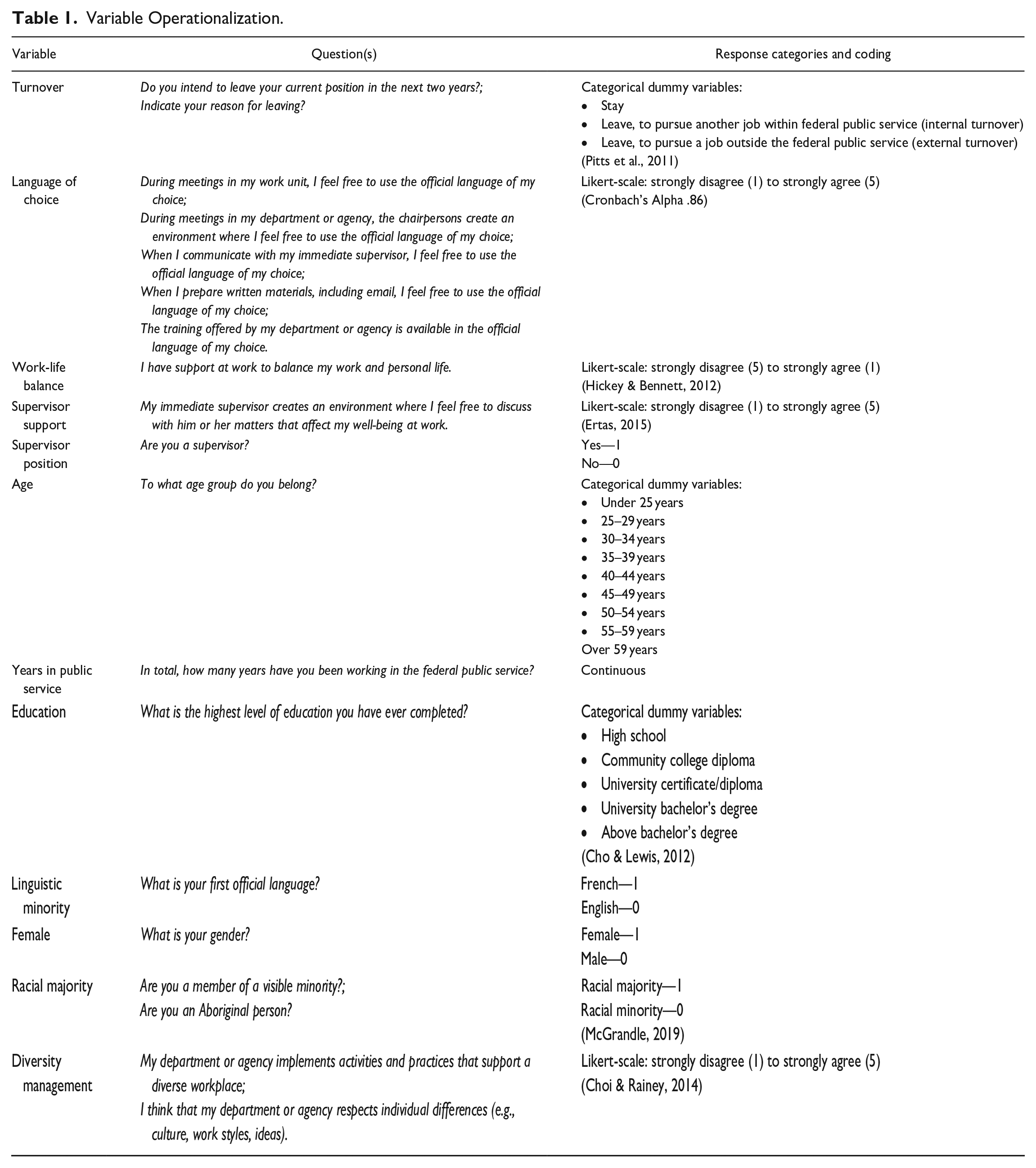
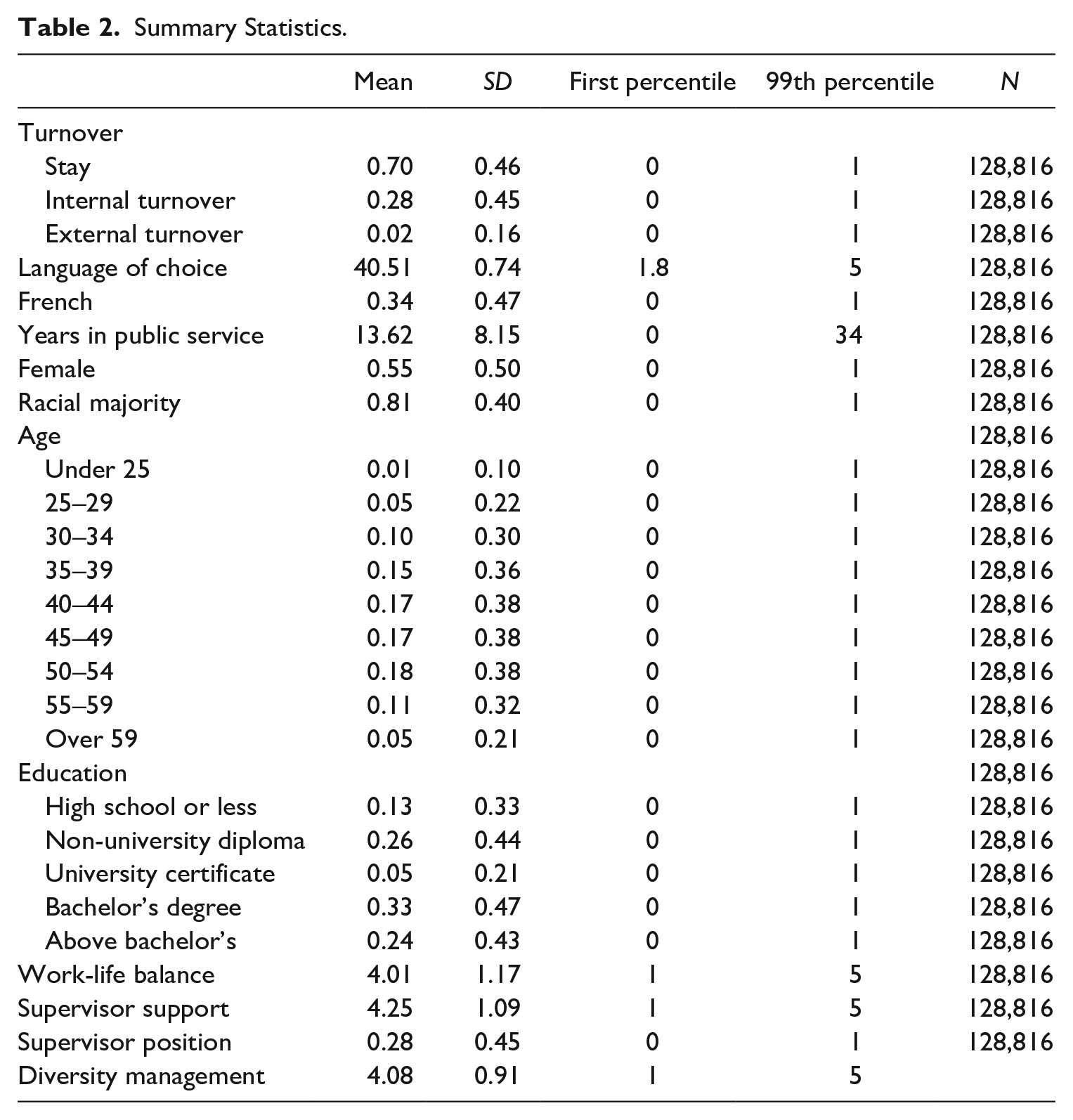
The PSES contains various questions about employees’ attitudes, behaviors, and work environment, and is similar to other national public service surveys (e.g., Australian Public Service Employee Census; American Federal Employee Viewpoint Survey). With a wide variety of questions, a survey design following best practices to accurately measure variables, and a large sample size, the PSES is an excellent, if underutilized, source of data to answer our research questions (Charbonneau et al., 2020). Table 1 describes the question(s) and measurement(s) used for our dependent, independent, and control variables. Table 2 provides the central tendencies, measures of variability and internal consistency for all variables.
Variable Operationalization.
Summary Statistics.
Dependent Variable
Our dependent variable is categorical and distinguishes between “stayers” (the intention to remain in one’s position), “internal turnover” (the intention to quit one’s agency for another job within the public service) and “external turnover” (the intention to quit the public service). Our objective is to investigate whether public servants’ ability to use their official language of choice at work has a relationship with their turnover intention, and therein, how this impacts the otherwise normal level of permanency within the bureaucracy. We also explore whether the relationship official language use has with turnover intention is different (i.e., moderated) according to whether one’s first official language is French or English. Accordingly, our analysis excludes expected turnover, that being, employees intending to leave their position to retire or because of an upcoming contract termination. We thus focus on understanding the turnover intention among full-time permanent (indeterminate) public servants who would otherwise be expected to remain within their public service position, which is likely to be the most worrisome form of turnover from a human resource perspective.
Independent Variables
Language of use at work is an index made up of five questions, which asked employees on a Likert scale about their ability, in varying written and oral contexts, to use their official language of choice at work. Linguistic minority is a binary categorical variable. Employees indicating their first official language as French were coded as a linguistic minority; those indicating English were coded as a linguistic majority.
Control Variables
Some of our regression models include additional variables to account for other factors that might affect turnover intention, and that are often included as control variables in studying employee turnover intention (Hur & Abner, 2024). The operationalization of these variables follows measures within the literature and is indicated in Table 1. These include employees’ personal characteristics—gender (Lewis & Park, 1989), race (McGrandle, 2019), education (Cho & Lewis, 2012), age, and number of years employed 5 —as well as employees’ work environment—work-life balance (Ertas, 2015), supervisor position, supervisor support (Ertas, 2015), and diversity management practices (Choi & Rainey, 2014; Chordiya, 2022).
Methods and Models
We test our hypotheses with multinomial logistic regression models, which is appropriate given that our dependent variable has three discrete categories (Long & Freese, 2014). Given the poor intuitive meaning of logistic regression coefficients, the regression outputs are reported using relative risk ratios. A relative risk ratio is the ratio of the outcome (e.g., internal turnover) in question given a one-unit change in value of the predictor. A relative risk ratio greater than 1.0 indicates a positive relationship and a risk ratio less than 1.0 indicates a negative relationship. Relative risk ratios, however, are only substantively meaningful if we know, and take into consideration, the underlying absolute risk of each outcome. Accordingly, we follow common practices with logistic regression and calculate the predictive probabilities that our independent variables (language of choice and linguistic minority status) have with each category of our dependent variable. We limit our interpretation and discussion of the results with respect to our hypotheses to these predictive probabilities.
Some researchers voice concern about social scientists’ tendency to include too many variables in their regression analysis (Schrodt, 2014; York, 2018). 6 These critics believe that in seeking to avoid omitted variable bias, researchers tend to include such a large number of control variables to render inaccurate the estimated effect that independent variables of interest have on the dependent variable. Yet at the same time, while others agree with some of the points made by these critics, such as not including intervening variables in models measuring direct effects, as doing so leads to underestimating the relationship the antecedent independent variable has with the dependent variable (Ray, 2003), there is no consensus over the recommendation for researchers to limit their regression models to three predictors (Clarke, 2005; Oneal & Russett, 2005, p. 294). 7
Noting the above, we adopt a hierarchical modeling approach beginning with a basic model containing a limited number of predictors, and in a sequential manner we include additional variables to the model to control for additional factors that research shows to effect turnover intention (Hur & Abner, 2024; H.-W.Lee, 2020; Moynihan & Landuyt, 2008). 8 This approach thus allows readers to see the relationship between linguistic diversity and turnover intention in various formats. The predictive probabilities in Figures 1 to 6 are also produced and reported from each hierarchical sequential model.
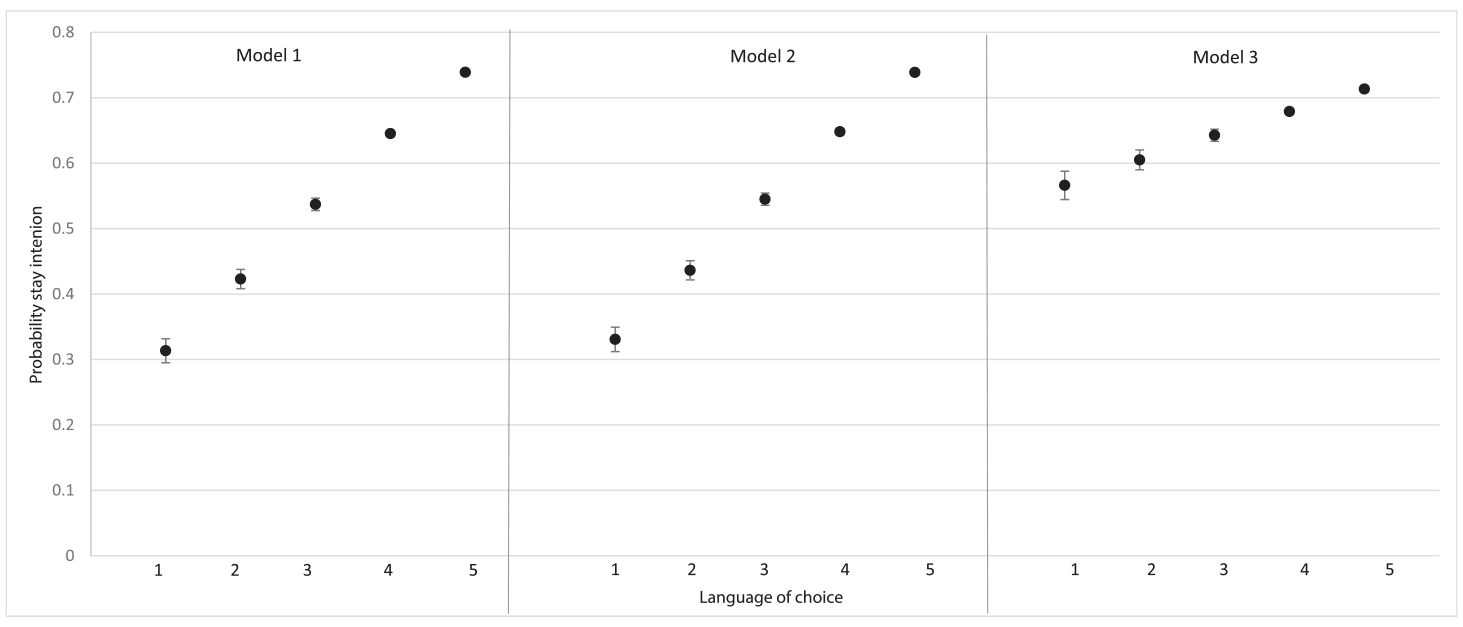
Stay intention and ability to use one’s language of choice at work
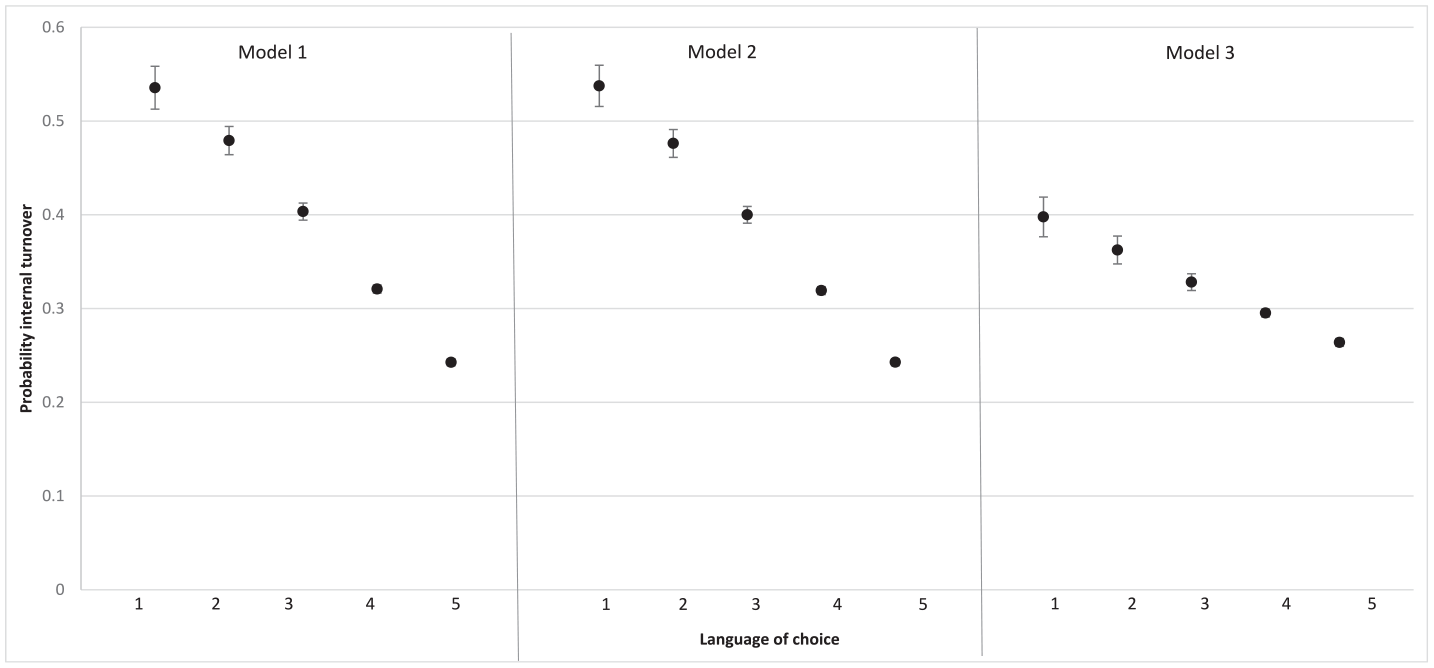
Internal turnover intention and ability to use one’s language of choice at work.
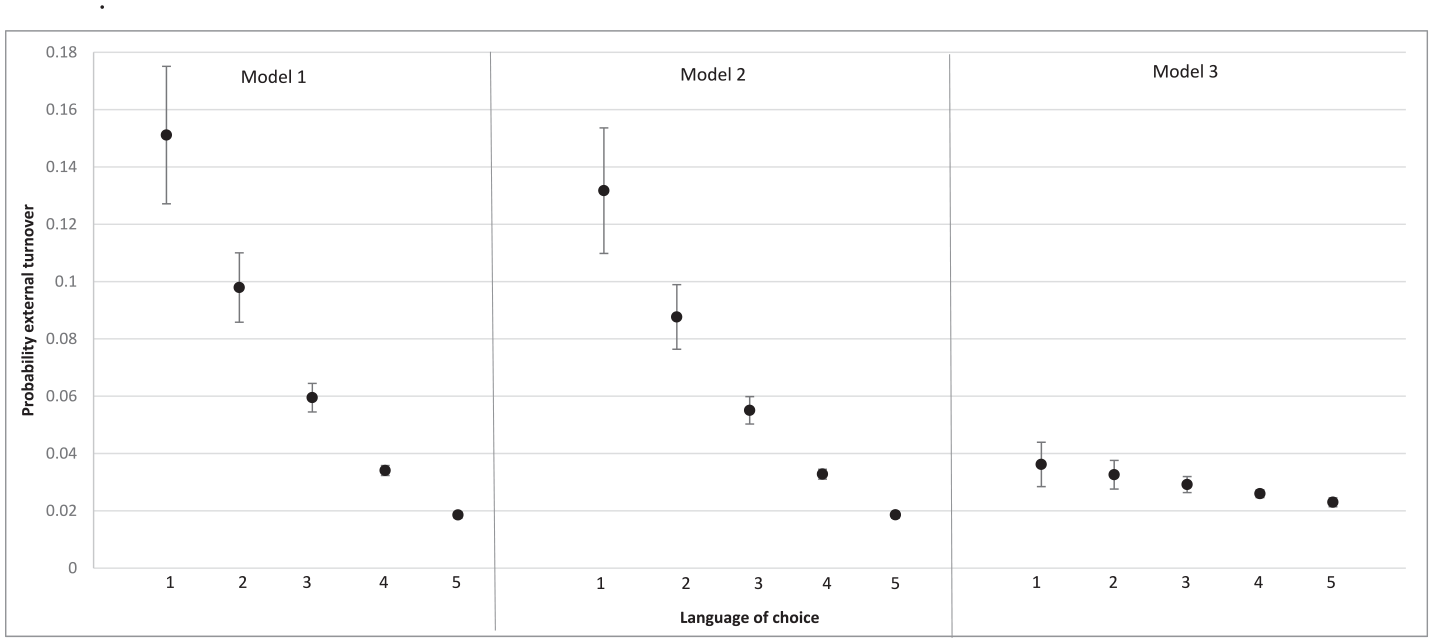
External turnover intention and ability to use one’s language of choice at work.
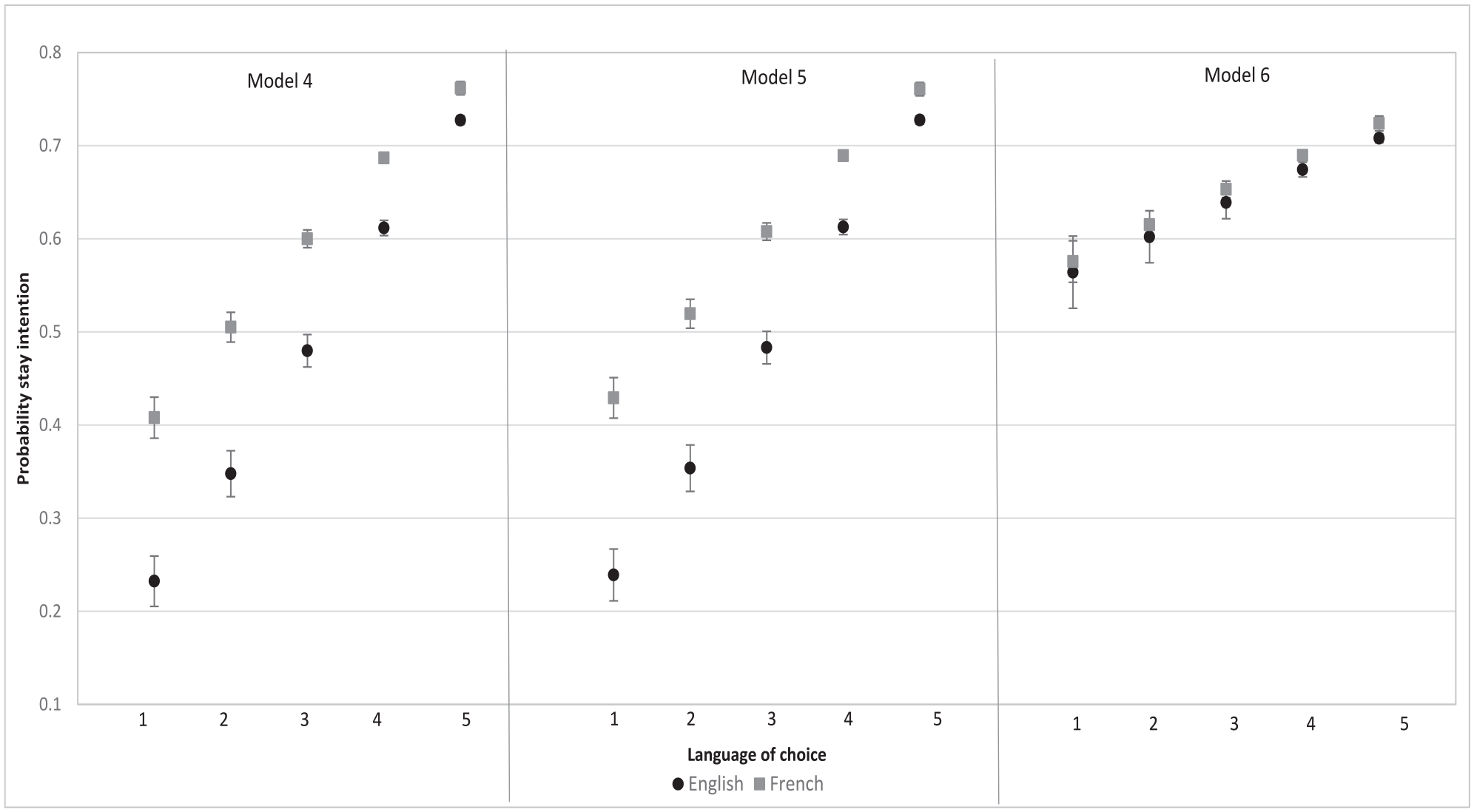
Stay intention by ability to use one’s language of choice at work and linguistic minority status.
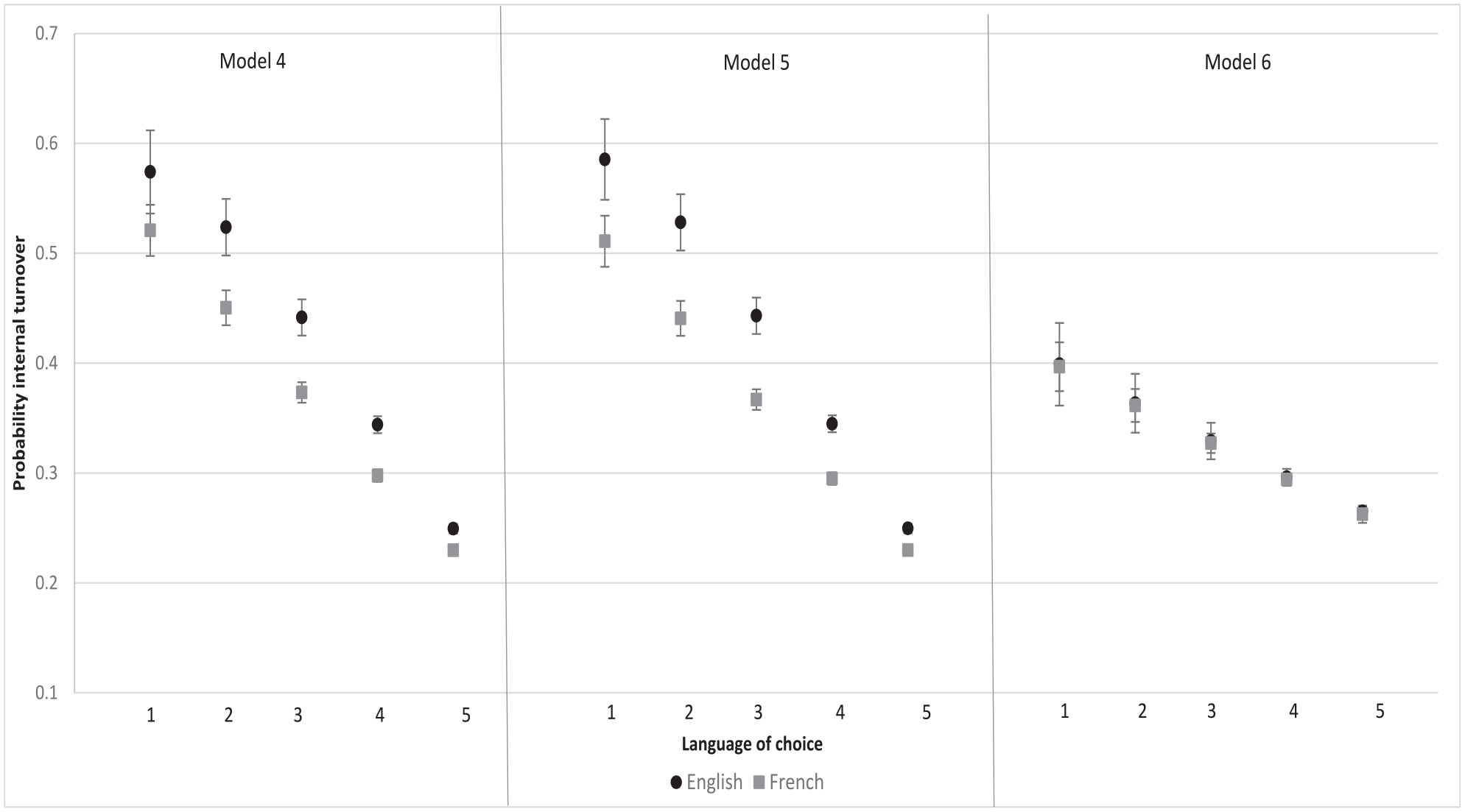
Internal turnover intention by ability to use one’s language of choice at work and linguistic minority status.
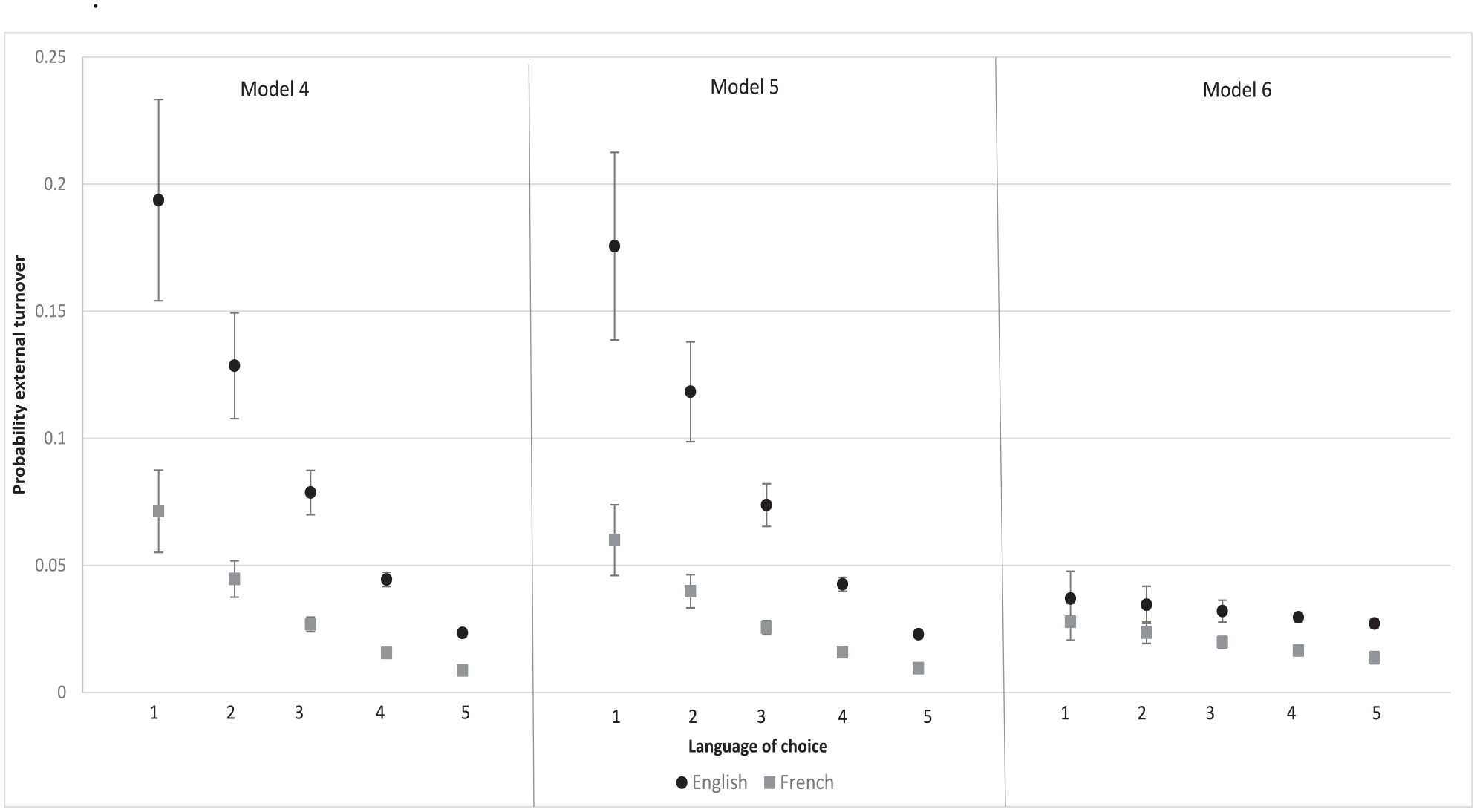
External turnover intention by ability to use one’s language of choice at work and linguistic minority status.
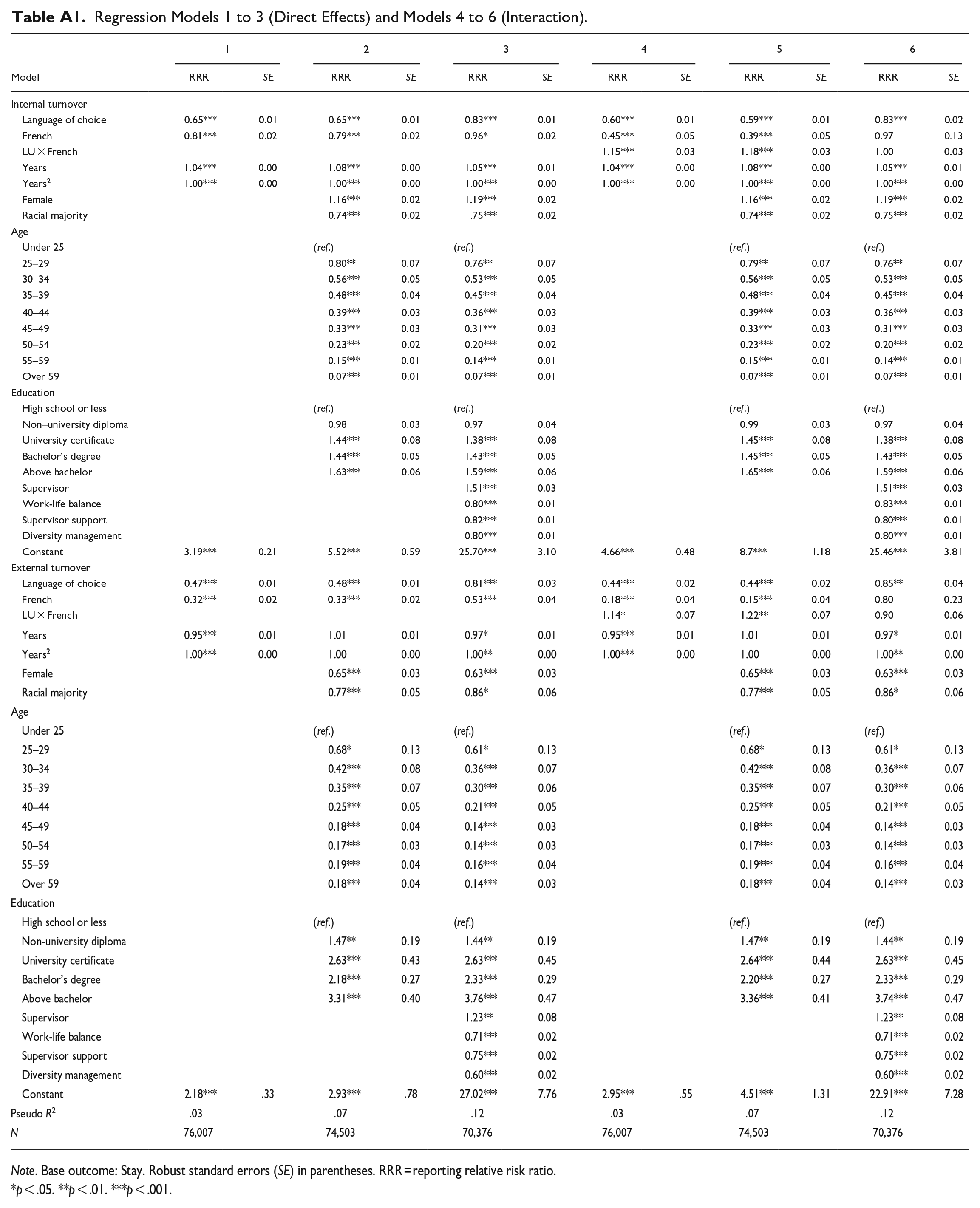
Altogether, we present six models, whose outputs are reported in the Appendix (Table A1). All models use robust standard errors and include survey weights that adjust for differences between the distribution of occupational groups among respondents and the actual public service population. We follow best practices and interpret the presence of a moderated relationship by focusing on differences in these predictive probabilities rather than the p-value of the interaction term’s coefficient (Mize, 2019). We follow Cumming (2009) and interpret non-overlapping confidence intervals as indicating statistical significance.
Models 1 to 3 are dedicated to the first hypothesis: the direct relationship that one’s ability to use their official language of choice at work has with turnover intentions. Model 1 is the most parsimonious model and regresses turnover intention against language use at work and belonging to a linguistic minority along with controls for the number of years an employee has worked in the public service. Model 2 is the same as Model 1, but includes controls measuring employees’ personal characteristics—age, education, gender, and race. Model 3 is the same as Model 2, but includes controls pertaining to one’s work environment—work-life balance, supervisor position, supervisor support and diversity management practices. Figure 1 displays that predicted probability of staying. Figures 2 and 3 display the predicted probability of internal and external turnover, respectively.
Models 4 to 6 are dedicated to the second hypothesis: whether the relationship between one’s ability to use their official language of choice at work and turnover intention is moderated according to one’s linguistic minority status. Models 3 to 5 are the same as Models 1 to 3, respectively, but include an interaction term between language of use and linguistic minority status. Figure 4 displays that predicted probability of staying. Figures 5 and 6 display the predicted probability of internal and external turnover, respectively.
Results
H1: Difficulty to Use One’s Official Language of Choice Has a Positive Relationship With Internal and External Turnover Intention
Figures 1 to 3 display employees’ intentions to stay, move within the public service and quit the public service altogether, respectively, according to their ability to use their official language of choice at work. The results support the first hypothesis. Figure 1 shows that increased ability to use one’s official language of choice at work has a statistically significant association with intending to stay in one’s position. For instance, looking to the predictive probabilities generated from Model 3, which controls for personal characteristics and workplace environment, Figure 1 shows that the probability of intending to stay in one’s position for employees with the lowest ability to use their language of choice at work is approximately 56%, whereas the probability of intending to stay among employees with the highest ability to use their official language of choice is 71%.
Figure 2 shows an equally meaningful and statistically significant relationship between public servants’ ability to use their official language of choice at work and their internal turnover intentions. For instance, looking to the predictive probabilities based on Model 3, Figure 2 shows that the probability of a public servant to express an internal turnover intention is approximately 40% among those reporting the lowest ability to use their official language at work, whereas among those reporting the highest ability to use their language of choice at work, the probability is approximately 26%.
Figure 3 examines the relationship language of use at work has with external turnover. As hypothesized, there is a negative statistically significant relationship between the ability to use one’s official language of choice at work and one’s intention to quit the public service altogether. While the predictive probabilities based on Models 1 and 2 are substantive, Figure 3 shows that once we control for employees’ personal characteristics and their workplace environment, the size of the difference in the probabilities is not as great as what is observed with one’s intention to stay, nor one’s internal turnover intention. Specifically, using the results from Model 3, the probability of a public servant with the lowest ability to use their official language of choice to express an intention to quit the public service is approximately 4%, whereas among those with the highest ability to use their official language of choice, the probability of expressing an intention to quit the public service is approximately 2%.
It is worth noting that the results in Table A1 (Appendix) indicate that the magnitude of the relationship language of choice has with internal and external turnover is similar to many better-known workplace variables such as supervisor support (Ertas, 2015), work-life balance (Ertas, 2015), and diversity management (Choi & Rainey, 2014; Chordiya, 2022). When it comes to internal turnover, Model 3 shows that the relative risk ratio is 0.83 for language of choice, 0.82 for supervisor support, 0.80 for work-life balance, and 0.80 for diversity management (all variables coded on a 5-point scale); whereas with external turnover the relative risk ratio for language choice is 0.81, which is similar, albeit slightly less substantive than the lower relative risk ratio of supervisor support (0.75), work-life balance (0.71), and diversity management (0.60).
H2: The Relationship Between Difficulty to Use One’s Official Language of Choice and Internal and External Turnover Intention is Moderated by Linguistic Minority Status
Figures 4 to 6 show the probability of intending to stay, internal turnover, and external turnover, respectively, according to an employee’s ability to use their official language of choice at work, separately, for linguistic minority and linguistic majority employees. The results do not provide consistent enough results for us to support the second hypothesis. Overall, the presence and direction of the relationships observed above, with respect to the first hypothesis between language use and turnover intention, are observed among linguistic minority and linguistic majority employees.
Concerning the intention to stay in one’s position, Figure 4 shows that in all three interactive models, the ability to use one’s official language of choice is a positive and statistically significant predictor for both linguistic minority and linguistic majority employees. While the predictive probabilities based on Models 4 and 5 show a meaningful difference in the stay intention between linguistic minority and linguistic majority employees who report a low ability to use their official language of choice at work (with linguistic majority employees having a lower stay intention than linguistic minority employees), the results from Model 6, which control for employees’ personal characteristics and their work environment, produce probabilities for linguistic minority and majority employees that are statistically indistinguishable from one another.
Figure 5 displays the predictive probabilities of internal turnover intention according to the ability of linguistic minority and linguistic majority employees to use their official language of choice at work. Again, the overall picture from Models 4 to 6 presented in Figure 5 suggests that the ability to use one’s language of choice is a substantive and statistically significant predictor of internal turnover intention among both linguistic minority and linguistic majority employees. In all three models, the ability of linguistic minority and linguistic majority employees to use their language of choice at work is associated with a substantive, and statistically significant, decrease in their intention to leave their present position for another job within the public service.
While the predictive probabilities produced from Models 4 to 5 show that linguistic majority employees have slightly lower internal turnover intentions than linguistic minority employees, the results from Model 6, which controls for employees’ personal characteristics and their workplace environment, show no meaningful difference in the relationship that language of use has with internal turnover according to linguistic minority or linguistic majority employees.
Figure 6 shows employees’ predictive probabilities of external turnover based in Models 4 to 6. The results in Figure 6, however, show a less consistent relationship across all three models than what we observed with respect to staying intention and internal turnover intention. On the one hand, as with internal turnover intention, the predictive probabilities based on Models 4 and 5 suggest that there is a statistically significant negative relationship for both linguistic majority and linguistic minority employees between the ability to use one’s official language of choice at work and one’s external turnover intention. Although substantively, the inability to use one’s language of choice at work leads to larger differences in the probability of quitting the public service entirely among linguistic majority than linguistic minority employees. For example, in Figure 6, the predictive probabilities based on Model 5, which controls for employees’ personal characteristics, show that among linguistic majority public servants reporting the lowest ability to use one’s language of work is associated with approximately an 18% probability of intending to quit the public service, whereas the probability of doing so drops to approximately 2% when linguistic majority employees report the highest ability to use their language at work. However, among linguistic minority employees, the probability of intending to quit the public service among those reporting the lowest ability to use their language at work is approximately 6%, whereas it is approximately 1% among those reporting the highest ability to use their language at work.
On the other hand, however, looking at the predictive probabilities based on Model 6, which controls for employees’ workplace environment in addition to controlling for employees’ personal characteristics, Figure 6 shows that variation in one’s ability to use their official language at work is not associated with substantive differences in the probability of quitting the public service among both linguistic minority and linguistic majority employees. Specifically, the probability of intending to quit the public service among linguistic majority employees reporting the lowest ability to use English at work is approximately 4%, whereas the probability is approximately 3% among those reporting the highest ability to use English at work. Similarly, the probability of intending to quit the public service among linguistic minority employees reporting the lowest ability to use French at work is approximately 3%, whereas the probability is approximately 1% among those reporting the highest ability to use French at work.
In sum, based on the overall empirical picture presented on the basis of six multivariate regression models presented in a hierarchical sequential manner, we conclude that there is enough evidence to support the first hypothesis—that difficulty to use one’s official language of choice has a positive relationship with internal and external turnover intention—and not enough evidence to support our second hypothesis—that the relationship between difficulty to use one’s official language of choice and internal and external turnover intention is moderated by linguistic minority status.
Conclusion
A growing number of public administration scholars interested in human resource management have examined how diversity and inclusion, in terms of race (Chordiya, 2022), gender (Moynihan & Landuyt, 2008), and sexuality (Sabharwal et al., 2019), affect employees’ workplace attitudes and behavior. But what about linguistic diversity? Answering this question has been the central objective of this article, since, despite a few studies examining language in the public service (Binderkrantz, 2011; Ritz & Alfes, 2018), the relationship between language diversity and public servants’ workplace attitudes and behavior has largely been overlooked by public administration scholarship.
A first contribution of this article has been to give attention to the important issue of language diversity and human resource management within the public services of multilingual states. Drawing upon research studying “psychological contract breaches” (Rousseau, 1989), we developed hypotheses concerning public servants’ ability to use their official language of choice at work and their turnover intentions. Beyond bringing attention to the issue of language diversity, this article also makes a theoretical contribution by specifying how language use in multilingual countries goes beyond matters of identity and representativeness to also effect employees’ behavior by creating (and varyingly breaking) contractual expectations that employees have about their work environment.
Empirically, this study examined the relationship between public servants’ ability to use their official language of choice at work and their turnover intentions with survey data from Canada. The results from a series of multinomial regression models presented in a hierarchical sequential fashion showed that: (1) the ability of public servants to use their official language of choice at work does have a statistically significant positive relationship with one’s intention to stay within their present job, and a statistically significant negative relationship with one’s internal and external turnover intentions; and (2) that the relationship between language use and turnover intention is not moderated by one’s linguistic minority status. In Canada, the ability to use one’s official language of choice at work is an important predictor of turnover intention among English- and French-speaking public servants alike.
Despite this study’s theoretical and empirical contributions, there remain additional outstanding issues future research can examine, some of which would extend from addressing this study’s own limitations. First, while permanency is an essential component of a well-functioning bureaucracy (Boyne et al., 2011; S.Lee, 2018), research has found psychological contract breaches to impact various aspects of employees’ attitudes and behavior (Lemire & Rouillard, 2005; Zhao et al., 2007). Future research can expand our understanding of the relationship that linguistic diversity has with human resource management by investigating whether and how public servants’ ability to use their official language of choice affects additional attitudes and behavior, such as employees’ sense of organizational belonging, their organizational citizenship behavior and their workplace satisfaction.
Future research could also explore more complex interactive dynamics between language diversity and turnover intention, such as whether the amount of time a public servant has worked in the public service, or whether the linguistic status of an employee’s subnational region in which they live and work, might have moderating effects.
While the survey data collected by Statistics Canada used in this study has many advantages, it is also limited in measuring other aspects that might help us further understand the intricacies at play when it comes to the relationship that language of use has with employees’ turnover intention as well as other workplace attitudes and behavior. Specifically, the PSES does not contain sufficient questions measuring wage penalty or market opportunities of employees, which theory informs us (Hou & Coulombe, 2010), might be an important factor affecting employees’ turnover behavior, and which we theorized might differ in influence between linguistic minority and majority employees. Future research using surveys with measurements of these variables would allow us to understand some of the mechanistic hows and whys of the important relationship between public servants’ ability to use their language of choice at work and their workplace behavior, shown to exist in this study.
This study also examined the direct effects that linguistic diversity had on public servants’ turnover intention. An important contribution to research would be to explore and unpack further the nature of this relationship, including latent pathways that language use might affect turnover intention through intervening variables such as workplace satisfaction, workplace recognition, and the degree of fit between employees’ job and skills.
Finally, this study examined data from Canada’s federal bureaucracy, which manages language diversity in an “individual-bilingual” regime whereby a large number of public servants are expected to be bilingual, but linguistic minorities unevenly absorb such costs (Turgeon & Gagnon, 2013). Further research could scrutinize whether the relationship observed between linguistic minorities’ ability to use their language at work and turnover differs in multilingual countries with a different type of linguistic regime, for example, as is the case in Belgium, whereas bilingualism requirements are limited to a small number of bureaucrats.
Footnotes
Appendix
Regression Models 1 to 3 (Direct Effects) and Models 4 to 6 (Interaction).
| I | 2 | 3 | 4 | 5 | 6 | |||||||
|---|---|---|---|---|---|---|---|---|---|---|---|---|
| Model | RRR | SE | RRR | SE | RRR | SE | RRR | SE | RRR | SE | RRR | SE |
| Internal turnover | ||||||||||||
| Language of choice | 0.65*** | 0.01 | 0.65*** | 0.01 | 0.83*** | 0.01 | 0.60*** | 0.01 | 0.59*** | 0.01 | 0.83*** | 0.02 |
| French | 0.81*** | 0.02 | 0.79*** | 0.02 | 0.96* | 0.02 | 0.45*** | 0.05 | 0.39*** | 0.05 | 0.97 | 0.13 |
| LU × French | 1.15*** | 0.03 | 1.18*** | 0.03 | 1.00 | 0.03 | ||||||
| Years | 1.04*** | 0.00 | 1.08*** | 0.00 | 1.05*** | 0.01 | 1.04*** | 0.00 | 1.08*** | 0.00 | 1.05*** | 0.01 |
| Years2 | 1.00*** | 0.00 | 1.00*** | 0.00 | 1.00*** | 0.00 | 1.00*** | 0.00 | 1.00*** | 0.00 | 1.00*** | 0.00 |
| Female | 1.16*** | 0.02 | 1.19*** | 0.02 | 1.16*** | 0.02 | 1.19*** | 0.02 | ||||
| Racial majority | 0.74*** | 0.02 | .75*** | 0.02 | 0.74*** | 0.02 | 0.75*** | 0.02 | ||||
| Age | ||||||||||||
| Under 25 | (ref.) | (ref.) | (ref.) | (ref.) | ||||||||
| 25–29 | 0.80** | 0.07 | 0.76** | 0.07 | 0.79** | 0.07 | 0.76** | 0.07 | ||||
| 30–34 | 0.56*** | 0.05 | 0.53*** | 0.05 | 0.56*** | 0.05 | 0.53*** | 0.05 | ||||
| 35–39 | 0.48*** | 0.04 | 0.45*** | 0.04 | 0.48*** | 0.04 | 0.45*** | 0.04 | ||||
| 40–44 | 0.39*** | 0.03 | 0.36*** | 0.03 | 0.39*** | 0.03 | 0.36*** | 0.03 | ||||
| 45–49 | 0.33*** | 0.03 | 0.31*** | 0.03 | 0.33*** | 0.03 | 0.31*** | 0.03 | ||||
| 50–54 | 0.23*** | 0.02 | 0.20*** | 0.02 | 0.23*** | 0.02 | 0.20*** | 0.02 | ||||
| 55–59 | 0.15*** | 0.01 | 0.14*** | 0.01 | 0.15*** | 0.01 | 0.14*** | 0.01 | ||||
| Over 59 | 0.07*** | 0.01 | 0.07*** | 0.01 | 0.07*** | 0.01 | 0.07*** | 0.01 | ||||
| Education | ||||||||||||
| High school or less | (ref.) | (ref.) | (ref.) | (ref.) | ||||||||
| Non–university diploma | 0.98 | 0.03 | 0.97 | 0.04 | 0.99 | 0.03 | 0.97 | 0.04 | ||||
| University certificate | 1.44*** | 0.08 | 1.38*** | 0.08 | 1.45*** | 0.08 | 1.38*** | 0.08 | ||||
| Bachelor’s degree | 1.44*** | 0.05 | 1.43*** | 0.05 | 1.45*** | 0.05 | 1.43*** | 0.05 | ||||
| Above bachelor | 1.63*** | 0.06 | 1.59*** | 0.06 | 1.65*** | 0.06 | 1.59*** | 0.06 | ||||
| Supervisor | 1.51*** | 0.03 | 1.51*** | 0.03 | ||||||||
| Work-life balance | 0.80*** | 0.01 | 0.83*** | 0.01 | ||||||||
| Supervisor support | 0.82*** | 0.01 | 0.80*** | 0.01 | ||||||||
| Diversity management | 0.80*** | 0.01 | 0.80*** | 0.01 | ||||||||
| Constant | 3.19*** | 0.21 | 5.52*** | 0.59 | 25.70*** | 3.10 | 4.66*** | 0.48 | 8.7*** | 1.18 | 25.46*** | 3.81 |
| External turnover | ||||||||||||
| Language of choice | 0.47*** | 0.01 | 0.48*** | 0.01 | 0.81*** | 0.03 | 0.44*** | 0.02 | 0.44*** | 0.02 | 0.85** | 0.04 |
| French | 0.32*** | 0.02 | 0.33*** | 0.02 | 0.53*** | 0.04 | 0.18*** | 0.04 | 0.15*** | 0.04 | 0.80 | 0.23 |
| LU × French | 1.14* | 0.07 | 1.22** | 0.07 | 0.90 | 0.06 | ||||||
| Years | 0.95*** | 0.01 | 1.01 | 0.01 | 0.97* | 0.01 | 0.95*** | 0.01 | 1.01 | 0.01 | 0.97* | 0.01 |
| Years2 | 1.00*** | 0.00 | 1.00 | 0.00 | 1.00** | 0.00 | 1.00*** | 0.00 | 1.00 | 0.00 | 1.00** | 0.00 |
| Female | 0.65*** | 0.03 | 0.63*** | 0.03 | 0.65*** | 0.03 | 0.63*** | 0.03 | ||||
| Racial majority | 0.77*** | 0.05 | 0.86* | 0.06 | 0.77*** | 0.05 | 0.86* | 0.06 | ||||
| Age | ||||||||||||
| Under 25 | (ref.) | (ref.) | (ref.) | (ref.) | ||||||||
| 25–29 | 0.68* | 0.13 | 0.61* | 0.13 | 0.68* | 0.13 | 0.61* | 0.13 | ||||
| 30–34 | 0.42*** | 0.08 | 0.36*** | 0.07 | 0.42*** | 0.08 | 0.36*** | 0.07 | ||||
| 35–39 | 0.35*** | 0.07 | 0.30*** | 0.06 | 0.35*** | 0.07 | 0.30*** | 0.06 | ||||
| 40–44 | 0.25*** | 0.05 | 0.21*** | 0.05 | 0.25*** | 0.05 | 0.21*** | 0.05 | ||||
| 45–49 | 0.18*** | 0.04 | 0.14*** | 0.03 | 0.18*** | 0.04 | 0.14*** | 0.03 | ||||
| 50–54 | 0.17*** | 0.03 | 0.14*** | 0.03 | 0.17*** | 0.03 | 0.14*** | 0.03 | ||||
| 55–59 | 0.19*** | 0.04 | 0.16*** | 0.04 | 0.19*** | 0.04 | 0.16*** | 0.04 | ||||
| Over 59 | 0.18*** | 0.04 | 0.14*** | 0.03 | 0.18*** | 0.04 | 0.14*** | 0.03 | ||||
| Education | ||||||||||||
| High school or less | (ref.) | (ref.) | (ref.) | (ref.) | ||||||||
| Non-university diploma | 1.47** | 0.19 | 1.44** | 0.19 | 1.47** | 0.19 | 1.44** | 0.19 | ||||
| University certificate | 2.63*** | 0.43 | 2.63*** | 0.45 | 2.64*** | 0.44 | 2.63*** | 0.45 | ||||
| Bachelor’s degree | 2.18*** | 0.27 | 2.33*** | 0.29 | 2.20*** | 0.27 | 2.33*** | 0.29 | ||||
| Above bachelor | 3.31*** | 0.40 | 3.76*** | 0.47 | 3.36*** | 0.41 | 3.74*** | 0.47 | ||||
| Supervisor | 1.23** | 0.08 | 1.23** | 0.08 | ||||||||
| Work-life balance | 0.71*** | 0.02 | 0.71*** | 0.02 | ||||||||
| Supervisor support | 0.75*** | 0.02 | 0.75*** | 0.02 | ||||||||
| Diversity management | 0.60*** | 0.02 | 0.60*** | 0.02 | ||||||||
| Constant | 2.18*** | .33 | 2.93*** | .78 | 27.02*** | 7.76 | 2.95*** | .55 | 4.51*** | 1.31 | 22.91*** | 7.28 |
| Pseudo R2 | .03 | .07 | .12 | .03 | .07 | .12 | ||||||
| N | 76,007 | 74,503 | 70,376 | 76,007 | 74,503 | 70,376 | ||||||
Note. Base outcome: Stay. Robust standard errors (SE) in parentheses. RRR = reporting relative risk ratio.
p < .05. **p < .01. ***p < .001.
Declaration of Conflicting Interests
The author(s) declared no potential conflicts of interest with respect to the research, authorship, and/or publication of this article.
Funding
The author(s) received no financial support for the research, authorship, and/or publication of this article.
