



Abstract
Although non-managerial employees are increasingly seen as valuable sources of leadership in public organizations, their leadership behavior is rarely studied. This study zooms in on the leadership behavior of non-managerial employees and assesses whether leadership identity and previous experience in formal leadership positions affect their engagement in leadership. According to identity theory, seeing oneself as a leader may be a crucial component in behaving as one. Survey data collected among public servants (n = 976) in The Netherlands show that non-managerial employees with a more central leadership identity use all types of leadership behavior from the repertoire more often, which can partially be explained by their experience. This demonstrates that leadership identity is a meaningful lens to explain why this group engages in leadership behavior. Leadership development can be stimulated by helping non-managerial employees identify with a leadership role.
Keywords
Introduction
Non-managerial employees are increasingly important for leadership in public organizations. Nowadays, public organizations commonly incorporate post-bureaucratic and “boundaryless” structures (Groeneveld & Van de Walle, 2011; Van der Voet & Steijn, 2021). Characteristic of these forms of organizing is that coordination through the hierarchy is more complicated because responsibilities and authority are partially transferred from formal managers to a broader set of organizational members without management positions. Moreover, public service delivery is often performed in collaboration with partners within and outside the organization (Bryson et al., 2015; Cristofoli et al., 2017, 2019; Crosby et al., 2017; Nolte & Lindenmeier, 2023). This brings along new interdependencies and greater demands for coordination: since specialists from different teams, units, and organizations work together, the organizational hierarchy cannot straightforwardly guide their cooperation. This means that lines of command are complicated, and managers alone cannot satisfy the need for leadership (Denis et al., 2001; Getha-Taylor et al., 2011; Groeneveld & Van de Walle, 2011; Shamir, 1999; Van der Voet & Steijn, 2021). Accordingly, organizations recognize a need for broader participation in leadership: non-managerial employees are involved and expected to contribute to organizational leadership (Spillane, 2006; Tian et al., 2016; Woods et al., 2004).
Against this background, distributed and collective forms of leadership attract increasing attention in the public management literature (e.g., Jakobsen et al., 2021; Ospina, 2017). Such relational theories of leadership adopt a system-centric approach and consider leadership as emergent practices or conjoint agency by multiple actors (managers and employees alike) within an organization (Ospina, 2017; Spillane, 2006). Still, a tendency to not think of non-managerial employees as “leaders” resonates in the literature, with studies on leadership behavior by non-managerial organizational members being scarce (Van der Hoek & Kuipers, 2022). Research usually conceptualizes leadership as supervising subordinates and has a solid theoretical and empirical focus on formal managers (Ospina, 2017; Vogel & Masal, 2015). Now that non-managerial employees—defined as employees without formal management positions and lacking authority over personnel—acquire a role in leadership in public organizations, studying their leadership behavior to understand why they engage is relevant for public administration and human resource management theory and practice.
The concept of leadership identity can help to answer this question. Prior research indicates that thinking of yourself as a leader contributes to exercising leadership behavior (e.g., Day et al., 2009; Day & Harrison, 2007; Miscenko et al., 2017). Identifying with a leadership role may be even more influential in the absence of position-based leadership expectations, as is the case for managers; possibly more barriers need to be overcome to show leadership behavior when it is not explicitly part of your job (DeRue & Ashford, 2010; Turner, 2002). Therefore, how non-managerial employees think of themselves is key to understanding their leadership engagement. The literature shows experience from learning on the job can contribute to one’s self-image as a leader (Day et al., 2009; Miscenko et al., 2017). This type of experience can be gained by working in managerial positions because such jobs often explicitly involve leadership tasks (DeRue & Ashford, 2010; Hansen & Villadsen, 2010; Mintzberg, 1979). It can be expected that a share of non-managerial employees have had management experience in the past. As public organizations incorporate more “boundaryless” and hybrid arrangements to work collaboratively, career paths will also become more varied to not only involve linear, upward moves along the hierarchy toward more managerial responsibility (DeRue & Ashford, 2010).
This study addresses these issues in the public sector by zooming in on the leadership behavior of organizational members who are not formal managers and have no responsibility and authority over personnel. This is guided by the research question: To what extent can leadership identity and formal leadership experience explain leadership behavior by non-managerial employees in public organizations? This research then aims to gain insight into leadership by non-managerial public servants.
Several contributions to the literature on public management and human resource management follow. First, this study focuses on leadership by non-managerial organizational members—a group largely neglected in leadership research. Recently, more scholars have called for adopting a collective conception of leadership in public management (Jakobsen et al., 2021; Kjeldsen, 2019; Ospina, 2017). Moreover, human resource management studies pay attention to the potential of employees to adopt roles beyond their traditional tasks (e.g., Vivona & Lewis, 2023). This study aims to connect to this scholarship by studying the leadership behavior of a group of increasingly relevant organizational members on the individual level. As some types of behavior may be typically associated with formal authority and managerial positions, a repertoire conceptualization of leadership behavior (Van der Hoek, Groeneveld & Beerkens, 2021) is adopted. Including such variety helps to avoid missing relevant differences in behavior because non-managerial employees generally lack formal authority. Second, the concept of leadership identity in relation to leadership behavior has received limited empirical research attention in the leadership literature (Grøn et al., 2020; Kwok et al., 2018; Lord et al., 2020) and application to non-managerial public sector employees has not yet been investigated. Recently, Grøn and Andersen (2023) studied the gap between how employees perceive their manager’s leadership identity and how managers experience their own leadership identity, but whether these employees see themselves as leaders is unknown. By drawing on identity theory, this study advances theorizing on leadership behavior and identity. Addressing these theoretical questions can provide stepping stones for leadership development in practice.
The article continues with the theoretical framework, elaborating on the central concepts and hypotheses. Then, the research design and methods are outlined and the analyses are presented. The final paragraph discusses the results and theoretical and practical implications.
Theoretical Framework
Leadership Behavior and Identity
With the rise of post-bureaucratic and collaborative forms of organizing, leadership at all levels in public organizations has become more important (Groeneveld & Van de Walle, 2011; Van der Voet & Steijn, 2021). Since the traditional hierarchy with clear lines of command is less straightforward when partners from different teams, units, or organizations work together, leadership by managers and non-managerial employees alike is needed. In this study, leadership is defined as “the process of influencing others to understand and agree about what needs to be done and how to do it, and the process of facilitating individual and collective efforts to accomplish shared objectives” (Yukl, 2008, p. 8). Given the growing importance of leadership, how can we explain engagement in leadership behaviors outside of formal positions of leadership?
The literature on leader and leadership development shows that a leadership identity can help explain leadership behavior (Ibarra et al., 2014). Although non-managerial employees may not see themselves as leaders, the literature shows one’s self-image affects one’s behavior. Prior research on leadership behavior and identity will be discussed before turning to this specific group. Following Grøn et al. (2020), leadership identity is defined as “the extent to which an individual views himself or herself as a leader” (p. 1698). In line with Kwok et al. (2018) and Miscenko et al. (2017), this definition of leadership identity is connected to a particular role rather than a social category. Drawing on role theory, a role can be understood as the expectations regarding a person’s behavior in a specific position, forming a mental image of what this role entails (Seeman, 1953). This can refer to an individual’s overall formal position and separate tasks or parts that make up a position. Similarly, identity theory poses that a role identity “reflects an internalized set of role expectations” (Farmer et al., 2003, p. 620; Stryker & Burke, 2000) that guides an individual in “what to do, what to value, and how to behave” (Kwok et al., 2018, p. 649). Identifying with a leadership role then helps to determine which types of behavior are suitable and how to act.
To what extent the leadership identity influences behavior depends on its centrality compared to other sub-identities connected to various roles in an individual’s working life (Day & Harrison, 2007). These sub-identities can vary in centrality: the more central an identity is, the more critical this identity is for self-definition (Grøn et al., 2020). As a result, central identities are more readily available to activate internalized role expectations and cue behavior (Kwok et al., 2018). Additionally, more central identities have a stronger influence on behavior because centrality enhances consistency between role expectations and role behavior (Grøn et al., 2020; Kwok et al., 2018). If a leadership identity is more important to a person, it will more likely explain their engagement in leadership behaviors.
Leadership Behavior and Identity of Non-Managerial Employees
DeRue and Ashford (2010) discuss that leadership identity is not exclusively for formal hierarchical managers; non-managerial employees can have leadership identities. Although management positions are generally associated with leadership (Mintzberg, 1979), these are not necessarily connected. Since shared and distributed conceptions of leadership in organizations gain currency and non-managerial employees throughout public organizations are playing a role in organizational leadership (Gronn, 2002; Jakobsen et al., 2021; Ospina, 2017; Tian et al., 2016; Van der Hoek & Kuipers, 2022), this is increasingly relevant to acknowledge. If public organizations have higher expectations regarding the leadership behavior of employees, their identification with a leadership role could leverage their participation in organizational leadership.
To understand the use of leadership behaviors by this group, the centrality of leadership identity in relation to substantive occupational identity merits attention. Analogous to a leadership identity, a substantive occupational identity provides an individual with role expectations regarding values, beliefs, and behaviors connected to a specific career track (Leavitt et al., 2012). Such occupational identities result from being socialized in a culture of strong professional norms (Leavitt et al., 2012; McGivern et al., 2015; Pratt et al., 2006). As Grøn et al. (2020) argue, this occupational identity is particularly relevant for employees in public organizations, where many types of work are done by professionals. Since non-managerial employees work in substantive occupational positions instead of management positions, they likely identify mainly with their professional group and accept the behavioral expectations from the professional norms. This does not mean that public professionals cannot develop a leadership identity; to what extent the leadership identity of non-managerial employees in public organizations affects their use of leadership behaviors has not been studied thus far.
Combining the insights from the literature, a relationship between an individual’s leadership identity and leadership behavior can be expected and applied to public professionals. When an individual identifies with a leadership role, identity theory posits that they have internalized expectations about appropriate behavior matching that role (Day et al., 2009; Farmer et al., 2003; Lord & Hall, 2005; Stryker & Burke, 2000). As a result, the individual is also likely to show leadership behaviors. Indeed, various studies show that seeing yourself as a leader motivates engagement in leadership behavior (Day & Harrison, 2007; DeRue & Ashford, 2010) as it guides how you act and interact in roles of leadership (Day et al., 2009; Johnson et al., 2012; Kwok et al., 2018; Miscenko et al., 2017). When this identity is stronger or more central, the acceptance of behavioral expectations is stronger, and role behaviors are more easily activated. Consequently, it is more likely that you will follow up on these expectations by enacting leadership behavior.
In a public sector context, Grøn et al. (2020) studied leadership identity in relation to transformational leadership among managers. They found that managers with more central leadership identities—contrasted with their substantive occupational identity—showed more leadership behavior. Since non-managerial employees can also develop a leadership identity (DeRue & Ashford, 2010), it is expected that a similar relationship exists for this group in the public sector.
H1: Organizational members with a more central leadership identity perform leadership behaviors more actively.
Leadership Identity and Experience
Leadership identity is shaped by experience (Miscenko et al., 2017), and empirical findings support that managers’ centrality of the leadership identity is enhanced by prior experiences (Day et al., 2009). Also in a public sector setting, Grøn et al. (2020) found a positive relationship between tenure and leadership identity, indicating that managers with more formal management experience have a more central leadership identity than less experienced managers. Identity theory points at two mechanisms that usually underlie leadership identity development: becoming acquainted with and internalizing the behavioral expectations connected to the leadership role, and practicing and acting out the expected behaviors (Stryker & Burke, 2000). As a result, a connection between the leadership identity and the self is made and the individual sees herself as a leader: a self-in-role schema is developed (Collier & Callero, 2005). Working in managerial positions is a type of experience that can trigger these processes. Job changes, such as taking up a managerial position, spur the development of the identity also to include more leadership identity (Day et al., 2009; Day & Harrison, 2007; Miscenko et al., 2017). This type of experience is particularly relevant to understand the development of leadership identity, as DeRue and Ashford (2010) note: “it is likely that a person’s leader identity will be enhanced by being placed in a formal supervisory role, even though the two are not synonymous” (p. 640).
Managerial experience contributes to leadership identity because of the formal role expectations that connote a managerial position and opportunities to practice leadership behavior. Typically, job descriptions of managerial positions contain explicit expectations that managers show leadership behaviors. DeRue and Ashford (2010) refer to this as institutionalized expectations of leadership provided by formal supervisory positions. As such, formal leadership positions provide cues that can reinforce leadership identities, both for leaders themselves and for followers: “occupying a supervisory role represents a powerful institutional grant of a leader identity conveyed through a formal social structure that all group members recognize and operate within” (DeRue & Ashford, 2010, p. 640). Hence, the behavioral expectations connected to a management position are explicated and are more likely integrated into one’s self-image (Day & Harrison, 2007). Moreover, working in a managerial position creates opportunities to practice leadership behavior and enact the leadership identity. This reinforces one’s self-image as a leader (Collier & Callero, 2005; Stryker & Burke, 2000).
Whether this translates to non-managerial employees has not been studied. Yet, a case can be made that experience that stimulated leadership identity in past formal leadership positions continues to influence this group’s leadership identity when no longer in a management position. While non-managerial employees are likely to have a balance between occupational and leadership identities tilted toward the substantive occupational identity, management experience may have shifted it toward the leadership identity. Although identity is subject to development and can change over time, it can be understood as incremental rather than radical (Ibarra et al., 2014). It can then be thought that the substantive occupational identity gains importance by transitioning from a managerial into a non-managerial position. At the same time, the leadership identity may become less critical, for instance, because others around you have lower expectations of you performing a leadership role (Stryker & Burke, 2000). Still, the leadership identity remains part of the self-image. The leadership identity built up during past managerial experience may be less relevant for the new position but can still be activated and guide behavior. Longer experience in managerial positions could have made the leadership identity more central, resulting in a stronger and more durable connection between the leadership identity and the self (Ibarra et al., 2014; Stryker & Burke, 2000). It can then be expected that someone with more experience in management positions has a leadership identity that has been integrated into the self-image, resulting in a more central leadership identity compared to someone with less managerial experience.
H2: Organizational members with longer formal leadership experience in management positions have a more central leadership identity.
Leadership Identity Connecting Behavior and Experience
Both hypotheses can be combined to explain an employee’s current leadership behavior by the identification with a leadership role they developed in past managerial jobs. Based on identity theory, this study argues that prior experience contributes to developing leadership identity, which in turn explains the use of leadership behaviors. Several studies have supported this argument by showing that past behavior enhances role identity and future behavior. Penner (2002) discusses research that supports this relationship between volunteering behavior and identity in sociology (Grube & Piliavin, 2000; Piliavin et al., 2002). Both the influence of prior volunteering behavior on volunteer identity and of volunteer identity on sustained volunteering behavior have been supported. Moreover, Callero (1985) tested the full path in a study of the relationship between the salience of the role identity of a blood donor and blood donations. Callero (1985) shows that past blood donation is associated with higher identity salience, which is related to continuing more role-congruent behavior.
These arguments could be translated to leadership behavior and identity. Though not tested directly, Day and Harrison (2007) write about novice leaders having a narrower leadership identity and, accordingly, a more limited leadership behavior repertoire, as they seem to “encounter most situations in the same way” (p. 366). This reflects that prior experience with leadership behavior affects the leadership identity and follow-up leadership behavior. When someone has gained less experience, the leadership identity is less developed. In turn, this limits the impact on future behavior. On the other hand, more experienced leaders are found to have a more developed leadership identity that is stronger and more central (Grøn et al., 2020; Lord & Hall, 2005), which is associated with more engagement in leadership. As DeRue and Ashford (2010) theorize, showing leadership behavior bolsters the leadership identity, stimulating continued leadership activity.
If leadership behavior can be explained by the centrality of one’s leadership identity, and the centrality of leadership identity can be explained by one’s past managerial experience, it could be argued that experience leads to leadership behavior as a consequence of developing a more central leadership identity. This leads to the last hypothesis.
H3: Organizational members with longer formal leadership experience in management positions perform leadership behaviors more actively due to having developed a more central leadership identity.
The hypotheses are visualized in the conceptual model (Figure 1).
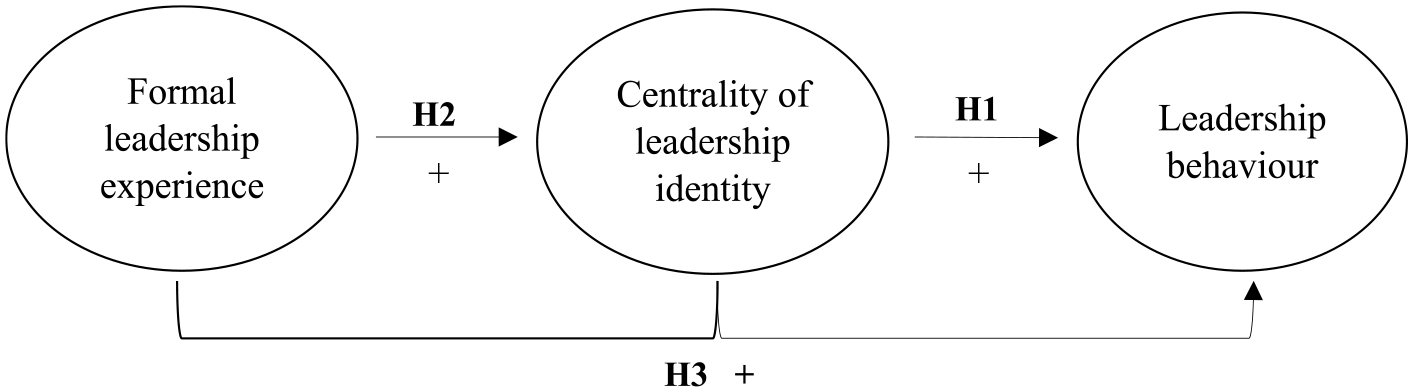
Conceptual model.
Research Design
Data and Sample
The hypotheses are tested on survey data collected as part of a survey among civil servants in the Netherlands. An online questionnaire was distributed among members of Flitspanel: managers and employees in the Dutch public sector who have signed up voluntarily to participate in research about management and work in the public sector. InternetSpiegel (part of the Ministry of the Interior) coordinates Flitspanel and has carried out sampling and questionnaire administration logistics. Data collection ran from January through March 2020; one reminder was sent 2 weeks after the first invite.
The sample used in this study consists of non-managerial employees without formal leadership positions. Formal leadership positions were defined as being a supervisor of employees and conducting performance and development reviews. Respondents work in organizations in four subsectors of the Dutch public sector: municipalities, police, universities, and university medical centers (UMCs). This selection was made to sample respondents with different types of work (policy, implementation, service delivery, high-skilled professional work) employed in organizations with varying characteristics (e.g., the role of hierarchy and professionalism), with the intention to sample variation on the explanatory variables. 1,001 respondents filled out the survey (23% response rate). Respondents were excluded if they were older than the retirement age and/or had entered impossible values (e.g., 102 years of experience in their current position). This resulted in complete data of 990 respondents. Upon inspection of outliers, 14 respondents were deleted, resulting in a total of 976 respondents.
Sixty percent of respondents were male. Respondents had an average age of M = 54.7 (SD = 7.72) years and an average M = 10.8 years of experience in their current position (SD = 8.22). In the total sample, respondents reported M = 3.4 (SD = 6.46) years of experience in managerial positions, ranging from 0 to 40 years. Leaving out those without such experience, respondents (n = 366) had a mean of 9.2 (SD = 7.69) years of experience in managerial positions. The distribution of respondents per sector is as follows: municipalities 47.4%, the police 17.6%, universities 20.7%, and university medical centers (UMCs) 14.2%.
Measurement
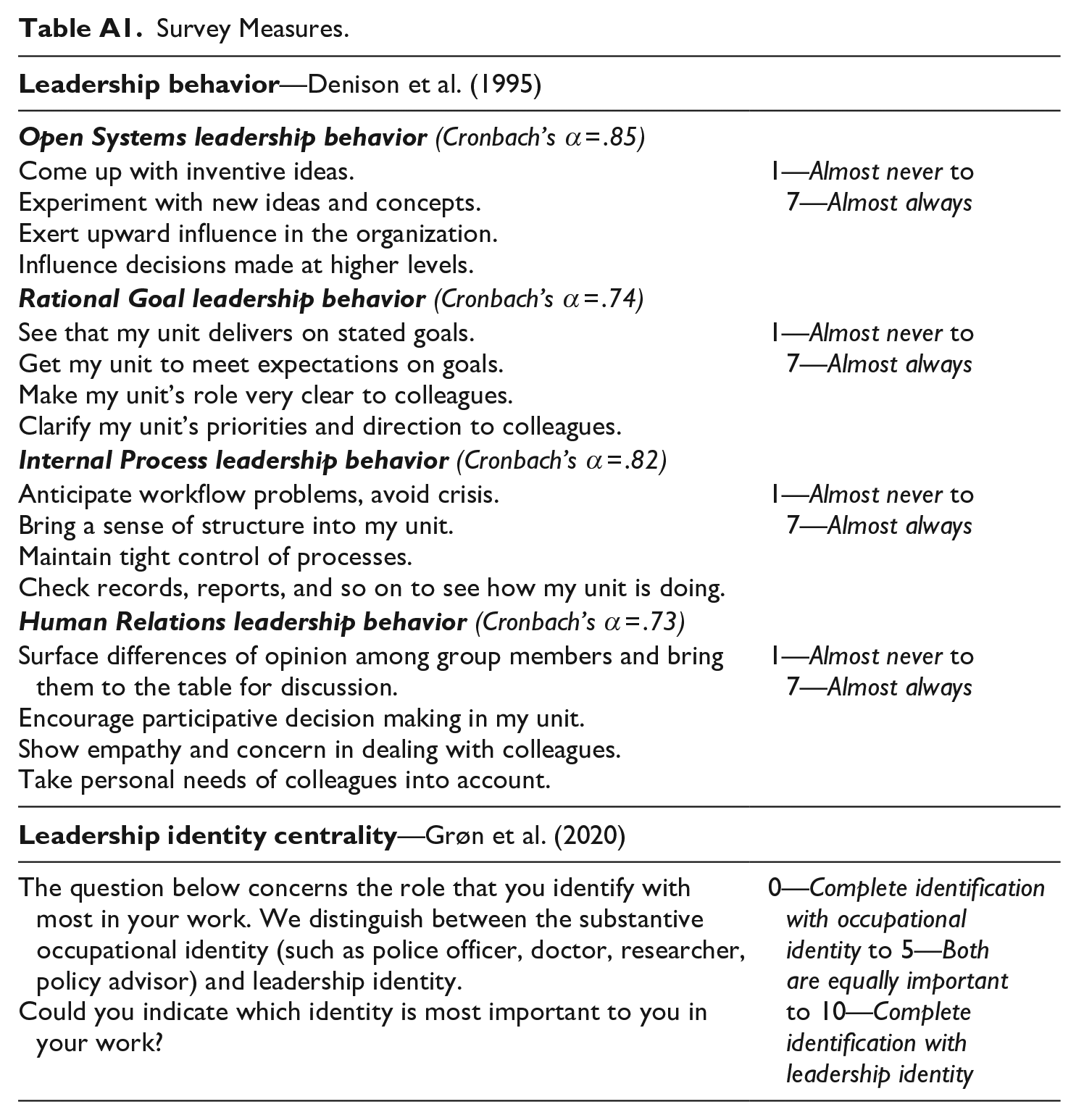
The questionnaire consisted of previously developed scales and measures to measure the central concepts. An overview of all items can be found in the Appendix.
Leadership Behavior
The dependent variable, leadership behavior, was measured with a 16-item scale developed by Denison et al. (1995). This scale covers a variety of leadership behaviors, matching a repertoire conceptualization of leadership behavior (Van der Hoek, Groeneveld, & Beerkens, 2021). All items were scored on a 7-point scale ranging from 1—Almost never to 7—Almost always. Item wording was adapted to ask respondents about their own leadership behavior.
Four types of leadership behaviors related to the quadrants of the Competing Values Framework (CVF; Denison et al., 1995; Quinn & Rohrbaugh, 1981) were distinguished in the analyses and were measured by 4 items each. Open Systems (OS) leadership behaviors concern adapting to the organization’s external environment. This includes developing, scanning, and maintaining a network and envisioning, encouraging, and facilitating change. Rational Goal (RG) leadership behaviors focus on directing and motivating goal-directed efforts of the group. This involves setting goals, clarifying roles, managing expectations, and stimulating task completion. Internal Process (IP) leadership behaviors emphasize internal control and stability. This entails creating and maintaining structure, coordinating, problem-solving, collecting and distributing (performance) information, and overseeing compliance with rules and standards. Human Relations (HR) leadership behaviors prioritize human interaction and group processes. This involves encouraging deliberation and discussion, seeking and negotiating consensus or compromise, signaling and attending to individual needs and requests fairly and actively, and facilitating individuals’ development (Denison et al., 1995, pp. 527–528).
Centrality of Leadership Identity
Following the procedure of Grøn et al. (2020), the centrality of leadership identity was measured with an item contrasting the importance of the respondent’s substantive occupational identity and leadership identity: “The question below concerns the role that you identify with most in your work. We distinguish between a substantive occupational identity (such as police officer, doctor, researcher, policy advisor) and a leadership identity. Could you indicate which identity is most important to you in your work?” Answers were measured on an 11-point scale, ranging from 0—Complete identification with occupational identity to 5—Both are equally important to 10—Complete identification with leadership identity.
Formal Leadership Experience
Respondents were asked: “How many years of experience in management positions have you gained during your working life?” Respondents who answered Not applicable, no such experience, were recoded into a score of 0 years.
Control Variables
The analyses control for several individual and organizational characteristics that could influence the variables of interest and their relationships. Relevant individual characteristics are gender (0 = male, 1 = female), age in years, and educational level (0 = other, 1 = lower vocational training, 2 = lower secondary education, 3 = higher secondary education, 4 = intermediate vocational training, 5 = higher vocational training, 6 = some university education, 7 = university education, 8 = doctoral degree). Moreover, experience in the current position measured in years is important since it may affect identity centrality as well as the potential influence of prior managerial experience on identity centrality. Two organizational characteristics were included as control variables. Size of the organizational unit was measured by asking respondents to indicate the number of employees working for the organizational unit that their direct manager supervises. Answer categories range from 1 = 0–10; 2 = 11–20; 3 = 21–50; 4 = 51–100; to 5 = More than 100. Lastly, sector serves as a control variable based on the sampling frame (municipalities, police, universities, and UMCs). Sector was dummy-coded, with the university sector as the reference category.
Analytical Strategy
Structural equation modelling (SEM) was performed using STATA 15 to test the hypotheses. As a first step, the measurement model for the dependent variables was assessed in a confirmatory factor analysis (CFA). Following Kline’s (2011) recommendation, various complementary criteria were used to evaluate model fit. Since assumptions of (multivariate) normality were violated, the Santorra-Bentler correction was applied (Byrne, 2010). Table 1 reports the model fit statistics for alternative models. A single-factor model shows poor fit to the data. Alternatively, a measurement model including four factors corresponding to leadership behavior types of the four quadrants of the CVF (Denison et al., 1995; Quinn & Rohrbaugh, 1981) fits the data acceptably well. Evaluation of fit statistics and modification indices resulted in the inclusion of four error correlations. These additions are substantively defensible because the included error correlations only relate to items measuring similar behaviors within the same factor (Byrne, 2010). Each factor has adequate reliability above the common threshold of 0.70 (OS leadership behavior: Cronbach’s α = .85; RG leadership behavior: Cronbach’s α = .74; IP leadership behavior: Cronbach’s α = .82; and HR leadership behavior: Cronbach’s α = .73). Since single-indicator constructs complicate the identification of full SEM models, path analysis with only observed variables was performed. Therefore, factor scores, standardized at M = 0.0 and SD = 1.0, were computed from the CFA to represent the leadership constructs.
Model Fit of Measurement and Structural Models (n = 976).
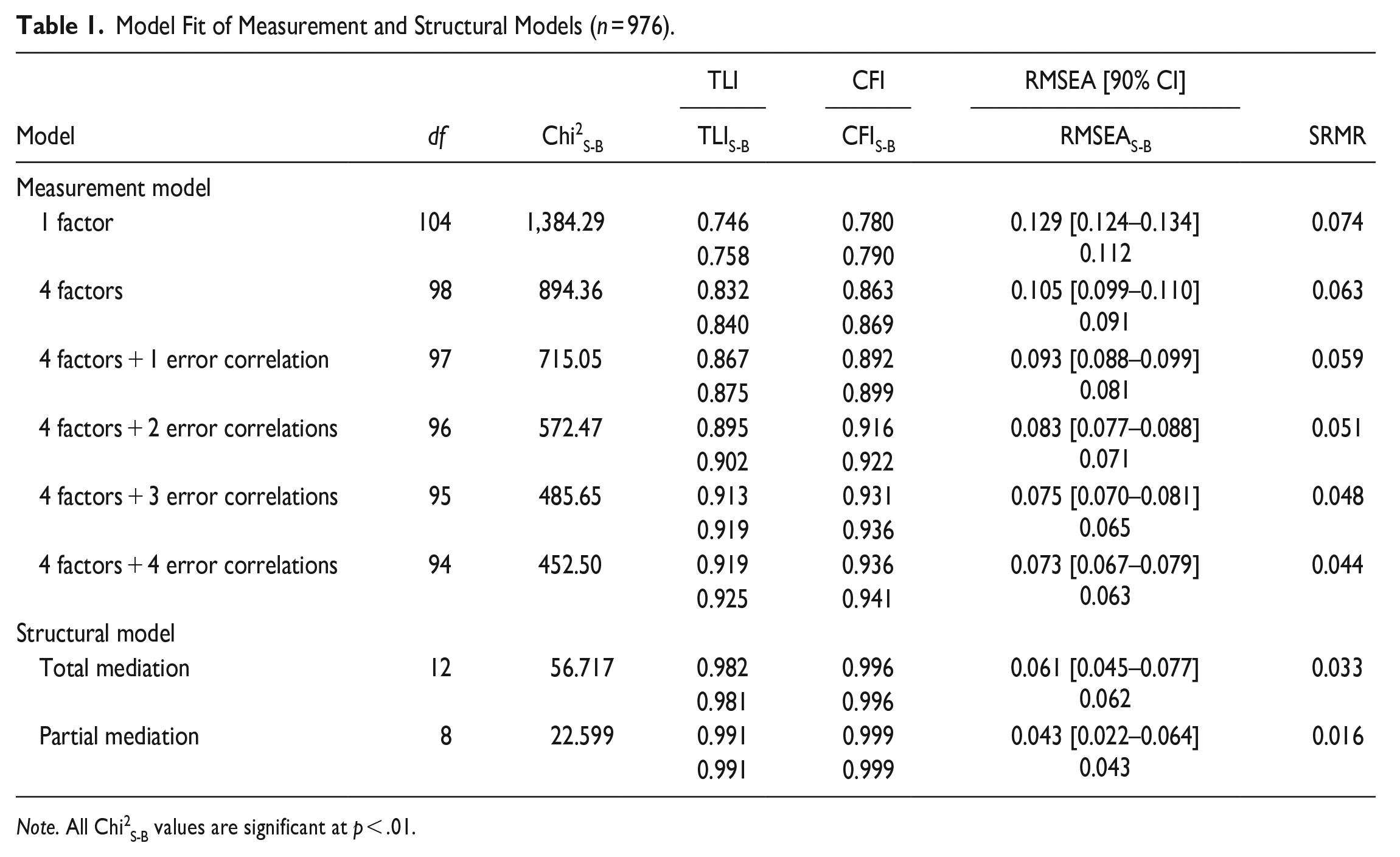
Note. All Chi2S-B values are significant at p < .01.
As a second step, the structural path model was estimated to investigate the hypothesized relationships. A total mediation model was compared to a partial mediation model, in which the independent variable also had a direct relationship with the dependent variables. All control variables have direct paths to the dependent variables and are all correlated with each other and the independent variable. Fit statistics were compared (see Table 1), which revealed a better fit for the partial mediation model. The analysis below therefore continues with this partial mediation model.
Results
Descriptive Statistics
Table 2 displays all variables’ means, standard deviations, and bivariate correlations. Variation on all key variables is present. Respondents score just below the scale mid-point for the centrality of leadership identity (M = 4.18, SD = 2.264), indicating that their occupational identity is slightly more important than a leadership identity, yet the latter is also substantial. Put in perspective: in their sample of managers, Grøn et al. (2020) observed the opposite: leadership identity was more central than occupational identity (M = 6.75, SD = 1.94). Notably, the dependent, independent, and mediating variables show significant and positive associations, in line with the theoretical expectations. To what extent the variation in leadership identity centrality and prior management experience account for variation in leadership behavior activity is examined next.
Descriptive Statistics, Bivariate Correlations, and Reliability Statistics in Diagonal (n = 976). a .
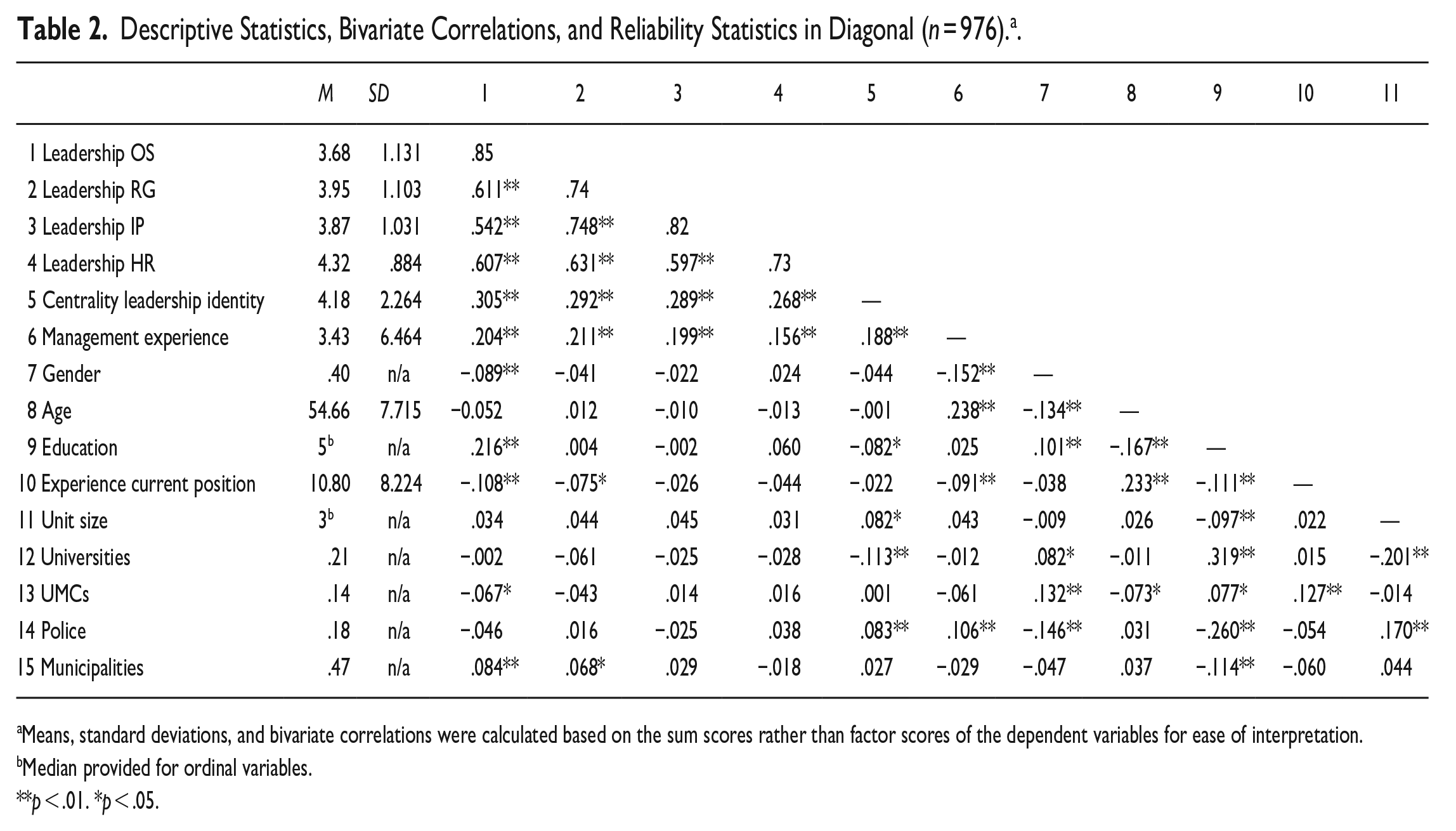
Means, standard deviations, and bivariate correlations were calculated based on the sum scores rather than factor scores of the dependent variables for ease of interpretation.
Median provided for ordinal variables.
p < .01. *p < .05.
Hypothesis Testing
Table 3 shows the partial mediation path model with all direct and indirect effects. Looking at the control variables, only a few significant relationships appear. The effect of education is positive and significant for OS, RG, and HR leadership behavior. In contrast to universities, respondents working for municipalities report significantly more activity for OS and HR leadership behavior.
Structural Partial Mediation Model Including Control Variables (n = 976).
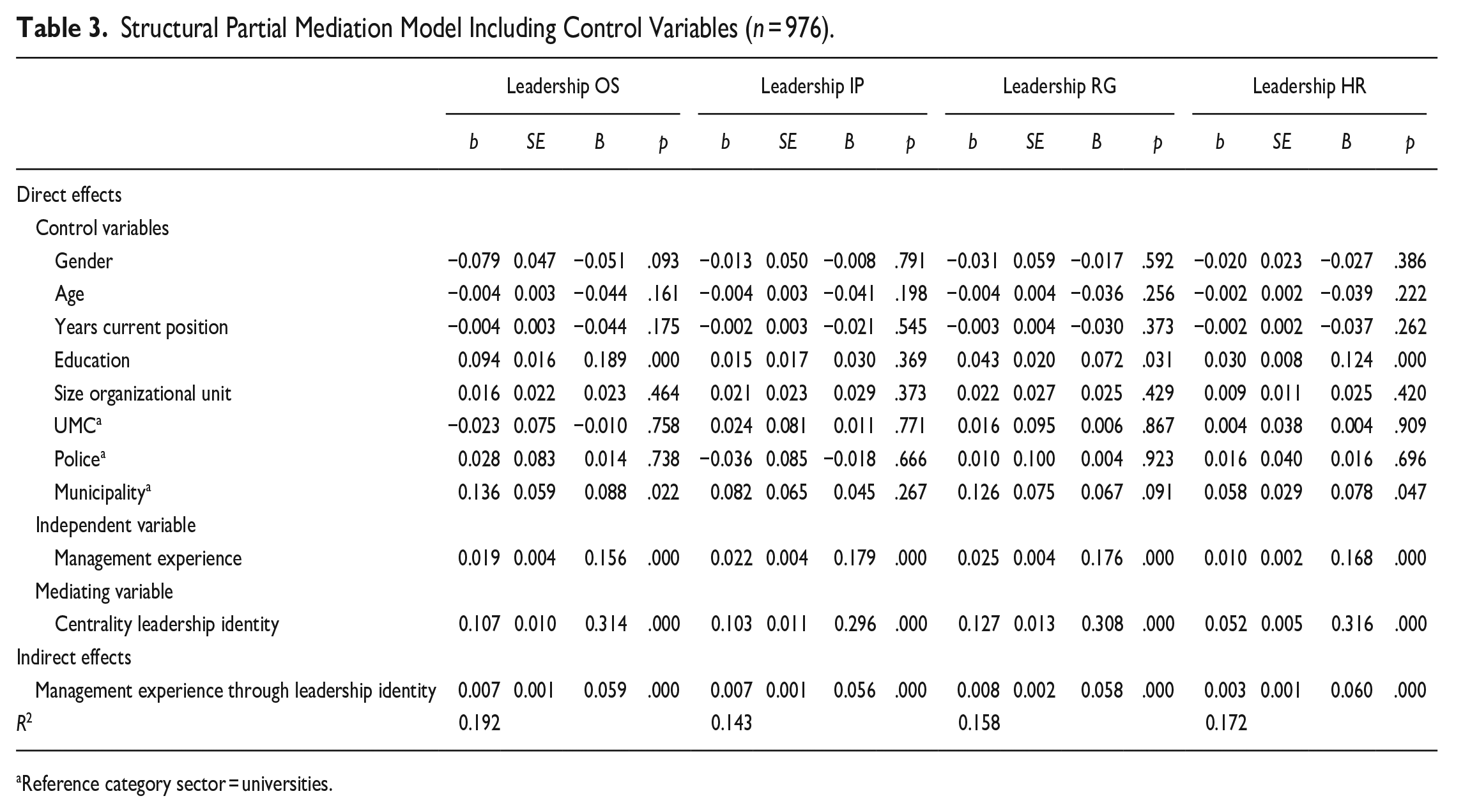
Reference category sector = universities.
Overall, the results suggest that organizational members with a more central leadership identity perform more leadership behaviors; this applies to all four types of leadership behavior. All direct paths from the centrality of leadership identity to the four types of leadership behavior are positive and significant (OS leadership behavior: B = 0.314; IP leadership behavior: B = 0.296; RG leadership behavior: B = 0.308; HR leadership behavior: B = 0.316, all p < .001). Noteworthy are the differences in effect sizes: whereas HR leadership behavior only changes with b = 0.052 for each step on the scale toward a more central leadership identity, the effect size for RG leadership behavior is more than double that size (b = 0.127). Still, the pattern holds for the whole repertoire of behaviors, supporting hypothesis 1. Supporting hypothesis 2, the centrality of leadership identity itself can be explained by formal leadership experience in management positions, with every additional year of such experience being associated with a shift of .066 toward a more central leadership identity (b = 0.066; SE = 0.012; B = 0.188; p = .000; R2 = 0.036; not displayed in Table 3). Despite the weakness of this effect, it is significant and in the expected direction.
Finally, organizational members with longer formal leadership experience in management positions perform more leadership behaviors due to developing a more central leadership identity. This can be concluded since the indirect paths from formal leadership experience in management positions through the centrality of leadership identity to all four types of leadership behavior are positive and significant. Thus, the data support hypothesis 3. These findings qualify the indirect relationships as mediation, though the coefficients signal only a weak association (OS leadership behavior: B = 0.059; IP leadership behavior: B = 0.056; RG leadership behavior: B = 0.058; HR leadership behavior: B = 0.060, all p < .001). Again, the effect size of the mediated path for HR leadership behavior (b = 0.003) is less than half the size for the other types of leadership behavior. The mediation has to be considered as partial only since formal leadership experience in management positions has an independent positive and significant influence on each type of leadership behavior (OS leadership behavior: B = 0.156; IP leadership behavior: B = 0.179; RG leadership behavior: B = 0.176; HR leadership behavior: B = 0.168, all p < .001). Comparing the direct and mediated effects of the independent variable shows that the proportion of the total effect that is mediated is only modest. Respectively, 27.4% (OS leadership behavior), 23.8% (IP leadership behavior, 24.8% (RG leadership behavior), and 26.3% (HR leadership behavior) of the total effect of formal leadership experience is mediated through the centrality of leadership identity, which reflects direct effect sizes being about 3 times as big. Still, comparing the direct effects of past experience and leadership identity centrality indicates that the latter is more influential for each type of leadership behavior.
Discussion
This study makes two main contributions to the public management and human resource management literature on leadership: demonstrating that leadership identity is a meaningful lens to explain why non-managerial employees in public organizations show leadership behavior and creating insight into their leadership behavior as a repertoire. The findings corroborate the relationships found in prior research on leadership identity among managers (e.g. Day & Harrison, 2007; Grøn et al., 2020; Kwok et al., 2018) and extend the application of identity theory to a new group (non-managerial employees) to explain the use of leadership behavior. Thereby, this study feeds into discussions about distributed forms of leadership in which non-managerial employees increasingly play a role and which bring along challenges for developing and motivating public personnel.
First, this study confirms that studying leadership identity is relevant to understanding why organizational members who are not formal managers use leadership behaviors. The data show that non-managerial employees identify with an occupational role and frequently have a partial leadership identity. This indicates that having a managerial position is not a prerequisite for an internalized leadership identity (Ibarra et al., 2014). This adds to the argument to let go of the narrow focus on managers that is still dominant in leadership research (Ospina, 2017; Vogel & Masal, 2015) stemming from the typical association between leadership and positions in the organizational hierarchy (DeRue & Ashford, 2010). Since collective and distributed conceptions of leadership gain more momentum in public management (e.g., Jakobsen et al., 2021; Kjeldsen, 2019; Kjeldsen & Van der Voet, 2021; Ospina, 2017), non-managerial employees should be taken into account as leaders and not only as followers. Another way to broaden the perspective in leadership research is to study hybrid managers, who also play a role in distributed forms of leadership. Such hybrid managers have substantive responsibilities for specified projects in public organizations but without hierarchical formal authority over personnel and resources (Gronn, 2002; Mintzberg, 1979). Taking characteristics of present and past jobs and role expectations into account further adds to our understanding of the relationships between leadership identity and behavior in public organizations.
As hypothesized, employees with a more central leadership identity relative to their occupational identity more actively engage in all types of leadership behavior than employees with relatively less central leadership identities. Therefore, identity theory and concepts help understand how employees can be motivated to participate in organizational leadership. This study found that individuals with prior management experience have a more central leadership identity. Such experience in formal leadership positions partially explains leadership behavior in a later job. This suggests a lasting effect of internalizing a leadership identity that can exist independently of a management position (Ibarra et al., 2014; Stryker & Burke, 2000). Nonetheless, while past managerial experience has some influence on leadership behavior, it is more strongly associated with leadership identity, and the mediation by leadership identity is weak. Hence, how the mechanism of identifying with a leadership role is activated needs more research. It is plausible that identifying as a leader and utilizing leadership behaviors can be stimulated through forms of learning: a growing number of studies in the human resource management literature show the utility of leadership training (e.g., Finkel et al., 2023; Grøn & Andersen, 2023; Kjeldsen & Andersen, 2023). For instance, Grøn et al. (2020) have demonstrated that training can support the development of leadership identity among managers, while Grøn and Andersen (2023) found that training strengthened the recognition of managers’ leadership identity by their subordinates. Testing the effectiveness of distributed leadership training designed for employees could provide further insights into how to stimulate leadership identification of this group.
The second contribution of this study is that the conclusions apply to the whole repertoire of leadership behaviors. Still, some differences in relationship strength appeared for the various types of leadership. The use of behaviors typically connected to formal leadership (in particular Rational Goal leadership behaviors) was more affected by the leadership identity than behaviors related to social and group relations (Human Relations leadership behaviors). This is in line with the arguments of Grøn et al. (2020) that recognizing oneself as a leader is necessary to perform leadership behaviors that relate to goal-oriented decision-making in line with the organizational strategy. When someone has used those behaviors before as a manager, they may feel more confident contributing to such processes in their current job. Therefore, this study emphasizes that a comprehensive repertoire conceptualization aids in detecting nuances in behavior patterns.
The findings have implications for theorizing about broader participation in leadership in the public sector. Without the formal authority that managers have, there may be more barriers to taking on a leadership role and, consequently, limits to what can be expected from non-managerial employees in terms of leadership behavior (Van der Hoek, Beerkens & Groeneveld, 2021; Van der Hoek & Kuipers, 2022). Such barriers may be particularly persistent in the public sector, where bureaucratic structures constrain the random influence of public servants by prescribing who can do what and based on which authority to protect legitimacy (Rainey et al., 1995). This can make it more difficult for non-managerial employees to see themselves as leaders. To advance understanding of these processes in public organizations, it is relevant to study how centralization and autonomy in organizations, as well as characteristics of collaborative arrangements with internal and external partners, influence identification with and enactment of leadership. Research on expectancy theory (e.g., Blackman et al., 2019) and supervisor support and extra-role behavior (e.g., Knies & Leisink, 2014) offers additional perspectives to understand how to motivate and facilitate employees to participate in organizational leadership.
Second, these findings can inform research on implicit leadership theories (ILTs), which is of growing interest in the public management literature (e.g., Vogel & Werkmeister, 2021). ILTs refer to people’s ideas about leadership and who is a leader based on prototypes of typical leaders and leadership (Lord et al., 2020). Such ideas could be another barrier for non-managerial employees since they are not readily linked to leadership prototypes. It would be particularly relevant to distinguish between ILTs that are hierarchical (groups have a single leader, and leadership and follower identities are mutually exclusive) or shared (groups can have multiple leaders, and leadership and follower identities can co-exist) (DeRue & Ashford, 2010). If non-managerial employees become more important for leadership in public organizations, follow-up research could explicitly address how the types of ILTs in groups or organizations influence the likelihood that non-managerial employees identify with and enact leadership and how views of leadership as a shared process can be stimulated in public organizations.
This study also has practical implications for human resource management that could contribute to leadership development in public organizations. The findings indicate that leadership identity offers a leverage point to activate leadership capacity among non-managerial employees since a leadership identity is not solely embedded in formal leadership positions. Moreover, broader participation in leadership throughout public organizations can be stimulated along this route as a more central leadership identity goes hand in hand with more leadership behavior. Explicating what employees are expected and allowed to do as part of their job could help them adopt a leadership role and identity (see also Blackman et al., 2019). Support from managers in this regard seems particularly important in public organizations since the room for maneuver to lead is limited for organizational members without formal authority (Van der Hoek, Beerkens, & Groeneveld, 2021, 2021; Van der Hoek & Kuipers, 2022).
Limitations
Several limitations require some caution regarding the conclusions. Firstly, the cross-sectional design hampers the ability to make claims about causality in the model. It was argued that leadership identity development results from gaining experience in managerial positions. In contrast, it could be argued that individuals with a more central leadership identity seek opportunities to enact that identity and practice skills by pursuing formal leadership positions (Miscenko et al., 2017). Likewise, the centrality of leadership identity and engagement in leadership behavior could mutually influence each other. While self-perception theory (Bem, 1972) supports that individuals derive a stronger sense of self as a leader from their experience in managerial positions (in line with the current study), it would also support that engaging in leadership behavior would feed a more central leadership identity (Miscenko et al., 2017) (in contrast to this study). Feedback loops are plausible and require follow-up research, which should be tested in longitudinal designs.
Secondly, the measurement of the central concepts has some limitations. The measurement model of leadership behavior included several items with weaker factor loadings at the expense of construct validity. Moreover, error correlations within factors were included in the model to achieve a better fit to the data. Since the instrument to capture the leadership behavior repertoire is relatively new and was not used before to examine the leadership behavior of non-managerial employees, this study was an opportunity to explore the utility of this measurement. Based on the results, improving it further can help reach more robust conclusions about the effects on different types of leadership behavior.
In addition, the measurement of leadership identity and formal leadership experience convey limited information. Respondents were not asked how they understand a leadership role, so no insight is available into how ILTs impact the studied relationships. Moreover, contrasting occupational and leadership identities in a single measure of identity centrality may forego the existence of a professional leadership identity with a distinct effect on leadership behavior. Grøn et al. (2020) did not find that managers with a balanced occupational–leadership identity use more leadership aimed at professional development, indicating against this. Yet, whether a separate identity exists for non-managerial employees cannot be ruled out. The measurement for experience necessitates the assumption that more years of experience indicate more opportunities to develop and a qualitatively richer experience. Prior studies show that the type of management position, span of control, hierarchical level in an organization, and amount of leadership training play a role in leadership identity development (Dragoni et al., 2011; Grøn et al., 2020).
Finally, the sample was not selected randomly and is likely not fully representative of the population in terms of gender and age. The sampling frame contains a bias in favor of men and older employees, which also appears in the sample with a majority of male respondents and very low response by employees below the age of 30. Gender and age, however, do not seem to confound the relationships of interest in this study. In models including and excluding these control variables, the relationships between formal leadership experience, the centrality of leadership identity, and engagement in leadership behaviors are positive and significant. Still, it would be theoretically valuable to study the role of gender further (see also Finkel et al., 2023). The literature points at generally less management experience and less developed leadership identity among women due to the stereotype ‘think manager, think male’ and ILTs that make one’s identification with a leadership role less likely (e.g., Ibarra et al., 2014). In light of expectations of broader participation in organizational leadership, understanding possible barriers for a large share of the workforce seems necessary.
Conclusion
This study demonstrates the utility of role and identity theories in explaining leadership behavior of non-managerial employees and concludes that the traditional “think leader, think manager” does not fully capture the reality of leadership in public organizations. Now distributed and collective forms of leadership become more common in the public sector, non-managerial employees are a valuable leadership resource. As hypothesized, leadership identity was found to explain to what extent employees use leadership behaviors from the full repertoire. Therefore, this study shows that leadership identity could be a leverage point for human resource management to unlock the leadership potential of employees.
Footnotes
Appendix
Survey Measures.
|
|
|
| Come up with inventive ideas. Experiment with new ideas and concepts. Exert upward influence in the organization. Influence decisions made at higher levels. |
1—Almost never to 7—Almost always |
|
|
|
| See that my unit delivers on stated goals. Get my unit to meet expectations on goals. Make my unit’s role very clear to colleagues. Clarify my unit’s priorities and direction to colleagues. |
1—Almost never to 7—Almost always |
|
|
|
| Anticipate workflow problems, avoid crisis. Bring a sense of structure into my unit. Maintain tight control of processes. Check records, reports, and so on to see how my unit is doing. |
1—Almost never to 7—Almost always |
|
|
|
| Surface differences of opinion among group members and bring them to the table for discussion. Encourage participative decision making in my unit. Show empathy and concern in dealing with colleagues. Take personal needs of colleagues into account. |
1—Almost never to 7—Almost always |
| The question below concerns the role that you identify with most in your work. We distinguish between the substantive occupational identity (such as police officer, doctor, researcher, policy advisor) and leadership identity. Could you indicate which identity is most important to you in your work? |
0—Complete identification with occupational identity to 5—Both are equally important to 10—Complete identification with leadership identity |
Declaration of Conflicting Interests
The author(s) declared no potential conflicts of interest with respect to the research, authorship, and/or publication of this article.
Funding
The author(s) received no financial support for the research, authorship, and/or publication of this article.
