




Abstract
Civil service organizations around the world are confronted with a constant need to change to meet the needs of the public in a more efficient manner. The success of resultant change initiatives depends on the members of the civil service and, in particular, their affective commitment to change. In this case study of the Irish civil service, we examine factors that may foster affective commitment to change, with a focus on the roles of prosocial impact and organizational identification. We also consider the perceived involvement climate. Based on extensive survey data (N = 16,050) collected in the Irish Civil Service, we find that organizational identification acts as a mediator between prosocial impact and affective commitment to change and that this mediated relationship is strengthened when there is a strong involvement climate. Theoretical contributions are discussed along with practical implications.
Keywords
Introduction
Civil services worldwide are experiencing continuous change as they grapple with the ongoing effects of major reform programs and, most recently, the COVID-19 pandemic. While change is typically initiated in a top-down manner, its success relies heavily on the employees who must implement it (Chen et al., 2021). The public administration literature notes the critical need for change recipients to overcome resistance behaviors if change initiatives are to succeed (Chen et al., 2021; Hameed et al., 2019; van der Voet et al., 2016). Affective commitment to change (ACC), described as “a desire to provide support for the change based on beliefs about its inherent benefits” (Herscovitch & Meyer, 2002, p. 475), is the most powerful predictor of successful change implementation (Sonenshein & Dholakia, 2012) and is a critical antecedent of change-related behavior (Ahmad & Cheng, 2018; van der Voet et al., 2016). One reason ACC is powerful in predicting successful change is the degree of autonomy employees feel when they commit to change rather than the helplessness they may feel when coerced or guilted into the change (Herscovitch & Meyer, 2002). ACC is also strongly predictive of active indicators on the part of employees towards the change, for instance, behavioral support for change in the form of cooperation and championing behaviors (Bouckenooghe et al., 2015).
While the literature has established the importance of ACC as an antecedent to change, what predicts ACC remains poorly understood. There is a notable gap in understanding how and why employees want to commit to organizational change as opposed to feeling obliged or perceiving that they have no choice. While research on antecedents has focused on the role of leadership in driving ACC (Ahmad & Cheng, 2018; van der Voet et al., 2016), this is a variable external to the employee and that does not consider the active processes an employee engages in to develop ACC. Oreg et al. (2018) observe that research on change has been overly focused on valence, that is, whether employees hold positive or negative perceptions of the change. This disregards the importance of activation, which Oreg et al. (2018) argue is critical in shaping change outcomes. For instance, they propose that while viewing change positively is necessary, it is insufficient in determining change implementation. They suggest that actions on the part of employees, such as seeking to understand the change, questioning the change, and taking action to implement the change, are what is vital to longer term change success. Thus, understanding the factors that support positive perceptions of change that are accompanied by active responses to change on the part of employees warrants further investigation.
While we concur with Oreg et al. (2018) in viewing activation as being of value to change implementation, our point of departure is the positioning of activation. We argue that ACC remains the strongest predictor of change implementation for both theoretical and empirical reasons, but that activation triggers the state of ACC. To advance our understanding, we consider acts by employees and the organization that foster ACC. In so doing, we focus on one aspect of the work of civil servants: how they may make an impact on and form connections with beneficiaries, an activity that is captured through prosocial impact (Grant et al., 2007).
Building on work by van der Voet et al. (2017), who focus on prosocial motivation, we move beyond the passive state of prosocial motivation to focus on prosocial impact as triggering an activation process that culminates in ACC. We consider how, driven by acts that result in prosocial impact, employees actively engage in a psychological process of organizational identification (OI): “an active process by which individuals link themselves to elements in the social scene” (Cheney, 1983, p. 342). Through this process, employees act to identify with the organization and its values and goals (Cheney, 1983; see also Edwards, 2005). We contend that this active process on the part of employees must be matched by action on the part of the organization and so we consider the involvement climate as representing the organization’s deliberate attempt to give employees a voice. This type of involvement echoes the type of activation Oreg et al. (2018) refer to in their circumplex model of commitment to change. Further, incorporating involvement enables us to test Oreg et al.’s (2011) theoretical proposition that factors that increase change recipients’ perceptions that their interests are accounted for will increase appraisals of goal congruence.
Drawing on a national survey of civil servants in Ireland, we contribute to the literature in several ways. First, taking Oreg et al.’s (2018) circumplex model of recipients’ behavioral responses to change, we illustrate empirically how the active processes that employees engage in when responding to change initiatives support the development of ACC. We point to the role of activation on the part of employees—through prosocial impact and OI—and activation on the part of the organization—through employee involvement initiatives—as key drivers of ACC. Second, we illustrate the critical role of prosocial impact in triggering action on the part of employees to internalize change and, ultimately, to perceive positive valence of the change. Moreover, by integrating aspects of both personal and organizational valence to understand reactions to organizational change, our study adds to the limited number of studies that explain the development of positive attitudes during organizational change (Hameed et al., 2019). Finally, we offer a new explanatory mechanism regarding why employees develop ACC by illustrating that OI, as an active psychological process, enables employees to commit positively to the change by helping them to tie the change to the values of the organization that they have internalized. In doing so, we argue that ACC has a “binding” effect in pursuing a course of action of relevance to one or more targets (Meyer & Herscovitch, 2001). Taken together, our findings support Oreg et al.’s (2018) contention that theoretical models for understanding ACC must capture both valence and activation. Our article begins with a review of relevant theory and research and develops hypotheses for testing. Next, we describe the research context and the method employed. We conclude with a discussion of our findings and their implications for practice.
Theoretical Background
Commitment to change is regarded as critically important for successful change implementation in organizations (Ahmad & Cheng, 2018). Herscovitch and Meyer (2002) propose that commitment to change comprises three dimensions: desire to support the change based on its inherent benefits (affective; ACC), a felt sense of obligation to support the change (normative), and a recognition that there are costs associated with failure to support the change (continuance). Of these dimensions, ACC has been identified as key to successful change implementation (Sonenshein & Dholakia, 2012) and as a critical antecedent of change-related behavior (Ahmad & Cheng, 2018; van der Voet et al., 2016). In their meta-analysis, Bouckenooghe et al. (2015) reported that ACC is more strongly predictive of behavioral support for change, particularly cooperation and championing. It is argued that ACC is different from other constructs, such as openness or readiness for change, because “it represents a behavioral intention to work toward success of the change rather than just reflecting a favorable disposition toward it” (Fedor et al. 2006, p. 4). ACC is, therefore, more than a positive or negative attitude towards change (Oreg et al., 2018) and instead “captures the notion of a positive, proactive intent toward change” (Ahmad & Cheng, 2018, p. 199).
Prosocial Impact and Organizational Identification
One way in which proactive intent toward change can be mobilized is in the extent to which individuals perceive that their work impacts positively on others. Prosocial impact, which is related to prosocial motivation, refers “not to motivation itself but the realization or recognition that one’s efforts at work are indeed making a difference to someone” (Bolino & Grant, 2016, p. 4). Since Grant’s (2008a, 2008b, 2000c) seminal work, prosocial impact has been the focus of studies in a variety of contexts in both the private and public sectors. These studies suggest that prosocial impact is negatively related to unethical behaviors (Bellé & Cantarelli 2019) and positively associated with work engagement (Freeney & Fellenz, 2013), and a stronger prosocial motivation to do good (Grant, 2008b). Jobs designed to generate higher prosocial impact encourage individuals “to empathize, identify with and take the perspective of others with whom they interact, resulting in more positive outcomes” (Oldham & Hackman, 2010, p. 469). Prosocial impact can initiate an activation process to commit to a particular course of action for two main reasons. First, it can instill a sense of meaning and personal responsibility to achieve outcomes that have significance to themselves or others (Hackman & Oldman, 1980). Second, in a public sector context, it can help employees feel that their public service values are shared by the organization and are being realized in the work that they do. In doing so, it can strengthen the individual’s identification with the organization.
Although there is debate in the literature regarding the conceptualization and operationalization of OI, there is consensus that it represents an active process involving internalization that culminates in a bond between employees and their organizations that links individuals’ self-concept and their organizational membership (Cheney, 1983; Edwards, 2005). This linkage can take place either cognitively, through feeling a part of the organization and internalizing organizational values; emotionally, through pride in membership; or both (Riketta, 2005). Social identity theory underpins much OI research and there is evidence that when employees define themselves by the same set of attributes they believe define their organizations, they are more likely to identify with their organizations and are more motivated to contribute to the collective (Ashforth & Mael, 1989; Dutton et al., 1994). Thus, the organization becomes a large part of the employee’s self-concept (Edwards, 2005). Adopting Ashforth and Mael’s (1989) definition, we view OI as “a specific form of social identification” and “the perception of oneness with, or belongingness to the organization” (p. 22). Employees identify with their organizations when jobs are designed in such a way as to maximize alignment between their own values and those of the organization (Mael & Ashforth, 1992).
An ethos that emphasizes the value of making a difference to the lives of others has long been associated with public sector employment, as is the need for congruence between the values promulgated by the organization and those of employees (Siciliano & Thompson, 2022). Grant et al. (2008) also identified the importance of “other-interested prosocial content in employees’ sensemaking and identity construction efforts” (p. 914). They suggest that organizations, by providing opportunities for employees to engage in giving, enable employees to see both themselves and their organizations as more caring, thus enhancing OI. Dutton et al. (2011) suggest prosocial actions that can give rise to impact may strengthen virtuous identity content (e.g., having a compassionate, caring identity) and that receiving positive feedback from clients may further bolster evaluations of identity and self-regard. Opportunities for prosocial impact can therefore enhance the regard that individuals have for these opportunities and for themselves as members of the organization that provides them.
We propose that engaging in work that has a positive impact on beneficiaries is central to the ethos of public service work. We further argue that by designing jobs in ways that facilitate prosocial impact, thus fulfilling public sector values, organizations are more likely to ensure congruence, enhancing the possibility that individuals will identify with the organization. Opportunities for prosocial impact are perceived when employees can see that their job enables them to do good, which can create a sense of agency regarding their own identity construction. As both employee and organizational interests, as well as the interests of the public they serve are met, OI will be enhanced. We hypothesize that:
OI as a Mediator Between Prosocial Impact and ACC
Meyer and Herscovitch (2001) suggest that commitment to change “develops when an individual becomes involved in, recognizes the value-relevance of, and/or derives his or her identity from, association with an entity or pursuit of a course of action” (p. 316). A range of factors have been positively associated with ACC including: trust in management (Michaelis et al., 2009), participation in decision making (Wright et al., 2013), satisfaction with communication (Conway & Monks, 2008), and beliefs about the legitimacy and relevance of the change (Morin et al., 2016). Evidence also suggests that organizational commitment is an attitudinal outcome of OI (Lee et al., 2015). We argue this association can be extended to ACC. First, there is evidence that OI is a predictor of employees’ responses to change (Oreg et al., 2011; van Knippenberg et al., 2006). Employees with strong OI are more likely to actively support the organization and engage in prosocial or extra-role behaviors (Fuchs & Edwards, 2012). The display of such behaviors is suggestive of a similar association between OI and pro-change behavior. Second, Oreg et al. (2018) argue that the greater an individual’s OI, the higher their appraisal of the change event’s goal relevance. In this regard, ACC can signify that a change is consistent with the organization’s goals and values. Accordingly, individuals who identify strongly with their organization want to act in the best interests of the organization (Edwards, 2005), which will be demonstrated through higher ACC. In this way, individuals’ actions in supporting and committing to change, while internally driven, can be regarded as having an external locus of causality (Oreg et al., 2018).
Although employees’ beliefs about the personal valence of a change are regarded as critical for the success of change (Armenakis et al., 1993), their beliefs about the change for the good of the organization imply a perceived oneness with the organization. In this regard, the change valence extends to both the individual’s and the organization’s best interests. Thus, ACC will have the “binding” effect in pursuing a course of action of relevance to one or more targets (Meyer & Herscovitch, 2001). OI, as an active psychological process, enables employees to commit positively to change by helping them to tie the change to values of the organization they have internalized. Moreover, it is important to regard OI as both a product and as an active psychological process (Cheney, 1983; Cheney & Tompkins, 1987). As a process, employees actively identify through social interactions, for example, in the mutual negotiation of their goals and those of the organization (Scott & Lane, 2000) or by acting in the best interests of their fellow citizens through prosocial impact (Bolino & Grant, 2016). As a product, identification arises due to, for example, the needs for affiliation (Hogg & Terry, 2000), sense-making (Weick, 1995), and organizational membership (Ashforth & Mael, 1989) and manifests through “concrete decisions, behaviors and commitments” (Cheney & Tompkins, 1987, p. 6). Thus, OI is not a passive construct but instead represents an active mechanism through which ACC emerges. Despite this evidence, little, if any, research has considered OI as “a central mechanism” that may explain how prosocial practices may promote change outcomes (Dutton et al., 2011). In conjunction with the arguments made in relation to the positive relationships between prosocial impact and OI, we hypothesize that:
The Moderating Role of Involvement Climate
An involvement climate exists when organizations provide opportunities for employees to participate in decisions, while also communicating information about the organization and anticipated changes (Patterson et al., 2005). When viewed as a collective construct, perceptions of an involvement climate emerge when individuals have similar experiences of participative practices and engage in collective sense making through their social interactions (Bowen & Ostroff, 2004; Weick, 1995). Such a climate equips employees to deal effectively with challenges and uncertainties (Richardson & Vandenberg, 2005) and allows employees to take part in decision-making (Patterson et al. 2005).
In the context of change, Kotter (1995) argues change implementation can disintegrate when the organization fails to support clear and transparent communication between leaders and subordinates. Research points to the value of communication in enhancing people’s willingness to embrace change (Armenakis & Harris, 2002). An involvement climate that is characterized by such communication and, critically, that allows employees to participate in decisions (Patterson et al., 2005), allows them to consider and evaluate whether the change aligns with their own values and those of the organization. Such a climate can create or reinforce a shared set of values about what is important in the organization and can signal these values to employees (Bowen & Ostroff, 2004). Identifying with the organization means that employees are motivated to scrutinize the change, while an involvement climate provides the opportunity for them to appraise its implications. Research in a public sector context suggests that employees who identify strongly with their organizations tend to be primarily concerned about the fairness of the change process and opportunities for participation in it rather than on repercussions arising from the change (van Knippenberg et al., 2006).
The cultivation of a strong climate of involvement by the organization represents a deliberate attempt to give employees a voice and to provide opportunities for them to question decisions, including those related to change. This indicates to employees that the organization cares about their views, sending signals about the nature and quality of their organizational membership. This involvement climate thus strengthens the activation process that enables goal congruence and internalization which contributes to employees’ beliefs about the legitimacy and necessity for the change. Where opportunities for involvement are lacking, the relationship between OI and ACC will be weaker because employees cannot determine whether the change violates values or whether it is in the best interests of the organization, ultimately dampening the activation process. Put simply, it is not possible for employees to determine if the change is in the best interest of their organization and the citizens it serves unless they are clearly informed about the change, or unless they can ask questions and influence decisions regarding the change.
Thus, while OI represents an activation on the part of the employee in response to perceived prosocial impact, this must be matched by an activation on the part of the organization to ensure it takes steps to inform and involve employees in the change process. This dyadic activation fuels ownership of the change by employees, ultimately increasing ACC. Drawing on Oreg et al. (2018), we argue active immersion in the change process is required to strengthen an individual’s OI and ACC. Thus, when OI is high, an involvement climate augments the active appraisal process and thus, strengthens the relationship between an employee’s OI and their commitment to the change. We therefore hypothesize:
Figure 1 presents our conceptual model.
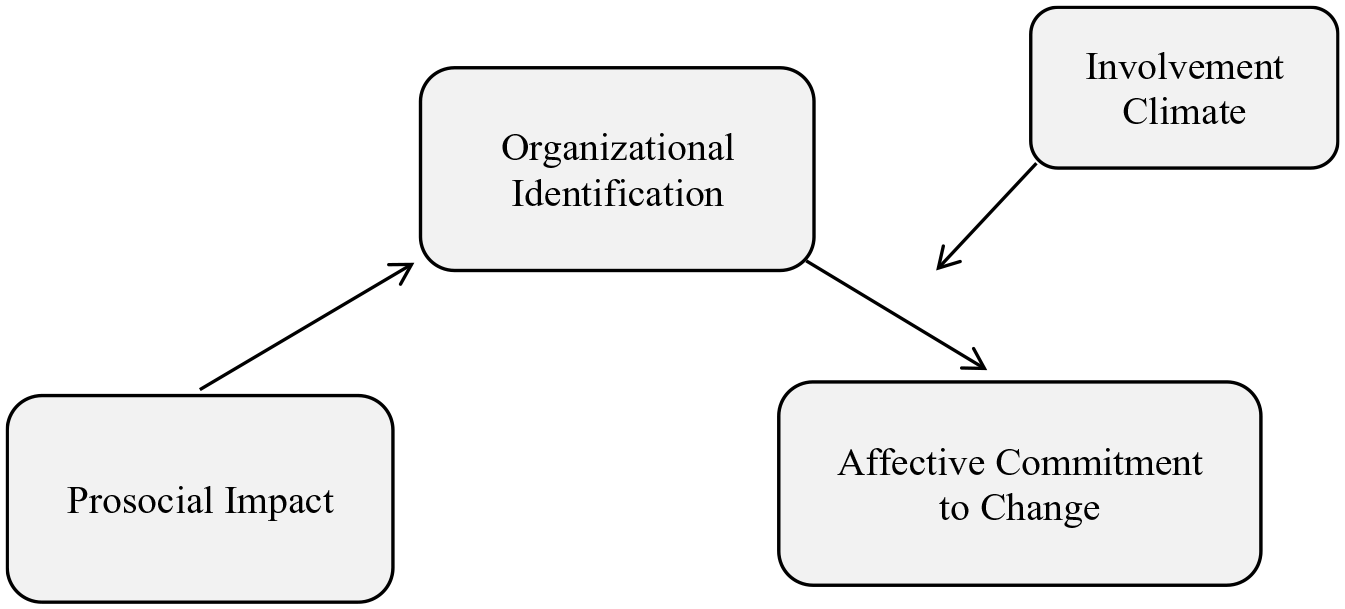
Conceptual model.
Method
Study Context
Our study was conducted in the Civil Service in Ireland, a country with a population of nearly 5 million and a Civil Service of approximately 40,000 employees. In 2014, the Irish Government published the Civil Service Renewal Plan (2014) , which focused on “driving practical change and action” (p. 6). This plan entailed a “large scale change program” (p. 6) comprising 24 actions. Core to the plan was that the “strong public service ethos and the values of honesty, impartiality and independence that underpin it, is critical to how we work and must be maintained and affirmed as part of any renewal process” (p. 9). Progress under the four areas was to be assessed in ways that included employee engagement and customer surveys, as well as regular meetings with staff and senior managers. Significant progress has been made in implementing the Plan, which remains the footprint for ongoing reform.
In 2015, an opportunity was offered to the research team to work with the Irish civil service to develop a survey to assess the impact on employees of the major change management program. This provided the chance to design an “empirically defensible” study that was capable of informing theory development (Rubin & Baker, 2019, p. 524). It also ensured that the survey utilized reliable and valid measures, elements which are frequently missing from many commissioned surveys of public sector work engagement (OECD, 2016). Employee participation was an important element in the processes underpinning the development of the Renewal Plan with extensive deliberations with stakeholders.
Sample
A survey was emailed to 38,152 employees across 49 departments and agencies of the Irish civil service in September 2017. A total of 21,365 employees participated, giving a response rate of 56 percent. Deletion of missing values resulted in a usable sample of 16,050 of which 59 percent were female, with 47 percent holding a primary degree or higher. The median tenure was 15 to 20 years. Respondents were working at entry (31%), first line supervisor (25%), first line management and policy (23%), middle management (14%), and senior management (7%) levels. This profile is broadly representative of the organization which comprises females (59%), entry level grades (33%), first line supervisors (25%), first line management and policy grades (22%), middle management (13%), and senior management (8%). We checked for non-response bias by exploring differences among our variables for early versus late respondents, as it has been suggested that late respondents are like non-respondents (Armstrong & Overton, 1977). We found no significant differences.
Measures
All constructs were measured using 5-point Likert scales ranging from strongly disagree (1) to strongly agree (5). Where possible, the wording was adapted to relate specifically to the Irish civil service context. The list of measures is included in the Appendix.
Affective Commitment to Change: Four items from Herscovitch and Meyer’s (2002) affective commitment to change sub-scale were used. The Cronbach’s α was .93.
Prosocial impact: Grant’s (2008a) 3-item scale was used to measure prosocial impact. The scale was adapted slightly to specify the ‘citizen’ as the target of prosocial impact. The Cronbach’s α for the scale was .95.
Organizational Identification: Three items devised by Mael and Ashforth (1992) were used to capture OI. The Cronbach’s α for the scale was .70.
Involvement Climate: Four items were drawn from the involvement subscale of Patterson et al.’s (2005) the organizational climate measure. All items are reverse coded. The Cronbach’s α for the scale was .88
Control Variables: Several individual characteristics can influence reactions to change. These include hierarchical distance, which may also be associated with age and gender (Hill et al., 2012), organizational tenure (e.g., Van Dam et al., 2007), and level of education (van der Voet et al., 2016). We therefore controlled for grade, organizational tenure, age, education, and gender. These were coded as follows: grade (entry level through to senior management), tenure (years), age (16 years through to 65 years and older), education (second level through to master’s degree, and above) and gender (0 = male, 1 = female).
Data Analysis Strategy
We followed recommendations (Podsakoff et al., 2012) during the research design phase to address issues associated with common method variance (CMV). A series of statistical tests were then performed to verify the integrity of the data. First, Hierarchical Linear Modelling (HLM) was performed to address concerns about the nested structure of the data by department and by grade. This also helped to determine whether multi-level analysis techniques were required. The proportion of total variance explained by department and grade was estimated by calculating the interclass correlation coefficient (ICC) for the exogenous variables. The results yielded ICC values of less than 2%. Overall, the proportion of variation in ACC and OI scores fall well below the .05 threshold (Heck et al., 2010) indicating that there is no substantial clustering effect by department, or by grade. Thus, the structure of the data does not meet the criteria for multi-level modelling and the use of individual-level variables is both justified and more parsimonious (Aguinis et al., 2013).
We then conducted Confirmatory Factor Analysis (CFA) using AMOS (v. 27) to assess model fit. A four-factor model provided the best fit. Results were as follows: χ2 (59, 16,050) = 679.38, p < .001; comparative fit index (CFI) = 0.99; the Normed Fit Index (NFI) = 0.99; the Tucker Lewis Index (TLI) = 0.99; and the Root Mean Error Approximation (RMSEA) = 0.03. While the Chi-square tests indicate a potential lack of fit based on the p value, this is to be expected given the large sample size (Hair et al., 2010). The model fit statistics indicate a good model fit as the CFI, NFI, and TLI estimates are within the established threshold ranges (Schumacker & Lomax, 2016). At the parameter level, the estimates for the unstandardized path coefficients for each indicator variable as it loads onto its respective latent factor are all statistically significant (p < .001). Overall, the data provide evidence of good model fit and a clear four-factor structure.
Following recommendations by Podsakoff et al. (2012) to control for CMV, a common latent factor (CLF) with a variance equal to 1 was added to the CFA model. Paths were drawn to each of the factor items of the CFA model and constrained to be equal. CMV adjusted composites were then created through imputation of factor scores from the structural model that retained the common latent factor.
Results
To test the hypotheses, structural equation modeling (SEM) was conducted using AMOS (v. 27). An integrated moderated mediation model was adopted because the research question centers on why, and under what conditions, variables are related to one another (Hayes & Preacher, 2013). Mediation tests were conducted using Hayes’ (2017) approach, by directly calculating the indirect effect. The moderation test was conducted by adopting Jöreskog and Yang’s (1996) product indicator approach to Moderated SEM (MSEM). Fit statistics for the model are as follows: χ2 = 367.88; df = 8; CFI = 0.99, NFI = 0.99; TLI = 0.92, SRMR = 0.02, RMSEA = 0.05. Aside from the high χ2 statistic, which is to be expected given the large sample size (Hair et al., 2010), the fit statistics show a good model fit.
The means, standard deviations, intercorrelations, and internal reliabilities among the variables are presented in Table 1. It shows that all variables in our model have a low to moderate positive correlation with each other.
Means, Standard Deviations, Intercorrelations, and Internal Reliabilities.
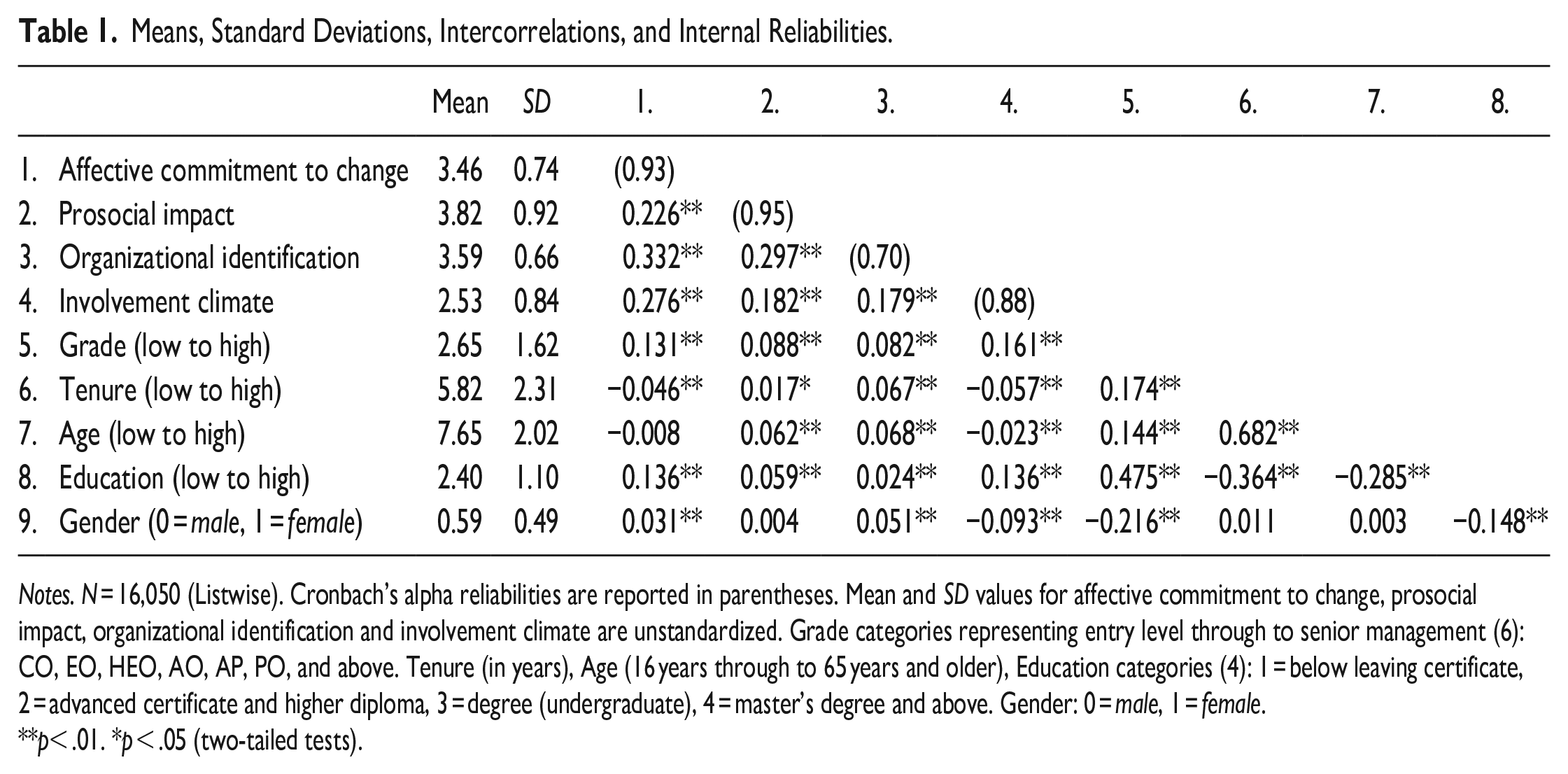
Notes. N = 16,050 (Listwise). Cronbach’s alpha reliabilities are reported in parentheses. Mean and SD values for affective commitment to change, prosocial impact, organizational identification and involvement climate are unstandardized. Grade categories representing entry level through to senior management (6): CO, EO, HEO, AO, AP, PO, and above. Tenure (in years), Age (16 years through to 65 years and older), Education categories (4): 1 = below leaving certificate, 2 = advanced certificate and higher diploma, 3 = degree (undergraduate), 4 = master’s degree and above. Gender: 0 = male, 1 = female.
p< .01. *p < .05 (two-tailed tests).
Hypothesis Testing
Hypothesis 1, which posited a positive relationship between perceived prosocial impact and OI, was supported. The results in Figure 2 show prosocial impact to be moderately related to OI: (β = .20, p < .001). Thus, Hypothesis 1 is supported.
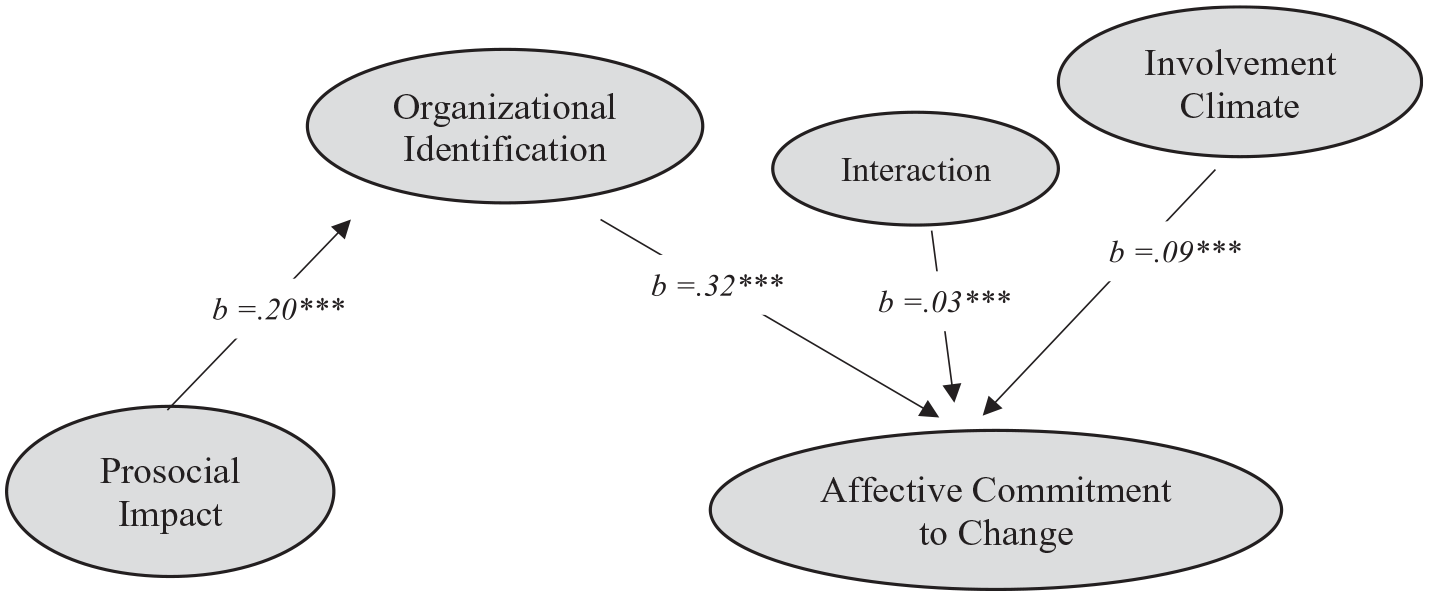
Results of the moderated mediation model.
Hypothesis 2 posited that the relationship between prosocial impact and ACC would be mediated by OI. The effect of the IV (prosocial impact) on the mediator (OI) was moderate and significant (β = .20, p < .001) and the effect of the mediator (OI) on the DV (ACC) was larger and significant (β = .32, p < .001). Based on Hayes’ (2017) approach, the indirect (mediated) effect of prosocial impact on ACC with bootstrapping confidence intervals using 5,000 samples at 95% confidence interval is: effect = .06., BCa 95% [.06, .07] indicating mediation. Therefore, Hypothesis 2 is supported.
Hypothesis 3 posited that involvement climate would have a moderating effect on the relationship between OI and ACC of the mediation model (see Hypothesis 2). The Jöreskog and Yang (1996) product indicator approach involved multiplying the interacting indicators of the latent variable so that all possible combinations of indicator products were utilized. Latent variable composites were mean centered through data imputation based on the factor scores from the CFA model.
Results in Figure 2 show that the interaction term indicates a weak, positive interaction effect on ACC (β = .03, p < .001). The bootstrapping confidence intervals using 5,000 bootstrapping samples at 95% on the conditional indirect effects of prosocial impact (independent variable) on ACC (dependent variable) through OI (mediator) at low, medium and high values of involvement climate (moderator) are: effect = −.04, BCa 95% [−.1, .02], p = .15, effect = .06, BCa 95% [.06, .07], p < .001, effect = .17, BCa 95% [.11, .23]. The index of moderated mediation effect is: .006, BCa 95% [.003, .01], p = .001. The results indicate that an involvement climate enhances the positive relationship between OI and ACC therefore, Hypothesis 3 is supported. The interaction plot is presented in Figure 3.
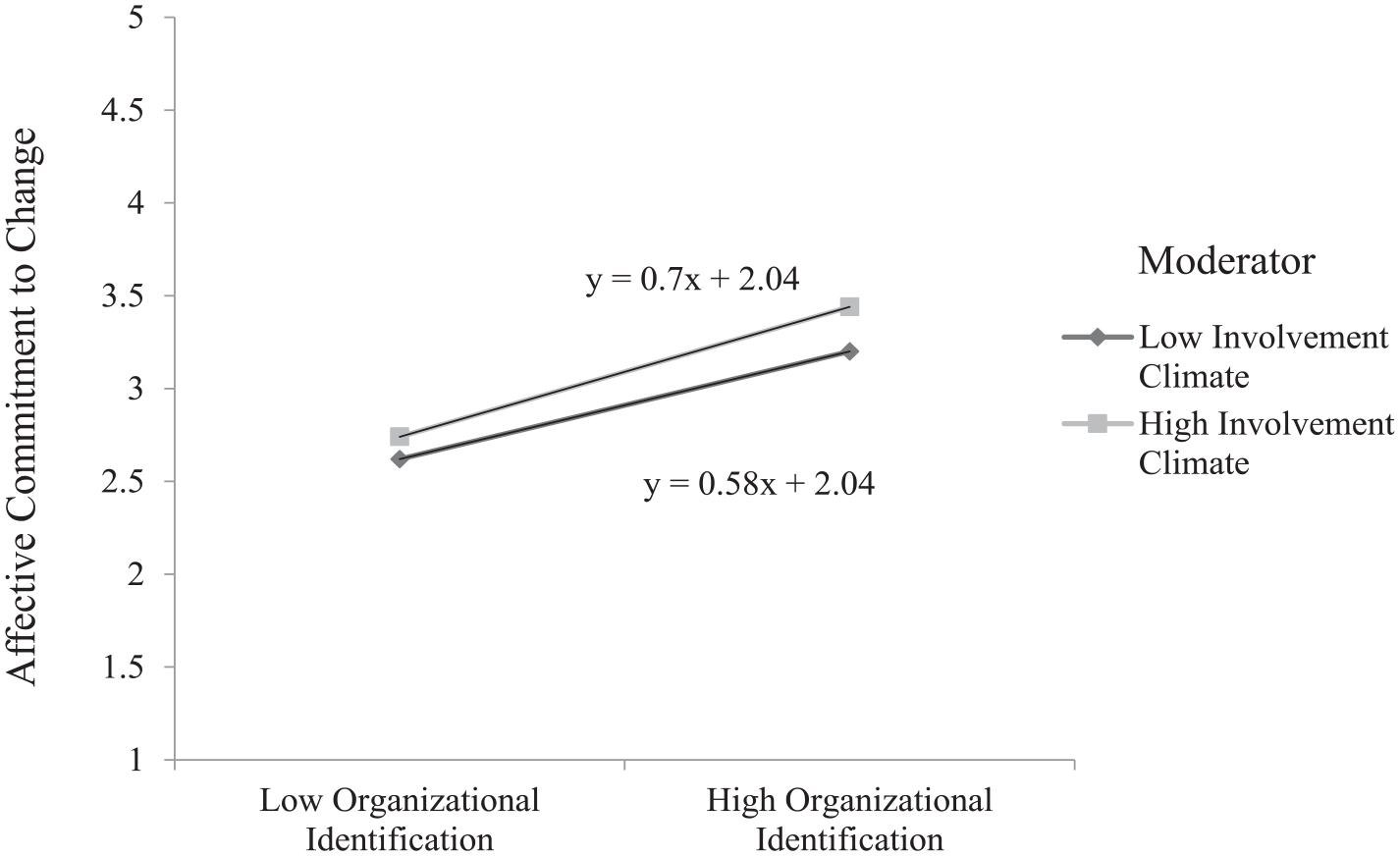
Simple slopes plot of the interaction between organizational identification and involvement climate on affective commitment to change.
Discussion
Our study found support for a positive association between perceptions of prosocial impact and OI. Further, our hypothesis that OI would mediate the relationship between perceptions of prosocial impact and ACC was supported. Finally, we found support for the moderating role of involvement climate in the relationship between perceptions of prosocial impact and ACC, such that involvement climate strengthens the role of OI as a conduit through which prosocial impact activates ACC.
Our study makes several contributions to theory. First, we enhance understanding of the way in which ACC develops through a process of activation. Building on Oreg et al.’s (2018) circumplex model of recipients’ behavioral responses to change, our findings demonstrate how opportunities for prosocial impact trigger an activation process that reinforces individuals’ OI, which in turn enhances levels of ACC. This occurs through an internalization process regarding the goals and values of the organization and an assessment of how the change in question aligns with those goals and values. Thus, prosocial impact will be reflected among the values held by individuals, which will be congruent with the goals of the organization. Values such as being caring or benevolent, which are central to the self-concept, will be activated because prosocial impact reflects a concern for the welfare of others (Grant et al., 2008). This is consistent with Schwartz’s (1973, 2010) view that values affect behavior only if they can be activated.
Second, our findings provide empirical support for the theorized role of activation in addition to valence in supporting positive employee reactions to change (see Oreg et al., 2018). In investigating potential triggers of an active response on the part of employees, we honed in on the role of values. We evidence how alignment of organizational and employee values trigger an active response to change on the part of employees that, when mirrored by organizational efforts that facilitate employees in channeling that activation, culminates in positive ACC. Moreover, our findings show that organizations, through their deliberate attempts to involve employees, play an important role in this activation process. This integration of both personal and organizational valence to understand reactions to change adds to the limited number of studies that explain the development of positive attitudes during change (Hameed et al., 2019). We therefore provide a new explanatory mechanism for why employees develop ACC by illustrating that OI, as an active psychological process, facilitates ACC by helping employees to associate the change with the organizational values that they have internalized. Thus, ACC represents a “binding” effect in pursuing a course of action of relevance to one or more targets (Meyer & Herscovitch, 2001).
In making overall sense of our respondents’ reactions to the change in the Civil Service, it is useful to view these from the ethical perspective proposed by Jacobs and Keegan (2018). In line with Jacobs and Keegan, our findings suggest that change is not just about individuals’ needs or self-interested motives; rather the needs of citizens and of the Civil Service itself were crucially important to the ACC identified among our respondents. This attention to “other” noted by Jacobs and Keegan was also embedded in our finding that perceptions of an involvement climate strengthened the relationship between OI and ACC only when the involvement climate was perceived as moderate or strong. Indeed, when the involvement climate was perceived as low, the significant relationship disappeared. This suggests that individuals engage with involvement initiatives when they are made in the spirit of “other,” that is, as initiatives involving others in the changes that impact directly on their working lives. Thus, half-hearted attempts by an organization to involve employees in change initiatives, or to undertake such initiatives simply to pursue an organizational agenda, may be detrimental to the outcome of the initiatives.
Implications for Practice
There are several implications for practice that emerge from the research. First, the evidence from the study points to the importance of the design of jobs in the civil service, in particular that jobs should be designed so that individuals can see where their work has a positive impact on others, whether co-workers, the general public or other stakeholders. This will require a lessening of the restraints of the traditional hierarchy embedded within the civil service so that decision-making can be made at lower levels within the organization. Many individuals in lower-level positions are in public-facing roles but frequently lack the discretionary power to deal with queries or complaints that they receive (Conway et al., 2018). Instead, they may be forced to refer such queries to their supervisors who may, in turn, need to refer to their managers. This hierarchical decision-making process not only creates delays but also prevents those directly engaged with the public or other stakeholders from seeing the impact of their work. Following on from this, there is merit in managers taking the time to celebrate prosocial impact through storytelling (Grant, 2008c). Where managers take the time to share stories with employees of their own impact, it will have an amplifying effect on employees’ identification with the organization.
Second, the findings suggest that there is a need for intensive efforts to create an involvement climate if OI is to foster ACC. This supports the effort made by the Irish civil service, both before and during the change process, to encourage a climate of involvement, but also suggests that departments varied in their efforts to build involvement or at least that those efforts did not go far enough in some cases. Finally, the findings highlight the importance of communicating the organization’s goals and values, consistent with a strong public service ethos, to signal congruence with individuals’ own goals and values and to foster higher levels of OI.
Limitations and Future Research
Despite these stated contributions of our study, several limitations need to be acknowledged. First, despite drawing on a very substantial and representative dataset, the data are cross-sectional. Future research should seek to determine the direction of causality in our variables through longitudinal research. Notwithstanding this limitation, our research model and findings are broadly consistent with theorizing on ACC and with findings from prior studies utilizing longitudinal designs. While we have presented an argument consistent with the idea that prosocial impact sparks an activation chain in motion, culminating in employees’ positive valence towards chance, research should investigate whether activation precedes valence, or valence precedes activation or whether in fact they are concurrent.
Furthermore, self-reported, cross-sectional data present the possibility of common method bias, although our analysis suggests that this is not a major cause for concern. As the variables of interest are largely subjective, we do not believe that they can be assessed more objectively by other parties. As our study is limited to the civil service in Ireland, our findings may not be generalizable, and it would therefore be useful to replicate it in other similar contexts internationally. Our model may, in particular, be restricted to public sector settings where prosocial motives are abundant, such that the triggering effects of prosocial impact for OI and ACC in turn, may be less intense in organizations less driven by prosocial values.
Finally, there is scope for future experimental work to isolate the precise role of prosocial impact in activating OI. For instance, manipulating the scope and nature of prosocial impact and varying to what extent managers recognize and amplify this impact for employees would be valuable in advancing theory around OI but also in informing organizational change practices.
Conclusion
This study extends understanding of how ACC develops in a civil service context. In particular, we identify employees as active participants, rather than passive recipients, in change initiatives. We highlight the ways in which factors that are core to civil service values—undertaking work that is of benefit to citizens, attachment to a public service ethos via OI, and a climate of involvement—operate in tandem. While these are important theoretical insights, it is also important to report that the Irish civil service has been able to utilize the survey findings to make changes and improvements to the working lives of its staff, with positive outcomes for the general public with whom they deal.
Footnotes
Appendix
Affective Commitment to Change (Herscovitch & Meyer, 2002)
Prosocial Impact (Grant, 2008c)
Organizational Identification (Mael & Ashforth, 1992)
Involvement Climate (Patterson et al., 2005)
Authors’ Note
Yseult Freeney is now affiliated to Irish Institute of Digital Business, Dublin City University Business School, Dublin, Ireland.
Declaration of Conflicting Interests
The author(s) declared no potential conflicts of interest with respect to the research, authorship, and/or publication of this article.
Funding
The author(s) received no financial support for the research, authorship, and/or publication of this article.
