



Abstract
Can public sector employees act as entrepreneurs and help solve some of the world’s most pressing problems? Amid crises such as COVID-19, rising inflation, and climate disasters, governments worldwide are facing credibility and legitimacy crises, and the need for innovation and entrepreneurship in the public sector has never been more critical. To understand how to make public servants more entrepreneurial, this study explores the relationship between human resource management (HRM) practices, person-environment fit theory, and attitudes toward public sector entrepreneurship. Based on data from the 2019 Australian Public Service census survey (n = 92,128), this study finds the practices of promoting employee recognition and inclusion exhibit the strongest effects on entrepreneurial attitudes of public servants, via person-job and person-organization fit respectively. However, practices such as performance appraisal and trainings show irrelevant effects. Overall, this article suggests that public managers should instill a culture of inclusion, innovation, and participation within their organizations to unleash the entrepreneurial public servant, while they need to rethink their performance appraisal systems to serve better the purpose of improving employees fit with their tasks.
Keywords
Introduction
Can public sector employees act as entrepreneurs and help solve some of the world’s most pressing problems? In our collective imagination, the story of the archetypal public servant is not the story of a main character who has an ambitious vision, who takes personal risks, and who is driven by a fighting spirit to create a new tomorrow; instead, it is generally the story of an employee who does the bare minimum, does not take risks, is lazy, and—maybe—even corrupt (Willems, 2020). These stereotypes are, however, very distant from reality: the “entrepreneurial public servant” is not a fiction, and research has reached widespread consensus that, under the right conditions, public sector employees are driven by a strong passion and motivation to serve the public and do whatever they can (and far beyond what they would be required to do) to see innovative solutions come to life (Demircioglu & Audretsch, 2017; Lavee & Cohen, 2019).
Moreover, amid crises such as COVID-19, rising inflation, and climate disasters, governments worldwide are facing credibility and legitimacy crises, and the need for innovation and entrepreneurship in the public sector has never been more critical. Nevertheless, while the scholarships on human resource management (HRM) and organizational behavior have been concerned with several employee attitudes, such as job satisfaction, affective commitment, and turnover intentions (see, e.g., Chordiya, 2022; Demircioglu, 2023), our knowledge about unlocking public sector employees’ full potential and making them more innovative, proactive, and thus entrepreneurial, is limited. This is unfortunate, since recent experiences during the COVID-19 pandemic demonstrate that entrepreneurial public sector organizations and employees can indeed solve problems in times of uncertainty and create public value (Kauzya & Niland, 2020).
Therefore, there is a need to clarify this gap both from a theoretical and from a practical perspective. Considering that, by employing the employee fit theoretical perspective (i.e., by looking at the compatibility of public sector employees with their work environment), this article explores the relationship between five distinct HRM practices (namely, performance appraisal, training and learning, employee recognition, inclusion, and wellbeing) and entrepreneurial attitudes of public servants. This article aims to answer the following research question: “what are the HRM practices public managers can employ to support entrepreneurial attitudes of public sector employees?.
To answer this question, this article uses data from the 2019 Australian Public Service (APS) Census Survey (n = 92,128), conducted by the Australian Public Service Commission (APSC, 2021) to collect opinion data from public servants as a basis to build better workplace capability and environment. As the public service of the future increasingly needs innovative and proactive public servants, the findings of this study contribute both to human resource and organization theory, by providing a theoretical link between HRM practices and entrepreneurship in established organizations, and to practice, by showing that instilling a culture of inclusion, innovation, and participation within public sector organizations is fundamental to unleash the entrepreneurial public servant.
Theoretical and Conceptual Framework
This section aims at elucidating the theoretical basis for this article, which investigates the relationship between human resource management (HRM) practices and public sector entrepreneurship (PSE) through the person-job fit (PJ fit) and person-organization fit (PO fit) theoretical perspectives. We first clarify what the multi-faceted and multi-dimensional phenomenon of PSE consists of and how we define it for the purpose of this study, and then proceed to explain the theoretical basis for examining the relationship between HRM and PSE. Finally, we build on the explored theoretical perspectives to develop a conceptual model and hypotheses.
Public Sector Entrepreneurship (PSE)
In recent years, research on PSE has gained momentum due to the increasing interest from both public administration scholarship in its expected contribution to government effectiveness (D. B. Audretsch et al., 2020; Demircioglu et al., 2020; Vivona, 2023) and from the entrepreneurship research interest in analyzing a variety of contexts, including the public sector (D. Audretsch, 2012). Public sector entrepreneurship can be defined as “the process that exists within the public sector organization that results in innovative activities such as the development of new and existing services, technologies, administrative techniques, new improved strategies, risk taking and proactivity” (Kearney et al., 2009, p. 28). Therefore, PSE is crucial to drive public sector innovation and address societal challenges.
PSE has been reported in a variety of different forms: for instance, examples of PSE range from the creation of complete new “ventures” (i.e., new public sector organizations; Ongaro & Ferlie, 2020), the enhanced competition of state-owned enterprises on international markets (Luke et al., 2010), to the role of public managers who inspire their employees to pursue opportunities to achieve organizational goals (Vivona, 2023), and the role of front-line staff who aim at making their organization more efficient, flexible, innovative (Boyett, 1996), and at building trust and collaboration (Cunningham et al., 2016). In this article, we are interested in PSE as an individual-level phenomenon that can manifest as entrepreneurial attitudes of public servants.
In this sense, PSE scholarship has considered and put emphasis on how different entrepreneurial attitudes and behaviors are between the public and private sector. Particularly, Sadler (2000) explains that since the public sector tends to be averse to entrepreneurship due to its bureaucratic structures, procedures, and values, and since it faces several obstacles (e.g., goal ambiguity, weaker leadership, discouraged risk-taking, and restrictive personnel policies), “the application of entrepreneurial behavior needs to be adjusted to fit the public sector environment” (p. 28) Klein et al. (2010) suggest some major differences between public and private sector entrepreneurship lie in the processes of alertness to opportunity (e.g., it is more difficult to measure expected gains from pursuing opportunities due to lack of market prices, and the pursuit itself is made more difficult by bureaucratic procedures), and in the processes of decision-making under uncertainty (e.g., decision horizons are usually bound to political cycles, and decision makers take risks on political exposure and career prospects rather than on their own money).
However, Zampetakis and Moustakis (2007) observe that front-line public sector employees can act as entrepreneurs when they exhibit a combination of strategic vision, creation of an energetic working environment, and change orientation. More recently, Demircioglu and Chowdhury (2021) have given the following operational definition of individual employees’ attitude toward PSE, which will be implemented later in this article: “in order to achieve an organization’s objective, an employee works beyond what is required in his/her[/their] job, goes the extra mile, and suggests ideas or policies that improve how the organization and its members work” (p. 1109) This definition reflects a specific aspect of PSE, which is related to both the attitudes of proactiveness and innovativeness of public servants. The next section explores how the person-environment fit theory explains public servants’ work attitudes, including PSE.
The Person-Job and Person-Organization Fit Theoretical Perspectives
Central to this article’s theoretical framework is the perspective of the employee fit theory, or person-environment fit theory (Edwards et al., 1998), which is concerned with the compatibility of employees with their work environment. Among various types of employee fit (Kristof-Brown et al., 2005), in the literature two main perspectives emerge: the person-job fit (PJ fit) and the person-organization fit (PO fit). The PJ fit perspective is concerned with the appropriate matching between job tasks and employees’ skills, as it is conceptualized as a demand-ability fit (Edwards, 1991) in which “employees” knowledge, skills, and abilities are commensurate with what the job requires” (Kristof-Brown et al., 2005, p. 284). On the other hand, the PO fit perspective is instead interested in the congruence between an employee’s own belief system with the purpose and value system of the organization (Chatman, 1989). Research has validated PJ fit and PO fit as two important separate constructs, which tend to exhibit little to no correlation with one another (Lauver & Kristof-Brown, 2001).
Therefore, an important question addressed by research is how organizations can simultaneously improve actual and perceived PJ fit and PO fit (PJ/PO fit). Scholars agree that HRM can play an important role in improving the match between employees and their work environment (C. Boon et al., 2011). Through several HRM practices, organizations can thus both improve employee fit and in turn their employee outcomes (Mostafa & Gould-Williams, 2014). Research has also focused on investigating the composite effect of PJ/PO fit, including public administration research that has been mainly interested in the outcomes of public service motivation (PSM; see e.g., Bright, 2007; Christensen & Wright, 2011; Kim, 2012). These studies have shown that PJ/PO fit are important mediating factors that can better explain the outcomes of PSM. In particular, Bright (2007) states that the mediating role played by PO fit can help explain mixed findings on the PSM-performance relationship in prior studies. Thus, he urges public administration researchers to better consider the effects of PJ/PO fit in public sector organizations.
The literature also confirms that an important effect of PJ/PO fit is related to improved employee work attitudes in general (Guan et al., 2010; Verquer et al., 2003) and employee attitude toward innovation in particular (Afsar et al., 2015). Specifically, general management scholars have consistently reported that PJ/PO fit has significant positive effects on employees’ innovative work behavior (see e.g., Afsar et al., 2015; Suwanti et al., 2018; Wahyudi, 2019). However, extant scholarship has neglected the role of PJ/PO fit in explaining the attitude toward entrepreneurship in established organizations (or intrapreneurship), including PSE. While we can to some extent translate findings from innovation studies, as innovation and entrepreneurship share overlapping skill bases (Paladino, 2022), this gap is unfortunate, as the manifestations, effects, and overall impacts of PSE are distinct from innovation (Demircioglu et al., 2020). To remedy this, the next section develops a conceptual framework linking together the attitudes toward entrepreneurship in public sector organizations with PJ/PO fit, and HRM as its antecedent.
The HRM-PJ/PO Fit-PSE Conceptual Framework
The primary goal of this article is to uncover the HRM practices that public managers can employ to foster entrepreneurial attitudes of public servants. Building upon the theoretical perspectives presented earlier, this section serves as the backbone of our study. Here, we establish a conceptual framework that links HRM, person-environment fit theory, and PSE together, and that lays the foundation for the development and testing of hypotheses.
First, we develop a simple model that links PJ/PO fit to PSE and allows us to test the theoretical relationship between constructs exemplified in previous sections. As the literature suggests that both PJ and PO fit are linked with attitudes of innovativeness and proactiveness (Afsar et al., 2015; Suwanti et al., 2018; Wahyudi, 2019), and as we defined PSE in such terms, we hypothesize that:
H1a: Person-job fit (PJ fit) will have a positive significant effect on public sector entrepreneurship (PSE).
H1b: Person-organization fit (PO fit) will have a positive significant effect on public sector entrepreneurship (PSE).
Second, we enrich the model by considering a managerial perspective linking PJ/PO fit as a mediator between PSE and five specific HRM practices—performance appraisal, training and learning, employee recognition, inclusion, and wellbeing. In particular, HRM can play a relevant role in matching employees with their job (e.g., by routinely check the congruence of an employee performance and by supporting their skill development) as well as with the organization (e.g., by ensuring that employees feel included and treated well at work; C. Boon et al., 2011).
Performance appraisal (i.e., the system of measurement and management of employees’ performance) is a cardinal practice of HRM, as “[p]roperly designed and realized process of employees’ appraisal is not only the necessary basis of successful employee performance management, but also provides valuable information for other human resource management functions” (Aggarwal & Thakur, 2013, p. 617). Effective appraisal is considered as having positive impact on several dimensions of performance, including employee innovativeness (Chen & Huang, 2009). Effective performance appraisal can improve the fit between job demands and employee skills, and as this makes employees more satisfied (C. Boon et al., 2011) it can in turn improve attitudes toward PSE. Thus:
H2a: The HRM practice of performance appraisal (PER) will have a positive significant effect on person-job fit (PJ fit) in public sector organizations.
H3a: Person-job fit will mediate the relationship between the HRM practice of performance appraisal and attitudes toward PSE.
Training and learning are also widely accepted as one of the most important functions of HRM, to the extent that scholars and practitioners began to extend them as a separate field of research and practice (i.e., Human Resource Development—HRD; Swanson et al., 2001). HRD serves the “needs of organizations to provide employees with up-to-date expertise” (Torraco & Swanson, 1995, p. 11) and is specifically important due to its inherent impact on performance (Swanson, 1995). Training and learning practices are considered to be strategic as evidence points out the positive linkage they exhibit with innovation at the organizational level (Manresa et al., 2019) and with entrepreneurial behavior at the individual level, as HRD makes employees more likely to contribute new ideas in the workplace (Manresa et al., 2018). Similarly, we hypothesize:
H2b: The HRM practice of training and learning (TRA) will have a positive significant effect on person-job fit (PJ fit) in public sector organizations.
H3b: Person-job fit will mediate the relationship between the HRM practice of training and learning and attitudes toward PSE.
Employee recognition, which represents the formal or informal acknowledgment of an employee for good, significant, and exemplary work, is an important motivator that can boost employee attitudes, involvement, and commitment (O. K. Boon et al., 2007; Danish & Usman, 2010). Practicing employee recognition in the public sector context is fundamental, as Saunderson (2004, p. 256) finds that effective recognition does not seem to be a reality in many organizations, despite the fact that “[m]anagers and leaders in the public sector strongly believe in the importance of giving meaningful employee recognition correlating with good morale, loyalty, commitment and satisfaction in the workplace.” Moreover, employee recognition (in terms of non-financial rewards) plays a big role in influencing employee performance and job satisfaction (Tessema et al., 2013), which ultimately lead to innovativeness and entrepreneurial behavior (Niu, 2014). Given the dual relationship of employee recognition with job commitment and organizational involvement (O. K. Boon et al., 2007) we advance the following four hypotheses:
H2c: The HRM practice of employee recognition (REC) will have a positive significant effect on person-job fit (PJ fit) in public sector organizations.
H3c: Person-job fit will mediate the relationship between the HRM practice of employee recognition and attitudes toward PSE.
H2d: The HRM practice of employee recognition will have a positive significant effect on person-organization fit (PO fit) in public sector organizations.
H3d: Person-organization fit will mediate the relationship between the HRM practice of employee recognition and attitudes toward PSE.
Inclusion is defined as the practice that ensures that “individuals of all backgrounds - not just members of historically powerful identity groups - are fairly treated, valued for who they are, and included in core decision making” (Nishii, 2013, p. 1754). Inclusion is linked to performance and entrepreneurship, since employees considering themselves as integral elements of their organizations can fully contribute (Miller, 1998) and be innovative (Solheim, 2022). Inclusion is also a fundamental practice to preserve employee rights, such as protection from discrimination and ethical treatment. This is particularly valid in the context of an increasingly diverse workforce, such as in the public sector representative bureaucracy (Bradbury & Kellough, 2011). Inclusion is also fundamental to ensure that all employees “fit in,” despite their backgrounds, which suggests that when employees feel included at work they are more likely to align with the organization’s values and to approach entrepreneurship. Thus:
H2e: The HRM practice of employee inclusion (INC) will have a positive significant effect on person-organization fit (PO fit) in public sector organizations.
H3e: Person-organization fit will mediate the relationship between the HRM practice of employee inclusion and attitudes toward PSE.
Finally, health and employee wellbeing are related to the employee’s physical and emotional state and are linked with a plethora of benefits both at the organizational and individual level (Guest, 2017). Health and wellbeing are associated with positive work engagement and commitment to the organization (Schaufeli et al., 2009). They are also found to be positively related to proactiveness, collaborative activities, and engagement in organizational citizenship behavior and extra-role behavior (Wright, 2003), which increase individual entrepreneurship (Demircioglu & Chowdhury, 2021). Therefore:
H2f: The HRM practice of employee wellbeing (WEL) will have a positive significant effect on person-organization fit (PO fit) in public sector organizations.
H3f: Person-organization fit will mediate the relationship between the HRM practice of employee wellbeing and attitudes toward PSE.
The resulting overall conceptual framework is presented in Figure 1.
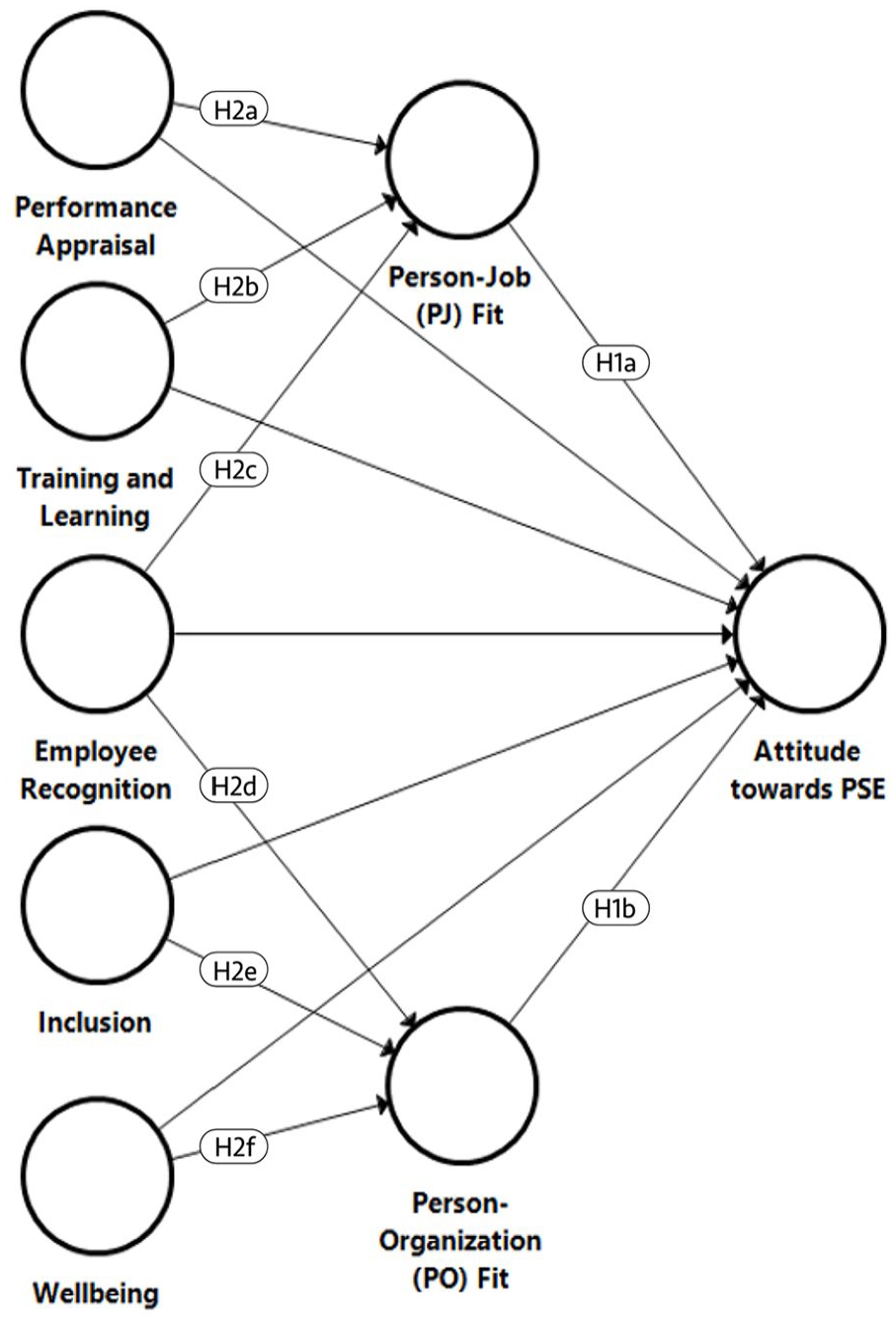
Conceptual model and hypothesized direct effects.
Methods
Data and Sample: The Australian Public Sector Context
This article uses data from the 2019 Australian Public Service (APS) Employee Census survey. The APS survey is conducted annually, since 2012, by the Australian Public Service Commission (APSC, 2021), which aims to gather insights from Australian public servants on their job, workplaces, and view of the APS as a whole. Since 2012, the APSC has improved both the survey and its distribution, considerably improving response rates. Indeed, while the response rate in 2012 was of 55%, in 2019, 136,527 APS employees were invited, between May 6th and June 7th, to complete the census survey, and 104,471 employees responded, for a response rate of 77%.
Moreover, the yearly nature of the survey and the annual review the APSC undertakes of it (e.g., by changing, shifting, moving, eliminating, or adding new questions and evaluation criteria to the questionnaire), function as important ex-ante remedies to the issue of common method bias, which “is a phenomenon that is caused by the measurement method used in an SEM study, and not by the network of causes and effects in the model being studied” (Kock, 2015, p. 2). In this sense, the literature suggests that some of the best ways to deal with common method bias are ex-ante procedural remedies such as the continuous improvement of scale items and the use of pre-tested surveys (Demircioglu et al., 2021; Podsakoff, 2003). The APSC also makes sure, through strict procedures, that the anonymity, confidentiality, and representativeness of respondents are assured.
Finally, the APS represents an appropriate context to investigate the relationship between HRM practices and PSE, since the APSC (2021) is committed to working toward the development and improvement of the entrepreneurial roles of its workforce. Along this line, the Australian public sector context has long been characterized by a marked approach toward innovation since the mid 1970s when explicit mentions of innovation first began to appear in APS reports. In particular, Lewis (2021, p. 462) reports how the APSC has promoted both a narrative or “innovation as technology” but also of “innovation as culture,” by focusing on changing organizational structures, removing barriers to novel ideas, developing the skills and values (i.e., the PJ/PO fit) of APS employees, promoting more open forms of policy decision-making, and on establishing new organizational forms to support innovation, such as public sector innovation labs. This suggests that Australian public servants are exposed to some degree to innovation culture, are encouraged to be innovative and proactive, and so have some familiarity with public sector entrepreneurship.
Measurement Systems and Operationalization of Study Variables
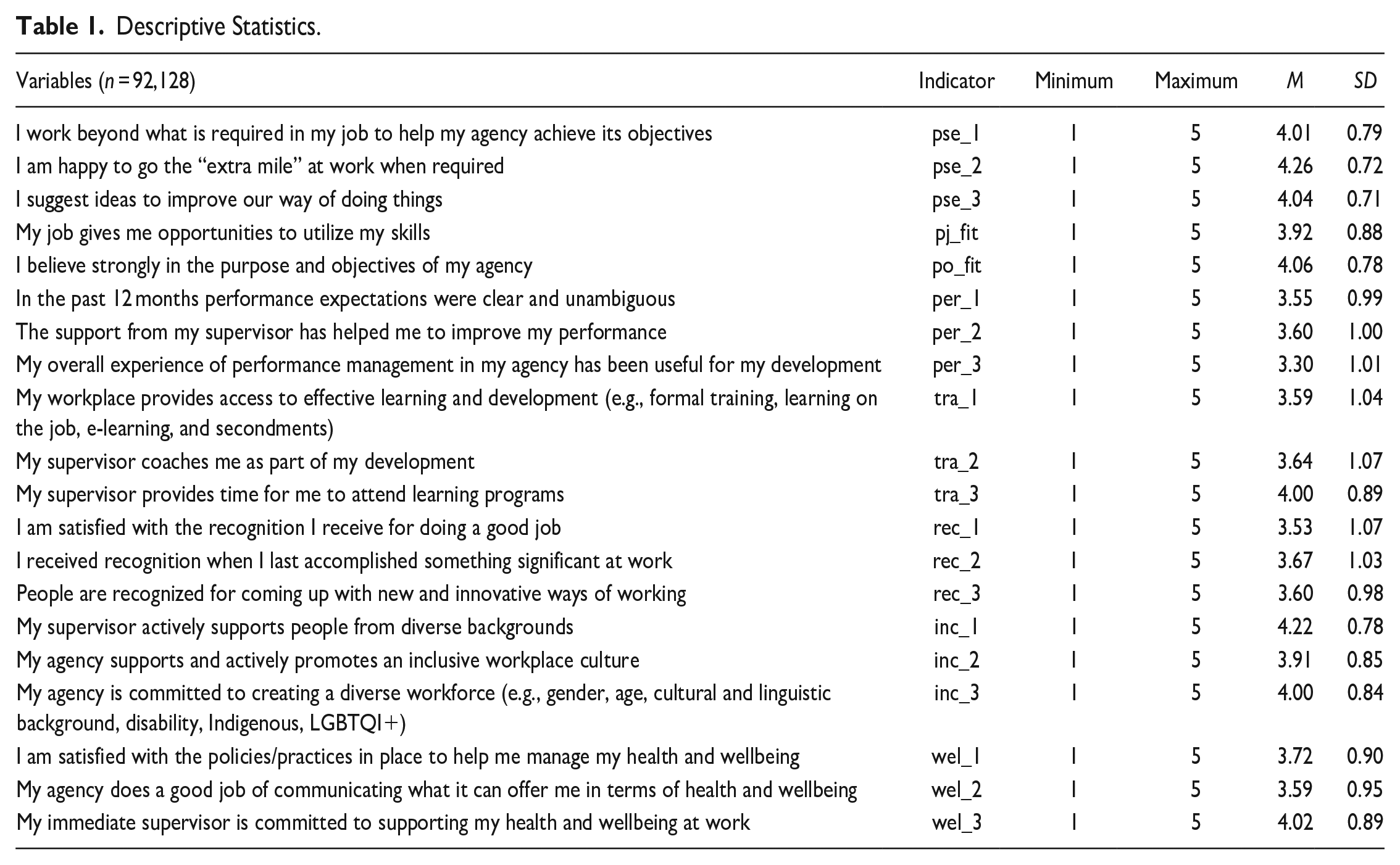
The dependent variable of this study is an attitudinal variable representing public sector entrepreneurship (PSE) of public sector employees, and it is operationalized based on a three-item scale developed by Demircioglu and Chowdhury (2021). As such, the attitude toward PSE is represented through a formative measurement system including the items: “I work beyond what is required in my job to help my agency achieve its objectives,” “I am happy to go the “extra mile” at work when required,” and “I suggest ideas to improve our way of doing things.”
The mediating variables of this study are person-job fit (PJ fit) and person-organization fit (PO fit), while five independent variables are based on a reflective measurement system to capture the HRM practices of (i) performance appraisal (PER), (ii) training and learning (TRA), (iii) job recognition (REC), (iv) employee inclusion (INC), and (vii) employee wellbeing (WEL). Table 1 reports all items used to compose the measurement systems for this study, with their main descriptive statistics.
Descriptive Statistics.
Empirical Strategy: Partial Least Squares Structural Equation Modeling (PLS-SEM)
Given the complexity of the specified conceptual model we use partial least squares structural equation modeling (PLS-SEM) in order to simultaneously measure and analyze the complex relationships and test the hypotheses. PLS-SEM is preferred to ordinary SEM (or covariance-based SEM, CB-SEM) when the research problem is related to early stages of exploration and theory development, that is, when “theory is less developed” (Hair et al., 2017, p. 118), which is coherent with the purpose of this article. Moreover, PLS-SEM is preferred to CB-SEM when the research involves secondary data, which is generally collected without the grounding of a theoretical framework and thus is not a good match for CB-SEM analysis (Ringle et al., 2012), and because “a major advantage of PLS-SEM when using secondary data is that it permits the unrestricted use of single-item and formative measures” (Sarstedt et al., 2014, p. 29).
To do so, we performed a two-step analysis through the SmartPLS 3.3.9 analytical software. First, we conducted an ex-ante quality assessment through a confirmatory composite analysis (CCA) to verify the appropriateness of the measurement model, as CCA is preferred to CFA (confirmatory factor analysis) in the context of PLS-SEM (Hair et al., 2020). Second, we evaluated the resulting structural model and path coefficients in order to test hypotheses.
Results
Confirmatory Composite Analysis (CCA)
First, we estimate loadings and their significance through bootstrapping (i.e., a nonparametric significance testing procedure), with 500 subsamples at a .05 significance level. Contrary to regression analysis, in which bootstrapping would not be normally needed with big sample sizes, PLS-SEM analysis cannot apply parametric significance testing as it does not assume normal distribution of the data. Resulting loadings (which are shown for each item in Figure 2 with the arrows from a latent variable to the item) are compared to the ordinary threshold value of 0.70. Note that in Figure 2 the arrows between PSE and its items show weights rather than loadings (as the construct is formatively-measured), loadings for “pse_1,” “pse_2,” and “pse_3” are respectively 0.853, 0.862, and 0.601. All loadings are greater than the 0.70 cutoff point, apart from “pse_3.” However, this should not be a concern as the loading is above the 0.60 threshold validated by the literature comparing PLS-SEM to CB-SEM (Afthanorhan et al., 2020). Moreover, the smaller t-statistics, associated with “pse_3,” presents a value of 105.608, far above the threshold value of 1.96 (Hair et al., 2020), confirming significance.
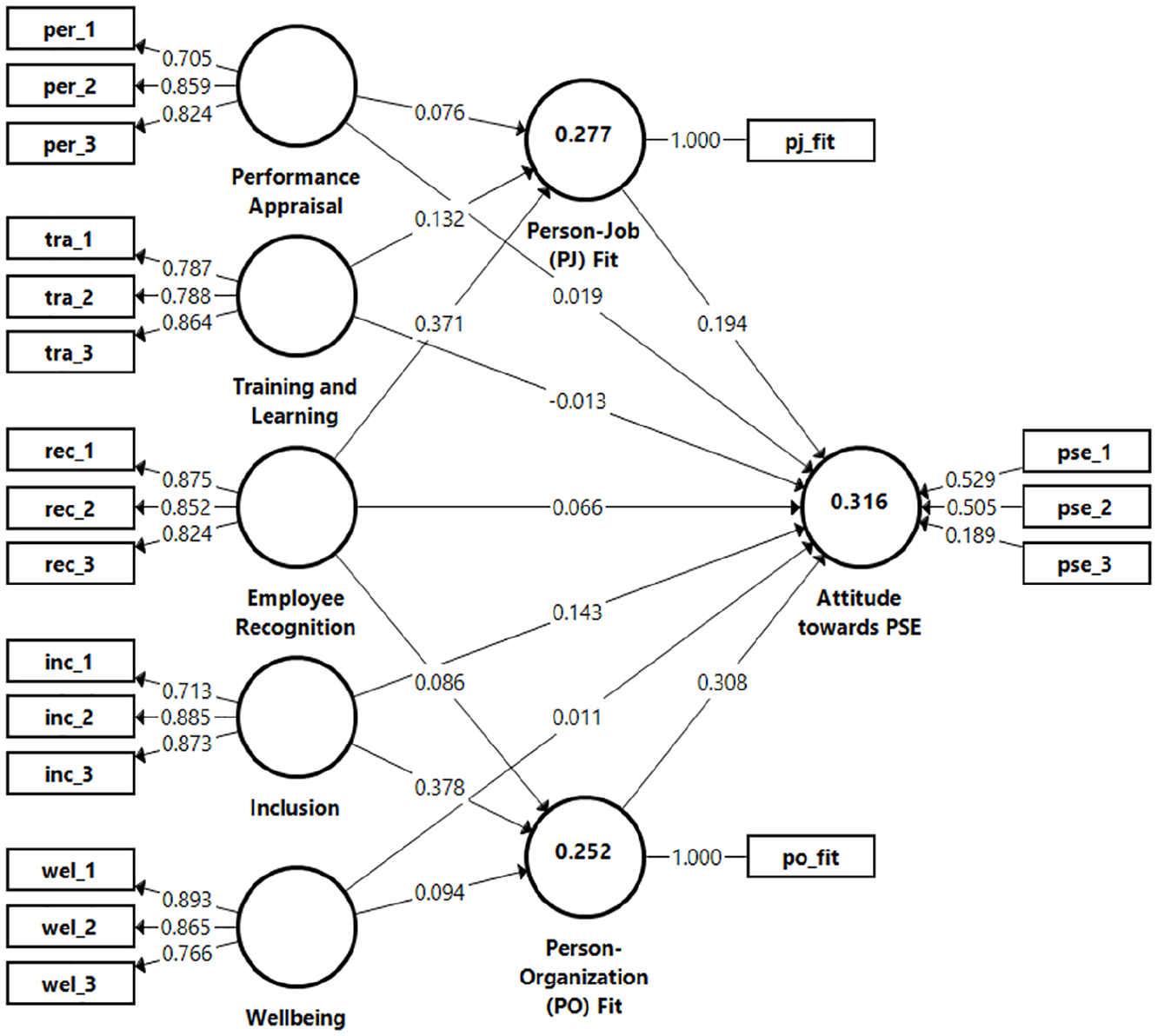
Structural model and direct path coefficients.
Second, we evaluate construct reliability through the estimation of Cronbach’s Alpha (α) and composite reliability (CR) for each reflectively-measured construct (that is, HRM constructs). The resulting values of α and CR are all greater than the threshold value of .70 (respectively .71 and .84 for “PER,” .74 and .85 for “TRA,” .81 and .89 for “REC,” .77 and .86 for “INC,” and .79 and .88 for “WEL”), which confirms the reliability of the constructs. Moreover, since the operationalization of the dependent variable is recent (Demircioglu & Chowdhury, 2021), we extended the evaluation of Cronbach’s Alpha and of the composite reliability indicator also to the measurement of public sector entrepreneurship (by inverting the measurement model to represent the dependent variable as a reflectively-measured construct). While the resulting α is just slightly below .70 (at a .694 value) the CR indicator (which is more relevant in the context of PLS-SEM analysis) is above the threshold (at a .718 value), confirming the reliability of the dependent variable.
Third, we evaluate convergent validity by computing the average variance extracted (AVE), measuring the average variance that is shared between a construct and its individual indicators. Resulting AVE values are all greater than the threshold value of .50 (respectively, .64 for “PER,” .66 for “TRA,” .72 for “REC,” .68 for “INC,” and .71 for “WEL”), and confirm convergent validity.
Finally, we assess discriminant validity to evaluate the distinctiveness of the constructs, by demonstrating that each AVE (shared variance within a construct) exceeds shared variance between constructs. To do so, we compute the HTMT (hetereotrait-monotrait) ratios of correlation (Henseler et al., 2015), which are all smaller than the cutoff point of 0.90 (Hair et al., 2020), therefore also confirming discriminant validity.
Overall, the tests presented above confirm that the measurement model developed in the previous section is satisfactory. Moreover, the CCA assessment also represents an important ex-post demonstration that common method bias should not be an issue for this study, as research suggests that a “way to rule out substantial method effects is to demonstrate construct validity of the measures,” for instance by confirming convergent and discriminant validity (Conway & Lance, 2010, p. 329). To enhance this finding, we also compute full collinearity variance inflation factors (VIF), as they may be a more appropriate ex-post testing of common method bias in the context of PLS-SEM (Kock, 2015). VIF values range from 1.000 to 2.413 and are thus all below the cutoff point of 3 (Hair et al., 2019), which suggests, along with the other ex-ante and ex-post remedies implemented in this study, that common method bias is not an issue. Moreover, as VIFs are below this threshold, we can also exclude that collinearity bias is a problem in this study.
Structural Model Evaluation
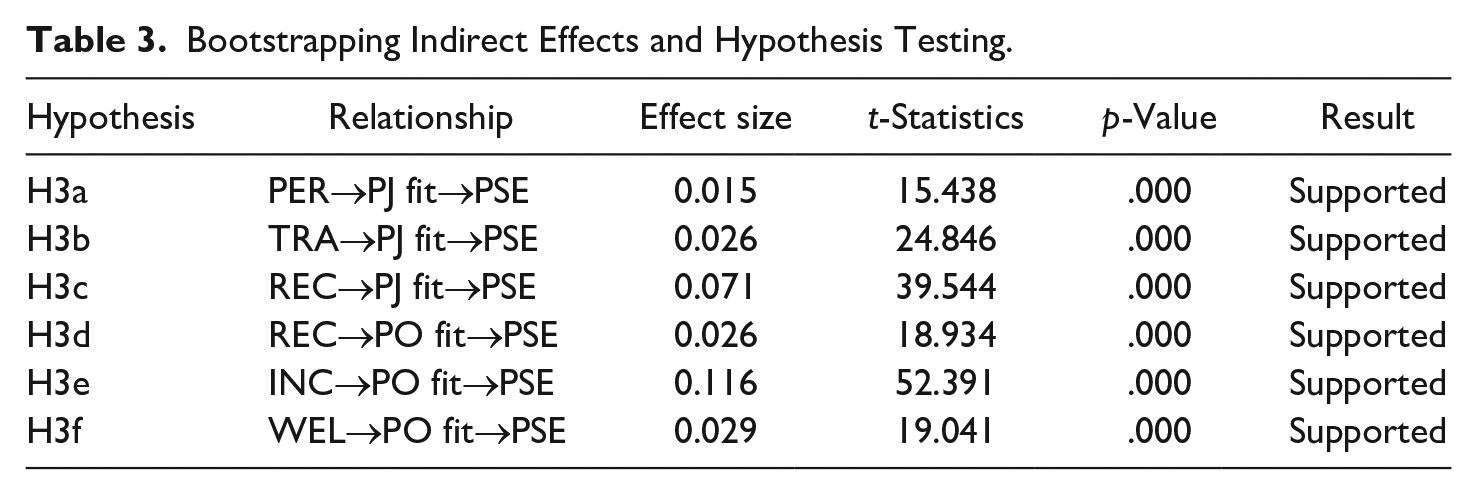
Figure 2 shows the results of the PLS-SEM analysis by reporting the structural model and direct path coefficients. The R2 of the model equals .316, which means that approximately 32% of the variance in attitudes toward public sector entrepreneurship of public servants is explained by the direct and indirect effects (through PJ/PO fit) of the HRM practices of performance appraisal, training and learning, employee recognition, employee inclusion, and employee wellbeing. The path coefficients shown in Figure 2 can be interpreted as standardized beta coefficients of a regression and represent the hypothesized relationships that link the study constructs (Hair et al., 2014). As such, we first evaluate their significance. Tables 2 and 3 reports the bootstrapping direct and indirect effects respectively, and along with their t-statistics, they summarize the findings of the hypotheses developed in this study, which are all supported. However, Hair et al. (2014) also suggest considering whether significant path coefficients of the structural model are meaningful and whether they deserve managerial attention. In particular, while Table 2 shows that all HRM practices studied in this article are significant and positively associated with employee fit, only employee recognition and inclusion exhibit relevant effect sizes, on person-job and person-organization fit respectively. The effect sizes of other links are considerably weaker, which suggests that managerial attention should be directed toward inclusion and recognition. Likewise, Table 3 shows that employee inclusion exhibits a great indirect effect on PSE, that employee recognition indirect effect is more moderate, and that other indirect effects are relatively weak.
Bootstrapping Direct Effects and Hypothesis Testing.
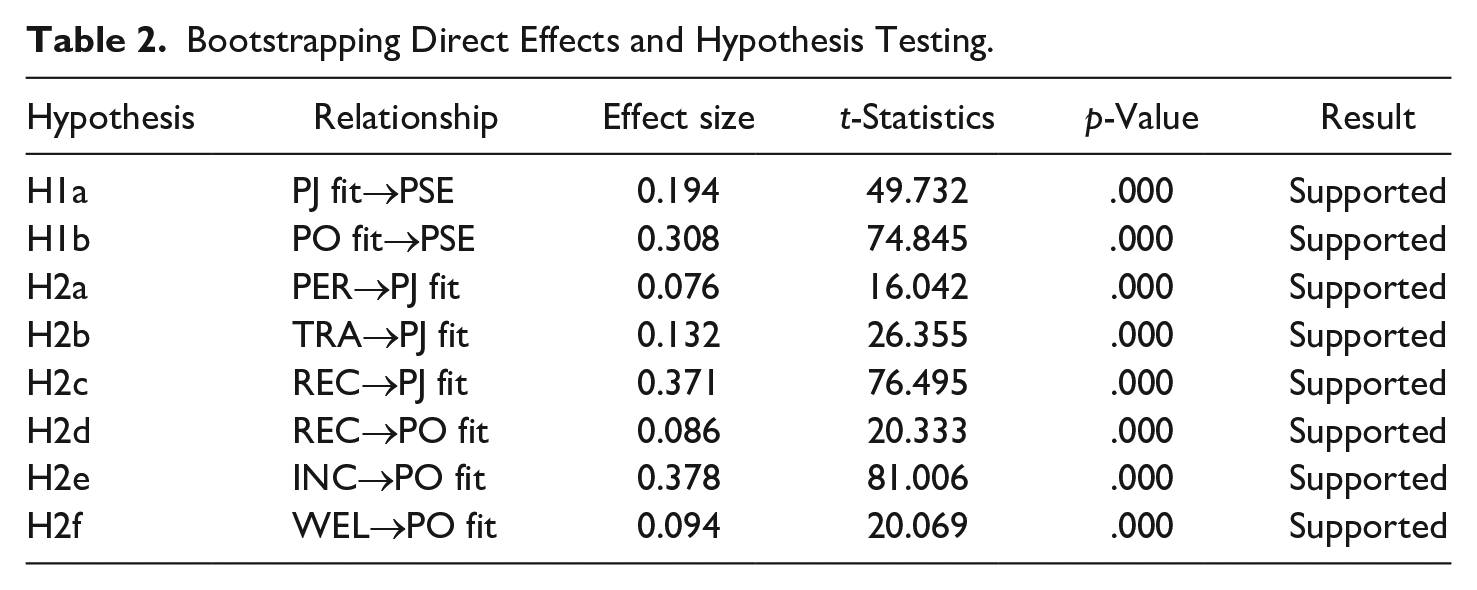
Bootstrapping Indirect Effects and Hypothesis Testing.
Discussion and Conclusion
Countries worldwide are facing increasingly severe crises, such as the COVID-19 pandemic, the Russian invasion of Ukraine, rising inflation, and climate disasters; at the same time, governments are facing credibility and legitimacy crises, which hamper their ability to serve society effectively. However, recent experiences (especially in response to COVID-19) demonstrate that innovative and entrepreneurial public sector organizations and employees can solve citizens’ problems in times of uncertainty and create public value (Kauzya & Niland, 2020; Vivona et al., 2023). Against this background, it is unfortunate that we have little knowledge (both in terms of theory and practice) about making public sector organizations and employees more entrepreneurial. This study aimed at resolving this issue, by asking: what are the HRM practices public managers can employ to support entrepreneurial attitudes of public sector employees? To answer this research question, this study explored the relationship between HRM practices, person-environment fit theory, and attitudes toward public sector entrepreneurship in the Australian public sector context. Findings from the structural model have important implications for organization and human resource theory, as they provide an empirical link between HRM and entrepreneurship, and for practice.
First, both person-job and person-organization fit are directly and significantly linked with attitudes of public sector entrepreneurship. We find that, against this background, person-organization fit has much more relevance than person-job fit in predicting public servants’ attitudinal entrepreneurship. Therefore, this confirms that, as the APSC practice (Lewis, 2021) and research (Vivona et al., 2021) have stressed, while the development of skills and capabilities of public sector employees remains an important policy reform to be successfully achieved, instilling a culture of inclusion, innovation, and participation within public sector organizations is fundamental not only to improve the fit of public servants with their agencies, but also to support their entrepreneurial attitudes.
Along this line, we found that fostering employee inclusion (e.g., by supporting people from diverse backgrounds, by promoting an inclusive workplace culture, and by making an explicit commitment to include vulnerable minorities in the workforce) has the highest relevance in explaining how well public servants fit within their organization. While practices to improve employee recognition (i.e., when employees feel recognized by their coworkers and supervisors) and employee wellbeing (i.e., when employees fell that their agency cares about their health and wellbeing) are significantly associated with PO fit, their effect size is relevantly lower than the promotion of inclusion. This has important practical implications, suggesting that making inclusion a priority within public sector agencies can not only considerably improve how well people “fit in” at work and can contribute, for instance to reduce turnover intentions (Memon et al., 2014), but can also improve the proactiveness and innovativeness of public servants (i.e., entrepreneurial attitudes). These are important considerations that are linked with the retention of a talented public sector workforce that can innovate and improve the public service, address grand challenges, and create value in society.
Additionally, we find that both the HRM practices of employee recognition and training and learning have relevant impacts on person-job fit. The former has also a positive strong total effect on PSE; however, the latter exhibits, in our structural model, a negative direct effect on PSE. While the total effect of training and learning on PSE is overall positive, it is curious to see a negative direct effect, which can be explained by the fact that, similarly to performance appraisal, trends of austerity and budget cuts may reduce the effectiveness of this practice (Elliott, 2020). This is also consistent with findings from previous research, which suggests that access to training and learning in public sector organizations seem to be negatively associated with innovation capacity (Demircioglu & Audretsch, 2017); this may be due to the fact that, as Thunnissen and Sanders (2021, p. 119) note, while access to training is broadly provided in the public sector, these activities are usually “focused on remaining productive in the current job, and not so much on future changes in their job.” This finding indicates an important opportunity for enhancing human resource development within public sector organizations. Therefore, we encourage future research to delve deeper into investigating how public managers can effectively design training programs aimed at equipping public servants with the necessary skills and mindsets to foster innovation, proactivity, and a willingness to take risks.
More surprisingly, both the direct and indirect effect of performance appraisal on PSE and the direct effect on PJ fit, despite being significant, show a particularly weak impact. This seems unfortunate, as it supports the line of research that criticizes the actuality of this practice in the public sector context. Indeed, performance appraisal has become a predominant practice in public sector organizations (Barbieri et al., 2023), but the approach has been found to generally focus on measurement rather than actually enhancing work attitudes of public servants (Waxin & Bateman, 2009). We suggest that public managers might need to rethink their performance appraisal systems, in order to serve better the purpose of improving employees fit with their job tasks, and to avoid ineffective performance appraisals reducing employee motivation.
This study is not without limitations. First, in this article, we focused entrepreneurial attitudes of public servants in the Australian national public sector context, and therefore results may not be generalized to other sector contexts (e.g., established organizations in the private sector) or national contexts. Future research may aim at collecting data from multiple sectors/countries to validate these findings through comparative studies. Furthermore, future research should aim at collecting longitudinal data. Indeed, cross-sectional analyses (such as the one developed in this article) are limited, especially when testing mediated relationship, even though the PLS-SEM approach compensate this limitation as it is not subject “to the limitations of both regression and factor-based SEM analyses when estimating even highly complex mediation models” (Sarstedt et al., 2020, p. 295).
Second, while the PSE phenomenon is complex and multi-faceted, we analyzed, based on the work of Demircioglu and Chowdhury (2021), PSE as the attitudinal entrepreneurship of public servants. On the one side, this study contributes to management scholarship by offering additional insights on entrepreneurship in the public sector, which is difficult to measure quantitively. Moreover, by re-analyzing the reliability of the PSE construct developed by Demircioglu and Chowdhury (2021), it also validates its operationalization. On the other hand, the same operationalization represents just one first step toward a deeper understanding of the PSE phenomenon, as it merges an item of innovativeness and two items of proactiveness (or organizational citizenship behavior). Future studies may look at other dimensions of PSE, such as risk-taking, attitudes of creating new collaborations, and of boundary spanning.
Third, we employed the person-environment fit theory by focusing on the two core types of person-job and person-organization fit. As research on team-level entrepreneurship is increasing, future research may also consider conducting multilevel analyses, where individuals are nested in teams, in order to include the person-group fit perspective to explain work attitudes in public sector organizations, including entrepreneurship. Moreover, we focused on five different HRM practices, whose choice has been based on the needs and interests toward HRM that the Australian Public Service Commission makes explicit in its reports and through the census survey. Future research could measure other HRM practices (e.g., incentive pay and recruiting) and assess their relevance in the context of entrepreneurship in the public sector. Finally, future studies could also link employee-environment fit and PSE to public service motivation (PSM).
To conclude, this study demonstrates that HRM practices can improve employee fit in public sector organizations and in turn enhance their attitudes toward public sector entrepreneurship. More importantly, it has shown that public managers should consider prioritizing promoting employee recognition and inclusion, as these exhibit the strongest effects on person-job and person-organization fit respectively, and through them on public servants’ entrepreneurial attitudes, if the goal is to create public service organizations that support innovation.
Footnotes
Declaration of Conflicting Interests
The author(s) declared no potential conflicts of interest with respect to the research, authorship, and/or publication of this article.
Funding
The author(s) disclosed receipt of the following financial support for the research, authorship, and/or publication of this article: Open access funding provided by Nord University.
