




Abstract
Although public service employees are regularly exposed to uncivil behavior by citizens, we still know little about the effects of these incivilities. This study aims to examine the reactions of public employees who work in a climate of citizen incivility. Using a multilevel multisource design, we examine the indirect effects of citizen incivility climate on employee withdrawal and helping behaviors via job tension, and test the moderating influence of employees’ public service motivation on these relationships. Our analyses were performed using data collected from a sample of 734 employees and 77 supervisors working in Canadian public libraries. Results show that public servants who work in a climate of citizen incivility experience greater job tension and consequently show more withdrawal and less helping behaviors. Our results also show that public service motivation acts as a buffer against the detrimental effects of incivility climate on helping behaviors, but not against withdrawal.
Citizens’ uncivil behaviors are on the rise (Mingus & Horiuchi, 2012). A survey led by R. Williams and Associates (2013) reported that 71% of Americans had perceived an increase in incivility in recent years. Willsher (2016) discussed how the city of Paris has implemented an “incivility brigade” to counter daily antisocial behaviors such as throwing cigarette butts or garbage on the street. Citizen incivility has become a concern for politicians and a matter of investigation for scientists (Kenski et al., 2020; Mingus & Horiuchi, 2012), and affects all spheres of life including work (Porath & Pearson, 2013). Despite the common agreement that citizens engage in uncivil behaviors, the public administration literature remains silent on how citizen incivility affects public servants’ attitudes and behaviors at work (see Vraimaki et al., 2019, for an exception). This is quite surprising given the detrimental effects of incivility from organizational outsiders on employees’ emotional exhaustion (Al-Hawari et al., 2020; Sliter et al., 2010; Van Jaarsveld et al., 2010), service performance (Al-Hawari et al., 2020; Lin & Lai, 2020; Sliter et al., 2010, 2012; Van Jaarsveld et al., 2010), and defensive behaviors at work (Schilpzand et al., 2016; Sliter et al., 2012) that have been observed in the private sector.
To address this literature gap, our main objective is to explore how citizen incivility climate is related to individual public servants’ service helping behaviors by increasing job tension. We acknowledge that individual experiences of incivility play fundamental roles in shaping peoples’ reactions. However, the way coworkers collectively build perceptions about their relationship with outsiders may also affect individuals. For example, sharing a belief that citizens are rude and lack recognition of the efforts public servants make may create a threatening climate that can be detrimental to employees’ well-being. Given the rise of uncivil behaviors among citizens (Mingus & Horiuchi, 2012), we believe the shared perceptions of incivility―or of a climate of citizen incivility―are of great interest in the context of public organizations.
Starting from this premise, we use conservation of resource theory (COR, Hobfoll, 1989, 2002) and, to a lesser extent, the JD-R model (Demerouti et al., 2001), to develop our research hypotheses and test them among a network of public libraries. The basic tenet of COR theory is that individuals are motivated to retain, protect, and build resources, and that stress (or tension) is a reaction to a situation in which individuals’ resources are threatened (Hobfoll, 1989). We conceptualized the climate of citizen incivility as a contextual feature that threatens the development of positive relationships with citizens. COR theory suggests that individuals who lack resources are likely to adopt a defensive posture to protect their remaining resources (Hobfoll et al., 2000), so we expect that the job tension emerging from the climate of citizen incivility will translate into low citizen service helping behaviors to protect the individual against further resource loss.
COR theory also argues that there exist key personal resources that can help the employee cope with resources losses (Halbesleben et al., 2014). This argument is echoed in the JD-R literature, which maintains that job resources interact with job demands to moderate the detrimental effects of job demands on employees’ well-being (Bakker, 2015; Bakker et al., 2014). Drawing on this premise, we investigate how public service motivation (PSM) moderates the relationship between the climate of citizen incivility and employees’ service helping behaviors through job tension. Public service motivation is an individual disposition to serve the public interest. It is a raison d’être for civil servants (Perry & Wise, 1990). For this reason, PSM is identified as a key individual resource for public servants (Bakker, 2015). We thus argue that employees with high PSM are better protected against the potential threat coming from a citizen incivility climate.
We expect our study to contribute to the literature in several ways. First, we enrich the literature on workplace incivility by exploring the concept at the group level rather than the individual level. This contribution extends our understanding of the detrimental effect of incivility by showing that shared perceptions (or a climate) about levels of citizen incivility undermine individual well-being and service behaviors. Second, we extend the public administration literature by examining the consequences of an underexplored yet frequent source of incivility: citizens (Vraimaki et al., 2019). The few studies that focused on workplace incivility looked mainly at coworkers’ incivility, especially toward women and minorities, and to a lesser extent at supervisors’ incivility (Johnson & Indvik, 2001; A. E. Smith et al., 2021; Young et al., 2021). Our article enriches this literature by providing a general theoretical framework for understanding the impact of citizen incivility climate, and answers the call for more research that explores the dynamics of citizen - state encounters (Guy, 2021; Hand & Catlaw, 2019). It also offers relevant practical implications for public administrations through the inclusion of key variables (public service motivation and service helping behaviors) that are central to public servants’ working experience.
Literature Review
Citizen Incivility Climate
Andersson and Pearson (1999) define incivility in the working context as “low intensity deviant behavior with ambiguous intent to harm the target, in violation of workplace norms for mutual respect” (p. 452). When people behave with incivility, they break the collective norms of mutual respect that are needed to build positive working conditions. Contrary to other negative behaviors such as verbal or physical aggression, harassment, or threats that civil servants experience (Blessinger, 2002; Borst & Knies, 2023), uncivil behaviors are not violent or aggressive. They rather involve a lack of regard for others and the breach of politeness norms expected during social interactions (Andersson & Pearson, 1999).
Cortina (2008) conducted three surveys among different samples of public servants (i.e., court, university, and law enforcement employees), and finds that more than 70% of participants have experienced incivility in the past year. Outsiders (i.e., citizens and customers) are, with coworkers and supervisors, the main incivility instigators that employees encounter (Blessinger, 2002). However, incivility from outsiders occurs more frequently than insider incivility (Grandey et al., 2007; LeBlanc & Kelloway, 2002). For example, neglecting to say thank you or hello, using a condescending tone, making unreasonable demands, being impatient or angry are examples of incivilities witnessed from citizens by public librarians (Vraimaki et al., 2019). Because interactions with citizens are a core aspect of frontline employees’ daily tasks, citizen incivility may resonate strongly for these individuals.
Civil servants may both experience and observe uncivil behaviors, what Lim et al. (2008) call the vicarious experience of incivility, and share their appraisal of incivility with their colleagues. Collectively, they form shared perceptions of the extent to which citizens are uncivil (Schneider et al., 2002), which we name citizen incivility climate or CIC. These perceptions are built from the experience of the workgroup and the appraisal by workgroup members of how rude citizens are according to the group members’ beliefs. These perceptions are communicated among other group members through a variety of means such as comments about rude citizens or stories about harmful events with citizens. They thus shape a collective belief regarding citizens’ uncivil behaviors (Feldman, 1984) that orients unit employees’ patterns of behaviors (Schulte et al., 2009).
We argue that a CIC is likely to develop in public administrations. Public organizations are characterized by high goal ambiguity (Rainey & Jung, 2015). Contrary to private organizations that can implement clear sales and performance results, public agencies have multiple and vague goals, combined with strong procedures. For example, public employees serve citizens, yet ask them to follow rules, fill in forms and comply to bureaucratic principles that all together limit the quality of interactions and service. In a highly ambiguous environment, expectations regarding relationships with citizens may be unclear, and employees should be more inclined to rely on collective beliefs to interpret citizens’ behaviors. The need to rely on group members’ perceptions is reinforced by the fact that incivility is characterized by behaviors of low intensity that can be interpreted differently from one individual to another (Andersson & Pearson, 1999; Cortina et al., 2001). For all these reasons, we believe that perceptions of CIC are likely to affect public servants’ attitudes and behavior.
The Detrimental Effects of Citizen Incivility Climate
Incivility creates a negative social interaction and is thus associated with workplace mistreatment and seen as a major cause of stress. Cortina and Magley (2009) show that incivility at work is judged as frustrating and annoying by targeted employees. In the specific context of libraries, D. L. Smith et al. (2020) find that citizens’ issues represent the most important source of stress among employees.
According to Bliese and Jex (2002), group-level stressors should have a direct effect on individual outcomes. Whereas at the individual level, the stressor is treated as a subjective perception, the authors argue that at the group-level, the stressor can be conceptualized as an “objective rating of the environment” (p. 271) that becomes normative for all group members. It thus represents a collective belief that helps individuals understand the ambiguous phenomenon of incivility.
When the collective belief represents a threat to the group, as in a CIC, individuals may wish to protect themselves against the perceived threat. COR theory (Hobfoll, 1989, 2002) has been built to explain how stress develops and how people react to stress. According to COR theory, when faced with a stressor or a job demand such as CIC, people feel that their resources are threatened. Hobfoll (1989) defines resources “as those objects, personal characteristics, conditions, or energies that are valued by the individual or that serve as a means for attainment of these objects” (p. 516). A CIC signals that citizen incivility may exist and harm the interaction quality that public servants can form with citizens. It represents a threat for the individual, due to a potential loss of constructive interactions with patrons. The basic tenet of COR theory is that stress—or tension—is a reaction to a situation in which there is a threat of, or a loss of resources (Hobfoll, 1989).
This rationale is consistent with the previous studies that investigated the outcomes of incivility climates. Lim et al. (2008) reported a significant relationship between group-level incivility and two individual outcomes: job satisfaction and mental health. Walsh et al. (2012) developed a civility norm questionnaire regarding the norms of civility that are valued in a group and showed that the climate of civility at the group level is related to a myriad of individual outcomes, including general satisfaction. Paulin and Griffin (2016) showed that an incivility climate has a negative effect on affective well-being. We thus expect that CIC will be related to higher levels of job tension (as a proxy of stress) for the individual:
Hypothesis 1 (multi-level): The climate of citizen incivility is positively associated with job tension.
Further, we expect job tension to affect employees’ behaviors. COR theory (Hobfoll, 1989) advances that individuals engage in behaviors that avoid additional resource losses to protect their remaining resources. They deploy cognitive and emotional efforts to cope with stress or tension, and these efforts drain their intrinsic energy resources (Halbesleben et al., 2014; Hobfoll et al., 2000). A typical strategy is to withdraw from the environment that creates strain (Halbesleben & Bowler, 2007) because withdrawal enables individuals to conserve their remaining resources. Work withdrawal captures disengagement and avoidance from work in general and can take the form of avoiding daily tasks through strategies of lateness or absences, or through strategies of slow work and reduced task effort (Carpenter & Berry, 2017). It is a passive strategy compared with other withdrawal behaviors such as sabotage and reflects an adaptive function that employees employ to cope with job tension.
Given that job tension stems from the collective belief that citizens are uncivil, it is likely that public servants will choose to withdraw from any task associated with citizens. This can be done by declining to invest in extra-role behaviors related to citizen service. In the organizational behavior literature, Organ (1988) defined five types of discretionary behaviors, that is, behaviors that are not part of the formal role requirements attributed to an employee. These behaviors are important to “promote the effective functioning of the organisation” (Organ, 1988, p. 4). Helping others in extra tasks is an example of what Organ calls organizational citizenship behaviors, or OCBs. Helping behaviors have also been labelled the ‘altruism’ dimension (i.e., Podsakoff et al., 1990) or the OCB-I (I for individual-oriented) dimension (L. J. Williams & Anderson, 1991) of OCBs. We expect that job tension will be negatively associated with service helping behaviors, because this avoidance strategy protects the public servant from the risks of experiencing additional stressful situations during interactions with citizens. Hence the following hypothesis:
Hypothesis 2 (individual level): Job tension is negatively related to service helping behaviors (as rated by the supervisor)
Overall, the mechanisms under study indicate that job tension is likely to mediate the relationship between CIC and employees’ service helping behaviors. As a stressor, CIC creates tension or stress among employees, who react to cope with the stressful situation. In line with COR theory (Halbesleben et al., 2014; Hobfoll, 1989), the tension felt may produce additional resource losses. The risk of entering a resource loss spiral is heightened by the fact that frontline employees have to spend many hours at work in direct contact with citizens; this requires them to maintain regular cognitive and emotional efforts to reduce the strain engendered by the threat and anxiety that employees feel in a context of high CIC. The tension created by CIC thus puts individuals in a loss spiral whereby they will use avoidance strategies to protect their remaining resources. Hence Hypothesis 3:
Hypothesis 3 (multi-level): Job tension mediates the negative relationship between the climate of citizen incivility at the team level and service helping behaviors at the individual level.
The Buffering Effect of Public Service Motivation
Among the resources that individuals may possess, COR theory views personality (e.g., emotional stability) and motivational state (e.g., self-efficacy) as key resources for the individual, that is, resources that enable individuals to get additional resources for themselves and to stem resource losses (Halbesleben et al., 2014). For frontline employees working in public administrations, an important key resource is public service motivation (PSM, Perry & Wise, 1990). Individuals who are motivated to serve the public want to contribute to society and foster citizens’ well-being (Perry & Hondeghem, 2008; Perry et al., 2008). As such, PSM is a disposition or a motive to go beyond self-interests to serve the public. This concept is especially relevant to understand public servants’ behavior at work because it captures the desire and motivation required to serve the mission of public organizations.
We expect that employees with high PSM will feel less job tension than public servants with low PSM because PSM provides public servants with a willingness to serve that represents a resource pool to cope with a situation of high CIC. Using the JD-R model (Demerouti et al., 2001), according to which resources counter the detrimental effects of job demands on strain, Bakker (2015) proposes that PSM interacts with job demands in predicting exhaustion. This is because people with high PSM are better equipped to manage the job demands they encounter. They are intrinsically motivated to serve citizens, and for this reason, are more likely to minimize the damaging effect of a job demand such as CIC. Thus, the drive to make citizens happy helps individuals recover from citizens’ potentially uncivil behaviors. Empirical results support this hypothesis. For example, Lui et al. (2015) find that PSM moderates the relationship between job stressors and well-being among a sample of police officers. Hence the following hypothesis:
Hypothesis 4 (multilevel): PSM moderates the positive relationship between citizen incivility climate and job tension, such that the relationship is weaker when PSM is high.
We also believe that PSM can alleviate the spiral of resource losses following the experience of job tension. Public servants with high PSM should attempt to resolve problems with citizens through the use of active coping strategies that help them restore a sense of control over the situation (Ito & Brotheridge, 2003). Examples of coping strategies can be seeking assistance, trying to interact with citizens in another way, or focusing on the positive aspects of the relationship with citizens. Conversely, individuals with low PSM do not possess the motivation to serve citizens that is necessary to invest in active strategies. Deprived of this resource, they are more likely to protect their remaining resources’ reserves and choose avoidance coping strategies (Ito & Brotheridge, 2003), such as putting less effort into tasks related to citizens’ service.
We thus argue that individuals with a key-resource such as PSM will be able to avoid the resource loss spiral that we described in the preceding section. Again, our rationale is supported by empirical results showing a moderation effect of PSM on the relationship between job stressors and work engagement (Cooke et al., 2019), and between job stressors and turnover intentions (Hu et al., 2022). Hence hypothesis 5:
Hypothesis 5 (individual level): PSM moderates the negative relationship between job tension and service helping behaviors, such that the relationship is weaker when PSM is high.
Figure 1 summarizes the research hypotheses developed in this section.
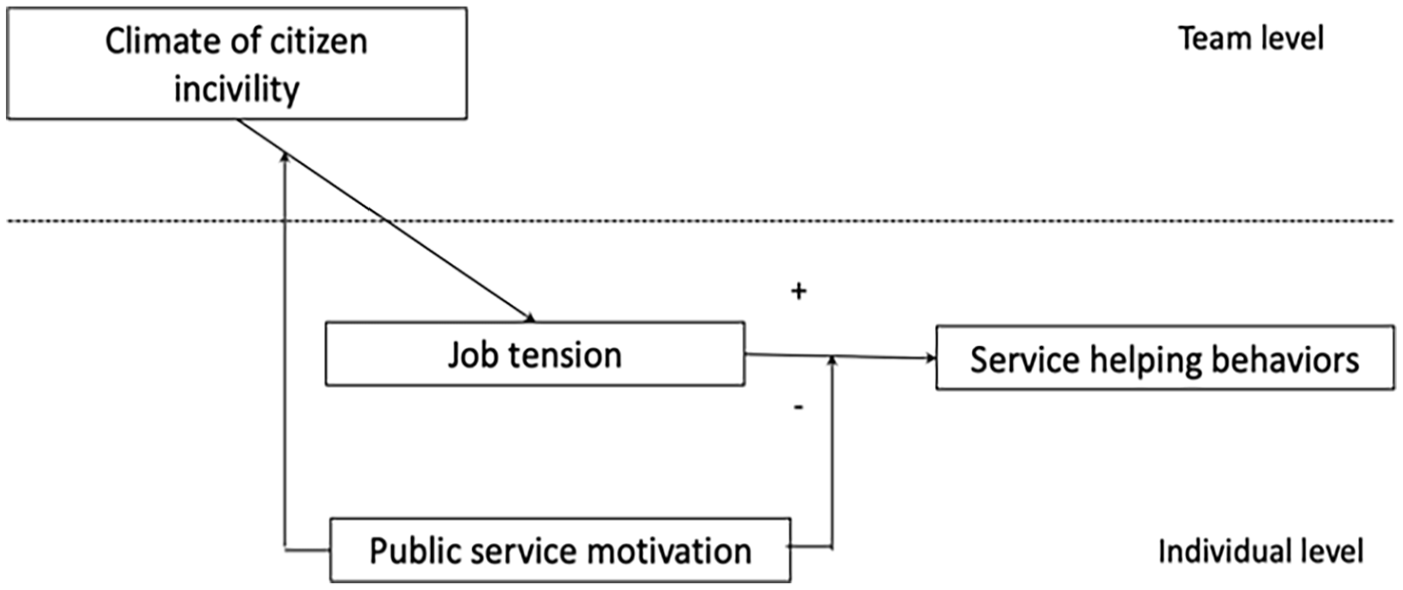
Research model.
Method
Sample and Research Design
The data analyzed in this article were collected as part of a wider research project implemented in partnership with the Quebec Public Library Association (QPLA). A total of 305 autonomous libraries are members of the QPLA. Collectively, they serve more than 80% of the Quebec population. We expected this study context to be especially suited to our research question. First, employees in libraries have frequent contacts with citizens; serving users is a core aspect of their job. Second, libraries, similar to other public places where any citizen is authorized to enter, are places where employees must deal with difficult patrons (D. L. Smith et al., 2020).
An invitation to participate in our research was sent to all 305 libraries. Of this number, 158 agreed to participate, representing a total of 2,037 employees managed by 175 supervisors. The data were collected with an online questionnaire measuring citizen incivility, job tension, and public service motivation, among other variables. The library supervisors completed a questionnaire in which they evaluated the behaviors of each employee under their supervision. Following this data collection process, we collected 947 employee questionnaires (return rate of 46%) and 97 supervisor questionnaires (return rate of 55%). We eliminated the questionnaires for which we were unable to match the two sources (i.e., employees and supervisors), or for which we had too many missing variables. Finally, given that CIC is conceptualized as a group-level variable, we also excluded questionnaires from libraries with fewer than three employees who took part in the study.
The final sample is composed of 734 employees and 77 supervisors. Among the 734 remaining participants, 82.15% are women; the average age of all employees is 45.2 years, and the average tenure is 9.09 years. The average age of the 77 supervisors is 46.18 years, and the average tenure is 12.39 years. The employee-supervisor dyad has an average tenure of 5.14 years. Finally, the libraries that took part in our study have 14.53 employees in average.
Measures
We used previously validated scales to measure our variables. Given that Quebec is a French-speaking province of Canada, we translated the original variables into French, and back translated them into English (Schaffer & Riordan, 2003). The scales were based on a 7-point Likert-type going from 1 = strongly disagree to 7 = strongly agree. The items used to measure each variable are presented in the Appendix. The mean of the items was used to indicate a scale score.
Citizen Incivility
We used the eight-item scale developed by Dormann and Zapf (2004) to assess citizen incivility. The scale was originally designed to measure customers’ behaviors as a stressor. One factor is called “disproportionate customer expectations.” It refers to customers’ attitudes and behaviors that transcend what is considered reasonable and acceptable. The factor is consistent with other measures of customer incivility (Wilson & Holmvall, 2013). We changed “customers” to “citizens” when using Dormann and Zapf’s scale. A sample item is: “Citizens vent their bad mood out on us” (Cronbach’s alpha = .90).
Job Tension
We used the seven-item scale developed by House and Rizzo to measure job tension (Fields, 2002). The authors built their measure from the Taylor Manifest Anxiety Scale and validated it among 200 employees. The initial list of items has been refined and reduced by House and Rizzo to the seven items we used. A sample item is: “Problems associated with my job have kept me awake at night” (Cronbach’s alpha = .89).
Public Service Motivation
We measured PSM with four items extracted from Perry’s (1996) scale. The initial scale includes 24 items grouped around six dimensions. We limited our measure to the dimension labelled “commitment to the public interest” and used four items that the authors kept after the scale revision. A sample item is: “Meaningful public service is very important to me” (Cronbach’s alpha = .82).
Service Helping Behaviors Rated by Managers
Library managers assessed each of their subordinates’ service helping behaviors with three items that we adapted from Podsakoff et al. (1990). The authors developed a five-item scale based on Organ’s (1988) definition of helping behaviors. We selected the three items that could be easily transposable to the context of citizens’ helping behaviors in libraries. For example, we changed “help others who have heavy work load” by “help others who are overloaded with user service” (Cronbach’s alpha = .95).
Control Variables
At the individual level, we controlled for the influence of gender and job tenure. At the group level, we controlled for team size, because size may influence the interactions and dynamics among team members, and hence the climate among them (e.g., Wheelan, 2009).
Analyses and Results
Analytical Strategy
We led analyses following two main steps: we first performed confirmatory factor analyses to assess the measurement model validity using the Lavaan package in R (Rosseel, 2012). We then tested our hypotheses using the lme4 (Bates et al., 2015) and mediation (Tingley et al., 2014) packages. Analyses were all performed with R 4.0.3 software.
Measurement Issues: Confirmatory Factor Analyses
We conducted confirmatory factor analyses (CFAs) to examine the adequacy of our measurement model at the individual level. We first tested the hypothesized four-factor model, in which citizen incivility (at the individual level), job tension, public service motivation, and service helping behaviors formed four distinct factors as expected. Results showed that this model yields a good fit to the data (χ2(203) = 925.06, p < .001, CFI = 0.92, TLI = 0.91, SRMR = 0.04, RMSEA = 0.07). To ensure the discriminant validity of our measure, we compared this model to a two-factor model in which the employee-rated constructs (citizen incivility, job tension, public service motivation) were combined on a single factor (χ2(208) = 4,105.57, p < .001, CFI = 0.57, TLI = 0.52, SRMR = 0.16, RMSEA = 0.16), and a one-factor model in which all variables were combined in a single factor (χ2(209) = 6,217.67, p < .001, CFI = 0.33, TLI = 0.26, SRMR = 0.18, RMSEA = 0.20). Overall, the hypothesized model provides a significantly better fit to the data than the two alternative models [two-factor model: Δχ2(5) = 3,180.51, p < .01; one-factor model: Δχ2(6) = 5,292.61, p < .01]. All items significantly load on the expected factor (loadings ≥0.56). In addition, the average variance extracted (AVE) scores for citizen incivility, job tension, public service motivation, and service helping behaviors were above the .50 threshold (.52, .54, .81, and .95, respectively) and the composite reliability (CR) scores were well above .70 (.89, .89, .81, and .95), indicating convergent validity (Fornell & Larcker, 1981).
Data Aggregation
Given that we expected to examine incivility climate as a library-level construct, it was necessary to assess the viability of aggregating the employees’ responses at the group level. We calculated (1) rwg(j) and (2) intraclass correlations (ICC1) as measures of agreement within groups. The average rwg(j) across the 77 libraries was .77, indicating strong agreement (LeBreton & Senter, 2008). The ICC(1) was .09, F = 2.03, p < .001, suggesting a moderate group effect (Bliese, 2000). Overall, the results support the aggregation of incivility climate at the group-level. We thus aggregated the data for this variable at the group level by averaging the individual scores for each library.
Descriptive Statistics and Correlations
Means, standard deviations, Cronbach’s alphas and intercorrelations between variables are displayed in Table 1. All control variables are significantly correlated with our variables. Gender and tenure are correlated with service helping behaviors (r = .12, p < .01; r = .12, p < .01) and team size is correlated with CIC (r = .26, p < .01). We thus retained all control variables in the following analyses. In line with our hypotheses, we also find that job tension is negatively correlated to service helping behaviors (r = −.15, p < .01).
Means, Standard Deviations, and Correlations With Confidence Intervals.
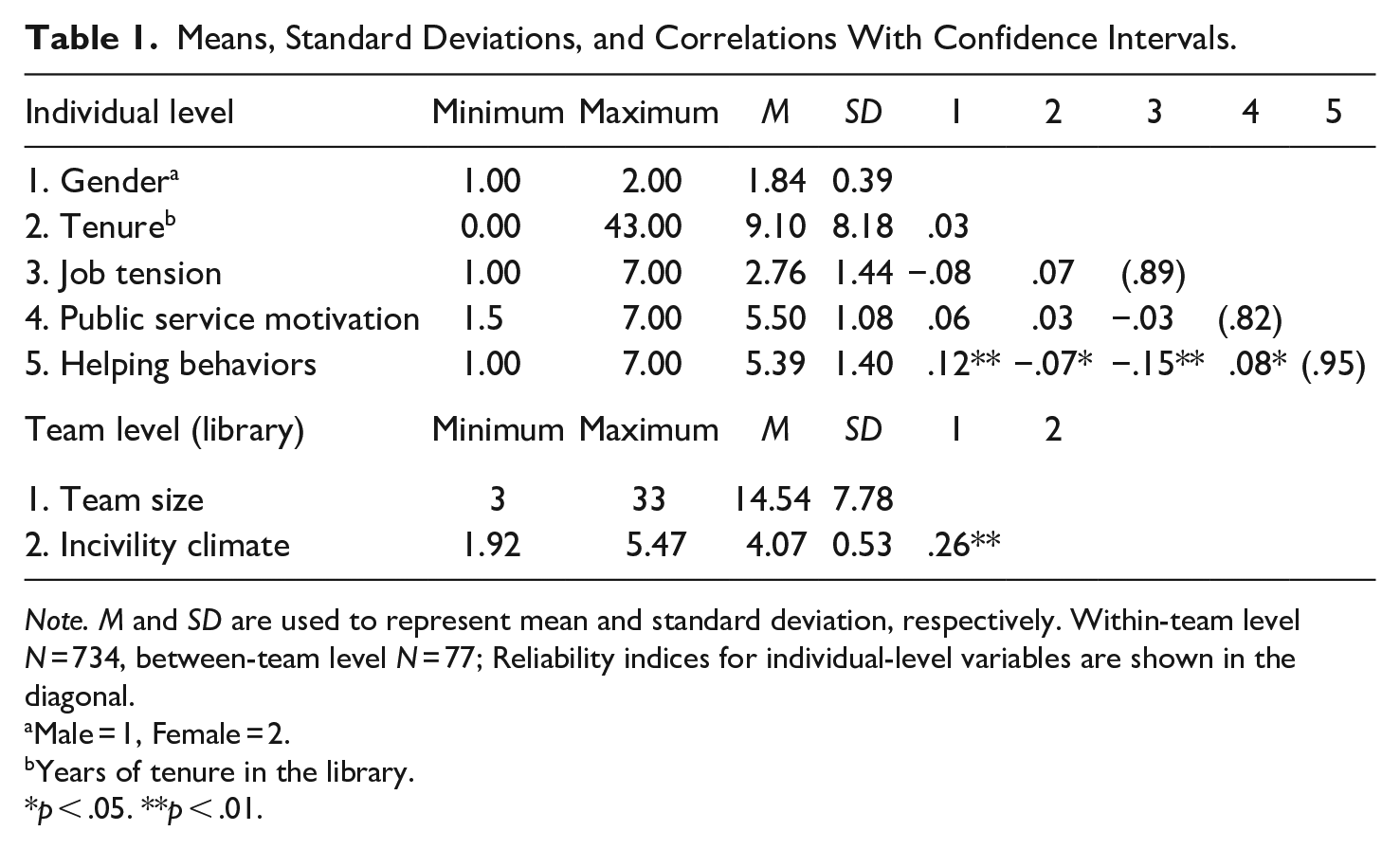
Note. M and SD are used to represent mean and standard deviation, respectively. Within-team level N = 734, between-team level N = 77; Reliability indices for individual-level variables are shown in the diagonal.
Male = 1, Female = 2.
Years of tenure in the library.
p < .05. **p < .01.
Multilevel Analyses
We performed several multilevel regression models to test our research hypotheses. Before testing Hypotheses 4 and 5, we also mean-centered all predictive variables (Aiken et al., 1991). Table 2 shows the results of these analyses. Model 1 includes both individual- and library-level control variables and the CIC variable as predictors of job tension to test Hypothesis 1. As shown in Table 2, CIC is positively related to job tension (estimate = 0.31, p < .01). Model 3 regresses job tension on service helping behaviors, controlling for the other variables. Results indicate that job tension is negatively related to service helping behaviors (estimate = −0.10, p < .001), supporting Hypotheses 2. Results of bootstrap analyses of the indirect effects of CIC on helping behaviors (estimate = −0.03, 95% CI [−0.07, −0.01], p < .01) support hypothesis 3. However, the significant relationship between CIC and service helping behaviors, after controlling for job tension, suggests that the mediation is partial, not full. Lastly, models 2 and 4 add the moderator and the interaction effects to the analyses to test hypotheses 4 and 5. Results indicate that PSM does not moderate the relationship between CIC and job tension (estimate = −0.04, n.s.), but show a significant moderating effect of PSM on the relationship between job tension and service helping behaviors (estimate = 0.08, p < .01), providing support for hypothesis 5 only. Our results also show a significant direct relationship between PSM and service helping behaviors (estimate = 0.14, p < .01).
Multilevel Regression Analyses.
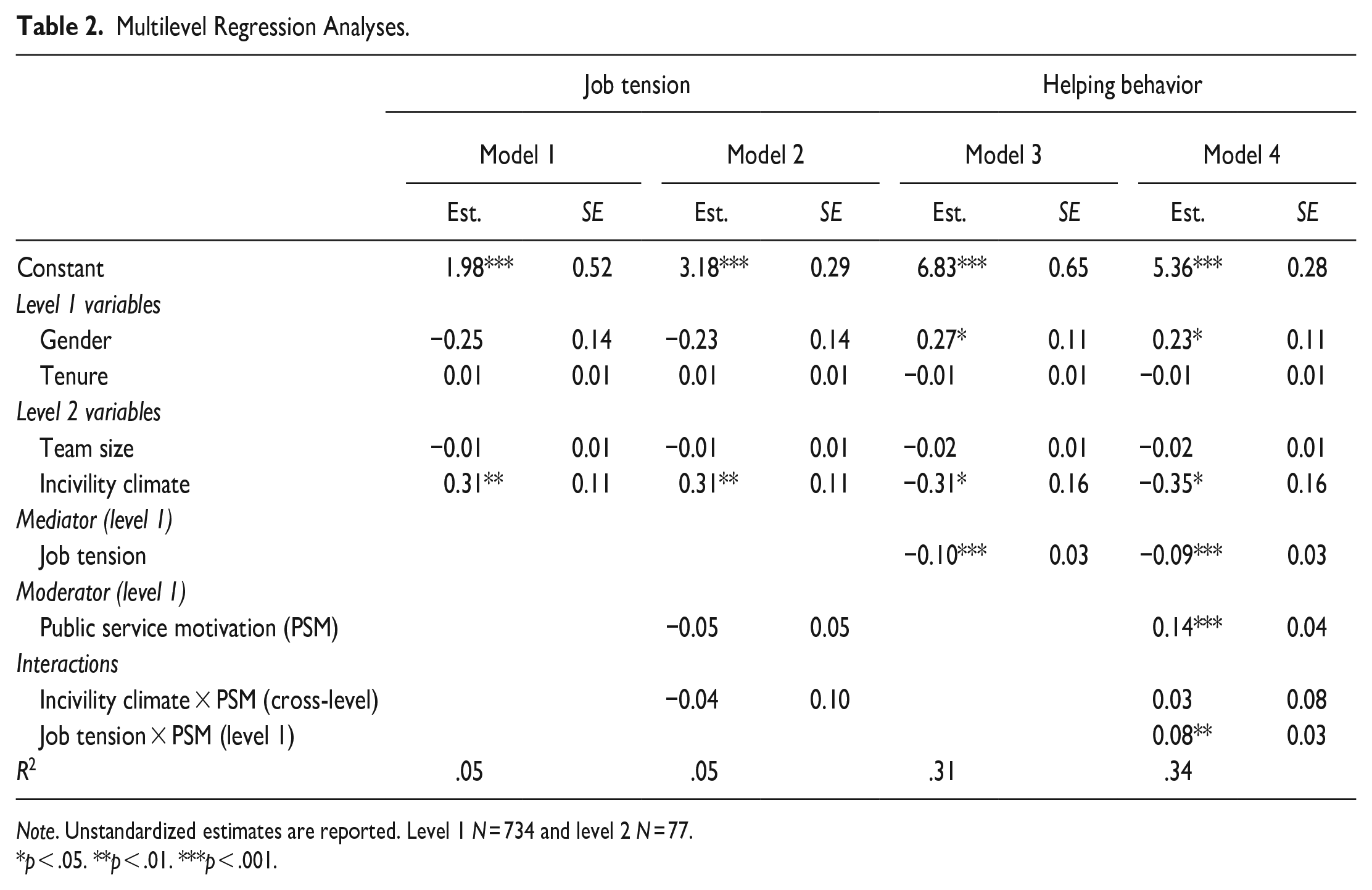
Note. Unstandardized estimates are reported. Level 1 N = 734 and level 2 N = 77.
p < .05. **p < .01. ***p < .001.
To further understand the significant moderation relationship, we tested the link between job tension and service helping behaviors at three levels of PSM: one standard deviation below the mean, the mean, and one standard deviation above the mean. Figure 2 shows the graphic representation of the slopes at low and high levels of PSM. As can be seen, the relationship between job tension and service helping behaviors is negative and significant at low levels of PSM. When PSM is high, the relationship loses significance.
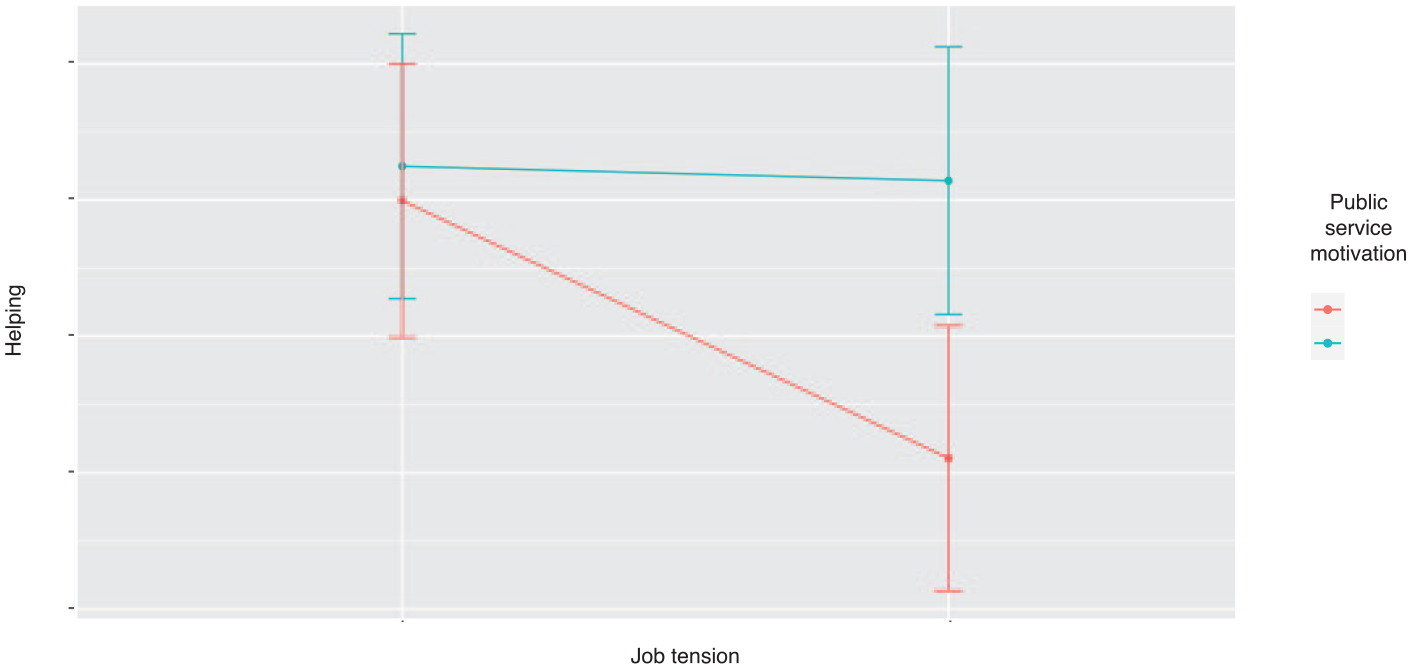
Moderating effect of public service motivation on the job tension–service helping behaviors relationship.
Discussion
Our study aimed to explore the effects of CIC on employees working in the context of public administrations. The results of our multisource multilevel research, implemented in 77 Canadian public libraries, indicate that CIC is negatively related to service helping behaviors, and that this relationship is partially mediated by job tension. We also established that public service motivation not only buffers the job tension–service helping relationship but is also directly related to service helping behaviors. We now turn to the discussion of our results.
Theoretical Implications
Our results enrich the literature on the effects of CIC on employees’ attitudes and behaviors. The first original contribution of our study lies in the conceptualization of incivility as a climate. Whereas evidence regarding the impact of incivility on employees is well established in private sector organizations at the individual level (Cortina et al., 2001; Schilpzand et al., 2016; Sliter et al., 2012), we still lack knowledge about the effects of incivility as a climate. Investigating incivility as a group-level phenomenon is important because it can have a pervasive effect on employees’ attitudes and behaviors. Indeed, the incivility climate is a dimension of the organizational environment that expresses shared beliefs by group members (Patterson et al., 2005), and acts as a stressor by shaping a culture of threat. Our study is among the first, to our knowledge, to demonstrate that CIC is related to employees’ job tension and, in turn, to employees’ service helping behaviors. By using a multisource research design, we provide empirical evidence of the negative impact of incivility climate on service helping behaviors and the stress process associated with such work climate.
Our results also extend the literature on public organizations. Despite the importance of citizen service for those organizations, few studies have explored the role of incivility perpetrated by citizens. Vraimaki et al. (2019) noted that employees reported experiencing negative feelings such as anger, irritation, nervousness, or disappointment when faced with users’ uncivil behaviors, but reported mild behavioral reactions to user incivility, a result that the authors admitted could be tainted by the self-reported nature of their data (Vraimaki et al., 2019). Our study builds on and extends these results. Measuring the behavioral reactions of employees in a more objective way (supervisor rating), we observe that CIC acts as a stressor in the context of libraries and, through a process of resource depletion, leads to reduced service helping behaviors. The partial mediation observed in our study suggests, however, that resource depletion does not fully explain the effect of CIC on employee helping behavior, and that other intermediate mechanisms may be at play. For instance, employees who work in environments characterized by high levels of CIC may develop generalized negative perceptions of citizens over time and reduce their helping behaviors as a form of retaliation to punish them (Miner et al., 2018). More research is needed to further explore these associations, but our results indicate that an incivility climate is detrimental to the overall functioning of libraries, which directly impairs the quality of public service.
Contrary to what we expected, our results indicate that the level of stress induced by CIC does not differ depending on whether the employee has a low or high level of PSM. This finding runs counter to the JD-R approach to PSM, which positions PSM as a resource that will help employees deal with environmental demands and thus reduce stress (Bakker, 2015). A possible explanation is that PSM may, in certain environments, be both a bright
Nevertheless, our results show that PSM is a key resource in that it not only buffers the negative effect of job tension on service helping behaviors, but also directly impacts employees’ service helping behaviors. The prosocial nature of PSM and the fact that this form of motivation underlies the mission of serving the public interest (Perry & Wise, 1990) help employees channel their energy to offer quality service to citizens despite experienced strain (job tension). These results are consistent with the literature that argues that resources can have both a direct effect and an interaction effect on employees’ behaviors (Bakker, 2015). Overall, our results show that employees who work in libraries with a high CIC will experience strain and reduce their helping behaviors toward citizens. However, even if they experience stress, those with high levels of PSM will be better able to cope with it, which will alleviate the impact of job tensions on the quality of service provided.
Practical Implications
Although the library is commonly perceived as a peaceful and relaxing place, our research shows that it can harbor a stressful climate of citizen incivility with which library employees must cope, hindering the adoption of service helping behavior. As such, it is important for library leaders to take actions to prevent the emergence of high CICs. Developing a policy on incivility aimed at both employees and users of the library, communicating it, and developing intervention tools to empower employees who are confronted with uncivil behaviors from citizens are among the means identified to avoid the emergence of incivility climates such as the one we measured here (Vraimaki et al., 2019). However, before considering such actions, leaders should also take a reflective look at the needs of citizens that, if met, could mitigate incidences of incivility. Libraries have changed significantly in recent years. In Canada, as in many other countries, libraries have evolved into a “third place,” a space to spend time distinct from home and work, which contributes to the vitality of the community (Oldenburg, 1989). The library is no longer a silent place for borrowing books; it is also a place for story time, yoga, meetings, board gaming events, and more. This trend has changed what is considered an appropriate user behavior or an acceptable user demand. Accompanying both users and employees in this transition as to what uncivil behavior entails can also be part of the solution.
In addition, PSM counteracts the negative effects of job tension on service helping behavior. Hiring employees who are highly motivated to serve the public and developing this type of motivation among the employees seems to be an effective way to ensure quality service to citizens. To that end, library managers are of utmost importance because they serve as credible role models and play a significant role in communicating and demonstrating the mission and values of public service (Jacobson, 2011).
Limitations
Despite its contributions, our study is not without limitations. First, in terms of methodology, full scales were not used to assess public service motivation and helping behaviors, and we adapted some items to fit the library context. Nonetheless, our results provide statistical evidence for the validity and reliability of our measures.
Second, the cross-sectional design of our study prevents us from ruling out endogeneity concerns. The purpose of our study was to assess employees’ reactions to CIC in libraries. However, it could be argued that collective helping behaviors also impact citizen incivility and reduce such behaviors. Research in the private sector has shown that customer incivility can sometimes be a response to behaviors initiated by employees (Sliter & Jones, 2016). Further studies should thus consider longitudinal or diary approaches to examine reverse causation or spiraling effect of (in)civility over time.
Third, we focused our data collection on libraries in Quebec. As such, our results cannot be generalized to other public organizations. Libraries are places where people come to read, have fun, and enjoy a relaxing atmosphere. It is thus likely that greater citizen incivility could be found in other public organizations such as tax centers, or among other public occupations such as police officers. Replicating our study in other contexts is necessary to validate the existence of a CIC and generalize our results.
Conclusion
Our study’s goal was to look at an overlooked topic in public administrations: climate of citizens’ incivility (CIC). We highlight that CIC may have consequences on public servants’ job tension and behaviors, but that resources exist to counter such detrimental effects. One resource that public servants are likely to possess is PSM. Our study opens the door to future research that grasp the citizen – state encounter like CIC. Il also raises the importance of identifying resources like PSM that are specific to public organizations and may help improve the experience regarding the citizen – employee relationship.
Footnotes
Appendix
Declaration of Conflicting Interests
The author(s) declared no potential conflicts of interest with respect to the research, authorship, and/or publication of this article.
Funding
The author(s) disclosed receipt of the following financial support for the research, authorship, and/or publication of this article: the Social Sciences and Humanities Research Council of Canada. Grant No 435-2017-1000.
