




Abstract
The COVID-19 pandemic brought disruptions to government workplaces, including abrupt transitions to remote work for many employees. Remote work can offer a physically distant environment and greater flexibility for individual employees and organizations; remote work also creates or exacerbates potential work-life balance tensions. Drawing on Job-Demands Resources theory, we propose that two organizational resources, instrumental leadership (a vertical organizational resource) and a sense of social belonging (a horizontal organizational resource), help prevent burnout by alleviating conflict between work- and family-life activities. Using survey responses from local government employees collected during the COVID-19 pandemic (May 2020), we show that employees with a strong sense of social belonging experience less work-family conflict and, in turn, report lower levels of burnout. We also find that social belonging, as a horizontal organizational resource, appears more important for reducing burnout in a period characterized by disruption than the more formal, vertical resource of instrumental leadership.
Keywords
With the COVID-19 pandemic, public employees across many functions and levels of government made abrupt transitions to working remotely on a part- or full-time basis. Remote work, such as from one’s home, can offer a safer working environment by increasing adherence to physical distancing guidelines and, potentially, providing greater flexibility for individual employees and organizations. However, remote work might create or even exacerbate potential tensions as individuals seek to navigate and recalibrate a new equilibrium between work- and family-life responsibilities. The conflict between work and other life responsibilities such as family is an important antecedent of stress and burnout (e.g., Beauregard & Henry, 2009; Giauque et al., 2019). Therefore, a fundamental challenge for public sector human resource management (HRM) scholars and professionals is to identify core resources that can mitigate work-family conflicts and defend against negative trickle-down effects on employees’ psychological well-being. This challenge to promote employee well-being has been propelled to the forefront by the COVID-19 pandemic. Yet, the saliency of employee well-being extends beyond major crises and is critical for understanding the day-to-day functioning of public organizations.
Existing scholarship considers how different organizational resources, like job control/autonomy, rewards, employer-related childcare, and social support (Feeney & Stritch, 2019; Hsieh, 2014), and policies, like telework (De Vries et al., 2019) or family-friendly leave and scheduling policies (Feeney & Stritch, 2019), mitigate work-family and work-life conflicts by alleviating burnout and supporting work-life balance. With the swift transition to working from home that occurred during the COVID-19 pandemic, established organization policies and resources utilized routinely in periods of relative stability might prove less effective in supporting employees. Identifying organizational resources that employees might access to mitigate immediate term stress and burnout during periods of disruption can help public sector organizations protect and foster psychological well-being among its most critical resource: its employees.
Drawing on Job-Demands Resources (JD-R) theory, we ask, “Do two organizational resources, instrumental leadership and a sense of social belonging, help prevent employee burnout by alleviating work-family conflict?” To answer this question, we distinguish conceptually between horizontal and vertical resources based on where and how employees access these resources in the organization. In our paper, instrumental leadership is a vertical resource, initiated by an employee’s supervisor, and comes from formal positions of authority in the organization’s hierarchy. Instrumental leadership focuses on the day-to-day actions of these supervisors and combines visionary leader actions with path-goal facilitation, strategy, and environmental monitoring. A sense of social belonging reflects a horizontal resource that comes from an employee’s lateral contacts, such as their peers and coworkers. A sense of belonging reflects positive social relationships that can be utilized by employees to help manage changes in work demands. Through the lens of JD-R theory, the COVID-19 pandemic, and its subsequent disruptions to work environments, can be seen as an increase in job demands, which places strain on the psychological well-being of government workers. According to JD-R theory (Bakker & Demerouti, 2007), job resources counteract the toll of greater job demands. We propose that both instrumental leadership and a sense of social belonging represent organizational resources that enable individuals to manage the increased demands COVID-19 placed on navigating work and family activities and, in turn, mitigate employee burnout.
We test our theoretical mediation model using survey data from municipal employees in a large city in the southwest United States. Data were collected during the COVID-19 pandemic (May 2020) affording us a unique opportunity to study the complex relationships between organizational resources and local government employees’ psychological well-being. The results from structural equation modeling lend preliminary support to our theoretical propositions. We show that the organizational resources of instrumental leadership and a sense of social belonging negatively correlate with work-family conflicts. Furthermore, a statistically significant indirect relationship between a sense of social belonging and job burnout is observed, indicating that work-family conflict works as a mediating factor. In contrast, the mediating role of work-family conflict for the instrumental leadership–burnout relationship is characterized by more uncertainty.
Our results offer two immediate, and important, implications about the potential negative effects on employee psychological well-being amid the COVID-19 pandemic for public sector HRM scholars and professionals. First, a sense of social belonging to a group at work stands out as a critical and vital resource for mitigating work-family conflict and, in turn, reducing feelings of burnout. HRM professionals may want to link the results of this study to emerging findings on how to foster social belonging affirmations in public workplaces (e.g., Linos et al., 2021). Second, instrumental leadership might alleviate work-life conflicts, presumably by providing employees with resources that are critical for goal achievement, such as knocking down barriers to task completion, providing feedback, and emphasizing collective identities through visions and other strategic communications.
COVID-19 and Workplace Changes
A crisis is a high impact event “characterized by ambiguity of cause and effect and means of resolution, as well as by a belief that decisions must be made quickly” (Pearson & Clair, 1998, p. 60). During the unfolding of the COVID-19 health crisis, public organizations needed to transform workplace structures almost overnight to help slow the spread of SARS-CoV-2 while still providing public services to local communities. For many government workers, this transformation meant working in alternate settings, often in one’s home. A vast existing literature on organizational change highlights the deleterious effects of uncertainty and ambiguity on a workforce under rapid, sudden, or unexpected change efforts (e.g., Oreg et al., 2011; Stanley et al., 2005).
Shifting to working from home requires significant adaptations, including new work routines, deployment of new technologies, and separation from coworkers and peers. Consequently, individuals may have felt a loss of control, increased cognitive strain from navigating and implementing required changes, and increased social isolation. Disruptions to workplace structures and routines were compounded by the disruptions to other critical social and educational institutions. This shift to working from home exacerbated the demands on individuals, such as the need to facilitate and deliver curricular activities for children or assume extra care responsibilities for elderly relatives (Garbe et al., 2020; Hashikawa et al., 2020; O’Donnell, 2020). Empirical research is only beginning to emerge on the psychosocial outcomes for employees during the COVID-19 pandemic’s transformation of the public workplace (e.g., Sadiq, 2020; Sokal et al., 2020). It is therefore critical that we expand our insights to phenomena core to employee psychological well-being, including our focal constructs of work-family conflict and burnout. We begin by considering the role the job demands-resource theory and the role of vertical and horizontal resources in promoting employee well-being.
A Job Demands-Resources (JD-R) Perspective
Job burnout is a combination of physical, emotional, and psychological fatigue due to work-related stress and emotional turmoil and can potentially result in the depersonalization of clients and loss of any sense of personal achievement (Kristensen et al., 2005; Maslach & Jackson, 1981). Burnout, and questions of how to prevent it, attracts attention among organizational and work psychologists, and, more recently, public sector HRM scholars, often because of its empirical associations with withdrawal behavior such as turnover (e.g., Linos et al., 2021). The extent to which burnout is prevalent in the workplace is quite alarming. In a 2018 poll (Wigert & Agrawal, 2018), 23% of employees report feeling burnt out at work very often or always, while an additional 44% report feeling burnt out sometimes. More directly relevant to our study, Sciepura and Linos (2021) find burnout rates of 33% in a survey of 3,324 public sector employees conducted in April and May of 2020, at the height of initial workplace disruptions in the wake of the COVID-19 pandemic.
Job demands-resources (JD-R) theory offers a useful starting point for examining burnout amid the COVID-19 pandemic and further exploring the drivers of employee stress, burnout, and work engagement in existing public sector HRM scholarship (e.g., Bauwens et al., 2019; Borst et al., 2019; Hsieh, 2014). A fundamental proposition in JD-R theory is that every individual is exposed to a mixture of demands and resources in their job. Demands refer to “the physical, social or organizational aspects of the job that require sustained physical or mental effort and are therefore associated with certain physiological and psychological costs” (Demerouti et al., 2001, p. 501). We find these demands in the physical and cognitive aspects of one’s job, including workload, relative time pressure, the ease or difficulty in working with clients, and other attributes such as uncertainty or ambiguity of the physical work environment. Job demands, when left unmatched by corresponding resources, lead to negative outcomes such as role conflict, stress, and withdrawal as employees must increase their efforts to successfully complete tasks (Bakker & Demerouti, 2007).
As alluded to, job demands do not necessarily cause deleterious effects on individual psychological well-being—especially if an appropriate set of job resources counterbalance the job demands. In this perspective, resources refer to the “. . .physical, psychological, social, or organizational aspects of the job that may do any of the following: (a) be functional in achieving work goals; (b) reduce job demands and the associated physiological and psychological costs; and (c) stimulate personal growth and development” (Demerouti et al., 2001, p. 501). Job resources take on many manifestations and include feedback on job performance, intrinsic or extrinsic rewards for work, job autonomy, participation in group processes, and support from supervisors and colleagues (Bakker & Demerouti, 2007).
We conceptualize job resources along two dimensions, both of which possess the potential for offsetting the deleterious effect on employee burnout amid the COVID-19 pandemic. The first dimension reflects vertical resources, which typically embody resources originating from the formal, vertical structures of the organization. Key examples of vertical resources include goal setting, performance feedback, and formal strategies that facilitate task completion. An organization and an organization’s management are most likely initiating vertical resources. Vertical resources are linked to both performance and desirable psychosocial outcomes, such as job satisfaction (Bakker & Demerouti, 2007; Gregersen et al., 2016; Yang & Kassekert, 2010).
The second dimension captures horizontal resources, which are the resources employees can access from lateral structures, like coworker relationships, and include resources like social support and trust in coworkers (Audenaert et al., 2020). In contrast to vertical resources, horizontal resources might be more readily accessed by employees at their own discretion. Such resources might manifest themselves in the willingness of peers to troubleshoot problems or give assistance to a colleague. In times of change and disruption, employees might turn to these less formal, horizontal resources to help cope with stress, but also to engage in creative problem solving (Chiaburu & Harrison, 2008; Perreault et al., 2017; Wadsworth & Owens, 2007).
We now consider how two important job resources, one vertical (instrumental leadership) and one horizontal (social belonging), mitigate burnout by reducing work-family conflict. Work-family conflict is a critical construct and is particularly salient starting point for understanding the disruptions to employees’ work and personal lives resulting from the COVID-19 pandemic.
Work-Family Conflict and Burnout
An individual’s ability to balance work and other life obligations, and the subsequent psychosocial consequences of this balance, are important topics in public sector HRM research (Den Dulk & Groeneveld, 2013; Facer & Wadsworth, 2008; Feeney & Stritch, 2019; Giauque et al., 2019). When work and other life commitments are balanced, individuals experience better psychological and physiological health and greater organizational satisfaction (Haar et al., 2014). However, an imbalance or conflict between work and responsibilities in one’s personal life can drive a host of negative psychosocial outcomes, including emotional exhaustion, cynicism, and burnout (Allen et al., 2000; Geraldes et al., 2019).
We focus on the concept of work-family conflict, defined by Netemeyer et al. (1996, p. 401) as an “interrole conflict in which the general demands of, time devoted to, and strain created by the job interfere with performing family-related responsibilities.” As noted by Wadsworth and Owens (2007), considerable effort is placed on studying and understanding the directionality of the role conflict (i.e., life-work vs. work-life conflict; family-work vs. work-family conflict). Our interest is in understanding how resources from the work domain can mitigate burnout by providing support in the work domain. The COVID-19 pandemic forced a swift transition to remote work, primarily to facilitate the physical safety of employees. Employees were often left to navigate increased work demands characterized by considerable uncertainty from a distance while also managing increases in family demands due to the disruptions to child and adult care and K-12 education. This escalated potential for conflict between work and family demands increases the importance of understanding which organizational resources can minimize work-family conflict and feelings of burnout during periods of change and uncertainty.
Work-family conflict is an important antecedent of job burnout (Allen et al., 2000; Haar, 2006; Leineweber et al., 2014; Lambert et al., 2010; Lizano et al., 2014). Work-family conflict depletes an individual’s physical and psychological resources when they are seeking to manage the imbalance between work and family demands (Lizano et al., 2014); research shows that such conflict is significantly related to both workplace stress (Triplett, 1999) and decreased job satisfaction (Lambert et al., 2006). For employees experiencing high levels of work-family conflict, the depletion of physical and cognitive resources can manifest itself in the workplace through physical, emotional, and psychological fatigue, all of which are indicative of job burnout. We examine the following hypothesis:
H1: Work-family conflict is positively associated with burnout.
Instrumental Leadership
We now consider how organizations might deploy resources to mitigate work-life conflict and, in turn, decrease job-related burnout. The first resource is instrumental leadership. Leadership, by itself, is a vertical resource that organizations offer within the context of formal activities, usually as part of a manager’s initiative to serve employees. Recent research investigates the role ascribed to public managers and leaders in cultivating human resources in public organizations (e.g., Bellé, 2014; Jensen, 2018; Jensen & Bro, 2018; Sun & Henderson, 2017). The importance of leadership is particularly true in times of crises and uncertainty, as employees will look to leaders for guidance, vision, and resources (Klein & House, 1995; Tavares et al., 2021). While recent contributions stress the importance of leading with values and goals, concerns exist over the narrow scope and heavy reliance on particular behaviors associated with such concepts, like transformational leadership (Antonakis & House, 2014). Indeed, scholars call for more comprehensive or integrated views (Fernandez et al., 2010), arguing that the strategic elements of leadership need to focus on functional and practical complementarities.
Heeding this call, we follow Antonakis’ and House’s (2014) invitation to focus on instrumental leadership. Instrumental leadership is defined as “the application of leader expert knowledge on monitoring of the environment and of performance, and the implementation of strategic and tactical solutions” (p. 749). Instrumental leadership is a conceptual expansion of classical leadership models that focus on transformational leadership and task-oriented behaviors such as “initiating structure” (e.g., Fleishman, 1953). Unlike visionary, transformational, or charismatic leadership, instrumental leadership focuses on leaders’ actions related to vision, mission, and goals and on a more holistic set of activities. Instrumental leadership examines how leaders navigate the organizational environment and facilitate path to goal accomplishments by providing employees with feedback and resources. Path-goal facilitation is at the heart of instrumental leadership, showcasing its strong anchoring in task-oriented leadership by engaging in behaviors and “giving direction, support and resources, removing obstacles for goal attainment and providing path-goal clarifications” (Antonakis & House, 2014, p. 750). Instrumental leadership extends beyond a focus on initiating structure as instrumental leaders apply their expert knowledge to implement strategic and tactical solutions. Instrumental leaders continuously scan the external environment for resources and opportunities, bringing together a more comprehensive set of leader functions that encompass functional and strategic behaviors.
Instrumental leadership behaviors can limit workplace uncertainty and ambiguity experienced by employees. In particular, instrumental leaders can be expected to help employees cope with uncertainty and rapid transitions by redirecting attention to new goals, initiating new work structures and processes, and providing guidance and feedback to individual employees. Given the importance of strategic decisions during a time of crisis, instrumental leaders remove a significant amount of ambiguity for employees navigating transitions under conditions of uncertainty. By identifying how and when work needs to be completed and setting clear priorities in the wake of changes during the COVID-19 pandemic, instrumental leaders might refocus employee efforts on tasks essential to preserve the essential functioning of the unit and mitigate unnecessary increases to workloads. In contrast, leaders who are not particularly instrumental may focus less on setting new goals and thinking of ways to best perform or allocate work in the wake of shutdowns and work-from-home orders. Furthermore, leaders who are not instrumental might neglect to provide feedback following changes to workflows and work structures. In the wake of COVID-19 work-from-home orders, employees working for leaders who failed to act instrumentally might find themselves alone in navigating and adapting to changes without a path charted for the road ahead.
For these reasons, we expect employees of instrumental leaders to be able to better navigate and calibrate a new work-family equilibrium as a function of receiving adequate strategic and functional resources to counterbalance the demands incurred by COVID-19 and its disruptions to workplace structures. We hypothesize:
H2: Instrumental leadership is negatively correlated with work-family conflict.
Instrumental leadership and managerial behaviors that mitigate increases in job demands that arise from uncertainty and ambiguity on employees also reduce work-family conflict. In turn, an employee preserves their physical and cognitive resources and are less susceptible to any job-related burnout manifesting from this loss of capacity and resources. Existing research corroborates this notion by demonstrating a mediating effect of work-life conflict on the leadership-burnout relationship, with increased supervisor support reducing work-life conflict, which, in turn, reduces emotional exhaustion (Li et al., 2017; Yeh et al., 2020). Similarly, Che et al. (2017) demonstrate that passive leadership increases employee work-life conflict by heightening employee workload, in turn increasing burnout and decreasing psychological and physical well-being. On this basis, we expect the relationship between instrumental leadership and burnout to be mediated by work-family conflict. We hypothesize:
H3: Work-family conflict mediates the relationship between instrumental leadership and burnout.
Sense of Social Belonging
A second critical resource that might reduce demands in times of stress and uncertainty is an employee’s sense of social belonging in their organization (Bakker et al., 2005; Linos et al., 2021). We view a sense of social belonging as a horizontal resource; this resource is informal and reflects the quality of social relationships that employees might rely on to help with issues they experience in the workplace. Anant (1966) describes a sense of social belonging as a “sense of personal involvement in a social system so that persons feel themselves to be an indispensable and integral part of the system” (p. 21). According to Hagerty et al. (1992, p. 174), the two fundamental characteristics of belonging occur when: (a) an individual feels valued, needed, or important to other people and (b) when the person experiences a fit or congruence with these other people or groups. A sense of social belonging in an organization can develop into positive social relationships and supports that employees use as resources in navigating the demands of their job (Bakker et al., 2005).
A sense of social belonging can be important for managing work-family conflict in the wake of radical transitions in the workplace. Support from coworkers can help employees carry out their duties and cope with negative emotional reactions to stressful circumstances (see Bakker et al., 2005; Hsieh, 2014; Rhoades & Eisenberger, 2002). Wadsworth and Owens (2007, p. 77) argue coworker support can mitigate feelings of depression and isolation, increase communications, and reduce feelings of stress. We contend that a sense of social belonging reflects the quality of an employee’s social relationships within the organization. When high-quality social relationships are present in the organization, employees can informally engage with others to manage or mitigate work-family conflicts effectively (e.g., rearranging meetings to allow for caregiving responsibilities or accommodate an employee’s sharing of common space at home for work purposes). In contrast with instrumental leadership (and vertical resources), high-quality social relationships create informal pathways for employees to problem solve and manage role conflicts. Given the disruption of the COVID-19 pandemic to the workplace, we expect that individuals who report a higher sense of social belonging in the workplace will have additional social resources to draw from in navigating disruptions that drive role conflict. Our fourth hypothesis states:
H4: A sense of social belonging is negatively correlated with work-family conflict.
Work-family conflict is considered a potential mediator of the relationship between social support and negative psychosocial outcomes among employees in the workplace (e.g., Blanch & Aluja, 2012; Ford et al., 2007; Janssen et al., 2004). We contend that a strong sense of social belonging in the workplace reflects high-quality social relationships that can be accessed and utilized informally by an employee to minimize work challenges or disruptions interfering with family responsibilities. In turn, the reduction in work-family conflict will leave employees with more physical and cognitive resources to use in the workplace, minimizing feelings of job burnout. As such, work-family conflict represents a critical pathway for a sense of social belonging as a horizontal job resource to mitigate employee burnout. On this basis, we expect the relationship between a sense of social belonging and burnout to be mediated by work-family conflict. Our fifth and final hypothesis states:
H5: Work-family conflict mediates the relationship between a sense of social belonging and burnout.
Research Design and Data
To test our hypotheses, this study relies on cross-sectional survey data from a set of local government employees in the United States. Survey data were collected as part of a non-COVID related research project in a large city in the southwest U.S. (population >500,000) in May 2020. Respondents are employees from a wide range of departments, including water, fire and medical, community and library services, police, parks and recreation, and human resources. The timing of the survey affords a unique opportunity to study local government employees’ emotional well-being during the COVID-19 pandemic and helps identify organizational resources HRM professionals can use during disruptions and organizational uncertainty.
Respondents were contacted and asked to complete a survey about their immediate supervisor and provide additional information related to their own work experiences. Two reminders were sent to maximize the response rate. A total of 124 employees of an initial set of 241 contacts provided complete responses for a response rate of 51%. Respondents are almost evenly split on gender, with 50.8% identifying as women. While 35% of the city’s workforce identify as women, the even split in our subsample allows for a more balanced test of our hypotheses. This representation is especially important given popular observations that the brunt of caregiving and other family responsibilities during work-from-home transitions have fallen on the shoulders of women. The average tenure with the city is 8.24 years and a majority of respondents have some college experience (29.8%), a 2- or 4-year degree (36.3%), or a professional degree (25.8%).
Descriptive statistics and a correlation matrix for all study variables can be found in Tables 1 and 2. For the purpose of presenting descriptive statistics and correlation of study variables, we generate latent constructs using simple additive indexes in which items belonging to the same factor were added together and then rescaled to a 0 to 100 range.
Summary Statistics for Study Variables.
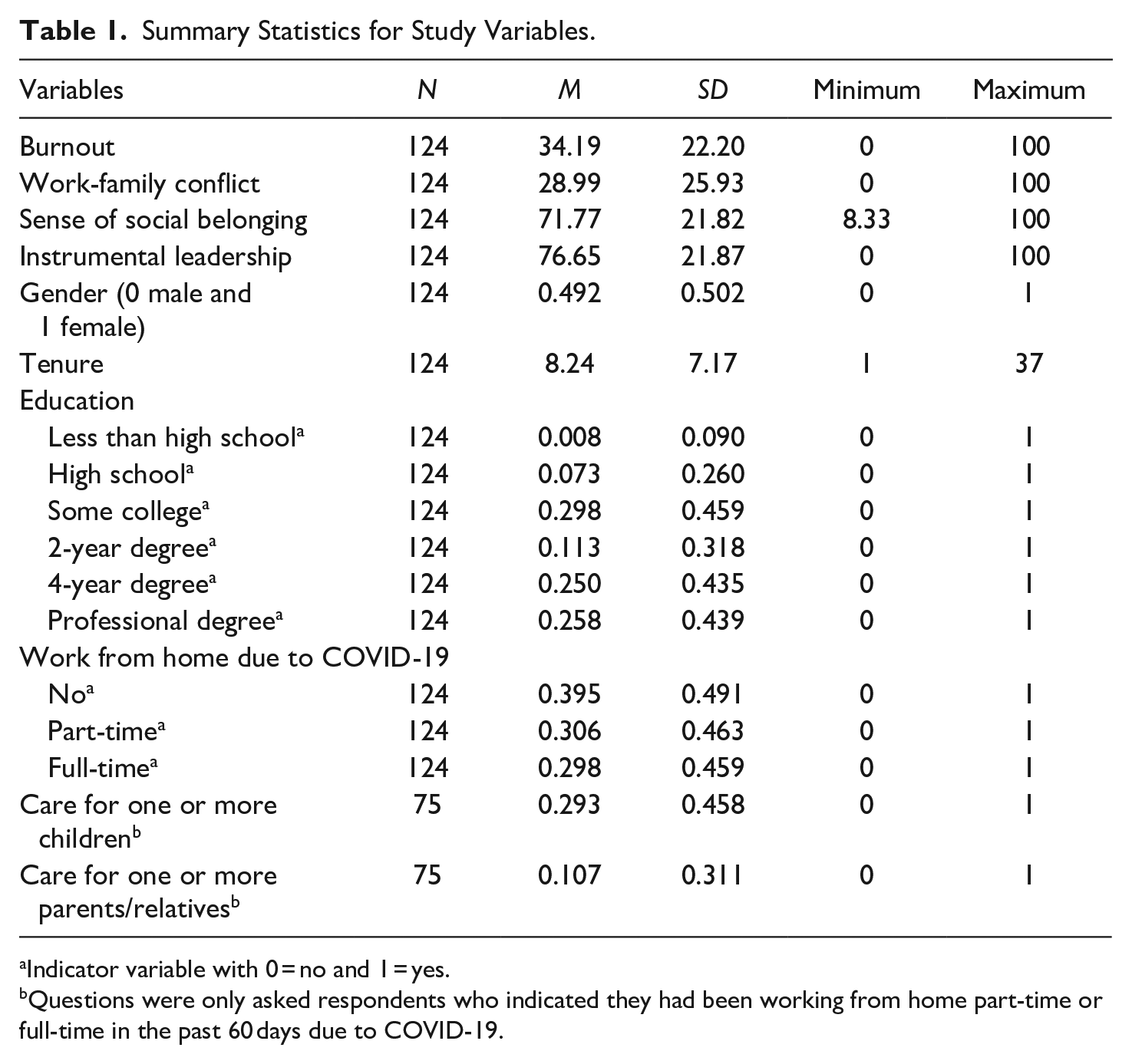
Indicator variable with 0 = no and 1 = yes.
Questions were only asked respondents who indicated they had been working from home part-time or full-time in the past 60 days due to COVID-19.
Correlation Matrix of Study Variables.
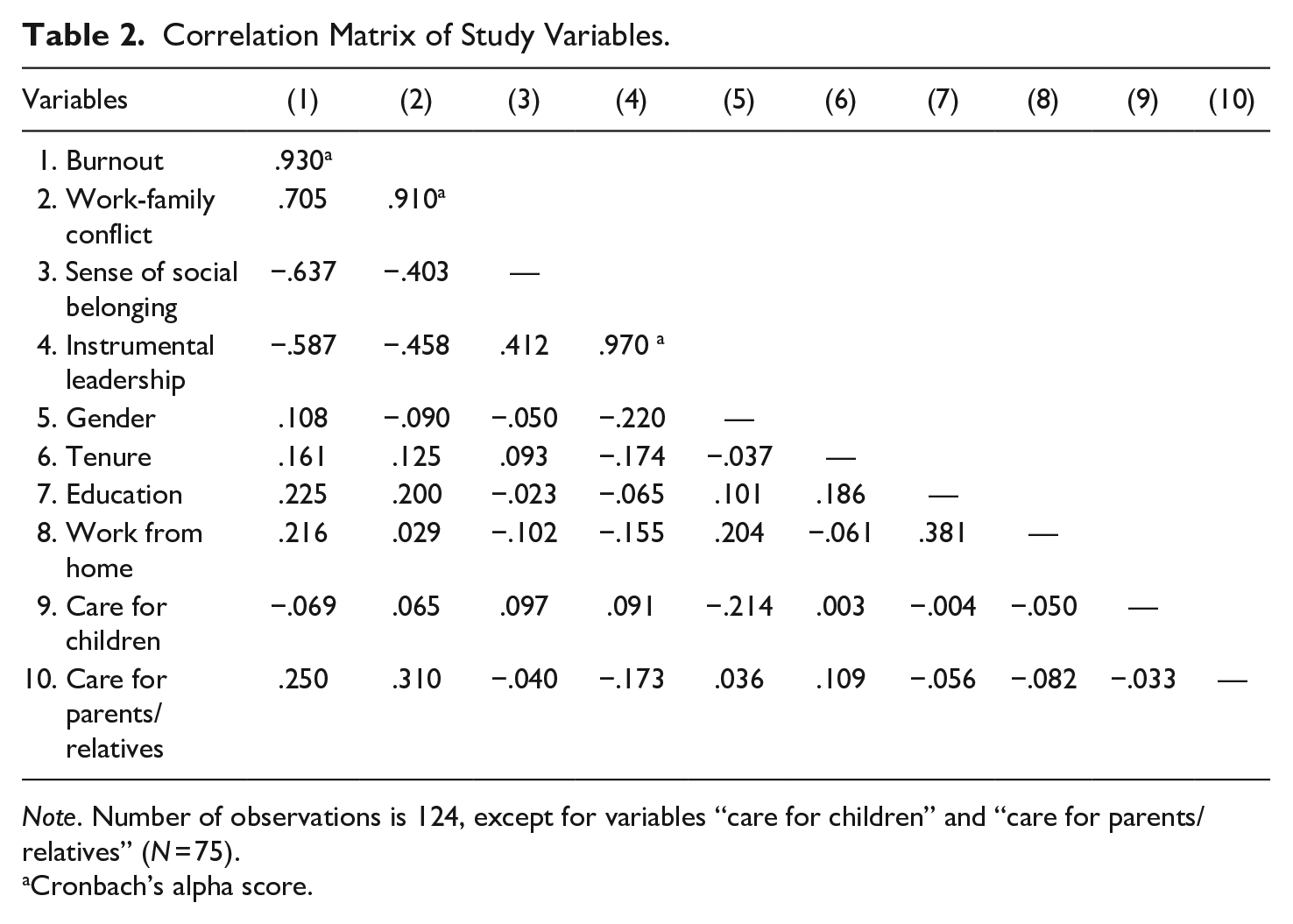
Note. Number of observations is 124, except for variables “care for children” and “care for parents/relatives” (N = 75).
Cronbach’s alpha score.
Measurement
As part of the survey, we use several established and validated instruments to capture the main constructs of our study: burnout, work-family conflict, instrumental leadership, and a sense of social belonging. These constructs all represent latent variables and we present evidence from confirmatory factor analyses to support their psychometric properties.
We measure burnout using the Copenhagen Burnout Inventory (CBI; Kristensen et al., 2005). Burnout can stem from one of several domains, including stressors in one’s personal lives, job demands, and interactions with clients. Since our sample includes city employees with both administrative and service-oriented tasks, direct interaction with clients and residents is only relevant for a subset of our respondents. Moreover, personal burnout is similar, if not overlapping, with aspects of the work-family conflict construct. As a result, we focus on the subscale work-related burnout consisting of seven 5-point Likert scaled questions. 1 The internal consistency for our scale is high with a Cronbach’s alpha of .93. The wording of all items and their respective loadings can be found in Table A1.
We measure work-family conflict using three items from the Netemeyer et al. (1996) work-family conflict scale. This work-family conflict measure captures the extent to which job demands and duties infringe on one’s ability to perform family activities. We measure all three items using a 7-point Likert scale and show high internal consistency with a Cronbach’s alpha score of .91.
The work-family conflict and burnout constructs are closely linked as demonstrated by the simple bivariate correlation of .705 (i.e., constructs share about half of their variance). It is therefore crucial to demonstrate not only the validity of the individual constructs, but also their sufficient distinctiveness—that is, that our measures discriminate from each other. To this end, we run a two-factor model, with our 7-item burnout inventory and our 3-item work-family conflict instrument, and a reduced model in which all 10 items are constrained to load onto a single common factor. Standardized factor loadings are in all cases well above 0.50. The two-factor model fits our data well with χ2(32) = 47.73 (p = .036), CFI = 0.904, and RMSEA = 0.063, and significantly outperforms the constrained model: χ2(1) = 27.89 (p < .001), indicating both construct and discriminant validity of our burnout and work-family conflict measures.
To measure instrumental leadership, we rely on the 8-item measure developed and validated by Antonakis and House (2014). The measure captures each of the four factors of instrumental leadership: environmental monitoring, strategy formulation and implementation, part-goal facilitation, and outcome monitoring. Together, the factors are believed to capture “the application of leader expert knowledge on monitoring of the environment and of performance, and the implementation of strategic and tactical solutions” (Antonakis & House, 2014, p. 749). Due to our small sample size, we opt to treat the 8-item measure as a single-factor measure. A one-factor solution fits our data well: χ2(16) = 24.75 (p = .074), CFI = 0.892, and RMSEA = 0.067, and is only marginally outperformed by a four-factor model: χ2(2) = 6.63 (p = .036). Factor loadings are all above 0.50 and the scale shows excellent internal consistency with a Cronbach’s alpha of .97.
Finally, we follow Linos et al. (2021) to measure a sense of social belonging with two survey items: “There is someone at work I can talk to about my day-to-day problems if I need to” and “When something bad happens at work, I feel that maybe I don’t belong.” The latter is reversed coded for the purpose of our analyses. The items are moderately correlated at .341, suggesting these items capture some shared variation, but are also distinguishable.
Estimation
We estimate the full measurement and path models in conjunction using the structural equation modeling package sem in STATA’s version 16. The model specifies the latent factors as described above in the measurement section along with paths from a sense of social belonging and instrumental leadership to work-family conflict and from work-family conflict to burnout. We also include key respondent characteristics: gender, tenure, work from home status, and education. Finally, we estimate cluster robust standard errors by the department to account for the interdependence of employee observations reporting to the same leader.
Results
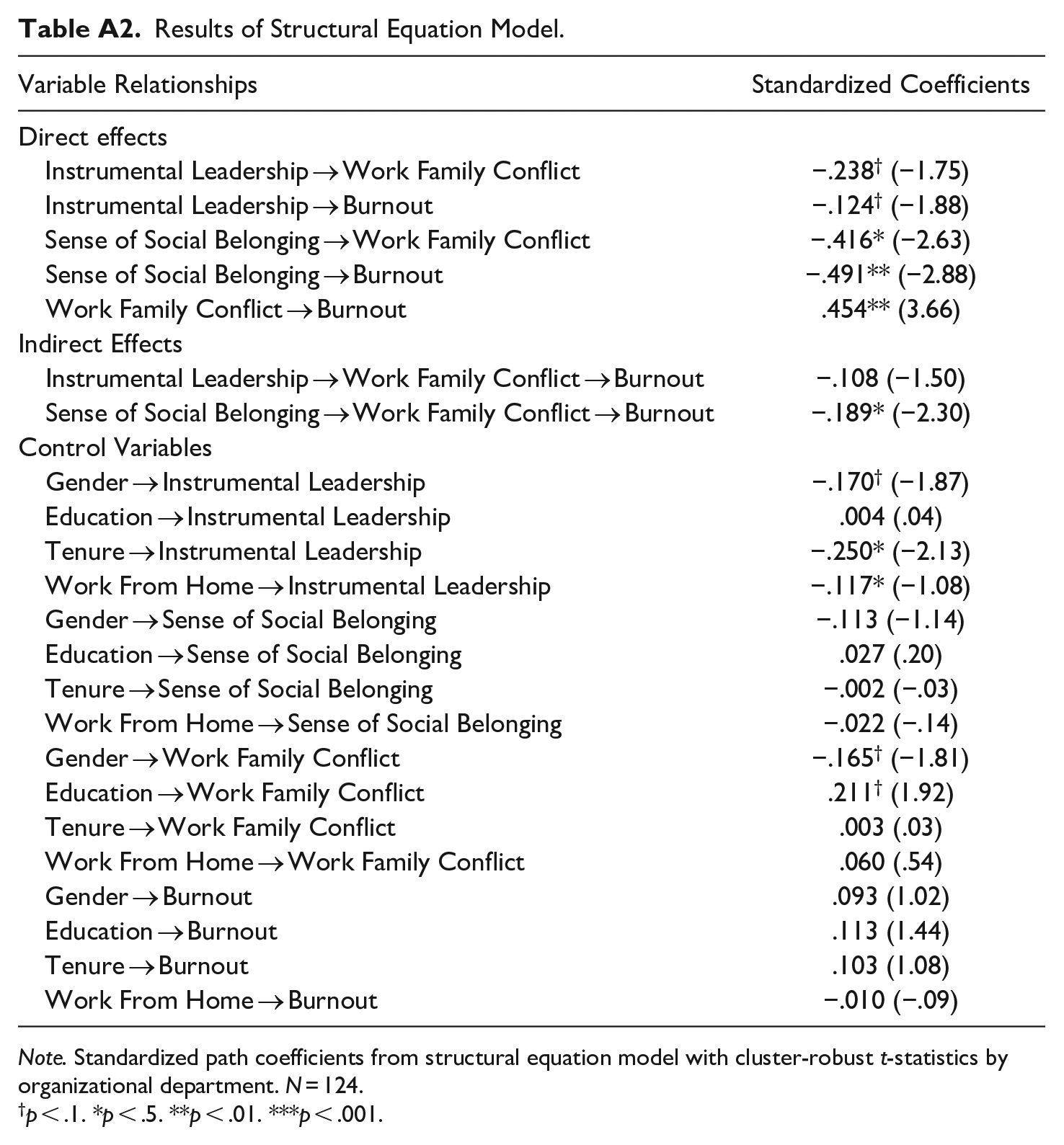
Figure 1 depicts our conceptual model, main hypotheses, and key findings. Full estimation results, including respondent control characteristics (gender, tenure, work from home, and education) can be found in Table A2. 2 The structural model provides a good fit to our data: χ2(223) = 314.19, p < .001, CFI = 0.962, and RMSEA = 0.058. Consistent with our expectations, we observe a positive and statistically significant association between work-family conflict and burnout. The standardized path coefficient is .454 (p < .01), supporting H1 and the argument that individuals experiencing more tension between work and family-life activities are likely to report higher levels of burnout. As such, it is crucial to identify the organizational resources that managers and HR professionals can cultivate to help mitigate work-family conflict that may, in turn, reduce burnout.
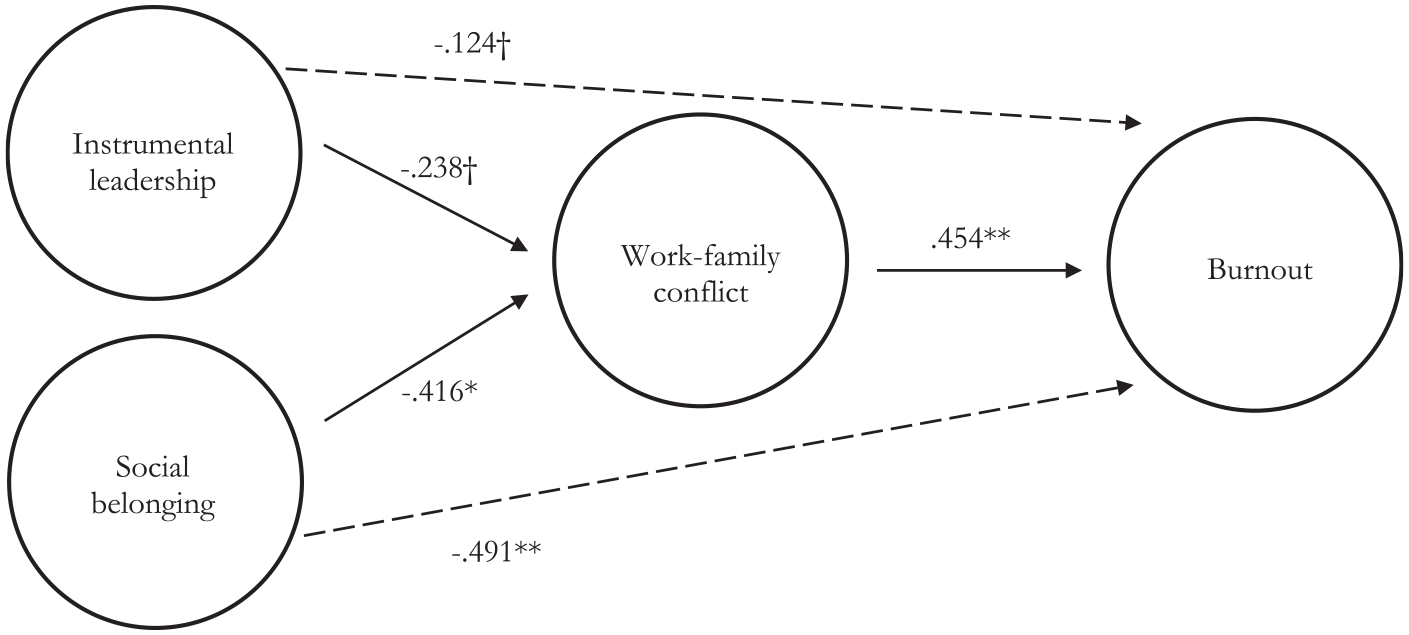
Conceptual map and results of path analysis.
We first test whether instrumental leadership can represent such a resource. We expect leaders who engage more proactively in strategy implementation, resource facilitation, and feedback giving are better at helping employees minimize work-family conflict in the wake of uncertainty and ambiguity in the workplace. Consistent with H2, we see a negative association between instrumental leadership and work-family conflict, albeit the standardized path coefficient estimate is marginally significant (β = −.238, p = .089). Given our small sample size, we might expect standard errors to be inflated and cannot rule out that a similar coefficient estimate would appear statistically significant at conventional threshold levels for a larger sample. The observed indirect path coefficient (β = −.108) indicates that instrumental leadership might reduce burnout by mitigating work-family conflict (H3). This coefficient estimate, however, does not reach statistical significance (p = .142), suggesting that more research and larger sample sizes are needed to offer more conclusive evidence of this proposed mechanism.
Second, we test whether a sense of social belonging acts as an organizational resource that can be initiated by employees to problem solve and minimize work-family conflicts in the wake of workplace disruptions. Hypothesis 4 states that the stronger a sense of social belonging an individual feels at the workplace, the less likely they will be to experience conflict between work and family life. Our data lend support to H4 as we observe a negative and statistically significant relationship between a sense of social belonging and work-family conflict: β = −.416, p = .013. Furthermore, in line with H5, this relationship carries over into individual burnout as we observe a statistically significant, indirect effect of a sense of social belonging on burnout through work-family conflict (β = −.189, p = .027). This finding corroborates the idea that a sense of social belonging can act as an organizational resource that employees use to cope with workplace disruptions, promoting the balance between work and family life and an employee’s emotional well-being.
Discussion and Conclusion
The COVID-19 pandemic created unprecedented disruptions to government workplaces and left many workers scrambling to adapt to swift transitions such as working remotely, in many cases, from one’s home. This pandemic presented government employees not only with logistical and technological challenges, but also exacerbated the need to navigate and calibrate a new equilibrium between work- and family-life responsibilities. HRM scholars and professionals are concerned that heightened demands following increased uncertainty and rapid change amid COVID-19 come with deleterious effects on employee psychological well-being (Sadiq, 2020; Sokal et al., 2020). A core challenge is to identify if, and what kind of, organizational resources can be deployed to help alleviate family-work conflicts and mitigate burnout among government workforces.
Our study provides evidence for two organizational resources leaders can leverage to combat the damaging effects of COVID-19 on employee psychological well-being. We also add to an emerging body of evidence on the disruptive effects of COVID-19 on psychosocial outcomes among public employees. While these studies focus on frontline employees, such as law enforcement officers (Sadiq, 2020) and teachers (Sokal et al., 2020), we offer insights into work-family conflict and burnout among a professionally diverse group of local government employees. This contribution is important as it constitutes a more representative view into the array of service and administrative jobs that shifted to remote settings, along with the psychological responses among the people occupying these positions.
Specifically, we find that a sense of social belonging (horizontal resource), appears to be a promising lever for counterbalancing workplace strain and disruptions caused by COVID-19. The finding suggests that social relationships in the organization represent a key (horizontal) organizational resource that can reduce work-family conflict and burnout. An individual’s sense of social belonging derives from the informal aspects of the organization, such as relationships with coworkers. Informal networks can help employees deal with the demands of both work and home during a time of crisis. These relationships help employees handle the demands of their job by providing social support and feelings of being part of a collective. A sense of social belonging may also be more important in times of more isolating crises, like the COVID-19 pandemic, where employees have little control over organizational challenges and changes. Instead, employees may focus on things they can control, like their involvement with peers in the workplace. A sense of social belonging may also reduce burnout as employees could rely on their peer network to work through and understand the implications of the COVID-19 pandemic for their work and engage in problem solving to address potential work-family conflicts.
Interestingly, we only found marginally significant direct relationships with work-life conflict and burnout and no evidence of relationship between instrumental leadership and burnout mediated by work-life conflict.These findings point to another important theoretical implication to investigate further in future research. While we exercise some caution given the small sample, the results suggest that a sense of social belonging might play a larger role in mitigating work-family conflict and, as such, burnout than instrumental leadership. The relative estimated coefficient size of a sense of social belonging’s impact on work-family conflict is greater than that of instrumental leadership and achieves a higher level of statistical significance in our data. Furthermore, the indirect effect of a sense of social belonging on burnout is statistically significant while the indirect effect of instrumental leadership is not. While more research is needed, one explanation for the difference could be that social relationships and support (and, more generally, horizontally accessed resources) are resources that employees can access and initiate themselves through their own discretion (e.g., Boyas & Wind, 2010; Wrzesniewski & Dutton, 2001). Employees might be able to access these resources quickly and efficiently to shape and deploy them in ways that focus directly on resolving tensions and conflicts between work and family-life. In contrast, instrumental leadership is a resource largely initiated and allocated by the manager like other vertical resources that come from the hierarchy of the organization. However, future research should explore the relationship between instrumental leadership and burnout. One possibility is that more formal, vertically accessed resources are more important in periods of relative stability.
The COVID-19 pandemic occurred in the midst of a planned data collection effort in the spring of 2020, which presented a unique opportunity to explore how organizational resources can serve to minimize employee experiences of work-family conflict and burnout. However, the data comes with its own set of caveats that need to be considered. First, given the uncertainty, and rapid changes characterizing organizational environments during the first few months of the COVID-19 pandemic, employees likely faced unusually high demands in their jobs. While these high demands could constrain the variance in our measures of work-family conflict and burnout, it also increases the salience of organizational resources. At the same time, employee and organizational attention might have been focused on adapting to the exigent circumstances, rather than engaging in non-essential tasks, like responding to an academic survey. Second, we are confined to offer a quantitative case with responses from a single local government workforce located in the southwest United States. We need to be careful in acknowledging that the idiosyncratic characteristics of our particular setting can limit our ability to generalize our findings externally, even if the “work-from-home” order in place in this organization was fairly typical throughout the U.S. While the pandemic hit with various intensity across the U.S., swift transitions to working from home were the rule rather than the exception for many government workplaces by late Spring of 2020.
Third, the relatively small sample size limits our statistical power and ability to conduct secondary analyses of interest, such as examining heterogeneous effects across departments or along key individual characteristics like gender or caregiving responsibilities. For example, the responsibility of care for children or relatives can exacerbate experienced conflict between work demands and life activities, creating a greater need for horizontal and vertical resources to counterbalance the higher demands. It is important for future research to explore such heterogeneous effects to better understand how public sector employees might respond and cope differently during times of crisis and uncertainty. We recognize that statistical power in lieu of our small sample size may be an issue in evaluating the statistical uncertainty around our estimates; we also note the direct relationships are relatively robust and consistent with theoretical expectations. Although our sample consists of only one local government, the participants represent a heterogeneous group of employees, including water, fire and medical, community and library services, police, parks and recreation, and human resources. While organizations responded differently throughout the trajectory of the COVID-19 pandemic, it’s a strength of our design that all employees were surveyed at the same point of time within the same organization. Higher-level organizational policies, like work-from-home mandates, are considered fixed elements in our model and cannot confound our estimates.
Finally, our data are cross-sectional from a single source without clear exogenous sources of variation in our explanatory variables. Despite the strong psychometric properties of our latent constructs and the inclusion of several demographic characteristics, we cannot preclude that our reported relationships are not potentially confounded by unobserved, omitted variables nor that the empirical directionality necessarily mimics the ones presented in our conceptual model. Additionally, future research might integrate attributes of the work environment and individual-level attitudes and motives to offer a more nuanced and complex understanding of the correlational relationships between vertical and horizontal job resources, work-life conflict, and burnout.
An important step for future studies is to test the role of organizational resources, including the ones presented here, with designs that allow for causal inference. These future studies could include longitudinal designs such as diary studies tracking within-individual variation in job demands, job resources, and work-family conflict over time or experimental designs that introduce exogenous variation in leadership or a sense of social belonging through active interventions (e.g., Jensen, 2018; Linos et al., 2021). Longitudinal collections of burnout data as part of an organization’s HRM system could also provide a critical tool for managers seeking to promote workplace well-being and mitigate burnout and its negative consequences, such as poor performance, turnover, and workplace incivility. Indeed, the robust collection of longitudinal burnout data could be both a valuable tool for managers as well as researchers.
Our findings hold several important implications for HRM scholars and practitioners. First, we draw from JD-R theory and conceptualize how vertical and horizontal organizational resources can influence employee burnout by reducing work-family conflict and, in turn, burnout. As observed in our findings, how job resources are initiated or accessed by employees might have implications for how useful these resources are or how quickly these resources can be utilized. For HRM professionals concerned about the psychological toll that COVID-19 and other future workplace disruptions might invoke, our study offers a nuanced picture of how two organizational resources (i.e., instrumental leadership and a sense of social belonging) are related to work-family conflict and burnout. The findings are important because existing research suggests that organizations can cultivate both resources—even though the results of this study suggest cultivating a sense of social belonging might be particularly effective for periods characterized by disruption.
In the case of social belonging, research suggests that organizations can design active support systems to foster a stronger sense of social belonging. Linos et al. (2021) offer a recent example based on an experimental trial among emergency dispatchers in the United States. A peer-sharing and support system creates a direct line of emotional support among coworkers (even colleagues not physically located in the same space) and can significantly increase feelings of a sense of social belonging and reduce feelings of burnout, which is a strong predictor of turnover among emergency dispatchers. Organizations can take steps to cultivate such systems. Organization research has long recognized the importance of the informal organization and positive co-worker relationships for effective organizational functioning. Our findings reiterate the need for leaders and organizations to cultivate and foster supportive work environments and collegiality among their employees and promote employee engagement in the range of organizational citizenship behaviors. Such efforts should be integrated into the day-to-day operations during periods of stability in order to serve as a resource in periods of turbulence or rapid change.
As noted earlier, while we didn’t observe an indirect relationship between instrumental leadership and burnout through work-life balance, instrumental leadership did have marginally significant (p < .10) direct relationships with work-life conflict and burnout in our small-sample study. Leadership development and training might be active ingredients in cultivating the skills required for leaders to successfully navigate times of crisis. Recent studies support the notion that value-based and goal-oriented leadership behaviors can be taught (e.g., Antonakis et al., 2011; Jensen, 2018) and both behaviors constitute the core domains of instrumental leadership.
For organizations facing constraints in pursuing these levers, it is worth noting that the standardized results in our study gives prominence to a sense of social belonging, suggesting this resource is more impactful for buffering against work-family conflict and downstream preventing employee burnout. Whether this observation is particular to our empirical setting or whether it extends to routine (non-crisis) times of operations is unclear. However, the findings suggest that public sector HRM professionals will do well not only to activate, but also to cultivate a strong sense of social belonging and active instrumental leadership as means for fostering and maintaining psychological well-being among government workforces.
Footnotes
Appendix
Results of Structural Equation Model.
| Variable Relationships | Standardized Coefficients |
|---|---|
| Direct effects | |
| Instrumental Leadership → Work Family Conflict | −.238 † (−1.75) |
| Instrumental Leadership → Burnout | −.124 † (−1.88) |
| Sense of Social Belonging → Work Family Conflict | −.416* (−2.63) |
| Sense of Social Belonging → Burnout | −.491** (−2.88) |
| Work Family Conflict → Burnout | .454** (3.66) |
| Indirect Effects | |
| Instrumental Leadership → Work Family Conflict → Burnout | −.108 (−1.50) |
| Sense of Social Belonging → Work Family Conflict → Burnout | −.189* (−2.30) |
| Control Variables | |
| Gender → Instrumental Leadership | −.170 † (−1.87) |
| Education → Instrumental Leadership | .004 (.04) |
| Tenure → Instrumental Leadership | −.250* (−2.13) |
| Work From Home → Instrumental Leadership | −.117* (−1.08) |
| Gender → Sense of Social Belonging | −.113 (−1.14) |
| Education → Sense of Social Belonging | .027 (.20) |
| Tenure → Sense of Social Belonging | −.002 (−.03) |
| Work From Home → Sense of Social Belonging | −.022 (−.14) |
| Gender → Work Family Conflict | −.165 † (−1.81) |
| Education → Work Family Conflict | .211 † (1.92) |
| Tenure → Work Family Conflict | .003 (.03) |
| Work From Home → Work Family Conflict | .060 (.54) |
| Gender → Burnout | .093 (1.02) |
| Education → Burnout | .113 (1.44) |
| Tenure → Burnout | .103 (1.08) |
| Work From Home → Burnout | −.010 (−.09) |
Note. Standardized path coefficients from structural equation model with cluster-robust t-statistics by organizational department. N = 124.
p < .1. *p < .5. **p < .01. ***p < .001.
Declaration of Conflicting Interests
The author(s) declared no potential conflicts of interest with respect to the research, authorship, and/or publication of this article.
Funding
The author(s) received no financial support for the research, authorship, and/or publication of this article.
