




Abstract
In organizations with a diverse workforce, inclusive leadership is assumed to be required to support the full appreciation and participation of diverse members. To date, studies identifying how leadership enables an inclusive climate in diverse teams are scarce. The aim of this study, therefore, is to examine how inclusive leadership fosters inclusiveness in diverse teams. Hypotheses were tested on a sample of 293 team members clustered in 45 public sector teams using structural equation modeling. The results showed that inclusive leadership positively moderates the negative relation between team ethnic–cultural diversity and inclusive climate. This study shows that greater team diversity does not automatically yield an inclusive climate. Inclusive leadership is needed to support an inclusive climate in which different team members are valued for what they bring to work practices. Inclusive leadership is crucial for fostering inclusiveness in diverse teams. Limitations are discussed and recommendations for future research are proposed.
Keywords
Introduction
Achieving a diverse workforce is, for many public organizations, a central theme based on the expected outcomes that diversity could bring. Notably, from a representative bureaucracy perspective, workforce diversity can enhance an organization’s legitimacy and responsiveness to a diversifying society and, therefore, instigated many diversity management efforts in public organizations (Andrews et al., 2005; Groeneveld & Van de Walle, 2010; Pitts et al., 2010).
Recent studies imply that simply enhancing the representation of more diverse employees is not enough though. To fully tap into the intended outcomes of diversity, organizations need to focus on including them (Mor Barak et al., 2016; Shore et al., 2018). Scholars have, however, raised questions about how to foster this inclusion. This need for careful attention to inclusion becomes even more important when examined in the context of teams. An inclusive climate is considered a prerequisite for inclusion and allows for making use of a wide range of perspectives and ideas that can enrich decision-making processes and boost the performance of diverse teams. The attention has thus shifted toward from simply achieving diversity to the need to foster inclusive working environments to be appreciative of differences and to support the integration of minority employees (Andrews & Ashworth, 2015; Ashikali & Groeneveld, 2015; Sabharwal et al., 2018).
Previous studies in public management and human resource management (HRM) show that, among other aspects, diversity management and leadership are important for fostering organizational inclusiveness (Andrews & Ashworth, 2015; Ashikali & Groeneveld, 2015; Bae et al., 2017; Brimhall, 2019; Sabharwal et al., 2018). Emerging studies in both the public management and generic management literature underline the need for supportive leadership to enable fruitful cooperation in diverse teams (Guillaume et al., 2017; Joshi & Roh, 2009; Kearney & Gebert, 2009; Van Knippenberg et al., 2013; Van Knippenberg & Van Ginkel, 2010) and, hence, to enable inclusiveness in organizations and teams (Bae et al., 2017; Paustian-Underdahl et al., 2017; Randel et al., 2018; Ritz & Alfes, 2018).
Research on public leadership tends to focus on dyadic follower–leader behavior (Knies et al., 2016; Ospina, 2017). Abovementioned mechanisms indicate that inclusiveness depends on interactions between team members. To realize public organizations’ goals of representativeness and responsiveness to a diverse society (Bishu & Kennedy, 2019; Feeney & Camarena, 2019), identifying and understanding how leadership enables an inclusive climate in diverse public sector teams is needed. This study, therefore, examines the role of inclusive leadership in supporting an inclusive climate within diverse teams. This leads to our central research question:
Both the public management and generic management literature offer many studies on different leadership styles and their outcomes (e.g., Boekhorst, 2015; Chrobot-Mason et al., 2016; Gotsis & Grimani, 2016; Randel et al., 2018). These various leadership styles are conceptually distinctive and grounded in different normative arguments for their intended outcomes. Randel et al. (2018), in their review of the literature, discuss a number of different leadership styles, and conclude that inclusive leadership, that involves a set of behaviors aimed at supporting team members’ full integration as well as establishing an open norm for unique social identities, is required to successfully foster inclusiveness. They call for further conceptual development and empirical studies on inclusive leadership and its potential impact on inclusiveness. Inclusive leadership is considered to play a pivotal role in influencing employees’ experiences of equity and boosting activities needed to establish perceptions of inclusiveness (Chrobot-Mason et al., 2014, 2016; Randel et al., 2018).
This study is one of the few studies in public HRM and related fields alike to have empirically investigated how leadership contributes to inclusiveness in public sector teams. As such, our article speaks to studies on diversity and representation in public management and HRM and connects this field to the increasing number of studies on public leadership. Different from these latter studies, we focus on leadership behaviors targeted at team processes rather than taking the leader–follower dyad as a point of departure. Furthermore, by identifying the inclusive leadership behaviors needed to minimize the negative and enhance the positive effects of diversity, we respond to the call for further conceptual development and empirical studies on inclusive leadership and its potential impact on inclusiveness more generally (Randel et al., 2018).
Based on a final sample of 293 team members clustered in 45 teams belonging to four Dutch public organizations, this study finds a negative relation between team ethnic–cultural diversity and inclusive climate. However, the moderation analysis indeed showed that high inclusive leadership mitigates the negative impact of high team ethnic–cultural diversity on inclusive climate. The next section outlines the theoretical framework. Following this, the data and methods are discussed. Thereafter, results are presented followed by a discussion with conclusions drawn.
Theoretical Framework
Inclusion and Inclusive Climate
Representative bureaucracy theory argues that public organizations tend to value diversity for its potential contribution to the organizations’ responsiveness to diverse needs in the general population (Bishu & Kennedy, 2019; Feeney & Camarena, 2019; Groeneveld & Van de Walle, 2010; McDougall, 1996; Riccucci, 2009). Although these studies assume positive diversity outcomes in terms of improved policy outcomes and interaction between public employees and citizens, they often overlook organizational processes that affect the inclusion of diverse individuals. The interaction between public employees at a team level and how this would affect inclusion are particularly understudied within representative bureaucracy literature. For this reason, we turn to the broader management literature to define the concept of inclusion and its antecedents.
Drawing on optimal distinctiveness theory, inclusion has been conceptualized as dependent on two needs that individuals seek to satisfy: belongingness and uniqueness (Shore et al., 2011). Belongingness involves individuals seeking similarities with and validation by others. Uniqueness refers to individuals seeking individuality in comparison with others. Balancing these needs results in optimal distinctiveness (Brewer, 1991). To experience inclusion, individuals need to feel they belong to the group, meaning that each team member is treated as an insider, while having the opportunity to sustain and express their unique identities. This requires differences among team members to be valued; each individual is encouraged to remain their authentic self, rather than being stimulated to adhere to the culture or norms of dominant groups within a team (Dwertmann & Boehm, 2016; Jansen et al., 2014; Nishii, 2013; Roberson, 2006; Shore et al., 2011).
To encourage feelings of inclusion, a climate needs to be created where diverse individuals have the opportunity to be themselves and are treated as insiders, as well as learning from and utilizing the differences among team members (Boekhorst, 2015; Dwertmann & Boehm, 2016; Dwertmann et al., 2016; Ellemers et al., 2013; Nishii, 2013; Shore et al., 2011). This study departs on the few studies available on inclusive climate in teams (Dwertmann et al., 2016; Nishii, 2013; Randel et al., 2018). To understand an inclusive climate at the team level, two dimensions are of particular interest. 1 These dimensions do not directly capture belongingness and uniqueness (e.g., Shore et al., 2011), but refer to dimensions of the team climate.
The first dimension involves the integration of differences (Nishii, 2013). In this dimension, the norms and expectations of being open to differences and valuing them are emphasized. Where this is present, team members are able to enact their social identities, even if these differ from mainstream or majority groups (Dwertmann & Boehm, 2016; Dwertmann et al., 2016; Nishii, 2013). The resulting opportunity to be oneself could satisfy individuals’ needs for uniqueness. As such, an environment in which differences are valued and respected would support individuals’ needs for uniqueness. The second dimension, the inclusion of differences in decision making, involves actively seeking different ideas and perspectives that unique team members have, and considering these in decision-making processes (Nishii, 2013). Because this signals that team members’ unique contributions are important, and used to enhance work practices, it could support their feelings of belongingness. Both the integration and inclusion of differences could sustain an environment in which diverse individuals have the opportunity to be themselves and, simultaneously, to be group insiders. With increasing diversity, one may assume that inclusiveness becomes not only more relevant but also more difficult to realize, as elaborated in the next section.
Team Diversity and Inclusive Climate
The literature on climate formation suggests that the team climate is affected by group composition, with the homogeneity versus heterogeneity of team members affecting the extent of their shared climate perceptions (Ashforth, 1985; Schneider et al., 2013). To understand the mechanism through which team diversity actually results in an inclusive climate, two diversity perspectives are important: the information/decision-making perspective and the social identity/categorization perspective (Mor Barak et al., 2016; Van Knippenberg & Van Ginkel, 2010).
The positive effects of team diversity can be explained by an information/decision-making perspective that involves exchanging and discussing different ideas and perspectives on problem solving (Van Knippenberg et al., 2004; Van Knippenberg & Van Ginkel, 2010). By adopting an information/decision-making perspective, the unique characteristics of team members are highly valued because these enrich the different perspectives that could be used for problem solving, contributing to the value attached to team members’ belongingness and uniqueness. As an example, previous research has found a positive link between the representation of ethnic–cultural groups in public organizations and their feelings of inclusion (Andrews & Ashworth, 2015). Furthermore, Kanter’s theory on the representation of groups in organizations argues that a highly imbalanced representation would engender a greater exclusion of those who are different from the majority groups (Kanter, 1977). When there is a better balance in the representation of different groups, intergroup inequalities between minority and majority groups are less prevalent, creating a culture where every group has an opportunity to contribute (Andrews & Ashworth, 2015).
Adopting a different perspective, social identity theory posits that individuals tend to seek similarities with others, and based on the perceived similarities or differences, categorize people into in-groups and out-groups (Ashforth & Mael, 1989; Brewer, 1991; Mor Barak et al., 2016; Turner, 1975; Williams & O’Reilly, 1998). Due to intergroup biases, fruitful discussions and the utilization of differences are obstructed with those who are considered part of an out-group. Social identity and intergroup relationship theories argue that employees’ experiences of their work environment are explained by their group membership and the meaning they attach to that membership (Ashforth & Mael, 1989; Hogg et al., 2017). A sense of belonging to a specific identity group affects the interaction with members of that group. As a result, communication and cooperation with those who are considered to be similar are expected to be more fruitful than with those who are considered to be out-group members (Mor Barak et al., 1998; Van Knippenberg et al., 2004). The perceived similarities or differences of group members could, therefore, result in excluding those who are perceived to be different (Brewer, 1991; Cho & Mor Barak, 2008; Mor Barak et al., 1998; Van Knippenberg & Schippers, 2007). This would result in differential treatment in favor of in-group members, which could hinder the inclusion of other groups of team members. These intergroup biases could undermine the social integration of diverse teams (Nishii, 2013; Shore et al., 2011).
The above processes simultaneously play a role in teams and could occur due to any diversity attribute, both visible and less visible, depending on whether those differences are salient (Mayo et al., 2016; Van Knippenberg et al., 2004). Previous studies suggest that the salience of the categorization, and the extent to which this affects intergroup relations, could be more apparent for visible demographic differences such as ethnic–cultural diversity. Being a member of a certain ethnic–cultural group could also overlap with other (less visible) diversity dimensions, creating fault lines with other socially constructed identities based on status differences, beliefs, traditions, norms, or values that could more easily elicit salient categorizations (cf. Breslin et al., 2017; Ospina & Foldy, 2009). However, at the same time, it could also be argued that different ethnic–cultural groups have a greater pool of perspectives and resources that a team could use (Mayo et al., 2016; Nederveen Pieterse et al., 2013).
Based on the abovementioned diversity perspectives, one can argue that team diversity can result in both negative and positive effects on team integration and inclusiveness (Van Knippenberg et al., 2004; Van Knippenberg & Schippers, 2007). Because we are not able to specify either a positive or a negative link between team diversity and inclusive climate, we now elaborate further on the potential moderating role of inclusive leadership (Randel et al., 2018).
The Moderating Role of Inclusive Leadership
Inclusive leadership is seen as necessary to facilitate and support belongingness and uniqueness (Randel et al., 2016, 2018). Inclusive leadership considers team members’ differences and supports their belongingness to facilitate each team member’s contributions, rather than emphasize the need to assimilate toward collective needs or goals, as is central to transformational leadership (Randel et al., 2018). For instance, inclusive leadership stimulates team members to voice their ideas and perspectives in the team, through explicitly encouraging team members to discuss and exchange diverse opinions and ideas. At the same time, inclusive leadership supports fruitful cooperation among diverse team members. Because inclusive leadership focuses both on stimulating and valuing distinctiveness and ensuring belongingness of team members, it is distinct from other leadership styles such as transformational and authentic leadership (Chrobot-Mason et al., 2014; Randel et al., 2018). Inclusive leadership, in this regard, provides the necessary conditions for teams to balance individual needs for uniqueness and for belongingness and aims to manage both the positive and negative outcomes of team diversity.
Inclusive leaders are especially focused on facilitating a safe environment in a diverse setting in which all team members have the opportunity to be themselves (Nembhard & Edmondson, 2006; Randel et al., 2018). Inclusive leaders will sustain a climate in which the norm is to be open to differences and to value these. Explicitly promoting the value of differences may enhance openness to diversity, and thereby attenuate the negative effects of intergroup bias (Randel et al., 2018). Diverse team members thus become considered as insiders of the group, rather than outsiders, boosting their feelings of belongingness.
Furthermore, by emphasizing the importance of differences, an environment is created in which it is expected that team members will share and exchange distinct qualities, and to utilize these to inform work practices and decision making. Inclusive leaders perform an important role in motivating and facilitating their followers to engage in an exchanging as well as a learning behavior (Boekhorst, 2015; Paustian-Underdahl et al., 2017; Van Knippenberg et al., 2004; Van Knippenberg & Van Ginkel, 2010). This involves leaders creating an environment in which they develop opportunities for individuals to express diverse viewpoints, such as with problem solving (Chrobot-Mason et al., 2014; Randel et al., 2018). Leaders both encourage the exchange of these diverse viewpoints among employees and stimulate team members to discuss these differences.
Because inclusive leaders are expected to effectively balance the needs for belongingness and uniqueness, it can be argued they will be successful in attenuating a negative relationship between a team’s ethnic–cultural diversity and its inclusive climate. Furthermore, in an inclusive climate, because all team members are valued for who they are, and consequently, the different perspectives of all members are actively sought and considered, this would enable those group processes that are necessary to utilize the potential benefits of a diverse team. As such, it can be argued that inclusive leadership will moderate the relationship between team ethnic–cultural diversity and inclusive climate to the extent that the potential negative relationship is weakened and a positive relationship strengthened. This leads to the following hypothesis:
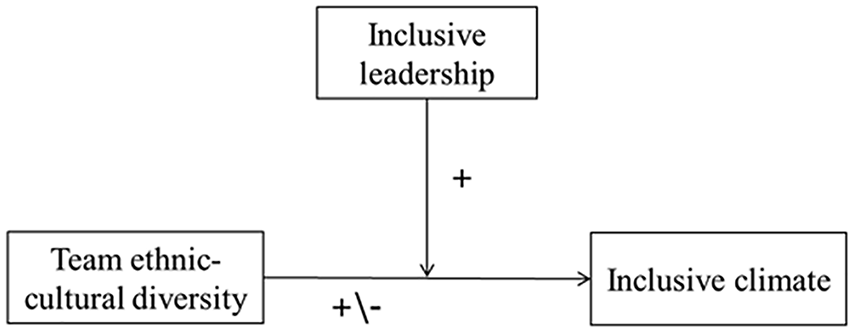
Conceptual model: The moderating effect of inclusive leadership on the link between team ethnic–cultural diversity and inclusive climate.
Data and Method
Data
Dutch public sector organizations have a long history of implementing diversity policies to improve the representation of minorities (Groeneveld & Verbeek, 2012; Rijksoverheid, 2016). As such, the Dutch public sector provides an appropriate context for testing theories on inclusive leadership, inclusive climate, and team ethnic–cultural diversity. Dutch public administration is divided into tiers: central government, the provinces, the municipalities (local government), and water authorities (Ministry of the Interior and Kingdom Relations, 2016). Of these subsectors, central government and the municipalities have the highest representation of ethnic–cultural minorities: 2 18% and 16%, respectively, in 2014. To ensure variety in the variables of interest (such as team ethnic–cultural diversity), data were collected among work teams from two ministries (central government) and two municipalities (local government), using a quantitative survey design.
Team supervisors were approached to seek their participation in the study through contact persons within the four organizations. Team supervisors were seen as direct supervisors who conduct the annual performance appraisals and development interviews with their team members. They were asked to identify which members were part of the team based on the following criteria: a unit or cluster of at least three employees who on a daily basis collaborate to achieve a collective goal or complete a shared task (Cohen & Bailey, 1997). Team members were then contacted through their supervisors to ask whether they would participate in the study.
In 2016, online surveys were sent to 59 teams (556 team members) within the Dutch ministries and municipalities. Teams that participated varied in team size. The largest team contained 32 team members, whereas the smallest only three. In total, 304 team members participated in the survey, a response rate of 54.7%. The minimum threshold for including teams in the analysis was set on a response of at least three team members per team. Fourteen teams where fewer than three members completed the survey were removed from the analysis. The total sample thus used for this study contains 293 team members clustered in 45 teams, with a response rate ranging from 27% to 100% per team. In our analysis, we examine the construct validity of concepts at the individual level (N = 293), and examine the associations between the constructed variables at the team level (N = 45). Given the number of independent factors at the individual level of analysis, as well as at the team level, this can be considered a sufficient sample size (Field, 2009; Hox, 2010).
Measurements
Team ethnic–cultural diversity
Ethnic–cultural variety was estimated using Blau’s index for estimating the heterogeneity of groups based on the spread of group members across distinct categories. This index is seen as adequate when using both information/decision-making and categorization perspectives as explanatory mechanisms (Harrison & Klein, 2007; Mayo et al., 2016). Furthermore, because we were conducting a team study, the Blau N index was used because this allows estimations on a sample with varying group sizes (Biemann & Kearney, 2010; Harrison & Klein, 2007):

In this formula, nk is the frequency of unit members in the kth category and N is the unit size. Blau’s index ranges between 0 and 1, where a value of 1 indicates large team ethnic–cultural diversity. Two categories are used in establishing ethnic–cultural diversity, namely, native Dutch and nonnative Dutch team members. In the Netherlands, nonnative Dutch refers to a person who was, or at least one of their parents was, born abroad. This criterion was used in the survey by asking respondents to indicate whether they and/or one of their parents were born abroad. The index thus calculates the scale of a team’s ethnic–cultural diversity based on data on the sample used in the study.
Inclusive climate
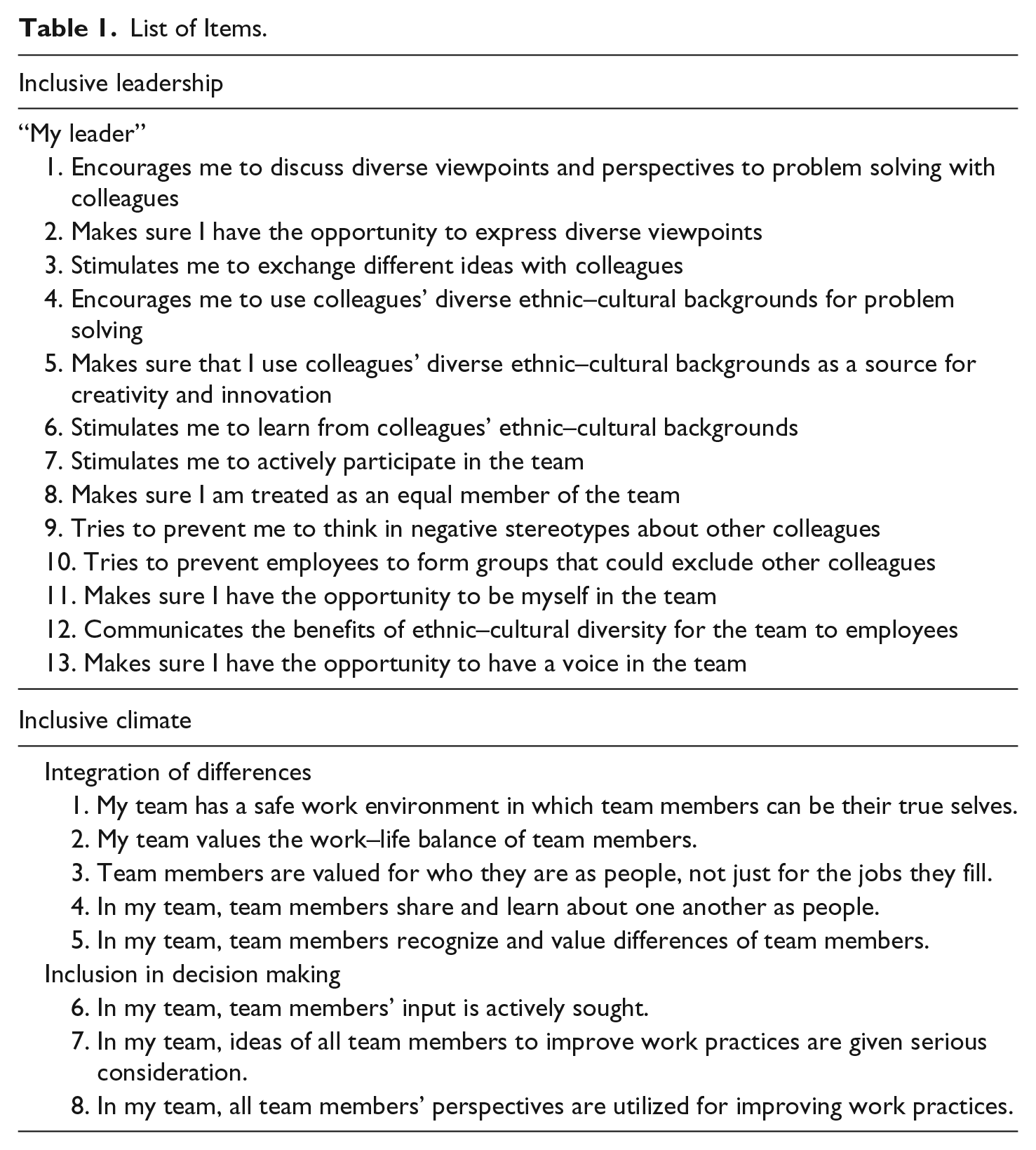
Inclusive climate was measured at the individual level and aggregated to the team level. Eight items were used to measure the two dimensions of integration of differences and of inclusion in decision making (Nishii, 2013). All items were measured on a 5-point scale ranging from 1 = not at all applicable to 5 = very applicable. Sample items from each dimension are “My team has a safe environment in which team members can be their true selves” and “In my team, team members’ input is actively sought,” respectively. The complete list of scale items is included in Table 1.
List of Items.
Inclusive leadership
Inclusive leadership was measured using 13 items (Ashikali, 2019). All items were measured on a 5-point scale ranging from 1 = strongly disagree to 5 = strongly agree. Aggregated measures were used to estimate team member’s perceptions of leadership behavior rather than using leaders’ own estimates of their intended leadership behavior. This was because previous research has found discrepancies between leader and employee ratings of leadership, and suggested using aggregated employee ratings (Avolio et al., 2009; Jacobsen & Andersen, 2015). The aggregation of individual responses to the team level will further minimize possible individual response bias (Favero & Bullock, 2015) and should more accurately represent leadership behavior because leader ratings could be biased (Jacobsen & Andersen, 2015). Again, a list of the items used can be found in Table 1.
Controls
In testing our hypotheses, several control variables were added to the analysis. First, the analysis was controlled for sector, with 0 = local government organization and 1 = central government. Second, team tasks were distinguished as 0 = policy and advice and 1 = implementation and support. This was considered relevant because the workgroup diversity literature (Van Knippenberg & Schippers, 2007) considers that team diversity could have different outcomes depending on the need for information exchange and to learn from differences to enhance complex problem solving. These activities could be more relevant to teams involved with policy development. Finally, team size was included because the outcomes of team characteristics could depend on team size (Cha et al., 2015).
Analytical Strategy
STATA 13 was used for analyzing the relationships between the variables of interest. Exploratory factor analysis (EFA) and confirmatory factor analysis (CFA) were conducted to examine construct validity of the concepts on the individual level (N = 293). An EFA (with oblique rotation) of the inclusive climate and inclusive leadership items resulted in a three-factor solution. This factor analysis showed that the inclusive climate and inclusive leadership items each loaded onto a separate factor. Next, a CFA with clustered robust standard errors was conducted separately for each construct. This tested the factor structures while taking account of the nested structure of our data (Kline, 2011). The results of these analyses are included in Supplemental Appendices A and B. Given the limited sample size after aggregation, all the variables of interest were constructed prior to testing the structural equation models. If we had not done this, the sample size, relative to the number of parameters, would limit the accuracy of the parameter estimates and model fit statistics (Wolf et al., 2013).
Because team-level variables were derived from individual team members’ data, we calculated intraclass correlations (ICCs) to examine team-level variance. In Table 2, ICC(1) covers the variances accounted for by team membership, and ICC(2) indicates the reliability of the group means. These are estimated using the between and within mean squares from a one-way analysis of variance using an estimator for differences in team size (Hox, 2010; Van Mierlo et al., 2009). As shown in Table 2, all ICC(1) values are statistically significant, and indicate the variance due to group membership. The ICC(2) values did not reach the desired level of reliability (values above .65). This could be because the low ICC values are affected by the varying group sizes (Groeneveld & Kuipers, 2014). Within team variance was further tested by estimating the within group agreement

In this formula,

Here, A is the number of discrete Likert-type response options. For a 5-point Likert-type scale, the expected variance would be 2 (O’Neill, 2017). With our data, the
Intraclass Correlations.
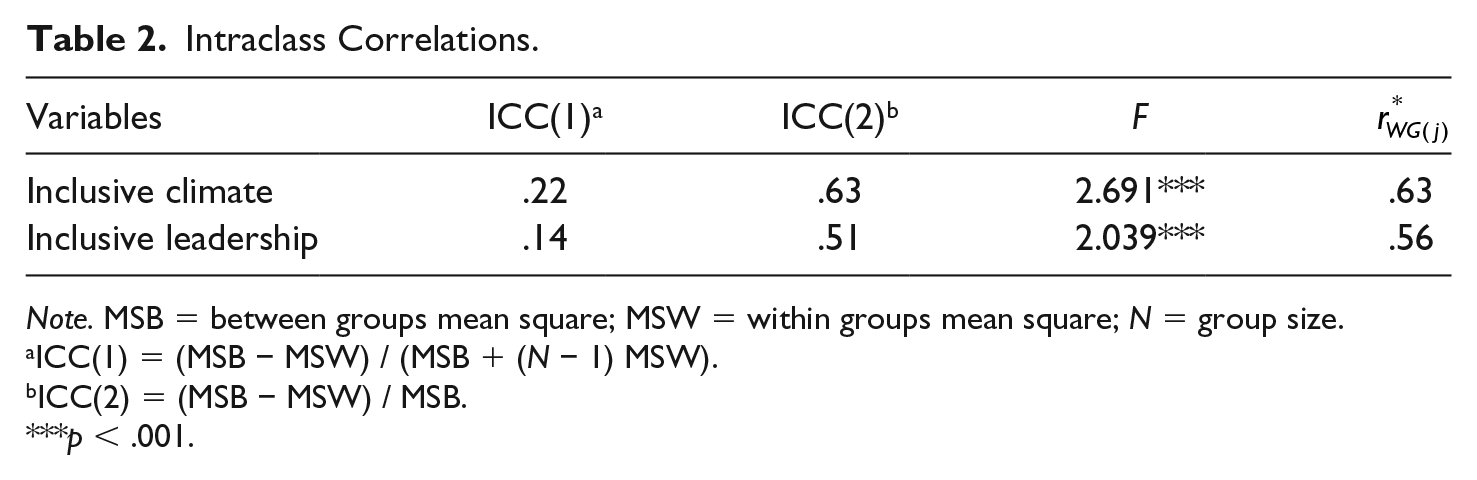
Note. MSB = between groups mean square; MSW = within groups mean square; N = group size.
ICC(1) = (MSB − MSW) / (MSB + (N − 1) MSW).
ICC(2) = (MSB − MSW) / MSB.
p < .001.
Descriptive Statistics, Correlations, and Cronbach’s Alpha in Parentheses (N = 45 Teams).
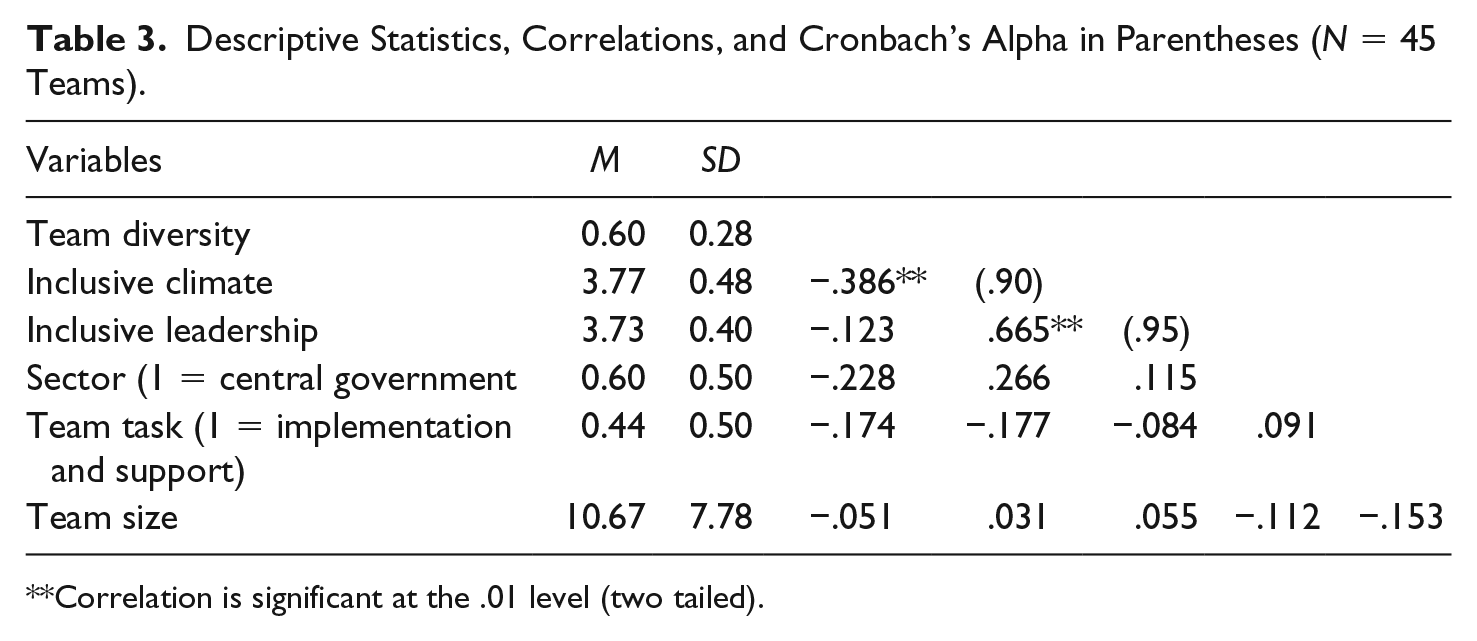
Correlation is significant at the .01 level (two tailed).
Results
In this section, the results of multiple structural equation modeling analyses are presented. The results of these analyses are shown in Table 4, with model fit statistics for each model in Table 5. Model 1 included the control variables and the results indicate that teams that work for a central government organization tend to experience greater inclusiveness than those in local government organizations (B = .28, p < .05). The correlation analysis results, shown in Table 3, also indicate that the former teams are less diverse than those in local government organizations.
Results of Structural Equation Modeling (N = 45 Teams; Unstandardized Estimates).
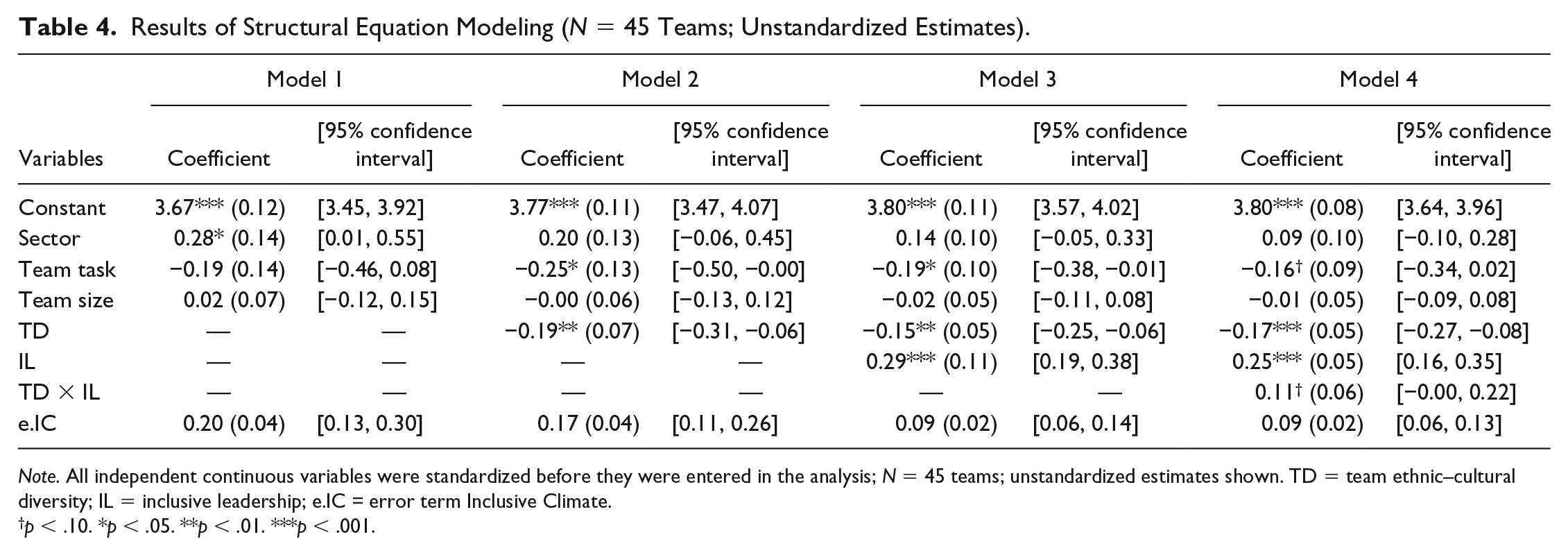
Note. All independent continuous variables were standardized before they were entered in the analysis; N = 45 teams; unstandardized estimates shown. TD = team ethnic–cultural diversity; IL = inclusive leadership; e.IC = error term Inclusive Climate.
p < .10. *p < .05. **p < .01. ***p < .001.
Model Fit Statistics.
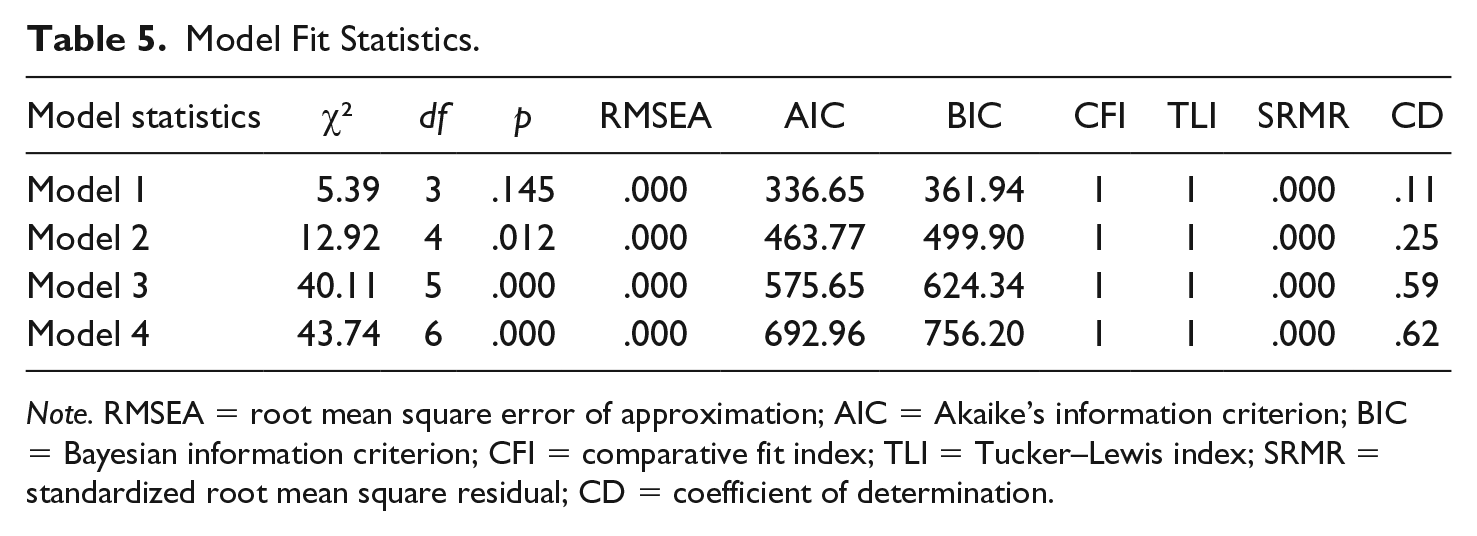
Note. RMSEA = root mean square error of approximation; AIC = Akaike’s information criterion; BIC = Bayesian information criterion; CFI = comparative fit index; TLI = Tucker–Lewis index; SRMR = standardized root mean square residual; CD = coefficient of determination.
Model 2 identified a negative association between team ethnic–cultural diversity and inclusive climate (B = −0.19, p < .01). It appears that greater team ethnic–cultural diversity results in lower team inclusiveness. This finding offers support to the social categorization perspective that argues that an increase in team diversity will result in stronger intergroup bias, which, in turn, impedes the full participation of all team members.
In a final model, we tested for the interaction effect of inclusive leadership on the association between team diversity and inclusive climate. This analysis found a statistically significant interaction effect between inclusive leadership and team diversity on inclusive climate (B = 0.11, p < .10). The indication is that inclusive leadership attenuates the negative association between team ethnic–cultural diversity and an inclusive climate, which supports Hypothesis 1. Figure 2 provides a more substantive interpretation of the interaction effect by visualizing how the relationship between team diversity and inclusive climate changes depending on the level of inclusive leadership. The figure includes three levels of inclusive leadership: low (one standard deviation below the mean), medium (the mean level), and high (one standard deviation above the mean). This analysis shows the effect of a one standard deviation change in inclusive leadership on the inclusive climate of teams with different levels of diversity. This figure shows that, when the team ethnic–cultural diversity is high, inclusive leadership also needs to be high to minimize the negative relationship between team diversity and inclusive climate. If a team’s ethnic–cultural diversity is low, the level of inclusive leadership has no significant effect. Figure 3 shows the final path model.
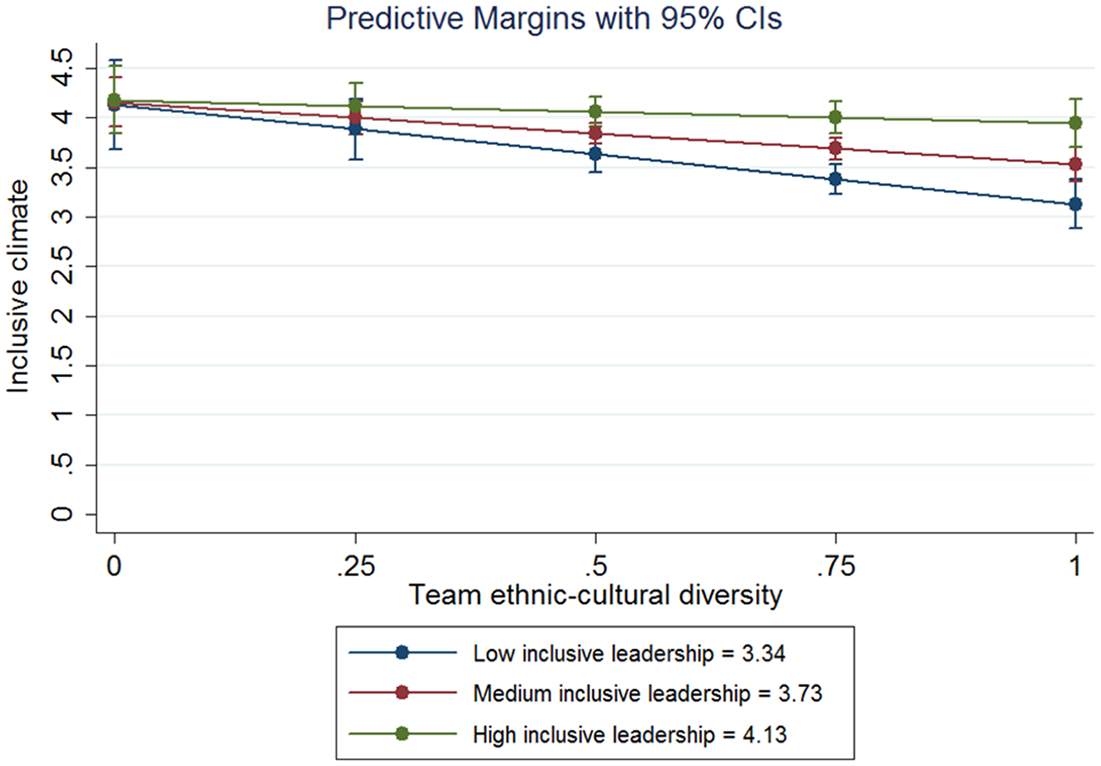
Margins plot inclusive leadership and team ethnic–cultural diversity against inclusive climate.
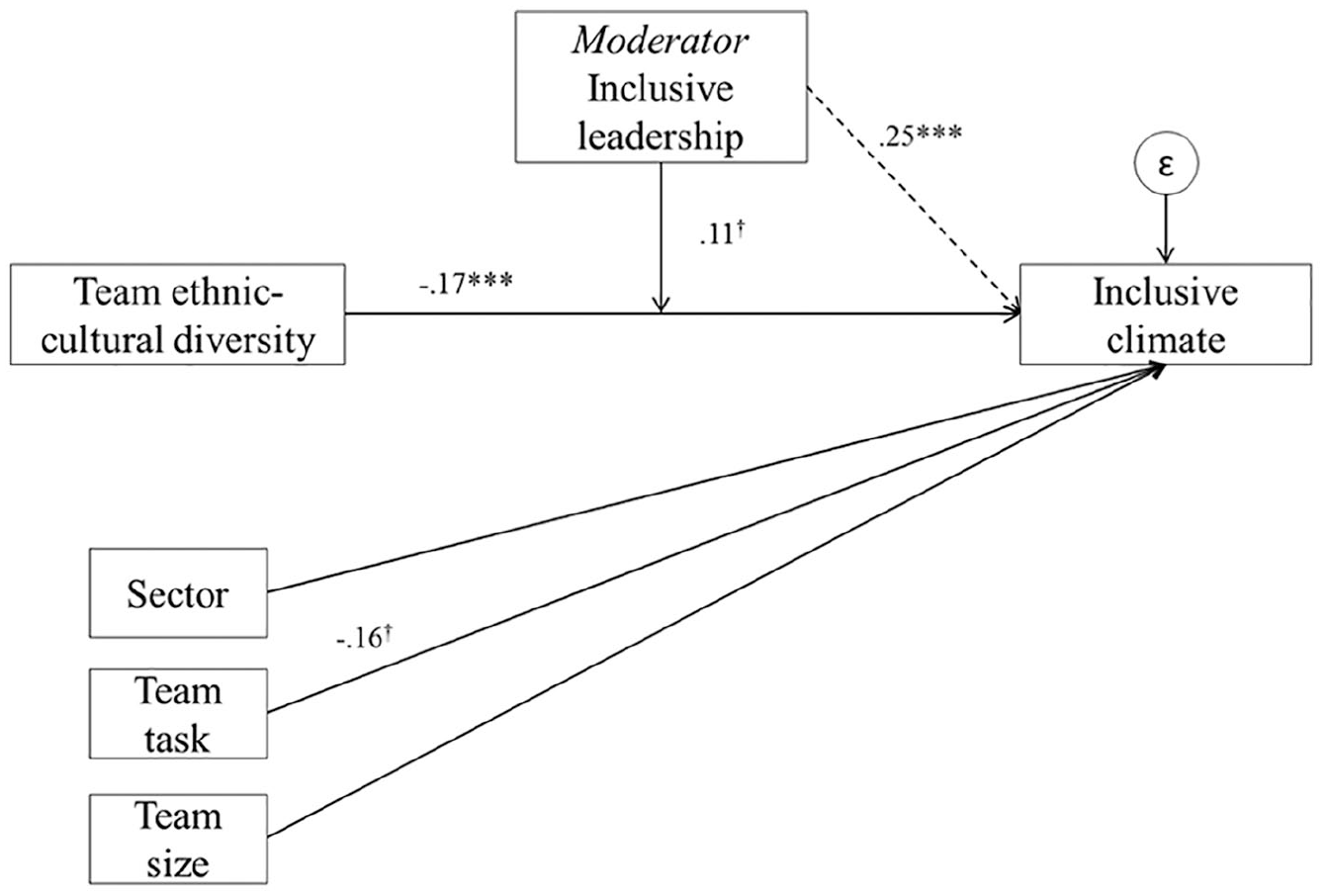
Final path model (unstandardized estimates shown; covariances not included in the figure).
Discussion and Conclusion
This article reports on a team study conducted to examine to what extent inclusive leadership moderates the association between team ethnic–cultural diversity and inclusive climate in public sector teams. In the study, we examined the extent to which inclusive leadership successfully supports an inclusive climate in ethnic–cultural diverse teams. As hypothesized, inclusive leadership positively moderates the relationship between team diversity and inclusive climate. That is, that highly ethnic–cultural diverse teams experience a more inclusive climate when inclusive leadership is high than when it is low. These findings emphasize the importance of leadership that aims to support positive, and attenuate negative, team diversity outcomes to foster inclusiveness (Guillaume et al., 2017; Mayo et al., 2016). Inclusive leadership is needed to manage affective responses that result from social categorization processes. However, this is only an issue with highly diverse teams; inclusive leadership does not significantly change the inclusiveness of teams with low ethnic–cultural diversity. The results also suggest that highly ethnically and culturally diverse teams experience less inclusiveness than less diverse teams. This contradicts previous research findings of a positive relationship between ethnic–cultural representation and perceptions of inclusion in a public context (Andrews & Ashworth, 2015).
Social identity theory offers an explanation for the negative relationship found between team diversity and inclusive climate. It suggests that greater group heterogeneity will result in the categorization of team members when differences are salient (Ashforth & Mael, 1989; Brewer, 2010). When team members differ on multiple diversity dimensions or socially constructed identities, and these dimensions coincide, these fault lines or “intersectionalities” more often result in intergroup biases and the exclusion of those who are different, disrupting the full integration of diverse team members, hindering the utilization of their diverse strengths (Feeney & Camarena, 2019; Mayo et al., 2016; Van Knippenberg et al., 2004; Van Knippenberg & Schippers, 2007). This would explain why teams that are more heterogeneous experience a less inclusive climate than teams that are more homogeneous.
Our findings are significant given the moves toward boosting diversity and inclusion in a public sector context. Many public organizations are aiming to improve their inclusiveness based on the predicated benefits of increased effectiveness, greater diversity in perspectives and ideas, and increased representation of and responsiveness to a diversifying society. This study shows that the push for diversity needs explicit supervisory attention to create an inclusive climate in which the potential benefits of diversity actually can be realized.
In line with previous research on the effectiveness of (public) HRM and the role of leadership (Leroy et al., 2018; Vermeeren et al., 2014), we underline the pivotal role of inclusive leadership in realizing an inclusive work environment as intended through human resource (HR) diversity policies and practices (Buengeler et al., 2018; Nishii et al., 2018). We, therefore, call for more attention for inclusive leadership in HR and leadership development programs. However, to inform these programs, we need more insights into the contextual factors that shape the conditions for inclusive leadership to develop and to affect inclusiveness. Public managers, for instance, could have multiple (conflicting) demands while managing their teams, which could require different leadership behaviors (i.e., Van Wart, 2013) and whereby inclusiveness may not be prioritized. Therefore, insights on these demands and how they affect inclusive leadership behavior are needed to further our understanding of inclusive leadership and the inclusiveness of public sector teams.
With this study, we emphasized the importance of studying leadership behaviors aimed at group processes within the team. However, conducting a team study also comes with its methodological challenges and limitations. First, to reach a sufficient sample size, both at the team level and at the individual level, data need to be collected among many individuals and sometimes across different organizations. It also suggests a need to use larger samples for testing more complex models (Hox, 2010; Van Mierlo et al., 2009). In our study, for example, the CFAs showed the inclusive climate and leadership constructs are multidimensional but, due to the small sample size at the team level, it was not possible to test latent concepts or the influence of distinct dimensions. To further our understanding of how leadership contributes to inclusiveness, the association between the different dimensions of inclusive leadership and the dimensions of inclusiveness should be carved out in future research.
Second, our study only included teams in a Dutch public sector context, which might question the generalizability of our findings. We would argue, though, that our study is conceptually and theoretically generalizable to studies in other contexts. Although the meaning and salience of different dimensions of diversity depend on the context, the dual processes that explain diversity effects can play a role in any context related to any diversity dimension (Mayo et al., 2016; Van Knippenberg et al., 2004). This, we would argue, makes our findings relevant for other contexts too, and calls for more empirical studies on inclusive leadership and inclusiveness in public sector teams in other contexts. Such studies could also be used to expand our understanding of how boundary conditions that are specific to public organizations, such as bureaucratic structures and changes therein (Groeneveld & Kuipers, 2014), and team characteristics as specified in the team literature such as task and goal interdependency (e.g., Cohen & Bailey, 1997), influence the extent to which inclusive leadership contributes to the inclusiveness of public organizations.
To study the role of leadership in generating an inclusive climate, analyses at the team level are pivotal. In fact, inclusiveness is a group-level phenomenon involving exchange processes and the social relationships among group members, which cannot be captured by doing an analysis at the individual level. To more systematically study the effects of inclusive leadership, and better assess causality, we would propose a field experiment that includes measuring the effects of changes in inclusive leadership on inclusiveness. This would require the commitment of public organizations to cooperate over a lengthy period, but would be helpful in determining the effects of inclusive leadership and also contribute to the development of leadership practices (Knies et al., 2016). Through such research, the expected performances of inclusive teams can be further studied.
And finally, common method bias can be a concern in survey research (Favero & Bullock, 2015; George & Pandey, 2017; Podsakoff et al., 2012). We believe, though, that because we used an objective indicator of team ethnic–cultural diversity and tested this against subjective experiences of inclusive climate and inclusive leadership, this is less of a concern in our study. Furthermore, a survey was the appropriate data collection method, given that we wanted to examine team members’ experiences, and through this their perceptions of inclusiveness (George & Pandey, 2017). It can also be argued that potential individual response biases were minimized by aggregating the individual responses to the team level (Favero & Bullock, 2015). This approach is also a favored approach for measuring leadership because measuring leadership from the perspective of the employees being led, rather than relying on a leader’s assessment of their own leadership, avoids self-rating bias (Jacobsen & Andersen, 2015).
This study shows that greater team diversity does not automatically yield an inclusive climate. This means that intended outcomes of HR diversity practices of realizing inclusive organizations is not effectively realized by only focusing on the diversity numbers. Instead, inclusive team leadership is a prerequisite for diverse teams to develop at a team level an inclusive climate in which different team members are valued for what they bring to work practices. The conceptualization and empirical investigation of inclusive leadership in this study provides further insights into specific leadership behaviors needed for supporting team inclusiveness. These insights are relevant for managers of diverse public sector teams who aim to foster inclusiveness and to contribute to the responsiveness of their organization to the wider society.
Supplemental Material
Supplemental_material – Supplemental material for The Role of Inclusive Leadership in Supporting an Inclusive Climate in Diverse Public Sector Teams
Supplemental material, Supplemental_material for The Role of Inclusive Leadership in Supporting an Inclusive Climate in Diverse Public Sector Teams by Tanachia Ashikali, Sandra Groeneveld and Ben Kuipers in Review of Public Personnel Administration
Footnotes
Declaration of Conflicting Interests
The author(s) declared no potential conflicts of interest with respect to the research, authorship, and/or publication of this article.
Funding
The author(s) received no financial support for the research, authorship, and/or publication of this article.

Supplemental Material
Supplemental material for this article is available online.
Notes
Author Biographies
References
Supplementary Material
Please find the following supplemental material available below.
For Open Access articles published under a Creative Commons License, all supplemental material carries the same license as the article it is associated with.
For non-Open Access articles published, all supplemental material carries a non-exclusive license, and permission requests for re-use of supplemental material or any part of supplemental material shall be sent directly to the copyright owner as specified in the copyright notice associated with the article.
