




Abstract
This article extends the job demands–resources model in the public sector by including (a) cross-level (moderation) effects of job demands and resources, (b) positive and nonlinear effects of job demands, and (c) vitality as a key work engagement concept. Data on expected contributions and developmental rewards in public university colleges (n = 65 teams and n = 219 employees) reveals that individual-level higher expected contributions are associated with higher performance, mediated by vitality. This mediation is stronger in the presence of more team-level developmental rewards, suggesting a cross-level moderated mediation. We find indications for curvilinear effects of expected contributions. Contrary to expectations, these effects do not show inverted U shapes, but rather exponential relations. Our results contribute to “bringing in a psychological perspective” in public administration and suggest that public leaders could apply the job demands–resources model as a practical tool and vitality as a metric to create healthy and effective work environments.
Introduction
Personnel reforms inspired by new public management and new public governance have made working in the public sector progressively performance driven and demand intensive (Audenaert, George, & Decramer, 2019; Bach & Bordogna, 2011). At the same time, traditional rewards and advantages that make up the attractiveness of public sector employment, like lifelong job security and fringe benefits, are quickly dissolving (Clerkin & Coggburn, 2012). This is problematic, as such imbalances are believed to embargo employee’s well-being and performance (Jia, Shaw, Tsui, & Park, 2014; Zhang, Song, Tsui, & Fu, 2014) and ultimately hamper healthy and performant public organizations.
These imbalances are central to the job demands–resources model (Bakker & Demerouti, 2007), which advances that employee’s well-being and performance are a function of job demands (i.e., job characteristics that consume employee’s mental and/or physical capacities) and job resources (i.e., job characteristics that help employees in their goal achievement, coping, and personal development). Despite recent interest in the job demands–resources model within public administration literature (e.g., Bakker, 2015; Borst, Kruyen, & Lako, 2019; Giauque, Anderfuhren-Biget, & Varone, 2013; Quratulain & Khan, 2015), studies investigating job demands and job resources within the public sector employment relationship remain scarce (Audenaert et al., 2019). Adding to this scarcity, public administration has mostly focused on the traditional job demands–resources model. Hereby, it seems limited consideration has been given to (a) more complex relationships of job demands and job resources, such as interactions and cross-level and nonlinear influences, as well as (b) positive effects of job demands, all of which feature in recent conceptualizations of the job demands–resources model (Bakker, 2015; Schaufeli, Taris, Bauer, & Hämmig, 2014). Furthermore, (c) work engagement, defined as an affectual state of well-being at work, is a central concept in job demands–resources research (Bakker & Demerouti, 2007, 2018). Nevertheless, work engagement has typically received less attention in public administration compared to other domains (Akingbola & van den Berg, 2019; Borst et al., 2019). This is surprising, since work engagement is considered the antithesis of burnout and could fulfill a key mediating role between job characteristics and employee outcomes, like well-being and performance (Borst, 2018; Noesgaard & Hansen, 2018).
This article makes a threefold contribution to the emerging job demands–resources literature in public administration. First, contemporary studies suggest job resources could buffer the effects of job demands (Schaufeli et al., 2014). Moreover, job resources are considered to be more homogeneous between employees belonging to a similar organizational unit or segment (i.e., team or department) because those employees share contextual and structural factors that shape the distribution of such resources (Füllemann, Brauchli, Jenny, & Bauer, 2016). We argue this is particularly relevant in public organizations, where resources are more constrained and less individualized in their distribution (Brewer & Walker, 2013). Therefore, we focus on how job resources at unit level affect the influence of job demands at the individual level. This supposes a moderation between variables at different levels (i.e., individual and unit level) or a cross-level moderation (cf. Aguinis & Culpepper, 2015).
Second, we address the positive effects of job demands. Placing certain demands on employees can be interpreted by those employees as personal challenges, opportunities, or as tokens of confidence in their skills and capacities (Audenaert, Decramer, Lange, & Vanderstraeten, 2016; Bakker & Demerouti, 2018; Crawford, LePine, & Rich, 2010). However, it is important to keep in mind that the positive influences of job demands on employee outcomes could be affected by the “too-much-of-a-good-thing-effect.” In other words, such positive influences could be limited to a certain threshold (Audenaert et al., 2018; Pierce & Aguinis, 2013). Therefore, we also take into account the potential nonlinearity of these relationships.
Finally, we focus on vitality and assess its mediating role between job demands–resources and employee performance. Vitality is considered the key distinguishing component of work engagement (Tummers, Kruyen, Vijverberg, & Voesenek, 2015; Tummers, Steijn, Nevicka, & Heerema, 2018) and refers to a psychological state that denotes employee’s energy levels. Specifically, vitality deals with the extent to which employees feel able to work actively and energetically (Ryan & Frederick, 1997). Vitality is important, since energetic employees are key to an organization’s success. The subsequent challenge for organizations thus becomes to manage that energy. Energy is implied in several organizational theories, but is seldom made explicit (Schippers & Hogenes, 2011). Focusing on vitality and linking it, the job demands–resources theory can help to make employee’s energy more conceptually explicit and demonstrate how leaders can engage in “energy management” (Dorenbosch, 2014). Furthermore, by building on insights from organizational and positive psychology, we advance the psychological perspective in public administration (Borst et al., 2019; Grimmelikhuijsen, Jilke, Olsen, & Tummers, 2017). To that end, this paper answers the following research questions:
To what extent do job demands at lower levels interact with job resources at higher levels of analyses (i.e., employee vs. team level)?
How do job demands affect employees’ performance? To what extent is this relation positive, nonlinear, and/or mediated by vitality?
To answer these questions, we focus on a sample of lecturers (n = 219) within teaching programs (n = 65) in public higher education, which currently faces intense challenges in job demands and resources (Kyvik & Lepori, 2010). The remainder of this article discusses the contemporary job demands–resources model, formulates three main hypotheses and present the methods and results of the study. This article concludes with a couple of theoretical implications and suggestions for further research on job demands, job resources, and vitality in public organizations.
Theory and Hypotheses
The Contemporary Job Demands–Resources Model
The job demands–resources model asserts that employee’s well-being and performance can be explained through job demands (i.e., job characteristics that call upon employee’s efforts) and job resources (i.e., job characteristics that reduce employees’ mental or physical costs). The traditional model (Bakker & Demerouti, 2007) advances that job demands and job resources influence employee’s performance and well-being via two parallel processes. Job demands decrease employee’s well-being and performance in a health impairment process, while job resources manage to stimulate the same outcomes in a motivational process (Schaufeli et al., 2014).
Recent conceptualizations of the model (Bakker, 2015; Schaufeli et al., 2014) depart from this dual process in three ways, enabling a more fine-grained understanding of job demands and resources. First, job demands and job resources seldom achieve their beneficial effects in isolation; they regularly interact to influence employee’s well-being and performance (Schaufeli et al., 2014). However, with a few recent exceptions (e.g., Borst, 2018; Quratulain & Khan, 2015), public administration literature offers limited support for such interactions. Second, job characteristics can be located at different levels of analysis (Bakker, 2015; Schaufeli et al., 2014). Job resources are more likely to follow a nested structure because employees within the same organizational unit or segment share the same structural, social, and contextual factors that shape the distribution of resources (Füllemann et al., 2016). A multilevel structure of job resources fits the context of public organizations because possibilities for differential rewards are more constrained, formalized, and less individualized (Brewer & Walker, 2013). However, prior job demands–resources research in public administration has mostly ignored the nested structure of job resources in the public sector (Borst et al., 2019; Noesgaard & Hansen, 2018). Finally, job demands can also positively influence employee outcomes because employees perceive them as challenges or opportunities for personal development (Crawford et al., 2010). However, scholars warn against the universality of such claims and argue that the nature of the relation between job characteristics and employee depends on their intensity (e.g., Van Veldhoven et al., 2019; Warr, 1990). Certain job demands can be beneficial in smaller intensities but detrimental in larger intensities (or vice versa). This implies that relation between certain job demands might be nonlinear, following an inverted U shape (i.e., dome shape) (Sawang, 2012). Nonetheless, such nonlinear effects seldom feature in contemporary empirical public administration (Audenaert et al., 2018; Noblet & Rodwell, 2009).
This study focuses on typical job demands, expected contributions, which are defined as the intensity to which individual employees are confronted with personal goals, targets, and expectations in the workplace. For example, collaborating, working accurately, and taking initiative (Jia et al., 2014). We explore positive and nonlinear relationships of expected contributions with vitality and performance. In addition, we consider the moderating role of important job resources at the team-level developmental rewards or the whole of immaterial inducements, like training and opportunities for participation that team members enjoy (Jia et al., 2014).
Positive and Curvilinear Effects of Expected Contributions
Recent conceptualizations of the job demands–resources model (Bakker, 2015; Bakker & Demerouti, 2018; Schaufeli et al., 2014) suggest job demands are not only necessarily negative but can also benefit employee outcomes like well-being and performance. As job demands, expected contributions can present challenges or opportunities to employee’s career and personal development, with energizing and motivating results (Crawford et al., 2010). Past research shows that when leaders hold high expectations toward their employees, the well-being of those employees prospers because it demonstrates their leader has confidence in their personal skills and capacities (Audenaert et al., 2016; Zhang et al., 2014). High expectations can also boost employee’s well-being through physiological reactions (i.e., “rush” or “adrenaline”) that physically and mentally prepare employees to overcome the challenges associated with those expectations (Bakker, 2015). Although studies linking expected contributions to vitality are scarce, high expected contributions can foster work engagement, of which vitality is an important aspect (Barbier, Hansez, Chmiel, & Demerouti, 2013). Other dimensions of employee’s well-being, like affective commitment and psychological empowerment, also benefit from high expectations (Audenaert et al., 2019; Zhang et al., 2014). Hence, we argue that as a type of job demands, expected contributions can endow employees with energy, resulting in higher vitality levels. In addition, high expected contributions can also directly enhance employee’s performance (Audenaert et al., 2016). This observation follows from goal-setting theory, which states that how employees perform depends on the goals and expectations held toward them (Locke & Latham, 1990). Employees perform better when leaders set challenging goals or expectations because such goals and expectations provide employees with a sense of purpose, focus, and direction (cf. Barbier et al., 2013; Jung & Ritz, 2014; Taylor, 2013). This leads us to the following hypotheses:
Furthermore, Pierce and Aguinis (2013) draw attention to the “too-much-of-a-good-thing-effect” in management. This effect states that particular variables might initially have positive influences but turn into negative influences after a certain “threshold” (inverted U shape). A common example is the relationship between stress and performance, where moderate stress levels can work stimulating (i.e., “eustress”), but high levels of stress can have adverse effects and paralyze employee’s performance (Noblet & Rodwell, 2009). Such arguments resonate with (renewed) consideration for nonlinear relationships between job demands and their outcomes (Noblet & Rodwell, 2009; Sawang, 2012). In support for this line of argumentation, a recent study by Audenaert et al. (2018) observed nonlinear relationships between expected contributions and employee outcomes in a public sector context. Therefore, we also hypothesize:
The Mediating Role of Vitality
The job demands–resources model represents an “energy-driven process” among employees (Bakker & Demerouti, 2007, p. 316). Central in this process is work engagement, which is theorized to fulfill a key mediating role between job characteristics and employee outcomes (Borst, 2018; Schaufeli et al., 2014). Vitality captures employee’s energy levels, and hence the extent to which they can invest such energy in dealing with job demands, like expected contributions (Ryan & Frederick, 1997). Furthermore, vitality is considered an important dimension of work engagement (Tummers et al., 2015; Tummers et al., 2018). Taken together, this suggests vitality might act as a mechanism via which job demands (i.e., expected contributions) impact employee’s performance. High expected contributions stimulate employee’s vitality (Barbier et al., 2013). In turn, employees with higher vitality levels possess more energy to invest in their work requirements, but also (a) feel a higher need to put such energy to good use (Ashkanasy, Zerbe, & Härtel, 2009; Dorenbosch, 2014), (b) have a more positive work attitude, and (c) possess a stronger mental resilience to overcome challenges (Tummers et al., 2015). Because of their energy, positive attitude, and persistence, “vital” employees could be more productive and performant. Since high expected contributions can work vitalizing (Barbier et al., 2013) and this energy is likely to benefit employee’s performance (Dorenbosch, 2014; Tummers et al., 2015), we propose:
The Moderating Role of Team-Level Developmental Rewards
Recent developments in the job demands–resources model suggest the relevance of a cross-level moderation of job resources in the relationship between job demands and employee performance (Bakker & Demerouti, 2018; Schaufeli et al., 2014). In public organizations, there is typically less room for individual differentiation in developmental rewards (e.g., smaller differences in rewards, bonuses, or training opportunities for comparable staff categories compared to the private sector) and more similarity at team level of analysis (Brewer & Walker, 2013). Numerous developmental rewards at the team level could stimulate the effectiveness of expected contributions for individual employee’s work engagement and performance. In particular, combinations of high expected contributions and high developmental rewards are theorized to achieve beneficial employee outcomes (Audenaert et al., 2019; Jia et al., 2014). Employees feel more energized by expected contributions, knowing they have sufficient inducements at their disposal within the team (Dorenbosch, 2014). In turn, this larger pool of energy channels into improved performance (Ashkanasy et al., 2009; Tummers et al., 2015). Consequentially, we argue team-level developmental rewards, and individual-level expected contributions interact with each other to affect the well-being and performance of employees in a team. Earlier, we proposed a mediation of expected contributions on employee’s performance via vitality: high expected contributions vitalize employees, who will use this energy to be more productive and performant. Here, we propose that this mediation is stronger or weaker, depending on the amount of developmental rewards. Taken together, these effects assume a (cross-level) moderated mediation or combination of moderation and mediation, in which the size and significance of a mediation depend on the value of a moderating variable (Hayes, 2018):
Methods
Participants and Procedure
To test our hypotheses, we collected survey data from public university colleges (i.e., universities of applied sciences or polytechnics) in Flanders, Belgium. Public university colleges offer professional education at the undergraduate or bachelor level and make up most of the higher education sector, both in terms of staff members and students numbers (Kyvik & Lepori, 2010). Flanders hosts 13 university colleges (each having around 10,000 students) and has a predominantly public system of higher education, in which higher education institutions strongly rely on government funding for their operating costs and are obligated to justify such expenses to the regional government. University colleges face increasingly high expected contributions, resulting from (a) a strong rise in student numbers and degree programs that encompass all academic disciplines; (b) continuous pressures to adapt teaching to demands from labor market and society, and (c) the development and professionalization of research activities, causing university colleges to compete with regular universities (Decramer, Smolders, Vanderstraeten, Christiaens, & Desmidt, 2012; Kyvik & Lepori, 2010). Finally, employees in university college experience constraints in their developmental rewards, as in many European countries, such institutions face budget and other resource restrictions (Stensaker & Benner, 2013).
This study uses the “teaching team” as the unit of analysis. In Flanders, University Colleges are structured into faculties; each faculty is responsible for several Bachelor’s and Master’s programs. Lecturers within the same teaching team teach within the same bachelor program and report to the same program leader. In what follows, we refer to the lecturer level as the individual level (level 1) and the teaching team level as the team level (level 2). Data were collected from November 2016 to February 2017 through a paper and pencil questionnaire that was piloted beforehand. In a first step, we contacted the program leaders of all 342 bachelor programs taught at public university colleges in Flanders. Sixty-six programs (i.e., teaching teams) participated in the study (level-2 response rate of 19.30%), representing 12 of 13 university colleges (i.e., the exception being a small naval college). In a second step, we send out 1,000 questionnaires to lecturers in these programs, resulting in 219 returned questionnaires (level-1 response rate of 21.90%). These response rates are consistent with previous research in higher education in Flanders (Decramer et al., 2012). Most lecturers were female (54.50%) and about 41.45 years old (SD = 8.90). The majority had a fixed (71.6%), full-time position (67.90%) and enjoyed a tenure of 9.71 years (SD = 8.62).
Measures
We used scales from prior research, employing 7-point Likert-type scales (1 = strongly disagree; 7 = strongly agree), with the exception for performance, where we respected the original 5-point scale (1 = needs much improvement; 5 = is excellent). Scales without Dutch translations had their items forth- and back-translated. All items were measured at the individual level. The items for developmental rewards were aggregated to the team level, based on theoretical and statistical consideration. The full items are in the Supplemental Appendix.
Developmental rewards were measured at the individual level with the scale by Jia et al. (2014), which measures developmental rewards as communicated by their leaders (α = .894). This measure has both a strong theoretical foundation in (Zhang et al., 2014) and a good empirical link with the job demands–resources model (e.g., Audenaert et al., 2019). Dutch items came from Audenaert et al. (2019) and had good internal reliability (α = .894). To obtain team-level developmental rewards, we aggregated individual perceptions to the team level. The theoretical reason for aggregation is that job resources tend to nest at the team level, since team members share the structural, social, and other contextual resources that affect the distribution of such resources (Füllemann et al., 2016). The lecturers within a teaching team shared the same leader (i.e., program coordinator) and leaders play an important role in shaping job demands and job resources (Schaufeli, 2015). The statistical reason for aggregation is that there are significant differences in developmental rewards between teams, analysis of variance (ANOVA: F(56; 158) = 1.663, p < .010), and acceptable values for the intraclass correlation coefficients (ICC(1) = .15; ICC(2) =.40), and within-group agreement (rwg = .81) (cf. Cicchetti, 2001; LeBreton & Senter, 2008).
Expected contributions were measured at the individual level with the scale by Jia et al. (2014), which measures work requirements as communicated by their leaders (α = .912). Dutch items came from Audenaert et al. (2019). One item was removed (λ > .400): “[My program coordinator expects me to] work hard without complaints.” In line with the expectations, team-level aggregation for this variable was not supported, as there are no significant differences between teams, ANOVA: F(56; 157) = 1.15, p > .100.
Vitality was assessed at the individual level with the Dutch items of the short Utrecht Work Engagement Scale (UWES) (Schaufeli, Bakker, & Salanova, 2006) (α = .829).
Performance was assessed at the individual level with eight items derived from Marsh (1984), which measure teaching performance. One item was removed (λ > .400): “I strengthen my classes with the use of humor” (α = .728).
Control variables were included for the gender and tenure of both leaders and employees (Audenaert et al., 2019). Furthermore, expectations and inducement tend to gradually increase with tenure (i.e., in Flemish public higher education, differences in tenure also reflect pay differences) (Jia et al., 2014). We also added controls for part-time work and temporary contracts, as studies show managers have different expectation and reward patterns for employees in such “flexible arrangements.” Finally, we accounted for team size, as we expect discrepancies in team dynamics between teams of different sizes. Since participants were all lecturers, we did not control for function.
Common Source Bias and Instrument Validation
Our study draws on self-reported data derived from a single questionnaire. Despite its drawbacks, self-reported data are useful for studies on individual perceptions and beliefs. To mitigate common source bias (CSB) (cf. George & Pandey, 2017), (a) we used measures with established psychometric properties, (b) we underscored participant’s anonymity and voluntary participation, and (c) we separated the (in)dependent variables in the questionnaire. After the data collection, we conducted confirmatory factor analysis with cluster-correction (Muthén & Satorra, 1995). We compared the hypothesized four-factor model (all items on their respective factors) against a one-factor model (all items on one factor) and a common-factor model (all items on their hypothesized factors and a common factor) to account for potential CSB. In addition, we tested a plausible five-factor model (expected contributions as two factors: in-role requirements and extra-role requirements). Following Kline (2011), we consider models to fit the data when their root mean square error of approximation (RMSEA) and standardized root mean square residual (SRMR) are between .050 and .100, while their Comparative Fit Index (CFI) and Tucker–Lewis Index (TLI) are close to .90. The hypothesized four-factor model approaches acceptable fit (χ² = 878.687; df = 548; CFI = .871; TLI = .860; RMSEA = .065; SRMR = .077). The one-factor model (Δχ² = 835.300, Δdf = 12, p < .001) and common-factor model (Δχ² = 70.404, Δdf = 8, p < .001) fit the data significantly worse, suggesting considerate CSB is absent. All items loaded sufficiently (λ > .400) on their hypothesized factors. The average variance extracted (AVE) for all factors surpassed .500, with the exception of performance (AVE = .425). Nevertheless, we retained this factor as both its internal reliability (α = .728) and composite reliability (ω = .650) are satisfactory. Together, these results confirm the convergent and divergent validity of our hypothesized model.
Analyses
As shown in Figure 1, our model represents a cross-level moderated mediation, consisting of a 1-1-1 mediation and a level-2 cross-level moderation. We analyzed the data with hierarchical regression, using the nlme-package for R, version 3.2.5. Mediation was tested via the Monte Carlo method, which produces indirect effects with 95% quasi-Bayesian confidence intervals (CIs). Similar to bootstrapping, this method is more appropriate for dealing with clustered data sets (Hayes, 2018). Cross-level moderated mediation was tested by regressing the cross-level moderation term (i.e., group-mean centered product of team-level developmental rewards and individual-level expected contributions) on the outcome variables. Subsequently, we employed to Monte Carlo Method to test the indirect effect, conditional on the cross-level moderator (Hayes, 2018).
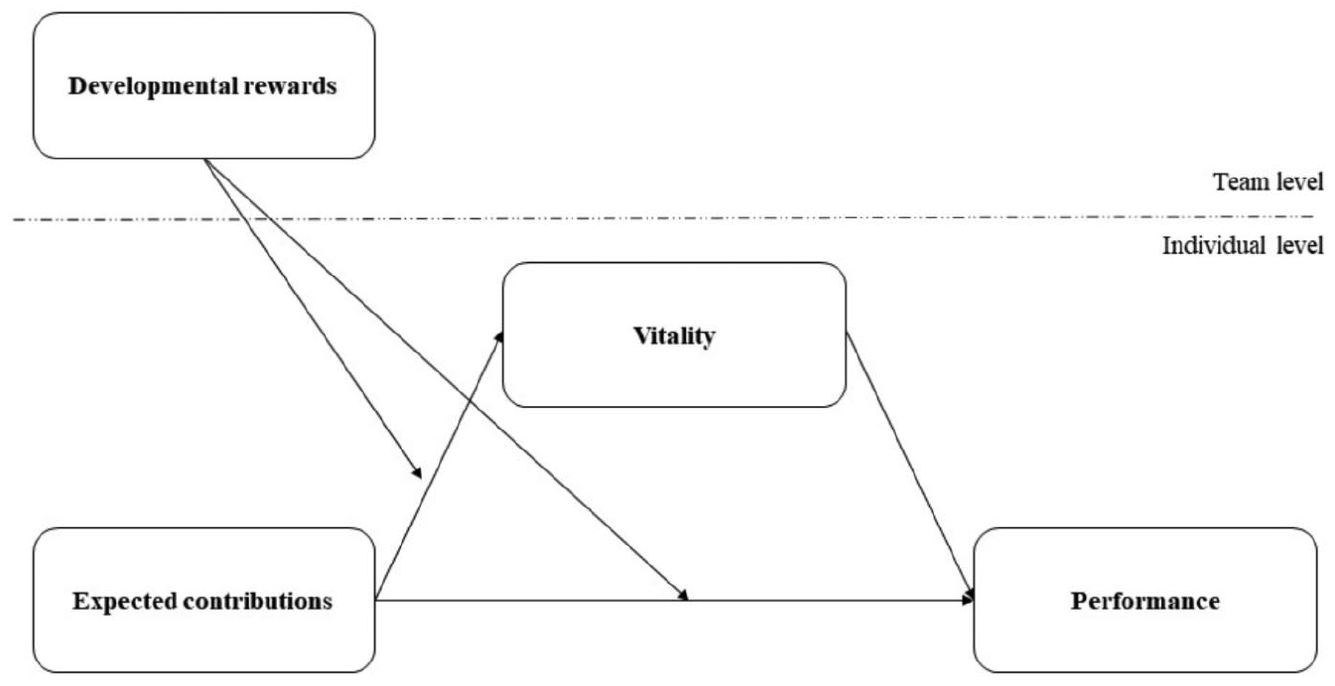
Conceptual model.
Results
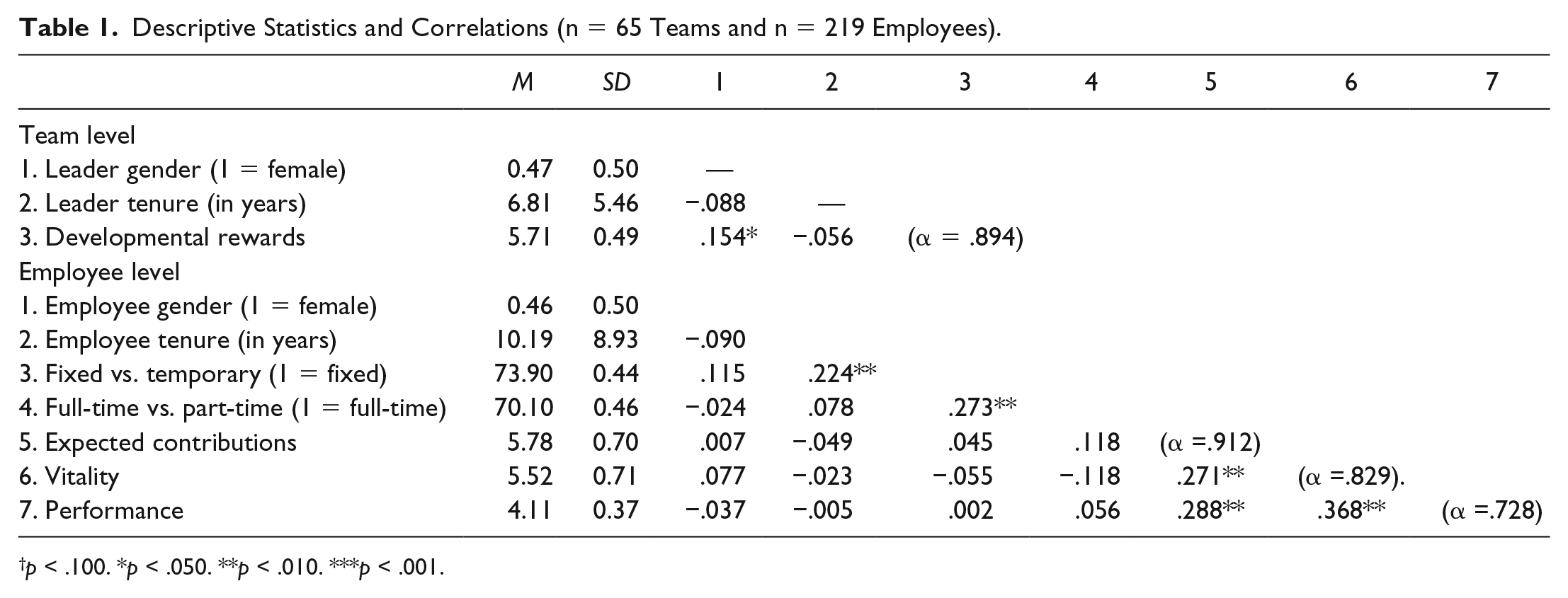
The descriptive statistics and bivariate associations of the variables are shown in Table 1. Correlations did not exceed .|800| and variance inflation factors (VIFs) remained in range 1.266 to 1.500, suggesting the absence of multicollinearity (Kline, 2011).
Descriptive Statistics and Correlations (n = 65 Teams and n = 219 Employees).
p < .100. *p < .050. **p < .010. ***p < .001.
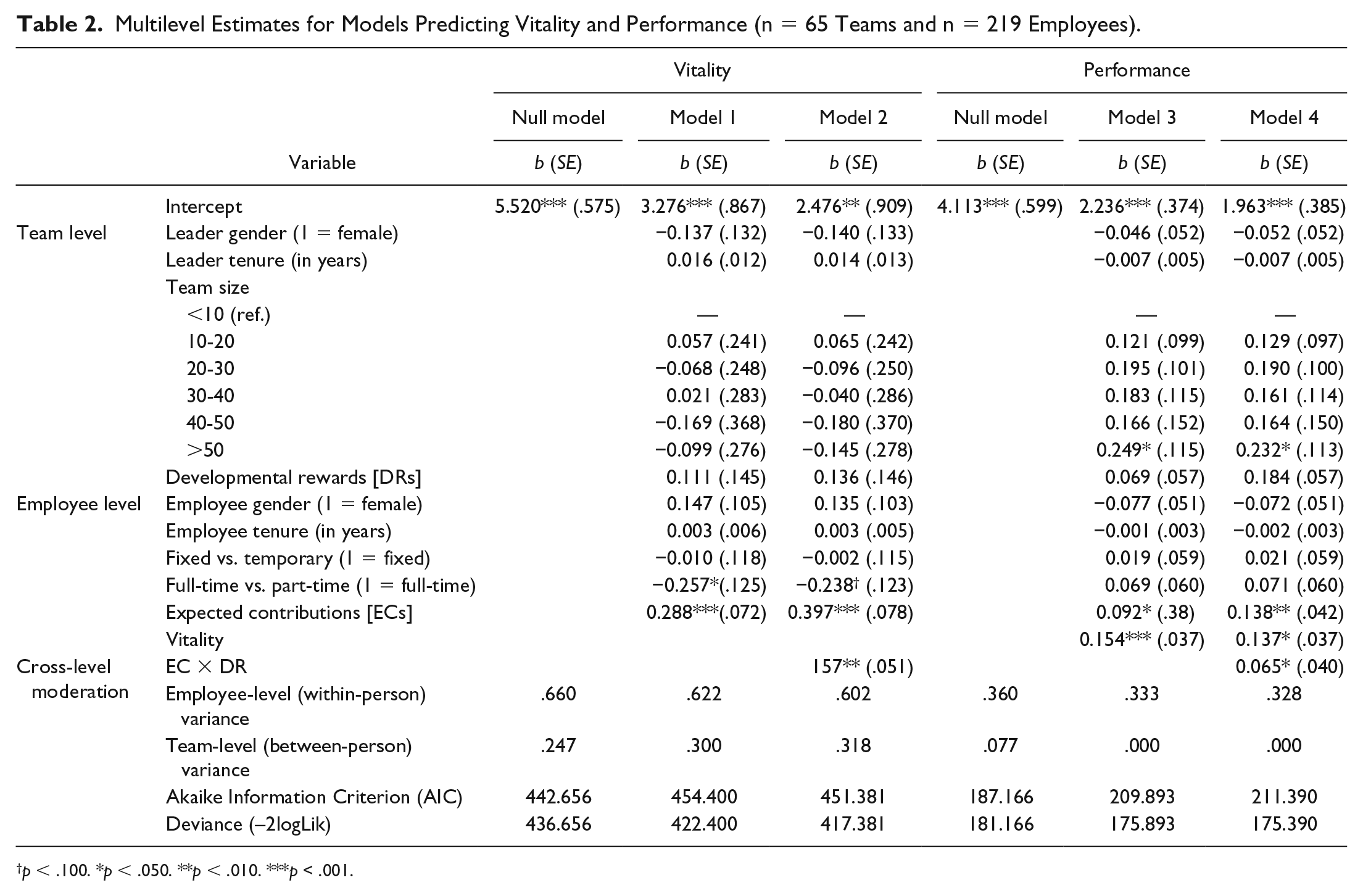
The results of the different hierarchical linear models are in Table 2. Based on the residual errors, 27.25% of the variance in vitality and 17.51% of the variance in performance is situated at team level. Effects for control variables are largely absent, except for full-time work, which is associated with lower levels of vitality (Model 2: b = –.238, p < .100) and team size, with employees reporting higher performance in the largest team category (Model 4: b = .238, p < .050). The best models to test our hypotheses are the models with cross-level moderations, based on lower Deviance scores and smaller values for the Akaike Information Criterion (AIC; Hox, 2010). The models support Hypothesis 1a and 1b: when employees perceive higher expected contributions, they report significantly more vitality (Model 2: b = .397, p < .001) and higher performance (Model 4: b = .282, p < .001). In addition, vitality is also related to performance when controlled for expected contributions (Model 4: b = .138, p < .050). Supporting the mediating effect of vitality in Hypothesis 2, the average direct effect of expected contributions in 10,000 Monte Carlo simulations was .129 (CI: .056-.20, p < .050) and the indirect effect was .040 (CI: .015-.070, p < .001). Supporting cross-level moderated mediation in Hypothesis 3, developmental rewards moderated the relationship between the independent and the mediator (M3: b =.157, p < .010), as well as the relationship between the independent and the dependent when controlled for the mediator (M6: b =.065, p < .050). The plots of the moderations are in Supplemental Appendices 2 and 3. In addition, in 10,000 Monte Carlo simulations, the average direct effect across groups for expected contributions, conditional on team-level developmental rewards was .136 (CI: .058-.210, p < .001) and the indirect effect was .035 (CI: .013-.060, p < .001).
Multilevel Estimates for Models Predicting Vitality and Performance (n = 65 Teams and n = 219 Employees).
p < .100. *p < .050. **p < .010. ***p < .001.
To test for curvilinearity, we performed additional linearity checks with expected contributions and its quadric term as predictors of vitality and performance. We kept controls and main effects of developmental rewards in the respective models. Both vitality (b = .133, p < .050) and performance (b = .086, p < .010) had significant quadratic terms in addition to their main effects (vitality: b = .362, p < .001; performance: b = .145, p < .001). However, as the plots in Supplemental Appendices 4 and 5 reveal, these curvilinear effects resemble positive exponential relations, rather than inverse U-shaped relations. An exponential relationship implies that the association between two variables follows a power coefficient, leading to a stronger increase in the dependent variable than under a normal, linear relation. Hence, we can only partially confirm Hypothesis 1c and Hypothesis 1d.
Discussion and Conclusions
This article aimed at advancing our understanding of job demands and jobs resources in public organizations (Bakker, 2015). We sought to contribute to the psychological perspective in public administration (cf. Borst et al., 2019; Grimmelikhuijsen et al., 2017). We focused on expected contributions and developmental rewards, which we conceptualized respectively as the intensity of individual goals and expectations and intensity of nonmaterial inducements (Audenaert et al., 2019). In our sample, both expected contributions and developmental rewards were high. While this does not correspond to the image of “unbalanced” public sector jobs, it follows claims about human resource management (HRM) in public organizations being increasingly performance driven and demanding, and at the same time also developmental in its focus (Clerkin & Coggburn, 2012). However, it is important to keep in mind that different configurations of expected contribution and developmental rewards exist within the larger public sector (cf. Audenaert et al., 2019).
As a first contribution, we examined more complex relationships of job demands and job resources in the public sector. Our findings show higher expected contributions are associated with increased vitality and performance among employees. This demonstrates that by energizing and challenging employees, certain job demands can have positive effects (Crawford et al., 2010) also in a public context. Furthermore, our findings endorse nonlinear or curvilinear effects of job characteristics (cf. Audenaert et al., 2018; Noblet & Rodwell, 2009; Sawang, 2012). Specifically, we observed positive exponential relations between expected contributions and their outcomes, vitality, and performance. While these exponential relations are modest at best, they suggest that lower expectations work less effectively and higher expectations more effectively than one would expect under linear relations (i.e., taking into account the presence of team-level developmental rewards). In other words, leaders first need to set a certain (base) level of expectations toward their employees before setting additional expectations can fully realize their energizing and motivating potential. However, since the positive effects of expected contributions did not become negative after a certain “threshold,” we cannot support the “too-much-of-a-good-thing-effect” (Pierce & Aguinis, 2013). Instead, our findings seem more consistent with goal-setting theory (Locke & Latham, 1990), which stresses the motivating potential of challenging goals and expectations.
Our findings also demonstrate a cross-level moderation of individual expected contributions and team-level developmental rewards. Not only does this observation illustrate that job demands and job resources can engage in moderating effects, but also that they can operate at different levels of analysis (Bakker & Demerouti, 2018; Füllemann et al., 2016; Schaufeli et al., 2014). This might be particularly relevant in public organizations, where the distribution of material and immaterial resources is rather more constrained and less tailored to the individual (Brewer & Walker, 2013). Hereby, we endorse recent calls to study moderations and multiple levels concerning job demands and resources in the public sector. Unraveling such complex relationships of job demands and job resources in public environments constitutes a next step of building in the job demands–resources model in public administration and connects it with theoretical developments in other disciplines (Borst, 2018; Borst et al., 2019).
Second, we found empirical support for the mediating role of vitality. Expected contributions enhance performance by stimulating employees’ vitality levels. In other words, expected contributions create energy and employees use that energy to perform. This suggests that vitality, as an engagement concept, could be an important mechanism via which job characteristics affect employee’s performance in the public sector (Akingbola & van den Berg, 2019; Bakker & Demerouti, 2007; Noesgaard & Hansen, 2018). It also supports the idea that the job demands–resources model represents an energy-driven process (cf. Bakker & Demerouti, 2007, p. 316) and that vitality is a way of measuring and conceptualizing that energy (Dorenbosch, 2014), ultimately bringing leaders and organizations closer toward managing the energy of their employees (Schippers & Hogenes, 2011). In this way, our analyses suggest that vitality deserves its merit in public HRM research (Dorenbosch, 2014; Tummers et al., 2018). Future research could focus on the specific circumstances under which vitality is an effective mediator in public organizations. In other words, which particular job characteristics (i.e., demands and resources) are most vitalizing and what are the subsequent implications for different types of employee performance (e.g., innovative work behavior, in-role and extra-role performance, and team performance)?
On a practical level, our study suggests leaders in the public sector, and public university colleges specifically, should carefully balance developmental rewards and expected contributions. In this sense, high combinations of expected contributions and high developmental rewards are generally more advantageous. This is not only true for individual employees but also for employees in a team, since HRM practices can interact with each other to affect employee’s well-being and performance. In this sense, the job demands–resources model offers leaders in public organizations a practical tool to create healthy work environments, since it considers employee’s well-being and performance as a product of expectations and inducements, guiding the development of more effective interventions (Schaufeli et al., 2014). From a practical point of view, the concept of vitality is also relevant to help public leaders develop sustainable HRM strategies. Sustainable HRM is concerned with employees’ long-term employability in a healthy and motivated fashion. To reconcile performance with employment over longer periods requires that employees are energetic and also resilient to deal with future demands, challenges, and requirements. As vitality is a reflection of employees’ energy and resilience, scholars like Dorenbosch (2014) argue that vitality constitutes a metric of HRM sustainability, analogous to the ecological footprint for ecological sustainability. In this way, the sustainability of different HRM practices can be assessed through their contribution to (or maintenance of) employees’ vitality.
This study has limitations. First, data were cross-sectional, while past public personnel reforms illustrate that expectations and inducements are not time-invariant (Audenaert et al., 2019). Furthermore, our measurements might show CSB due to the use of single-survey data. However, the presence of moderation effects strongly reduces this probability (George & Pandey, 2017). Second, data were self-reported. Although bias in self-reports constitutes a concern, its use is warranted when variables maintain criterion-related validity, and objective data are not publicly available. In times where concerns over privacy and data management are proliferating, access to objective data is becoming increasingly difficult. Nevertheless, future research could secure access to student evaluations and lecturer assessments to measure performance or draw on data from multiple sources (e.g., multi-informant studies and teaching evaluations). Third, we conducted this study in higher education institutions in Flanders. While it would be useful to replicate and generalize the study to other national and organizational contexts, it is important to assert that the precarious balance between job demands and job resources is not unique to the Flemish context. Rather, they are the result of more global public personnel reforms toward a more performance-driven and demand-intensive public employment relationship (Audenaert et al., 2019; Bach & Bordogna, 2011). Furthermore, our findings closely follow those in other national and cultural contexts (e.g., Borst et al., 2018; Crawford et al., 2010; Quratulain & Khan, 2015; Sawang, 2012). Fourth, our study is limited by its focus on developmental rewards in a team context. Future research could investigate how expected contributions and developmental rewards interact with extrinsic rewards and material resources at higher levels of analyses. A final limitation concerns our quantitative design. Qualitative examinations of the job demands–resources model are scant but could lead to valuable extensions of the model and theory and could be instrumental in understanding the contextual and institutional influences of how job demands and job resources operate in a team context (Daniels et al., 2013).
In conclusion, this article advances research on the job demands–resource model in public administration by demonstrating that employee-level job demands interact with team-level job resources influence employees’ performance, mediated by vitality. Furthermore, our study shows that job demands do not have universal negative effects and that they can also maintain positive and nonlinear effects with employee outcomes. Nevertheless, future research is required to enhance our understanding of these complex relations.
Supplemental Material
supplemental_Material_PDF – Supplemental material for Challenged by Great Expectations?: Examining Cross-Level Moderations and Curvilinearity in the Public Sector Job Demands–Resources Model
Supplemental material, supplemental_Material_PDF for Challenged by Great Expectations?: Examining Cross-Level Moderations and Curvilinearity in the Public Sector Job Demands–Resources Model by Robin Bauwens, Adelien Decramer and Mieke Audenaert in Review of Public Personnel Administration
Footnotes
Declaration of Conflicting Interests
The author(s) declared no potential conflicts of interest with respect to the research, authorship, and/or publication of this article.
Funding
The author(s) disclosed receipt of the following financial support for the research, authorship, and/or publication of this article: The authors acknowledge support from the Ghent University Special Research Fund (BOF) under BOF.STA.2015.0032.01-BOF15/STA/049.

Supplemental Material
Supplemental material for this article is available online.
Author Biographies
References
Supplementary Material
Please find the following supplemental material available below.
For Open Access articles published under a Creative Commons License, all supplemental material carries the same license as the article it is associated with.
For non-Open Access articles published, all supplemental material carries a non-exclusive license, and permission requests for re-use of supplemental material or any part of supplemental material shall be sent directly to the copyright owner as specified in the copyright notice associated with the article.
