




Abstract
Scholarly knowledge of organizational citizenship behavior (OCB) has developed significantly in the private and public sectors. However, comparisons between sectors have not been advanced. This article aims to address the gap with hierarchical linear modeling of OCB antecedents across sectors, accounting for individual- and sector-level differences. The results show a significant association between public service motivation (PSM) and OCB, as well as several other central correlates of OCB in the public sector: goal clarity, job satisfaction, and leader–member exchange (LMX). In addition, although there are marginally higher levels of OCB in the public sector, the interaction effect of sector and PSM is not significant. This finding suggests the effect of PSM on OCB is important across sectors rather than solely being a function of public sector employment.
Keywords
Introduction
Organizational citizenship behavior (OCB) refers to “behavior(s) of a discretionary nature that are not part of the employee’s formal role requirements, but nevertheless promote the effective functioning of the organization” (Organ, 1988, p. 4). The importance of the OCB concept for scholars and managers is that incentive-based management of employee self-interest is rarely sufficient for achieving what is in an organization’s collective self-interest. Instead, organizations rely on everyday occurrence of selfless (or, at least, self-interest deferring) acts that directly help other members of the organization or that help the general needs and functioning of the organization. Organ (1988) identified five core dimensions of OCB: conscientiousness, sportsmanship, courtesy, altruism, and civic virtue. Subsequent scholarship has developed variations to the five-dimension approach (e.g., Williams & Anderson’s [1991] organizational and individual-oriented OCB types), but Organ’s dimensions continue to be at the core of measurement approaches in both the public and private sector.
Public sector research on OCB is still far behind the private sector, but scholars have observed high levels of OCB in public organizations (Christensen & Whiting, 2009; Kim, 2006). There are reasons to believe that OCB has special salience in public organizations due to the relevance of generalized citizenship in government–citizen relationships and the goals of public administration reforms to achieve greater organizational responsiveness to citizens. OCB is a sociopolitical construct and has spillover effects between the workplace and political institutions (Cohen & Vigoda, 2000). According to Vigoda-Gadot and Cohen (2004), “citizenship behavior is vital for any public system and administrative bureaucracy in quest of effectiveness, efficiency, fairness, social justice and overall healthy growth and development” (p. 13). Managing OCB in the public sector, thus, takes on a challenge of understanding the way OCB works in its institutional setting.
A further finding in public sector research is that OCB has strong organizational synergies with public service motivation (PSM); OCB complements PSM. The former involves innovation and informal behavior, whereas the latter is more formally directed to public organizations and can motivate many areas of work beyond innovation (Vigoda-Gadot & Beeri, 2012). For example, research finds that PSM may substitute for the relationship between transformative leadership and OCB because it provides individuals with inner motivation to serve their organizations and fellow employees rather than to rely on external influencers such as the role of leaders (Bottomley, Mostafa, Gould-Williams, & Cázares, 2016). In Bottomley et al.’s (2016) study, as with an increasing number of other studies, PSM was shown to directly increase levels of OCB in organizations (e.g., Gould-Williams, Mostafa, & Bottomley, 2013; Kim, 2006). Thus, empirical studies provide robust evidence of an important role played by OCB in public organizations, and suggest PSM and OCB are closely related constructs. However, the results of the studies beg two key puzzles: first, whether there are different levels of OCB between sectors, and, second, whether there is a role for PSM in understanding this possible difference. Knowledge of such public–private differences provides a means for making better, sector-specific, managerial and behavioral interventions (Baarspul & Wilderom, 2011). As research on OCB in public organizations develops, it will be necessary to establish stronger empirical foundations of public sector distinctiveness with conceptual sharpness and clarity.
This article reports empirical research based on a data set from the 2014 U.S. General Social Survey (GSS). The nationally representative sample includes more than 2,000 employees from both the private and public sectors. Hierarchical linear modeling (HLM) is used to estimate random slopes and intercepts for private and public sector variance. Two research questions are addressed building on the puzzles identified above:
To begin, extant research on OCBs in the public and private sectors is reviewed, and hypotheses are deduced that set forward a theoretical framework for what we should expect to find. The hypotheses are then tested using the multilevel models, and discussion of the theoretical and practical importance of the findings is presented.
Theoretical Framework
Research on OCB shows a wide array of individual and organizational antecedents. The following theoretical framework adopts a threefold schema to include a specific set of traditional OCB antecedents. Research using meta-analysis of the literature and empirical testing organized and grouped these antecedents, and the theoretical framework here selects from among Podsakoff, MacKenzie, Paine, and Bachrach’s (2000) categories of individual, task, organization, or leadership characteristics. The main antecedents across sectors are discussed below, but first it is important to consider a factor with particular relevance important for public organizations and public employees—PSM.
PSM as an Antecedent of OCB
A strong case for a positive relationship between PSM and OCB has been gathering apace in the last decade or so. PSM has been noted for the role it plays in OCB and other dimensions of employee and organizational performance in the public sector (Campbell & Im, 2016; Kroll & Vogel, 2014; Shim & Faerman, 2017). Pandey, Wright, and Moynihan (2008) found that PSM is a predictor of interpersonal citizenship behavior, which they defined as, “helping behavior directed towards co-workers” (p. 102). In a survey of national attitudes in Australia, Taylor (2010) found that PSM predicted positive citizen behaviors such as political engagement, prosocial acts (e.g., giving to charity), and appreciation of civic rights.
Individuals with high PSM have a strong sense of civic duty and are motivated to seek the greater good of society. In a professional context, this motivation often is expressed in behavior aimed to develop the organization or support colleagues in helpful ways that are not formally expected (Gould-Williams et al., 2013). In studies focused on OCB specifically, PSM, along with other predictors, organizational commitment and job satisfaction, was shown to have a direct, positive influence on OCB (Kim, 2006; Liu & Perry, 2016). Gould-Williams et al. (2013) and Bottomley et al. (2016) have shown evidence of a positive association between PSM and OCB. Although there are fewer studies of PSM in the private sector than the public sector, and even fewer examining the relationship between PSM and OCB in the private sector, one study by Liu, Zhang, Du, and Hu (2015) found that PSM is positively associated with a similar construct, which they called community citizenship behavior.
Public administration research has shown that there are some important differences in motivations and attitudes of employees between the private and public sectors, and one of those differences is PSM. Employees in the public sector may generally have higher levels of PSM because individuals with higher PSM are motivated by prosocial interests to work in public sector organizations (Perry & Wise, 1990). Crewson (1997) found that public service workers were uniquely characterized by the desire to serve society, compared with their counterparts in the private sector. Even among employees in the private sector who do have high PSM, these individuals are more likely to express an interest in moving into the public sector in future career positions (Steijn, 2008).
But public–private differences go beyond motivation to include behavioral differences. According to Perry and Wise (1990), the science of PSM has been part of a search for behaviors that are grounded “primarily or uniquely in public institutions and organizations” (Perry and Wise, 1990, p. 368). Perry (1997) went further on the topic of public sector uniqueness in his article on the antecedents of PSM, where he observed that ostensibly unique aspects or values of public organizations were among the fundamental explanations of behavior by workers in the public service. The theoretical foundation of PSM as a value of public service reinforces this point, and suggests important behavioral consequences in the public sector, which may also extend to the area of OCB. If there are higher levels of PSM in the public sector compared with the private sector, then it begs the question of whether the process of turning motivations into behavioral expressions such as OCB may also be higher. The multidimensional constructs of PSM bear a strong resemblance to OCB typologies. One of the most well-known constructs of PSM is Perry’s (1996) fourfold scale, which includes compassion and self-sacrifice, and these are similar to OCB dimensions such as altruism and sportsmanship. Therefore, in an organizational setting, it is probable that these kinds of characteristics are likely to lead to OCBs involving altruistic actions taken to support colleagues.
In addition to hypothesizing that OCB levels are higher in the public sector as a result of PSM, public administration theory might be able to explain a mechanism for how this relationship takes place. The key assumption here is that the expression of PSM in the tasks of public organizations is not always captured in formal reward structures, and, therefore, it can be shown in ways that go beyond formal roles. Public sector employees are tasked with improving the public sphere in a very general sense, but they are probably no more formally tasked to serve their own organizations than employees who are formally tasked in the private sector. And yet, informally, the behavior toward their social community may be transferable to their work community. According to Boyne (2002) and Perry and Wise (1990), public sector employees are less driven by material rewards. In the public sector, employees may derive intrinsic satisfaction from helping their colleagues even if these behaviors are not recognized in the formal reward structure. PSM is not only a strong characteristic of individuals who choose to work in the public sector but also consolidated through social processes that take place for employees within the public organization (Giauque, Ritz, Varone, Anderfuhren-Biget, & Waldner, 2011; Perry, 2000; Vandenabeele, 2007; Vandenabeele & Van de Walle, 2008). These social processes involve employees developing their self-concept through finding meaning roles, seeing the results of individual and collective tasks, altering behavior, and undergoing normal attitudinal and cognitive changes that increase organizational identification through matching of individual and organizational values. According to Perry (2000), self-concept motivates employee behavior, and is developed through identification with organizational values and preferences that are learned through social processes in the organization.
Traditional Antecedents of OCB
As stated earlier, Podsakoff et al. (2000) introduced a schema grouping antecedents of OCB into the characteristics of individual, task, organization, or leadership. This schema has been retested and adapted in later works, such as Organ, Podsakoff, and MacKenzie (2005) who argued that the leadership and organization antecedents should be just one category—organization—of which leadership is a part. Leadership is, therefore, also used here as the organizational antecedent. Meanwhile, the theoretical framework develops another two of Organ et al.’s (2005) antecedents for the individual and task antecedents, respectively, job satisfaction and goal clarity. These three traditional antecedents have special relevance in prior studies of OCB and for attempts to better understand the dynamics of OCB in the public sector, as argued below.
Goal clarity
The first antecedent is goal clarity, which scholars have demonstrated has an important relationship to performance in the public sector. Public organizations are supposed to be more likely to suffer from vague or ambiguous goals compared with the private sector (Perry, 2000). Role ambiguity can decrease performance by causing emotional and cognitive stress (Onyemah, 2008), but goal clarity works to reduce role ambiguity (Pandey & Wright, 2006). The power of clear goals for performance lies in the way that “goals combine cognitive and motivational elements” (Lindenberg & Foss, 2011, p. 504) to endow them with an “energizing function” (Locke & Latham, 2002, p. 706). Goal clarity allows employees to regulate performance by more accurately assessing what resources employees have to achieve their goals and what types of performance-pursuing behavior they can engage in without detracting from ordinary task behavior (Koopman, Lanaj, & Scott, 2016; Whitaker, Dahling, & Levy, 2007).
Recently, public administration scholarship has shifted attention to associations that goal clarity might have with OCB. Specifically, goal clarity has been found to be positively associated with OCB (Caillier, 2016a, 2016b). According to Caillier (2016a), the ability of employees to perform well and put in high levels of effort is dependent on managers being able to give clear instructions to employees so that “subordinates know how their tasks relate to the purpose of the organization” (p. 302). Kahn, Wolfe, Quinn, Snoek, and Rosentbal (1964) suggested that having a clear idea of what is expected from one’s work is a function of an ongoing feedback process between the employee and the organization, so, by developing clear goals, employees are actually developing a deeper integration with the goal orientations and values of the organization. However, according to Vigoda-Gadot and Angert (2007), one consequence of having clear goals is that employees may develop their efforts toward OCB but that these efforts may be crowded out over time because goals tend to be focused on formal, rather than informal, tasks. However, although this effect may diminish OCBs, there are other processes that could counteract it. For example, in the public sector, it has been found that having clear goals allows employees to internalize the goals and then act in a more autonomous way to improve performance including OCB (Taylor, 2013), or even to create greater goal alignment and willingness to cooperate with colleagues (Bogaert, Boone, & van Witteloostuijn, 2012). Ultimately, if employees do not have clear goals, they might disregard information that is necessary for them to perform well, and, further, clarity is needed for knowing when it is realistic to engage in OCBs.
Job satisfaction
Job satisfaction is central to organizational behavior and has played a key role as an antecedent of OCB. Ang, Van Dyne, and Begley (2003) define job satisfaction as “an employee’s overall sense of well-being at work” (p. 564). Although employees may be well equipped and skilled for a job, their ability to put these skills into practice inevitably relies on many attitudinal factors, and job satisfaction plays a core role in this respect. Job satisfaction is broadly found to be positively associated with OCB (Cantarelli, Belardinelli, & Belle, 2016; Chih, Yang, & Chang, 2012). Organ and Konovsky (1989) said that of all antecedents, job satisfaction has the strongest effect on OCB. However, there have also been some nonsignificant results reported of the relationship between job satisfaction and OCB, suggesting that the relationship might sometimes depend on mediating variables (e.g., Alotaibi, 2001). Overall, research shows that job satisfaction has a direct relationship with OCB, but the strength of the relationship tends to depend on an employee having meaningful work and strong identification with his or her organization (Organ & Ryan, 1995; Williams & Anderson, 1991). This sense of meaningfulness extends to positive treatment of colleagues, and encourages employees to engage in positive extra-role behaviors (Joireman, Daniels, George-Falvy, & Kamdar, 2006). The relationship between job satisfaction and OCB takes place through a variety of causal mechanisms, which demonstrates the vital role that it plays in OCB. For example, job satisfaction partially mediates effect of work importance and work challenges on OCB, which means that it can partially compensate for tedious or unrewarding work (Shim & Rohrbaugh, 2014).
Leader–member exchange (LMX)
A final important organizational antecedent of OCB in the public sector is leadership (Bottomley et al., 2016; Caillier, 2016b). Organizational behavior research has demonstrated the importance of leadership in fostering desired behaviors on the part of employees and creating conditions for improved performance (Moynihan, Pandey, & Wright, 2011). Studies have typically found positive associations between leadership and extra-role performance such as OCB (e.g., Piccolo & Colquitt, 2006; Podsakoff et al., 1990). But what has been less studied is how positive LMX encourages the performance-enhancing behavior of leadership. LMX theory emphasizes three primary domains of leadership: followers, leaders, and the relationship itself (Graen, Uhl-Bien, 1995). Scholars have specified that the capacity of leadership to effect performance change is emphasized mainly in the relationship exchange between “leaders” and “followers” (Gerstner & Day, 1997), and that robust conceptualizations of leadership should emphasize both leader and employee perspectives (Jensen et al., 2016).
Thus, by fostering positive leader–member relationships, LMX can positively affect the relationships between employees via OCB (Vigoda-Gadot & Beeri, 2012). It is the quality of this relationship between managers and subordinates that has a positive effect on OCB (Hassan & Hatmaker, 2014). Research on OCB finds that this kind of leadership fosters a positive professional identity among employees with their coworkers, motivates supportive interpersonal behaviors by employees, and gives employees the confidence to speak their minds and to address concerns in the organization (Chen, Hwang, & Liu, 2012; Hassan, 2015; Settoon, Bennett, & Liden, 1996).
Data and Method
The test of the hypotheses uses data from the GSS for the year 2014. The data set contains the responses of 468 individuals who work in federal, state, and local governments, as well as 1,939 individuals working in the private sector, and is a representative national sample of the U.S. population. The industry areas in the data are based on the 305 item industry typology of the North American Industry Classification System (NAICS); 192 of these industry areas include observations for respondents who are either in the public sector or the private sector. The public sector employees are spread across 20 areas of public service industry: primary, secondary, and higher education teachers (19%); scientific, legal, health, and business professionals (17%); service workers (15%); office and customer service clerks (14%); technical and associate professionals, administrators, policy, and social workers (12%); senior officials, managers, and legislators (9%); and armed forces professionals (7%). This representative subpopulation of public sector workers has previously been used for estimates of statistical covariance in the United States, in public administration, using the GSS such as intrinsic motivation and the meaningfulness and sense of accomplishment inherent in public service work (Houston, 2000), and the motivational differences between public and private sector employees (Crewson, 1997).
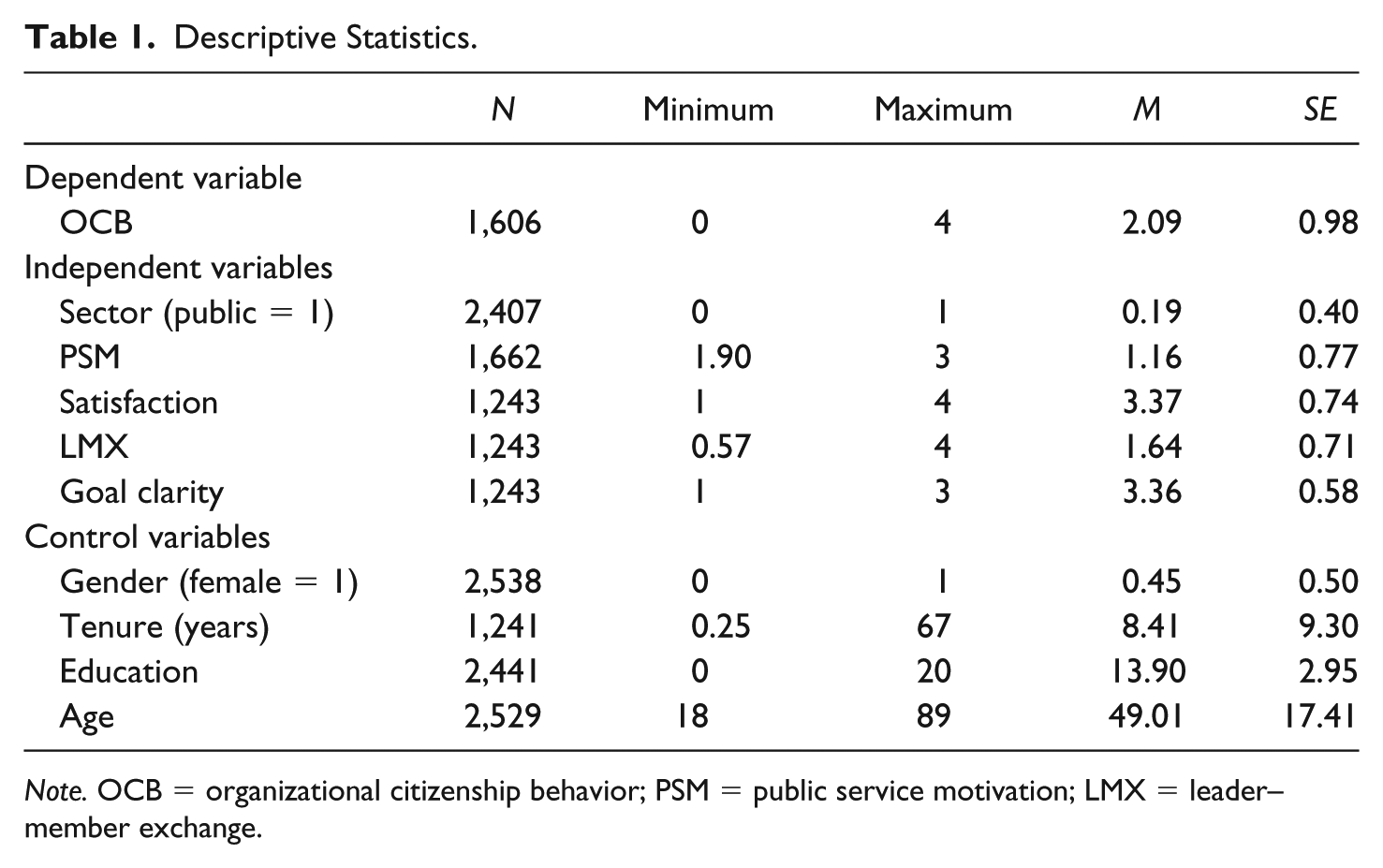
To construct the variables for PSM and OCB that resemble the variables used in previous public administration and OCB literature, principal component factor analysis (PCA) was used. The dependent variable, OCB (α = .68), and the independent variables, PSM (α = .71) and LMX (α = .82), were constructed using factor analysis with varimax rotation, discarding factors with eigenvalues below 1, and removing survey items with low levels of interitem covariance through iterative stages of testing. The factor analysis also indicated that the scales were representative of strong underlying latent variables with the lambda values of the variables falling between 0.40 and 0.84. The other independent variables—goal clarity and job satisfaction—and the control variables were single-item variables. The use of a single-item measure is quite common for measuring job satisfaction especially when the item directly refers to satisfaction (Choi & Rainey, 2014; Ellickson & Logsdon, 2002), and single-item measures have also been used for goal- and task-related constructs (e.g., Jung & Rainey, 2011; Pandey & Rainey, 2006). However, although comparisons of single- and multi-item measures find similar results, this is a limitation in the present study as multi-item measures can help to capture the reality of complex phenomena (Choi & Rainey, 2014; West & Berman, 2009). The single-item variables were typically Likert-type scales varying from 1 to 4 or 1 to 3, and encapsulated responses such as strongly disagree (1) to strongly agree (4). The list of descriptive statistics is shown in Table 1.
Descriptive Statistics.
Note. OCB = organizational citizenship behavior; PSM = public service motivation; LMX = leader–member exchange.
The PSM scale used in this work is an abridged version of Perry’s (1996) original 24-item scale using the four key dimensions of PSM: attraction to policy making, commitment to the public interest, civic duty, and compassion (full measurement items are listed in Appendices A-C). A similar abridgement of Perry has been used by Leisink and Steijn (2009) and Coursey and Pandey (2007). In both the latter articles, the authors found that using an abridged version provided equally good predictive power in comparison with the 24-item scale. Other effective PSM scales were used by Kim (2006) and Brewer and Selden (2000), and in the former for similar measures of covariance between PSM and OCB as in the present study. The OCB scale follows Organ’s (1988) original five-dimension typology of OCB (conscientiousness, sportsmanship, courtesy, altruism, and civic virtue). Due to having to work with the GSS survey items, the measurement items operationalize the five dimensions using GSS questions rather than identical questions from prior studies. But using novel measurement approaches by adapting existing OCB scales is similar to other operationalizations used in public administration scholarship (e.g., Rho, Yun, & Lee, 2015; Taylor, 2016). Critically, all OCB measurement items aimed to meet Organ’s (1988) conceptualization of cooperative and helpful behavior in organizations. Following recent precedents in public administration literature (Kim, 2006; Taylor, 2013; Vigoda, 2000), gender, education, age, and individual job tenure in terms of the number of years an employee has spent in the job were added as control variables.
HLM is used to test six different models with random slopes and random intercepts with restricted maximum likelihood (RML) estimation. The fixed effects variables were grand mean centered. Such centering has been recommended by researchers when the variables have no meaningful value of zero (Hofmann & Gavin, 1998), as they do for the attitudinal scales for OCB antecedents. Multilevel regression analysis is suitable for empirical models that have individual observations nested within subgroups that account for a proportion of the individual variation (Raudenbush & Bryk, 2002). The GSS data have such a hierarchical structure, in that, employees are nested by industry area. By estimating a model with individual (Level 1) and industry (Level 2) predictors, the model of the determinants of OCB can be predicted through simultaneously estimated coefficients for the two sectors. Moreover, scalar measures of fit and analysis of residuals can be used to compare the predictions across the models, so that further inferences can be made about the variables that should be retained for the best model (Bryk, Raudenbush, & Congdon, 1996). A null model (Model 1) was estimated first to estimate the amount of Level 2 variance explained by the industry differences. In the subsequent models, to test the fixed effects of the antecedents as well as PSM-based differences between the public and private sectors, a mixed-level ANCOVA model was used with interactions between a Level 1 (PSM) and a Level 2 predictor (sector). To estimate the Level 2 (industry level) model with intercept and slope variance as random effects, an intercepts- and slopes-as-outcomes model was simultaneously employed. The equations of the Level 1 and Level 2 models can be specified in the following formula below. In addition to fixed effects for the controls and OCB antecedents (β1j-β8j), there are fixed effects for sector (β9j) and the interaction effect (β10j).
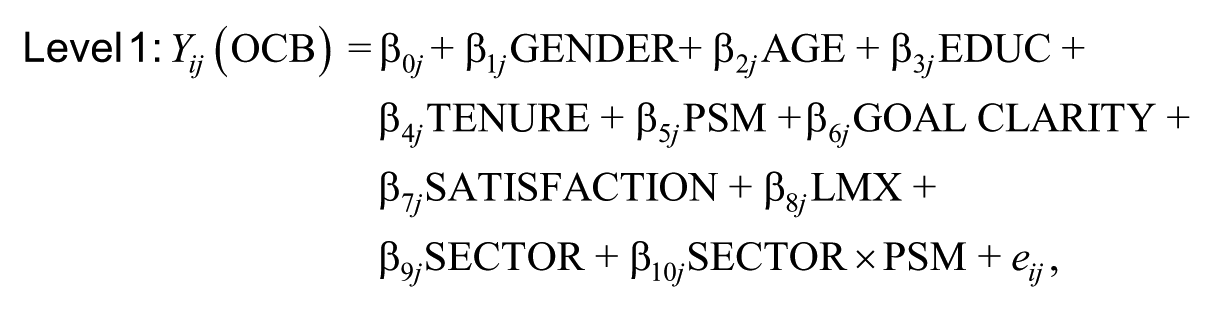

The fixed effects, Level 1 estimates test the hypotheses concerning the association of PSM and the traditional antecedents and PSM with OCB. Hypothesis 2 regarding whether sector increases the explained variance in Level 1 model is tested through the estimate of the random intercept for sectoral differences. Finally, Hypothesis 3 on the moderated effect of PSM on OCB in the public sector is tested through the mixed-level interaction term involving the moderating effect of sector on PSM. As the sector variable is a dummy coded “1” for public sector, the sector estimates effectively serve as a test of public sector estimates. One of the potential threats to statistical validity with regression performed with independent and dependent variables from the same data source is common method bias (Podsakoff, MacKenzie, Lee, & Podsakoff, 2003). To test for the presence of such bias, a PCA was run on all the variables in the model, and the results showed that there are four factors with eigenvalues above 1. The largest of these factors explained 38% of the model covariance. Therefore, although common method bias may still raise the risk of biased estimates, it should not cause errors in the interpretation of the regression coefficients that are sizable enough for serious validity concerns.
Results
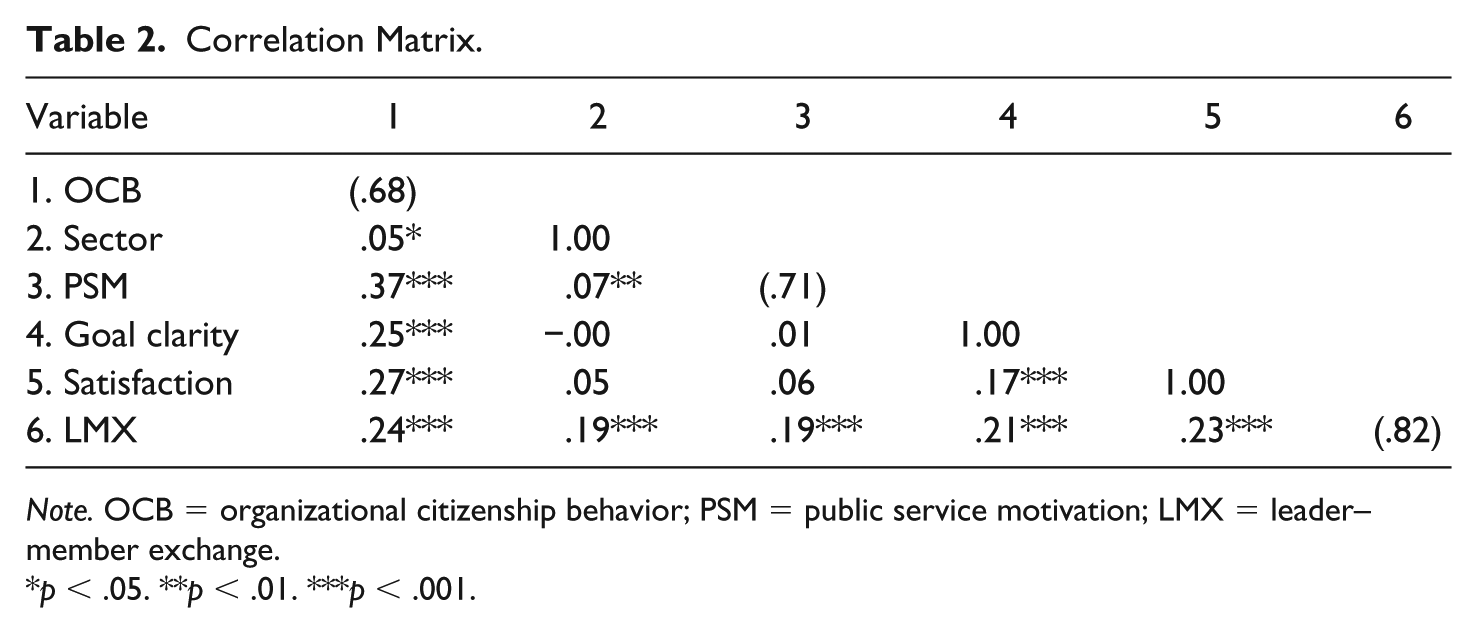
A correlation matrix (Table 2) was run to test the measurement and external validity of the variables. The matrix shows that most of the dependent and independent variables have moderate levels of correlation and are significant. Sector is also positively correlated with OCB (.05). PSM is positively correlated with OCB (.32) and sector (.07). Among the OCB antecedents, there are also many positive and highly significant correlations as we would expect. Scatterplots of the residuals of the full model (Model 3) revealed that the data satisfy the HLM requirement of normality and linearity. A test for multicollinearity using variance inflation factors (VIFs) found that multicollinearity is not a concern. The conventional area for detecting multicollinearity risk is VIF values at 5 or greater, but the tests or variables revealed an average VIF was 1.39 and no individual VIF was above 1.84.
Correlation Matrix.
Note. OCB = organizational citizenship behavior; PSM = public service motivation; LMX = leader–member exchange.
p < .05. **p < .01. ***p < .001.
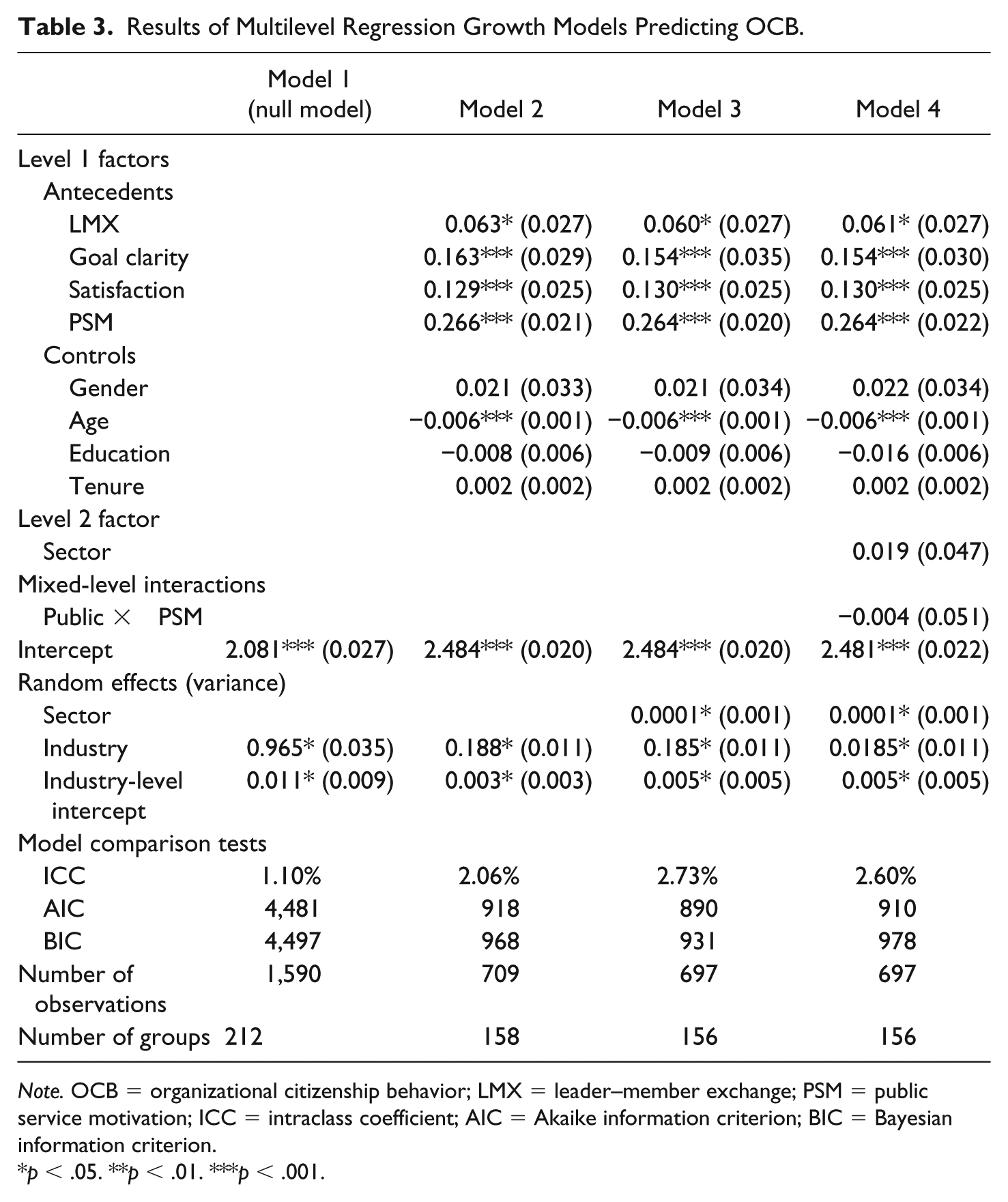
The results of the HLM analysis in Table 3 show support for the majority of the hypotheses. Specifically, the fixed effects of the antecedents of goal clarity, job satisfaction, and LMX are statistically significant across the models. These Level 1 fixed effect predictors also show that PSM plays an important role as a predictor. Its coefficient indicates that each unit increase in PSM is associated with a 2.6% increase in the level of OCB. One assumption of the empirical model discussed earlier in the theory section is that PSM and OCB are distinct constructs. The moderate positive correlation of .37 also suggests that the two constructs are not measuring the same underlying construct. However, the analysis was taken further by a confirmatory factor analysis (CFA) of the underlying dimensions using structural equation modeling to test a two-factor model versus a single-factor model. The results showed that a two-factor model marginally fits the data better than a one-factor model (χ2 = 763 and df = 252 vs. χ2 = 617 and df = 251). Thus, although CFA does not tell us which dimensions explain the distinctiveness, it does suggest that the two constructs can be treated as empirically distinct.
Results of Multilevel Regression Growth Models Predicting OCB.
Note. OCB = organizational citizenship behavior; LMX = leader–member exchange; PSM = public service motivation; ICC = intraclass coefficient; AIC = Akaike information criterion; BIC = Bayesian information criterion.
p < .05. **p < .01. ***p < .001.
The random intercepts for the Level 2 effect of industry shows that the variance explained across industries (0.019) is significant but also very small. In the null model, the intraclass coefficient (ICC), indicating what percentage of the variance in the outcome variables is accounted for by industry differences, is 1.10%, indicating that the organizational level does not account for a large amount of variance in OCB differences. The random effect of sector differences is also very small but again significant. The estimated variance explained by sector differences is 0.0001 in Models 3 and 4. As this variance is positive and significant, it shows that the average mean level of OCB is just slightly higher in the public sector industries if all the other variables are held equal at zero, which confirms Hypothesis 2, concerning the difference in the levels of OCB between the private and public sectors.
The decreases in the Akaike information criterion (AIC) and Bayesian information criterion (BIC) scores between Models 1 and 3 show that the addition of the fixed effects of the antecedents (in Model 2) and the random effect of sector (in Model 3) progressively improves the estimates by accounting for a progressively larger amount of variance. However, the additions of the mixed-level interaction term and the fixed effect of sector in Model 4 increase the AIC and BIC scores, indicating that these additions decrease the explanatory power of the model. Furthermore, neither of these fixed effect estimates is significant. Sector differences as a fixed effect predictor of OCB has no significant effect. The interpretation of the sector estimates as both a fixed and random effect is that, although the statistically significant random slope for the influence of sector on OCB shows that sector differences account for Level 2 variance in the relationship between antecedents and OCB, the fixed effect estimate for sector shows that being an employee in the public sector in itself makes no difference to the expected level of OCB. Furthermore, counter to Hypothesis 3, the mixed-level interaction of PSM and sector is not significant for OCB.
Discussion
The results of the analysis confirm the finding that PSM is positively associated with OCB. In measuring this relationship, this study, therefore, adds to evidence shown in earlier findings regarding PSM and OCB begun by Kim (2006), and repeated in later studies by Gould-Williams et al. (2013), Bottomley et al. (2016), and Pandey et al. (2008). Because an organization relates to an employee’s place and function, OCB is a kind of expression of self-identity (Lee & Allen, 2002). In a public sector setting, PSM means that organizational identification tends to be strong (Perry, 2000). The added persuasiveness of this theory is further supported by estimating the role of PSM in conjunction with the effects of several of the traditional public sector OCB antecedents. As earlier research identifies sensitivity of models of antecedents to inclusion of additional variables (Shim & Rohrbaugh, 2014), this research makes an important step forward by estimating the effects of several traditional antecedents together with PSM and finding a salient link with OCB.
The results of the HLM analysis also found that variation in the effects of the antecedents of OCB across different types of industry is partially accounted for by the random effect of the status of an organization as either a public or private sector organization. This effect, showing higher average amounts of OCB in the public sector is significant but very small. By addressing the association of sector differences and OCB, the article answers important theoretical questions posed in the article’s “Introduction” section about whether there are higher levels of OCB in the public sector, and whether the effect of PSM on OCB is the result of the interaction of public sector. Although PSM does predict OCB, sector does not moderate the effect of PSM, which means that sector differences are not explained by higher levels of PSM in the public sector. Prior findings suggest that the effects of PSM on organizational performance are dependent on a range of contextual factors, and so, it is not sufficient to explain variation of OCB between sectors. Scholars have earlier noted that PSM can also benefit private organizations (Perry & Rainey, 1988). The findings here corroborate that view and suggest that there may be an important mechanism connecting PSM and OCB. PSM is defined by its responsiveness to the larger community, the “public body,” but an organization is a different kind of corporate entity with a collective ethos to which PSM may respond. These two types of corporate identification are surely very different but each may interact with PSM and OCB in ways that should be investigated. For example, job attitudes such as organizational identification or job fit that connects an individual’s corporate identity with behavior may interact with the PSM–OCB relationship, or there may be individual or organizational characteristics that explain the moderation of PSM and OCB such as policy area, government level, or the quality of public approval. Furthermore, as PSM is not a distinguishing factor between the private and public, it is unclear from the analysis in this article alone what reasons may account for OCB differences between the sectors. Future research could pick up this line of enquiry to research the problem of public–private sector differences in OCB further. Scholars studying OCB in private organizations have called for more research to distinguish among the differential effects of antecedents on different kinds of OCB (Harper, 2015; Podsakoff et al., 2000), and this area may also help our understanding of public organizations and differences between the sectors.
By estimating the effects of PSM and traditional public sector antecedents of OCB together, this study adds a further argument to the field of OCB studies that PSM is an equally important predictor of OCB as the antecedents goal clarity, job satisfaction, and LMX. In fact, as the results have demonstrated, PSM may even be a stronger factor than some of the other antecedents that have frequently been used in public sector OCB research. Although effects over time following Vigoda-Gadot and Angert (2007) were not tested, the findings regarding goal clarity suggest a positive connection with OCB. Goal clarity provides better individual planning as well as opportunities for better goal-sharing behavior that favor better opportunities for employees to engage in helping behavior. Both job satisfaction and LMX also function as direct positive predictors of OCB across sectors. Prior work notes mediating and moderating effects involving the relationship between job satisfaction and OCB, but effect is also direct. Therefore, managers in both sectors should promote PSM in addition to promoting OCB antecedents such as goal clarity, job satisfaction, and LMX to harness better organizational behaviors.
This recommendation to develop these antecedents comes with the caveat that empirical findings increasingly show a “dark side” to OCB, and there may be dangers of this when exploitative managers seek to gain from employee good will or if reform pressures expect employees to achieve similar levels of organizational performance with fewer resources (Bolino, Klotz, Turnley, & Harvey, 2013; Taylor, 2013). The risk of what Vigoda-Gadot (2006) coined compulsory citizenship behavior (CCB) stems from the fact that the line between in- and extra-role behavior is blurry; one may be turned into the other by suiting the interests of managers. OCB may be harnessed by managers without fair processes or rewards that may ultimately lead to OCB diminishing (Zhao, Peng, & Chen, 2014). It is, therefore, vital from both scholarly and practitioner perspectives that OCB and CCB are treated separately, and it is clearly understood that although employees may be incentivized to “go the extra mile,” they can do this for both positive and negative reasons (Vigoda-Gadot, 2006; Zhao et al., 2014). Similarly, downsides of PSM have also been uncovered (van Loon, Vandenabeele, & Leisink, 2015). Given the propensity of public sector employees to PSM and evidence of the relationship between PSM and OCB, it is especially important for the mechanisms of such dark sides to be further investigated.
A significant limitation of the research presented here is that the empirical model relies on cross-sectional data of self-reported survey answers, which means, first, that statistical correlations cannot be construed as evidence of causation and, second, that the reported behavior may be about how the respondents would prefer to see themselves (Naff & Crum, 1999). As discussed in the “Data and Method” section, caution should be taken in interpreting data from survey items that may be affected by common source bias, as the use of Harman’s test and multi-item scales do not offer certainty of the absence of such bias (Podsakoff et al., 2003). Furthermore, the use of secondary data is challenging for the construction of measurement scales, as the survey items sometimes cannot be matched precisely to existing measurement scales. This is the case for other studies in this field (e.g., Rho et al., 2015; Taylor, 2016), but it requires interpretation of results in comparison with other studies and with special attention to the effects of underlying constructs. Another potential limitation of the data is that they do not observe smaller subgroups of public organizations such as differences between the federal, state, and local levels. Besides the lack of granularity in the data, the generalizability of the findings is also an important issue as the findings here are centered on one country, the United States. The variables under analysis are important in a range of cultural and geographic contexts but it cannot be assumed that the empirical relationships will be the same outside of the United States. A final shortcoming of the study is that it treats the public–private distinction as a rigid dichotomy, rather than with the fluidity that characterizes collaborative governance in the public sector (Boyne, 2002; Bozeman & Bretschneider, 1994; Peters & Pierre, 1998). The specification of the model along the axis of the public–private distinction was a necessary result of using a dummy variable. Continuous variables for publicness would be a much more suitable measure of the private–public differences, but such a measure was not possible with the GSS data. Although we have argued that it is valuable to draw inferences from such a distinction in so far as the two sectors represent two conceptually and ontologically distinct institutional structures and processes, it must be remembered that the reality of today’s institutional landscape is not so distinct. Numerous types of organizations are involved in public governance from nonprofits to government corporations and community organizations to religious groups (Ansell & Gash, 2008; Emerson, Nabatchi, & Balogh, 2012). Furthermore, the way that these types of organizations interact is also a source of hybridity due to mixed funding sources, government outsourcing, and collaborative governance arrangements (Perry & Rainey, 1988; Rainey & Bozeman, 2000). Therefore, in making inferences from this study, it is necessary to understand the actual institutional complexity of the concepts of “public” and “private.”
Conclusion
This article examined two research questions to tackle the gap in scholarly understanding of sector differences in OCB. The major contribution is that this study is the first to address the specific hypotheses of the relationship between industry sector and OCB, and to do so using multilevel modeling involving a range of traditional antecedents. The tests of the antecedents of OCB show that the antecedents function in similar ways across the private and public sectors. Among these antecedents, the article provides evidence that PSM should be considered among the antecedents in both sectors. Although the effect of PSM, a unique public sector characteristic, on OCB is strong, PSM does not explain differences in levels of OCB in the private and public sectors. However, there is a difference in the variance of OCB levels across different industry areas that is partially explained by whether an employee works in a public or private organization.
In addition to the theoretical implications, there are practical applications of the results. Although the results of this research cannot be interpreted as causal effects, prior research has shown managers in the private and public sectors are capable of boosting OCB through several attitudinal characteristics of their employees. Part of the challenge of increasing levels of OCB through PSM is in understanding the mechanisms involved in interactions between employees and managers with regard to simultaneous and overlapping effects of OCB antecedents, sector characteristics, and PSM. There will be a need for further qualitative and quantitative work investigating the individual and organizational determinants of these mechanisms.
From another practical perspective, this finding is both an opportunity for public managers to harness PSM, traditional antecedents, and OCB. This process may be especially important in the public sector as empirical research has shown that certain employees, such as younger employees, experience organizational obstacles to developing PSM (Houston, 2000; Leisink & Steijn, 2009; Perry, 1997), and that individuals with PSM are deterred from entering public service because of a lack of clear organizational mission (Bright, 2011). It makes logical sense that employees who seek the public good in their professional work would be further incentivized by the existence of a supportive professional community in their own organizational daily existence. This is an important and potentially useful topic for public performance management that merits further research to understand the management practices that can nurture and promote PSM and OCB.
Footnotes
Appendix A
Appendix B
Appendix C
Acknowledgements
The author thanks Professor Sanjay K. Pandey for mentorship during the author’s PhD candidacy, as well as for many helpful conversations and commentaries while this manuscript was in early stages of development. I also thank the three anonymous reviewers of the article for their insightful reviews.
Declaration of Conflicting Interests
The author(s) declared no potential conflicts of interest with respect to the research, authorship, and/or publication of this article.
Funding
The author(s) received no financial support for the research, authorship, and/or publication of this article.
