




Abstract
Vitality refers to the experience of having energy available to one’s self. Vital employees are full of positive energy when they work, and feel mentally and physically strong. Such employees often show higher job performance and lower stress than their less vital colleagues. Despite the importance of vitality, few public administration studies have studied vitality. More generally, by focusing on vitality, we aim to bring a “positive psychology” perspective into the domain of public administration. We analyze whether two important job characteristics (leader’s task communication and job autonomy) affect vitality. We use a multi-method design. A large-scale survey (N = 1,502) shows that leader’s task communication and job autonomy are positively related to vitality. A lab experiment (N = 102) replicated these findings, showing cause-and-effect relationships. In conclusion, public organizations can potentially increase employee vitality (a) by increased task communication from leaders and (b) by providing employees with greater job autonomy.
Keywords
Introduction
Vitality is a direct experience of having energy available to one’s self (Ryan & Frederick, 1997). Vital employees are full of positive energy when they are working, and feel mentally and physically strong (Kark & Carmeli, 2009). Vitality has been linked to higher job performance (Carmeli, 2009), better mental health (Nix, Ryan, Manly, & Deci, 1999), and better coping with stress (Ryan & Frederick, 1997). Research also suggests that higher vitality enhances people’s resilience to physical and viral stressors, and thereby makes them less vulnerable to illness (Ryan & Deci, 2008).
Although vitality is considered important (Kark & Carmeli, 2009; Ryan & Deci, 2001), there is a dearth of research examining vitality in the public administration literature. A greater focus is being placed on “hedonic” (Ryan & Deci, 2001) indicators of well-being, such as job satisfaction and organizational commitment (see, for instance, Cantarelli, Belardinelli, & Belle, 2016). Managing such hedonic indicators of well-being is important, as they can have significant consequences for employees and their organizations, such as lower turnover (Griffeth, Hom, & Gaertner, 2000). However, this is not sufficient. For example, employees can be very satisfied with their job, but simultaneously be passive in their behavior (e.g., arriving at 10 a.m., taking an extensively long lunch break, unwilling to help colleagues). Most likely such satisfied, but passive employees might not show much initiative and might not always realize their full potential. Therefore, positive psychology argues that “eudaimonic” well-being indicators such as vitality, engagement, and thriving should also be taken into consideration (Ryan & Bernstein, 2004, see for two recent public administration examples, Vigoda-Gadot, Eldor, & Schohat, 2013, and Meng & Wu, 2015). Whereas the hedonic approach conceptualizes well-being as a subjective experience of happiness, positive affect, and satisfaction, the eudaimonic approach conceptualizes well-being as fulfillment of one’s potential (Deci & Ryan, 2008). Thus, the eudaimonic approach focuses more on the process of living well—feeling vital and having a sense of meaning—rather than a delimited state such as pleasure or satisfaction (Ryan, Huta, & Deci, 2008).
We will examine how two important factors in the work environment of employees can positively influence vitality, namely, leader’s task communication and job autonomy. We acknowledge that many other factors—such as reward practices and social support—can also be relevant (see, for an overview, Shirom, 2011). However, leader’s task communication and job autonomy are important potential antecedents of vitality, as we will argue extensively in the theoretical framework. Based on the above, we will answer the following research question:
This article thus contributes to the public administration field by examining a core but neglected component of well-being, namely, vitality. We utilize a multi-method design, conducting both a cross-sectional survey and an experiment. By doing so, this research answers to calls for more multi-method research in public administration and specifically more emphasis on using experiments (Perry, 2012). Groeneveld, Tummers, Bronkhorst, Ashikali, and Van Thiel (2015) found that only 6% of journal articles in the top tier public administration journals use a multi-method design. The combination of these two methods allows for greater validity of the findings (Grimmelikhuijsen, Jilke, Olsen, & Tummers, 2016; Jilke, Van de Walle, & Kim, 2016).
This article is structured as follows. The section “Theoretical Framework” explains the theoretical background and develops three hypotheses. The section “Study 1—Survey” discusses the method of the survey, involving 1,502 public health care employees, as well as its results. The advantage of this survey is that it is located in real organizational environments and employs a large sample. This increases the generalizability and makes it possible to examine whether relationships exist. Section “Study 2—Experiment” describes the method used for the experiment, involving 102 participants, and its results. The experimental study is beneficial as it can make a stronger causal claim because the independent variables are exogenously manipulated. We manipulate leadership communication and job autonomy and investigate whether this causally influences the degree of vitality that the participants experience. The concluding section discusses the contributions of this article and highlights a number of limitations.
Theoretical Framework
Positive Psychology and Public Administration
Since the early 2000s, research based on positive psychology insights has gained momentum (Ramlall, 2008; Seligman & Csikszentmihalyi, 2000). According to Seligman, Steen, Park, and Peterson (2005) positive psychology is “an umbrella term for the study of positive emotions, positive character traits, and enabling institutions” (p. 410). Positive psychologists argue that traditional psychology has tended to focus too much on what is wrong with people. As a counterweight to this, positive psychology emphasizes human strengths and ways to increase these.
Drawing upon positive psychology, organizational behavior scholars started studying and looking for conceptual models and measurements, which are in line with a positive, proactive approach to organizational research (Wright & Quick, 2009). Related to this, Deci and Ryan (2008) advocate the use of eudaimonic concepts of well-being. In contrast to the hedonic view—which stresses the fact that well-being consists of pleasure and happiness—the eudaimonic view suggests that well-being involves the actualization of human potential. With this focus, the eudaimonic view of well-being fits well within the focus of positive psychology, which also stresses the importance of using strengths and psychological capacities (see, for instance, Luthans, 2002). In line with the rise of positive psychology, in the recent decades, eudaimonic concepts of well-being such as engagement, vitality, and thriving are being used increasingly (Ryan & Bernstein, 2004; Schaufeli & Bakker, 2004; Spreitzer, Sutcliffe, Dutton, Sonenshein, & Grant, 2005).
However, the application of ideas from positive psychology to the field of public administration has been scarce (exceptions are Bakker, 2015; Meng & Wu, 2015; Vigoda-Gadot et al., 2013). Vigoda-Gadot et al. (2013) express their surprise at the fact that the concept of employee engagement is seldom used. Employee engagement is according to them, a positive, fulfilling, work-related state of mind. They empirically show that employee engagement is distinct from more widely used concepts such as affective commitment and job involvement.
We argue that insights from positive psychology can be beneficial for public employees and their clients. For public employees (as well as private employees), it is important to feel vital and energetic at work as it has been linked to lower stress and better mental health (Nix et al., 1999; Ryan & Frederick, 1997). Understanding the antecedents for concepts such as vitality—as we do in this article—is, therefore, important. Furthermore, it has been argued that such concepts are important as the positive emotions of “energized” public sector employees will also affect the feelings and emotions of citizens (Vigoda-Gadot et al., 2013, p. 529).
Vitality
Vitality refers to “the experience of having energy available to one’s self” (Ryan & Frederick, 1997, p. 2). Vitality is derived from vita, or “life.” A person who is vital at work approaches his or her job with positive energy and excitement (Kark & Carmeli, 2009).
Although vitality is related to other indicators of well-being such as job satisfaction, positive affect, happiness, job involvement, and organizational commitment, it has also been found to be empirically distinct from these (e.g., Nix et al., 1999; Ryan & Frederick, 1997; Vigoda-Gadot et al., 2013). For instance, although happiness is also a positive emotional state, it is, contrary to vitality, not necessarily characterized by high energy or activation (Deci & Ryan, 2008). Furthermore, vitality is strongly related to the concept of engagement (Schaufeli & Bakker, 2004). This is especially the case for the dimension “vigor,” one of the three dimensions of engagement. Both vigor and vitality focus on having positive energy at work (Ryan & Deci, 2008), although vigor is also about resilience in the face of difficulties.
In this research, we focus on vitality given that it has been robustly associated with positive behavioral and health outcomes. These include creativity (Kark & Carmeli, 2009), career success (Baruch, Grimland, & Vigoda-Gadot, 2014), lower susceptibility to illness (Polk, Cohen, Doyle, Skoner, & Kirschbaum, 2005), and higher job performance (Carmeli, 2009). Ryan and Deci (2008) conclude that “when we consider that vitality and energy have been associated with greater performance and persistence, as well as psychological and physical wellness, it is clear that vitality represents an important resource whose promotion has multiple benefits” (p. 714).
Several antecedents can arguably affect vitality. In his article on the closely related concept of vigor, Shirom (2011) discerns four different types of antecedents: organizational, group, job, and individual resources. In this study, we focus on two potentially key antecedents: leadership (a group resource) and job autonomy (a job resource).
Leadership and Vitality
Scholars have argued that communication is an important part of leadership (Atwater & Waldman, 2008; Van Wart, 2012). For instance, by communicating with employees, leaders provide strategic direction, help set concrete goals, and solve problems (Offermann & Hellmann, 1996; Riggio, Riggio, Salinas, & Cole, 2003). However, leadership communication is a broad concept and we should, therefore, be explicit about what type of communication is referred to. In this study, we focus on task communication, which is defined as “the extent to which supervisors let subordinates know what needed to be done, explained changes in the workplace, and explained policy” (Penley & Hawkins, 1985, p. 313). Task communication has been linked to various important outcomes such as increased trust in management (Ertürk, 2008), group performance (Vora & Markóczy, 2012), and job satisfaction (Penley & Hawkins, 1980). Task communication can be considered as an “operational” form of communication, as compared with more strategic communication such as articulating an inspiring mission and creating a positive organizational climate. Related to this, Van Wart (2012) classifies the highly related concept of clarifying roles and objectives as a “task” domain of leaders.
Communicating with employees about their tasks is one of the most important leadership activities. It is an integral aspect of “initiating structure,” one of the two core leadership dimensions identified by the Ohio State Leadership Studies. Related to this, it is a specific leadership behavior. This contrasts with general “styles” of leadership, which often encompass various loosely coupled activities. Such leadership “styles” are increasingly being challenged. For instance, Van Knippenberg and Sitkin (2013) strongly critique the charismatic-transformational leadership style. They note that it often fails to distinguish leadership’s separate dimensions and tends to define the leadership styles in terms of their outcomes rather than behavior. Therefore, they have suggested that distinct elements of leadership behavior (such as leader’s task communication) should be investigated.
We expect that leader’s task communication is positively related to employee vitality. Through task communication, employees obtain knowledge regarding their roles. They can better understand how they can achieve desired outcomes and gain more confidence in completing their tasks (Baard, Deci, & Ryan, 2004). Moreover, information provided by a leader about the goals and mission helps create a sense of meaning and informs employees about how their jobs fit within the organizational context (Amundsen & Martinsen, 2014). This is possibly even more relevant in the public sector domain where organizational goals can be quite ambiguous and conflicting (Rainey, 2014). Hence, via several routes, leader’s task communication can help increase employees’ competence, a perception that one can effectively bring about desired outcomes and effects. Earlier studies studying self-determination theory have shown that increased competence leads to greater vitality (for instance, Sheldon, Ryan, & Reis, 1996). We can, thus, expect that the extent to which leaders employ task communication positively influences the vitality of their employees. Our first hypothesis is thus as follows:
Job Autonomy and Vitality
Next to the role of task communication, we expect that job autonomy also positively influences vitality. The relationships between job autonomy on one hand and well-being and behavior on the job on the other hand have been extensively studied. In public administration literature, job autonomy has been related to higher job involvement (Hassan, 2014), higher job satisfaction (Taylor & Westover, 2011), and reduced stress (Pearson & Moomaw, 2005). We expect that increased job autonomy will likewise enhance employee vitality. Job autonomy makes people act upon their deep values, goals, and interests (Graves & Luciano, 2012). Within the positive psychology framework, this implies that employees can better use their potential. Controlled behavior, however, can be experienced as demands to think or behave in certain specific (sometimes undesirable) ways and, therefore, could drain personal energy. In their famous diary study on self-determination theory “What makes a good day,” Sheldon et al. (1996) showed that students who experienced more autonomy during the day also experienced greater vitality. Other scholars also empirically showed that when people are in an autonomy supportive context, they experienced greater vitality than in a controlled context (Muraven et al., 2008; Nix et al., 1999; Ryan et al., 2010). Based upon this we formulate the following hypothesis:
Interaction Effect of Leader’s Task Communication and Job Autonomy
In addition to the expected main effects of leader’s task communication and employees’ job autonomy on vitality, we furthermore expect that the effect of leader’s task communication on vitality will depend on the degree of job autonomy employees have. Contingency theories of leadership argue that not only the leadership behavior but also the context within which that behavior occurs needs to be taken into account when examining its effects (Fiedler, 2005). We use path goal theory (House, 1996) to explain why we expect job autonomy to moderate the effect of task communication. Path goal theory examines which contingencies are deficient in a situation and suggest which type of leadership is necessary to remedy the specific need (Van Wart, 2012). It is important to note that the theory also explains that in some contexts, leadership is not needed. As Van Wart (2012) summarizes it, “Under ideal conditions, well trained, highly motivated, cooperative employees with ample supplies and incentives need very little ‘leadership’” (p. 65).
Related to this, self-determination theory propagandists argue that autonomy is a basic need, and its fulfillment will help employees to use their full potential. They will get energy and will be intrinsically motivated to perform a task. Thus, one would expect that when employees have high job autonomy, they will be (a) intrinsically motivated to look for the information they need and (b) have more freedom to search for this information themselves given their higher autonomy. Hence, they will be less dependent on the leader to provide information for them. In other words, leader’s task communication will be less important in situations with high job autonomy. This brings us to Hypothesis 3:
Study 1—Survey
Method—Procedure and Respondents
To test the three hypotheses, we first conducted a survey. Data were collected between 2010 and 2011 in three large public health care organizations in the Netherlands using an anonymous electronic survey (developed by Stichting IZZ, supported by PwC). The survey covered a range of issues associated with work, including indicators of leader’s task communication, job autonomy, and employee vitality.
The electronic survey was emailed to all 2,876 employees of the participating organizations. After an introductory email and reminders, 1,507 employees responded, yielding a response rate of 52%. Of the respondents, 91% were female. This is somewhat comparable with the Dutch health care sector (82%; Central Bureau for Statistic [CBS], 2013). The average age was approximately 43 years, which is consistent with other findings showing that the average age of employees in the Dutch health care lies between 41 and 45 years (UWV, 2013).
Measures
The items of all scales are shown in Online Appendix 1. We constructed the scales using the MEAN command in SPSS. Vitality was assessed using the scale developed by Kark and Carmeli (2009; α = .88). Leader’s task communication was measured with the scale of Penley and Hawkins (1985; α = .83). We measured job autonomy via the scale of Eisenberger and Rhoades (2001; α = .83).
We included commonly used control variables: gender, age (categories), education level (categories), and management position (yes/no). Furthermore, the organizations employees work for were controlled for using two dummy variables.
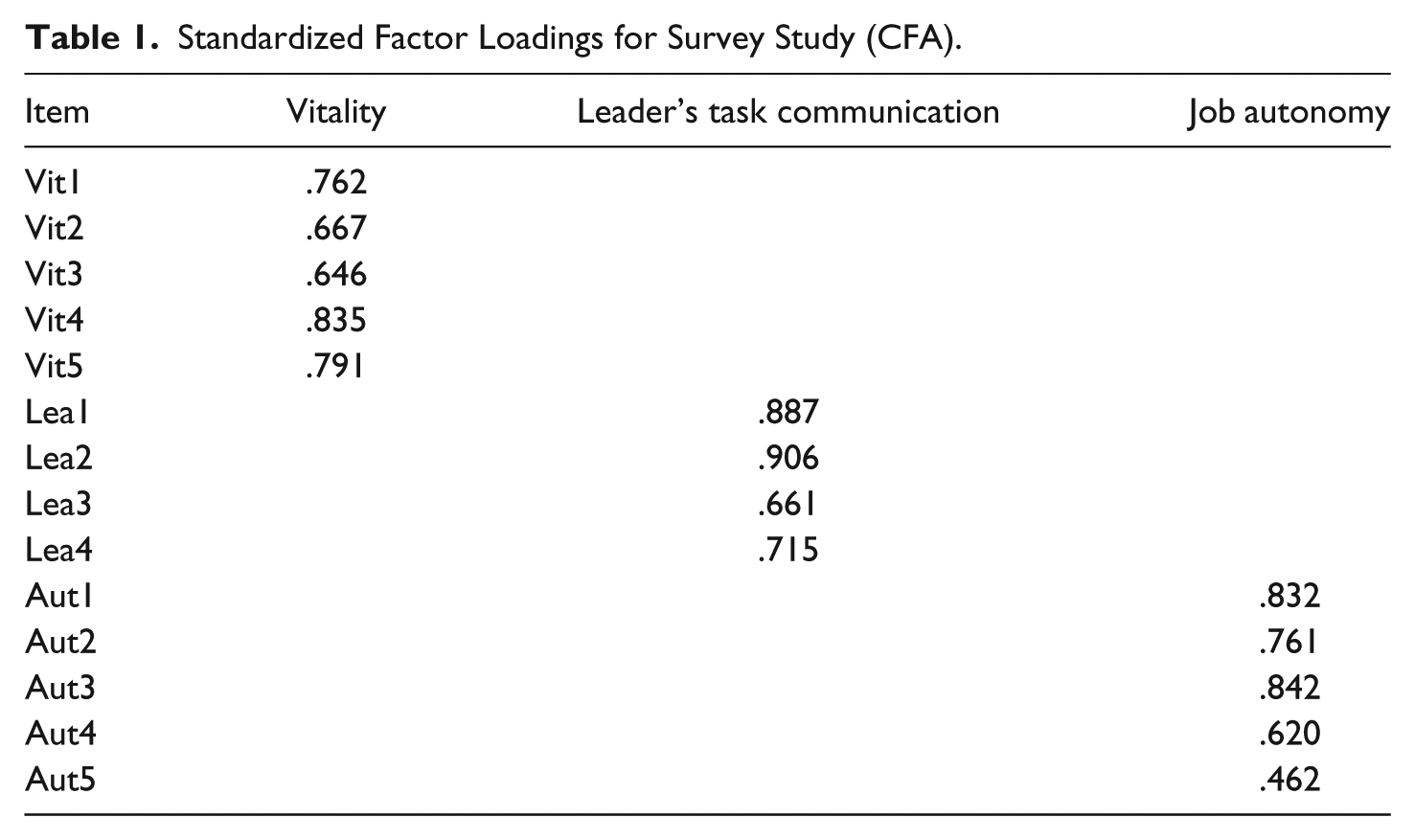
We conducted Confirmatory Factor Analyes (CFAs) in Mplus to analyze whether the factor structure for the three scales (vitality, leader’s task communication, and job autonomy) was present in the data. The CFA (using maximum likelihood with robust standard errors, MLR) model proved to be a good fit of the data: root mean square error of approximation (RMSEA) = .076 (criterion ≤ .08), comparative fit index (CFI) = .921 (criterion ≥ .90), Tucker–Lewis index (TLI) = .903 (criterion ≥ .90; criteria based on Hair, Black, Babin, Anderson, & Tatham, 1998). Correlated-error terms were not used given the recommendations of Hooper, Coughlan, and Mullen (2008). The values of the standardized factor loadings were all above .4, as shown in Table 1.
Standardized Factor Loadings for Survey Study (CFA).
Results
Descriptive statistics and correlations of the variables are presented in Table 2. As can be seen, all bivariate correlations for the variables linked through our hypotheses were statistically significant and in the anticipated direction. For example, job autonomy was positively related to vitality.
Means, Standard Deviations, and Correlations for the Variables in the Study.
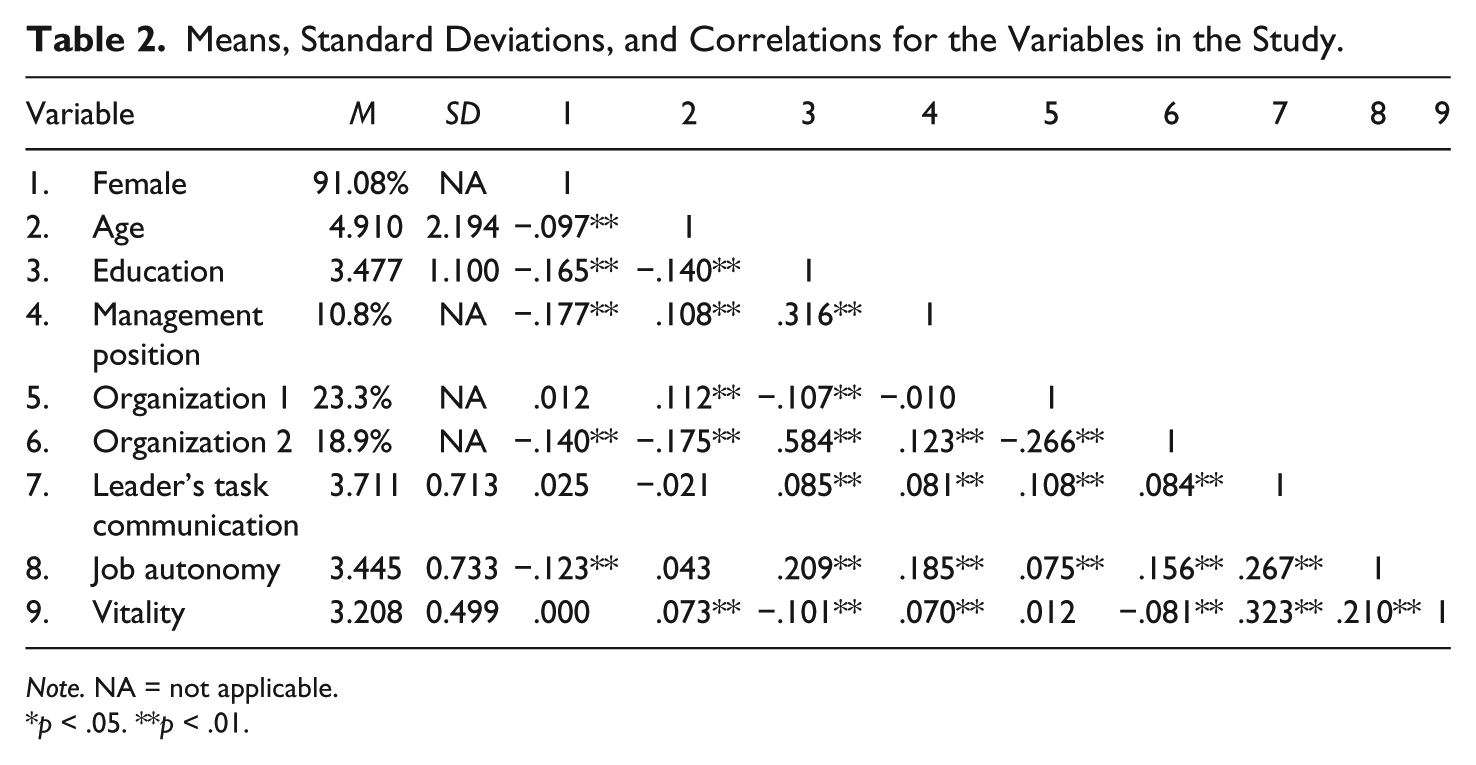
Note. NA = not applicable.
p < .05. **p < .01.
Regression Results
To test our hypotheses, we conducted ordinary least squares regression analyses. Table 3 shows the results.
The Relationships Between Leader’s Task Communication and Autonomy on Vitality.
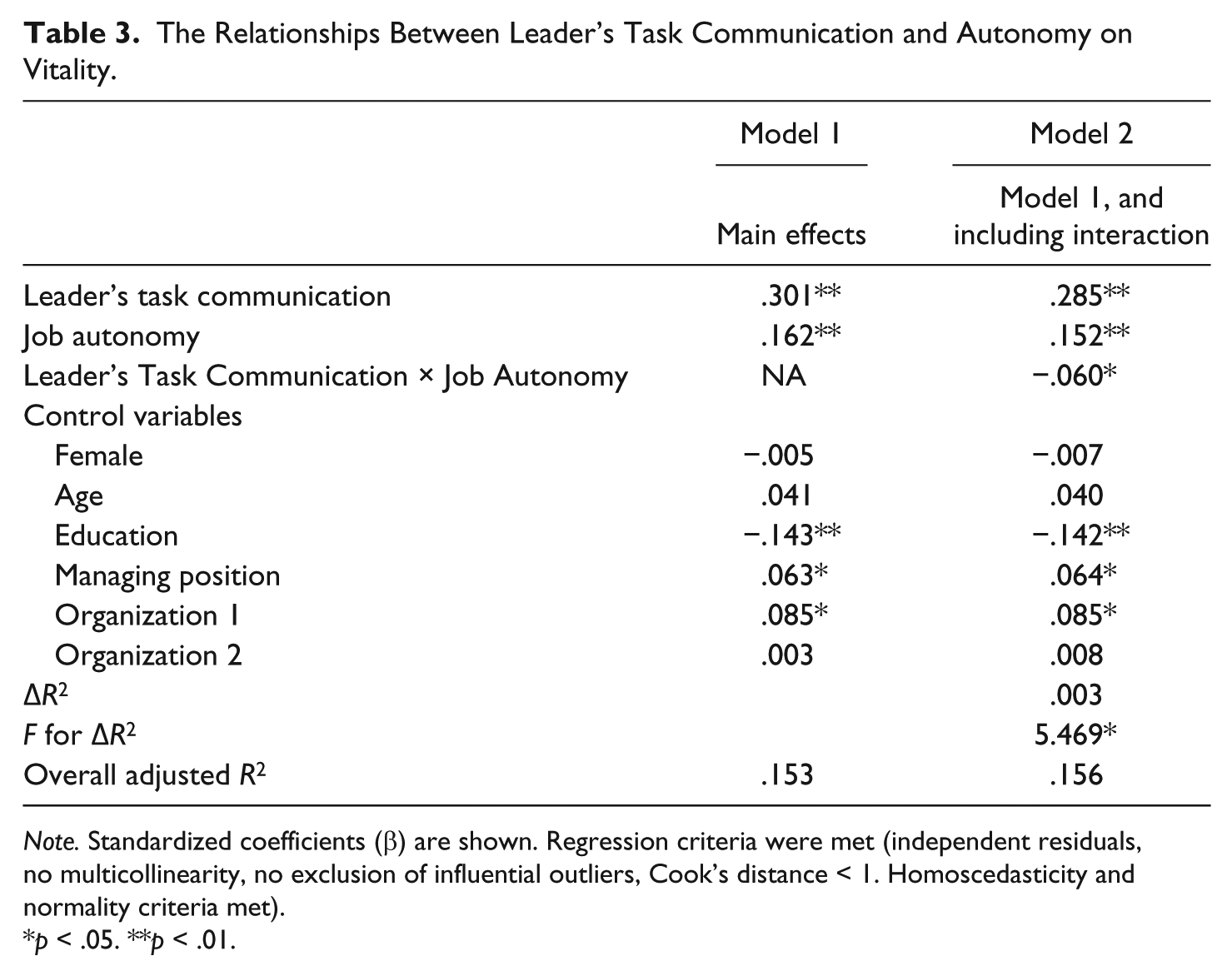
Note. Standardized coefficients (β) are shown. Regression criteria were met (independent residuals, no multicollinearity, no exclusion of influential outliers, Cook’s distance < 1. Homoscedasticity and normality criteria met).
p < .05. **p < .01.
Hypothesis 1 stated that leader’s task communication positively affects employee vitality. In the cross-sectional survey, we indeed found this relationship (final model: β = .285, p < .01). Employees who felt that their supervisors clearly explained policy changes and communicated what work needed to be done, showed higher vitality than employees who felt that their leader was not very communicative regarding tasks. Based on the survey data, we thus found support for Hypothesis 1.
Hypotheses 2 posited that job autonomy will increase employee vitality. The data from the survey are also in line with this hypothesis (final model: β = .152, p < .01). In the public organizations studied, there is a significant and positive relationship between job autonomy and employee vitality.
Hypothesis 3 expected an interaction effect: In high autonomy situations, the influence of leader task communication on vitality will be weaker. We indeed found the (expected) negative interaction between leader’s task communication and autonomy in the survey data (final model: β = −.060, p < .05). Figure 1 shows this interaction effect. As can be seen, the relationship between leader’s task communication and vitality is stronger when autonomy is high compared with when autonomy is low. Employees having low autonomy become increasingly less vital when confronted with low task communication by their leader: Their line drops quicker than for employees with high autonomy.
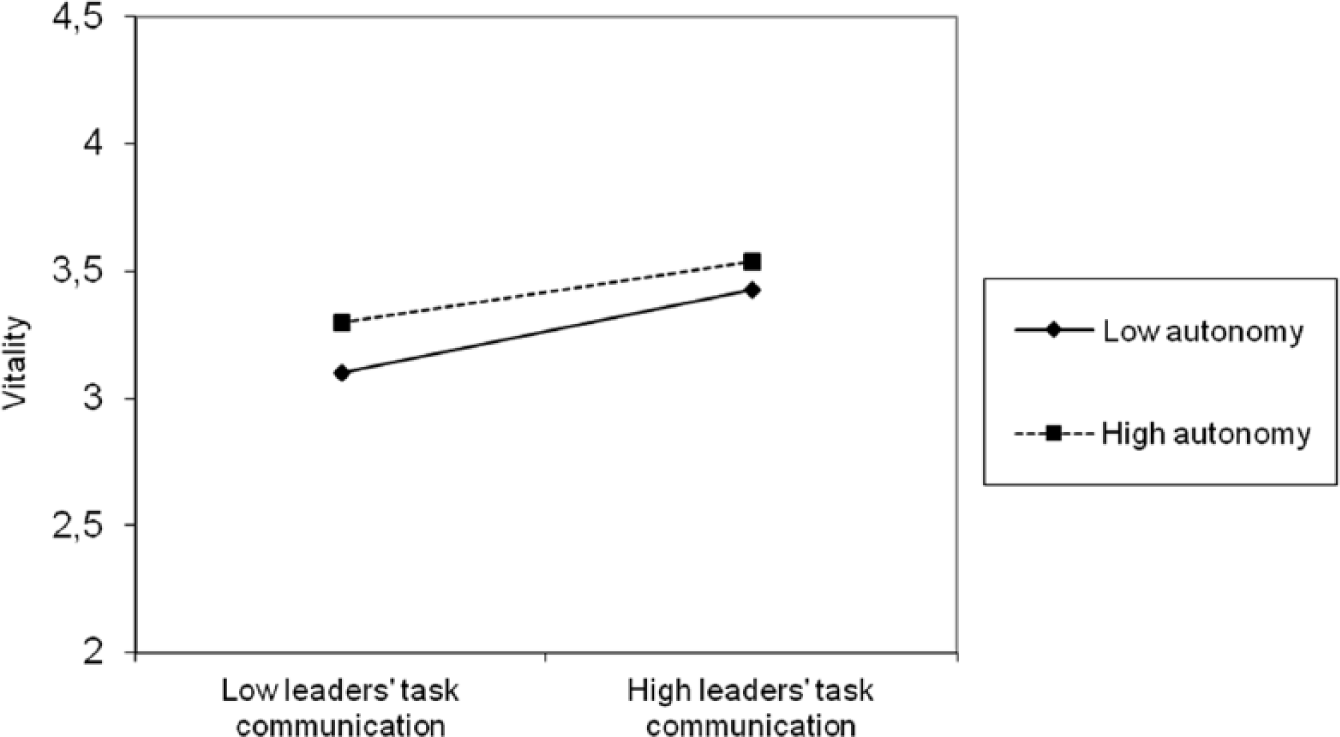
Interaction effect of leader’s task communication and autonomy on vitality in survey (very weak significant interaction).
Following the recommendations of Aiken and West (1991), we conducted simple slope analyses as a robustness check for the interaction effect. This analysis showed that when employees had low autonomy (calculated as 1 SD below the mean) the positive relationship between task communication and vitality was stronger (β = .32, p < .001, Cohen’s d = .59) than when employees had high autonomy (calculated as 1 SD above the mean; β = .24, p < .001, Cohen’s d = .36). Hence, task communication by the leader seems to be more relevant when autonomy is low. However, we must stress that—although the interaction is significant—it is a weak interaction effect. 1
The goal of the survey was to examine whether leader’s task communication and autonomy had a positive association with vitality. Multiple regression analysis supported our three hypotheses; leader’s task communication and autonomy both have a significant and strong relationship with vitality. The negative interaction effect of leader’s task communication and autonomy was not strong. As the survey was cross-sectional, it is not possible to determine the causal direction of the relationship between leader’s task communication and autonomy on vitality. It suffers from various biases, such as common-source bias, omitted variable bias, and simultaneity bias (Favero & Bullock, 2015). Therefore, our second study is a controlled experiment to (a) address the concern about causality and (b) replicate the results we found in the survey.
Study 2—Experiment
Participants and Design
To make the results accessible, we will follow the setup of M. Kim and Van Ryzin (2014) when describing the experimental procedures. The participants comprised of 102 Dutch Public Administration students of a university in the Netherlands. Two participants who did not complete the entire questionnaire were excluded from the analyses.
To test the three hypotheses, we developed a classroom experiment where participants were randomly assigned to one of four arms. The experiment took place following a regular lecture of the participants. The participants were asked to take part in a questionnaire for a graduation project. They were instructed to sit apart from each other so that they would not be able to see the different manipulations.
The experimental design is shown in Figure 2. The experiment started with a short survey asking background questions that we used to check for effective randomization: gender, age, and highest degree of education. Hereafter, the experimental section began. Participants were randomly allocated to one of four treatment arms: (a) high leader’s task communication, high autonomy; (b) high leader’s task communication, low autonomy, (c) low leader’s task communication, high autonomy; and (d) low leader’s task communication, low autonomy. See Online Appendix 2 for all the detailed instructions to the participants.
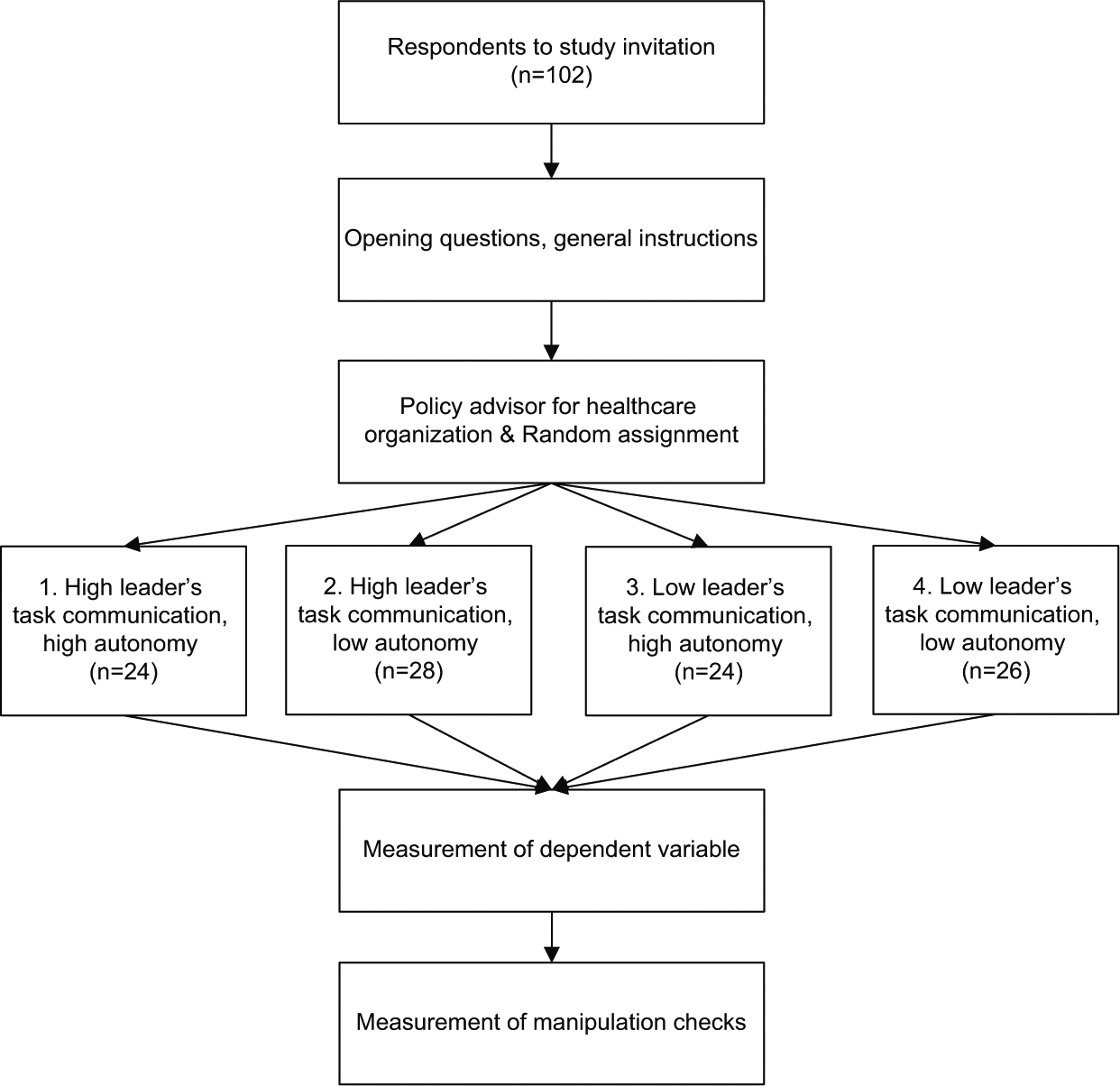
Experimental design.
Experimental Section
For the experimental section, participants were told to pretend they were policy advisors in a hypothetical public health care organization and that they functioned as policy advisors. In the written instructions, they were asked by their supervisor to write a short policy advice about aging and the related staff shortages and increased demand their organization would probably have to deal with. Participants were given 15 min to complete this task. Because they were all public administration students, the task was one they could realistically experience in their future jobs. This helped enhance the ecological validity and “mundane reality” of this task: students could easily relate to this specific task (Bozeman & Scott, 1992, p. 309).
The manipulations were developed for this study based on the conceptual definitions of task communication and job autonomy. In the high leader’s task communication condition, participants were given extra information concerning the policy changes, and this came explicitly from their supervisor. There was an extra paragraph, titled “Additional information regarding policy changes” (see Online Appendix 2). In the low communication condition, this information was not provided to the participants.
This paragraph can be linked to the definition of leader’s task communication, as provided by Penley and Hawkins (1985): “the extent to which supervisors let subordinates know what needed to be done, explained changes in the workplace, and explained policy” (p. 313). In line with the definition, the paragraph explained changes in the workplace and changes in the policy. However, it did not explicitly give information about what needed to be done exactly. This can be considered a limitation.
In the high autonomy condition, instructions of the supervisor used wording such as “I invite you to,” “you may want to do your best,” and “you can decide for yourself what you think is important for me to know.” In this condition, participants were presented with a blank page (without a text box) in which they were asked: “you can write your policy report below.” In the low autonomy condition, the instruction of the supervisor used explicit controlling words such as “you have to,” “you need to perform,” “I expect you to,” and “follow my instructions explicitly.” They were presented with a blank page with a text box in which they were told, “you have to write your policy report below.” This was intended to constrain their autonomy.
Measures
After the experimental manipulations, we measured the dependent variable (vitality) and checked whether our manipulations of leader’s task communication and autonomy worked as intended.
To be able to compare the results of the experiment with the survey, the same scales were used as in Study 1. However, we made some adjustments to the items to make them applicable to the specific task participants had to perform. For instance, we used past tense and indicated that the measures were related to the task rather than a job in general. All scales are shown in Online Appendix 1. Cronbach’s alphas were adequate (vitality, α = .88; leader’s task communication, α = .89; autonomy, α = .97). Leader’s task communication and autonomy were used as manipulation checks.
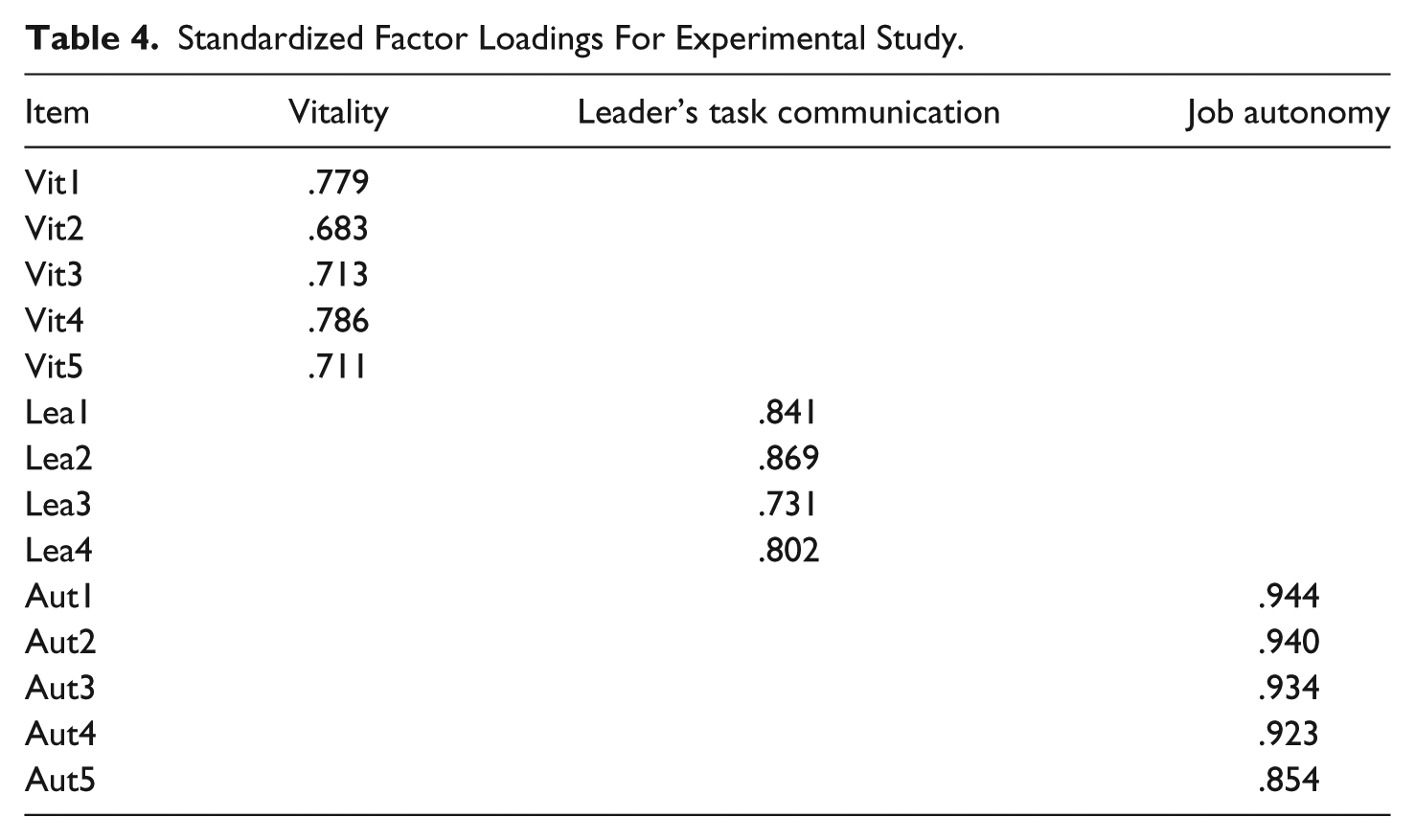
We also conducted CFAs in Mplus to analyze whether the factor structure for the three scales was present in the data. The scores for the CFA model indicated a good fit: RMSEA = .055, CFI = .976, TLI = .971. The values of the standardized factor loadings were all above .6, as shown in Table 4.
Standardized Factor Loadings For Experimental Study.
The manipulation checks showed that the manipulations indeed worked as expected. Participants who received the “low” leader’s task communication setup indeed perceived communication to be lower (M = 2.31, SD = .77) than participants in the high communication group (M = 3.77, SD = .67), F(1, 101) = 114.00, p < .01, partial η2 = .51. Also, participants in the low autonomy treatment reported lower perceived autonomy (M = 1.90, SD =.65) than participants in the high autonomy treatment (M = 4.20, SD = .54), F(1, 101) = 367.91, p < .01, partial η2 = .78.
Randomization Check
We checked the sample for homogeneity among demographic variables that could affect vitality, such as age, gender, and educational level. Table 5 shows the differences between the four conditions. The differences were all insignificant. This indicates that the groups were equivalent with regard to these variables. This cancels out potential confounding effects, making it unnecessary to include these background variables in the subsequent analyses.
Demographic Comparison Across Groups.
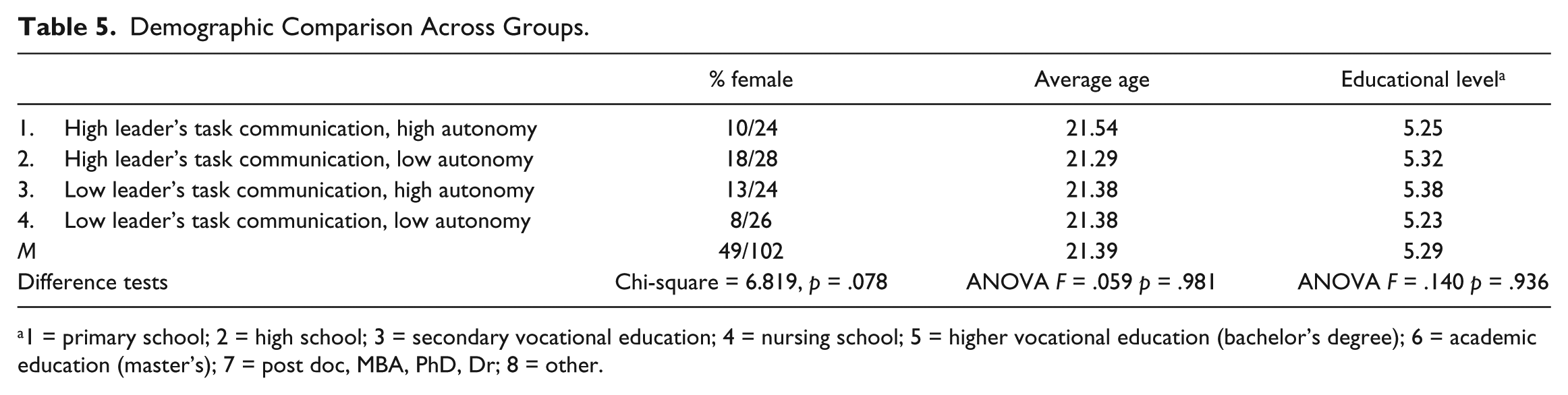
1 = primary school; 2 = high school; 3 = secondary vocational education; 4 = nursing school; 5 = higher vocational education (bachelor’s degree); 6 = academic education (master’s); 7 = post doc, MBA, PhD, Dr; 8 = other.
Results
To test our hypotheses for the experimental study, we performed ANOVAs with autonomy (high vs. low) and leader’s task communication (high vs. low) as the independent variables and also their interaction. Results of the ANOVA revealed a significant main effect of leader’s task communication on vitality, F(1, 101) = 21.86, p < .01, partial η2 = .18, with participants in the high leader task communication condition reporting greater experienced vitality (M = 3.60, SD = .79) than those in the low leader task communication condition (M = 3.04, SD = .79). This confirms Hypothesis 1.
We also found a significant main effect found for autonomy on vitality, F(1, 101) = 62.90, p < .001, partial η2 = .39, which showed that participants in the high autonomy condition indeed experienced more vitality (M = 3.84, SD = .64) than those in the low autonomy condition (M = 2.87, SD = .72). Thus, Hypothesis 2 was likewise confirmed.
The interaction effect, however, was not significant, F(1, 101) = 0.27, p = .608, thus Hypothesis 3 was not supported in the experimental study. This is also illustrated in Figure 3. It can be seen that leader’s use of high leader’s task communication was beneficial in both the low as well as the high autonomy group, and the magnitude of its effect was not significantly different between the groups.
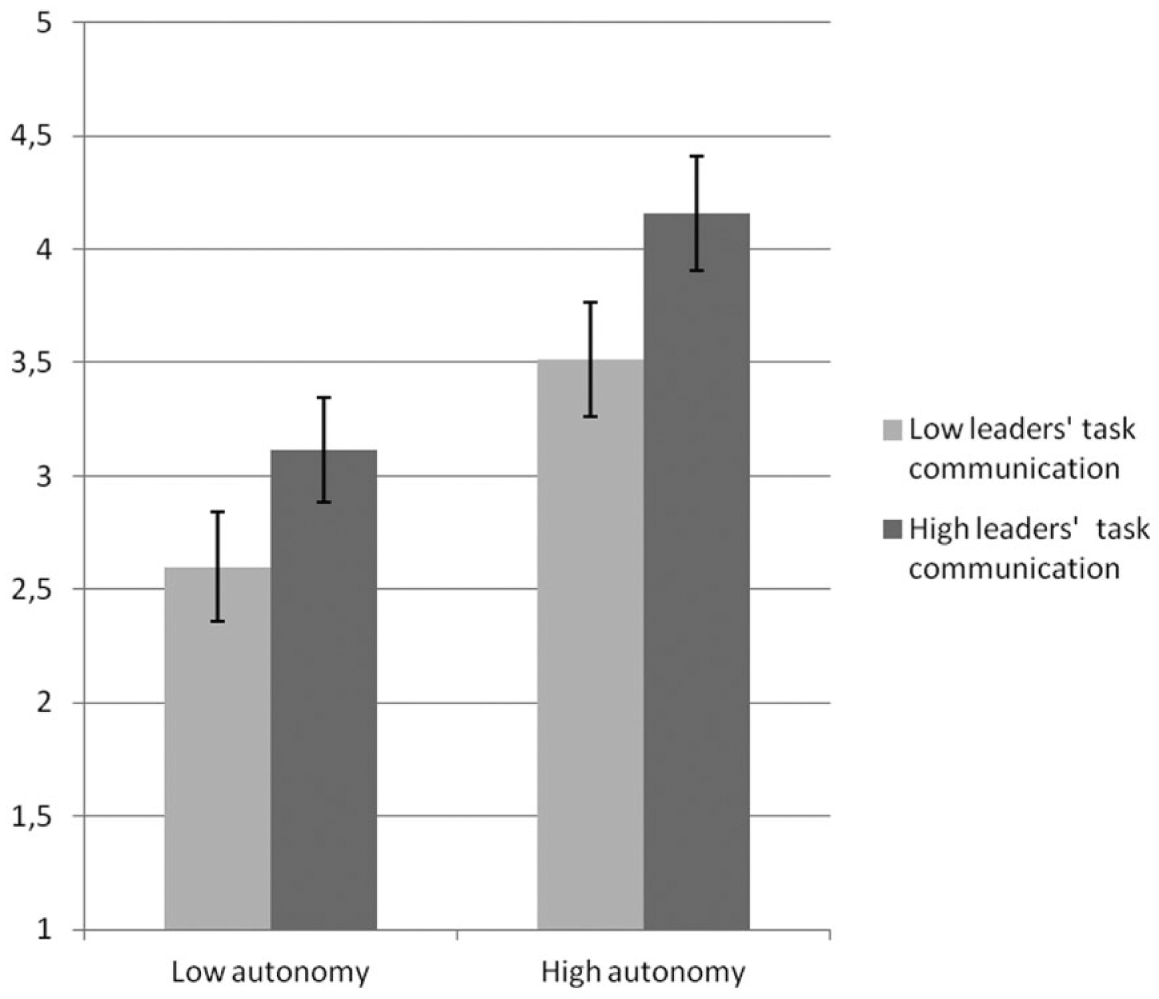
Experimental evidence that leader’s task communication and job autonomy increase vitality (95% error bars).
We can also compare the effect sizes of the survey and the experiment by conducting correlations and ordinary least squares regressions for the experimental results and compare this with the survey results.
In general, we found that the total impact of the independent variables on vitality in the survey study was smaller than in the experimental study. This can be seen by comparing the total explained variance, which is much smaller in the survey study as compared with the experimental study: adjusted R2 = 15.6% in the survey versus 41.6% in the experiment.
This was mainly due to the differential size of the effect of autonomy on vitality. The effect size of autonomy was substantially larger in the experimental study in comparison with the survey study (rsurvey = .210; rexperiment = .582). It seems that the manipulation for autonomy in the experiment had quite a large effect. The effect sizes for leader’s task communication were found to be very comparable across the two studies (rsurvey = .323; rexperiment = .324). All effects sizes for the main effects can be considered medium to large, based on Bosco, Aguinis, Singh, Field, and Pierce’s (2015) recent study in the Journal of Applied Psychology. They derived meta-analytically derived benchmarks for effect sizes: |r| ≥ .09 (small), |r| ≥ .16 (medium), and |r| ≥ .26 (large). In both the survey and the experiment, the effect size of the interaction effect was small and comparable: rsurvey = .062; rexperiment = .032.
Discussion and Conclusion
This article had two main aims. In the first place, we wanted to contribute to the public administration literature by examining an important but often neglected component of well-being, namely vitality. In the second place, we aimed to contribute methodologically, by using a multi-method design by using both a survey and an experiment.
From a theoretical perspective, studying vitality as an employee outcome variable is relevant for the public administration literature. It introduces a “positive psychology” perspective into public administration, which to date is not very widespread. Scholars tend to focus especially on “hedonic” (Ryan & Deci, 2001) indicators of well-being, such as job satisfaction and organizational commitment. Complementing this with “eudaimonic” indicators such as vitality and engagement is relevant, as these are conceptually and empirically distinct from hedonic indicators of well-being and have potentially important consequences, such as higher job performance, better adaptation to change, and better mental health (Ryan & Frederick, 1997; Van den Heuvel, Demerouti, Bakker, & Schaufeli, 2010).
Studying these in a public sector context is especially important as the positive emotions of “energized” public sector employees will also affect the feelings and emotions of clients and citizens. In a similar vein, Vigoda-Gadot et al. (2013) note that “ . . . public organizations need public servants who feel energetic and dedicated, are absorbed in their work for the public, and hence are physically and mentally engaged” (p. 529). A better understanding of the factors affecting these positive emotions of public employees (such as vitality) is, thus, important if one wants to positively influence the performance of public organizations.
Although a variety of antecedents will affect employee vitality (Shirom, 2011), we choose to focus on two which are potentially influential: leader’s task communication and job autonomy. Indeed, the results show that leader’s task communication and job autonomy both have a positive effect on vitality within the public domain. The effect sizes for the main effects are medium to high (based on Bosco et al., 2015). Greater task communication provided by the leader (i.e., clarifying tasks, informing about new policies) as well as higher job autonomy (freedom to use your own approach, having control over your work) tend to lead to higher employee vitality.
The results with respect to our third hypothesis are less clear. Based on path goal theory, we expected that leader’s communication about tasks would be less needed in a high autonomy situation as the employees would be intrinsically motivated to seek any task-relevant information for themselves. Due to the self-directed nature of the employees, we expected that the role of the leader would be less important in this situation. However, the effect was significant in the survey and not significant effect in the experiment. The magnitude of the effects was comparable: They were both small.
It could be the case that our research designs prevented us from finding a significant moderation effect. For instance, in the experiment participants completed a short task, which inherently limited their opportunities to gather additional information. Thus, even though highly autonomous employees should be less dependent on leaders to provide them with information about their tasks because they are more intrinsically motivated to gather this information themselves, there was not much leeway of doing this within the scope of the provided task. As a result, participants seem to have benefited from additional task communication by the leader equally well irrespective of whether they had low or high autonomy. In other words, the high autonomy context did not seem to lessen the importance of task communication, as we originally proposed, potentially as participants could not substitute for lack of task communication by gathering this information themselves given the experimental constraints. Future studies could further investigate this using an experimental design with a task of longer duration, for example, in the context of a longer assignment or project with varying degrees of autonomy and leadership communication. However, our study suggests that the main effects of leadership communication and job autonomy are more important predictors of employee vitality.
Overall our findings demonstrate the usefulness of a multi-method design for public administration studies. The fact that we replicated the main effects of leader’s task communication and autonomy on vitality across both the survey as well as the experimental study, with very different samples, gives strong support for the argument that these results are robust. Moreover, using these methods in combination helps to harness the strengths of each and cancel out some of their respective limitations. The survey method has the benefit of greater generalizability of the results because it uses actual employees in an organizational context. Here, the experiment is limited because it uses public administration students. A drawback of the survey is that its cross-sectional nature of the data precludes conclusions regarding causality. Here, the experimental design is beneficial. It can make a stronger causal claim because the independent variables are exogenously manipulated.
Future research could extend our research in multiple ways. Conceptually, our focus on leader’s task communication and autonomy as antecedents is clearly a limitation as other factors will also affect vitality. Leaders can potentially affect vitality via communicating a compelling vision (Jacobsen & Andersen, 2015) or by developing a good relationship with their employees (Tummers & Knies, 2013). More generally, other situational and dispositional factors can affect vitality, including personality characteristics such as self-efficacy (Bandura, 1977) and organizational characteristics such as organizational politics (Vigoda-Gadot & Beeri, 2012). Next to this, also public administration concepts can be linked to increases or decreases of employee vitality, such as red tape (Bozeman & Feeney, 2011), public service motivation (S. Kim et al., 2013) and policy alienation (Tummers, 2012). Hence, scholars can take various routes to analyze which factors influence vitality, and which factors are more influential than others.
The proposed model can also be replicated to test its generalizability and boundary conditions. This is valuable, as the results of this study, and the implications outlined, should be interpreted in light of the study’s limited context and samples. The results can be replicated using other types of public employees in a range of countries. Moreover, future studies can also utilize new methodological venues to analyze for instance the antecedents and effects of vitality of public employees, such as longitudinal studies or field experiments.
Concluding, our results emphasize the importance of leader’s task communication and job autonomy for increasing the vitality of public employees. With respect to practical implications, public managers can use these findings to help improve their employees’ vitality by providing them with greater autonomy, for example, by adapting their language. For instance, they can use expressions such as “I invite you to” and “you can” instead of “you should” and “you must.” Furthermore, they can try to provide them with more information about what is going on in the broader organization and be open to communicate about problems at work. This can result in public employees feeling more energetic, and physiologically and mentally stronger at work. This is not only beneficial for the employees themselves but also for public organizations and the people who deal with these employees such as citizens or clients as they can be positively affected by the positive emotions of the employees.
Footnotes
Acknowledgements
We would like to thank the three anonymous referees and Review of Public Personnel Administration (ROPPA) editor Prof. Paul Battaglio of the University of Texas at Dallas, who offered valuable critiques and provided us with constructive suggestions, thereby improving the article substantially.
Declaration of Conflicting Interests
The author(s) declared no potential conflicts of interest with respect to the research, authorship, and/or publication of this article
Funding
The author(s) received no financial support for the research, authorship, and/or publication of this article.
Notes
Author Biographies
References
Supplementary Material
Please find the following supplemental material available below.
For Open Access articles published under a Creative Commons License, all supplemental material carries the same license as the article it is associated with.
For non-Open Access articles published, all supplemental material carries a non-exclusive license, and permission requests for re-use of supplemental material or any part of supplemental material shall be sent directly to the copyright owner as specified in the copyright notice associated with the article.
